AB 2574: Sales and use taxes: exemption: research and development: design: digital interactive media.
- Session Year: 2017-2018
- House: Assembly
- Latest Version Date: 2018-05-16
Existing state sales and use tax laws impose a tax on retailers measured by the gross receipts from the sale of tangible personal property sold at retail in this state, or on the storage, use, or other consumption in this state of tangible personal property purchased from a retailer for storage, use, or other consumption in this state. The Sales and Use Tax Law provides various exemptions from those taxes.
This bill would exempt from those taxes, on and after January 1, 2019, before January 1, 2024, the gross receipts from the sale of, and the storage, use, or other consumption of, tangible personal property purchased for use by a qualified person primarily in the research and development and design of digital interactive media, and tangible personal property purchased for use by a qualified person primarily to maintain, repair, measure, or test that property.
The Bradley-Burns Uniform Local Sales and Use Tax Law authorizes counties and cities to impose local sales and use taxes in conformity with the Sales and Use Tax Law, and existing law authorizes districts, as specified, to impose transactions and use taxes in conformity with the Transactions and Use Tax Law, which conforms to the Sales and Use Tax Law. Exemptions from state sales and use taxes are incorporated into these laws.
This bill would specify that this exemption does not apply to local sales and use taxes and transactions and use taxes.
This bill would take effect immediately as a tax levy.This bill would take effect immediately as a tax levy, but its operative date would depend on its effective date.
Existing state sales and use tax laws impose a tax on retailers measured by the gross receipts from the sale of tangible personal property sold at retail in this state, or on the storage, use, or other consumption in this state of tangible personal property purchased from a retailer for storage, use, or other consumption in this state. The Sales and Use Tax Law provides various exemptions from those taxes.
This bill would exempt from those taxes, on and after January 1, 2019, the gross receipts from the sale of, and the storage, use, or other consumption of, tangible personal property purchased for use by a qualified person primarily in the research and development and design of digital interactive media, and tangible personal property purchased for use by a qualified person primarily to maintain, repair, measure, or test that property.
The Bradley-Burns Uniform Local Sales and Use Tax Law authorizes counties and cities to impose local sales and use taxes in conformity with the Sales and Use Tax Law, and existing law authorizes districts, as specified, to impose transactions and use taxes in conformity with the Transactions and Use Tax Law, which conforms to the Sales and Use Tax Law. Exemptions from state sales and use taxes are incorporated into these laws.
This bill would specify that this exemption does not apply to local sales and use taxes and transactions and use taxes.
This bill would take effect immediately as a tax levy.
The Corporation Tax Law allows various credits against the taxes imposed by that law, including, in modified conformity with federal law, a credit for qualified research, as provided. Existing law defines tax for these purposes as several different taxes, including the franchise tax and the corporation income tax. The Corporation Tax Law, in modified conformity with federal law, makes a corporation subject to the alternative minimum tax under specified circumstances. This bill, for each taxable year beginning on or after January 1, 2019, would include the alternative minimum tax in the definition of tax for purposes of allowing the credit for qualified research.This bill would take effect immediately as a tax levy.The Corporation Tax Law allows various credits against the taxes imposed by that law, including, in modified conformity with federal law, a credit for qualified research, as provided. Existing law defines tax for these purposes as several different taxes, including the franchise tax and the corporation income tax. The Corporation Tax Law, in modified conformity with federal law, makes a corporation subject to the alternative minimum tax under specified circumstances.
This bill, for each taxable year beginning on or after January 1, 2019, would include the alternative minimum tax in the definition of tax for purposes of allowing the credit for qualified research.
This bill would take effect immediately as a tax levy.
Existing property tax law requires every assessor to assess all property subject to general property taxation at its full value.This bill would make a nonsubstantive change to that provision.Existing property tax law requires every assessor to assess all property subject to general property taxation at its full value.
This bill would make a nonsubstantive change to that provision.
(a)On and after January 1, 2019, there There are exempted from the taxes imposed by this part the gross receipts from the sale of, and the storage, use, or other consumption in this state of, any of the following:
(1)Tangible personal property purchased for use by a qualified person to be used primarily in the research and development, development of, and design of of, digital interactive media.
(2)Tangible personal property purchased for use by a qualified person to be used primarily to maintain, repair, measure, or test any property described in paragraph (1).
(b)This exemption shall not apply to any tangible personal property that is used primarily in administration, general management, or marketing.
(c)For purposes of this section:
(1)Design means the process of designing the content and rules of digital interactive media in the preproduction stage and designing the game play environment, storytime, and characters in the production stage.
(2)(A)Digital interactive media means interactive software that meets all of the following requirements:
(i)Is produced for distribution on or accessed via electronic media, including, but not limited to, software that may be accessed via or downloaded from the Internet or mobile networks and software that is distributed on optical media or embedded in or downloadable to electronic devices, including, but not limited to, mobile phones, game systems, personal digital assistants, or other handheld electronic devices or similar technology in existence now or hereafter developed. devices.
(ii)Users may Allows users to interact with the software via an electronic device, which may include, but is not limited to, a computer, a game system, a mobile phone, a personal digital assistant, or other handheld electronic devices, in order to achieve a goal or set of goals and objectives.
(iii)Include Includes an appreciable quantity of text, sound, music, fixed images, animated images, or 3-D geometry.
(iv)Is intended primarily for entertainment purposes.
(B)Digital interactive media does not include media that contains obscene matter. For purposes of this subparagraph, obscene matter means any media that depicts sexually explicit conduct as enumerated in Section 2256 of Title 18 of the United States Code and as defined in Section 311 of the Penal Code.
(3)Primarily means tangible personal property used 50 percent or more of the time in an activity described in subdivision (a).
(4)Qualified person means any person that is primarily engaged in research and development and design of digital interactive media that are described in Codes 511210, 512191, and 54151 of the North American Industry Classification System Manual published by the United States Office of Management and Budget, 2017 edition.
(5)Research and development shall have the same meaning as basic research under Section 23609.
(6)(A)Tangible personal property includes, but is not limited to, all of the following:
(i)Machinery and equipment, including component parts.
(ii)All equipment or devices used or required to research and develop and design, operate, control, regulate, or maintain the machinery for digital interactive media, including, but not limited to, computers, data processing equipment, computer servers, workstations, server racks, hard drives, optical drives, monitors, keyboards, integrated video and audio equipment, networking routers, switches, network cabling, and computer software, and other similar technology now or hereafter developed, together with all repair and replacement parts with a useful life of one or more years, whether purchased separately or in conjunction with a complete machine and regardless of whether the machine or component parts are assembled by the taxpayers qualified person or another party.
(B)Tangible personal property does not include furniture, inventory, or equipment used to store products.
(d)No exemption shall be allowed under this section unless the purchaser furnishes the retailer with an exemption certificate, completed in accordance with any instructions or regulations as the board department may prescribe, and the retailer subsequently furnishes the board department with a copy of the exemption certificate. The exemption certificate shall contain the sales price of the machinery and equipment that is exempt pursuant to subdivision (a).
(e)(1)Notwithstanding any provision of the Bradley-Burns Uniform Local Sales and Use Tax Law (Part 1.5 (commencing with Section 7200)) or the Transactions and Use Tax Law (Part 1.6 (commencing with Section 7251)), the exemption established by this section shall not apply with respect to any tax levied by a county, city, or district pursuant to, or in accordance with, either of these laws.
(2)The exemption established by this section shall not apply to any sale or use of property that, within one year from the date of purchase, is either removed from California or converted from an exempt use under subdivision (a) to some other use not qualifying for the exemption.
(f)If a purchaser certifies in writing to the seller that the property purchased without payment of the tax will be used in a manner entitling the seller to regard the gross receipts from the sale as exempt from the sales tax, and within one year from the date of purchase, the purchaser (1) removes that property outside California, (2) converts that property for use in a manner not qualifying for the exemption, or (3) uses that property in a manner not qualifying for the exemption, the purchaser shall be liable for payment of sales tax, with applicable interest, as if the purchaser were a retailer making a retail sale of the property at the time the property is so removed, converted, or used, and the sales price of the property to the purchaser shall be deemed the gross receipts from that retail sale.
(g)This section shall remain in effect only until January 1, 2024, and as of that date is repealed.
SEC. 2. This act provides for a tax levy within the meaning of Article IV of the California Constitution and shall go into immediate effect.SEC. 2.This act provides for a tax levy within the meaning of Article IV of the California Constitution and shall go into immediate effect. However, the provisions of this act shall become operative on the first day of the first calendar quarter commencing more than 90 days after the effective date of this act.
(a)On and after January 1, 2019, there are exempted from the taxes imposed by this part the gross receipts from the sale of, and the storage, use, or other consumption in this state of, any of the following:
(1)Tangible personal property purchased for use by a qualified person to be used primarily in the research and development, and design of digital interactive media.
(2)Tangible personal property purchased for use by a qualified person to be used primarily to maintain, repair, measure, or test any property described in paragraph (1).
(b)This exemption shall not apply to any tangible personal property that is used primarily in administration, general management, or marketing.
(c)For purposes of this section:
(1)Design means the process of designing the content and rules of digital interactive media in the preproduction stage and designing the game play environment, storytime, and characters in the production stage.
(2)(A)Digital interactive media means interactive software that meets all of the following requirements:
(i)Is produced for distribution on or accessed via electronic media, including, but not limited to, software that may be accessed via or downloaded from the Internet or mobile networks and software that is distributed on optical media or embedded in or downloadable to electronic devices, including, but not limited to, mobile phones, game systems, personal digital assistants, or other handheld electronic devices or similar technology in existence now or hereafter developed.
(ii)Users may interact with the software via an electronic device, which may include, but is not limited to, a computer, a game system, a mobile phone, a personal digital assistant, or other handheld electronic devices, in order to achieve a goal or set of goals and objectives.
(iii)Include an appreciable quantity of text, sound, music, fixed images, animated images, or 3-D geometry.
(B)Digital interactive media does not include media that contains obscene matter. For purposes of this subparagraph, obscene matter means any media that depicts sexually explicit conduct as enumerated in Section 2256 of Title 18 of the United States Code and as defined in Section 311 of the Penal Code.
(3)Primarily means tangible personal property used 50 percent or more of the time in an activity described in subdivision (a).
(4)Qualified person means any person that is primarily engaged in research and development and design of digital interactive media that are described in Codes 511210, 512191, and 54151 of the North American Industry Classification System Manual published by the United States Office of Management and Budget, 2017 edition.
(5)Research and development shall have the same meaning as basic research under Section 23609.
(6)(A)Tangible personal property includes, but is not limited to, all of the following:
(i)Machinery and equipment, including component parts.
(ii)All equipment or devices used or required to research and develop and design, operate, control, regulate, or maintain the machinery for digital interactive media, including, but not limited to, computers, data processing equipment, computer servers, workstations, server racks, hard drives, optical drives, monitors, keyboards, integrated video and audio equipment, networking routers, switches, network cabling, and computer software, and other similar technology now or hereafter developed, together with all repair and replacement parts with a useful life of one or more years, whether purchased separately or in conjunction with a complete machine and regardless of whether the machine or component parts are assembled by the taxpayers or another party.
(B)Tangible personal property does not include furniture, inventory, or equipment used to store products.
(d)No exemption shall be allowed under this section unless the purchaser furnishes the retailer with an exemption certificate, completed in accordance with any instructions or regulations as the board may prescribe, and the retailer subsequently furnishes the board with a copy of the exemption certificate. The exemption certificate shall contain the sales price of the machinery and equipment that is exempt pursuant to subdivision (a).
(e)(1)Notwithstanding any provision of the Bradley-Burns Uniform Local Sales and Use Tax Law (Part 1.5 (commencing with Section 7200)) or the Transactions and Use Tax Law (Part 1.6 (commencing with Section 7251)), the exemption established by this section shall not apply with respect to any tax levied by a county, city, or district pursuant to, or in accordance with, either of these laws.
(2)The exemption established by this section shall not apply to any sale or use of property that, within one year from the date of purchase, is either removed from California or converted from an exempt use under subdivision (a) to some other use not qualifying for the exemption.
(f)If a purchaser certifies in writing to the seller that the property purchased without payment of the tax will be used in a manner entitling the seller to regard the gross receipts from the sale as exempt from the sales tax, and within one year from the date of purchase, the purchaser (1) removes that property outside California, (2) converts that property for use in a manner not qualifying for the exemption, or (3) uses that property in a manner not qualifying for the exemption, the purchaser shall be liable for payment of sales tax, with applicable interest, as if the purchaser were a retailer making a retail sale of the property at the time the property is so removed, converted, or used, and the sales price of the property to the purchaser shall be deemed the gross receipts from that retail sale.
SEC. 2.This act provides for a tax levy within the meaning of Article IV of the California Constitution and shall go into immediate effect.
SECTION 1.Section 23036 of the Revenue and Taxation Code is amended to read:23036.(a)(1)The term tax includes any of the following:(A)The tax imposed under Chapter 2 (commencing with Section 23101).(B)The tax imposed under Chapter 3 (commencing with Section 23501).(C)The tax on unrelated business taxable income, imposed under Section 23731.(D)The tax on S corporations imposed under Section 23802.(2)The term tax does not include any amount imposed under paragraph (1) of subdivision (e) of Section 24667 or paragraph (2) of subdivision (f) of Section 24667.(b)For purposes of Article 5 (commencing with Section 18661) of Chapter 2, Article 3 (commencing with Section 19031) of Chapter 4, Article 6 (commencing with Section 19101) of Chapter 4, and Chapter 7 (commencing with Section 19501) of Part 10.2, and for purposes of Sections 18601, 19001, and 19005, the term tax also includes all of the following:(1)The tax on limited partnerships, imposed under Section 17935, the tax on limited liability companies, imposed under Section 17941, and the tax on registered limited liability partnerships and foreign limited liability partnerships imposed under Section 17948.(2)The alternative minimum tax imposed under Chapter 2.5 (commencing with Section 23400).(3)The tax on built-in gains of S corporations, imposed under Section 23809.(4)The tax on excess passive investment income of S corporations, imposed under Section 23811.(c)For each taxable year beginning on or after January 1, 2019, for purposes of Section 23609, the term tax shall also include the alternative minimum tax imposed under Chapter 2.5 (commencing with Section 23400). (d)Notwithstanding any other provision of this part, credits are allowed against the tax in the following order:(1)Credits that do not contain carryover provisions.(2)Credits that, when the credit exceeds the tax, allow the excess to be carried over to offset the tax in succeeding taxable years, except for those credits that are allowed to reduce the tax below the tentative minimum tax, as defined by Section 23455. The order of credits within this paragraph shall be determined by the Franchise Tax Board.(3)The minimum tax credit allowed by Section 23453.(4)Credits that are allowed to reduce the tax below the tentative minimum tax, as defined by Section 23455.(5)Credits for taxes withheld under Section 18662.(e)Notwithstanding any other provision of this part, each of the following applies:(1)A credit may not reduce the tax below the tentative minimum tax (as defined by paragraph (1) of subdivision (a) of Section 23455), except the following credits:(A)The credit allowed by former Section 23601 (relating to solar energy).(B)The credit allowed by former Section 23601.4 (relating to solar energy).(C)The credit allowed by former Section 23601.5 (relating to solar energy).(D)The credit allowed by Section 23609 (relating to research expenditures).(E)The credit allowed by former Section 23609.5 (relating to clinical testing expenses).(F)The credit allowed by Section 23610.5 (relating to low-income housing).(G)The credit allowed by former Section 23612 (relating to sales and use tax credit).(H)The credit allowed by Section 23612.2 (relating to enterprise zone sales or use tax credit).(I)The credit allowed by former Section 23612.6 (relating to Los Angeles Revitalization Zone sales tax credit).(J)The credit allowed by former Section 23622 (relating to enterprise zone hiring credit).(K)The credit allowed by Section 23622.7 (relating to enterprise zone hiring credit).(L)The credit allowed by former Section 23623 (relating to program area hiring credit).(M)The credit allowed by former Section 23623.5 (relating to Los Angeles Revitalization Zone hiring credit).(N)The credit allowed by former Section 23625 (relating to Los Angeles Revitalization Zone hiring credit).(O)The credit allowed by Section 23633 (relating to targeted tax area sales or use tax credit).(P)The credit allowed by Section 23634 (relating to targeted tax area hiring credit).(Q)The credit allowed by former Section 23649 (relating to qualified property).(R)For taxable years beginning on or after January 1, 2011, the credit allowed by Section 23685 (relating to qualified motion pictures).(S)For taxable years beginning on or after January 1, 2014, the credit allowed by Section 23689 (relating to GO-Biz California Competes Credit).(T)For taxable years beginning on or after January 1, 2016, the credit allowed by Section 23695 (relating to qualified motion pictures).(U)For taxable years beginning on or after January 1, 2014, the credit allowed by Section 23686 (relating to the College Access Tax Credit Fund).(V)For taxable years beginning on or after January 1, 2017, the credit allowed by Section 23687 (relating to the College Access Tax Credit Fund).(2)A credit against the tax may not reduce the minimum franchise tax imposed under Chapter 2 (commencing with Section 23101).(f)Any credit which is partially or totally denied under subdivision (e) is allowed to be carried over to reduce the tax in the following year, and succeeding years if necessary, if the provisions relating to that credit include a provision to allow a carryover of the unused portion of that credit.(g)Unless otherwise provided, any remaining carryover from a credit that has been repealed or made inoperative is allowed to be carried over under the provisions of that section as it read immediately prior to being repealed or becoming inoperative.(h)Unless otherwise provided, if two or more taxpayers share in costs that would be eligible for a tax credit allowed under this part, each taxpayer is eligible to receive the tax credit in proportion to his or her respective share of the costs paid or incurred.(i)Unless otherwise provided, in the case of an S corporation, any credit allowed by this part is computed at the S corporation level, and any limitation on the expenses qualifying for the credit or limitation upon the amount of the credit applies to the S corporation and to each shareholder.(j)(1)With respect to any taxpayer that directly or indirectly owns an interest in a business entity that is disregarded for tax purposes pursuant to Section 23038 and any regulations thereunder, the amount of any credit or credit carryforward allowable for any taxable year attributable to the disregarded business entity is limited in accordance with paragraphs (2) and (3).(2)The amount of any credit otherwise allowed under this part, including any credit carryover from prior years, that may be applied to reduce the taxpayers tax, as defined in subdivision (a), for the taxable year is limited to an amount equal to the excess of the taxpayers regular tax, as defined in Section 23455, determined by including income attributable to the disregarded business entity that generated the credit or credit carryover, over the taxpayers regular tax, as defined in Section 23455, determined by excluding the income attributable to that disregarded business entity. A credit is not allowed if the taxpayers regular tax, as defined in Section 23455, determined by including the income attributable to the disregarded business entity is less than the taxpayers regular tax, as defined in Section 23455, determined by excluding the income attributable to the disregarded business entity.(3)If the amount of a credit allowed pursuant to the section establishing the credit exceeds the amount allowable under this subdivision in any taxable year, the excess amount may be carried over to subsequent taxable years pursuant to subdivisions (e), (f), and (g).(k)(1)Unless otherwise specifically provided, in the case of a taxpayer that is a partner or shareholder of an eligible passthrough entity described in paragraph (2), any credit passed through to the taxpayer in the taxpayers first taxable year beginning on or after the date the credit is no longer operative may be claimed by the taxpayer in that taxable year, notwithstanding the repeal of the statute authorizing the credit prior to the close of that taxable year.(2)For purposes of this subdivision, eligible passthrough entity means any partnership or S corporation that files its return on a fiscal year basis pursuant to Section 18566, and that is entitled to a credit pursuant to this part for the taxable year that begins during the last year a credit is operative.(3)This subdivision applies to credits that become inoperative on or after the operative date of Chapter 920 of the Statutes of 2001.SEC. 2.This act provides for a tax levy within the meaning of Article IV of the California Constitution and shall go into immediate effect.(a)(1)The term tax includes any of the following:
(A)The tax imposed under Chapter 2 (commencing with Section 23101).
(B)The tax imposed under Chapter 3 (commencing with Section 23501).
(C)The tax on unrelated business taxable income, imposed under Section 23731.
(D)The tax on S corporations imposed under Section 23802.
(2)The term tax does not include any amount imposed under paragraph (1) of subdivision (e) of Section 24667 or paragraph (2) of subdivision (f) of Section 24667.
(b)For purposes of Article 5 (commencing with Section 18661) of Chapter 2, Article 3 (commencing with Section 19031) of Chapter 4, Article 6 (commencing with Section 19101) of Chapter 4, and Chapter 7 (commencing with Section 19501) of Part 10.2, and for purposes of Sections 18601, 19001, and 19005, the term tax also includes all of the following:
(1)The tax on limited partnerships, imposed under Section 17935, the tax on limited liability companies, imposed under Section 17941, and the tax on registered limited liability partnerships and foreign limited liability partnerships imposed under Section 17948.
(2)The alternative minimum tax imposed under Chapter 2.5 (commencing with Section 23400).
(3)The tax on built-in gains of S corporations, imposed under Section 23809.
(4)The tax on excess passive investment income of S corporations, imposed under Section 23811.
(c)For each taxable year beginning on or after January 1, 2019, for purposes of Section 23609, the term tax shall also include the alternative minimum tax imposed under Chapter 2.5 (commencing with Section 23400).
(c)(d)Notwithstanding any other provision of this part, credits are allowed against the tax in the following order:
(1)Credits that do not contain carryover provisions.
(2)Credits that, when the credit exceeds the tax, allow the excess to be carried over to offset the tax in succeeding taxable years, except for those credits that are allowed to reduce the tax below the tentative minimum tax, as defined by Section 23455. The order of credits within this paragraph shall be determined by the Franchise Tax Board.
(3)The minimum tax credit allowed by Section 23453.
(4)Credits that are allowed to reduce the tax below the tentative minimum tax, as defined by Section 23455.
(5)Credits for taxes withheld under Section 18662.
(d)(e)Notwithstanding any other provision of this part, each of the following applies:
(1)A credit may not reduce the tax below the tentative minimum tax (as defined by paragraph (1) of subdivision (a) of Section 23455), except the following credits:
(A)The credit allowed by former Section 23601 (relating to solar energy).
(B)The credit allowed by former Section 23601.4 (relating to solar energy).
(C)The credit allowed by former Section 23601.5 (relating to solar energy).
(D)The credit allowed by Section 23609 (relating to research expenditures).
(E)The credit allowed by former Section 23609.5 (relating to clinical testing expenses).
(F)The credit allowed by Section 23610.5 (relating to low-income housing).
(G)The credit allowed by former Section 23612 (relating to sales and use tax credit).
(H)The credit allowed by Section 23612.2 (relating to enterprise zone sales or use tax credit).
(I)The credit allowed by former Section 23612.6 (relating to Los Angeles Revitalization Zone sales tax credit).
(J)The credit allowed by former Section 23622 (relating to enterprise zone hiring credit).
(K)The credit allowed by Section 23622.7 (relating to enterprise zone hiring credit).
(L)The credit allowed by former Section 23623 (relating to program area hiring credit).
(M)The credit allowed by former Section 23623.5 (relating to Los Angeles Revitalization Zone hiring credit).
(N)The credit allowed by former Section 23625 (relating to Los Angeles Revitalization Zone hiring credit).
(O)The credit allowed by Section 23633 (relating to targeted tax area sales or use tax credit).
(P)The credit allowed by Section 23634 (relating to targeted tax area hiring credit).
(Q)The credit allowed by former Section 23649 (relating to qualified property).
(R)For taxable years beginning on or after January 1, 2011, the credit allowed by Section 23685 (relating to qualified motion pictures).
(S)For taxable years beginning on or after January 1, 2014, the credit allowed by Section 23689 (relating to GO-Biz California Competes Credit).
(T)For taxable years beginning on or after January 1, 2016, the credit allowed by Section 23695 (relating to qualified motion pictures).
(U)For taxable years beginning on or after January 1, 2014, the credit allowed by Section 23686 (relating to the College Access Tax Credit Fund).
(V)For taxable years beginning on or after January 1, 2017, the credit allowed by Section 23687 (relating to the College Access Tax Credit Fund).
(2)A credit against the tax may not reduce the minimum franchise tax imposed under Chapter 2 (commencing with Section 23101).
(e)(f)Any credit which is partially or totally denied under subdivision (d) (e) is allowed to be carried over to reduce the tax in the following year, and succeeding years if necessary, if the provisions relating to that credit include a provision to allow a carryover of the unused portion of that credit.
(f)(g)Unless otherwise provided, any remaining carryover from a credit that has been repealed or made inoperative is allowed to be carried over under the provisions of that section as it read immediately prior to being repealed or becoming inoperative.
(g)(h)Unless otherwise provided, if two or more taxpayers share in costs that would be eligible for a tax credit allowed under this part, each taxpayer is eligible to receive the tax credit in proportion to his or her respective share of the costs paid or incurred.
(h)(i)Unless otherwise provided, in the case of an S corporation, any credit allowed by this part is computed at the S corporation level, and any limitation on the expenses qualifying for the credit or limitation upon the amount of the credit applies to the S corporation and to each shareholder.
(i)(j)(1)With respect to any taxpayer that directly or indirectly owns an interest in a business entity that is disregarded for tax purposes pursuant to Section 23038 and any regulations thereunder, the amount of any credit or credit carryforward allowable for any taxable year attributable to the disregarded business entity is limited in accordance with paragraphs (2) and (3).
(2)The amount of any credit otherwise allowed under this part, including any credit carryover from prior years, that may be applied to reduce the taxpayers tax, as defined in subdivision (a), for the taxable year is limited to an amount equal to the excess of the taxpayers regular tax (as tax, as defined in Section 23455), 23455, determined by including income attributable to the disregarded business entity that generated the credit or credit carryover, over the taxpayers regular tax (as tax, as defined in Section 23455), 23455, determined by excluding the income attributable to that disregarded business entity. A credit is not allowed if the taxpayers regular tax (as tax, as defined in Section 23455), 23455, determined by including the income attributable to the disregarded business entity is less than the taxpayers regular tax (as tax, as defined in Section 23455), 23455, determined by excluding the income attributable to the disregarded business entity.
(3)If the amount of a credit allowed pursuant to the section establishing the credit exceeds the amount allowable under this subdivision in any taxable year, the excess amount may be carried over to subsequent taxable years pursuant to subdivisions (d), (e), and (f). (e), (f), and (g).
(j)(k)(1)Unless otherwise specifically provided, in the case of a taxpayer that is a partner or shareholder of an eligible pass-thru passthrough entity described in paragraph (2), any credit passed through to the taxpayer in the taxpayers first taxable year beginning on or after the date the credit is no longer operative may be claimed by the taxpayer in that taxable year, notwithstanding the repeal of the statute authorizing the credit prior to the close of that taxable year.
(2)For purposes of this subdivision, eligible pass-thru passthrough entity means any partnership or S corporation that files its return on a fiscal year basis pursuant to Section 18566, and that is entitled to a credit pursuant to this part for the taxable year that begins during the last year a credit is operative.
(3)This subdivision applies to credits that become inoperative on or after the operative date of the act adding this subdivision. Chapter 920 of the Statutes of 2001.
SEC. 2.This act provides for a tax levy within the meaning of Article IV of the California Constitution and shall go into immediate effect.
SECTION 1.Section 401 of the Revenue and Taxation Code is amended to read:401.The assessor shall assess all property subject to general property taxation at its full value.Every The assessor shall assess all property subject to general property taxation at its full value.
|
Date
|
Status
|
|---|---|
| May 25, 2018 | In committee: Held under submission. |
| May 25, 2018 | Joint Rule 62(a), file notice suspended. |
| May 23, 2018 | In committee: Set, first hearing. Referred to APPR. suspense file. |
| May 17, 2018 | Re-referred to Com. on APPR. |
| May 16, 2018 | Read second time and amended. |
| May 15, 2018 | From committee: Amend, and do pass as amended and re-refer to Com. on APPR. (Ayes 8. Noes 1.) (May 14). |
| May 7, 2018 | In committee: Set, first hearing. Hearing canceled at the request of author. |
| May 1, 2018 | Re-referred to Com. on REV. & TAX. |
| Apr 30, 2018 | From committee chair, with author's amendments: Amend, and re-refer to Com. on REV. & TAX. Read second time and amended. |
| Apr 2, 2018 | Re-referred to Com. on REV. & TAX. |
| Mar 22, 2018 | Referred to Com. on REV. & TAX. |
| Feb 16, 2018 | From printer. May be heard in committee March 18. |
| Feb 15, 2018 | Read first time. To print. |
|
Date
|
Description
|
Location
|
Votes
|
|
|---|---|---|---|---|
| May 14, 2018 | Do pass as amended and be re-referred to the Committee on [Appropriations] | Assembly Standing Committee on Revenue and Taxation |
Passed |
This list shows positions taken on this bill by organizations on the date displayed, which is linked to the original source.
Positions by individuals are not included.
|
Organization
|
Position
|
Date
|
|---|---|---|
| Entertainment Software Association | ** Support | May 11, 2018 |
Date of Hearing: May 23, 2018
ASSEMBLY COMMITTEE ON APPROPRIATIONS
Lorena Gonzalez Fletcher, Chair
ABPCA Bill Id:AB 2574
Author:(Bloom) – As Amended Ver:May 16, 2018
Policy Committee: | Revenue and Taxation | Vote: | 8 - 1 |
|
| ||
|
|
Urgency: No State Mandated Local Program: No Reimbursable: No
SUMMARY:
This bill establishes, until January 1, 2024, a partial sales-and-use tax (SUT) exemption for tangible personal property purchased for the development and design of digital interactive media property.
FISCAL EFFECT:
Annual General Fund revenue loss of $2.5 million in 2018-19 and $5.2 million in 2019-20.
COMMENTS:
- Purpose. The video game industry is bigger in California than it is any other state. The author points to data showing that while California is home to more than 900 video game companies, California’s share of the industry is also shrinking. According to the author, competition from abroad and from other states offering tax incentives means that California will need to explore policies. AB 2574 will create a new tax expenditure program for purchases of goods used for the development and design of digital interactive media.
- Digital interactive media. AB 2574 defines “digital interactive media” as interactive software that is produced for distribution on or accessed via electronic media, includes an appreciable quantify to text, sound, music, fixed images, animated images, or 3-D geometry, and with which users interact through an electronic device.
- Affected industries. AB 2547 provides a SUT exemption for qualified purchases by a person in any of specified sectors within the software industry. These sectors include establishments primarily engaged in: a) computer software publishing or publishing and reproduction; b) providing specialized motion picture or video postproduction services, such as editing, film/tape transfers, subtitling, credits, closed captioning, and animation and special effects; and, c) providing expertise in the field of information technologies through specified activities.
Analysis Prepared by: Luke Reidenbach / APPR. / (916) 319-2081
Date of Hearing: May 14, 2018
ASSEMBLY COMMITTEE ON REVENUE AND TAXATION
Autumn R. Burke, Chairwoman
ABPCA Bill Id:AB 2574 (
Author:Bloom) – As Amended Ver:April 30, 2018
vote. Tax levy. Fiscal committee.
SUBJECT: Sales and use taxes: exemption: research and development: design: digital interactive media
SUMMARY: Establishes a partial sales and use tax (SUT) exemption for specified "digital interactive media" property. Specifically, this bill:
- Provides, on and after January 1, 2019, a SUT exemption for any of the following:
- "Tangible personal property" (TPP) purchased for use by a "qualified person" to be used "primarily" in the "research and development", and "design" of "digital interactive media"; or,
- "TPP" purchased for use by a "qualified person" to be used "primarily" to maintain, repair, measure, or test any property described above.
- Provides that this exemption shall not apply to any "TPP" that is used "primarily" in administration, general management, or marketing.
- Defines "digital interactive media" as interactive software that meets all of the following requirements:
- Is produced for distribution on or accessed via electronic media, including, but not limited to, software that may be accessed via or downloaded from the Internet or mobile networks and software that is distributed on optical media or embedded in or downloadable to electronic devices, including, but not limited to, mobile phones, game systems, personal digital assistants, or other handheld electronic devices or similar technology in existence now or hereafter developed;
- Users may interact with the software via an electronic device, which may include, but is not limited to, a computer, a game system, a mobile phone, a personal digital assistant, or other handheld electronic devices, in order to achieve a goal or set of goals and objectives; and,
- Include an appreciable quantity of text, sound, music, fixed images, animated images, or 3-D geometry.
- Provides that "digital interactive media" does not include media that contains obscene matter. For purposes of this bill, "obscene matter" means any media that depicts sexually explicit conduct as enumerated in Section 2256 of Title 18 of the United States Code and as defined in Penal Code Section 311.
- Provides that "TPP" includes, but is not limited to, all of the following:
- Machinery and equipment, including component parts; and,
- All equipment or devices used or required to research and develop and design, operate, control, regulate, or maintain the machinery for digital interactive media, including, but not limited to, computers, data processing equipment, computer servers, workstations, server racks, hard drives, optical drives, monitors, keyboards, integrated video and audio equipment, networking routers, switches, network cabling, and computer software, and other similar technology now or hereafter developed, together with all repair and replacement parts with a useful life of one or more years, whether purchased separately or in conjunction with a complete machine and regardless of whether the machine or component parts are assembled by the taxpayers or another party.
- Provides that "TPP" does not include furniture, inventory, or equipment used to store products.
- Defines a "qualified person" as any person that is "primarily" engaged in "research and development" and "design" of digital interactive media that are described in Codes 511210, 512191, and 54151 of the North American Industry Classification System Manual published by the United States Office of Management and Budget, 2017 edition.
- Defines "primarily" as TPP used 50% or more of the time in the specified activity.
- Provides that "research and development" shall have the same meaning as "basic research" under Revenue and Taxation Code (R&TC) Section 23609.
- Defines "design" as the process of designing the content and rules of digital interactive media in the preproduction stage and designing the game play environment, storytime, and characters in the production stage.
- Provides that no exemption shall be allowed unless the purchaser furnishes the retailer with an exemption certificate, as specified.
- Provides that notwithstanding any provision of the Bradley-Burns Uniform Local SUT Law or the Transactions and Use Tax Law, the exemption shall not apply with respect to any tax levied by a county, city, or district pursuant to either of these laws.
- Specifies that the exemption shall not apply to any sale or use of property that, within one year from purchase, is either removed from California or converted to a non-qualifying use.
- Takes immediate effect as a tax levy.
EXISTING LAW:
- Imposes a sales tax on retailers for the privilege of selling TPP, absent a specific exemption. The tax is based upon the retailer's gross receipts from TPP sales in this state.
- Imposes a complimentary use tax on the storage, use, or other consumption of TPP purchased out-of-state and brought into California. The use tax is imposed on the purchaser; and unless the purchaser pays the use tax to an out-of-state retailer registered to collect California's use tax, the purchaser remains liable for the tax. The use tax is set at the same rate as the state's sales tax and must generally be remitted to the California Department of Tax and Fee Administration (CDTFA).
- Provides a partial SUT exemption, on or after July 1, 2014, and before July 1, 2030, for specified TPP used in research and development, manufacturing, and other specified activities. Specifically, the exemption applies to qualified TPP purchased for use by a:
- Qualified person to be used primarily in any stage of the manufacturing, processing, refining, fabricating, or recycling of TPP, as specified;
- Qualified person to be used primarily in research and development;
- Qualified person to be used primarily to maintain, repair, measure, or test any qualified TPP described above;
- Contractor purchasing that property for use in the performance of a construction contract for the qualified person, as specified; and,
- Qualified person to be used primarily in the generation or production, or storage and distribution, of electric power.
- Qualified person to be used primarily in any stage of the manufacturing, processing, refining, fabricating, or recycling of TPP, as specified;
FISCAL EFFECT: Unknown
COMMENTS:
- The author has provided the following statement in support of this bill:
California is synonymous with the video game industry just as we are with the film and television industry. As with film and television production, other states are poaching our video game innovators and developers, most of whom are small businesses and startups. We need to stay competitive and act fast so that we can keep this multi-billion dollar industry right here in our backyard.
Global consumer revenue in the video game industry was approximately $116 billion in 2017. In California, the software industry contributed approximately $32 billion to the state's gross domestic product and $13.2 billion in California wages. California is also home to more than 900 video game companies with a workforce of 33,000. These numbers are more than the next four states combined. In fact, Texas, the second leading state has approximately 275 companies and 4,300 employees.
However, California's share of the industry shrunk from 38% to 21% from 2009 to 2012. While that number increased to 27% between 2012 and 2015, California's market share gap compared to the next four states combined decreased from 4% to 2% in that same time. Also, 50 states now have a share of the market.
While California still remains the hub for the video game industry, it does not provide tax incentives, grants or rebates that are available in 21 other states and two Canadian provinces. To remain a leader in the video game industry and the economic boon it provides California will need to explore policies that foster a more competitive business climate.
- Committee Staff Comments:
- What is a "tax expenditure"? Existing law provides various credits, deductions, exclusions, and exemptions for particular taxpayer groups. In the late 1960s, U.S. Treasury officials began arguing that these features of the tax law should be referred to as "expenditures" since they are generally enacted to accomplish some governmental purpose and there is a determinable cost associated with each (in the form of foregone revenues).
- How is a tax expenditure different from a direct expenditure? As the Department of Finance notes in its annual Tax Expenditure Report, there are several key differences between tax expenditures and direct expenditures. First, tax expenditures are reviewed less frequently than direct expenditures once they are put in place. Second, there is generally no control over the amount of revenue losses associated with any given tax expenditure. Finally, it should also be noted that, once enacted, it takes a two-thirds vote to rescind an existing tax expenditure absent a sunset date. This effectively results in a "one-way ratchet" whereby tax expenditures can be conferred by majority vote, but cannot be rescinded, irrespective of their efficacy or cost, without a supermajority vote.
- An overview of the SUT Law: California's SUT Law imposes a sales tax on retailers for the privilege of selling TPP, absent a specific exemption. The tax is based upon a retailer's gross receipts from TPP sales in California. The SUT Law also imposes a mirror "use tax" on the storage, use, or other consumption of TPP purchased out-of-state and brought into California. The use tax is imposed on the purchaser, and unless the purchaser pays the use tax to an out-of-state retailer registered to collect California's use tax, the purchaser remains liable for the tax. The use tax is set at the same rate as the state's sales tax and must generally be remitted to the CDTFA.
- What is a "tax expenditure"? Existing law provides various credits, deductions, exclusions, and exemptions for particular taxpayer groups. In the late 1960s, U.S. Treasury officials began arguing that these features of the tax law should be referred to as "expenditures" since they are generally enacted to accomplish some governmental purpose and there is a determinable cost associated with each (in the form of foregone revenues).
The SUT represents the state's second largest source of General Fund (GF) revenues. Nevertheless, the past 60 years have seen a dramatic reduction in the state's reliance on the SUT and a corresponding increase in its reliance on personal income tax revenues. In fiscal year (FY) 2016-17, SUT revenues were estimated to comprise roughly 20% of the state's GF revenues, down from nearly 60% in FY 1950-51.
- What accounts for the state's reduced reliance on SUT revenues? The SUT Law was enacted in a very different era. In the 1930s, California's economy was largely dominated by manufacturing, and residents mostly bought and sold tangible goods. Thus, in establishing the base for a new consumption tax, it made sense to impose the tax on sales of TPP, defined as personal property that may be "seen, weighed, measured, felt, or touched." Over the past 80 years, however, California's economy has seen dramatic growth in the service and information sectors, resulting in a significant erosion of the SUT base. For example, the Commission on the 21st Century Economy noted that spending on taxable goods represented 34.6% of personal income in 2008, down from 55.4% in 1980. As a result, tax experts and economists from across the political spectrum argue that California should expand its SUT base.
It could be argued that, while well-intentioned, additional SUT exemptions further erode an already shrinking SUT base. This, in turn, increases fiscal pressures to maintain or even increase California's relatively high SUT rate. High rates arguably promote non-compliance and encourage out-of-state purchases, placing California retailers at a competitive disadvantage. High rates also risk impacting consumer decision-making, which runs counter to widely accepted principles of sound tax policy.
- What would this bill do? This bill would establish a new tax expenditure program in the form of a SUT exemption for specified "digital interactive media" property. Specifically, the exemption would apply to TPP purchased by a "qualified person" for use primarily in the research and development (or design) of digital interactive media. This bill defines a "qualified person", in part, by reference to specified codes published by the North American Industry Classification System Manual: Codes 511210, 512191, and 54151. These codes, in turn, correspond to specific sectors of the software industry, as follows:
- Code 511210: This industry comprises establishments primarily engaged in computer software publishing or publishing and reproduction;
- Code 512191: This U.S. industry comprises establishments primarily engaged in providing specialized motion picture or video postproduction services, such as editing, film/tape transfers, subtitling, credits, closed captioning, and animation and special effects; and,
- Code 54151: This industry comprises establishments primarily engaged in providing expertise in the field of information technologies through one or more of the following activities: (1) writing, modifying, testing, and supporting software to meet the needs of a particular customer; (2) planning and designing computer systems that integrate computer hardware, software, and communication technologies; (3) on-site management and operation of clients' computer systems and/or data processing facilities; and, (4) other professional and technical computer related advice and services.
- Why the video game industry? The author argues that the video gaming sector comprises a critical industry in California. Despite this industry's historical ties to the state, the author contends that California's preeminence is being challenged by other states like Texas that are experiencing strong growth in the field. As such, the author argues that it is essential to provide industry support, in the form of tax relief, to ensure that video gaming businesses continue to open and grow in California. In support of his arguments, the author points to a 2018 study published by the Milken Institute and entitled, "Future-Proofing the Video Game Industry in California". Among other things, this report notes:
- With global consumer revenues of roughly $116 billion in 2017, the video game industry continues to grow at a robust pace;
- California currently leads the industry domestically, with more than three times the number of companies and seven times the number of employees compared to the second leading state, Texas; and,
- California nevertheless faces increased domestic and foreign competition, and should consider ways to improve its business climate to attract and retain jobs in this sector.
- Are SUT exemptions for business inputs generally considered good tax policy? Businesses currently pay a significant portion of the state's SUT. A business pays SUT when it is considered to be the final consumer of TPP. Any SUT paid by a business will necessarily be factored into the prices it charges for goods, which, in turn, may be subject to taxation. This can result in a consumer paying a tax on a tax (i.e., "pyramiding"), which makes the overall tax system less transparent. Requiring a business in California to pay SUT on its business equipment also increases the cost of production and potentially places California at a competitive disadvantage vis-à-vis other states.
- What might critics argue? Critics might argue that the "pyramiding" argument is not particularly persuasive in connection with the video game industry because most consumer purchases of video game software escape sales tax. For example, if a consumer purchases a video game by downloading it directly from the Internet, the purchase is not considered a sale of TPP and, thus, no sales tax is charged. From a policy standpoint, it might make sense to exempt software industry inputs but tax the industry's end products to ensure they are treated the same as other consumer purchases and to minimize attendant revenue losses. Critics might also question the wisdom of enacting industry-specific tax benefits, which tend to pit state against state and encourage a proverbial "race to the bottom". For this reason, the Legislative Analyst's Office has generally argued that such industry-specific inducements represent poor tax policy.
- The technical stuff: Committee staff has identified numerous areas where this bill could potentially benefit from further refinement. For example:
- This bill's definition of "digital interactive media" is remarkably broad and could potentially be read to include not just video games, but most other forms of software. In addition, the definition includes references to future technologies that have not yet been developed. Thus, the scope of this exemption, and its future application, is rather open-ended. If this is contrary to the author's intent, clarifying amendments should be adopted;
- This bill's exemption would apply on or after January 1, 2019. If this bill were to be enacted in late 2018, however, the CDTFA may not have sufficient lead time to inform impacted taxpayers and develop appropriate forms and publications. For this reason, it may be preferable to provide a delayed operative date for the exemption;
- This bill provides for a partial, rather than a complete, SUT exemption. While this may reduce the fiscal impact to local governments, it may also increase administrative complexities for both retailers and the CDTFA as similar partial exemptions have resulted in significant errors in proper SUT reporting; and,
- This bill includes references to the State Board of Equalization, which is no longer charged with administering the SUT Law. References to the "board" should be replaced with appropriate references to the CDTFA.
- A note on sunsets: This bill currently provides for an indefinite SUT exemption. This Committee, however, has a longstanding policy favoring the inclusion of appropriate sunset dates to allow for proper legislative review of new tax expenditure programs. As such, the Committee may wish to consider adding a five-year sunset date to this bill.
- What would this bill do? This bill would establish a new tax expenditure program in the form of a SUT exemption for specified "digital interactive media" property. Specifically, the exemption would apply to TPP purchased by a "qualified person" for use primarily in the research and development (or design) of digital interactive media. This bill defines a "qualified person", in part, by reference to specified codes published by the North American Industry Classification System Manual: Codes 511210, 512191, and 54151. These codes, in turn, correspond to specific sectors of the software industry, as follows:
REGISTERED SUPPORT / OPPOSITION:
Support
Entertainment Software Association
Opposition
None on file
Analysis Prepared by: M. David Ruff / REV. & TAX. / (916) 319-2098
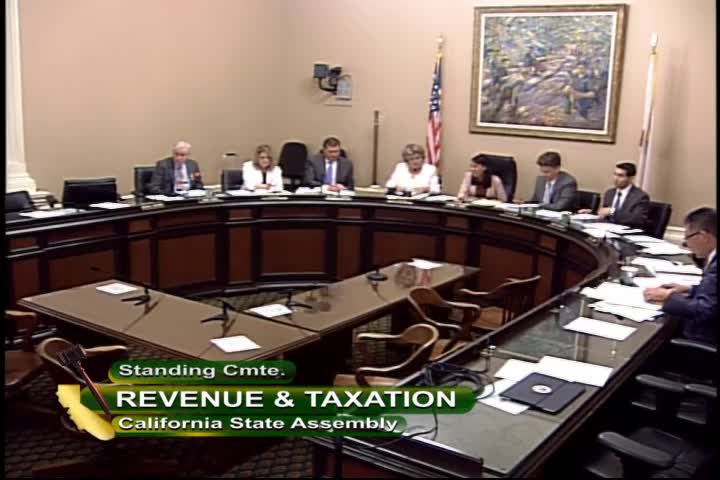
Discussed in Hearing
 6MIN
Assembly Standing Committee on Revenue and Taxation


Bill Co-Author(s):