AB 2758: Income taxes: credits: qualified small businesses.
- Session Year: 2017-2018
- House: Assembly
- Latest Version Date: 2018-04-18
The Personal Income Tax Law and the Corporation Tax Law allow various credits against the taxes imposed by those laws.
This bill would allow a credit against those taxes for each taxable year beginning on or after January 1, 2020, and before January 1, 2030, in an amount equal to 5% of the amount paid or incurred by an angel investor, as defined, for investing in a qualified small business, as defined, for the taxable year in which the Franchise Tax Board issues a credit certificate.
This bill would take effect immediately as a tax levy.
(a)For each taxable year beginning on or after January 1, 2020, and before January 1, 2030, there shall be allowed as a credit against the net tax, as defined in Section 17039, an amount equal to 5 percent of the amount paid or incurred from January 1, 2020, to January 1, 2030, by an angel investor for investing in a qualified small business for the taxable year in which the Franchise Tax Board issues a credit certificate.
(b)For purposes of this section:
(1)(A)Angel investor means an accredited investor who that comes within any of the following categories described in Section 230.501(a) of Title 17 of the Code of Federal Regulations, as it read on the effective date of this act, January 1, 2018, that is organized as a general partnership, limited partnership, corporation that has in effect a valid election to be taxed as an S corporation under the Internal Revenue Code, or a limited liability company that has elected to be taxed as a partnership under the Internal Revenue Code, that was established and is operated for the sole purpose of making investments in other entities, and who that seeks returns through private investments in start-up companies and may seek active involvement in the business, including consulting and mentoring the entrepreneur.
(B)Angel investor does not include a person who serves as an executive, officer, employee, vendor, or independent contractor of the business in which an otherwise qualified cash investment is made.(2)Permitted entity investor means (A) any general partnership, limited partnership, corporation that has in effect a valid election to be taxed as an S corporation under the Internal Revenue Code, or a limited liability company that has elected to be taxed as a partnership under the Internal Revenue Code, and (B) that was established and is operated for the sole purpose of making investments in other entities.(3)(2)Qualified small business means a business that has two million dollars ($2,000,000) or less in gross receipts annually averaged over five years and that has 51 percent or more of the business owned by individuals who are members of a group that has been underrepresented in securing investor dollars. is certified under Part 124 (commencing with Section 124.1) of Title 13 of the Code of Federal Regulations.
(c)In the case where the credit allowed by this section exceeds the net tax, the excess may be carried over to reduce the net tax in the following taxable year, and the succeeding four years if necessary, until the credit is exhausted.
(d)To receive a credit, an angel investor shall apply to the Franchise Tax Board for a credit. The Franchise Tax Board shall give the angel investor a reservation for the credit if the annual aggregate amount of the credit described in subdivision (e) has not been met. After the angel investor has invested the money in a qualified small business, the angel investor shall apply for a credit certificate from the Franchise Tax Board. The Franchise Tax Board shall grant a certificate to an angel investor that provides information and evidence that the money has been invested in a qualified small business that meets the definition of qualified small business.
(e)The aggregate amount of credits that may be allocated for a fiscal year pursuant to this section and Section 23660 shall be fifteen million dollars ($15,000,000) annually.
(f)Section 41 does not apply to the credit allowed by this section.(g)(f)This section shall remain in effect only until December 1, 2030, and as of that date is repealed.
SEC. 2.Section 23660 is added to the Revenue and Taxation Code, to read:23660.(a)For each taxable year beginning on or after January 1, 2020, and before January 1, 2030, there shall be allowed as a credit against the tax, as defined in Section 23036, an amount equal to 5 percent of the amount paid or incurred from January 1, 2020, to January 1, 2030, by an angel investor for investing in a qualified small business for the taxable year in which the Franchise Tax Board issues a credit certificate.
(b)For purposes of this section:
(1)(A)Angel investor means an accredited investor who that comes within any of the following categories described in Section 230.501(a) of Title 17 of the Code of Federal Regulations, as it read on the effective date of this act, January 1, 2018, that is organized as a general partnership, limited partnership, corporation that has in effect a valid election to be taxed as an S corporation under the Internal Revenue Code, or a limited liability company that has elected to be taxed as a partnership under the Internal Revenue Code, that was established and is operated for the sole purpose of making investments in other entities, and who that seeks returns through private investments in start-up companies and may seek active involvement in the business, including consulting and mentoring the entrepreneur.
(B)Angel investor does not include a person who serves as an executive, officer, employee, vendor, or independent contractor of the business in which an otherwise qualified cash investment is made.(2)Permitted entity investor means (A) any general partnership, limited partnership, corporation that has in effect a valid election to be taxed as an S corporation under the Internal Revenue Code, or a limited liability company that has elected to be taxed as a partnership under the Internal Revenue Code, and (B) that was established and is operated for the sole purpose of making investments in other entities.(3)(2)Qualified small business means a business that has two million dollars ($2,000,000) or less in gross receipts annually averaged over five years and that has 51 percent or more of the business owned by individuals who are members of a group that has been underrepresented in securing investor dollars. is certified under Part 124 (commencing with Section 124.1) of Title 13 of the Code of Federal Regulations.
(c)In the case where the credit allowed by this section exceeds the tax, the excess may be carried over to reduce the tax in the following taxable year, and the succeeding four years if necessary, until the credit is exhausted.
(d)To receive a credit, an angel investor shall apply to the Franchise Tax Board for a credit. The Franchise Tax Board shall give the angel investor a reservation for the credit if the annual aggregate amount of the credit described in subdivision (e) has not been met. After the angel investor has invested the money in a qualified small business, the angel investor shall apply for a credit certificate from the Franchise Tax Board. The Franchise Tax Board shall grant a certificate to an angel investor that provides information and evidence that the money has been invested in a qualified small business that meets the definition of qualified small business.
(e)The aggregate amount of credits that may be allocated for a fiscal year pursuant to this section and Section 17053.60 shall be fifteen million dollars ($15,000,000) annually.
(f)Section 41 does not apply to the credit allowed by this section.(g)(f)This section shall remain in effect only until December 1, 2030, and as of that date is repealed.
SEC. 3.For the purposes of complying with Section 41 of the Revenue and Taxation Code, with respect to Sections 17053.60 and 23660 of the Revenue and Taxation Code, as added by this act, the Franchise Tax Board shall collect data related to the amount of the return on investment made from investments in qualified small businesses.
SEC. 3.SEC. 4.This act provides for a tax levy within the meaning of Article IV of the California Constitution and shall go into immediate effect.
(a)For each taxable year beginning on or after January 1, 2020, and before January 1, 2030, there shall be allowed as a credit against the net tax, as defined in Section 17039, an amount equal to 5 percent of the amount paid or incurred from January 1, 2020, to January 1, 2030, by an angel investor for investing in a qualified small business for the taxable year in which the Franchise Tax Board issues a credit certificate.
(b)For purposes of this section:
(1)(A)Angel investor means an accredited investor who comes within any of the following categories described in Section 230.501(a) of Title 17 of the Code of Federal Regulations, as it read on the effective date of this act, and who seeks returns through private investments in start-up companies and may seek active involvement in the business, including consulting and mentoring the entrepreneur.
(B)Angel investor does not include a person who serves as an executive, officer, employee, vendor, or independent contractor of the business in which an otherwise qualified cash investment is made.
(2)Permitted entity investor means (A) any general partnership, limited partnership, corporation that has in effect a valid election to be taxed as an S corporation under the Internal Revenue Code, or a limited liability company that has elected to be taxed as a partnership under the Internal Revenue Code, and (B) that was established and is operated for the sole purpose of making investments in other entities.
(3)Qualified small business means a business that has two million dollars ($2,000,000) or less in gross receipts annually averaged over five years and that has 51 percent or more of the business owned by individuals who are members of a group that has been underrepresented in securing investor dollars.
(c)In the case where the credit allowed by this section exceeds the net tax, the excess may be carried over to reduce the net tax in the following taxable year, and the succeeding four years if necessary, until the credit is exhausted.
(d)To receive a credit, an angel investor shall apply to the Franchise Tax Board for a credit. The Franchise Tax Board shall give the angel investor a reservation for the credit if the annual aggregate amount of the credit described in subdivision (e) has not been met. After the angel investor has invested the money in a qualified small business, the angel investor shall apply for a credit certificate from the Franchise Tax Board. The Franchise Tax Board shall grant a certificate to an angel investor that provides information and evidence that the money has been invested in a qualified small business that meets the definition of qualified small business.
(e)The aggregate amount of credits that may be allocated for a fiscal year pursuant to this section and Section 23660 shall be fifteen million dollars ($15,000,000) annually.
(f)Section 41 does not apply to the credit allowed by this section.
(g)This section shall remain in effect only until December 1, 2030, and as of that date is repealed.
SEC. 2.Section 23660 is added to the Revenue and Taxation Code, to read:23660.(a)For each taxable year beginning on or after January 1, 2020, and before January 1, 2030, there shall be allowed as a credit against the tax, as defined in Section 23036, an amount equal to 5 percent of the amount paid or incurred from January 1, 2020, to January 1, 2030, by an angel investor for investing in a qualified small business for the taxable year in which the Franchise Tax Board issues a credit certificate.
(b)For purposes of this section:
(1)(A)Angel investor means an accredited investor who comes within any of the following categories described in Section 230.501(a) of Title 17 of the Code of Federal Regulations, as it read on the effective date of this act, and who seeks returns through private investments in start-up companies and may seek active involvement in the business, including consulting and mentoring the entrepreneur.
(B)Angel investor does not include a person who serves as an executive, officer, employee, vendor, or independent contractor of the business in which an otherwise qualified cash investment is made.
(2)Permitted entity investor means (A) any general partnership, limited partnership, corporation that has in effect a valid election to be taxed as an S corporation under the Internal Revenue Code, or a limited liability company that has elected to be taxed as a partnership under the Internal Revenue Code, and (B) that was established and is operated for the sole purpose of making investments in other entities.
(3)Qualified small business means a business that has two million dollars ($2,000,000) or less in gross receipts annually averaged over five years and that has 51 percent or more of the business owned by individuals who are members of a group that has been underrepresented in securing investor dollars.
(c)In the case where the credit allowed by this section exceeds the tax, the excess may be carried over to reduce the tax in the following taxable year, and the succeeding four years if necessary, until the credit is exhausted.
(d)To receive a credit, an angel investor shall apply to the Franchise Tax Board for a credit. The Franchise Tax Board shall give the angel investor a reservation for the credit if the annual aggregate amount of the credit described in subdivision (e) has not been met. After the angel investor has invested the money in a qualified small business, the angel investor shall apply for a credit certificate from the Franchise Tax Board. The Franchise Tax Board shall grant a certificate to an angel investor that provides information and evidence that the money has been invested in a qualified small business that meets the definition of qualified small business.
(e)The aggregate amount of credits that may be allocated for a fiscal year pursuant to this section and Section 17053.60 shall be fifteen million dollars ($15,000,000) annually.
(f)Section 41 does not apply to the credit allowed by this section.
(g)This section shall remain in effect only until December 1, 2030, and as of that date is repealed.
SEC. 3.This act provides for a tax levy within the meaning of Article IV of the California Constitution and shall go into immediate effect.
|
Date
|
Status
|
|---|---|
| May 25, 2018 | In committee: Held under submission. |
| May 2, 2018 | In committee: Set, first hearing. Referred to APPR. suspense file. |
| Apr 19, 2018 | Re-referred to Com. on APPR. |
| Apr 18, 2018 | Read second time and amended. |
| Apr 17, 2018 | From committee: Amend, and do pass as amended and re-refer to Com. on APPR. (Ayes 8. Noes 0.) (April 9). |
| Mar 8, 2018 | Referred to Com. on REV. & TAX. |
| Feb 17, 2018 | From printer. May be heard in committee March 19. |
| Feb 16, 2018 | Read first time. To print. |
|
Date
|
Description
|
Location
|
Votes
|
|
|---|---|---|---|---|
| Apr 9, 2018 | Do pass as amended and be re-referred to the Committee on [Appropriations] | Assembly Standing Committee on Revenue and Taxation |
Passed |
This list shows positions taken on this bill by organizations on the date displayed, which is linked to the original source.
Positions by individuals are not included.
|
Organization
|
Position
|
Date
|
|---|---|---|
| Silicon Valley Leadership Group | * Indeterminate | Apr 9, 2018 |
Date of Hearing: May 2, 2018
ASSEMBLY COMMITTEE ON APPROPRIATIONS
Lorena Gonzalez Fletcher, Chair
ABPCA Bill Id:AB 2758
Author:(Burke) – As Amended Ver:April 18, 2018
Policy Committee: | Revenue and Taxation | Vote: | 8 - 0 |
|
| ||
|
|
Urgency: No State Mandated Local Program: No Reimbursable: No
SUMMARY:
This bill creates a Personal Income Tax (PIT) and Corporation Tax (CT) credit worth 5% of an angel investor’s investment in a business that has $2 million or less in gross receipts on average over five years and is considered a small disadvantaged business, as defined in specified federal regulations. No more than $15 million in credits may be allocated each taxable year, and the credit is available for taxable years beginning in January 2020 through 2029.
FISCAL EFFECT:
Annual General Fund (GF) revenue loss of $7.7 million in 2019-20 and $14.0 million in 2019-20.
COMMENTS:
- Purpose. According to the author, AB 2758 will bring greater parity to the distribution of venture capital dollars by expanding small businesses’ access to capital. The author notes that small businesses face difficulty in accessing capital, and this difficulty is far greater for minority-owned businesses. While California receives 53.5% of nationally invested venture capital funds, only 5% of these funds go to female-owned businesses and just 1% is invested businesses owned by African Americans or Latinos.
- Fiscal implications of tax expenditures. Existing law allows for various tax expenditures such as credits, deductions, exclusions, and exemptions for particular taxpayer groups. These features of the tax code can result in significant state costs through foregone tax revenue and, in many cases, policymakers have little control over the revenue loss that occurs in any given year. As a result, many tax expenditure bills now include provisions designed to give the Legislature more control over costs. Examples of such provisions include placing a sunset date or making a bill’s provisions contingent upon a separate budget appropriation. AB 2758 includes a sunset as well as a cap ($15 million) on the total amount of credits that may be allocated each fiscal year.
- Qualified businesses. AB 2758 defines an eligible small business as one that is certified under Part 124 of Title 13 of the Code of Federal Regulations. These regulations apply to the federal “8(a) Business Development Program,” which aims to level the playing field for small businesses owned by socially and economically disadvantaged people or entities. To participate in the program, the small business must be at least 51% owned and controlled by U.S. citizens who are economically and socially disadvantaged, as defined, and be owned by someone whose average adjusted gross income for three years is $250,000 or less.
- Recent legislation. AB 999 (Burke), of the 2017-18 Legislative Session, would creates a tax credit for taxpayers that invest in qualified small businesses That bill died in the Assembly Committee on Jobs, Economic Development, and the Economy.
Analysis Prepared by: Luke Reidenbach / APPR. / (916) 319-2081
Date of Hearing: April 9, 2018
ASSEMBLY COMMITTEE ON REVENUE AND TAXATION
Autumn R. Burke, Chairwoman
ABPCA Bill Id:AB 2758 (
Author:Burke) – As Introduced Ver:February 16, 2018
Majority vote. Tax levy. Fiscal committee.
SUBJECT: Income taxes: credits: qualified small businesses
SUMMARY: Provides a credit, under the Personal Income Tax (PIT) Law and the Corporation Tax (CT) Law, equal to 5% of the amount paid or incurred by an "angel investor" for investing in a "qualified small business" for the taxable year in which the Franchise Tax Board (FTB) issues a credit certificate. Specifically, this bill:
- Provides, on or after January 1, 2020, and before January 1, 2030, a credit equal to 5% of the amount paid or incurred by an "angel investor" for investing in a "qualified small business."
- Defines an "angel investor" as an accredited investor who comes within any of the categories described in Code of Federal Regulations Section 230.501(a), as it read on the effective date of this act, and who seeks returns through private investments in start-up companies. An "angel investor" may seek active involvement in the business, including consulting and mentoring the entrepreneur. "Angel investor" does not include a person who serves as an executive, officer, employee, vendor, or independent contractor of the business in which an otherwise cash investment is made.
- Defines a "qualified small business" as a business that has $2 million or less in gross receipts annually averaged over five years and that has 51 or more of the business owned by individuals who are members of a group that has been underrepresented in securing investor dollars.
- Defines a "permitted entity investor" as the following:
- A general partnership, limited partnership, or corporation that has elected to be taxed as an “S” corporation, or a limited liability company that has elected to be taxed as a partnership; and,
- Is established and is operated for the sole purpose of making investments in other entities.
- Requires an "angel investor" to apply to the FTB for the credit. The FTB shall give the "angel investor" a reservation for the credit if the annual aggregate amount of the credit has not been met. After the "angel investor" has invested money in a "qualified small business," the "angel investor" shall apply for the credit certificate from FTB. The FTB shall grant a certificate to an "angel investor" that provides information and evidence that the money has been invested in a "qualified small business."
- Limits the aggregate amount of the credit that may be allocated for a fiscal year to $15 million annually.
- Allows the credit to be carried over for five years.
- Provides that Revenue and Taxation Code (R&TC) Section 41 does not apply.
- Repeals this credit on December 1, 2030.
- Takes effect immediately as a tax levy.
EXISTING LAW:
- Allows various tax credits under the PIT Law and the CT Law. These credits are generally designed to encourage socially beneficial behavior or to provide relief to taxpayers who incur specified expenses.
- Requires any bill authorizing a new credit to contain all of the following:
- Specific goals, purposes, and objectives that the tax credit will achieve;
- Detailed performance indicators for the Legislature to use when measuring whether the tax credit meets the goals, purposes, and objectives stated in the bill; and,
- Data collection requirements to enable the Legislature to determine whether the tax credit is meeting, failing to meet, or exceeding those specific goals, purposes, and objectives. The requirements shall include the specific data and baseline measurements to be collected and remitted in each year the credit is in effect, for the Legislature to measure the change in performance indicators, and the specific taxpayers, state agencies, or other entities required to collect and remit data. (R&TC Section 41.)
FISCAL EFFECT: The FTB estimates General Fund revenue losses of $0 in fiscal year (FY) 2018-19, $7.7 million in FY 2019-20, and $14 million in FY 2020-21.
COMMENTS:
- The author has provided the following statement in support of this bill:
California’s small businesses are a vital component in the state’s economic well-being. Small firms comprise 99.8% of all businesses in California and employ 49.2% of the state’s workforce. Most critically, small businesses are the largest contributor to net job creation, the number of jobs created after accounting for job losses. According to the US Census Bureau, in 2014, California’s small businesses had a net creation of 197,532 jobs, comprising 51% of net jobs created in the state.
While these businesses offer the most job creation, they often can experience the most difficulty securing financing to expand their business. Limited access to capital is especially acute for minority owned businesses. According to a Hamilton Project report, the average loan amount for a nonminority owned business was $20,500, compared to $9,300 average for minority owned businesses. Furthermore, while California receives 53.5% of nationally invested venture capital funds, only 5% of these funds go to female-owned businesses and 1% is invested in African-American and Latino-owned businesses, combined.
Assembly Bill 2758 incentivizes investors to target small businesses in which they may otherwise find it too risky to invest. These investors often act as mentors to help the business owner develop a profitable model and expand their business. Additionally, the bill prioritizes applications from minority- and female-owned businesses. Thus, AB 2758 brings greater parity in the distribution of venture capital dollars, expands small businesses’ access to capital and facilitates expansion of businesses which contribute most to creating new jobs for Californians.
- Committee staff comments:
- Underrepresented Entrepreneurs: According to PitchBook, all-female owned businesses received a little over 2% of the total amount invested by venture capitalists in 2017 while 79% of investments went to all-male owned firms[1]. Other studies have shown that minority-owned businesses are more likely to be denied for loans, receive lower amounts for loans, and pay higher interest rates on those loans[2]. Although there are many reasons why capital investments are not being made in women- and minority-owned businesses, some studies have shown that the fear of rejection from lenders and a lack of personal wealth may explain part of the desparity[3]. Despite the many challenges of acquiring capital, First Round, a venture capital firm, has found that its investments in companies with at least one female founder performed 63% better than its investments in all-male companies over the last 10 years[4].
- Addressing market failures: Although there may be many reasons that explain the disparate treatment, the fact remains that many women- and minority-owned businesses receive less capital than non-minorit- owned businesses. Given First Round's realization that its investments in companies with at least one female founder performed 63% better than its investments in all-male run companies, it appears that there may be a large number of business ideas that fail to come to fruition because the market, for whatever reason, deems these companies unfit for investment. This bill's credit attempts to correct this market failure by encouraging angel investors to invest in businesses where a majority share is owned by a group that has been underrepresented in securing investor dollars. By providing a 5% credit, angel investors may be more willing to invest in minority- and women-owned businesses or may be willing to invest more capital than they otherwise would absent the credit. If, as the First Round findings suggest, companies with at least one female founder perform 63% better than all-male founded companies, this credit may be able to help change the industry's perception of minority-and women-owned businesses.
- How is a tax expenditure different from a direct expenditure? As the Department of Finance notes in its annual Tax Expenditure Report, there are several key differences between tax expenditures and direct expenditures. First, tax expenditures are reviewed less frequently than direct expenditures once they are put in place. Second, there is generally no control over the amount of revenue losses associated with any given tax expenditure. Finally, it should also be noted that, once enacted, it takes a two-thirds vote to rescind an existing tax expenditure absent a sunset date. This effectively results in a "one-way ratchet" whereby tax expenditures can be conferred by majority vote, but cannot be rescinded, irrespective of their efficacy or cost, without a supermajority vote. This bill contains a 10-year sunset.
- Section 41: On September 29, 2014, Governor Brown signed SB 1335 (Leno), Chapter 845, Statutes of 2014, which added R&TC Section 41. SB 1335 recognized that the Legislature should apply the same level of review used for government spending programs to tax expenditure programs, including tax credits. Thus, R&TC Section 41 requires any bill introduced on or after January 1, 2015 that allows a new income tax credit to contain specific goals, purposes, and objectives that the tax credit will achieve. In addition, Section 41 requires detailed performance indicators for the Legislature to use when measuring whether the tax credit meets the goals, purposes, and objectives so-identified. In its current form, this bill does not contain language complying with Section 41. Given the recent findings by First Round, it may be beneficial to attach performance indicators that can help show the benefits of investing in minority-and women-owned businesses.
- What does "underrepresented" mean? This bill defines a "qualified small business" as a business that has $2 million or less in gross receipts annually averaged over five years and that has 51% or more of the business owned by an individual who is a member of a group that has been underrepresented in securing investor dollars. Based on information provided by the author's office, this bill is intended to encourage investment in minority-and women-owned businesses. Information has been provided showing that African-American, Latino, and female-owned businesses have a more difficult time acquiring capital than other nonminority-owned businesses. Because the definition provided in this bill does not specifically mention these groups, recipients of this credit may not necessarily be the intended beneficiaries. It may be better, in terms of administering this credit, to clearly outline those groups that have been underrepresented in securing investor dollars. Unfortunately, doing so may raise certain constitutional concerns.
- Unused definition: This bill contains a definition for "permitted entity investor" that is not referred to in any other part of this bill. The definition outlines the legal structures that are allowed to make investments in a "qualified small business" and requires the legal entity to be established for the sole purpose of making investments in other entities. Because the requirements outlined under "permitted entity investor" appear to be intended to apply to "angel investors," the author may wish to apply these requirements to "angel investors."
REGISTERED SUPPORT / OPPOSITION:
Support
None on file
Opposition
None on file
Analysis Prepared by: Carlos Anguiano / REV. & TAX. / (916) 319-2098
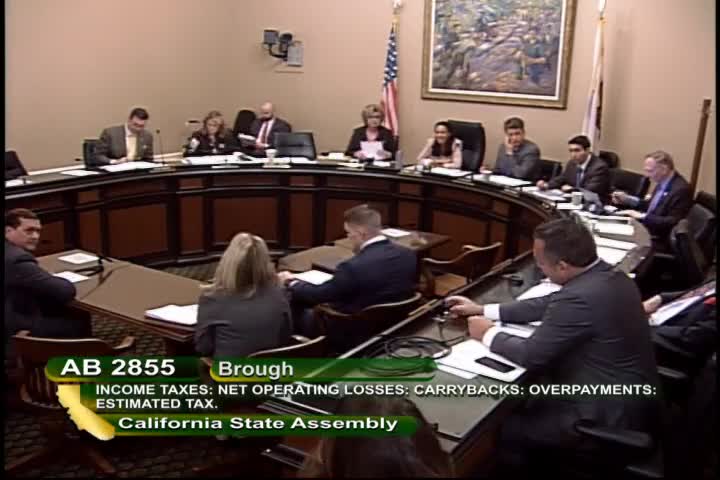
Discussed in Hearing
 6MIN
Assembly Standing Committee on Revenue and Taxation
Bill Author

Bill Co-Author(s):