AB 2883: Vote by mail ballots.
- Session Year: 2017-2018
- House: Assembly
- Latest Version Date: 2018-02-16
Existing law requires a vote by mail voter to return his or her voted vote by mail ballot (1) by mail or in person to the elections official, (2) in person to a member of a precinct board at a polling place or vote center, or (3) to a vote by mail ballot dropoff location, as specified. Existing law permits a vote by mail voter who is unable to return his or her ballot to designate another person to return the ballot.
This bill would require the designated person to offer to give a receipt to the voter when the designated person receives the ballot, and to provide a receipt to the voter upon request. The bill would require the Secretary of State to prescribe a form for that receipt, and would specify the information to be included on the receipt.
(a)(1)All vote by mail ballots cast under this division shall be voted on or before the day of the election. After marking the ballot, the vote by mail voter shall do any of the following: (1) return
(A)Return the ballot by mail or in person to the elections official who issued the ballot, (2) return ballot.
(B)Return the ballot in person to a member of a precinct board at a polling place or vote center within the state, or (3) return state.
(C)Return the ballot to a vote by mail ballot dropoff location within the state that is provided pursuant to Section 3025 or 4005. However, a
(2)(A)A vote by mail voter who is unable to return the ballot may designate any person to return the ballot to the elections official who issued the ballot, to the precinct board at a polling place or vote center within the state, or to a vote by mail ballot dropoff location within the state that is provided pursuant to Section 3025 or 4005. The ballot must, however, The person designated by the voter shall offer to give the voter a receipt in the form described in subparagraph (B) when the designated person receives the ballot, and shall provide a receipt to the voter upon request.
(B)The Secretary of State shall prescribe a form for a receipt required by subparagraph (A). The receipt shall include all of the following information:
(i)The name and address of the person designated to return the ballot.
(ii)The telephone number at which the designated person may be contacted.
(iii)The drivers license or California identification card number of the designated person.
(iv)The date and time the ballot was received by the designated person from the voter.
(v)The name of the political party, candidate, or committee for which the designated person is acting as an actual or implied agent, if applicable.
(vi)A statement that the designated person must return the ballot to the elections official who issued the ballot, to the precinct board at a polling place or vote center within the state, or to a vote by mail ballot dropoff location within the state that is provided pursuant to Section 3025 or 4005 no later than two days after receiving the ballot from the voter or before the close of the polls on election day, whichever time period is shorter.
(C)The ballot must be received by the elections official who issued the ballot, the precinct board, or the vote by mail ballot dropoff location before the close of the polls on election day. If a vote by mail ballot is returned to a precinct board at a polling place or vote center, or to a vote by mail ballot dropoff location, that is located in a county that is not the county of the elections official who issued the ballot, the elections official for the county in which the vote by mail ballot is returned shall forward the ballot to the elections official who issued the ballot no later than eight days after receipt.
(b)The elections official shall establish procedures to ensure the secrecy of a ballot returned to a polling place and the security, confidentiality, and integrity of any personal information collected, stored, or otherwise used pursuant to this section.
(c)On or before March 1, 2008, the elections official shall establish procedures to track and confirm the receipt of voted vote by mail ballots and to make this information available by means of online access using the countys elections division Internet Web site. If the county does not have an elections division Internet Web site, the elections official shall establish a toll-free telephone number that may be used to confirm the date a voted vote by mail ballot was received.
(d)The provisions of this section are mandatory, not directory, and a ballot shall not be counted if it is not delivered in compliance with this section.
(e)(1)A person designated to return a vote by mail ballot shall not receive any form of compensation based on the number of ballots that the person has returned and an individual, group, or organization shall not provide compensation on this basis.
(2)For purposes of this paragraph, compensation means any form of monetary payment, goods, services, benefits, promises or offers of employment, or any other form of consideration offered to another person in exchange for returning another voters vote by mail ballot.
(3)Any person in charge of a vote by mail ballot and who knowingly and willingly engages in criminal acts related to that ballot as described in Division 18 (commencing with Section 18000), including, but not limited to, fraud, bribery, intimidation, and tampering with or failing to deliver the ballot in a timely fashion, is subject to the appropriate punishment specified in that division.
REVISIONS: HeadingLines 2 and 3.|
Date
|
Status
|
|---|---|
| May 23, 2018 | From committee: Without further action pursuant to Joint Rule 62(a). |
| Apr 25, 2018 | In committee: Set, second hearing. Failed passage. |
| Apr 11, 2018 | In committee: Set, first hearing. Hearing canceled at the request of author. |
| Mar 15, 2018 | Coauthors revised. |
| Mar 8, 2018 | Referred to Com. on E. & R. |
| Feb 17, 2018 | From printer. May be heard in committee March 19. |
| Feb 16, 2018 | Read first time. To print. |
|
Date
|
Description
|
Location
|
Votes
|
|
|---|---|---|---|---|
| Apr 25, 2018 | Do pass and be re-referred to the Committee on [Appropriations] | Assembly Standing Committee on Elections and Redistricting |
Failed |
This list shows positions taken on this bill by organizations on the date displayed, which is linked to the original source.
Positions by individuals are not included.
|
Organization
|
Position
|
Date
|
|---|---|---|
| ACLU of California | * Against | Apr 25, 2018 |
| Disability Rights California | * For If Amend | Apr 25, 2018 |
| Howard Jarvis Tax Payers Association | * Support | Apr 25, 2018 |
| Voting Rights Task Force | * Support | Apr 25, 2018 |
Date of Hearing: April 25, 2018
ASSEMBLY COMMITTEE ON ELECTIONS AND REDISTRICTING
Marc Berman, Chair
ABPCA Bill Id:AB 2883 (
Author:Harper) – As Introduced Ver:February 16, 2018
SUBJECT: Vote by mail ballots.
SUMMARY: Requires a person designated by a voter to drop off his or her vote by mail (VBM) ballot to provide the voter with a receipt, as specified. Specifically, this bill:
- Requires a person designated by a voter to return his or her VBM ballot to offer to give the voter a receipt when the designated person receives the ballot, and requires the receipt to be provided upon request.
- Requires the Secretary of State (SOS) to prescribe a form for the receipt required above. Requires the receipt to include all of the following information:
- The name and address of the person designated to return the ballot;
- The telephone number at which the designated person may be contacted;
- The driver's license or California identification card number of the designated person;
- The date and time the ballot was received by the designated person from the voter;
- The name of the political party, candidate, or committee for which the designated person is acting as an actual or implied agent, if applicable; and,
- A statement that the designated person must return the ballot to the elections official who issued the ballot, to the precinct board at a polling place or vote center within the state, or to a VBM ballot dropoff location within the state that is provided pursuant to existing law no later than two days after receiving the ballot from the voter or before the close of the polls on election day, whichever time period is shorter.
EXISTING LAW:
- Requires voting by mail to be available to any registered voter.
- Permits a VBM voter who is unable to return his or her ballot to designate any person to return the ballot by mail or in person to the elections official who issued the ballot, to the precinct board at a polling place or vote center within the state, or to a VBM ballot dropoff location within the state before the close of the polls on election day.
- Prohibits a person designated to return a VBM ballot from receiving any compensation based on the number of ballots that the person has returned and prohibits an individual, group, or organization from compensating on this basis. Defines "compensation" to mean any form of monetary payment, goods, services, benefits, promises or offers of employment, or any other form of consideration offered to another person in exchange for returning another voter's VBM ballot.
- Provides that any person in charge of a VBM ballot who knowingly and willingly engages in criminal acts related to the VBM ballot as described under current law, including, but not limited to, fraud, bribery, intimidation, and tampering with or failing to deliver the ballot in a timely fashion, is subject to the appropriate punishment pursuant to existing law.
- Requires an elections official to establish procedures to ensure the secrecy of a VBM ballot returned to a precinct polling place and the security, confidentiality, and integrity of any related personal information collected, stored, or otherwise used.
- Prohibits a ballot from being counted if it is not delivered in compliance with the aforementioned sections.
- Requires an elections official to establish procedures to track and confirm the receipt of voted VBM ballots and to make this information available by means of online access using the county’s elections division Internet Web site. Requires a county elections official that does not have an elections division Internet Web site to establish a toll-free telephone number that may be used to confirm the date a voted VBM ballot was received.
- Provides that any person who votes more than once, attempts to vote more than once, or impersonates or attempts to impersonate a voter at an election is guilty of a crime punishable by imprisonment in the state prison for 16 months or two or three years, or in county jail not exceeding one year.
- Provides that every person who defrauds any voter at any election by deceiving and causing him or her to vote for a different person for any office than he or she intended or desired to vote for is guilty of a felony punishable by imprisonment in the state prison for 16 months or two or three years.
- Provides that any person having charge of a completed VBM ballot who willfully interferes or causes interference with its return to the local elections official having jurisdiction over the election is guilty of a misdemeanor punishable by imprisonment in a county jail, a fine of ten thousand dollars ($10,000), or both.
FISCAL EFFECT: Unknown
COMMENTS:
- Purpose of the Bill: According to the author:
Prior to 2017, state law provided that voters who were unable to return their VBM ballot to the polls could designate a family member and roommates to return the VBM ballot for them. Prior law specifically prohibited campaign workers and other special interest groups from collecting VBM ballots – a tactic known as “ballot harvesting” – in order to prevent potential voter coercion, fraud, and non-delivered ballots.
However, the Legislature passed AB 1921 (Gonzalez-Fletcher) in 2016 to repeal restrictions on who can return VBM ballots on behalf of voters, and to provide instead that any person – including campaign workers and special interest groups -- may now go door-to-door harvesting VBM ballots from voters.
Elections experts agree that VBM ballots are far more susceptible to fraud than traditional ballots, due to the separation of both ballot and voter from the polling place. Rick Hasen, the Chancellor’s Professor of Law at the U.C. Irvine School of Law, has noted that a smart way to steal an election “is through the sale of absentee ballots. That transaction can be done in private. The person buying the ballots can buy blank ones from cheating voters, then cast the votes herself. … It is easy to find cases throughout the country every year of fraud or attempted fraud with absentee ballots.”
The National Commission on Federal Election Reform has reported that VBM voting is the most likely opportunity for election fraud because the misuse of a voter’s ballot or the pressure on the voter occurs away from the polling place and other outside scrutiny, and it urged lawmakers to limit opportunities for such abuses.
In the first election since ballot harvesting was legalized, there were published reports of overly-aggressive VBM harvesters harassing and coercing voters into handing over their ballots, and reveal who they were voting for.
But under current law, if a stranger collects a VBM ballot from a voter and fails to deliver it to the polls in time to be counted, there is no way for law enforcement officials to track that person down for criminal prosecution.
In response to these abuses, the Los Angeles Times issued an editorial entitled “Don’t allow voter coercion and corruption to take hold in California,” stating that voter protections need to be put in place, and urged lawmakers to reassess the wisdom of allowing unknown third-parties to collect ballots.
Assembly Bill 2883 will require ballot harvesters who collect VBM ballots from voters to provide a receipt to the voter, upon request, identifying who is picking up their ballot. It will protect voters by ensuring that their vote is counted, and that no one disenfranchises them by failing to deliver their ballot to elections officials.
- Previous Legislation: AB 1921 (Gonzalez-Fletcher), Chapter 820, Statutes of 2016, permits a voter who is unable to return his or her VBM ballot to designate any person to return the voter’s VBM ballot to the elections official from whom it came, to the precinct board at the polling place or voter center within the jurisdiction, or VBM dropoff location within the jurisdiction. The practical effect of AB 1921 is that a VBM voter may designate any person such as a co-worker, friend, neighbor, or even a campaign worker to drop off his or her VBM ballot.
This bill requires a person designated by a voter to drop off his or her VBM ballot to offer and, upon request, to provide the voter with a receipt containing personal identifying information, as specified. - Existing Penalties: Current law provides for a variety of safeguards in law to protect against voter fraud and abuse. Existing law makes it a felony for any person who defrauds any voter at any election by deceiving and causing him or her to vote for a different person for any office other than the candidate for whom he or she intended or desired to vote. Any person having charge of a completed VBM ballot who willfully interferes or causes interference with its return to the local elections official having jurisdiction over the election is guilty of a misdemeanor punishable by imprisonment in the county jail, a fine of ten thousand dollars ($10,000), or both. Additionally, AB 1921 (Gonzalez-Fletcher), Chapter 820, Statutes of 2016, provided that any person in charge of a VBM ballot who knowingly and willingly engages in criminal acts related to the VBM ballot as described under current law, including, but not limited to, fraud, bribery, intimidation, and tampering with or failing to deliver the ballot in a timely fashion, is subject to the appropriate punishment pursuant to existing law. AB 1921 also specifically prohibits a person designated to return a VBM ballot from receiving any form of compensation, as defined, based on the number of ballots that the person has returned and prohibits an individual, group, or organization from providing compensation on this basis. Moreover, once the ballot is received by the elections official, California law requires the elections officials to compare the signature on a VBM ballot envelope with the signature on that voter's affidavit of registration before the VBM ballot may be counted. If those signatures do not match, the ballot will not be counted.
Furthermore, the Legislature has taken steps to address the potential for fraud in connection with VBM ballots. For example, many elders in state-licensed or state-subsidized facilities or programs have physical and cognitive impairments or conditions that may limit their ability to independently cast a vote. As a result, many elders choose to vote via VBM ballot. Due to the high use of VBM ballots in this population, some questions and concerns have arisen regarding the influence elders are receiving from caregivers in the receipt, completion, and return of their ballots. In response to those concerns, the Legislature approved and the Governor signed AB 547 (Gatto), Chapter 260, Statutes of 2011, which makes it a misdemeanor for a person who is providing care or direct supervision to an elder in a state-licensed or state-subsidized facility or program to coerce or deceive the elder into voting for or against a candidate or measure contrary to the elder's intent or in the absence of any intent of the elder to cast a vote for or against that candidate or measure. - Other States: Other states allow a voter to designate any person to drop off his or her mail ballot. These laws, however, vary from state to state. For example, Colorado permits a person to drop off up to 10 mail ballots, as specified. Oregon state law permits a person who returns a ballot for an elector to return the ballot no later than two days after receiving the ballot in accordance with existing law. Texas state law permits a voter who is eligible to vote by mail to designate any person to drop off his or her ballot, but requires the designated person to put his or her name and address on the carrier envelope as a witness or assistant, as specified. The Texas Secretary of State's web site also recommends a VBM voter to decline assistance from a political organization and to instead select a trusted relative or friend to return the mail ballot.
According to information from the National Conference of State Legislatures, a handful of states require some form of documentation that the ballot was delivered by someone other than the voter, however, there are a mix of requirements. Some states require the documentation to occur during delivery of the VBM ballot, while others require documentation once the ballot has been voted and is being returned. The information that is required to be gathered from the voter or designee also varies. According to the author's office, this bill is similar to Iowa state law which requires a person designated to return a VBM ballot, upon request of the voter, to fill out a receipt to be retained by the voter. Iowa law requires the receipt to include the name of (1) the voter's designee, (2) the date and time the completed VBM ballot was received by the voter, (3) the name and date of the election for which the VBM ballot is being voted, (4) the name of the political party, candidate, or committee for which the designee is acting as an actual or implied agent, if applicable, (5) a telephone number at which the voter's designee may be contacted, and (6) a statement that the completed VBM ballot will be delivered or mailed to the election commissioner's office within seventy-two hours of retrieving the ballot or before the closing of the polls on election day, whichever is earlier, as specified. - Logistical Issues: As mentioned above, this bill requires a designee to offer and, upon request, provide a VBM voter a receipt which contains personal identifying information. What does the VBM voter do with the receipt? Does the VBM voter keep the receipt and bring it to the elections official's office to confirm his or her VBM ballot was delivered? What recourse does the VBM voter have if the information on the receipt is false? How does the elections official confirm a receipt was given at the request of the voter? Committee staff is unsure how this bill would be enforced and how VBM voter fraud of this type would be prevented by requiring a designee to provide a VBM voter with a receipt.
- Vote by Mail Data: Statistics show that voters are choosing to cast a VBM ballot more and more over time. For instance, according to the SOS's office, in the November 2004 general election approximately 32 percent of voters cast a VBM ballot. In the November 2014 general election over 60 percent of voters cast a VBM ballot. Most recently, in the November 2016 general election over 57 percent of the voters cast a VBM ballot.
- Arguments in Support: In support, the Howard Jarvis Taxpayers Association writes:
Current law allows anyone to return an absentee ballot as long as they don’t receive monetary or other compensation in exchange for doing so. This renders California vulnerable to significant voter fraud. Vote by mail ballots can be picked up by anyone (not just immediate family members and those residing in the same household as prior law stated)…
At the very least, this bill will allow voters to have the peace of mind that their vote will be counted, as “ballot harvesters” must be required to provide a receipt and guarantee of ballot delivery to the voter. Ballot harvesters must be held accountable and a receipt ensures that this likelihood stands a better chance of occurring.
- Amendments Sought: Disability Rights California, which has a "support if amended" position on this bill, requests that the bill to be amended to exempt family members, caregivers, or others in the disability support network from providing the details on the receipt form.
- Arguments in Opposition: In opposition, the American Civil Liberties Union of California writes:
AB 2883's provisions requiring a vote-by-mail receipt to include the designated person's government identification number is unnecessarily restrictive and excludes certain demographic populations from civic participation. Many voters who are elderly, low-income, or survivors of domestic violence do not have, or cannot afford, a driver's license, or the underlying documents necessary to obtain such identification. A November 2006 survey found that 11% of United States citizens do not have government-issued photo identification. This provision also fails to align with the information required on the state's voter registration cards, which allow a voter without a government issued identification number to register to vote.
Furthermore, to align this vote-by-mail receipt with the requirements for the voter registration receipt and to protect individual privacy, AB 2883 should be amended to permit an individual to list an organizational name and address, instead of their home address, on the receipt.
Finally, AB 2883 fails to delineate how the designated person would be notified of their duty to offer, and provide upon request, a vote-by-mail receipt. To prevent people from being penalized without proper notice of their obligations, the receipt should be attached to the vote-by-mail envelope, as is the case with voter registration form, and the vote-by-mail envelope should clearly state the duties of the designated person with regards to offering and providing the receipt.
- Related Legislation: AB 306 (Gonzalez-Fletcher) requires a person who is designated by a VBM voter to return the voter's ballot to deliver it no later than two days after receiving it from the voter or before the close of the polls on election day, whichever is sooner. AB 306 is pending in the Senate Elections & Constitutional Amendments Committee.
REGISTERED SUPPORT / OPPOSITION:
Support
Disability Rights California (if amended)
Howard Jarvis Taxpayers Association
Voting Rights Task Force
Opposition
American Civil Liberties Union of California
Analysis Prepared by: Nichole Becker / E. & R. / (916) 319-2094
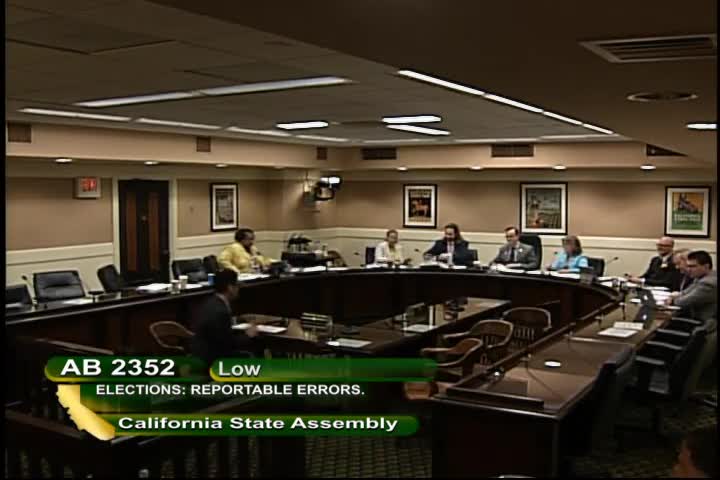
Discussed in Hearing
 11MIN
Assembly Standing Committee on Elections and Redistricting
Bill Author




