AB 3111: Telecommunications: universal service.
- Session Year: 2017-2018
- House: Assembly
- Latest Version Date: 2018-05-08
Under existing law, the Public Utilities Commission has regulatory authority over public utilities, including telephone corporations. The Moore Universal Telephone Service Act establishes the Universal Lifeline Telephone Service program to provide low-income households with access to affordable basic residential telephone service. Existing law requires each lifeline telephone service subscriber to be provided with one lifeline subscription, as defined by the commission, at his or her principal place of residence, and provides that no bars from lifeline service eligibility any other member of that lifeline subscribers family or household, as defined, who maintains residence at that principal place is eligible for lifeline telephone service. of residence.
This bill would end the eligibility bar for lifeline service to more than one family member in a residence, retain that eligibility bar for lifeline service to more than one member of a household while deleting the definition of household, instead bar from lifeline service eligibility any member of a group of individuals who are living together with a lifeline subscriber at the same address and as one economic unit, as defined, and would assert that multiple lifeline telephone service subscribers may maintain the same principal place of residence. The bill would require the commission to ensure all eligible individuals are provided with information about the lifeline program and given equal opportunities to subscribe to the lifeline service, and would require the commission, as part of that outreach, to maximize the participation of all groups, including students, veterans, and the formerly incarcerated. The bill would require the commission to develop outreach and enrollment programs for the formerly incarcerated and for veterans. The bill would require the commission to consider accepting alternative forms of identification to increase participation in the lifeline program for certain purposes.
Under existing law, a violation of the Public Utilities Act or any order, decision, rule, direction, demand, or requirement of the commission is a crime.
Because the provisions of this bill would be a part of the act and because a violation of an order, decision, or rule of the commission implementing its requirements would be a crime, the bill would impose a state-mandated local program.
The California Constitution requires the state to reimburse local agencies and school districts for certain costs mandated by the state. Statutory provisions establish procedures for making that reimbursement.
This bill would provide that no reimbursement is required by this act for a specified reason.
Under existing law, the Public Utilities Commission has regulatory authority over public utilities, including telephone corporations. The Moore Universal Telephone Service Act establishes the Universal Lifeline Telephone Service program to provide low-income households with access to affordable basic residential telephone service. Existing law requires each lifeline telephone service subscriber to be provided with one lifeline subscription, as defined by the commission, at his or her principal place of residence, and provides that no other member of that subscribers family or household, as defined, who maintains residence at that place is eligible for lifeline telephone service.
This bill would revise that latter provision to make other members of that subscribers household who maintain residence at the subscribers principal place of residence also eligible for lifeline telephone service, and would expressly provide end the eligibility bar for lifeline service to more than one family member in a residence, retain that eligibility bar for lifeline service to more than one member of a household while deleting the definition of household, and assert that multiple lifeline telephone service subscribers may maintain the same principal place of residence. The bill would require the commission to ensure all eligible individuals are provided with information about the lifeline program and given equal opportunities to subscribe to the lifeline service, and would require the commission, as part of that outreach, to maximize the participation of all groups, including students, veterans, and the formerly incarcerated. The bill would require the commission to develop outreach and enrollment programs for the formerly incarcerated and for veterans. The bill would specify that the prisoner identification card issued by the Department of Corrections and Rehabilitation is a valid proof of identification for purposes of the lifeline program. require the commission to consider accepting alternative forms of identification to increase participation in the lifeline program for certain purposes.
Under existing law, a violation of the Public Utilities Act or any order, decision, rule, direction, demand, or requirement of the commission is a crime.
Because the provisions of this bill would be a part of the act and because a violation of an order, decision, or rule of the commission implementing its requirements would be a crime, the bill would impose a state-mandated local program.
The California Constitution requires the state to reimburse local agencies and school districts for certain costs mandated by the state. Statutory provisions establish procedures for making that reimbursement.
This bill would provide that no reimbursement is required by this act for a specified reason.
Under existing law, the Public Utilities Commission has regulatory authority over public utilities, including telephone corporations. The Moore Universal Telephone Service Act establishes the Universal Lifeline Telephone Service program in order to provide low-income households with access to affordable basic residential telephone service. Existing law requires each lifeline telephone service subscriber to be provided with one lifeline subscription, as defined by the commission, at his or her principal place of residence, and provides that no other member of that subscribers family or household, as defined, who maintains residence at that place is eligible for lifeline telephone service.
This bill would revise that latter provision to make other members of that subscribers household who maintain residence at the subscribers principal place of residence also eligible for lifeline telephone service, and would expressly provide that multiple lifeline telephone service subscribers may maintain the same principal place of residence. The bill would require the commission to ensure all eligible individuals are provided with information about the lifeline program and given equal opportunities to subscribe to the lifeline service, and would require the commission, as part of that outreach, to maximize the participation of all groups, including students, veterans, and the formerly incarcerated. The bill would require the commission to develop outreach and enrollment programs for the formerly incarcerated and for veterans. The bill would specify that the prisoner identification card issued by the Department of Corrections and Rehabilitation is a valid proof of identification for purposes of the lifeline program.
Under existing law, a violation of the Public Utilities Act or any order, decision, rule, direction, demand, or requirement of the commission is a crime.
Because the provisions of this bill would be a part of the act and because a violation of an order, decision, or rule of the commission implementing its requirements would be a crime, the bill would impose a state-mandated local program by expanding the application of a crime. program.
The California Constitution requires the state to reimburse local agencies and school districts for certain costs mandated by the state. Statutory provisions establish procedures for making that reimbursement.
This bill would provide that no reimbursement is required by this act for a specified reason.
Under existing law, the Public Utilities Commission has regulatory authority over public utilities, including telephone corporations. The Moore Universal Telephone Service Act establishes the Universal Lifeline Telephone Service program in order to provide low-income households with access to affordable basic residential telephone service. Existing law requires each lifeline telephone service subscriber to be provided with one lifeline subscription, as defined by the commission, at his or her principal place of residence, and provides that no other member of that subscribers family or household, as defined, who maintains residence at that place is eligible for lifeline telephone service.
This bill would revise that latter provision to make other members of that subscribers household who maintain residence at the subscribers principal place of residence also eligible for lifeline telephone service, and would expressly provide that multiple lifeline telephone service subscribers may maintain the same principal place of residence. The bill would require the commission to ensure all eligible individuals are provided with information about the lifeline program and given equal opportunities to subscribe to the lifeline service, and would require the commission, as part of that outreach, to maximize the participation of all groups, including students, veterans, and the formerly incarcerated.
Under existing law, a violation of the Public Utilities Act or any order, decision, rule, direction, demand, or requirement of the commission is a crime.
Because the provisions of this bill would be a part of the act and because a violation of an order, decision, or rule of the commission implementing its requirements would be a crime, the bill would impose a state-mandated local program by expanding the application of a crime.
The California Constitution requires the state to reimburse local agencies and school districts for certain costs mandated by the state. Statutory provisions establish procedures for making that reimbursement.
This bill would provide that no reimbursement is required by this act for a specified reason.
(a)The commission shall ensure all eligible individuals, including students, veterans, and the formerly incarcerated, are provided with information about the lifeline program and given equal opportunities to subscribe to the lifeline telephone service. In performing this outreach, the commission shall seek to maximize the participation of all groups, including students, veterans, and the formerly incarcerated.
(b)(1)The commission, in consultation with the Department of Corrections and Rehabilitation, shall develop an outreach and enrollment program for the formerly incarcerated as a part of the departments reentry services.
(2)The commission, in consultation with the Department of Veterans Affairs, shall develop an outreach and enrollment program for veterans.
(c)In addition to any other proof of identification required for enrollment in the lifeline program, the commission shall consider accepting for enrollment purposes alternative forms of identification to increase participation in the program for the purposes specified in subdivision (b).
SEC. 2.Section 872 of the Public Utilities Code is repealed.SEC. 3.Section 878 of the Public Utilities Code is amended to read:878.(a)A lifeline telephone service subscriber shall be provided with one lifeline subscription, as defined by the commission, at his or her principal place of residence, and no other member of that subscribers household who maintains residence at that place is eligible for lifeline telephone service.
(b)An applicant for lifeline telephone service may report only one address in this state as the principal place of residence.
(c)Multiple lifeline telephone service subscribers may maintain the same principal place of residence.
(d)For purposes of this section, the following definitions shall apply:
(1)Adult means any person 18 years of age or older.
(2)Economic unit means all adult individuals contributing to and sharing in the income and expenses of a household.
(3)Household means any group of individuals, including the subscriber, who are living together at the same address and as one economic unit. A household may include related and unrelated persons. If an adult has no, or minimal, income and lives with someone who provides financial support to him or her, both people shall be part of the same household. A child under 18 years of age and living with his or her parent or guardian shall be part of the same household as the parent or guardian.
SEC. 4.No reimbursement is required by this act pursuant to Section 6 of Article XIIIB of the California Constitution because the only costs that may be incurred by a local agency or school district will be incurred because this act creates a new crime or infraction, eliminates a crime or infraction, or changes the penalty for a crime or infraction, within the meaning of Section 17556 of the Government Code, or changes the definition of a crime within the meaning of Section 6 of Article XIIIB of the California Constitution.
(a)The commission shall ensure all eligible individuals, including students, veterans, and the formerly incarcerated, are provided with information about the lifeline program and given equal opportunities to subscribe to the lifeline telephone service. In performing this outreach, the commission shall seek to maximize the participation of all groups, including students, veterans, and the formerly incarcerated.
(b)(1)The commission, in consultation with the Department of Corrections and Rehabilitation, shall develop an outreach and enrollment program for the formerly incarcerated as a part of the departments reentry services.
(2)The commission, in consultation with the Department of Veterans Affairs, shall develop an outreach and enrollment program for veterans.
(c)In addition to any other proof of identification required for enrollment in the lifeline program, a prisoner identification card issued by the Department of Corrections and Rehabilitation is a valid proof of identification for purposes of the program. the commission shall consider accepting for enrollment purposes alternative forms of identification to increase participation in the program for the purposes specified in subdivision (b).
SEC. 2.Section 872 of the Public Utilities Code is repealed.SEC. 3.Section 878 of the Public Utilities Code is amended to read:878.(a)A lifeline telephone service subscriber shall be provided with one lifeline subscription, as defined by the commission, at his or her principal place of residence, and no other member of that subscribers family household who maintains residence at that place is eligible for lifeline telephone service.
(b)An applicant for lifeline telephone service may report only one address in this state as the principal place of residence.
(c)Multiple lifeline telephone service subscribers may maintain the same principal place of residence.
SEC. 4.No reimbursement is required by this act pursuant to Section 6 of Article XIIIB of the California Constitution because the only costs that may be incurred by a local agency or school district will be incurred because this act creates a new crime or infraction, eliminates a crime or infraction, or changes the penalty for a crime or infraction, within the meaning of Section 17556 of the Government Code, or changes the definition of a crime within the meaning of Section 6 of Article XIIIB of the California Constitution.
(a)The commission shall ensure all eligible individuals, including students, veterans, and the formerly incarcerated, are provided with information about the lifeline program and given equal opportunities to subscribe to the lifeline telephone service. In performing this outreach, the commission shall seek to maximize the participation of all groups, including students, veterans, and the formerly incarcerated.
(b)(1)The commission, in consultation with the Department of Corrections and Rehabilitation, shall develop an outreach and enrollment program for the formerly incarcerated as a part of the departments reentry services.
(2)The commission, in consultation with the Department of Veterans Affairs, shall develop an outreach and enrollment program for veterans.
(c)In addition to any other proof of identification required for enrollment in the lifeline program, a prisoner identification card issued by the Department of Corrections and Rehabilitation is a valid proof of identification for purposes of the program.
SEC. 2.Section 872 of the Public Utilities Code is repealed.SEC. 3.Section 878 of the Public Utilities Code is amended to read:878.(a)A lifeline telephone service subscriber shall be provided with one lifeline subscription, as defined by the commission, at his or her principal place of residence, and no other member of that subscribers family who maintains residence at that place is eligible for lifeline telephone service.
(b)An applicant for lifeline telephone service may report only one address in this state as the principal place of residence.
(c)Multiple lifeline telephone service subscribers may maintain the same principal place of residence.
SEC. 4.No reimbursement is required by this act pursuant to Section 6 of Article XIIIB of the California Constitution because the only costs that may be incurred by a local agency or school district will be incurred because this act creates a new crime or infraction, eliminates a crime or infraction, or changes the penalty for a crime or infraction, within the meaning of Section 17556 of the Government Code, or changes the definition of a crime within the meaning of Section 6 of Article XIIIB of the California Constitution.
The commission shall ensure all eligible individuals, including students, veterans, and the formerly incarcerated, are provided with information about the lifeline program and given equal opportunities to subscribe to the lifeline service. In performing this outreach, the commission shall seek to maximize the participation of all groups, including students, veterans, and the formerly incarcerated.
SEC. 2.Section 872 of the Public Utilities Code is repealed.872.As used in this article, household means a residential dwelling that is the principal place of residence of the lifeline telephone service subscriber, and excludes any industrial, commercial, or other nonresidential building.SEC. 3.Section 878 of the Public Utilities Code is amended to read:878.(a)A lifeline telephone service subscriber shall be provided with one lifeline subscription, as defined by the commission, at his or her principal place of residence, and no other member of that subscribers family or household who maintains residence at that place is eligible for lifeline telephone service.
An(b)An applicant for lifeline telephone service may report only one address in this state as the principal place of residence.
(c)Multiple lifeline telephone service subscribers may maintain the same principal place of residence.
SEC. 4.No reimbursement is required by this act pursuant to Section 6 of Article XIIIB of the California Constitution because the only costs that may be incurred by a local agency or school district will be incurred because this act creates a new crime or infraction, eliminates a crime or infraction, or changes the penalty for a crime or infraction, within the meaning of Section 17556 of the Government Code, or changes the definition of a crime within the meaning of Section 6 of Article XIIIB of the California Constitution.
|
Date
|
Status
|
|---|---|
| May 25, 2018 | In committee: Held under submission. |
| May 16, 2018 | In committee: Set, first hearing. Referred to APPR. suspense file. |
| May 9, 2018 | Re-referred to Com. on APPR. |
| May 8, 2018 | From committee chair, with author's amendments: Amend, and re-refer to Com. on APPR. Read second time and amended. |
| May 2, 2018 | Re-referred to Com. on APPR. |
| May 1, 2018 | Read second time and amended. |
| Apr 30, 2018 | From committee: Amend, and do pass as amended and re-refer to Com. on APPR. (Ayes 8. Noes 4.) (April 25). |
| Apr 3, 2018 | Re-referred to Com. on C. & C. |
| Apr 2, 2018 | From committee chair, with author's amendments: Amend, and re-refer to Com. on C. & C. Read second time and amended. |
| Mar 12, 2018 | Referred to Com. on C. & C. |
| Feb 17, 2018 | From printer. May be heard in committee March 19. |
| Feb 16, 2018 | Read first time. To print. |
|
Date
|
Description
|
Location
|
Votes
|
|
|---|---|---|---|---|
| Apr 25, 2018 | Do pass as amended and be re-referred to the Committee on [Appropriations] | Assembly Standing Committee on Communications and Conveyance |
Passed |
This list shows positions taken on this bill by organizations on the date displayed, which is linked to the original source.
Positions by individuals are not included.
|
Organization
|
Position
|
Date
|
|---|---|---|
| TruConnect | ** Support | Apr 24, 2018 |
Date of Hearing: May 16, 2018
ASSEMBLY COMMITTEE ON APPROPRIATIONS
Lorena Gonzalez Fletcher, Chair
ABPCA Bill Id:AB 3111
Author:(Eduardo Garcia) – As Amended Ver:May 8, 2018
Policy Committee: | Communications and Conveyance | Vote: | 8 - 4 |
|
| ||
|
|
Urgency: No State Mandated Local Program: Yes Reimbursable: No
SUMMARY:
This bill requires the California Public Utilities Commission (CPUC) to ensure all eligible individuals are provided information about, and given equal opportunities to subscribe to, lifeline telephone service. To the end, the bill:
- Requires the CPUC, to develop outreach and enrollment programs for veterans and for formerly incarcerated individuals, in consultation with the Department of Veterans Affairs and the Department of Corrections and Rehabilitation, respectively.
- Directs the CPUC to consider accepting alternative forms of identification to increase participation in the lifeline program.
- Allows multiple lifeline subscribers to live in the same principal place of residence, provided those subscribers are not part of the same “household,” as the bill defines that term.
FISCAL EFFECT:
- Ongoing annual special-fund costs to CPUC of approximately $475,00 ($225,000 for personnel and $250,000 for contracts) to develop and revise outreach and enrollment programs, coordinate with other state and local agencies and private organizations, and manage contracts for outreach and enrollment programs.
- Unknown ongoing, but likely absorbable costs, for other state agencies to consult with the CPUC in development of the outreach and enrollment programs and coordinate their delivery. State agencies will include, at a minimum, the Department of Corrections and Rehabilitation, the Department of Veterans Affairs, California Community Colleges, the California State University, and the University of California.
COMMENTS:
- Purpose. The author intends this bill to increase participation in the lifeline program. The author contends wireless lifeline service is vital for low-income and underserved Californians. Yet, the author asserts, only 34% of those eligible for wireless lifeline service participate in the program. The author notes several features of the existing program the author concludes hinders program participation. Specifically, the author cites as barriers to program participation a) limiting lifeline eligibility to one subscriber per place of residence and b) making possession of a “valid state ID” a requirement of program participation. The author further notes these requirements can be especially burdensome on the formerly incarcerated who are reentering the larger society. This is because, the author continues, such individuals oftentimes live in shared housing and do not possess identification the CPUC considers valid.
- Background. The California LifeLine Program is one of several programs administered by the CPUC to further the goal of universal access to telecommunications service. LifeLine does so by subsidizing the landline and cellular service of low-income Californians who qualify for the program. A surcharge on each Californian’s telecommunications bill funds the LifeLine program. The current surcharge is 4.75% of each bill’s total.
Currently, the California LifeLine Program offers a maximum monthly subsidy of $14.30. The federal lifeline program, also administered by the CPUC, offers an additional maximum subsidy of $9.25. Individuals may qualify for the lifeline subsidies a couple of ways—either by showing participation in any one of several programs to help low-income individuals, such as Medi-Cal and CalFresh, or by demonstrating household income falls within certain limits. Statute limits the program to only one LifeLine discount per household.
- “All” means “all,” doesn’t it? This bill requires the CPUC to ensure “all eligible individuals,” including students, veterans, and the formerly incarcerated, “are provided with information the program” and to seek to “maximize the participation of all groups.”
The CPUC reports there are approximately 1.8 million participants in the California LifeLine Program. This means that fewer than half of Californians eligible to participate in lifeline do so. The CPUC documents also note declining rates of program enrollment.
The CPUC’s estimate of the cost to implement this bill is modest, in light of the bills extreme requirements. Presumably, it would take considerable new resources to ensure every person eligible for the lifeline program is provided information on the program. The CPUC’s estimate of the cost of implementation seems to not take the bill literally. However, state agencies probably should read statute, and potential statute, literally. If the author does not intend to require the CPUC to ensure that literally every individual eligible to participate in the lifeline program is provided with information about the program, then the author might want to amend the bill to make clear the goal is aspirational. Intent language would do the trick.
Analysis Prepared by: Jay Dickenson / APPR. / (916) 319-2081
Date of Hearing: April 25, 2018
ASSEMBLY COMMITTEE ON COMMUNICATIONS AND CONVEYANCE
Miguel Santiago, Chair
ABPCA Bill Id:AB 3111 (
Author:Eduardo Garcia) – As Amended Ver:April 2, 2018
SUBJECT: Telecommunications: universal service
SUMMARY: Requires the California Public Utilities Commission (CPUC), in consultation with the Department of Corrections and Rehabilitation (CDCR), and the Department of Veterans Affairs, to develop outreach and enrollment programs for the California LifeLine Program for the formerly incarcerated and veterans. Specifically, this bill:
- Requires the CPUC to ensure all eligible individuals, including students, veterans, and the formerly incarcerated, are provided with information about the lifeline program and given equal opportunities to subscribe to the lifeline telephone service. In performing this outreach, the CPUC shall seek to maximize the participation of all groups, including students, veterans, and the formerly incarcerated.
- Requires the CPUC, in consultation with the CDCR, to develop an outreach and enrollment program for the formerly incarcerated as a part of the CDCR’s reentry services.
- Requires the CPUC, in consultation with the Department of Veterans Affairs, to develop an outreach and enrollment program for veterans.
- Specifies in addition to any other proof of identification required for enrollment in the lifeline program, a prisoner identification card issued by the CDCR is a valid proof of identification for purposes of the specified program.
- Deletes references, and the definition, of “household” as a principal place of residence in which a subscriber is eligible for lifeline telephone service, as specified.
- Authorizes multiple lifeline telephone service subscribers to maintain the same principal place of residence.
EXISTING LAW:
- Establishes the Moore Universal Telephone Service Act to achieve universal service by making basic telephone service affordable to low-income households through the creation of a lifeline class of service. Requires the CPUC and telephone corporations to employ every means to ensure that every qualified household is informed and afforded the opportunity to subscribe to the service. (Public Utilities Code (PUC) Section 871 et seq.)
- Requires a lifeline telephone service subscriber to be provided with one lifeline subscription, as defined by the CPUC, at his or her principal place of residence, and no other member of that subscriber’s family or household who maintains residence at that place is eligible for lifeline telephone service. An applicant for lifeline telephone service may report only one address in this state as the principal place of residence. (PUC Section 878)
- Requires the CPUC to annually do all of the following:
- Designate a class of lifeline service necessary to meet minimum communications needs;
- Set the rates and charges for that service;
- Develop eligibility criteria for that service; and,
- Assess the degree of achievement of universal service, including telephone penetration rates by income, ethnicity, and geography. (PUC Section 873)
- Specifies that the lifeline telephone service rates and charges shall be as follows:
- In a residential subscriber’s service area where measured service is not available, the lifeline telephone service rates shall not be more than 50 percent of the rates for basic flat rate service, exclusive of federally mandated end user access charges, available to the residential subscriber; and,
- In a residential subscriber’s service area where measured service is available, the subscriber may elect either of the following:
- A lifeline telephone service measured rate of not more than 50 percent of the basic rate for measured service, exclusive of federally mandated end user access charges, available to the residential subscriber; or,
- A lifeline flat rate of not more than 50 percent of the rates for basic flat rate service, exclusive of federally mandated end user access charges, available to the residential subscriber. (PUC Section 874)
- Requires the CPUC to require every telephone corporation providing telephone service within a service area to file a schedule of rates and charges providing a class of lifeline telephone service. Every telephone corporation providing service within a service area shall inform all eligible subscribers of the availability of lifeline telephone service, and how they may qualify for and obtain service, and shall accept applications for lifeline telephone service according to procedures specified by the CPUC. (PUC Section 876)
- Establishes the Universal Lifeline Telephone Service Trust Administrative Committee (ULTSAC), which is an advisory board to advise the CPUC regarding the development, implementation, and administration of a program to ensure lifeline telephone service is available to the people of the state, as specified, and to carry out the program pursuant to the CPUC’s direction, control, and approval. (PUC Section 277)
- Requires the CPUC to require interconnected Voice over Internet Protocol (VoIP) service providers to collect and remit surcharges on their California intrastate revenues in support of specified public purpose program funds. (PUC Section 285)
FISCAL EFFECT: Unknown. This bill has been keyed fiscal by the Legislative Counsel.
COMMENTS:
- Author’s Statement: According to the author, “Wireless Lifeline service is a vital service for the low income and underserved population of California. It is estimated that only 34% of those eligible for this wireless service are participating in the lifeline program. Under existing law, this critical service is limited to one subscriber per place of residence. The re-entry population, oftentimes, participates in shared housing as they transition from prison to career making this service unavailable to them. Additionally, the formerly incarcerated population often does not have “valid ID” to qualify for lifeline services despite the fact that they were previously wards of the State with State IDs from the CDCR. Assembly Bill 3111 addresses the lifeline program deficiencies resulting in low participation by acknowledging members of that subscriber’s household who maintain residence at the subscriber’s principal place of residence as also eligible for lifeline telephone service. Additionally, this bill would expressly provide that multiple lifeline telephone service subscribers may maintain the same principal place of residence. Lastly, this bill would recognize a CDCR as a valid ID for the purposes on enrolling in the lifeline program.”
- Background: Ensuring that everyone has access to safe, reliable, and high-quality telecommunications service is a bedrock principle of telecommunications policy. The CPUC is tasked with developing and implementing programs to advance universal access to necessary services, such as telephone and broadband services. To do so, the CPUC implements a number of public programs to promote universal service, including the California High Cost Fund-A, California High Cost Fund-B, the California LifeLine Program, the California Teleconnect Fund, the Deaf & Disabled Telecommunications Program, and the California Advanced Services Fund.
Such universal service programs are generally developed to provide support either for providers in areas of the state where it might not make economic sense to provide telecommunications services due to the difficulties in building and/or providing services, such as rural, remote, and sparsely populated areas; or support for individuals who are low income, deaf and disabled, or living in or serving disadvantage communities and institutions, that otherwise might struggle to access affordable telecommunications services. Universal service programs serve to give as many subscribers as possible access to the telecommunications network; further complimenting the network and advancing the State’s telecommunications objectives.
The universal service programs are funded through a surcharge on each customer’s phone bill for landline, wireless, and VoIP services. The surcharge for each program is typically adjusted on an annual basis to ensure adequate funding to cover carrier claims and administrative costs. As of March 1, 2018, the total surcharge for all universal service programs is 7.24 percent of each customer’s phone bill for intrastate telecommunications service.
- California LifeLine Program: The California LifeLine Program was created in 1984 following the enactment of the Moore Universal Telephone Service Act to provide access for low-income households to affordable basic residential telephone service. The California LifeLine Program helps consumers lower the cost of their phone bills by providing discounts for home phone and cell phone service to qualified California residents. The California LifeLine Program works in conjunction with the federal LifeLine program which provides an additional discount on phone service for qualifying low-income consumers. Together each program participant can currently receive a monthly maximum discount of $14.30 from the California LifeLine Program in addition to a monthly maximum discount of $9.25 from the Federal LifeLine Program. As of March 1, 2018, the surcharge for Universal Lifeline Telephone Service is 4.75 percent of each customer’s phone bill for intrastate telecommunications service.
To qualify for LifeLine, consumers must be enrolled in certain public assistance programs, such as, Medicaid/Medi-Cal; Supplemental Security Income; CalFresh, Food Stamps or Supplemental Nutrition Assistance Program; Women, Infants and Children Program; National School Lunch Program, among others. In addition, consumer may also qualify if their household’s total annual gross income is less than a specified amount. Only one LifeLine discount is allowed per household for each residential address. As of January 2018, there are approximately 1.77 million participants in the California LifeLine Program.
- Veterans & the Formerly Incarcerated Population: Veterans and the formerly incarcerated population represent a critical group of individuals who may benefit from Lifeline and other public assistance programs. California is home to approximately 1.8 million veterans; more than any other state. In January 2016, the U.S. Department of Housing and Urban Development reported that 40,000 of the nation’s homeless were veterans, and 24 percent of them live in California. Of that, 58 percent of California’s homeless veterans were unsheltered. Veterans returning to civilian life face a myriad of barriers to employment, including mental health challenges and access to affordable housing. In addition, providing resources to formerly incarcerated individuals is critical to furthering the goal of reducing recidivism rates in the State.
Certainly Lifeline can help reduce the cost of accessing telecommunications services, especially for those who may have limited incomes or may not have stable housing. Access to affordable telecommunications services not only provides individuals with a means of communications in emergencies, but with the evolution of telecommunications services to wireless and broadband technology also serves as a means to accessing additional support and resources. This bill requires the CPUC, in consultation with the CDCR, and the Department of Veterans Affairs, to develop an outreach and enrollment program for veterans and the formerly incarcerated and veterans.
The bill specifies that in addition to any other proof of identification required for enrollment in the lifeline program, a prisoner identification card issued by the CDCR is a valid proof of identification. The CPUC currently accepts a number of identification documents including: U.S. Driver License; Certificate of US Citizenship; US Passport; Foreign Passport; US government, military, state, or tribal-issue ID; US Military ID cards, among others. The lack of valid identification cards for individuals recently release from prison is a major barrier to accessing services, such as LifeLine. Although some inmates may still have their original identification cards upon release; arguably, many do not. However, it is unclear if individuals leaving prison retain their prisoner identification card upon release.
The author may wish to consider an amendment to require the CPUC to consider alternative forms of identification as part of its specified outreach and enrollment programs.
- Household Eligibility: In 2010, the Legislature passed AB 2213 (Fuentes), Chapter 381, Statutes of 2010, which among other things, specified that a lifeline subscriber can only have one lifeline subscription at their principle place of resident, and no other member of that subscribers family or household is eligible for lifeline service. Since then, LifeLine has been expanded to include wireless telephone services and the traditional concept of having one landline in one household is not as relevant. Today, one might have multiple individuals residing in the same address but are providing for their own individual income. This is especially true for individuals such as veterans or the formerly incarcerated who may reside in veteran homes or halfway houses until they are able to earn enough income to resident on their own.
The CPUC currently limits Lifeline subscription to one per household, with households being an individual or group of individuals who are living together at the same address as one economic unit. An economic unit consists of all adult individuals contributing to and sharing in the income and expenses of a household. This bill deletes the reference and definition to “household,” and authorizes multiple lifeline telephone service subscribers to maintain the same principle place of residence.
The author may wish to consider an amendment maintaining the reference to “households” instead of “family” to better align the bill with the current practices of the LifeLine program.
- Suggested Amendment:
871.9 (c) In addition to any other proof of identification required for enrollment in the lifeline program, a prisoner identification card issued by the Department of Corrections and Rehabilitation is a valid proof of identification for purposes of the program the commission shall consider alternative forms of identification to increase participation in the program for the purposes specified in subdivision (b).
878 (a) A lifeline telephone service subscriber shall be provided with one lifeline subscription, as defined by the commission, at his or her principal place of residence, and no other member of that subscriber’s family or household who maintains residence at that place is eligible for lifeline telephone service.
- Arguments in Support: According to TruConnect, “AB 3111, […] seeks to improve outreach by requesting that the CPUC maximize enrollment opportunities for veterans, students and formerly incarcerated individuals. Additionally the bill seeks to address issues of eligibility by allowing for a prisoner identification card to be used as a valid proof of identification for the lifeline program and affirming the CPUC’s decision to recognize economic units within households vs just households. While the Lifeline program provides access to workforce, healthcare, educational, and other opportunities for vulnerable populations, less than 50% of eligible participants are enrolled in the Lifeline program. Moreover, many eligible populations continue to face additional hurdles for enrollment.”
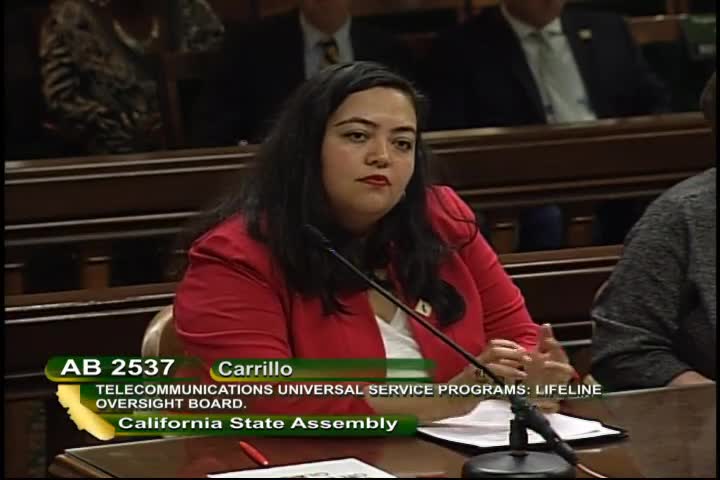
- Related Legislation: AB 2537 (Carrillo) of 2018 establishes the Lifeline Oversight Board to advise the CPUC on the California Lifeline Program. Status: Pending in the Assembly Committee on Communications and Conveyance.
AB 2652 (Quirk) of 2018 requires the CPUC to adopt a portability freeze and a rule to improve the cost-effectiveness of the delivery of the California LifeLine Program. Status: Pending in the Assembly Committee on Communications and Conveyance.
- Previous Legislation: AB 2570 (Quirk) of 2016 required the CPUC to adopt a portability freeze rule for the California LifeLine Program that limits the ability of subscribers to change services. Status: Chaptered by the Secretary of State, Chapter 577, Statutes of 2016.
AB 2213 (Fuentes) of 2010 replaced the definition of “residential” for California’s low-income residential telephone service with a definition of “household” and defines household as a residential dwelling that is the principal place of residence of the lifeline telephone service subscriber. Status: Chaptered by the Secretary of State, Chapter 381, Statutes of 2010.
SB 742 (Escutia) of 2001 provided for an orderly transition of the Universal Service Telephone Programs, including the Universal Lifeline Telephone Service Program, to state fiscal and budgetary control. Status: Chaptered by the Secretary of State, Chapter 118, Statutes of 2001.
SB 669 (Polanco) of 1999 codified six existing CPUC advisory boards, including the ULTSAC, and requires the CPUC to administer the revenues used to fund the boards’ activities. Status: Chaptered by the Secretary of State, Chapter 677, Statutes of 1999.
REGISTERED SUPPORT / OPPOSITION:
Support
TruConnect
Opposition
None on file.
Analysis Prepared by: Edmond Cheung / C. & C. / (916) 319-2637
Discussed in Hearing
 5MIN
Assembly Standing Committee on Communications and Conveyance
Bill Author

Bill Co-Author(s):