SB 1414: Timber harvesting plans: San Jose Water Company.
- Session Year: 2017-2018
- House: Senate
- Latest Version Date: 2018-05-01
The Zberg-Nejedly Forest Practices Practice Act of 1973 prohibits a person from conducting timber operations, as defined, unless a timber harvesting plan prepared by a registered professional forester for those operations has been submitted to the Department of Forestry and Fire Protection. Existing law requires the department to review, approve, require the modification of, or disapprove timber harvesting plans in accordance with prescribed procedures.
This bill would require the department to ensure that, before the approval of a timber harvesting plan or an associated permit on lands owned by the San Jose Water Company, the San Jose Water Company conducts 3 2 public hearings on the timber harvesting plan or associated permit, the Midpeninsula Regional Open Space District publicly reviews the timber harvesting plan or associated permit and adopts a resolution that timber harvesting would result in no significant impacts to public lands, is a member of the interagency review team for any timber harvesting document proposed by the San Jose Water Company, and the County of Santa Clara, the County of Santa Cruz, Clara and the appropriate regional water quality control boards each conducts conduct a public hearing on the timber harvesting plan or associated permit. The bill would repeal these provisions on January 1, 2038.
This bill would make legislative findings and declarations as to the necessity of a special statute for the Counties of Santa Clara and Santa Cruz.
The Zberg-Nejedly Forest Practices Act of 1973 prohibits a person from conducting timber operations, as defined, unless a timber harvesting plan prepared by a registered professional forester for those operations has been submitted to the Department of Forestry and Fire Protection. Existing law requires the department to review, approve, require the modification of, or disapprove timber harvesting plans in accordance with prescribed procedures.
This bill would require the department to ensure that, before the approval of a timber harvesting plan or an associated permit on lands owned by the San Jose Water Company, the San Jose Water Company conducts 3 public hearings on the timber harvesting plan or associated permit, the Midpeninsula Regional Open Space District publicly reviews the timber harvesting plan or associated permit and adopts a resolution that timber harvesting would result in no significant impacts to public lands, and the County of Santa Clara, the County of Santa Cruz, and the appropriate regional water quality control boards each conducts a public hearing on the timber harvesting plan or associated permit. The bill would repeal these provisions on January 1, 2038.
This bill would make legislative findings and declarations as to the necessity of a special statute for the Counties of Santa Clara and Santa Cruz.
Existing law required, on or before July 1, 2014, the governing boards of school districts and county boards of education to adopt a local control and accountability plan using a state template adopted by the State Board of Education. Existing law requires the local control and accountability plan to include, among other things, a description of annual goals for all pupils and specified subgroups of pupils to be achieved for each state priority, as specified, and a description of the specific actions the school district or county superintendent of schools will take to achieve those goals. Existing law required the state board, on or before October 1, 2016, to adopt evaluation rubrics to, among other things, assist a school district, county office of education, or charter school in evaluating its strengths, weaknesses, and areas that require improvement.This bill would make nonsubstantive changes to the provision requiring the state board to adopt evaluation rubrics.Existing law required, on or before July 1, 2014, the governing boards of school districts and county boards of education to adopt a local control and accountability plan using a state template adopted by the State Board of Education. Existing law requires the local control and accountability plan to include, among other things, a description of annual goals for all pupils and specified subgroups of pupils to be achieved for each state priority, as specified, and a description of the specific actions the school district or county superintendent of schools will take to achieve those goals. Existing law required the state board, on or before October 1, 2016, to adopt evaluation rubrics to, among other things, assist a school district, county office of education, or charter school in evaluating its strengths, weaknesses, and areas that require improvement.
This bill would make nonsubstantive changes to the provision requiring the state board to adopt evaluation rubrics.
The Legislature finds and declares all of the following:
(a)The Upper Guadalupe, Los Gatos Creek, and Saratoga Creek watersheds are located in the Santa Cruz Mountains.
(b)Together, these watersheds provide water to one of the most populous areas in California. Their importance led the Association of Bay Area Governments to designate portions of the watersheds a Priority Conservation Area in recognition of their ecological value.
(c)The habitat located in the watersheds includes several listed species under Article 1 (commencing with Section 2050) of Chapter 1.5 of Division 3 of the Fish and Game Code and the federal Endangered Species Act (16 U.S.C. Sec. 1531 et seq.), including the Bay Checkerspot Butterfly and the California Red-legged Frog.
(d)The watersheds serve as a natural corridor for many species, including mountain lions, that roam beyond the San Francisco Peninsula.
(e)The watersheds contain large amounts of serpentine soils that support a high diversity of native plants, including a unique chaparral ecosystem that supports rare and endangered plant species.
(f)The watersheds are also located in the Southern Subdistrict of the Coast Forest District, which has been identified as extremely fire-prone.
(g)Provided the increasing impact of extreme weather and drought, the area is and will continue to be extremely fire-prone.
(h)The private watershed lands owned by the San Jose Water Company are located in these important watersheds and provide critical habitat and water quality benefits, as well as significant potential fire risk if not managed appropriately by a public agency.
(i)The San Jose Water Companys holdings replenish Lake Elsman, a 6,200-acre-foot reservoir that is also fed by Los Gatos Creek and impacts the nearby public lands.
(j)The San Jose Water Companys holdings include 96 parcels, equaling approximately 6,300 acres, and is surrounded by over 20,0000 20,000 acres managed by the Midpeninsula Regional Open Space District, over 52,000 acres managed by the Santa Clara County parks system, 10 reservoirs managed by the Santa Clara Valley Water District, and thousands of acres of state park properties.
(k)The potential for commercial timber harvests in this area greatly impacts water quality and supply, fire management, critical species, and Californias efforts to reduce greenhouse gas emissions by eliminating pristine redwood trees.
(l)The potential for commercial timber harvests would also significantly impact publicly protected lands that surround the San Jose Water Companys holdings, impacting millions of nearby Californians.
(m)Past timber harvest applications on this property generated a great deal of public interest and concern regarding the public benefits associated with the property and how those public benefits might be negatively impacted.
(n)Given the potential for the significant damage to the publicly owned parcels, the negative impacts of commercial harvest in this area need to be carefully examined to ensure they do not damage water quality, erode fire suppression and prevention efforts, or frustrate conservation priorities, including preserving critical habitat for wildlife and fish populations. It is the intent of the Legislature to establish safeguards to ensure the public interest and mitigate harm before timber harvesting.
(o)The transfer of the San Jose Water Companys properties to the Midpeninsula Regional Open Space District pursuant to Section 5540.2 of the Public Resources Code provides the best opportunity to address the fire, water quality, and habitat values of the properties.
SEC. 2.Section 4584.8 is added to the Public Resources Code, to read:4584.8.(a)(1)The department shall ensure that the approval of a timber harvesting plan and associated permits pursuant to this chapter article and Article 7.5 (commencing with Section 4593) on lands owned by the San Jose Water Company shall occur only after adequate public review, as described in this section.
(2)Any such timber harvesting plan or associated permit shall be based on thinning overly stocked areas to reduce wildfire risk or to enable larger and more fire-resistant trees to grow and sequester carbon. The San Jose Water Company shall manage its timberlands in an integrated manner so as to accomplish both of these goals.
(b)At a minimum, the department shall ensure that, before the approval of a timber harvesting plan or an associated permit on lands owned by the San Jose Water Company, all of the following occur:
(1)The San Jose Water Company conducts three two public hearings on the timber harvesting plan or associated permit.
(2)The Midpeninsula Regional Open Space District publicly reviews the timber harvesting plan or associated permit and adopts a resolution that timber harvesting would result in no significant impacts to public lands.(2)Notwithstanding any other law, the Midpeninsula Regional Open Space District is a member of the interagency review team for any timber harvesting document proposed by the San Jose Water Company. The department shall resolve any concerns presented by the district and present the resolution of those concerns at a public meeting of the Santa Clara County Board of Supervisors.
(3)Each of the following entities conducts a public hearing on the timber harvesting plan or associated permit:
(A)The County of Santa Clara.
(B)The County of Santa Cruz.(C)(B)The appropriate regional water quality control boards.
(c)This section shall not apply to any lands sold to the Midpeninsula Regional Open Space District pursuant to Section 5540.2.
(d)Section 4601 shall not apply to this section.(e)This section shall remain in effect only until January 1, 2038, and as of that date is repealed.SEC. 3.The Legislature finds and declares that a special statute is necessary and that a general statute cannot be made applicable within the meaning of Section 16 of Article IV of the California Constitution because of the unique circumstances in the Counties of Santa Clara and Santa Cruz regarding the need to protect water quality, improve fire suppression and prevention efforts, and preserve critical habitat for wildlife and fish populations in the Upper Guadalupe, Los Gatos Creek, and Saratoga Creek watersheds.
The Legislature finds and declares all of the following:
(a)The Upper Guadalupe, Los Gatos Creek, and Saratoga Creek watersheds are located in the Santa Cruz Mountains.
(b)Together, these watersheds provide water to one of the most populous areas in California. Their importance led the Association of Bay Area Governments to designate portions of the watersheds a Priority Conservation Area in recognition of their ecological value.
(c)The habitat located in the watersheds includes several listed species under Article 1 (commencing with Section 2050) of Chapter 1.5 of Division 3 of the Fish and Game Code and the federal Endangered Species Act (16 U.S.C. Sec. 1531 et seq.), including the Bay Checkerspot Butterfly and the California Red-legged Frog.
(d)The watersheds serve as a natural corridor for many species, including mountain lions, that roam beyond the San Francisco Peninsula.
(e)The watersheds contain large amounts of serpentine soils that support a high diversity of native plants, including a unique chaparral ecosystem that supports rare and endangered plant species.
(f)The watersheds are also located in the Southern Subdistrict of the Coast Forest District, which has been identified as extremely fire-prone.
(g)Provided the increasing impact of extreme weather and drought, the area is and will continue to be extremely fire-prone.
(h)The private watershed lands owned by the San Jose Water Company are located in these important watersheds and provide critical habitat and water quality benefits, as well as significant potential fire risk if not managed appropriately by a public agency.
(i)The San Jose Water Companys holdings replenish Lake Elsman, a 6,200-acre-foot reservoir that is also fed by Los Gatos Creek and impacts the nearby public lands.
(j)The San Jose Water Companys holdings include 96 parcels, equaling approximately 6,300 acres, and is surrounded by over 20,0000 acres managed by the Midpeninsula Regional Open Space District, over 52,000 acres managed by the Santa Clara County parks system, 10 reservoirs managed by the Santa Clara Valley Water District, and thousands of acres of state park properties.
(k)The potential for commercial timber harvests in this area greatly impacts water quality and supply, fire management, critical species, and Californias efforts to reduce greenhouse gas emissions by eliminating pristine redwood trees.
(l)The potential for commercial timber harvests would also significantly impact publicly protected lands that surround the San Jose Water Companys holdings, impacting millions of nearby Californians.
(m)Past timber harvest applications on this property generated a great deal of public interest and concern regarding the public benefits associated with the property and how those public benefits might be negatively impacted.
(n)Given the potential for the significant damage to the publicly owned parcels, the negative impacts of commercial harvest in this area need to be carefully examined to ensure they do not damage water quality, erode fire suppression and prevention efforts, or frustrate conservation priorities, including preserving critical habitat for wildlife and fish populations. It is the intent of the Legislature to establish safeguards to ensure the public interest and mitigate harm before timber harvesting.
(o)The transfer of the San Jose Water Companys properties to the Midpeninsula Regional Open Space District pursuant to Section 5540.2 of the Public Resources Code provides the best opportunity to address the fire, water quality, and habitat values of the properties.
SEC. 2.Section 4584.8 is added to the Public Resources Code, to read:4584.8.(a)The department shall ensure that the approval of a timber harvesting plan and associated permits pursuant to this chapter on lands owned by the San Jose Water Company shall occur only after adequate public review, as described in this section.
(b)At a minimum, the department shall ensure that, before the approval of a timber harvesting plan or an associated permit on lands owned by the San Jose Water Company, all of the following occur:
(1)The San Jose Water Company conducts three public hearings on the timber harvesting plan or associated permit.
(2)The Midpeninsula Regional Open Space District publicly reviews the timber harvesting plan or associated permit and adopts a resolution that timber harvesting would result in no significant impacts to public lands.
(3)Each of the following entities conducts a public hearing on the timber harvesting plan or associated permit:
(A)The County of Santa Clara.
(B)The County of Santa Cruz.
(C)The appropriate regional water quality control boards.
(c)This section shall not apply to any lands sold to the Midpeninsula Regional Open Space District pursuant to Section 5540.2.
(d)Section 4601 shall not apply to this section.
(e)This section shall remain in effect only until January 1, 2038, and as of that date is repealed.
SEC. 3.The Legislature finds and declares that a special statute is necessary and that a general statute cannot be made applicable within the meaning of Section 16 of Article IV of the California Constitution because of the unique circumstances in the Counties of Santa Clara and Santa Cruz regarding the need to protect water quality, improve fire suppression and prevention efforts, and preserve critical habitat for wildlife and fish populations in the Upper Guadalupe, Los Gatos Creek, and Saratoga Creek watersheds.
SECTION 1.Section 52064.5 of the Education Code is amended to read:52064.5.(a)On or before October 1, 2016, the state board shall adopt evaluation rubrics for all of the following purposes:(1)To assist a school district, county office of education, or charter school in evaluating its strengths, weaknesses, and areas that require improvement.(2)To assist a county superintendent of schools in identifying the school districts and charter schools in need of technical assistance pursuant to Section 52071 or 47607.3, as applicable, and the specific priorities upon which the technical assistance should be focused.(3)To assist the Superintendent in identifying the school districts for which intervention pursuant to Section 52072 is warranted.(b)The evaluation rubrics shall reflect a holistic, multidimensional assessment of school district and individual schoolsite performance and shall include all of the state priorities described in subdivision (d) of Section 52060.(c)As part of the evaluation rubrics, the state board shall adopt standards for school district and individual schoolsite performance and expectations for improvement in regard to each of the state priorities described in subdivision (d) of Section 52060.(a)On or before October 1, 2016, the state board shall adopt evaluation rubrics for all of the following purposes:
(1)To assist a school district, county office of education, or charter school in evaluating its strengths, weaknesses, and areas that require improvement.
(2)To assist a county superintendent of schools in identifying the school districts and charter schools in need of technical assistance pursuant to Section 52071 or 47607.3, as applicable, and the specific priorities upon which the technical assistance should be focused.
(3)To assist the Superintendent in identifying the school districts for which intervention pursuant to Section 52072 is warranted.
(b)The evaluation rubrics shall reflect a holistic, multidimensional assessment of school district and individual schoolsite performance and shall include all of the state priorities described in subdivision (d) of Section 52060.
(c)As part of the evaluation rubrics, the state board shall adopt standards for school district and individual schoolsite performance and expectations for improvement in regard to each of the state priorities described in subdivision (d) of Section 52060.
|
Date
|
Status
|
|---|---|
| May 25, 2018 | May 25 hearing: Held in committee and under submission. |
| May 23, 2018 | Set for hearing May 25. |
| May 22, 2018 | May 22 hearing: Placed on APPR. suspense file. |
| May 15, 2018 | Set for hearing May 22. |
| May 14, 2018 | May 14 hearing postponed by committee. |
| May 4, 2018 | Set for hearing May 14. |
| May 1, 2018 | Read second time and amended. Re-referred to Com. on APPR. |
| Apr 30, 2018 | From committee: Do pass as amended and re-refer to Com. on APPR. (Ayes 7. Noes 2.) (April 24). |
| Apr 10, 2018 | Set for hearing April 24. |
| Apr 4, 2018 | Re-referred to Com. on N.R. & W. |
| Mar 22, 2018 | From committee with author's amendments. Read second time and amended. Re-referred to Com. on RLS. |
| Mar 8, 2018 | Referred to Com. on RLS. |
| Feb 20, 2018 | From printer. May be acted upon on or after March 22. |
| Feb 16, 2018 | Introduced. Read first time. To Com. on RLS. for assignment. To print. |
|
Date
|
Description
|
Location
|
Votes
|
|
|---|---|---|---|---|
| May 22, 2018 | Placed on suspense file | Senate Standing Committee on Appropriations |
Passed |
|
| Apr 24, 2018 | Do pass as amended, but first amend, and re-refer to the Committee on [Appropriations] | Senate Standing Committee on Natural Resources and Water |
Passed |
This list shows positions taken on this bill by organizations on the date displayed, which is linked to the original source.
Positions by individuals are not included.
|
Organization
|
Position
|
Date
|
|---|---|---|
| Board of Supervisors of Santa Clara County | * Support | Apr 24, 2018 |
| California Chamber Of Commerce | * Against | Apr 24, 2018 |
| California Farm Bureau Federation | * Against | Apr 24, 2018 |
| California Forestry Association | ** Against | Apr 19, 2018 |
| California Licensed Foresters Assoaciation | * Against | Apr 24, 2018 |
| California Licensed Foresters Association | ** Against | Apr 19, 2018 |
| County of Santa Clara | ** Support | Apr 19, 2018 |
| Forest Landowners Of California | ** Against | Apr 19, 2018 |
| Humboldt and Mendocino Redwood Companies | ** Against | Apr 19, 2018 |
| San Jose Water Company | * Against | Apr 24, 2018 |
SENATE COMMITTEE ON APPROPRIATIONS
Senator Ricardo Lara, Chair
2017 - 2018 Regular Session
SB 1414 (Beall) - Timber harvesting plans: San Jose Water Company
Version: May 1, 2018 | Policy Vote: N.R. & W. 7 - 2 |
Urgency: No | Mandate: No |
Hearing Date: | Consultant: Narisha Bonakdar |
This bill meets the criteria for referral to the Suspense File.
Bill Summary:
SB 1414 would require the Department of Forestry and Fire Protection (Cal Fire) to ensure specified conditions are met before the approval of a timber harvesting plan on lands owned by the San Jose Water Company, except for land that is sold to the Midpeninsula Regional Open Space District.
Fiscal Impact:
Approximately $140,000 in 2018-19 and $128,000 in 2019-20 in costs to Cal Fire to promulgate regulations to enact a new system for a timber harvest plan review for projects located on lands owned by the San Jose Water Company. (General Fund)
Background:
The Z’berg-Nejedly Forest Practice Act of 1973 prohibits a person from conducting timber operations, as defined, unless a timber harvesting plan prepared by a registered professional forester for those operations has been submitted to Cal Fire, which must review the plan and approve, require the modification of, or disapprove it in accordance with prescribed procedures.
The San Jose Water Company is an investor-owned public utility that supplies water to over one million people in the greater-San Jose metropolitan area. It owns approximately 6,300 acres of watershed land in the Upper Guadalupe, Los Gatos Creek, and Saratoga Creek Watersheds. More specifically, the San Jose Water Company owns over 1,000 acres of redwood forest, which encompass some of the largest watersheds in the San Francisco Bay Area. Runoff from the watershed replenishes Lake Elsman, a large reservoir that also is fed by Los Gatos Creek. These watershed lands are located in the Critical Linkages Conceptual Area Protection Plan and contain wildlife corridors, critical habitat, valuable species, and water supply to nearby populations. The property is surrounded by publicly protected-lands, including over 20,000 acres owned by the Midpeninsula Regional Open Space District, over 52,000 acres owned by the Santa Clara County Parks system, ten reservoirs managed by the Santa Clara Valley Water District, and thousands of acres of state park properties.
Proposed Law:
This bill would:
- Require Cal Fire to ensure that, before the approval of a timber harvesting plan or an associated permit on lands owned by the San Jose Water Company, the San Jose Water Company conducts two public hearings on the timber harvesting plan or associated permit
- Require the Midpeninsula Regional Open Space District is a member of the interagency review team for any timber harvesting document proposed by the San Jose Water Company
- Require the County of Santa Clara and the appropriate regional water quality control boards each conduct a public hearing on the timber harvesting plan or associated permit.
- Provide that the requirements listed above do not apply to any lands sold to the Midpeninsula Regional Open Space District.
- Make specified legislative findings and declarations.
-- END --
SENATE COMMITTEE ON NATURAL RESOURCES AND WATER
Senator Robert Hertzberg, Chair
2017 - 2018 Regular
Bill No: SB Hearing Date: April 24, 2018
Author: | Beall | ||
Version: | March 22, 2018 | ||
Urgency: | No | Fiscal: | Yes |
Consultant: | William Craven | ||
Subject: Timber harvesting plans: San Jose Water Company
BACKGROUND AND EXISTING LAW
Pursuant to the Z’Berg-Nejedly Forest Practice Act (FPA):
- Prohibits timber operations unless a timber harvest plan (THP) has been prepared by a registered professional forester (RPF) and approved by the Department of Forestry and Fire Protection (department).
- Considers a THP the functional equivalent of an environmental impact report (EIR) under the California Environmental Quality Act (CEQA) with requirements for multiagency comment and review and public participation.
- Requires a THP to contain a description of the location of the planned harvest, the harvest method, measures to avoid excessive erosion, timeframe of operations, and other information required by statute as well as the forest practices that are proposed. This includes a pre-harvest inspection when required, notice to landowners within 300 feet, and required completion reports and re-stocking the area.
- Establishes as part of the approval process a multi-agency review team that includes the Department of Fish and Wildlife, California Geologic Survey, and regional water quality control boards.
- Authorizes counties to petition the Board of Forestry (board) to establish county timber harvest rules. Santa Cruz and Santa Clara counties have had county rules for an extended period of time both of which may involve local permits and public hearings as specified.
- Authorizes Working Forest Management Plans as a way for landowners of up to 15000 acres to obtain a permit for harvesting timber that forecloses clearcutting and establishes other conditions. This procedure is not applicable in the southern sub-district (Santa Cruz, San Mateo, and Santa Clara counties) because this area of the state is more urbanized and long-term plans do not provide adequate opportunities for public comment as do individual plans.
PROPOSED LAW
This bill:
- Contains several findings regarding the importance of the Upper Guadalupe, Los Gatos Creek, and Saratogo Creek watersheds that are located in the Santa Cruz Mountains.
- Notes that this region has been designated by the Association of Bay Area Governments to designate portions of these watersheds as a “priority conservation area.”
- Contains information pertaining to the species that are listed under the California Endangered Species Act including the Bay Checkerspot Butterfly and the California Red-legged Frog, as well as a natural corridor for many species including mountain lions, and a very high diversity of native and rare plant species.
- Notes that these watersheds are located in the Southern Subdistrict of the Coast Forest District which has been identified as extremely fire-prone.
- States that the privately owned watershed lands owned by the San Jose Water Company (company) provide important public water quality benefits as well as critical habitat as well as potential fire risk if not managed appropriately by a public agency.
- States that the company owns approximately 6,300 acres and is surrounded by more than 20,000 acres managed by the Midpeninsula Regional Open Space District, more than 52,000 acres managed by the Santa Clara Valley Water District, and thousands of acres of state park properties.
- States that the potential of commercial timber harvesting greatly impacts water quality, fire management, protected species, and California’s efforts to reduce greenhouse gas emissions by eliminating pristine redwood trees.
- States that commercial timber harvests would also significantly affect publicly protected lands that surround the company’s holdings, impacting millions of nearby Californians.
- Notes the significant public interest in past timber harvest applications on the property owned by the company.
- States that the potential for significant damage to publicly owned parcels, that the negative impacts of commercial timber harvest need to be carefully examined to ensure water quality, erode fire suppression and prevention efforts, or frustrate conservation priorities.
- States legislative intent that the transfer of the company’s land to the Midpeninsula Regional Open Space District provides the best opportunity to address the fire, water quality, and habitat values of the property.
- Requires the company to hold 3 public hearings before the approval of a THP or associated permits on lands it owns.
- Requires the Midpeninsula Regional Open Space District to publicly review a proposed THP and adopt a resolution that the harvest would result in no significant impact to public lands.
- Require the Counties of Santa Clara and Santa Cruz and the regional water quality control board each to conduct a public hearing.
- Provides that points 12-14 do not apply to lands sold to the Midpeninsula Regional Open Space District.
- Proposes to sunset these provisions on 1/1/38.
ARGUMENTS IN SUPPORT
According to the author, the lands owned by the company are in an urbanized area where the protection of public values requires additional public review. The author states that the area is far more urban than the typically more rural areas where THPs are normally implemented. Historically, timber harvest applications on this property generated significant public interest and concern.
The area is designated a high hazard fire severity zone according to the author.
This bill safeguards the public’s interest by providing property owners and residents a forum to obtain information and provide input before any logging is approved in this vital watershed. A commercial timber harvest permit could significantly impact publicly protected lands that surround the company’s holdings, thereby affecting hundreds of thousands of nearby residents. Given the public safety risk, significant erosion, loss of redwood habitat, and reduction in carbon sequestration that would result from logging, additional public review is needed before the approval of any permit to harvest timber on the company’s lands in the Santa Cruz Mountains.
About 1900 acres of the land consists of redwood forest. Runoff from the watershed replenishes Lake Elsman, a large reservoir that is also fed by Los Gatos Creek. These watershed lands are located in the Critical Linkages Conceptual Area Protection Plan (CAPP) of the California Department of Fish and Wildlife and contain important wildlife corridors, critical habitat, valuable species, and water supply to nearby populations.
The County of Santa Clara is in support of the bill. The county said that commercial timber harvests would greatly impact water quality and storage, fire management, critical species, and efforts to reduce greenhouse gas emissions.
ARGUMENTS IN OPPOSITION
The company is opposed to the bill for several reasons:
- It considers the bill unnecessary since none of its lands are currently subject to a THP.
- It considers the new provisions for any future THPs on land that it owns to be punitive and duplicative.
- It believes the bill overlooks existing law that recognizes the ability of counties to have local rules approved by the Board of Forestry which has occurred in both Santa Cruz and Santa Clara counties.
- It objects to the proposed role of the Midpeninsula Regional Open Space District regarding the adoption of a resolution declaring that a proposed THP has no significant impacts to public lands.
- It questions why the bill excludes any lands that may be transferred to Midpeninsula Regional Open Space District. It asks: If the protections imposed on the water company are important, then why aren’t they important if the land is transferred to the special district?
- Although mentioned above, the company’s letter goes to some length to argue that the legislation impermissibly singles out its property for disparate treatment.
- It also claims that the bill could result in a regulatory taking.
Several business and forestry-related interest groups also oppose the bill. They concur with the company on the argument that the bill is duplicative of existing law, and they are very concerned about a precedent with which they are in fundamental disagreement, specifically the ability of a special district to essentially veto a THP by not issuing a required resolution that the THP would result in no significant impact on public lands.
The California Forestry Association and several other opponents’ letters recite the various regulatory steps involved in the THP process, including the existing regulations for the Southern Sub-District (that includes Santa Cruz and Santa Clara counties) where certain aspects of the Forest Practice Rules are more restrictive than those that otherwise apply statewide.
COMMENTS
- This bill is a work in progress and it is likely that the Committee will want to see the bill again assuming it is substantially changed after it leaves this Committee.
- There is not much middle ground between the author and the opposition so Committee staff is making a series of recommendations that address some of the concerns of the opposition, while at the same time making recommendations that address the author’s central concerns.
- As currently drafted, the bill applies only to timber harvest plans and associated permits. It does not cover non-industrial timber management plans which should also be covered in the event these lands are ever covered by that form of a timber harvesting document. Amendment 1.
- Assuming some timber harvesting may be necessary to thin overly-stocked areas to reduce wildfire risk or to enable larger and more fire-resistant trees to grow and sequester carbon, the bill should make it clear that only that type of timber harvesting is allowable. This will minimize, but not entirely eliminate, commercial harvest of larger trees. Language should be added restricting timber harvest for these purposes. The proposed language is placeholder language for this purpose and the Committee recognizes that it may change going forward. Amendment 2.
- Staff recommends reducing the number of hearings required of the San Jose Water Company to two. Amendment 3.
- Staff recommends that the provision relating to the Midpeninsula Open Space District adopting a resolution that timber harvesting would result in no significant impacts to public lands be deleted. At the same time, it is common in the approval process for THPs for the multi-agency review process to occur and for the comments of those reviewing agencies to be given great weight in the conditions that attach to a THP. In some cases, a review agency may even be able to recommend disapproval of a THP. Staff recommends adding a provision that the Midpeninsula Open Space District be added as a review team member for THPs applied for by the company and that CDF must resolve any concerns raised by the district and that a resolution of those concerns is presented at a public hearing of the Santa Clara County Board of Supervisors. Amendment 4.
- Staff recommends that the public hearing of the Santa Cruz Board of Supervisors be dropped since the Committee has been advised that none of the San Jose Water Company’s land is located in that county. Amendment 5.
- Staff recommends that the public hearing requirement of the regional water quality control board be deleted since that board is already a member of the review team. The regional board, under existing law, must find that the THP will not result in a discharge to an impaired watercourse, and will not violate the regional water quality control plan. Amendment 6.
- Staff recommends restoring the penalty provisions of Public Resources Code 4601. Amendment 6.
- Staff recommends deleting the 20-year sunset. Whatever the provisions of this bill turn out to be, there should either be no sunset or a much shorter one. Amendment 7.
- This is a matter that can be negotiated as this bill moves forward and the outcome may be very different than what is in the bill as it leaves this Committee. The Committee requests that it be kept informed of discussions as they occur and reserves the right to bring the bill back for further review.
SUGGESTED AMENDMENTS
AMENDMENT 1
Page 4, line 15. Delete “chapter’” and add “Article 7 and Article 7.5
AMENDMENT 2
Page 4, line 17. Any such timber harvest plan or associated permit shall be based on thinning overly-stocked areas to reduce wildfire risk or to enable larger and more fire-resistant trees to grow and sequester carbon. The company shall manage its timberlands in an integrated manner so as to accomplish both of these goals.
AMENDMENT 3
Page 4, line 22. Change 3 to 2.
AMENDMENT 4
Page 4, lines 24-27. Draft language consistent with Comment 6.
AMENDMENT 5
Page 4, line 31. Delete.
AMENDMENT 6.
Page 4, line 36. Delete.
AMENDMENT 7.
Page 4, line 37-38. Delete.
SUPPORT
County of Santa Clara
OPPOSITION
California Chamber of Commerce
California Farm Bureau Federation
California Forestry Association
California Licensed Foresters Association
Forest Landowners of California
Humboldt and Mendocino Redwood Companies
San Jose Water Company
-- END --
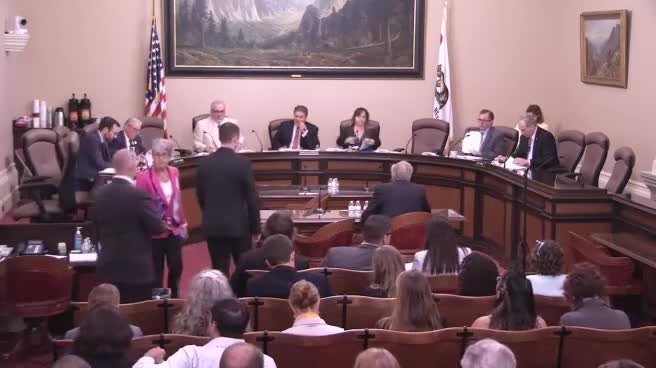
Discussed in Hearing
 26MIN
Senate Standing Committee on Natural Resources and Water
Bill Author

Bill Co-Author(s):