SCA 20: Local sales taxes: online sales.
- Session Year: 2017-2018
- House: Senate
- Latest Version Date: 2018-04-23
The Bradley-Burns Uniform Local Sales and Use Tax Law authorizes counties and cities to impose a local sales and use tax in accordance with that law for tangible personal property sold at retail in the county or city, or purchased for storage, use, or other consumption in the county or city. Existing law requires the city tax rate to be credited against the county rate so that the combined rate does not exceed 1.25%. Existing law requires the county or city to contract with the California Department of Tax and Fee Administration for the administration of the taxes and requires the department to transmit those taxes to the city or county.
The Bradley-Burns Uniform Local Sales and Use Tax Law provides that for the purpose of a local sales tax adopted pursuant to that law, all retail sales are consummated at the place of business of the retailer, unless otherwise specified. Existing law provides that these local sales taxes are allocated to the place where the sale is deemed to take place.
The California Constitution prohibits the Legislature from enacting a statute that would change the method of distributing revenues derived under the Bradley-Burns Uniform Local Sales and Use Tax Law, as that law read on November 3, 2004, except the Legislature may change that law by statute to allow the state to participate in an interstate compact or to comply with federal law.
This measure would provide that, on and after January 1, 2020, for the purpose of distributing the revenues derived under a sales tax imposed pursuant to the Bradley-Burns Uniform Local Sales and Use Tax Law, the retail sale of tangible personal property by a qualified retailer, as defined, that is transacted online is instead consummated at the point of the delivery of that tangible personal property to the purchasers address or to any other delivery address designated by the purchaser.
This bill, on and after January 1, 2020, would allow the Legislature to change by statute the method of distributing the revenues derived under a sales tax imposed pursuant to the Bradley-Burns Uniform Local Sales and Use Tax Law for the sale of tangible personal property by a qualified retailer that is transacted online.The Bradley-Burns Uniform Local Sales and Use Tax Law authorizes counties and cities to impose a local sales and use tax in accordance with that law for tangible personal property sold at retail in the county or city, or purchased for storage, use, or other consumption in the county or city. Existing law requires the city tax rate to be credited against the county rate so that the combined rate does not exceed 1.25%. Existing law requires the county or city to contract with the California Department of Tax and Fee Administration for the administration of the taxes and requires the department to transmit those taxes to the city or county.
The Bradley-Burns Uniform Local Sales and Use Tax Law provides that for the purpose of a local sales tax adopted pursuant to that law, all retail sales are consummated at the place of business of the retailer, unless otherwise specified. Existing law provides that these local sales taxes are allocated to the place where the sale is deemed to take place.
The California Constitution prohibits the Legislature from enacting a statute that would change the method of distributing revenues derived under the Bradley-Burns Uniform Local Sales and Use Tax Law, as that law read on November 3, 2004, except the Legislature may change that law by statute to allow the state to participate in an interstate compact or to comply with federal law.
This bill, on and after January 1, 2020, would allow the Legislature to change by statute the method of distributing the revenues derived under a sales tax imposed pursuant to the Bradley-Burns Uniform Local Sales and Use Tax Law for the sale of tangible personal property by a qualified retailer that is transacted online.
Resolved by the Senate, the Assembly concurring, That the Legislature of the State of California at its 201718 Regular Session commencing on the fifth day of December 2016, two-thirds of the membership of each house concurring, hereby proposes to the people of the State of California, that the Constitution of the State be amended as follows:
(a)On or after November 3, 2004, the Legislature shall not enact a statute to do any of the following:
(1)(A)Except as otherwise provided in subparagraph (B), modify the manner in which ad valorem property tax revenues are allocated in accordance with subdivision (a) of Section 1 of Article XIIIA so as to reduce for any fiscal year the percentage of the total amount of ad valorem property tax revenues in a county that is allocated among all of the local agencies in that county below the percentage of the total amount of those revenues that would be allocated among those agencies for the same fiscal year under the statutes in effect on November 3, 2004. For purposes of this subparagraph, percentage does not include any property tax revenues referenced in paragraph (2).
(B)In the 200910 fiscal year only, and except as otherwise provided in subparagraph (C), subparagraph (A) may be suspended for that fiscal year if all of the following conditions are met:
(i)The Governor issues a proclamation that declares that, due to a severe state fiscal hardship, the suspension of subparagraph (A) is necessary.
(ii)The Legislature enacts an urgency statute, pursuant to a bill passed in each house of the Legislature by rollcall vote entered in the journal, two-thirds of the membership concurring, that contains a suspension of subparagraph (A) for that fiscal year and does not contain any other provision.
(iii)No later than the effective date of the statute described in clause (ii), a statute is enacted that provides for the full repayment to local agencies of the total amount of revenue losses, including interest as provided by law, resulting from the modification of ad valorem property tax revenue allocations to local agencies. This full repayment shall be made not later than the end of the third fiscal year immediately following the fiscal year to which the modification applies.
(C)A suspension of subparagraph (A) shall not result in a total ad valorem property tax revenue loss to all local agencies within a county that exceeds 8 percent of the total amount of ad valorem property tax revenues that were allocated among all local agencies within that county for the fiscal year immediately preceding the fiscal year for which subparagraph (A) is suspended.
(2)(A)Except as otherwise provided in subparagraphs (B) and (C) and in subdivision (b), restrict the authority of a city, county, or city and county to impose a tax rate under, or change the method of distributing revenues derived under, the Bradley-Burns Uniform Local Sales and Use Tax Law set forth in Part 1.5 (commencing with Section 7200) of Division 2 of the Revenue and Taxation Code, as that law read on November 3, 2004. The restriction imposed by this subparagraph also applies to the entitlement of a city, county, or city and county to the change in tax rate resulting from the end of the revenue exchange period, as defined in Section 7203.1 of the Revenue and Taxation Code as that section read on November 3, 2004.
(B)The Legislature may change by statute the method of distributing the revenues derived under a use tax imposed pursuant to the Bradley-Burns Uniform Local Sales and Use Tax Law to allow the State to participate in an interstate compact or to comply with federal law.
(C)The Legislature may authorize by statute two or more specifically identified local agencies within a county, with the approval of the governing body of each of those agencies, to enter into a contract to exchange allocations of ad valorem property tax revenues for revenues derived from a tax rate imposed under the Bradley-Burns Uniform Local Sales and Use Tax Law. The exchange under this subparagraph of revenues derived from a tax rate imposed under that law shall not require voter approval for the continued imposition of any portion of an existing tax rate from which those revenues are derived.
(3)Except as otherwise provided in subparagraph (C) of paragraph (2), change for any fiscal year the pro rata shares in which ad valorem property tax revenues are allocated among local agencies in a county other than pursuant to a bill passed in each house of the Legislature by rollcall vote entered in the journal, two-thirds of the membership concurring. The Legislature shall not change the pro rata shares of ad valorem property tax pursuant to this paragraph, nor change the allocation of the revenues described in Section 15 of Article XI, to reimburse a local government when the Legislature or any state agency mandates a new program or higher level of service on that local government.
(4)Extend beyond the revenue exchange period, as defined in Section 7203.1 of the Revenue and Taxation Code as that section read on November 3, 2004, the suspension of the authority, set forth in that section on that date, of a city, county, or city and county to impose a sales and use tax rate under the Bradley-Burns Uniform Local Sales and Use Tax Law.
(5)Reduce, during any period in which the rate authority suspension described in paragraph (4) is operative, the payments to a city, county, or city and county that are required by Section 97.68 of the Revenue and Taxation Code, as that section read on November 3, 2004.
(6)Restrict the authority of a local entity to impose a transactions and use tax rate in accordance with the Transactions and Use Tax Law (Part 1.6 (commencing with Section 7251) of Division 2 of the Revenue and Taxation Code), or change the method for distributing revenues derived under a transaction and use tax rate imposed under that law, as it read on November 3, 2004.
(7)Require a community redevelopment agency (A) to pay, remit, loan, or otherwise transfer, directly or indirectly, taxes on ad valorem real property and tangible personal property allocated to the agency pursuant to Section 16 of Article XVI to or for the benefit of the State, any agency of the State, or any jurisdiction; or (B) to use, restrict, or assign a particular purpose for such taxes for the benefit of the State, any agency of the State, or any jurisdiction, other than (i) for making payments to affected taxing agencies pursuant to Sections 33607.5 and 33607.7 of the Health and Safety Code or similar statutes requiring such payments, as those statutes read on January 1, 2008, or (ii) for the purpose of increasing, improving, and preserving the supply of low and moderate income housing available at affordable housing cost.
(b)(1)On and after January 1, 2020, the Legislature may change by statute the method of distributing the revenues derived under a sales tax imposed pursuant to the Bradley-Burns Uniform Local Sales and Use Tax Law for the sale of tangible personal property by a qualified retailer that is transacted online.(b)(1)On and after January 1, 2020, for the purpose of distributing the revenues derived under a sales tax imposed pursuant to the Bradley-Burns Uniform Local Sales and Use Tax Law, the retail sale of tangible personal property by a qualified retailer that is transacted online is consummated at the point of the delivery of that tangible personal property to the purchasers address or to any other delivery address designated by the purchaser.
(2)A sale is transacted online if all of the following conditions are met:
(A)The purchasers order and payment for the sale and purchase of tangible personal property is transacted and completed on an Internet Web site or web-based application.
(B)The purchasers order and payment for the sale and purchase of tangible personal property is not initiated by the qualified retailer using the qualified retailers equipment at the qualified retailers place of business.
(C)The purchaser does not receive the tangible personal property at the qualified retailers place of business or at another location designated by the qualified retailer.
(3)Qualified retailer means a retailer whose total cumulative gross receipts from all of the retailers sales, within the preceding 12 months, of tangible personal property to purchasers in this state transacted online exceeds one hundred thousand dollars ($100,000).
(4)This subdivision shall not be interpreted to prevent a city, county, or city and county from entering into a contract pursuant to subdivision (b) of Section 29 to apportion between them the revenue derived from any sales tax or use tax imposed by them pursuant to the Bradley-Burns Uniform Local Sales and Use Tax Law.
(c)For purposes of this section, the following definitions apply:
(1)Ad valorem property tax revenues means all revenues derived from the tax collected by a county under subdivision (a) of Section 1 of Article XIIIA, regardless of any of this revenue being otherwise classified by statute.
(2)Local agency has the same meaning as specified in Section 95 of the Revenue and Taxation Code as that section read on November 3, 2004.
(3)Jurisdiction has the same meaning as specified in Section 95 of the Revenue and Taxation Code as that section read on November 3, 2004.
Resolved by the Senate, the Assembly concurring, That the Legislature of the State of California at its 201718 Regular Session commencing on the fifth day of December 2016, two-thirds of the membership of each house concurring, hereby proposes to the people of the State of California, that the Constitution of the State be amended as follows:
(a)On or after November 3, 2004, the Legislature shall not enact a statute to do any of the following:
(1)(A)Except as otherwise provided in subparagraph (B), modify the manner in which ad valorem property tax revenues are allocated in accordance with subdivision (a) of Section 1 of Article XIIIA so as to reduce for any fiscal year the percentage of the total amount of ad valorem property tax revenues in a county that is allocated among all of the local agencies in that county below the percentage of the total amount of those revenues that would be allocated among those agencies for the same fiscal year under the statutes in effect on November 3, 2004. For purposes of this subparagraph, percentage does not include any property tax revenues referenced in paragraph (2).
(B)In the 200910 fiscal year only, and except as otherwise provided in subparagraph (C), subparagraph (A) may be suspended for that fiscal year if all of the following conditions are met:
(i)The Governor issues a proclamation that declares that, due to a severe state fiscal hardship, the suspension of subparagraph (A) is necessary.
(ii)The Legislature enacts an urgency statute, pursuant to a bill passed in each house of the Legislature by rollcall vote entered in the journal, two-thirds of the membership concurring, that contains a suspension of subparagraph (A) for that fiscal year and does not contain any other provision.
(iii)No later than the effective date of the statute described in clause (ii), a statute is enacted that provides for the full repayment to local agencies of the total amount of revenue losses, including interest as provided by law, resulting from the modification of ad valorem property tax revenue allocations to local agencies. This full repayment shall be made not later than the end of the third fiscal year immediately following the fiscal year to which the modification applies.
(C)A suspension of subparagraph (A) shall not result in a total ad valorem property tax revenue loss to all local agencies within a county that exceeds 8 percent of the total amount of ad valorem property tax revenues that were allocated among all local agencies within that county for the fiscal year immediately preceding the fiscal year for which subparagraph (A) is suspended.
(2)(A)Except as otherwise provided in subparagraphs (B) and (C), (C) and in subdivision (b), restrict the authority of a city, county, or city and county to impose a tax rate under, or change the method of distributing revenues derived under, the Bradley-Burns Uniform Local Sales and Use Tax Law set forth in Part 1.5 (commencing with Section 7200) of Division 2 of the Revenue and Taxation Code, as that law read on November 3, 2004. The restriction imposed by this subparagraph also applies to the entitlement of a city, county, or city and county to the change in tax rate resulting from the end of the revenue exchange period, as defined in Section 7203.1 of the Revenue and Taxation Code as that section read on November 3, 2004.
(B)The Legislature may change by statute the method of distributing the revenues derived under a use tax imposed pursuant to the Bradley-Burns Uniform Local Sales and Use Tax Law to allow the State to participate in an interstate compact or to comply with federal law.
(C)The Legislature may authorize by statute two or more specifically identified local agencies within a county, with the approval of the governing body of each of those agencies, to enter into a contract to exchange allocations of ad valorem property tax revenues for revenues derived from a tax rate imposed under the Bradley-Burns Uniform Local Sales and Use Tax Law. The exchange under this subparagraph of revenues derived from a tax rate imposed under that law shall not require voter approval for the continued imposition of any portion of an existing tax rate from which those revenues are derived.
(3)Except as otherwise provided in subparagraph (C) of paragraph (2), change for any fiscal year the pro rata shares in which ad valorem property tax revenues are allocated among local agencies in a county other than pursuant to a bill passed in each house of the Legislature by rollcall vote entered in the journal, two-thirds of the membership concurring. The Legislature shall not change the pro rata shares of ad valorem property tax pursuant to this paragraph, nor change the allocation of the revenues described in Section 15 of Article XI, to reimburse a local government when the Legislature or any state agency mandates a new program or higher level of service on that local government.
(4)Extend beyond the revenue exchange period, as defined in Section 7203.1 of the Revenue and Taxation Code as that section read on November 3, 2004, the suspension of the authority, set forth in that section on that date, of a city, county, or city and county to impose a sales and use tax rate under the Bradley-Burns Uniform Local Sales and Use Tax Law.
(5)Reduce, during any period in which the rate authority suspension described in paragraph (4) is operative, the payments to a city, county, or city and county that are required by Section 97.68 of the Revenue and Taxation Code, as that section read on November 3, 2004.
(6)Restrict the authority of a local entity to impose a transactions and use tax rate in accordance with the Transactions and Use Tax Law (Part 1.6 (commencing with Section 7251) of Division 2 of the Revenue and Taxation Code), or change the method for distributing revenues derived under a transaction and use tax rate imposed under that law, as it read on November 3, 2004.
(7)Require a community redevelopment agency (A) to pay, remit, loan, or otherwise transfer, directly or indirectly, taxes on ad valorem real property and tangible personal property allocated to the agency pursuant to Section 16 of Article XVI to or for the benefit of the State, any agency of the State, or any jurisdiction; or (B) to use, restrict, or assign a particular purpose for such taxes for the benefit of the State, any agency of the State, or any jurisdiction, other than (i) for making payments to affected taxing agencies pursuant to Sections 33607.5 and 33607.7 of the Health and Safety Code or similar statutes requiring such payments, as those statutes read on January 1, 2008, or (ii) for the purpose of increasing, improving, and preserving the supply of low and moderate income housing available at affordable housing cost.
(b)(1)On and after January 1, 2020, the Legislature may change by statute the method of distributing the revenues derived under a sales tax imposed pursuant to the Bradley-Burns Uniform Local Sales and Use Tax Law for the sale of tangible personal property by a qualified retailer that is transacted online.
(2)A sale is transacted online if all of the following conditions are met:
(A)The purchasers order and payment for the sale and purchase of tangible personal property is transacted and completed on an Internet Web site or web-based application.
(B)The purchasers order and payment for the sale and purchase of tangible personal property is not initiated by the qualified retailer using the qualified retailers equipment at the qualified retailers place of business.
(C)The purchaser does not receive the tangible personal property at the qualified retailers place of business or at another location designated by the qualified retailer.
(3)Qualified retailer means a retailer whose total cumulative gross receipts from all of the retailers sales, within the preceding 12 months, of tangible personal property transacted online exceeds one hundred thousand dollars ($100,000).
(b)(c)For purposes of this section, the following definitions apply:
(1)Ad valorem property tax revenues means all revenues derived from the tax collected by a county under subdivision (a) of Section 1 of Article XIIIA, regardless of any of this revenue being otherwise classified by statute.
(2)Local agency has the same meaning as specified in Section 95 of the Revenue and Taxation Code as that section read on November 3, 2004.
(3)Jurisdiction has the same meaning as specified in Section 95 of the Revenue and Taxation Code as that section read on November 3, 2004.
|
Date
|
Status
|
|---|---|
| Aug 16, 2018 | August 16 hearing: Held in committee and under submission. |
| Aug 10, 2018 | Set for hearing August 16. |
| May 24, 2018 | May 25 hearing postponed by committee. |
| May 23, 2018 | Set for hearing May 25. |
| May 22, 2018 | May 22 hearing: Placed on APPR. suspense file. |
| May 17, 2018 | Set for hearing May 22. |
| May 15, 2018 | From committee: Be adopted and re-refer to Com. on APPR. (Ayes 3. Noes 1.) (May 15). Re-referred to Com. on APPR. |
| May 2, 2018 | Set for hearing May 15. |
| Apr 25, 2018 | From committee: Be adopted and re-refer to Com. on E. & C.A. (Ayes 7. Noes 0.) (April 25). Re-referred to Com. on E. & C.A. |
| Apr 23, 2018 | From committee with author's amendments. Read second time and amended. Re-referred to Com. on GOV. & F. |
| Apr 12, 2018 | April 18 hearing postponed by committee. |
| Apr 6, 2018 | Set for hearing April 18. |
| Apr 4, 2018 | Referred to Coms. on GOV. & F., E. & C.A., and APPR. |
| Mar 23, 2018 | From printer. May be acted upon on or after April 22. |
| Mar 22, 2018 | Introduced. Read first time. To Com. on RLS. for assignment. To print. |
|
Date
|
Description
|
Location
|
Votes
|
|
|---|---|---|---|---|
| May 22, 2018 | Placed on suspense file | Senate Standing Committee on Appropriations |
Passed |
|
| May 15, 2018 | Be adopted, but first be re-referred to the Committee on [Appropriations] | Senate Standing Committee on Elections and Constitutional Amendments |
Passed |
|
| Apr 25, 2018 | Be adopted, but first be re-referred to the Committee on [Elections and Constitutional Amendments] | Senate Standing Committee on Governance and Finance |
Passed |
This list shows positions taken on this bill by organizations on the date displayed, which is linked to the original source.
Positions by individuals are not included.
|
Organization
|
Position
|
Date
|
|---|---|---|
| California Business Properties Association | * Support | Apr 25, 2018 |
| California Computing Technology Industry Association | * Against | May 22, 2018 |
| California League of Cities | * Against | May 15, 2018 |
| California Manufacturers & Technology Association | ** Against | May 14, 2018 |
| California Retailers Association | ** Against | May 14, 2018 |
| Capitol Advocacy LLC | * Against | May 22, 2018 |
| City of Buena Park | ** Support | May 14, 2018 |
| City of Chino Hills | ** Support | May 14, 2018 |
| City Of Dinuba | * Against | May 22, 2018 |
| City of Emeryville | * Against | May 22, 2018 |
| City Of Fresno | * Against | May 22, 2018 |
| City Of Mission Viejo | ** Support | May 14, 2018 |
| City Of Ontario | * Against | May 15, 2018 |
| City Of Placentia | ** Support | May 14, 2018 |
| Computing Technology Industry Association | ** Against | May 14, 2018 |
| Cutler-Orosi Joint Unified School District | ** Against | May 14, 2018 |
| Dinuba Chamber Of Commerce | ** Against | May 14, 2018 |
| Jim Manning Dodge, Inc. | ** Against | May 14, 2018 |
| Layer 77, Llc. | ** Against | May 14, 2018 |
| Leadership Northern Tulare County | ** Against | May 14, 2018 |
| Leroy Bakery Electric | ** Against | May 14, 2018 |
| Orange County Transportation Authority | * Support | May 15, 2018 |
| Pacific Fire | ** Against | May 14, 2018 |
| Pena'S Disposal, Inc. | ** Against | May 14, 2018 |
| Proteus, Inc. | ** Against | May 14, 2018 |
| S&K - Siohu Inc. | ** Against | May 14, 2018 |
SENATE COMMITTEE ON
Senator Ricardo Lara, Chair
2017 - 2018 Regular Session
SCA 20 (Glazer) - Local sales taxes: online sales
Version: | Policy Vote: |
Urgency: | Mandate: |
Hearing Date: | Consultant: |
This bill meets the criteria for referral to the Suspense File.
Bill Summary:
SCA 20, if approved by the voters, would amend the California Constitution to provide that the retail sale of tangible personal property transacted online is consummated at the point of delivery for the purpose of sales tax allocation.
Fiscal Impact:
- This bill would result in one-time General Fund costs to the Secretary of State (SOS) in the range of $438,000 to $584,000, likely in 2018-19, for printing and mailing costs to place the measure on the ballot in a statewide election. Actual costs may be higher or lower, depending on the length of required elements and the overall size of the ballot.
- The California Department of Tax and Fee Administration’s (CDTFA’s) costs to implement the bill have yet to be determined. Specifically, CDTFA would incur increased costs to update regulations, develop new allocation schedules, revise publications, prepare special notice, revise audit and compliance manuals, program computers, train staff, and answer inquiries from taxpayers. In addition, the department would experience additional workload for its Local Revenue Allocation Section and Allocation Group to review local tax schedules, verify local tax allocations, and investigate and process misallocation inquiries. CDTFA’s local tax cost allocation model is designed such that any increased costs associated with this measure would be borne by all funds in which sales and use tax revenue is deposited, including the General Fund.
- The bill would not have an impact on annual state revenues. However, it would lead to a reallocation of a portion of annual sales tax revenues among local jurisdictions (see Staff Comments).
Background:
California’s local governmental entities (cities, counties, and special districts) provide services such as fire and police protection, water, libraries, and parks and recreation programs. Local agencies pay for these services using revenue derived from, among other sources, local taxes and fees, user charges, and state and federal aid. The property tax, the Bradley-Burns uniform local sales tax, and the vehicle license fee (VLF) are the three major revenue sources for most State’s local agencies.
The California Constitution prohibits the Legislature from imposing taxes for local purposes. Instead, it provides that the Legislature can authorize local agencies to impose them, which it has done with respect to parcel taxes, utility user taxes, hotel taxes, and business license taxes. As statutes, the Legislature had authority to change VLF or sales and use tax (SUT) rates, and exempt items from tax. Proposition 13 (1978) gave the State authority to allocate the local property tax among local governmental entities, including schools and community college districts. During the 1990-91 recession, the Legislature used this authority to require that property taxes that had previously been allocated to local governments be “shifted” to education purposes, thereby reducing the state General Fund contribution to schools by approximately $3.6 billion. The Legislature also reduced the VLF rate in 1998, backfilling the local revenue loss first with subventions, and then with increased property taxes.
As part of the 2004-05 State Budget , the Legislature enacted SCA 4 (Torlakson), which was approved by voters as Proposition 1A in November, 2004. That initiative significantly limited the ability of the Legislature to alter local tax and revenue allocation.
Except where a specific exemption or exclusion is provided, current law imposes SUT on all retailers for the privilege of selling tangible personal property (TPP) at retail in California, or on the storage, use, or other consumption in this state of TPP purchased from a retailer. Sales tax applies whenever a retail sale is made, which is basically any sale other than one for resale in the regular course of business. Unless the person pays the sales tax to the retailer, he or she is liable for the use tax, which is imposed on any person consuming tangible personal property in the State. The use tax rate is the same rate as the sales tax rate, and must be remitted on or before the last day of the month following the quarterly period in which the person made the purchase.
After CDTFA collects SUT revenue, it allocates the money to various state and local funds. Roughly half—collected from an approximately 3.9 percent rate—goes to the General Fund and can be spent on any state program, such as education, health care, and criminal justice. Another 1.25 percent, known as the Bradley-Burns rate, goes to cities and counties for general purposes. Three sales tax funds have uniform state rates and support specified programs—an approximately 1.1 percent rate for 2011 realignment (county-administered criminal justice, mental health, and social service programs); a 0.5 percent rate for 1991 realignment (county-administered health and social services programs); and a 0.5 percent rate for city and county public safety programs pursuant to Proposition 172 (1993). Additionally, some local governments levy optional local rates—known as district taxes, or Transactions and Use Taxes (TUTs)—and a small portion of these funds are used for general purposes. As of January 1, 2018, the average statewide SUT rate was 8.50 percent.
As mentioned above, CDTFA collects sales tax from retailers, deposits the state share in the General Fund, and then allocates the local share of the Bradley-Burns sales tax and any district tax to the appropriate jurisdiction. As of June 30, 2016, more than 949,000 retailers representing about 1.3 million business locations had registered to remit California’s SUT. Sales tax revenue totaled $54 billion in 2015-16, with $39 billion for the state, $6.2 billion for district taxes, $7.1 billion from the Bradley Burns, and $1.6 billion for transportation.
Bradley-Burns and district tax allocations differ. State law requires local agencies imposing a district tax to exempt from its tax any sales bound for other jurisdictions, but imposes a use tax requirement if the jurisdiction of the purchaser levies a district tax. The district use tax is collected by the retailer if it has a physical presence in the purchaser’s jurisdiction; if not, the purchaser is liable for the district use tax.
While district taxes generally follow the property to the jurisdiction of its eventual destination, statewide Bradley-Burns sales taxes are instead based on the place of sale of the property. Bradley-Burns sales taxes are allocated to the place of business of the retailer, unless the property sold is delivered by the retailer or his or her agent to an out-of-state destination or to a common carrier for delivery to an out-of-state destination, in which case no tax is collected. CDTFA must consider specific characteristics of the retailer to correctly determine the “place of sale,” and therefore correctly allocate the local share of Bradley-Burns sales tax:
- For a retailer that has one location in the State, that location is determined to be the place of sale for all of its sales. CDTFA does so even if title to the property passes from seller to buyer outside of the jurisdiction of the seller, or if the property never enters the jurisdiction of the seller. For example, CDTFA would determine that all local taxes attributable to a furniture store in the City of Sacramento would be sourced to that city, regardless of where the store delivered furniture to the buyer.
- For a retailer that has more than one location in the state, CDTFA determines the location based on the location where principal negotiations occurred. In the above example, if a retailer has more than one location, CDTFA considers the place of business the location where the retailer takes the order, regardless of whether they subsequently forward it to another location for delivery. For example, if a resident of the City of Davis called a furniture store in Sacramento to order a lamp, which the store shipped to Davis from its location in Vacaville, CDTFA would consider Sacramento the place of business for purposes of allocating the local tax.
- For a retailer that has no location in the State, but has a stock of property in the state from which it fills orders, CDTFA considers the place of sale as the location from which the property is shipped. If a resident of the City of Davis ordered a lamp from an internet retailer that did not have a retail location in the state, but filled the order from its warehouse in Vacaville, CDTFA would consider Vacaville the place of sale.
Proposed Law:
This bill would do the following:
- Amend the California Constitution, upon approval by the voters, to provide that for purposes of allocating the Bradley-Burns share of the sales tax, the retail sale of tangible personal property transacted online is consummated at the point of delivery to the purchaser’s address, or to any address designated by the purchaser.
- Provide that it does not apply to contracts entered into by cities and counties to reallocate Bradley-Burns sales taxes.
- Define “transacted online” to mean:
- The purchaser’s order and payment for the sale and purchase of tangible personal property is transacted and completed on an Internet Web site or web-based application.
- The purchaser’s order and payment for the sale and purchase of tangible personal property is not initiated by the qualified retailer using the qualified retailer’s equipment at the qualified retailer’s place of business.
- The purchaser does not receive the tangible personal property at the qualified retailer’s place of business or at another location designated by the qualified retailer
- Define “qualified retailer” as a retailer whose total cumulative gross receipts from all of the retailer’s sales, within the preceding 12 months, of tangible personal property to purchasers in this state transacted online exceeds $100,000.
Related Legislation:
AB 376 (Chavez) of 2001, SB 1114 (Brulte) of 2002, and AB 553 (Chavez) of 2003 all provided that for purposes of allocating the local tax on concrete batch plant sales by retailers with more than one place of business in California, the place of sale is the point of manufacture of the concrete. None of these bills were enacted.
Staff Comments:
This measure would reallocate Bradley-Burns local sales tax revenue resulting from online sales from the jurisdiction that is the place of sale to the one where the property is delivered. Consequently, revenues that are currently flowing to one jurisdiction would instead be allocated to another. Specifically, the current system favors jurisdictions that house distribution centers and warehouses that fulfil internet sales; such locations would lose these revenues under this measure, while cities and counties with residents that make purchases online would receive increased revenues. The potential magnitude and distribution of the SUT reallocation at the local level has yet to be determined.
SOS indicates that printing and mailing costs associated with placing a measure on the statewide ballot are approximately $73,000 per page, depending on the length of the ballot. The fiscal estimates noted above reflect the addition of 6-8 pages in the Voter Information Guide. Actual costs would depend upon the length of the title and summary, analysis by the Legislative Analyst’s Office, proponent and opponent arguments, and text of the proposal.
-- END --
SENATE COMMITTEE ON
ELECTIONS AND CONSTITUTIONAL AMENDMENTS
Senator Henry Stern, Chair
2017 - 2018 Regular
Bill No: 20 Hearing Date: 5/15/18
Author: | Glazer | ||
Version: |
| ||
Urgency: | Fiscal: | ||
Consultant: | |||
Subject:
DIGEST
This measure amends the California Constitution to provide that the retail sale of tangible personal property transacted online is consummated at the point of delivery for the purpose of sales taxes.
ANALYSIS
Existing law:
- Authorizes, pursuant to the Bradley-Burns Uniform Local Sales and Use Tax Law, counties and cities to impose a local sales and use tax in accordance with that law for tangible personal property sold at retail in the county or city, or purchased for storage, use, or other consumption in the county or city.
- Requires the city tax rate to be credited against the county rate so that the combined rate does not exceed 1.25%.
- Requires the county or city to contract with the California Department of Tax and Fee Administration (CDTFA) for the administration of the taxes and requires the department to transmit those taxes to the city or county.
- Provides that for the purpose of a local sales tax adopted pursuant to Bradley-Burns, all retail sales are consummated at the place of business of the retailer, unless otherwise specified. These local sales taxes are allocated to the place where the sale is deemed to take place.
- Prohibits, pursuant to the California Constitution, the Legislature from enacting a statute that would change the method of distributing revenues derived under Bradley-Burns, as that law read on November 3, 2004, except the Legislature may change that law by statute to allow the state to participate in an interstate compact or to comply with federal law.
This measure:
- Amends the California Constitution, upon approval by the voters, to provide that for purposes of allocating the Bradley-Burns share of the sales tax, the retail sale of tangible personal property transacted online is consummated at the point of delivery to the purchaser’s address, or to any address designated by the purchaser.
- Provides that it does not apply to contracts entered into by cities and counties to reallocate Bradley-Burns sales taxes.
- Defines “transacted online” to mean:
- The purchaser’s order and payment for the sale and purchase of tangible personal property is transacted and completed on an Internet Web site or web-based application.
- The purchaser’s order and payment for the sale and purchase of tangible personal property is not initiated by the qualified retailer using the qualified retailer’s equipment at the qualified retailer’s place of business.
- The purchaser does not receive the tangible personal property at the qualified retailer’s place of business or at another location designated by the qualified retailer
- Defines “qualified retailer” as a retailer whose total cumulative gross receipts from all of the retailer’s sales, within the preceding 12 months, of tangible personal property to purchasers in this state transacted online exceeds $100,000.
BACKGROUND
Proposition 1A. California’s cities, counties, and special districts provide services such as fire and police protection, water, libraries, and parks and recreation programs. Local agencies pay for these services using revenue derived from local taxes and fees, user charges, and state and federal aid, among others. The property tax, the Bradley-Burns Uniform Local Sales Tax, and the vehicle license fee (VLF) are the three major revenue sources for most of the more than 5,000 local agencies operating in California.
The California Constitution prohibits the Legislature from imposing taxes for local purposes, instead providing that the Legislature can authorize local agencies to impose them. The Legislature has authorized local agencies to impose other taxes, such as parcel taxes, utility user taxes, hotel taxes, and business license taxes. As statutes, the Legislature had authority to change VLF or sales and use tax rates, and exempt items from tax. Proposition 13 (1978) gave the state authority to allocate the local property tax among local governments, schools, and community college districts. During the 1990 recession, the Legislature used this authority to require that property taxes that had previously been allocated to local governments be “shifted” to the Education Revenue Augmentation Fund (ERAF), thereby reducing the state General Fund contribution to schools by approximately $3.6 billion. The Legislature also reduced the VLF rate in 1998, backfilling the local revenue loss first with subventions, and then with increased property taxes.
As part of the agreement that enacted the 2004-05 State Budget Act, the Legislature again shifted local property taxes to ERAF from other local agencies, but also enacted SCA 4 (Torlakson) Res. Chapter 133, Statues of 2004 which was approved by voters in November, 2004, as Proposition 1A. That measure significantly limited the ability of the Legislature to alter local taxes and revenue allocation, including, among other changes, to:
- Prohibit the Legislature from reducing any local sales tax rate, limiting existing local government authority to levy a sales tax rate;
- Change the allocation of local sales tax revenues, except to participate in an interstate compact or to comply with federal law;
- Preclude the Legislature from shifting any share of property tax revenues from non-school local agencies to school districts, while allowing the Legislature to shift property tax revenues between non-school local agencies within a county with a two-thirds vote of both houses of the Legislature;
- Require the state to provide local governments with equal replacement revenues if it further reduced the VLF; and
- Allow the Legislature to authorize two or more local agencies within a county to enter into a contract to exchange property tax or sales tax revenues.
Sales taxes. State law imposes the sales tax on every retailer engaged in business in this state that sells tangible personal property, requires them to collect the appropriate tax from the purchaser, and remit the amount to CDTFA. Sales tax applies whenever a retail sale is made, which is basically any sale other than one for resale in the regular course of business. Unless the person pays the sales tax to the retailer, he or she is liable for the use tax, which is imposed on any person consuming tangible personal property in the state. The use tax rate is the same rate as the sales tax rate, and must be remitted on or before the last day of the month following the quarterly period in which the person made the purchase. The current rate is 7.25% as shown in the table below.
Bradley-Burns allows all local agencies to apply its own sales and use tax on the same base of tangible personal property. This tax rate currently is fixed at 1.25% of the sales price of tangible personal property sold at retail in the local jurisdiction, or purchased outside the jurisdiction for use within the jurisdiction. Cities and counties use this 1% tax to support general operations, while the remaining 0.25% is used for county transportation purposes. In California, all cities and counties impose Bradley-Burns local taxes.
Rate | Jurisdiction | Purpose/Authority | |
|---|---|---|---|
3.9375% | State (General Fund) | State general purposes | |
1.0625% |
| Realignment of local public safety services | |
0.50% | State (Local Revenue Fund) | Local governments to fund health and welfare programs | |
0.50% | State (Local Public Safety Fund) | Local governments to fund public safety services | |
1.25% | Local (City/County) 1.00% City and County 0.25% County | City and county general operations. Dedicated to county transportation purposes | |
7.25% | Total Statewide Rate |
District taxes. State law also allows cities, counties, and special districts to impose their own transactions and use tax within its jurisdiction subject to voter approval, known as “local add-ons” or “district taxes,” so long as they relied on the same base and procedures as the sales and use tax. As of April 1, 2018, 269 local agencies impose their own transactions and use taxes: 4 of 58 county-imposed taxes are general purpose taxes and 54 are special purpose taxes, with 35 dedicated for transportation purposes. Of the 211 city-imposed taxes, 174 are general purpose and 37 are special purpose. Some cities and counties impose more than one district tax. These taxes are counted as separate taxes, with the exception of the Bay Area Rapid Transit District which is counted as one despite covering Alameda, Contra Costa, and San Francisco Counties, and the Sonoma-Marin Area Rail Transit District which is counted as one. State law caps the total rate for any county at 2%, with some exceptions.
Tax allocation. As mentioned above, CDTFA collects sales taxes from retailers, deposits the state share in the General Fund, and then allocates the local share of the Bradley-Burns sales tax and any district tax to the appropriate jurisdiction. As of June 30, 2016, more than 949,000 retailers representing about 1.3 million business locations had registered to remit California’s sales and use taxes, according to CDTFA. Sales tax revenue totaled $54.1 billion in 2015-16, with $39 billion for the state, $6.2 billion for district taxes, $7.1 billion from the Bradley‑Burns, plus $1.6 billion for transportation.
Bradley-Burns and district tax allocations differ. State law requires local agencies imposing a district tax to exempt from its tax any sales bound for other jurisdictions, but imposes a use tax requirement if the jurisdiction of the purchaser levies a district tax. The district use tax is collected by the retailer if it has a physical presence in the purchaser’s jurisdiction; if not, the purchaser is liable for the district use tax.
While district taxes generally follow the property to the jurisdiction of its eventual destination, statewide Bradley-Burns sales taxes are instead based on the place of sale of the property. Bradley-Burns sales taxes are allocated to the place of business of the retailer, unless the property sold is delivered by the retailer or his or her agent to an out-of-state destination or to a common carrier for delivery to an out-of-state destination, in which case no tax is collected. CDTFA must consider specific characteristics of the retailer to correctly determine the “place of sale,” and therefore correctly allocate the local share of Bradley-Burns sales tax:
- For a retailer that has one location in the state, that location is determined to be the place of sale for all of its sales. CDTFA does so even if title to the property passes from seller to buyer outside of the jurisdiction of the seller, or if the property never enters the jurisdiction of the seller. For example, CDTFA would determine that all local taxes attributable to a furniture store in the City of Sacramento would be sourced to that city, regardless of where the store delivered furniture to the buyer.
- For a retailer that has more than one location in the state, CDTFA determines the location based on the location where principal negotiations occurred. In the above example, if a retailer has more than one location, CDTFA considers the place of business the location where the retailer takes the order, regardless of whether they subsequently forward it to another location for delivery. For example, if a resident of the City of Davis called a furniture store in Sacramento to order a lamp, which the store shipped to Davis from its location in Vacaville, CDTFA would consider Sacramento the place of business for purposes of allocating the local tax.
- For a retailer that has no location in the state, but has a stock of property in the state from which it fills orders, CDTFA considers the place of sale as the location from which the property is shipped. If a resident of the City of Davis ordered a lamp from an internet retailer that did not have a retail location in the state, but filled the order from its warehouse in Vacaville, CDTFA would consider Vacaville the place of sale.
California State Auditor Report 2017-106. In November, 2017, the California State Auditor issued a report entitled, “The Bradley-Burns Tax and Local Transportation Funds: Changing the Allocation Structure for the Bradley-Burns Tax Would Result in a More Equitable Distribution of Local Transportation Funding.” The report stated:
“Some counties may benefit disproportionately from the Bradley‑Burns tax because of the way state law currently directs the allocation of the funds. Retailers generally allocate Bradley‑Burns tax revenue based on the place of sale, which they identify according to their business structure. However, retailers that make sales over the Internet may allocate sales to various locations, including their warehouses, distribution center, or sales offices. This approach tends to concentrate Bradley‑Burns tax revenue into the warehouses’ or sales offices’ respective jurisdictions. Consequently, counties with a relatively large amount of industrial space may receive disproportionately larger amounts of Bradley‑Burns tax, and therefore Local Transportation Fund, revenue. The State could make its distribution of Bradley‑Burns tax revenue derived from online sales more equitable if it based allocations of the tax on the destinations to which goods are shipped rather than on place of sale. In addition, e‑commerce is growing and is a significant factor in California’s tax gap, which affects the amount of Bradley‑Burns tax revenue that local jurisdictions receive.”
The report recommends that the Legislature change the method of allocation for internet sales from the retailer’s place of business to the destination of sold goods. The author wants to amend Proposition 1A to reallocate Bradley-Burns sales taxes from the place of sale to its destination.
COMMENTS
- According to the author: As e-commerce continues to make a larger footprint in our economy, it is critical that the state make appropriate changes to its revenue and taxation code to help account for the shift from brick and mortar sales to online sales. Numerous cities and counties across the state have reported a drop in sales tax revenue due to the substantial growth of e-commerce leading to budget shortfalls and cuts to city services. As reported in the State Auditor’s report 2017-106, several cities and counties currently benefit disproportionately from the Bradley‑Burns Uniform Local Sales Tax because of the way state law currently directs the allocation of the funds based on archaic language that was implemented back in the 1950’s. Retailers generally allocate Bradley‑Burns tax revenue based on the point-of-sale (“situs”) which was based on the idea that brick and mortar store fronts would be the location where the majority of sale transactions would be consummated. However, after the introduction of e-commerce to the economy, current language allows for online retailers to designate an unlimited amount of sale transactions to specific warehouses, sales offices, or distribution centers and as a result their respective city or county. With this given ability, online retailers and cities enter into tax share agreements that are ultimately unfair to other parts of the state but act as economic development tools to help individual cities. These tax share agreements allow, in some cases, for 100% of all sales tax revenues stemming from these sale transactions to be rebated back to these retailers as a form of profit. Numerous cities have entered into these tax share agreements allowing for millions of dollars to go back into the hands of these private companies instead of being utilized for public services and infrastructure with cities that have seen a steady decline in sales tax revenues.
Several counties benefit disproportionately from the Bradley‑Burns tax because of the way state law currently directs the allocation of the funds. Retailers generally allocate Bradley‑Burns tax revenue based on the place of sale (situs). However, online retailers may allocate sales to various locations, including their warehouses, distribution center, or sales offices (e.g. Amazon). This approach tends to concentrate Bradley‑Burns tax revenue into the warehouses’ or sales offices’ respective jurisdictions. Therefore, counties with a large amount of industrial space may receive disproportionately larger amounts of Bradley‑Burns tax revenue for their General Funds and Local Transportation Funds. The State could make its distribution of Bradley‑Burns tax revenue derived from online sales more equitable if it based allocations of the tax on the destinations to which goods are shipped rather than on place of sale. - Winners and losers. SCA 20 changes the allocation of Bradley-Burns local sales taxes from the jurisdiction that is the place of sale to the one where the property is delivered for online sales. As a result, revenues that are currently flowing to one jurisdiction would instead be allocated to others. While the current system favors jurisdictions that house distribution centers and warehouses that fulfil internet sales, those jurisdictions would lose these revenues under SCA 20, and cities and counties with residents that make purchases online would receive increased revenues. The Auditor states:
“We found that the current situs‑based system for collecting and allocating sales tax has resulted in some local governments receiving a disproportionate share of Bradley‑Burns tax revenue in relation to their purchases provided significant Bradley‑Burns tax revenue for the retailer’s home jurisdiction, even though the company shipped products to locations throughout the State. Allocating the tax by destination results in a distribution of tax revenue based on the value of purchases a jurisdiction receives rather than the sales it makes.
In San Bernardino County during the second half of 2016, retailers allocated Bradley‑Burns tax on more than $4 billion in goods shipped out of the county. This was equal to nearly 21 percent of the county’s total taxable sales. By comparison, in neighboring Riverside County, which does not have a similar concentration of industrial space, retailers allocated Bradley‑Burns tax on only $1.8 billion in goods that were shipped out of the county during the same period, just over 10 percent of its total taxable sales. As a result, San Bernardino County received disproportionately more Bradley‑Burns tax revenue, and therefore more funding for local transportation services, than Riverside County -- $47.7 million versus $44.3 million. This was the case even though nearly 200,000 more people reside in Riverside County.”
While the current system has resulted in potentially undesirable outcomes, SCA 20 shifts revenues from cities and counties with warehouses and distribution centers to more affluent ones where residents have dispensable income to purchase items online. Additionally, accessible nearby transportation infrastructure is an important consideration for a firm seeking to locate warehouses and distribution centers, as shipping high volumes of products purchased online requires trucks and other vehicles to be able to load and unload quickly and efficiently. SCA 20 would redirect revenues attributable to the Bradley-Burns 0.25% dedicated to transportation, making it more difficult for jurisdictions to address transportation infrastructure impacts from shipping activities.
- Constitution and statute. The California Constitution explicitly prohibits the Legislature from shifting the allocation of local revenues, which SCA 20 would alter to specifically redirect Bradley-Burns taxes from the place of sale to the destination. As such, the measure amends the Constitution to provider new tax allocation procedures generally found in statute. The California Constitution specifically allocates some taxes, such as Article XIX direction for gasoline taxes to be spent on transportation, and Propositions 30 (2012) and 55 (2016) distribution of revenues from its sales and income tax increases for specific purposes; however, SCA 20 would set a precedent by placing into the Constitution specific sales tax allocation procedures for one kind of transaction executed by specific retailers. As a result, if approved by voters, the Legislature would have to amend the Constitution again if it wanted to alter the measure’s terms. Given the rapid growth in e-commerce, and constantly evolving business models, the Legislature could not change SCA 20’s definition of “online retailer,” or adjust upward or downward the measure’s current threshold of $100,000 in cumulative gross receipts from the previous year to account for unforeseen implementation issues, without again amending the Constitution.
- Internet Sales. Online transactions, also called remote sales, are fundamentally changing commerce in America. According to CDTFA, internet sales grew 1,321% from 2001 to 2016, compared to 62.8% growth for all sales during the same period. As a percentage of total sales, e-commerce now constitutes 8% of total sales. While internet retailer Amazon dwarfs other sellers with more than $80 billion in annual sales, traditional retailers’ e-commerce transactions grew significantly in 2016, such as Target (21.9%), Best Buy (20.9%), and Wal-Mart (15.5%). Most of the time, internet retailers ship from their own inventory; however, one significant emerging trend is “marketplace” sellers, where goods from other sellers can appear alongside the internet retailer’s products on its platform, and if the customer chooses to purchase the other seller’s item, the internet retailer will often store, pack, and ship the goods to the customer. Marketplace sellers now constitute 40% of Amazon’s total sales, but unlike sales from its own inventory, Amazon does not collect and remit tax from marketplace transactions in California like it does in Washington state. However, even as e-commerce grows, traditional mail order sales which would not be affected by SCA 20 remain significant: census data indicate that traditional mail order sales are about 32% of total remote sales. As a result, the disparity that SCA 20 seeks to address today will likely only grow in the future.
- Kickbacks. Many cities in California enter into agreements with retailers to reallocate or “kickback” sales taxes attributable to that retailer in exchange for a commitment to construct, operate, and maintain a warehouse or distribution center in their jurisdiction that result in an increase in sales tax revenue to the city, and meet specified levels of employment. The City of Fresno has recently entered into long-term agreements with Amazon, Nordstrom, and the Gap, and the City of Dinuba has done the same with BestBuy. The agreements generally operate in the same way. First, the city must receive a threshold amount of actual revenue from sales or property taxes. Second, the city sends a percentage of the revenue above the threshold amount but under a cap set in the agreement to the retailer if it maintains specified employment levels, generally on a per full-time equivalent position basis. The agreements state that the Legislature has in the past diverted local sales tax revenues, and that the retailer acknowledges the risk that the kickback amount may change in the future if the Legislature does so again, as proposed in SCA 20.
Cities that focus their economic development efforts on warehouse and distribution centers view these agreements as valuable economic development tools that create employment and economic activity that can’t be generated any other way. Critics argue that these agreements give away tax revenues to some of the world’s most profitable retailers that could be used to pay for public services, and that retailers must construct distribution centers somewhere in California to meet customer demands for timely delivery. SCA 20 would likely upend many of these agreements by diverting the revenue away from the distribution center jurisdictions to the destination ones. The agreements don’t require the city to pay the kickbacks if the revenue doesn’t materialize, but these cities would likely lose some revenue directly, and eliminate the effectiveness of the kickback agreements as an economic development tool. Additionally, if the city doesn’t make the kickbacks, the retailer is no longer obligated to maintain employment levels. - Sales, not use. SCA 20 affects the distribution of sales tax revenue, not use tax revenue, which is paid by the consumer when purchasing property outside of California for use here, and is allocated locally using countywide pools. The Legislature expanded its requirements for internet retailers to collect use tax in 2011 which resulted in a significant increase in sales and use tax revenue. The state still cannot compel retailers that lack physical presence in the state to collect and remit use tax under Quill Corp. v. North Dakota, 504 U.S. 278 (1992). However, the United States Supreme Court heard oral arguments on April 17, 2018 in South Dakota v. Wayfair, which could overturn Quill, which might allow states to do so.
- Retailer burden. SCA 20 may make the current administrative burden for retailers reporting sales taxes to CDTFA more difficult. Instead of simply reporting that all of its sales took place in its current jurisdiction, retailers under SCA 20 would have to report the location jurisdiction for each one of its sales. Large internet retailers are likely sufficiently able to report this information easily, while others may have to procure software, or manually track orders.
- Argument in Opposition. In a letter dated April 6, 2018, the City of Ontario stated the following:
The City of Ontario must oppose your Senate Bill 1446 and Senate Constitutional Amendment 20, which would place a significant financial burden on cities and counties that have “point-of-sale” agreements with e-commerce companies. These cities and counties have made land use decisions based on the expectation that Bradley-Burns tax revenues will mitigate any consequential burdens to the surrounding community. By eliminating the revenue while leaving the attendant burdens, Senate Bill 1466 and Senate Constitutional Amendment 20 unfairly change the terms surrounding critical land use decisions ex post facto
The progressively growing e-commerce industry is an economic catalyst that has benefitted many cities and counties in our state. The cost to nurture that industry is disproportionately laid upon some regions more than others, however. The inland areas of our state, San Bernardino and Riverside Counties included, have facilitated the rapid growth of online e-commerce by allowing concentrated pockets of warehouses along strategic trace corridors. While these pockets of warehouses bring benefit to the community, including jobs and corporate goodwill, their burden is also significant. The fleets of heavy trucks needed to bring goods to and from the warehouses place a substantial toll on local roads and infrastructure, as well as the local community. This is a toll borne by the local jurisdiction alone, and as such is a sufficient rational to justify the current allocation structure of Bradley-Burns revenues to cities and counties who facilitate these uses.
The current allocation structure of Bradley-Burns tax revenues also help facilitate growth in a vital sector of the California economy. Without Bradley-Burns revenues, on top of the elimination of redevelopment and other economic development tools, fewer cities and counties will be willing or able to facilitate these uses. This will impede future growth in the e-commerce industry in California and likely result in an exodus of companies to other states.
RELATED/PRIOR LEGISLATION
AB 376 (Chavez) of 2001, SB 1114 (Brulte) of 2002, and AB 553 (Chavez) of 2003 all provided that for purposes of allocating the local tax on concrete batch plant sales by retailers with more than one place of business in California, the place of sale is the point of manufacture of the concrete. These bills were not enacted.
AB 451 (Yee), Chapter 391, Statutes of 2005, required that all local tax on jet fuel sales be allocated to the point of delivery into the aircraft, regardless of whether the jet fuel retailer has one or more than one places of business in California.
SB 983 (Hernandez) of 2014 provided that for purposes of allocating the local tax on sales of fuel made through a card lock network, the place of sale is the point of delivery of the fuel into the vehicle. The author subsequently amended the measure for another purpose.
SB 533 (Pan), Chapter 717, Statutes of 2015, prohibited a local agency from entering into an agreement that would result in the payment, transfer, diversion, or rebate of Bradley-Burns local tax proceeds to a retailer if the agreement results in a reduction of revenue that is received by another local agency when the retailer continues to maintain a physical presence and location within that other local agency.
PRIOR ACTION
Senate Governance & Finance Committee: | 7 - 0 |
POSITIONS
Sponsor: Author
Support: City of Buena Park
City of Chino Hills
City of Mission Viejo
City of Placentia
Orange County Transportation Authority
Oppose: California Manufacturers & Technology Association
California Retailers Association
City of Dinuba
City of Emeryville
City of Fresno
City of Ontario
Computing Technology Industry Association
Cutler-Orosi Joint Unified School District
Dinuba Chamber of Commerce
Jim Manning Dodge, Inc.
Layer 77, LLC.
Leadership Northern Tulare County
Leroy Bakery Electric
Pacific Fire
Peña’s Disposal, Inc.
Proteus, Inc.
S&K – Siohu Inc.
-- END --
SENATE COMMITTEE ON GOVERNANCE AND FINANCE
Senator Mike McGuire, Chair
2017 - 2018 Regular
Bill No: | SCA 20 | Hearing Date: | 4/25/18 |
Author: | Glazer | Tax Levy: |
|
Version: | 3/22/18 As proposed to be amended 4/22/18 | Fiscal: | No |
Consultant: | Grinnell | ||
Local sales taxes: online sales
Amends the California Constitution to provide that the retail sale of tangible personal property transacted online is consummated at the point of delivery.
Background
Proposition 1A. California’s cities, counties, and special districts provide services such as fire and police protection, water, libraries, and parks and recreation programs. Local agencies pay for these services using revenue derived from local taxes and fees, user charges, and state and federal aid, among others. The property tax, the Bradley-Burns uniform local sales tax, and the vehicle license fee (VLF) are the three major revenue sources for most of the more than 5,000 local agencies operating in California.
The California Constitution prohibits the Legislature from imposing taxes for local purposes, instead providing that the Legislature can authorize local agencies to impose them. The Legislature has authorized local agencies to ties to impose other taxes, such as parcel taxes, utility user taxes, hotel taxes, and business license taxes. As statutes, the Legislature had authority to change VLF or sales and use tax rates, and exempt items from tax. Proposition 13 (1978) gave the state authority to allocate the local property tax among local governments, schools, and community college districts. During the 1990 recession, the Legislature used this authority to require that property taxes that had previously been allocated to local governments be “shifted” to the Education Revenue Augmentation Fund (ERAF), thereby reducing the state General Fund contribution to schools by approximately $3.6 billion. The Legislature also reduced the VLF rate in 1998 (AB 2797, Cardoza), backfilling the local revenue loss first with subventions, and then with increased property taxes.
As part of the agreement that enacted the 2004-05 State Budget Act, the Legislature again shifted local property taxes to ERAF from other local agencies, but also enacted SCA 4 (Torlakson), which was approved by voters in November, 2004, as Proposition 1A. That initiative significantly limited the ability of the Legislature to alter local taxes and revenue allocation, including, among other changes, to:
- Prohibit the Legislature from reducing any local sales tax rate, limiting existing local government authority to levy a sales tax rate;
- Change the allocation of local sales tax revenues, except to participate in an interstate compact or to comply with federal law;
- Preclude the Legislature from shifting any share of property tax revenues from non-school local agencies to school districts, while allowing the Legislature to shift property tax revenues between non-school local agencies within a county with a two-thirds vote of both houses of the Legislature;
- Require the state to provide local governments with equal replacement revenues if it further reduced the VLF; and
- Allow the Legislature to authorize two or more local agencies within a county to enter into a contract to exchange property tax or sales tax revenues.
Sales taxes. State law imposes the sales tax on every retailer engaged in business in this state that sells tangible personal property, requires them to collect the appropriate tax from the purchaser, and remit the amount to the California Department of Tax and Fee Administration. Sales tax applies whenever a retail sale is made, which is basically any sale other than one for resale in the regular course of business. Unless the person pays the sales tax to the retailer, he or she is liable for the use tax, which is imposed on any person consuming tangible personal property in the state. The use tax rate is the same rate as the sales tax rate, and must be remitted on or before the last day of the month following the quarterly period in which the person made the purchase. The current rate is 7.25% as shown in the table below.
The Bradley-Burns Uniform Sales Tax Act allows all local agencies to apply its own sales and use tax on the same base of tangible personal property. This tax rate currently is fixed at 1.25% of the sales price of tangible personal property sold at retail in the local jurisdiction, or purchased outside the jurisdiction for use within the jurisdiction. Cities and counties use this 1% tax to support general operations, while the remaining 0.25% is used for county transportation purposes. In California, all cities and counties impose Bradley-Burns local taxes.
Rate | Jurisdiction | Purpose/Authority | |
|---|---|---|---|
3.9375% | State (General Fund) | State general purposes | |
1.0625% |
| Realignment of local public safety services | |
0.50% | State (Local Revenue Fund) | Local governments to fund health and welfare programs | |
0.50% | State (Local Public Safety Fund) | Local governments to fund public safety services | |
1.25% | Local (City/County) 1.00% City and County | City and county general operations. Dedicated to county transportation purposes | |
7.25% | Total Statewide Rate |
District taxes. State law also allows cities, counties, and special districts to impose their own transactions and use tax within its jurisdiction subject to voter approval, known as “local add-ons” or “district taxes,” so long as they relied on the same base and procedures as the sales and use tax. As of April 1, 2018, 269 local agencies impose their own transactions and use taxes: 4 of 58 county-imposed taxes are general purpose taxes and 54 are special purpose taxes, with 35 dedicated for transportation purposes. Of the 211 city-imposed taxes, 174 are general purpose and 37 are special purpose. Some cities and counties impose more than one district tax. These taxes are counted as separate taxes, with the exception of the Bay Area Rapid Transit which is counted as one despite covering Alameda, Contra Costa, and San Francisco Counties, and the Sonoma-Marin Rail which is counted as one. State law caps the total rate for any county at 2%, with some exceptions.
Tax allocation. As mentioned above, CDTFA collects sales taxes from retailers, deposits the state share in the General Fund, and then allocates the local share of the Bradley-Burns sales tax and any district tax to the appropriate jurisdiction. As of June 30, 2016, more than 949,000 retailers representing about 1.3 million business locations had registered to remit California’s sales and use taxes, according to CDTFA. Sales tax revenue totaled $54.1 billion in 2015-16, with $39 billion for the state, $6.2 billion for district taxes, $7.1 billion from the Bradley‑Burns, plus $1.6 billion for transportation.
Bradley-Burns and district tax allocations differ. State law requires local agencies imposing a district tax to exempt from its tax any sales bound for other jurisdictions, but imposes a use tax requirement if the jurisdiction of the purchaser levies a district tax. The district use tax is collected by the retailer if it has a physical presence in the purchaser’s jurisdiction; if not, the purchaser is liable for the district use tax.
While district taxes generally follow the property to the jurisdiction of its eventual destination, statewide Bradley-Burns sales taxes are instead based on the place of sale of the property. Bradley-Burns sales taxes are allocated to the place of business of the retailer, unless the property sold is delivered by the retailer or his or her agent to an out-of-state destination or to a common carrier for delivery to an out-of-state destination, in which case no tax is collected. CDTFA must consider specific characteristics of the retailer to correctly determine the “place of sale,” and therefore correctly allocate the local share of Bradley-Burns sales tax:
- For a retailer that has one location in the state, that location is determined to be the place of sale for all of its sales. CDTFA does so even if title to the property passes from seller to buyer outside of the jurisdiction of the seller, or if the property never enters the jurisdiction of the seller. For example, CDTFA would determine that all local taxes attributable to a furniture store in the City of Sacramento would be sourced to that city, regardless of where the store delivered furniture to the buyer.
- For a retailer that has more than one location in the state, CDTFA determines the location based on the location where principal negotiations occurred. In the above example, if a retailer has more than one location, CDTFA considers the place of business the location where the retailer takes the order, regardless of whether they subsequently forward it to another location for delivery. For example, if a resident of the City of Davis called a furniture store in Sacramento to order a lamp, which the store shipped to Davis from its location in Vacaville, CDTFA would consider Sacramento the place of business for purposes of allocating the local tax.
- For a retailer that has no location in the state, but has a stock of property in the state from which it fills orders, CDTFA considers the place of sale as the location from which the property is shipped. If a resident of the City of Davis ordered a lamp from an internet retailer that did not have a retail location in the state, but filled the order from its warehouse in Vacaville, CDTFA would consider Vacaville the place of sale.
California State Auditor Report 2017-106. In November, 2017, the California State Auditor issued a report entitled, “The Bradley-Burns Tax and Local Transportation Funds: Changing the Allocation Structure for the Bradley-Burns Tax Would Result in a More Equitable Distribution of Local Transportation Funding.” The report stated:
“Some counties may benefit disproportionately from the Bradley‑Burns tax because of the way state law currently directs the allocation of the funds. Retailers generally allocate Bradley‑Burns tax revenue based on the place of sale, which they identify according to their business structure. However, retailers that make sales over the Internet may allocate sales to various locations, including their warehouses, distribution center, or sales offices. This approach tends to concentrate Bradley‑Burns tax revenue into the warehouses’ or sales offices’ respective jurisdictions. Consequently, counties with a relatively large amount of industrial space may receive disproportionately larger amounts of Bradley‑Burns tax, and therefore Local Transportation Fund, revenue. The State could make its distribution of Bradley‑Burns tax revenue derived from online sales more equitable if it based allocations of the tax on the destinations to which goods are shipped rather than on place of sale. In addition, e‑commerce is growing and is a significant factor in
California’s tax gap, which affects the amount of Bradley‑Burns
tax revenue that local jurisdictions receive.”
The report recommends that the Legislature change the method of allocation for internet sales from the retailer’s place of business to the destination of sold goods. The author wants to amend Proposition 1A to reallocate Bradley-Burns sales taxes from the place of sale to its destination.
Proposed Law
Senate Constitutional Amendment 20 amends the California Constitution to provide that for purposes of allocating the Bradley-Burns share of the sales and use tax, the retail sale of tangible personal property transacted online is consummated at the point of delivery to the purchaser’s address, or to any address designated by the purchaser. The measure does not apply to contracts entered into by cities and counties to reallocate Bradley Burns sales taxes.
SCA 20 defines “transacted online” to mean:
- The purchaser’s order and payment for the sale and purchase of tangible personal property is transacted and completed on an Internet Web site or web-based application.
- The purchaser’s order and payment for the sale and purchase of tangible personal property is not initiated by the qualified retailer using the qualified retailer’s equipment at the qualified retailer’s place of business.
- The purchaser does not receive the tangible personal property at the qualified retailer’s place of business or at another location designated by the qualified retailer
The measure only applies to retailers whose total cumulative gross receipts from all of the retailer’s sales, within the preceding 12 months, of tangible personal property transacted online exceeds $100,000.
State Revenue Impact
No estimate.
Comments
1. Purpose of the bill. According to the author, “As e-commerce continues to make a larger footprint in our economy, it is critical that the state make appropriate changes to its revenue and taxation code to help account for the shift from brick and mortar sales to online sales. Numerous cities and counties across the state have reported a drop in sales tax revenue due to the substantial growth of e-commerce leading to budget shortfalls and cuts to city services. As reported in the State Auditor’s report 2017-106, several cities and counties currently benefit disproportionately from the Bradley Burns Uniform Local Sales Tax because of the way state law currently directs the allocation of the funds based on archaic language that was implemented back in the 1950’s. Retailers generally allocate Bradley Burns tax revenue based on the point-of-sale which was based on the idea that brick-and-mortar store fronts would be the location where the majority of sale transactions would be consummated. However, after the introduction of e-commerce to the economy, current language allows for online retailers to designate an unlimited amount of sale transactions to specific warehouses, sales offices, or distribution centers and as a result their respective city or county. With this given ability, online retailers and cities enter into tax share agreements that are ultimately unfair to other parts of the state but act as economic development tools to help individual cities. These tax share agreements allow, in some cases, for 100% of all sales tax revenues stemming from these sale transactions to be rebated back to these retailers as a form of profit. Numerous cities have entered into these tax share agreements allowing for millions of dollars to go back into the hands of these private companies instead of being utilized for public services and infrastructure with cities that have seen a steady decline in sales tax revenues.”
2. Winners and losers. SCA 20 changes the allocation of Bradley-Burns local sales taxes from the jurisdiction that is the place of sale to the one where the property is delivered for online sales. As a result, revenues that are currently flowing to one jurisdiction would instead be allocated to another. While the current system favors jurisdictions that house distribution centers and warehouses that fulfil internet sales, those jurisdictions would lose these revenues under SCA 20, and cities and counties with residents that make purchases online would receive increased revenues. The Auditor states:
“We found that the current situs‑based system for collecting and allocating sales tax has resulted in some local governments receiving a disproportionate share of Bradley‑Burns tax revenue in relation to their purchases provided significant Bradley‑Burns tax revenue for the retailer’s home jurisdiction, even though the company shipped products to locations throughout the State Allocating the tax by destination results in a distribution of tax revenue based on the value of purchases a jurisdiction receives rather than the sales it makes.
“In San Bernardino County during the second half of 2016, retailers allocated Bradley‑Burns tax on more than $4 billion in goods shipped out of the county. This was equal to nearly 21 percent of the county’s total taxable sales. By comparison, in neighboring Riverside County, which does not have a similar concentration of industrial space, retailers allocated Bradley‑Burns tax on only $1.8 billion in goods that were shipped out of the county during the same period, just over 10 percent of its total taxable sales. As a result, San Bernardino County received disproportionately more Bradley‑Burns tax revenue, and therefore more funding for local transportation services, than Riverside County—$47.7 million versus $44.3 million. This was the case even though nearly 200,000 more people reside in Riverside County.”
While the current system has resulted in potentially undesirable outcomes, SCA 20 shifts revenues from cities and counties with warehouses and distribution centers to more affluent ones where residents have dispensable income to purchase items online. Additionally, accessible nearby transportation infrastructure is an important consideration for a firm seeking to locate warehouses and distribution centers, as shipping high volumes of products purchased online requires trucks and other vehicles to be able to load and unload quickly and efficiently. SCA 20 would redirect revenues attributable to the Bradley-Burns 0.25% dedicated to transportation, making it more difficult for jurisdictions to address transportation infrastructure impacts from shipping activities. The Committee may wish to consider the merits of the current allocation system, and whether SCA 20’s change is fair.
3. Constitution and statute. The California Constitution explicitly prohibits the Legislature from shifting the allocation of local revenues, which SCA 20 would alter to specifically redirect Bradley-Burns taxes from the place of sale to the destination. As such, the measure amends the Constitution to provider new tax allocation procedures generally found in statute. The California Constitution specifically allocates some taxes, such as Article XIX direction for gasoline taxes to be spent on transportation, and Propositions 30 (2012) and 55 (2016) distribution of revenues from its sales and income tax increases for specific purposes; however, SCA 20 would set a precedent by placing into the Constitution specific sales tax allocation procedures for one kind of transaction executed by specific retailers. As a result, if approved by voters, the Legislature would have to amend the Constitution again if it wanted to alter the measure’s terms. Given the rapid growth in ecommerce, and constantly evolving business models, the Legislature could not change SCA 20’s definition of “online retailer,” or adjust upward or downward the measure’s current threshold of $100,000 in cumulative gross receipts from the previous year to account for unforeseen implementation issues, without again amending the Constitution. The Committee may wish to consider whether SCA 20’s changes are better placed in statute.
4. Internet Sales. Online transactions, also called remote sales, are fundamentally changing commerce in America. According to CDTFA, internet sales grew 1,321% from 2001 to 2016, compared to 62.8% growth for all sales during the same period. As a percentage of total sales, e-commerce now constitutes 8% of total sales. While internet retailer Amazon dwarfs other sellers with more than $80 billion in annual sales, traditional retailers’ ecommerce transactions grew significantly in 2016, such as Target (21.9%), Best Buy (20.9%), and Wal-Mart (15.5%). Most of the time, internet retailers ship from their own inventory; however, one significant emerging trend is “marketplace” sellers, where goods from other sellers can appear alongside the internet retailer’s products on its platform, and if the customer chooses to purchase the other seller’s item, the internet retailer will often store, pack, and ship the goods to the customer. Marketplace sellers now constitute 40% of Amazon’s total sales, but unlike sales from its own inventory, Amazon does not collect and remit tax from marketplace transactions in California like it does in Washington state. However, even as ecommerce grows, traditional mail order sales which would not be affected by SCA 20 remain significant: census data indicate that traditional mail order sales are about 32% of total remote sales. As a result, the disparity that SCA 20 seeks to address today will likely only grow in the future.
5. Kickbacks. Many cities in California enter into agreements with retailers to reallocate or “kickback” sales taxes attributable to that retailer in exchange for a commitment to construct, operate, and maintain a warehouse or distribution center in their jurisdiction that result in an increase in sales tax revenue to the city, and meet specified levels of employment. The City of Fresno has recently entered into long-term agreements with Amazon, Nordstrom, and the Gap, and the City of Dinuba has done the same with BestBuy. The agreements generally operate in the same way. First, the city must receive a threshold amount of actual revenue from sales or property taxes. Second, the city sends a percentage of the revenue above the threshold amount but under a cap set in the agreement to the retailer if it maintains specified employment levels, generally on a per full-time equivalent position basis. The agreements state that the Legislature has in the past diverted local sales tax revenues, and that the retailer acknowledges the risk that the kickback amount may change in the future if the Legislature does so again, as proposed in SCA 20.
Cities that focus their economic development efforts on warehouse and distribution centers view these agreements as valuable economic developments tools that create employment and economic activity that can’t be generated any other way. Critics argue that these agreements give away tax revenues to some of the world’s most profitable retailers that could be used to pay for public services, and that retailers must construct distribution centers somewhere in California to meet customer demands for timely delivery. SCA 20 would likely upend many of these agreements by diverting the revenue away from the distribution center jurisdictions to the destination ones. The agreements don’t require the City to pay the kickbacks if the revenue doesn’t materialize, but these cities would likely lose some revenue directly, and eliminate the effectiveness of the kickback agreements as an economic development tool. Additionally, if the City doesn’t make the kickbacks, the retailer is no longer obligated to maintain employment levels.
6. Sales, not use. SCA 20 affects the distribution of sales tax revenue, not use tax revenue, which is paid by the consumer when purchasing property outside of California for use here, and is allocated locally using countywide pools. The Legislature expanded its requirements for internet retailers to collect use tax in 2011 (AB 155, Calderon), which resulted in a significant increase in sales and use tax revenue. The state still cannot compel retailers that lack physical presence in the state to collect and remit use tax under Quill Corp. v. North Dakota, 504 U.S. 278 (1992). However, the United States Supreme Court heard oral arguments on April 17th in South Dakota v. Wayfair, which could overturn Quill, which might allow states to do so.
7. Retailer burden. SCA 20 may make the current administrative burden for retailers reporting sales taxes to CDTFA more difficult. Instead of simply reporting that all of its sales took place in its current jurisdiction, retailers under SCA 20 would have to report the location jurisdiction for each one of its sales. Large internet retailers are likely sufficiently able to report this information easily, while others may have to procure software, or manually track orders.
8. Previous efforts. The Legislature has considered previous efforts to address the allocation of local sales taxes:
- AB 376 (Chavez, 2001), SB 1114 (Brulte, 2002), and AB 553 (Chavez, 2003) provided that for purposes of allocating the local tax on concrete batch plant sales by retailers with more than one place of business in California, the place of sale is the point of manufacture of the concrete. These bills were not enacted.
- The Legislature enacted AB 451 (Yee), which required that all local tax on jet fuel sales be allocated to the point of delivery into the aircraft, regardless of whether the jet fuel retailer has one or more than one places of business in California.
- The Committee approved SB 983 (Hernandez, 2014) provided that for purposes of allocating the local tax on sales of fuel made through a card lock network, the place of sale is the point of delivery of the fuel into the vehicle. The author subsequently amended the measure for another purpose.
- The Legislature enacted SB 533 (Pan, 2015), which prohibited a local agency from entering into an agreement that would result in the payment, transfer, diversion, or rebate of Bradley-Burns local tax proceeds to a retailer if the agreement results in a reduction of revenue that is received by another local agency when the retailer continues to maintain a physical presence and location within that other local agency.
9. Double-referred. The Senate Rules Committee ordered a double referral of SCA 20: first, to the Committee on Governance and Finance, and second, to the Committee on Elections and Constitutional Amendments.
Support and Opposition
(4/20/18)
Support: City of Buena Park, City of Chino Hills, City of Mission Viejo, Orange County Transportation Authority
Opposition: City of Dinuba, City of Fresno, City of Ontario
-- END --
Discussed in Hearing
 1H
Senate Standing Committee on Appropriations
 14MIN
Senate Standing Committee on Appropriations
 51MIN
Senate Standing Committee on Elections and Constitutional Amendments
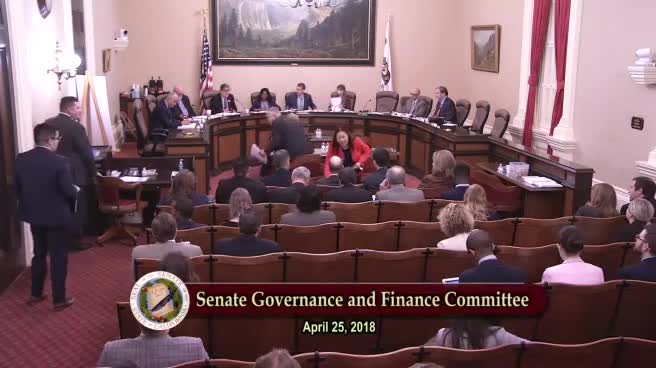 19MIN
Senate Standing Committee on Governance and Finance
Bill Author