AB 1013: On-sale general public premises: drug testing devices.
- Session Year: 2023-2024
- House: Assembly
- Latest Version Date: 2023-10-07
Current Status:
Passed
(2023-10-07: Chaptered by Secretary of State - Chapter 353, Statutes of 2023.)
Introduced
In Committee
First Chamber
In Committee
Second Chamber
Enacted
The Alcoholic Beverage Control Act, administered by the Department of Alcoholic Beverage Control, regulates the application for, the issuance of, the suspension of, and the conditions imposed upon, various alcoholic beverage licenses. Existing law generally provides that a violation of the act is a misdemeanor.
This bill would require an applicant for a new permanent on-sale general public premises (Type 48) license or the holder of an existing Type 48 license to offer for sale to their customers drug testing devices at a cost not to exceed a reasonable amount based on the wholesale cost of those devices. The bill would require a licensee to post a related notice containing specified language in a prominent and conspicuous location. The bill would prohibit a Type 48 licensee from being held liable for a defective test or inaccurate test result. The bill would require a Type 48 licensee to ensure that all testing devices offered to customers have not exceeded their expiration date or recommended period of use, as specified. The bill would specify that a violation of its provisions is not a crime. The bill would require the department to post on its internet website information about the bills requirements, as specified. The bill would make its provisions operative on July 1, 2024, and would repeal its provisions on January 1, 2027.
The Alcoholic Beverage Control Act, administered by the Department of Alcoholic Beverage Control, regulates the application for, the issuance of, the suspension of, and the conditions imposed upon, various alcoholic beverage licenses. Existing law generally provides that a violation of the act is a misdemeanor.
This bill would require an applicant for a new permanent on-sale general public premises (Type 48) license or the holder of an existing Type 48 license to offer for sale to their customers drug testing and antitampering devices at a cost not to exceed a reasonable amount based on the wholesale cost of those devices. The bill would require a licensee to post a related notice about that requirement containing specified language in a prominent and conspicuous location in each restroom and at each entrance and exit available to the public. location. The bill would prohibit a Type 48 licensee from being held liable for a defective test or inaccurate test result. The bill would require a Type 48 licensee to ensure that all testing devices offered to customers have not exceeded their expiration date or recommended period of use, as specified. By expanding the scope of an existing crime, the bill would impose a state-mandated local program. The bill would specify that a violation of its provisions is not a crime. The bill would require the department to post on its internet website information about the bills requirements, as specified. The bill would make its provisions operative on July 1, 2024, and would repeal its provisions on January 1, 2027.
The California Constitution requires the state to reimburse local agencies and school districts for certain costs mandated by the state. Statutory provisions establish procedures for making that reimbursement.This bill would provide that no reimbursement is required by this act for a specified reason.The Alcoholic Beverage Control Act, administered by the Department of Alcoholic Beverage Control, regulates the application for, the issuance of, the suspension of, and the conditions imposed upon, various alcoholic beverage licenses. Existing law generally provides that a violation of the act is a misdemeanor.
This bill would require an applicant for a new permanent on-sale general public premises (Type 48) license or the holder of an existing Type 48 license to offer for sale to their customers drug testing and antitampering devices at a cost not to exceed a reasonable amount based on the wholesale cost of the drug testing those devices. The bill would require a licensee to post a notice about that requirement in a prominent and conspicuous location in each restroom and at each entrance and exit available to the public. The bill would prohibit a Type 48 licensee from being held liable for a defective test or inaccurate test result. The bill would require a Type 48 licensee to ensure that all testing devices offered to customers have not exceeded their expiration date or recommended period of use, as specified. By expanding the scope of an existing crime, the bill would impose a state-mandated local program. The bill would repeal its provisions on January 1, 2027.
The California Constitution requires the state to reimburse local agencies and school districts for certain costs mandated by the state. Statutory provisions establish procedures for making that reimbursement.
This bill would provide that no reimbursement is required by this act for a specified reason.
The Alcoholic Beverage Control Act, administered by the Department of Alcoholic Beverage Control, regulates the application for, the issuance of, the suspension of, and the conditions imposed upon, various alcoholic beverage licenses. Existing law generally provides that a violation of the act is a misdemeanor.
This bill would require an applicant for a new permanent on-sale general public premises (Type 48) license or the holder of an existing Type 48 license to offer for sale to their customers drug testing devices at a cost not to exceed a reasonable amount based on the wholesale cost of the drug testing devices. The bill would require a licensee to post a notice about that requirement in a prominent and conspicuous location in each restroom and at each entrance and exit available to the public. The bill would prohibit a Type 48 licensee from being held liable for a defective test or inaccurate test result. The bill would require a Type 48 licensee to ensure that all testing devices offered to customers have not exceeded their expiration date or recommended period of use, as specified. By expanding the scope of an existing crime, the bill would impose a state-mandated local program. The bill would repeal its provisions on January 1, 2027.
The California Constitution requires the state to reimburse local agencies and school districts for certain costs mandated by the state. Statutory provisions establish procedures for making that reimbursement.
This bill would provide that no reimbursement is required by this act for a specified reason.
The Alcoholic Beverage Control Act, administered by the Department of Alcoholic Beverage Control, regulates the application for, the issuance of, the suspension of, and the conditions imposed upon, various alcoholic beverage licenses. Existing law generally provides that a violation of the act is a misdemeanor.
This bill would require an applicant for a new permanent on-sale general public premises (Type 48) license or the holder of an existing Type 48 license to offer for sale to their customers drug testing devices at a cost not to exceed a reasonable amount based on the wholesale cost of the drug testing devices. The bill would require a licensee to post a notice about that requirement in all restrooms a prominent and conspicuous location in each restroom and at each entrance and exit available to the public or in prominent and conspicuous locations, as specified. public. By expanding the scope of an existing crime, the bill would impose a state-mandated local program. The bill would repeal its provisions on January 1, 2027.
The California Constitution requires the state to reimburse local agencies and school districts for certain costs mandated by the state. Statutory provisions establish procedures for making that reimbursement.
This bill would provide that no reimbursement is required by this act for a specified reason.
The Alcoholic Beverage Control Act, administered by the Department of Alcoholic Beverage Control, regulates the application for, the issuance of, the suspension of, and the conditions imposed upon, various alcoholic beverage licenses. Existing law generally provides that a violation of the act is a misdemeanor.
This bill would require an applicant for a new permanent on-sale general public premises (Type 48) license or the holder of an existing Type 48 license to offer for sale to their customers drug testing devices at a cost not to exceed a reasonable amount based on the wholesale cost of the drug testing devices. The bill would require a licensee to post a notice about that requirement in all restrooms available to the public or in prominent and conspicuous locations, as specified. By expanding the scope of an existing crime, the bill would impose a state-mandated local program.
The California Constitution requires the state to reimburse local agencies and school districts for certain costs mandated by the state. Statutory provisions establish procedures for making that reimbursement.
This bill would provide that no reimbursement is required by this act for a specified reason.
(a)For purposes of this section, the following definitions apply:
(1)Drug testing devices means test strips, stickers, straws, and other devices designed to detect the presence of controlled substances in a drink.
(2)Controlled substances includes, but is not limited to, flunitrazepam, ketamine, and gamma hydroxybutyric acid, also known by other names, including GHB, gamma hydroxybutyrate, 4-hydroxybutyrate, 4-hydroxybutanoic acid, sodium oxybate, and sodium oxybutyrate.
(b)An applicant for a new permanent on-sale general public premises (Type 48) license or the holder of an existing Type 48 license shall offer for sale to their customers drug testing devices at a cost not to exceed a reasonable amount based on the wholesale cost of those devices.
(c)A licensee subject to subdivision (b) shall post the following notice in a prominent and conspicuous location:
Dont get roofied! Drink spiking drug test kits available here. Ask a staff member for details.
(d)This section does not prevent a Type 48 licensee from offering drug testing devices to their customers free of charge.
(e)A Type 48 licensee shall not be held liable for a defective test or inaccurate test result, including, but not limited to, a false positive or false negative test result.
(f)A Type 48 licensee shall ensure that all testing devices offered to customers have not exceeded their expiration date or recommended period of use, according to the product label, product packaging, or otherwise recommended by the manufacturer.
(g)Notwithstanding Section 25617, a violation of this section is not a crime.
(h)The department shall post on its internet website a link to a page that contains information about the requirements of this section, including, but not limited to, the signage that is required to be posted and the types of drug testing devices that are required to be available on a Type 48 licensed premises.
(i)This section shall be operative on July 1, 2024, and shall be repealed on January 1, 2027.
(a)An For purposes of this section, the following definitions apply:
(1)Drug testing devices means test strips, stickers, straws, and other devices designed to detect the presence of controlled substances in a drink.
(2)Controlled substances includes, but is not limited to, flunitrazepam, ketamine, and gamma hydroxybutyric acid, also known by other names, including GHB, gamma hydroxybutyrate, 4-hydroxybutyrate, 4-hydroxybutanoic acid, sodium oxybate, and sodium oxybutyrate.
(b)An applicant for a new permanent on-sale general public premises (Type 48) license or the holder of an existing Type 48 license shall offer for sale to their customers drug testing devices and antitampering devices at a cost not to exceed a reasonable amount based on the wholesale cost of those devices.
(b)The licensee shall post a notice regarding the requirements of subdivision (a) in a prominent and conspicuous location as follows:(1)In each of the licensed premises restrooms that are available to the public.(2)At each of the licensed premises entrances that are available to the public.(3)At each of the licensed premises exits that are available to the public.(c)A licensee subject to subdivision (b) shall post the following notice in a prominent and conspicuous location:
Dont get roofied! Drink spiking drug test kits available here. Ask a staff member for details.
(c)(d)This section does not prevent a Type 48 licensee from offering drug testing devices or antitampering devices to their customers free of charge.
(d)(e)A Type 48 licensee shall not be held liable for a defective test or inaccurate test result, including, but not limited to, a false positive or false negative test result.
(e)(f)A Type 48 licensee shall ensure that all testing devices offered to customers have not exceeded their expiration date or recommended period of use, according to the product label, product packaging, or otherwise recommended by the manufacturer.
(f)For purposes of this section, the following definitions apply:(1)Antitampering devices means covers, lids, and other devices designed to prevent an individual from tampering with or adding controlled substances to a drink.(2)Drug testing devices means test strips, stickers, straws, and other devices designed to detect the presence of controlled substances in a drink.(3)Controlled substances includes, but is not limited to, flunitrazepam, ketamine, and gamma hydroxybutyric acid, also known by other names, including GHB, gamma-hydroxybutyrate, 4-hydroxybutyrate, 4-hydroxybutanoic acid, sodium oxybate, and sodium oxybutyrate.(g)Notwithstanding Section 25617, a violation of this section is not a crime.
(h)The department shall post on its internet website a link to a page that contains information about the requirements of this section, including, but not limited to, the signage that is required to be posted and the types of drug testing devices that are required to be available on a Type 48 licensed premises.
(g)(i)This section shall be operative on July 1, 2024, and shall be repealed on January 1, 2027.
SEC. 2.No reimbursement is required by this act pursuant to Section 6 of Article XIIIB of the California Constitution because the only costs that may be incurred by a local agency or school district will be incurred because this act creates a new crime or infraction, eliminates a crime or infraction, or changes the penalty for a crime or infraction, within the meaning of Section 17556 of the Government Code, or changes the definition of a crime within the meaning of Section 6 of Article XIIIB of the California Constitution.(a)An applicant for a new permanent on-sale general public premises (Type 48) license or the holder of an existing Type 48 license shall offer for sale to their customers drug testing devices and antitampering devices at a cost not to exceed a reasonable amount based on the wholesale cost of the drug testing those devices.
(b)The licensee shall post a notice regarding the requirements of subdivision (a) in a prominent and conspicuous location as follows:
(1)In each of the licensed premises restrooms that are available to the public.
(2)At each of the licensed premises entrances that are available to the public.
(3)At each of the licensed premises exits that are available to the public.
(c)This section does not prevent a Type 48 licensee from offering drug testing devices or antitampering devices to their customers free of charge.
(d)A Type 48 licensee shall not be held liable for a defective test or inaccurate test result, including, but not limited to, a false positive or false negative test result.
(e)A Type 48 licensee shall ensure that all testing devices offered to customers have not exceeded their expiration date or recommended period of use, according to the product label, product packaging, or otherwise recommended by the manufacturer.
(f)For purposes of this section, drug the following definitions apply:
(1)Antitampering devices means covers, lids, and other devices designed to prevent an individual from tampering with or adding controlled substances to a drink.
(2)Drug testing devices means test strips, stickers, straws, and other devices designed to detect the presence of controlled substances in a drink. Controlled substances include, but are not
(3)Controlled substances includes, but is not limited to, flunitrazepam, ketamine, and gamma hydroxybutyric acid, also known by other names, including GHB, gamma hydroxybutyrate, gamma-hydroxybutyrate, 4-hydroxybutyrate, 4-hydroxybutanoic acid, sodium oxybate, and sodium oxybutyrate.
(g)This section shall be repealed on January 1, 2027.
SEC. 2.No reimbursement is required by this act pursuant to Section 6 of Article XIIIB of the California Constitution because the only costs that may be incurred by a local agency or school district will be incurred because this act creates a new crime or infraction, eliminates a crime or infraction, or changes the penalty for a crime or infraction, within the meaning of Section 17556 of the Government Code, or changes the definition of a crime within the meaning of Section 6 of Article XIIIB of the California Constitution.
(a)An applicant for a new permanent on-sale general public premises (Type 48) license or the holder of an existing Type 48 license shall offer for sale to their customers drug testing devices at a cost not to exceed a reasonable amount based on the wholesale cost of the drug testing devices.
(b)The licensee shall post a notice regarding the requirements of subdivision (a) in a prominent and conspicuous location as follows:
(1)In each of the licensed premises restrooms that are available to the public.
(2)At each of the licensed premises entrances that are available to the public.
(3)At each of the licensed premises exits that are available to the public.
(c)This section does not prevent a Type 48 licensee from offering drug testing devices to their customers free of charge.
(d)A Type 48 licensee shall not be held liable for a defective test or inaccurate test result, including, but not limited to, a false positive or false negative test result.
(e)A Type 48 licensee shall ensure that all testing devices offered to customers have not exceeded their expiration date or recommended period of use, according to the product label, product packaging, or otherwise recommended by the manufacturer.
(d)(f)For purposes of this section, drug testing devices means test strips, stickers, straws, and other devices designed to detect the presence of controlled substances in a drink. Controlled substances include, but are not limited to, flunitrazepam, ketamine, and gamma hydroxybutyric acid, also known by other names, including GHB, gamma hydroxybutyrate, 4-hydroxybutyrate, 4-hydroxybutanoic acid, sodium oxybate, and sodium oxybutyrate.
(e)(g)This section shall be repealed on January 1, 2027.
SEC. 2.No reimbursement is required by this act pursuant to Section 6 of Article XIIIB of the California Constitution because the only costs that may be incurred by a local agency or school district will be incurred because this act creates a new crime or infraction, eliminates a crime or infraction, or changes the penalty for a crime or infraction, within the meaning of Section 17556 of the Government Code, or changes the definition of a crime within the meaning of Section 6 of Article XIIIB of the California Constitution.
(a)An applicant for a new permanent on-sale general public premises (Type 48) license or the holder of an existing Type 48 license shall offer for sale to their customers drug testing devices at a cost not to exceed a reasonable amount based on the wholesale cost of the drug testing devices.
(b)(1)The licensee shall post a notice regarding the requirements of subdivision (a) in a prominent and conspicuous location in all as follows:
(1)In each of the licensed premises restrooms that are available to the public.
(2)At each of the licensed premises entrances that are available to the public.
(3)At each of the licensed premises exits that are available to the public.
(2)If no restroom is available to the public, the licensee shall post a notice regarding the requirements of subdivision (a) in at least ____ prominent and conspicuous locations on the premises where the license is held.(c)Nothing in this This section shall does not prevent a Type 48 licensee from offering drug testing devices to their customers free of charge.
(d)For purposes of this section, drug testing devices means test strips, stickers, straws, and other devices designed to detect the presence of controlled substances in a drink. Controlled substances include, but are not limited to, flunitrazepam, ketamine, and gamma hydroxybutyric acid, also known by other names, including GHB, gamma hydroxybutyrate, 4-hydroxybutyrate, 4-hydroxybutanoic acid, sodium oxybate, and sodium oxybutyrate.
(e)This section shall be repealed on January 1, 2027.
SEC. 2.No reimbursement is required by this act pursuant to Section 6 of Article XIIIB of the California Constitution because the only costs that may be incurred by a local agency or school district will be incurred because this act creates a new crime or infraction, eliminates a crime or infraction, or changes the penalty for a crime or infraction, within the meaning of Section 17556 of the Government Code, or changes the definition of a crime within the meaning of Section 6 of Article XIIIB of the California Constitution.
(a)An applicant for a new permanent on-sale general public premises (Type 48) license or the holder of an existing Type 48 license shall offer for sale to their customers drug testing devices at a cost not to exceed a reasonable amount based on the wholesale cost of the drug testing devices.
(b)(1)The licensee shall post a notice regarding the requirements of subdivision (a) in a prominent and conspicuous location in all restrooms available to the public.
(2)If no restroom is available to the public, the licensee shall post a notice regarding the requirements of subdivision (a) in at least ____ prominent and conspicuous locations on the premises where the license is held.
(c)Nothing in this section shall prevent a Type 48 licensee from offering drug testing devices to their customers free of charge.
(d)For purposes of this section, drug testing devices means test strips, stickers, straws, and other devices designed to detect the presence of controlled substances in a drink. Controlled substances include, but are not limited to, flunitrazepam, ketamine, and gamma hydroxybutyric acid, also known by other names, including GHB, gamma hydroxybutyrate, 4-hydroxybutyrate, 4-hydroxybutanoic acid, sodium oxybate, and sodium oxybutyrate.
SEC. 2.No reimbursement is required by this act pursuant to Section 6 of Article XIIIB of the California Constitution because the only costs that may be incurred by a local agency or school district will be incurred because this act creates a new crime or infraction, eliminates a crime or infraction, or changes the penalty for a crime or infraction, within the meaning of Section 17556 of the Government Code, or changes the definition of a crime within the meaning of Section 6 of Article XIIIB of the California Constitution.
|
Date
|
Status
|
|---|---|
| Oct 7, 2023 | Chaptered by Secretary of State - Chapter 353, Statutes of 2023. |
| Oct 7, 2023 | Approved by the Governor. |
| Sep 12, 2023 | Enrolled and presented to the Governor at 2 p.m. |
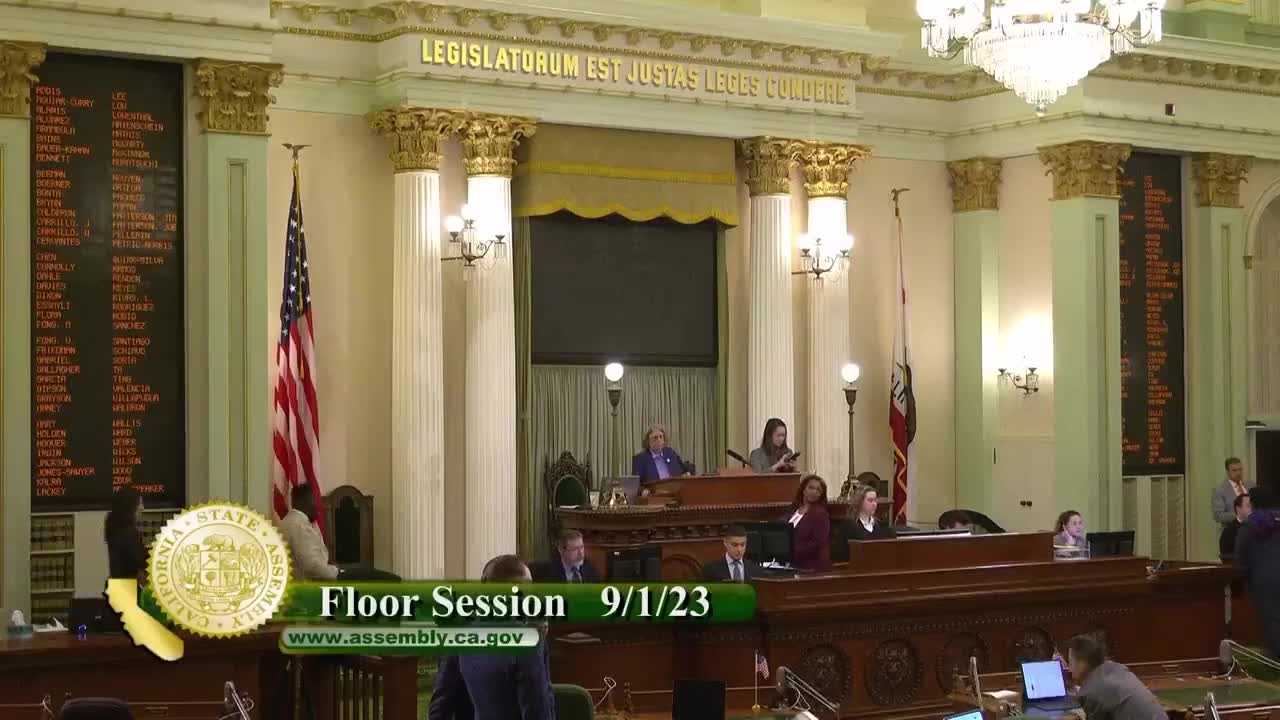
| Sep 1, 2023 | Senate amendments concurred in. To Engrossing and Enrolling. (Ayes 74. Noes 0. Page 2879.). |
| Aug 17, 2023 | In Assembly. Concurrence in Senate amendments pending. May be considered on or after August 19 pursuant to Assembly Rule 77. |
| Aug 17, 2023 | Read third time. Passed. Ordered to the Assembly. (Ayes 38. Noes 0. Page 2140.). |
| Aug 15, 2023 | Read second time. Ordered to Consent Calendar. |
| Aug 14, 2023 | From committee: Be ordered to second reading file pursuant to Senate Rule 28.8 and ordered to Consent Calendar. |
| Jul 6, 2023 | From committee: Do pass and re-refer to Com. on APPR with recommendation: To Consent Calendar. (Ayes 11. Noes 0.) (July 6). Re-referred to Com. on APPR. |
| Jun 28, 2023 | Read second time and amended. Re-referred to Com. on JUD. |
| Jun 27, 2023 | From committee: Amend, and do pass as amended and re-refer to Com. on JUD. (Ayes 15. Noes 0.) (June 27). |
| Jun 13, 2023 | From committee chair, with author's amendments: Amend, and re-refer to committee. Read second time, amended, and re-referred to Com. on G.O. |
| May 31, 2023 | Referred to Coms. on G.O. and JUD. |
| May 23, 2023 | In Senate. Read first time. To Com. on RLS. for assignment. |
| May 22, 2023 | Read third time. Passed. Ordered to the Senate. (Ayes 76. Noes 0. Page 1686.) |
| May 15, 2023 | Read third time and amended. Ordered to third reading. (Page 1553.) |
| May 4, 2023 | Read second time. Ordered to third reading. |
| May 3, 2023 | From committee: Do pass. (Ayes 16. Noes 0.) (May 3). |
| Apr 19, 2023 | Re-referred to Com. on APPR. |
| Apr 18, 2023 | Read second time and amended. |
| Apr 17, 2023 | From committee: Amend, and do pass as amended and re-refer to Com. on APPR. (Ayes 19. Noes 0.) (April 12). |
| Feb 23, 2023 | Referred to Com. on G.O. |
| Feb 16, 2023 | From printer. May be heard in committee March 18. |
| Feb 15, 2023 | Read first time. To print. |
|
Date
|
Description
|
Location
|
Votes
|
|
|---|---|---|---|---|
| Sep 1, 2023 | AB 1013 Lowenthal Concurrence in Senate Amendments | Assembly Floor |
Passed |
|
| Aug 17, 2023 | Consent Calendar 2nd AB1013 Lowenthal et al. | Senate Floor |
Passed |
|
| Jul 6, 2023 | Do pass, but first be re-referred to the Committee on [Appropriations] with the recommendation: To Consent Calendar | Senate Standing Committee on Judiciary |
Passed |
|
| Jun 27, 2023 | Do pass as amended, but first amend, and re-refer to the Committee on [Judiciary] | Senate Standing Committee on Governmental Organization |
Passed |
|
| May 22, 2023 | AB 1013 Lowenthal Assembly Third Reading | Assembly Floor |
Passed |
|
| May 3, 2023 | Do pass. | Assembly Standing Committee on Appropriations |
Passed |
|
| Apr 12, 2023 | Do pass as amended and be re-referred to the Committee on [Appropriations] | Assembly Standing Committee on Governmental Organization |
Passed |
This list shows positions taken on this bill by organizations on the date displayed, which is linked to the original source.
Positions by individuals are not included.
|
Organization
|
Position
|
Date
|
|---|---|---|
| Alcohol Justice | ** Support | |
| California Council on Alcohol Problems | * Support | Jun 27, 2023 |
| Drinksafe | * Support | Apr 12, 2023 |
CONCURRENCE IN SENATE AMENDMENTS
CSA1 Bill Id:AB 1013
Author:(Lowenthal and Gipson)
As Amended Ver:June 28, 2023
Majority vote
SUMMARY
This bill requires on-sale general public premises (Type 48 – Bar, Night Club) licensees to offer for sale to their customers drug testing devices at a cost not to exceed a reasonable amount based on the wholesale cost of those devices. A Type 48 licensee shall not be held liable for a defective test or inaccurate test result, including, but not limited to, a false positive or false negative test result.
Senate Amendments
- Require the licensee to post the following notice in a prominent and conspicuous location: "Don't get roofied! Drink spiking drug test available here. Ask a staff member for details."
- Provide that the Department of Alcoholic Beverage Control (ABC) shall post on its internet website a link to a page that contains information about the requirements of this bill, including, but not limited to, the signage that is required to be posted and the types of drug testing devices that are required to be available on a Type 48 licensed premises.
- Make its provisions operative on July 1, 2024.
- Make technical and clarifying changes.
- Add Co-authors.
COMMENTS
Background.
According to information provided by the author's office and various media outlets, it's difficult to find comprehensive, up-to-date statistics on the prevalence of drink-spiking/drugging but various state officials and police departments from across the country have stated that it is a problem that needs to be addressed. For example, the Boston Police Department (BPD) issued a statement warning the public to be mindful of alcohol consumption while in the city's bars and clubs. This was after the department said it has "become aware of numerous social media posts from various individuals who state that they were victims of drink spiking at local area bars." These drugs can cause disorientation, confusion, and temporary paralysis or loss of consciousness, according to the BPD. The drugs can also make potential victims vulnerable to the intentions of a suspect. Bar and nightclub patrons are often reminded to never leave a drink unattended and make sure a drink is served directly by the bartender.
In California, in the previous three years, the Long Beach Department received, on average, about 25 reports per year from people who felt they had been drugged while out with friends, possibly by something slipped into their drink. In response to these reports, the City of Long Beach is launching a pilot program that will provide residents with a free test strip that can identify specific drugs in a beverage. Distribution of drug detection test strips and educational outreach will both be part of the pilot program. The test strip user drops a small amount of drink fluid onto the test strip, which changes color to a specific shade if a drug is present. The distribution of the strips and other details are still being worked out. The city's Health Department will be in charge of managing the program.
Following reports of people feeling as though they had been drugged (or "roofied") at West Hollywood nightlife establishments, the City of West Hollywood recently launched a similar program that included outreach and distribution of disposable test kits that check for illegal substances in drinks. Numerous locations (restaurants, bars, clubs, etc.) have received more than 12,000 test kits, according to reports. The test strips are free, and some bars leave containers of them out for patrons to use.
It should be noted that over the years, the ABC has developed community-oriented policing approaches involving local merchants in deterring crime. It is designed in a manner that fosters and protects the health, safety, welfare, and economic well-being of the people of the State of California. This bill seems to be in-line with that directive.ABC Type 48 License (On-sale General – Public Premises (Bar, Night Club). Authorizes the sale of beer, wine and distilled spirits for consumption on the premises where sold. Authorizes the sale of beer and wine for consumption off the premises where sold. Minors may not enter and remain. Food service is not required.
Responsible Beverage Service (RBS) Training. Anyone that is employed at an ABC on-premises licensed establishment who is responsible for checking identifications, taking customer orders, and pouring or delivering alcoholic beverages must have a valid RBS certification from ABC. Servers and their managers must register in the RBS Portal, take RBS training from an approved training provider, and pass the ABC RBS exam within 60 days of their first date of employment. On-premises locations include, but are not limited to, bars, restaurants, tasting rooms, clubs, stadiums, movie theaters, hotels, and caterers. Covered licensees are required to maintain records of their various certifications, and violators are subject to unspecified "disciplinary action." The RBS training is currently available in several different languages.
Retail Operating Standards apply to stores (License Types 20 & 21), bars, and taverns (License Type 40, 42, 48 and 61). They do not apply to bona fide eating places (License Types 41, 47 or 75), convention centers, exhibit halls, auditoriums, ball parks, stadiums, coliseums, hotels, motels, certain marine parks, wineries or beer manufacturers.
ABC LEAD Program. ABC offers free and voluntary four-hour classes, called Licensee Education on Alcohol and Drugs, or LEAD, for retail licensees, their employees, and applicants. In 1991, the program began due to a grant from the California Office of Traffic Safety. The LEAD Program provides the licensee and applicant with practical information and instruction on checking various forms of identification, detecting and preventing illegal activity, and reducing liability. At the conclusion of the class, an exam is given on the material that was covered. Each person who fulfills all of the training requirements receives a certificate certifying that they successfully completed a LEAD training course.
ABC inspection and advisement. ABC carries out business inspections through its Informed Merchants Preventing Alcohol-Related Crime Tendencies (IMPACT) Program. ABC created IMPACT in 1984 as a preventative and education program. It employs a community-oriented policing strategy that involves local businesses in deterring crime. IMPACT teams select and survey licensed outlets at random. During their visits, IMPACT teams remind licensees of the responsibilities and accountability associated with the sale of alcohol. The officers also inspect licensed premises for compliance with State and local laws.
According to the Author
According to the author's office, "the underreported epidemic of drink spiking is often used to facilitate the commission of other crimes, such as sexual assault and rape. While anyone can have their drink spiked, the targets of this act are all too often women. Although drink spiking can be perpetrated in almost any setting, a common location for this activity to take place is at bars or night clubs, where alcoholic beverages are being served. Type 48 licensees are the primary operators of these types of establishments."
The author's office states that, "AB 1013 is a commonsense measure to protect individuals from being unknowingly drugged by requiring Type 48 licensees to offer for sale to customers drug testing devices, such as test strips, that can be detected the presence of controlled substances. These devices are simple, preventative measures that can protect someone from being drugged and becoming the victim of another crime, such as sexual assault or rape."
Arguments in Support
According to Alcohol Justice, "the actual incidence of having a drug put in one's drink without one's knowledge varies from around six percent to 25% depending on the survey. Yet even the lowest rate – 1 in 20 – means that you can look around any given bar on a Friday night and know
that at least one person there has or will be the victim of spiked drink."
Arguments in Opposition
None on file.
FISCAL COMMENTS
According to the Senate Appropriations Committee, pursuant to Senate Rule 28.8, negligible state costs.
VOTES:
ASM GOVERNMENTAL ORGANIZATION: 19-0-3
YES: Santiago, Lackey, Aguiar-Curry, Berman, Cervantes, Megan Dahle, Davies, Gipson, Jones-Sawyer, Low, Mathis, McCarty, McKinnor, Quirk-Silva, Ramos, Robert Rivas, Blanca Rubio, Ta, Villapudua
ABS, ABST OR NV: Bryan, Garcia, Jim Patterson
ASM APPROPRIATIONS: 16-0-0
YES: Holden, Megan Dahle, Bryan, Calderon, Wendy Carrillo, Dixon, Mike Fong, Hart, Lowenthal, Mathis, Papan, Pellerin, Robert Rivas, Sanchez, Weber, Wilson
ASSEMBLY FLOOR: 76-0-4
YES: Addis, Aguiar-Curry, Alanis, Alvarez, Arambula, Bains, Bauer-Kahan, Bennett, Berman, Boerner, Bonta, Bryan, Calderon, Juan Carrillo, Wendy Carrillo, Cervantes, Connolly, Megan Dahle, Davies, Dixon, Flora, Mike Fong, Vince Fong, Friedman, Gabriel, Gallagher, Garcia, Gipson, Grayson, Haney, Hart, Holden, Hoover, Irwin, Jackson, Jones-Sawyer, Kalra, Lee, Low, Lowenthal, Maienschein, Mathis, McCarty, McKinnor, Muratsuchi, Stephanie Nguyen, Ortega, Pacheco, Papan, Jim Patterson, Joe Patterson, Pellerin, Petrie-Norris, Ramos, Reyes, Luz Rivas, Robert Rivas, Rodriguez, Blanca Rubio, Sanchez, Santiago, Schiavo, Soria, Ta, Ting, Valencia, Villapudua, Waldron, Wallis, Ward, Weber, Wicks, Wilson, Wood, Zbur, Rendon
ABS, ABST OR NV: Chen, Essayli, Lackey, Quirk-Silva
SENATE FLOOR: 38-0-2
YES: Allen, Alvarado-Gil, Archuleta, Ashby, Atkins, Becker, Blakespear, Bradford, Caballero, Cortese, Dahle, Dodd, Durazo, Glazer, Gonzalez, Grove, Hurtado, Jones, Limón, McGuire, Menjivar, Min, Newman, Nguyen, Niello, Ochoa Bogh, Padilla, Portantino, Roth, Rubio, Seyarto, Skinner, Smallwood-Cuevas, Stern, Umberg, Wahab, Wiener, Wilk
ABS, ABST OR NV: Eggman, Laird
UPDATED
VERSION: June 28, 2023
CONSULTANT: Eric Johnson / G.O. / (916) 319-2531 FN: 0001276
SENATE RULES COMMITTEE Office of Senate Floor Analyses (916) 651-1520 Fax: (916) 327-4478 | AB 1013 |
CONSENT
Bill No: AB 1013
Author: Lowenthal (D) and Gipson (D), et al.
Amended: 6/28/23 in Senate
Vote: 21
SENATE GOVERNMENTAL ORG. COMMITTEE: 15-0, 6/27/23
AYES: Dodd, Wilk, Alvarado-Gil, Archuleta, Ashby, Bradford, Glazer, Jones, Nguyen, Ochoa Bogh, Padilla, Portantino, Roth, Rubio, Seyarto
SENATE JUDICIARY COMMITTEE: 11-0, 7/6/23
AYES: Umberg, Wilk, Allen, Ashby, Caballero, Durazo, Laird, Min, Niello, Stern, Wiener
SENATE APPROPRIATIONS COMMITTEE: Senate Rule 28.8
ASSEMBLY FLOOR: 76-0, 5/22/23 - See last page for vote
SUBJECT: On-sale general public premises: drug testing devices
SOURCE: Author
DIGEST: This bill requires on-sale general public premises (Type 48 – Bar, Night Club) licensees to offer for sale to their customers drug testing devices at a cost not to exceed a reasonable amount based on the wholesale cost of those devices.
ANALYSIS:
Existing law:
- Establishes the Department of Alcoholic Beverage Control (ABC) and grants it exclusive authority to administer the provisions of the ABC Act in accordance with laws enacted by the Legislature. This involves licensing individuals and businesses associated with the manufacture, importation, and sale of alcoholic beverages and the collection of license fees for this purpose.
- Provides, under the ABC Act, for the issuance of various alcoholic beverage licenses, including the imposition of fees, conditions, and restrictions in connection with the issuance of those licenses.
- Defines an “on-sale” license as authorizing the sale of all types of alcoholic beverages; namely, beer, wine, and distilled spirits, for consumption on the premises (such as restaurants or bar). An ‘off-sale” license authorizes the sale of all types of alcoholic beverages for consumption off the premises in original sealed containers.
- Establishes the Responsible Beverage Service (RBS) Training program that requires the Department of ABC to develop, implement, and administer a curriculum for an RBS training program for servers of alcohol and their managers, as specified. Alcohol servers are required to successfully complete an RBS training course offered or authorized by the department of ABC.
- Requires that certain licensees, including Type 48 licensees, must maintain a sign reading, “No Person Under 21 allowed” at or near each public entrance. The sign must be visible from the exterior. In addition, a sign of like size and content must be posted at a prominent place inside the licensed premises.
- Provides that a violation of the ABC act is a misdemeanor.
This bill:
- Requires an applicant for a new permanent on-sale general public premises (Type 48) license or the holder of an existing Type 48 license to offer for sale to their customers drug testing devices at a cost not to exceed a reasonable amount based on the wholesale cost of those devices.
- Requires the licensee to post the following notice in a prominent and conspicuous location: “Don’t get roofied! Drink spiking drug test available here. Ask a staff member for details.”
- Provides that a licensee shall not be held liable for a defective test or inaccurate test result, including, but not limited to, a false positive or false negative test result.
- Requires a licensee to ensure that all testing devices offered to customers have not exceeded their expiration date or recommended period of use, according to the product label, product packaging, or otherwise recommended to the manufacturer.
- Defines “drug testing devices” to mean test strips, stickers, straws, and other devices designed to detect the presence of controlled substances in a drink.
- Requires the Department of ABC to post on its website a link to a page that contains information about the requirements of this bill, as specified.
- Includes a sunset date of January 1, 2027.
Background
- Author Statement. According to the author’s office, “the underreported epidemic of drink spiking is often used to facilitate the commission of other crimes, such as sexual assault and rape. While anyone can have their drink spiked, the targets of this act are all too often women. Although drink spiking can be perpetrated in almost any setting, a common location for this activity to take place is at bars or night clubs, where alcoholic beverages are being served. Type 48 licensees are the primary operators of these types of establishments.”
The author’s office states that, “AB 1013 is a commonsense measure to protect individuals from being unknowingly drugged by requiring Type 48 licensees to offer for sale to customers drug testing devices, such as test strips, that can be detected the presence of controlled substances. These devices are simple, preventative measures that can protect someone from being drugged and becoming the victim of another crime, such as sexual assault or rape.”
- Type 48 Alcohol License. A Type 48 alcohol license, also known as an “On-Sale General Public Premises” license allows for the sale of beer, wine, and distilled spirits for consumption on the premises. These types of licenses are generally used for bars or nightclubs. Food service is not required and minors are not allowed to enter and remain. According to the Department of ABC’s website there are approximately 2,497 Type 48 licenses in the state.
- Drink Spiking. According to information provided by the author’s office and various media outlets, it’s difficult to find comprehensive, up-to-date statistics on the prevalence of drink-spiking/drugging but various state officials and police departments from across the country have stated that it is a problem that needs to be addressed. For example, the Boston Police Department (BPD) issued a statement warning the public to be mindful of alcohol consumption while in the city's bars and clubs. This was after the department said it's "become aware of numerous social media posts from various individuals who state that they were victims of drink spiking at local area bars.” These drugs can cause disorientation, confusion, and temporary paralysis or loss of consciousness, according to the BPD. The drugs can also make potential victims vulnerable to the intentions of a suspect. BPD officials reminded anyone going out to bars or clubs in the city to be aware of where your drink is at all times, never leaving it unattended. They also suggest making sure a drink is served directly by the bartender or server.
In California, in the previous three years, the Long Beach Department received, on average, about 25 reports per year from people who felt they had been drugged while out with friends, possibly by something slipped into their drink. In response to these reports, the City of Long Beach is launching a pilot program that will provide residents with a free test strip that can identify specific drugs in a beverage. Distribution of drug detection test strips and educational outreach will both be part of the pilot program. The test strip user drops a small amount of drink fluid onto the test strip, which changes color to a specific shade if a drug is present. The distribution of the strips and other details are still being worked out. The city's Health Department will be in charge of managing the program.
Following reports of people feeling as though they had been drugged (or "roofied") at West Hollywood nightlife establishments, the City of West Hollywood recently launched a similar program that included outreach and distribution of disposable test kits that check for illegal substances in drinks. Numerous locations (restaurants, bars, clubs, etc.) have received more than 12,000 test kits, according to reports. The test strips are free, and some bars leave containers of them out for patrons to use.
It should be noted that over the years, the Department of ABC has developed community-oriented policing approaches involving local merchants in deterring crime. It is designed in a manner that fosters and protects the health, safety, welfare, and economic well-being of the people of the State of California.
- New Requirement on Alcohol Licensees. According to the Department of ABC there is currently no requirement in the ABC Act which requires any alcohol licensee to offer particular products for sale to their customers. As such, this bill establishes a one of a kind requirement on licensees that would require nearly 2,500 licensees to ensure that they are making particular products available for sale.
Failure to make those products available could result in possible fines and violations by the Department of ABC. While the department generally takes an educational approach, including multiple warnings to licensees before any fines and violations are issued, licensees would nonetheless be responsible for ensuring these particular products are always available for purchase.
It should also be noted that while these products described in this bill do seem to be available for purchase online, the availability of these products do not appear to be widely available. For example, a search of “drink spiking test strips” on Google resulted in only one testing strip company that is selling 10 total strips for approximately $16 dollars.
- Responsible Beverage Service (RBS) Training. Anyone that is employed at an ABC on-premises licensed establishment who is responsible for checking identifications, taking customer orders, and pouring or delivering alcoholic beverages must have a valid RBS certification from the Department of ABC. Servers and their managers must register in the RBS Portal, take RBS training from an approved training provider, and pass the department’s RBS exam within 60 days of their first date of employment. On-premises locations include, but are not limited to, bars, restaurants, tasting rooms, clubs, stadiums, movie theaters, hotels, and caterers. Covered licensees are required to maintain records of their various certifications, and violators are subject to unspecified “disciplinary action”. The RBS training is currently available in several different languages.
- LEAD Program. The Department of ABC offers free and voluntary four-hour classes, called Licensee Education on Alcohol and Drugs (LEAD), for retail licensees, their employees, and applicants. In 1991, the program began due to a grant from the California Office of Traffic Safety. The LEAD Program provides the licensee and applicant with practical information and instruction on checking various forms of identification, detecting and preventing illegal activity, and reducing liability. At the conclusion of the class, an exam is given on the material that was covered. Each person who fulfills all of the training requirements receives a certificate certifying that they successfully completed a LEAD training course.
- Department of ABC’s Inspection and Advisement. The Department of ABC carries out business inspections through its Informed Merchants Preventing Alcohol-Related Crime Tendencies (IMPACT) Program. The Department of ABC created IMPACT in 1984 as a preventative and educational program. It employs a community-oriented policing strategy that involves local businesses in deterring crime. IMPACT teams select and survey licensed outlets at random. During their visits, IMPACT teams remind licensees of the responsibilities and accountability associated with the sale of alcohol. The officers also inspect licensed premises for compliance with State and local laws. The officers may look for loitering, litter, graffiti, posted signs, slot machines, lack of food service in restaurants, illegal weapons, or other violations. Although education is the main goal, if any major violations are discovered during the inspections, officers will act. A checklist is used to note any violations observed, and it is given to the licensee. Any issues must then be fixed by the licensee.
Related/Prior Legislation
AB 1221 (Gonzalez Fletcher, Chapter 847, Statutes of 2017) established the Responsible Beverage Service Training Program Act of 2017, and required the Department of ABC to develop, implement, and administer a curriculum for an RBS training program, as specified. The bill also required an alcohol sever, as defined, to successfully complete an RBS training course offered or authorized by the Department of ABC.
FISCAL EFFECT: Appropriation: No Fiscal Com.: Yes Local: No
SUPPORT: (Verified 8/14/23)
Alcohol Justice
OPPOSITION: (Verified 8/14/23)
None received
ARGUMENTS IN SUPPORT: According to Alcohol Justice, “the actual incidence of having a drug put in one’s drink without one’s knowledge varies from around six percent to 25% depending on the survey. Yet even the lowest rate – 1 in 20 – means that you can look around any given bar on a Friday night and know that at least one person there has or will be the victim of spiked drink.”
ASSEMBLY FLOOR: 76-0, 5/22/23
AYES: Addis, Aguiar-Curry, Alanis, Alvarez, Arambula, Bains, Bauer-Kahan, Bennett, Berman, Boerner, Bonta, Bryan, Calderon, Juan Carrillo, Wendy Carrillo, Cervantes, Connolly, Megan Dahle, Davies, Dixon, Flora, Mike Fong, Vince Fong, Friedman, Gabriel, Gallagher, Garcia, Gipson, Grayson, Haney, Hart, Holden, Hoover, Irwin, Jackson, Jones-Sawyer, Kalra, Lee, Low, Lowenthal, Maienschein, Mathis, McCarty, McKinnor, Muratsuchi, Stephanie Nguyen, Ortega, Pacheco, Papan, Jim Patterson, Joe Patterson, Pellerin, Petrie-Norris, Ramos, Reyes, Luz Rivas, Robert Rivas, Rodriguez, Blanca Rubio, Sanchez, Santiago, Schiavo, Soria, Ta, Ting, Valencia, Villapudua, Waldron, Wallis, Ward, Weber, Wicks, Wilson, Wood, Zbur, Rendon
NO VOTE RECORDED: Chen, Essayli, Lackey, Quirk-Silva
Prepared by: Felipe Lopez / G.O. / (916) 651-1530
8/16/23 14:49:22
**** END ****
Senator Thomas Umberg, Chair
2023-2024 Regular Session
Bill No: AB 1013 (Author:Lowenthal)
Version: June 28, 2023
Hearing Date: July 6, 2023
Fiscal: Yes
Urgency: No
Consultant: CK
SUBJECT
On-sale general public premises: drug testing devices
DIGEST
This bill requires holders of and applicants for a bar/night club license to offer for sale drug testing devices at reasonable prices. Such licensees are immune from liability for defective or inaccurate tests.
EXECUTIVE SUMMARY
The Alcoholic Beverage Control Act regulates the licensing of businesses that serve alcoholic beverages. A Type 48 license is associated with bars or night clubs authorized to sell beer, wine, and distilled spirits for consumption on the premises where sold. Minors are prohibited from entering.
This bill places a requirement on such licensees to sell, at a reasonable price, drug testing devices to patrons. These devices include test strips, stickers, straws, and other devices designed to detect the presence of controlled substances in a drink.
The goal of the bill is to address the incidence of drink spiking in such establishments and to prevent the commission of crimes associated with such conduct, namely sexual assault and rape. The bill provides immunity to licensees from liability for defective tests and inaccurate test results.
The bill is author-sponsored. It is supported by Alcohol Justice. There is no known opposition. The bill passed out of the Senate Governmental Organization Committee on a 15 to 0 vote.
PROPOSED CHANGES TO THE LAW
Existing law:
- Provides that no person who, in good faith, and not for compensation, renders emergency medical or nonmedical care at the scene of an emergency shall be liable for any civil damages resulting from any act or omission. The scene of an emergency shall not include emergency departments and other places where medical care is usually offered. This applies only to medical, law enforcement, and emergency personnel, as specified. (Health & Saf. Code § 1799.102(a).)
- Extends to all other persons not covered by the above who are rendering medical or nonmedical care or other assistance in such situations immunity from civil damages resulting from any act or omission other than acts or omissions constituting gross negligence or willful or wanton misconduct. (Health & Saf. Code § 1799.102(b).)
- Provides that every person who willfully mingles any poison or harmful substance with any food, drink, medicine, or pharmaceutical product or who willfully places any poison or harmful substance in any spring, well, reservoir, or public water supply, where the person knows or should have known that the same would be taken by any human being to his or her injury, is guilty of a felony punishable by imprisonment in the state prison for two, four, or five years. Any violation involving the use of a poison or harmful substance that may cause death if ingested or that causes the infliction of great bodily injury on any person shall be punished by an additional term of three years. (Pen. Code § 347.)
- Provides that every person guilty of administering to another any chloroform, ether, laudanum, or any controlled substance, anesthetic, or intoxicating agent, with intent thereby to enable or assist themselves or any other person to commit a felony, is guilty of a felony punishable by imprisonment in the state prison for 16 months, or two or three years. (Pen. Code § 222.)
This bill:
- Requires an applicant for a new permanent on-sale general public premises (Type 48) license or the holder of an existing Type 48 license to offer for sale to their customers drug testing devices at a cost not to exceed a reasonable amount based on the wholesale cost of the drug testing devices.
- Requires licensees to post notices of this requirement, as provided.
- Provides that a licensee shall not be held liable for a defective test or inaccurate test result, including a false positive or false negative test result. However, a licensee shall ensure that all testing devices offered to customers have not exceeded their expiration date or recommended period of use, according to the product label, product packaging, or otherwise recommended by the manufacturer.
- Defines “drug testing devices” as test strips, stickers, straws, and other devices designed to detect the presence of controlled substances in a drink. Controlled substances include flunitrazepam, ketamine, and gamma hydroxybutyric acid, also known by other names, including GHB, gamma hydroxybutyrate, 4-hydroxybutyrate, 4-hydroxybutanoic acid, sodium oxybate, and sodium oxybutyrate.
- Sunsets on January 1, 2027.
COMMENTS
- The scourge of drink spiking
Drink spiking, in which drugs are placed into another’s drink, is a growing issue in this country. The Office on Women’s Health in the U.S. Department of Health and Human Services explains:
Date rape drugs are any type of drug used to make rape or sexual assault easier. Alcohol is often used this way. Or date rape drugs can be put into a drink without you knowing. Drugs or alcohol can make a person confused about what is happening, less able to defend themselves against unwanted sexual contact, or unable to remember what happened. Nearly 11 million women in the United States have been raped while drunk, drugged, or high.[1]
The Office on Women’s Health provides guidance on preventing drink spiking:
- Be aware of drinks in punchbowls or other containers that can be easily “spiked.”
- Don’t accept drinks from other people. If someone offers to get you a drink from a bar or at a party, go with the person to order your drink. Watch your drink as it is poured and carry it yourself.
- Open your drink yourself. Keep control of it at all times.
- Don’t drink anything that smells strange.
- Get help right away if you feel drunk and haven’t had any alcohol or if you feel like the effects of drinking alcohol are stronger than usual. Find a friend who can help you get to a safe place.
- Look out for your friends, and ask them to look out for you. You can play a powerful role in helping other people stay safe. If a friend seems out of it, seems much too drunk for the amount of alcohol she drank, is acting out of character, or seems too drunk to stay safe in general, get her to a safe place.[2]
One emerging trend beyond these steps is the distribution and use of drug testing devices. These devices can come in the form of test strips, straws, and other devices that are specifically designed to detect the presence of controlled substances that are often used in drink spiking, including ketamine and GHB. The devices can be used in public drinking establishments when drink spiking is suspected.
This bill requires such devices to be offered for sale by licensees operating specified bars and nightclubs. The devices must be offered at a reasonable price.
This approach has been piloted in various localities, including West Hollywood:
The City of West Hollywood will begin distributing drink-spiking test strips in partnership with the Los Angeles LGBT Center’s WeHo Life program to West Hollywood nightlife establishments. Drink-spiking test strips are designed to detect the possible presence of “date rape” drugs, such as GHB (gamma hydroxybutyrate) or ketamine. The test-strip user drops a small amount of drink liquid on the testing patch, which turns dark blue if drugs are present.
Outreach staff from the WeHo Life program will begin test-strip distribution efforts on Friday, October 14, 2022. The program will partner with local nightlife venues to ensure test strips are available on an ongoing basis for interested patrons. The immediate aim is to inform and educate community members and businesses that drink-spiking test strips are a tool for personal safety that can be used anywhere at any time. The City and the Center hope that personal experience with using test strips will encourage nightlife patrons to purchase, carry, and use them on a regular basis.
The West Hollywood City Council approved a plan to purchase and distribute drink-spiking test strips earlier this year following reports of individuals feeling that they had been drugged (“roofied”) at West Hollywood nightlife venues.[3]
According to the author:
The underreported epidemic of drink spiking continues to plague California and the world. Unfortunately, drink spiking is often used to facilitate the commission of other crimes, such as sexual assault and rape. While anyone can have their drink spiked, the targets of this act are all too often women. Although drink spiking can be perpetrated in almost any setting, a common location for this activity to take place is at bars or night clubs, where alcoholic beverages are being served. Type 48 licensees are the primary operators of these types of establishments. AB 1013 is a commonsense measure to protect individuals from being unknowingly drugged by requiring Type 48 licensees to offer for sale to customers drug testing devices, such as test strips, that can detect the presence of controlled substances and anti-tampering devices, such lids, that can help prevent someone’s drink from being drugged. These devices are simple, preventative measures that can protect someone from being drugged and becoming the victim of another crime, such as sexual assault or rape.
Alcohol Justice writes in support:
The actual incidence of having a drug put in one’s drink without one’s knowledge (“spiking”) varies from around 6% to 25% depending on the survey (American Psychological Association 2016). Yet even the lowest rate—1 in 20—means that you can look around any given bar on a Friday night and know that at least one person there has or will been the victim of spiked drink.
Even if the only result is unwanted extreme intoxication, the experience can be deeply upsetting, with feelings of anxiety or mistrust that last for years. That is not always the only result, however. Along with acquaintance rape and other forms of sexual assault, this person may be humiliated, robbed, and/or injured. Worse, however, is the risk of death. Not only are the most common additives—benzodiazepines and/or GHB or other hypnotics—synergistic with alcohol (lowering the threshold for life-threatening alcohol poisoning), but recent changes in the illegal drug supply raise the risk that the “mickey” may include fentanyl or other adulterants that are fatal on their own.
The proposed bill goes for empowering individuals to monitor their drink, and to normalize the act of additive testing for those who might be hesitant to engage in it.
- Civil liability and immunity
As a general rule, California law provides that persons are responsible, not only for the result of their willful acts, but also for an injury occasioned to another by their want of ordinary care or skill in the management of their property or person, except so far as the latter has, willfully or by want of ordinary care, brought the injury upon themselves. (Civ. Code § 1714(a).) Liability has the primary effect of ensuring that some measure of recourse exists for those persons injured by the negligent or willful acts of others; the risk of that liability has the primary effect of ensuring parties act reasonably to avoid harm to those to whom they owe a duty.
Conversely, immunity from liability disincentivizes careful planning and acting on the part of individuals and entities. When one enjoys immunity from civil liability, it is relieved of the responsibility to act with due regard and an appropriate level of care in the conduct of its activities. Immunity provisions are also disfavored because they, by their nature, preclude parties from recovering when they are injured, and force injured parties to absorb losses for which they are not responsible. Liability acts not only to allow a victim to be made whole, but to encourage appropriate compliance with legal requirements.
Although immunity provisions are rarely preferable, the Legislature has in limited scenarios approved measured immunity from liability (as opposed to blanket immunities) to promote other policy goals that could benefit the public. Immunities are generally afforded when needed to ensure the willingness of individuals to continue taking on certain roles that may involve some risk and to incentivize certain conduct, such as the provision of life-saving or other critical services. Examples include protections for use of CPR (Civ. Code § 1714.2); use of an automated external defibrillator (Civ. Code § 1714.21); use of opiate overdose treatment (Civ. Code § 1714.22); providing emergency care at the scene of an emergency (Health & Saf. Code §§ 1799.102, 1799.106); and performing emergency rescue services (Health & Saf. Code § 1799.107). However, as indicated above, rarely is immunity absolute, and these immunities generally do not cover grossly negligent conduct or intentional misconduct.
This bill provides that licensees shall not be held liable for a defective test or inaccurate test result, including a false positive or false negative test result. This is a narrow immunity that applies only to the effectiveness of the product the licensees are required to purchase and sell. Given the strong public policy aim, arguably this is a well-measured immunity. To ensure the Legislature can revisit the policy, the bill provides a sunset date of January 1, 2027.
SUPPORT
Alcohol Justice
OPPOSITION
None known
RELATED LEGISLATION
Pending Legislation: None known.
Prior Legislation: None known.
PRIOR VOTES:
Senate Governmental Organization Committee (Ayes 15, Noes 0)
Assembly Floor (Ayes 76, Noes 0)
Assembly Appropriations Committee (Ayes 16, Noes 0)
Assembly Governmental Organization Committee (Ayes 19, Noes 0)
**************
Date rape drugs (Feb. 22, 2021) Office on Women’s Health, https://www.womenshealth.gov/a-z-topics/date-rape-drugs. All internet citations are current as of June 30, 2023. ↑
Ibid. ↑
City of West Hollywood will Begin Distributing Drink-Spiking Test Strips in Partnership with the Los Angeles LGBT Center’s WeHo Life Program (Oct. 13, 2022) City of West Hollywood, https://www.weho.org/Home/Components/News/News/10573/23#:~:text=The%20West%20Hollywood%20City%20Council,at%20West%20Hollywood%20nightlife%20venues. ↑
SENATE COMMITTEE ON GOVERNMENTAL ORGANIZATION
Senator Bill Dodd
Chair
2023 - 2024 Regular
Bill No: 1013 Hearing Date: 6/27/2023
Author: | , et al. | ||
Version: | 6/13/2023 Amended | ||
Urgency: | No | Fiscal: | Yes |
Consultant: | Felipe Lopez | ||
SUBJECT: On-sale general public premises: drug testing and antitampering devices
DIGEST: This bill requires on-sale general public premises (Type 48 – Bar, Night Club) licensees to offer for sale to their customers drug testing and anti-tampering devices at a cost not to exceed a reasonable amount based on the wholesale cost of those devices. The bill also requires the licensee to post a notice about that requirement in all restrooms, entrances, and exits that are available to the public.
ANALYSIS:
Existing law:
- Establishes the Department of Alcoholic Beverage Control (ABC) and grants it exclusive authority to administer the provisions of the ABC Act in accordance with laws enacted by the Legislature. This involves licensing individuals and businesses associated with the manufacture, importation, and sale of alcoholic beverages and the collection of license fees for this purpose.
- Provides, under the ABC Act, for the issuance of various alcoholic beverage licenses, including the imposition of fees, conditions, and restrictions in connection with the issuance of those licenses.
- Defines an “on-sale” license as authorizing the sale of all types of alcoholic beverages; namely, beer, wine, and distilled spirits, for consumption on the premises (such as restaurants or bar). An ‘off-sale” license authorizes the sale of all types of alcoholic beverages for consumption off the premises in original sealed containers.
- Establishes the Responsible Beverage Service (RBS) Training program that requires the Department of ABC to develop, implement, and administer a curriculum for an RBS training program for servers of alcohol and their managers, as specified. Alcohol servers are required to successfully complete an RBS training course offered or authorized by the department of ABC.
- Requires that certain licensees, including Type 48 licensees, must maintain a sign reading, “No Person Under 21 allowed” at or near each public entrance. The sign must be visible from the exterior. In addition, a sign of like size and content must be posted at a prominent place inside the licensed premises.
- Generally provides that a violation of the ABC act is a misdemeanor.
This bill:
- Requires an applicant for a new permanent on-sale general public premises (Type 48) license or the holder of an existing Type 48 license to offer for sale to their customers drug testing and anti-tampering devices at a cost not to exceed a reasonable amount based on the wholesale cost of those devices.
- Requires the licensee to post a notice regarding the requirements established by this bill in a prominent and conspicuous locations as follows:
- In each restroom that is available to the public.
- At each entrance that is available to the public.
- At each exit that is available to the public.
- Provides that nothing in the bill prevents a licensee from offering drug testing or anti-tampering devices to their customers free of charge.
- Requires a Type 48 licensee to ensure that all testing devices offered to customers have not exceeded their expiration date or recommended period of use, according to the product label, product packaging, or otherwise recommended to the manufacturer.
- Defines “drug testing devices” to mean test strips, stickers, straws, and other devices designed to detect the presence of controlled substances in a drink.
- Defines “controlled substances” to include, but not limited to, flunitrazepam, ketamine, and gamma hydroxibutyric acid, also known by other names, including GHB, gamma hydroxybutyrate, 4-hydroxybutyrate, 4-hydroxybutanoc acid, sodium oxybate, and sodium oxybutyrate.
- Defines “anti-tampering devices” to mean covers, lids, and other devices designed to prevent an individual from tampering with or adding controlled substances to a drink
- Includes a sunset date of January 1, 2027.
Background
Author Statement. According to the author’s office, “the underreported epidemic of drink spiking is often used to facilitate the commission of other crimes, such as sexual assault and rape. While anyone can have their drink spiked, the targets of this act are all too often women. Although drink spiking can be perpetrated in almost any setting, a common location for this activity to take place is at bars or night clubs, where alcoholic beverages are being served. Type 48 licensees are the primary operators of these types of establishments.”
The author’s office states that, “AB 1013 is a commonsense measure to protect individuals from being unknowingly drugged by requiring Type 48 licensees to offer for sale to customers drug testing devices, such as test strips, that can be detected the presence of controlled substances and anti-tampering devices, such as lids, that can help prevent someone’s drink from being drugged. These devices are simple, preventative measures that can protect someone from being drugged and becoming the victim of another crime, such as sexual assault or rape.”
Type 48 Alcohol License. A Type 48 alcohol license, also known as an “On-Sale General Public Premises” license allows for the sale of beer, wine, and distilled spirits for consumption on the premises. These types of licenses are generally used for bars or nightclubs. Food service is not required and minors are not allowed to enter and remain. According to the Department of ABC’s website there are approximately 2,497 Type 48 licenses in the state.
Drink Spiking. According to information provided by the author’s office and various media outlets, it’s difficult to find comprehensive, up-to-date statistics on the prevalence of drink-spiking/drugging but various state officials and police departments from across the country have stated that it is a problem that needs to be addressed. For example, the Boston Police Department (BPD) issued a statement warning the public to be mindful of alcohol consumption while in the city's bars and clubs. This was after the department said it's "become aware of numerous social media posts from various individuals who state that they were victims of drink spiking at local area bars.” These drugs can cause disorientation, confusion, and temporary paralysis or loss of consciousness, according to the BPD. The drugs can also make potential victims vulnerable to the intentions of a suspect. BPD officials reminded anyone going out to bars or clubs in the city to be aware of where your drink is at all times, never leaving it unattended. They also suggest making sure a drink is served directly by the bartender or server.
In California, in the previous three years, the Long Beach Department received, on average, about 25 reports per year from people who felt they had been drugged while out with friends, possibly by something slipped into their drink. In response to these reports, the City of Long Beach is launching a pilot program that will provide residents with a free test strip that can identify specific drugs in a beverage. Distribution of drug detection test strips and educational outreach will both be part of the pilot program. The test strip user drops a small amount of drink fluid onto the test strip, which changes color to a specific shade if a drug is present. The distribution of the strips and other details are still being worked out. The city's Health Department will be in charge of managing the program.
Following reports of people feeling as though they had been drugged (or "roofied") at West Hollywood nightlife establishments, the City of West Hollywood recently launched a similar program that included outreach and distribution of disposable test kits that check for illegal substances in drinks. Numerous locations (restaurants, bars, clubs, etc.) have received more than 12,000 test kits, according to reports. The test strips are free, and some bars leave containers of them out for patrons to use.
It should be noted that over the years, the Department of ABC has developed community-oriented policing approaches involving local merchants in deterring crime. It is designed in a manner that fosters and protects the health, safety, welfare, and economic well-being of the people of the State of California.
Anti-Tampering Devices. Anti-tampering alcohol drink devices are devices designed to prevent unwanted access or tampering with an individual’s alcoholic beverages. These type of devices are commonly used in bars and clubs and can take different forms such as bottle seals, lids with tamper-evident features, or special locking mechanisms.
The purposes of these devices is to ensure the integrity and safety of alcoholic beverages by deterring and detecting any attempts to tamper with the drink. In doing so, they provide reassurance that the drink has not been tampered with. Such devices are particularly useful in environments where the security of an alcoholic drink is a concern, such as bars and nightclubs, where a drink can be left unattended or in situations where an individual wants to safeguard their alcoholic drink.
New Requirement on Alcohol Licensees. According to the Department of ABC there is currently no requirement in the ABC Act which requires any alcohol licensee to offer particular products for sale to their customers. As such, this bill establishes a one of a kind requirement on licensees that would require nearly 2,500 licensees to ensure that they are making particular products available for sale.
Failure to make those products available could result in possible fines and violations by the Department of ABC. While the department generally takes an educational approach, including multiple warnings to licensees before any fines and violations are issued, licensees would nonetheless be responsible for ensuring these particular products are always available for purchase.
It should also be noted that while these products described in the bill do seem to be available for purchase online, the availability of these products do not appear to be widely available. For example, a search of “drink spiking test strips” on Google resulted in only one testing strip company that is selling 10 total strips for approximately $16 dollars. Given that this bill would impact approximately 2,500 licensees throughout the state, what happens when a licensee faces difficulty in obtaining these products?
Responsible Beverage Service (RBS) Training. Anyone that is employed at an ABC on-premises licensed establishment who is responsible for checking identifications, taking customer orders, and pouring or delivering alcoholic beverages must have a valid RBS certification from the Department of ABC. Servers and their managers must register in the RBS Portal, take RBS training from an approved training provider, and pass the department’s RBS exam within 60 days of their first date of employment. On-premises locations include, but are not limited to, bars, restaurants, tasting rooms, clubs, stadiums, movie theaters, hotels, and caterers. Covered licensees are required to maintain records of their various certifications, and violators are subject to unspecified “disciplinary action.” The RBS training is currently available in several different languages.
LEAD Program. The Department of ABC offers free and voluntary four-hour classes, called Licensee Education on Alcohol and Drugs, or LEAD, for retail licensees, their employees, and applicants. In 1991, the program began due to a grant from the California Office of Traffic Safety. The LEAD Program provides the licensee and applicant with practical information and instruction on checking various forms of identification, detecting and preventing illegal activity, and reducing liability. At the conclusion of the class, an exam is given on the material that was covered. Each person who fulfills all of the training requirements receives a certificate certifying that they successfully completed a LEAD training course.
Department of ABC’s Inspection and Advisement. The Department of ABC carries out business inspections through its Informed Merchants Preventing Alcohol-Related Crime Tendencies (IMPACT) Program. The Department of ABC created IMPACT in 1984 as a preventative and educational program. It employs a community-oriented policing strategy that involves local businesses in deterring crime. IMPACT teams select and survey licensed outlets at random. During their visits, IMPACT teams remind licensees of the responsibilities and accountability associated with the sale of alcohol. The officers also inspect licensed premises for compliance with State and local laws. The officers may look for loitering, litter, graffiti, posted signs, slot machines, lack of food service in restaurants, illegal weapons, or other violations. Although education is the main goal, if any major violations are discovered during the inspections, officers will act. A checklist is used to note any violations observed, and it is given to the licensee. Any issues must then be fixed by the licensee.
Suggested Amendments. The committee may wish to amend the bill in the following manner.
Amendment 1. As currently drafted, the bill requires licensees to offer for sale both drug testing and anti-tampering devices. The committee may wish to amend the bill to delete the requirement that licensees must offer for sale “antitampering devices” and instead require Type 48 licensees to offer for sale only drug testing devices. This change will mirror the language that was voted on by the Assembly, lessen costs for licensees, and provide additional time for these types products to become more widely available.
Amendment 2. As currently drafted, the bill requires the licensee to post a notice, however the bill does not specify what the notice must say. As such, the committee may wish to amend the bill to require licensees to post the following notice:
“Don’t get roofied! Drink spiking drug test kits available here. Ask a staff member for detail.”
Amendment 3. As currently drafted, the bill requires licensee to post a notice about that requirement in all restrooms, entrances, and exits that are available to the public. Such a requirement seems excessive and could result in licensees having to post notices in various locations throughout the licensed premises. As such the committee may wish to amend the bill to instead require the licensee to simply post the notice in a prominent and conspicuous location.
Amendment 4. The committee may wish to clarify that a violation of the provisions of this bill shall not constitute a misdemeanor pursuant to section 25617.
Amendment 5. There is currently nothing in the ABC Act that requires licensees to sell particular products to consumers. As such, the requirements of this bill could result in confusion by licensees as to what products they must make available for purchase. In order to provide guidance to licensees the committee may wish to amend the bill to require the Department of ABC to maintain a link accessible on its Internet webpage that contains information about the requirements of the bill, including, but not limited to, the signage that must be posted and the types of drug testing devices that must be made available on the Type 48 licensed premises.
Amendment 6. The committee may wish to push back the implementation date to July 1, 2024 to allow the Department of ABC sufficient time to make licensees aware of the new requirement and for the licensees to acquire the required drug testing devices.
Prior/Related Legislation
AB 1221 (Gonzalez Fletcher, Chapter 847, Statutes of 2017) established the Responsible Beverage Service Training Program Act of 2017, and requires the Department of ABC to develop, implement, and administer a curriculum for an RBS training program, as specified. The bill also requires an alcohol sever, as defined, to successfully complete an RBS training course offered or authorized by the Department of ABC.
FISCAL EFFECT: Appropriation: Fiscal Com.: Local:
SUPPORT:
Alcohol Justice
OPPOSITION:
None received
ARGUMENTS IN SUPPORT: According to Alcohol Justice, “the actual incidence of having a drug put in one’s drink without one’s knowledge varies from around six percent to 25% depending on the survey. Yet even the lowest rate – 1 in 20 – means that you can look around any given bar on a Friday night and know that at least one person there has or will be the victim of spiked drink.”
DUAL REFERRAL: Senate Governmental Organization Committee & Senate Judiciary Committee
ASSEMBLY THIRD READING
ATR Bill Id:AB 1013
Author:(Lowenthal and Gipson)
As Amended Ver:May 15, 2023
Majority vote
SUMMARY
This bill would require an applicant for a new permanent on-sale general public premises (Type 48 - Bar, Night Club) license or the holder of an existing Type 48 license to offer for sale to their customers drug testing devices at a cost not to exceed a reasonable amount based on the wholesale cost of the drug testing devices. A licensee shall post a notice about that requirement in all restrooms available to the public or in prominent and conspicuous locations, as specified.
Major Provisions
1) Provides that an applicant for a new permanent on-sale general public premises (Type 48) license or the holder of an existing Type 48 license shall offer for sale to their customers drug testing devices at a cost not to exceed a reasonable amount based on the wholesale cost of the drug testing devices.
2) States that the licensee shall post a notice regarding the requirements of subdivision a), below, in a prominent and conspicuous location as follows:
a) In each of the licensed premises' restrooms that are available to the public.
b) At each of the licensed premises' entrances that are available to the public.
c) At each of the licensed premises' exits that are available to the public.
3) States that this bill does not prevent a Type 48 licensee from offering drug testing devices to their customers free of charge.
4) Provides that a Type 48 licensee shall not be held liable for a defective test or inaccurate test result, including, but not limited to, a false positive or false negative test result.
5) States that a Type 48 licensee shall ensure that all testing devices offered to customers have not exceeded their expiration date or recommended period of use, according to the product label, product packaging, or otherwise recommended by the manufacturer.
4) Defines "drug testing devices" as test strips, stickers, straws, and other devices designed to detect the presence of controlled substances in a drink. Controlled substances include, but are not limited to, flunitrazepam, ketamine, and gamma hydroxybutyric acid, also known by other names, including GHB, gamma hydroxybutyrate, 4-hydroxybutyrate, 4-hydroxybutanoic acid, sodium oxybate, and sodium oxybutyrate.
5) Contains a January 1, 2027 sunset date.
COMMENTS
Background.
According to information provided by the author's office and various media outlets, it's difficult to find comprehensive, up-to-date statistics on the prevalence of drink-spiking/drugging but various state officials and police departments from across the country have stated that it is a problem that needs to be addressed. For example, the Boston Police Department (BPD) issued a statement warning the public to be mindful of alcohol consumption while in the city's bars and clubs. This was after the department said it's "become aware of numerous social media posts from various individuals who state that they were victims of drink spiking at local area bars." These drugs can cause disorientation, confusion, and temporary paralysis or loss of consciousness, according to the BPD. The drugs can also make potential victims vulnerable to the intentions of a suspect. Bar and nightclub patrons are often reminded to never leave a drink unattended and make sure a drink is served directly by the bartender.
In California, in the previous three years, the Long Beach Department received, on average, about 25 reports per year from people who felt they had been drugged while out with friends, possibly by something slipped into their drink. In response to these reports, the City of Long Beach is launching a pilot program that will provide residents with a free test strip that can identify specific drugs in a beverage. Distribution of drug detection test strips and educational outreach will both be part of the pilot program. The test strip user drops a small amount of drink fluid onto the test strip, which changes color to a specific shade if a drug is present. The distribution of the strips and other details are still being worked out. The city's Health Department will be in charge of managing the program.
Following reports of people feeling as though they had been drugged (or "roofied") at West Hollywood nightlife establishments, the City of West Hollywood recently launched a similar program that included outreach and distribution of disposable test kits that check for illegal substances in drinks. Numerous locations (restaurants, bars, clubs, etc.) have received more than 12,000 test kits, according to reports. The test strips are free, and some bars leave containers of them out for patrons to use.
It should be noted that over the years, the Department of Alcoholic Beverage Control (ABC) has developed community-oriented policing approaches involving local merchants in deterring crime. It is designed in a manner that fosters and protects the health, safety, welfare, and economic well-being of the people of the State of California. This bill seems to be in-line with that directive.
ABC Type 48 License (On-sale General – Public Premises (Bar, Night Club). Authorizes the sale of beer, wine and distilled spirits for consumption on the premises where sold. Authorizes the sale of beer and wine for consumption off the premises where sold. Minors may not enter and remain. Food service is not required.
Responsible Beverage Service (RBS) Training. Anyone that is employed at an ABC on-premises licensed establishment who is responsible for checking identifications, taking customer orders, and pouring or delivering alcoholic beverages must have a valid RBS certification from ABC. Servers and their managers must register in the RBS Portal, take RBS training from an approved training provider, and pass the ABC RBS exam within 60 days of their first date of employment. On-premises locations include, but are not limited to, bars, restaurants, tasting rooms, clubs, stadiums, movie theaters, hotels, and caterers. Covered licensees are required to maintain records of their various certifications, and violators are subject to unspecified "disciplinary action." The RBS training is currently available in several different languages.
Retail Operating Standards apply to stores (License Types 20 & 21), bars, and taverns (License Type 40, 42, 48 and 61). They do not apply to bona fide eating places (License Types 41, 47 or 75), convention centers, exhibit halls, auditoriums, ball parks, stadiums, coliseums, hotels, motels, certain marine parks, wineries or beer manufacturers.
ABC LEAD Program. ABC offers free and voluntary four-hour classes, called Licensee Education on Alcohol and Drugs, or LEAD, for retail licensees, their employees, and applicants. In 1991, the program began due to a grant from the California Office of Traffic Safety. The LEAD Program provides the licensee and applicant with practical information and instruction on checking various forms of identification, detecting and preventing illegal activity, and reducing liability. At the conclusion of the class, an exam is given on the material that was covered. Each person who fulfills all of the training requirements receives a certificate certifying that they successfully completed a LEAD training course.
ABC inspection and advisement. ABC carries out business inspections through its Informed Merchants Preventing Alcohol-Related Crime Tendencies (IMPACT) Program. ABC created IMPACT in 1984 as a preventative and education program. It employs a community-oriented policing strategy that involves local businesses in deterring crime. IMPACT teams select and survey licensed outlets at random. During their visits, IMPACT teams remind licensees of the responsibilities and accountability associated with the sale of alcohol. The officers also inspect licensed premises for compliance with State and local laws.
According to the Author
According to the author, "The under-reported epidemic of drink spiking continues to plague California and the world. Unfortunately, drink spiking is often used to facilitate the commission of other crimes, such as sexual assault and rape. While anyone can have their drink spiked, the targets of this act are all too often women. Although drink spiking can occur in almost any setting, it is more common in bars and nightclubs that serve alcoholic beverages. Type 48 licensees are the primary operators of these types of establishments."
The author further states that "this bill is a common-sense measure to protect individuals from being unknowingly drugged by requiring Type 48 licensees to offer for sale to customers drug testing devices, such as test strips, that can detect the presence of controlled substances and anti-tampering devices, such as lids, that can help prevent someone's drink from being drugged. These devices are simple, preventative measures that can protect someone from being drugged and becoming the victim of another crime, such as sexual assault or rape."
Arguments in Support
None on file.
Arguments in Opposition
None on file.
FISCAL COMMENTS
According to the Assembly Appropriations Committee, minor and absorbable costs to ABC for education and enforcement. This committee sees a wide array of bills that propose to modify the scope of alcohol laws. Generally, imposing a modest requirement on a licensee does not generate major new enforcement workload for ABC, but taken together, these proposals could lead to significant new costs and future budget requests. ABC notes there are approximately 2,400 Type 48 licensees in the state that will need to comply with this bill's requirement to provide drug-testing devices. ABC anticipates education to occur through an industry advisory and enforcement to occur in the course of regular duties – for example, if there is a complaint against a licensee or as part of an existing investigation or premises inspection.
VOTES
ASM GOVERNMENTAL ORGANIZATION: 19-0-3
YES: Santiago, Lackey, Aguiar-Curry, Berman, Cervantes, Megan Dahle, Davies, Gipson, Jones-Sawyer, Low, Mathis, McCarty, McKinnor, Quirk-Silva, Ramos, Robert Rivas, Blanca Rubio, Ta, Villapudua
ABS, ABST OR NV: Bryan, Garcia, Jim Patterson
ASM APPROPRIATIONS: 16-0-0
YES: Holden, Megan Dahle, Bryan, Calderon, Wendy Carrillo, Dixon, Mike Fong, Hart, Lowenthal, Mathis, Papan, Pellerin, Robert Rivas, Sanchez, Weber, Wilson
UPDATED
VERSION: May 15, 2023
CONSULTANT: Eric Johnson / G.O. / (916) 319-2531 FN: 0000381
ASSEMBLY THIRD READING
ATR Bill Id:AB 1013
Author:(Lowenthal and Gipson)
As Amended Ver:April 18, 2023
Majority vote
SUMMARY
This bill would require an applicant for a new permanent on-sale general public premises (Type 48 - Bar, Night Club) license or the holder of an existing Type 48 license to offer for sale to their customers drug testing devices at a cost not to exceed a reasonable amount based on the wholesale cost of the drug testing devices. A licensee shall post a notice about that requirement in all restrooms available to the public or in prominent and conspicuous locations, as specified.
Major Provisions
Provides that an applicant for a new permanent on-sale general public premises (Type 48) license or the holder of an existing Type 48 license shall offer for sale to their customers drug testing devices at a cost not to exceed a reasonable amount based on the wholesale cost of the drug testing devices.
- States that the licensee shall post a notice regarding the requirements of subdivision (a), below, in a prominent and conspicuous location as follows:
- In each of the licensed premises' restrooms that are available to the public.
- At each of the licensed premises' entrances that are available to the public.
- At each of the licensed premises' exits that are available to the public.
- States that this bill does not prevent a Type 48 licensee from offering drug testing devices to their customers free of charge.
- Defines "drug testing devices" as test strips, stickers, straws, and other devices designed to detect the presence of controlled substances in a drink. Controlled substances include, but are not limited to, flunitrazepam, ketamine, and gamma hydroxybutyric acid, also known by other names, including GHB, gamma hydroxybutyrate, 4-hydroxybutyrate, 4-hydroxybutanoic acid, sodium oxybate, and sodium oxybutyrate.
- Contains a January 1, 2027 sunset date.
COMMENTS
Background.
According to information provided by the author's office and various media outlets, it's difficult to find comprehensive, up-to-date statistics on the prevalence of drink-spiking/drugging but various state officials and police departments from across the country have stated that it is a problem that needs to be addressed. For example, the Boston Police Department (BPD) issued a statement warning the public to be mindful of alcohol consumption while in the city's bars and clubs. This was after the department said it's "become aware of numerous social media posts from various individuals who state that they were victims of drink spiking at local area bars." These drugs can cause disorientation, confusion, and temporary paralysis or loss of consciousness, according to the BPD. The drugs can also make potential victims vulnerable to the intentions of a suspect. Bar and nightclub patrons are often reminded to never leave a drink unattended and make sure a drink is served directly by the bartender.
In California, in the previous three years, the Long Beach Department received, on average, about 25 reports per year from people who felt they had been drugged while out with friends, possibly by something slipped into their drink. In response to these reports, the City of Long Beach is launching a pilot program that will provide residents with a free test strip that can identify specific drugs in a beverage. Distribution of drug detection test strips and educational outreach will both be part of the pilot program. The test strip user drops a small amount of drink fluid onto the test strip, which changes color to a specific shade if a drug is present. The distribution of the strips and other details are still being worked out. The city's Health Department will be in charge of managing the program.
Following reports of people feeling as though they had been drugged (or "roofied") at West Hollywood nightlife establishments, the City of West Hollywood recently launched a similar program that included outreach and distribution of disposable test kits that check for illegal substances in drinks. Numerous locations (restaurants, bars, clubs, etc.) have received more than 12,000 test kits, according to reports. The test strips are free, and some bars leave containers of them out for patrons to use.
It should be noted that over the years, the Department of Alcoholic Beverage Control (ABC) has developed community-oriented policing approaches involving local merchants in deterring crime. It is designed in a manner that fosters and protects the health, safety, welfare, and economic well-being of the people of the State of California. This bill seems to be in-line with that directive.
ABC Type 48 License (On-sale General – Public Premises (Bar, Night Club). Authorizes the sale of beer, wine and distilled spirits for consumption on the premises where sold. Authorizes the sale of beer and wine for consumption off the premises where sold. Minors may not enter and remain. Food service is not required.
Responsible Beverage Service (RBS) Training. Anyone that is employed at an ABC on-premises licensed establishment who is responsible for checking identifications, taking customer orders, and pouring or delivering alcoholic beverages must have a valid RBS certification from ABC. Servers and their managers must register in the RBS Portal, take RBS training from an approved training provider, and pass the ABC RBS exam within 60 days of their first date of employment. On-premises locations include, but are not limited to, bars, restaurants, tasting rooms, clubs, stadiums, movie theaters, hotels, and caterers. Covered licensees are required to maintain records of their various certifications, and violators are subject to unspecified "disciplinary action." The RBS training is currently available in several different languages.
Retail Operating Standards apply to stores (License Types 20 & 21), bars, and taverns (License Type 40, 42, 48 and 61). They do not apply to bona fide eating places (License Types 41, 47 or 75), convention centers, exhibit halls, auditoriums, ball parks, stadiums, coliseums, hotels, motels, certain marine parks, wineries or beer manufacturers.
ABC LEAD Program. ABC offers free and voluntary four-hour classes, called Licensee Education on Alcohol and Drugs, or LEAD, for retail licensees, their employees, and applicants. In 1991, the program began due to a grant from the California Office of Traffic Safety. The LEAD Program provides the licensee and applicant with practical information and instruction on checking various forms of identification, detecting and preventing illegal activity, and reducing liability. At the conclusion of the class, an exam is given on the material that was covered. Each person who fulfills all of the training requirements receives a certificate certifying that they successfully completed a LEAD training course.
ABC inspection and advisement. ABC carries out business inspections through its Informed Merchants Preventing Alcohol-Related Crime Tendencies (IMPACT) Program. ABC created IMPACT in 1984 as a preventative and education program. It employs a community-oriented policing strategy that involves local businesses in deterring crime. IMPACT teams select and survey licensed outlets at random. During their visits, IMPACT teams remind licensees of the responsibilities and accountability associated with the sale of alcohol. The officers also inspect licensed premises for compliance with State and local laws.
According to the Author
According to the author, "The under-reported epidemic of drink spiking continues to plague California and the world. Unfortunately, drink spiking is often used to facilitate the commission of other crimes, such as sexual assault and rape. While anyone can have their drink spiked, the targets of this act are all too often women. Although drink spiking can occur in almost any setting, it is more common in bars and nightclubs that serve alcoholic beverages. Type 48 licensees are the primary operators of these types of establishments."
The author further states that "this bill is a common-sense measure to protect individuals from being unknowingly drugged by requiring Type 48 licensees to offer for sale to customers drug testing devices, such as test strips, that can detect the presence of controlled substances and anti-tampering devices, such as lids, that can help prevent someone's drink from being drugged. These devices are simple, preventative measures that can protect someone from being drugged and becoming the victim of another crime, such as sexual assault or rape."
Arguments in Support
None on file.
Arguments in Opposition
None on file.
FISCAL COMMENTS
According to the Assembly Appropriations Committee, minor and absorbable costs to ABC for education and enforcement. This committee sees a wide array of bills that propose to modify the scope of alcohol laws. Generally, imposing a modest requirement on a licensee does not generate major new enforcement workload for ABC, but taken together, these proposals could lead to significant new costs and future budget requests. ABC notes there are approximately 2,400 Type 48 licensees in the state that will need to comply with this bill's requirement to provide drug-testing devices. ABC anticipates education to occur through an industry advisory and enforcement to occur in the course of regular duties – for example, if there is a complaint against a licensee or as part of an existing investigation or premises inspection.
VOTES
ASM GOVERNMENTAL ORGANIZATION: 19-0-3
YES: Santiago, Lackey, Aguiar-Curry, Berman, Cervantes, Megan Dahle, Davies, Gipson, Jones-Sawyer, Low, Mathis, McCarty, McKinnor, Quirk-Silva, Ramos, Robert Rivas, Blanca Rubio, Ta, Villapudua
ABS, ABST OR NV: Bryan, Garcia, Jim Patterson
ASM APPROPRIATIONS: 16-0-0
YES: Holden, Megan Dahle, Bryan, Calderon, Wendy Carrillo, Dixon, Mike Fong, Hart, Lowenthal, Mathis, Papan, Pellerin, Robert Rivas, Sanchez, Weber, Wilson
UPDATED
VERSION: April 18, 2023
CONSULTANT: Eric Johnson / G.O. / (916) 319-2531 FN: 0000302
Date of Hearing: May 3, 2023
ASSEMBLY COMMITTEE ON APPROPRIATIONS
Chris Holden, Chair
ABPCA Bill Id:AB 1013
Author:(Lowenthal) – As Amended Ver:April 18, 2023
Policy Committee: | Governmental Organization | Vote: | 19 - 0 |
|
| ||
|
|
Urgency: No State Mandated Local Program: Yes Reimbursable: No
SUMMARY:
This bill requires, until January 1, 2027, bars and nightclubs to provide drug-testing devices at a reasonable cost or no cost to customers.
Specifically, this bill requires an applicant or holder of a Type 48 license issued by the Department of Alcoholic Beverage Control (ABC) to sell customers drug-testing devices, designed to detect the presence of a controlled substance in a drink, at a cost not to exceed the reasonable amount based on the devices’ wholesale cost. The licensee must post a notice about the requirement in a prominent and conspicuous location in each restroom and at each entrance and exit available to the public.
FISCAL EFFECT:
Minor and absorbable costs to ABC for education and enforcement.
This committee sees a wide array of bills that propose to modify the scope of alcohol laws. Generally, imposing a modest requirement on a licensee does not generate major new enforcement workload for ABC, but taken together, these proposals could lead to significant new costs and future budget requests. ABC notes there are approximately 2,400 Type 48 licensees in the state that will need to comply with this bill’s requirement to provide drug-testing devices. ABC anticipates education to occur through an industry advisory and enforcement to occur in the course of regular duties – for example, if there is a complaint against a licensee or as part of an existing investigation or premises inspection.
COMMENTS:
- Purpose. According to the author:
The under-reported epidemic of drink spiking continues to plague California and the world. Unfortunately, drink spiking is often used to facilitate the commission of other crimes, such as sexual assault and rape. While anyone can have their drink spiked, the targets of this act are all too often women. Although drink spiking can occur in almost any setting, it is more common in bars and nightclubs that serve alcoholic beverages. Type 48 licensees are the primary operators of these types of establishments.
- Drink Spiking. Bar and nightclub patrons are often reminded to never leave a drink unattended and make sure a drink is served directly by the bartender. The author notes that the Long Beach police department receives on average 25 reports per year from people who believe they were drugged while out with friends, possibly because something was slipped into their drink. In response to these reports, the City of Long Beach’s health department is developing a pilot program to provide residents with free test strips that can identify specific drugs in a beverage. The test strip user will be able to drop a small amount of drink fluid onto the strip, which will change color to a specific shade if a drug is present. The City of West Hollywood also recently launched a program distributing over 12,000 disposable drug-testing kits to restaurants, bars, and clubs for patrons’ free use. This bill requires bars and nightclubs across the state to provide drug-testing devices at a reasonable cost or no cost to customers to help prevent consumption of a spiked drink. Recent amendments adopt a three-year sunset clause on the requirement, allowing ABC to assess its implementation and effectiveness. Accordingly, the author may wish to consider specifying what metrics to consider when evaluating the program.
Analysis Prepared by: Irene Ho / APPR. / (916) 319-2081
Date of Hearing: April 12, 2023
ASSEMBLY COMMITTEE ON GOVERNMENTAL ORGANIZATION
Miguel Santiago, Chair
ABPCA Bill Id:AB 1013 (
Author:Lowenthal) – As Introduced Ver:February 15, 2023
SUBJECT: On-sale general public premises: drug testing devices
SUMMARY: This bill would require an applicant for a new permanent on-sale general public premises (Type 48 - Bar, Night Club) license or the holder of an existing Type 48 license to offer for sale to their customers drug testing devices at a cost not to exceed a reasonable amount based on the wholesale cost of the drug testing devices. A licensee shall post a notice about that requirement in all restrooms available to the public or in prominent and conspicuous locations, as specified. Specifically, this bill:
1) Provides an applicant for a new permanent on-sale general public premises (Type 48) license or the holder of an existing Type 48 license shall offer for sale to their customers drug testing devices at a cost not to exceed a reasonable amount based on the wholesale cost of the drug testing devices. The licensee shall post a notice regarding the requirements, as defined, in a prominent and conspicuous location in all restrooms available to the public.
2) States if no restroom is available to the public, the licensee shall post a notice regarding the requirements, as specified, in at least (blank in bill) prominent and conspicuous locations on the premises where the license is held.
3) States that nothing shall prevent a Type 48 licensee from offering drug testing devices to their customers free of charge.
4) Defines “drug testing devices” to mean test strips, stickers, straws, and other devices designed to detect the presence of controlled substances in a drink. Controlled substances include, but are not limited to, flunitrazepam, ketamine, and gamma hydroxybutyric acid, also known by other names, including GHB, gamma hydroxybutyrate, 4-hydroxybutyrate, 4-hydroxybutanoic acid, sodium oxybate, and sodium oxybutyrate.
EXISTING LAW:
1) Establishes the Department of Alcoholic Beverage Control (ABC) and grants it exclusive authority to administer the provisions of the Alcoholic Beverage Control Act (Act) in accordance with laws enacted by the Legislature. This involves licensing individuals and businesses associated with the manufacture, importation, and sale of alcoholic beverages and the collection of license fees for this purpose.
2) Provides, under the Act, for the issuance of various categories of alcoholic beverage licenses, including the imposition of fees, conditions, and restrictions in connection with the issuance of those licenses.
3) Defines an “on-sale” license as authorizing the sale of all types of alcoholic beverages: namely, beer, wine, and distilled spirits, for consumption on the premises (such as restaurant or bar). An “off-sale” license authorizes the sale of all types of alcoholic beverages for consumption off the premises in original sealed containers. (California Business and Professions Code § 23393, 23394, 23396 and 23399)
4) Provides that every person who sells, furnishes, gives, or causes to be sold, furnished, or given away, any alcoholic beverage to any habitual or common drunkard or to any obviously intoxicated person is guilty of a misdemeanor. (California Business and Professions Code § 25602)
5) States that no person who sells, furnishes, gives, or causes to be sold, furnished, or given
away, any alcoholic beverage shall be civilly liable to any injured person or the estate of such person for injuries inflicted on that person as a result of intoxication by the consumer of such alcoholic beverage. (California Business and Professions Code § 25602)
6) Establishes the Responsible Beverage Service (RBS) Training Program that requires ABC, on or before January 1, 2020, to develop, implement, and administer a curriculum for an RBS training program for on-premises servers of alcohol (and their managers), as specified. Alcohol servers are required to successfully complete an RBS training course offered or authorized by the department. The law provides that an RBS training course include information on, among other things, state laws and regulations relating to alcoholic beverage control and the impact of alcohol on the body, as specified. (California Business and Professions Code § 25680 et seq.)
7) Provides, upon written notice from ABC, Type 20, 21, 40, 42, 48, and 61 licensees must post signs prohibiting loitering and open alcoholic beverage containers. ABC will issue the written notice when there is substantial evidence of loitering or drinking in public that is adjacent to the premises. The signs must be prominent, permanent and clearly visible. (Business & Professions Code § 25612.5)
8) Provides that Type 42, 48, and 61 licensees must maintain a sign reading, "No Person Under 21 Allowed" at or near each public entrance. The sign must be visible from the exterior. In addition, a sign of like size and content must be posted at a prominent place inside the licensed premises, as defined. (Rule 107, California Code of Regulations)
FISCAL EFFECT: This bill is keyed fiscal by Legislative Counsel.
COMMENTS:
Purpose of the bill. According to the author, “The under-reported epidemic of drink spiking continues to plague California and the world. Unfortunately, drink spiking is often used to facilitate the commission of other crimes, such as sexual assault and rape. While anyone can have their drink spiked, the targets of this act are all too often women. Although drink spiking can occur in almost any setting, it is more common in bars and nightclubs that serve alcoholic beverages. Type 48 licensees are the primary operators of these types of establishments.”
The author further states that “this bill is a common-sense measure to protect individuals from being unknowingly drugged by requiring Type 48 licensees to offer for sale to customers drug testing devices, such as test strips, that can detect the presence of controlled substances and anti-tampering devices, such as lids, that can help prevent someone’s drink from being drugged. These devices are simple, preventative measures that can protect someone from being drugged and becoming the victim of another crime, such as sexual assault or rape.”
Background.
According to information provided by the author’s office and various media outlets, it’s difficult to find comprehensive, up-to-date statistics on the prevalence of drink-spiking/drugging but various state officials and police departments from across the country have stated that it is a problem that needs to be addressed. For example, the Boston Police Department (BPD) issued a statement warning the public to be mindful of alcohol consumption while in the city's bars and clubs. This was after the department said it's "become aware of numerous social media posts from various individuals who state that they were victims of drink spiking at local area bars.” These drugs can cause disorientation, confusion, and temporary paralysis or loss of consciousness, according to the BPD. The drugs can also make potential victims vulnerable to the intentions of a suspect. BPD officials reminded anyone going out to bars or clubs in the city to be aware of where your drink is at all times, never leaving it unattended. They also suggest making sure a drink is served directly by the bartender or server.
In California, in the previous three years, the Long Beach Department received, on average, about 25 reports per year from people who felt they had been drugged while out with friends, possibly by something slipped into their drink. In response to these reports, the City of Long Beach is launching a pilot program that will provide residents with a free test strip that can identify specific drugs in a beverage. Distribution of drug detection test strips and educational outreach will both be part of the pilot program. The test strip user drops a small amount of drink fluid onto the test strip, which changes color to a specific shade if a drug is present. The distribution of the strips and other details are still being worked out. The city's Health Department will be in charge of managing the program.
Following reports of people feeling as though they had been drugged (or "roofied") at West Hollywood nightlife establishments, the City of West Hollywood recently launched a similar program that included outreach and distribution of disposable test kits that check for illegal substances in drinks. Numerous locations (restaurants, bars, clubs, etc.) have received more than 12,000 test kits, according to reports. The test strips are free, and some bars leave containers of them out for patrons to use.
It should be noted that over the years, the ABC has developed community-oriented policing approaches involving local merchants in deterring crime. It is designed in a manner that fosters and protects the health, safety, welfare, and economic well-being of the people of the State of California. This bill seems to be in-line with that directive.
ABC Type 48 License (On-sale General – Public Premises (Bar, Night Club). Authorizes the sale of beer, wine and distilled spirits for consumption on the premises where sold. Authorizes the sale of beer and wine for consumption off the premises where sold. Minors may not enter and remain. Food service is not required.
Responsible Beverage Service (RBS) Training. Anyone that is employed at an ABC on-premises licensed establishment who is responsible for checking identifications, taking customer orders, and pouring or delivering alcoholic beverages must have a valid RBS certification from ABC. Servers and their managers must register in the RBS Portal, take RBS training from an approved training provider, and pass the ABC RBS exam within 60 days of their first date of employment. On-premises locations include, but are not limited to, bars, restaurants, tasting rooms, clubs, stadiums, movie theaters, hotels, and caterers. Covered licensees are required to maintain records of their various certifications, and violators are subject to unspecified “disciplinary action.” The RBS training is currently available in several different languages.
Retail Operating Standards apply to stores (License Types 20 & 21), bars, and taverns (License Type 40, 42, 48 and 61). They do not apply to bona fide eating places (License Types 41, 47 or 75), convention centers, exhibit halls, auditoriums, ball parks, stadiums, coliseums, hotels, motels, certain marine parks, wineries or beer manufacturers.
ABC LEAD Program. ABC offers free and voluntary four-hour classes, called Licensee Education on Alcohol and Drugs, or LEAD, for retail licensees, their employees, and applicants. In 1991, the program began due to a grant from the California Office of Traffic Safety. The LEAD Program provides the licensee and applicant with practical information and instruction on checking various forms of identification, detecting and preventing illegal activity, and reducing liability. At the conclusion of the class, an exam is given on the material that was covered. Each person who fulfills all of the training requirements receives a certificate certifying that they successfully completed a LEAD training course.
ABC inspection and advisement. ABC carries out business inspections through its Informed Merchants Preventing Alcohol-Related Crime Tendencies (IMPACT) Program. ABC created IMPACT in 1984 as a preventative and education program. It employs a community-oriented policing strategy that involves local businesses in deterring crime. IMPACT teams select and survey licensed outlets at random. During their visits, IMPACT teams remind licensees of the responsibilities and accountability associated with the sale of alcohol. The officers also inspect licensed premises for compliance with State and local laws. The officers may look for loitering, litter, graffiti, posted signs, slot machines, lack of food service in restaurants, illegal weapons, or other violations. Although education is the main goal, if any major violations are discovered during the inspections, officers will act. A checklist is used to note any violations observed, and it is given to the licensee. Any issues must then be fixed by the licensee.
Suggested Committee Amendment. Currently, the bill states that “If no restroom is available to the public, the licensee shall post a notice regarding the requirements of subdivision (a) in at least (blank in bill) prominent and conspicuous locations on the premises where the license is held.” The author should consider an amendment that states that in addition to signage in all restrooms available to the public, signage shall be placed “at each entrance to and exit from the premises”.
The committee also recommends adding a three-year sunset clause (December 31, 2026) to the measure to allow the ABC to assess the implementation and effectiveness of the bill.
Related legislation. AB 771 (Lowenthal) of 2023. Existing law prohibits a person from administering a controlled substance or anaesthetic or intoxicating agent to a person with the intent of enabling themselves or another person to commit a felony. This bill would instead prohibit the administering of any such substance to a person without their consent. The bill would also impose an additional penalty if this prohibition was violated with the intent to enable the commission of a crime or if the violation results in bodily injury or death. (Assembly Committee on Public Safety)
Prior legislation. AB 1221 (Gonzalez Fletcher), Chapter 847, Statutes of 2017. Established the Responsible Beverage Service (RBS) Training Program Act of 2017, and requires ABC, on or before January 1, 2020, to develop, implement, and administer a curriculum for an RBS training program, as specified. Additionally, the bill requires, beginning July 1, 2021, an alcohol server, as defined, to successfully complete an RBS training course offered or authorized by ABC.
REGISTERED SUPPORT / OPPOSITION:
Support
None on file
Opposition
None on file
Analysis Prepared by: Eric Johnson / G.O. / (916) 319-2531