AB 1224: Workforce development: green jobs survey.
- Session Year: 2023-2024
- House: Assembly
- Latest Version Date: 2023-03-16
Current Status:
Failed
(2024-02-01: From committee: Filed with the Chief Clerk pursuant to Joint Rule 56.)
Introduced
In Committee
First Chamber
In Committee
Second Chamber
Enacted
What does this bill do?
This bill requires the Employment Development Department’s Labor Market Information Division to run a California green jobs survey to update the state’s definition of “green job” and map where green jobs are growing. It also requires a public comment period during survey development and directs the California Workforce Development Board and the EDD’s Workforce Services Branch to use the survey findings in outreach, job materials, job fairs, workshops, and training for job seekers and local workforce boards.
The summary is provided by generative AI which can make mistakes. For original language, please view the details in the table below.
Existing law establishes the Labor and Workforce Development Agency in state government under the supervision of an executive officer known as the Secretary of Labor and Workforce Development. Existing law charges the agency with various duties relating to coordinating workforce programs and overseeing specified departments, boards, and panels, including the Employment Development Department and the California Workforce Development Board.
Existing law establishes the California Workforce Development Board, formerly named the California Workforce Investment Board, as the body responsible for assisting the Governor in the development, oversight, and continuous improvement of Californias workforce investment system and the alignment of the education and workforce investment systems to the needs of the 21st century economy and workforce. Existing law requires the board to establish a committee known as the Green Collar Jobs Council to, among other things, consult with other state agencies, higher education representatives, local workforce investment boards, industry representatives, and specified others in the development of a strategic initiative relating to the training and development of a skilled workforce to meet the needs of Californias emerging green economy.
This bill would require the Labor Market Information Division of the Employment Development Department to conduct, upon appropriation by the Legislature, a green jobs survey, as specified, to gather information about statewide green job industry strengths. The bill would require the division to create a standard operating definition of green job based on the results of the survey for the purpose of employment in California, as described. The bill would require the California Workforce Development Board to incorporate the surveys findings into education outreach, as specified, and would require the Workforce Services Branch of the Employment Development Department to incorporate the surveys findings into appropriate communications or educational materials relating to job opportunities for persons seeking employment.
Existing law requires the California Environmental Protection Agency to develop a model environmental justice mission statement for boards, departments, and offices within the agency, and defines environmental justice for these purposes.This bill would provide that it is the intent of the Legislature to enact subsequent legislation relating to environmental justice.Existing law requires the California Environmental Protection Agency to develop a model environmental justice mission statement for boards, departments, and offices within the agency, and defines environmental justice for these purposes.
This bill would provide that it is the intent of the Legislature to enact subsequent legislation relating to environmental justice.
The Legislature finds and declares all of the following:
(a)Climate change is a proven threat to the safety and well-being of Californians. The State of California has prioritized and mandated a reduction of greenhouse gas emissions by the year 2035 pursuant to Section 38562.2 of the Health and Safety Code, and by doing so, created a need for trained workforce to fill positions within this advancing economy, as declared in Part 8.5 (commencing with Section 15550) of Division 3 of Title 2 of the Government Code.
(b)In California, the operating definition of green job is outdated and not reflective of current industry capability, aptitude, and ambition. In moving our economy toward a greener future, we must use up-to-date data to inform Californias workforce in achieving the goals set forth in Section 38562.2 of the Health and Safety Code.
(c)Governor Gavin Newsom and the Legislatures climate commitment estimates that 4,000,000 new green jobs will be created statewide, budgeting an investment of $315,000,000 to provide training and education for these green workers.
(d)Many green jobs are high-road jobs that typically have better pay and benefits, while offering upward career mobility and safe workplaces. As research shows that occupational segregation is a significant factor in the pay gap, providing pathways for all underrepresented populations into good green jobs will contribute to advancing pay equity overall.
(e)Californias 45 local workforce development boards provide vital training and outreach services for the advancement of Californias workforce.
SEC. 2.Division 8.1 (commencing with Section 15010) is added to the Unemployment Insurance Code, to read:8.1.Green Jobs Survey15010.(a)The Labor Market Information Division of the Employment Development Department shall, upon appropriation by the Legislature, conduct a green jobs survey as a California-specific survey to the appropriate scope of the federal Green Goods and Services survey and the federal Green Technologies and Practices survey to gather information about statewide green job industry strengths.
(b)Notwithstanding any law, the division shall provide for a public comment opportunity during the initial development process of the survey described in subdivision (a) and to be determined upon appropriation thereafter. The public comment may be in the form of a hearing including presubmitted digital comments over a period of time not to exceed 30 days.
(c)The division shall create a standard operating definition of green job based on the results of the survey for the purpose of employment in California, reflecting any position contributing, either directly or indirectly, to the goals set forth in Section 38562.2 of the Health and Safety Code. This definition shall not interfere with any definition set forth by the federal government subject to federal funding or tax exemption.
(d)Upon the surveys completion, the California Workforce Development Board shall incorporate the surveys findings into education outreach to local workforce development boards, job fairs, and relevant internal and associated external workshops and training programs.
(e)The Workforce Services Branch of the Employment Development Department shall incorporate the surveys findings into appropriate communications or educational materials relating to job opportunities for persons seeking employment.
SECTION 1.It is the intent of the Legislature to enact subsequent legislation relating to environmental justice.It is the intent of the Legislature to enact subsequent legislation relating to environmental justice.
|
Date
|
Status
|
|---|---|
| Feb 1, 2024 | From committee: Filed with the Chief Clerk pursuant to Joint Rule 56. |
| Jan 31, 2024 | Died pursuant to Art. IV, Sec. 10(c) of the Constitution. |
| May 18, 2023 | In committee: Held under submission. |
| May 10, 2023 | In committee: Set, first hearing. Referred to APPR. suspense file. |
| Apr 27, 2023 | From committee: Do pass and re-refer to Com. on APPR. (Ayes 7. Noes 0.) (April 26). Re-referred to Com. on APPR. |
| Mar 20, 2023 | Re-referred to Com. on L. & E. |
| Mar 16, 2023 | From committee chair, with author's amendments: Amend, and re-refer to Com. on L. & E. Read second time and amended. |
| Mar 16, 2023 | Referred to Com. on L. & E. |
| Feb 17, 2023 | From printer. May be heard in committee March 19. |
| Feb 16, 2023 | Read first time. To print. |
|
Date
|
Description
|
Location
|
Votes
|
|
|---|---|---|---|---|
| Apr 26, 2023 | Do pass and be re-referred to the Committee on [Appropriations] | Assembly Standing Committee on Labor and Employment |
Passed |
This list shows positions taken on this bill by organizations on the date displayed, which is linked to the original source.
Positions by individuals are not included.
|
Organization
|
Position
|
Date
|
|---|---|---|
| Climate Reality Project, Los Angeles Chapter | ** Support | |
| Climate Reality Project, San Fernando Valley | ** Support | |
| Include Venture Partners | * Support | Apr 26, 2023 |
| jobs to move america | ** Support | |
| Los Angeles Cleantech Incubator | * Support | Apr 26, 2023 |
| Los Angeles County Economic Development Corporation | ** Support | |
| Outward Bound Adventures | ** Support | |
| San Fernando Valley Chapter of Climate Reality Project | ** Support | |
| The Los Angeles Coalition for The Economy & Jobs | ** Support |
Date of Hearing: May 10, 2023
ASSEMBLY COMMITTEE ON APPROPRIATIONS
Chris Holden, Chair
ABPCA Bill Id:AB 1224
Author:(Bryan) – As Amended Ver:March 16, 2023
Policy Committee: | Labor and Employment | Vote: | 7 - 0 |
|
| ||
|
|
Urgency: No State Mandated Local Program: No Reimbursable: No
SUMMARY:
This bill requires the Labor Market Information Division (LMID) of the Employment Development Department (EDD) to conduct, upon appropriation, a green jobs survey to gather information about statewide green job industry strengths.
Specifically, this bill:
- Models the required state-specific green survey off the federal Green Goods and Services survey and the federal Green Technologies and Practices survey.
- Requires LMID to provide for a public comment opportunity during the initial development process of the survey and create a standard operating definition of “green job” based on survey results.
- Requires the Workforce Services Branch of EDD to incorporate the survey’s findings into appropriate communications or educational materials relating to job opportunities for people seeking employment.
- Requires the California Workforce Development Board (CWDB) to incorporate the survey’s findings in education outreach to local workforce development boards, job fairs, and other programs.
FISCAL EFFECT:
- One-time General Fund (GF) cost pressures to appropriate to EDD approximately $2.5 million to conduct a statewide green jobs survey. EDD estimates an implementation timeframe of approximately 36 months and notes costs are attributed to creating and administering the survey, analyzing the results, and publishing a report.
- Minor and absorbable costs to CWDB to incorporate survey findings in education outreach.
COMMENTS:
- Purpose. The author notes that a lot has changed regarding California’s environmental policies since the initial LMID green jobs survey was conducted over a decade ago. Thus, “we are taking action and building, but we are moving forward without a clear path.” This bill directs LMID to once again conduct a green jobs survey so “California can bring clarity to the green job question, and as a result, solidify the state’s investment into a green economy.” This bill is supported by the Los Angeles Cleantech Incubator and other regional green jobs groups.
- Another LMID Survey. In early 2008, following enactment of the federal Green Jobs Act of 2007, LMID began a study of California’s green economy in partnership with state, local, and national partners. LMID conducted a survey to estimate the number of green jobs and green business practices in California. The final October 2010 report defined “GREEN” jobs as those that produce (or supply) goods or services that result in: (a) Generating and storing renewable energy, (b) Recycling existing materials, (c) Energy efficient product manufacturing, distribution, construction, installation, and maintenance, (d) Education, compliance, and awareness, and (e) Natural and sustainable product manufacturing. The survey revealed 7.9% of California businesses employ workers to produce green products or supply green service, with such employment accounting for an estimated 3.4% of California’s total wage and salary employment.
This bill requires LMID to conduct an updated green jobs survey “to the appropriate scope of the federal Green Goods and Services survey and the federal Green Technologies and Practices survey.” However, as noted in the Assembly Labor and Employment Committee’s analysis of this bill, both of these federal surveys were conducted over 10 years ago and the related federal programs have been discontinued since 2013. Providing a clearer scope of what LMID must survey will help achieve the proposed goal of this bill.
- Related Legislation. AB 2204 (Boerner), Chapter 348, Statutes of 2022, establishes, upon appropriation, the position of Deputy Secretary for Climate within the Labor and Workforce Development Agency to assist in the oversight of California’s workforce transition to a sustainable and equitable carbon neutral economy.
Analysis Prepared by: Irene Ho / APPR. / (916) 319-2081
Date of Hearing: April 26, 2023
ASSEMBLY COMMITTEE ON LABOR AND EMPLOYMENT
Ash Kalra, Chair
ABPCA Bill Id:AB 1224 (
Author:Bryan) – As Amended Ver:March 16, 2023
SUBJECT: Workforce development: green jobs survey
SUMMARY: Requires, upon appropriation by the Legislature, the Labor Market Information Division (LMID) within the Employment Development Department (EDD) to conduct a green jobs survey, as specified, to gather information about statewide green job industry strengths. Specifically, this bill:
- Finds and declares, among other things, that many green jobs are high-road jobs that typically have better pay and benefits, while offering upward career mobility and safe workplaces.
- Requires the LMID to conduct a green jobs survey as a California-specific survey to the appropriate scope of the federal Green Goods and Services survey and the federal Green Technologies and Practices survey to gather information about statewide green job industry strengths.
- Requires, notwithstanding any law, the LMID to provide a public comment opportunity during the initial development process of the survey and permit public comment to be in the form of a hearing including presubmitted digital comments over a period of time not to exceed 30 days.
- Requires the LMID to create a standard operating definition of “green job” based on the results of the survey for the purposes of employment in California, reflecting any position contributing, either directly or indirectly, to the state’s greenhouse gas (GHG) reduction goals.
- Provides that the definition of “green jobs” shall not interfere with any definition set forth by the federal government subject to federal funding or tax exemption.
- Requires, upon the survey’s completion, the California Workforce Development Board (CWDB), to incorporate the survey’s findings into education outreach to local workforce development boards, job fairs, and relevant internal and associated external workshops and training programs.
- Requires the Workforce Services Branch of EDD to incorporate the survey’s findings into appropriate communications or educational materials relating to job opportunities for persons seeking employment.
EXISTING LAW:
- Establishes EDD within the Labor and Workforce Development Agency (LWDA). EDD is responsible for, among other things, job creation activities, and the administration of the Unemployment Insurance and Disability Insurance programs. (Unemp. Ins. Code, § 301.)
- Establishes CWDB within LWDA as the body responsible for assisting the Governor in the development, oversight, and continuous improvement of California’s workforce investment system and the alignment of the education and workforce investment systems to the needs of the 21st century economy and workforce. (Unemp. Ins. Code, § 14010 et seq.)
- Establishes, upon appropriation by the Legislature, the position of Deputy Secretary for Climate within LWDA to assist in the oversight of California's workforce transition to a sustainable and equitable carbon neutral economy. (Gov. Code, §15563.2.)
- Requires CWDB to report to the Legislature on, among other things, the need for increased education, career technical education, job training, and workforce development resources, including community workforce agreements (CWAs), to help industry, workers, and communities transition to economic and labor-market changes related to statewide greenhouse gas (GHG) emissions reduction goals. (Health & Saf. Code, § 38591.3.)
- Requires the CWDB to establish a committee known as the Green Collar Jobs Council (GCJC) to, among other things, consult with state agencies, higher education representatives, local workforce investment boards, and other industry representative, as specified, to develop a strategic initiative relating to the training and development of a skilled workforce to meet the needs of California’s emerging green economy. (Unemp. Ins. Code, § 15002.)
- Establishes the California Global Warming Solutions Act of 2006 that requires, among other things, the California Air Resources Board (ARB) to adopt a statewide GHG emissions limit equivalent to 1990 levels by 2020 and adopt regulations to achieve maximum technologically feasible and cost-effective GHG emission reductions. (Health & Saf. Code, § 38500 et seq.)
- Establishes the California Jobs Plan Act of 2021 which requires ARB to work with LWDA to update, by July 1, 2025, the funding guidelines for administering agencies to ensure that all applicants to grant programs funded by the Greenhouse Gas Reduction Fund (GGRF) meet fair and responsible employer standards and provide inclusive procurement policies. (Health & Saf. Code, § 38599.11.)
FISCAL EFFECT: Unknown
COMMENTS: In early 2008, following enactment of the federal Green Jobs Act of 2007, the LMID began a study of California’s green economy, in partnership with state, local and national policy makers and researchers. After consulting with stakeholders, LMID decided to conduct a survey covering all segments of California’s economy in order to estimate the number of green jobs and green business practices. The results of LMID’s survey were published in a report in October 2010.[1]
LMID noted in their 2010 report that “one of the biggest challenges in the national discussion about the emerging green economy is defining and understanding what constitutes a green job. Although sustainability and related concepts are frequently cited, there is no widely accepted definition of a ‘green job,’ either domestically or internationally. There is no agreed upon metric to determine what sectors or sub-sectors of industries qualify as green goods producers or service providers. It is challenging to differentiate between varying types of sustainable practices and to determine what threshold defines an ‘environmentally-friendly’ business.”[2]
Additionally, a 2020 report by the UC Berkeley Labor Center found that “Tracking and reporting on the job impacts of climate policy is necessary to measure progress over time. Measuring economic and workforce development across Scoping Plan sectors involves complex inquiries into job creation, job quality, employment of targeted groups, employment in given industries and occupations, advancement in the labor market, wages and benefits, and apprenticeship utilization.”[3]
According to the author, “Over the past decade, our state has become a global leader in environmental policy, choosing how to best make clean and equitable investments into a better future. When the green economy survey was first conducted, we were still looking at a new frontier. Now, we are taking action and building, but we are moving forward without a clear path. From our halls of education all the way to green tech incubators, they are working with outdated, ineffective stratifications. It is difficult to train for a job when the metrics we are using to define it are incomprehensive.
California can bring clarity to the green job question, and as a result, solidify the state’s investment into a green economy. [This bill] will direct the Labor Market Information Division of EDD to once again conduct a green jobs survey, create an updated definition of what a green job is, and to include that information and relevant job training resources in the outreach which the Workforce Services Branch conducts, allowing us to set our workforce up for success.”
In addition, the author points out that this bill will promote equity solutions and maximize benefits for underserved and marginalized communities because “Workers, especially in smaller companies, are being exposed to lack of investment and training. With [this bill], this disparity may be addressed to protect workers while achieving and further incentivizing steps toward carbon neutrality.”
Arguments in Support
The San Fernando Valley and Los Angeles Chapters of the Climate Reality Project, in support, state, “It is imperative that training opportunities are in place for a large variety of green jobs. A skilled, reliable, and equitable workforce must be available for rapid deployment as jobs are created. The job training and job placement pipeline must meet the needs of current and future sustainable industries. Unfortunately, the last state and federal surveys to define green jobs were completed over a decade ago. This data is clearly inaccurate and cannot inform the current training and career opportunities. Accurate definitions and comprehensive data from a green jobs survey will ensure that the California Workforce Development Board and the Workforce Services Branch of the EDD have the necessary information to recruit, train and deploy workers in the expanding market for green jobs.”
Committee Comments
In the future, the author may wish to further clarify what “to the appropriate scope of the federal Green Goods and Services (GGS) survey and the federal Green Technologies and Practices (GTP) survey” means. Both of the federal surveys referenced in the bill were conducted over 10 years ago and both the GGS and GTP programs have been discontinued by the U.S. Bureau of Labor Statistics as of March 1, 2013. Providing a clearer scope of what LMID is required to collect and report on in the green jobs survey, as specified in this measure, will help to better achieve this bill’s proposed goals.
Related and Prior Legislation
AB 2204 (Boerner Horvath) Chapter 348, Statutes of 2022 establishes, upon appropriation by the Legislature, the position of Deputy Secretary for Climate within the LWDA to assist in the oversight of California's workforce transition to a sustainable and equitable carbon neutral economy.
SB 674 (Durazo) Chapter 875, Statutes of 2022 requires a contractor or subcontractor, until January 1, 2028, that is awarded a state contract, as specified, for the acquisition of zero-emission transit vehicles or electric vehicle supply equipment valued at 10 million dollars or more, to incorporate high road job standards, as defined.
AB 1279 (Muratsuchi) Chapter 337, Statutes of 2022 establishes the California Climate Crisis Act that declares the policy of the state both to achieve net zero greenhouse gas emissions as soon as possible, but no later than 2045, and achieve and maintain net negative greenhouse gas emissions thereafter, and to ensure that by 2045, statewide anthropogenic greenhouse gas emissions are reduced to at least 85% below the 1990 levels.
AB 1453 (Muratsuchi) of 2021 would have establishes the Just Transition Advisory Commission within LWDA, until January 1, 2028 and would have required the Commission to adopt and submit to the Legislature, by January 1, 2024, a Just Transition Plan that contained recommendations to transition the state’s economy to a climate-resilient and low-carbon economy. This bill was held under submission in the Assembly Appropriations Committee.
AB 680 (Burke) Chapter 746, Statutes of 2021 establishes the California Jobs Plan Act of 2021 which requires ARB to work with LWDA to update, by July 1, 2025, the funding guidelines for administering agencies to ensure that all applicants to grant programs funded by the Greenhouse Gas Reduction Fund (GGRF) meet fair and responsible employer standards and provide inclusive procurement policies.
AB 1315 (Pérez) of 2013 would have, among other things, added the Speaker of the Assembly and the President Pro Tempore of the Senate as members of the CWDB and the GCJC. This bill died on the Senate Inactive File.
AB 3018 (Nunez) Chapter 312, Statutes of 2008 established the California Green Collar Jobs Act of 2008 which required the CWDB to establish the GCJC to develop a comprehensive array of programs, strategies, and resources to address the workforce needs that accompany California’s growing green economy and to establish, among other programs, green job training programs for eligible individuals.
REGISTERED SUPPORT / OPPOSITION:
Support
Climate Reality Project, Los Angeles Chapter
Climate Reality Project, San Fernando Valley
Jobs to Move America
Los Angeles Cleantech Incubator
Los Angeles County Economic Development Corporation
Outward Bound Adventures
San Fernando Valley Chapter of Climate Reality Project
The Los Angeles Coalition for The Economy & Jobs
Opposition
None on file.
Analysis Prepared by: Martin Vindiola / L. & E. /
Discussed in Hearing
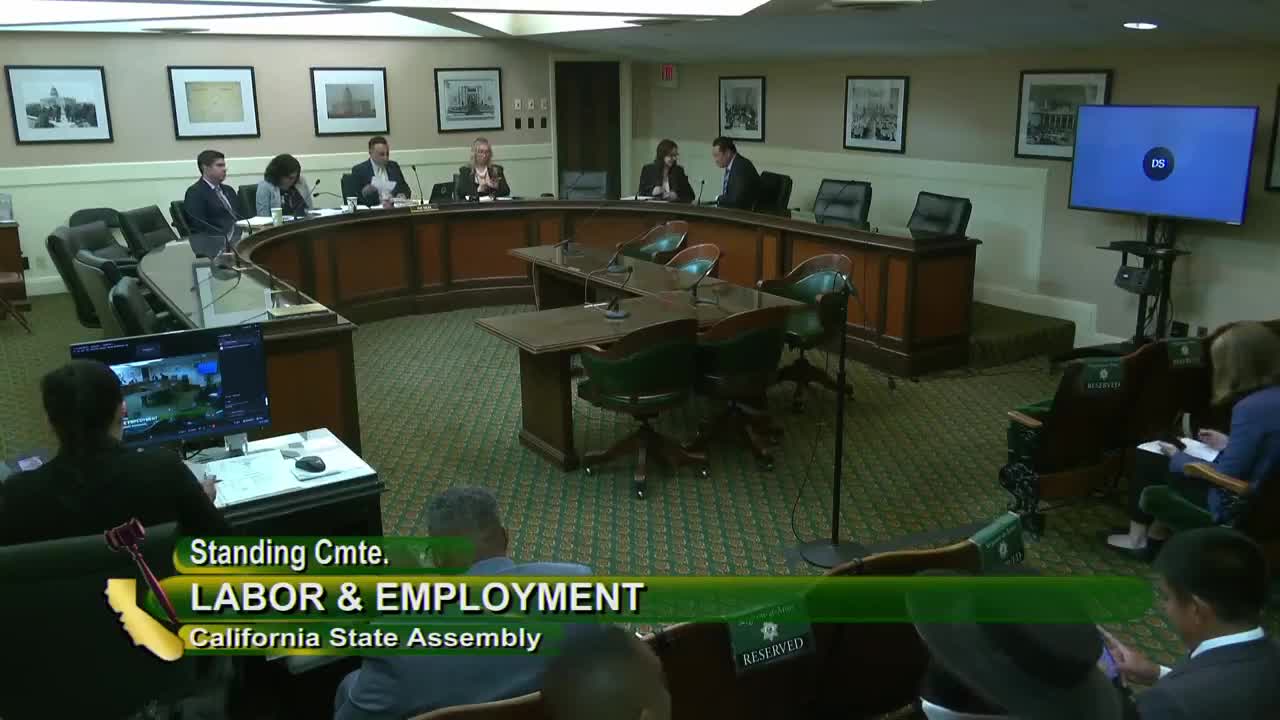 8MIN
Assembly Standing Committee on Labor and Employment
Bill Author

Bill Co-Author(s):