AB 1804: Crime: fentanyl trafficking.
- Session Year: 2023-2024
- House: Assembly
- Latest Version Date: 2024-01-08
Current Status:
Failed
(2024-05-16: In committee: Held under submission.)
Introduced
In Committee
First Chamber
In Committee
Second Chamber
Enacted
What does this bill do?
The bill lowers the amount of fentanyl (or closely related chemicals) that lets prosecutors get a judge’s order to intercept phone or electronic communications to 1.67 gallons by liquid volume or eight ounces by weight. It applies when prosecutors seek surveillance in suspected drug crimes such as importation, sale, transport, manufacture, or possession for sale of controlled substances.
The summary is provided by generative AI which can make mistakes. For original language, please view the details in the table below.
Existing law authorizes the Attorney General or a district attorney to make an application, as specified, to a judge of a superior court, for an order authorizing the interception of wire or electronic communications. Existing law authorizes a judge, upon a finding of probable cause as that an individual is committing, has committed, or is about to commit offenses involving a substance containing fentanyl or its precursors or analogs that exceeds 10 gallons by liquid volume or 3 pounds of solid substance by weight, to issue an order authorizing the interception.
This bill would reduce the above-described amounts for an order authorizing interception to 1.67 gallons by liquid volume and 8 ounces of solid substance by weight of a substance containing fentanyl or its precursors or analogs.
Upon application made under Section 629.50, the judge may enter an ex parte order, as requested or modified, authorizing interception of wire or electronic communications initially intercepted within the territorial jurisdiction of the court in which the judge is sitting, if the judge determines, on the basis of the facts submitted by the applicant, all of the following:
(a)There is probable cause to believe that an individual is committing, has committed, or is about to commit, one of the following offenses:
(1)Importation, possession for sale, transportation, manufacture, or sale of controlled substances in violation of Section 11351, 11351.5, 11352, 11370.6, 11378, 11378.5, 11379, 11379.5, or 11379.6 of the Health and Safety Code with respect to either of the following: a
(A)A substance containing heroin, cocaine, PCP, methamphetamine, fentanyl, or their precursors or analogs where the substance exceeds 10 gallons by liquid volume or three pounds of solid substance by weight.
(B)A substance containing fentanyl or its precursors or analogs where the substance exceeds 1.67 gallons by liquid volume or eight ounces of solid substance by weight.
(2)Murder, solicitation to commit murder, a violation of Section 209, or the commission of a felony involving a destructive device in violation of Section 18710, 18715, 18720, 18725, 18730, 18740, 18745, 18750, or 18755.
(3)A felony violation of Section 186.22.
(4)A felony violation of Section 11418, relating to weapons of mass destruction, Section 11418.5, relating to threats to use weapons of mass destruction, or Section 11419, relating to restricted biological agents.
(5)A violation of Section 236.1.
(6)An attempt or conspiracy to commit any of the above-mentioned crimes.
(b)There is probable cause to believe that particular communications concerning the illegal activities will be obtained through that interception, including, but not limited to, communications that may be utilized for locating or rescuing a kidnap victim.
(c)There is probable cause to believe that the facilities from which, or the place where, the wire or electronic communications are to be intercepted are being used, or are about to be used, in connection with the commission of the offense, or are leased to, listed in the name of, or commonly used by the person whose communications are to be intercepted.
(d)Normal investigative procedures have been tried and have failed or reasonably appear either unlikely to succeed if tried or too dangerous.
(e)Notwithstanding any other provision in this section, no a magistrate shall not enter an ex parte order authorizing interception of wire or electronic communications for the purpose of investigating or recovering evidence of a prohibited violation, as defined in Section 629.51.
REVISIONS: HeadingLine 2.|
Date
|
Status
|
|---|---|
| May 16, 2024 | Coauthors revised. |
| May 16, 2024 | In committee: Held under submission. |
| Mar 20, 2024 | In committee: Set, first hearing. Referred to APPR. suspense file. |
| Feb 27, 2024 | From committee: Do pass and re-refer to Com. on APPR. (Ayes 7. Noes 0.) (February 27). Re-referred to Com. on APPR. |
| Jan 22, 2024 | Referred to Com. on PUB. S. |
| Jan 9, 2024 | From printer. May be heard in committee February 8. |
| Jan 8, 2024 | Read first time. To print. |
|
Date
|
Description
|
Location
|
Votes
|
|
|---|---|---|---|---|
| Feb 27, 2024 | Do pass and be re-referred to the Committee on [Appropriations] | Assembly Standing Committee on Public Safety |
Passed |
This list shows positions taken on this bill by organizations on the date displayed, which is linked to the original source.
Positions by individuals are not included.
|
Organization
|
Position
|
Date
|
|---|---|---|
| Aclu California Action | * Against | Feb 27, 2024 |
| Arcadia Police Officers' Association | ** Support | |
| Burbank Police Officers' Association | ** Support | |
| California Association Of Highway Patrolmen | ** Support | |
| California Attorney's for Criminal Justice | * Against | Feb 27, 2024 |
| California Coalition of School Safety Professionals | ** Support | |
| California District Attorney Association | * Support | Feb 27, 2024 |
| California Family Council | * Support | Feb 27, 2024 |
| California Narcotic Officers' Association | ** Support | |
| California Public Defenders Association | * Against | Feb 27, 2024 |
| California Reserve Peace Officers Association | ** Support | |
| Clan Club and Education Services | * Support | Feb 27, 2024 |
| CLAREMONT POLICE OFFICERS ASSOCIATION | ** Support | |
| Corona Police Officers Association | ** Support | |
| Culver City Police Officers' Association | ** Support | |
| Deputy Sheriffs Association of Monterey County | ** Support | |
| Drug Policy Alliance | * Against | Feb 27, 2024 |
| Fresno County District Attorneys Office | ** Support | |
| Fresno Police Department | * Support | Feb 27, 2024 |
| Friends Committee on Legislative of California | * Against | Feb 27, 2024 |
| Fullerton Police Officers' Association | ** Support | |
| Initiate Justice | ** Against | |
| Legal Services for Prisoners with Children | * Against | Feb 27, 2024 |
| Legal Services with Prisons with Children | * Against | Feb 27, 2024 |
| Los Angeles School Police Management Association | ** Support | |
| los angeles school police officers association | ** Support | |
| LSPC | * Against | Feb 27, 2024 |
| Madera Police Department | ** Support | |
| Murrieta Police Officers' Association | ** Support | |
| Newport Beach Police Association | ** Support | |
| Novato Police Officers Association | ** Support | |
| Palos Verdes Police Officers Association | ** Support | |
| Peace Officers Research Association Of California | ** Support | |
| PLACER COUNTY DEPUTY SHERIFFS ASSOCIATION | ** Support | |
| Pomona Police Officers' Association | ** Support | |
| RIVERSIDE POLICE OFFICERS ASSOCIATION | ** Support | |
| Riverside Sheriff Association | * Support | Feb 27, 2024 |
| San Francisco Public Defender | * Against | Feb 27, 2024 |
| Santa Ana Police Officers Association | ** Support | |
| Sister Warriors Freedom Coalition | ** Against | Feb 27, 2024 |
| Tuolumne County Sheriff's Office | ** Support | |
| Upland Police Officers Association | ** Support | |
| Young Women's Freedom Center | * Against | Feb 27, 2024 |
Date of Hearing: March 20, 2024
ASSEMBLY COMMITTEE ON APPROPRIATIONS
Buffy Wicks, Chair
ABPCA Bill Id:AB 1804
Author:(Jim Patterson) – As Introduced Ver:January 8, 2024
Policy Committee: | Public Safety | Vote: | 7 - 0 |
|
| ||
|
|
Urgency: No State Mandated Local Program: No Reimbursable: No
SUMMARY:
This bill reduces the amount of fentanyl needed to support probable cause for an order authorizing wiretapping during the investigation of certain fentanyl-related crimes.
Specifically, this bill reduces the requisite amount of fentanyl, its precursors, or its analogs needed to authorize a wiretapping order from ten gallons to 1.67 gallons by liquid volume and from three pounds to eight ounces of solid substance by weight.
FISCAL EFFECT:
- Non-reimbursable local costs to law enforcement agencies for new wiretapping investigations authorized by this bill.
- Costs (Trial Court Trust Fund, General Fund) of an unknown but potentially significant amount to the courts to adjudicate criminal cases based on evidence obtained through wiretapping authorized by this bill. Actual costs will depend on the number of arrests resulting from wiretapping evidence, prosecutorial discretion, and the amount of time needed to adjudicate each case, but, as described below, the number of cases may increase significantly as a result of this bill. Although courts are not funded on the basis of workload, increased pressure on the Trial Court Trust Fund may create a need for increased funding for courts from the General Fund. The Governor’s 2024-25 budget proposes $83.1 million ongoing from the General Fund to backfill declining revenue to the Trial Court Trust Fund.
- Costs (local funds, General Fund) of an unknown but potentially significant amount to the counties and the California Department of Corrections and Rehabilitation to incarcerate people convicted using evidence obtained via wiretapping. Actual incarceration costs will depend on the number of convictions, the length of each sentence, and whether the sentence must be served in prison or county jail. The Legislative Analyst’s Office estimates the average annual cost to incarcerate one person in state prison is $133,000. The average annual cost to incarcerate one person in county jail is approximately $29,000. Although county incarceration costs are generally not considered reimbursable state mandates pursuant to Proposition 30 (2012), overcrowding in county jails creates cost pressure on the General Fund because the state has historically granted new funding to counties to offset overcrowding after the 2011 Realignment Act.
According to the Legislative Analyst’s Office, the General Fund faces a structural deficit in the tens of billions of dollars over the next several fiscal years.
COMMENTS:
- Purpose. According to the author:
AB 1804 is a targeted legislative initiative designed to empower law enforcement in the fight against the fentanyl crisis. By reducing the interception threshold for wire or electronic communications, the bill strategically focuses on providing valuable intelligence to catch major drug dealers rather than individual users.
- Background. In general, it is illegal for someone to wiretap or otherwise intercept another person’s electronic communications in California. This includes phone conversations and text messages sent via cellphone. However, a court may authorize a law enforcement agency to intercept someone’s electronic communications if a prosecutor makes certain showings of probable cause pertaining to criminal activities and demonstrates either that normal investigative procedures have been tried and have failed, or that such procedures appear unlikely to succeed or are too dangerous to try.
Existing law allows a court to issue an order authorizing wiretapping if there is probable cause to believe that an individual is committing, has committed, or is about to commit the crime of importing, possessing for sale, transporting, manufacturing, or selling of a substance containing a certain amount of fentanyl or its precursors or analogs. This bill reduces the requisite amount of fentanyl, its precursors, or its analogs that must be present to support such a wiretapping order. In its annual report on this topic, the Department of Justice reported 89 drug-related arrests and two convictions in 2022 that resulted from authorized electronic interceptions. Additional related convictions may occur in the following year due to the timing of court proceedings. Given the ubiquity of fentanyl in California today, lowering these fentanyl thresholds may result in many more wiretapping orders being sought and granted, leading to additional arrests, trials, and incarceration for fentanyl offenses.
- Related Legislation. AB 1892 (Flora) allows a court to grant an order authorizing wiretapping if there is probable cause to believe that an individual is committing, has committed, or is about to commit a crime related to specified obscene matter involving minors. AB 1892 is pending hearing in this committee.
Analysis Prepared by: Annika Carlson / APPR. / (916) 319-2081
Date of Hearing: February 27, 2024
Counsel: Andrew Ironside
ASSEMBLY COMMITTEE ON
Kevin McCarty, Chair
ABPCA Bill Id:
Author:() – As Ver:
SUMMARY:
Lowers the requisite amount of fentanyl to support probable cause to obtain a wiretap order. Specifically, this bill: Authorizes a judge, upon receipt of a valid application to issue an ex parte order authorizing interception of wire or electronic communications initially intercepted within the territorial jurisdiction of the judge’s court if there is probable cause to believe that an individual is committing, has committed, or is about to commit the crime of importing, possessing for sale, transporting, manufacturing, or selling of a substance containing fentanyl or its precursors or analogs where the substance exceeds 1.67 gallons by liquid volume or eight ounces of solid substance by weight.
EXISTING FEDERAL LAW: Provides that the right of the people to be secure in their persons, houses, papers, and effects, against unreasonable searches and seizures, shall not be violated, and no warrants shall issue, but upon probable cause, supported by oath or affirmation, and particularly describing the place to be searched, and the persons or things to be seized. (U.S. Const., Amend. IV.)
EXISTING STATE LAW:
- Provides that all people have an inalienable right to privacy. (Cal. Const., art. I, § 1.)
- Provides that the right of the people to be secure in their persons, houses, papers, and effects against unreasonable seizures and searches may not be violated; and a warrant may not issue except on probable cause, supported by oath or affirmation, particularly describing the place to be searched and the persons and things to be seized. (Cal. Const., Art. I, § 13.)
- Requires each application for an order authorizing the interception of a wire or electronic communication to be made in writing upon the personal oath or affirmation of the Attorney General, Chief Deputy Attorney General, or Chief Assistant Attorney General, Criminal Law Division, or of a district attorney, or the person designated to act as district attorney in the district attorney’s absence, to the presiding judge of the superior court or one other judge designated by the presiding judge. (Pen. Code, § 629.50, subd. (a).)
- Requires that the application include a statement of facts and circumstances, including the offense that is being, has been, or is about to be committed, the place where the communication is to be intercepted, that conventional investigative techniques are unlikely to succeed, the type of communication that is to be intercepted, the identity, if known, of the person whose communications are to be intercepted, and a statement of the period of time for which the interception is required to be maintained. (Pen. Code, § 629.50, subd. (a)(4)-(5).)
- Authorizes a judge, upon application as specified, to enter an ex parte order, as requested or modified, authorizing interception of wire or electronic communications initially intercepted within the territorial jurisdiction of the court in which the judge is sitting, if the judge determines, on the basis of the facts submitted by the applicant, all of the following:
- There is probable cause to believe that an individual is committing, has committed, or is about to commit, among other crimes, the crime of importing, possessing for sale, transporting, manufacturing, or selling of controlled substances, as specified, with respect to a substance containing heroin, cocaine, PCP, methamphetamine, fentanyl, or their precursors or analogs where the substance exceeds 10 gallons by liquid volume or three pounds of solid substance by weight;
- There is probable cause to believe that particular communications concerning the illegal activities will be obtained through that interception, including, but not limited to, communications that may be utilized for locating or rescuing a kidnap victim;
- There is probable cause to believe that the facilities from which, or the place where, the wire or electronic communications are to be intercepted are being used, or are about to be used, in connection with the commission of the offense, or are leased to, listed in the name of, or commonly used by the person whose communications are to be intercepted; and,
- Normal investigative procedures have been tried and have failed or reasonably appear either unlikely to succeed if tried or too dangerous. (Pen. Code, § 629.52, subds. (a)-(d).)
- There is probable cause to believe that an individual is committing, has committed, or is about to commit, among other crimes, the crime of importing, possessing for sale, transporting, manufacturing, or selling of controlled substances, as specified, with respect to a substance containing heroin, cocaine, PCP, methamphetamine, fentanyl, or their precursors or analogs where the substance exceeds 10 gallons by liquid volume or three pounds of solid substance by weight;
- Prohibits a magistrate, unless otherwise authorized by law, from entering an ex parte order authorizing interception of wire or electronic communications for the purpose of investigating or recovering evidence of a prohibited violation, as specified. (Pen. Code, § 629.52, subd. (e).)
- Authorizes the Judicial Council to establish guidelines for judges to follow in granting an order authorizing the interception of any wire or electronic communications. (Pen. Code, § 629.53.)
- Requires each order authorizing the interception of any wire or electronic communication to specify all of the following:
- The identity, if known, of the person whose communications are to be intercepted, or if the identity is not known, then that information relating to the person’s identity known to the applicant;
- The nature and location of the communication facilities as to which, or the place where, authority to intercept is granted;
- A particular description of the type of communication sought to be intercepted, and a statement of the illegal activities to which it relates;
- The identity of the agency authorized to intercept the communications and of the person making the application; and,
- The period of time during which the interception is authorized including a statement as to whether or not the interception shall automatically terminate when the described communication has been first obtained. (Pen. Code, § 629.54, subds. (a)-(e).)
- The identity, if known, of the person whose communications are to be intercepted, or if the identity is not known, then that information relating to the person’s identity known to the applicant;
- Permits the judge to grant oral approval for an emergency interception without an order as specified. Approval for an oral interception shall be conditioned upon filing with the court, within 48 hours of the oral approval, a written application for an order. (Pen. Code, § 629.56.)
- Provides that no order shall authorize the interception of a wire or electronic communication for a period longer than necessary to achieve the objective of the authorization, nor longer than 30 days. (Pen. Code, § 629.58.)
- Requires that a defendant identified as the result of an interception shall be notified prior to the entry of a plea of guilty or nolo contendere, or at least 10 days prior to any trial, hearing, or proceedings in the case other than an arraignment or grand jury proceeding. Within 10 days prior to trial, hearing, or proceeding the prosecution shall provide the defendant a copy of all recorded interceptions from which evidence against the defendant was derived, including a copy of the court order, accompanying application and monitory logs. (Pen. Code, § 629.70.)
- Specifies that a defendant in any trial, hearing, or proceeding, may move to suppress some or all of the contents of an intercepted wire or electronic communications, or evidence derived from an intercepted communication, on the basis that the evidence was obtained in violation of the Fourth Amendment of the United States Constitution. (Pen. Code, § 629.72).
- Defines “wire communication” as any aural transfer made in whole or in part through the use of facilities for the transmission of communications by the aid of wire, cable, or other like connection between the point of origin and the point of reception (including the use of a like connection in a switching station), furnished or operated by any person engaged in providing or operating these facilities for the transmission of communications. (Pen. Code, § 629.51, subd. (a)(1).)
- Defines “electronic communication” as any transfer of signs, signals, writings, images, sounds, data, or intelligence of any nature in whole or in part by a wire, radio, electromagnetic, photoelectric, or photo-optical system. (Pen. Code, § 629.51, subd. (a)(2).)
FISCAL EFFECT:
Unknown
COMMENTS:
- Author's Statement: According to the author, “AB 1804 is a targeted legislative initiative designed to empower law enforcement in the fight against the fentanyl crisis. By reducing the interception threshold for wire or electronic communications, the bill strategically focuses on providing valuable intelligence to catch major drug dealers rather than individual users.”
- Probable Cause: The Fourth Amendment to the U.S. Constitution protects against unreasonable searches and seizures by the government. “[A] Fourth Amendment search occurs when the government violates a subjective expectation of privacy that society recognizes as reasonable.” (Kyllo v. U.S. (2001) 533 U.S. 27, 33; California v. Ciraolo (1986) 476 U.S. 207, 211.) The U.S. Supreme Court has held that the interception of private communications is a search within the meaning of the Fourth Amendment. (See Berger v. New York (1967) 388 U.S. 41 and Katz v. U.S. (1967) 389 U.S. 347; cf. People v. Roberts (2010) 184 Cal.App.4th 1149, 1160 [California’s wiretap statute allows for “the judicially authorized intrusion into a constitutionally protected zone of privacy”].)
Subject to limited exceptions, a search is reasonable if it is supported by probable cause. Probable cause sufficient to justify a search generally requires showing that “there is a fair probability that contraband or evidence of a crime will be found in a particular place” to be searched. (Illinois v. Gates (1983) 462 U.S. 213, 238.) Whether justification for a search exists is based on the totality of the circumstances known to law enforcement at the time of submitting an affidavit for a search warrant. (See e.g., Illinois v. Gates, supra, 462 U.S. at 238; U.S. v. Buckner (9th Cir. 1999) 179 F.3d 834, 837.)
This bill lowers the requisite amount of fentanyl to support probable cause to obtain a wiretap order from 10 gallons by liquid volume or three pounds solid substance by weight to 1.67 gallons by liquid volume or eight ounces of solid substance by weight. - Ex Parte Orders for Interception of Wire and Electronic Communications: Electronic intercepts are legally sanctioned surveillance of electronic and wire communications for law enforcement purposes. Individuals involved in criminal activity often use wire and electronic communications to plan crimes such as drug trafficking. The use of court-authorized electronic intercepts is a tool used by law enforcement to identify and investigate drug traffickers, street gangs, and investigate serious and violent offenses. According to the California Department of Justice, in 2022, intercept orders led to approximately 89 drug related arrests and two convictions. (California Electronic Interceptions Report, Annual Report, Office of the Attorney General (2022) at p. 6 <https://oag.ca.gov/system/files/media/annual-rept-legislature-2022.pdf>)
An ex parte order is a limited order that a court may issue without providing the subject of the order the usual notice prescribed by law. Such orders are justified on the grounds that informing the targeted individual of law enforcement efforts to monitor their communications would jeopardize law enforcement’s investigation—the individual could simply cease communicating specifically about the suspect criminal activity or use an alternate means of communication. (Cf. People v. Roberts (2010) 184 Cal.App.4th 1149, 1160.)
In interpreting a state wiretap scheme, the courts may look for guidance to cases under the Federal Wiretap Act of 1968, which “provides a ‘comprehensive scheme for the regulation of wiretapping and electronic surveillance.’” (People v. Otto (1992) 2 Cal.4th 1088, 1097.) “The [Federal Wiretap Act], in effect, establishes minimum standards for the admissibility of evidence procured through electronic surveillance; state law cannot be less protective of privacy than the federal Act.” (Id. at p. 1098.) California law generally is stricter than federal law, with a presumption that wiretapping is prohibited. (People v. Leon (2007) 40 Cal.4th 376, 383.) “California’s wiretap law subjects the authorization of electronic surveillance to a much higher degree of scrutiny than a conventional search warrant.” (People v. Roberts, 184 Cal. App. 4th 1149, 1166.) The purpose of wiretap laws is to protect the privacy of wire and oral communications and to delineate a uniform basis of the circumstances and conditions under which the interception of wire and oral communications may be authorized. (Halpin v. Superior Court (1972) 6 Cal.3d 885, 898.)
Existing state law authorizes ex parte orders for the interception and recording of wire an electronic communications in limited circumstances. (See Pen. Code, § 629.52.) Unlike a search warrant, the application for authorization to intercept wire or electronic communications must come from the Attorney General, Chief Deputy Attorney General, or Chief Assistant Attorney General, Criminal Law Division, or of a district attorney. (Pen. Code, § 629.50, subd. (a).) The application must attest to the facts and circumstance justifying the application, including the details of the offense being investigated; the investigative techniques employed by law enforcement and why those techniques are unlikely to be successful; the nature and location of the facilities or place where the communication is to be intercepted; a description of the communications law enforcement expects to intercept; and the identity, if known, of the person being investigated and whose communications are to be intercepted. (Pen. Code, § 629.50, subd. (a)(4).) The application must also specify the period of time it will maintain the interception. (Pen. Code, § 629.50, subd. (a)(5).) And, an extension of the period of time for intercepting communications requires a request for an extension of the order. (Pen. Code, § 629.50, subd. (a)(7).)
Finally, the application must attest, and the court must find, that normal investigative procedures have been tried and have failed or reasonably appear either unlikely to succeed if tried or would be too dangerous. (Pen. Code, §§ 629.50, subd. (a)(4) and 629.52, subd. (d).) In People v. Roberts, the appellate court considered a challenge to the trial court’s order authorizing interception of wire and electronic communications because, among other reasons, “the state did not exhaust normal investigatory methods before seeking the wiretaps.” ((2010) 184 Cal.App.4th 1149, 1171.) The court rejected this argument, citing the detectives statement of the techniques used and that those techniques were unlikely to be efficacious in further investigation; that confidential informants upon whom investigators had relied had become unreliable; that an undercover officer had not been able to identifying the drug supplier or purchase large amounts of the drug, despite successfully purchasing smaller amounts; the target of the wiretap had become suspicious of the undercover agent and had cut off direct contact with the agent; the target of the wiretap took extensive measure to avoid surveillance; and that “search warrants, interviews and grand jury proceedings would effectively terminate the investigation by alerting participants and foreclosing prosecution of some of [the] most culpable participants in the narcotics trafficking organization.” (Id. at p. 1173.) Based on these facts, the court concluded, “The record supports the trial court’s conclusion that the supervising judge’s finding of necessity did not contravene the Fourth Amendment or [Pen. Code] section 629.52, subdivision (d).” (Id. at p. 1172.) - Fentanyl, Generally: Fentanyl was synthesized in the 1960s and has been used medically since 1968. According to the Centers for Disease Control and Prevention (CDC), “Fentanyl is a synthetic opioid that is up to 50 times stronger than heroin and 100 times stronger than morphine.” (https://www.cdc.gov/stopoverdose/fentanyl/index.html) Pharmaceutical fentanyl is used legally to treat severe pain in both hospital and outpatient settings. It is often used to treat post-operative pain and advanced stage cancer. (Ibid.)
Illicit fentanyl is primarily responsible for the dramatic increase in fentanyl-related overdoses in recent years. Most of the illicit fentanyl consumed in the United States originates in China, “a major pipeline of the building blocks of fentanyl, known as fentanyl precursors, according to U.S. officials.” (John et al., The US sanctioned Chinese companies to fight illicit fentanyl. But the drug’s ingredients keep coming, CNN.com (Mar. 30, 2023) < https://www.cnn.com/2023/03/30/americas/fentanyl-us-china-mexico-precursor-intl/index.html> [last visited Mar. 31, 2023].). Chemical manufactures in China ship fentanyl precursors to Mexico where drug cartels make fentanyl and arrange for it to be transported across the U.S./Mexico border. (Ainsley, U.S. and Mexico weighing deal from Mexico to crack down on fentanyl going north while U.S. cracks down on guns going south, NBCNews.com (Mar. 27, 2023) <https://www.nbcnews.com/politics/national-security/fentanyl-gun-smuggling-us-mexico-border-deal-rcna75782> [last visited Mar. 31, 2023].) The vast majority of the fentanyl seizures in the U.S. occur at legal ports of entry or interior vehicle checkpoints, and U.S. citizens are primarily the ones trafficking fentanyl. (Bier, Fentanyl Is Smuggled for U.S. Citizens By U.S. Citizens, Not Asylum Seekers, Cato.org (Sept. 14, 2022) <https://www.cato.org/blog/fentanyl-smuggled-us-citizens-us-citizens-not-asylum-seekers> [last visited Mar. 31, 2023].).
Available as either a liquid or powder, illicit fentanyl has proved a potent and relatively low cost drug, making it attractive to drug cartels seeking to increase profit margins. (See DEA, Facts About Fentanyl <https://www.dea.gov/resources/facts-about-fentanyl> [last visited Feb. 21, 2024].) Illicit fentanyl is often mixed with other drugs like heroin, cocaine, or methamphetamine, and is widely used in counterfeit prescription opioids. Because of mixing, many users are not aware that they are consuming fentanyl. (CDC, Fentanyl Facts <https://www.cdc.gov/stopoverdose/fentanyl/index.html> [last visited Apr. 25, 2023].) Even when aware, the potency of the drug and variability within the market often leave people who use fentanyl and other drugs often mixed with fentanyl without accurate ways to gauge whether they are consuming a lethal dose. - Overdoses in California: The number of deaths involving opioids, and fentanyl in particular, has increased significantly over the course of the last decade. In California, between 2019 and 2022, the number of opioid-related deaths in the state increased by 121 percent. (Ibarra et al., California’s opioid deaths increased 121% in 3 years. What’s driving the crisis?, CalMatters.org (July 25, 2023) <https://calmatters.org/explainers/california-opioid-crisis/> [last visited Feb. 21, 2024].) In 2022, the year for which the most recent data is available, there were 21,316 emergency room visits resulting from an opioid overdose, 7,385 opioid-related overdose deaths, and 6,473 overdose deaths from fentanyl. (CDPH, Overdose Surveillance Dashboard <https://skylab.cdph.ca.gov/ODdash/?tab=Home> [last visited Feb. 21, 2024].)
Because of mixing, many fentanyl-related deaths were people who did not know they were consuming the drug. Intentional fentanyl use is also on the rise. Many people who use drugs now choose to use fentanyl on its own or knowingly seek drugs containing it. (Edwards, Once feared, illicit fentanyl is now a drug of choice for many opioid users, NBC News (Aug. 7, 2022) <https://www.nbcnews.com/health/health-news/feared-illicit-fentanyl-now-drug-choice-many-opioids-users-rcna40418> [last visited Apr. 24, 2023].) A recent University of Washington survey of people who had used syringe service programs found that two-thirds had used fentanyl “on purpose” in the last three months. (Kingston et al., University of Washington, Results from the 2021 WA State Syringe Service Program Health Survey (Mar. 2022) at pp. 1, 6 <https://adai.uw.edu/wordpress/wp-content/uploads/ssp-health-survey-2021.pdf> [last visited Apr. 24, 2023].) Harm reduction workers in San Francisco report that “[m]ore than half of drug users [in the Tenderloin district in San Francisco] purposely seek fentanyl, despite its dangers.” (Vestal, Some Drug Users in Western U.S. Seek Out Deadly Fentanyl. Here’s Why., PEW Charitable Trusts (Jan. 7, 2019) <https://www.pewtrusts.org/en/research-and-analysis/blogs/stateline/2019/01/07/some-drug-users-in-western-us-seek-out-deadly-fentanyl-heres-why> [last view Apr. 24, 2023].) - Existing Efforts to Combat Fentanyl in California: The state’s 2022-23 budget included $7.9 million in 2022-23 and $6.7 million ongoing to fund the Fentanyl Task Force within the Department of Justice (DOJ) to help tackle the fentanyl crisis. (Governor’s Budget Summary – 2023-24 at p. 117 <https://ebudget.ca.gov/2022-23/pdf/Enacted/BudgetSummary/FullBudgetSummary.pdf> [April 20, 2023].) The task force includes 25 new positions within the DOJ to support those efforts. (Ibid.)
Building on the 2022-23 Budget, the state’s 2023-24 Budget includes additional funding to combat fentanyl abuse. The budget allocates $93 million over the next four years, including $79 million for Naloxone distribution projects; $10 million for grants for education, testing, recovery, and support services; $4 million to make test strips more available; and, $3.5 million for overdose medication for all middle and high schools. (Governor’s Budget Summary – 2023-24 at p. 69 <https://ebudget.ca.gov/FullBudgetSummary.pdf> [April 20, 2023].)
The Governor’s Master Plan for Tackling the Fentanyl and Opioid Crisis also includes $30 million to expand California National Guard’s work to prevent drug-trafficking transnational criminal organizations and $15 million over two years to establish and operate the Fentanyl Enforcement Program within the DOJ to combat manufacturing, distribution, and trafficking. The Governor also has allocated $40.8 million for an education and awareness campaign to establish partnerships and create messaging and education tools for parents and educators, and $23 million in substance use disorder workforce grants to develop substance use disorder training for non-behavioral health professionals working with children and youth. (Governor Newsom’s Master Plan for Tackling the Fentanyl and Opioid Crisis <https://www.gov.ca.gov/wp-content/uploads/2023/03/Fentanyl-Opioids-Glossy-Plan_3.20.23.pdf?emrc=86c07e> [April 20, 2023].)
Adding to these efforts, the Governor recently announced a public safety partnership charged with combatting fentanyl trafficking in San Francisco. The partnership would include the California Highway Patrol, the California National Guard, San Francisco Police Department, and the San Francisco District Attorney’s Office. According to the press release, “This agreement will lead to the formation of a new collaborative operation between all four agencies focused on dismantling fentanyl trafficking and disrupting the supply of the deadly drug in the city by holding the operators of large-scale drug trafficking operations accountable.” (Governor Newsom Announces Public Safety Partnership to Disrupt Fentanyl Trafficking San Francisco <https://www.gov.ca.gov/2023/04/21/public-safety-partnership-sf/> [last visited Apr. 24, 2023].)
Additionally, AB 33 (Bains), Chapter 887, Statutes of 2023, established the Fentanyl Addiction and Overdose Prevention Task Force to, among other things, collect and organize data on the nature and extent of fentanyl abuse in California; identify and assess sources and drivers of legal and illicit fentanyl activity in California; analyze existing statutes for their adequacy in addressing fentanyl abuse and, if the analysis determines that those statutes are inadequate, recommend revisions to those statutes or the enactment of new statutes that specifically define and address fentanyl abuse; and recommend strategies to increase the ability and willingness of the medical community to treat fentanyl addiction and abuse. - Argument in Support: According to the Fresno County District Attorney’s Office, “In 2021, fentanyl overdoses emerged as the leading cause of death among adults aged 18-45, comprising 36% of all drug-related fatalities in California. AB 1804 confronts this crisis by reinforcing law enforcement capabilities to gather intelligence on drug suppliers. The proposed changes the criteria for authorizing the interception of wire or electronic communications, specifically related to offenses involving fentanyl or its precursors.
“The existing law allows interception when there’s probable cause that an individual is involved in offenses related to a substance containing fentanyl or its precursors, exceeding 10 gallons by liquid volume or 3 pounds of solid substance by weight.
“Yet, the existing interception threshold inadequately addresses situations involving substantial quantities linked to suppliers, necessitating a recalibration to align with the potent lethality of fentanyl in comparison to other drugs. AB 1804 strategically empowers law enforcement by reducing the interception threshold, setting authorization amounts at 1.67 gallons by liquid volume and 8 ounces by weight for solid substances containing fentanyl or its precursors. This recalibration ensures proactive action against large-scale fentanyl operations, safeguarding our communities.” - Argument in Opposition: According to the California Public Defenders Association, “AB 1804 would lower the threshold quantity of fentanyl or its precursors or analogs from ten liquid gallons or three pounds of solid substance to 1.67 liquid gallons or eight ounces of solid substance believed to be involved in the importation, possession for sale, transportation, manufacture, or sale of fentanyl required for a judge to authorize interception of wire or electronic communications.
“CPDA sympathizes with and understands the unintended consequences and impact that the use of unregulated illegal drugs can have on the lives of users, including overdoses, as so many of our clients have struggled with substance abuse, mental health and addiction. However, AB 1804, by making it easier to investigate and prosecute conduct associated with fentanyl trafficking, represents a step backwards towards a debunked “tough on crime” approach, and is an attempt to resurrect the failed public policy of the past and return to mass incarceration as a solution for societal problems. Social scientists have extensively researched the outcomes of an enforcement and penalty-based approach to combatting illicit drugs and the results are clear: incarcerating those involved in the drug trade does not reduce the sale and use of drugs, does not reduce recidivism, does not increase public safety, and in fact is leads to more crime.
“By lowering the minimum quantity required for judicially authorized communications surveillance, AB 1804 will not only make it easier to prosecute narcotics sales generally, it will also promote the prosecution of low-level users and individuals who sell fentanyl due to their struggles with substance abuse, mental health and myriad other challenges, rather than to earn profit. The prosecution of this class of person, rather than more sophisticated individuals, is easier, and the result will be the increased and repeated incarceration of indigent people, with a likely disproportionate impact on people of color.
“Returning to a ‘War on Drugs,’ tough on crime approach is a mistake, and runs contrary to established data and the will of California voters, who have repeatedly indicated their preference for treating the illicit drug trade as what it is—a health crisis. Instead of making it easier to prosecute and increasing the amount and type of people who can be targeted by law enforcement, California should double down on prevention, rehabilitation, education, and reentry. The War on Drugs has had a catastrophic impact on communities all across the state, its ruinous effects most acutely felt by people of color. Making it easier to investigate and prosecute these offenses will result in an increase in jail and prison populations, which will cause its own set of devastating collateral consequences on the families and communities of those incarcerated.
“From our experience as public defenders we know that many of those who engage in the illegal drug trade are often low-level users of drugs themselves. To make it easier to prosecute for engaging in illegal narcotic sales is contrary to sound public policy and humane treatment in our criminal justice system.” - Related Legislation:
- AB 1814 (Ting), would prohibit law enforcement and peace officers from using a facial recognition technology (FRT) as the sole basis for probable cause for an arrest, search, or affidavit for a warrant. AB 1814 will be heard today in this committee.
- AB 1892 (Flora), would authorize a judge, upon receipt of a valid application, to issue an ex parte order authorizing interception of wire or electronic communications initially intercepted within the territorial jurisdiction of the judge’s court if there is probable cause to believe that an individual is committing, has committed, or is about to commit a crime related to specified obscene matter involving minors. AB 1892 is currently pending hearing in this committee.
- AB 1814 (Ting), would prohibit law enforcement and peace officers from using a facial recognition technology (FRT) as the sole basis for probable cause for an arrest, search, or affidavit for a warrant. AB 1814 will be heard today in this committee.
- Prior Legislation:
- AB 793 (Bonta), of the 2023-2024 Legislative Session, would have prohibited a government entity from seeking or obtaining information from a reverse-location demand or a reverse-keyword demand, and prohibits any person or government entity from complying with a reverse-location demand or a reverse-keyword demand.
- AB 1242 (Bauer-Kahan), Chapter 627, Statutes of 2022, prohibits the issuance of, among other things, an ex parte order authorizing interception of wire or other electronic communication or a trap and trace devise for purpose of investigating or recovering evidence arising out of the lawful abortion services.
- SB 439 (Umberg), Chapter 645, Statutes of 2019, expanded the ability for prosecuting agencies to use intercepted communications related to additional crimes captured during the lawful execution of a wiretap in court, as specified, and states that an agency that employs peace officers may use intercepted communications in an administrative or disciplinary hearing against a peace officer if the evidence relates to any crime involving a peace officer.
- AB 1948 (Jones-Sawyer), Chapter 294, Statutes of 2018, added fentanyl to the list of controlled substances for which interception of wire or electronic communications may be ordered.
- AB 1924 (Low), Chapter 511, Statutes of 2016, required an order or extension order authorizing or approving the installation and use of a pen register or a trap and trace device direct that the order be sealed until the order, including any extensions, expires, and would require that the order or extension direct that the person owning or leasing the line to which the pen register or trap and trace device is attached not disclose the existence of the pen register or trap and trace device or the existence of the investigation to the listed subscriber or to any other person.
- SB 178 (Leno), Chapter 651, Statutes of 2015, prohibits a government entity from compelling the production of, or access to, electronic-communication information or electronic-device information without a search warrant or wiretap order, except under specified emergency situations.
- SB 741 (Hill) Chapter 741, Statutes of 2015, required local agencies to publicly approve or disclose the acquisition of cellular communications interception technology.
- SB 35 (Pavley), Chapter 745, Statutes of 2014, extended the sunset date on California’s wiretapping law until January 1, 2020.
- SB 61 (Pavley), Chapter 663, Statutes of 2011, extended the sunset date on California’s wiretapping law until January 1, 2015.
- AB 569 (Portantino), Chapter 391, Statutes of 2007, extended the sunset date on California wiretap law until January 1, 2012.
- AB 74 (Washington), Chapter 605, Statutes of 2002, extended the sunset date on California wiretap law until January 1, 2008.
- AB 2343 (Pacheco), of the 2001-2002 Legislative Session, would have deleted the sunset date of the current wiretap law, expanded the definition of "wire communication" to authorize the interception of information sent through e-mail media, and created the emergency authority to expand an existing interception order. AB 2343 died in this committee.
- AB 793 (Bonta), of the 2023-2024 Legislative Session, would have prohibited a government entity from seeking or obtaining information from a reverse-location demand or a reverse-keyword demand, and prohibits any person or government entity from complying with a reverse-location demand or a reverse-keyword demand.
REGISTERED SUPPORT / OPPOSITION:
Support
Arcadia Police Officers' Association
Burbank Police Officers' Association
California Association of Highway Patrolmen
California Coalition of School Safety Professionals
California District Attorneys Association
California Family Council
California Narcotic Officers' Association
California Reserve Peace Officers Association
Claremont Police Officers Association
Corona Police Officers Association
Culver City Police Officers' Association
Deputy Sheriffs' Association of Monterey County
Fresno County District Attorneys Office
Fresno Police Department
Fullerton Police Officers' Association
Los Angeles School Police Management Association
Los Angeles School Police Officers Association
Madera Police Department
Murrieta Police Officers' Association
Newport Beach Police Association
Novato Police Officers Association
Palos Verdes Police Officers Association
Peace Officers Research Association of California (PORAC)
Placer County Deputy Sheriffs' Association
Pomona Police Officers' Association
Riverside Police Officers Association
Riverside Sheriffs' Association
Santa Ana Police Officers Association
Tuolumne County Sheriff's Office
Upland Police Officers Association
2 Private Individuals
Oppose
ACLU California Action
California Public Defenders Association
Drug Policy Alliance
Friends Committee on Legislation of California
Initiate Justice (UNREG)
Legal Services for Prisoners With Children
San Francisco Public Defender
Sister Warriors Freedom Coalition
Young Women's Freedom Center
Analysis Prepared by:
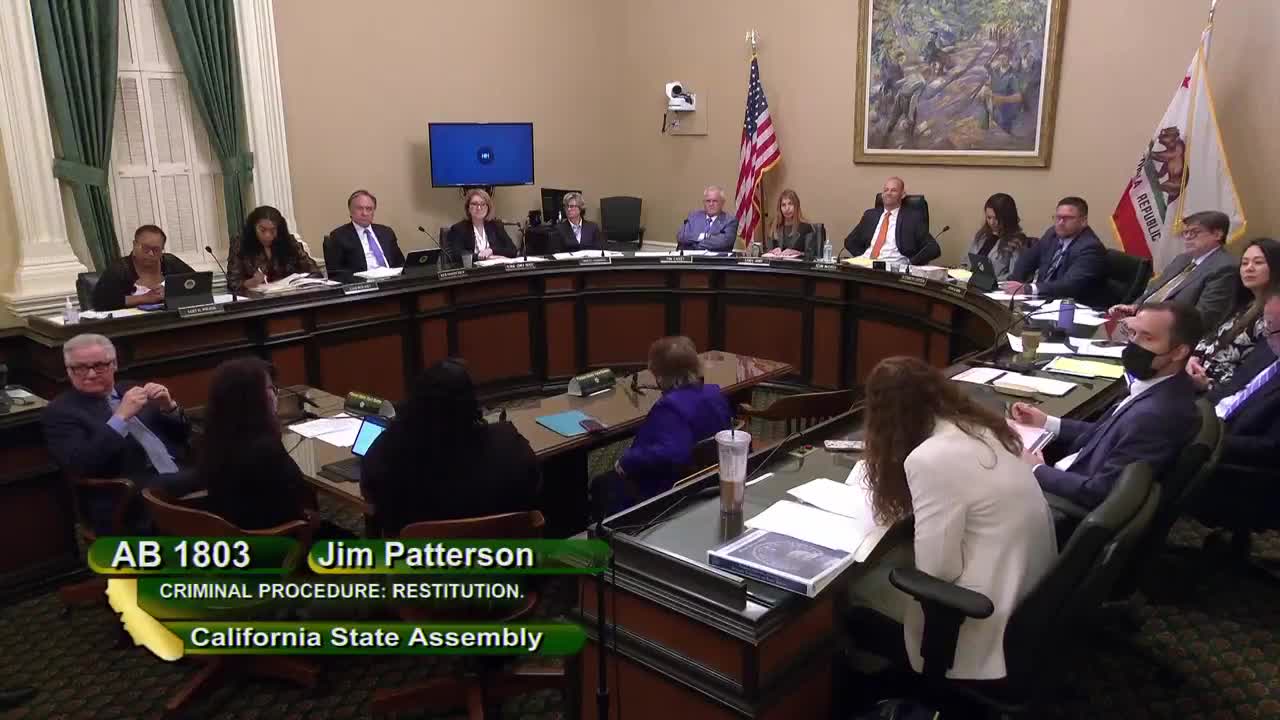
Discussed in Hearing
 46MIN
Assembly Standing Committee on Public Safety
Bill Author