AB 1857: State Air Resources Board: air quality regulation: valleys.
- Session Year: 2023-2024
- House: Assembly
- Latest Version Date: 2024-01-18
Current Status:
Failed
(2024-05-16: In committee: Held under submission.)
Introduced
In Committee
First Chamber
In Committee
Second Chamber
Enacted
Existing law imposes various limitations on emissions of air contaminants for the control of air pollution from vehicular and nonvehicular sources. Existing law generally designates the State Air Resources Board as the state agency with the primary responsibility for the control of vehicular air pollution and air pollution control and air quality management districts with the primary responsibility for the control of air pollution from all sources other than vehicular sources.
This bill would require the state board to adopt regulations to improve air quality in population centers located in valleys and would require each local air district to implement those regulations with regard to stationary sources located within its jurisdiction. The bill would make those requirements inoperative on January 1, 2029, and would require the state board, on or before January 1, 2030, to submit a report to the Legislature and specified committees of the Legislature describing any air quality improvements resulting from those regulations.
By adding to the duties of local air districts, this bill would impose a state-mandated local program.
The California Constitution requires the state to reimburse local agencies and school districts for certain costs mandated by the state. Statutory provisions establish procedures for making that reimbursement.
This bill would provide that, if the Commission on State Mandates determines that the bill contains costs mandated by the state, reimbursement for those costs shall be made pursuant to the statutory provisions noted above.
(a)The state board shall adopt regulations to improve air quality in population centers located in valleys.
(b)Each district shall implement the regulations adopted pursuant to subdivision (a) with regard to stationary sources located within its jurisdiction.
(c)Subdivisions (a) and (b) shall become inoperative on January 1, 2029.
(d)(1)The state board shall submit a report to the Legislature on or before January 1, 2030, summarizing the regulations adopted pursuant to subdivision (a) and describing any air quality improvements resulting from those regulations.
(2)The report to be submitted pursuant to paragraph (1) shall be submitted in compliance with Section 9795 of the Government Code.
(3)The state board shall also submit the report required pursuant to paragraph (1) to the Assembly Committee on Natural Resources and the Senate Committee on Environmental Quality.
(e)For purposes of this section, valley means an elongate depression of the earth's surface usually between ranges of hills or mountains.
(f)This section shall remain in effect only until January 1, 2034, and as of that date is repealed.
SEC. 2.If the Commission on State Mandates determines that this act contains costs mandated by the state, reimbursement to local agencies and school districts for those costs shall be made pursuant to Part 7 (commencing with Section 17500) of Division 4 of Title 2 of the Government Code.
|
Date
|
Status
|
|---|---|
| May 16, 2024 | In committee: Held under submission. |
| Apr 10, 2024 | In committee: Set, first hearing. Referred to APPR. suspense file. |
| Mar 20, 2024 | From committee: Do pass and re-refer to Com. on APPR. (Ayes 8. Noes 2.) (March 19). Re-referred to Com. on APPR. |
| Jan 29, 2024 | Referred to Com. on NAT. RES. |
| Jan 19, 2024 | From printer. May be heard in committee February 18. |
| Jan 18, 2024 | Read first time. To print. |
|
Date
|
Description
|
Location
|
Votes
|
|
|---|---|---|---|---|
| Mar 19, 2024 | Do pass and be re-referred to the Committee on [Appropriations] | Assembly Standing Committee on Natural Resources |
Passed |
This list shows positions taken on this bill by organizations on the date displayed, which is linked to the original source.
Positions by individuals are not included.
|
Organization
|
Position
|
Date
|
|---|---|---|
| California Environmental Voters | * Support | Mar 19, 2024 |
| California Manufacturers And Technology Association | * Neutral | Mar 19, 2024 |
| FracTracker Alliance | * Support | Mar 19, 2024 |
Date of Hearing: April 10, 2024
ASSEMBLY COMMITTEE ON APPROPRIATIONS
Buffy Wicks, Chair
ABPCA Bill Id:AB 1857
Author:(Jackson) – As Introduced Ver:January 18, 2024
Policy Committee: | Natural Resources | Vote: | 8 - 2 |
|
| ||
|
|
Urgency: No State Mandated Local Program: Yes Reimbursable: Yes
SUMMARY:
This bill requires, until 2029, the Air Resources Board (ARB) to adopt, and air districts to implement, regulations to improve air quality in population centers located in valleys. In addition, this bill requires ARB to submit a report to the Legislature by January 1, 2030, summarizing the regulations adopted pursuant to this bill and describing any air quality improvements resulting from those regulations.
FISCAL EFFECT:
1) Annual costs until at least 2029 of an unknown but significant amount, likely in the low tens of millions of dollars, for ARB to implement this bill (General Fund).
ARB estimates significant annual costs, potentially over $21 million, for at least 90 new staff to develop a control strategy to improve air quality in valleys, implement a stakeholder process for the control strategy and identified actions, adopt and implement regulations identified in the control strategy, and prepare the required report. ARB estimates there are approximately 7,608 valleys in California. Of this number, approximately 1,826 valleys contain population centers. ARB would likely need to tailor its regulations to address the specific air quality issues facing different valleys. ARB’s initial estimates indicate, based on current emissions inventories across the state, it would need to develop a minimum of 19 new regulations to fulfill the requirements of this bill. ARB estimates it would require at least three staff for each new regulation, as well as additional legal, equity, and information technology staff.
2) By requiring each air district to implement ARB’s regulations with regard to stationary sources, this bill imposes a state-mandated local program. Many air districts have fee authority to recover certain costs. However, given the many unknowns about the types of regulations ARB might adopt – and an air district would be required to implement – to improve air quality in population centers in valleys, it is not clear if an air district will be able to recover its implementation costs using its existing fee authority. Therefore, should the Commission on State Mandates determine that this bill establishes a reimbursable mandated local program, the state would need to reimburse these local costs, which would likely be significant, potentially in the low tens of millions of dollars annually (General Fund).
According to the Legislative Analyst’s Office, the General Fund faces a structural deficit in the tens of billions of dollars over the next several fiscal years.
COMMENTS:
1) Purpose. According to the author:
California prides itself on its stringent air quality standards, yet paradoxically, regions like the Inland Empire and San Joaquin Valley contend every year for hosting some of the nation's most polluted air. This intolerable situation underscores the critical importance of AB 1857. For too long, California's valley regions have been neglected, placing an unjust burden on our most disadvantaged communities who are suffering the most. It's time to address this pressing issue and prioritize the health and well-being of our communities.
2) Background. As noted in the Assembly Natural Resources Committee analysis of this bill, meteorology, topography, concentration of emissions sources, and exposure are well-known factors in the effects of air pollution. As a result, air pollution laws, governance, and decades of federal, state, and local air district regulations recognize and focus on valleys and population centers. While these existing efforts have resulted in significant progress, many air basins in California remain in nonattainment for one or more National Ambient Air Quality Standards, and many communities suffer from additional burdens of criteria pollutants and toxic air contaminants.
While this bill is intended to further regulate sources of air pollution in valley population centers, ARB already has broad authority to regulate mobile sources of air pollution, as well as the authority to oversee air districts’ regulation of stationary sources. Further, according to ARB, in 2020, nitrogen oxides (NOx) emissions from primarily federally regulated sources exceeded emissions from California-regulated mobile sources statewide and, absent additional federal actions, NOx emissions from primarily federally regulated sources will be double California-regulated mobile sources in 2031.
As noted in the Assembly Natural Resources Committee analysis of this bill, to achieve a predictable, positive result, this bill may need to focus on a more specific objective, such as specific emissions sources, specific air districts or regions, or specific regulations, enforcement objectives, or incentives. In addition, it is not clear why this bill makes ARB regulations adopted under the bill inoperative in 2029. Even if ARB were able to adopt a regulation, there is no guarantee that air quality improvements would be realized by January 1, 2029, given the time it will likely take ARB to research and develop the regulation, lead times for implementation, and transition or phase-out periods for industry to comply and begin achieving reductions.
3) Opposition. The California Air Pollution Control Officers Association (CAPCOA), which represents the air pollution control officers from all 35 local air quality districts throughout California, writes in opposition:
The definition of “valley” in this bill is too broadly vague and does not recognize that California Health and Safety code already defines air basins as well as sets requirements for how air quality will be regulated in those basins. AB 1857 may have the unintended impact of introducing unnecessary complexity into the science of air quality management, which in turn would slow progress. Further, we feel this bill is unnecessary as CARB and the air districts already partner closely to develop and implement mobile and stationary source programs that reduce air pollution and improve air quality for all areas of California, including valleys. These programs are developed in coordination with and under the oversight of the United States Environmental Protection Agency (US EPA) to ensure they meet Clean Air Act requirements.
The League of Cities writes in opposition:
By requiring CARB to create additional air quality regulations would potentially be duplicative of existing air quality standards and rules that air districts are already implementing…Regional air pollution control districts and air quality management districts are better positioned to tailor rules to the specific needs and issues in their region.
Analysis Prepared by: Nikita Koraddi / APPR. / (916) 319-2081
Date of Hearing: March 19, 2024
ASSEMBLY COMMITTEE ON NATURAL RESOURCES
Isaac G. Bryan, Chair
ABPCA Bill Id:AB 1857 (
Author:Jackson) – As Introduced Ver:January 18, 2024
SUBJECT: State Air Resources Board: air quality regulation: valleys
SUMMARY: Requires, until 2029, the Air Resources Board (ARB) to adopt, and air districts to implement, regulations to improve air quality in population centers located in valleys.
EXISTING LAW:
- The federal Clean Air Act (CAA) and its implementing regulations set National Ambient Air Quality Standard (NAAQS) for six criteria pollutants, designate air basins that do not achieve NAAQS as nonattainment, and require states with nonattainment areas to submit a State Implementation Plan (SIP) detailing how they will achieve compliance with NAAQS. (42 U.S.C. 7401 et seq.)
- Establishes ARB as the air pollution control agency in California and requires the ARB, among other things, to control emissions from a wide array of mobile sources and coordinate with local air districts to control emissions from stationary sources in order to implement the CAA. (Health and Safety Code (HSC) 39000 et seq.)
- Requires ARB to (1) divide the state into air basins based upon similar meteorological and geographic conditions, and consideration for political boundary lines whenever practicable, and (2) adopt air quality standards for each air basin in consideration of the public health, safety, and welfare. (HSC 39606)
- Requires, subject to the powers and duties of the ARB, air districts to adopt and enforce rules and regulations to achieve and maintain the state and federal air quality standards in all areas affected by emission sources under their jurisdiction, and to enforce all applicable provisions of state and federal law. (HSC 40001)
- Requires air districts to develop attainment plans detailing how they will attain and maintain state air quality standards, and submit those plans to ARB. (HSC 40910 et seq.)
- Requires ARB to:
- Review the district attainment plans to determine whether the plans will achieve and maintain state air quality standards by the earliest practicable date.
- Review district rules, regulations and programs to determine whether they are sufficiently effective to achieve and maintain state air quality standards.
- Review district and other local enforcement practices to determine whether reasonable action is being taken to enforce their programs, rules, and regulations.
(HSC 41500)
- Authorizes ARB, if it finds that the program or the rules and regulations of a district will not likely achieve and maintain state air quality standards, to establish a program, or rules and regulations it deems necessary to enable the district to achieve and maintain such standards, which shall have the same force and effect as a district program, rule, or regulation and shall be enforced by the district. (HSC 41504)
- Authorizes ARB, if it finds that a district is not taking reasonable action to enforce the statutory provisions, rules, and regulations relating to air quality in such a manner that will likely achieve and maintain state air quality standards, to exercise any of the powers of that district to achieve and maintain such standards. (HSC 41505)
THIS BILL:
- Requires ARB to adopt regulations to improve air quality in population centers located in valleys.
- Requires each district to implement ARB’s regulations with regard to stationary sources located within its jurisdiction.
- Provides these requirements become inoperative on January 1, 2029.
- Requires ARB to submit a report to the Legislature on or before January 1, 2030, summarizing the regulations adopted and describing any air quality improvements resulting from those regulations.
- Defines “valley” as an elongate depression of the earth’s surface usually between ranges of hills or mountains.
- Sunsets these requirements January 1, 2034.
FISCAL EFFECT: Unknown
COMMENTS:
- Author’s statement:
California prides itself on its stringent air quality standards, yet paradoxically, regions like the Inland Empire and San Joaquin Valley contend every year for hosting some of the nation's most polluted air. This intolerable situation underscores the critical importance of AB 1857. For too long, California's valley regions have been neglected, placing an unjust burden on our most disadvantaged communities who are suffering the most. It's time to address this pressing issue and prioritize the health and well-being of our communities.
- Valleys and population centers are already a focus of efforts to improve air quality. Meteorology, topography, concentration of emissions sources, and exposure are well-known factors in the effects of air pollution. As a result, air pollution laws, governance, and decades of federal, state and district regulations recognize and focus on valleys and population centers.
While these existing efforts have resulted in significant progress, many air basins in California remain in nonattainment for one or more NAAQS, and many communities suffer from additional burdens of criteria pollutants and toxic air contaminants.
This bill provokes the question – What more should be done to regulate sources of air pollution in valley population centers suffering from poor air quality? However, it’s not clear how this bill will improve the situation. As noted above, ARB already has broad authority to regulate mobile sources of air pollution, as well as authority to oversee air districts’ regulation of stationary sources. To achieve a predictable, positive result, the bill may need to focus on a more specific objective, such as specific emissions sources, specific air districts or regions, or specific regulations, enforcement and/or incentives.
The bill also provokes concerns and opposition from cities and air districts due to the suggestion that it steps on the established division of duties between ARB and the local air districts. While existing law does permit ARB to adopt and enforce regulations within the jurisdiction of a district where ARB finds the district has fallen short, regulating local stationary sources is not a challenge ARB likely wants to take on.
Finally, it’s not clear why the bill makes ARB regulations adopted under the bill, which may take considerable time and effort to adopt, inoperative in 2029.
REGISTERED SUPPORT / OPPOSITION:
Support
None on file
Opposition
California Air Pollution Control Officers Association
League of California Cities
Analysis Prepared by: Lawrence Lingbloom / NAT. RES. /
Discussed in Hearing
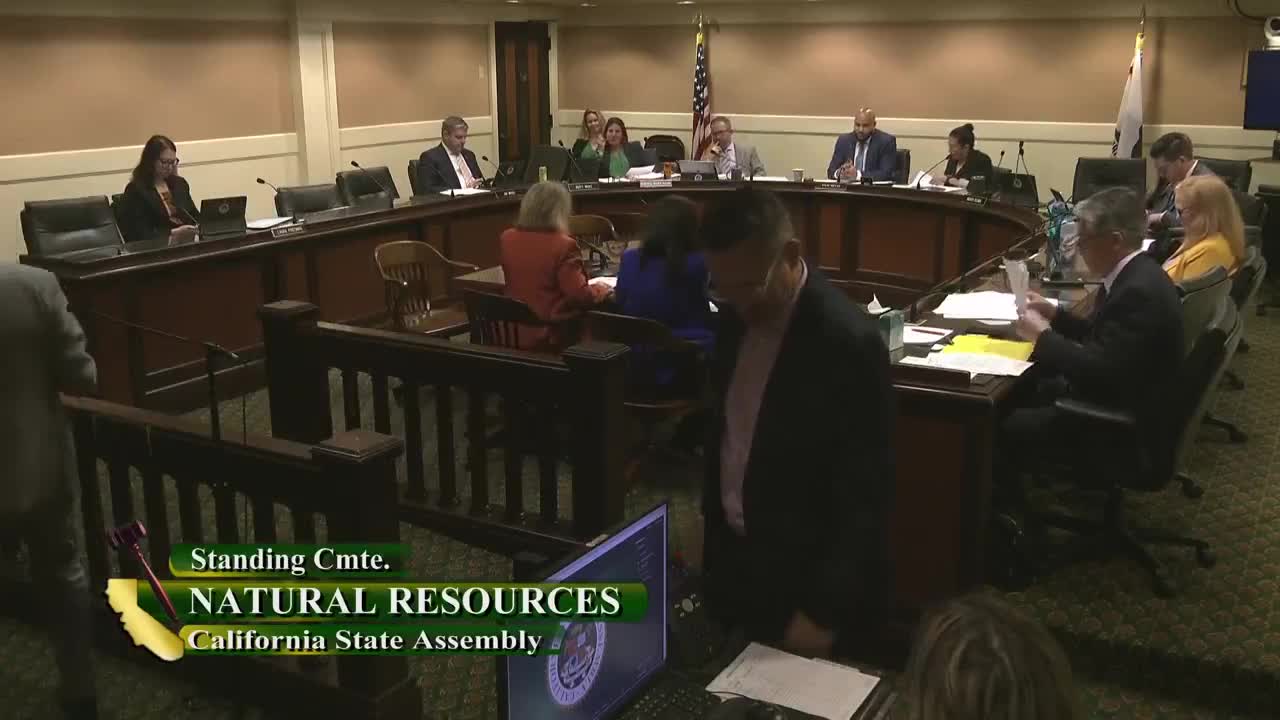 27MIN
Assembly Standing Committee on Natural Resources
Bill Author

Bill Co-Author(s):