AB 2071: Pupil instruction: English Learner Roadmap: grant program: parent toolkit.
- Session Year: 2023-2024
- House: Assembly
- Latest Version Date: 2024-05-30
Current Status:
Failed
(2024-08-15: In committee: Held under submission.)
Introduced
In Committee
First Chamber
In Committee
Second Chamber
Enacted
Existing law establishes the State Board of Education, and requires the state board to adopt rules and regulations, not inconsistent with the laws of the state, to govern the public elementary and secondary schools of the state. Existing law requires the state board to determine all questions of policy within its powers. Pursuant to these powers, the state board has adopted a policy known as the California English Learner Roadmap State Board of Education Policy: Educational Programs and Services for English Learners, also known as the EL Roadmap Policy, for the stated purpose of assisting the State Department of Education in providing guidance to local educational agencies with respect to educating English learners attending California public schools.
Existing law establishes the State Department of Education, under the administration of the Superintendent of Public Instruction, and assigns the department numerous duties relating to the governance and funding of local educational agencies.
This bill would require the state board to, on or before December 31, 2025, March 15, 2026, develop and adopt a California English Learner Roadmap: Parent Toolkit that will be made available to families served by school districts, county offices of education, and charter schools that are implementing the EL Roadmap Policy. The bill would require the state board to convene a workgroup to assist in the development of the parent toolkit, as provided. The bill would require the department to develop forms that may be used by parents of English learner pupils to request services from the pupils teacher or administrator as it relates to the parent toolkit.
The bill would establish the English Learner Roadmap Implementation Grant Pilot Program with the goal of locally planning and implementing the EL Roadmap Policy. The bill would require the department, commencing on or before September 1, 2025, to award 25 no more than 8 one-time grants of up to $1,500,000 per grant and no more than 4 one-time grants of up to $750,000 per grant to school districts, county offices of education, or charter schools, as provided. The bill would require the department to, among other things, determine application procedures and selection criteria for grant awards, review applications, identify and determine how data will be collected and shared with the public, and meet quarterly with leaders from the grant recipients for specified purposes. The bill would require grant recipients to submit to the department specified data as it relates to the grant received. The bill would require the department to submit to the appropriate policy and fiscal committees of the Legislature an annual a progress report on or before January 31, 2027, and, on or before December 1, 2028, a final report, with specified information about, among other things, the successes and challenges of the grant program, as provided.
This bill would make implementation of its provisions contingent upon an appropriation by the Legislature, as provided.
Existing law establishes the State Board of Education, and requires the state board to adopt rules and regulations, not inconsistent with the laws of the state, to govern the public elementary and secondary schools of the state. Existing law requires the state board to determine all questions of policy within its powers. Pursuant to these powers, the state board has adopted a policy known as the California English Learner Roadmap State Board of Education Policy: Educational Programs and Services for English Learners, also known as the EL Roadmap Policy, for the stated purpose of assisting the State Department of Education in providing guidance to local educational agencies with respect to educating English learners attending California public schools.
Existing law establishes the State Department of Education, under the administration of the Superintendent of Public Instruction, and assigns the department numerous duties relating to the governance and funding of local educational agencies.
This bill would require the state board to, on or before December 31, 2025, develop and adopt a California English Learner Roadmap: Parent Toolkit that will be made available to families served by school districts, county offices of education, and charter schools that are implementing the EL Roadmap Policy. The bill would require the state board to convene a workgroup to assist in the development of the parent toolkit, as provided. The bill would require the department to develop forms that may be used by parents of English learner pupils to request services from the pupils teacher or administrator as it relates to the parent toolkit.
The bill would establish the English Learner Roadmap Implementation Grant Program with the goal of locally planning and implementing the EL Roadmap Policy. The bill would appropriate $30,000,000 from the General Fund to the department for allocation pursuant to the program. The bill would require the department, commencing September 1, 2025, to award 25 one-time grants of up to $1,500,000 per grant to school districts, county offices of education, or charter schools, as provided. The bill would require the department to, among other things, determine application procedures and selection criteria for grant awards, review applications, identify and determine how data will be collected and shared with the public, and meet quarterly with leaders from the grant recipients for specified purposes. The bill would require grant recipients to submit to the department specified data as it relates to the grant received. The bill would require the department to submit to the appropriate policy and fiscal committees of the Legislature an annual progress report and, on or before December 1, 2028, a final report, with specified information about, among other things, the successes and challenges of the grant program, as provided.
Funds appropriated by this bill would be applied toward the minimum funding requirements for school districts and community college districts imposed by Section 8 of Article XVI of the California Constitution.This bill would make implementation of its provisions contingent upon an appropriation by the Legislature, as provided.
Existing law establishes the State Board of Education, and requires the state board to adopt rules and regulations, not inconsistent with the laws of the state, to govern the public elementary and secondary schools of the state. Existing law requires the state board to determine all questions of policy within its powers. Pursuant to these powers, the state board has adopted a policy known as the California English Learner Roadmap State Board of Education Policy: Educational Programs and Services for English Learners, also known as the EL Roadmap Policy, for the stated purpose of assisting the State Department of Education in providing guidance to local educational agencies with respect to educating English learners attending California public schools.
Existing law establishes the State Department of Education, under the administration of the Superintendent of Public Instruction, and assigns the department numerous duties relating to the governance and funding of local educational agencies.
This bill would require the state board to, on or before December 31, 2025, develop and adopt a California English Learner Roadmap: Parent Toolkit that will be made available to families served by school districts, county offices of education, and charter schools that are implementing the EL Roadmap Policy. The bill would require the state board to convene a workgroup to assist in the development of the parent toolkit, as provided. The bill would require the department to develop forms that may be used by parents of English learner pupils to request services from the pupils teacher or administrator as it relates to the parent toolkit.
The bill would establish the English Learner Roadmap Implementation Grant Program with the goal of locally planning and implementing the EL Roadmap Policy. The bill would appropriate $30,000,000 from the General Fund to the department for allocation pursuant to the program. The bill would require the department, commencing September 1, 2025, to award 25 one-time grants of up to $1,500,000 per grant to school districts, county offices of education, or charter schools, as provided. The bill would require the department to, among other things, determine application procedures and selection criteria for grant awards, review applications, identify and determine how data will be collected and shared with the public, and meet quarterly with leaders from the grant recipients for specified purposes. The bill would require grant recipients to submit to the department specified data as it relates to the grant received. The bill would require the department to submit to the appropriate policy and fiscal committees of the Legislature an annual progress report and, on or before December 1, 2028, a final report, with specified information about, among other things, the successes and challenges of the grant program, as provided.
Funds appropriated by this bill would be applied toward the minimum funding requirements for school districts and community college districts imposed by Section 8 of Article XVI of the California Constitution.
The Legislature finds and declares all of the following:
(a)Sixty percent of the young children in the state have a home language other than English. The state currently enrolls 1,100,000 pupils in kindergarten and grades 1 to 12, inclusive, that are English learners. For these pupils, academic gaps persist, many never achieve English proficiency, and academic outcomes remain unacceptably low.
(b)In 2017, the State Board of Education unanimously adopted a new, comprehensive, assets-oriented, and research-based California English Learner Roadmap State Board of Education Policy: Educational Programs and Services for English Learners (EL Roadmap Policy), which superseded the 1998 English Learner policy that was based upon Proposition 227.
(c)The EL Roadmap Policy explicitly focuses on English learner pupils in the context of the states efforts to improve the educational system, the quality of teaching and learning, and educational outcomes. Its purpose is to support local educational agencies as they incorporate English learner education into local programs, policies, and services.
(d)As a comprehensive policy, by design, the EL Roadmap Policy touches almost all aspects of schooling from preschool through high school and requires the involvement of and alignment of multiple roles, departments, and functions within a local district while calling upon district leadership to engage multiple stakeholders in taking shared responsibility for English learner education.
(e)As an aspirational assets-based policy, implementation of the EL Roadmap Policy is a long-term endeavor that requires thoughtful planning, priority setting, monitoring, and continuous improvement as well as the creation of local systems and policies aligned with the EL Roadmap Policy to ensure sustainability.
(f)The research-based principles of the EL Roadmap Policy further require aligned capacity-building capacity building across multiple roles and the building of a district infrastructure for professional learning and instructional coherence.
(g)The EL Roadmap Policy is an assets-oriented policy that positions pupils cultures and languages as assets for their learning and seeks bilingualism and biliteracy as outcomes of schooling. As a result, the EL Roadmap Policy represents a paradigm shift from previous English learner policies.
(h)The EL Roadmap Policy explicitly calls for certain conditions to make enactment possible, such as seeking structural changes, attitudinal shifts, and system improvements. Thus, implementing the EL Roadmap Policy is a more complex and longer term investment in systems change than previous English learner policies.
(i)In the first five years since the 2017 adoption of the EL Roadmap Policy, implementation has produced some bright spots due to the effectiveness of the Educator Workforce Investment Grant program. However, this program alone is not enough to move the needle for systemic and broader change across the state.
(j)There are a handful of local educational agencies with strong leadership that have embraced the vision and principles of the EL Roadmap Policy and have invested in professional learning and capacity-building systems across their districts and have developed district-level plans and systems for coherence, clarity, accountability, and sustainability aligned to the EL Roadmap Policy. These districts have also seen strong academic and other positive outcomes for multilingual learners. However, there are not enough of these local educational agencies.
(k)Recent findings from the academic field have documented major barriers to implementation of the EL Roadmap Policy to include, among others, a widespread lack of awareness, understanding, and capacity among district staff, administrators, and district-level leadership related to building coherent and aligned local systems and mechanisms to give life to the EL Roadmap Policy principles and ensure that the promise of the EL Roadmap Policy reaches the 1,100,000 English learners in the state.
(l)Local educational agencies have been inundated with multiple new state-funded initiatives requiring complex local planning, but without connection to, or alignment with, the EL Roadmap Policy principles for effective English learner education.
(m)Incentives and support are needed to facilitate the engagement of local educational agencies in embracing and further implementing the EL Roadmap Policy.
(n)While some of the states local educational agencies have either fully implemented or are in the process of implementing the EL Roadmap Policy, others have not yet begun the process.
(o)Unfortunately, the state does not have an English learner parent toolkit that could serve as a guide to help local educational agencies who are currently implementing the EL Roadmap Policy, as well as those local educational agencies that plan on integrating the EL Roadmap Policy in the future.
(p)Without proper guidance, local educational agencies lack the necessary knowledge and experience to ensure parents and families of the states English learners play an integral role in the process of navigating the education system to lead their children to linguistic fluency and academic success in English and other languages.
(q)Parents need a clear guide that breaks down the ways in which they can participate in the implementation process for each principle of the EL Roadmap Policy.
SEC. 2.Chapter 5.5 (commencing with Section 424) is added to Part 1 of Division 1 of Title 1 of the Education Code, to read:5.5.English Learner Roadmap Implementation Grant Pilot Program1.Incentive and Support Grants for English Learner Roadmap Implementation 424.For purposes of this article, the following definitions apply:
(a)Designated ELD means instruction provided during a time during the regular schoolday for focused instruction on the state-adopted ELD standards to assist English learners to develop critical English language skills necessary for academic content learning in English.
(b)EL Roadmap Policy means the California English Learner Roadmap State Board of Education Policy: Educational Programs and Services for English Learners adopted by the state board on July 12, 2017.
(c)ELD means English language development.
(d)English learner has the same meaning as defined in subdivision (a) of Section 306.
(e)Integrated ELD means instruction in which the state-adopted ELD standards are used in tandem with the state-adopted academic content standards and includes specifically designed academic instruction in English.
(f)Local educational agency means a school district, county office of education, or charter school.
(g)Long-term English learner has the same meaning as defined in subdivision (a) of Section 313.1.
(h)Newcomer pupil has the same meaning as defined in subdivision (a) of Section 54450.
425.The English Learner Roadmap Implementation Grant Pilot Program is hereby established with the goal of locally planning and implementing the EL Roadmap Policy by doing all of the following:
(a)Developing local comprehensive EL Roadmap Policy implementation plans with clear and measurable goals that focus on the four principles of the EL Roadmap Policy.
(b)Aligning local policies and guidance, including, but not limited to, master plans and local educational agency vision and goal statements, to the EL Roadmap Policy.
(c)Building shared understanding and ownership across multiple roles, departments, and stakeholders related to applying the vision and principles of the EL Roadmap Policy to local context and need.
(d)Creating coherent local systems to support instructional improvement for English learners that are consistent with the EL Roadmap Policy.
(e)Establishing or strengthening progress monitoring and data systems to focus continuous improvement on programs and services aligned to the vision, principles, and goals of the EL Roadmap Policy.
(f)Building capacity and instituting aligned professional learning across multiple roles for implementing evidence-based practices for English learner success aligned to the EL Roadmap Policy.
(g)Including a focus on the implementation of integrated ELD, designated ELD, and bilingual and dual language pathways for pupils in transitional kindergarten, kindergarten, and grades 1 to 12, inclusive.
(h)Aligning school resources with the EL Roadmap Policy implementation plan to enact the four principles of the EL Roadmap Policy.
(i)Engaging technical assistance and professional learning services to bring English learner and dual language expertise for a local educational agencys planning and implementation process as well as provide facilitation support, as needed.
(j)Aligning goals, actions, and services for English learners in local control and accountability plans to the EL Roadmap Policy principles.
(k)To the extent possible, implementing the parent toolkit developed pursuant to subdivision (a) of Section 429.
426.(a)The department shall administer the English Learner Roadmap Implementation Grant Pilot Program, which shall be a three-year grant program. Commencing On or before September 1, 2025, the department shall award 25 one-time grants of up to one million five hundred thousand dollars ($1,500,000) per grant, to local educational agencies to be expended before September 1, 2028, for the purposes described in Section 425. 425, as follows:
(b)The department may use up to 10 percent of moneys appropriated for purposes of this article to administer the grants described in subdivision (a), provide support to those grantees, and facilitate the community of practice described in paragraph (5) of subdivision (a) of Section 427.(c)Priority for grant awards shall be given to all of the following:(1)Local educational agencies with a high percentage of English learner pupil enrollment as compared to total enrollment.(2)Local educational agencies with the highest numbers of English learner pupils.(3)Local educational agencies with the lowest numbers of English learner pupils and multiple languages spoken by English learners.(d)In accordance with Section 427, the department shall identify criteria for evaluating applicants and awarding grants.(1)No more than eight grants of up to one million five hundred thousand dollars ($1,500,000) per grant to local educational agencies that are in the top 19 local educational agencies in the state with the highest number of enrolled English learner pupils and in which 19 percent or more of its total enrolled pupils are English learners.
(2)No more than four grants of up to seven hundred fifty thousand dollars ($750,000) per grant to local educational agencies that are not in the top 19 local educational agencies in the state with the highest number of enrolled English learner pupils but have 1,000 or more enrolled English learner pupils and in which 19 percent or more of its total enrolled pupils are English learners.
(b)The department shall ensure grant recipients selected for purposes of this article, to the maximum extent possible, are balanced with regard to geographic regions and urban and rural settings.
(e)(c)An applicant shall include all both of the following in its application:
(1)Pupil enrollment data for the three years before the date of the application, disaggregated by all of the following:
(A)Number of English learner pupils, including long-term English learner pupils and newcomer pupils.
(B)Number of reclassified fluent English proficient pupils.
(C)Number of pupils who are native speakers of English. determined to be initially fluent English proficient or English-only speakers.
(D)Languages spoken by English learner pupils.
(2)How the applicant will be equipped to serve as a demonstration site to model how successful EL Roadmap Policy implementation works.
427.(a)In administering the English Learner Roadmap Implementation Grant Pilot Program, the department shall perform all of the following functions:
(1)(A)Determine application procedures and selection criteria for grant awards.
(B)Create a rubric of key elements of successful programs based on the EL Roadmap Policy to be part of the application process.
(2)Review applications and award grants.
(3)Identify data to be collected by grant recipients for reporting to the department.
(4)Identify how the department will collect data from grant recipients and make that data available to the public.
(5)(A)Meet quarterly with leaders from the grant recipients, to be known as a community of practice, for purposes of sharing lessons, models, materials, tools, or other resources that may be developed in the course of the planning and implementation phases.
(B)The department is encouraged to seek the participation of parent leaders in the community of practice process and is encouraged to provide interpretation and translation services, as necessary.
(b)A grant recipient shall use the grant received under this article for any of the following purposes:
(1)Hiring staff to be assigned to the administration of the grant program.
(2)Purchase of instructional materials.
(3)Professional learning, including compensating teachers for their participation.
(4)Development of local educational agency and site implementation plans.
(5)Professional development, including substitutes for teachers, administrators, and support staff.
(6)Coaches and coaching.
(7)Trainings to implement the parent toolkit developed pursuant to subdivision (a) of Section 429, including childcare.
(c)A grant recipient shall use the grant to supplement, not supplant, funding used to support English learner pupils.
428.(a)Notwithstanding Section 10231.5 of the Government Code, the department shall submit an annual a progress report to the appropriate policy and fiscal committees of the Legislature commencing July 1, 2026, and continuing through the duration of the English Learner Roadmap Implementation Grant Program. The department shall include on or before January 31, 2027, that includes all of the following:
(1)Data identified by the department pursuant to paragraph (3) of subdivision (a) of Section 427.
(2)A description of how each grant recipient has used the grant funds.
(3)A description of teacher, administrator, parent, and community involvement.
(4)The number of pupils, parents, teachers, administrators, and support staff that received support from the grant.
(b)Notwithstanding Section 10231.5 of the Government Code, in addition to the annual progress reports report described in subdivision (a), the department shall submit a final report to the appropriate policy and fiscal committees of the Legislature on or before December 1, 2028, that includes all of the following:
(1)A description of successes and challenges or barriers faced in the implementation of the grant program and recommendations to address identified challenges or barriers.
(2)The final number of pupils served.
(3)The final number of parents who participated in the program and a description of their involvement.
(4)A description of services or programs, or both, provided at each site.
(5)A description of services or professional learning, or both, provided and disaggregated by teacher, administrator, and parent involvement.
(6)A breakdown of costs disaggregated by services and programs provided to pupils.
429.428.5.The implementation of this article is contingent upon an appropriation by the Legislature for these purposes in the annual Budget Act or another statute.428.7.This article shall remain in effect only until January 1, 2029, and as of that date is repealed.
2.California English Learner Roadmap: Parent Toolkit430.429.(a)On or before December 31, 2025, March 15, 2026, the state board shall:
(1)Develop and adopt a California English Learner Roadmap: Parent Toolkit that will be made available to families served by local educational agencies that are implementing the EL Roadmap Policy. The parent toolkit shall include all of the following:
(A)Questions that parents can ask schools, including user-friendly descriptors of each of the four principles of the EL Roadmap Policy.
(B)Language that is translated into the parents primary language.
(C)An introduction on how to the use the parent toolkit, how the toolkit is aligned to the EL Roadmap Policy, and a summary of the four principles.
(D)How parents can apply their learning from the parent toolkit to the promotion of biliteracy.
(E)A glossary of terms.
(2)Convene a workgroup to assist in the development of the parent toolkit that may include parent leaders, local educational agency English learner administrators or specialists, representatives from institutions of higher education, or one or more nonprofit organizations with expertise in developing and providing high-quality professional learning focused on serving English learners as well as implementing the EL Roadmap Policy.
(b)On or before July 1, 2025, March 15, 2027, the department shall develop forms to be used by parents of English learner pupils that may be used to request services from the pupils teacher or administrator as they relate to the parent toolkit.
(c)For purposes of this article, the following definitions apply:
(1)EL Roadmap Policy means the California English Learner Roadmap State Board of Education Policy: Educational Programs and Services for English Learners adopted by the state board on July 12, 2017.
(2)Local educational agency means a school district, county office of education, or charter school.
431.429.5.The implementation of this article is contingent upon an appropriation by the Legislature for these purposes in the annual Budget Act or another statute.
The Legislature finds and declares all of the following:
(a)Sixty percent of the young children in the state have a home language other than English. The state currently enrolls 1,100,000 pupils in kindergarten and grades 1 to 12, inclusive, that are English learners. For these pupils, academic gaps persist, many never achieve English proficiency, and academic outcomes remain unacceptably low.
(b)In 2017, the State Board of Education unanimously adopted a new, comprehensive, assets-oriented, and research-based California English Learner Roadmap State Board of Education Policy: Educational Programs and Services for English Learners (EL Roadmap Policy), which superseded the 1998 English Learner policy that was based upon Proposition 227.
(c)The EL Roadmap Policy explicitly focuses on English learner pupils in the context of the states efforts to improve the educational system, the quality of teaching and learning, and educational outcomes. Its purpose is to support local educational agencies as they incorporate English learner education into local programs, policies, and services.
(d)As a comprehensive policy, by design, the EL Roadmap Policy touches almost all aspects of schooling from preschool through high school and requires the involvement of and alignment of multiple roles, departments, and functions within a local district while calling upon district leadership to engage multiple stakeholders in taking shared responsibility for English learner education.
(e)As an aspirational assets-based policy, implementation of the EL Roadmap Policy is a long-term endeavor that requires thoughtful planning, priority setting, monitoring, and continuous improvement as well as the creation of local systems and policies aligned with the EL Roadmap Policy to ensure sustainability.
(f)The research-based principles of the EL Roadmap Policy further require aligned capacity-building across multiple roles and the building of a district infrastructure for professional learning and instructional coherence.
(g)The EL Roadmap Policy is an assets-oriented policy that positions pupils cultures and languages as assets for their learning and seeks bilingualism and biliteracy as outcomes of schooling. As a result, the EL Roadmap Policy represents a paradigm shift from previous English learner policies.
(h)The EL Roadmap Policy explicitly calls for certain conditions to make enactment possible, such as seeking structural changes, attitudinal shifts, and system improvements. Thus, implementing the EL Roadmap Policy is a more complex and longer-term longer term investment in systems change than previous English learner policies.
(i)In the first five years since the 2017 adoption of the EL Roadmap Policy, implementation has produced some bright spots due to the effectiveness of the Educator Workforce Investment Grant program. However, this program alone is not enough to move the needle for systemic and broader change across the state.
(j)There are a handful of local educational agencies with strong leadership that have embraced the vision and principles of the EL Roadmap Policy and have invested in professional learning and capacity-building systems across their districts and have developed district-level plans and systems for coherence, clarity, accountability, and sustainability aligned to the EL Roadmap Policy. These districts have also seen strong academic and other positive outcomes for multilingual learners. However, there are not enough of these local educational agencies.
(k)Recent findings from the academic field have documented major barriers to implementation of the EL Roadmap Policy to include, among others, a widespread lack of awareness, understanding, and capacity among district staff, administrators, and district-level leadership related to building coherent and aligned local systems and mechanisms to give life to the EL Roadmap Policy principles and ensure that the promise of the EL Roadmap Policy reaches the 1,100,000 English learners in the state.
(l)Local educational agencies have been inundated with multiple new state-funded initiatives requiring complex local planning, but without connection to, or alignment with, the EL Roadmap Policy principles for effective English learner education.
(m)Incentives and support are needed to facilitate the engagement of local educational agencies in embracing and further implementing the EL Roadmap Policy.
(n)While some of the states local educational agencies have either fully implemented or are in the process of implementing the EL Roadmap Policy, others have not yet begun the process.
(o)Unfortunately, the state does not have an English learner parent toolkit that could serve as a guide to help local educational agencies who are currently implementing the EL Roadmap Policy, as well as those local educational agencies that plan on integrating the EL Roadmap Policy in the future.
(p)Without proper guidance, local educational agencies lack the necessary knowledge and experience to ensure parents and families of the states English learners play an integral role in the process of navigating the education system to lead their children to linguistic fluency and academic success in English and other languages.
(q)Parents need a clear guide that breaks down the ways in which they can participate in the implementation process for each principle of the EL Roadmap Policy.
SEC. 2.Chapter 5.5 (commencing with Section 424) is added to Part 1 of Division 1 of Title 1 of the Education Code, to read:5.5.English Learner Roadmap Implementation Grant Program1.Incentive and Support Grants for English Learner Roadmap Implementation 424.For purposes of this article, the following definitions apply:
(a)Designated ELD means instruction provided during a time during the regular schoolday for focused instruction on the state-adopted ELD standards to assist English learners to develop critical English language skills necessary for academic content learning in English.
(b)EL Roadmap Policy means the California English Learner Roadmap State Board of Education Policy: Educational Programs and Services for English Learners adopted by the state board on July 12, 2017.
(c)ELD means English language development.
(d)English learner has the same meaning as defined in subdivision (a) of Section 306.
(e)Integrated ELD means instruction in which the state-adopted ELD standards are used in tandem with the state-adopted academic content standards and includes specifically designed academic instruction in English.
(f)Local educational agency means a school district, county office of education, or charter school.
(g)Long-term English learner has the same meaning as defined in subdivision (a) of Section 313.1.
425.The English Learner Roadmap Implementation Grant Program is hereby established with the goal of locally planning and implementing the EL Roadmap Policy by doing all of the following:
(a)Developing local comprehensive EL Roadmap Policy implementation plans with clear and measurable goals that focus on the four principles of the EL Roadmap Policy.
(b)Aligning local policies and guidance, including, but not limited to, master plans and local educational agency vision and goal statements, to the EL Roadmap Policy.
(c)Building shared understanding and ownership across multiple roles, departments, and stakeholders related to applying the vision and principles of the EL Roadmap Policy to local context and need.
(d)Creating coherent local systems to support instructional improvement for English learners that are consistent with the EL Roadmap Policy.
(e)Establishing or strengthening progress monitoring and data systems to focus continuous improvement on programs and services aligned to the vision, principles, and goals of the EL Roadmap Policy.
(f)Building capacity and instituting aligned professional learning across multiple roles for implementing evidence-based practices for English learner success aligned to the EL Roadmap Policy.
(g)Including a focus on the implementation of integrated ELD, designated ELD, and bilingual and dual language pathways for pupils in transitional kindergarten, kindergarten, and grades 1 to 12, inclusive.
(h)Aligning school resources with the EL Roadmap Policy implementation plan to enact the four principles of the EL Roadmap Policy.
(i)Engaging technical assistance and professional learning services to bring English learner and dual language expertise for a local educational agencys planning and implementation process as well as provide facilitation support, as needed.
(j)Aligning goals, actions, and services for English learners in local control and accountability plans to the EL Roadmap Policy principles.
(k)To the extent possible, implementing the parent toolkit developed pursuant to subdivision (a) of Section 429.
426.(a)The department shall administer the English Learner Roadmap Implementation Grant Program, which shall be a three-year grant program. Commencing September 1, 2025, the department shall award 25 one-time grants of up to one million five hundred thousand dollars ($1,500,000) per grant, to local educational agencies for the purposes described in Section 425.
(b)The department may use up to 10 percent of moneys appropriated for purposes of this article to administer the grants described in subdivision (a), provide support to those grantees, and facilitate the community of practice described in paragraph (5) of subdivision (a) of Section 427.
(c)Priority for grant awards shall be given to all of the following:
(1)Local educational agencies with a high percentage of English learner pupil enrollment as compared to total enrollment.
(2)Local educational agencies with the highest numbers of English learner pupils.
(3)Local educational agencies with the lowest numbers of English learner pupils and multiple languages spoken by English learners.
(d)In accordance with Section 427, the department shall identify criteria for evaluating applicants and awarding grants.
(e)An applicant shall include all of the following in its application:
(1)Pupil enrollment data for the three years before the date of the application, disaggregated by all of the following:
(A)Number of English learner pupils, including long-term English learner pupils and newcomer pupils.
(B)Number of reclassified fluent English proficient pupils.
(C)Number of pupils who are native speakers of English.
(2)How the applicant will be equipped to serve as a demonstration site to model how successful EL Roadmap Policy implementation works.
427.(a)In administering the English Learner Roadmap Implementation Grant Program, the department shall perform all of the following functions:
(1)(A)Determine application procedures and selection criteria for grant awards.
(B)Create a rubric of key elements of successful programs based on the EL Roadmap Policy to be part of the application process.
(2)Review applications and award grants.
(3)Identify data to be collected by grant recipients for reporting to the department.
(4)Identify how the department will collect data from grant recipients and make that data available to the public.
(5)(A)Meet quarterly with leaders from the grant recipients, to be known as a community of practice, for purposes of sharing lessons, models, materials, tools, or other resources that may be developed in the course of the planning and implementation phases.
(B)The department is encouraged to seek the participation of parent leaders in the community of practice process and is encouraged to provide interpretation and translation services, as necessary.
(b)A grant recipient shall use the grant received under this article for any of the following purposes:
(1)Hiring staff to be assigned to the administration of the grant program.
(2)Purchase of instructional materials.
(3)Professional learning, including compensating teachers for their participation.
(4)Development of local educational agency and site implementation plans.
(5)Professional development, including substitutes for teachers, administrators, and support staff.
(6)Coaches and coaching.
(7)Trainings to implement the parent toolkit developed pursuant to subdivision (a) of Section 429, including childcare.
(c)A grant recipient shall use the grant to supplement, not supplant, funding used to support English learner pupils.
428.(a)Notwithstanding Section 10231.5 of the Government Code, the department shall submit an annual progress report to the appropriate policy and fiscal committees of the Legislature commencing July 1, 2026, and continuing through the duration of the English Learner Roadmap Implementation Grant Program. The department shall include all of the following:
(1)Data identified by the department pursuant to paragraph (3) of subdivision (a) of Section 427.
(2)A description of how each grant recipient has used the grant funds.
(3)A description of teacher, administrator, parent, and community involvement.
(4)The number of pupils, parents, teachers, administrators, and support staff that received support from the grant.
(b)Notwithstanding Section 10231.5 of the Government Code, in addition to the annual progress reports described in subdivision (a), the department shall submit a final report to the appropriate policy and fiscal committees of the Legislature on or before December 1, 2028, that includes all of the following:
(1)A description of successes and challenges or barriers faced in the implementation of the grant program and recommendations to address identified challenges or barriers.
(2)The final number of pupils served.
(3)The final number of parents who participated in the program and a description of their involvement.
(4)A description of services or programs, or both, provided at each site.
(5)A description of services or professional learning, or both, provided and disaggregated by teacher, administrator, and parent involvement.
(6)A breakdown of costs disaggregated by services and programs provided to pupils.
429.The implementation of this article is contingent upon an appropriation by the Legislature for these purposes in the annual Budget Act or another statute.
2.California English Learner Roadmap: Parent Toolkit429. 430.(a)On or before December 31, 2025, the state board shall:
(1)Develop and adopt a California English Learner Roadmap: Parent Toolkit that will be made available to families served by local educational agencies that are implementing the EL Roadmap Policy. The parent toolkit shall include all of the following:
(A)Questions that parents can ask schools, including user-friendly descriptors of each of the four principles of the EL Roadmap Policy.
(B)Language that is translated into the parents primary language.
(C)An introduction on how to the use the parent toolkit, how the toolkit is aligned to the EL Roadmap Policy, and a summary of the four principles.
(D)How parents can apply their learning from the parent toolkit to the promotion of biliteracy.
(E)A glossary of terms.
(2)Convene a workgroup to assist in the development of the parent toolkit that may include parent leaders, local educational agency English learner administrators or specialists, representatives from institutions of higher education, or one or more nonprofit organizations with expertise in developing and providing high-quality professional learning focused on serving English learners as well as implementing the EL Roadmap Policy.
(b)On or before July 1, 2025, the department shall develop forms to be used by parents of English learner pupils that may be used to request services from the pupils teacher or administrator as they relate to the parent toolkit.
(c)For purposes of this article, the following definitions apply:
(1)EL Roadmap Policy means the California English Learner Roadmap State Board of Education Policy: Educational Programs and Services for English Learners adopted by the state board on July 12, 2017.
(2)Local educational agency means a school district, county office of education, or charter school.
431.The implementation of this article is contingent upon an appropriation by the Legislature for these purposes in the annual Budget Act or another statute.
SEC. 3.The sum of thirty million dollars ($30,000,000) is hereby appropriated from the General Fund to the State Department of Education for allocation for purposes of Article 1 (commencing with Section 424) of Chapter 5.5 of Part 1 of Division 1 of Title 1 of the Education Code.The Legislature finds and declares all of the following:
(a)Sixty percent of the young children in the state have a home language other than English. The state currently enrolls 1,100,000 pupils in kindergarten and grades 1 to 12, inclusive, that are English learners. For these pupils, academic gaps persist, many never achieve English proficiency, and academic outcomes remain unacceptably low.
(b)In 2017, the State Board of Education unanimously adopted a new, comprehensive, assets-oriented, and research-based California English Learner Roadmap State Board of Education Policy: Educational Programs and Services for English Learners (EL Roadmap Policy), which superseded the 1998 English Learner policy that was based upon Proposition 227.
(c)The EL Roadmap Policy explicitly focuses on English learner pupils in the context of the states efforts to improve the educational system, the quality of teaching and learning, and educational outcomes. Its purpose is to support local educational agencies as they incorporate English learner education into local programs, policies, and services.
(d)As a comprehensive policy, by design, the EL Roadmap Policy touches almost all aspects of schooling from preschool through high school and requires the involvement of and alignment of multiple roles, departments, and functions within a local district while calling upon district leadership to engage multiple stakeholders in taking shared responsibility for English learner education.
(e)As an aspirational assets-based policy, implementation of the EL Roadmap Policy is a long-term endeavor that requires thoughtful planning, priority setting, monitoring, and continuous improvement as well as the creation of local systems and policies aligned with the EL Roadmap Policy to ensure sustainability.
(f)The research-based principles of the EL Roadmap Policy further require aligned capacity-building across multiple roles and the building of a district infrastructure for professional learning and instructional coherence.
(g)The EL Roadmap Policy is an assets-oriented policy that positions pupils cultures and languages as assets for their learning and seeks bilingualism and biliteracy as outcomes of schooling. As a result, the EL Roadmap Policy represents a paradigm shift from previous English learner policies.
(h)The EL Roadmap Policy explicitly calls for certain conditions to make enactment possible, such as seeking structural changes, attitudinal shifts, and system improvements. Thus, implementing the EL Roadmap Policy is a more complex and longer-term investment in systems change than previous English learner policies.
(i)In the first five years since the 2017 adoption of the EL Roadmap Policy, implementation has produced some bright spots due to the effectiveness of the Educator Workforce Investment Grant program. However, this program alone is not enough to move the needle for systemic and broader change across the state.
(j)There are a handful of local educational agencies with strong leadership that have embraced the vision and principles of the EL Roadmap Policy and have invested in professional learning and capacity-building systems across their districts and have developed district-level plans and systems for coherence, clarity, accountability, and sustainability aligned to the EL Roadmap Policy. These districts have also seen strong academic and other positive outcomes for multilingual learners. However, there are not enough of these local educational agencies.
(k)Recent findings from the academic field have documented major barriers to implementation of the EL Roadmap Policy to include, among others, a widespread lack of awareness, understanding, and capacity among district staff, administrators, and district-level leadership related to building coherent and aligned local systems and mechanisms to give life to the EL Roadmap Policy principles and ensure that the promise of the EL Roadmap Policy reaches the 1,100,000 English learners in the state.
(l)Local educational agencies have been inundated with multiple new state-funded initiatives requiring complex local planning, but without connection to, or alignment with, the EL Roadmap Policy principles for effective English learner education.
(m)Incentives and support are needed to facilitate the engagement of local educational agencies in embracing and further implementing the EL Roadmap Policy.
(n)While some of the states local educational agencies have either fully implemented or are in the process of implementing the EL Roadmap Policy, others have not yet begun the process.
(o)Unfortunately, the state does not have an English learner parent toolkit that could serve as a guide to help local educational agencies who are currently implementing the EL Roadmap Policy, as well as those local educational agencies that plan on integrating the EL Roadmap Policy in the future.
(p)Without proper guidance, local educational agencies lack the necessary knowledge and experience to ensure parents and families of the states English learners play an integral role in the process of navigating the education system to lead their children to linguistic fluency and academic success in English and other languages.
(q)Parents need a clear guide that breaks down the ways in which they can participate in the implementation process for each principle of the EL Roadmap Policy.
SEC. 2.Chapter 5.5 (commencing with Section 424) is added to Part 1 of Division 1 of Title 1 of the Education Code, to read:5.5.English Learner Roadmap Implementation Grant Program1.Incentive and Support Grants for English Learner Roadmap Implementation 424.For purposes of this article, the following definitions apply:
(a)Designated ELD means instruction provided during a time during the regular schoolday for focused instruction on the state-adopted ELD standards to assist English learners to develop critical English language skills necessary for academic content learning in English.
(b)EL Roadmap Policy means the California English Learner Roadmap State Board of Education Policy: Educational Programs and Services for English Learners adopted by the state board on July 12, 2017.
(c)ELD means English language development.
(d)English learner has the same meaning as defined in subdivision (a) of Section 306.
(e)Integrated ELD means instruction in which the state-adopted ELD standards are used in tandem with the state-adopted academic content standards and includes specifically designed academic instruction in English.
(f)Local educational agency means a school district, county office of education, or charter school.
(g)Long-term English learner has the same meaning as defined in subdivision (a) of Section 313.1.
425.The English Learner Roadmap Implementation Grant Program is hereby established with the goal of locally planning and implementing the EL Roadmap Policy by doing all of the following:
(a)Developing local comprehensive EL Roadmap Policy implementation plans with clear and measurable goals that focus on the four principles of the EL Roadmap Policy.
(b)Aligning local policies and guidance, including, but not limited to, master plans and local educational agency vision and goal statements, to the EL Roadmap Policy.
(c)Building shared understanding and ownership across multiple roles, departments, and stakeholders related to applying the vision and principles of the EL Roadmap Policy to local context and need.
(d)Creating coherent local systems to support instructional improvement for English learners that are consistent with the EL Roadmap Policy.
(e)Establishing or strengthening progress monitoring and data systems to focus continuous improvement on programs and services aligned to the vision, principles, and goals of the EL Roadmap Policy.
(f)Building capacity and instituting aligned professional learning across multiple roles for implementing evidence-based practices for English learner success aligned to the EL Roadmap Policy.
(g)Including a focus on the implementation of integrated ELD, designated ELD, and bilingual and dual language pathways for pupils in transitional kindergarten, kindergarten, and grades 1 to 12, inclusive.
(h)Aligning school resources with the EL Roadmap Policy implementation plan to enact the four principles of the EL Roadmap Policy.
(i)Engaging technical assistance and professional learning services to bring English learner and dual language expertise for a local educational agencys planning and implementation process as well as provide facilitation support, as needed.
(j)Aligning goals, actions, and services for English learners in local control and accountability plans to the EL Roadmap Policy principles.
(k)To the extent possible, implementing the parent toolkit developed pursuant to subdivision (a) of Section 429.
426.(a)The department shall administer the English Learner Roadmap Implementation Grant Program, which shall be a three-year grant program. Commencing September 1, 2025, the department shall award 25 one-time grants of up to one million five hundred thousand dollars ($1,500,000) per grant, to local educational agencies for the purposes described in Section 425.
(b)The department may use up to 10 percent of moneys appropriated for purposes of this article to administer the grants described in subdivision (a), provide support to those grantees, and facilitate the community of practice described in paragraph (5) of subdivision (a) of Section 427.
(c)Priority for grant awards shall be given to all of the following:
(1)Local educational agencies with a high percentage of English learner pupil enrollment as compared to total enrollment.
(2)Local educational agencies with the highest numbers of English learner pupils.
(3)Local educational agencies with lowest numbers of English learner pupils and multiple languages spoken by English learners.
(d)In accordance with Section 427, the department shall identify criteria for evaluating applicants and awarding grants.
(e)An applicant shall include all of the following in its application:
(1)Pupil enrollment data for the three years before the date of the application, disaggregated by all of the following:
(A)Number of English learner pupils, including long-term English learner pupils and newcomer pupils.
(B)Number of reclassified fluent English proficient pupils.
(C)Number of pupils who are native speakers of English.
(2)How the applicant will be equipped to serve as a demonstration site to model how successful EL Roadmap Policy implementation works.
427.(a)In administering the English Learner Roadmap Implementation Grant Program, the department shall perform all of the following functions:
(1)(A)Determine application procedures and selection criteria for grant awards.
(B)Create a rubric of key elements of successful programs based on the EL Roadmap Policy to be part of the application process.
(2)Review applications and award grants.
(3)Identify data to be collected by grant recipients for reporting to the department.
(4)Identify how the department will collect data from grant recipients and make that data available to the public.
(5)(A)Meet quarterly with leaders from the grant recipients, to be known as a community of practice, for purposes of sharing lessons, models, materials, tools, or other resources that may be developed in the course of the planning and implementation phases.
(B)The department is encouraged to seek the participation of parent leaders in the community of practice process and is encouraged to provide interpretation and translation services, as necessary.
(b)A grant recipient shall use the grant received under this article for any of the following purposes:
(1)Hiring staff to be assigned to the administration of the grant program.
(2)Purchase of instructional materials.
(3)Professional learning, including compensating teachers for their participation.
(4)Development of local educational agency and site implementation plans.
(5)Professional development, including substitutes for teachers, administrators, and support staff.
(6)Coaches and coaching.
(7)Trainings to implement the parent toolkit developed pursuant to subdivision (a) of Section 429, including childcare.
(c)A grant recipient shall use the grant to supplement, not supplant, funding used to support English learner pupils.
428.(a)Notwithstanding Section 10231.5 of the Government Code, the department shall submit an annual progress report to the appropriate policy and fiscal committees of the Legislature commencing July 1, 2026, and continuing through the duration of the English Learner Roadmap Implementation Grant Program. The department shall include all of the following:
(1)Data identified by the department pursuant to paragraph (3) of subdivision (a) of Section 427.
(2)A description of how each grant recipient has used the grant funds.
(3)A description of teacher, administrator, parent, and community involvement.
(4)The number of pupils, parents, teachers, administrators, and support staff that received support from the grant.
(b)Notwithstanding Section 10231.5 of the Government Code, in addition to the annual progress reports described in subdivision (a), the department shall submit a final report to the appropriate policy and fiscal committees of the Legislature on or before December 1, 2028, that includes all of the following:
(1)A description of successes and challenges or barriers faced in the implementation of the grant program and recommendations to address identified challenges or barriers.
(2)The final number of pupils served.
(3)The final number of parents who participated in the program and a description of their involvement.
(4)A description of services or programs, or both, provided at each site.
(5)A description of services or professional learning, or both, provided and disaggregated by teacher, administrator, and parent involvement.
(6)A breakdown of costs disaggregated by services and programs provided to pupils.
2.California English Learner Roadmap: Parent Toolkit429.(a)On or before December 31, 2025, the state board shall:
(1)Develop and adopt a California English Learner Roadmap: Parent Toolkit that will be made available to families served by local educational agencies that are implementing the EL Roadmap Policy. The parent toolkit shall include all of the following:
(A)Questions that parents can ask schools, including user-friendly descriptors of each of the four principles of the EL Roadmap Policy.
(B)Language that is translated into the parents primary language.
(C)An introduction on how to the use the parent toolkit, how the toolkit is aligned to the EL Roadmap Policy, and a summary of the four principles.
(D)How parents can apply their learning from the parent toolkit to the promotion of biliteracy.
(E)A glossary of terms.
(2)Convene a workgroup to assist in the development of the parent toolkit that may include parent leaders, local educational agency English learner administrators or specialists, representatives from institutions of higher education, or one or more nonprofit organizations with expertise in developing and providing high-quality professional learning focused on serving English learners as well as implementing the EL Roadmap Policy.
(b)On or before July 1, 2025, the department shall develop forms to be used by parents of English learner pupils that may be used to request services from the pupils teacher or administrator as they relate to the parent toolkit.
(c)For purposes of this article, the following definitions apply:
(1)EL Roadmap Policy means the California English Learner Roadmap State Board of Education Policy: Educational Programs and Services for English Learners adopted by the state board on July 12, 2017.
(2)Local educational agency means a school district, county office of education, or charter school.
SEC. 3.The sum of thirty million dollars ($30,000,000) is hereby appropriated from the General Fund to the State Department of Education for allocation for purposes of Article 1 (commencing with Section 424) of Chapter 5.5 of Part 1 of Division 1 of Title 1 of the Education Code.
REVISIONS: HeadingLine 2.|
Date
|
Status
|
|---|---|
| Aug 15, 2024 | In committee: Held under submission. |
| Jun 24, 2024 | In committee: Referred to suspense file. |
| Jun 12, 2024 | From committee: Do pass and re-refer to Com. on APPR. (Ayes 7. Noes 0.) (June 12). Re-referred to Com. on APPR. |
| May 30, 2024 | From committee chair, with author's amendments: Amend, and re-refer to committee. Read second time, amended, and re-referred to Com. on ED. |
| May 29, 2024 | Referred to Com. on ED. |
| May 22, 2024 | In Senate. Read first time. To Com. on RLS. for assignment. |
| May 21, 2024 | Read third time. Passed. Ordered to the Senate. (Ayes 74. Noes 0. Page 5360.) |
| May 20, 2024 | Read second time. Ordered to third reading. |
| May 16, 2024 | Read second time and amended. Ordered returned to second reading. |
| May 16, 2024 | From committee: Amend, and do pass as amended. (Ayes 11. Noes 0.) (May 16). |
| May 16, 2024 | Assembly Rule 63 suspended. |
| Apr 10, 2024 | In committee: Set, first hearing. Referred to APPR. suspense file. |
| Mar 21, 2024 | From committee: Do pass and re-refer to Com. on APPR. (Ayes 6. Noes 0.) (March 20). Re-referred to Com. on APPR. |
| Mar 21, 2024 | Coauthors revised. |
| Feb 20, 2024 | Referred to Com. on ED. |
| Feb 6, 2024 | From printer. May be heard in committee March 7. |
| Feb 5, 2024 | Read first time. To print. |
|
Date
|
Description
|
Location
|
Votes
|
|
|---|---|---|---|---|
| Jun 24, 2024 | Placed on suspense file | Senate Standing Committee on Appropriations |
Passed |
|
| Jun 12, 2024 | Do pass, but first be re-referred to the Committee on [Appropriations] | Senate Standing Committee on Education |
Passed |
|
| May 21, 2024 | AB 2071 Juan Carrillo Assembly Third Reading | Assembly Floor |
Passed |
|
| May 16, 2024 | Do pass as amended. | Assembly Standing Committee on Appropriations |
Passed |
|
| Mar 20, 2024 | Do pass and be re-referred to the Committee on [Appropriations] | Assembly Standing Committee on Education |
Passed |
This list shows positions taken on this bill by organizations on the date displayed, which is linked to the original source.
Positions by individuals are not included.
|
Organization
|
Position
|
Date
|
|---|---|---|
| Aclu California Action | * Support | Jun 12, 2024 |
| Azusa Unified School District | * Support | Mar 20, 2024 |
| CABE | * Support | Jun 12, 2024 |
| California Association For Bilingual Education | * Support | Jun 14, 2024 |
| California Charter Schools Association | * Support | Jun 12, 2024 |
| Californians Together | * Support | Jun 12, 2024 |
| Catalyst California | * Support | Jun 12, 2024 |
| CFT | * Support | Jun 12, 2024 |
| Children Now | * Support | Jun 14, 2024 |
| Delta Kappa Gamma California | * Support | Jun 12, 2024 |
| Education Trust - West | ** Support | Jun 14, 2024 |
| Hispanas Organized for Political Equality | * Support | Jun 14, 2024 |
| Los Angeles County Office Of Education | * Support | Jun 12, 2024 |
| Palmdale School District | * Support | Jun 12, 2024 |
| San Diego County Office Of Education | * Support | Mar 20, 2024 |
| Teach Plus California | * Support | Mar 20, 2024 |
| Woodland Joint Unified School District | * Support | Mar 20, 2024 |
SENATE COMMITTEE ON APPROPRIATIONS
Senator Anna Caballero, Chair
2023 - 2024 Regular Session
AB 2071 (Juan Carrillo) - Pupil instruction: English Learner Roadmap: grant program: parent toolkit
Version: May 30, 2024 | Policy Vote: ED. 7 - 0 |
Urgency: No | Mandate: No |
Hearing Date: June 24, 2024 | Consultant: Lenin Del Castillo |
Bill Summary:
This bill establishes the English Learner (EL) Roadmap Implementation Grant Pilot Program to be administered by the California Department of Education (CDE), and requires the State Board of Education (SBE) to develop and adopt a California English Learner Roadmap Parent Toolkit.
Fiscal Impact:
- While the bill’s provisions would be subject to an appropriation, it could result in one-time Proposition 98 General Fund cost pressures of up to $15 million to fund the new grant program.
- The CDE estimates General Fund costs of $640,000 over three years to administer the grant program and for various administrative activities regarding the grant reading and community of practice meetings for grantees, including parent engagement, interpretation and translation.
Background:
Proposition 58, as approved by voters in November, 2016, requires that public schools ensure students obtain English language proficiency. It requires school districts to solicit parent/community input in developing language acquisition programs, and also requires instruction to ensure English acquisition as rapidly and effectively as possible. Further, Proposition 58 authorizes school districts to establish dual language immersion programs for both native and non–native English speakers.
Existing law requires the SBE to approve standards for English language development for students whose primary language is other than English. These standards are required to be comparable in rigor and specificity to the adopted standards for English language arts, mathematics, and science. The SBE has adopted a policy known as the California English Learner Roadmap policy, also known as the EL Roadmap, for the purpose of assisting the CDE with providing guidance to local educational agencies (LEAs) with respect to educating English learners attending California public schools.
In 2017, the SBE adopted the California English Learner Roadmap to assist the CDE in providing guidance to LEAs in welcoming and understanding the diverse population of students who are English learners attending California public schools from preschool to graduation. The policy aims to encourage innovative district and school implementation of evidence-based practices for curricula materials adoption and development, instruction, professional development and leadership that are responsive to the differentiated strengths and needs of English learners and strengthening appropriate assessment tools and practices. Further, the policy establishes a state vision of success for English learners and outlines four foundational principles to support its vision.
Proposed Law:
This bill establishes, until January 2029, the English Learner Roadmap Implementation Grant Pilot Program with the goal of locally planning and implementing the EL Roadmap Policy, as specified, including:
- Developing local comprehensive EL Roadmap Policy implementation plans with clear and measurable goals that focus on the four principles of the EL Roadmap Policy.
- Aligning local policies and guidance, including but not limited to, master plans and local educational agency vision and goal statements, to the EL Roadmap policy.
- Building shared understanding and ownership across multiple roles, departments, and stakeholders related to applying the vision and principles of the EL Roadmap Policy to local context and need.
- Creating coherent local systems to support instructional improvement for ELs that are consistent with the EL Roadmap Policy.
- Establishing or strengthening progress monitoring and data systems to focus continuous improvement on programs and services aligned to the vision, principles, and goals of the EL Roadmap Policy.
This bill requires that CDE administer the EL Roadmap Implementation Grant Pilot Program for three years and, by September 1, 2025, award one-time grants to be expended before September 1, 2028, as follows:
- A maximum of eight grants of up to $1.5 million per grant to local educational agencies (LEA) that are in the top 19 LEAs in the state with the highest number of enrolled ELs, and in which 19 percent or more of its total enrolled students are ELs.
- A maximum of four grants of up to $750,000 per grant to LEAs that are not in the top 19 LEAs in the state with the highest number of enrolled English learner students but have 1,000 or more enrolled ELs, and in which 19 percent or more of this total enrolled students are ELs.
- Ensure that grant recipients selected for purposes of the bill, to the maximum extent possible, are balanced with regard to geographic regions and urban and rural settings.
This bill requires that an applicant include both of the following in their application: enrollment data for the three-years before the date of the application, disaggregated by the number of EL students as specified, the number of reclassified fluent English proficient students, and the number of students who are determined to be initially fluent English proficient, English-only speakers, and languages spoken by English learner students; and how the applicant will be equipped to serve as a demonstration site model and how successful EL Roadmap Policy implementation works.
This bill requires CDE in administering the pilot program to perform all of the following functions: determine application procedures and selection criteria for grant awards as specified; review applications and award grants; identify data to be collected by grant recipients for reporting to CDE; identify how the department will collect data from grant recipients and make that data available to the public; and meet quarterly with leaders from the grant recipients, to be known as a community of practice, for purposes of sharing lessons, models, materials, or other resources that may be developed in the course of planning and implementation phases. CDE is encouraged to seek the participation of parents as specified.
This bill requires that a grant recipient supplement, not supplant, funding sued to support EL students and use the grant award for any of specified purposes, including hiring staff to be assigned to the administration of the pilot program, purchase of instructional materials, and professional learning, including compensating teachers for their participation.
This bill requires that CDE submit to the Legislature a progress report by January 31, 2027, and include specified information in the report.
This bill requires, by March 15, 2026, that the SBE develop and adopt a “California English Learner Roadmap: Parent Toolkit,” that will be made available to families by LEAs that are implementing the EL Roadmap policy and specifies the type of information to be included in that parent toolkit and convene a workgroup to assist in the development of the parent toolkit with the specified stakeholders.
This bill requires CDE, by March 15, 2027, to develop forms to be used by parents of EL students to request services from teachers or administrators as they relate to the parent toolkit.
Related Legislation:
AB 2074 (Muratsuchi, 2024) would require the CDE to develop a statewide implementation plan for the EL Roadmap Policy. AB 2074 is pending in this Committee.
AB 185 (Committee on Budget, Chapter 571, Statutes of 2022) appropriates $20 million to support one or more competitive Educator Workforce Investment Grants for professional learning opportunities for teachers and paraprofessionals, including $10 million for qualified entities for developing and delivering professional learning opportunities which support the implementation of effective language acquisition programs for EL students, which may include integrated language development within and across content areas, bilingual and biliterate proficiency, and building and strengthening capacity to implement the EL Roadmap Policy.
SB 75 (Committee on Budget and Fiscal Review, Chapter 51, Statutes of 2019) appropriated $10 million to create and deliver professional learning opportunities designed to implement the California EL Roadmap Policy.
SB 594 (Rubio, 2019) would have established the California EL Roadmap Initiative under the administration of the CDE and California Collaborative for Educational Excellence. This bill was held in the Assembly Education Committee.
Staff Comments:
This bill would require the CDE, in administering the EL Roadmap Implementation Grant Pilot Program, to award one-time grants as follows:
- A maximum of eight grants of up to $1.5 million per grant to LEAs that are in the top 19 LEAs in the state with the highest number of enrolled ELs, and in which 19 percent or more of its total enrolled students are ELs.
- A maximum of four grants of up to $750,000 per grant to LEAs that are not in the top 19 LEAs in the state with the highest number of enrolled English learner students but have 1,000 or more enrolled ELs, and in which 19 percent or more of this total enrolled students are ELs.
Implementation of the program would be contingent upon an appropriation, resulting in one-time Proposition 98 General Fund cost pressures of up to $15 million.
-- END --
SENATE COMMITTEE ON EDUCATION
Senator Josh Newman, Chair
2023 - 2024 Regular
Bill No: Hearing Date: June 12, 2024
Author: | |||
Version: |
| ||
Urgency: | Fiscal: | ||
Consultant: | |||
Subject:
SUMMARY
This bill establishes, until January 2029, the English Learner (EL) Roadmap Implementation Grant Pilot Program (Program) administered by the California Department of Education (CDE) and requires the State Board of Education (SBE) to develop and adopt a California English Learner Roadmap Parent Toolkit, subject to appropriations for these purposes.
BACKGROUND
Existing law:
1) Through initiative statute (Proposition 58, approved by voters in November,
2016), requires that public schools ensure students obtain English language proficiency. Requires school districts to solicit parent/community input in developing language acquisition programs. Requires instruction to ensure English acquisition as rapidly and effectively as possible. Authorizes school districts to establish dual language immersion programs for both native and non–native English speakers. (Education Code (EC) § 300-340)
2) Defines EL to mean a student who is “limited English proficient” as that term is defined in the federal No Child Left Behind Act of 2001. (20 U.S.C. Sec. 7801(25), EC § 306)
3) Requires school districts and county offices of education (COE) to, at a minimum, provide ELs with a structured English immersion program. (EC § 305)
4) Requires school districts and COEs to provide to students, effective and appropriate instructional methods, including, but not limited to, establishing language acquisition programs. (EC § 305)
5) Defines “language acquisition programs” as educational programs designed to ensure English acquisition as rapidly and as effectively as possible, and that provide instruction to students on the state-adopted academic content standards, including the English language development (ELD) standards. (EC § 306)
6) States that language acquisition programs may include, but are not limited to dual-language immersion programs, transitional or developmental programs for ELs, and structured English immersion programs for ELs in which nearly all classroom instruction is provided in English, but with curriculum and a presentation designed for students who are learning English. (EC § 306)
7) Establishes requirements for the identification and reclassification of students as ELs. (EC § 313)
8) Defines Long Term EL (LTEL) and “EL at risk of becoming an LTEL.” (EC §
313.1)
9) Establishes the Educator Workforce Investment Grants (EWIG) program, to
support one or more competitive grants for professional learning opportunities for teachers and paraprofessionals, including $10 million for qualified entities for developing and delivering professional learning opportunities which support the implementation of effective language acquisition programs for EL students, which may include integrated language development within and across content areas, bilingual and biliterate proficiency, and building and strengthening capacity to implement the EL Roadmap Policy. (AB 185 (Committee on Budget) Chapter 571, Statutes of 2022)
10) Establishes the State Seal of Biliteracy (SSB), which certifies attainment of a high
level of proficiency by a graduating high school student in one or more languages, in addition to English, and certifies that a graduate meets all of the specified criteria. (EC § 51461)
ANALYSIS
This bill:
Grant program and goals
- Establishes, until January 2029, the English Learner Roadmap Implementation Grant Pilot Program with the goal of locally planning and implementing the EL Roadmap Policy by doing all of the following:
- Developing local comprehensive EL Roadmap Policy implementation
plans with clear and measurable goals that focus on the four principles of the EL Roadmap Policy.
- Aligning local policies and guidance, including but not limited to, master
plans and local educational agency vision and goal statements, to the EL Roadmap policy.
- Building shared understanding and ownership across multiple roles,
departments, and stakeholders related to applying the vision and principles of the EL Roadmap Policy to local context and need.
- Creating coherent local systems to support instructional improvement for
ELs that are consistent with the EL Roadmap Policy.
- Establishing or strengthening progress monitoring and data systems to
focus continuous improvement on programs and services aligned to the vision, principles, and goals of the EL Roadmap Policy.
- Building capacity and instituting aligned professional learning across
multiple roles for implementing evidence-based practices for English learner success aligned to the EL Roadmap Policy.
- Including a focus on the implementation of integrated English language
ELD, designated ELD, and bilingual and dual language pathways for students in transitional kindergarten, kindergarten, and grades 1 to 12, inclusive.
- Aligning school resources with the EL Roadmap Policy implementation
plan to enact the four principles of the EL Roadmap Policy.
- Engaging technical assistance and professional learning services to bring
English learner and dual language expertise for a local educational agency’s planning and implementation process, as well as provide facilitation support as needed.
- Aligning goals, actions, and services for ELs in local control
and accountability plans to the EL Roadmap Policy principles.
- To the extent possible, implementing the specified parent toolkit
developed by the state board.
Award amounts and program administration
- Requires that CDE administer the EL Roadmap Implementation Grant Pilot Program for three years and, by September 1, 2025, award one-time grants to be expended before September 1, 2028, as follows:
- A maximum of eight grants of up to $1.5 million per grant to local
educational agencies (LEA) that are in the top 19 LEAs in the state with the highest number of enrolled ELs, and in which 19 percent or more of its total enrolled students are ELs.
- A maximum of four grants of up to $750,000 per grant to LEAs that are not
in the top 19 LEAs in the state with the highest number of enrolled English learner students but have 1,000 or more enrolled ELs, and in which 19 percent or more of this total enrolled students are ELs.
- Ensure that grant recipients selected for purposes of the bill, to the
maximum extent possible, are balanced with regard to geographic regions and urban and rural settings.
- Requires that an applicant include both of the following in their application:
- Enrollment data for the three-years before the date of the application,
disaggregated by the number of EL students as specified, the number of reclassified fluent English proficient students, and the number of students who are determined to be initially fluent English proficient, English-only speakers, and languages spoken by English learner students.
- How the applicant will be equipped to serve as a demonstration site model
how successful EL Roadmap Policy implementation works.
- Requires CDE in administering the pilot program to perform all of the following functions:
- Determine application procedures and selection criteria for grant awards
as specified.
- Review applications and award grants.
- Identify data to be collected by grant recipients for reporting to CDE.
- Identify how the department will collect data from grant recipients and
make that data available to the public.
- Meet quarterly with leaders from the grant recipients, to be known as a
community of practice, for purposes of sharing lessons, models, materials, or other resources that may be developed in the course of planning and implementation phases. CDE is encouraged to seek the participation of parents as specified.
- Requires that a grant recipient supplement, not supplant, funding sued to support EL students and use the grant award for any of the following purposes:
- Hiring staff to be assigned to the administration of the pilot program.
- Purchase of instructional materials.
- Professional learning, including compensating teachers for their
participation.
- Development of LEA and site implementation plans.
- Professional development.
- Coaches and coaching.
- Trainings to implement the parent toolkit, including child care.
Reporting requirements
- Requires that CDE submit to the Legislature a progress report by January 31, 2027, and include the specified information in the report.
Parent toolkit
- Requires, by March 15, 2026, the state board:
- Develop and adopt a “California English Learner Roadmap: Parent
Toolkit,” that will be made available to families by LEAs that are implementing the EL Roadmap policy and specifies the type of information to be included in that parent toolkit.
- Convene a workgroup to assist in the development of the parent toolkit
with the specified stakeholders.
- Requires CDE, by March 15, 2027, to develop forms to be used by parents of EL students to request services from teachers or administrators as they relate to the parent toolkit.
Miscellaneous
- Defines various terms for purposes of the bill.
- States various findings and declarations relative to the EL Roadmap Policy and the need to expand upon the handful of LEAs with strong leadership that have embraced the vision and principles of the EL Roadmap Policy.
- Makes provisions relative to the EL Roadmap Implementation Grant Pilot Program contingent upon a budget appropriation.
- Sunsets the EL Roadmap Implementation Grant Pilot Program January 1, 2029.
STAFF COMMENTS
- Need for the bill. The author states, “For a long time in California, native or home languages were seen as a barrier to academic and professional success. It is only recently that the state began to see bilingual students’ native languages as an asset. In 2017, the Legislature took an important step forward in advancing this framework by adopting the EL Roadmap policy.
“Since then, only five school district have successfully implemented this policy, but there remain gaps and a lack of tools for all schools to fully engage. Given the significant number of ELs in California’s schools, it is imperative that the State not only lead the nation with a strong policy but that it take proactive measures to ensure this policy is being actively implemented in schools across the state. It is also important that parents play an active role in children’s English learning journey, which is why I believe it is necessary to create a ‘parent toolkit’ for the purposes of family engagement in building generational skills.”
- ELs in California. According to the California Department of Education (CDE), in the 2022-23 school year, there were approximately 1.1 million ELs in California public schools, representing 19.01 percent of the total enrollment. The majority of ELs (65.8 percent) are enrolled in the elementary grades K-6 with the remaining 34.2 percent enrolled in grades 7-12. The statewide average rate of annual reclassification of ELs to English proficient is approximately 15.9 percent. Of the state’s EL population, 82 percent are Spanish speakers. It is CDE’s goal to support LEAs to ensure that ELs acquire full proficiency in English as rapidly and effectively as possible, attain parity with native English speakers, and achieve the same rigorous grade-level academic standards that are expected of all students.
- EL Roadmap policy. In 2017, the SBE adopted the California EL Roadmap to assist the CDE in providing guidance to LEAs in understanding the diverse population of students who are ELs attending California public schools from preschool to graduation. It is a comprehensive policy aimed at improving educational outcomes for ELs in the state. As stated, the policy aims to encourage innovative implementation of evidence-based practices for curricula materials adoption and development, instruction, professional development, and leadership that are responsive to the differentiated strengths and needs of ELs. It also seeks to strengthen appropriate assessment tools and practices. To support its vision, the policy outlines four foundational principles; 1) create assets-oriented and needs-responsive schools: 2) ensure intellectual quality of instruction and meaningful access; 3) create system conditions that support effectiveness; and 4) alignment and articulation with and across systems. This bill seeks to promote greater awareness and full implementation of this policy statewide.
- Related report. In 2020, the state Legislature funded $10 million in three-year Educator Workforce Investment Grants for EL Roadmap implementation, emphasizing awareness-building and capacity-building. EL RISE! (English Learner Roadmap Implementation for Systemic Excellence) partnership received one of the grants. Their report, “Moving the California English Learner Roadmap Forward: Lessons Learned from EL RISE!” identifies key findings from the group’s work and provides recommendations for implementation of the EL Roadmap. It highlights the EL Roadmap Policy’s potential to drive positive change in EL education when supported by robust professional development, strong leadership, and systemic commitment at the local and state level. This bill is a direct result of the report. The following is a summary of the key findings and recommendations in relation to this bill.
Key findings
- Compared to previous EL policies, the EL Roadmap Policy signals a mindset paradigm shift in content and requires stronger engagement, collaboration, and planning to implement.
- California educators’ current understanding of ELs is inadequate as a foundation for translating the EL Roadmap Policy into action and delivering effective instruction, programs, and services.
- There is a lack of alignment and coherence across the system that makes the vision of the EL Roadmap Policy a challenge to implement.
- Leaders and administrators must give careful attention to each principle of the EL Roadmap Policy in order for ELs to benefit.
Recommendations to the Legislature.
The report also included recommendations to LEAs and school site leaders. The following is a summary of the recommendations to the state Legislature:
- Provide state resources for state-funded staff within CDE to lead the implementation of the EL Roadmap, sponsor meetings, lead the development of a state plan for enactment, and facilitate and model cross-divisional work for its successful completion at all levels of the system.
- Enact legislation that requires LEAs to develop EL Roadmap aligned EL master plans that are beyond a minimal compliance focus and respond to the aspirational principles-based call of the EL Roadmap, and directing the CDE to develop a state plan for implementation of the EL Roadmap.
- Recognize the need and provide resources for regional and local staffing with EL expertise charged with leading capacity building and implementation of the EL Roadmap. This would enable COEs and LEAs to incorporate additional staff positions, time, resources, and support to realize EL Roadmap through adequate investments in professional learning, local planning, and EL expertise staffing.
This bill aims to meet these recommendations by awarding a limited number of state-funded grants to LEAs for EL Roadmap Policy implementation and planning. LEAs can use the grants for hiring staff, purchasing instructional materials, providing professional learning, developing local implementation plans, and providing coaches and training for parent toolkit implementation.
- Why is more support necessary? As mentioned, Educator Workforce Investment Grants provided support for EL Roadmap policy implementation. According to The California Association for Bilingual Education and Californians Together, co-sponsor of this bill, “the first five years of CA EL Roadmap policy implementation have produced some bright spots due to the effectiveness of the Educator Workforce Investment Grants, but that program alone is not enough to move the needle for systemic and broad change across the state. Recent findings from the field have documented, among major barriers to implementation of the EL Roadmap, a widespread lack of awareness, understanding and capacity among district staff and administrators related to building coherent and aligned systems and mechanisms to ensure that the promise of the EL Roadmap reaches all ELs in California.” They further assert that the bill would create the necessary incentives and supports needed to facilitate the engagement of LEAs in embracing and further implementing the EL Roadmap.
- Related and prior legislation.
AB 2074 (Muratsuchi, 2024) would require the CDE to develop a statewide implementation plan for the EL Roadmap Policy. AB 2074 is scheduled to be heard by this Committee on June 19, 2024.
AB 185 (Committee on Budget, Chapter 571, Statutes of 2022) appropriates $20 million, through the 2024-25 fiscal year, to support one or more competitive EWIG grants for professional learning opportunities for teachers and paraprofessionals, including $10 million for qualified entities for developing and delivering professional learning opportunities which support the implementation of effective language acquisition programs for EL students, which may include integrated language development within and across content areas, bilingual and biliterate proficiency, and building and strengthening capacity to implement the EL Roadmap Policy.
SB 75 (Committee on Budget and Fiscal Review, Chapter 51, Statutes of 2019) appropriated $10 million to create and deliver professional learning opportunities designed to implement the California EL Roadmap Policy.
SB 594 (Rubio, 2019) would have established the California EL Roadmap Initiative under the administration of the CDE and California Collaborative for Educational Excellence (CCEE). This bill was held in the Assembly Education Committee.
AB 714 (McCarty, Chapter 342, Statutes of 2023) required the CDE to maintain information on its website relating to the education of recently arrived immigrant students (newcomers), to annually publish enrollment and other information about newcomers on its website; requires the Instructional Quality Commission (IQC) to consider adding content to help teachers meet the unique needs of newcomers to the next revision of the English Language Arts (ELA)/ELD curriculum framework and recommended instructional materials; and revises the definition of newcomers to align with the federal definition for purposes of specified educational rights in existing law.
SB 952 (Limon, 2021-22) would have revised and recasted an existing three-year competitive dual language grant program administered by the CDE for schools. This bill was held in the Assembly Appropriations Committee.
AB 2514 (Thurmond, Chapter 763, Statutes of 2018) establishes the Pathways to Success Grant Program, for the purpose of providing grants for the establishment and expansion of dual language immersion programs, developmental bilingual programs for ELs, and early learning dual language learners (DLL) programs.
AB 130 (Committee on Budget, Chapter 44, Statutes of 2021) appropriates $10 million for a dual language immersion grant program, to award 25 one-time grants over a period of 3 fiscal years to eligible entities to expand or establish dual language immersion programs.
AB 1363 (L. Rivas, Chapter 498, Statutes of 2021) requires the Superintendent of Public Instruction (SPI) to develop procedures for providers to identify and report data on DLLs enrolled in the California State Preschool Program (CSPP).
AB 1012 (Reyes, 2019-20) would have required, upon appropriations for this purpose, the CDE to provide grants to LEAs for, among other purposes, professional learning for child development providers so that they can support the development of DLLs. This bill was held in the Assembly Appropriations Committee.
AB 952 (Reyes, 2017-18) would have required the Commission on Teacher Credentialing (CTC) to establish a process to identify short-term, high-quality pathways to address the shortage of bilingual education teachers. This bill was vetoed by the Governor, who stated:
California recently provided funds to support teachers and paraprofessionals interested in becoming bilingual teachers. This past spring the Commission awarded one-time grants to higher education institutions that sought to create or improve four-year integrated teacher education programs, including for bilingual teachers. Before making additional investments on this matter I believe it's wise to first assess the success of our current programs.
AB 99 (Committee on Budget, Chapter 15, Statutes of 2017) established the Bilingual Teacher Professional Development Program and requires the CDE to allocate grant funding for purposes of providing professional development services to specified teachers and paraprofessionals to provide instruction to ELs.
SUPPORT
California Association for Bilingual Education (Co-Sponsor)
Californians Together (Co-Sponsor)
Alliance for a Better Community
American Civil Liberties Union California Action
Asian Americans Advancing Justice Southern California
Association of Two-Way Dual Language Education
California Charter Schools Association
California Teachers of English to Speakers of Other Languages
Catalyst California
Children Now
Delta Kappa Gamma International - Chi State
Hispanas Organized for Political Equality
Los Angeles County Office of Education
Loyola Marymount University - the Center for Equity for English Learners
Parent Institute for Quality Education
Sobrato Early Academic Language
The Children's Partnership
The Education Trust - West
Unidosus
OPPOSITION
None received
-- END --
ASSEMBLY THIRD READING
ATR Bill Id:AB 2071
Author:(Juan Carrillo)
As Amended Ver:May 16, 2024
Majority vote
SUMMARY
Establishes the English Learner Roadmap Implementation Grant Program and requires the State Board of Education (SBE) to develop and adopt a California English Learner Roadmap Parent Toolkit, subject to appropriations for these purposes.
Major Provisions
- Establishes the English Learner (EL) Roadmap Implementation Grant Program, and requires the California Department of Education (CDE) to administer it as a three-year grant program.
- Requires the CDE, commencing September 1, 2025, to award 25 one-time grants of up to $1.5 million per grant, to LEAs.
- Permits the CDE to use up to 10% of program funds to administer the grants, provide support to grantees, and facilitate a community of practice.
- Establishes priority for grant awards for:
- Local educational agencies (LEAs) with a high percentage of EL student enrollment as compared to total enrollment;
- LEAs with the highest numbers of ELs; and
- LEAs with the lowest numbers of ELs and multiple languages spoken by ELs.
- Requires the CDE to identify criteria for evaluating applicants and awarding grants.
- Requires an applicant to include all of the following in its application:
- Student enrollment data for the three years before the date of the application, disaggregated as specified.
- How the applicant will be equipped to serve as a demonstration site to model how successful EL Roadmap Policy implementation works.
- Requires the CDE, in administering the EL Roadmap Implementation Grant Program, to perform specified functions.
- Requires a grant recipient to use the grant to supplement, not supplant, funding used to support ELs.
- Requires the CDE to submit an annual progress report to the appropriate policy and fiscal committees of the Legislature commencing July 1, 2026, and continuing through the duration of the EL Roadmap Implementation Grant Program.
- Requires the CDE, in addition to the annual progress reports, to submit a final report to the appropriate policy and fiscal committees of the Legislature on or before December 1, 2028, that includes all of the following.
- Requires the SBE, on or before December 31, 2025, to develop and adopt a "California EL Roadmap: Parent Toolkit" that will be made available to families served by LEAs that are implementing the EL Roadmap Policy.
- Convene a workgroup to assist in the development of the parent toolkit that may include parent leaders, LEA EL administrators or specialists, representatives from institutions of higher education, or one or more nonprofit organizations with expertise in developing and providing high-quality professional learning focused on serving ELs as well as implementing the EL Roadmap Policy.
- Requires the CDE, on or before July 1, 2025, to develop forms to be used by parents of ELs that may be used to request services from the student's teacher or administrator as they relate to the parent toolkit.
- Makes implementation of the grant program and the parent toolkit contingent upon appropriations for those purposes.
- Defines specified terms for purposes of the act.
COMMENTS
EL Roadmap for California. In July, 2017, the SBE adopted the California EL Roadmap Policy. The Roadmap is intended to articulate a common vision and mission for educating ELs and to assist the CDE in providing guidance to LEAs in order to welcome, understand, and educate the diverse population of students who are ELs attending California public schools.
The vision of the Roadmap is: "ELs fully and meaningfully access and participate in a twenty-first century education from early childhood through grade twelve that results in their attaining high levels of English proficiency, mastery of grade level standards, and opportunities to develop proficiency in multiple languages." The principles of the Roadmap are shown below:
- Principle One: Assets-Oriented and Needs-Responsive Schools
- Principle Two: Intellectual Quality of Instruction and Meaningful Access
- Principle Three: System Conditions that Support Effectiveness
- Principle Four: Alignment and Articulation Within and Across Systems
What has prevented wider adoption of the EL Roadmap? According to a report, Moving the California EL Roadmap Forward: Lessons Learned from EL RISE!, published by Californians Together and EL RISE!, there are a number of challenges to widespread implementation of the EL Roadmap:
- We recognize the deep implications of how the EL Roadmap policy differs from previous policy. The EL Roadmap represents a sea-change in how EL policy is approached. Compared to previous EL policies it signals a mindset paradigm shift in content, and requires more intensive meaning-making, engagement, collaboration, and planning to implement.
- We are facing a basic lack of understanding and capacity for meeting the needs and leveraging the assets of ELs. California educators' current baseline understanding of ELs is inadequate as a foundation for translating the EL Roadmap policy into action and for delivering effective instruction, programs, and services.
- We know EL expertise matters. EL expertise is desperately needed throughout the system and is inadequately staffed.
- We see a lack of alignment and coherence across the system. Result: ELs and EL work remain largely siloed and marginalized, and the comprehensive vision of the EL Roadmap is a challenge to implement.
- We need to focus our leaders' and administrators' attention. When the attention of school leaders and administrators is thoroughly applied, powerful movement occurs, and ELs benefit. All our leaders' energy to achieve intersectionality, form partnerships, and direct investments in time and capacity-building must be concentrated on the four ELR Principles for multiple roles in the system.
According to the Author
"For a long time in California, native or home languages were seen as a barrier to academic and professional success. It is only recently that the state began to see bilingual students' native languages as an asset. In 2017, the Legislature took an important step forward in advancing this framework by adopting the EL Roadmap policy.
Since then, only five school district have successfully implemented this policy, but there remain gaps and a lack of tools for all schools to fully engage. Given the significant number of ELs in California's schools, it is imperative that the State not only lead the nation with a strong policy but that it take proactive measures to ensure this policy is being actively implemented in schools across the state. It is also important that parents play an active role in children's English learning journey, which is why I believe it is necessary to create a 'parent toolkit' for the purposes of family engagement in building generational skills"
Arguments in Support
Californians Together writes, "In 2017 the State Board of Education unanimously adopted a new, comprehensive, assets-oriented, and research-based California EL Roadmap policy superseding the 1998 EL policy which was based upon Proposition 227. This policy explicitly focuses on ELs in the context of the state's efforts to improve the educational system, the quality of teaching and learning, and educational outcomes – and its purpose is to support LEAs as they incorporate EL education into local programs, policies, and services.
The first five years of California EL Roadmap policy implementation have produced some bright spots due to the effectiveness of the Educator Workforce Investment Grants, but that program alone is not enough to move the needle for systemic and broad change across the state. Recent findings from the field have documented, among major barriers to implementation of the EL Roadmap, a widespread lack of awareness, understanding and capacity among district staff and administrators related to building coherent and aligned systems and mechanisms to ensure that the promise of the EL Roadmap reaches all ELs in California. AB 2071 will create the necessary incentives and supports needed to facilitate the engagement of LEAs in embracing and further implementing the EL Roadmap."
Arguments in Opposition
None on file.
FISCAL COMMENTS
According to the Assembly Appropriations Committee:
- One-time Proposition 98 General Fund cost pressures, potentially in the millions of dollars, to create a grant program to implement the English Learner Roadmap at LEAs.
- One-time General Fund costs to CDE of about $950,000 over three years to administer the grant program and develop and adopt an English Learner Roadmap parent toolkit. The bill allows CDE to use up to 10% of the grant funds for grant program administration.
VOTES
ASM EDUCATION: 6-0-1
YES: Muratsuchi, Addis, Bonta, Flora, Hoover, McCarty
ABS, ABST OR NV: Alvarez
ASM APPROPRIATIONS: 11-0-4
YES: Wicks, Arambula, Bryan, Calderon, Wendy Carrillo, Mike Fong, Grayson, Haney, Hart, Pellerin, Villapudua
ABS, ABST OR NV: Sanchez, Dixon, Jim Patterson, Ta
UPDATED
VERSION: May 16, 2024
CONSULTANT: Tanya Lieberman / ED. / (916) 319-2087 FN: 0003322
Date of Hearing: April 10, 2024
ASSEMBLY COMMITTEE ON APPROPRIATIONS
Buffy Wicks, Chair
ABPCA Bill Id:AB 2071
Author:(Juan Carrillo) – As Introduced Ver:February 5, 2024
Policy Committee: | Education | Vote: | 6 - 0 |
|
| ||
|
|
Urgency: No State Mandated Local Program: No Reimbursable: No
SUMMARY:
This bill appropriates $30 million to create a three-year grant program at the California Department of Education (CDE) to implement the English Learner Roadmap at local educational agencies (LEAs). The bill also requires the State Board of Education (SBE) to develop and adopt an English Learner Roadmap parent toolkit by December 31, 2025.
Specifically, this bill:
- Requires CDE, by September 1, 2025, to administer and award 25 competitive one-time grants of up to $1.5 million per grant to LEAs to implement the English Learner Roadmap locally.
- Permits CDE to use up to 10% of program funds to administer the grants, provide support to grantees, and facilitate a community of practice
- Requires grant recipients to use the grant funding for various purposes, including purchase of instructional materials, professional learning, and development of LEA implementation plans.
- Requires grant recipients to submit data to CDE with certain data, and requires CDE to submit and annual progress report on the grant program to the Legislature and a final report by December 1, 2028.
- Requires SBE to convene a workgroup to assist in the development of the English Learner Roadmap parent toolkit.
- Requires CDE to develop forms to be used by parents of English learner students to request services.
FISCAL EFFECT:
- One-time Proposition 98 General Fund costs of $30 million to create a grant program to implement the English Learner Roadmap at LEAs.
- One-time General Fund costs to CDE of about $950,000 over three years to administer the grant program and develop and adopt an English Learner Roadmap parent toolkit. The bill allows CDE to use up to 10% of the grant funds for grant program administration, which would equate to $3 million of a $30 million grant.
According to the Legislative Analyst’s Office, the General Fund faces a structural deficit in the tens of billions of dollars over the next several fiscal years.
COMMENTS:
- Purpose. According to the author:
In 2017, the Legislature took an important step forward in advancing this framework by adopting the EL Roadmap policy. Since then, only five school district have successfully implemented this policy, but there remain gaps and a lack of tools for all schools to fully engage. Given the significant number of ELs in California’s schools, it is imperative that the State not only lead the nation with a strong policy but that it take proactive measures to ensure this policy is being actively implemented in schools across the state. It is also important that parents play an active role in children’s English learning journey, which is why I believe it is necessary to create a ‘parent toolkit’ for the purposes of family engagement in building generational skills.
- Background. In 2017, SBE adopted the California English Learner Roadmap. The Roadmap provides guidance to LEAs on welcoming and educating English learners in grades K-12. While some schools have implemented elements of the Roadmap, widespread implementation has been stunted by several variables, including the COVID-19 pandemic, lack of English learner expertise locally, and staffing challenges, among other issues.
- Related Legislation. AB 2074 (Muratsuchi) requires CDE to designate three staff to develop a statewide implementation plan for the English Learner Roadmap and to assist LEAs in implementing the plan. The bill in pending before this committee.
- Prior Legislation. AB 185 (Committee on Budget), Chapter 571, Statutes of 2022, provided $10 million, through the 2024-25 fiscal year, for entities to create and deliver professional learning opportunities to support English learners.
SB 75 (Committee on Budget and Fiscal Review), Chapter 51, Statutes of 2019, appropriated $10 million to create and deliver professional learning opportunities designed to implement the English Learner Roadmap Policy.
Analysis Prepared by: Natasha Collins / APPR. / (916) 319-2081
Date of Hearing: March 20, 2024
ASSEMBLY COMMITTEE ON EDUCATION
Al Muratsuchi, Chair
ABPCA Bill Id:AB 2071 (
Author:Juan Carrillo) – As Introduced Ver:February 5, 2024
SUBJECT: Student instruction: English Learner Roadmap: grant program: parent toolkit
SUMMARY: Establishes the English Learner Roadmap Implementation Grant Program and makes an appropriation for this purpose, and requires the State Board of Education (SBE) to develop and adopt a California English Learner Roadmap Parent Toolkit. Specifically, this bill:
- Establishes the English Learner (EL) Roadmap Implementation Grant Program, with the goal of locally planning and implementing the EL Roadmap Policy by doing all of the following:
- Developing local comprehensive EL Roadmap Policy implementation plans with clear and measurable goals that focus on the four principles of the EL Roadmap Policy;
- Aligning local policies and guidance, including, but not limited to, master plans and local educational agency (LEA) vision and goal statements, to the EL Roadmap Policy;
- Building shared understanding and ownership across multiple roles, departments, and stakeholders related to applying the vision and principles of the EL Roadmap Policy to the local context and need;
- Creating coherent local systems to support instructional improvement for ELs that are consistent with the EL Roadmap Policy;
- Establishing or strengthening progress monitoring and data systems to focus continuous improvement on programs and services aligned to the vision, principles, and goals of the EL Roadmap Policy;
- Building capacity and instituting aligned professional learning across multiple roles for implementing evidence-based practices for EL success aligned to the EL Roadmap Policy;
- Including a focus on the implementation of integrated English language Development (ELD), designated ELD, and bilingual and dual language pathways for students in transitional kindergarten (TK), kindergarten, and grades 1 to 12, inclusive;
- Aligning school resources with the EL Roadmap Policy implementation plan to enact the four principles of the EL Roadmap Policy;
- Engaging technical assistance and professional learning services to bring EL and dual language expertise for an LEA’s planning and implementation process as well as provide facilitation support, as needed;
- Aligning goals, actions, and services for ELs in the Local Control and Accountability Plans (LCAPs) to the EL Roadmap principles; and
- To the extent possible, implementing the parent toolkit established by this measure.
- Requires the California Department of Education (CDE) to administer the EL Roadmap Implementation Grant Program, as a three-year grant program.
- Requires the CDE, commencing September 1, 2025, to award 25 one-time grants of up to $1.5 million per grant, to LEAs.
- Permits the CDE to use up to 10% of program funds to administer the grants, provide support to grantees, and facilitate a community of practice.
- Establishes priority for grant awards for:
- LEAs with a high percentage of EL student enrollment as compared to total enrollment;
- LEAs with the highest numbers of ELs; and
- LEAs with the lowest numbers of ELs and multiple languages spoken by ELs.
- Requires the CDE to identify criteria for evaluating applicants and awarding grants.
- Requires an applicant to include all of the following in its application:
- Student enrollment data for the three years before the date of the application, disaggregated by all of the following:
- Number of ELs, including long-term ELs (LTELs) and newcomers;
- Number of reclassified fluent English proficient students (RFEPs); and
- Number of students who are native speakers of English.
- How the applicant will be equipped to serve as a demonstration site to model how successful EL Roadmap Policy implementation works.
- Requires the CDE, in administering the EL Roadmap Implementation Grant Program, to perform all of the following functions:
- Determine application procedures and selection criteria for grant awards;
- Create a rubric of key elements of successful programs based on the EL Roadmap Policy to be part of the application process;
- Review applications and award grants;
- Identify data to be collected by grant recipients for reporting to the CDE;
- Identify how the CDE will collect data from grant recipients and make that data available to the public; and
- Meet quarterly with leaders from the grant recipients, to be known as a community of practice, for purposes of sharing lessons, models, materials, tools, or other resources that may be developed in the course of the planning and implementation phases. Encourages the CDE to seek the participation of parent leaders in the community of practice process and to provide interpretation and translation support as necessary.
- Requires a grant recipient to use the grant for any of the following purposes:
- Hiring staff to be assigned to the administration of the grant program;
- Purchase of instructional materials;
- Professional learning, including compensating teachers for their participation;
- Development of LEA and site implementation plans;
- Professional development, including substitutes for teachers, administrators, and support staff;
- Coaches and coaching; and
- Trainings to implement the parent toolkit developed pursuant to this measure.
- Requires a grant recipient to use the grant to supplement, not supplant, funding used to support ELs.
- Requires the CDE to submit an annual progress report to the appropriate policy and fiscal committees of the Legislature commencing July 1, 2026, and continuing through the duration of the EL Roadmap Implementation Grant Program, including all of the following:
- Data identified by the CDE as specified in this measure;
- A description of how each grant recipient has used the grant funds;
- A description of teacher, administrator, parent, and community involvement; and
- The number of students, parents, teachers, administrators, and support staff that received support from the grant.
- Requires the CDE, in addition to the annual progress reports, to submit a final report to the appropriate policy and fiscal committees of the Legislature on or before December 1, 2028, that includes all of the following:
- A description of successes and challenges or barriers faced in the implementation of the grant program and recommendations to address identified challenges or barriers;
- The final number of students served;
- The final number of parents who participated in the program and a description of their involvement;
- A description of services or programs, or both, provided at each site;
- A description of services or professional learning, or both, provided and disaggregated by teacher, administrator, and parent involvement; and
- A breakdown of costs disaggregated by services and programs provided to students.
- Requires the SBE, on or before December 31, 2025, to:
- Develop and adopt a “California EL Roadmap: Parent Toolkit” that will be made available to families served by LEAs that are implementing the EL Roadmap Policy. Requires that the parent toolkit include all of the following:
- Questions that parents can ask schools, including user-friendly descriptors of each of the four principles of the EL Roadmap Policy;
- Language that is translated into parents’ primary language;
- An introduction on how to use the parent toolkit, how the toolkit is aligned to the EL Roadmap Policy, and a summary of the four principles;
- How parents can apply their learning from the parent toolkit to the promotion of biliteracy; and
- A glossary of terms.
- Convene a workgroup to assist in the development of the parent toolkit that may include parent leaders, LEA EL administrators or specialists, representatives from institutions of higher education, or one or more nonprofit organizations with expertise in developing and providing high-quality professional learning focused on serving ELs as well as implementing the EL Roadmap Policy.
- Requires the CDE, on or before July 1, 2025, to develop forms to be used by parents of ELs that may be used to request services from the student’s teacher or administrator as they relate to the parent toolkit.
- Appropriates $30 million to the CDE for purposes of the EL Roadmap Implementation Grant program.
- Defines the following terms for purposes of the act:
- “Designated ELD” means instruction provided during the regular schoolday for focused instruction on the state-adopted ELD standards to assist ELs to develop critical English language skills necessary for academic content learning in English;
- “EL Roadmap Policy” means the California EL Roadmap SBE Policy: Educational Programs and Services for ELs adopted by the SBE on July 12, 2017;
- “English Language Development” means ELD;
- “English Learner” has the same meaning as the definition in current law;
- “Integrated ELD” means instruction in which the state-adopted ELD standards are used in tandem with the state-adopted academic content standards and includes specifically designed academic instruction in English;
- “Local educational agency” means a school district, county office of education (COE), or charter school; and
- “Long-term English learner” has the same meaning as defined in current law.
EXISTING LAW:
- Through initiative statute (Proposition 58, approved by voters in November, 2016), requires that public schools ensure students obtain English language proficiency. Requires school districts to solicit parent/community input in developing language acquisition programs. Requires instruction to ensure English acquisition as rapidly and effectively as possible. Authorizes school districts to establish dual language immersion programs for both native and non–native English speakers. (Education Code (EC) 300-340)
- Defines EL to mean a student who is “limited English proficient” as that term is defined in the federal No Child Left Behind Act of 2001 (20 U.S.C. Sec. 7801(25), EC 306)
- Requires school districts and COEs to, at a minimum, provide ELs with a structured English immersion program. (EC 305)
- Requires school districts and COEs to provide to students, effective and appropriate instructional methods, including, but not limited to, establishing language acquisition programs. (EC 305)
- Defines “language acquisition programs” as educational programs designed to ensure English acquisition as rapidly and as effectively as possible, and that provide instruction to students on the state-adopted academic content standards, including the ELD standards. (EC 306)
- States that language acquisition programs may include, but are not limited to dual-language immersion programs, transitional or developmental programs for ELs, and structured English immersion programs for ELs in which nearly all classroom instruction is provided in English, but with curriculum and a presentation designed for students who are learning English. (EC 306)
- Establishes requirements for the identification and reclassification of students as ELs. (EC 313)
- Defines Long Term EL (LTEL) and “EL at risk of becoming an LTEL.” (EC 313.1)
- Establishes the Educator Workforce Investment Grants (EWIG) program, to support one or more competitive grants for professional learning opportunities for teachers and paraprofessionals, including $10 million for qualified entities for developing and delivering professional learning opportunities which support the implementation of effective language acquisition programs for EL students, which may include integrated language development within and across content areas, bilingual and biliterate proficiency, and building and strengthening capacity to implement the EL Roadmap Policy. (AB 185, Chapter 571, Statutes of 2022)
- Establishes the State Seal of Biliteracy (SSB), which certifies attainment of a high level of proficiency by a graduating high school student in one or more languages, in addition to English, and certifies that a graduate meets all of the specified criteria. (EC 51461)
FISCAL EFFECT: Unknown
COMMENTS:
Need for the bill. The author states, “For a long time in California, native or home languages were seen as a barrier to academic and professional success. It is only recently that the state began to see bilingual students’ native languages as an asset. In 2017, the Legislature took an important step forward in advancing this framework by adopting the EL Roadmap policy.
Since then, only five school district have successfully implemented this policy, but there remain gaps and a lack of tools for all schools to fully engage. Given the significant number of ELs in California’s schools, it is imperative that the State not only lead the nation with a strong policy but that it take proactive measures to ensure this policy is being actively implemented in schools across the state. It is also important that parents play an active role in children’s English learning journey, which is why I believe it is necessary to create a ‘parent toolkit’ for the purposes of family engagement in building generational skills.”
EL Roadmap for California. In July, 2017, the SBE adopted the California EL Roadmap Policy. The Roadmap is intended to articulate a common vision and mission for educating ELs and to assist the CDE in providing guidance to LEAs in order to welcome, understand, and educate the diverse population of students who are ELs attending California public schools.
The vision of the Roadmap is: “ELs fully and meaningfully access and participate in a twenty-first century education from early childhood through grade twelve that results in their attaining high levels of English proficiency, mastery of grade level standards, and opportunities to develop proficiency in multiple languages.” The principles of the Roadmap are shown below:
Principle One: Assets-Oriented and Needs-Responsive Schools | Preschools and schools are responsive to different EL strengths, needs, and identities and support the socio-emotional health and development of ELs. Programs value and build upon the cultural and linguistic assets students bring to their education in safe and affirming school climates. Educators value and build strong family, community, and school partnerships. |
Principle Two: Intellectual Quality of Instruction and Meaningful Access | ELs engage in intellectually rich, developmentally appropriate learning experiences that foster high levels of English proficiency. These experiences integrate language development, literacy, and content learning as well as provide access for comprehension and participation through native language instruction and scaffolding. ELs have meaningful access to a full standards-based and relevant curriculum and the opportunity to develop proficiency in English and other languages. |
Principle Three: System Conditions that Support Effectiveness | Each level of the school system (state, county, district, school, pre-school) has leaders and educators who are knowledgeable of and responsive to the strengths and needs of ELs and their communities and who utilize valid assessment and other data systems that inform instruction and continuous improvement. Each level of the system provides resources and tiered support to ensure strong programs and build the capacity of teachers and staff to leverage the strengths and meet the needs of ELs. |
Principle Four: Alignment and Articulation Within and Across Systems | ELs experience a coherent, articulated, and aligned set of practices and pathways across grade levels and educational segments, beginning with a strong foundation in early childhood and appropriate identification of strengths and needs, and continuing through to reclassification, graduation, higher education, and career opportunities. These pathways foster the skills, language(s), literacy, and knowledge students need for college- and career-readiness and participation in a global, diverse, multilingual, 21st century world. |
A different kind of policy. The EL Roadmap is described in a report, Moving the California EL Roadmap Forward: Lessons Learned from EL RISE!, published by Californians Together and EL Roadmap Implementation for Systemic Excellence (EL RISE!), as:
A different kind of policy—a state policy for a local control era and a broad policy embracing the language and cultural assets of students after two decades of a narrow English-only policy in the state. The policy is:
- Aspirational: It turns the tide from bottom-line, compliance-prescriptive approaches to instead describing the system of education we want for our state’s 1.1 million ELs for equitable access, academic success, and active participation in this multilingual global world—including the promise of biliteracy.
- Research-based: It draws upon the knowledge and accumulated expertise related to effective approaches to dual language development, second language development, and culturally and linguistically supportive pedagogy.
- Principles-driven: It describes a core set of principles to guide aligned action across the P-12 system meant to be enacted by all educators and multiple levels of our educational system.
- Comprehensive: The EL Roadmap covers all aspects of EL schooling, from school climate to support services to classroom practice to the philosophy.”
What does EL Roadmap implementation look like? The CDE notes that the EL Roadmap principles and elements are general enough that they can be applied in ways that fit each LEA’s context and can be implemented to reflect the unique strengths and needs of ELs across California.
The CDE has produced a self-reflection rubric for use by LEAs which provides descriptors of different levels of implementation, from minimally to very responsive. Recognizing that local implementation will look different in each LEA, below is a sample of those descriptors, at the highest level of implementation, shown for Roadmap Principle 1.
Principle #1: Assets-Oriented and Needs-Responsive Schools
Element | Very Responsive (high degree of implementation) |
|---|---|
A. The languages and cultures ELs bring to their education are assets for their own learning and are important contributions to learning communities. These assets are valued and built upon in culturally responsive curriculum and instruction and in programs that support, wherever possible, the development of proficiency in multiple languages. | School is multilingual focused and dedicated to a culturally responsive pedagogy and climate for all students. School has multilingual programs, materials, and celebrations. School engages students in many opportunities to build proficiency in multiple languages. |
B. Recognizing that there is no single EL profile and no one-size-fits-all approach that works for all ELs, programs, curriculum, and instruction must be responsive to different EL student characteristics and experiences. EL students entering school at the beginning levels of English proficiency have different needs and capacities than do students entering at intermediate or advanced levels. Similarly, students entering in kindergarten have different needs than students entering in later grades. The needs of long term ELs are vastly different from recently arrived students (who in turn vary in their prior formal education). Districts vary considerably in the distribution of these EL profiles, so no single program or instructional approach works for all EL students. | School programs, curriculum, and instruction are tailored toward each individual student in order to promote the greatest amount of learning for each individual. Programs, curriculum, and instruction provide options for students that embrace their strengths and are responsive to their individual needs. These options respond to all EL profiles represented at the school. |
C. School climates and campuses are affirming, inclusive, and safe. | School climate is safe and affirming towards all students and their families. Programs and practices celebrate diversity. Programs and practices affirm, value, and uplift all groups represented at the school and treat all students and families in a responsive, fair way. |
D. Schools value and build strong family and school partnerships. | School engages families with opportunities to be meaningfully involved in their children’s learning experience. School has proactive supports for two-way engagement with families. Participation reflects the demographics of the school. |
E. Schools and districts develop a collaborative framework for identifying ELs with disabilities and use valid assessment practices. Schools and districts develop appropriate individualized education programs (IEPs) that support culturally and linguistically inclusive practices and provide appropriate training to teachers, thus leveraging expertise specific to ELs. The IEP addresses academic goals that take into account student language development, as called for in state and national policy recommendations. | School accurately identifies ELs with disabilities and has systems in place to support them and to identify and distinguish language needs from special education needs. School has IEP practices and teacher training support systems specific to addressing the needs of ELs with disabilities. |
What has prevented wider adoption of the EL Roadmap? According to a report, Moving the California EL Roadmap Forward: Lessons Learned from EL RISE!, published by Californians Together and EL RISE!, there are a number of challenges to widespread implementation of the EL Roadmap:
- We recognize the deep implications of how the EL Roadmap policy differs from previous policy. The EL Roadmap represents a sea-change in how EL policy is approached. Compared to previous EL policies it signals a mindset paradigm shift in content, and requires more intensive meaning-making, engagement, collaboration, and planning to implement.
- We are facing a basic lack of understanding and capacity for meeting the needs and leveraging the assets of ELs. California educators’ current baseline understanding of ELs is inadequate as a foundation for translating the EL Roadmap policy into action and for delivering effective instruction, programs, and services.
- We know EL expertise matters. EL expertise is desperately needed throughout the system and is inadequately staffed.
- We see a lack of alignment and coherence across the system. Result: ELs and EL work remain largely siloed and marginalized, and the comprehensive vision of the EL Roadmap is a challenge to implement.
- We need to focus our leaders’ and administrators’ attention. When the attention of school leaders and administrators is thoroughly applied, powerful movement occurs, and ELs benefit. All our leaders’ energy to achieve intersectionality, form partnerships, and direct investments in time and capacity-building must be concentrated on the four ELR Principles for multiple roles in the system. Simple to say, but not easy to do.
Educator Workforce Investment Grants (EWIG). The 2019-20 Budget appropriated $10 million to create and deliver professional learning opportunities designed to implement the California EL Roadmap Policy. The CDE awarded two EWIG: EL Roadmap Policy Implementation grants for $5 million each, with a grant period beginning April 3, 2020, and ending June 30, 2023. Those grants went to Californians Together/EL RISE! and the California Association for Bilingual Education (CABE) Multilingual California Project (MCaP). Some of the grant outcomes include:
- Working with a network of 20 partnering COEs, EL RISE! designed and delivered 44 different professional learning modules addressing a comprehensive range of EL education issues, preschool through graduation, and explicitly focusing on a wide range of roles within the system (district leaders, site administrators, classroom teachers, counselors, school board members, higher education faculty, parents, and families). These offerings were delivered multiple times, for a total of 645 sessions facilitated across the 20 COEs. These covered preschool, elementary and secondary levels, and both dual language and English-instructed classrooms. A variety of delivery modalities addressed local contexts and needs and accommodated the realities of a COVID-impacted system. Over the course of the three-year grant, EL RISE! served educators from 547 LEAs and 18 public and private universities across the state, which included over 8,000 teachers, 53 paraprofessionals, over 2,700 administrators, over 1,700 support staff, nearly 100 counselors, over 180 school board members, and nearly 30 higher education staff.
An external evaluation elicited participant feedback surveys at the close of each session. Four out of five (81%) participants reported that EL RISE! increased their skills and strategies for implementing research based practices to enact the EL Roadmap; almost all (95%) reported that the resources provided through the trainings (e.g., reflection and planning tools, case studies, “playbooks” and toolkits) were useful to them implementing the policy.
- CABE's Multilingual California Project (MCaP) was a statewide alliance with Butte COE, Fresno County Superintendent of Schools, Orange County Department of Education, San Bernardino County Superintendent of Schools, San Diego COE, and San Diego State University. CABE and its partners, known collectively as the MCaP Alliance, are recognized statewide as expert leaders in professional learning, coaching, EL instruction, and research in PK-16 education. The Multilingual California Project over a 3-year period delivered a statewide professional learning model to strengthen the capacity of districts in implementing the four principles of the California EL Roadmap Policy and accelerate the academic and multilingual opportunities, and outcomes of ELs across California. Using a four-stage implementation model, MCaP provided statewide access to and understanding of the EL Roadmap Policy and its implementation, while also providing guidance and support to districts for focused, in-depth strategic development and implementation of the EL Roadmap. Despite the disruptions and challenges posed by the COVID-19 pandemic, MCaP annually served over 13,000 educators across 491 LEAs and 54 COEs, served approximately 400 families and indirectly impacted over 44,000 students. In total, they offered 231 professional learning opportunities to educators and over 30 parent and family engagement sessions.
AB 185 (Committee on Budget), Section 54, provided $20 million, through the 2024-25 fiscal year, to support one or more competitive EWIG grants for professional learning opportunities for teachers and paraprofessionals, including $10 million for qualified entities for developing and delivering professional learning opportunities which support the implementation of effective language acquisition programs (ELAP) for EL students, which may include integrated language development within and across content areas, bilingual and biliterate proficiency, and building and strengthening capacity to implement the EL Roadmap Policy. Professional learning opportunities for teachers, paraprofessionals, school leaders, and counselors are to include strategies for high-quality instruction aligned to the Quality Professional Learning Standards. The CDE awarded the EWIG: ELAP funds to four COEs that formed consortia to provide free professional development to interested LEAs.
According to the CDE, in the first six months of implementation, EWIG: ELAP lead grantees provided 11 professional learning sessions for 807 participants, addressing topics such as integrated and designated ELD, dual language pedagogy, and the implementation of ELD through the lens of the EL Roadmap Principles.
ELs in California. According to the CDE, as of the 2022-23 school year, over 2 million students, comprising roughly 35% of all students, were either current or former ELs. This total was composed of:

- A total of 2,310,311 students (ELs and Fluent English Proficient students) speak a language other than English in their homes. This number represents about 39.5% of all students;
- 1,112,535 were current ELs, or 19.0% of all students;
- 927,723 were Reclassified Fluent English Proficient (RFEP), or 15.9% of all students;
- 144,190, or 7.1% of ELs, were At-Rrisk of becoming LTELs;
- 226,535, or 11.1% of ELs, were LTELs;
- 236,323, or 11.6% of ELs had been ELs for more than four years but were not At-Risk or LTELs; and
- Spanish was the most commonly spoken home language, at 82% of all ELs. Vietnamese was second at 2% of all ELs.
Arguments in support. Californians Together writes, “In 2017 the State Board of Education unanimously adopted a new, comprehensive, assets-oriented, and research-based California EL Roadmap policy superseding the 1998 EL policy which was based upon Proposition 227. This policy explicitly focuses on ELs in the context of the state’s efforts to improve the educational system, the quality of teaching and learning, and educational outcomes – and its purpose is to support LEAs as they incorporate EL education into local programs, policies, and services.
The first five years of California EL Roadmap policy implementation have produced some bright spots due to the effectiveness of the Educator Workforce Investment Grants, but that program alone is not enough to move the needle for systemic and broad change across the state. Recent findings from the field have documented, among major barriers to implementation of the EL Roadmap, a widespread lack of awareness, understanding and capacity among district staff and administrators related to building coherent and aligned systems and mechanisms to ensure that the promise of the EL Roadmap reaches all ELs in California. AB 2071 will create the necessary incentives and supports needed to facilitate the engagement of LEAs in embracing and further implementing the EL Roadmap.”
Related legislation. AB 2074 (Juan Carrillo) would requires the CDE to develop a statewide implementation plan for the EL Roadmap Policy.
AB 185 (Committee on Budget), Chapter 571, Statutes of 2022, appropriates $20 million, through the 2024-25 fiscal year, to support one or more competitive EWIG grants for professional learning opportunities for teachers and paraprofessionals, including $10 million for qualified entities for developing and delivering professional learning opportunities which support the implementation of effective language acquisition programs for EL students, which may include integrated language development within and across content areas, bilingual and biliterate proficiency, and building and strengthening capacity to implement the EL Roadmap Policy.
SB 75 (Committee on Budget and Fiscal Review), Chapter 51, Statutes of 2019, appropriated $10 million to create and deliver professional learning opportunities designed to implement the California EL Roadmap Policy.
SB 594 (Rubio) of the 2019-20 Session would have established the California EL Roadmap Initiative under the administration of the CDE and California Collaborative for Educational Excellence (CCEE). This bill was held in the Assembly Education Committee.
AB 714 (McCarty), Chapter 342, Statutes of 2023, requires the CDE to maintain information on its website relating to the education of recently arrived immigrant students (newcomers), to annually publish enrollment and other information about newcomers on its website; requires the Instructional Quality Commission (IQC) to consider adding content to help teachers meet the unique needs of newcomers to the next revision of the English Language Arts (ELA)/ELD curriculum framework and recommended instructional materials; and revises the definition of newcomers to align with the federal definition for purposes of specified educational rights in existing law.
SB 952 (Limon) of the 2021-22 Session would have revised and recasted an existing three-year competitive dual language grant program administered by the CDE for schools. This bill was held in the Assembly Appropriations Committee.
AB 2514 (Thurmond), Chapter 763, Statutes of 2018, establishes the Pathways to Success Grant Program, for the purpose of providing grants for the establishment and expansion of dual language immersion programs, developmental bilingual programs for ELs, and early learning dual language learners (DLL) programs.
AB 130 (Committee on Budget), Chapter 44, Statutes of 2021, appropriates $10 million for a dual language immersion grant program, to award 25 one-time grants over a period of 3 fiscal years to eligible entities to expand or establish dual language immersion programs.
AB 1363 (L. Rivas), Chapter 498, Statutes of 2021, requires the Superintendent of Public Instruction (SPI) to develop procedures for providers to identify and report data on DLLs enrolled in the California State Preschool Program (CSPP).
AB 1012 (Reyes) of the 2019-20 Session would have required, upon appropriations for this purpose, the CDE to provide grants to LEAs for, among other purposes, professional learning for child development providers so that they can support the development of DLLs. This bill was held in the Assembly Appropriations Committee.
AB 952 (Reyes) of the 2017-18 Session would have required the Commission on Teacher Credentialing (CTC) to establish a process to identify short-term, high-quality pathways to address the shortage of bilingual education teachers. This bill was vetoed by the Governor, who stated:
California recently provided funds to support teachers and paraprofessionals interested in becoming bilingual teachers. This past spring the Commission awarded one-time grants to higher education institutions that sought to create or improve four-year integrated teacher education programs, including for bilingual teachers. Before making additional investments on this matter I believe it's wise to first assess the success of our current programs.
AB 99 (Committee on Budget), Chapter 15, Statutes of 2017, establishes the Bilingual Teacher Professional Development Program and requires the CDE to allocate grant funding for purposes of providing professional development services to specified teachers and paraprofessionals to provide instruction to ELs.
REGISTERED SUPPORT / OPPOSITION:
Support
Association of Two-way Dual Language Education
California Association for Bilingual Education
California Charter School Association
California Teachers of English to Speakers of Other Languages
Californians Together
Children Now
Parent Institute for Quality Education
Sobrato Early Academic Language
Teach Plus
The Center for Equity for English Learners, Loyola Marymount University
The Children's Partnership
Unidos US
600 individuals
Opposition
None on file
Analysis Prepared by: Tanya Lieberman / ED. / (916) 319-2087
Discussed in Hearing
 15MIN
Senate Standing Committee on Education
 1MIN
Assembly Floor
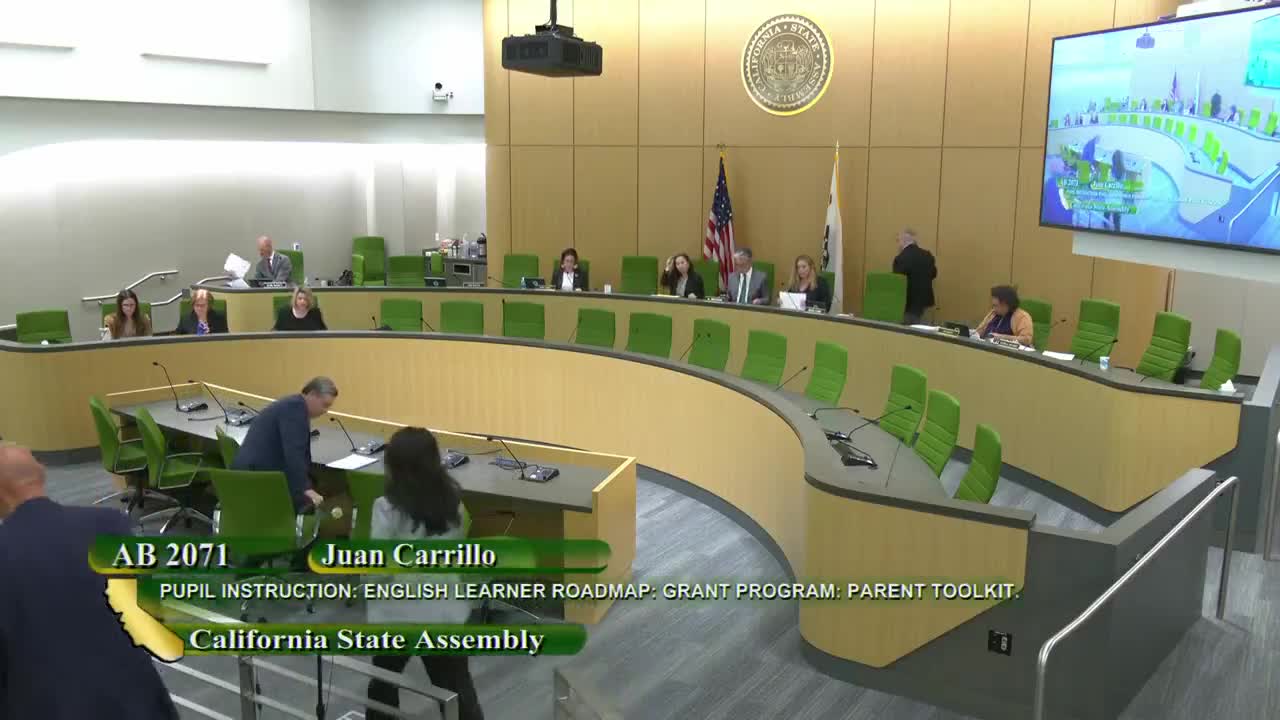 12MIN
Assembly Standing Committee on Education
Bill Author