AB 2273: Career technical education: California Pilot Paid Internship Program.
- Session Year: 2023-2024
- House: Assembly
- Latest Version Date: 2024-02-08
Current Status:
Failed
(2024-05-16: In committee: Held under submission.)
Introduced
In Committee
First Chamber
In Committee
Second Chamber
Enacted
Existing law establishes the California Career Pathways Trust as a state education and economic and workforce development initiative with the goal of preparing pupils in kindergarten and grades 1 to 12, inclusive, to successfully transition to postsecondary education and training and to employment in high-skill, high-wage, and high-growth or emerging sectors of the states economy. Existing law establishes the California Career Technical Education Incentive Grant Program, administered by the State Department of Education, with the purpose of encouraging, maintaining, and strengthening the delivery of high-quality career technical education programs.
This bill would establish the California Pilot Paid Internship Program in the department to help prepare thousands of California pupils for high-skill jobs of the future in engineering, health care, mathematics, manufacturing, science, teaching, and technology. The bill would appropriate $12,000,000 from the General Fund to the department to provide technical assistance to, and allocate grant funds to, school districts, charter schools, and county offices of education that establish or expand existing local public-private internship programs, as provided. The bill would require the department to allocate grant funds to local educational agencies to support, in total, up to 5,000 rising grade 12 pupils per year participating in 8-week internship programs, as provided. The bill would require the department to develop an application process for local educational agency grant applicants, as provided.
This bill would require local educational agency grant applicants to use grant funds and employer matching funds to provide participating pupils with an hourly wage of $15. The bill would require public-private partnership internship programs to, among other things, include a career-related experience that exposes grade 12 pupils to the world of work and opportunities for supervised and specific practice for a future career. The bill would require grant recipients to report pupil internship data to the Superintendent of Public Instruction on or before December 31 of each fiscal year, as provided. The bill would authorize grant funds to be available for expenditure or encumbrance from the 202425 fiscal year through the 202627 fiscal year. The bill would require the Superintendent to contract for an independent evaluation of the program and provide a report to the relevant fiscal and policy committees of the Legislature by January 1, 2028.
The Legislature finds and declares all of the following:
(a)Career and technical education (CTE) provides an important pathway to success for high school pupils and offers pupils the opportunity to personalize their education based on their career interests and unique learning needs.
(b)A critical workforce challenge in the United States is the skills gap, particularly among jobs that require a high school diploma, postsecondary certificate, or associate degree.
(c)Over three-fourths of United States grade 9 public school pupils in 2009 had participated in one CTE course by their senior year in 2013. Only 37 percent of these pupils took additional CTE courses by their senior year in 2013.
(d)High school pupils who take at least two CTE courses in their high school years graduate from high school at higher rates than pupils who do not.
(e)Internships provide employers with talented and engaged high school youth that bring fresh energy and curiosity to the workplace.
(f)Organizations and businesses can benefit from the pupils skills, creativity, and fresh perspectives. Hosting interns can also be a cost-effective way to recruit, train, and evaluate prospective employees.
(g)Unpaid internships exclude the most marginalized in society from an opportunity to gain valuable life and professional experience.
SEC. 2.Chapter 16.6 (commencing with Section 53077) is added to Part 28 of Division 4 of Title 2 of the Education Code, to read:16.6.California Pilot Paid Internship Program53077.(a)For the purposes of this chapter, the following definitions apply:
(1)Local educational agency means a school district, county office of education, or charter school.
(2)Program means the California Pilot Paid Internship Program established pursuant to subdivision (b).
(b)(1)The sum of twelve million dollars ($12,000,000) is hereby appropriated from the General Fund to the department for the California Pilot Paid Internship Program, which is hereby established in the department. The department shall provide grants to local educational agencies that establish or expand existing local public-private partnership internship programs that will, collectively, help prepare thousands of California pupils for high-skill jobs of the future in engineering, health care, mathematics, manufacturing, science, teaching, and technology. The program model shall deliver the following core benefits to California:
(A)Pupils will gain hands-on experience in a career technical education field that will help prepare them for the jobs of tomorrow.
(B)Pupils will earn wages to help support themselves and their families while gaining valuable real-world personal finance experiences.
(C)Pupils will spend their wages in their communities, generating additional spending to support local businesses, economic recovery, and growth.
(2)The department shall administer the program by providing grant funds and technical expertise to local educational agencies career technical education internship programs. Local educational agencies shall use grant funds to pay participating pupils for their internship work pursuant to paragraph (1) of subdivision (d).
(c)(1)The department shall allocate funds appropriated pursuant to subdivision (b) as grants to local educational agencies to support, in total, up to 5,000 rising grade 12 pupils per year participating in eight-week internship programs that provide up to 40 hours of work per week.
(2)Local educational agency grant applicants shall be chosen based on an application process developed by the department that considers existing career technical education pathway programs and existing public-private partnerships that provide pupils internships in their communities.
(d)As a condition of receiving grant funds pursuant to subdivision (c), local educational agencies shall comply with the following requirements:
(1)(A)Use grant funds and employer matching funds to provide participating pupils with an hourly wage of fifteen dollars ($15), in consultation with the department.
(B)Program funds awarded pursuant to subdivision (c) shall account for seven dollars and fifty cents ($7.50) of the fifteen-dollar ($15) wage described in subparagraph (A).
(C)Employer matching funds shall account for seven dollars and fifty cents ($7.50) of the fifteen-dollar ($15) wage described in subparagraph (A).
(2)Report pupil internship data to the Superintendent on or before December 31 of each fiscal year. This report shall include all of the following:
(A)The number of pupil internships.
(B)The total hours worked by pupils.
(C)The businesses, organizations, or industries in which pupils were employed.
(e)(1)Any public-private partnership internship program funded pursuant to subdivision (c) shall include all of the following components:
(A)A career-related experience that exposes grade 12 pupils to the world of work.
(B)Partnerships with local businesses, industries, nonprofit organizations, or other organizations in the community.
(C)Opportunities for supervised and specific practice for a future career.
(D)Intern placement occurring during the summer between 11th and 12th grade.
(2)The following components, on their own, shall not qualify as public-private partnership internship programs eligible for funding pursuant to subdivision (c):
(A)Job shadowing.
(B)One-time events.
(C)Jobs that pupils secure on their own.
(f)Funds awarded pursuant to subdivision (c) shall be available for expenditure or encumbrance from the 202425 fiscal year through the 202627 fiscal year.
(g)Upon conclusion of the program, the Superintendent shall contract for an independent evaluation of the program and provide a report to the relevant fiscal and policy committees of the Legislature by January 1, 2028, in compliance with Section 9795 of the Government Code.
(h)Funds appropriated for purposes of offering paid internships pursuant to subdivision (b) shall not count towards satisfying the minimum funding obligation to school districts and community college districts imposed by Section 8 of Article XVI of the California Constitution.
|
Date
|
Status
|
|---|---|
| May 16, 2024 | In committee: Held under submission. |
| Apr 10, 2024 | In committee: Set, first hearing. Referred to APPR. suspense file. |
| Mar 21, 2024 | From committee: Do pass and re-refer to Com. on APPR. (Ayes 5. Noes 2.) (March 20). Re-referred to Com. on APPR. |
| Feb 26, 2024 | Referred to Com. on ED. |
| Feb 9, 2024 | From printer. May be heard in committee March 10. |
| Feb 8, 2024 | Read first time. To print. |
|
Date
|
Description
|
Location
|
Votes
|
|
|---|---|---|---|---|
| Mar 20, 2024 | Do pass and be re-referred to the Committee on [Appropriations] | Assembly Standing Committee on Education |
Passed |
This list shows positions taken on this bill by organizations on the date displayed, which is linked to the original source.
Positions by individuals are not included.
Date of Hearing: April 10, 2024
ASSEMBLY COMMITTEE ON APPROPRIATIONS
Buffy Wicks, Chair
ABPCA Bill Id:AB 2273
Author:(Holden) – As Introduced Ver:February 8, 2024
Policy Committee: | Education | Vote: | 5 - 2 |
|
| ||
|
|
Urgency: No State Mandated Local Program: No Reimbursable: No
SUMMARY:
This bill establishes the California Pilot Paid Internship Program to provide grants to local educational agencies (LEAs) to establish or expand internship programs within their Career Technical Education courses or pathways. The bill requires the California Department of Education (CDE) to contract for an independent evaluation of the grant program and provide a report to the Legislature by January 1, 2028.
Specifically, this bill:
- Appropriates $12 million in non-Proposition 98 General Fund to CDE to administer a program to provide grants to LEAs to support paid internships for students in 12th grade, through public-private partnerships. The funds would be available for expenditure or encumbrance from the 2024-25 through the 2026-27 fiscal years and would support up to 5,000 students per year to participate in eight-week internship programs that provide up to 40 hours per week of employment.
- Requires LEAs to use the grant funds and employer matching funds to provide participating students with an hourly wage of $15 per hour with grant proceeds to fund the $7.50 per hour contribution to pupils’ wages from the LEA and employer matching funds for the remaining $7.50 per hour.
FISCAL EFFECT:
- One-time General Fund costs of $12 million for grants.
- One-time General Fund costs to CDE of about $875,000 over three years for two staff to administer the grant program. Additional one-time General Fund costs, likely in the low hundreds of thousands of dollars, for CDE to contract for an evaluation of the grant program.
According to the Legislative Analyst’s Office, the General Fund faces a structural deficit in the tens of billions of dollars over the next several fiscal years.
COMMENTS:
- Purpose. According to the State Superintendent of Public Instruction Tony Thurmond, the sponsor of the bill:
CTE internships provide businesses with talented and engaged high school youth who can bring fresh energy and curiosity to the workplace. Unfortunately, current internship opportunities are often unpaid and, therefore, a barrier to many students who are already disproportionately affected—namely, low-income students, students of color, and English learners. Limiting internship opportunities to those students who have the resources and privilege to work without pay is a disservice to our students and our society. As State Superintendent of Public Instruction, I place equity and opportunity for our students at the center of our agenda.
- Prior Legislation. AB 2088 (Cooper), of the 2021-22 Legislative Session, was very similar to this bill. AB 2088 would have appropriated $575 million in non-Proposition 98 General Fund to CDE to administer a program to provide grants to LEAs to support paid internships for students in 12th grade through public-private partnerships. This bill also was sponsored by the State Superintendent of Public Instruction. AB 2088 was held on this committee’s suspense file.
Analysis Prepared by: Natasha Collins / APPR. / (916) 319-2081
Date of Hearing: March 20, 2024
ASSEMBLY COMMITTEE ON EDUCATION
Al Muratsuchi, Chair
ABPCA Bill Id:AB 2273 (
Author:Holden) – As Introduced Ver:February 8, 2024
SUBJECT: Career technical education: California Pilot Paid Internship Program
SUMMARY: Establishes the California Pilot Paid Internship Program and appropriate $12 million for the California Department of Education (CDE) to provide grants to local educational agencies (LEAs) to support paid internships for students in 12th grade, through public-private partnerships. Specifically, this bill:
- Appropriates $12 million from the General Fund to the CDE and establishes the California Pilot Paid Internship Program (program), to provide grants to LEAs that establish or expand existing local public-private partnership internship programs to prepare students for high-skill jobs in the fields of engineering, health care, mathematics, manufacturing, science, teaching, and technology.
- Requires the program to deliver core benefits to California students in gaining hands-on experience in a career technical education (CTE) field, earning wages while gaining personal finance experiences, and spending their wages in the communities to support local businesses, economic recovery, and growth.
- Requires the CDE to administer the program by providing grant funds and technical expertise to LEAs CTE internship programs, including the development of an application process, and to select LEAs to receive grant funds based, at least partially, on their existing CTE pathway programs and existing public-private partnerships providing pupil internships in their community.
- Requires the CDE to allocate funds as grants to LEAs to support up to 5,000 rising grade 12 students each year who are participating in 8-week internship programs providing up to 40 hours of work per week.
- Requires LEAs to use grant funds to pay participating students for their internship work at a rate of $15 per hour, with $7.50 coming from grant funds and $7.50 in employer matching funds.
- Requires LEAs to report student internship data to the Superintendent of Public Instruction (SPI) by December 31st of each year, including all of the following: number of student internships; total hours worked by students; and the businesses, organizations, or industries in which students were employed.
- Requires a public-private partnership receiving funding under this program to include all of the following:
- A career-related experience that exposes grade 12 students to the world of work;
- Partnerships with local businesses, industries, nonprofit organizations, or other organizations in the community;
- Opportunities for supervised and specific practice for a future career; and
- Intern placement occurring during the summer between 11th and 12th grade.
- Prohibits the following components, on their own, from qualifying as public-private internship programs eligible for funding under this program: job shadowing, one-time events, or jobs that students secure on their own.
- Requires that the funds awarded under this program be available for expenditure or encumbrance from the 2024-25 fiscal year through the 2026-27 fiscal year.
- Requires the SPI to contract for an independent evaluation of the program upon its completion, and provide a report to the relevant fiscal and policy committees of the Legislature by January 1, 2028.
- Specifies that funds appropriated to offer paid internships not be counted toward meeting the minimum funding obligation to schools under Proposition 98.
- Defines “local educational agency” as a school district, county office of education (COE), or charter school.
EXISTING LAW:
- Authorizes work-based learning opportunities for pupils to be delivered by CTE programs which may include work experience education, community classrooms, cooperative CTE programs, and job shadowing experience. (Education Code (EC) 51760.1)
- Authorizes the Career Technical Education Incentive Grant (CTEIG) Program as a state education, economic, and workforce development initiative with the goal of providing students in kindergarten through 12th grade with the knowledge and skills necessary to transition to employment and postsecondary education. Appropriates funding for the CTEIG program as follows: $400 million for 2015-16; $300 million for 2016-17; $200 million for 2017-18; and $150 million per year for the 2018-19 to 2020-21, and $300 million per year beginning in the 2021-22 fiscal year and every year thereafter. (EC 53070).
- Requires applicants for the CTEIG Program to demonstrate that their CTE programs meet specified minimum eligibility standards, including ongoing and meaningful partnerships with industry and labor, and opportunities for pupils to participate in after-school, extended day, and out-of-school internships, competitions, leadership development opportunities, and other work-based learning opportunities.
- Authorizes the K-12 component of the Strong Workforce Program (SWP) to create, support, or expand high-quality CTE programs at the K-12 level that are aligned with the workforce development efforts occurring through the SWP, and authorizes, commencing with the 2018-19 fiscal year, $150 million annually by the California Community College Chancellor’s Office (CCCCO) to local consortia. (EC 88827)
- Establishes the California Partnership Academies and requires the SPI to prioritize proposals for new partnership academies based upon a school district’s enrollment of the following pupil groups: unduplicated pupils; pupils from groups historically underrepresented in career technical education or STEM programs or professions; and at-promise pupils. Authorizes the SPI to also prioritize new partnership academies for school districts located in a rural area or an economically disadvantaged area. (EC 54694-54697)
- Establishes the Golden State Pathways Program to:
- Promote pathways in high-wage, high-skill, high-growth areas, including, but not limited to, technology, health care, education, including early education and child development, and climate-related fields that allow pupils to advance seamlessly from high school to college and career and, provide the workforce needed for economic growth.
- Encourage collaboration between LEAs, institutions of higher education, local and regional employers, and other relevant community interest holders to develop, or expand the availability of, innovative college and career pathways that simultaneously align with an LEA’s local or regional labor market needs.
- Enable more students to access postsecondary education opportunities and workforce training opportunities, or to obtain gainful employment in an industry that simultaneously aligns with local, regional, or state labor market needs.
- Support the continued development of a skilled and educated workforce, with an emphasis on addressing areas of acute statewide need, such as developing a diverse workforce to meet the need for professional and learning support positions in childcare settings, preschools, and schools maintaining prekindergarten, kindergarten, or any of grades 1 to 12, inclusive. (EC 53020-53025)
- Federal law, the Strengthening Career and Technical Education for the 21st Century Act, reauthorizes the Carl D. Perkins Career and Technical Education Act of 2006 (Perkins) provides federal support for CTE programs and focuses on improving the academic and technical achievement of CTE students, strengthening the connections between secondary and postsecondary education and improving accountability. (H.R. 2353, 2017-18)
FISCAL EFFECT: Unknown
COMMENTS:
Need for the bill. According to the author, “AB 2273 creates the California Pilot Paid Internship Program to fund local public-private partnership paid internship programs for CTE students. Providing students paid internship programs will help prepare and transition them to post-secondary educational opportunities and careers.”
Defining Career Technical Education. CTE is a program of study that involves a multiyear sequence of courses that integrates core academic knowledge with technical and occupational knowledge to provide students with a pathway to postsecondary education and careers. CTE programs in California are organized into 15 industry sectors, covering 58 pathways that identify the knowledge and skills students need. Partnerships are usually developed between high schools, businesses, and postsecondary schools, providing pathways to employment and associates, Bachelor’s, and advanced degrees. CTE prepares students for the world of work by introducing them to workplace competencies and makes academic content accessible to students by providing it in a hands-on context. Along the way, students develop career-relevant, real-world 21st Century skills.”
Improved outcomes for CTE students. A wide body of research indicates that involvement in CTE coursework provides improved academic outcomes and provides other benefits to students, with findings such as the following:
- Students with greater exposure to CTE are more likely to graduate from high school, enroll in a two-year college, be employed, and earn higher wages;
- The average high school graduation rate for students concentrating in CTE programs is 93%, compared to an average national graduation rate of 80%;
- Students taking more CTE classes are just as likely to pursue a four-year degree as their peers;
- 91% of high school graduates who earned 2-3 CTE credits enrolled in college;
- Students who focus their CTE coursework are more likely to graduate high school by 21% compared to otherwise similar students;
- CTE provides the greatest boost to students who need it most – boys and students from low-income families; and
- 80% of students taking a college preparatory academic curriculum with rigorous CTE met college and career readiness goals, compared to only 63% of students taking the same academic core who did not experience rigorous CTE.
College and career readiness is a state priority. Each LEA’s Local Control and Accountability Plan (LCAP) must demonstrate, among other priorities, how they are ensuring that all students are being prepared to be college and career ready. The College and Career Readiness Index displayed on each LEA’s dashboard includes data on the number of students completing a CTE pathway. CDE notes that over 90% of districts report that CTE is now embedded in their LCAP.
Current K-12 CTE programs. There are a number of initiatives supporting K-12 CTE programs supported by state and federal funds, including the following:
- Career Technical Education Incentive Grant (CTEIG) Program;
- K-12 Strong Workforce Program (SWP);
- California Partnership Academies (CPA);
- Workability;
- Golden State Pathways Program; and
- Regional K-16 Education Collaborative Grant Program.
Many of these promote work-based learning and internships as an important element of a successful CTE program.
What are internships? According to the National Association of Colleges and Employers (NACE), internships are “a form of experiential learning that integrates knowledge and theory learned in the classroom with practical application and skills development in a professional setting.” Internships can offer students a site to apply their skills in a real-world workplace and provide them with a lens to evaluate their chosen field of study. From an employer’s perspective, they can receive additional resources and a quick inexpensive review of potential new hires to fill their talent pipeline in the future.
NACE identifies 7 criteria for internships:
- The experience must be an extension of the classroom: a learning experience that provides for applying the knowledge gained in the classroom. It must not be simply to advance the operations of the employer or be the work that a regular employee would routinely perform;
- The skills or knowledge learned must be transferable to other employment settings;
- The experience has a defined beginning and end, and a job description with desired qualifications;
- There are clearly defined learning objectives/goals related to the professional goals of the student’s academic coursework;
- There is supervision by a professional with expertise and educational and/or professional background in the field of the experience;
- There is routine feedback by the experienced supervisor; and
- There are resources, equipment, and facilities provided by the host employer that support learning objectives/goals (NACE, 2018).
These recommendations by NACE relate to a university or college-level internship, but many of the factors may be worthwhile in a high school context as well.
Paid internships as a tool to promote equity. A study of a project in Detroit to stimulate high school students’ interest in STEM career pathways found that the offering of the paid internship to students who came from disadvantaged families not only helped the students to nurture their interests in STEM careers and education, but also won the support from students’ parents and communities. The project provided funding to the City of Detroit municipal departments to hire participating students as interns; in turn students contributed to real-world infrastructure problems and solutions (Xie, 2014).
Survey data from postsecondary institutions that mandate internships found that 64% of students who did not take internships had in fact wanted to, but could not due to intersecting obstacles that included the need to work at a full-time or part-time job, heavy course loads, and a lack of opportunities in their disciplines. First-generation students were more likely to report needing to work. The authors concluded that colleges and universities must work to ensure that internships do not reproduce privilege and exacerbate inequality (Hora, 2019).
A study of the value of paid internships in college notes, “a post-secondary education has become almost essential for getting a decent job and entering the middle class, and increasingly, internships are a critical part of the college experience. Yet financial constraints prevent many low- and moderate-income young people from seeking internships because such experiences are frequently unpaid. In a tight labor market, college graduates who have gained experience through internships have an edge on the job market. But the inequities go far beyond internships—a college degree itself is increasingly financially out of reach for young people from modest economic backgrounds.” (Edwards, 2010)
Arguments in support. The State Superintendent of Public Instruction Tony Thurmond, the sponsor of the bill, writes, “While CTE courses are common, with three-quarters of American public school students who began ninth grade in 2009 participating in one CTE course by their senior year, only 37% of students took additional CTE courses. Studies have shown that students who enroll in multiple CTE courses attend and graduate from high school at higher rates and show better long-term career outcomes than their peers.
The benefits to students are multiple and significant, but CTE programs also yield positive results for employers. Specifically, CTE internships provide businesses with talented and engaged high school youth who can bring fresh energy and curiosity to the workplace. Unfortunately, current internship opportunities are often unpaid and, therefore, a barrier to many students who are already disproportionately affected—namely, low-income students, students of color, and English learners. Limiting internship opportunities to those students who have the resources and privilege to work without pay is a disservice to our students and our society. As State Superintendent of Public Instruction, I place equity and opportunity for our students at the center of our agenda.”
Related legislation. AB 1929 (McKinnor) of the 2023-24 Session would require LEAs receiving funding through the CTEIG Program, in reporting required data metrics to the CDE, to disaggregate those metrics by race. Also would require consortia receiving funding through the K-14 SWP to collect data on CTE outcomes, disaggregated by race.
AB 3131 (McCarty) of the 2023-24 Session would require the CDE, in consultation with the State Board of Education (SBE), when determining grant recipients for the CTEIG, and the K–12 SWP, to first give priority consideration to applicants in historically redlined communities, as determined by the CDE.
AB 377 (Muratsuchi and McCarty) of the 2023-24 Session would have deleted authorization for the K-12 SWP, administered by the California Community College (CCC) Chancellor’s Office, and shifted the $150 million of SWP funding to the CTEIG, administered by the CDE. This bill was held in the Senate Appropriations Committee.
AB 2088 (Cooper) of the 2021-22 Session would have established the California Pilot Paid Internship Program to provide grants to LEAs to establish or expand internship programs within their CTE courses or pathways. This bill was held in the Assembly Appropriations Committee.
AB 2058 (O’Donnell and Quirk-Silva) of the 2021-22 Session would have required consolidation of specified K-12 CTE programs; increased ongoing funding for the CTEIG, administered by the CDE to $450 million per year; required specified CTE staffing at the state and regional level to support local CTE programs and pathways; and deleted authorization for the K-12 SWP administered by the CCCCO. This bill was held in the Senate Education Committee.
AB 1923 (Mathis) Chapter 114, Statutes of 2022, requires the SPI to prioritize proposals for new California Partnership Academies (CPAs) based on a school district’s enrollment of socioeconomically disadvantaged pupils, as specified, and for school districts located in a rural or economically disadvantaged area.
AB 130 (Committee on Budget) Chapter 44, Statutes of 2021, provides that, for the 2021–22 fiscal year and each fiscal year thereafter, $300 million would be made available to the CDE, upon appropriation for the CTEIG program. Also makes adjustments to program provisions relating to eligibility requirements for grant applicants, and for ensuring compliance with program requirements.
AB 1808 (Committee on Budget) Chapter 32, Statutes of 2018, appropriates in the 2018–19 fiscal year and each fiscal year thereafter, $150 million to the CTEIG program administered through CDE. Also establishes a K–12 component of the SWP to create, support, or expand high-quality CTE programs at the K–12 level aligned with the workforce development efforts and, commencing with the 2018–19 fiscal year, requires the CCCCO to allocate $150 million for this program to regional CTE consortia.
AB 1743 (O’Donnell) of the 2017-18 Session would have extended funding for the CTEIG Program by providing ongoing funding of $500 million per year with a 1:1 local match as well as $12 million per year for regional K-12 CTE coordinators to provide technical assistance and support to local CTE providers. This bill was held in the Senate Education Committee.
AB 104 (Committee on Budget) Chapter 13, Statutes of 2015, establishes the CTEIG, a competitive grant program administered by the CDE to provide support for CTE in grades K-12, and provides $400 million in 2015-16, $300 million in 2016-17, and $200 million in 2017-18 for this program.
REGISTERED SUPPORT / OPPOSITION:
Support
State Superintendent of Public Instruction Tony Thurmond (Sponsor)
Alameda County Office of Education
Opposition
None on file
Analysis Prepared by: Debbie Look / ED. / (916) 319-2087
Discussed in Hearing
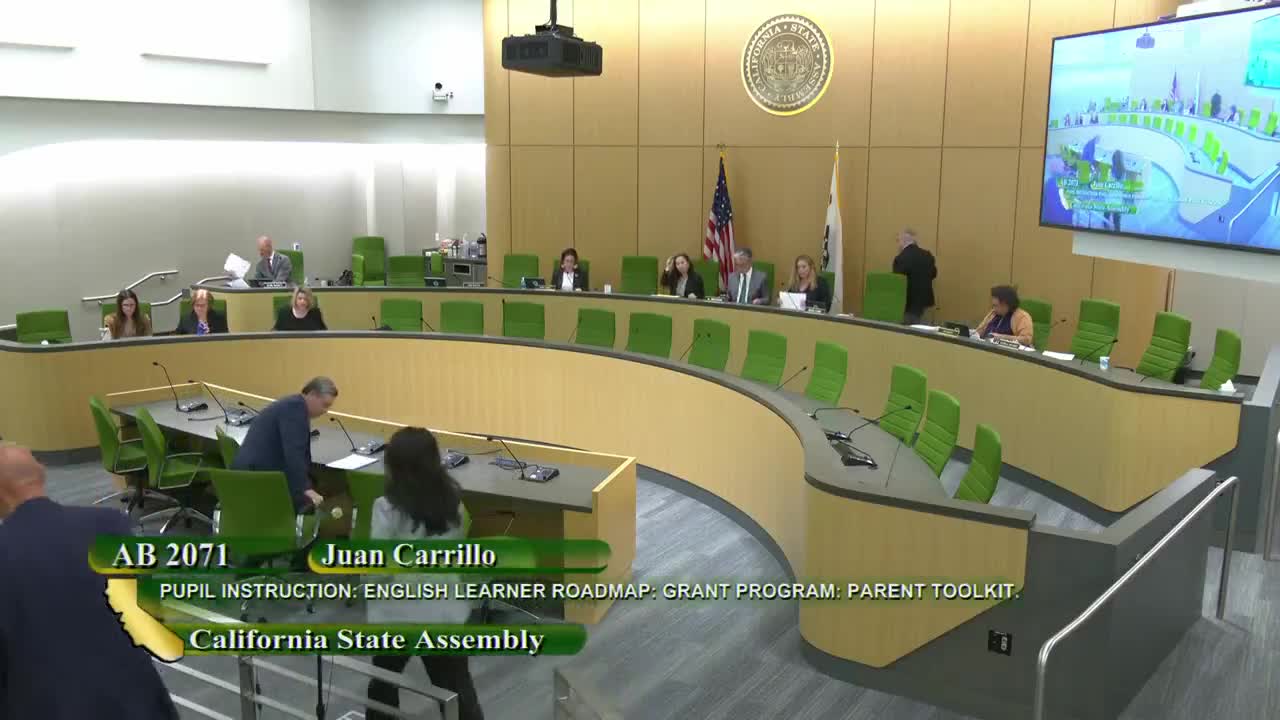 17MIN
Assembly Standing Committee on Education
Bill Author

Bill Co-Author(s):