AB 230: Menstrual products: Menstrual Equity for All Act of 2021.
- Session Year: 2023-2024
- House: Assembly
- Latest Version Date: 2023-10-08
Current Status:
Passed
(2023-10-08: Chaptered by Secretary of State - Chapter 421, Statutes of 2023.)
Introduced
In Committee
First Chamber
In Committee
Second Chamber
Enacted
Existing law, the Menstrual Equity for All Act of 2021, requires a public school, as provided, maintaining any combination of classes from grades 6 to 12, inclusive, to stock the schools restrooms with an adequate supply of free menstrual products, as defined, available and accessible, free of cost, in all womens restrooms and all-gender restrooms, and in at least one mens restroom, at all times, and to post a certain notice, on or before the start of the 202223 school year, as prescribed.
This bill would extend these requirements, commencing on or before the start of the 202425 school year, to instead apply to public schools maintaining any combination of classes from grades 3 to 12, inclusive. By imposing new duties on local educational agencies, the bill would impose a state-mandated local program.
The California Constitution requires the state to reimburse local agencies and school districts for certain costs mandated by the state. Statutory provisions establish procedures for making that reimbursement.
This bill would provide that, if the Commission on State Mandates determines that the bill contains costs mandated by the state, reimbursement for those costs shall be made pursuant to the statutory provisions noted above.
Existing law, the Menstrual Equity for All Act of 2021, requires a public school, as provided, maintaining any combination of classes from grades 6 to 12, inclusive, to stock the schools restrooms with an adequate supply of free menstrual products, as defined, available and accessible, free of cost, in all womens restrooms and all-gender restrooms, and in at least one mens restroom, at all times, and to post a certain notice, on or before the start of the 202223 school year, as prescribed.
This bill, to be known as the Girl Scouts Period Equity Act, bill would extend these requirements requirements, commencing on or before the start of the 202425 school year, to instead apply to public schools maintaining any combination of classes from grades 3 to 12, inclusive. By imposing new duties on local educational agencies, the bill would impose a state-mandated local program.
The California Constitution requires the state to reimburse local agencies and school districts for certain costs mandated by the state. Statutory provisions establish procedures for making that reimbursement.
This bill would provide that, if the Commission on State Mandates determines that the bill contains costs mandated by the state, reimbursement for those costs shall be made pursuant to the statutory provisions noted above.
Existing law, the Menstrual Equity for All Act of 2021, requires a public school, as provided, maintaining any combination of classes from grades 6 to 12, inclusive, to stock the schools restrooms with an adequate supply of free menstrual products, as defined, available and accessible, free of cost, in all womens restrooms and all-gender restrooms, and in at least one mens restroom, at all times, and to post a certain notice, on or before the start of the 202223 school year, as prescribed.
This bill, to be known as the Girl Scouts Period Equity Act, would extend these requirements to instead apply to public schools maintaining any combination of classes from grades 3 to 12, inclusive. By imposing new duties on local educational agencies, the bill would impose a state-mandated local program.
The California Constitution requires the state to reimburse local agencies and school districts for certain costs mandated by the state. Statutory provisions establish procedures for making that reimbursement.
This bill would provide that, if the Commission on State Mandates determines that the bill contains costs mandated by the state, reimbursement for those costs shall be made pursuant to the statutory provisions noted above.
(a)The Legislature finds and declares all of the following:
(1)California has made great strides in increasing access to menstrual products by enacting legislation that addresses period equity.
(2)The Menstrual Equity for All Act of 2021 requires schools serving any of grades 6 to 12, inclusive, to stock restrooms with free and accessible menstrual products.
(3)There are over 2,400 schools that serve younger pupils in grades 3 to 5, inclusive, that are not required to stock free menstrual products in school restrooms, missing a population of pupils that may start their periods early.
(4)The Girl Scout Troop 76 of San Gorgonio Council have tackled menstrual equity through their Silver Award Project by destigmatizing periods and by providing emergency menstrual kits to young pupils in need.
(5)The Silver Award is one of the highest awards that a girl scout can earn and it requires the girl scout to identify a need in the community and engage in 50 hours of community service.
(6)Through this work, the Girl Scout Troop 76 of San Gorgonio Council realized that there was a greater need related to the lack of access to menstrual products to young pupils and have advocated to increase access to menstrual products through legislation.
(7)When pupils do not have access to menstrual products, they may miss school or are less engaged in the classroom, which can have a long-lasting impact on their learning.
(8)Ensuring young pupils have access to menstrual products is crucial to their educational development and success.
(b)It is the intent of the Legislature to promote period equity through adequate access to menstrual products in schools also serving grades 3 to 5, inclusive.
SEC. 2.Section 35292.6 of the Education Code is amended to read:35292.6.(a)On or before the start of the 202223 school year, a public school, including a school operated by a school district, county office of education, or charter school, maintaining any combination of classes from grades 6 to 12, inclusive, shall stock the schools restrooms at all times with an adequate supply of menstrual products, available and accessible, free of cost, in all womens restrooms and all-gender restrooms, and in at least one mens restroom.
(b)A public school described in subdivision (a) shall not charge for any menstrual products provided to pupils.
(c)A public school described in subdivision (a) shall post a notice regarding the requirements of this section in a prominent and conspicuous location in every restroom required to stock menstrual products, available and accessible, free of cost, pursuant to this section. This notice shall include the text of this section and contact information, including an email address and telephone number, for a designated individual responsible for maintaining the requisite supply of menstrual products.
(d)For purposes of this section, menstrual products means menstrual pads and tampons for use in connection with the menstrual cycle.
(e)This section shall become inoperative on July 1, 2024, and, as of January 1, 2025, is repealed.
SEC. 3.Section 35292.6 is added to the Education Code, to read:35292.6.(a)On or before the start of the 202425 school year, a public school, including a school operated by a school district, county office of education, or charter school, maintaining any combination of classes from grades 3 to 12, inclusive, shall stock the schools restrooms at all times with an adequate supply of menstrual products, available and accessible, free of cost, in all womens restrooms and all-gender restrooms, and in at least one mens restroom.
(b)A public school described in subdivision (a) shall not charge for any menstrual products provided to pupils.
(c)A public school described in subdivision (a) shall post a notice regarding the requirements of this section in a prominent and conspicuous location in every restroom required to stock menstrual products, available and accessible, free of cost, pursuant to this section. This notice shall include the text of this section and contact information, including an email address and telephone number, for a designated individual responsible for maintaining the requisite supply of menstrual products.
(d)For purposes of this section, menstrual products means menstrual pads and tampons for use in connection with the menstrual cycle.
(e)This section shall become operative on July 1, 2024.
SEC. 4.If the Commission on State Mandates determines that this act contains costs mandated by the state, reimbursement to local agencies and school districts for those costs shall be made pursuant to Part 7 (commencing with Section 17500) of Division 4 of Title 2 of the Government Code.
(a)The Legislature finds and declares all of the following:
(1)California has made great strides in increasing access to menstrual products by enacting legislation that addresses period equity.
(2)The Menstrual Equity for All Act of 2021 required requires schools serving any of grades 6 to 12, inclusive, to stock restrooms with free and accessible menstrual products.
(3)There are over 2,400 schools that serve younger pupils in grades 3 to 5, inclusive, that are not required to stock free menstrual products in school restrooms, missing a population of pupils that may start their periods early.
(4)The Girl Scout Troop 76 of San Gorgonio Council have tackled menstrual equity through their Silver Award Project by destigmatizing periods and by providing emergency menstrual kits to young pupils in need.
(5)The Silver Award is one of the highest awards that a girl scout can earn and it requires the girl scout to identify a need in the community and engage in 50 hours of community service.
(6)Through this work, the Girl Scout Troop 76 of San Gorgonio Council realized that there was a greater need related to the lack of access to menstrual products to young pupils and have advocated to increase access to menstrual products through legislation.
(7)When pupils do not have access to menstrual products, they may miss school or are less engaged in the classroom, which can have a long-lasting impact on their learning.
(8)Ensuring young pupils have access to menstrual products is crucial to their educational development and success.
(b)It is the intent of the Legislature to promote period equity through adequate access to menstrual products in schools also serving grades 3 to 5, inclusive.
SEC. 2.Section 35292.6 of the Education Code is amended to read:35292.6.(a)On or before the start of the 202223 school year, a public school, including a school operated by a school district, county office of education, or charter school, maintaining any combination of classes from grades 6 to 12, inclusive, shall stock the schools restrooms at all times with an adequate supply of menstrual products, available and accessible, free of cost, in all womens restrooms and all-gender restrooms, and in at least one mens restroom.
(b)A public school described in subdivision (a) shall not charge for any menstrual products provided to pupils.
(c)A public school described in subdivision (a) shall post a notice regarding the requirements of this section in a prominent and conspicuous location in every restroom required to stock menstrual products, available and accessible, free of cost, pursuant to this section. This notice shall include the text of this section and contact information, including an email address and telephone number, for a designated individual responsible for maintaining the requisite supply of menstrual products.
(d)For purposes of this section, menstrual products means menstrual pads and tampons for use in connection with the menstrual cycle.
(e)This section shall become inoperative on July 1, 2024, and, as of January 1, 2025, is repealed.
SEC. 3.Section 35292.6 is added to the Education Code, to read:35292.6.(a)On or before the start of the 202425 school year, a public school, including a school operated by a school district, county office of education, or charter school, maintaining any combination of classes from grades 3 to 12, inclusive, shall stock the schools restrooms at all times with an adequate supply of menstrual products, available and accessible, free of cost, in all womens restrooms and all-gender restrooms, and in at least one mens restroom.
(b)A public school described in subdivision (a) shall not charge for any menstrual products provided to pupils.
(c)A public school described in subdivision (a) shall post a notice regarding the requirements of this section in a prominent and conspicuous location in every restroom required to stock menstrual products, available and accessible, free of cost, pursuant to this section. This notice shall include the text of this section and contact information, including an email address and telephone number, for a designated individual responsible for maintaining the requisite supply of menstrual products.
(d)For purposes of this section, menstrual products means menstrual pads and tampons for use in connection with the menstrual cycle.
(e)This section shall become operative on July 1, 2024.
SEC. 4.If the Commission on State Mandates determines that this act contains costs mandated by the state, reimbursement to local agencies and school districts for those costs shall be made pursuant to Part 7 (commencing with Section 17500) of Division 4 of Title 2 of the Government Code.
(a)The Legislature finds and declares all of the following:
(1)California has made great strides in increasing access to menstrual products by enacting legislation that addresses period equity.
(2)The Menstrual Equity for All Act of 2021 required schools serving any of grades 6 to 12, inclusive, to stock restrooms with free and accessible menstrual products.
(3)There are over 2,400 schools that serve younger pupils in grades 3 to 5, inclusive, that are not required to stock free menstrual products in school restrooms, missing a population of pupils that may start their periods early.
(4)The Girl Scout Troop 76 of San Gorgonio Council have tackled menstrual equity through their Silver Award Project by destigmatizing periods and by providing emergency menstrual kits to young pupils in need.
(5)The Silver Award is one of the highest awards that a girl scout can earn and it requires the girl scout to identify a need in the community and engage in 50 hours of community service.
(6)Through this work, the Girl Scout Troop 76 of San Gorgonio Council realized that there was a greater need related to the lack of access to menstrual products to young pupils and have advocated to increase access to menstrual products through legislation.
(7)When pupils do not have access to menstrual products, they may miss school or are less engaged in the classroom, which can have a long-lasting impact on their learning.
(8)Ensuring young pupils have access to menstrual products is crucial to their educational development and success.
(b)It is the intent of the Legislature to promote period equity through adequate access to menstrual products in schools also serving grades 3 to 5, inclusive.
SEC. 2.Section 35292.6 of the Education Code is amended to read:35292.6.(a)On or before the start of the 202223 school year, a public school, including a school operated by a school district, county office of education, or charter school, maintaining any combination of classes from grades 6 to 12, inclusive, shall stock the schools restrooms at all times with an adequate supply of menstrual products, available and accessible, free of cost, in all womens restrooms and all-gender restrooms, and in at least one mens restroom.
(b)A public school described in subdivision (a) shall not charge for any menstrual products provided to pupils.
(c)A public school described in subdivision (a) shall post a notice regarding the requirements of this section in a prominent and conspicuous location in every restroom required to stock menstrual products, available and accessible, free of cost, pursuant to this section. This notice shall include the text of this section and contact information, including an email address and telephone number, for a designated individual responsible for maintaining the requisite supply of menstrual products.
(d)For purposes of this section, menstrual products means menstrual pads and tampons for use in connection with the menstrual cycle.
(e)This section shall become operative on July 1, 2022. inoperative on July 1, 2024, and, as of January 1, 2025, is repealed.
SEC. 3.Section 35292.6 is added to the Education Code, to read:35292.6.(a)On or before the start of the 202425 school year, a public school, including a school operated by a school district, county office of education, or charter school, maintaining any combination of classes from grades 3 to 12, inclusive, shall stock the schools restrooms at all times with an adequate supply of menstrual products, available and accessible, free of cost, in all womens restrooms and all-gender restrooms, and in at least one mens restroom.
(b)A public school described in subdivision (a) shall not charge for any menstrual products provided to pupils.
(c)A public school described in subdivision (a) shall post a notice regarding the requirements of this section in a prominent and conspicuous location in every restroom required to stock menstrual products, available and accessible, free of cost, pursuant to this section. This notice shall include the text of this section and contact information, including an email address and telephone number, for a designated individual responsible for maintaining the requisite supply of menstrual products.
(d)For purposes of this section, menstrual products means menstrual pads and tampons for use in connection with the menstrual cycle.
(e)This section shall become operative on July 1, 2024.
SEC. 4.If the Commission on State Mandates determines that this act contains costs mandated by the state, reimbursement to local agencies and school districts for those costs shall be made pursuant to Part 7 (commencing with Section 17500) of Division 4 of Title 2 of the Government Code.
SECTION 1.This act shall be known, and may be cited, as the Girl Scouts Period Equity Act.SEC. 2.Section 35292.6 of the Education Code is amended to read:35292.6.(a)A public school, including a school operated by a school district, county office of education, or charter school, maintaining any combination of classes from grades 3 to 12, inclusive, shall stock the schools restrooms at all times with an adequate supply of menstrual products, available and accessible, free of cost, in all womens restrooms and all-gender restrooms, and in at least one mens restroom.(b)A public school described in subdivision (a) shall not charge for any menstrual products provided to pupils.(c)A public school described in subdivision (a) shall post a notice regarding the requirements of this section in a prominent and conspicuous location in every restroom required to stock menstrual products, available and accessible, free of cost, pursuant to this section. This notice shall include the text of this section and contact information, including an email address and telephone number, for a designated individual responsible for maintaining the requisite supply of menstrual products.(d)For purposes of this section, menstrual products means menstrual pads and tampons for use in connection with the menstrual cycle.SEC. 3.If the Commission on State Mandates determines that this act contains costs mandated by the state, reimbursement to local agencies and school districts for those costs shall be made pursuant to Part 7 (commencing with Section 17500) of Division 4 of Title 2 of the Government Code. REVISIONS: HeadingLine 2.This act shall be known, and may be cited, as the Girl Scouts Period Equity Act.
SEC. 2.Section 35292.6 of the Education Code is amended to read:35292.6.(a)On or before the start of the 202223 school year, a A public school, including a school operated by a school district, county office of education, or charter school, maintaining any combination of classes from grades 6 3 to 12, inclusive, shall stock the schools restrooms at all times with an adequate supply of menstrual products, available and accessible, free of cost, in all womens restrooms and all-gender restrooms, and in at least one mens restroom.
(b)A public school described in subdivision (a) shall not charge for any menstrual products provided to pupils.
(c)A public school described in subdivision (a) shall post a notice regarding the requirements of this section in a prominent and conspicuous location in every restroom required to stock menstrual products, available and accessible, free of cost, pursuant to this section. This notice shall include the text of this section and contact information, including an email address and telephone number, for a designated individual responsible for maintaining the requisite supply of menstrual products.
(d)For purposes of this section, menstrual products means menstrual pads and tampons for use in connection with the menstrual cycle.
(e)This section shall become operative on July 1, 2022.SEC. 3.If the Commission on State Mandates determines that this act contains costs mandated by the state, reimbursement to local agencies and school districts for those costs shall be made pursuant to Part 7 (commencing with Section 17500) of Division 4 of Title 2 of the Government Code.
|
Date
|
Status
|
|---|---|
| Oct 8, 2023 | Chaptered by Secretary of State - Chapter 421, Statutes of 2023. |
| Oct 8, 2023 | Approved by the Governor. |
| Sep 19, 2023 | Enrolled and presented to the Governor at 4 p.m. |
| Sep 12, 2023 | Senate amendments concurred in. To Engrossing and Enrolling. (Ayes 77. Noes 0. Page 3230.). |
| Sep 12, 2023 | Assembly Rule 77 suspended. (Page 3228.) |
| Sep 11, 2023 | In Assembly. Concurrence in Senate amendments pending. May be considered on or after September 13 pursuant to Assembly Rule 77. |
| Sep 11, 2023 | Read third time. Passed. Ordered to the Assembly. (Ayes 32. Noes 0. Page 2557.). |
| Sep 5, 2023 | Read second time. Ordered to third reading. |
| Sep 1, 2023 | Read second time and amended. Ordered returned to second reading. |
| Sep 1, 2023 | From committee: Amend, and do pass as amended. (Ayes 5. Noes 0.) (September 1). |
| Jun 26, 2023 | In committee: Referred to APPR. suspense file. |
| Jun 14, 2023 | From committee: Do pass and re-refer to Com. on APPR. (Ayes 5. Noes 0.) (June 14). Re-referred to Com. on APPR. |
| May 31, 2023 | Referred to Com. on ED. |
| May 23, 2023 | In Senate. Read first time. To Com. on RLS. for assignment. |
| May 22, 2023 | Read third time. Passed. Ordered to the Senate. (Ayes 76. Noes 0. Page 1707.) |
| May 18, 2023 | Read second time. Ordered to third reading. |
| May 18, 2023 | From committee: Do pass. (Ayes 15. Noes 0.) (May 18). |
| Apr 19, 2023 | In committee: Set, first hearing. Referred to APPR. suspense file. |
| Mar 29, 2023 | Coauthors revised. |
| Mar 28, 2023 | Re-referred to Com. on APPR. |
| Mar 27, 2023 | Read second time and amended. |
| Mar 23, 2023 | From committee: Amend, and do pass as amended and re-refer to Com. on APPR. (Ayes 7. Noes 0.) (March 22). |
| Jan 26, 2023 | Referred to Com. on ED. |
| Jan 12, 2023 | From printer. May be heard in committee February 11. |
| Jan 11, 2023 | Read first time. To print. |
|
Date
|
Description
|
Location
|
Votes
|
|
|---|---|---|---|---|
| Sep 12, 2023 | AB 230 Reyes Concurrence in Senate Amendments | Assembly Floor |
Passed |
|
| Sep 11, 2023 | Assembly 3rd Reading AB230 Reyes et al. By Skinner | Senate Floor |
Passed |
|
| Sep 1, 2023 | Do pass as amended | Senate Standing Committee on Appropriations |
Passed |
|
| Jun 26, 2023 | Placed on suspense file | Senate Standing Committee on Appropriations |
Passed |
|
| Jun 14, 2023 | Do pass, but first be re-referred to the Committee on [Appropriations] | Senate Standing Committee on Education |
Passed |
|
| May 22, 2023 | AB 230 Reyes Assembly Third Reading | Assembly Floor |
Passed |
|
| May 18, 2023 | Do pass. | Assembly Standing Committee on Appropriations |
Passed |
|
| Mar 22, 2023 | Do pass as amended and be re-referred to the Committee on [Appropriations] | Assembly Standing Committee on Education |
Passed |
This list shows positions taken on this bill by organizations on the date displayed, which is linked to the original source.
Positions by individuals are not included.
|
Organization
|
Position
|
Date
|
|---|---|---|
| Access Reproductive Justice | ** Support | |
| Aclu California Action | ** Support | |
| American Academy of Pediatrics, California Chapter | ** Support | |
| American Association Of University Women - California | ** Support | |
| American College of Emergency Physicians - California Chapter | * Support | Jan 10, 2024 |
| American College Of Obstetricians And Gynecologists District Ix | ** Support | |
| California Academy Of Family Physicians | ** Support | |
| California Alternative Payment Program Association | ** Support | |
| California Association Of School Counselors | ** Support | |
| California Association of Student Councils | ** Support | |
| California Federation Of Teachers | ** Support | |
| California Nurse Midwives Association | ** Support | |
| California Teachers Association | ** Support | |
| California Women's Law Center | ** Support | |
| Catholic Families 4 Freedom California | ** Against | |
| Citizens for Choice | ** Support | |
| Coalition of California Welfare Rights Organizations | ** Support | |
| Conference of California Bar Associations | ** Support | |
| Consumer Watchdog | ** Support | |
| County of Santa Clara | ** Support | |
| Courage California | ** Support | |
| Disability Rights California | ** Support | |
| First 5 Alameda County | ** Support | |
| Girl Scouts | * Support | Mar 22, 2023 |
| Girl Scouts | * Support | Mar 22, 2023 |
| Girl Scouts | * Support | Jun 14, 2023 |
| Girl Scouts | * Support | Jun 14, 2023 |
| Girl Scouts of San Gorgonio | * Support | Mar 22, 2023 |
| girl scouts of san gorgonio council | ** Support | |
| Health Access California | * Against | Jan 10, 2024 |
| Independent Insurance Agents & Brokers of California | * Support | Jan 10, 2024 |
| John Burton Advocates for Youth | ** Support | |
| Junior Leagues of California State Public Affairs Committee | ** Support | |
| Lead of Our Duty | * Against | Jun 14, 2023 |
| Lighthouse Public Affairs | * Support | Mar 22, 2023 |
| los angeles county bar association | ** Support | |
| NARAL Pro-Choice California | ** Support | |
| National Association Of Social Workers, California Chapter | ** Support | |
| New Voices for Reproductive Justice | ** Support | |
| Nouri Law Corporation | ** Support | |
| Office of Lieutenant Governor Eleni Kounalakis | ** Support | |
| Period - the Menstrual Movement | ** Support | |
| Planned Parenthood Affiliates Of California | ** Support | |
| San Francisco Black, Jewish and Unity Group | ** Support | |
| Santa Barbara Women Lawyers | ** Support | |
| Santa Barbara Women's Political Committee | ** Support | |
| Solano County Democratic Central Committee | ** Support | |
| UDW- AFSME | * Against | Jan 10, 2024 |
| Women Lawyers of Sacramento | ** Support |
CONCURRENCE IN SENATE AMENDMENTS
CSA1 Bill Id:AB 230
Author:(Reyes)
As Amended Ver:September 1, 2023
Majority vote
SUMMARY
Expands the requirement that schools serving students in grades 6 through 12 stock specified restrooms with menstrual products to include schools serving students in grades 3 to 5.
Senate Amendments
Add a co-author.
COMMENTS
- Requires, commencing with the 2024-25 school year, that schools operated by school districts, county offices of education (COE), and charter schools which enroll students in grades 3 through 5 stock the schools' restrooms at all times with an adequate supply of menstrual products, available and accessible free of cost, in all women's restrooms, all-gender restrooms, and in at least one men's restroom.
- Prohibits these schools from charging for menstrual products provided to students.
- Requires these schools to post a notice regarding these requirements in a prominent and conspicuous location in every restroom required to stock menstrual products. Requires this notice to include the text of this requirement and contact information, including an email address and telephone number for a designated individual responsible for maintaining the requisite supply of menstrual products.
According to the Author
Age of onset of menstruation. According to materials provided by the author, the Centers for Disease Control and Prevention (CDC) reports that among women aged 15 to 44 in the United States between 2013 and 2017, 10% reached menarche by age 10, 53% by age 12, and 90% by age 14. Students aged 10 are typically enrolled in the 5th grade.
Relationship between access to menstrual products and school absenteeism. School absenteeism is associated with multiple negative school and life course outcomes, and low income is associated with higher rates of absenteeism. (Sosu, 2021)
Nearly all research on the relationship between access to menstrual products and absence from school has been conducted in developing countries. More research on this topic is needed in United States schools.
One small study conducted in Missouri found that one third of the participants reported missing school due to a lack of period products. Almost half reported being unable to afford menstrual products most months, and over 60% used products provided at school. (Kuhlmann, 2021) Another larger study using survey data from women who had attended U.S. high schools found that lack of access to menstrual products resulted in 13% having missed school, 15% having been late to school, and 24% having left school early for the day. Lack of access was also identified by 18% of respondents as having impacted their ability to learn. There were statistically significant correlations between a school's failure to provide menstrual products and a student having missed school, having left school early, and negative impacts on their ability to learn. (Cotropia, 2019)
During the 2015-16 school year, New York City conducted a pilot program in which 380 menstrual product dispensers were placed in 25 middle and high schools. The City reported a 2.4% increase in school attendance during the pilot program year. In 2016, the city adopted a requirement that made free feminine hygiene products available to students in the bathrooms of school buildings in which there are female students in grades 6 to 12.
Arguments in Support
"AB 230 expands on the Menstrual Equity for All Act of 2021 by requiring public schools serving third through fifth grades to adequately stock restrooms with menstrual products. The Menstrual Equity for All Act of 2021 was enacted to expand access to menstrual products in public schools serving sixth through twelfth grades across California. Currently, there are over 2,000 schools serving third through fifth grade students that are not required to make menstrual products available to their students. AB 230 will continue California's progress toward period equity by expanding availability of free menstrual products to younger students in need."
Arguments in Opposition
None on file
FISCAL COMMENTS
According to the Assembly Appropriations Committee:
- One-time Proposition 98 General Fund costs of about $2.4 million to schools to install or modify menstrual product dispensers and ongoing Proposition 98 General Fund costs of about $905,000 ($610,000 annually to provide free menstrual products and about $295,000 annually for dispenser maintenance and overhead).
This estimate uses assumptions from the Commission on State Mandates (CSM) evaluation of the cost per female student to provide free menstrual products at certain schools serving students in grades six through twelve as required by AB 10 (C. Garcia) Chapter 687, Statutes of 2017, (described in more detail below). According to that evaluation, costs are $3.70 per female student one-time to install or retrofit menstrual product dispensers, and about $2.36 per female student annually to provide free menstrual products, for dispenser maintenance, and for overhead. This estimate does not adjust rates for inflation.
Several unknown variables are at play that could affect this bill's cost. (a) The costs of this bill would likely be somewhat higher than AB 10 because this bill requires all gender restrooms and one boy's restroom to supply free menstrual products. (b) Some elementary schools serve students through grade six, in which case a school already would be providing menstrual products, which would result in lower costs. (c) Evidence indicates students in lower grades may have less demand for menstrual product than those in higher grades, therefore ongoing costs to supply products would likely be less. This estimate does not account for (a) or (b). This estimate accounts for (c) by reducing the CSM's per-female cost for the ongoing costs to supply free menstrual products by assuming half as many products will be purchased as are purchased in higher grades
According to data from the California Department of Education, about 640,000 females enrolled in grades three, four, and five in the 2022-23 school year.
If the CSM determines the bill's requirements to be a reimbursable state mandate, the state would need to reimburse these costs to schools or provide funding through the K-12 Mandate Block Grant.
VOTES:
ASM EDUCATION: 7-0-0
YES: Muratsuchi, Megan Dahle, Juan Carrillo, Hoover, Lee, McCarty, Quirk-Silva
ASM APPROPRIATIONS: 15-0-1
YES: Holden, Megan Dahle, Bryan, Calderon, Wendy Carrillo, Dixon, Mike Fong, Hart, Lowenthal, Mathis, Papan, Pellerin, Sanchez, Weber, Ortega
ABS, ABST OR NV: Robert Rivas
ASSEMBLY FLOOR: 76-0-4
YES: Addis, Aguiar-Curry, Alanis, Alvarez, Arambula, Bains, Bauer-Kahan, Bennett, Berman, Boerner, Bonta, Bryan, Calderon, Juan Carrillo, Wendy Carrillo, Cervantes, Connolly, Megan Dahle, Davies, Dixon, Essayli, Flora, Mike Fong, Vince Fong, Friedman, Gabriel, Garcia, Gipson, Grayson, Haney, Hart, Holden, Hoover, Irwin, Jackson, Jones-Sawyer, Kalra, Lee, Low, Lowenthal, Maienschein, Mathis, McCarty, McKinnor, Muratsuchi, Stephanie Nguyen, Ortega, Pacheco, Papan, Jim Patterson, Joe Patterson, Pellerin, Petrie-Norris, Ramos, Reyes, Luz Rivas, Robert Rivas, Rodriguez, Blanca Rubio, Sanchez, Santiago, Schiavo, Soria, Ta, Ting, Valencia, Villapudua, Waldron, Wallis, Ward, Weber, Wicks, Wilson, Wood, Zbur, Rendon
ABS, ABST OR NV: Chen, Gallagher, Lackey, Quirk-Silva
SENATE FLOOR: 32-0-8
YES: Allen, Alvarado-Gil, Archuleta, Ashby, Atkins, Becker, Blakespear, Bradford, Cortese, Dahle, Dodd, Durazo, Eggman, Glazer, Gonzalez, Hurtado, Laird, Limón, McGuire, Menjivar, Min, Newman, Padilla, Portantino, Roth, Rubio, Skinner, Smallwood-Cuevas, Stern, Umberg, Wahab, Wiener
ABS, ABST OR NV: Caballero, Grove, Jones, Nguyen, Niello, Ochoa Bogh, Seyarto, Wilk
UPDATED
VERSION: September 1, 2023
CONSULTANT: Tanya Lieberman / ED. / (916) 319-2087 FN: 0002342
SENATE RULES COMMITTEE Office of Senate Floor Analyses (916) 651-1520 Fax: (916) 327-4478 | AB 230 |
THIRD READING
Bill No: AB 230
Author: Reyes (D), et al.
Amended: 9/1/23 in Senate
Vote: 21
SENATE EDUCATION COMMITTEE: 5-0, 6/14/23
AYES: Newman, Cortese, Glazer, McGuire, Smallwood-Cuevas
NO VOTE RECORDED: Ochoa Bogh, Wilk
SENATE APPROPRIATIONS COMMITTEE: 5-0, 9/1/23
AYES: Portantino, Ashby, Bradford, Wahab, Wiener
NO VOTE RECORDED: Jones, Seyarto
ASSEMBLY FLOOR: 76-0, 5/22/23 - See last page for vote
SUBJECT: Menstrual products: Menstrual Equity for All Act of 2021
SOURCE: Office of Lieutenant Governor Eleni Kounalakis
California Association of Student Councils
Girl Scouts of San Gorgonio Council
DIGEST:
This bill expands the grade range in which a public school’s women’s and all-gender restrooms, and in at least one men’s restroom, must stock menstrual products to any combination of classes from grades 6 to 12 to grades 3 to 12, beginning the 2024-25 school year.
ANALYSIS:
Existing law:
- Provides that on or before the start of the 2022–23 school year, a public school, including a school operated by a local education agency (LEA), county office of education (COE), or charter school, maintaining any combination of classes from grades 6 to 12, inclusive, shall stock the school’s restrooms at all times with an adequate supply of menstrual products, available and accessible, free of cost, in all women’s restrooms and all-gender restrooms, and in at least one men’s restroom. (Education Code (EC) § 35292.6)
- Requires every public and private school maintaining any combination of classes from kindergarten to grade 12, inclusive, to comply with all of the following:
- Every restroom shall at all times be maintained and cleaned regularly, fully operational and stocked at all times with toilet paper, soap, and paper towels or functional hand dryers.
- The school shall keep all restrooms open during school hours when pupils are not in classes, and shall keep a sufficient number of restrooms open during school hours when pupils are in classes. (EC § 35292.5(a))
This bill:
- Requires on or before the 2024-25 school year, a public school, including a school operated by a LEA, COE, or charter school, maintaining any combination of classes from grades 3 to 12, inclusive, shall stock the school’s restrooms at all times with an adequate supply of menstrual products, available and accessible, free of cost, in all women’s restrooms and all-gender restrooms, and at least one men’s restroom.
- Prohibits a public school from charging students for any menstrual products.
- Requires these schools to post a notice regarding these requirements in a prominent and conspicuous location in every restroom required to stock menstrual products that include the text of this requirement and contact information, including an email address and telephone number for a designated individual responsible for maintaining the requisite supply of menstrual products.
- Defines “menstrual products” to mean “menstrual pads and tampons for use in connection with the menstrual cycle.”
- Finds and declares California’s strides in increasing access to menstrual products by establishing the Menstrual Equity for All Act of 2021. However, it missed a population of pupils in grades 3 to 5 that may start their periods early.
- States it is the intent of the Legislature to promote period equity through adequate access to menstrual products in schools also serving grades 3 to 5.
Comments
- Need for the bill. According to the author, “AB 230 expands on the Menstrual Equity for All Act of 2021 by requiring public schools serving third through fifth grades to adequately stock restrooms with menstrual products. The Menstrual Equity for All Act of 2021 was enacted to expand access to menstrual products in public schools serving sixth through twelfth grades across California. Currently, there are over 2,400 schools serving third through fifth grade students that are not required to make menstrual products available to their students. AB 230 will continue California’s progress toward period equity by expanding availability of free menstrual products to younger students in need.”
- Menstrual Equity for All Act of 2021. In 2021, Governor Gavin Newsom signed AB 367 (C. Garcia, Chapter 664, Statutes of 2021), the Menstrual Equity for All Act of 2021, which required all public schools serving students in grades 6 to 12 to stock specified restrooms with an adequate supply of free menstrual products, commencing in the 2022-23 school year; and requires the CSU and each community college district, and encourages the Regents of UC, independent institutions of higher education, and private postsecondary educational institutions, to stock an adequate supply of free menstrual products at no fewer than one designated and accessible central location on each campus.
One in four women and girls in the U.S. struggle to pay for them. This lack of access to these products among school-aged female students directly impacts the quality of their education and well-being. A 2021 study by the University of Pennsylvania found that 80% of female students have missed all or part of a class or know someone who had to miss class because they did not have access to menstrual hygiene products. Beyond impacting education, period poverty, the inability to afford and lack of access to menstrual and sanitary products can worsen the social stigma around menstruation and affect students’ mental and physical health. Roughly 68% of students who experienced monthly poverty reported moderate to severe depression. Furthermore, researchers found that 50% of students who could not afford to buy disposable products to stretch their dollars did not change them out every four to eight hours as the Food and Drug Administration recommended. This increases the risk of a rare but deadly reaction known as “Toxic Shock Syndrome” (TSS) and other bacterial infections.
According to the author, AB 367 sought to ensure that “students have equal access to education and are empowered to reach their full potential, irrespective of their gender or economic status.”
- Age of Onset of Menstruation. According to a report from the Centers for Disease Control and Prevention (CDC) reports that among women aged 15 to 44 in the United States between 2013 and 2017, 10% reached menarche by age 10, 53% by age 12, and 90% by age 14. Students aged 10 are typically enrolled in the 5th grade.
This bill builds on AB 367 by expanding the Menstrual Equity for All Act of 2021 to include grades 3, 4, and 5.
- Adolescent Experience Relating to Menstruation and School. A 2019 Harris Interactive poll of 2,000 teens aged 13 to 19 in the United States commissioned by the nonprofit organization PERIOD and a menstrual products company found:
- Two-thirds of teens have felt stressed due to limited access to period products.
- 20% have struggled to afford period products or could not purchase them at all.
- 61% have worn a tampon or pad for more than 4 hours because they did not have enough access to period products (which puts them at risk of infection and TSS).
- 84% have either missed class time or know someone who missed it because they could not access period products.
- 25% have missed class because of insufficient access to period products.
- 83% think lack of access to period products is an issue that is not discussed enough.
- 66% do not want to be at school during their period.
- 69% feel embarrassed when they have to bring period products to the bathroom.
- The majority (51%) of students feel their school does not care about them if they do not provide free period products in their bathrooms.
- 51% have missed at least part of a class or class period due to menstruation symptoms such as cramps.
- Dangers of TSS. While some pupils who menstruate may choose to reduce the cost of menstrual products by reducing the time between changing the product, this choice can have deathly health consequences caused by TSS. In 1980, the Center for Disease Control established a close association between incidents of TSS and tampon use. The potentially fatal disease causes fever, shock, low blood pressure, skin rashes, and liver and kidney abnormalities. In 1982, the Federal Drug Administration required that menstrual tampon packages contain a brief statement alerting consumers to the dangers of TSS, including the risk to all women using tampons during their menstrual period, especially the reported higher risks to women under 30 years of age and teenage girls. The package warnings also included the incidence of TSS of 6 to 17 per 100,000 menstruating women and girls per year and the risk of death from contracting TSS.
Related/Prior Legislation
AB 367 (C. Garcia, Chapter 664, Statutes of 2021) required all public schools serving students in grades 6 to 12 to stock specified restrooms with an adequate supply of free menstrual products, commencing in the 2022-23 school year; and required the CSU and each community college district, and encouraged the Regents of the UC, independent institutions of higher education, and private postsecondary educational institutions, to stock an adequate supply of free menstrual products at no fewer than one designated and accessible central location on each campus.
FISCAL EFFECT: Appropriation: No Fiscal Com.: Yes Local: Yes
According to the Senate Appropriations Committee, this bill could result in one-time Proposition 98 General Fund costs in the low millions of dollars for school districts to install or modify menstrual product dispensers, and additional ongoing Proposition 98 General Fund costs in the low to mid hundreds of thousands of dollars each year to provide free menstrual products and for dispenser maintenance. School districts may also incur additional, unknown costs to comply with this bill’s restroom noticing requirements. This bill’s costs are likely to be deemed reimbursable by the Commission on State Mandates and could lead to pressure for the state to provide additional funds through the K-12 Mandate Block Grant.
SUPPORT: (Verified 9/1/23)
Office of Lieutenant Governor Eleni Kounalakis (co-source)
California Association of Student Councils (co-source)
Girl Scouts of San Gorgonio Council (co-source)
Access Reproductive Justice
ACLU California Action
American Academy of Pediatrics, California, Chapter 2
American Association of University Women - California
American College of Obstetricians and Gynecologists District 1X
California Academy of Family Physicians
California Alternative Payment Program Association
California Association of School Counselors
California Federation of Teachers
California Nurse Midwives Association
California Teachers Association
California Women's Law Center
Citizens for Choice
Coalition of California Welfare Rights Organizations
Conference of California Bar Associations
Consumer Watchdog
County of Santa Clara
Courage California
Disability Rights California
First 5 Alameda County
Health Access California
John Burton Advocates for Youth
Junior Leagues of California State Public Affairs Committee
Los Angeles County Bar Association
NARAL Pro-Choice California
National Association of Social Workers, California Chapter
New Voices for Reproductive Justice
Nouri Law Corporation
PERIOD - The Menstrual Movement
Planned Parenthood Affiliates of California
San Francisco Black, Jewish and Unity Group
Santa Barbara Women Lawyers
Santa Barbara Women's Political Committee
Solano County Democratic Central Committee
Women Lawyers of Sacramento
OPPOSITION: (Verified 9/1/23)
Catholic Families 4 Freedom California
ARGUMENTS IN SUPPORT: According to the Office of Lieutenant Governor Eleni Kounalakis, “In the U.S., more than 800 million people menstruate, 500 million of these people lack access to menstrual products. Additionally, 1 in 5 American teenagers who live in poverty lack menstrual products, which can lead to a lost educational opportunity as a result of missed attendance. By increasing convenient access to menstrual products on campus, students have equal access to education, regardless of economic status. Tremendous strides have been made to increase access to menstrual products across California, however poverty and lack of access to period products continues to impact students across our state. The Menstrual Equity for All Act of 2021 (AB 367, C. Garcia) expanded access to menstrual products by requiring schools serving sixth through twelfth grades across California to carry menstrual products. Currently, more than 2,000 schools serving third through fifth grade students are not required to provide menstrual products. AB 230 amends existing statute to include these schools and expand access to menstrual products. This is an important step to ensure all students who may be menstruating have access to menstrual products. We urge you to continue to support California’s strides towards period equity and expand access to menstrual products to all students.”
ARGUMENTS IN OPPOSITION: According to the Catholic Families 4 Freedom California, “AB 230 is a bill that will expand an existing law that requires public schools to put free menstrual products in girls' and boys' bathrooms in grades 6 to 12, to now include grades 3 to 12. AB 230, pushes the misconception that boys can have a menstrual cycle and erases the truth of what a girl is. This also creates confusion in young boys in school as to why there would need to be female products in a male restroom. AB 230 violates the Religious liberty of parents who want to raise their children to believe God created them male or female, and their sex is determined by biology, not feelings. The Catholic Church recognizes & celebrates that every human person is created in the image and likeness of God, male or female (Gen. 1:26-27). Finally, this bill would cause an immense unnecessary expense.”
ASSEMBLY FLOOR: 76-0, 5/22/23
AYES: Addis, Aguiar-Curry, Alanis, Alvarez, Arambula, Bains, Bauer-Kahan, Bennett, Berman, Boerner, Bonta, Bryan, Calderon, Juan Carrillo, Wendy Carrillo, Cervantes, Connolly, Megan Dahle, Davies, Dixon, Essayli, Flora, Mike Fong, Vince Fong, Friedman, Gabriel, Garcia, Gipson, Grayson, Haney, Hart, Holden, Hoover, Irwin, Jackson, Jones-Sawyer, Kalra, Lee, Low, Lowenthal, Maienschein, Mathis, McCarty, McKinnor, Muratsuchi, Stephanie Nguyen, Ortega, Pacheco, Papan, Jim Patterson, Joe Patterson, Pellerin, Petrie-Norris, Ramos, Reyes, Luz Rivas, Robert Rivas, Rodriguez, Blanca Rubio, Sanchez, Santiago, Schiavo, Soria, Ta, Ting, Valencia, Villapudua, Waldron, Wallis, Ward, Weber, Wicks, Wilson, Wood, Zbur, Rendon
NO VOTE RECORDED: Chen, Gallagher, Lackey, Quirk-Silva
Prepared by: Kordell Hampton / ED. / (916) 651-4105
9/4/23 9:26:43
**** END ****
SENATE COMMITTEE ON
Senator Anthony Portantino, Chair
2023 - 2024 Regular Session
AB 230 (Reyes) - Menstrual products: Menstrual Equity for All Act of 2021
Version: | Policy Vote: |
Urgency: | Mandate: |
Hearing Date: | Consultant: |
Bill Summary:
This bill expands the grade range in which a public school’s women’s and all-gender restrooms, and in at least one men’s restroom, must stock menstrual products to any combination of classes from grades 6 to 12 to grades 3 to 12, beginning the 2024-25 school year.
*********** ANALYSIS ADDENDUM – SUSPENSE FILE ***********
The following information is revised to reflect amendments
adopted by the committee on September 1, 2023
Fiscal Impact:
This bill could result in one-time Proposition 98 General Fund costs in the low millions of dollars for school districts to install or modify menstrual product dispensers, and additional ongoing Proposition 98 General Fund costs in the low to mid hundreds of thousands of dollars each year to provide free menstrual products and for dispenser maintenance. School districts may also incur additional, unknown costs to comply with the bill’s restroom noticing requirements. The bill’s costs are likely to be deemed reimbursable by the Commission on State Mandates and could lead to pressure for the state to provide additional funds through the K-12 Mandate Block Grant.
Author Amendments:
Add Assembly Member Berman as a coauthor.
SENATE COMMITTEE ON
Senator Anthony Portantino, Chair
2023 - 2024 Regular Session
AB 230 (Reyes) - Menstrual products: Menstrual Equity for All Act of 2021
Version: | Policy Vote: |
Urgency: | Mandate: |
Hearing Date: | Consultant: |
Bill Summary:
This bill expands the grade range in which a public school’s women’s and all-gender restrooms, and in at least one men’s restroom, must stock menstrual products to any combination of classes from grades 6 to 12 to grades 3 to 12, beginning the 2024-25 school year.
Fiscal Impact:
This bill could result in one-time Proposition 98 General Fund costs in the low millions of dollars for school districts to install or modify menstrual product dispensers, and additional ongoing Proposition 98 General Fund costs in the low to mid hundreds of thousands of dollars each year to provide free menstrual products and for dispenser maintenance. School districts may also incur additional, unknown costs to comply with the bill’s restroom noticing requirements. The bill’s costs are likely to be deemed reimbursable by the Commission on State Mandates and could lead to pressure for the state to provide additional funds through the K-12 Mandate Block Grant.
Background:
Existing law requires on or before the start of the 2022–23 school year, a public school, including a school operated by a local education agency (LEA) maintaining any combination of classes from grades 6 to 12, inclusive, shall stock the school’s restrooms at all times with an adequate supply of menstrual products, available and accessible, free of cost, in all women’s restrooms and all-gender restrooms, and in at least one men’s restroom.
Existing law requires every public and private school maintaining any combination of classes from kindergarten to grade 12, inclusive, to ensure that every restroom at all times be maintained and cleaned regularly, fully operational, and stocked at all times with toilet paper, soap, and paper towels or functional hand dryers; and to keep all restrooms open during school hours when pupils are not in classes, and keep a sufficient number of restrooms open during school hours when pupils are in classes.
Proposed Law:
This bill requires on or before the 2024-25 school year, a public school, including a school operated by an LEA, COE, or charter school, maintaining any combination of classes from grades 3 to 12 (the current requirement applies to grades 6 to 12) to stock the school’s restrooms at all times with an adequate supply of menstrual products, available and accessible, free of cost, in all women’s restrooms and all-gender restrooms, and at least one men’s restroom. The bill prohibits a public school from charging students for any menstrual products.
This bill requires the schools to post a notice regarding these requirements in a prominent and conspicuous location in every restroom required to stock menstrual products that include the text of this requirement and contact information, including an email address and telephone number for a designated individual responsible for maintaining the requisite supply of menstrual products.
This bill defines “menstrual products” to mean “menstrual pads and tampons for use in connection with the menstrual cycle.”
Related Legislation:
AB 367 (C. Garcia, Chapter 664, Statutes of 2021) requires all public schools serving students in grades 6 to 12 to stock specified restrooms with an adequate supply of free menstrual products, commencing in the 2022-23 school year; and requires the CSU and each community college district, and encourages the Regents of the UC, independent institutions of higher education, and private postsecondary educational institutions, to stock an adequate supply of free menstrual products at no fewer than one designated and accessible central location on each campus.
Staff Comments:
This bill could result in one-time Proposition 98 General Fund costs in the low millions for LEAs to install or modify menstrual product dispensers and ongoing Proposition 98 General Fund costs in the low to mid hundreds of thousands of dollars each year to provide free menstrual products and for dispense maintenance. This estimate is based on the Commission on State Mandates’ statewide cost estimate for the Public Schools Restrooms: Feminine Hygiene Products mandate but is likely to be on the lower end of the range since the bill only applies to grades 3 to 5. Additionally, there could be less demand for these products in the lower grade levels.
-- END --
SENATE COMMITTEE ON EDUCATION
Senator Josh Newman, Chair
2023 - 2024 Regular
Bill No: AB 230 Hearing Date: June 14, 2023
Author: | Reyes | ||
Version: | March 27, 2023 | ||
Urgency: | No | Fiscal: | Yes |
Consultant: | Kordell Hampton | ||
Subject: Menstrual products: Menstrual Equity for All Act of 2021.
SUMMARY
This bill expands the grade range in which a public school’s women’s and all-gender restrooms, and in at least one men’s restroom, must stock menstrual products to any combination of classes from grades 6 to 12 to grades 3 to 12, beginning the 2024-25 school year.
BACKGROUND
Existing Law:
Education Code (EC)
- On or before the start of the 2022–23 school year, a public school, including a school operated by a local education agency (LEA), COE, or charter school, maintaining any combination of classes from grades 6 to 12, inclusive, shall stock the school’s restrooms at all times with an adequate supply of menstrual products, available and accessible, free of cost, in all women’s restrooms and all-gender restrooms, and in at least one men’s restroom. (EC § 35292.6)
- States that it is the policy of the state that elementary and secondary school classes and courses, including nonacademic and elective classes and courses, be conducted, without regard to the sex of the pupil enrolled in these classes and courses. (EC § 221.5 (a))
- Requires every public and private school maintaining any combination of classes from kindergarten to grade 12, inclusive, to comply with all of the following:
- Every restroom shall at all times be maintained and cleaned regularly, fully operational and stocked at all times with toilet paper, soap, and paper towels or functional hand dryers.
- The school shall keep all restrooms open during school hours when pupils are not in classes, and shall keep a sufficient number of restrooms open during school hours when pupils are in classes. (EC § 35292.5(a))
ANALYSIS
This bill expands the grade range in which a public school’s women’s and all-gender restrooms, and in at least one men’s restroom, must stock menstrual products to any combination of classes from grades 6 to 12 to grades 3 to 12, beginning the 2024-25 school year. Specifically, this bill:
General Provisions
- Requires on or before the 2024-25 school year, a public school, including a school operated by a LEA, COE, or charter school, maintaining any combination of classes from grades 3 to 12, inclusive, shall stock the school’s restrooms at all times with an adequate supply of menstrual products, available and accessible, free of cost, in all women’s restrooms and all-gender restrooms, and at least one men’s restroom.
- Prohibits a public school from charging students for any menstrual products.
- Requires these schools to post a notice regarding these requirements in a prominent and conspicuous location in every restroom required to stock menstrual products that include the text of this requirement and contact information, including an email address and telephone number for a designated individual responsible for maintaining the requisite supply of menstrual products.
- Defines “menstrual products” to mean “menstrual pads and tampons for use in connection with the menstrual cycle.”
Findings and Declarations
- Finds and declares California’s strides in increasing access to menstrual products by establishing the Menstrual Equity for All Act of 2021. However, it missed a population of pupils in grades 3 to 5 that may start their periods early.
- States it is the intent of the Legislature to promote period equity through adequate access to menstrual products in schools also serving grades 3 to 5.
STAFF COMMENTS
- Need for the bill. According to the author “ AB 230 expands on the Menstrual Equity for All Act of 2021 by requiring public schools serving third through fifth grades to adequately stock restrooms with menstrual products. The Menstrual Equity for All Act of 2021 was enacted to expand access to menstrual products in public schools serving sixth through twelfth grades across California. Currently, there are over 2,400 schools serving third through fifth grade students that are not required to make menstrual products available to their students. AB 230 will continue California’s progress toward period equity by expanding availability of free menstrual products to younger students in need.”
- Menstrual Equity for All Act of 2021. In 2021, Governor Gavin Newsom signed AB 367 (C. Garcia) Chapter 664, Statutes of 2021, the Menstrual Equity for All Act of 2021, which required all public schools serving students in grades 6 to 12 to stock specified restrooms with an adequate supply of free menstrual products, commencing in the 2022-23 school year; and requires the CSU and each community college district, and encourages the Regents of UC, independent institutions of higher education, and private postsecondary educational institutions, to stock an adequate supply of free menstrual products at no fewer than one designated and accessible central location on each campus.
One in four women and girls in the U.S. struggle to pay for them. This lack of access to these products among school-aged female students directly impacts the quality of their education and well-being. A 2021 study by the University of Pennsylvania found that 80% of female students have missed all or part of a class or know someone who had to miss class because they did not have access to menstrual hygiene products. Beyond impacting education, period poverty, the inability to afford and lack of access to menstrual and sanitary products can worsen the social stigma around menstruation and affect students’ mental and physical health. Roughly 68% of students who experienced monthly poverty reported moderate to severe depression. Furthermore, researchers found that 50% of students who could not afford to buy disposable products to stretch their dollars did not change them out every four to eight hours as the Food and Drug Administration recommended. This increases the risk of a rare but deadly reaction known as “Toxic Shock Syndrome” (TSS) and other bacterial infections.
According to the author, AB 367 sought to ensure that “students have equal access to education and are empowered to reach their full potential, irrespective of their gender or economic status.”
- Age of Onset of Menstruation. According to a report from the Centers for Disease Control and Prevention (CDC) reports that among women aged 15 to 44 in the United States between 2013 and 2017, 10% reached menarche by age 10, 53% by age 12, and 90% by age 14. Students aged 10 are typically enrolled in the 5th grade.
This bill builds on AB 367 by expanding the Menstrual Equity for All Act of 2021 to include grades 3, 4, and 5.
- Adolescent Experience Relating to Menstruation and School. A 2019 Harris Interactive poll of 2,000 teens aged 13 to 19 in the United States commissioned by the nonprofit organization PERIOD and a menstrual products company found:
• Two-thirds of teens have felt stressed due to limited access to period products.
• 20% have struggled to afford period products or could not purchase them at all.
• 61% have worn a tampon or pad for more than 4 hours because they did not have enough access to period products (which puts them at risk of infection and TSS).
• 84% have either missed class time or know someone who missed it because they could not access period products.
• 25% have missed class because of insufficient access to period products.
• 83% think lack of access to period products is an issue that is not discussed enough.
• 66% do not want to be at school during their period.
• 69% feel embarrassed when they have to bring period products to the bathroom.
• The majority (51%) of students feel their school does not care about them if they do not provide free period products in their bathrooms.
• 51% have missed at least part of a class or class period due to menstruation symptoms such as cramps.
- Dangers of TSS. While some pupils who menstruate may choose to reduce the cost of menstrual products by reducing the time between changing the product, this choice can have deathly health consequences caused by TSS. In 1980, the Center for Disease Control established a close association between incidents of TSS and tampon use. The potentially fatal disease causes fever, shock, low blood pressure, skin rashes, and liver and kidney abnormalities. In 1982 the Federal Drug Administration required that menstrual tampon packages contain a brief statement alerting consumers to the dangers of TSS, including the risk to all women using tampons during their menstrual period, especially the reported higher risks to women under 30 years of age and teenage girls. The package warnings also included the incidence of TSS of 6 to 17 per 100,000 menstruating women and girls per year and the risk of death from contracting TSS.
- Related Legislation
AB 367 (C. Garcia) Chapter 664, Statutes of 2021, requires all public schools serving students in grades 6 to 12 to stock specified restrooms with an adequate supply of free menstrual products, commencing in the 2022-23 school year; and requires the CSU and each community college district, and encourages the Regents of the UC, independent institutions of higher education, and private postsecondary educational institutions, to stock an adequate supply of free menstrual products at no fewer than one designated and accessible central location on each campus.
AB 1732 (Ting) Chapter 818, Statutes of 2016, required, commencing on March 1, 2017, businesses, places of public accommodation, or state or local government agencies that offer a single-user toilet facility to be designated as an all-gender toilet facility, as specified, and authorizes an inspector, as determined to inspect for compliance.
SB 760 (Newman, 2023) This bill would require, on or before January 1, 2025, each LEA, COE, and charter school, including charter schools operating in a school district facility, to maintain any combination of classes from kindergarten to grade 12, inclusive, to provide at least one all-gender restroom for pupil use at each of its schoolsites.
SUPPORT
Office of Lieutenant Governor Eleni Kounalakis (Co-Sponsor)
American Association of University Women - California
American College of Obstetricians and Gynecologists District 1X
California Academy of Family Physicians
California Alternative Payment Program Association
California Association of School Counselors
California Federation of Teachers
California Nurse Midwives Association
California Teachers Association
County of Santa Clara
Health Access California
Naral Pro-Choice California
National Association of Social Workers, California Chapter
2 Individual
OPPOSITION
1 Individual
-- END --
Date of Hearing: March 22, 2023
ASSEMBLY COMMITTEE ON EDUCATION
Al Muratsuchi, Chair
ABPCA Bill Id:AB 230 (
Author:Reyes) – As Introduced Ver:January 11, 2023
SUBJECT: Menstrual products: Girl Scouts Period Equity Act
SUMMARY: Expands the requirement that schools serving students in grades 6 through 12 stock specified restrooms with menstrual products to include schools serving students in grades 3 to 5. Specifically, this bill:
- Requires that schools operated by school districts, county offices of education (COE), and charter schools, which enroll students in grades 3 through 5, stock the schools’ restrooms at all times with an adequate supply of menstrual products, available and accessible free of cost, in all women’s restrooms, all-gender restrooms, and in at least one men’s restroom.
- Prohibits these schools from charging for menstrual products provided to students.
- Requires these schools to post a notice regarding these requirements in a prominent and conspicuous location in every restroom required to stock menstrual products. Requires this notice to include the text of this requirement and contact information, including an email address and telephone number for a designated individual responsible for maintaining the requisite supply of menstrual products.
EXISTING LAW:
- Requires that, on or before the start of the 2022-23 school year, a school operated by a school district, a COE, or a charter school enrolling students in grades 6 through 12 stock the school’s restrooms at all times with an adequate supply of menstrual products, available and accessible free of cost, in all women’s restrooms, all-gender restrooms, and in at least one men’s restroom.
- Prohibits schools from charging for menstrual products provided to students.
- Requires schools to post a notice regarding these requirements in a prominent and conspicuous location in every restroom required to stock menstrual products. Requires this notice to include the text of this requirement and contact information, including an email address and telephone number, for a designated individual responsible for maintaining the requisite supply of menstrual products.
- Defines “menstrual products” to mean menstrual pads and tampons for use in connection with the menstrual cycle. (Education Code (EC) 35292.6)
FISCAL EFFECT: The Office of Legislative Counsel has keyed this bill a possible state-mandated local program.
COMMENTS:
Need for the bill. The author states, “AB 230 expands on the Menstrual Equity for All Act of 2021 by requiring public schools serving third through fifth grades to adequately stock restrooms with menstrual products. The Menstrual Equity for All Act of 2021 was enacted to expand access to menstrual products in public schools serving sixth through twelfth grades across California. Currently, there are over 2,000 schools serving third through fifth grade students that are not required to make menstrual products available to their students. AB 230 will continue California’s progress toward period equity by expanding availability of free menstrual products to younger students in need.”
Age of onset of menstruation. According to materials provided by the author, the Centers for Disease Control and Prevention (CDC) reports that among women aged 15 to 44 in the United States between 2013 and 2017, 10% reached menarche by age 10, 53% by age 12, and 90% by age 14. Students aged 10 are typically enrolled in the 5th grade.
How many additional schools would be subject to this requirement? According to data from the California Department of Education (CDE) and provided by the author, there are 2,497 schools serving grades K-3 and grades K-5 which would be newly subject to this requirement.
Access to menstrual products and school absenteeism. School absenteeism is associated with multiple negative school and life course outcomes, and low income is associated with higher rates of absenteeism. (Sosu, 2021)
Nearly all research on the relationship between access to menstrual products and absence from school has been conducted in developing countries. More research on this topic is needed in U.S. schools.
One small study conducted in Missouri found that one third of the participants reported missing school due to a lack of period products. Almost half reported being unable to afford menstrual products most months, and over 60% used products provided at school. (Kuhlmann, 2021) Another larger study using survey data from women who had attended U.S. high schools found that lack of access to menstrual products resulted in 13% having missed school, 15% having been late to school, and 24% having left school early for the day. Lack of access was also identified by 18% of respondents as having impacted their ability to learn. There were statistically significant correlations between a school’s failure to provide menstrual products and a student having missed school, having left school early, and negative impacts on their ability to learn. (Cotropia, 2019)
During the 2015-16 school year, New York City conducted a pilot program in which 380 menstrual product dispensers were placed in 25 middle and high schools. The City reported a 2.4% increase in school attendance during the pilot program year. In 2016, the city adopted a requirement that made free feminine hygiene products available to students in the bathrooms of school buildings in which there are female students in grades 6 to 12.
Adolescent experience relating to menstruation and school. A 2019 Harris Interactive poll of 2,000 U.S. teens aged 13 to 19 commissioned by the nonprofit organization PERIOD and a menstrual products company found:
- Two-thirds of teens have felt stress due to lack of access to period products.
- 20% have struggled to afford period products or were not able to purchase them at all.
- 61% have worn a tampon or pad for more than 4 hours because they did not have enough access to period products (which puts them at risk of infection and toxic shock syndrome).
- 84% have either missed class time or know someone who missed class time because they did not have access to period products.
- 25% have missed class because of lack of access to period products.
- 83% think lack of access to period products is an issue that is not talked about enough.
- 66% do not want to be at school when they are on their period.
- 69% feel embarrassed when they have to bring period products to the bathroom.
- 51% reported feeling that their school does not care about them if they do not provide free period products in their bathrooms.
- 51% have missed at least part of a class or class period due to menstruation symptoms such as cramps.
Dangers of toxic shock syndrome. While some pupils who menstruate may choose to reduce the cost of feminine hygiene products by reducing the time between changing the product, this choice can have serious health consequences caused by Toxic Shock Syndrome (TSS). In 1980 the CDC identified a close association between incidents of TSS and tampon use. The potentially fatal disease causes fever, shock, low blood pressure, skin rashes and liver and kidney abnormalities. In 1982 the Federal Drug Administration (FDA) required that menstrual tampon packages contain a brief statement alerting consumers to the dangers of TSS, including the risk to all women using tampons during their menstrual period, especially the reported higher risks to women under 30 years of age and teenage girls. The package warnings were also to include information on the incidence of TSS of 6 to 17 per 100,000 menstruating women and girls per year and the risk of death from contracting TSS.
Arguments in support. The leader for the Girl Scout San Gorgonio Troop 76 writes, “It is important to identify menstruation needs in younger girls and the lack of adequate supplies available at elementary schools. There are many young girls and their families who may not be able to afford menstrual pads, and therefore often miss school while on their menstrual cycle due to embarrassment and the inability to maintain proper hygiene during their cycle because of not having proper supplies. AB 230 recognizes the importance of having menstrual supplies available, accessible and free to young girls while at school; it may lessen the stress girls are experiencing and allow them to take care of their menstrual needs and feel confident at school, which can lead to increase in school attendance during their menstrual cycle. Please think of all the girls who might not have pads or supplies, and how knowing they can come to school and feel safe, cared for and valued enough by the State of California to make sure their basic health needs will be met if they are experiencing their menstrual cycle while in class.”
Recommended amendments. If enacted, this bill would impose a new requirement on LEAs and charter schools on January 1, 2024. Consistent with prior legislation on this topic, which made the effective date the start of the school year, staff recommends that this bill be amended to take effect on or before the start of the 2024-25 school year. Staff also notes that this act is named after a trademarked organization, and recommends that this be removed from the bill and instead add findings and declarations.
Related legislation. AB 367 (C. Garcia), Chapter 667, Statutes of 2021, requires all public schools serving students in grades 6 to 12 to stock specified restrooms with an adequate supply of free menstrual products, commencing in the 2022-23 school year; and requires the California State University (CSU) and each community college district, and encourages the Regents of the University of California (UC), independent institutions of higher education, and private postsecondary educational institutions, to stock an adequate supply of free menstrual products at no fewer than one designated and accessible central location on each campus.
AB 10 (C. Garcia) Chapter 687, Statutes of 2017, requires a public school serving grades 6 to grade 12 that meets the 40% pupil poverty threshold required to operate a schoolwide Title 1 program to stock at least 50% of the school’s restrooms with feminine hygiene products at all times.
AB 150 (Committee on Budget), Chapter 82, Statutes of 2021, indefinitely extends the sales and use tax exemptions for the sale of, or the storage, use, or other consumption of, menstrual hygiene products.
SB 971 (Huff) Chapter 923, Statutes of 2004, eliminates the requirement, established by SB 892 in 2003, for schools to submit reports to the Office of Public School Construction on the responses to restroom maintenance complaint forms.
SB 550 (Vasconcellos), Chapter 900, Statutes of 2004, authorizes school districts to use the Uniform Complaint Process to help identify and resolve any deficiencies related to instructional materials, the condition of a facility that is not maintained in a clean or safe manner or in good repair, and teacher vacancy or misassignment.
SB 892 (Murray), Chapter 909, Statutes of 2003, establishes the requirement that every public and private school have restroom facilities that are open as prescribed during school hours, and at all times to keep every restroom maintained and cleaned regularly, fully operational, and stocked with soap and paper supplies.
REGISTERED SUPPORT / OPPOSITION:
Support
Girl Scouts of San Gorgonio Council (sponsor)
Office of Lieutenant Governor Eleni Kounalakis (co-sponsor)
Access Reproductive Justice
California Alternative Payment Program Association
California Association of Student Councils
Citizens for Choice
Coalition of California Welfare Rights Organizations
Conference of California Bar Associations
Consumer Watchdog
Courage California
First 5 Alameda County
Health Access California
John Burton Advocates for Youth
New Voices for Reproductive Justice
Nouri Law Corporation
Period - the Menstrual Movement
San Francisco Black, Jewish and Unity Group
Santa Barbara Women's Political Committee
Opposition
None on file
Analysis Prepared by: Tanya Lieberman / ED. / (916) 319-2087
ASSEMBLY THIRD READING
ATR Bill Id:AB 230
Author:(Reyes)
As Amended Ver:March 27, 2023
Majority vote
SUMMARY
Expands the requirement that schools serving students in grades 6 through 12 stock specified restrooms with menstrual products to include schools serving students in grades 3 to 5.
Major Provisions
- Requires, commencing with the 2024-25 school year, that schools operated by school districts, county offices of education (COE), and charter schools which enroll students in grades 3 through 5 stock the schools' restrooms at all times with an adequate supply of menstrual products, available and accessible free of cost, in all women's restrooms, all-gender restrooms, and in at least one men's restroom.
- Prohibits these schools from charging for menstrual products provided to students.
- Requires these schools to post a notice regarding these requirements in a prominent and conspicuous location in every restroom required to stock menstrual products. Requires this notice to include the text of this requirement and contact information, including an email address and telephone number for a designated individual responsible for maintaining the requisite supply of menstrual products.
COMMENTS
Age of onset of menstruation. According to materials provided by the author, the Centers for Disease Control and Prevention (CDC) reports that among women aged 15 to 44 in the United States between 2013 and 2017, 10% reached menarche by age 10, 53% by age 12, and 90% by age 14. Students aged 10 are typically enrolled in the 5th grade.
Relationship between access to menstrual products and school absenteeism. School absenteeism is associated with multiple negative school and life course outcomes, and low income is associated with higher rates of absenteeism. (Sosu, 2021)
Nearly all research on the relationship between access to menstrual products and absence from school has been conducted in developing countries. More research on this topic is needed in United States (U.S.) schools.
One small study conducted in Missouri found that one third of the participants reported missing school due to a lack of period products. Almost half reported being unable to afford menstrual products most months, and over 60% used products provided at school. (Kuhlmann, 2021) Another larger study using survey data from women who had attended U.S. high schools found that lack of access to menstrual products resulted in 13% having missed school, 15% having been late to school, and 24% having left school early for the day. Lack of access was also identified by 18% of respondents as having impacted their ability to learn. There were statistically significant correlations between a school's failure to provide menstrual products and a student having missed school, having left school early, and negative impacts on their ability to learn. (Cotropia, 2019)
During the 2015-16 school year, New York City conducted a pilot program in which 380 menstrual product dispensers were placed in 25 middle and high schools. The City reported a 2.4% increase in school attendance during the pilot program year. In 2016, the city adopted a requirement that made free feminine hygiene products available to students in the bathrooms of school buildings in which there are female students in grades 6 to 12.
According to the Author
"AB 230 expands on the Menstrual Equity for All Act of 2021 by requiring public schools serving third through fifth grades to adequately stock restrooms with menstrual products. The Menstrual Equity for All Act of 2021 was enacted to expand access to menstrual products in public schools serving sixth through twelfth grades across California. Currently, there are over 2,000 schools serving third through fifth grade students that are not required to make menstrual products available to their students. AB 230 will continue California's progress toward period equity by expanding availability of free menstrual products to younger students in need."
Arguments in Support
The leader of the Girl Scout San Gorgonio Troop 76 writes, "It is important to identify menstruation needs in younger girls and the lack of adequate supplies available at elementary schools. There are many young girls and their families who may not be able to afford menstrual pads, and therefore often miss school while on their menstrual cycle due to embarrassment and the inability to maintain proper hygiene during their cycle because of not having proper supplies. AB 230 recognizes the importance of having menstrual supplies available, accessible and free to young girls while at school; it may lessen the stress girls are experiencing and allow them to take care of their menstrual needs and feel confident at school, which can lead to increase in school attendance during their menstrual cycle. Please think of all the girls who might not have pads or supplies, and how knowing they can come to school and feel safe, cared for and valued enough by the State of California to make sure their basic health needs will be met if they are experiencing their menstrual cycle while in class."
Arguments in Opposition
None on file
FISCAL COMMENTS
According to the Assembly Appropriations Committee:
- One-time Proposition 98 General Fund costs of about $2.4 million to schools to install or modify menstrual product dispensers and ongoing Proposition 98 General Fund costs of about $905,000 ($610,000 annually to provide free menstrual products and about $295,000 annually for dispenser maintenance and overhead).
This estimate uses assumptions from the Commission on State Mandates (CSM) evaluation of the cost per female student to provide free menstrual products at certain schools serving students in grades six through twelve as required by AB 10 (C. Garcia) Chapter 687, Statutes of 2017, (described in more detail below). According to that evaluation, costs are $3.70 per female student one-time to install or retrofit menstrual product dispensers, and about $2.36 per female student annually to provide free menstrual products, for dispenser maintenance, and for overhead. This estimate does not adjust rates for inflation.
Several unknown variables are at play that could affect this bill's cost. (a) The costs of this bill would likely be somewhat higher than AB 10 because this bill requires all gender restrooms and one boy's restroom to supply free menstrual products. (b) Some elementary schools serve students through grade six, in which case a school already would be providing menstrual products, which would result in lower costs. (c) Evidence indicates students in lower grades may have less demand for menstrual product than those in higher grades, therefore ongoing costs to supply products would likely be less. This estimate does not account for (a) or (b). This estimate accounts for (c) by reducing the CSM's per-female cost for the ongoing costs to supply free menstrual products by assuming half as many products will be purchased as are purchased in higher grades.
According to data from the California Department of Education, about 640,000 females enrolled in grades three, four, and five in the 2022-23 school year.
If the CSM determines the bill's requirements to be a reimbursable state mandate, the state would need to reimburse these costs to schools or provide funding through the K-12 Mandate Block Grant.
VOTES
ASM EDUCATION: 7-0-0
YES: Muratsuchi, Megan Dahle, Juan Carrillo, Hoover, Lee, McCarty, Quirk-Silva
ASM APPROPRIATIONS: 15-0-1
YES: Holden, Megan Dahle, Bryan, Calderon, Wendy Carrillo, Dixon, Mike Fong, Hart, Lowenthal, Mathis, Papan, Pellerin, Sanchez, Weber, Ortega
ABS, ABST OR NV: Robert Rivas
UPDATED
VERSION: March 27, 2023
CONSULTANT: Tanya Lieberman / ED. / (916) 319-2087 FN: 0000852
Date of Hearing: April 19, 2023
ASSEMBLY COMMITTEE ON APPROPRIATIONS
Chris Holden, Chair
ABPCA Bill Id:AB 230
Author:(Reyes) – As Amended Ver:March 27, 2023
Policy Committee: | Education | Vote: | 7 - 0 |
|
| ||
|
|
Urgency: No State Mandated Local Program: Yes Reimbursable: Yes
SUMMARY:
This bill requires, by the start of the 2024-25 school year, every public school with grades three through five stock the school’s restrooms with an adequate supply of free menstrual products in all girl’s restrooms and all-gender restrooms, and in at least one boy’s restroom, at all times. The bill also requires schools to post a notice in the restrooms that is to contain information about this requirement and include the email address and telephone number of the designated individual responsible for maintaining the supply of menstrual products.
FISCAL EFFECT:
- One-time Proposition 98 General Fund costs of about $2.4 million to schools to install or modify menstrual product dispensers and ongoing Proposition 98 General Fund costs of about $905,000 ($610,000 annually to provide free menstrual products and about $295,000 annually for dispenser maintenance and overhead).
This estimate uses assumptions from the Commission on State Mandates (CSM) evaluation of the cost per female student to provide free menstrual products at certain schools serving students in grades six through twelve as required by AB 10 (C. Garcia) Chapter 687, Statutes of 2017, (described in more detail below). According to that evaluation, costs are $3.70 per female student one-time to install or retrofit menstrual product dispensers, and about $2.36 per female student annually to provide free menstrual products, for dispenser maintenance, and for overhead. This estimate does not adjust rates for inflation.
Several unknown variables are at play that could affect this bill’s cost. (a) The costs of this bill would likely be somewhat higher than AB 10 because this bill requires all gender restrooms and one boy’s restroom to supply free menstrual products. (b) Some elementary schools serve students through grade six, in which case a school already would be providing menstrual products, which would result in lower costs. (c) Evidence indicates students in lower grades may have less demand for menstrual product than those in higher grades, therefore ongoing costs to supply products would likely be less. This estimate does not account for (a) or (b). This estimate accounts for (c) by reducing the CSM’s per-female cost for the ongoing costs to supply free menstrual products by assuming half as many products will be purchased as are purchased in higher grades.
According to data from the California Department of Education, about 640,000 females enrolled in grades three, four, and five in the 2022-23 school year.
If the CSM determines the bill’s requirements to be a reimbursable state mandate, the state would need to reimburse these costs to schools or provide funding through the K-12 Mandate Block Grant.
COMMENTS:
- Purpose. The author states:
AB 230 expands on the Menstrual Equity for All Act of 2021 by requiring public schools serving third through fifth grades to adequately stock restrooms with menstrual products. The Menstrual Equity for All Act of 2021 was enacted to expand access to menstrual products in public schools serving sixth through twelfth grades across California. Currently, there are over 2,000 schools serving third through fifth grade students that are not required to make menstrual products available to their students. AB 230 will continue California’s progress toward period equity by expanding availability of free menstrual products to younger students in need.
- Background. AB 10 (C. Garcia), Chapter 687, Statutes of 2017, requires a school that enrolls any students from grades six through twelve and has a student body where more than 40% of students are low income to stock 50% of restrooms with menstrual products at all times at no cost to students. In May 2019, the CSM found that requirements added by AB 10 impose a reimbursable state‑mandated program, beginning January 1, 2018. Specifically, schools could file reimbursement claims for costs related to stocking 50% of restrooms with menstrual products, and purchasing and installing or retrofitting dispensers for menstrual products, to the extent that the school is not already equipped with a sufficient number of dispensers in their restrooms to comply with the mandate.
In December 2020, the CSM published a statewide cost estimate that projects the ongoing costs of the mandate using mandate claim data. The CSM estimated ongoing costs to be $2.36 per female student in grades six through twelve. Of this, (a) ongoing costs of $1.90 per female student in grades six through twelve to stock restrooms with menstrual products; (b) one-time costs of $3.70 per female student in grades six through twelve to purchase and install dispensers for menstrual products for the first year of the mandate’s implementation. (The CSM determined that, in future years, these costs fell by 90%, to $0.37 in ongoing costs); and (c) ongoing costs of $0.09 per female student as indirect cost associated with complying with the mandate.
AB 367 (C. Garcia), Chapter 667, Statutes of 2021, expanded AB 10 to require every public school serving students in grades six to twelve to stock all girl’s restrooms and all-gender restrooms, and in at least one boy’s restroom, at all times, with an adequate supply of free menstrual products, commencing in the 2022-23 school year; and requires the California State University and each community college district, and encourages the University of California, independent institutions of higher education, and private postsecondary educational institutions, to stock an adequate supply of free menstrual products at no fewer than one designated and accessible central location on each campus.
Analysis Prepared by: Natasha Collins / APPR. / (916) 319-2081
Discussed in Hearing
 8MIN
Senate Standing Committee on Governance and Finance
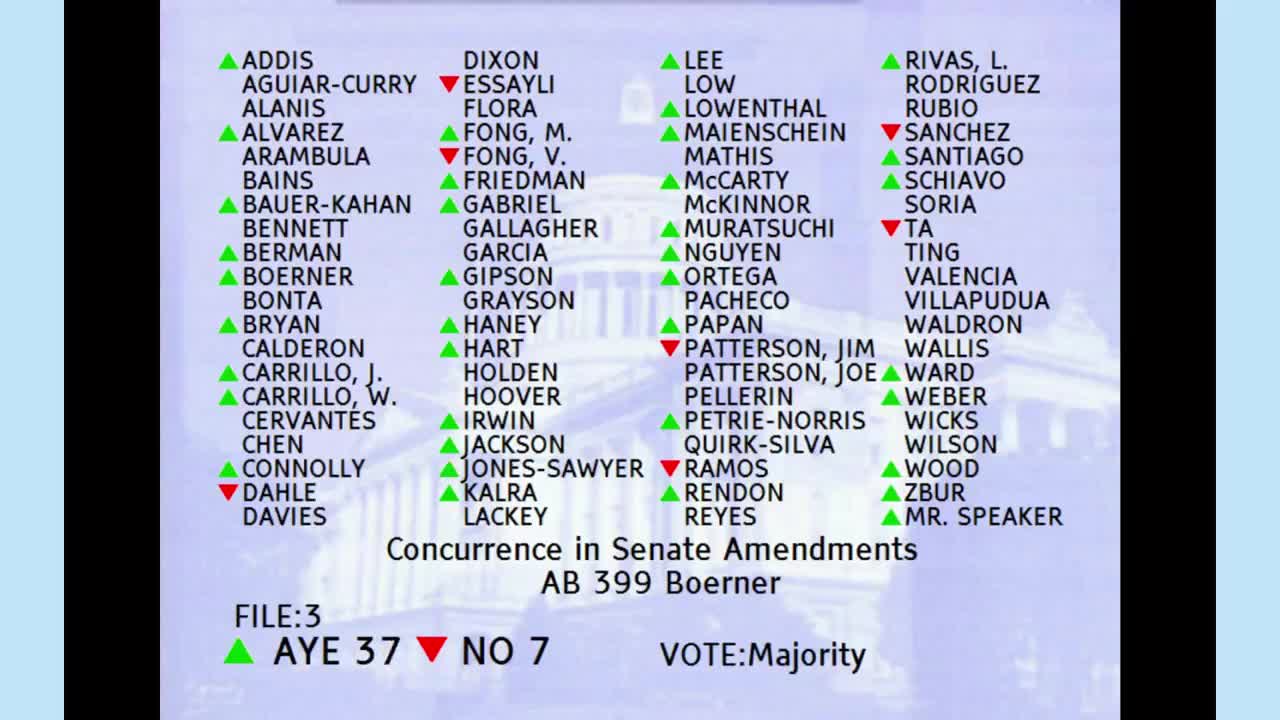 1MIN
Assembly Floor
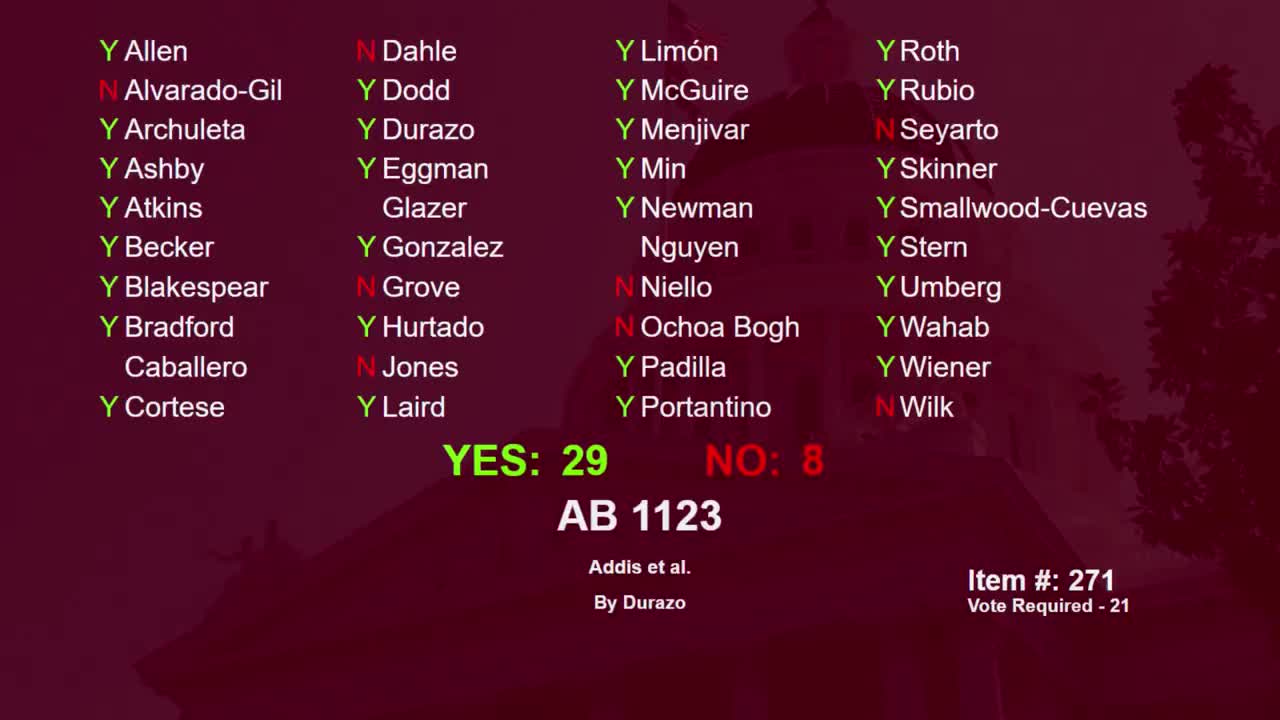 2MIN
Senate Floor
 29MIN
Senate Standing Committee on Education
 1MIN
Assembly Floor
 13MIN
Assembly Standing Committee on Education
Bill Author