AB 2486: Personal Income Tax Law: Corporation Tax Law: administration: Income Tax Stabilization Fund.
- Session Year: 2023-2024
- House: Assembly
- Latest Version Date: 2024-04-15
Current Status:
Failed
(2024-04-23: In committee: Set, first hearing. Referred to REV. & TAX. suspense file.)
Introduced
In Committee
First Chamber
In Committee
Second Chamber
Enacted
What does this bill do?
The bill creates a new Income Tax Stabilization Fund, run by the Franchise Tax Board, to hold personal income and corporation tax revenues (after refunds). It directs the state Controller to transfer each year from that fund to the General Fund no more than the five‑year average of those deposits (less refunds), adjusted for inflation using the California consumer price index.
The summary is provided by generative AI which can make mistakes. For original language, please view the details in the table below.
The Personal Income Tax Law and the Corporation Tax Law impose taxes based upon taxable income at specified rates. Existing law requires all moneys and remittances received by the Franchise Tax Board as amounts imposed under those laws, except as provided, to be deposited into the Personal Income Tax Fund or the Corporation Tax Fund, as specified. Existing law requires amounts deposited into the Personal Income Tax Fund and the Corporation Tax Fund to be drawn upon for the purpose of making refunds or be transferred to the General Fund.
This bill would create the Income and Franchise Tax Tax Stabilization Fund in the State Treasury, and would require that all revenues collected pursuant to those laws, less refunds, be deposited in that fund. to be administered by the Franchise Tax Board. The bill would require amounts deposited in the Personal Income Tax Fund and the Corporation Tax Fund to be drawn upon for the purpose of making refunds or be transferred to the Income Tax Stabilization Fund instead of the General Fund. The bill would require the Controller to annually transfer from that fund the Income Tax Stabilization Fund to the General Fund an amount not to exceed the average revenues generated pursuant to the Personal Income Tax Law and the Corporation Tax Law, amounts deposited in the Personal Income Tax Fund and the Corporation Tax Fund, less refunds, over the prior 5 fiscal years. The bill would adjust the amount of the transfer for inflation, as provided.
The Personal Income Tax Law and the Corporation Tax Law impose taxes based upon taxable income at specified rates.
This bill would create the Income and Franchise Tax Fund in the State Treasury, and would require that all revenues collected pursuant to those laws, less refunds, be deposited in that fund. The bill would require the Controller to annually transfer from that fund to the General Fund an amount not to exceed the average revenues generated pursuant to the Personal Income Tax Law and the Corporation Tax Law, less refunds, over the prior 5 fiscal years. The bill would adjust the amount of the transfer for inflation, as provided.
The Personal Income Tax Law allows to a taxpayer who transports a donated agricultural product, as specified, a credit against the net tax in an amount equal to 50 percent of the transportation costs paid or incurred by the taxpayer in connection with the transportation of that donated agricultural product.This bill would make a nonsubstantive change to that provision.The Personal Income Tax Law allows to a taxpayer who transports a donated agricultural product, as specified, a credit against the net tax in an amount equal to 50 percent of the transportation costs paid or incurred by the taxpayer in connection with the transportation of that donated agricultural product.
This bill would make a nonsubstantive change to that provision.
The balance of the moneys in the Personal Income Tax Fund shall, upon order of the Controller, be drawn therefrom for the purpose of making refunds under this part or be transferred to the General Income Tax Stabilization Fund. All undelivered refund warrants shall be redeposited in the Personal Income Tax Fund upon receipt by the Controller.
SEC. 2.Section 19604 of the Revenue and Taxation Code is amended to read:19604.(a)Except for fees received for services under Section 23305e, all moneys and remittances received by the Franchise Tax Board as amounts imposed under Part 11 (commencing with Section 23001), and related penalties, additions to tax, fees, and interest imposed under this part, shall be deposited in a special fund in the State Treasury, to be designated the Corporation Tax Fund. The moneys in the fund shall, upon the order of the Controller, be drawn therefrom for the purpose of making refunds under this part or be transferred into the General Income Tax Stabilization Fund. All undelivered refund warrants shall be redeposited into the Corporation Tax Fund upon receipt by the Controller. Fees received for services under Section 23305e shall be treated as reimbursement of the Franchise Tax Boards costs and shall be deposited into the General Fund.
(b)Notwithstanding Section 13340 of the Government Code, all moneys in the Corporation Tax Fund are hereby continuously appropriated, without regard to fiscal year, to the Franchise Tax Board for purposes of making all payments as provided in this section.
SECTION 1.Section 19501.5 is added to the Revenue and Taxation Code, to read:19501.5.(a)Notwithstanding any other law, all revenues collected pursuant to Part 10 (commencing with Section 17001) and Part 11 (commencing with Section 23001), less refunds, shall be deposited into the Income and Franchise Tax Fund, which is hereby created in the State Treasury.SEC. 3.Section 19606 is added to the Revenue and Taxation Code, to read:19606.There is hereby established in the State Treasury, the Income Tax Stabilization Fund, to be administered by the Franchise Tax Board.
(b)(1)The Controller shall annually transfer from the Income and Franchise Tax Tax Stabilization Fund to the General Fund an amount not to exceed the average revenues generated pursuant to Part 10 (commencing with Section 17001) and Part 11 (commencing with Section 23001), less refunds, for the prior five fiscal years. sum of the following:
(A)The average amount deposited into the Personal Income Tax Fund pursuant to Section 1585.5 of the Unemployment Insurance Code and Section 19602 of this code, less refunds, for the prior five fiscal years.
(B)The average amount deposited into the Corporation Tax Fund, pursuant to Sections 19604 and 19607, less refunds, for the prior five fiscal years.
(2)The transfer in paragraph (1) shall be adjusted for inflation as follows:
(A)The California Department of Industrial Relations shall transmit annually to the Controller the percentage change in the California Consumer Price Index for all items from June of the prior calendar year to June of the current calendar year, no later than August 1 of the current calendar year.
(B)The Controller shall do both of the following:
(i)Compute an inflation adjustment factor by adding 100 percent to the percentage change figure that is furnished pursuant to paragraph (1) subparagraph (A) and dividing the result by 100.
(ii)Multiply the five-year average revenues amounts described in subparagraphs (A) and (B) of paragraph (1) by the inflation adjustment factor determined in clause (i) and round off the resulting products to the nearest one dollar ($1).
(a)Notwithstanding any other law, all revenues collected pursuant to Part 10 (commencing with Section 17001) and Part 11 (commencing with Section 23001), less refunds, shall be deposited into the Income and Franchise Tax Fund, which is hereby created in the State Treasury.
(b)(1)The Controller shall annually transfer from the Income and Franchise Tax Fund to the General Fund an amount not to exceed the average revenues generated pursuant to Part 10 (commencing with Section 17001) and Part 11 (commencing with Section 23001), less refunds, for the prior five fiscal years.
(2)The transfer in paragraph (1) shall be adjusted for inflation as follows:
(A)The California Department of Industrial Relations shall transmit annually to the Controller the percentage change in the California Consumer Price Index for all items from June of the prior calendar year to June of the current calendar year, no later than August 1 of the current calendar year.
(B)The Controller shall do both of the following:
(i)Compute an inflation adjustment factor by adding 100 percent to the percentage change figure that is furnished pursuant to paragraph (1) and dividing the result by 100.
(ii)Multiply the five-year average revenues by the inflation adjustment factor determined in clause (i) and round off the resulting products to the nearest one dollar ($1).
SECTION 1.Section 17053.12 of the Revenue and Taxation Code is amended to read:17053.12.(a)In the case of a taxpayer who transports an agricultural product donated in accordance with Chapter 5 (commencing with Section 58501) of Part 1 of Division 21 of the Food and Agricultural Code, for taxable years beginning on or after January 1, 1996, there shall be allowed as a credit against the net tax (as defined by Section 17039), an amount equal to 50 percent of the transportation costs paid or incurred by the taxpayer in connection with the transportation of that donated agricultural product.(b)If any credit allowed by this section is claimed by the taxpayer, any deduction otherwise allowed under this part for that amount of the cost paid or incurred by the taxpayer which is eligible for the credit that is claimed shall be reduced by the amount of the credit allowed.(c)Upon delivery of the donated agricultural product by a taxpayer authorized to claim a credit pursuant to subdivision (a), the nonprofit charitable organization shall provide a certificate to the taxpayer who transported the agricultural product. The certificate shall contain a statement signed and dated by a person authorized by that organization that the product is donated under Chapter 5 (commencing with Section 58501) of Part 1 of Division 21 of the Food and Agricultural Code. The certificate shall also contain the following information: the type and quantity of product donated, the distance transported, the name of the transporter, the name of the taxpayer donor, and the name and address of the donee. Upon the request of the Franchise Tax Board, the taxpayer shall provide a copy of the certification to the Franchise Tax Board.(d)In the case where any credit allowed by this section exceeds the net tax, the excess may be carried over to reduce the net tax in the following year, and succeeding years if necessary, until the credit has been exhausted.(a)In the case of a taxpayer who transports any an agricultural product donated in accordance with Chapter 5 (commencing with Section 58501) of Part 1 of Division 21 of the Food and Agricultural Code, for taxable years beginning on or after January 1, 1996, there shall be allowed as a credit against the net tax (as defined by Section 17039), an amount equal to 50 percent of the transportation costs paid or incurred by the taxpayer in connection with the transportation of that donated agricultural product.
(b)If any credit allowed by this section is claimed by the taxpayer, any deduction otherwise allowed under this part for that amount of the cost paid or incurred by the taxpayer which is eligible for the credit that is claimed shall be reduced by the amount of the credit allowed.
(c)Upon delivery of the donated agricultural product by a taxpayer authorized to claim a credit pursuant to subdivision (a), the nonprofit charitable organization shall provide a certificate to the taxpayer who transported the agricultural product. The certificate shall contain a statement signed and dated by a person authorized by that organization that the product is donated under Chapter 5 (commencing with Section 58501) of Part 1 of Division 21 of the Food and Agricultural Code. The certificate shall also contain the following information: the type and quantity of product donated, the distance transported, the name of the transporter, the name of the taxpayer donor, and the name and address of the donee. Upon the request of the Franchise Tax Board, the taxpayer shall provide a copy of the certification to the Franchise Tax Board.
(d)In the case where any credit allowed by this section exceeds the net tax, the excess may be carried over to reduce the net tax in the following year, and succeeding years if necessary, until the credit has been exhausted.
|
Date
|
Status
|
|---|---|
| Apr 23, 2024 | In committee: Set, first hearing. Held under submission. |
| Apr 23, 2024 | In committee: Set, first hearing. Referred to REV. & TAX. suspense file. |
| Apr 16, 2024 | Re-referred to Com. on REV. & TAX. |
| Apr 15, 2024 | From committee chair, with author's amendments: Amend, and re-refer to Com. on REV. & TAX. Read second time and amended. |
| Apr 8, 2024 | In committee: Hearing postponed by committee. |
| Mar 19, 2024 | Re-referred to Com. on REV. & TAX. |
| Mar 18, 2024 | From committee chair, with author's amendments: Amend, and re-refer to Com. on REV. & TAX. Read second time and amended. |
| Mar 18, 2024 | Referred to Com. on REV. & TAX. |
| Feb 14, 2024 | From printer. May be heard in committee March 15. |
| Feb 13, 2024 | Read first time. To print. |
This list shows positions taken on this bill by organizations on the date displayed, which is linked to the original source.
Positions by individuals are not included.
|
Organization
|
Position
|
Date
|
|---|---|---|
| California Federation Of Teachers | ** Against | |
| California School Employees Association | * Support | Apr 22, 2024 |
| California Taxpayers Association | * Support | Apr 22, 2024 |
Date of Hearing: April 22, 2024
ASSEMBLY COMMITTEE ON REVENUE AND TAXATION
Jacqui Irwin, Chair
ABPCA Bill Id:AB 2486 (
Author:Vince Fong) – As Amended Ver:April 15, 2024
Majority vote. Fiscal committee.
SUBJECT: Personal Income Tax Law: Corporation Tax Law: administration: Income Tax Stabilization Fund
SUMMARY: Requires that all revenues collected pursuant to the Personal Income Tax (PIT) Law and the Corporation Tax (CT) Law, less refunds and other specified amounts, must be deposited into a new Income Tax Stabilization Fund (Stabilization Fund), which this bill establishes in the State Treasury. Specifically, this bill:
- Charges the Franchise Tax Board (FTB) with administering the Stabilization Fund.
- Requires the State Controller to annually transfer from the Stabilization Fund to the General Fund (GF) an amount not to exceed the sum of the following:
- The average amount deposited into the PIT Fund pursuant to Unemployment Insurance Code Section 1585.5 and Revenue and Taxation Code (R&TC) Section 19602, less refunds, for the prior five fiscal years (FYs); and,
- The average amount deposited into the CT Fund, pursuant to R&TC Sections 19604 and 19607, less refunds, for the prior five FYs.
- Requires the transfer to be adjusted for inflation as follows:
- The California Department of Industrial Relations shall transmit annually to the State Controller the percentage change in the California Consumer Price Index for all items from June of the prior calendar year to June of the current calendar year, no later than August 1 of the current calendar year; and,
- The State Controller shall do both of the following:
- Compute an inflation adjustment factor by adding 100% to the percentage change figure that is furnished and dividing the result by 100; and,
- Multiply the average amounts deposited into the PIT Fund and CT Fund, as specified, by the inflation adjustment factor and round off the resulting products to the nearest $1.
EXISTING LAW:
- Imposes, under both the PIT Law and the CT Law, taxes based upon taxable income at specified rates. (R&TC Sections 17001 et seq. and 23001 et seq.)
- Vests the FTB with various powers and duties including, among other things, the administration of the PIT Law and the CT Law. (Id.)
- Requires all moneys and remittances received by the FTB as amounts imposed under the PIT Law and the CT Law, except as provided, to be deposited into the PIT Fund or the CT Fund, as specified. (R&TC Sections 19602 and 19604.)
- Requires amounts deposited into the PIT Fund and the CT Fund to be drawn upon for the purpose of making refunds or be transferred to the GF. (R&TC Sections 19603 and 19604.)
FISCAL EFFECT: This bill could potentially lead to significant reductions in state revenues flowing into the GF.
COMMENTS:
- The author has provided the following statement in support of this bill:
As demonstrated through the peaks and valleys in California's capital gains collections, budget volatility will only continue unless the State changes how it handles capital gains. Californians across the state deserve to know that their government has confidence in the predictability of its revenues. Without making practical changes to capital gains allocations, California will continue to experience extreme revenue volatility, requiring the state to make tough decisions time and time again on delaying funding or approving budget cuts to many important programs. Assembly Bill 2486 will address this problem by creating a capital gains stabilization account, which will establish an average revenue from capital gains over five years.
- This bill is opposed by the California School Employees Association, which notes:
AB 2486 would restrict California's ability to spend its resources to support the varying needs of its residents. It creates an unnecessary administrative process without any consideration for the state's priorities or potential emergency needs.
Furthermore, AB 2486 raises significant constitutionality questions surrounding Proposition (Prop) 98. Will the new calculation for deposit into the state's General Fund affect the calculation in determining the Prop 98 minimum guarantee? What protections are in place to ensure that public education receives its constitutional rightful share?
- Committee Staff Comments:
- Existing state budget reserves and related budget flexibilities: Voters have approved the key elements of California's progressive PIT rate structure, which heightens the state budget's reliance on high-income taxpayers and introduces considerable year-to-year volatility to tax receipts. State policy during the last decade has led to the creation of a few different budget reserves in response to that volatility. The creation of this system of budget reserves - of late, the largest of any U.S. state in history - represented a coordinated response by the Legislature and voters after the state's fiscal crisis of the late 2000s. The reserves were intended to provide elected officials with time to carefully consider cuts, possible tax increases, and other options when faced with projected budget deficits.
The June 2023 state budget package included an estimated $37.8 billion of GF budget reserves, including $22.5 billion in the Budget Stabilization Account (BSA) and $10.8 billion in the Public School System Stabilization Account (PSSSA) established by Proposition 2 of 2014 [ACAx2 1 (John A. Pérez)]. Proposition 2 establishes a detailed formula for required deposits to the rainy day fund, including more deposits in years when taxpayers report high levels of capital gains income and a cap on mandatory deposits to the BSA set at about 10% of GF tax revenues. (The Governor and legislative leaders recently have proposed future voter action to increase that 10% cap.)
In addition to the BSA and PSSSA, GF-related reserves include the longstanding Special Fund for Economic Uncertainties (Government Code Section 16418) and more recently established accounts: the Safety Net Reserve (Welfare and Institutions Code Section 11011[a][1]) and the currently unfunded Budget Deficit Savings Account (Government Code Section 16418.8[a]). In addition to these formal reserves, the state GF can access temporarily the reserves of hundreds of other state accounts, with aggregate borrowable balances of around $60 billion as of March 31, 2024. Moreover, other budgetary tools developed during budget downturns of the 1990s and 2000s provide billions of dollars of additional flexibility when budget shortfalls are projected. The Governor's January 2024 budget proposal proposes using a portion of these reserves and budget flexibilities in the 2024 state budget package as the state again deals with the volatility of its income tax revenues.
- What would this bill do? This bill would institute a new statutory mechanism aimed at stabilizing budget expenditures. This mechanism would do so by requiring the vast majority of both PIT and CT revenues to be deposited into a newly established Stabilization Fund in lieu of the GF. The State Controller would then annually transfer from the Stabilization Fund to the GF an amount no greater than the average amount deposited into the PIT Fund and CT Fund, less refunds, for the prior five FYs. While the PIT and CT are not the only sources of GF dollars, the Department of Finance estimates that in FY 2024-25 these two laws will generate a combined $153.2 billion, representing roughly 75.6% of the state's GF revenues.
In support of this proposal, the author's office notes:
Aside from Alaska, California has the most volatile tax structure within the United States. The state used to rely heavily on retail sales and use taxes to fill its coffers, but has now shifted towards receiving most of its revenue through personal income taxes. Capital gains, along with personal income tax, are both major sources of California's revenues. This poses a problem as it is widely known that capital gains collections are highly volatile.
Assembly Bill 2486 proposes a solution to the revenue volatility issue by creating a separate account for capital gains collections and sending a consistent 5-year average amount to the General Fund. Given that the revenues will no longer be reported and spent all at once, this will smooth out volatility without increasing taxes while also protecting Prop 98 allocations.
- Proposition 98: Proposition 98 (1988) established a minimum funding requirement for schools and community colleges commonly referred to as the "minimum guarantee". Specifically, the California Constitution sets forth three main tests for calculating the Proposition 98 minimum guarantee. Each of these tests take into consideration various inputs, including GF revenue, per capita personal income, and student attendance. Test 1 links school funding to a minimum share of GF revenue. Tests 2 and 3, in turn, build upon the amount of funding provided in the previous year.
Given that this bill would, in some years, reduce the amount of revenues that would otherwise flow into the GF, it is not entirely clear how the proposed Stabilization Account would impact the minimum guarantee for school funding. While the author's office suggests that this bill would "[protect] Prop 98 allocations", the opponents contend that this bill raises significant constitutional questions regarding how the minimum guarantee is calculated. In reality, it is not entirely clear how this bill's new Stabilization Fund would interact with either the calculation of the minimum guarantee for school funding or the existing budget stabilization requirements discussed above. Synthesizing these provisions would likely entail a multi-year effort and could potentially lead to litigation.
REGISTERED SUPPORT / OPPOSITION:
Support
None on file
Opposition
California Federation of Teachers
California School Employees Association
Analysis Prepared by: M. David Ruff / REV. & TAX. / (916) 319-2098
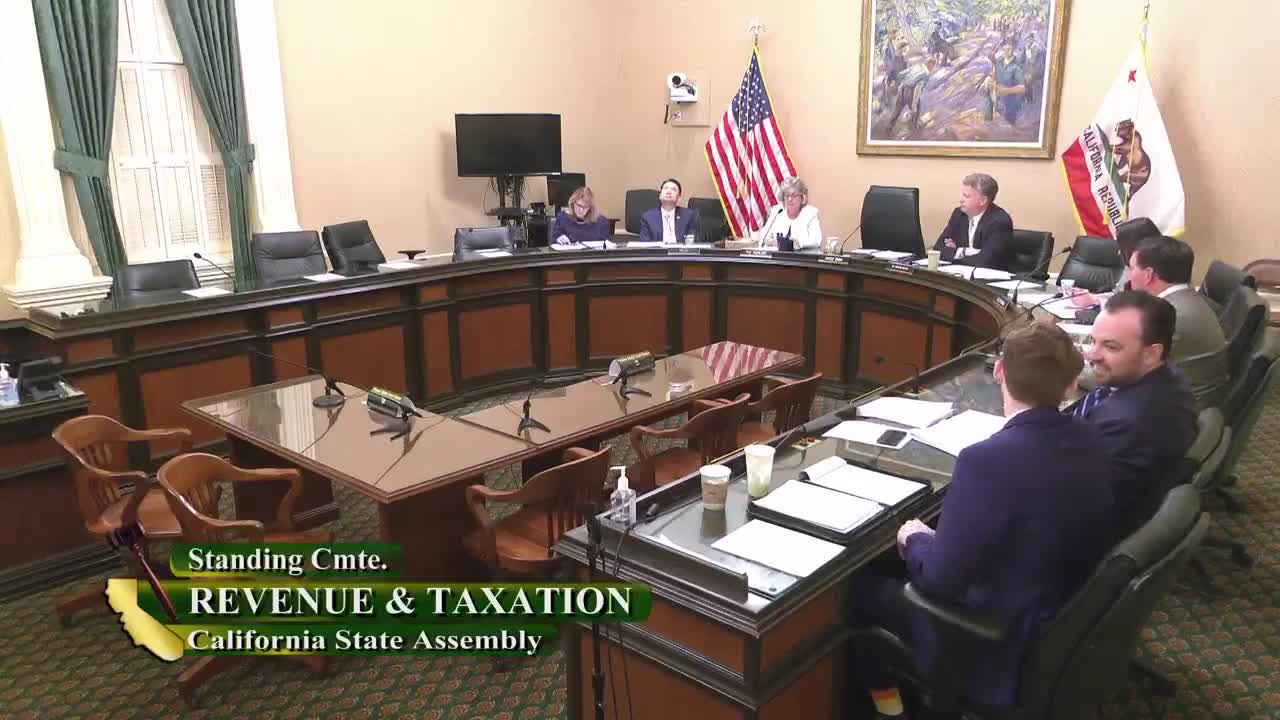
Discussed in Hearing
 5MIN
Assembly Standing Committee on Revenue and Taxation
1MIN
Assembly Standing Committee on Revenue and Taxation
Bill Author

Bill Co-Author(s):