AB 2577: Organic waste: reduction regulations.
- Session Year: 2023-2024
- House: Assembly
- Latest Version Date: 2024-02-14
Current Status:
Failed
(2024-05-16: In committee: Held under submission.)
Introduced
In Committee
First Chamber
In Committee
Second Chamber
Enacted
What does this bill do?
This bill requires the Department of Resources Recycling and Recovery to add product labeling requirements that reduce food waste to its rules on recovering edible food. Those labeling rules would be part of the effort to meet the existing goal that at least 20% of edible food now thrown away is recovered for people to eat by 2025 and would affect food makers and sellers.
The summary is provided by generative AI which can make mistakes. For original language, please view the details in the table below.
Existing law requires the State Air Resources Board to complete, approve, and implement a comprehensive strategy to reduce emissions of short-lived climate pollutants in the state to reduce the statewide methane emissions by 40% below 2013 levels by 2030. Existing law requires methane emissions reduction goals to include specified targets to reduce the landfill disposal of organics. Existing law requires the Department of Resources Recycling and Recovery, in consultation with the state board, to adopt regulations that achieve those targets for reducing organic waste in landfills, and include in those regulations, among other things, requirements intended to meet the goal that not less than 20% of edible food that is currently disposed of is recovered for human consumption by 2025.
This bill would require the department to include in those recovered edible food requirements, product labeling requirements that reduce food waste.
(a)The department, in consultation with the State Air Resources Board, shall adopt regulations to achieve the organic waste reduction goals for 2020 and 2025 established in Section 39730.6 of the Health and Safety Code. The regulations shall comply with all of the following:
(1)May require local jurisdictions to impose requirements on generators or other relevant entities within their jurisdiction and may authorize local jurisdictions to impose penalties on generators for noncompliance.
(2)(A)Shall include requirements intended to meet the goal that not less than 20 percent of edible food that is currently disposed of is recovered for human consumption by 2025.
(B)The requirements adopted pursuant to subparagraph (A) shall include, but not be limited to, product labeling requirements that reduce food waste.
(3)Shall not establish a numeric organic waste disposal limit for individual landfills.
(4)May include different levels of requirements for local jurisdictions and phased timelines based upon their progress in meeting the organic waste reduction goals for 2020 and 2025 established in Section 39730.6 of the Health and Safety Code. The department shall base its determination of progress on relevant factors, including, but not limited to, reviews conducted pursuant to Section 41825, the amount of organic waste disposed compared to the 2014 level, per capita disposal rates, the review required by Section 42653, and other relevant information provided by a local jurisdiction.
(5)(A)May include penalties to be imposed by the department for noncompliance. If penalties are included, they shall not exceed the amount authorized pursuant to Section 41850.
(B)Notwithstanding any other law, administrative civil penalties for a local jurisdiction that fails to procure a quantity of recovered organic waste products that meets or exceeds its recovered organic waste product procurement target established by the department pursuant to Section 18993.1 of Title 14 of the California Code of Regulations shall be imposed pursuant to the following schedule:
(i)On or after January 1, 2023, each jurisdiction shall procure a quantity of recovered organic waste products that meets or exceeds 30 percent of its recovered organic waste product procurement target.
(ii)On or after January 1, 2024, each jurisdiction shall procure a quantity of recovered organic waste products that meets or exceeds 65 percent of its recovered organic waste product procurement target.
(iii)On or after January 1, 2025, each jurisdiction shall procure a quantity of recovered organic waste products that meets or exceeds 100 percent of its recovered organic waste product procurement target.
(6)Shall take effect on or after January 1, 2022, except the imposition of penalties pursuant to paragraph (1) shall not take effect until two years after the effective date of the regulations.
(7)Jurisdictions in possession of a rural exemption pursuant to subdivision (c) of Section 18984.12 of Title 14 of the California Code of Regulations, as that section read on January 1, 2022, are exempt from the procurement requirement of this subdivision until December 31, 2026. Beginning January 1, 2027, the department may, in its discretion, provide rural counties and jurisdictions located within rural counties that are exempt from organic waste collection requirements an extended recovered organic waste product procurement target schedule similar to the schedule set forth in this subdivision, which shall be exempt from the Administrative Procedure Act (Chapter 3.5 (commencing with Section 11340) of Part 1 of Division 3 of Title 2 of the Government Code).
(8)The department may, in its discretion, create an adjusted recovered organic waste product procurement target schedule, not to exceed the requirements of the schedule set forth in this subdivision, which shall be exempt from the Administrative Procedure Act (Chapter 3.5 (commencing with Section 11340) of Part 1 of Division 3 of Title 2 of the Government Code).
(b)A local jurisdiction may charge and collect fees to recover the local jurisdictions costs incurred in complying with the regulations adopted pursuant to this section.
(c)A local jurisdiction facing continuing violations of the regulations adopted pursuant to subdivision (a) that commence during the 2022 calendar year may submit to the department a notification of intent to comply, as described in this section. Upon approval by the department, and implementation by the local jurisdiction, of a notification of intent to comply that meets the requirements of subdivision (e), a local jurisdiction may be eligible for both of the following:
(1)Administrative civil penalty relief for the 2022 calendar year pursuant to subdivision (d).
(2)A corrective action plan pursuant to Section 18996.2 of Title 14 of the California Code of Regulations.
(d)(1)For violations of the regulations that are disclosed in a notification of intent to comply that is approved by the department as meeting the requirements of subdivision (e), the department shall waive administrative civil penalties under paragraph (5) of subdivision (a) during the 2022 calendar year if, and administrative civil penalties shall not accrue under paragraph (5) of subdivision (a) during the 2022 calendar year if, the local jurisdiction implements the proposed actions according to the schedule proposed pursuant to paragraph (4) of subdivision (e).
(2)For violations that commence during the 2022 calendar year and continue into the 2023 calendar year, administrative civil penalties may begin accruing as of January 1, 2023. Those administrative civil penalties accruing on and after January 1, 2023, shall be waived upon complete compliance with the terms of a corrective action plan pursuant to Section 18996.2 of Title 14 of the California Code of Regulations.
(3)If a local jurisdiction fails to adhere to the proposed actions and schedule described in a notification of intent to comply pursuant to paragraph (4) of subdivision (e), the department may revoke its approval of the notification of intent to comply and impose administrative civil penalties for violations occurring during the 2022 calendar year retroactive to the date of violation.
(4)Notwithstanding any proposed actions and schedule provided by a local jurisdiction in an approved notification of intent to comply pursuant to paragraph (4) of subdivision (e), the department may instead address through a corrective action plan any violations disclosed in that notification that may take more than 180 days to correct. Under those circumstances, the proposed actions and schedule provided pursuant to an approved notification of intent to comply pursuant to paragraph (4) of subdivision (e) shall control until a corrective action plan is finalized.
(e)The department shall approve a notification of intent to comply if the department determines the notification meets the requirements of this subdivision. A notification of intent to comply shall be in writing, adopted by formal resolution by the governing body of the local jurisdiction, and filed with the department no later than March 1, 2022. The notification of intent to comply shall include, at a minimum, all of the following:
(1)A description, with specificity, of the continuing violations.
(2)A detailed explanation of the reasons, supported by documentation, why the local jurisdiction is unable to comply.
(3)A description of the impacts of the COVID-19 pandemic on compliance.
(4)A description of the proposed actions the local jurisdiction will take to remedy the violations within the timelines established in Section 18996.2 of Title 14 of the California Code of Regulations with a proposed schedule for doing so. The proposed actions shall be tailored to remedy the violations in a timely manner.
(f)The department shall respond in writing to a local jurisdiction within 45 business days of receiving a notification of intent to comply with an approval, disapproval, request for additional information, or timeline for a decision on approval or disapproval. If the department disapproves the notification of intent to comply due to the notification not meeting the requirements of subdivision (e), the department shall include in the response a justification for the disapproval.
(g)Notwithstanding Section 18996.2 of Title 14 of the California Code of Regulations, the department may establish any maximum compliance deadline in a corrective action plan that it determines to be necessary and appropriate under the circumstances for the correction of a violation of the regulations adopted pursuant to subdivision (a).
(h)(1)The department may adopt regulations it determines to be necessary to implement and enforce the changes made to this section by Chapter 508 of the Statutes of 2021 as emergency regulations.
(2)Emergency regulations adopted pursuant to paragraph (1) shall be adopted in accordance with Chapter 3.5 (commencing with Section 11340) of Part 1 of Division 3 of Title 2 of the Government Code, and for purposes of that chapter, including Section 11349.6 of the Government Code, the adoption of these regulations is an emergency and shall be considered by the Office of Administrative Law as necessary for the immediate preservation of the public peace, health, safety, and general welfare. Notwithstanding Chapter 3.5 (commencing with Section 11340) of Part 1 of Division 3 of Title 2 of the Government Code, emergency regulations adopted by the department pursuant to paragraph (1) shall be filed with, but not be repealed by, the Office of Administrative Law and shall remain in effect until January 1, 2024.
REVISIONS: HeadingLine 2.|
Date
|
Status
|
|---|---|
| May 16, 2024 | In committee: Held under submission. |
| Apr 10, 2024 | In committee: Set, first hearing. Referred to APPR. suspense file. |
| Mar 20, 2024 | Coauthors revised. |
| Mar 20, 2024 | From committee: Do pass and re-refer to Com. on APPR. (Ayes 8. Noes 3.) (March 19). Re-referred to Com. on APPR. |
| Mar 4, 2024 | Referred to Com. on NAT. RES. |
| Feb 15, 2024 | From printer. May be heard in committee March 16. |
| Feb 14, 2024 | Read first time. To print. |
|
Date
|
Description
|
Location
|
Votes
|
|
|---|---|---|---|---|
| Mar 19, 2024 | Do pass and be re-referred to the Committee on [Appropriations] | Assembly Standing Committee on Natural Resources |
Passed |
This list shows positions taken on this bill by organizations on the date displayed, which is linked to the original source.
Positions by individuals are not included.
|
Organization
|
Position
|
Date
|
|---|---|---|
| Californians Against Waste | * Support | Mar 19, 2024 |
| CALPIRG | * Support | Mar 19, 2024 |
| Climate Action California | * Support | Mar 19, 2024 |
| Environment California | * Support | Mar 19, 2024 |
| Rethinkwaste | * Support | Mar 19, 2024 |
| StopWaste | * Support | Mar 19, 2024 |
Date of Hearing: April 10, 2024
ASSEMBLY COMMITTEE ON APPROPRIATIONS
Buffy Wicks, Chair
ABPCA Bill Id:AB 2577
Author:(Irwin) – As Introduced Ver:February 14, 2024
Policy Committee: | Natural Resources | Vote: | 8 - 3 |
|
| ||
|
|
Urgency: No State Mandated Local Program: No Reimbursable: No
SUMMARY:
This bill requires the regulations adopted by the Department of Resources Recycling and Recovery (CalRecycle) to meet the state’s edible food recovery goal to include product labeling requirements that reduce food waste.
FISCAL EFFECT:
CalRecycle estimates, at a minimum, annual costs of approximately $500,000 in contract funds as well as $340,000 for two new positions for fiscal years (FY) 2024-25, 2025-26, and 2026-27 to develop and promulgate regulations that include food labeling requirements (General Fund). In addition, CalRecycle anticipates ongoing annual costs after FY 2026-27 of an unknown amount, likely in the hundreds of thousands of dollars, for at least five new positions to conduct inspections, provide technical assistance, respond to industry inquiries, and generate educational materials. According to the Legislative Analyst’s Office, the General Fund faces a structural deficit in the tens of billions of dollars over the next several fiscal years.
COMMENTS:
1) Purpose. According to the author:
Food products often feature phrases next to dates such as “Best By”, “Expires On”, “Use By”, “Enjoy By”, “Best Before”, and “Sell By”, among countless other variations. The meaning of these phrases can be unclear to average consumers…this confusion ultimately leads to food being unnecessarily wasted, grocery budgets strained, and increased methane emissions from rotting food contributing to climate change. AB 2577 addresses the food waste and methane emissions stemming from these confusing date labels by directing CalRecycle to adopt food product labeling requirements as part of its regulations to meet California’s SB 1383 surplus food rescue goals.
2) Background.
Edible Food Recovery Goals. CalRecycle estimates that Californians throw away nearly six million tons of food waste annually. This represents about 18% of all the material that goes into landfills. SB 1383 (Lara), Chapter 395, Statutes of 2016, requires the Air Resources Board (ARB) to approve and implement a comprehensive short-lived climate pollutant strategy to achieve, by 2030, the following reductions from 2013 levels: a 40% reduction in methane, a 40% reduction in hydrofluorocarbon gases, and a 50% reduction in anthropogenic black carbon. In order to accomplish these goals, the law specifies that the methane emission reduction goals include the following targets to reduce the landfill disposal of organic waste, including food: 50% from the 2014 level by 2020 and 75% from the 2014 level by 2025. The law also requires that by 2025, 20% of edible food that would otherwise be sent to landfills is redirected to feed people.
CalRecycle, as part of its edible food recovery grant program, awarded $5 million (General Fund) over two fiscal years (FY) – FY 2021-22 and FY 2022-23 – to support edible food recovery projects. In addition, the department received and allocated $24 million (Greenhouse Gas Reduction Fund) for its food waste prevention and rescue grant program between FYs 2016-17 and 2019-20. The FY 2023-24 budget and the Governor’s January budget for FY 2024-25 do not propose any new funding for either of these programs.
Food Labeling. With the exception of infant formula, product date labeling is voluntary. Date labels are highly inconsistent and confusing, not science-based, and vary widely across jurisdictions, brands, and food products, leading the majority of Americans to prematurely throw away food. In an effort to address confusing food date labels and reduce food waste, AB 954 (Chiu), Chapter 787, Statutes of 2017, required the California Department of Food and Agriculture (CDFA), in consultation with the California Department of Public Health (CDPH), to publish information that encourages food manufacturers, processors, and retailers to voluntarily use specified “best by” and “use by” labels that communicate quality and safety, respectively. However, supporters of this bill note that data collected from a 2019 store shelf study found only 36% of products displayed these recommended labels.
While reducing food waste is an essential component of achieving the state’s short-lived climate pollutant reduction targets, CalRecycle does not have the expertise needed to establish food labeling requirements and would likely need to coordinate with CDFA and CDPH on this effort.
3) Opposition. Writing in opposition, the California League of Food Producers contends:
Food product labels are an essential mechanism used to communicate food safety, food quality, and other valuable information to both the consumer and other industry professionals throughout the food distribution supply chain. Much thought and research go into each label, including the real estate each product allows for labeling, disclosures that may be necessary to place on the product, and more. Given the sensitive nature of food labels, we are concerned with giving generalized regulatory authority to CalRecycle on food product labeling, an agency that does not oversee food safety within California.
4) Related Legislation. AB 660 (Irwin) of the current legislative session requires a food manufacturer, processor, or retailer responsible for labeling food items for human consumption to use “BEST if Used by” to indicate quality and “Use by” to indicate product safety, and prohibits the use of “Sell by.” AB 660 is pending in the Senate Agriculture Committee.
Analysis Prepared by: Nikita Koraddi / APPR. / (916) 319-2081
Date of Hearing: March 19, 2024
ASSEMBLY COMMITTEE ON NATURAL RESOURCES
Isaac G. Bryan, Chair
ABPCA Bill Id:AB 2577 (
Author:Irwin) – As Introduced Ver:February 14, 2024
SUBJECT: Organic waste: reduction regulations
SUMMARY: Requires the regulations adopted by the Department of Resources Recycling and Recovery (CalRecycle) to meet the state’s edible food recovery goal to include product labeling requirements that reduce food waste.
EXISTING LAW:
- Requires the Air Resources Board (ARB), pursuant to California Global Warming Solutions Act of 2006, to adopt a statewide greenhouse gas (GHG) emissions limit equivalent to 1990 levels by 2020 and adopt regulations to achieve maximum technologically feasible and cost-effective GHG emission reductions. The Act authorizes ARB to permit the use of market-based compliance mechanisms to comply with GHG reduction regulations once specified conditions are met. Requires ARB to approve a statewide GHG emissions limit equivalent to 85% below the 1990 level by 2045. (Health and Safety Code (HSC) 38500-38599.11)
- Requires ARB to develop a comprehensive strategy to reduce the emissions of short-lived climate pollutants (SLCP) to achieve a 40% reduction in methane emissions, 40% reduction in hydrofluorocarbon gases, and 50% reduction in anthropogenic black carbon below 2013 levels by 2030. (HSC 39730-39730.5)
- Requires the state to reduce the disposal of organic waste by 40% from the 2014 level by 2020 and 75% by 2025 to help achieve the state’s methane reduction goal. (HSC 39730.6)
- Requires CalRecycle, in consultation with ARB, to adopt regulations to achieve the state’s organic waste reduction goals. Specifies that the regulations, among other things:
- May require local jurisdictions to impose requirements on generators or other relevant entities within their jurisdictions and may authorize local jurisdictions to impose penalties on generators for noncompliance; and,
- Shall include requirements intended to meet the goal that not less than 20% of edible food that is currently disposed of is recovered for human consumption by 2025. (Public Resources Code (PRC) 42652.5)
- Requires the California Department of Food and Agriculture (CDFA) in consultation with the Department of Public Health (DPH), to publish information that encourages food manufacturers, processors, and retailers responsible for the labeling of food products to voluntarily use specified "best by" and "use by" labels that communicate quality and safety dates, respectively. (Food and Agriculture Code (FAC) 82001)
- Requires CDFA to encourage food distributors and retailers to develop alternatives to consumer-facing “sell by” dates, defined to mean a date on a label affixed to the packaging or container of food that is intended to communicate primarily to a distributor or retailer for purposes of stock rotation and that is not a quality date or a safety date. (FAC 82001)
- Provides that it is unlawful for an egg handler to sell, offer for sale, or expose for sale certain eggs that are packed for human consumption unless each container intended for sale to the ultimate consumer is labeled with certain information, including, among other information, the words “sell-by” immediately followed by the month and day in bold type, as specified. (FAC 27644, 24644.5)
- Requires repackaged eggs to be labeled with the original sell by date. (FAC 27687)
- Requires a food facility that packages food using a reduced-oxygen packaging method and Clostridium botulinum to have an approved plan limiting the refrigerated shelf life to no more than 30 calendar days from packaging to consumption, except the time product is maintained frozen, or the original manufacturer’s “sell by” or “use by” date, whichever occurs first. (HSC 114057.1)
- Requires raw shucked shellfish to be obtained in nonreturnable packages that bear a legible “sell by” date or a “best if used by” date for packages, as specified. (HSC 114039)
FISCAL EFFECT: Unknown
COMMENTS:
- Organic waste recycling. An estimated 35 million tons of waste are disposed of in California's landfills annually. More than half of the materials landfilled are organics, such as food waste and yard waste. CalRecycle’s 2021 waste characterization study found that 34% of disposed waste is organic waste. According to University of California Los Angeles Center for Health Policy Research, more than a third of Californians (39%) can’t afford enough food. In spite of widespread food insecurity, 11.2 billion pounds of food is disposed of annually in the state.
ARB is required to approve and implement a comprehensive SLCP strategy to achieve, from 2013 levels, a 40% reduction in methane, a 40% reduction in hydrofluorocarbon gases, and a 50% reduction in anthropogenic black carbon, by 2030. In order to accomplish these goals, the law specifies that the methane emission reduction goals include targets to reduce the landfill disposal of organic waste, including food, 50% by 2020 and 75% by 2025 from the 2014 level. The law also requires that by 2025, 20% of edible food that would otherwise be sent to landfills is redirected to feed people. Specifically, the law requires: jurisdictions to establish food recovery programs and strengthen existing food recovery networks; food donors to arrange to recover the maximum amount of edible food; and, food recovery organizations and services that participate in SB 1383 to maintain specified records.
To achieve this, California’s waste management infrastructure is going to have to process and recycle much higher quantities of organic materials, involving significant investments in additional processing infrastructure. Organic waste is primarily recycled by composting the material, which generates compost that can be used in gardening and agriculture as a soil amendment and engineering purposes for things like slope stabilization. Anaerobic digestion is also widely used to recycle organic wastes. This technology uses bacteria to break down the material in the absence of oxygen and produces biogas, which can be used as fuel, and digestate, which can also be used as a soil amendment. Tree trimmings and prunings can also be mulched. These processes are expensive and Californians are paying to manage billions of pounds of wasted food every year.
- Food labeling. There is no standardized date on food labels. Moreover, there are no federal, state, or local regulations on the use of dates, with the exception of baby formula. Instead, labels use a variety of terms, including "use by," "best before," "sell by," and "enjoy by" dates, which are both poorly understood and surprisingly under-regulated. AB 954 (Chiu) Chapter 787, Statutes of 2017 requires CDFA and DPH to encourage food manufacturers, processors, and retailers responsible for the labeling of food products to voluntarily use specified "best by" and "use by" labels that communicate quality and safety dates.
Food labels have been used for decades to estimate peak freshness. Unlike “use by” labels, which are found on perishable foods like meat and dairy, “best before” labels are not related to safety and may encourage consumers to throw away food that is perfectly safe to eat.
Major United Kingdom grocery stores have removed “best before” labels from prepackaged fruit and vegetables. The European Union is considering revising its labeling laws for “use by” and “best before” labels. There is growing momentum in the United States to standardize the language on date labels to help educate buyers about food waste. Other states have introduced bills to streamline date labels, including Colorado, Massachusetts, and New Jersey.
The United States Department of Agriculture estimates that almost one third of the American food supply is wasted. Quantifying these losses at the household level, the average consumer spends about $1,300 annually on food that is later discarded. Moreover, product prices have remained high following pandemic-induced inflation, further prioritizing the need for families to make the most of their grocery budgets and minimize waste.
Many Californians, especially our underserved and marginalized communities, struggle with food insecurity. These communities are harmed by unclear food labels, which lead them to throw away nutritious and quality food. Additionally many of these communities rely on food banks, pantries, and other charitable sources of food. While these charitable organizations regularly accept and distribute donated food with expired dates that may indicate that they should already be sold or past peak quality, but remain safe, it often results in recipients believing that they are being given spoiled food. This is an unnecessary scenario that could be remedied by standardizing the use of labels.
While CDFA and DPH have developed voluntary standards for food manufacturers, processors, and retailers to use in labeling food products, Californians have continued to see a variety of labels that use phrases other than ones selected by CDFA and DPH across a range of food products. The presence of other phrases have hampered efforts to educate consumers on the quality and safety messages meant by the uniform terms.
- This bill. This bill requires CalRecycle to incorporate product labeling requirements that reduce food waste in its regulations to meet the state’s edible food recovery goal. While reducing food waste is an essential component of achieving the state’s SLCP reduction targets, it is not clear that CalRecycle has the expertise needed to establish food labeling requirements.
- Author’s statement:
Food products often feature phrases next to dates such as “Best By”, “Expires On”, “Use By”, “Enjoy By”, “Best Before”, and “Sell By”, among countless other variations. The meaning of these phrases can be unclear to average consumers as they can indicate a product’s peak freshness, when a product is no longer safe for consumption, or, in the case of “Sell By” dates, act as a guide for when retailers should pull products from the shelf. These phrases are often all referred to as “expiration dates”, which can lead to consumer confusion. With the exception of baby formula, date labels on packaged food are not federally regulated. Furthermore, state rules can be widely inconsistent and only apply to certain product groups. This confusion ultimately leads to food being unnecessarily wasted, grocery budgets strained, and increased methane emissions from rotting food contributing to climate change.
AB 2577 addresses the food waste and methane emissions stemming from these confusing date labels by directing CalRecycle to adopt food product labeling requirements as part of its regulations to meet California’s SB 1383 surplus food rescue goals. The bill gives CalRecycle the authority to determine which food labels it would like to adopt in order to most effectively reduce food waste.
- Previous and related legislation:
AB 660 (Irwin) would require, on and after January 1, 2025, food manufacturers, processors, and retailers responsible for labeling foot items to use “BEST if Used by” to indicate quality, “Use by” to indicate product safety, and would prohibit the use of “Sell by” on food items. This bill is currently in the Senate Agriculture Committee.
AB 954 (Chiu), Chapter 787, Statutes of 2017, requires CDFA, in consultation with DPH, to publish information to encourage food manufacturers, processors, and retailers responsible for labeling foot items to voluntarily use uniform terms on food product labels to communicate quality dates and safety dates. Requires CDFA to encourage food distributors and retailers to develop alternatives to consumer-facing “sell by” dates.
AB 2311 (Bennett) adds edible food recovery activities to the activities eligible for funding from CalRecycle’s grant program that provides financial assistance to promote the development of organic waste infrastructure and waste reduction programs. This bill is also scheduled to be heard in the Assembly Natural Resources Committee on March 19, 2024.
AB 2346 (Lee) authorizes local jurisdictions to be credited for the procurement of recovered organic waste products through contracts with direct service providers, and authorizes jurisdictions to receive procurement credit for investments made in projects that increase organic waste recycling capacity. This bill has been referred to the Assembly Natural Resources Committee.
AB 2514 (Aguiar Curry) exempts small counties with a population under 70,000 from the state’s organic waste reduction requirements. This bill defines pyrolysis as the thermal decomposition of organic material at elevated temperatures in the absence of oxygen. This bill also requires CalRecycle to include hydrogen and pipeline biomethane converted from organic waste as eligible for procurement credit by local jurisdictions and requires CalRecycle to consider “life-cycle carbon intensity” when providing incentives to facilitate progress toward the organic waste reduction targets. Finally, this bill requires CalRecycle, in consultation with ARB, to report to the Legislature on the amount of methane emissions leaked from “different recovered organic waste product procurement target compliance pathways” and measures to reduce methane leakage. This bill has been referred to the Assembly Natural Resources Committee.
AB 2658 (Bains) exempts food processing establishments that do not “divert organic waste to landfills” from the state’s organic waste diversion targets. This bill has been referred to the Assembly Natural Resources Committee.
AB 2902 (Wood) indefinitely extends the exemption for small rural counties with a population below 70,000 from the state’s organic waste reduction requirements, as specified. This bill provides additional compliance flexibility for small counties that produce less than 200,000 tons of solid waste annually. This bill also provides a process by which jurisdictions located at higher altitudes may receive an exemption from CalRecycle where food waste collection bins pose a threat to public health or animal safety due to bears. This bill has been referred to the Assembly Natural Resources Committee.
SB 972 (Min) requires CalRecycle, ARB, and the California Environmental Protection Agency to hold at least two joint meetings each calendar year to coordinate the implementation of policies that affect organic waste reduction targets. This bill has been referred to the Senate Environmental Quality Committee.
SB 1034 (Blakespear) requires the Office of Planning and Research, in consultation with CalRecycle, to develop a model zoning ordinance that facilitates the siting of compost facilities and requires local jurisdictions, when amending a zoning ordinance to also amend an appropriate zoning ordinance based on the model ordinance. This bill also requires district or regional water boards to act on permits for compost facilities within 30 days. This bill has been referred to the Senate Environmental Quality Committee.
SB 1046 (Laird) requires CalRecycle to prepare a program environmental impact report that streamlines the California Environmental Quality Act process for small and medium sized compost facilities. This bill has been referred to the Senate Environmental Quality Committee.
SB 1175 (Ochoa Bogh) requires CalRecycle to consider alternatives to census tracts when establishing the boundaries for a low-population or elevation waiver from the state’s organic waste reduction requirements and extends the length of the waivers to 10 years. This bill has been referred to the Senate Environmental Committee.
SB 1232 (Grove) authorizes CalRecycle to issue a waiver, upon request, from the requirement to separate and recover food waste and food-soiled paper for all or part of a rural jurisdiction in which there is low population density and limited waste collection services. This bill has been referred to the Senate Environmental Quality Committee.
REGISTERED SUPPORT / OPPOSITION:
Support
Alameda County Community Food Bank
California Compost Coalition
California Environmental Voters
California Product Stewardship Council
Californians Against Waste (sponsor)
California Public Interest Research Group
Elders Climate Action NorCal
Elders Climate Action SoCal
Los Angeles Alliance for a New Economy
Natural Resources Defense Council
Plastic Free Future
RethinkWaste
Save Our Shores
Second Harvest of Silicon Valley
Solana Center for Environmental Innovation
StopWaste
Zero Waste Sonoma
Opposition
California League of Food Processors
Analysis Prepared by: Elizabeth MacMillan / NAT. RES. /
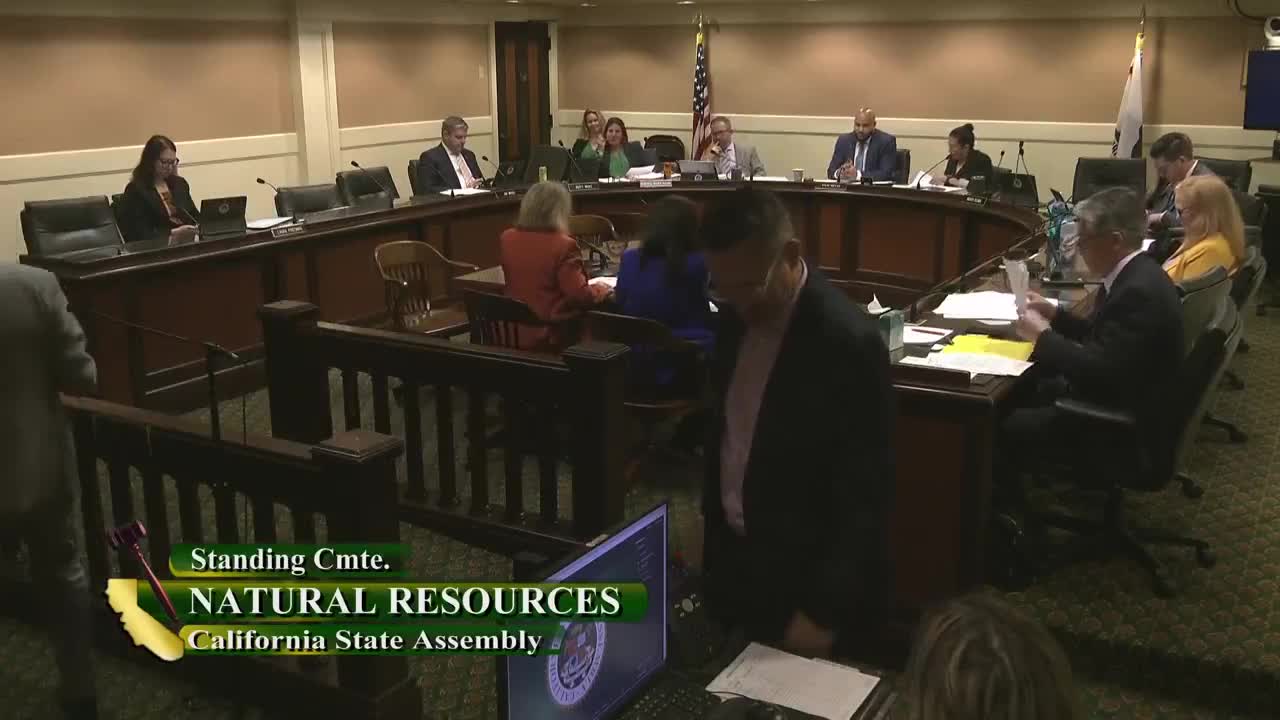
Discussed in Hearing
 7MIN
Assembly Standing Committee on Natural Resources
Bill Author


