AB 3019: Oil and gas wells: Hazardous and Idle-Deserted Well Abatement Fund.
- Session Year: 2023-2024
- House: Assembly
- Latest Version Date: 2024-04-24
Current Status:
Failed
(2024-05-16: In committee: Held under submission.)
Introduced
In Committee
First Chamber
In Committee
Second Chamber
Enacted
What does this bill do?
The bill requires the Department of Conservation to reserve at least 25% of annual money from the Hazardous and Idle-Deserted Well Abatement Fund for counties that have at least 100 orphaned or deserted oil and gas wells (wells with no responsible owner) and that say they can plug and abandon those wells faster than the state can. It also requires the department to immediately make at least 10% of annual funds available to a county when liquid or gas is leaking from an orphaned or deserted well there, and to split funds among eligible counties based on how many wells they will fix and the cost estimates. All spending must follow the state’s skilled and trained workforce rules.
The summary is provided by generative AI which can make mistakes. For original language, please view the details in the table below.
Existing law establishes the Geologic Energy Management Division in the Department of Conservation, under the direction of the State Oil and Gas Supervisor, who is required to supervise the drilling, operation, maintenance, and abandonment of oil and gas wells, as provided. Existing law requires the operator of any idle well to either (1) no later than May 1 of each year, for each idle well that was an idle well at any time in the last calendar year, file with the supervisor an annual fee according to a specified schedule of fees based on the length of time a well has been idle, or (2) file a plan with the supervisor to provide for the management and elimination of all long-term idle wells. Existing law also establishes the Hazardous and Idle-Deserted Well Abatement Fund in the State Treasury for the deposit of those idle well fees, and continuously appropriates moneys in the fund to the department for expenditure to mitigate a hazardous or potentially hazardous condition, by well plugging and abandonment, decommissioning the production facilities, or both, at a well of an operator, as provided.
Existing law establishes requirements that apply when a public entity is required by statute or regulation to obtain an enforceable commitment that a bidder, contractor, or other entity will use a skilled and trained workforce to complete a contract or project, as provided.
This bill would require the department to make available at least 25% of the funds to be expended each year from the Hazardous and Idle-Deserted Well Abatement Fund to a county in which there are at least 100 legacy orphaned or deserted oil and gas wells, as defined, wells and that attests to the department that it can plug and abandon those wells more quickly than the department can, as provided. The bill would also require the department, upon becoming aware of liquid or gas leaking from a legacy an orphaned or deserted oil and gas well, to immediately make available at least 10% of the funds to be expended each year from the fund to the county in which the well is located, if the county attests to the department that it can plug and abandon the well more quickly than the department can, as provided. The bill would require the department to distribute funds amongst eligible counties based on the number of wells that would be plugged and abandoned by the county and the cost estimate to plug and abandon the wells. The bill would require the expenditure of all money from the fund to comply with those skilled and trained workforce requirements, as provided.
Existing law establishes the Geologic Energy Management Division in the Department of Conservation, under the direction of the State Oil and Gas Supervisor, who is required to supervise the drilling, operation, maintenance, and abandonment of oil and gas wells, as provided. Existing law requires the operator of any idle well to either (1) no later than May 1 of each year, for each idle well that was an idle well at any time in the last calendar year, file with the supervisor an annual fee according to a specified schedule of fees based on the length of time a well has been idle, or (2) file a plan with the supervisor to provide for the management and elimination of all long-term idle wells. Existing law also establishes the Hazardous and Idle-Deserted Well Abatement Fund in the State Treasury for the deposit of those idle well fees, and continuously appropriates moneys in the fund to the department for expenditure to mitigate a hazardous or potentially hazardous condition, by well plugging and abandonment, decommissioning the production facilities, or both, at a well of an operator, as provided.
Existing law establishes requirements that apply when a public entity is required by statute or regulation to obtain an enforceable commitment that a bidder, contractor, or other entity will use a skilled and trained workforce to complete a contract or project, as provided.
This bill would require the department to make available at least 25% of the funds to be expended each year from the Hazardous and Idle-Deserted Well Abatement Fund to a county in which there are at least 100 legacy oil and gas wells, as defined, and that attests to the department that it can plug and abandon those wells more quickly than the department can, as provided. The bill would also require the department, upon becoming aware of liquid or gas leaking from a legacy oil and gas well, to immediately make available at least 10% of the funds to be expended each year from the fund to the county in which the well is located, if the county attests to the department that it can plug and abandon the well more quickly than the department can, as provided. The bill would require the expenditure of all money from the fund to comply with those skilled and trained workforce requirements, as provided.
(a)The operator of any idle well shall do either of the following:
(1)No later than May 1 of each year, for each idle well that was an idle well at any time in the last calendar year, file with the supervisor an annual fee equal to the sum of the following amounts:
(A)One hundred fifty dollars ($150) for each idle well that has been an idle well for three years or longer, but less than eight years.
(B)Three hundred dollars ($300) for each idle well that has been an idle well for eight years or longer, but less than 15 years.
(C)Seven hundred fifty dollars ($750) for each idle well that has been an idle well for 15 years or longer, but less than 20 years.
(D)One thousand five hundred dollars ($1,500) for each idle well that has been an idle well for 20 years or longer.
(2)File a plan with the supervisor to provide for the management and elimination of all long-term idle wells.
(A)For the purposes of the plan required by this paragraph, elimination of an idle well shall be accomplished when the well has been properly abandoned in accordance with Section 3208, or it has been shown to the divisions satisfaction that, since the well became an idle well, the well has maintained production of oil or gas or been used for injection for a continuous six-month period.
(B)A plan filed pursuant to this paragraph shall meet all of the following requirements and conditions:
(i)The plan shall specify the time period that it covers. The plan and any renewal of the plan shall cover a time period of no more than five years and shall be subject to approval by the supervisor who may prioritize the order in which idle wells are addressed.
(ii)The plan shall be reviewed for performance annually by the supervisor, and be subject to amendment by the supervisor, or by the operator with the approval of the supervisor.
(iii)The required rate of long-term idle well elimination shall be based upon the number of idle wells under the control of an operator on January 1 of each year, as specified in clause (iv). If the operator has eliminated more wells than required in the prior two years, the supervisor may deduct from the new requirement the net total of long-term idle wells eliminated in excess of those previously required. In addition, the supervisor may require additional well testing requirements as part of the plan.
(iv)Unless and until the operator has no long-term idle wells, the plan shall require that operators with 250 or fewer idle wells eliminate at least 4 percent of their long-term idle wells each year, and, in no case, less than one long-term idle well; operators with 251 to 1,250, inclusive, idle wells eliminate at least 5 percent of their long-term idle wells each year, and, in no case, less than one long-term idle well; and operators with more than 1,250 idle wells eliminate at least 6 percent of their long-term idle wells each year, and, in no case, less than one long-term idle well.
(v)An operator who fails to comply with the plan, as determined by the supervisor after the annual performance review, is not eligible to use the requirements of this paragraph, for purposes of compliance with this section, for any of its idle wells. That operator may not propose a new idle well plan for the next five years. An operator may appeal to the director pursuant to Article 6 (commencing with Section 3350) regarding the supervisors rejection of a plan and plan amendments and the supervisors determination of the operators failure to comply with a plan. If the supervisors determination that the operator failed to comply with the plan is not timely appealed, or if the director upholds the supervisors determination upon appeal, then the operator shall immediately file the fees required under paragraph (1) for each year that the operator failed to comply with the plan.
(b)(1)All fees received under this section shall be deposited in the Hazardous and Idle-Deserted Well Abatement Fund, which is hereby created in the State Treasury. Notwithstanding Section 13340 of the Government Code, the moneys in the Hazardous and Idle-Deserted Well Abatement Fund are hereby continuously appropriated to the department for expenditure without regard to fiscal year, to mitigate a hazardous or potentially hazardous condition, by well plugging and abandonment, decommissioning the production facilities, or both, at a well of an operator subject to the requirements of this section.
(2)(A)The department shall make available at least 25 percent of the funds to be expended each year pursuant to paragraph (1) to a county that meets both of the following requirements:
(i)There are at least 100 legacy orphaned or deserted oil and gas wells located in the county.
(ii)The county attests to the department that it can plug and abandon those wells more quickly than the department can.
(B)If multiple counties meet the conditions described in clauses (i) and (ii) of subparagraph (A), the department shall make available at least 25 percent of the funds to be expended each year pursuant to paragraph (1) to be distributed between those counties.
(C)The department shall distribute the funds pursuant to subparagraph (B) amongst eligible counties based on the number of wells that would be plugged and abandoned by the county and based on the cost estimate to plug and abandon the wells pursuant to subparagraph (C) of paragraph (1) of subdivision (a) of Section 3206.3, unless information pursuant to Section 3205.7 is available.
(C)(D)The funding requirements of this paragraph shall not apply if no counties meet the conditions described in clauses (i) and (ii) of subparagraph (A).
(3)(A)The department shall, upon becoming aware of liquid or gas leaking from a legacy an orphaned or deserted oil and gas well, immediately make available at least 10 percent of the funds to be expended each year pursuant to paragraph (1) to the county in which the well is located, if the county attests to the department that it can plug and abandon the well more quickly than the department can.
(B)(i)If a county described in subparagraph (A) plugs and abandons a legacy an orphaned or deserted oil and gas well that is leaking liquid or gas before receiving funds from the department, the department shall, to the extent allowable under existing law, reimburse the county for all costs incurred from plugging and abandoning the well, consistent with clause (ii).
(ii)The department shall not be required to expend more than 10 percent of the funds to be expended each year pursuant to paragraph (1) to reimburse a county, or multiple counties as described in subparagraph (C), for costs already incurred from plugging and abandoning legacy orphaned or deserted oil and gas wells that are leaking liquid or gas.
(iii)If the cost to a county described in clause (i), or to multiple counties as described in subparagraph (C), to plug and abandon the legacy orphaned or deserted oil and gas wells that are leaking liquid or gas exceeds 10 percent of the funds to be expended each year pursuant to paragraph (1), the department may, in its discretion, reimburse the county for some or all of the costs incurred.
(C)If multiple counties meet the condition described in subparagraph (A), the department shall immediately make available at least 10 percent of the funds to be expended each year pursuant to paragraph (1) to the counties in which the leaking legacy orphaned or deserted oil and gas wells are located, to be distributed between those counties, consistent with subparagraph (B).
(D)The department shall distribute the funds pursuant to subparagraph (C) amongst eligible counties based on the number of wells that would be plugged and abandoned by the county and based on the cost estimate to plug and abandon the wells pursuant to subparagraph (C) of paragraph (1) of subdivision (a) of Section 3206.3, unless information pursuant to Section 3205.7 is available.
(4)The expenditure of any moneys pursuant to this section shall comply with the skilled and trained workforce requirements in Chapter 2.9 (commencing with Section 2600) of Part 1 of Division 2 of the Public Contract Code.
(5)For purposes of this subdivision, legacy oil and gas wells are wells where there is little or no information on the wells abandonment procedure and there is no viable company with the responsibility to reabandon the well should it start leaking or pose a threat to the environment or to public health and safety.(c)Failure to file, for any well, the fee required under this section shall be conclusive evidence of desertion of the well, permitting the supervisor to order the well abandoned pursuant to Section 3237.
(d)Nothing in this section prohibits a local agency from collecting a fee for regulation of wells.
(e)This section shall become operative on January 1, 2018.
(a)The operator of any idle well shall do either of the following:
(1)No later than May 1 of each year, for each idle well that was an idle well at any time in the last calendar year, file with the supervisor an annual fee equal to the sum of the following amounts:
(A)One hundred fifty dollars ($150) for each idle well that has been an idle well for three years or longer, but less than eight years.
(B)Three hundred dollars ($300) for each idle well that has been an idle well for eight years or longer, but less than 15 years.
(C)Seven hundred fifty dollars ($750) for each idle well that has been an idle well for 15 years or longer, but less than 20 years.
(D)One thousand five hundred dollars ($1,500) for each idle well that has been an idle well for 20 years or longer.
(2)File a plan with the supervisor to provide for the management and elimination of all long-term idle wells.
(A)For the purposes of the plan required by this paragraph, elimination of an idle well shall be accomplished when the well has been properly abandoned in accordance with Section 3208, or it has been shown to the divisions satisfaction that, since the well became an idle well, the well has maintained production of oil or gas or been used for injection for a continuous six-month period.
(B)A plan filed pursuant to this paragraph shall meet all of the following requirements and conditions:
(i)The plan shall specify the time period that it covers. The plan and any renewal of the plan shall cover a time period of no more than five years and shall be subject to approval by the supervisor who may prioritize the order in which idle wells are addressed.
(ii)The plan shall be reviewed for performance annually by the supervisor, and be subject to amendment by the supervisor, or by the operator with the approval of the supervisor.
(iii)The required rate of long-term idle well elimination shall be based upon the number of idle wells under the control of an operator on January 1 of each year, as specified in clause (iv). If the operator has eliminated more wells than required in the prior two years, the supervisor may deduct from the new requirement the net total of long-term idle wells eliminated in excess of those previously required. In addition, the supervisor may require additional well testing requirements as part of the plan.
(iv)Unless and until the operator has no long-term idle wells, the plan shall require that operators with 250 or fewer idle wells eliminate at least 4 percent of their long-term idle wells each year, and, in no case, less than one long-term idle well; operators with 251 to 1,250, inclusive, idle wells eliminate at least 5 percent of their long-term idle wells each year, and, in no case, less than one long-term idle well; and operators with more than 1,250 idle wells eliminate at least 6 percent of their long-term idle wells each year, and, in no case, less than one long-term idle well.
(v)An operator who fails to comply with the plan, as determined by the supervisor after the annual performance review, is not eligible to use the requirements of this paragraph, for purposes of compliance with this section, for any of its idle wells. That operator may not propose a new idle well plan for the next five years. An operator may appeal to the director pursuant to Article 6 (commencing with Section 3350) regarding the supervisors rejection of a plan and plan amendments and the supervisors determination of the operators failure to comply with a plan. If the supervisors determination that the operator failed to comply with the plan is not timely appealed, or if the director upholds the supervisors determination upon appeal, then the operator shall immediately file the fees required under paragraph (1) for each year that the operator failed to comply with the plan.
(b)(1)All fees received under this section shall be deposited in the Hazardous and Idle-Deserted Well Abatement Fund, which is hereby created in the State Treasury. Notwithstanding Section 13340 of the Government Code, the moneys in the Hazardous and Idle-Deserted Well Abatement Fund are hereby continuously appropriated to the department for expenditure without regard to fiscal year, to mitigate a hazardous or potentially hazardous condition, by well plugging and abandonment, decommissioning the production facilities, or both, at a well of an operator subject to the requirements of this section.
(2)(A)The department shall make available at least 25 percent of the funds to be expended each year pursuant to paragraph (1) to a county that meets both of the following requirements:
(i)There are at least 100 legacy oil and gas wells located in the county.
(ii)The county attests to the department that it can plug and abandon those wells more quickly than the department can.
(B)If multiple counties meet the conditions described in clauses (i) and (ii) of subparagraph (A), the department shall make available at least 25 percent of the funds to be expended each year pursuant to paragraph (1) to be distributed between those counties.
(C)The funding requirements of this paragraph shall not apply if no counties meet the conditions described in clauses (i) and (ii) of subparagraph (A).
(3)(A)The department shall, upon becoming aware of liquid or gas leaking from a legacy oil and gas well, immediately make available at least 10 percent of the funds to be expended each year pursuant to paragraph (1) to the county in which the well is located, if the county attests to the department that it can plug and abandon the well more quickly than the department can.
(B)(i)If a county described in subparagraph (A) plugs and abandons a legacy oil and gas well that is leaking liquid or gas before receiving funds from the department, the department shall, to the extent allowable under existing law, reimburse the county for all costs incurred from plugging and abandoning the well, consistent with clause (ii).
(ii)The department shall not be required to expend more than 10 percent of the funds to be expended each year pursuant to paragraph (1) to reimburse a county, or multiple counties as described in subparagraph (C), for costs already incurred from plugging and abandoning legacy oil and gas wells that are leaking liquid or gas.
(iii)If the cost to a county described in clause (i), or to multiple counties as described in subparagraph (C), to plug and abandon the legacy oil and gas wells that are leaking liquid or gas exceeds 10 percent of the funds to be expended each year pursuant to paragraph (1), the department may, in its discretion, reimburse the county for some or all of the costs incurred.
(C)If multiple counties meet the condition described in subparagraph (A), the department shall immediately make available at least 10 percent of the funds to be expended each year pursuant to paragraph (1) to the counties in which the leaking legacy oil and gas wells are located, to be distributed between those counties, consistent with subparagraph (B).
(4)The expenditure of any moneys pursuant to this section shall comply with the skilled and trained workforce requirements in Chapter 2.9 (commencing with Section 2600) of Part 1 of Division 2 of the Public Contract Code.
(5)For purposes of this subdivision, legacy oil and gas wells are wells where there is little or no information on the wells abandonment procedure and there is no viable company with the responsibility to reabandon the well should it start leaking or pose a threat to the environment or to public health and safety.
(c)Failure to file, for any well, the fee required under this section shall be conclusive evidence of desertion of the well, permitting the supervisor to order the well abandoned pursuant to Section 3237.
(d)Nothing in this section prohibits a local agency from collecting a fee for regulation of wells.
(e)This section shall become operative on January 1, 2018.
|
Date
|
Status
|
|---|---|
| May 16, 2024 | In committee: Held under submission. |
| May 8, 2024 | In committee: Set, first hearing. Referred to APPR. suspense file. |
| Apr 25, 2024 | Re-referred to Com. on APPR. |
| Apr 24, 2024 | Read second time and amended. |
| Apr 23, 2024 | From committee: Amend, and do pass as amended and re-refer to Com. on APPR. (Ayes 10. Noes 0.) (April 22). |
| Mar 11, 2024 | Referred to Com. on NAT. RES. |
| Feb 17, 2024 | From printer. May be heard in committee March 18. |
| Feb 16, 2024 | Read first time. To print. |
|
Date
|
Description
|
Location
|
Votes
|
|
|---|---|---|---|---|
| Apr 22, 2024 | Do pass as amended and be re-referred to the Committee on [Appropriations] | Assembly Standing Committee on Natural Resources |
Passed |
This list shows positions taken on this bill by organizations on the date displayed, which is linked to the original source.
Positions by individuals are not included.
|
Organization
|
Position
|
Date
|
|---|---|---|
| Kern County | * Support | Apr 22, 2024 |
Date of Hearing: May 8, 2024
ASSEMBLY COMMITTEE ON APPROPRIATIONS
Buffy Wicks, Chair
ABPCA Bill Id:AB 3019
Author:(Bains) – As Amended Ver:April 24, 2024
Policy Committee: | Natural Resources | Vote: | 10 - 0 |
|
| ||
|
|
Urgency: No State Mandated Local Program: No Reimbursable: No
SUMMARY:
This bill requires the Division of Geologic Energy Management (CalGEM) to make specified amounts of funding available to a county in which there are at least 100 orphaned or deserted oil and gas wells and that attests to CalGEM that the county can plug and abandon those wells more quickly than CalGEM can.
Specifically, this bill, among other things:
- Requires CalGEM to make available at least 25% of the funds to be expended each year from the Hazardous and Idle-Deserted Well Abatement Fund (HIDWAF) to a county in which there are at least 100 orphaned or deserted oil and gas wells and that attests to CalGEM that the county can plug and abandon those wells more quickly than CalGEM can.
- Requires CalGEM, if multiple counties meet the conditions described in 1), above, to distribute the funds between those counties as specified. Provides that if no counties meet the conditions, the funding requirements do not apply.
- Requires CalGEM, upon becoming aware of liquid or gas leaking from an orphaned or deserted oil and gas well, to immediately make available at least 10% of HIDWAF funds to the county in which the well is located, if the county attests to CalGEM that it can plug and abandon the well more quickly than CalGEM can.
- Requires CalGEM, if a county plugs and abandons an orphaned or deserted oil and gas well that is leaking liquid or gas before receiving funds from CalGEM, to the extent allowable under existing law, to reimburse the county for all costs incurred from plugging and abandoning the well.
- Provides that CalGEM is not required to expend more than 10% of HIDWAF funds to reimburse a county, or multiple counties, for costs already incurred from plugging and abandoning orphaned or deserted oil and gas wells that are leaking liquid or gas.
- Authorizes CalGEM, if the cost to a county or to multiple counties to plug and abandon the orphaned or deserted oil and gas wells that are leaking liquid or gas exceeds 10% of HIDWAF funds, to, in its discretion, reimburse the county for some or all of the costs incurred.
- Requires CalGEM, if multiple counties meet the conditions described in 3, above, to immediately make available at least 10% of the funds to be expended each year to the counties in which the leaking orphaned or deserted oil and gas wells are located, to be distributed between those counties, as specified.
- Requires the expenditure of any moneys pursuant to this bill to comply with skilled and trained workforce requirements, as specified.
FISCAL EFFECT:
1) CalGEM estimates ongoing annual costs of approximately $1.4 million (Oil, Gas, and Geothermal Administrative Fund (OGGAF)) for six new positions to develop guidelines and appropriate terms and conditions for funding; review contract and subcontract agreements for compliance with applicable laws and regulations; address any potential legal challenges; evaluate orphaned or deserted wells; review documentation for planned county projects; monitor and witness county plugging and abandonment activities as required under current law; document and update data on orphaned or deserted wells; monitor and administer county activities and progress; and review county attestations.
2) To the extent that counties, pursuant to this bill, apply for funding from CalGEM to plug and abandon orphaned or deserted oil and gas wells, this bill creates an ongoing cost pressure to HIDWAF of an unknown, but potentially significant amount, potentially in the hundreds of thousands of dollars to low millions of dollars. CalGEM collected approximately $1.62 million in idle well fees for fiscal year (FY) 2022-23 and anticipates collecting a similar amount in FY 2023-24.
COMMENTS:
1) Purpose. According to the author:
As the producer of more than 70% of California oil, it is critical that our process to plug and seal leaking oils wells works quickly and efficiently to protect the health and safety of Kern County residents. While good actors have a history of quickly addressing leaks once they are detected, CalGEM is tasked with addressing leaks from wells where no responsible party has been identified. The state has dedicated significant financial resources for this purpose, but current procedures can leave local families exposed to known leaks for weeks. AB 3019 ensures that the state will partner with local governments to reduce this lag time to fix leaking wells as quickly as possible.
2) Background.
Idle and Orphan Wells. According to CalGEM’s August 2023 “Idle Well Program Legislative Report,” which covered the 2021 calendar year, there are over 38,000 known idle wells in the state, each of which will eventually come to the end of its life. If these wells are not properly plugged and abandoned, they can contaminate waterways and soil, serve as a source of climate and air pollution, and present physical hazards to people and wildlife. Idle wells can become orphan wells if they are deserted by insolvent operators. As of December 31, 2021, CalGEM had identified more than 5,300 wells as orphan or potentially orphan. CalGEM estimates the potential liability to the state for plugging and abandoning these 5,300 wells to be approximately $974 million.
Funding. OGGAF is funded by operator assessment fees, and expenditures from this fund are statutorily capped at $5 million per year. Since FY 2016-17, CalGEM has expended over $12.7 million from OGGAF to depressurize 21 wells, plug and abandon 247 wells, and remediate 17 facilities, and has allocated an additional $1.9 million for contracts to plug and abandon facilities, pipelines, and appurtenances. The FY 2022-23 state budget allocated an additional $100 million (General Fund and Greenhouse Gas Reduction Fund) to CalGEM over two years to plug and abandon wells and to decommission facilities, and for site remediation. As part of the Governor’s FY 2024-25 proposed budget, CalGEM is requesting $7.5 million in FY 2024-25 and $7.5 million in FY 2025-26 from OGGAF as a match to the aforementioned $100 million appropriation.
Idle well fee revenues are deposited into HIDWAF, which is continuously appropriated to support the plugging and decommissioning of hazardous or potentially hazardous wells and facilities. As of March 1, 2024, HIDWAF had a fund balance of $25.5 million. In the last five FYs, beginning in FY 2018-19, CalGEM has spent a little over $4 million from HIDWAF to plug and abandon 46 wells and on site cleanup for 21 wells, five facilities, and 208 well repairs.
This bill requires CalGEM to annually provide up to 25% of the idle well fees to a county or multiple counties with at least 100 orphaned or deserted oil and gas wells and that have the financial and technical ability to plug and abandon those wells more quickly than CalGEM can. As noted in the Assembly Natural Resources Committee analysis of this bill, the proposed use of HIDWAF may present legal challenges. Under Proposition 26, use of regulatory fees can only be spent to benefit the regulated entity paying the fee. It may not be known if the orphaned or deserted oil and gas wells covered under this bill had operators who paid the idle well fees. Therefore, there could be a lack of nexus between a plugged and abandoned well under this bill and the operator(s) who paid the fees.
Los Angeles, Kern, and Ventura counties are home to a significant share of the state’s orphaned and deserted wells; however, none of these counties currently perform well plugging and abandonment. It is not clear if counties have the technical expertise and capacity to do this work themselves. And it is not clear how CalGEM is going to verify a county’s ability to plug and abandon wells “more quickly than the department can” or what financial recourse CalGEM has should a county fail to properly and expeditiously remediate a well.
3) Related Legislation. AB 1866 (Hart), of the current legislative session, eliminates the option for an idle well operator to pay idle well fees and requires the operator to, on or before July 1, 2025, file a plan with the State Oil and Gas Supervisor for the management and elimination of all idle wells.
Analysis Prepared by: Nikita Koraddi / APPR. / (916) 319-2081
Discussed in Hearing
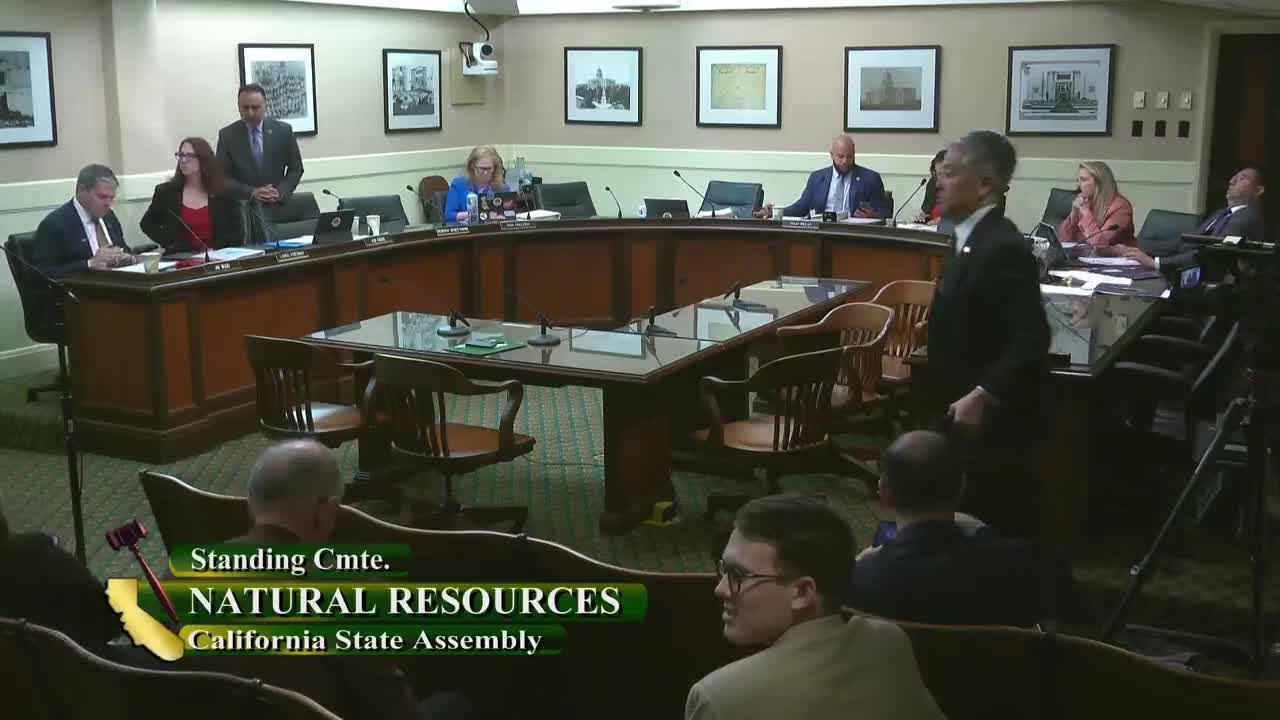 5MIN
Assembly Standing Committee on Natural Resources
Bill Author

Bill Co-Author(s):
