AB 808: Crimes: rape.
- Session Year: 2023-2024
- House: Assembly
- Latest Version Date: 2023-03-30
Current Status:
Failed
(2024-02-01: From committee: Filed with the Chief Clerk pursuant to Joint Rule 56.)
Introduced
In Committee
First Chamber
In Committee
Second Chamber
Enacted
Existing law prohibits an act of sexual intercourse accomplished against a persons will by means of force, violence, duress, menace, or fear of immediate and unlawful bodily injury on the person or another. Existing law provides a greater punishment for this offense if the victim is a minor, as specified.
Existing law also prohibits an act of sexual intercourse with a person who is incapable, because of a mental disorder or developmental or physical disability, of giving legal consent, and this is known or reasonably should be known to the person committing the act.
This bill would also impose a greater punishment for this offense if the victim is a minor, as specified.This bill would impose a greater punishment for prohibited acts of sexual intercourse, as defined, if the victim is a developmentally disabled minor, as specified and defined, and the person committing the prohibited acts knows or should have known that the person is developmentally disabled. The bill would specifically require a person who commits these offenses upon a person who is 10 years of age or younger to be prosecuted pursuant to another statute providing even greater punishment.
By increasing the punishment for crime, this bill would create a state-mandated local program.
The California Constitution requires the state to reimburse local agencies and school districts for certain costs mandated by the state. Statutory provisions establish procedures for making that reimbursement.
This bill would provide that no reimbursement is required by this act for a specified reason.
Existing law prohibits an act of sexual intercourse accomplished against a persons will by means of force, violence, duress, menace, or fear of immediate and unlawful bodily injury on the person or another. Existing law provides a greater punishment for this offense if the victim is a minor, as specified.
Existing law also prohibits an act of sexual intercourse with a person who is incapable, because of a mental disorder or developmental or physical disability, of giving legal consent, and this is known or reasonably should be known to the person committing the act.
This bill would also impose a greater punishment for this offense if the victim is a minor, as specified.
(a)Except as provided in subdivision (c), (c) or (d), rape, as defined in Section 261 or former Section 262, is punishable by imprisonment in the state prison for three, six, or eight years.
(b)In addition to any punishment imposed under this section the judge may assess a fine not to exceed seventy dollars ($70) against a person who violates Section 261 or former Section 262 with the proceeds of this fine to be used in accordance with Section 1463.23. The court shall, however, take into consideration the defendants ability to pay, and no defendant shall be denied probation because of the defendants inability to pay the fine permitted under this subdivision.
(c)(1)A person who commits rape in violation of paragraph (1) or (2) of subdivision (a) of Section 261 upon a child who is under 14 years of age shall be punished by imprisonment in the state prison for 9, 11, or 13 years.
(2)A person who commits rape in violation of paragraph (1) or (2) of subdivision (a) of Section 261 upon a minor who is 14 years of age or older shall be punished by imprisonment in the state prison for 7, 9, or 11 years.
(3)This subdivision does not preclude prosecution under Section 269, Section 288.7, or any other law.
(d)(1)A person, who knows or reasonably should know that a person is developmentally disabled, and who commits rape, as defined in Section 261, upon a person who is developmentally disabled who is under 14 years of age, shall be punished by imprisonment in the state prison for 9, 11, or 13 years.
(2)A person, who knows or reasonably should know that a person is developmentally disabled, and who commits rape, as defined in Section 261, upon a person who is developmentally disabled who is 14 years of age or older, shall be punished by imprisonment in the state prison for 7, 9, or 11 years.
(3)This subdivision does not preclude prosecution under Section 269 or any other law.
(4)Notwithstanding paragraphs (1) and (3), a person, subject to prosecution pursuant to paragraph (1) because the developmentally disabled person is 10 years of age or younger, shall be prosecuted pursuant to Section 288.7.
(5)Developmental disability means a disability as defined in subdivision (a) of Section 4512 of the Welfare and Institutions Code and for which a regional center finds eligibility for services under the Lanterman Developmental Disabilities Services Act.
SEC. 2.No reimbursement is required by this act pursuant to Section 6 of Article XIIIB of the California Constitution because the only costs that may be incurred by a local agency or school district will be incurred because this act creates a new crime or infraction, eliminates a crime or infraction, or changes the penalty for a crime or infraction, within the meaning of Section 17556 of the Government Code, or changes the definition of a crime within the meaning of Section 6 of Article XIIIB of the California Constitution.
(a)Except as provided in subdivision (c), rape, as defined in Section 261 or former Section 262, is punishable by imprisonment in the state prison for three, six, or eight years.
(b)In addition to any punishment imposed under this section the judge may assess a fine not to exceed seventy dollars ($70) against a person who violates Section 261 or former Section 262 with the proceeds of this fine to be used in accordance with Section 1463.23. The court shall, however, take into consideration the defendants ability to pay, and no defendant shall be denied probation because of the defendants inability to pay the fine permitted under this subdivision.
(c)(1)A person who commits rape in violation of paragraph (1) or (2) of subdivision (a) of Section 261 upon a child who is under 14 years of age shall be punished by imprisonment in the state prison for 9, 11, or 13 years.
(2)A person who commits rape in violation of paragraph (1) or (2) of subdivision (a) of Section 261 upon a minor who is 14 years of age or older shall be punished by imprisonment in the state prison for 7, 9, or 11 years.
(3)This subdivision does not preclude prosecution under Section 269, Section 288.7, or any other law.
|
Date
|
Status
|
|---|---|
| Feb 1, 2024 | From committee: Filed with the Chief Clerk pursuant to Joint Rule 56. |
| Jan 31, 2024 | Died pursuant to Art. IV, Sec. 10(c) of the Constitution. |
| Apr 11, 2023 | In committee: Set, final hearing. Failed passage. Reconsideration granted. |
| Apr 3, 2023 | Re-referred to Com. on PUB. S. |
| Mar 30, 2023 | From committee chair, with author's amendments: Amend, and re-refer to Com. on PUB. S. Read second time and amended. |
| Mar 22, 2023 | In committee: Set, second hearing. Hearing canceled at the request of author. |
| Mar 21, 2023 | In committee: Set, first hearing. Hearing canceled at the request of author. |
| Feb 23, 2023 | Referred to Com. on PUB. S. |
| Feb 14, 2023 | From printer. May be heard in committee March 16. |
| Feb 13, 2023 | Read first time. To print. |
|
Date
|
Description
|
Location
|
Votes
|
|
|---|---|---|---|---|
| Apr 11, 2023 | Do pass and be re-referred to the Committee on [Appropriations] | Assembly Standing Committee on Public Safety |
Failed |
This list shows positions taken on this bill by organizations on the date displayed, which is linked to the original source.
Positions by individuals are not included.
|
Organization
|
Position
|
Date
|
|---|---|---|
| Aclu California Action | * Against | Apr 11, 2023 |
| Arcadia Police Officers' Association | ** Support | |
| Association Of Regional Center Agencies | ** Support | |
| Burbank Police Officers' Association | ** Support | |
| California Coalition of School Safety Professionals | ** Support | |
| California District Attorneys Association | ** Support | Apr 11, 2023 |
| California Public Defenders Association | * Against | Apr 11, 2023 |
| California State Sheriff's Association | * Support | Apr 11, 2023 |
| CLAREMONT POLICE OFFICERS ASSOCIATION | ** Support | |
| Corona Police Officers Association | ** Support | |
| Crime Victims Alliance | ** Support | |
| Culver City Police Officers' Association | ** Support | |
| Deputy Sheriffs Association of Monterey County | ** Support | |
| Fullerton Police Officers' Association | ** Support | |
| los angeles school police officers association | ** Support | |
| Newport Beach Police Association | ** Support | |
| Palos Verdes Police Officers Association | ** Support | |
| Peace Officers Research Association Of California | ** Support | |
| PLACER COUNTY DEPUTY SHERIFFS ASSOCIATION | ** Support | |
| Pomona Police Officers' Association | ** Support | |
| RIVERSIDE POLICE OFFICERS ASSOCIATION | ** Support | |
| Riverside Sheriffs' Association | ** Support | |
| San Francisco Public Defender's Office | * Against | Apr 11, 2023 |
| San Joaquin District Attorney's Office | * Support | Apr 11, 2023 |
| Santa Ana Police Officers Association | ** Support | |
| Sister Warriors Freedom Coalition | ** Against | |
| Stone Advocacy | * Support | Apr 11, 2023 |
| Upland Police Officers Association | ** Support |
Date of Hearing:
Counsel: Cheryl Anderson
ASSEMBLY COMMITTEE ON PUBLIC SAFETY
Reginald Byron Jones-Sawyer, Sr., Chair
ABPCA Bill Id:AB 808
Author:(Mathis) – As Amended Ver:March 30, 2023
SUMMARY:
Provides that rape of a developmentally disabled person shall be punished by the same prison sentences that apply to rape of a minor accomplished by force, duress, or threats. Specifically, this bill:
- Makes the penalty for the crime of rape of a person who is under 14 years of age, who has a developmental disability which is known, or reasonably should be known, to the perpetrator, imprisonment in the state prison for 9, 11, or 13 years.
- Requires, however, that if the developmentally disabled minor is 10 years of age or younger than the perpetrator, the perpetrator be prosecuted under the law pertaining to sex acts with a child 10 years of age or younger.
- Makes the penalty for the crime of rape of a person who is 14 years of age or older, who has a developmental disability which is known, or reasonably should be known, to the perpetrator, imprisonment in the state prison for 7, 9, or 11 years.
- Provides this does not preclude prosecution under any other provision of law, including aggravated sexual assault of a child which is punishable by 15-years-to-life in state prison.
- Defines “developmental disability” to mean a disability that originates before an individual attains 18 years of age, continues, or can be expected to continue, indefinitely, and constitutes a substantial disability for that individual, and for which a regional center finds eligibility for services under the Lanterman Developmental Disabilities Services Act. The term includes intellectual disability, cerebral palsy, epilepsy, autism, and disabling conditions found to be closely related to intellectual disability or to require treatment similar to that required for individuals with an intellectual disability.
EXISTING LAW:
-
- Includes within the definition of rape an act of sexual intercourse with a person other than a spouse, who is incapable, because of a mental disorder or developmental or physical disability, of giving legal consent, and this is known or reasonably should be known to the person committing the act. (Pen. Code, § 261, subd. (a)(1).)
- Provides that a person who commits an act of rape against a victim who is incapable of giving legal consent due to a mental disorder or developmental or physical disability, shall be punished by imprisonment in the state prison for three, six, or eight years. (Pen. Code, § 264.)
- Provides that all rape is a serious felony subject to increased penalties, including under the Three Strikes Law. (Pen. Code, § 1192.7, subd. (c)(3).)
- Provides that a person who commits rape upon a child who is under 14 years of age, when the act is accomplished against the victim’s will by means of force, violence, duress, menace, or fear of immediate and unlawful bodily injury on the person or another, shall be punished by imprisonment in the state prison for 9, 11, or 13 years. When the victim is 14 years of age or older, the punishment is imprisonment in the state prison for 7, 9, or 11 years. (Pen. Code, § 264, subd. (c)(1) & (c)(2).)
- Defines unlawful sexual intercourse as an act of sexual intercourse accomplished with a person who is not the spouse of the perpetrator, if the person under 18 years of age. (Pen. Code, § 261.5, subd. (a).)
- Provides that a person who engages in an act of unlawful sexual intercourse with a minor who is not more than three years older or three years younger than the perpetrator, is guilty of a misdemeanor. (Pen. Code, § 261.5, subd. (b).)
- Provides that a person who engages in an act of unlawful sexual intercourse with a minor who is more than three years younger than the perpetrator is guilty of either a misdemeanor or a felony, and shall be punished by imprisonment in a county jail not exceeding one year, or by imprisonment in the county jail for 16 months, two or three years under realignment. (Pen. Code, § 261.5, subd. (c).)
- Provides that a person 21 years of age or older who engages in an act of unlawful sexual intercourse with a minor who is under 16 years of age is guilty of either a misdemeanor or a felony, and shall be punished by imprisonment in a county jail not exceeding one year, or by imprisonment in a county jail for two, three, or four years under realignment. (Pen. Code, § 261.5, subd. (d).)
- Provides that a person 18 years of age or older who engages in sexual intercourse or sodomy with a child who is 10 years of age or younger shall be punished by imprisonment in the state prison for a term of 25 years to life. (Pen. Code, § 288.7, subd. (a).)
- Provides that a person 18 years of age or older who engages in oral copulation or sexual penetration with a child who is 10 years of age or younger is guilty of a felony and shall be punished by imprisonment in the state prison for a term of 15 years to life. (Pen. Code, § 288.7, subd. (b).)
- Provides that a person who commits an act of sexual penetration by foreign object or sodomy against a victim who is incapable of giving legal consent due to a mental disorder or developmental or physical disability shall be punished by imprisonment in the state prison for a period of three, six, or eight years. If both the defendant and victim are confined in the state hospital or a treatment facility of the mentally disordered, the offense is punishable by 16 months, two, or three years in state prison, or up to one year in the county jail. (Pen. Code, §§ 286, subds. (g) & (h), 289, subds. (b) & (c).)
- Defines “sexual penetration” as “the act of causing the penetration, however slight, of the genital or anal opening of any person or causing another person to so penetrate the defendant’s or another person’s genital or anal opening for the purpose of sexual arousal, gratification, or abuse by any foreign object, substance, instrument, or device, or by any unknown object.
- Provides that a person who commits an act of sexual penetration upon a child who is under 14 years of age, when the act is accomplished against the victim’s will by means of force, violence, duress, menace, or fear of immediate and unlawful bodily injury on the victim or another person, shall be punished by imprisonment in the state prison for 8, 10, or 12 years. (Pen. Code, § 289, subd. (a)(1)(B).)
- Provides that a person who commits an act of sexual penetration upon a minor who is 14 years of age or older, when the act is accomplished against the victim’s will by means of force, violence, duress, menace, or fear of immediate and unlawful bodily injury on the victim or another person, shall be punished by imprisonment in the state prison for 6, 8, or 10 years. (Pen. Code, § 289, subd. (a)(1)(C).)
- Provides an additional punishment of one year when the defendant knows or reasonably should know that the victim of an enumerated offense, including rape or sexual penetration accomplished by force, duress or threats, is 65 years of age or older, blind, deaf, developmentally disabled, a paraplegic, a quadriplegic, or under 14 years old. (Pen. Code, § 667.9, subd. (a).)
- Provides an additional punishment of two years when the defendant knows or reasonably should know that the victim of an enumerated offense is 65 years of age or older, blind, deaf, developmentally disabled, a paraplegic, a quadriplegic, or under 14 years old, and where the defendant also has a prior conviction for one of those crimes. (Pen. Code, § 667.9, subd. (b).)
- Defines "developmentally disabled" for purposes of the vulnerable victim enhancement as "a severe, chronic disability of a person, which is all of the following:
- Attributable to a mental or physical impairment or a combination of mental and physical impairments;
- Likely to continue indefinitely; and,
- Results in substantial functional limitation in three or more of the following areas of life activity:
- Self-care;
- Receptive and expressive language;
- Learning;
- Mobility;
- Self-direction;
- Capacity for independent living; or,
- Economic self-sufficiency." (Pen. Code, § 667.9, subd. (d).)
- Self-care;
- Attributable to a mental or physical impairment or a combination of mental and physical impairments;
- Provides that a person who commits an enumerated offense, including rape or sexual penetration accomplished by force, duress or threats, upon a child who is under 14 years of age and seven or more years younger than the person is guilty of aggravated sexual assault of a child. (Pen. Code, § 269, subd. (a).)
- Makes aggravated sexual assault of a child punishable by imprisonment in the state prison for 15 years to life and requires the court to impose a consecutive sentence for each offense that results in a conviction under this provision if the crimes involve separate victims or involve the same victim on separate occasions. (Pen. Code, § 269, subds. (b) & (c).)
- Provides that a person who commits any lewd or lascivious act upon or with the body of a child who is under the age of 14 years, with the intent of arousing, appealing to, or gratifying the lust, passions, or sexual desires of that person or the child, shall be punished by imprisonment in the state prison for three, six, or eight years. (Pen. Code, § 288, subd. (a).)
- Defines lewd and lascivious acts upon a child under the age of 14 years as a serious and violent felony subject to increased penalties, including under the Three Strikes Law. (Pen. Code, §§ 667.5, subd. (c)(6), 1192.7, subd. (c)(6).)
- Provides that a person who commits a lewd or lascivious act, and the victim is a child of 14 or 15 years, and that person is at least 10 years older than the child, shall be punished by imprisonment in the state prison for one, two, or three years, or by imprisonment in a county jail for not more than one year. (Pen. Code, § 288, subd. (c)(1).)
- Defines “developmental disability” to mean a disability that originates before an individual attains 18 years of age, continues, or can be expected to continue, indefinitely, and constitutes a substantial disability for that individual. The term includes intellectual disability, cerebral palsy, epilepsy, autism, and disabling conditions found to be closely related to intellectual disability or to require treatment similar to that required for individuals with an intellectual disability. (Welf. & Inst. Code, § 4512, subd. (a).)
FISCAL EFFECT:
Unknown
COMMENTS:
- Author's Statement: According to the author, “Ensuring the rights of our most vulnerable is a bipartisan issue. This bill isn’t being pushed to promote one ideological agenda on crime or another. It’s being introduced to solve a problem that is disproportionately affecting disabled children. AB 808 is compassionate. It is the type of law government was formed to pass. Those who sincerely care about equity and protecting the marginalized will recognize that[.]”
- Current Penalties: An act of sexual intercourse committed with a mentally disordered, developmentally disabled, or physically disabled person who is unable to give legal consent is rape and punishable by up to eight years in prison. (Pen. Code, §§ 261, subd. (a)(1); 264, subd. (a).) The penalties are increased where any victim of rape is a minor and the act was accomplished by force, duress or threats. If the minor victim was under 14 years of age, the offense is punishable by 9, 11, or 13 years in state prison. If the minor victim was 14 years of age or older, the offense is punishable by 7, 9, or 11 years in state prison. (Pen. Code, § 264, subd. (c).)
Moreover under current law, it is always illegal to have sexual intercourse with a person under 18 years of age who is not your spouse. (Pen. Code, § 261.5, subd. (a).) The law deems minors incapable of giving legal consent to have sex. Depending on the circumstances, the act may be charged as a felony or a misdemeanor. Age difference is a significant factor regarding penalties. For example, if the defendant is 21 years of age or older, and the minor is under the age of 16, the penalty is a term of up to four years. (Pen. Code, § 261.5, subd. (d).) If the person 18 years of age or older and the minor is 10 years of age or younger, the punishment is 25-years-to-life in state prison. (Pen. Code, § 288.7, subd. (a).)
Lewd or lascivious acts upon a child under 14 years of age is punishable by three, six, or eight years in prison. (Pen. Code, § 261.5, subd. (a).) If the child is 14 or 15 years of age, and the perpetrator is at least 10 years older, the act is punishable by a term up to three years. (Pen. Code, § 261.5, subd. (a).)
This bill would make the rape of a developmentally disabled person punishable by the same prison sentences that apply to rape of minor that is accomplished by force, duress or threats. Where the victim is under 14 years of age, the punishment would be 9, 11, or 13 years in state prison. Where the victim is 14 years of age or older, the punishment would be 7, 9, or 11 years in state prison. These increased penalties would apply irrespective of whether the perpetrator themselves was a minor, including a minor with developmental disabilities themselves.
As a practical matter, as introduced this bill was directed at minor victims. As amended, the increased penalties in this bill would now also apply to adult victims with a developmental disability. Importantly, an act of sexual intercourse with a developmentally disabled adult falls under the rape statute and is punishable by up to eight years in prison, where the developmentally disabled person cannot give legal consent. The inability to legally consent due to a developmental disability is what makes the sexual act rape and, in particular, in the case of an adult victim. (A minor can never legally consent to sexual acts). The enhanced penalty under this bill would apply to an adult victim. Yet there are no distinguishing circumstances that would trigger the enhanced punishment where the victim is an adult. - Increased Penalties and Lack of Deterrent Effect: According the U.S. Department of Justice, “Laws and policies designed to deter crime by focusing mainly on increasing the severity of punishment are ineffective partly because criminals know little about the sanctions for specific crimes. More severe punishments do not ‘chasten’ individuals convicted of crimes, and prisons may exacerbate recidivism.” (National Institute of Justice, U.S. Department of Justice, Five Things About Deterrence (June 5, 2016) https://nij.ojp.gov/topics/articles/five-things-about-deterrence.) Rather than penalty increases, the NIJ, advocates for polices that “increase the perception that criminals will be caught and punished” because such perception is a vastly more powerful deterrent than increasing the punishment. (Ibid.)
In a 2014 report, the Little Hoover Commission also addressed the disconnect between science and sentencing – that is, putting away offenders for increasingly longer periods of time, with no evidence that lengthy incarceration, for many, brings any additional public safety benefit. (Little Hoover Commission, Sensible Sentencing for a Safer California (2014) at p. 4 https://lhc.ca.gov/sites/lhc.ca.gov/files/Reports/219/Report219.pdf.) - Background: In 2010, Disability Rights California (DRC) “issued an advisory to every law enforcement agency in the state, reminding them about the increased risk of sexual assault for individuals with disabilities and challenging the bias that people with developmental disabilities and cognitive impairments are not reliable reporters of abuse. DRC called for law enforcement agencies to follow Commission on Peace Officer Standards and Training (POST) guidelines for sexual assault investigations. Children with disabilities, in particular, are three times more likely to be victims of sexual abuse than children without them.” (https://www.disabilityrightsca.org/post/sexual-assault-awareness-month.) DRC has pushed for reforms ensuring that assaults are promptly reported and investigated. (Ibid.)
According to a study in the Journal of Law and Human Behavior, “Children and adolescents with intellectual disabilities are especially likely to be sexually abused. Even so, their claims are not likely to be heard in court, possibly because people assume that jurors will not believe them.” (https://link.springer.com/article/10.1023/A:1022551314668.)
According to the California Coalition against Sexual Assault (CALCASA), “Research has shown that programs that address the root causes of sexual violence, by modifying risk factors and/or enhancing protective factors, can prevent sexual violence perpetration (DeGue et al., 2014).”(https://www.calcasa.org/wp-content/uploads/2018/02/CALCASA_CCofSV_FINALSpreads_2018.pdf at p. 3.) “Prevention programs would lead to substantial cost savings: every prevented rape of an adult could save up to $163,800, and every prevented rape or sexual assault of a child could save up to $227,700. Preventing future incidents of sexual violence, while maintaining and improving services, would reduce costs to victims, governments and society. (Ibid.)
This bill is not directed at ensuring these assaults are promptly reported and investigated nor is it directed at prevention programs. Rather, it would increase the penalty for rape of a developmentally disabled person. - Argument in Support: According to the California District Attorneys Association, “Minors are already vulnerable to sexual predators because of their age. That vulnerability is compounded when a child suffers from a mental disorder, a developmental disability, or a physical disability. AB 808 will hold child rapists properly accountable for their crimes.”
- Argument in Opposition: According to the California Public Defenders Association, “AB 808 is confusing and unnecessary. The bill takes a law, Penal Code section 261(a)(1), that is intended to protect adults who are unable to consent to sexual intercourse due to a mental/physical disorder or developmental disability and extends it to minors. This is problematic for two reasons. Case law about whether a particular adult’s disability rises to the level of the inability to consent to sexual intercourse has been a fact specific inquiry on a case by case basis. (Capacity to Consent to Sexual Activity Among those with Developmental Disabilities, Stanford Intellectual and Developmental Disabilities Law and Policy Project available online at https://law.stanford.edu/publications/capacity-to-consent-to-sexual-activity-among-those-with-developmental-disabilities/ ) Contrast, existing law already prohibits sexual intercourse with a minor, regardless of whether or not the minor consented. A minor can never “consent” to sexual intercourse with an adult; it is always illegal. Children are already protected from sexual intercourse and consent is never an issue.
“Further, the law already has harsh penalties for anyone who has sexual intercourse with a minor, particularly a younger minor. For instance, the penalty for sexual intercourse with a minor who is 10 years or younger is already 25 years to life much more than the 9, 11 or 13 years proposed by AB 808. Any sexual contact with a child under 14 years old, including touching with a lewd or lascivious intent, is already punishable by 3, 6, or 8 years.” - Prior Legislation:
- AB 1335 (Maienschein), of the 2013-2014 legislative session, would have made specified sex crimes committed against developmentally disabled victims, as defined, qualifying crimes under the One Strike life-term sentencing scheme and the vulnerable victim sentence enhancement, as specified. AB 1335 was held in the Senate Appropriations Committee.
- SB 922 (Knight), of the 2013-2014 legislative session, would have provided that a sex crime against a mentally disordered, developmentally disabled, or physically disabled person by force, duress or threats shall be punished by the same prison sentences that apply to sex crimes accomplished by force, duress or threats against a child under the age of 14. SB 922 was not heard in this committee at the author’s request.
- AB 1844 (Fletcher), Chapter 219, Statutes of 2010, enacted "Chelsea's Law", which increased the punishment for rape, sodomy, oral copulation, or sexual penetration upon a child who is under 14 years of age to imprisonment in state prison for 9, 11, or 13 years, and if committed upon a minor who is 14 years of age or older, to imprisonment in state prison for 7, 9, or 11 years.
- AB 313 (Zettel), Chapter 569, Statutes of 1999, added deaf and developmentally disabled persons as qualifying victims to the existing enhancement statute for serious crimes committed against the elderly, children under age 14, and persons who are either blind, a paraplegic, or quadriplegic.
REGISTERED SUPPORT / OPPOSITION:
Support
Arcadia Police Officers' Association
Association of Regional Center Agencies
Burbank Police Officers' Association
California Coalition of School Safety Professionals
California District Attorneys Association
California State Sheriffs' Association
Claremont Police Officers Association
Corona Police Officers Association
Crime Victims Alliance
Culver City Police Officers' Association
Deputy Sheriffs' Association of Monterey County
Fullerton Police Officers' Association
Los Angeles School Police Officers Association
Newport Beach Police Association
Palos Verdes Police Officers Association
Peace Officers Research Association of California (PORAC)
Placer County Deputy Sheriffs' Association
Pomona Police Officers' Association
Riverside Police Officers Association
Riverside Sheriffs' Association
Santa Ana Police Officers Association
Upland Police Officers Association
Opposition
California Public Defenders Association (CPDA)
San Francisco Public Defender
Sister Warriors Freedom Coalition
Analysis Prepared by:
Cheryl Anderson / PUB. S. / (916) 319-3744
Date of Hearing:
Counsel: Cheryl Anderson
ASSEMBLY COMMITTEE ON PUBLIC SAFETY
Reginald Byron Jones-Sawyer, Sr., Chair
ABPCA Bill Id:AB 808
Author:(Mathis) – As Introduced Ver:February 13, 2023
SUMMARY:
Provides that rape of a mentally disordered, developmentally disabled, or physically disabled minor shall be punished by the same prison sentences that apply to rape of a minor accomplished by force, duress, or threats. Specifically, this bill:
- Makes the penalty for the crime of rape of a child who is under 14 years of age, who has a mental disorder or developmental or physical disability which is known, or reasonably should be known, to the perpetrator, imprisonment in the state prison for 9, 11, or 13 years.
- Makes the penalty for the crime of rape of a child who is 14 years of age or older, who has a mental disorder or developmental or physical disability which is known, or reasonably should be known, to the perpetrator, imprisonment in the state prison for 7, 9, or 11 years.
EXISTING LAW:
-
- Includes within the definition of rape an act of sexual intercourse with a person other than a spouse, who is incapable, because of a mental disorder or developmental or physical disability, of giving legal consent, and this is known or reasonably should be known to the person committing the act. (Pen. Code, § 261, subd. (a)(1).)
- Provides that a person who commits an act of rape against a victim who is incapable of giving legal consent due to a mental disorder or developmental or physical disability, shall be punished by imprisonment in the state prison for three, six, or eight years. (Pen. Code, § 264.)
- Provides that all rape is a serious felony subject to increased penalties, including under the Three Strikes Law. (Pen. Code, § 1192.7, subd. (c)(3).)
- Provides that a person who commits rape upon a child who is under 14 years of age, when the act is accomplished against the victim’s will by means of force, violence, duress, menace, or fear of immediate and unlawful bodily injury on the person or another, shall be punished by imprisonment in the state prison for 9, 11, or 13 years. When the victim is 14 years of age or older, the punishment is imprisonment in the state prison for 7, 9, or 11 years. (Pen. Code, § 264, subd. (c)(1) & (c)(2).)
- Defines unlawful sexual intercourse as an act of sexual intercourse accomplished with a person who is not the spouse of the perpetrator, if the person under 18 years of age. (Pen. Code, § 261.5, subd. (a).)
- Provides that a person who engages in an act of unlawful sexual intercourse with a minor who is not more than three years older or three years younger than the perpetrator, is guilty of a misdemeanor. (Pen. Code, § 261.5, subd. (b).)
- Provides that a person who engages in an act of unlawful sexual intercourse with a minor who is more than three years younger than the perpetrator is guilty of either a misdemeanor or a felony, and shall be punished by imprisonment in a county jail not exceeding one year, or by imprisonment in the county jail for 16 months, two or three years under realignment. (Pen. Code, § 261.5, subd. (c).)
- Provides that a person 21 years of age or older who engages in an act of unlawful sexual intercourse with a minor who is under 16 years of age is guilty of either a misdemeanor or a felony, and shall be punished by imprisonment in a county jail not exceeding one year, or by imprisonment in a county jail for two, three, or four years under realignment. (Pen. Code, § 261.5, subd. (d).)
- Provides that a person 18 years of age or older who engages in sexual intercourse or sodomy with a child who is 10 years of age or younger shall be punished by imprisonment in the state prison for a term of 25 years to life. (Pen. Code, § 288.7, subd. (a).)
- Provides that a person 18 years of age or older who engages in oral copulation or sexual penetration with a child who is 10 years of age or younger is guilty of a felony and shall be punished by imprisonment in the state prison for a term of 15 years to life. (Pen. Code, § 288.7, subd. (b).)
- Provides that a person who commits an act of sexual penetration by foreign object or sodomy against a victim who is incapable of giving legal consent due to a mental disorder or developmental or physical disability shall be punished by imprisonment in the state prison for a period of three, six, or eight years. If both the defendant and victim are confined in the state hospital or a treatment facility of the mentally disordered, the offense is punishable by 16 months, two, or three years in state prison, or up to one year in the county jail. (Pen. Code, §§ 286, subds. (g) & (h), 289, subds. (b) & (c).)
- Defines “sexual penetration” as “the act of causing the penetration, however slight, of the genital or anal opening of any person or causing another person to so penetrate the defendant’s or another person’s genital or anal opening for the purpose of sexual arousal, gratification, or abuse by any foreign object, substance, instrument, or device, or by any unknown object.
- Provides that a person who commits an act of sexual penetration upon a child who is under 14 years of age, when the act is accomplished against the victim’s will by means of force, violence, duress, menace, or fear of immediate and unlawful bodily injury on the victim or another person, shall be punished by imprisonment in the state prison for 8, 10, or 12 years. (Pen. Code, § 289, subd. (a)(1)(B).)
- Provides that a person who commits an act of sexual penetration upon a minor who is 14 years of age or older, when the act is accomplished against the victim’s will by means of force, violence, duress, menace, or fear of immediate and unlawful bodily injury on the victim or another person, shall be punished by imprisonment in the state prison for 6, 8, or 10 years. (Pen. Code, § 289, subd. (a)(1)(C).)
- Provides an additional punishment of one year when the defendant knows or reasonably should know that the victim of an enumerated offense, including rape or sexual penetration accomplished by force, duress or threats, is 65 years of age or older, blind, deaf, developmentally disabled, a paraplegic, a quadriplegic, or under 14 years old. (Pen. Code, § 667.9, subd. (a).)
- Provides an additional punishment of two years when the defendant knows or reasonably should know that the victim of an enumerated offense is 65 years of age or older, blind, deaf, developmentally disabled, a paraplegic, a quadriplegic, or under 14 years old, and where the defendant also has a prior conviction for one of those crimes. (Pen. Code, § 667.9, subd. (b).)
- Defines "developmentally disabled" for purposes of the vulnerable victim enhancement as "a severe, chronic disability of a person, which is all of the following:
- Attributable to a mental or physical impairment or a combination of mental and physical impairments;
- Likely to continue indefinitely; and,
- Results in substantial functional limitation in three or more of the following areas of life activity:
- Self-care;
- Receptive and expressive language;
- Learning;
- Mobility;
- Self-direction;
- Capacity for independent living; or,
- Economic self-sufficiency." (Pen. Code, § 667.9, subd. (d).)
- Self-care;
- Attributable to a mental or physical impairment or a combination of mental and physical impairments;
- Provides that a person who commits an enumerated offense, including rape or sexual penetration accomplished by force, duress or threats, upon a child who is under 14 years of age and seven or more years younger than the person is guilty of aggravated sexual assault of a child. (Pen. Code, § 269, subd. (a).)
- Makes aggravated sexual assault of a child punishable by imprisonment in the state prison for 15 years to life and requires the court to impose a consecutive sentence for each offense that results in a conviction under this provision if the crimes involve separate victims or involve the same victim on separate occasions. (Pen. Code, § 269, subds. (b) & (c).)
- Provides that a person who commits any lewd or lascivious act upon or with the body of a child who is under the age of 14 years, with the intent of arousing, appealing to, or gratifying the lust, passions, or sexual desires of that person or the child, shall be punished by imprisonment in the state prison for three, six, or eight years. (Pen. Code, § 288, subd. (a).)
- Defines lewd and lascivious acts upon a child under the age of 14 years as a serious and violent felony subject to increased penalties, including under the Three Strikes Law. (Pen. Code, §§ 667.5, subd. (c)(6), 1192.7, subd. (c)(6).)
- Provides that a person who commits a lewd or lascivious act, and the victim is a child of 14 or 15 years, and that person is at least 10 years older than the child, shall be punished by imprisonment in the state prison for one, two, or three years, or by imprisonment in a county jail for not more than one year. (Pen. Code, § 288, subd. (c)(1).)
FISCAL EFFECT:
Unknown
COMMENTS:
- Author's Statement: According to the author, “Ensuring the rights of our most vulnerable is a bipartisan issue. This bill isn’t being pushed to promote one ideological agenda on crime or another. It’s being introduced to solve a problem that is disproportionately affecting disabled children. AB 808 is compassionate. It is the type of law government was formed to pass. Those who sincerely care about equity and protecting the marginalized will recognize that[.]”
- Background: According to a study in the Journal of Law and Human Behavior, “Children and adolescents with intellectual disabilities are especially likely to be sexually abused. Even so, their claims are not likely to be heard in court, possibly because people assume that jurors will not believe them.” (https://link.springer.com/article/10.1023/A:1022551314668.)
In 2010, Disability Rights California (DRC) “issued an advisory to every law enforcement agency in the state, reminding them about the increased risk of sexual assault for individuals with disabilities and challenging the bias that people with developmental disabilities and cognitive impairments are not reliable reporters of abuse. DRC called for law enforcement agencies to follow Commission on Peace Officer Standards and Training (POST) guidelines for sexual assault investigations. Children with disabilities, in particular, are three times more likely to be victims of sexual abuse than children without them.” (https://www.disabilityrightsca.org/post/sexual-assault-awareness-month.) DRC has pushed for reforms ensuring that assaults are promptly reported and investigated. (Ibid.)
According to the California Coalition against Sexual Assault (CALCASA), “Research has shown that programs that address the root causes of sexual violence, by modifying risk factors and/or enhancing protective factors, can prevent sexual violence perpetration (DeGue et al., 2014).”(https://www.calcasa.org/wp-content/uploads/2018/02/CALCASA_CCofSV_FINALSpreads_2018.pdf at p. 3.) “Prevention programs would lead to substantial cost savings: …every prevented rape or sexual assault of a child could save up to $227,700. Preventing future incidents of sexual violence, while maintaining and improving services, would reduce costs to victims, government and society.” (Ibid.)
This bill is not directed at ensuring these assaults are promptly reported and investigated nor is it directed at prevention programs. Rather, it would increase the penalty for rape of a mentally disordered child, or one with developmental or physical disabilities. - Current Penalties: Under current law, it is always illegal to have sexual intercourse with a person under 18 years of age who is not your spouse. (Pen. Code, § 261.5, subd. (a).) The law deems minors incapable of giving legal consent to have sex. Depending on the circumstances, the act may be charged as a felony or a misdemeanor. Age difference is a significant factor regarding penalties. For example, if the defendant is 21 years of age or older, and the minor is under the age of 16, the penalty is a term of up to four years. (Pen. Code, § 261.5, subd. (d).) If the person 18 years of age or older and the minor is 10 years of age or younger, the punishment is 25-years-to-life in state prison. (Pen. Code, § 288.7, subd. (a).)
Lewd or lascivious acts upon a child under 14 years of age is punishable by three, six, or eight years in prison. (Pen. Code, § 261.5, subd. (a).) If the child is 14 or 15 years of age, and the perpetrator is at least 10 years older, the act is punishable by a term up to three years. (Pen. Code, § 261.5, subd. (a).)
An act of sexual intercourse committed with a mentally disordered, developmentally disabled, or physically disabled person who is unable to give legal consent is rape and punishable by up to eight years in prison. (Pen. Code, §§ 261, subd. (a)(1); 264, subd. (a).) The penalties are increased where any victim of rape is a minor and the act was accomplished by force, duress or threats. If the minor victim was under 14 years of age, the offense is punishable by 9, 11, or 13 years in state prison. If the minor victim was 14 years of age or older, the offense is punishable by 7, 9, or 11 years in state prison. (Pen. Code, § 264, subd. (c).)
This bill would make the rape of a mentally disordered, developmentally disabled, or physically disabled minor punishable by the same prison sentences that apply to rape of any minor that is accomplished by force, duress or threats. This would be the case irrespective of age difference, including whether the perpetrator themselves was a minor, and including a minor with developmental disabilities themselves. - Increased Penalties and Lack of Deterrent Effect: According the U.S. Department of Justice, “Laws and policies designed to deter crime by focusing mainly on increasing the severity of punishment are ineffective partly because criminals know little about the sanctions for specific crimes. More severe punishments do not ‘chasten’ individuals convicted of crimes, and prisons may exacerbate recidivism.” (National Institute of Justice, U.S. Department of Justice, Five Things About Deterrence (June 5, 2016) https://nij.ojp.gov/topics/articles/five-things-about-deterrence.) Rather than penalty increases, the NIJ, advocates for polices that “increase the perception that criminals will be caught and punished” because such perception is a vastly more powerful deterrent than increasing the punishment. (Ibid.)
In a 2014 report, the Little Hoover Commission also addressed the disconnect between science and sentencing – that is, putting away offenders for increasingly longer periods of time, with no evidence that lengthy incarceration, for many, brings any additional public safety benefit. (Little Hoover Commission, Sensible Sentencing for a Safer California (2014) at p. 4 https://lhc.ca.gov/sites/lhc.ca.gov/files/Reports/219/Report219.pdf.) - Argument in Support: According to the California District Attorneys Association, “Minors are already vulnerable to sexual predators because of their age. That vulnerability is compounded when a child suffers from a mental disorder, a developmental disability, or a physical disability. AB 808 will hold child rapists properly accountable for their crimes.”
- Argument in Opposition: According to the California Public Defenders Association, “AB 808 is confusing and unnecessary. The bill takes a law, Penal Code section 261(a)(1), that is intended to protect adults who are unable to consent to sexual intercourse due to a mental/physical disorder or developmental disability and extends it to minors. This is problematic for two reasons. Case law about whether a particular adult’s disability rises to the level of the inability to consent to sexual intercourse has been a fact specific inquiry on a case by case basis. (Capacity to Consent to Sexual Activity Among those with Developmental Disabilities, Stanford Intellectual and Developmental Disabilities Law and Policy Project available online at https://law.stanford.edu/publications/capacity-to-consent-to-sexual-activity-among-those-with-developmental-disabilities/ ) Contrast, existing law already prohibits sexual intercourse with a minor, regardless of whether or not the minor consented. A minor can never “consent” to sexual intercourse with an adult; it is always illegal. Children are already protected from sexual intercourse and consent is never an issue.
“Further, the law already has harsh penalties for anyone who has sexual intercourse with a minor, particularly a younger minor. For instance, the penalty for sexual intercourse with a minor who is 10 years or younger is already 25 years to life much more than the 9, 11 or 13 years proposed by AB 808. Any sexual contact with a child under 14 years old, including touching with a lewd or lascivious intent, is already punishable by 3, 6, or 8 years.” - Prior Legislation:
- AB 1335 (Maienschein), of the 2013-2014 legislative session, would have made specified sex crimes committed against developmentally disabled victims, as defined, qualifying crimes under the One Strike life-term sentencing scheme and the vulnerable victim sentence enhancement, as specified. AB 1335 was held in the Senate Appropriations Committee.
- SB 922 (Knight), of the 2013-2014 legislative session, would have provided that a sex crime against a mentally disordered, developmentally disabled, or physically disabled person by force, duress or threats shall be punished by the same prison sentences that apply to sex crimes accomplished by force, duress or threats against a child under the age of 14. SB 922 was not heard in this committee at the author’s request.
- AB 1844 (Fletcher), Chapter 219, Statutes of 2010, enacted "Chelsea's Law", which increased the punishment for rape, sodomy, oral copulation, or sexual penetration upon a child who is under 14 years of age to imprisonment in state prison for 9, 11, or 13 years, and if committed upon a minor who is 14 years of age or older, to imprisonment in state prison for 7, 9, or 11 years.
- AB 313 (Zettel), Chapter 569, Statutes of 1999, added deaf and developmentally disabled persons as qualifying victims to the existing enhancement statute for serious crimes committed against the elderly, children under age 14, and persons who are either blind, a paraplegic, or quadriplegic.
REGISTERED SUPPORT / OPPOSITION:
Support
Arcadia Police Officers' Association
Burbank Police Officers' Association
California Coalition of School Safety Professionals
California District Attorneys Association
California State Sheriffs' Association
Claremont Police Officers Association
Corona Police Officers Association
Culver City Police Officers' Association
Deputy Sheriffs' Association of Monterey County
Fullerton Police Officers' Association
Los Angeles School Police Officers Association
Newport Beach Police Association
Palos Verdes Police Officers Association
Peace Officers Research Association of California (PORAC)
Placer County Deputy Sheriffs' Association
Pomona Police Officers' Association
Riverside Police Officers Association
Riverside Sheriffs' Association
Santa Ana Police Officers Association
Upland Police Officers Association
Opposition
California Public Defenders Association (CPDA)
Analysis Prepared by:
Cheryl Anderson / PUB. S. / (916) 319-3744
Discussed in Hearing
 31MIN
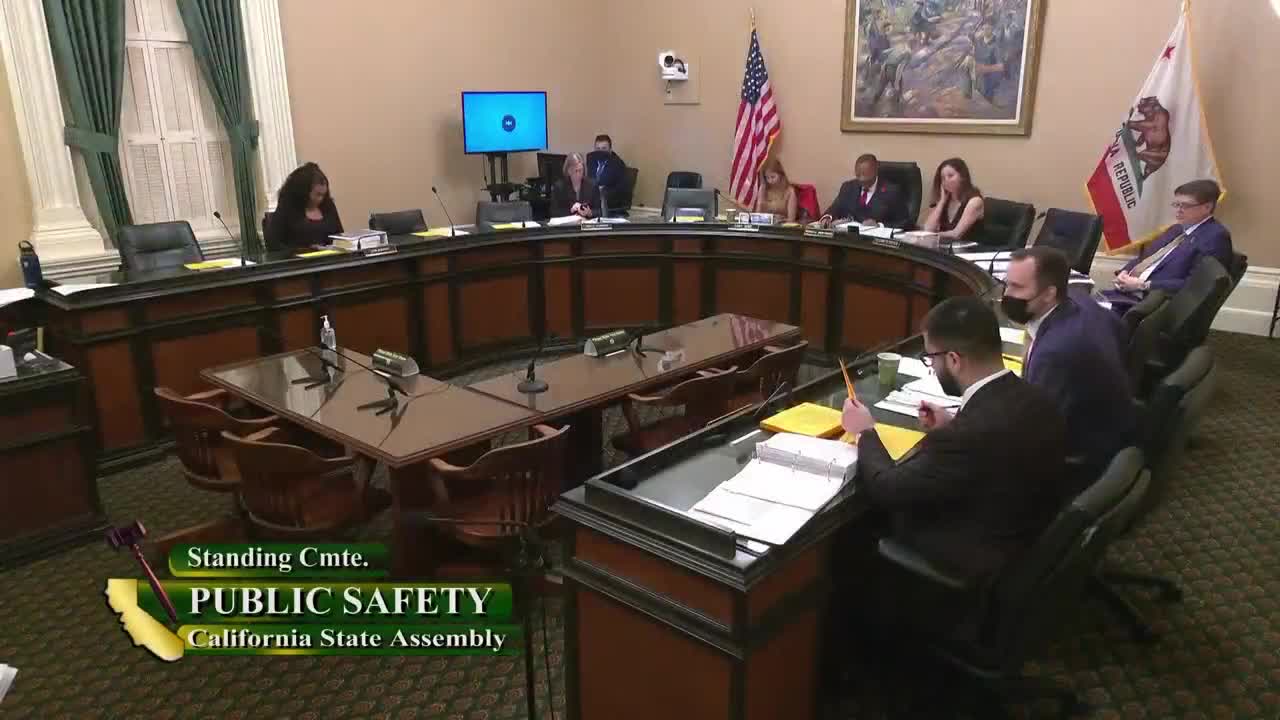
Assembly Standing Committee on Public Safety
Bill Author