SB 551: Beverage containers: recycling.
- Session Year: 2023-2024
- House: Senate
- Latest Version Date: 2024-09-29
Current Status:
Passed
(2024-09-29: Chaptered by Secretary of State. Chapter 983, Statutes of 2024.)
Introduced
In Committee
First Chamber
In Committee
Second Chamber
Enacted
What does this bill do?
The bill lets beverage manufacturers who share brands or whose products are distributed, marketed, or manufactured by the same company file one consolidated report instead of separate reports. That report must list how much postconsumer recycled plastic and virgin plastic is used in plastic beverage containers that carry the California Redemption Value (the state refund on certain beverage containers). The consolidated report must use department standard forms, be submitted under penalty of perjury, and the manufacturers named are jointly responsible for complying and for any penalties.
The summary is provided by generative AI which can make mistakes. For original language, please view the details in the table below.
The California Beverage Container Recycling and Litter Reduction Act requires plastic beverage containers sold by a beverage manufacturer, as specified, to contain a specified average percentage of postconsumer recycled plastic per year. The act requires the manufacturer of a beverage sold in a plastic beverage container subject to the California Redemption Value to report to the Department of Resources Recycling and Recovery certain information about the amounts of virgin plastic and postconsumer recycled plastic used for plastic beverage containers subject to the California Redemption Value for sale in the state in the previous calendar year. Existing law provides that a violation of the act or a regulation adopted pursuant to the act is a crime.
This bill would authorize certain beverage manufacturers to submit with other beverage manufacturers a consolidated report, in lieu of individual reports, that identifies the postconsumer recycled plastic content for beverage containers and the amounts of virgin plastic and postconsumer recycled plastic used in beverage containers, as specified. The bill would require the consolidated report to be submitted under penalty of perjury and pursuant to standardized forms prescribed by the department. The bill would authorize the department to adopt regulations to implement the bills provisions, as specified. Because these provisions would expand the scope of a crime and would create a new perjury crime, the bill would impose a state-mandated local program.
The California Constitution requires the state to reimburse local agencies and school districts for certain costs mandated by the state. Statutory provisions establish procedures for making that reimbursement.
This bill would provide that no reimbursement is required by this act for a specified reason.
This bill would declare that it is to take effect immediately as an urgency statute.
The California Beverage Container Recycling and Litter Reduction Act requires plastic beverage containers sold by a beverage manufacturer, as specified, to contain a specified average percentage of postconsumer recycled plastic per year. The act requires the manufacturer of a beverage sold in a plastic beverage container subject to the California Redemption Value to report to the Department of Resources Recycling and Recovery certain information about the amounts of virgin plastic and postconsumer recycled plastic used for plastic beverage containers subject to the California Redemption Value for sale in the state in the previous calendar year. Existing law provides that a violation of the act or a regulation adopted pursuant to the act is a crime.
This bill would authorize certain beverage manufacturers to submit with other beverage manufacturers a consolidated report report, in lieu of individual reports, that identifies the postconsumer recycled plastic content for beverage containers and the amounts of virgin plastic and postconsumer recycled plastic used in beverage containers, as specified. The bill would require the consolidated report to be submitted under penalty of perjury. perjury and pursuant to standardized forms prescribed by the department. The bill would authorize the department to adopt regulations to implement the bills provisions, as specified. Because these provisions would expand the scope of a crime and would create a new perjury crime, the bill would impose a state-mandated local program.
The California Constitution requires the state to reimburse local agencies and school districts for certain costs mandated by the state. Statutory provisions establish procedures for making that reimbursement.
This bill would provide that no reimbursement is required by this act for a specified reason.
This bill would declare that it is to take effect immediately as an urgency statute.
The California Beverage Container Recycling and Litter Reduction Act requires plastic beverage containers sold by a beverage manufacturer, as specified, to contain a specified average percentage of postconsumer recycled plastic per year. The act requires the manufacturer of a beverage sold in a plastic beverage container subject to the California Redemption Value to report to the Department of Resources Recycling and Recovery certain information about the amounts of virgin plastic and postconsumer recycled plastic used for plastic beverage containers subject to the California Redemption Value for sale in the state in the previous calendar year. Existing law provides that a violation of the act or a regulation adopted pursuant to the act is a crime.
This bill would authorize certain beverage manufacturers to comply with submit with other beverage manufacturers a consolidated report that identifies the postconsumer recycled plastic content requirements for beverage containers and the amounts of virgin plastic and postconsumer recycled plastic reporting requirements by submitting a consolidated report with aggregated information that covers one or more beverage manufacturers, used in beverage containers, as specified. The bill would require the consolidated report to be submitted under penalty of perjury. The bill would authorize the department to adopt regulations to implement the bills provisions, as specified. Because these provisions would expand the scope of a crime, crime and would create a new perjury crime, the bill would impose a state-mandated local program.
The California Constitution requires the state to reimburse local agencies and school districts for certain costs mandated by the state. Statutory provisions establish procedures for making that reimbursement.
This bill would provide that no reimbursement is required by this act for a specified reason.
This bill would declare that it is to take effect immediately as an urgency statute.
The California Beverage Container Recycling and Litter Reduction Act requires plastic beverage containers sold by a beverage manufacturer, as specified, to contain a specified average percentage of postconsumer recycled plastic per year. The act requires the manufacturer of a beverage sold in a plastic beverage container subject to the California Redemption Value to report to the Department of Resources Recycling and Recovery certain information about the amounts of virgin plastic and postconsumer recycled plastic used for plastic beverage containers subject to the California Redemption Value for sale in the state in the previous calendar year. Existing law provides that a violation of the act or a regulation adopted pursuant to the act is a crime.
This bill would authorize certain beverage manufacturers to comply with the postconsumer recycled plastic content requirements and the virgin plastic and postconsumer recycled plastic reporting requirements by submitting a consolidated report with aggregated information that covers one or more beverage manufacturers, as specified. The bill would authorize the department to adopt regulations to implement the bills provisions, as specified. Because these provisions would expand the scope of a crime, the bill would impose a state-mandated local program.
The California Constitution requires the state to reimburse local agencies and school districts for certain costs mandated by the state. Statutory provisions establish procedures for making that reimbursement.
This bill would provide that no reimbursement is required by this act for a specified reason.
This bill would declare that it is to take effect immediately as an urgency statute.
Existing law, the Bronzan-McCorquodale Act, contains provisions governing the operation and financing of community mental health services in every county through locally administered and locally controlled community mental health programs. Existing law requires each community mental health service to have a mental health board, as specified. Existing law encourages counties to appoint members of the community who represent specific groups, including county offices of education and hospitals. Existing law requires a member of the board to abstain from voting on any issue in which the member has a financial interest.This bill would require one member of a mental health boards membership to be employed by a local educational agency, and at least one member to be an individual who is 25 years of age or younger in counties with a mental health board membership of 5 to 8 members. The bill would require 2 members of the board to be employed by a local educational agency and at least 2 members to be 25 years of age or younger in counties with a mental health board membership of 9 to 15 members. The bill would require at least 2 members of the board to be employed by a local educational agency and at least two members to be 25 years of age or younger in counties with a mental health board membership of 16 or more members. The bill would require counties to give a strong preference to appointing members of the board who have experience providing mental health services to students. The bill would state that the intent of the Legislature is for youth appointments to a mental health board to address or prevent health and mental health disparities or inequities through representation of vulnerable, underserved, and marginalized communities. The bill would also authorize a person to represent more than one membership type on a mental health board. The bill would delete county offices of education from the list of representatives from which counties are encouraged to appoint board members. The bill would prohibit more than 49% of the members of a countys mental health board from owning or operating an organization or business that financially benefits from a proposed or adopted Mental Health Services Act plan. By placing a new requirement on counties, this bill would impose a state-mandated local program.The California Constitution requires the state to reimburse local agencies and school districts for certain costs mandated by the state. Statutory provisions establish procedures for making that reimbursement.This bill would provide that, if the Commission on State Mandates determines that the bill contains costs mandated by the state, reimbursement for those costs shall be made pursuant to the statutory provisions noted above.Existing law, the Bronzan-McCorquodale Act, contains provisions governing the operation and financing of community mental health services in every county through locally administered and locally controlled community mental health programs. Existing law requires each community mental health service to have a mental health board, as specified. Existing law encourages counties to appoint members of the community who represent specific groups, including county offices of education and hospitals. Existing law requires a member of the board to abstain from voting on any issue in which the member has a financial interest.
This bill would require at least 20% one member of a mental health boards membership to be employed by a local educational agency, and at least 20% one member to be an individual who is 25 years of age or younger in counties with a population of 500,000 or more. The bill would also require one member mental health board membership of 5 to 8 members. The bill would require 2 members of the board to be employed by a local educational agency and at least 2 members to be 25 years of age or younger in counties with a mental health board membership of 9 to 15 members. The bill would require at least 2 members of the board to be employed by a local educational agency and at least one member two members to be 25 years of age or younger in counties with a population fewer than 500,000, but more than 100,000. In counties with a population of fewer than 100,000, this bill would require those mental health board membership of 16 or more members. The bill would require counties to give a strong preference to appointing at least one member of the board who is employed by a local education agency or is 25 years of age or younger. The members of the board who have experience providing mental health services to students. The bill would state that the intent of the Legislature is for youth appointments to a mental health board to address or prevent health and mental health disparities or inequities through representation of vulnerable, underserved, and marginalized communities. The bill would also authorize a person to represent more than one membership type on a mental health board. The bill would delete county offices of education from the list of representatives from which counties are encouraged to appoint board members. The bill would prohibit more than 49% of the members of a countys mental health board from owning or operating an organization or business that financially benefits from a proposed or adopted Mental Health Services Act plan. By placing a new requirement on counties, this bill would impose a state-mandated local program.
The California Constitution requires the state to reimburse local agencies and school districts for certain costs mandated by the state. Statutory provisions establish procedures for making that reimbursement.
This bill would provide that, if the Commission on State Mandates determines that the bill contains costs mandated by the state, reimbursement for those costs shall be made pursuant to the statutory provisions noted above.
Existing law, the Bronzan-McCorquodale Act, contains provisions governing the operation and financing of community mental health services in every county through locally administered and locally controlled community mental health programs. Existing law requires each community mental health service to have a mental health board, as specified. Existing law requires a member of the board to abstain from voting on any issue in which the member has a financial interest.
This bill would require at least 20% of a mental health boards membership to be employed by a local educational agency, and at least 20% to be an individual who is 25 years of age or younger. younger in counties with a population of 500,000 or more. The bill would also require one member of the board to be employed by a local educational agency and at least one member to be 25 years of age or younger in counties with a population fewer than 500,000, but more than 100,000. In counties with a population of fewer than 100,000, this bill would require those counties to give a strong preference to appointing at least one member of the board who is employed by a local education agency or is 25 years of age or younger. The bill would prohibit more than 50% 49% of the members of a countys mental health board from owning or operating an organization or business that financially benefits from a proposed or adopted Mental Health Services Act plan. By placing a new requirement on counties, this bill would impose a state-mandated local program.
The California Constitution requires the state to reimburse local agencies and school districts for certain costs mandated by the state. Statutory provisions establish procedures for making that reimbursement.
This bill would provide that, if the Commission on State Mandates determines that the bill contains costs mandated by the state, reimbursement for those costs shall be made pursuant to the statutory provisions noted above.
Existing law, the Mental Health Services Act (MHSA), an initiative measure enacted by the voters as Proposition 63 in the November 2, 2004, statewide general election, establishes the continuously appropriated Mental Health Services Fund to fund various county mental health programs, including prevention and early intervention programs. The MHSA requires the counties to prepare and submit a 3-year program and expenditure plan, and annual updates, as specified. The act may be amended by the Legislature only by a 2/3 vote of both houses and only so long as the amendment is consistent with and furthers the intent of the act. The Legislature may clarify procedures and terms of the act by majority vote.
This bill would amend the MHSA by requiring each county to use at least 20% of the prevention and early intervention funds to provide direct services, as defined, on school campuses in collaboration with local educational agencies, as specified.
Existing law requires the Mental Health Services Oversight and Accountability Commission to adopt regulations for programs and expenditures for innovative programs and prevention and early intervention programs established by the act. Existing regulations require at least 51% of prevention and early intervention funds to be used to serve individuals who are 25 years of age or younger.
This bill would require the commission to adopt regulations that require each county to use at least 20% of its prevention and early intervention funds to provide direct services on school campuses in collaboration with local educational agencies.
Existing law requires the commission to establish priorities for the use of prevention and early intervention funds, including youth outreach and engagement strategies that target secondary school and transition-age youth, with a priority on partnership with college mental health programs. Under existing law, counties may include other priorities, as determined through a stakeholder process, either in place of, or in addition to, the established priorities.
The bill would also establish direct services on school campuses as a priority for prevention and early intervention funds.
Existing law, the Bronzan-McCorquodale Act, contains provisions governing the operation and financing of community mental health services in every county through locally administered and locally controlled community mental health programs. Existing law requires each community mental health service to have a mental health board, as specified. Existing law requires a member of the board to abstain from voting on any issue in which the member has a financial interest.
This bill would require at least 20% of a mental health boards membership to be employed by a local educational agency, and at least 20% to be an individual who is 25 years of age or younger. The bill would prohibit more than 50% of the members of a countys mental health board from owning or operating an organization or business that financially benefits from a proposed or adopted Mental Health Services Act plan.
(a)A beverage manufacturer may agree with one or more beverage manufacturers to submit a consolidated report, in lieu of individual reports, with aggregated information required by Section 14547 and subdivision (a) of Section 14549.3 that covers one or more beverage manufacturers if those beverage manufacturers share rights to the same brands or the products of which are distributed, marketed, or manufactured by a single reporting beverage manufacturer. A consolidated report shall be submitted to the department under penalty of perjury pursuant to standardized forms in the form and manner prescribed by the department. Beverage manufacturers included in the consolidated report shall be jointly and severally responsible for compliance with Section 14547 and subdivision (a) of Section 14549.3 and for penalties imposed in connection with the report, including, but not limited to, the annual administrative penalty specified in subdivision (b) of Section 14547.
(b)The department may adopt regulations as necessary to implement subdivision (a). Until January 1, 2025, the adoption and readoption of regulations to implement subdivision (a) shall be deemed to be an emergency and necessary for the immediate preservation of the public peace, health and safety, or general welfare for purposes of Sections 11346.1 and 11349.6 of the Government Code, and the department is hereby exempted from the requirement that it describe facts showing the need for immediate action and from review of the emergency regulations by the Office of Administrative Law.
SEC. 2.No reimbursement is required by this act pursuant to Section 6 of Article XIIIB of the California Constitution because the only costs that may be incurred by a local agency or school district will be incurred because this act creates a new crime or infraction, eliminates a crime or infraction, or changes the penalty for a crime or infraction, within the meaning of Section 17556 of the Government Code, or changes the definition of a crime within the meaning of Section 6 of Article XIIIB of the California Constitution.
SEC. 3.This act is an urgency statute necessary for the immediate preservation of the public peace, health, or safety within the meaning of Article IV of the California Constitution and shall go into immediate effect. The facts constituting the necessity are:
In order to justly and properly report compliance with existing law and provide accurate information to the Department of Resources Recycling and Recovery and to California consumers in order to protect the integrity of the program, it is necessary that this act take effect immediately.
(a)A beverage manufacturer may agree with one or more beverage manufacturers to submit a consolidated report to the department under penalty of perjury report, in lieu of individual reports, with aggregated information required by Section 14547 and subdivision (a) of Section 14549.3 that covers one or more beverage manufacturers if those beverage manufacturers share rights to the same brands or the products of which are distributed, marketed, or manufactured by a single reporting beverage manufacturer. A consolidated report shall be submitted to the department under penalty of perjury pursuant to standardized forms in the form and manner prescribed by the department. Beverage manufacturers included in the aggregated consolidated report shall be jointly and severally responsible for compliance with Section 14547 and subdivision (a) of Section 14549.3 and for penalties imposed in connection with the report, including, but not limited to, the annual administrative penalty specified in subdivision (b) of Section 14547.
(b)The department may adopt regulations as necessary to implement subdivision (a). Until January 1, 2025, the adoption and readoption of regulations to implement subdivision (a) shall be deemed to be an emergency and necessary for the immediate preservation of the public peace, health and safety, or general welfare for purposes of Sections 11346.1 and 11349.6 of the Government Code, and the department is hereby exempted from the requirement that it describe facts showing the need for immediate action and from review of the emergency regulations by the Office of Administrative Law.
SEC. 2.No reimbursement is required by this act pursuant to Section 6 of Article XIIIB of the California Constitution because the only costs that may be incurred by a local agency or school district will be incurred because this act creates a new crime or infraction, eliminates a crime or infraction, or changes the penalty for a crime or infraction, within the meaning of Section 17556 of the Government Code, or changes the definition of a crime within the meaning of Section 6 of Article XIIIB of the California Constitution.
SEC. 3.This act is an urgency statute necessary for the immediate preservation of the public peace, health, or safety within the meaning of Article IV of the California Constitution and shall go into immediate effect. The facts constituting the necessity are:
In order to justly and properly report compliance with existing law and provide accurate information to the Department of Resources Recycling and Recovery and to California consumers in order to protect the integrity of the program, it is necessary that this act take effect immediately.
(a)A beverage manufacturer may comply with the requirements of Section 14547 and subdivision (a) of Section 14549.3 by submitting agree with one or more beverage manufacturers to submit a consolidated report to the department under penalty of perjury with aggregated information required by Section 14547 and subdivision (a) of Section 14549.3 that covers one or more beverage manufacturers if those beverage manufacturers share rights to the same brands or the products of which are distributed, marketed, or manufactured by a single reporting beverage manufacturer. The beverage manufacturer that submits the consolidated report and all beverage manufacturers covered under the consolidated report shall be responsible for the reports content. Beverage manufacturers included in the aggregated report shall be jointly and severally responsible for compliance with Section 14547 and subdivision (a) of Section 14549.3 and for penalties imposed in connection with the report, including, but not limited to, the annual administrative penalty specified in subdivision (b) of Section 14547.
(b)The department may adopt regulations as necessary to implement subdivision (a). Until January 1, 2025, the adoption and readoption of regulations to implement subdivision (a) shall be deemed to be an emergency and necessary for the immediate preservation of the public peace, health and safety, or general welfare for purposes of Sections 11346.1 and 11349.6 of the Government Code, and the department is hereby exempted from the requirement that it describe facts showing the need for immediate action and from review of the emergency regulations by the Office of Administrative Law.
SEC. 2.No reimbursement is required by this act pursuant to Section 6 of Article XIIIB of the California Constitution because the only costs that may be incurred by a local agency or school district will be incurred because this act creates a new crime or infraction, eliminates a crime or infraction, or changes the penalty for a crime or infraction, within the meaning of Section 17556 of the Government Code, or changes the definition of a crime within the meaning of Section 6 of Article XIIIB of the California Constitution.
SEC. 3.This act is an urgency statute necessary for the immediate preservation of the public peace, health, or safety within the meaning of Article IV of the California Constitution and shall go into immediate effect. The facts constituting the necessity are:
In order to justly and properly report compliance with existing law and provide accurate information to the Department of Resources Recycling and Recovery and to California consumers in order to protect the integrity of the program, it is necessary that this act take effect immediately.
(a)A beverage manufacturer may comply with the requirements of Section 14547 and subdivision (a) of Section 14549.3 by submitting a consolidated report with aggregated information that covers one or more beverage manufacturers if those beverage manufacturers share rights to the same brands or the products of which are distributed, marketed, or manufactured by a single reporting beverage manufacturer. The beverage manufacturer that submits the consolidated report and all beverage manufacturers covered under the consolidated report shall be responsible for the reports content.
(b)The department may adopt regulations as necessary to implement subdivision (a). Until January 1, 2025, the adoption and readoption of regulations to implement subdivision (a) shall be deemed to be an emergency and necessary for the immediate preservation of the public peace, health and safety, or general welfare for purposes of Sections 11346.1 and 11349.6 of the Government Code, and the department is hereby exempted from the requirement that it describe facts showing the need for immediate action and from review of the emergency regulations by the Office of Administrative Law.
SEC. 2.No reimbursement is required by this act pursuant to Section 6 of Article XIIIB of the California Constitution because the only costs that may be incurred by a local agency or school district will be incurred because this act creates a new crime or infraction, eliminates a crime or infraction, or changes the penalty for a crime or infraction, within the meaning of Section 17556 of the Government Code, or changes the definition of a crime within the meaning of Section 6 of Article XIIIB of the California Constitution.
SEC. 3.This act is an urgency statute necessary for the immediate preservation of the public peace, health, or safety within the meaning of Article IV of the California Constitution and shall go into immediate effect. The facts constituting the necessity are:
In order to justly and properly report compliance with existing law and provide accurate information to the Department of Resources Recycling and Recovery and to California consumers in order to protect the integrity of the program, it is necessary that this act take effect immediately.
SECTION 1.Section 5604 of the Welfare and Institutions Code is amended to read:5604.(a)(1)Each community mental health service shall have a mental health board consisting of 10 to 15 members, depending on the preference of the county, appointed by the governing body, except that boards in counties with a population of fewer than 80,000 may have a minimum of five members. A county with more than five supervisors shall have at least the same number of members as the size of its board of supervisors. This section does not limit the ability of the governing body to increase the number of members above 15.(2)(A)The board shall serve in an advisory role to the governing body, and one member of the board shall be a member of the local governing body. Local mental health boards may recommend appointees to the county supervisors. The board membership should reflect the diversity of the client population in the county to the extent possible.(B)Fifty percent of the board membership shall be consumers, or the parents, spouses, siblings, or adult children of consumers, who are receiving or have received mental health services. At least 20 percent of the total membership shall be consumers, and at least 20 percent shall be families of consumers.(C)(i)In counties with a population of 100,000 or more, at least one member of the board shall be a veteran or veteran advocate. In counties with a population of fewer than 100,000, the county shall give a strong preference to appointing at least one member of the board who is a veteran or a veteran advocate.(ii)To comply with clause (i), a county shall notify its county veterans service officer about vacancies on the board, if a county has a veterans service officer.(D)(i)(I)In counties with a mental health board membership of five to eight members, one member of the board shall be employed by a local educational agency, and at least one member of the board shall be an individual who is 25 years of age or younger.(II)In counties with a mental health board membership of 9 to 15 members, 2 members of the board shall be employed by a local educational agency, and at least 2 members of the board shall be individuals who are 25 years of age or younger.(III)In counties with a mental health board of 16 or more members, at least 2 members of the board shall be employed by a local educational agency, and at least 2 members of the board shall be individuals who are 25 years of age or younger.(ii)(I)Counties shall give a strong preference when appointing a local educational agency member to individuals who have experience providing mental health services to students.(II)It is the intent of the Legislature that youth appointments to a mental health board should address or prevent health and mental health disparities or inequities through representation of vulnerable, underserved, and marginalized communities.(E)In addition to the requirements in subparagraphs (B), (C), and (D), counties are encouraged to appoint individuals who have experience with, and knowledge of, the mental health system. This would include members of the community that engage with individuals living with mental illness in the course of daily operations, such as representatives of large and small businesses, hospitals, hospital districts, physicians practicing in emergency departments, city police chiefs, county sheriffs, and community and nonprofit service providers.(F)An individual may represent more than one of the membership types specified in subparagraphs (B), (C), (D), and (E).(3)(A)In counties with a population that is fewer than 80,000, at least one member shall be a consumer and at least one member shall be a parent, spouse, sibling, or adult child of a consumer who is receiving, or has received, mental health services.(B)Notwithstanding subparagraph (A), a board in a county with a population that is fewer than 80,000 that elects to have the board exceed the five-member minimum permitted under paragraph (1) shall be required to comply with paragraph (2).(b)The mental health board shall review and evaluate the local public mental health system, pursuant to Section 5604.2, and advise the governing body on community mental health services delivered by the local mental health agency or local behavioral health agency, as applicable.(c)The term of each member of the board shall be for three years. The governing body shall equitably stagger the appointments so that approximately one-third of the appointments expire in each year.(d)If two or more local agencies jointly establish a community mental health service pursuant to Article 1 (commencing with Section 6500) of Chapter 5 of Division 7 of Title 1 of the Government Code, the mental health board for the community mental health service shall consist of an additional two members for each additional agency, one of whom shall be a consumer or a parent, spouse, sibling, or adult child of a consumer who has received mental health services.(e)(1)Except as provided in paragraph (2), a member of the board or the members spouse shall not be a full-time or part-time county employee of a county mental health service, an employee of the State Department of Health Care Services, or an employee of, or a paid member of the governing body of, a mental health contract agency.(2)A consumer of mental health services who has obtained employment with an employer described in paragraph (1) and who holds a position in which the consumer does not have any interest, influence, or authority over any financial or contractual matter concerning the employer may be appointed to the board. The member shall abstain from voting on any financial or contractual issue concerning the members employer that may come before the board.(f)(1)Members of the board shall abstain from voting on any issue in which the member has a financial interest as defined in Section 87103 of the Government Code.(2)No more than 49 percent of the members of a countys mental health board may own or operate an organization or business that financially benefits from a proposed or adopted Mental Health Services Act plan.(g)If it is not possible to secure membership as specified in this section from among persons who reside in the county, the governing body may substitute representatives of the public interest in mental health who are not full-time or part-time employees of the county mental health service, the State Department of Health Care Services, or on the staff of, or a paid member of the governing body of, a mental health contract agency.(h)The mental health board may be established as an advisory board or a commission, depending on the preference of the county.(i)For purposes of this section, veteran advocate means either a parent, spouse, or adult child of a veteran, or an individual who is part of a veterans organization, including the Veterans of Foreign Wars or the American Legion.SEC. 2.If the Commission on State Mandates determines that this act contains costs mandated by the state, reimbursement to local agencies and school districts for those costs shall be made pursuant to Part 7 (commencing with Section 17500) of Division 4 of Title 2 of the Government Code.(a)(1)Each community mental health service shall have a mental health board consisting of 10 to 15 members, depending on the preference of the county, appointed by the governing body, except that boards in counties with a population of fewer than 80,000 may have a minimum of five members. A county with more than five supervisors shall have at least the same number of members as the size of its board of supervisors. This section does not limit the ability of the governing body to increase the number of members above 15.
(2)(A)The board shall serve in an advisory role to the governing body, and one member of the board shall be a member of the local governing body. Local mental health boards may recommend appointees to the county supervisors. The board membership should reflect the diversity of the client population in the county to the extent possible.
(B)Fifty percent of the board membership shall be consumers, or the parents, spouses, siblings, or adult children of consumers, who are receiving or have received mental health services. At least 20 percent of the total membership shall be consumers, and at least 20 percent shall be families of consumers.
(C)(i)In counties with a population of 100,000 or more, at least one member of the board shall be a veteran or veteran advocate. In counties with a population of fewer than 100,000, the county shall give a strong preference to appointing at least one member of the board who is a veteran or a veteran advocate.
(ii)To comply with clause (i), a county shall notify its county veterans service officer about vacancies on the board, if a county has a veterans service officer.
(D)(i)(I)In counties with a population of 500,000 or more, at least 20 percent mental health board membership of five to eight members, one member of the board shall be employed by a local educational agency, and at least 20 percent one member of the board shall be an individual who is 25 years of age or younger. In counties with a population of fewer than 500,000, but more than 100,000, at least one member of the board shall be employed by a local educational agency, and at least one member shall be an individual who is 25 years of age or younger. In counties with a population of fewer than 100,000, the county shall give a strong preference to appointing at least one member of the board who is employed by a local educational agency, and at least one member who is an individual 25 years of age or younger.
(II)In counties with a mental health board membership of 9 to 15 members, 2 members of the board shall be employed by a local educational agency, and at least 2 members of the board shall be individuals who are 25 years of age or younger.
(III)In counties with a mental health board of 16 or more members, at least 2 members of the board shall be employed by a local educational agency, and at least 2 members of the board shall be individuals who are 25 years of age or younger.
(ii)(I)Counties shall give a strong preference when appointing a local educational agency member to individuals who have experience providing mental health services to students.
(II)It is the intent of the Legislature that youth appointments to a mental health board should address or prevent health and mental health disparities or inequities through representation of vulnerable, underserved, and marginalized communities.
(E)In addition to the requirements in subparagraphs (B), (C), and (D), counties are encouraged to appoint individuals who have experience with, and knowledge of, the mental health system. This would include members of the community that engage with individuals living with mental illness in the course of daily operations, such as representatives of county offices of education, large and small businesses, hospitals, hospital districts, physicians practicing in emergency departments, city police chiefs, county sheriffs, and community and nonprofit service providers.
(F)An individual may represent more than one of the membership types specified in subparagraphs (B), (C), (D), and (E).
(3)(A)In counties with a population that is fewer than 80,000, at least one member shall be a consumer and at least one member shall be a parent, spouse, sibling, or adult child of a consumer who is receiving, or has received, mental health services.
(B)Notwithstanding subparagraph (A), a board in a county with a population that is fewer than 80,000 that elects to have the board exceed the five-member minimum permitted under paragraph (1) shall be required to comply with paragraph (2).
(b)The mental health board shall review and evaluate the local public mental health system, pursuant to Section 5604.2, and advise the governing body on community mental health services delivered by the local mental health agency or local behavioral health agency, as applicable.
(c)The term of each member of the board shall be for three years. The governing body shall equitably stagger the appointments so that approximately one-third of the appointments expire in each year.
(d)If two or more local agencies jointly establish a community mental health service pursuant to Article 1 (commencing with Section 6500) of Chapter 5 of Division 7 of Title 1 of the Government Code, the mental health board for the community mental health service shall consist of an additional two members for each additional agency, one of whom shall be a consumer or a parent, spouse, sibling, or adult child of a consumer who has received mental health services.
(e)(1)Except as provided in paragraph (2), a member of the board or the members spouse shall not be a full-time or part-time county employee of a county mental health service, an employee of the State Department of Health Care Services, or an employee of, or a paid member of the governing body of, a mental health contract agency.
(2)A consumer of mental health services who has obtained employment with an employer described in paragraph (1) and who holds a position in which the consumer does not have any interest, influence, or authority over any financial or contractual matter concerning the employer may be appointed to the board. The member shall abstain from voting on any financial or contractual issue concerning the members employer that may come before the board.
(f)(1)Members of the board shall abstain from voting on any issue in which the member has a financial interest as defined in Section 87103 of the Government Code.
(2)No more than 49 percent of the members of a countys mental health board may own or operate an organization or business that financially benefits from a proposed or adopted Mental Health Services Act plan.
(g)If it is not possible to secure membership as specified in this section from among persons who reside in the county, the governing body may substitute representatives of the public interest in mental health who are not full-time or part-time employees of the county mental health service, the State Department of Health Care Services, or on the staff of, or a paid member of the governing body of, a mental health contract agency.
(h)The mental health board may be established as an advisory board or a commission, depending on the preference of the county.
(i)For purposes of this section, veteran advocate means either a parent, spouse, or adult child of a veteran, or an individual who is part of a veterans organization, including the Veterans of Foreign Wars or the American Legion.
SEC. 2.If the Commission on State Mandates determines that this act contains costs mandated by the state, reimbursement to local agencies and school districts for those costs shall be made pursuant to Part 7 (commencing with Section 17500) of Division 4 of Title 2 of the Government Code.
(a)(1)Each community mental health service shall have a mental health board consisting of 10 to 15 members, depending on the preference of the county, appointed by the governing body, except that boards in counties with a population of fewer than 80,000 may have a minimum of five members. A county with more than five supervisors shall have at least the same number of members as the size of its board of supervisors. This section does not limit the ability of the governing body to increase the number of members above 15.
(2)(A)The board shall serve in an advisory role to the governing body, and one member of the board shall be a member of the local governing body. Local mental health boards may recommend appointees to the county supervisors. The board membership should reflect the diversity of the client population in the county to the extent possible.
(B)Fifty percent of the board membership shall be consumers, or the parents, spouses, siblings, or adult children of consumers, who are receiving or have received mental health services. At least 20 percent of the total membership shall be consumers, and at least 20 percent shall be families of consumers.
(C)(i)In counties with a population of 100,000 or more, at least one member of the board shall be a veteran or veteran advocate. In counties with a population of fewer than 100,000, the county shall give a strong preference to appointing at least one member of the board who is a veteran or a veteran advocate.
(ii)To comply with clause (i), a county shall notify its county veterans service officer about vacancies on the board, if a county has a veterans service officer.
(D)At least 20 percent of the total membership shall be employed by a local educational agency, and at least 20 percent shall be an individual who is 25 years of age or younger. In counties with a population of 500,000 or more, at least 20 percent of the board shall be employed by a local educational agency, and at least 20 percent of the board shall be an individual who is 25 years of age or younger. In counties with a population of fewer than 500,000, but more than 100,000, at least one member of the board shall be employed by a local educational agency, and at least one member shall be an individual who is 25 years of age or younger. In counties with a population of fewer than 100,000, the county shall give a strong preference to appointing at least one member of the board who is employed by a local educational agency, and at least one member who is an individual 25 years of age or younger.
(E)In addition to the requirements in subparagraphs (B), (C), and (D), counties are encouraged to appoint individuals who have experience with, and knowledge of, the mental health system. This would include members of the community that engage with individuals living with mental illness in the course of daily operations, such as representatives of county offices of education, large and small businesses, hospitals, hospital districts, physicians practicing in emergency departments, city police chiefs, county sheriffs, and community and nonprofit service providers.
(3)(A)In counties with a population that is fewer than 80,000, at least one member shall be a consumer and at least one member shall be a parent, spouse, sibling, or adult child of a consumer who is receiving, or has received, mental health services.
(B)Notwithstanding subparagraph (A), a board in a county with a population that is fewer than 80,000 that elects to have the board exceed the five-member minimum permitted under paragraph (1) shall be required to comply with paragraph (2).
(b)The mental health board shall review and evaluate the local public mental health system, pursuant to Section 5604.2, and advise the governing body on community mental health services delivered by the local mental health agency or local behavioral health agency, as applicable.
(c)The term of each member of the board shall be for three years. The governing body shall equitably stagger the appointments so that approximately one-third of the appointments expire in each year.
(d)If two or more local agencies jointly establish a community mental health service pursuant to Article 1 (commencing with Section 6500) of Chapter 5 of Division 7 of Title 1 of the Government Code, the mental health board for the community mental health service shall consist of an additional two members for each additional agency, one of whom shall be a consumer or a parent, spouse, sibling, or adult child of a consumer who has received mental health services.
(e)(1)Except as provided in paragraph (2), a member of the board or the members spouse shall not be a full-time or part-time county employee of a county mental health service, an employee of the State Department of Health Care Services, or an employee of, or a paid member of the governing body of, a mental health contract agency.
(2)A consumer of mental health services who has obtained employment with an employer described in paragraph (1) and who holds a position in which the consumer does not have any interest, influence, or authority over any financial or contractual matter concerning the employer may be appointed to the board. The member shall abstain from voting on any financial or contractual issue concerning the members employer that may come before the board.
(f)(1)Members of the board shall abstain from voting on any issue in which the member has a financial interest as defined in Section 87103 of the Government Code.
(2)No more than 50 49 percent of the members of a countys mental health board may own or operate an organization or business that financially benefits from a proposed or adopted Mental Health Services Act plan.
(g)If it is not possible to secure membership as specified in this section from among persons who reside in the county, the governing body may substitute representatives of the public interest in mental health who are not full-time or part-time employees of the county mental health service, the State Department of Health Care Services, or on the staff of, or a paid member of the governing body of, a mental health contract agency.
(h)The mental health board may be established as an advisory board or a commission, depending on the preference of the county.
(i)For purposes of this section, veteran advocate means either a parent, spouse, or adult child of a veteran, or an individual who is part of a veterans organization, including the Veterans of Foreign Wars or the American Legion.
SEC. 3.Section 5840.6 of the Welfare and Institutions Code is amended to read:5840.6.For purposes of this chapter, the following definitions shall apply:(a)Commission means the Mental Health Services Oversight and Accountability Commission established pursuant to Section 5845.(b)County also includes a city receiving funds pursuant to Section 5701.5.(c)Prevention and early intervention funds means funds from the Mental Health Services Fund allocated for prevention and early intervention programs pursuant to paragraph (3) of subdivision (a) of Section 5892.(d)Childhood trauma prevention and early intervention refers to a program that targets children exposed to, or who are at risk of exposure to, adverse and traumatic childhood events and prolonged toxic stress in order to deal with the early origins of mental health needs and prevent long-term mental health concerns. This may include, but is not limited to, all of the following:(1)Focused outreach and early intervention to at-risk and in-need populations.(2)Implementation of appropriate trauma and developmental screening and assessment tools with linkages to early intervention services to children that qualify for these services.(3)Collaborative, strengths-based approaches that appreciate the resilience of trauma survivors and support their parents and caregivers when appropriate.(4)Support from peer support specialists and community health workers trained to provide mental health services.(5)Multigenerational family engagement, education, and support for navigation and service referrals across systems that aid the healthy development of children and families.(6)Linkages to primary care health settings, including, but not limited to, federally qualified health centers, rural health centers, community-based providers, school-based health centers, and school-based programs.(7)Leveraging the healing value of traditional cultural connections, including policies, protocols, and processes that are responsive to the racial, ethnic, and cultural needs of individuals served and recognition of historical trauma.(8)Coordinated and blended funding streams to ensure individuals and families experiencing toxic stress have comprehensive and integrated supports across systems.(e)Early psychosis and mood disorder detection and intervention has the same meaning as set forth in paragraph (2) of subdivision (b) of Section 5835 and may include programming across the age span.(f)Youth outreach and engagement means strategies that target secondary school and transition-age youth, with a priority on partnerships with college mental health programs that educate and engage students and provide either on-campus, off-campus, or linkages to mental health services not provided through the campus to students who are attending colleges and universities, including, but not limited to, public community colleges. Outreach and engagement may include, but is not limited to, all of the following:(1)Meeting the mental health needs of students that cannot be met through existing education funds.(2)Establishing direct linkages for students to community-based mental health services.(3)Addressing direct services, including, but not limited to, increasing college mental health staff-to-student ratios and decreasing wait times.(4)Participating in evidence-based and community-defined best practice programs for mental health services.(5)Serving underserved and vulnerable populations, including, but not limited to, lesbian, gay, bisexual, transgender, and queer persons, victims of domestic violence and sexual abuse, and veterans.(6)Establishing direct linkages for students to community-based mental health services for which reimbursement is available through the students health coverage.(7)Reducing racial disparities in access to mental health services.(8)Funding mental health stigma reduction training and activities.(9)Providing college employees and students with education and training in early identification, intervention, and referral of students with mental health needs.(10)Interventions for youth with signs of behavioral or emotional problems who are at risk of, or have had any, contact with the juvenile justice system.(11)Integrated youth mental health programming.(12)Suicide prevention programming.(g)Culturally competent and linguistically appropriate prevention and intervention refers to a program that creates critical linkages with community-based organizations, including, but not limited to, clinics licensed or operated under subdivision (a) of Section 1204 of the Health and Safety Code, or clinics exempt from clinic licensure pursuant to subdivision (c) of Section 1206 of the Health and Safety Code.(1)Culturally competent and linguistically appropriate means the ability to reach underserved cultural populations and address specific barriers related to racial, ethnic, cultural, language, gender, age, economic, or other disparities in mental health services access, quality, and outcomes.(2)Underserved cultural populations means those who are unlikely to seek help from any traditional mental health service because of stigma, lack of knowledge, or other barriers, including members of ethnically and racially diverse communities, members of the gay, lesbian, bisexual, and transgender communities, and veterans, across their lifespans.(h)Strategies targeting the mental health needs of older adults means, but is not limited to, all of the following:(1)Outreach and engagement strategies that target caregivers, victims of elder abuse, and individuals who live alone.(2)Suicide prevention programming.(3)Outreach to older adults who are isolated.(4)Early identification programming of mental health symptoms and disorders, including, but not limited to, anxiety, depression, and psychosis.(i)Direct services means individual or group behavioral health services provided at a location operated by a local educational agency for individuals who are 25 years of age or younger. Direct services include, but are not limited to, all of the following:(1)School-based health centers.(2)Student wellness or well-being centers.(3)Contracts with local educational agencies to provide behavioral health services.(4)Individualized behavioral health or substance abuse counseling.(5)Group behavioral health and substance abuse counseling and activities.(6)Integrated social-emotional learning and systems of support.(7)Behavior-related services, including activities to increase mindfulness, self-regulation, development of protective factors, calming strategies, and communication skills.(j)Local educational agency means a school district or county office of education.SEC. 4.Section 5840.7 of the Welfare and Institutions Code is amended to read:5840.7.(a)On or before January 1, 2020, the commission shall establish priorities for the use of prevention and early intervention funds. These priorities shall include, but are not limited to, the following:(1)Childhood trauma prevention and early intervention to deal with the early origins of mental health needs.(2)Early psychosis and mood disorder detection and intervention, and mood disorder and suicide prevention programming that occurs across the lifespan.(3)Youth outreach and engagement strategies that target secondary school and transition-age youth, with a priority on partnership with college mental health programs.(4)Culturally competent and linguistically appropriate prevention and intervention.(5)Strategies targeting the mental health needs of older adults.(6)Direct services on school campuses.(7)Other programs the commission identifies, with stakeholder participation, that are proven effective in achieving, and are reflective of, the goals stated in Section 5840.(b)On or before January 1, 2020, the commission shall develop a statewide strategy for monitoring implementation of this part, including enhancing public understanding of prevention and early intervention and creating metrics for assessing the effectiveness of how prevention and early intervention funds are used and the outcomes that are achieved. The commission shall analyze and monitor the established metrics using existing data, if available, and shall propose new data collection and reporting strategies, if necessary.(c)The commission shall establish a strategy for technical assistance, support, and evaluation to support the successful implementation of the objectives, metrics, data collection, and reporting strategy.(d)(1)The portion of funds in the county plan relating to prevention and early intervention shall focus on the established priorities, and shall be allocated, as determined by the county, with stakeholder input. A county may include other priorities, as determined through the stakeholder process, either in place of, or in addition to, the established priorities. If the county chooses to include other programs, the plan shall include a description of why those programs are included and metrics by which the effectiveness of those programs is to be measured.(2)Counties may act jointly to meet the requirements of this section.(e)(1)On or before January 1, 2025, the commission shall modify regulations to establish a general requirement that at least 20 percent of the prevention and early intervention funds in each county be used to provide direct services on school campuses in collaboration with local educational agencies in alignment with the priorities established by the commission and the goals stated in Section 5840.(2)For purposes of this subdivision, collaboration means a county proactively working with representatives from a local educational agency to determine how to best provide direct services on school campuses, including, but not limited to, consulting, coordinating contracts, and awarding direct grants.(f)If the commission requires additional resources for these purposes, it may prepare a proposal for consideration by the appropriate policy committees of the Legislature.SEC. 5.Section 5892 of the Welfare and Institutions Code is amended to read:5892.(a)In order to promote efficient implementation of this act, the county shall use funds distributed from the Mental Health Services Fund as follows:(1)In the 200506, 200607, and 200708 fiscal years, 10 percent shall be placed in a trust fund to be expended for education and training programs pursuant to Part 3.1 (commencing with Section 5820).(2)In the 200506, 200607, and 200708 fiscal years, 10 percent for capital facilities and technological needs shall be distributed to counties in accordance with a formula developed in consultation with the County Behavioral Health Directors Association of California to implement plans developed pursuant to Section 5847.(3)(A)Twenty percent of funds distributed to the counties pursuant to subdivision (c) of Section 5891 shall be used for prevention and early intervention programs in accordance with Part 3.6 (commencing with Section 5840).(B)At least 20 percent of the prevention and early intervention funds in each county shall be used to provide direct services on school campuses in collaboration with local educational agencies in alignment with the priorities established by the commission and the goals stated in Section 5840.(4)The expenditure for prevention and early intervention may be increased in any county in which the department determines that the increase will decrease the need and cost for additional services to persons with severe mental illness in that county by an amount at least commensurate with the proposed increase.(5)The balance of funds shall be distributed to county mental health programs for services to persons with severe mental illnesses pursuant to Part 4 (commencing with Section 5850) for the childrens system of care and Part 3 (commencing with Section 5800) for the adult and older adult system of care. These services may include housing assistance, as defined in Section 5892.5, to the target population specified in Section 5600.3.(6)Five percent of the total funding for each county mental health program for Part 3 (commencing with Section 5800), Part 3.6 (commencing with Section 5840), and Part 4 (commencing with Section 5850), shall be utilized for innovative programs in accordance with Sections 5830, 5847, and 5848.(b)(1)In any fiscal year after the 200708 fiscal year, programs for services pursuant to Part 3 (commencing with Section 5800) and Part 4 (commencing with Section 5850) may include funds for technological needs and capital facilities, human resource needs, and a prudent reserve to ensure services do not have to be significantly reduced in years in which revenues are below the average of previous years. The total allocation for purposes authorized by this subdivision shall not exceed 20 percent of the average amount of funds allocated to that county for the previous five fiscal years pursuant to this section.(2)A county shall calculate an amount it establishes as the prudent reserve for its Local Mental Health Services Fund, not to exceed 33 percent of the average community services and support revenue received for the fund in the preceding five years. The county shall reassess the maximum amount of this reserve every five years and certify the reassessment as part of the three-year program and expenditure plan required pursuant to Section 5847.(3)Notwithstanding Chapter 3.5 (commencing with Section 11340) of Part 1 of Division 3 of Title 2 of the Government Code, the State Department of Health Care Services may allow counties to determine the percentage of funds to allocate across programs created pursuant to Part 4 (commencing with Section 5850) for the childrens system of care and Part 3 (commencing with Section 5800) for the adult and older adult system of care for the 202021 and 202122 fiscal years by means of all-county letters or other similar instructions without taking further regulatory action.(c)The allocations pursuant to subdivisions (a) and (b) shall include funding for annual planning costs pursuant to Section 5848. The total of these costs shall not exceed 5 percent of the total of annual revenues received for the fund. The planning costs shall include funds for county mental health programs to pay for the costs of consumers, family members, and other stakeholders to participate in the planning process and for the planning and implementation required for private provider contracts to be significantly expanded to provide additional services pursuant to Part 3 (commencing with Section 5800) and Part 4 (commencing with Section 5850).(d)Prior to making the allocations pursuant to subdivisions (a), (b), and (c), funds shall be reserved for the costs for the State Department of Health Care Services, the California Behavioral Health Planning Council, the Office of Statewide Health Planning and Development, the Mental Health Services Oversight and Accountability Commission, the State Department of Public Health, and any other state agency to implement all duties pursuant to the programs set forth in this section. These costs shall not exceed 5 percent of the total of annual revenues received for the fund. The administrative costs shall include funds to assist consumers and family members to ensure the appropriate state and county agencies give full consideration to concerns about quality, structure of service delivery, or access to services. The amounts allocated for administration shall include amounts sufficient to ensure adequate research and evaluation regarding the effectiveness of services being provided and achievement of the outcome measures set forth in Part 3 (commencing with Section 5800), Part 3.6 (commencing with Section 5840), and Part 4 (commencing with Section 5850). The amount of funds available for the purposes of this subdivision in a fiscal year is subject to appropriation in the annual Budget Act.(e)In the 200405 fiscal year, funds shall be allocated as follows:(1)Forty-five percent for education and training pursuant to Part 3.1 (commencing with Section 5820).(2)Forty-five percent for capital facilities and technology needs in the manner specified by paragraph (2) of subdivision (a).(3)Five percent for local planning in the manner specified in subdivision (c).(4)Five percent for state implementation in the manner specified in subdivision (d).(f)Each county shall place all funds received from the State Mental Health Services Fund in a local Mental Health Services Fund. The Local Mental Health Services Fund balance shall be invested consistent with other county funds and the interest earned on the investments shall be transferred into the fund. The earnings on investment of these funds shall be available for distribution from the fund in future fiscal years.(g)All expenditures for county mental health programs shall be consistent with a currently approved plan or update pursuant to Section 5847.(h)(1)Other than funds placed in a reserve in accordance with an approved plan, funds allocated to a county that have not been spent for their authorized purpose within three years, and the interest accruing on those funds, shall revert to the state to be deposited into the Reversion Account, hereby established in the fund, and available for other counties in future years, provided, however, that funds, including interest accrued on those funds, for capital facilities, technological needs, or education and training may be retained for up to 10 years before reverting to the Reversion Account.(2)(A)If a county receives approval from the Mental Health Services Oversight and Accountability Commission of a plan for innovative programs, pursuant to subdivision (e) of Section 5830, the countys funds identified in that plan for innovative programs shall not revert to the state pursuant to paragraph (1) so long as they are encumbered under the terms of the approved project plan, including subsequent amendments approved by the commission, or until three years after the date of approval, whichever is later.(B)Subparagraph (A) applies to all plans for innovative programs that have received commission approval and are in process at the time of enactment of the act that added this subparagraph, and to all plans that receive commission approval thereafter.(3)Notwithstanding paragraph (1), funds allocated to a county with a population of less than 200,000 that have not been spent for their authorized purpose within five years shall revert to the state as described in paragraph (1).(4)(A)Notwithstanding paragraphs (1) and (2), if a county with a population of less than 200,000 receives approval from the Mental Health Services Oversight and Accountability Commission of a plan for innovative programs, pursuant to subdivision (e) of Section 5830, the countys funds identified in that plan for innovative programs shall not revert to the state pursuant to paragraph (1) so long as they are encumbered under the terms of the approved project plan, including subsequent amendments approved by the commission, or until five years after the date of approval, whichever is later.(B)Subparagraph (A) applies to all plans for innovative programs that have received commission approval and are in process at the time of enactment of the act that added this subparagraph, and to all plans that receive commission approval thereafter.(i)Notwithstanding subdivision (h) and Section 5892.1, unspent funds allocated to a county, and interest accruing on those funds, that are subject to reversion as of July 1, 2019, and July 1, 2020, shall be subject to reversion on July 1, 2021.(j)If there are revenues available in the fund after the Mental Health Services Oversight and Accountability Commission has determined there are prudent reserves and no unmet needs for any of the programs funded pursuant to this section, including all purposes of the Prevention and Early Intervention Program, the commission shall develop a plan for expenditures of these revenues to further the purposes of this act and the Legislature may appropriate these funds for any purpose consistent with the commissions adopted plan that furthers the purposes of this act.SEC. 2.If the Commission on State Mandates determines that this act contains costs mandated by the state, reimbursement to local agencies and school districts for those costs shall be made pursuant to Part 7 (commencing with Section 17500) of Division 4 of Title 2 of the Government Code.
The Legislature finds and declares all of the following:
(a)School-based behavioral health programs are one of the most effective methods of providing provide prevention and intervention services.
(b)Children are 21 times more likely to receive health and mental health services if they are provided on a school campus. An integrated, school-based approach to mental health improves timely access to services and can prevent mental illness in children from becoming severe and disabling.
(c)School-based partnerships are an effective strategy for addressing all eight of the Mental Health Services Act childhood trauma prevention and early intervention categories listed in Section 5840.6 of the Welfare and Institutions Code.
(d)School-based programs can significantly reduce behavioral health stigma by creating a culture of wellness and well-being among students, parents, and teachers.
(e)There are more than 10,000 schools and over 5,800,000 students in California, yet there are only 100 school-based behavioral health partnerships in the state.
(f)Counties are required to spend 51 percent of prevention and intervention funds on individuals who are 25 years of age or younger. Most counties struggle to meet this requirement.
(g)County prevention and intervention providers report difficulty connecting with and increasing participation of children and youth.
(h)By providing behavioral health services at schools, counties would increase participation of children and youth in prevention and intervention programs, cultivate a positive culture of wellness, reduce stigma in the community, and reduce barriers to accessing behavioral health services.
SEC. 2.Section 5604 of the Welfare and Institutions Code is amended to read:5604.(a)(1)Each community mental health service shall have a mental health board consisting of 10 to 15 members, depending on the preference of the county, appointed by the governing body, except that boards in counties with a population of fewer than 80,000 may have a minimum of five members. A county with more than five supervisors shall have at least the same number of members as the size of its board of supervisors. This section does not limit the ability of the governing body to increase the number of members above 15.
(2)(A)The board shall serve in an advisory role to the governing body, and one member of the board shall be a member of the local governing body. Local mental health boards may recommend appointees to the county supervisors. The board membership should reflect the diversity of the client population in the county to the extent possible.
(B)Fifty percent of the board membership shall be consumers, or the parents, spouses, siblings, or adult children of consumers, who are receiving or have received mental health services. At least 20 percent of the total membership shall be consumers, and at least 20 percent shall be families of consumers.
(C)(i)In counties with a population of 100,000 or more, at least one member of the board shall be a veteran or veteran advocate. In counties with a population of fewer than 100,000, the county shall give a strong preference to appointing at least one member of the board who is a veteran or a veteran advocate.
(ii)To comply with clause (i), a county shall notify its county veterans service officer about vacancies on the board, if a county has a veterans service officer.
(D)At least 20 percent of the total membership shall be employed by a local educational agency, and at least 20 percent shall be an individual who is 25 years of age or younger.
(D)(E)In addition to the requirements in subparagraphs (B) and (C), (B), (C), and (D), counties are encouraged to appoint individuals who have experience with, and knowledge of, the mental health system. This would include members of the community that engage with individuals living with mental illness in the course of daily operations, such as representatives of county offices of education, large and small businesses, hospitals, hospital districts, physicians practicing in emergency departments, city police chiefs, county sheriffs, and community and nonprofit service providers.
(3)(A)In counties with a population that is fewer than 80,000, at least one member shall be a consumer and at least one member shall be a parent, spouse, sibling, or adult child of a consumer who is receiving, or has received, mental health services.
(B)Notwithstanding subparagraph (A), a board in a county with a population that is fewer than 80,000 that elects to have the board exceed the five-member minimum permitted under paragraph (1) shall be required to comply with paragraph (2).
(b)The mental health board shall review and evaluate the local public mental health system, pursuant to Section 5604.2, and advise the governing body on community mental health services delivered by the local mental health agency or local behavioral health agency, as applicable.
(c)The term of each member of the board shall be for three years. The governing body shall equitably stagger the appointments so that approximately one-third of the appointments expire in each year.
(d)If two or more local agencies jointly establish a community mental health service pursuant to Article 1 (commencing with Section 6500) of Chapter 5 of Division 7 of Title 1 of the Government Code, the mental health board for the community mental health service shall consist of an additional two members for each additional agency, one of whom shall be a consumer or a parent, spouse, sibling, or adult child of a consumer who has received mental health services.
(e)(1)Except as provided in paragraph (2), a member of the board or the members spouse shall not be a full-time or part-time county employee of a county mental health service, an employee of the State Department of Health Care Services, or an employee of, or a paid member of the governing body of, a mental health contract agency.
(2)A consumer of mental health services who has obtained employment with an employer described in paragraph (1) and who holds a position in which the consumer does not have any interest, influence, or authority over any financial or contractual matter concerning the employer may be appointed to the board. The member shall abstain from voting on any financial or contractual issue concerning the members employer that may come before the board.
(f)(1)Members of the board shall abstain from voting on any issue in which the member has a financial interest as defined in Section 87103 of the Government Code.
(2)No more than 50 percent of the members of a countys mental health board may own or operate an organization or business that financially benefits from a proposed or adopted Mental Health Services Act plan.
(g)If it is not possible to secure membership as specified in this section from among persons who reside in the county, the governing body may substitute representatives of the public interest in mental health who are not full-time or part-time employees of the county mental health service, the State Department of Health Care Services, or on the staff of, or a paid member of the governing body of, a mental health contract agency.
(h)The mental health board may be established as an advisory board or a commission, depending on the preference of the county.
(i)For purposes of this section, veteran advocate means either a parent, spouse, or adult child of a veteran, or an individual who is part of a veterans organization, including the Veterans of Foreign Wars or the American Legion.
SEC. 3.Section 5840.6 of the Welfare and Institutions Code is amended to read:5840.6.For purposes of this chapter, the following definitions shall apply:
(a)Commission means the Mental Health Services Oversight and Accountability Commission established pursuant to Section 5845.
(b)County also includes a city receiving funds pursuant to Section 5701.5.
(c)Prevention and early intervention funds means funds from the Mental Health Services Fund allocated for prevention and early intervention programs pursuant to paragraph (3) of subdivision (a) of Section 5892.
(d)Childhood trauma prevention and early intervention refers to a program that targets children exposed to, or who are at risk of exposure to, adverse and traumatic childhood events and prolonged toxic stress in order to deal with the early origins of mental health needs and prevent long-term mental health concerns. This may include, but is not limited to, all of the following:
(1)Focused outreach and early intervention to at-risk and in-need populations.
(2)Implementation of appropriate trauma and developmental screening and assessment tools with linkages to early intervention services to children that qualify for these services.
(3)Collaborative, strengths-based approaches that appreciate the resilience of trauma survivors and support their parents and caregivers when appropriate.
(4)Support from peer support specialists and community health workers trained to provide mental health services.
(5)Multigenerational family engagement, education, and support for navigation and service referrals across systems that aid the healthy development of children and families.
(6)Linkages to primary care health settings, including, but not limited to, federally qualified health centers, rural health centers, community-based providers, school-based health centers, and school-based programs.
(7)Leveraging the healing value of traditional cultural connections, including policies, protocols, and processes that are responsive to the racial, ethnic, and cultural needs of individuals served and recognition of historical trauma.
(8)Coordinated and blended funding streams to ensure individuals and families experiencing toxic stress have comprehensive and integrated supports across systems.
(e)Early psychosis and mood disorder detection and intervention has the same meaning as set forth in paragraph (2) of subdivision (b) of Section 5835 and may include programming across the age span.
(f)Youth outreach and engagement means strategies that target secondary school and transition age transition-age youth, with a priority on partnerships with college mental health programs that educate and engage students and provide either on-campus, off-campus, or linkages to mental health services not provided through the campus to students who are attending colleges and universities, including, but not limited to, public community colleges. Outreach and engagement may include, but is not limited to, all of the following:
(1)Meeting the mental health needs of students that cannot be met through existing education funds.
(2)Establishing direct linkages for students to community-based mental health services.
(3)Addressing direct services, including, but not limited to, increasing college mental health staff-to-student ratios and decreasing wait times.
(4)Participating in evidence-based and community-defined best practice programs for mental health services.
(5)Serving underserved and vulnerable populations, including, but not limited to, lesbian, gay, bisexual, transgender, and queer persons, victims of domestic violence and sexual abuse, and veterans.
(6)Establishing direct linkages for students to community-based mental health services for which reimbursement is available through the students health coverage.
(7)Reducing racial disparities in access to mental health services.
(8)Funding mental health stigma reduction training and activities.
(9)Providing college employees and students with education and training in early identification, intervention, and referral of students with mental health needs.
(10)Interventions for youth with signs of behavioral or emotional problems who are at risk of, or have had any, contact with the juvenile justice system.
(11)Integrated youth mental health programming.
(12)Suicide prevention programming.
(g)Culturally competent and linguistically appropriate prevention and intervention refers to a program that creates critical linkages with community-based organizations, including, but not limited to, clinics licensed or operated under subdivision (a) of Section 1204 of the Health and Safety Code, or clinics exempt from clinic licensure pursuant to subdivision (c) of Section 1206 of the Health and Safety Code.
(1)Culturally competent and linguistically appropriate means the ability to reach underserved cultural populations and address specific barriers related to racial, ethnic, cultural, language, gender, age, economic, or other disparities in mental health services access, quality, and outcomes.
(2)Underserved cultural populations means those who are unlikely to seek help from any traditional mental health service because of stigma, lack of knowledge, or other barriers, including members of ethnically and racially diverse communities, members of the gay, lesbian, bisexual, and transgender communities, and veterans, across their lifespans.
(h)Strategies targeting the mental health needs of older adults means, but is not limited to, all of the following:
(1)Outreach and engagement strategies that target caregivers, victims of elder abuse, and individuals who live alone.
(2)Suicide prevention programming.
(3)Outreach to older adults who are isolated.
(4)Early identification programming of mental health symptoms and disorders, including, but not limited to, anxiety, depression, and psychosis.
(i)Direct services means individual or group behavioral health services provided at a location operated by a local educational agency for individuals who are 25 years of age or younger. Direct services include, but are not limited to, all of the following:
(1)School-based health centers.
(2)Student wellness or well-being centers.
(3)Contracts with local educational agencies to provide behavioral health services.
(4)Individualized behavioral health or substance abuse counseling.
(5)Group behavioral health and substance abuse counseling and activities.
(6)Integrated social-emotional learning and systems of support.
(7)Behavior-related services, including activities to increase mindfulness, self-regulation, development of protective factors, calming strategies, and communication skills.
(j)Local educational agency means a school district or county office of education.
SEC. 4.Section 5840.7 of the Welfare and Institutions Code is amended to read:5840.7.(a)On or before January 1, 2020, the commission shall establish priorities for the use of prevention and early intervention funds. These priorities shall include, but are not limited to, the following:
(1)Childhood trauma prevention and early intervention to deal with the early origins of mental health needs.
(2)Early psychosis and mood disorder detection and intervention, and mood disorder and suicide prevention programming that occurs across the lifespan.
(3)Youth outreach and engagement strategies that target secondary school and transition age transition-age youth, with a priority on partnership with college mental health programs.
(4)Culturally competent and linguistically appropriate prevention and intervention.
(5)Strategies targeting the mental health needs of older adults.
(6)Direct services on school campuses.
(6)(7)Other programs the commission identifies, with stakeholder participation, that are proven effective in achieving, and are reflective of, the goals stated in Section 5840.
(b)On or before January 1, 2020, the commission shall develop a statewide strategy for monitoring implementation of this part, including enhancing public understanding of prevention and early intervention and creating metrics for assessing the effectiveness of how prevention and early intervention funds are used and the outcomes that are achieved. The commission shall analyze and monitor the established metrics using existing data, if available, and shall propose new data collection and reporting strategies, if necessary.
(c)The commission shall establish a strategy for technical assistance, support, and evaluation to support the successful implementation of the objectives, metrics, data collection, and reporting strategy.
(d)(1)The portion of funds in the county plan relating to prevention and early intervention shall focus on the established priorities, and shall be allocated, as determined by the county, with stakeholder input. A county may include other priorities, as determined through the stakeholder process, either in place of, or in addition to, the established priorities. If the county chooses to include other programs, the plan shall include a description of why those programs are included and metrics by which the effectiveness of those programs is to be measured.
(2)Counties may act jointly to meet the requirements of this section.
(e)(1)On or before January 1, 2025, the commission shall modify regulations to establish a general requirement that at least 20 percent of the prevention and early intervention funds in each county be used to provide direct services on school campuses in collaboration with local educational agencies in alignment with the priorities established by the commission and the goals stated in Section 5840.
(2)For purposes of this subdivision, collaboration means a county proactively working with representatives from a local educational agency to determine how to best provide direct services on school campuses, including, but not limited to, consulting, coordinating contracts, and awarding direct grants.
(e)(f)If the commission requires additional resources for these purposes, it may prepare a proposal for consideration by the appropriate policy committees of the Legislature.
SEC. 5.Section 5892 of the Welfare and Institutions Code is amended to read:5892.(a)In order to promote efficient implementation of this act, the county shall use funds distributed from the Mental Health Services Fund as follows:
(1)In the 200506, 200607, and 200708 fiscal years, 10 percent shall be placed in a trust fund to be expended for education and training programs pursuant to Part 3.1 (commencing with Section 5820).
(2)In the 200506, 200607, and 200708 fiscal years, 10 percent for capital facilities and technological needs shall be distributed to counties in accordance with a formula developed in consultation with the County Behavioral Health Directors Association of California to implement plans developed pursuant to Section 5847.
(3)(A)Twenty percent of funds distributed to the counties pursuant to subdivision (c) of Section 5891 shall be used for prevention and early intervention programs in accordance with Part 3.6 (commencing with Section 5840).
(B)At least 20 percent of the prevention and early intervention funds in each county shall be used to provide direct services on school campuses in collaboration with local educational agencies in alignment with the priorities established by the commission and the goals stated in Section 5840.
(4)The expenditure for prevention and early intervention may be increased in any county in which the department determines that the increase will decrease the need and cost for additional services to persons with severe mental illness in that county by an amount at least commensurate with the proposed increase.
(5)The balance of funds shall be distributed to county mental health programs for services to persons with severe mental illnesses pursuant to Part 4 (commencing with Section 5850) for the childrens system of care and Part 3 (commencing with Section 5800) for the adult and older adult system of care. These services may include housing assistance, as defined in Section 5892.5, to the target population specified in Section 5600.3.
(6)Five percent of the total funding for each county mental health program for Part 3 (commencing with Section 5800), Part 3.6 (commencing with Section 5840), and Part 4 (commencing with Section 5850), shall be utilized for innovative programs in accordance with Sections 5830, 5847, and 5848.
(b)(1)In any fiscal year after the 200708 fiscal year, programs for services pursuant to Part 3 (commencing with Section 5800) and Part 4 (commencing with Section 5850) may include funds for technological needs and capital facilities, human resource needs, and a prudent reserve to ensure services do not have to be significantly reduced in years in which revenues are below the average of previous years. The total allocation for purposes authorized by this subdivision shall not exceed 20 percent of the average amount of funds allocated to that county for the previous five fiscal years pursuant to this section.
(2)A county shall calculate an amount it establishes as the prudent reserve for its Local Mental Health Services Fund, not to exceed 33 percent of the average community services and support revenue received for the fund in the preceding five years. The county shall reassess the maximum amount of this reserve every five years and certify the reassessment as part of the three-year program and expenditure plan required pursuant to Section 5847.
(3)Notwithstanding Chapter 3.5 (commencing with Section 11340) of Part 1 of Division 3 of Title 2 of the Government Code, the State Department of Health Care Services may allow counties to determine the percentage of funds to allocate across programs created pursuant to Part 4 (commencing with Section 5850) for the childrens system of care and Part 3 (commencing with Section 5800) for the adult and older adult system of care for the 202021 and 202122 fiscal years by means of all-county letters or other similar instructions without taking further regulatory action.
(c)The allocations pursuant to subdivisions (a) and (b) shall include funding for annual planning costs pursuant to Section 5848. The total of these costs shall not exceed 5 percent of the total of annual revenues received for the fund. The planning costs shall include funds for county mental health programs to pay for the costs of consumers, family members, and other stakeholders to participate in the planning process and for the planning and implementation required for private provider contracts to be significantly expanded to provide additional services pursuant to Part 3 (commencing with Section 5800) and Part 4 (commencing with Section 5850).
(d)Prior to making the allocations pursuant to subdivisions (a), (b), and (c), funds shall be reserved for the costs for the State Department of Health Care Services, the California Behavioral Health Planning Council, the Office of Statewide Health Planning and Development, the Mental Health Services Oversight and Accountability Commission, the State Department of Public Health, and any other state agency to implement all duties pursuant to the programs set forth in this section. These costs shall not exceed 5 percent of the total of annual revenues received for the fund. The administrative costs shall include funds to assist consumers and family members to ensure the appropriate state and county agencies give full consideration to concerns about quality, structure of service delivery, or access to services. The amounts allocated for administration shall include amounts sufficient to ensure adequate research and evaluation regarding the effectiveness of services being provided and achievement of the outcome measures set forth in Part 3 (commencing with Section 5800), Part 3.6 (commencing with Section 5840), and Part 4 (commencing with Section 5850). The amount of funds available for the purposes of this subdivision in any a fiscal year is subject to appropriation in the annual Budget Act.
(e)In the 200405 fiscal year, funds shall be allocated as follows:
(1)Forty-five percent for education and training pursuant to Part 3.1 (commencing with Section 5820).
(2)Forty-five percent for capital facilities and technology needs in the manner specified by paragraph (2) of subdivision (a).
(3)Five percent for local planning in the manner specified in subdivision (c).
(4)Five percent for state implementation in the manner specified in subdivision (d).
(f)Each county shall place all funds received from the State Mental Health Services Fund in a local Mental Health Services Fund. The Local Mental Health Services Fund balance shall be invested consistent with other county funds and the interest earned on the investments shall be transferred into the fund. The earnings on investment of these funds shall be available for distribution from the fund in future fiscal years.
(g)All expenditures for county mental health programs shall be consistent with a currently approved plan or update pursuant to Section 5847.
(h)(1)Other than funds placed in a reserve in accordance with an approved plan, any funds allocated to a county that have not been spent for their authorized purpose within three years, and the interest accruing on those funds, shall revert to the state to be deposited into the Reversion Account, hereby established in the fund, and available for other counties in future years, provided, however, that funds, including interest accrued on those funds, for capital facilities, technological needs, or education and training may be retained for up to 10 years before reverting to the Reversion Account.
(2)(A)If a county receives approval from the Mental Health Services Oversight and Accountability Commission of a plan for innovative programs, pursuant to subdivision (e) of Section 5830, the countys funds identified in that plan for innovative programs shall not revert to the state pursuant to paragraph (1) so long as they are encumbered under the terms of the approved project plan, including any subsequent amendments approved by the commission, or until three years after the date of approval, whichever is later.
(B)Subparagraph (A) applies to all plans for innovative programs that have received commission approval and are in the process at the time of enactment of the act that added this subparagraph, and to all plans that receive commission approval thereafter.
(3)Notwithstanding paragraph (1), funds allocated to a county with a population of less than 200,000 that have not been spent for their authorized purpose within five years shall revert to the state as described in paragraph (1).
(4)(A)Notwithstanding paragraphs (1) and (2), if a county with a population of less than 200,000 receives approval from the Mental Health Services Oversight and Accountability Commission of a plan for innovative programs, pursuant to subdivision (e) of Section 5830, the countys funds identified in that plan for innovative programs shall not revert to the state pursuant to paragraph (1) so long as they are encumbered under the terms of the approved project plan, including any subsequent amendments approved by the commission, or until five years after the date of approval, whichever is later.
(B)Subparagraph (A) applies to all plans for innovative programs that have received commission approval and are in the process at the time of enactment of the act that added this subparagraph, and to all plans that receive commission approval thereafter.
(i)Notwithstanding subdivision (h) and Section 5892.1, unspent funds allocated to a county, and interest accruing on those funds, which that are subject to reversion as of July 1, 2019, and July 1, 2020, shall be subject to reversion on July 1, 2021.
(j)If there are revenues available in the fund after the Mental Health Services Oversight and Accountability Commission has determined there are prudent reserves and no unmet needs for any of the programs funded pursuant to this section, including all purposes of the Prevention and Early Intervention Program, the commission shall develop a plan for expenditures of these revenues to further the purposes of this act and the Legislature may appropriate these funds for any purpose consistent with the commissions adopted plan that furthers the purposes of this act.
|
Date
|
Status
|
|---|---|
| Sep 29, 2024 | Chaptered by Secretary of State. Chapter 983, Statutes of 2024. |
| Sep 29, 2024 | Approved by the Governor. |
| Sep 10, 2024 | Enrolled and presented to the Governor at 4 p.m. |
| Aug 30, 2024 | Urgency clause adopted. |
| Aug 30, 2024 | Assembly amendments concurred in. (Ayes 40. Noes 0. Page 5746.) Ordered to engrossing and enrolling. |
| Aug 29, 2024 | Ordered to special consent calendar. |
| Aug 28, 2024 | From committee: That the Assembly amendments be concurred in. (Ayes 5. Noes 0. Page 5621.) |
| Aug 28, 2024 | Set for hearing August 28. |
| Aug 26, 2024 | From committee: Be re-referred to Com. on E.Q. pursuant to Senate Rule 29.10(d). (Ayes 5. Noes 0. Page 5416.) Re-referred to Com. on E.Q. |
| Aug 26, 2024 | Re-referred to Com. on RLS pursuant to Senate Rule 29.10(d). |
| Aug 26, 2024 | In Senate. Concurrence in Assembly amendments pending. |
| Aug 26, 2024 | Read third time. Urgency clause adopted. Passed. (Ayes 77. Noes 0. Page 6517.) Ordered to the Senate. |
| Aug 19, 2024 | Read second time. Ordered to third reading. |
| Aug 15, 2024 | From committee: Do pass. (Ayes 14. Noes 0.) (August 15). |
| Jun 19, 2024 | June 19 set for first hearing. Placed on suspense file. |
| Mar 21, 2024 | Read second time and amended. Re-referred to Com. on APPR. |
| Mar 20, 2024 | From committee: Do pass as amended and re-refer to Com. on APPR. (Ayes 11. Noes 0.) (March 19). |
| Feb 22, 2024 | Re-referred to Com. on NAT. RES. pursuant to Assembly Rule 96. |
| Feb 12, 2024 | From committee with author's amendments. Read second time and amended. Re-referred to Com. on RLS. |
| Jan 29, 2024 | Read third time and amended. |
| Jan 29, 2024 | Re-referred to Com. on RLS. pursuant to Assembly Rule 77.2. |
| Jan 29, 2024 | Ordered to third reading. |
| Jan 23, 2024 | From inactive file. |
| Jan 23, 2024 | Ordered to third reading. |
| Jan 22, 2024 | Notice of intention to remove from inactive file given by Assembly Member Blanca Rubio. |
| Sep 8, 2023 | Ordered to inactive file on request of Assembly Member Blanca Rubio. |
| Sep 5, 2023 | Read second time. Ordered to third reading. |
| Sep 1, 2023 | From committee: Do pass. (Ayes 16. Noes 0.) (September 1). |
| Jun 28, 2023 | June 28 set for first hearing. Placed on suspense file. |
| Jun 15, 2023 | Read second time and amended. Re-referred to Com. on APPR. |
| Jun 14, 2023 | From committee: Do pass as amended and re-refer to Com. on APPR. (Ayes 15. Noes 0.) (June 13). |
| Jun 1, 2023 | Referred to Com. on HEALTH. |
| May 25, 2023 | In Assembly. Read first time. Held at Desk. |
| May 24, 2023 | Read third time. Passed. (Ayes 40. Noes 0. Page 1276.) Ordered to the Assembly. |
| May 18, 2023 | Read second time. Ordered to third reading. |
| May 18, 2023 | From committee: Do pass. (Ayes 7. Noes 0. Page 1175.) (May 18). |
| May 12, 2023 | Set for hearing May 18. |
| May 8, 2023 | May 8 hearing: Placed on APPR suspense file. |
| May 2, 2023 | Set for hearing May 8. |
| May 1, 2023 | Read second time and amended. Re-referred to Com. on APPR. |
| Apr 27, 2023 | From committee: Do pass as amended and re-refer to Com. on APPR. (Ayes 11. Noes 0. Page 940.) (April 26). |
| Apr 13, 2023 | Set for hearing April 26. |
| Apr 12, 2023 | April 12 set for first hearing canceled at the request of author. |
| Mar 28, 2023 | Set for hearing April 12. |
| Feb 22, 2023 | Referred to Com. on HEALTH. |
| Feb 16, 2023 | From printer. May be acted upon on or after March 18. |
| Feb 15, 2023 | Introduced. Read first time. To Com. on RLS. for assignment. To print. |
|
Date
|
Description
|
Location
|
Votes
|
|
|---|---|---|---|---|
| Aug 30, 2024 | Special Consent SB551 Portantino Urgency Clause | Senate Floor |
Passed |
|
| Aug 28, 2024 | That the Assembly amendments be concurred in | Senate Standing Committee on Environmental Quality |
Passed |
|
| Aug 26, 2024 | SB 551 Portantino Third Reading Urgency By Irwin | Assembly Floor |
Passed |
|
| Aug 15, 2024 | Do pass. | Assembly Standing Committee on Appropriations |
Passed |
|
| Mar 19, 2024 | Do pass as amended and be re-referred to the Committee on [Appropriations] | Assembly Standing Committee on Natural Resources |
Passed |
|
| Sep 1, 2023 | Do pass. | Assembly Standing Committee on Appropriations |
Passed |
|
| Jun 13, 2023 | Do pass as amended and be re-referred to the Committee on [Appropriations] | Assembly Standing Committee on Health |
Passed |
|
| May 24, 2023 | Senate 3rd Reading SB551 Portantino et al. | Senate Floor |
Passed |
|
| May 18, 2023 | Do pass | Senate Standing Committee on Appropriations |
Passed |
|
| May 8, 2023 | Placed on suspense file | Senate Standing Committee on Appropriations |
Passed |
|
| Apr 26, 2023 | Do pass as amended, but first amend, and re-refer to the Committee on [Appropriations] | Senate Standing Committee on Health |
Passed |
This list shows positions taken on this bill by organizations on the date displayed, which is linked to the original source.
Positions by individuals are not included.
|
Organization
|
Position
|
Date
|
|---|---|---|
| American Beverage Association | ** Support | |
| Association Of Postconsumer Plastic Recyclers | ** Support | |
| Behavioral Health Directors Association | * Against | Apr 26, 2023 |
| California Alliance Of Child And Family Services | ** Against | |
| California Association of Local Behavioral Health Boards and Commissions | * For If Amend | Apr 26, 2023 |
| California Association of School Psychologists - cosponsor | ** Support | |
| California Association of School Social Workers | ** Support | |
| California Association of Social Rehabilitation Agencies | ** Against | |
| California County Superintendents of Schools | * Support | Jun 13, 2023 |
| California Faculty Associaiton | * Support | Jun 13, 2023 |
| California Federation of Teachers, AFL-CIO | ** Support | |
| California Manufacturers And Technology Association | * Support | Mar 19, 2024 |
| California Medical Association | * Support | Jun 13, 2023 |
| California Psychological Association | ** Against | |
| California School Boards Association - SPONSOR | ** Support | |
| California School Employees Association | * Support | Jun 13, 2023 |
| California State Association Of Counties | * For If Amend | Jun 13, 2023 |
| California Teachers Asociation | * Support | Jun 13, 2023 |
| Californians Against Waste | * Support | Mar 19, 2024 |
| Citizens Commission on Human Rights | ** Against | |
| Consumer Brands Association | ** Support | |
| County Behavioral Health Directors | * For If Amend | Jun 13, 2023 |
| County Behavioral Health Directors Association of California | ** Against | |
| County of Tuolumne | ** Support | |
| District 5 Supervisor, Tuolumne County | ** Support | |
| Generation Up | ** Support | |
| Los Angeles Area Chamber Of Commerce | ** Support | |
| Los Angeles Unified School District | * Support | Jun 13, 2023 |
| Mental Health America of California | ** Against | |
| National Association of Pediatric Nurse Practitioners, California Chapters | ** Support | |
| Niagara Bottling | * Support | Mar 19, 2024 |
| Office of the Riverside County Superintendent of Schools | ** Support | |
| Orange County Department Of Education | ** Support | |
| Public Health Advocates | * Support | Apr 26, 2023 |
| Racial and Ethnic Mental Health Disparities Coalition | ** Against | |
| Recycling Partnership The | ** Support | |
| Riverside County Office Of Education | * Support | Jun 13, 2023 |
| Rural County Representatives of California | ** Against | |
| Santa Clara County Office Of Education | ** Support | |
| Santa Clara County Office of Education - co-sponsor | ** Support | |
| Santa Clara County School Boards Association | ** Support | |
| Santa Clara County Superintendent of Schools | * Support | Jun 13, 2023 |
| Santa Clara Student Wellness Advisory Group - SWAG | ** Support | Jun 13, 2023 |
| The Village Project, Inc. | ** Against | |
| Tony Thurmond | ** Support | |
| Tony Thurmond, Superintendent of Public Instruction | ** Support | |
| Urban Counties of California | ** Against | |
| Vision y Compromiso | ** Support |
SENATE RULES COMMITTEE Office of Senate Floor Analyses (916) 651-1520 Fax: (916) 327-4478 | SB 551 |
UNFINISHED BUSINESS
Bill No: SB 551
Author: Portantino (D)
Amended: 3/21/24
Vote: 27 - Urgency
PRIOR SENATE VOTES NOT RELEVANT
SENATE ENVIRONMENTAL QUAL. COMMITTEE: 5-0, 8/28/24 (Pursuant to Senate Rule 29.10)
AYES: Allen, Dahle, Menjivar, Nguyen, Skinner
NO VOTE RECORDED: Gonzalez, Hurtado
ASSEMBLY FLOOR: 77-0, 8/26/24 - See last page for vote
SUBJECT: Beverage containers: recycling
SOURCE: Author
DIGEST:
This bill allows beverage manufacturers to demonstrate compliance with the state’s recycled content requirements for beverage containers by submitting a consolidated report to the Department of Resources Recycling and Recovery (CalRecycle), as specified.
Assembly Amendments
gut-and-amend this bill in the Assembly, striking language that imposed additional membership requirements for local mental health boards with language allowing beverage manufacturers to submit consolidated reports to CalRecycle to demonstrate compliance recycled content requirements of the bottle bill.
ANALYSIS:
Existing law:
- Establishes the Beverage Container Recycling and Litter Reduction Act (Bottle Bill) (Public Resources Code (PRC) § 14500 et seq.), which:
- Requires beverage containers, as defined, sold in-state to have a California redemption value (CRV) of 5 cents for containers that hold fewer than 24 ounces and 10 cents for containers that hold 24 ounces or more. Requires beverage distributors to pay a redemption payment to CalRecycle for every beverage container sold in the state. Provides that these funds are continuously appropriated to CalRecycle for, among other things, the payment of refund values and processing payments.
- Defines “beverage” as:
- Beer and other malt beverages;
- Wine and distilled spirit coolers;
- Carbonated water;
- Noncarbonated water;
- Carbonated soft drinks;
- Noncarbonated soft drinks and sports drinks;
- Noncarbonated fruit juice drinks;
- Coffee and tea drinks;
- Carbonated fruit drinks;
- Vegetable juice;
- Wine and sparkling wine; and,
- Distilled spirits. (PRC § 14505)
- Defines “beverage container” as the individual, separate bottle, can, jar, carton, or other receptacle in which a beverage is sold, and which is constructed of metal, glass, plastic or any other material, or any combination of these materials. Specifies that “beverage container” does not include cups or other similar open or loosely sealed receptacles. (PRC § 14505)
- Requires plastic beverage containers subject to the Bottle Bill to contain the following percentages of postconsumer recycled plastic annually:
- From January 1, 2022 until December 31, 2024, no less than 15%;
- From January 1, 2025 until December 31, 2029, no less than 25%; and,
- On and after January 1, 2030, no less than 50%. (PRC § 14547)
- Requires glass beverage containers to contain a minimum of 35% postfilled (recycled) glass, as specified. (PRC § 14549)
- On or before March 1 of each year, requires manufacturers of beverages sold in plastic beverage containers to report the amount in pounds and by resin type of virgin plastic and postconsumer recycled plastic used by the manufacturer for plastic beverage containers for the previous calendar year. On or before March 1, 2024, requires a manufacturer of postconsumer recycled plastic to report to amount in pounds of food-grade flake, pellet, sheet, fines, or other forms that were sold in the previous calendar year. (PRC § 14549.3)
- Directs CalRecycle to calculate processing payments annually and authorizes quarterly adjustments. Processing payments are determined from the difference between the cost of recycling a beverage container, plus a reasonable financial return and a cost-of-living adjustment, and the scrap value for the material. The scrap value is determined over an average 12-month scrap value. (PRC §14575)
This bill:
- Authorizes the report to contain aggregated information that covers one or more beverage manufacturers if those manufacturers share rights to the same brands or the products are distributed, marketed, or manufactured by a single reporting beverage manufacturer.
- Specifies that beverage manufacturers included in the report are jointly and severally responsible for compliance with PRC 14547 and PRC 14549.3 (a) and for penalties imposed in connection with the report, including, but not limited to, the annual administrative penalty specified in PRC 14547 (b).
- Requires the consolidated report to be submitted under penalty of perjury and pursuant to standardized forms prescribed by the department.
- Authorizes CalRecycle to adopt emergency regulations to implement the bill until January 1, 2025.
- Specifies that no reimbursement is required by the bill because the only costs that may be incurred by a local agency or school district will be incurred because the bill creates a new crime or infraction, eliminates a crime or infraction, or changes the penalty for a crime or infraction, as specified.
- States that this bill is an urgency statute necessary for the immediate preservation of the public peace, health, or safety within the meaning of Section 6 of Article XIII B of the California Constitution.
Background
- Bottle Bill. The Bottle Bill was established in 1986 to be a self-funded program that encourages consumers to recycle beverage containers and to prevent littering. The program accomplishes this goal by requiring consumers to pay a deposit for each eligible container purchased. Then the program guarantees consumers repayment of that deposit, the CRV, for each eligible container returned to a certified recycler. Statute includes two main goals for the program: (1) reducing litter; and, (2) achieving a recycling rate of 80% for eligible containers. Containers recycled through the Bottle Bill’s certified recycling centers also provides a consistent, clean, uncontaminated stream of recycled materials with minimal processing.
- Recycled content. AB 793 (Ting, Chapter 115, Statutes of 2020), requires plastic beverage containers subject to the Bottle Bill to contain specified amounts of postconsumer recycled plastic. Specifically, containers must contain 15% by 2022, 25% by 2025, and 50% by 2030. Under AB 793, penalties begin to be assessed on March 1, 2024. The penalty is assessed using a formula that is essentially equal to 20 cents for each pound of virgin plastic used, less the pounds of postconsumer recycled plastic used.
The current regulation to implement AB 793 uses a definition of Manufacturer used in the existing bottle bill, under which every manufacturer of every brand of beverage has to report separately.
Comments
- Purpose of Bill. According to the author, “This bill clarifies an agreement when AB 793 was passed to allow beverage companies to report and comply with mandatory minimum content requirements across their portfolio rather than by specific product line. When regulatory staff implemented mandatory minimum recycled content legislation, they narrowly interpreted the definition of “beverage manufacturer” to be every bottling plant. Balancing the compliance and reporting across all product lines takes into consideration supply chain and production realities.”
- Minimum content standards support recycling markets. AB 793 (Ting, 2020) was signed into law as a response to market challenges in plastics recycling. In order to encourage efficient use of recyclable plastics (consequently reducing the production of virgin plastics), the bill set a minimum recycled content standard for plastic bottles in California. The law also includes reporting requirements for plastic reclaimers (i.e., recyclers), manufacturers of postconsumer recycled plastic, and beverage manufacturers. These reporting requirements are critical to ensure that CalRecycle is able to verify and enforce the recycled content requirements. Furthermore AB 793 grants the director of CalRecycle the ability to review and determine to adjust the minimum postconsumer recycled content percentage, which may be informed by information submitted by producers.
- Additional flexibility in reporting requirements. AB 793 (Ting), Chapter 115, Statutes of 2020, requires manufacturers of beverages sold in a plastic beverage container to submit yearly reports to CalRecycle the amount of virgin plastic and recycled plastic used by the manufacturer. SB 551 revises the program to authorize beverage manufacturers to report at the parent company level for all subsidiary brands. This gives beverage manufacturers more flexibility in complying with the recycled content requirements by allowing them to achieve the requirements by averaging recycled content use across various product lines. It also makes reporting less burdensome for manufacturers. However, this streamlining for manufacturers comes with the tradeoff of losing granularity on what information CalRecycle can receive; in practice, this bill may result in CalRecycle receiving just two numbers in a few reports that potentially cover hundreds of brands. Under this scheme, it may be possible that one product line that is not meeting recycled material targets is lost in the overall average of the parent company, making it difficult for CalRecycle to evaluate the validity and accuracy of the information reported and whether or not to bring enforcement action against a non-compliant entity.
Related/Prior Legislation
SB 352 (Dodd, Chapter 868, Statutes of 2023) expanded beverages included in the Bottle Bill to include large fruit and vegetable juice containers starting January 1, 2024 and grants these containers an extension until January 1, 2026 to comply with the postconsumer recycled plastic content requirements in the Bottle Bill.
SB 1013 (Atkins, Chapter 610, Statutes of 2022) expanded beverages included in the Bottle Bill to include wine and liquor starting January 1, 2024.
AB 2779 (Irwin, 2022) would have included wine and distilled spirits in aluminum containers in the beverages covered under the Bottle Bill. This bill died in the Senate Appropriations committee.
SB 1906 (Sher, Chapter 731, Statues of 2000), among other things, adds vegetable juice in containers up to 16 oz. to the beverages covered by the Bottle Bill.
SB 332 (Sher, Chapter 815, Statutes of 1999) added carbonated and noncarbonated water, noncarbonated soft drinks and sports drinks, specified noncarbonated fruit drinks, coffee and tea drinks, and carbonated fruit drinks, as specified, to the definition of “beverages” in the Bottle Bill.
SB 1625 (Corbett, 2008), among other things, would have expanded the Bottle Bill to include all plastic bottles, excluding food, and revised the term “beverage” to include nut, grain, or soy drinks that contain any percentage of juice. This bill was held in the Assembly Rules Committee.
AB 793 (Ting, Chapter 115, Statutes of 2020) establishes a tiered program requiring the total number of plastic beverage containers sold by a beverage manufacturer to contain certain average amounts of postconsumer recycled plastic content starting January 1, 2022 and reaching at least 50% recycled content by January 1, 2030.
FISCAL EFFECT: Appropriation: No Fiscal Com.: Yes Local: Yes
According to the Assembly Appropriations Committee, the bill has “One-time costs in the low hundreds of thousands of dollars for CalRecycle to implement this bill (Beverage Container Recycling Fund (BCRF)). CalRecycle estimates one-time costs of at least $150,000 (BCRF) to hire one limited-term position to develop emergency regulations and assist with implementing and enforcing the modified reporting requirements. The department notes that while its workload in subsequent years will likely be absorbed within existing resources, the first year of implementation will necessitate additional limited-term support. Because a consolidated report might include potentially hundreds of brands, CalRecycle will need to evaluate the validity and accuracy of the information reported, and when enforcement is necessary, which entity to bring the enforcement action against. The limited-term position will be responsible for, among other things, providing education and technical assistance regarding consolidated reporting for beverage manufacturers; reviewing and crosschecking consolidated reports; working with beverage manufacturers to address any issues and concerns identified with reports; issuing notices of violation and penalties for the submission of incorrect information; reviewing and processing appeals from beverage manufacturers for shared responsibilities; and other tasks.”
SUPPORT: (Verified 8/27/24)
American Beverage Association
Association of Postconsumer Plastic Recyclers
Consumer Brands Association
Recycling Partnership; the
OPPOSITION: (Verified 8/27/24)
ASSEMBLY FLOOR: 77-0, 8/26/24
AYES: Addis, Aguiar-Curry, Alanis, Alvarez, Arambula, Bains, Bauer-Kahan, Bennett, Berman, Boerner, Bonta, Bryan, Calderon, Juan Carrillo, Wendy Carrillo, Chen, Connolly, Megan Dahle, Davies, Dixon, Essayli, Flora, Mike Fong, Friedman, Gabriel, Gallagher, Garcia, Gipson, Grayson, Haney, Hart, Holden, Hoover, Irwin, Jackson, Jones-Sawyer, Kalra, Lackey, Lee, Low, Lowenthal, Maienschein, Mathis, McCarty, McKinnor, Muratsuchi, Stephanie Nguyen, Pacheco, Papan, Jim Patterson, Joe Patterson, Pellerin, Petrie-Norris, Quirk-Silva, Ramos, Rendon, Reyes, Luz Rivas, Rodriguez, Blanca Rubio, Sanchez, Santiago, Schiavo, Soria, Ta, Ting, Valencia, Villapudua, Waldron, Wallis, Ward, Weber, Wicks, Wilson, Wood, Zbur, Robert Rivas
NO VOTE RECORDED: Cervantes, Ortega
Prepared by: Brynn Cook / E.Q. / (916) 651-4108
8/28/24 19:55:07
**** END ****
SENATE COMMITTEE ON ENVIRONMENTAL QUALITY
Senator Allen, Chair
2023 - 2024 Regular
Bill No. | SB 551 | Hearing Date: | 8/28/2024 |
Author: | Portantino | ||
Version: | 3/21/2024 | ||
Urgency: | Yes | Fiscal: | Yes |
Consultant: | Brynn Cook | ||
SUBJECT: Beverage containers: recycling
DIGEST: Allows beverage manufacturers to demonstrate compliance with the state’s recycled content requirements for beverage containers by submitting a consolidated report to the Department of Resources Recycling and Recovery (CalRecycle), as specified.
- Establishes the Beverage Container Recycling and Litter Reduction Act (Bottle Bill) (Public Resources Code (PRC) § 14500 et seq.), which:
- Requires beverage containers, as defined, sold in-state to have a California redemption value (CRV) of 5 cents for containers that hold fewer than 24 ounces and 10 cents for containers that hold 24 ounces or more. Requires beverage distributors to pay a redemption payment to CalRecycle for every beverage container sold in the state. Provides that these funds are continuously appropriated to CalRecycle for, among other things, the payment of refund values and processing payments.
- Defines “beverage” as:
- Beer and other malt beverages;
- Wine and distilled spirit coolers;
- Carbonated water;
- Noncarbonated water;
- Carbonated soft drinks;
- Noncarbonated soft drinks and sports drinks;
- Noncarbonated fruit juice drinks;
- Coffee and tea drinks;
- Carbonated fruit drinks;
- Vegetable juice;
- Wine and sparkling wine; and,
- Distilled spirits. (PRC § 14505)
- Defines “beverage container” as the individual, separate bottle, can, jar, carton, or other receptacle in which a beverage is sold, and which is constructed of metal, glass, plastic or any other material, or any combination of these materials. Specifies that “beverage container” does not include cups or other similar open or loosely sealed receptacles. (PRC § 14505)
- Requires plastic beverage containers subject to the Bottle Bill to contain the following percentages of postconsumer recycled plastic annually:
- From January 1, 2022 until December 31, 2024, no less than 15%;
- From January 1, 2025 until December 31, 2029, no less than 25%; and,
- On and after January 1, 2030, no less than 50%. (PRC § 14547)
- Requires glass beverage containers to contain a minimum of 35% postfilled (recycled) glass, as specified. (PRC § 14549)
- On or before March 1 of each year, requires manufacturers of beverages sold in plastic beverage containers to report the amount in pounds and by resin type of virgin plastic and postconsumer recycled plastic used by the manufacturer for plastic beverage containers for the previous calendar year. On or before March 1, 2024, requires a manufacturer of postconsumer recycled plastic to report to amount in pounds of food-grade flake, pellet, sheet, fines, or other forms that were sold in the previous calendar year. (PRC § 14549.3)
- Directs CalRecycle to calculate processing payments annually and authorizes quarterly adjustments. Processing payments are determined from the difference between the cost of recycling a beverage container, plus a reasonable financial return and a cost-of-living adjustment, and the scrap value for the material. The scrap value is determined over an average 12-month scrap value. (PRC §14575)
This bill:
- Authorizes the report to contain aggregated information that covers one or more beverage manufacturers if those manufacturers share rights to the same brands or the products are distributed, marketed, or manufactured by a single reporting beverage manufacturer.
- Specifies that beverage manufacturers included in the report are jointly and severally responsible for compliance with PRC 14547 and PRC 14549.3 (a) and for penalties imposed in connection with the report, including, but not limited to, the annual administrative penalty specified in PRC 14547 (b).
- Requires the consolidated report to be submitted under penalty of perjury and pursuant to standardized forms prescribed by the department.
- Authorizes CalRecycle to adopt emergency regulations to implement the bill until January 1, 2025.
- Specifies that no reimbursement is required by the bill because the only costs that may be incurred by a local agency or school district will be incurred because the bill creates a new crime or infraction, eliminates a crime or infraction, or changes the penalty for a crime or infraction, as specified.
- States that this bill is an urgency statute necessary for the immediate preservation of the public peace, health, or safety within the meaning of Section 6 of Article XIII B of the California Constitution.
Background
- Bottle Bill. The Bottle Bill was established in 1986 to be a self-funded program that encourages consumers to recycle beverage containers and to prevent littering. The program accomplishes this goal by requiring consumers to pay a deposit for each eligible container purchased. Then the program guarantees consumers repayment of that deposit, the CRV, for each eligible container returned to a certified recycler. Statute includes two main goals for the program: (1) reducing litter; and, (2) achieving a recycling rate of 80% for eligible containers. Containers recycled through the Bottle Bill’s certified recycling centers also provides a consistent, clean, uncontaminated stream of recycled materials with minimal processing.
- Recycled content. AB 793 (Ting), Chapter 115, Statutes of 2020, requires plastic beverage containers subject to the Bottle Bill to contain specified amounts of postconsumer recycled plastic. Specifically, containers must contain 15% by 2022, 25% by 2025, and 50% by 2030. Under AB 793, penalties begin to be assessed on March 1, 2024. The penalty is assessed using a formula that is essentially equal to 20 cents for each pound of virgin plastic used, less the pounds of postconsumer recycled plastic used.
The current regulation to implement AB 793 uses a definition of Manufacturer used in the existing bottle bill, under which every manufacturer of every brand of beverage has to report separately.
Comments
- Purpose of Bill. According to the author, “This bill clarifies an agreement when AB 793 was passed to allow beverage companies to report and comply with mandatory minimum content requirements across their portfolio rather than by specific product line. When regulatory staff implemented mandatory minimum recycled content legislation, they narrowly interpreted the definition of “beverage manufacturer” to be every bottling plant. Balancing the compliance and reporting across all product lines takes into consideration supply chain and production realities.”
- Minimum content standards support recycling markets. AB 793 (Ting, 2020) was signed into law as a response to market challenges in plastics recycling. In order to encourage efficient use of recyclable plastics (consequently reducing the production of virgin plastics), the bill set a minimum recycled content standard for plastic bottles in California. The law also includes reporting requirements for plastic reclaimers (i.e., recyclers), manufacturers of postconsumer recycled plastic, and beverage manufacturers. These reporting requirements are critical to ensure that CalRecycle is able to verify and enforce the recycled content requirements. Furthermore, AB 793 grants the director of CalRecycle the ability to review and determine to adjust the minimum postconsumer recycled content percentage, which may be informed by information submitted by producers.
- Additional flexibility in reporting requirements. AB 793 (Ting), Chapter 115, Statutes of 2020, requires manufacturers of beverages sold in a plastic beverage container to submit yearly reports to CalRecycle the amount of virgin plastic and recycled plastic used by the manufacturer. SB 551 revises the program to authorize beverage manufacturers to report at the parent company level for all subsidiary brands. This gives beverage manufacturers more flexibility in complying with the recycled content requirements by allowing them to achieve the requirements by averaging recycled content use across various product lines. It also makes reporting less burdensome for manufacturers. However, this streamlining for manufacturers comes with the tradeoff of losing granularity on what information CalRecycle can receive; in practice, this bill may result in CalRecycle receiving reports that cover hundreds of brands. Under this scheme, it may be possible that one product line that is not meeting recycled material targets is lost in the overall average of the parent company, making it difficult for CalRecycle to evaluate the validity and accuracy of the information reported and whether or not to bring enforcement action against a non-compliant entity.
- Gut and amend. As introduced in February 2023, SB 551 imposed additional membership requirements for local mental health boards. The bill was heard in the Senate Health Committee on April 26th, 2023, and the Assembly Health Committee on June 14th, 2024. On January 29, 2024, the author amended the bill to remove those contents and insert language that authorized beverage manufacturers to submit consolidated reports to CalRecycle to demonstrate compliance with recycled content requirements of the bottle bill. Because this topic was never heard in the Senate, the Senate Rules Committee referred the amended bill under Senate Rule 29.10(d) to the Senate Environmental Quality Committee for a hearing on the Assembly’s amendments. At its hearing, the Committee has four choices:
- Send the bill back to the Senate Floor, recommending concurrence.
- Send the bill back to the Senate Floor, recommending nonconcurrence.
- Send the bill back to the Senate Floor, without recommendation.
- Hold the bill.
Related/Prior Legislation
SB 352 (Dodd, Chapter 868, Statutes of 2023) expands beverages included in the Bottle Bill to include large fruit and vegetable juice containers starting January 1, 2024, and grants these containers an extension until January 1, 2026, to comply with the postconsumer recycled plastic content requirements in the Bottle Bill.
SB 1013 (Atkins, Chapter 610, Statutes of 2022) expands beverages included in the Bottle Bill to include wine and liquor starting January 1, 2024.
AB 2779 (Irwin, 2022) would have included wine and distilled spirits in aluminum containers in the beverages covered under the Bottle Bill. This bill died in the Senate Appropriations Committee.
SB 1906 (Sher, Chapter 731, Statues of 2000), among other things, adds vegetable juice in containers up to 16 oz. to the beverages covered by the Bottle Bill.
SB 332 (Sher, Chapter 815, Statutes of 1999) adds carbonated and noncarbonated water, noncarbonated soft drinks and sports drinks, specified noncarbonated fruit drinks, coffee and tea drinks, and carbonated fruit drinks, as specified, to the definition of “beverages” in the Bottle Bill.
SB 1625 (Corbett, 2008), among other things, would have expanded the Bottle Bill to include all plastic bottles, excluding food, and revised the term “beverage” to include nut, grain, or soy drinks that contain any percentage of juice. This bill was held in the Assembly Rules Committee.
AB 793 (Ting, Chapter 115, Statutes of 2020) establishes a tiered program requiring the total number of plastic beverage containers sold by a beverage manufacturer to contain certain average amounts of postconsumer recycled plastic content starting January 1, 2022 and reaching at least 50% recycled content by January 1, 2030.
SUPPORT: (Verified 8/27/2024)
American Beverage Association
Association of Postconsumer Plastic Recyclers
Consumer Brands Association
Recycling Partnership; the
OPPOSITION: (Verified 8/27/2024)
Positions reflect letters received by noon one week prior to the hearing.
-- END --
SENATE THIRD READING
STR Bill Id:SB 551
Author:(Portantino)
As Amended Ver:March 21, 2024
2/3 vote. Urgency
SUMMARY
This bill allows beverage manufacturers to demonstrate compliance with the state's recycled content requirements for beverage containers by submitting a consolidated report, in lieu of individual reports, to the Department of Resources Recycling and Recovery (CalRecycle).
Major Provisions
- Authorizes the consolidated report to contain aggregated information that covers one or more beverage manufacturers if those manufacturers share rights to the same brands or the products are distributed, marketed, or manufactured by a single reporting beverage manufacturer.
- Requires a beverage manufacturer to submit the consolidated report to CalRecycle under the penalty of perjury pursuant to standardized forms in the form and manner prescribed by CalRecycle.
- Specifies that beverage manufacturers included in the consolidated report are jointly and severally responsible for compliance with postconsumer recycled plastic minimum content requirements, including related reporting requirements, and for penalties imposed in connection with these reporting requirements.
- Authorizes CalRecycle to adopt emergency regulations to implement the bill until January 1, 2025.
COMMENTS
AB 793 (Ting), Chapter 115, Statutes of 2020, require plastic beverage containers subject to the Bottle Bill to contain specified amounts of postconsumer recycled plastic. Specifically, containers must contain 15% by 2022, 25% by 2025, and 50% by 2030. This law is intended to improve the market for recycled plastic by increasing demand, and increasing scrap values for recyclers. The law also includes reporting requirements for plastic reclaimers (i.e., recyclers), manufacturers of postconsumer recycled plastic, and beverage manufacturers. These reporting requirements are critical to ensure that CalRecycle is able to verify and enforce the recycled content requirements. Under AB 793, penalties begin to be assessed on March 1, 2024. The penalty is assessed using a formula that is essentially equal to 20 cents for each pound of virgin plastic used, less the pounds of postconsumer recycled plastic used.
When developing the regulations to implement AB 793, CalRecycle relied on the Bottle Bill definition of "manufacturer," in which case every manufacturer of every brand of beverage would have to report separately.
This bill revises the program to authorize beverage manufacturers to report at the parent company level for all subsidiary brands. This gives beverage manufacturers more flexibility in complying with the recycled content requirements by allowing them to achieve the requirements by averaging recycled content use across various product lines. It also makes reporting less burdensome for manufacturers. While this change may ease reporting for manufacturers, it may make it more challenging for CalRecycle to enforce the recycled content law.
According to the Author
This bill clarifies an agreement when AB 793 was passed to allow beverage companies to report and comply with mandatory minimum content requirements across their portfolio rather than by specific product line. When regulatory staff implemented mandatory minimum recycled content legislation, they narrowly interpreted the definition of "beverage manufacturer" to be every bottling plant. Balancing the compliance and reporting across all product lines takes into consideration supply chain and production realities.
Arguments in Support
According to the American Beverage Association:
This bill clarifies a beverage manufacturer may comply with reporting and minimum recycled content laws by balancing the requirement across their entire business portfolio rather than every product line. This was the accepted practice of reporting and compliance when the legislation was passed, and this bill will allow the practice to continue. Reports are due March 1 of every year, so an urgency clause and authorization for emergency regulation are included.
Arguments in Opposition
None on file.
FISCAL COMMENTS
According to the Assembly Appropriations Committee, one-time costs in the low hundreds of thousands of dollars for CalRecycle to implement this bill (Beverage Container Recycling Fund (BCRF)). CalRecycle estimates one-time costs of at least $150,000 (BCRF) to hire one limited-term position to develop emergency regulations and assist with implementing and enforcing the modified reporting requirements. The department notes that while its workload in subsequent years will likely be absorbed within existing resources, the first year of implementation will necessitate additional limited-term support. Because a consolidated report might include potentially hundreds of brands, CalRecycle will need to evaluate the validity and accuracy of the information reported, and when enforcement is necessary, which entity to bring the enforcement action against. The limited-term position will be responsible for, among other things, providing education and technical assistance regarding consolidated reporting for beverage manufacturers; reviewing and crosschecking consolidated reports; working with beverage manufacturers to address any issues and concerns identified with reports; issuing notices of violation and penalties for the submission of incorrect information; reviewing and processing appeals from beverage manufacturers for shared responsibilities; and other tasks.
VOTES
SENATE FLOOR: 40-0-0
YES: Allen, Alvarado-Gil, Archuleta, Ashby, Atkins, Becker, Blakespear, Bradford, Caballero, Cortese, Dahle, Dodd, Durazo, Eggman, Glazer, Gonzalez, Grove, Hurtado, Jones, Laird, Limón, McGuire, Menjivar, Min, Newman, Nguyen, Niello, Ochoa Bogh, Padilla, Portantino, Roth, Rubio, Seyarto, Skinner, Smallwood-Cuevas, Stern, Umberg, Wahab, Wiener, Wilk
ASM HEALTH: 15-0-0
YES: Wood, Waldron, Aguiar-Curry, Arambula, Boerner, Wendy Carrillo, Flora, Vince Fong, Maienschein, McCarty, Joe Patterson, Rodriguez, Santiago, Villapudua, Weber
ASM APPROPRIATIONS: 16-0-0
YES: Holden, Megan Dahle, Bryan, Calderon, Wendy Carrillo, Dixon, Mike Fong, Hart, Lowenthal, Mathis, Papan, Pellerin, Sanchez, Soria, Weber, Wilson
ASM NATURAL RESOURCES: 11-0-0
YES: Bryan, Flora, Bauer-Kahan, Friedman, Hoover, Kalra, Mathis, Muratsuchi, Pellerin, Wicks, Wood
ASM APPROPRIATIONS: 14-0-1
YES: Wicks, Sanchez, Arambula, Bryan, Calderon, Wendy Carrillo, Dixon, Mike Fong, Grayson, Haney, Hart, Pellerin, Ta, Villapudua
ABS, ABST OR NV: Jim Patterson
UPDATED
VERSION: March 21, 2024
CONSULTANT: Elizabeth MacMillan / NAT. RES. / (916) 319-2092 FN: 0003974
Date of Hearing: June 19, 2024
ASSEMBLY COMMITTEE ON APPROPRIATIONS
Buffy Wicks, Chair
SBPCA Bill Id:SB 551
Author:(Portantino) – As Amended Ver:March 21, 2024
Policy Committee: | Health | Vote: | 15 - 0 |
Natural Resources | 11 - 0 | ||
|
|
Urgency: Yes State Mandated Local Program: Yes Reimbursable: No
SUMMARY:
This bill allows beverage manufacturers to demonstrate compliance with the state’s recycled content requirements for beverage containers by submitting a consolidated report, in lieu of individual reports, to the Department of Resources Recycling and Recovery (CalRecycle).
In addition, this bill, among other things:
- Authorizes the consolidated report to contain aggregated information that covers one or more beverage manufacturers if those manufacturers share rights to the same brands or the products are distributed, marketed, or manufactured by a single reporting beverage manufacturer.
- Requires a beverage manufacturer to submit the consolidated report to CalRecycle under the penalty of perjury pursuant to standardized forms in the form and manner prescribed by CalRecycle.
- Specifies that beverage manufacturers included in the consolidated report are jointly and severally responsible for compliance with postconsumer recycled plastic minimum content requirements, including related reporting requirements, and for penalties imposed in connection with these reporting requirements.
- Authorizes CalRecycle to adopt emergency regulations to implement the bill until January 1, 2025.
FISCAL EFFECT:
One-time costs in the low hundreds of thousands of dollars for CalRecycle to implement this bill (Beverage Container Recycling Fund (BCRF)). CalRecycle estimates one-time costs of at least $150,000 (BCRF) to hire one limited-term position to develop emergency regulations and assist with implementing and enforcing the modified reporting requirements. The department notes that while its workload in subsequent years will likely be absorbed within existing resources, the first year of implementation will necessitate additional limited-term support. Because a consolidated report might include potentially hundreds of brands, CalRecycle will need to evaluate the validity and accuracy of the information reported, and when enforcement is necessary, which entity to bring the enforcement action against. The limited-term position will be responsible for, among other things, providing education and technical assistance regarding consolidated reporting for beverage manufacturers; reviewing and crosschecking consolidated reports; working with beverage manufacturers to address any issues and concerns identified with reports; issuing notices of violation and penalties for the submission of incorrect information; reviewing and processing appeals from beverage manufacturers for shared responsibilities; and other tasks.
COMMENTS:
1) Purpose. According to the author:
This bill clarifies an agreement when AB 793 was passed to allow beverage companies to report and comply with mandatory minimum content requirements across their portfolio rather than by specific product line. When regulatory staff implemented mandatory minimum recycled content legislation, they narrowly interpreted the definition of “beverage manufacturer” to be every bottling plant. Balancing the compliance and reporting across all product lines takes into consideration supply chain and production realities.
2) Background. Existing law requires a beverage manufacturer using plastic containers subject to the state’s beverage container recycling program (BCRP) to report the amount of virgin and post-consumer recycled plastic used in the previous year. AB 793 (Ting), Chapter 115, Statutes of 2020, requires plastic beverage containers subject to BCRP to contain specified amounts of postconsumer recycled plastic. This law is intended to improve the market for recycled plastic by increasing demand and increasing scrap values for recyclers. The law also includes reporting requirements for plastic reclaimers or recyclers, manufacturers of postconsumer recycled plastic, and beverage manufacturers. These reporting requirements are critical to ensure that CalRecycle is able to verify and enforce the recycled content requirements. Under AB 793, penalties begin to be assessed on March 1, 2024. According to the Assembly Natural Resources Committee analysis of this bill, when developing the regulations to implement AB 793, CalRecycle relied on the BCRP definition of “manufacturer,” in which case every manufacturer of every brand of beverage would have to report separately.
According to the American Beverage Association:
This bill clarifies a beverage manufacturer may comply with reporting and minimum recycled content laws by balancing the requirement across their entire business portfolio rather than every product line. This was the accepted practice of reporting and compliance when the legislation was passed, and this bill will allow the practice to continue. Reports are due March 1 of every year, so an urgency clause and authorization for emergency regulation are included.
Analysis Prepared by: Nikita Koraddi / APPR. / (916) 319-2081
Date of Hearing: March 19, 2024
ASSEMBLY COMMITTEE ON NATURAL RESOURCES
Isaac G. Bryan, Chair
SBPCA Bill Id:SB 551
Author:(Portantino) – As Amended Ver:February 12, 2024
SENATE VOTE: Not relevant
SUBJECT: Beverage containers: recycling
SUMMARY: This bill would allow beverage manufacturers to demonstrate compliance with the state’s recycled content requirements for beverage containers by submitting a consolidated report to the Department of Resources Recycling and Recovery (CalRecycle), as specified.
EXISTING LAW establishes the Beverage Container Recycling and Litter Reduction Act (Bottle Bill) (Public Resources Code (PRC) 14500 et seq.), which:
- Requires beverage containers, as defined, sold in-state to have a California redemption value (CRV) of 5 cents for containers that hold fewer than 24 ounces and 10 cents for containers that hold 24 ounces or more. Requires beverage distributors to pay a redemption payment to CalRecycle for every beverage container sold in the state. Provides that these funds are continuously appropriated to CalRecycle for, among other things, the payment of refund values and processing payments.
- Defines “beverage” as:
- Beer and other malt beverages;
- Wine and distilled spirit coolers;
- Carbonated water;
- Noncarbonated water;
- Carbonated soft drinks;
- Noncarbonated soft drinks and sports drinks;
- Noncarbonated fruit juice drinks that contain any percentage of fruit juice;
- Coffee and tea drinks;
- Carbonated fruit drinks;
- Vegetable juice;
- Wine and sparkling wine; and,
- Distilled spirits. (PRC 14505)
- Defines “beverage container” as the individual, separate bottle, can, jar, carton, or other receptacle in which a beverage is sold, and which is constructed of metal, glass, plastic, or any other material, or any combination of these materials. Specifies that “beverage container” does not include cups or other similar open or loosely sealed receptacles. (PRC 14505)
- Requires plastic beverage containers subject to the Bottle Bill to contain the following percentages of postconsumer recycled plastic annually:
- From January 1, 2022 until December 31, 2024, no less than 15%;
- From January 1, 2025 until December 31, 2029, no less than 25%; and,
- On and after January 1, 2030, no less than 50%. (PRC 14547)
- Requires glass beverage containers to contain a minimum of 35% postfilled (recycled) glass, as specified. (PRC 14549)
- On or before March 1 of each year, requires manufacturers of beverages sold in plastic beverage containers to report the amount in pounds and by resin type of virgin plastic and postconsumer recycled plastic used by the manufacturer for plastic beverage containers for the previous calendar year. On or before March 1, 2024, requires a manufacturer of postconsumer recycled plastic to report to amount in pounds of food-grade flake, pellet, sheet, fines, or other forms that were sold in the previous calendar year. (PRC 14549.3)
THIS BILL:
- Authorizes the report to contain aggregated information that covers one or more beverage manufacturers if those manufacturers share rights to the same brands or the products are distributed, marketed, or manufactured by a single reporting beverage manufacturer.
- Specifies that beverage manufacturers included in the report are jointly and severally responsible for compliance with PRC 14547 and PRC 14549.3 (a) and for penalties imposed in connection with the report, including, but not limited to, the annual administrative penalty specified in PRC 14547 (b).
- Authorizes CalRecycle to adopt emergency regulations to implement the bill until January 1, 2025.
- Specifies that no reimbursement is required by the bill because the only costs that may be incurred by a local agency or school district will be incurred because the bill creates a new crime or infraction, eliminates a crime or infraction, or changes the penalty for a crime or infraction, as specified.
- States that this bill is an urgency statute necessary for the immediate preservation of the public peace, health, or safety within the meaning of Section 6 of Article XIII B of the California Constitution.
FISCAL EFFECT: Unknown
COMMENTS:
- Bottle Bill. The Bottle Bill was established in 1986 to be a self-funded program that encourages consumers to recycle beverage containers and to prevent littering. The program accomplishes this goal by requiring consumers to pay a deposit for each eligible container purchased. Then the program guarantees consumers repayment of that deposit, the CRV, for each eligible container returned to a certified recycler. Statute includes two main goals for the program: (1) reducing litter; and, (2) achieving a recycling rate of 80% for eligible containers. Containers recycled through the Bottle Bill’s certified recycling centers also provides a consistent, clean, uncontaminated stream of recycled materials with minimal processing.
- Recycled content. AB 793 (Ting), Chapter 115, Statutes of 2020, require plastic beverage containers subject to the Bottle Bill to contain specified amounts of postconsumer recycled plastic. Specifically, containers must contain 15% by 2022, 25% by 2025, and 50% by 2030. This law is intended to improve the market for recycled plastic by increasing demand, and increasing scrap values for recyclers. The law also includes reporting requirements for plastic reclaimers (i.e., recyclers), manufacturers of postconsumer recycled plastic, and beverage manufacturers. These reporting requirements are critical to ensure that CalRecycle is able to verify and enforce the recycled content requirements. Under AB 793, penalties begin to be assessed on March 1, 2024. The penalty is assessed using a formula that is essentially equal to 20 cents for each pound of virgin plastic used, less the pounds of postconsumer recycled plastic used.
When developing the regulations to implement AB 793, CalRecycle relied on the Bottle Bill definition of “manufacturer,” in which case every manufacturer of every brand of beverage would have to report separately.
- This bill. This bill revises the program to authorize beverage manufacturers to report at the parent company level for all subsidiary brands. This gives beverage manufacturers more flexibility in complying with the recycled content requirements by allowing them to achieve the requirements by averaging recycled content use across various product lines. It also makes reporting less burdensome for manufacturers.
- Enforcement challenges. While this change may ease reporting for manufacturers, it may make it more challenging for CalRecycle to enforce the recycled content law. In practice, this bill will result in CalRecycle potentially receiving two numbers in just a few reports that cover potentially hundreds of brands, the total amount of virgin plastic procured and the total amount of postconsumer recycled plastic procured for use in California beverage containers. This may make it difficult for CalRecycle to evaluate the validity and accuracy of the information reported, and, when enforcement is necessary, what entity to bring the enforcement action against.
- Author’s statement:
This bill clarifies an agreement when AB 793 was passed to allow beverage companies to report and comply with mandatory minimum content requirements across their portfolio rather than by specific product line. When regulatory staff implemented mandatory minimum recycled content legislation, they narrowly interpreted the definition of “beverage manufacturer” to be every bottling plant. Balancing the compliance and reporting across all product lines takes into consideration supply chain and production realities.
- Urgency. This bill containers an urgency clause.
- Suggested amendments. In order to ensure that the information provided to CalRecycle is usable, the committee may wish to amend the bill to require that information be reported in the manner and form prescribed by CalRecycle and make related technical and clarifying changes.
REGISTERED SUPPORT / OPPOSITION:
Support
American Beverage Association
California Manufacturers and Technology Association
Californians Against Waste
Consumer Brands Association
Opposition
None on file
Analysis Prepared by: Elizabeth MacMillan / NAT. RES. /
SENATE THIRD READING
STR Bill Id:SB 551
Author:(Portantino)
As Amended Ver:June 15, 2023
Majority vote
SUMMARY
Requires a county mental health board (MHB) with five to eight members to include at least one local educational agency (LEA) employee who has experience providing mental health services to students, and one person age 25 years or younger. Requires a MHB with more than eight members to include two or more LEA and youth members, as specified.
Major Provisions
COMMENTS
- Bronzan McCorquodale Act (BMA).AB 1288 (Bronzan), Chapter 89, Statutes of 1991, known as the BMA, significantly changed community mental health (MH) services, with more of the focus and responsibility passing to the counties, including the requirement to establish MHBs. MHBs remain the primary vehicle for residents to have oversight of the administration and provision of the services funded by their tax dollars. The composition of MHBs are required to represent the populations and stakeholders interested in MH services. The creation of the MHBs was intended to provide community input into the development and adoption of community MH service plans and to act as a checks and balances to plans that are developed by the local MH/Behavioral Health (BH) agencies and approved by the county boards of supervisors. For decades the MHBs existed throughout the state, yet according to reports from members of MHBs, they were relegated to the background, input was ignored, and some work being done by the MHBs was being censored. AB 1352 (Waldron), Chapter 460, Statutes of 2019, among other provisions, authorizes MHBs to make their recommendations directly to the governing body rather than to the local MH/BH agencies. AB 1352 further requires the local MH/BH agency, as applicable, to provide an annual report of written explanations to the local governing body and the Department of Health Care Services (DHCS) for any substantive recommendations made by the local MHB that are not included in the county MH plan's.
- Mental Health Services Act (MHSA). The MHSA requires each community MH program (CMHP) to prepare and submit a three-year plan to DHCS that must be updated each year and approved by DHCS after review and comment by the Mental Health Services Oversight and Accountability Commission (MHSOAC). DHCS is required to provide guidelines to CMHPs related to each component of the MHSA. In the three-year plans, CMHPs are required to include a list of all programs for which MHSA funding is being requested and that identifies how the funds will be spent and which populations will be served. The MHSA makes explicit reference to those with co-occurring conditions and permits use of funds to treat those with a co-occurring substance use disorders (SUDs), as long as an individual has a primary MH condition. CMHPs also must submit their plans for approval to the MHSOAC before they can spend innovation program funds.
- Mental Health Student Services Act. (MHSSA). The MHSSA was established by SB 75 (Committee on Budget and Fiscal Review), Chapter 51, Statutes of 2019. The MHSSA provided $40 million one-time and $10 million ongoing funding for establishing additional MH partnerships between county BH departments and school districts, charter schools, and county offices of education (COE). The MHSSA is a competitive grant program, and the MHSOAC awards the grants to the MH/BH departments to fund the partnerships between educational and county agencies. County, city, or multi-county MH/BH departments, or a consortium of those entities, including multi-county partnerships, may, in partnership with one or more school districts and at least a COE or charter school located within the county, are able to apply for a grant. Allocation of grant funds require that all school districts, charter schools and the COE be invited to participate in the partnership, to the extent possible, and that applicants include with their application a plan developed and approved with the participating educational partners.
In its progress report to the Legislature regarding the MHSSA, the MHSOAC stated that it has disbursed MHSSA funds to support school MH partnerships in 54 of California's 58 counties. To support the successful implementation of MHSSA programs and continued learning, the MHSOAC has established an MHSSA Learning Collaborative that meets quarterly to discuss barriers, challenges, and successes, and is collecting data from grantees on students served and is developing a strategic data reporting and monitoring plan. The MHSOAC has learned from MHSSA grantees that although they have had success in building partnerships and delivering BH services to students and families, they also have encountered struggles, particularly in hiring staff. Additionally, grantees have expressed concerns about their ability to sustain student BH services and supports over time, particularly as student needs have increased with the COVID pandemic. The MHSOAC has prioritized quickly distributing MHSSA grant funding to improve opportunities for local partners to support the MH needs of students and is also working to build technical assistance and strategies to support grantee success. MHSSA awards are not intended to be supplemental funds; they are incentive funds designed to improve how local area agencies (LEAs) and county MH/BH departments invest in programs and services that support children, youth, and families.
- Children and Youth Behavioral Health Initiative (CYBHI). According to the California Health and Human Services Agency, the CYBHI was announced in July 2021 with a $4.4 billion investment to enhance, expand, and redesign the systems that support BH for children and youth. The CYBHI is investing in such things as community and school-linked services and infrastructure, virtual care service platforms, expansion of evidence-based care delivery practices, workforce development and training, program coordination and evaluations, and public awareness and education campaigns. The goal of the CYBHI is to reimagine MH and emotional well-being for all children, youth, and families in California by delivering equitable, appropriate, timely, and accessible BH services and supports.
- MH Modernization. On March 19, 2023, Governor Newsom announced a proposal to modernize how California treats mental illness, SUDs, and homelessness. Part of the proposal would amend the MHSA, redirecting at least $1 billion every year of MHSA funding to local assistance for housing and residential services for people experiencing mental illness and SUDs, chronic homelessness, and allowing MHSA funds to serve people with SUDs. According to the Governor's statement, the MHSA was originally passed 20 years ago, and it is now time to refresh it so it can better meet the challenges the state faces.
According to the Author
When we have stronger partnerships and collaboration, our children benefit. This bill strengthens Proposition 63 by improving intergovernmental partnerships to ensure that we prioritize our children. As our youth continue to grapple with BH challenges, we must focus on providing them with the tools they need to improve their MH and wellbeing, which starts with having a seat at the table.
Arguments in Support
A broad coalition of organizations sponsoring this bill, including Tony Thurmond, the State Superintendent of Public Instruction, the California School Boards Association, the Santa Clara County Office of Education, the Los Angeles Unified School District, and the California Teachers Association, state that the vast majority of counties currently have no youth or public education representatives on their MHBs, despite children and youth being an identified priority in Proposition 63. This lack of representation leads to under-investment in children and school-based services, which has compounding effects as children experiencing trauma grow into adults who lacked access to prevention and early innovation (PEI) services. Supporters argue, this bill would create better alignment with the intent of MHSA by requiring counties to include youth and education representatives on their MHBs.
Arguments in Support if amended: The Urban Counties of California, Rural County Representatives of California, and the California State Association of Counties, in a support if amended position state that this bill would impose additional requirements on the composition of community MHBs, which are already subject to various membership requirements. Specifically, this bill would require 20% of a board's membership to be reserved for individuals employed by an LEA and 20% for individuals 25 years of age or younger in counties with a population of 500,000 or more. While counties agree that LEAs and youth are important voices to be represented, counties are concerned about the prescriptive nature of the amendments. While acknowledging the composition requirements adjust for county population size, counties are still concerned the additional requirements will present potential challenges for community mental health boards to fill and maintain these memberships.
Arguments in Opposition
A coalition of mental health advocates and service providers, including the California Alliance of Child and Family Services, the California Association of Social Rehabilitation Agencies, the California Psychological Association and Mental Health America, California, in opposition to a previous version of the bill state this bill would divert funds critically needed now across California. PEI funding is used for a wide range of programming across the continuum of care for children and families, including, but not limited to, community defined evidence practices, family resources centers, local NAMI chapters, projects that reduce disparities, early psychosis programming, and early intervention of mental health conditions in homes, schools, and communities. This coalition argue that diverting any percentage of PEI funding threaten to tear at the fabric of locally defined priorities that are making a difference in communities across the state.
Arguments in oppose unless amended: The Governing Board of the California Association of Local Behavioral Health Boards and Commissions (CALBHBC) is in opposition of this bill unless it is amended to require larger counties to appoint at least one member who is employed by an LEA, and at least one individual who is 25 years or younger.
FISCAL COMMENTS
According to the Assembly Appropriations Committee, CALBHBC states this bill could result in costs to counties. If each MHB requires an additional $3,000 to implement the provisions of this bill, the total cost for the 59 MHBs would be $177,000 (Mental Health Services Fund). The state would need to reimburse county implementation costs if the Commission on State Mandates determines the bill imposes a state-reimbursable mandate.
This bill would also result in special fund cost pressure of approximately $27,000 if it requires additional CALBHBC staff time to provide training and technical assistance to the 59 MHBs (Mental Health Services Fund). The state has funded CALBHBC, through an annual contract, to support MHBs.
VOTES
SENATE FLOOR: 40-0-0
YES: Allen, Alvarado-Gil, Archuleta, Ashby, Atkins, Becker, Blakespear, Bradford, Caballero, Cortese, Dahle, Dodd, Durazo, Eggman, Glazer, Gonzalez, Grove, Hurtado, Jones, Laird, Limón, McGuire, Menjivar, Min, Newman, Nguyen, Niello, Ochoa Bogh, Padilla, Portantino, Roth, Rubio, Seyarto, Skinner, Smallwood-Cuevas, Stern, Umberg, Wahab, Wiener, Wilk
ASM HEALTH: 15-0-0
YES: Wood, Waldron, Aguiar-Curry, Arambula, Boerner, Wendy Carrillo, Flora, Vince Fong, Maienschein, McCarty, Joe Patterson, Rodriguez, Santiago, Villapudua, Weber
ASM APPROPRIATIONS: 16-0-0
YES: Holden, Megan Dahle, Bryan, Calderon, Wendy Carrillo, Dixon, Mike Fong, Hart, Lowenthal, Mathis, Papan, Pellerin, Sanchez, Soria, Weber, Wilson
UPDATED
VERSION: June 15, 2023
CONSULTANT: Lara Flynn / HEALTH / (916) 319-2097 FN: 0002615
Date of Hearing: June 28, 2023
ASSEMBLY COMMITTEE ON APPROPRIATIONS
Chris Holden, Chair
SBPCA Bill Id:SB 551
Author:(Portantino) – As Amended Ver:June 15, 2023
Policy Committee: | Health | Vote: | 15 - 0 |
|
| ||
|
|
Urgency: No State Mandated Local Program: Yes Reimbursable: Yes
SUMMARY:
This bill requires a county mental health board (MHB) with five to eight members to include at least one local educational agency (LEA) employee who has experience providing mental health services to students and one person age 25 years or younger. This bill also requires a MHB with more than eight members to include two or more LEA and youth members, as specified.
This bill requires counties to give a strong preference to LEA employees who have experience providing mental health services to students and states the intent of the Legislature that youth appointments to an MHB represent vulnerable, underserved, and marginalized communities. In addition, this bill prohibits more than 49% of the members of an MHB from owning or operating an organization or business that financially benefits from a proposed or adopted Mental Health Services Act (MHSA) plan.
FISCAL EFFECT:
According to the California Association of Local Behavioral Health Boards and Commissions (CALBHBC), this bill could result in costs to counties. If each MHB requires an additional $3,000 to implement the provisions of this bill, the total cost for the 59 MHBs would be $177,000 (Mental Health Services Fund). The state would need to reimburse county implementation costs if the Commission on State Mandates determines the bill imposes a state-reimbursable mandate.
This bill would also result in special fund cost pressure of approximately $27,000 if it requires additional CALBHBC staff time to provide training and technical assistance to the 59 MHBs (Mental Health Services Fund). The state has funded CALBHBC, through an annual contract, to support MHBs.
COMMENTS:
- Purpose. This bill is sponsored by the State Superintendent of Public Instruction, California Association of School Psychologists, California School Boards Association, California Teachers Association, Los Angeles Unified School District, and Santa Clara County Office of Education.
According to the author:
When we have stronger partnerships and collaboration, our children benefit. SB 551 strengthens Proposition 63 by improving intergovernmental partnerships to ensure that we prioritize our children. As our youth continue to grapple with [behavioral health (BH)] challenges, we must focus on providing them with the tools they need to improve their [mental health (MH)] and wellbeing, which starts with having a seat at the table.
Sponsors and other supporters of this bill state most counties currently have no youth or public education representatives on their MHBs, despite children and youth being an identified priority in MHSA. Proponents argue the lack of youth representation leads to under-investment in children and school-based services, which has compounding effects as children experiencing trauma grow into adults who lacked access to MH services.
- Legislative Background.
Bronzan-McCorquodale Act (BMA). AB 1288 (Bronzan) Chapter 89, Statutes of 1991, known as the BMA, increased responsibilities of counties to organize and finance community MH services. The BMA requires each community mental health service to establish an MHB. The MHB must review and evaluate the local public MH system and advise the county’s governing body on services delivered by the local MH agency or local BH agency.
Under existing state law, 50% of the MHB membership must be consumers or family of consumers who are receiving or have received MH services. At least 20% of an MHB’s membership must be consumers, and at least 20% must be families of consumers. Statute includes special provisions for counties with a population under 80,000 and encourages counties to appoint individuals who have experience with, and knowledge of, the MH system.
Mental Health Services Act (MHSA). Enacted by voters in 2004 as Proposition 63, MHSA provides funds to counties to expand services, develop innovative programs, and integrate service plans for mentally ill children, adults, and seniors through a 1% income tax on personal income above $1 million. - Concerns. CALBHBC argues additional prescriptive membership requirements increase the potential for “token members” who meet the requirements but may not be engaged or interested in the work of the MHB, and therefore may be frequently absent. According to CALBHBC, MHB member absences have delayed Community Program Planning (CPP), which is the state-mandated, community collaboration process used to assess capacity, define populations to be served, and determine strategies to provide effective MHSA-funded programs that meet state criteria. The CPP process includes adoption in an MHSA hearing, and the MHSA hearing must take place during an MHB meeting. However, without a quorum of the MHB, an MHB meeting cannot take place, thus delaying the adoption and subsequent funding of an MHSA plan.
CALBHBC further contends this bill emphasizes children and youth beyond the diversity and demographics of the local client population and could result in misalignment of MHSA funding. - Related Legislation. SB 326 (Eggman), if approved by the voters at the March 5, 2024 statewide primary election, renames and extensively revises the MHSA. SB 326 recasts and expands the MHSA to include treatment of substance use disorders, change the county planning process, and expand services for which counties and the state can use funds. SB 326 requires the Department of Health Care Services (DHCS) to establish priorities and a program to provide housing interventions. The bill authorizes DHCS to develop and revise documentation standards for certain county-administered MH services, revises the contracting process, and authorizes DHCS to temporarily withhold funds or impose monetary sanctions on a county BH department, among other provisions. SB 326 is pending hearing in Assembly Health Committee.
- Prior Legislation.
- AB 738 (Nguyen), Chapter 378, Statutes of 2022, requires at least one member of an MHB to be a veteran or veteran advocate in a county with a population of 100,000 or more.
- AB 1352 (Waldron), Chapter 460, Statutes of 2019, requires an MHB to report directly to the county governing body and grants the MHB autonomy to act, review, and report independently from the county mental health department or county behavioral health department.
- AB 1688 (Committee on Health), Chapter 511, Statutes of 2017, renames the California Mental Health Planning Council as the California Behavioral Health Planning Council (CBHPC), makes conforming changes to broaden the duties of the CBHPC to incorporate substance use disorders, and requires the CBHPC, in conjunction with other statewide and local BH organizations, to assist in the coordination of training and information to MHBs, among other provisions.
- AB 1424 (Mullin), Chapter 127, Statutes of 2015, allows a MH consumer who has obtained employment from a county MH service, DHCS, or a MH contracting agency, and who holds a position in which they do not have any financial or contractual conflicts of interest concerning the employer, to be appointed to an MHB.
- SB 75 (Committee on Budget and Fiscal Review), Chapter 51, Statutes of 2019, establishes the Mental Health Student Services Act, a grant program for the purpose of establishing MH partnerships between county BH departments and school districts, charter schools and county offices of education.
Analysis Prepared by: Allegra Kim / APPR. / (916) 319-2081
SENATE RULES COMMITTEE Office of Senate Floor Analyses (916) 651-1520 Fax: (916) 327-4478 | SB 551 |
THIRD READING
Bill No: SB 551
Author: Portantino (D), et al.
Amended: 5/1/23
Vote: 21
SENATE HEALTH COMMITTEE: 11-0, 4/26/23
AYES: Eggman, Glazer, Gonzalez, Grove, Hurtado, Limón, Menjivar, Roth, Rubio, Wahab, Wiener
NO VOTE RECORDED: Nguyen
SENATE APPROPRIATIONS COMMITTEE: 7-0, 5/18/23
AYES: Portantino, Jones, Ashby, Bradford, Seyarto, Wahab, Wiener
SUBJECT: Mental health boards
SOURCE: Tony Thurmond, Superintendent of Public Instruction
California Association of School Psychologists
California School Boards Association
California Teachers Association
Generation Up
Los Angeles Unified School District
Santa Clara County Office of Education
DIGEST:
This bill requires mental health board (MHB) membership to consist of employees of a local educational agency and individuals who are 25 years of age or younger, as specified.
ANALYSIS:
Existing law:
- Establishes the Bronzan-McCorquodale Act (BMA) to organize and finance community mental health (MH) services for those with MH disorders in every county through locally administered and controlled community MH programs. [WIC §5600, et seq.]
- Specifies that community MH services should be organized to provide an array of treatment options in the following areas, to the extent resources are available: precrisis and crisis services; comprehensive evaluation and assessment; individual service plans; medication education and management; case management; 24-hour treatment services; rehabilitation and support services; vocational rehabilitation; residential services; services for the homeless; and group services. [WIC §5600.4]
- Requires each community MH service to have a MHB consisting of ten to 15 members (or more than 15, depending on the preference of the county), appointed by the governing board, with added requirements for counties depending on the size of its population and the size of its board of supervisors. Requires 50% of the MHB membership to be consumers, or the parents, spouses, siblings, or adult children of consumers, who are receiving or have received mental health services, and at least 20% of the total membership to be consumers, and at least 20% to be families of consumers. Encourages counties to appoint individuals to a MHB with specified knowledge and experience, such as those who engage with individuals living with mental illness in the course of daily operations. Requires MHBs to include at least one member who is a veteran or veteran advocate, as specified. [WIC §5604]
- Requires a local MHB to do the following:
- Review and evaluate the community’s public MH needs, services, facilities, and special problems;
- Review any county agreements, as specified;
- Advise the governing body and local MH director as to any aspect of the local MH program;
- Review and approve procedures used to ensure citizen and professional involvement in all stages of the planning process, a specified;
- Submit an annual report to the governing body on the needs and performance of the county’s MH system;
- Review and make recommendations on applicants for the appointment of a local director of MH services, and be included in the selection process prior to the vote of the governing body;
- Review and comment on the county’s performance outcome data and communicate its findings to the California Behavioral Health Planning Council;
- Perform any other duties transferred by the governing body; and,
- Assess the impact of the realignment of services from the state to the county on services delivered to clients and on the local community.
- Requires members of a MHB to abstain from voting on any issue in which the member has a financial interest, as specified. [WIC §5604]
- Establishes the MHSA, enacted by voters in 2004 as Proposition 63, to provide funds to counties to expand services, develop innovative programs, and integrate service plans for mentally ill children, adults, and seniors through a 1% income tax on personal income above $1 million. [WIC §5890, et seq.]
- Requires each county MH program (CMHP) to prepare and submit a three-year program and expenditure plan for MHSA funds, with annual updates, adopted by the county board of supervisors, to the Mental Health Services Oversight and Accountability Commission (MHSOAC) and the Department of Health Care Services (DHCS) within 30 days after adoption. [WIC §5847]
- Requires a MHB to conduct a public hearing on the draft MHSA three-year plan and annual updates at the close of the 30-day comment period, as specified. Requires each adopted three-year plan and update to include any substantive written recommendations for revision, and a summary and analysis of the recommended revisions. Requires the MHB to review the adopted plan or update, and to make recommendations to the county MH department for revisions. [WIC §5848]
- Requires specified MHSA allocations to counties, including 20% of funds to be used for prevention and early intervention (PEI) programs. [WIC §5892]
- Requires the MHSOAC to establish priorities for the use of PEI funds, as specified. [WIC §5840.7]
- Establishes the Mental Health Student Services Act (MHSSA), administered by the MHSOAC, as a mental health partnership grant program for the purpose of establishing mental health partnerships between a county’s MH or behavioral health (MH/BH) agencies and school districts, charter schools, and the county office of education within the county. [WIC §5886]
This bill:
- Requires at least 20% of the total membership of a MHB to be employed by a local educational agency (LEA) and at least 20% to be an individual who is 25 years of age or younger in counties with a population of 500,000 or more; requires one MHB member to be an employee of an LEA and one member to be an individual who is 25 years of age or younger in counties with a population of fewer than 500,000 but more than 100,000; and requires a strong preference for MHB members to include one employee of an LEA and one individual who is 25 years of age or younger in counties with a population of fewer than 100,000.
- Prohibits more than 49% of the members of a MHB from owning or operating an organization or business that financially benefits from a proposed or adopted MHSA plan.
Background
AB 1288 (Bronzan, Chapter 89, Statutes of 1991), known as the BMA, significantly changed community MH services, with more of the focus and responsibility passing to the counties, including the requirements for MHBs. The MHBs remain the primary vehicle for residents to have oversight of the administration and provision of the services funded by their tax dollars. The composition of MHBs are required to represent the populations and stakeholders interested in MH services. The creation of the MHBs was intended to provide community input into the development and adoption of community MH service plans and to act as a checks and balances to plans that are developed by the local MH/BH agencies and approved by the county boards of supervisors. For decades the MHBs existed throughout the state, yet according to reports from members of MHBs, they were relegated to the background, input was ignored, and some work being done by the MHBs was being censored. AB 1352 (Waldron, Chapter 460, Statutes of 2019), among other things, authorizes MHBs to make their recommendations directly to the governing body rather than to the local MH/BH agencies. It further requires the local MH/BH agency, as applicable, to provide an annual report of written explanations to the local governing body and DHCS for any substantive recommendations made by the local MHB that are not included in the CMHP’s final MHSA three-year plan or update, thus ensuring the MHB’s input into the MHSA plan are fully vetted and considered prior to final adoption. AB 738 (Nguyen, Chapter 378, Statutes of 2022) requires at least one member of a MHB to be a veteran or veteran advocate in a county with a population of 100,000 or more. In counties with a population of fewer than 100,000, a county is required to give a strong preference to appointing at least one member of the MHB who is a veteran or a veteran advocate.
Comments
Author’s statement. According to the author, when we have stronger partnerships and collaboration, our children benefit. This bill strengthens the MHSA by improving intergovernmental partnerships to ensure that we prioritize our children. As our youth continue to grapple with behavioral health challenges, we must focus on providing them with the tools they need to improve their mental health and wellbeing.
FISCAL EFFECT: Appropriation: No Fiscal Com.: Yes Local: Yes
According to the Senate Appropriations Committee, unknown potential cost pressures for counties to implement the provisions. Cost to counties for administration would be potentially reimbursable by the state, subject to a determination by the Commission on State Mandates.
SUPPORT: (Verified 5/24/23)
Tony Thurmond, Superintendent of Public Instruction (co-source)
California Association of School Psychologists (co-source)
California School Boards Association (co-source)
California Teachers Association (co-source)
Generation Up (co-source)
Los Angeles Unified School District (co-source)
Santa Clara County Office of Education (co-source)
County of Tuolumne
California Federation of Teachers
Los Angeles Area Chamber of Commerce
National Association of Pediatric Nurse Practitioners, California Chapters
Office of the Riverside County Superintendent of Schools
Orange County Department of Education
Riverside County Office of Education
Santa Clara County School Boards Association Legislative Action Committee
Vision Y Compromiso
OPPOSITION: (Verified 5/17/23)
California Alliance of Child and Family Services
California Association of Social Rehabilitation Agencies
California Psychological Association
California State Association of Counties
County Behavioral Health Directors Association of California
Citizens Commission on Human Rights
Mental Health America of California
Racial and Ethnic Mental Health Disparities Coalition
Rural County Representatives of California
Urban Counties of California
The Village Project, Inc.
ARGUMENTS IN SUPPORT: The sponsors of this bill, largely education entities, and other supporters cite that suicide is the 10th leading cause of all deaths in the United States and the 44th leading cause of all deaths in California. Children and youth mental health issues are serious, widespread, and treatable. Numerous studies show high numbers of children and youth who are negatively affected by adverse childhood experiences. Researchers have found that the rate of mental health disorders in children and youth has steadily increased over the past two decades. Supporters state that, tragically, suicide remains the second leading cause of death for adolescents. The MHSA requires counties to spend 51% of PEI MHSA funds on children and youth, but nearly all counties struggle to meet this threshold. According to the MHSOAC, while counties use MHSA to fund programs for young children and their families, most programs do not focus on children and may only reach a small number of individuals. Supporters argue this bill would create better alignment with the intent of MHSA by requiring counties to collaborate with LEAs to invest PEI dollars in school-based mental health services. This evidence-based strategy reflects decades of research demonstrating that children are 21 times more likely to receive health and mental health services when they are provided on a school campus. The bill would also help counties better meet MHSA PEI requirements. Improving mental health access at school-based sites presents a unique and important opportunity to provide easily obtainable care for young children and adolescents. Nationally, more than 2.7 million children and adolescents are living with severe major depression, and more than 60% of youth with major depression receive no treatment. Supporters state school based clinics and health centers are critical in providing primary care and preventive services for children and adolescents. They are often the only health care entity that students have access to, making it even more important that we provide funding and resources to these centers to make mental health care more widely available.
The Governing Board of the California Association of Local Behavioral Health Boards and Commissions is in support of this bill if it is amended to require larger counties to appoint at least one member who is employed by an LEA, and at least one individual who is 25 years or younger.
ARGUMENTS IN OPPOSITION: One coalition of opponents of this bill, made up of county entities, on a previous version of this bill, state that counties do not take issue with the policy of establishing and improving the provision of behavioral health services to students in school settings. However, counties oppose efforts to redirect MHSA funding to other services. MHSA funds have been diverted in the past in very limited circumstances: first to address a massive state budget deficit and then again to establish housing (the No Place Like Home Program), which was critically needed to ensure individuals with behavioral conditions and who are homeless have housing options. Opponents state that this bill comes as the Newsom Administration has recently announced plans to modernize and reform the MHSA. While details are still being developed, it appears that the entire funding stream is being reevaluated to provide more services and housing to adults and older adults who are experiencing homelessness. It is unclear how MHSA reforms will impact PEI funds, as well as funding aimed at serving children and youth. Opponents argue it is premature for this bill to direct a portion of MHSA funds when we do not fully understand the details and assumptions about the larger conversation about MHSA reforms. Opponents also state that it is worrisome that this bill would divert MHSA funding just as the Community Assistance, Recovery and Empowerment (CARE) Act priority is on the precipice of implementation. Counties partnered with the Newsom Administration and Legislature to ensure the CARE Act is as successful as possible, spending months in thoughtful discussion about the CARE Act framework and funding, and ensuring several counties volunteered for the first cohort of implementation. The CARE Act identifies MHSA as a revenue source to pay for new and expanded services to CARE Court participants. Counties don’t believe the CARE Act can be successful if MHSA revenues that are being relied on to serve participants are diverted for other purposes.
Another coalition of opponents, consisting of mental health advocates and service providers, on a previous version of this bill, argue that this bill would divert funds critically needed now across California. PEI funding is used for a wide range of programming across the continuum of care for children and families, including, but not limited to, community defined evidence practices, family resources centers, local NAMI chapters, projects that reduce disparities, early psychosis programming, and early intervention of mental health conditions in homes, schools, and communities. This coalition argues that diverting any percentage of PEI funding threatens to tear at the fabric of locally defined priorities that are making a difference in communities across the state. MHSA was a true grassroots effort driven by and for the voices of those it was designed to serve. This coalition seeks to maintain the core values and intent of the MHSA to continue to be guided by community collaboration, cultural competence, and to be client and family driven. Local needs and locally driven priorities are crucial to ensure programs and services are designed to meet the needs of the unique and diverse populations across the state. This coalition states there already exist substantial partnerships and funding focusing on services to school-age children and youth and are derived from a local priority planning process. Furthermore, representatives from racial and ethnic communities are concerned that the proposed changes do nothing to increase the likelihood of reducing mental health disparities. School campuses are not always the safest or most effective places to provide mental health or prevention services, especially for youth and families from BIPOC communities. MHSA funds should not be diverted for purposes that are inconsistent with these values.
Prepared by: Reyes Diaz / HEALTH / (916) 651-4111
5/24/23 15:33:04
**** END ****
SENATE COMMITTEE ON
Senator Anthony Portantino, Chair
2023 - 2024 Regular Session
SB 551 (Portantino) - Mental health boards
Version: | Policy Vote: |
Urgency: | Mandate: |
Hearing Date: | Consultant: |
Bill Summary:
SB 551 would add requirements regarding the membership of local mental health boards.
Fiscal Impact:
Unknown potential cost pressures for counties to implement the provisions. Cost to counties for administration would be potentially reimbursable by the state, subject to a determination by the Commission on State Mandates.
Background:
Existing law establishes the Bronzan-McCorquodale Act to organize and finance community mental health services for those with mental health disorders in every county through locally administered and controlled community mental health programs. Current law requires each community mental health service to have a mental health board (MHB). The mental health board must review and evaluate the local public mental health system and advise the governing body on community mental health services delivered by the local mental health agency or local behavioral health agency, as applicable.
Under current law, fifty percent of the MHB membership must be consumers, or the parents, spouses, siblings, or adult children of consumers, who are receiving or have received mental health services. At least 20 percent of the total membership must be consumers, and at least 20 percent must be families of consumers. The law includes special provisions for counties with a population of fewer than 80,000.
In counties with a population of 100,000 or more, at least one member of the board must be a veteran or veteran advocate; in counties with a population of fewer than 100,000, the county must give a strong preference to appointing at least one member of the board who is a veteran or a veteran advocate. The law encourages counties to appoint individuals who have experience with, and knowledge of, the mental health system.
Proposed Law:
Specific provisions of the bill would:
- Require that in counties with a population of 500,000 or more, at least 20 percent of the board be employed by a local educational agency, and at least 20 percent of the board be an individual who is 25 years of age or younger.
- Require that in counties with a population of fewer than 500,000, but more than 100,000, at least one member of the board be employed by a local educational agency, and at least one member be an individual who is 25 years of age or younger.
- Require that in counties with a population of fewer than 100,000, the county must give a strong preference to appointing at least one member of the board who is employed by a local educational agency, and at least one member who is an individual 25 years of age or younger.
- Prohibit more than 49 percent of the members of a county’s mental health board from owning or operating an organization or business that financially benefits from a proposed or adopted Mental Health Services Act plan.
-- END --
Discussed in Hearing
 7MIN
Senate Standing Committee on Environmental Quality
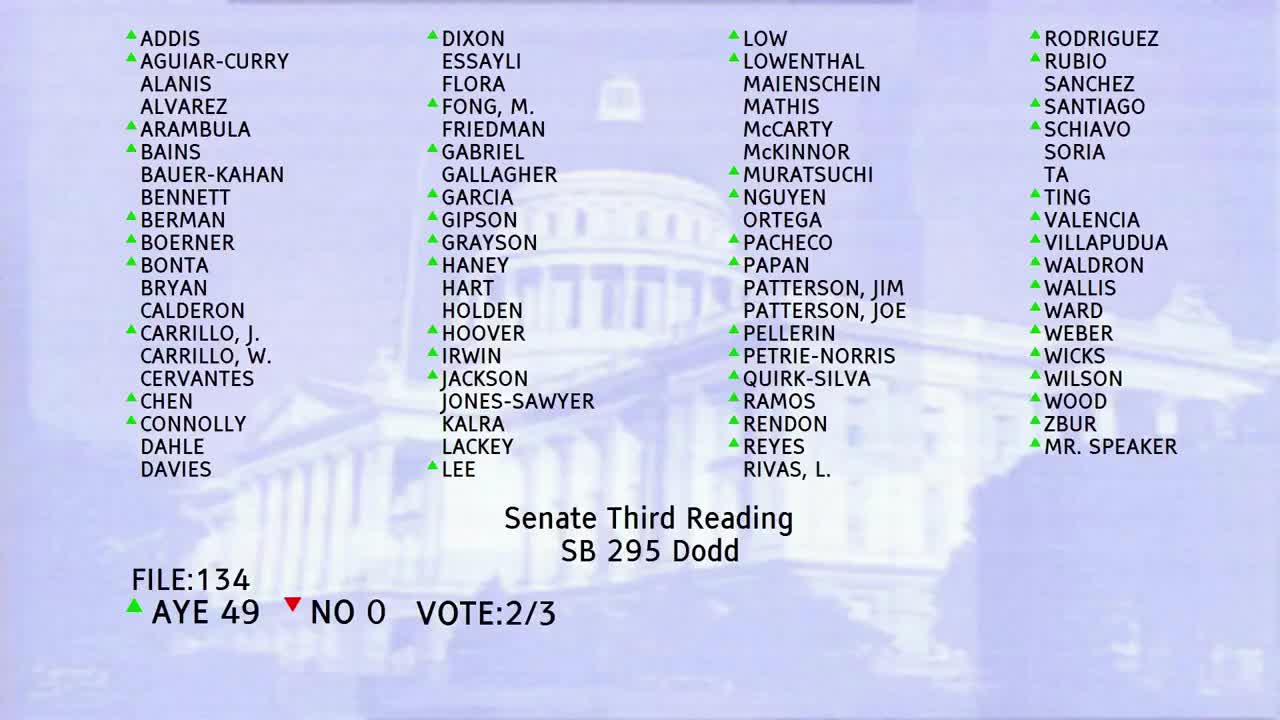 1MIN
Assembly Floor
 5MIN
Assembly Standing Committee on Natural Resources
 59SEC
Assembly Floor
 15MIN
Assembly Standing Committee on Health
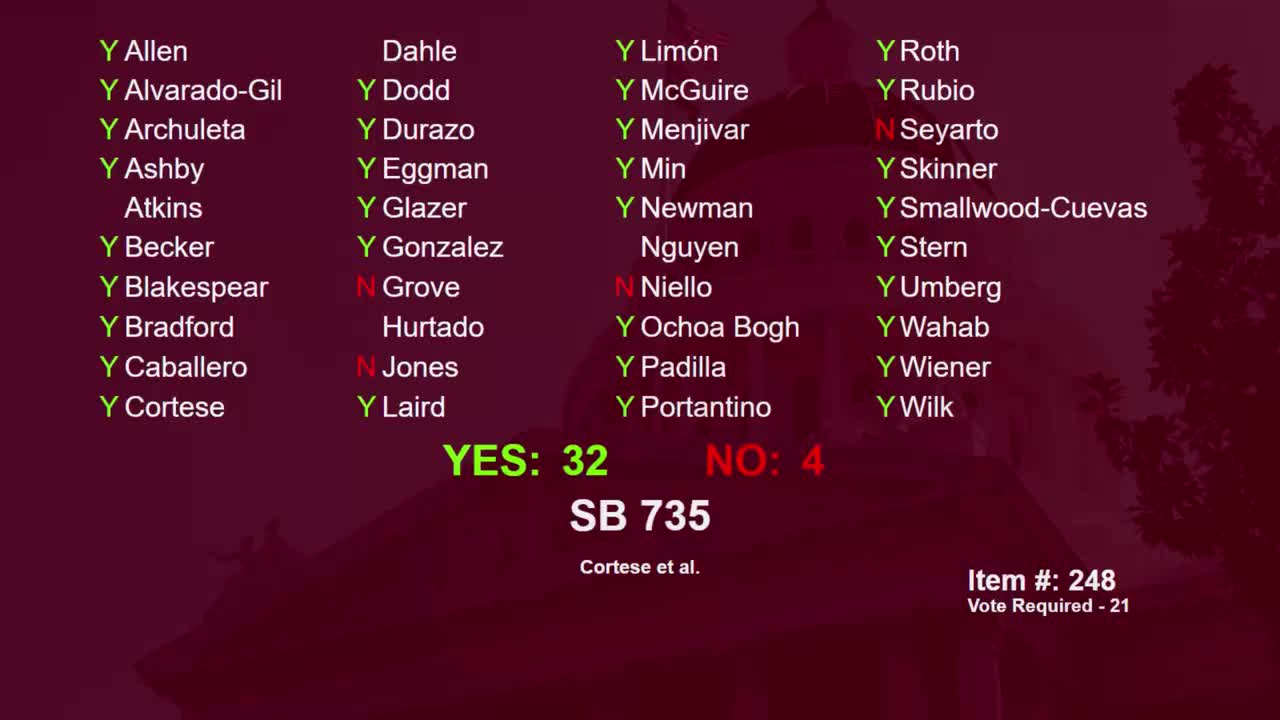 2MIN
Senate Floor
 13MIN
Senate Standing Committee on Health
Bill Author

Bill Co-Author(s):