SB 592: Labor standards information and enforcement.
- Session Year: 2023-2024
- House: Senate
- Latest Version Date: 2023-02-15
Current Status:
Failed
(2024-02-01: Returned to Secretary of Senate pursuant to Joint Rule 56.)
Introduced
In Committee
First Chamber
In Committee
Second Chamber
Enacted
Existing law creates with the Department of Industrial Relations, and establishes within the department the Division of Labor Standards Enforcement (DLSE), which is headed by the Labor Commissioner. The DLSE is generally charged with enforcing employment statutes and regulations, either in administrative actions or through litigation. Existing law imposes various administrative sanctions, civil fines and penalties, and criminal penalties for violations of employment statutes or regulations.
This bill would prohibit the imposition of punishment or liability for costs upon a person who has relied upon a published opinion letter or an enforcement policy, as defined, of DLSE that is displayed on the internet website of the division, except for restitution of unpaid wages, for violations of statutes or regulations in judicial or administrative proceedings if the person pleads and proves specified facts. The bill would require a person asserting this defense to have acted in good faith, to have relied upon, and conformed to, the applicable opinion letter or enforcement policy, and to have provided true and correct information to the division, among other things. The bill would require a person asserting this defense to post a bond and would prescribe requirements in this regard. The bill would specify certain circumstances under which the defense would not apply. The bill would apply its provisions to actions and proceedings that commence on or after January 1, 2024.
Existing law requires the Labor Commissioner to provide qualified bilingual persons in public contact positions or as interpreters to assist people in those positions with providing information and services in the language of a limited- or non-English-speaking person, as specified. Existing law requires the Labor Commissioner to prepare and distribute to the public, through the divisions local offices, materials explaining services available in non-English languages, as well as in English. Existing law requires the Labor Commissioner to prepare and use complaint processing forms and form letters in the language of non-English speaking people, as the commissioner deems necessary and appropriate for the filing, investigation, and resolution of wage claims, as specified.
This bill would require the Labor Commissioner to translate each of its internet websites in their entirety, and all materials available on those internet websites, into Spanish, Chinese, Tagalog, and Vietnamese by January 1, 2026.
(a)Any person who relies upon a published opinion letter or an enforcement policy of the division that is displayed on the internet website of the division shall not be liable for costs or subject to punishment, except for restitution of unpaid wages, for a violation of a statute or regulation in a judicial or administrative proceeding if the person pleads and proves to the trier of fact that, at the time the alleged act or omission occurred, the person, acting in good faith, did all of the following:
(1)Relied upon, and conformed to, the applicable opinion letter or enforcement policy published by the division.
(2)Provided true and correct information to the division in seeking an opinion letter or enforcement policy, if applicable.
(b)(1)Subdivision (a) shall apply even if, after the alleged act or omission occurred, the opinion letter or enforcement policy upon which the person relied is modified, rescinded, or determined by judicial authority to be invalid or of no legal effect.
(2)Subdivision (a) shall not apply if the alleged act or omission occurred after the opinion letter or enforcement policy upon which the person relied is modified, rescinded, or determined by judicial authority to be invalid or of no legal effect.
(c)This section applies to all actions and proceedings that commence on or after January 1, 2024.
(d)Any person who asserts reliance upon an opinion letter or enforcement policy of the division as described in subdivision (a) shall post an undertaking with the reviewing court or administrative body. The undertaking shall consist of a bond issued by a licensed surety qualified to do business in this state or a cash deposit with the court or administrative body in the amount of the reasonable estimate of alleged unpaid wages resulting from that reliance. The person shall provide written notification to all parties of the posting of the undertaking. The undertaking shall be on the condition that, if any judgment is entered in favor of the employee, the person shall pay the amount owed pursuant to the judgment. If the person prevails or the case is dismissed, withdrawn, or resolved through the execution of a settlement agreement, the court or administrative body shall return the undertaking to the person within 10 business days.
(e)Nothing in this section shall be construed to give any greater legal weight to an opinion letter or enforcement policy than it would otherwise have in the absence of this section.
(f)Nothing in this section shall be construed to require the division to issue an order, ruling, approval, interpretation, or enforcement policy.
(g)Nothing in this section shall be construed to authorize the division to issue an order, ruling, approval, interpretation, or enforcement policy that is contrary to an existing state statute or regulation.
(h)For purposes of this section, enforcement policy includes guidance issued by the division, such as frequently asked questions, fact sheets, model policies, templates, or charts.
SEC. 2.Section 105 of the Labor Code is amended to read:105.(a)The Labor Commissioner shall provide qualified bilingual persons in public contact positions or as interpreters to assist those in such those positions to provide information and services in the language of a limited- or non-English-speaking person, with the primary effort being exerted towards the largest segments of the non-English-speaking persons in this state.
(b)The Labor Commissioner shall provide that an interpreter be present at all hearings and interviews where appropriate.
(c)The Labor Commissioner shall prepare and distribute to the public, through its the divisions local offices, materials explaining services available in non-English languages, as well as in English. In addition, the commissioner shall prepare and use written materials in non-English languages as well as in English for use by local offices if the local office serves a substantial number of non-English-speaking people, as defined in Section 7296.2 of the Government Code. The commissioner shall prepare and use such complaint processing forms and form letters in the language of non-English speaking people as the commissioner deems necessary and appropriate for the filing, investigation, and resolution of wage claims, giving due consideration to the rights and obligations of all parties. The commissioner may, from time to time, at his or her their discretion, eliminate, modify, amend, or add to the complaint processing forms and form letters which are the subject of bilingual or multilingual treatment or application.
(d)The Labor Commissioner shall translate each of its internet websites in their entirety, and all materials available on those internet websites, into Spanish, Chinese, Tagalog, and Vietnamese by January 1, 2026.
|
Date
|
Status
|
|---|---|
| Feb 1, 2024 | Returned to Secretary of Senate pursuant to Joint Rule 56. |
| Apr 20, 2023 | April 19 set for second hearing. Failed passage in committee. (Ayes 1. Noes 3. Page 833.) Reconsideration granted. |
| Apr 11, 2023 | Set for hearing April 19. |
| Apr 6, 2023 | April 12 set for first hearing canceled at the request of author. |
| Mar 21, 2023 | Set for hearing April 12. |
| Feb 22, 2023 | Referred to Coms. on L., P.E. & R. and JUD. |
| Feb 16, 2023 | From printer. May be acted upon on or after March 18. |
| Feb 15, 2023 | Introduced. Read first time. To Com. on RLS. for assignment. To print. |
|
Date
|
Description
|
Location
|
Votes
|
|
|---|---|---|---|---|
| Apr 19, 2023 | [Second] hearing set for [04-20-2023]: Failed passage in Committee. Reconsideration granted | Senate Standing Committee on Labor, Public Employment and Retirement |
Passed |
|
| Apr 19, 2023 | Do pass, but first be re-referred to the Committee on [Judiciary] | Senate Standing Committee on Labor, Public Employment and Retirement |
Failed |
This list shows positions taken on this bill by organizations on the date displayed, which is linked to the original source.
Positions by individuals are not included.
|
Organization
|
Position
|
Date
|
|---|---|---|
| Acclamation Insurance Management Services | ** Support | |
| AFSCME American Federation of State, County and Municipal Employees, AFL-CIO | * Against | Apr 19, 2023 |
| Allied Managed Care | ** Support | |
| Anaheim Chamber Of Commerce | ** Support | |
| Antelope Valley Chambers of Commerce | ** Support | |
| Associated General Contractors Of California | * Support | Apr 19, 2023 |
| CalAsian Chamber of Commerce | ** Support | |
| California Apartment Association | ** Support | |
| California Asian Pacific Chamber Of Commerce | * Support | Apr 19, 2023 |
| California Association For Health Services At Home | ** Support | |
| California Association Of Health Facilities | ** Support | |
| California Association Of Joint Powers Authorities | ** Support | |
| California Association Of Sheet Metal Air Conditioning Contractors National Association | ** Support | |
| California Association Of Winegrape Growers | * Support | Apr 19, 2023 |
| California Bankers Association | ** Support | |
| California Building Industry Association | ** Support | |
| California Business Owner | * Support | Apr 19, 2023 |
| California Business Roundtable | ** Support | |
| California Cattlemen'S Association | ** Support | |
| California Chamber Of Commerce | * Support | Apr 19, 2023 |
| California Conference Of Machinists | ** Against | |
| California Employment Lawyers Association | * Against | Apr 19, 2023 |
| California Farm Bureau | * Support | Apr 19, 2023 |
| California Federation Of Teachers | ** Against | |
| California Fuels And Convenience Alliance | * Support | Apr 19, 2023 |
| California Grocers Association | * Support | Apr 19, 2023 |
| California Hispanic Chambers Of Commerce | * Support | Apr 19, 2023 |
| California Hotel & Lodging Association | ** Support | |
| California Labor Federation | * Against | Apr 19, 2023 |
| California League Of Food Producers | * Support | Apr 19, 2023 |
| California Nurses Association | ** Against | |
| California Restaurant Association | * Support | Apr 19, 2023 |
| California Retailers Association | * Support | Apr 19, 2023 |
| California Rural Legal Assistance Foundation | * Against | Apr 19, 2023 |
| California State Council for the Society of Human Resources Management | * Support | Apr 19, 2023 |
| California Teamsters Public Affairs Council | ** Against | |
| California Trucking Association | ** Support | |
| Carlsbad Chamber of Commerce | ** Support | |
| Chino Valley Chamber of Commerce | ** Support | |
| Citrus Heights Chamber of Commerce | ** Support | |
| Civil Justice Association Of California | * Support | Apr 19, 2023 |
| Coalition of California Chambers – Orange County | ** Support | |
| Coalition of Small and Disabled Veteran Businesses | ** Support | |
| Consumer Attorneys Of California | * Against | Apr 19, 2023 |
| Costa Mesa Chamber of Commerce | ** Support | |
| Dana Point Chamber of Commerce | ** Support | |
| El Dorado County Chamber of Commerce | ** Support | |
| El Dorado Hills Chamber of Commerce | ** Support | |
| Elk Grove Chamber Of Commerce | ** Support | |
| Engineers & Scientists of California, Local 20, IFPTE | ** Against | |
| Family Business Association of California | ** Support | |
| Flasher Barricade Association | ** Support | |
| Folsom Chamber Of Commerce | ** Support | |
| Fountain Valley Chamber of Commerce | ** Support | |
| Fresno Chamber of Commerce | ** Support | |
| Garden Grove Chamber Of Commerce | ** Support | |
| Gilroy Chamber of Commerce | ** Support | |
| Govern for California | ** Support | |
| Greater High Desert Chamber of Commerce | ** Support | |
| Greater Riverside Chambers of Commerce | ** Support | |
| Greater San Fernando Valley Chamber of Commerce | ** Support | |
| Half Moon Bay Coastside Chamber of Commerce | ** Support | |
| Hollywood Chamber Of Commerce | * Support | Apr 19, 2023 |
| Housing Contractors Of California | ** Support | |
| Imperial Valley Regional Chamber of Commerce | * Support | Apr 19, 2023 |
| L. Barrios and Associates | * Support | Apr 19, 2023 |
| LA Canada Flintridge Chamber of Commerce | ** Support | |
| Lake Elsinore Valley Chamber of Commerce | ** Support | |
| Legal Aid At Work | * Against | Apr 19, 2023 |
| lincoln area chamber of commerce | ** Support | |
| Long Beach Area Chamber of Commerce | ** Support | |
| Menifee Valley Chamber of Commerce | ** Support | |
| National Federation Of Independent Business | ** Support | |
| Oceanside Chamber of Commerce | ** Support | |
| Official Police Garages of Los Angeles | ** Support | |
| Orange County Business Council | ** Support | |
| Rancho Cordova Area Chamber of Commerce | ** Support | |
| Rocklin Area Chamber of Commerce | ** Support | |
| Roseville Area Chamber Of Commerce | ** Support | |
| San Gabriel Valley Economic Partnership | ** Support | |
| San Juan Capistrano Chamber of Commerce | ** Support | |
| San Marcos Chamber Of Commerce | ** Support | |
| Santa Ana Chamber of Commerce | ** Support | |
| Santa Barbara South Coast Chamber of Commerce | ** Support | |
| Santa Clarita Valley Chamber of Commerce | ** Support | |
| Santa Maria Valley Chamber of Commerce | ** Support | |
| Santee Chamber of Commerce | ** Support | |
| Sheet Metal, Air, Rail, and Transportation Workers | * Against | Apr 19, 2023 |
| Shingle Springs/cameron Park Chamber of Commerce | ** Support | |
| Small Business Majority | ** Support | |
| South Bay Association of Chambers of Commerce | ** Support | |
| Southern California Leadership Council | ** Support | |
| Tulare Chamber of Commerce | ** Support | |
| Ufcw Western States Council | * Against | Apr 19, 2023 |
| Unite Here International Union | * Against | Apr 19, 2023 |
| United Chamber Advocacy Network | ** Support | |
| Utility Workers Union of America | ** Against | |
| VALLEY INDUSTRY AND COMMERCE ASSOCIATION | ** Support | |
| West Ventura County Business Alliance | ** Support | |
| Western Growers | * Support | Apr 19, 2023 |
| Western United Diaries | ** Support | |
| Wine Institute | ** Support | |
| Yorba Linda Chamber of Commerce | ** Support | |
| Yorba Linda Chamber of Commerce | * Support | Apr 19, 2023 |
| Yuba Sutter Chamber of Commerce | ** Support |
SENATE COMMITTEE ON LABOR, PUBLIC EMPLOYMENT AND RETIREMENT
Senator Dave Cortese, Chair
2023 - 2024 Regular
Bill No: SB 592 Hearing Date: April 19, 2023
Author: | Newman | ||
Version: | February 15, 2023 | ||
Urgency: | No | Fiscal: | Yes |
Consultant: | Dawn Clover | ||
SUBJECT: Labor standards information and enforcement
KEY ISSUE
Should the Legislature provide employers with a defense against prosecution for alleged labor law violations based on guidance documents written by Department of Industrial Relations staff?
Should the Legislature require all entities under the Labor and Workforce Development Agency to translate each of its websites in their entirety into Spanish, Chinese, Tagalog, and Vietnamese?
ANALYSIS
Existing law:
- Charges the Division of Labor Standards Enforcement (DLSE) within the Department of Industrial Relations (DIR) with enforcement of employment statutes and regulations through administrative actions or litigation under which an employer may face administrative sanctions, civil fines and penalties, and criminal penalties for violations. (Labor Code §79-107)
- Allows employers that fail to pay minimum wage to avoid penalties if they demonstrate to a court or the Labor Commissioner that the failure was in good faith and they had reasonable grounds for believing they had not violated minimum wage laws or an order of the Industrial Welfare Commission. (Labor Code §1194.2)
- Requires an employer that fails to provide a wage statement to an employee, either semi-monthly or at the time of compensation, to pay damages and reasonable attorney’s fees to the employee if they suffer injury as a result of the employer’s knowing and intentional failure to do so. (Labor Code §226(a) and (e))
- Provides that an employer shall not be subject to liability or punishment for failure to pay minimum wage or overtime compensation under the Fair Labor Standards Act if the employer pleads and proves the failure was in good faith in conformity with and in reliance on any relevant administrative regulation, order, ruling, approval, or interpretation, of any agency of the United States, or any administrative practice or enforcement policy of any such agency. This defense remains valid even if the relevant administrative regulation, order, ruling, approval, interpretation, practice, or enforcement policy is modified, rescinded, or invalidated by a judicial authority. (29 USC §258-259, enacted May 14, 1947)
This bill:
- Provides that, for actions and proceedings that commence on or after January 1, 2024, any person who relies on a published opinion letter or enforcement policy, guidance, frequently asked question document, fact sheet, model policy, template, or chart (document) displayed on the DLSE website shall not be liable for costs or subject to punishment, except for restitution of unpaid wages, for a violation of a statute or regulation in a judicial or administrative proceeding if the person pleads and proves to the trier of fact that, at the time the alleged act or omission occurred, the person, acting in good faith, did all of the following:
- Relied upon and conformed to the applicable opinion letter or document published by DLSE.
- Provided true and correct information to DLSE in seeking an opinion letter or enforcement policy, if applicable.
- Relied upon and conformed to the applicable opinion letter or document published by DLSE.
- Provides that, beginning January 1, 2024, the defense against prosecution by DLSE shall apply even if, after the alleged act or omission occurred, the document upon which the person relied is modified, rescinded, or determined by judicial authority to be invalid or of no legal effect.
- Provides that there is no defense against prosecution if the alleged act or omission occurred after the opinion letter or enforcement policy upon which the person relied is modified or rescinded, or determined by judicial authority to be invalid or of no legal effect.
- Requires any person who asserts reliance upon an opinion letter of enforcement policy of DLSE shall post an undertaking with the reviewing court or administrative body. The undertaking shall consist of a bond issued by a licensed surety qualified to do business in this state or a cash deposit with the court or administrative body in the amount of the reasonable estimate of alleged unpaid wages resulting from that reliance. The person shall provide written notification to all parties of the posting of the undertaking. The undertaking shall be on the condition that, if any judgment is entered in favor of the employee, the person shall pay the amount owed pursuant to the judgment. If the person prevails or the case is dismissed, withdrawn, or resolved through the execution of a settlement agreement, the court or administrative body shall return the undertaking to the person within 10 business days.
- Declares that nothing in this act shall be construed to give any greater legal weight to an opinion letter or enforcement policy than it would otherwise have in the absence of this section and declares that nothing in this act shall be construed to require DLSE to issue an order, ruling, approval, interpretation, or enforcement policy.
- Declares that nothing in this act shall be construed to authorize DLSE to issue an order, ruling, approval, interpretation, or enforcement policy that is contrary to statute or regulation.
- Requires the Labor and Workforce Development Agency to translate each of its websites in their entirety into Spanish, Chinese, Tagalog, and Vietnamese by January 1, 2026.
COMMENTS
1. Need for this bill?
According to the author, “The [DLSE] is responsible for enforcing California’s labor laws. In doing so, the DSLE is empowered under Labor Code § 98.8 to issue regulations, rules of practice, and procedures to be used as guidance for individuals and employers in complying with state labor law. These materials come in a variety of forms, including the [DLSE] Enforcement Policies and Interpretations Manual, opinion letters, Frequently Asked Questions (FAQs), fact sheets, model policies, templates, and charts.
These materials are primarily provided in English, with a limited number of publications available in a separate Spanish-language index. Further, the [DLSE] website lacks a translation feature, requiring non-English language speakers either navigate a cluttered English-language website or request bilingual interpreters (as required under Labor Code § 105). SB 592 will require the [DLSE] to translate the entirety of its website and all materials published on it into Spanish, Chinese, Tagalog, and Vietnamese, allowing users to more easily navigate the [DLSE] website and materials.
Further, in its capacity as the enforcer of state labor law, employers must adhere to the policies and guidance of the [DLSE] or face penalties or enforcement action. Yet, current law allows for employers following the [DLSE] guidance to be penalized in the event that guidance is subsequently invalidated by a judicial authority. Such was the case in 2018, when in two separate cases, (See Troester v. Starbucks, Cal.5th 829 (2018) and Dynamex Operations W. v. Superior Court, 4 Cal.5th 903 (2018)) the California Supreme Court invalidated decades of [DLSE] guidance and left employers liable to penalties after changes in the law’s interpretation.”
This bill would require the Labor and Workforce Development Agency, and each entity under it, to translate their websites in their entirety into Spanish, Chinese, Tagalog, and Vietnamese by January 1, 2026. Significant language access barriers exist that disadvantage workers who do not understand and speak or read fluent English. Existing law does not require the Labor and Workforce Development Agency to offer a translation function or translation into most spoken languages for each of its entities in their entirety. This provision would minimize language access barriers for both employees and employers.
2. Committee Discussion:
Defense Against Prosecution
This bill would authorize a defense against prosecution for an employer who relies on a DLSE document that is contrary to settled labor law. The Legislature has been deliberate about which violations arise to what type of penalty, depending on the severity of the violation. As an example, an employer can avoid penalties if they demonstrate to a court or the Labor Commissioner that the failure to pay the minimum wage was in good faith and they had reasonable grounds for believing they had not violated minimum wage laws. The defense against prosecution policy in this bill has been proposed by employer trade associations, opposed by labor organizations, and rejected by the Legislature twice in recent years. It would disregard a century of intentional lawmaking by providing employers with a defense against prosecution should they obtain any document that is not consistent with current state, regulation, or case law.
This bill would also provide that the defense against prosecution shall apply even if, after the alleged act or omission occurred, the document upon which the person relied on is modified, rescinded, or determined by judicial authority to be invalid or of no legal effect. Under the Schwarzenegger Administration, the Labor Agency issued pronouncements, opinion letters, enforcement policies, and emergency rules regarding the right to a lunch break, which were in violation of settled law. Most of the actions the administration took regarding meal periods were subsequently invalidated by the courts or withdrawn due to public opposition. Had this bill been in effect at that time, employers could simply have relied on a DLSE document to violate workers’ rights.
DSLE Legal Opinions
The existing DLSE opinion process is based on a good faith assumption that only factual information is provided by the party requesting an opinion. The opinions are not intended to be relied on in the place of law. A request for a legal opinion must be submitted by letter and contain a statement that there is no California decision or prior opinion, and that the requestor has researched the subject matter on the DSLE website. Not all requests that are submitted result in an opinion and the information DSLE receives is not vetted for accuracy: it is a good faith opinion based on the information provided by the requestor.
This bill would require a party, when requesting a legal opinion from DLSE, to provide “true and correct” information. Previous versions of this attempted policy have required “true and complete” information to be provided to DLSE when seeking an opinion. Additionally, previous versions of the defense against prosecution language required those seeking opinions from DLSE to provide “all pertinent facts and circumstances” when seeking an opinion. This bill does not include that language. The committee may wish to consider whether this opens the door for bad actors to abuse the DLSE opinion process.
Would this bill end the practice of DLSE issuing opinions?
Should it be enacted, DLSE would need to ensure thorough legal staff oversight of each document published on the website, and continuously monitor website content around the clock as changes to laws, regulations, and court rulings occur. Additionally, DLSE may also see an increase in opinions being requested, given an opinion could negate the law under this bill. The committee may wish to consider whether DLSE has sufficient resources and if it is in the taxpayers’ best interest to provide those resources.
2. Proponent Arguments:
The sponsors, the California Chamber of Commerce, California Hispanic Chambers of Commerce, and CalAsian Chamber of Commerce state “The DLSE is a state agency that is charged with enforcing the wage, hour and working condition labor laws. As a part of its effort to fulfill this responsibility, the DLSE issues opinion letters on various wage, hour and working condition topics, Frequently Asked Questions (FAQs) regarding new labor laws, as well as an enforcement manual that sets forth the DLSE’s interpretation and position on these issues. This guidance was critical, for example, during the COVID-19 pandemic due to the number of new laws and ever-changing regulations. Currently, employers must refer to the DLSE’s written materials for “guidance” on these topics when there is no published, on-point case available. The DLSE can levy penalties against an employer for failing to do so if an employee files a wage claim. The Catch-22 is that employers are provided with no certainty that they will be shielded from penalties if they comply in good faith with the DLSE’s written opinions or interpretations. There have been numerous instances where courts have veered in a different direction from established DLSE guidance, resulting in employers owing not only back wages, but also penalties under the Private Attorneys General Act (PAGA), Labor Code Sections 203, 226, and more… SB 592 eliminates this problem and provides businesses in California with the security to know that, if they seek out and follow written advice from the DLSE regarding how to comply with the law, they can actually rely upon that information. Specifically, SB 592 prevents an employer from being financially penalized through the assessment of statutory civil and criminal penalties, fines and interest if the employer relies in good faith on written advice from the DLSE and a court ultimately determines the DLSE’s advice was wrong.”
3. Opponent Arguments:
According to the opponent coalition, “This proposal is harmful to workers in many ways. To begin with, a company’s reliance on an opinion letter or policy has no bearing on the extent to which a worker was harmed. With widespread wage theft, misclassification and other violations tilting the scales toward employer interests is misguided.
Opinion letters and enforcement policies are not intended to provide legal advice or be relied upon in place of actual laws. An opinion letter is sought by one party and is based on the facts provided. Even assuming an employer is truthful about the facts provided, they may not include additional facts that would have resulted in a contrary response. The worker has no ability to intervene or tell their side of the story. There is no audit or review of underlying documents. In fact, this bill incentivizes employers to be selective in the facts they provide to the DLSE to get a favorable opinion that will shield them from liability.
Enforcement guidance is intended to apply generally and may not fit perfectly into the facts of any specific situation. In addition, enforcement guidance is not always reliably free from political influence. Under then-Governor Schwarzenegger, the DLSE issued guidance curtailing meal period rights that was intended to shield companies from liability. Were this bill law at the time, that would have successfully blocked efforts to hold corporations accountable for violating the law.
In addition, this bill goes even further to protect employers even where the guidance was revoked. If an error is made and then recognized and corrected, an employer can continue to avoid liability by relying on the inaccurate version.
This bill states that it does not give opinion letters or enforcement policies greater legal weight but that is precisely the purpose of the bill. It would allow employers to violate the law if they can point to any policy or opinion letter that they think justifies it, even if that policy is subsequently revoked.
This bill also states that it does not authorize the DLSE to issue policies that violate the law and yet, that is precisely what this bill encourages. It politicizes the role of the agency in interpreting the law, giving them the power to shield companies from liability. It would also encourage corporate law firms to pressure the DLSE to write favorable opinions.”
4. Double Referral:
This bill is double referred to the Senate Committee on Judiciary.
5. Prior Legislation:
AB 2068 (Haney – Chapter 485, Statutes of 2022) required employers to post notices that they have received citations for specified Labor Code violations, and any special orders or actions issued to the employer by the Division of Occupational Safety and Health, as specified, in each language of the top seven non-English languages used by limited-English-proficient adults in California, as determined by the United States Census Bureau.
SB 524 (Vidak, 2017) was substantially similar to the liability provisions in this bill and included a sunset date of January 1, 2024. This bill failed passage in the Senate Committee on Labor and Industrial Relations.
AB 2688 (Brown, 2014) was nearly identical to SB 524 (Vidak, 2017) but included a sunset date of January 1, 2019. This bill was held in the Assembly Committee on Labor and Employment.
SUPPORT
California Chamber of Commerce (Co-sponsor)
California Hispanic Chambers of Commerce (Co-sponsor)
CalAsian Chamber of Commerce (Co-sponsor)
Acclamation Insurance Management Services
Allied Managed Care
Anaheim Chamber of Commerce
Antelope Valley Chambers of Commerce
California Apartment Association
California Association for Health Services At Home
California Association of Health Facilities
California Association of Joint Powers Authorities
California Association of Sheet Metal & Air Conditioning Contractors National Association
California Association of Winegrape Growers
California Bankers Association
California Building Industry Association
California Business Roundtable
California Cattlemen's Association
California Farm Bureau
California Fuels and Convenience Alliance
California Hotel & Lodging Association
California League of Food Producers
California Restaurant Association
California Retailers Association
California State Council of The Society for Human Resource Management (CALSHRM)
California Trucking Association
Carlsbad Chamber of Commerce
Chino Valley Chamber of Commerce
Citrus Heights Chamber of Commerce
Civil Justice Association of California
Coalition of California Chambers – Orange County
Coalition of Small and Disabled Veteran Businesses
Costa Mesa Chamber of Commerce
Dana Point Chamber of Commerce
El Dorado County Chamber of Commerce
El Dorado Hills Chamber of Commerce
Elk Grove Chamber of Commerce
Family Business Association of California
Flasher Barricade Association
Folsom Chamber of Commerce
Fountain Valley Chamber of Commerce
Fresno Chamber of Commerce
Garden Grove Chamber of Commerce
Gilroy Chamber of Commerce
Govern for California
Greater High Desert Chamber of Commerce
Greater Riverside Chambers of Commerce
Greater San Fernando Valley Chamber of Commerce
Half Moon Bay Coastside Chamber of Commerce
Hollywood Chamber of Commerce
Housing Contractors of California
Imperial Valley Regional Chamber of Commerce
LA Canada Flintridge Chamber of Commerce
Lake Elsinore Valley Chamber of Commerce
Lincoln Area Chamber of Commerce
Long Beach Area Chamber of Commerce
Menifee Valley Chamber of Commerce
National Federation of Independent Business
Oceanside Chamber of Commerce
Official Police Garages of Los Angeles
Orange County Business Council
Rancho Cordova Area Chamber of Commerce
Rocklin Area Chamber of Commerce
Roseville Area Chamber of Commerce
San Gabriel Valley Economic Partnership
San Juan Capistrano Chamber of Commerce
San Marcos Chamber of Commerce
Santa Ana Chamber of Commerce
Santa Barbara South Coast Chamber of Commerce
Santa Clarita Valley Chamber of Commerce
Santa Maria Valley Chamber of Commerce
Santee Chamber of Commerce
Shingle Springs/Cameron Park Chamber of Commerce
Small Business Majority
South Bay Association of Chambers of Commerce
Southern California Leadership Council
Tulare Chamber of Commerce
United Chamber Advocacy Network
Valley Industry and Commerce Association
West Ventura County Business Alliance
Western Growers Association
Western United Diaries
Wine Institute
Yorba Linda Chamber of Commerce
Yuba Sutter Chamber of Commerce
OPPOSITION
American Federation of State, County, and Municipal Employees of CA (AFSCME CA) California Conference Board of the Amalgamated Transit Union
California Conference of Machinists
California Employment Lawyers Association (CELA)
California Federation of Teachers (CFT)
California Labor Federation
California Nurses Association (CNA)
California Rural Legal Assistance Foundation (CRLAF)
California Teamsters Public Affairs Council
Consumer Attorneys of California
Engineers & Scientists of California, Local 20, IFPTE
United Food & Commercial Workers Western States Council
UNITE HERE
Utility Workers Union of America
-- END --
Discussed in Hearing
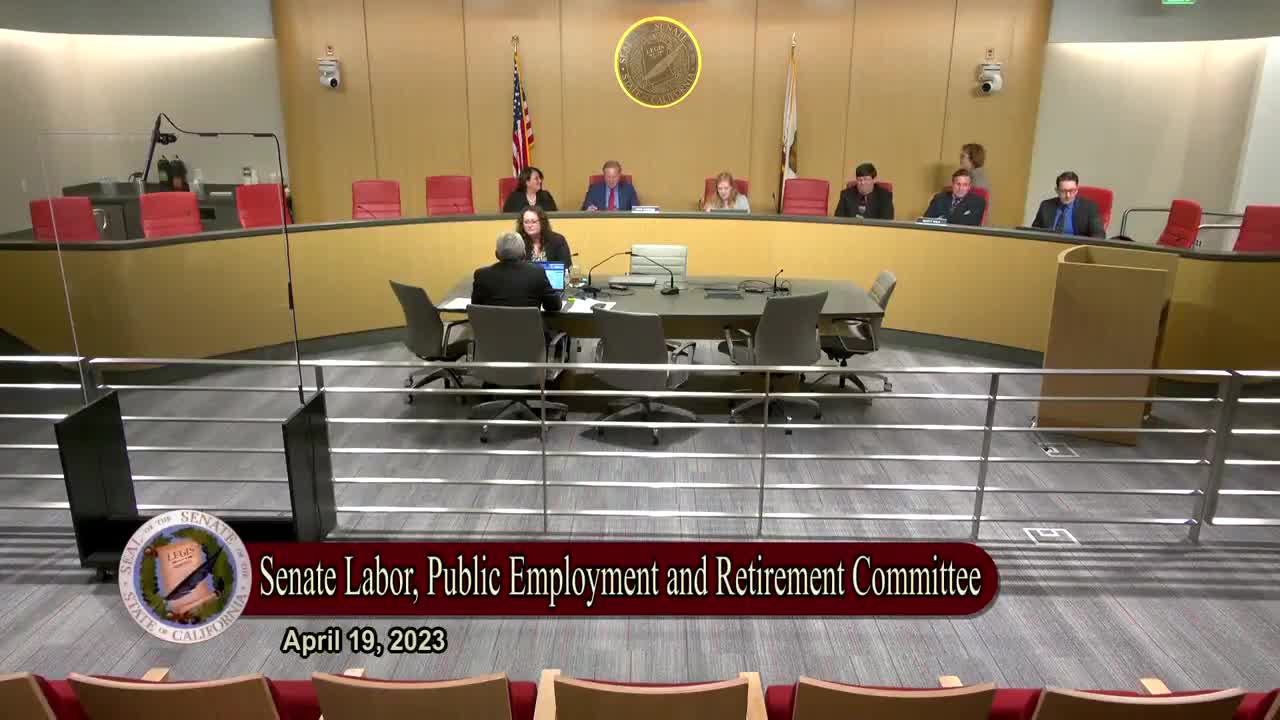 30MIN
Senate Standing Committee on Labor, Public Employment and Retirement
Bill Author

Bill Co-Author(s):