AB 1050: Unlawfully restrictive covenants: housing developments.
- Session Year: 2025-2026
- House: Assembly
- Latest Version Date: 2025-10-10
Current Status:
Passed
(2025-10-10: Chaptered by Secretary of State - Chapter 504, Statutes of 2025.)
Introduced
In Committee
Awaiting First Chamber Vote
Passed First Chamber
In Committee
Awaiting Second Chamber Vote
Passed Second Chamber
Enacted
Existing law provides that recorded covenants, conditions, restrictions, or private limits on the use of land contained in instruments affecting the transfer or sale of any interest in real property that, among other things, restrict the number, size, or location of the residences that may be built on the property, are not enforceable against the owner of an affordable housing development, as defined, if an approved restrictive covenant affordable housing modification document has been recorded in the public record, as provided. As part of this process, existing law requires the owner to submit to the county recorder a copy of the original restrictive covenant and any documents the owner believes necessary to establish that the property qualifies as an affordable housing development and requires the county counsel to determine, among other things, if the property qualifies as an affordable housing development and if a modification document may be recorded. Existing law provides that these provisions do not authorize any development that is not otherwise consistent with local general plans, zoning ordinances, and any applicable specific plan.
This bill would extend those provisions to a housing development that is owned or controlled by an entity or individual that has submitted a development project application to redevelop an existing commercial property, and the development project includes residential uses permitted by state housing laws or local land use and zoning regulations and would make various conforming changes. The bill would additionally make these provisions applicable to covenants, conditions, restrictions, or private limits contained in a reciprocal easement agreement, as provided, and include instruments affecting the transfer or sale of any interest in real property that prohibits the number, size, or location of residences that may be built on the property or restricts or prohibits the residential uses of the property. The bill would further provide that these provisions do not authorize any development that is not otherwise consistent with state housing laws. By imposing additional duties on county officials, the bill would impose a state-mandated local program.
The California Constitution requires the state to reimburse local agencies and school districts for certain costs mandated by the state. Statutory provisions establish procedures for making that reimbursement.
This bill would provide that no reimbursement is required by this act for a specified reason.
Existing law provides that specified recorded covenants, conditions, restrictions, or private limits on the use of land contained in specified instruments affecting the transfer or sale of any interest in real property that, among other things, restrict the number, size, or location of the residences that may be built on the property, are not enforceable against the owner of an affordable housing development, as defined, if an approved restrictive covenant affordable housing modification document has been recorded in the public record, as provided. As part of this process, existing law requires the owner to submit to the county recorder a copy of the original restrictive covenant and any documents the owner believes necessary to establish that the property qualifies as an affordable housing development and requires the county counsel to determine, among other things, if the property qualifies as an affordable housing development and if a modification document may be recorded. Existing law provides that these provisions do not authorize any development that is not otherwise consistent with local general plans, zoning ordinances, and any applicable specific plan.
This bill would extend those provisions to any a housing development that is owned or controlled by an entity or individual that has submitted a development project application to redevelop an existing commercial property, and the development project includes residential uses permitted by state housing laws or local land use and zoning regulations and would make various conforming changes. The bill would additionally make these provisions applicable to covenants, conditions, restrictions, or private limits contained in a reciprocal easement agreement, as provided. provided, and include instruments affecting the transfer or sale of any interest in real property that prohibits the number, size, or location of residences that may be built on the property or restricts or prohibits the residential uses of the property. The bill would further provide that these provisions do not authorize any development that is not otherwise consistent with state housing laws. By imposing additional duties on county officials, the bill would impose a state-mandated local program.
The California Constitution requires the state to reimburse local agencies and school districts for certain costs mandated by the state. Statutory provisions establish procedures for making that reimbursement.
This bill would provide that no reimbursement is required by this act for a specified reason.
Existing law provides that specified recorded covenants, conditions, restrictions, or private limits on the use of land contained in specified instruments affecting the transfer or sale of any interest in real property are not enforceable against the owner of an affordable housing development, as defined, if an approved restrictive covenant affordable housing modification document has been recorded in the public record, as provided. As part of this process, existing law requires the owner to submit to the county recorder a copy of the original restrictive covenant and any documents the owner believes necessary to establish that the property qualifies as an affordable housing development and requires the county counsel to determine, among other things, if the property qualifies as an affordable housing development and if a modification document may be recorded. Existing law provides that these provisions do not authorize any development that is not otherwise consistent with local general plans, zoning ordinances, and any applicable specific plan.
This bill would extend those provisions to any housing development that is owned or controlled by an entity or individual that has submitted a development project application to redevelop an existing commercial property, and the development project includes residential uses permitted by state housing laws or local land use and zoning regulations and would make various conforming changes. The bill would additionally make these provisions applicable to covenants, conditions, restrictions, or private limits contained in a reciprocal easement agreement, as provided. The bill would further provide that these provisions do not authorize any development that is not otherwise consistent with state housing laws. By imposing additional duties on county officials, the bill would impose a state-mandated local program.
The California Constitution requires the state to reimburse local agencies and school districts for certain costs mandated by the state. Statutory provisions establish procedures for making that reimbursement.
This bill would provide that no reimbursement is required by this act for a specified reason.
Existing law provides that specified recorded covenants, conditions, restrictions, or private limits on the use of land contained in specified instruments affecting the transfer or sale of any interest in real property are not enforceable against the owner of an affordable housing development, as defined, if an approved restrictive covenant affordable housing modification document has been recorded in the public record, as provided. As part of this process, existing law requires the owner to submit to the county recorder a copy of the original restrictive covenant and any documents the owner believes necessary to establish that the property qualifies as an affordable housing development and requires the county counsel to determine, among other things, if the property qualifies as an affordable housing development and if a modification document may be recorded. Existing law provides that these provisions do not authorize any development that is not otherwise consistent with local general plans, zoning ordinances, and any applicable specific plan.
This bill would extend those provisions to any housing development that is owned or controlled by an entity or individual that has submitted a development project application to redevelop an existing commercial property that property, and the development project includes residential uses permitted by state housing laws or local land use and zoning regulations and would make various conforming changes. The bill would additionally make these provisions applicable to covenants, conditions, restrictions, or private limits contained in a reciprocal easement agreement, as provided. The bill would further provide that these provisions do not authorize any development that is not otherwise consistent with state housing laws. By imposing additional duties on county officials, the bill would impose a state-mandated local program.
The California Constitution requires the state to reimburse local agencies and school districts for certain costs mandated by the state. Statutory provisions establish procedures for making that reimbursement.
This bill would provide that no reimbursement is required by this act for a specified reason.
Existing law provides that specified recorded covenants, conditions, restrictions, or private limits on the use of land contained in specified instruments affecting the transfer or sale of any interest in real property are not enforceable against the owner of an affordable housing development, as defined, if an approved restrictive covenant affordable housing modification document has been recorded in the public record, as provided. As part of this process, existing law requires the owner to submit to the county recorder a copy of the original restrictive covenant and any documents the owner believes necessary to establish that the property qualifies as an affordable housing development and requires the county counsel to determine, among other things, if the property qualifies as an affordable housing development and if a modification document may be recorded. Existing law provides that these provisions do not authorize any development that is not otherwise consistent with local general plans, zoning ordinances, and any applicable specific plan.
This bill would extend those provisions to any housing development that is owned or controlled by an entity or individual that has submitted a development project application to redevelop an existing commercial property that includes residential uses permitted by state housing laws or local land use and zoning regulations and would make various conforming changes. The bill would additionally make these provisions applicable to a reciprocal easement agreement and covenants, conditions, restrictions, or private limits contained in a reciprocal easement agreement, as provided. The bill would further provide that these provisions do not authorize any development that is not otherwise consistent with state housing laws. By imposing additional duties on county officials, the bill would impose a state-mandated local program.
The California Constitution requires the state to reimburse local agencies and school districts for certain costs mandated by the state. Statutory provisions establish procedures for making that reimbursement.
This bill would provide that no reimbursement is required by this act for a specified reason.
Existing law provides that specified recorded covenants, conditions, restrictions, or private limits on the use of land contained in specified instruments affecting the transfer or sale of any interest in real property are not enforceable against the owner of an affordable housing development, as defined, if an approved restrictive covenant affordable housing modification document has been recorded in the public record. record, as provided. As part of this process, existing law requires the owner to submit to the county recorder a copy of the original restrictive covenant and any documents the owner believes necessary to establish that the property qualifies as an affordable housing development and requires the county counsel to determine, among other things, if the property qualifies as an affordable housing development and if a modification document may be recorded. Existing law provides that these provisions do not authorize any development that is not otherwise consistent with local general plans, zoning ordinances, and any applicable specific plan.
This bill would extend those provisions to apply to any housing development that is owned or controlled by an entity or individual that has submitted a development project application to redevelop an existing commercial property that includes residential uses permitted by state housing laws or local land use and zoning regulations and would make various conforming changes. The bill would additionally make these provisions applicable to a reciprocal easement agreement. agreement and would further provide that these provisions do not authorize any development that is not otherwise consistent with state housing laws. By imposing additional duties on county officials, the bill would impose a state-mandated local program.
The California Constitution requires the state to reimburse local agencies and school districts for certain costs mandated by the state. Statutory provisions establish procedures for making that reimbursement.
This bill would provide that no reimbursement is required by this act for a specified reason.
Existing law provides that specified recorded covenants, conditions, restrictions, or private limits on the use of land contained in specified instruments affecting the transfer or sale of any interest in real property are not enforceable against the owner of an affordable housing development, as defined, if an approved restrictive covenant affordable housing modification document has been recorded in the public record. As part of this process, existing law requires the owner to submit to the county recorder a copy of the original restrictive covenant and any documents the owner believes necessary to establish that the property qualifies as an affordable housing development and requires the county counsel to determine, among other things, if the property qualifies as an affordable housing development and if a modification document may be recorded.
This bill would extend those provisions to apply to a reciprocal easement agreement. By imposing additional duties on county officials, the bill would impose a state-mandated local program.
The California Constitution requires the state to reimburse local agencies and school districts for certain costs mandated by the state. Statutory provisions establish procedures for making that reimbursement.
This bill would provide that no reimbursement is required by this act for a specified reason.
(a)Recorded covenants, conditions, restrictions, or private limits on the use of private or publicly owned land contained in any deed, contract, security instrument, reciprocal easement agreement, or other instrument affecting the transfer or sale of any interest in real property that restrict or prohibit the residential uses of the property, the number, size, or location of the residences that may be built on the property, or that restrict the number of persons or families who may reside on the property, shall not be enforceable against the owner of a housing development, if an approved restrictive covenant housing modification document has been recorded in the public record as provided for in this section, except as explicitly provided in this section.
(b)(1)The owner of a housing development shall be entitled to establish that an existing restrictive covenant is unenforceable pursuant to subdivision (a) by submitting a restrictive covenant modification document pursuant to Section 12956.2 of the Government Code that modifies or removes any existing restrictive covenant language that restricts or prohibits the residential uses of the property, the number, size, or location of the residences that may be built on the property, or that restricts the number of persons or families that may reside on the property, to the extent necessary to allow the housing development to proceed under the existing declaration of restrictive covenants.
(2)(A)The owner shall submit to the county recorder a copy of the original restrictive covenant, a copy of any notice the owner believes is required pursuant to paragraph (3) of subdivision (g), and any documents the owner believes necessary to establish that the property qualifies as a housing development under this section prior to, or simultaneously with, the submission of the request for recordation of the restrictive covenant modification document.
(B)Before recording the restrictive covenant modification document, pursuant to subdivision (b) of Section 12956.2 of the Government Code, the county recorder shall, within five business days of receipt, submit the documentation provided to the county recorder by the owner pursuant to subparagraph (A) and the modification document to the county counsel for review. The county counsel shall determine whether the original restrictive covenant document restricts the property in a manner prohibited by subdivision (a), whether the owner has submitted documents sufficient to establish that the property qualifies as a housing development under this section, whether any notice required under this section has been provided, whether any exemption provided in subdivision (g) or (h) applies, and whether the restriction may no longer be enforced against the owner of the housing development and that the owner may record a modification document pursuant to this section.
(C)Pursuant to Section 12956.2 of the Government Code, the county counsel shall return the documents and inform the county recorder of the county counsels determination within 15 days of submission to the county counsel. If the county counsel is unable to make a determination, the county counsel shall specify the documentation that is needed in order to make the determination. If the county counsel has authorized the county recorder to record the modification document, that authorization shall be noted on the face of the modification or on a cover sheet affixed thereto, and the county recorder shall notify the owner or submitting party of the county counsels determination without delay so that the notice described in subparagraph (D) may be given.
(D)Upon being notified that the county counsel has authorized the county recorder to record the modification document, the owner may mail, by certified mail to anyone who the owner knows has an interest in the property or in the restrictive covenant, a copy of the modification document, together with a copy of this section and a written explanation that the modification has been applied for and approved for recordation by the county counsel pursuant to this section. That notice shall be deemed given if the notice is actually received by the intended recipient or if the notice is mailed by certified mail both to an address for notice indicated in the restrictive covenant, if any, and to the intended recipients address as shown in the last equalized assessment roll, if that address reasonably can be ascertained from the assessment roll. The owner may also publish notice pursuant to Section 6061 of the Government Code identifying that a modification document pursuant to this section has been submitted to the county recorder and approved for recordation by the county counsel, and that the modification document is available for public inspection in the office of the county recorder. The notice shall also identify the property by assessors parcel number and mailing address. If no mailing address has been assigned for the property, then the property shall be identified instead by its nearest intersection. If the owner elects to publish notice in this manner, then notice shall be deemed given to anyone whose interest does not appear of record or for whom an address for notice does not appear of record and cannot reasonably be ascertained from the assessment roll. Notice as described in this subparagraph is optional, and failure to provide it shall not, in any manner, invalidate a restrictive covenant modification document recorded pursuant to this section.
(E)The county recorder shall not record the modification document if the county counsel finds that the original restrictive covenant document does not contain a restriction prohibited by this section or if the county counsel finds that the property does not qualify as a housing development. If the owner of the property is not yet its record title owner, but is instead a beneficial owner with a right pursuant to a purchase and sale or similar agreement to purchase the property, then the owner shall not record the modification document until the owner closes escrow on the property and becomes its record title owner.
(F)A modification document shall be indexed in the same manner as the original restrictive covenant document being modified. It shall contain a recording reference to the original restrictive covenant document, in the form of a book and page or instrument number, and date of the recording. The effective date of the terms and conditions of the modification document shall be the same as the effective date of the original restrictive covenant document, subject to any intervening amendments or modifications, except to the extent modified by the recorded modification document.
(3)If the holder of an ownership interest of record in property causes to be recorded a modification document pursuant to this section that modifies or removes a restrictive covenant that is not authorized by this section, the county shall not incur liability for recording the document. The liability that may result from the unauthorized recordation shall be the sole responsibility of the holder of the ownership interest of record who caused the unauthorized recordation.
(4)A restrictive covenant that was originally invalidated by this section shall become and remain enforceable while the property subject to the restrictive covenant modification is utilized in any manner that violates the terms of the restrictions required by this section.
(5)If the property is utilized in any manner that violates the terms of the restrictions required by this section, the city or county may, after notice and an opportunity to be heard, record a notice of that violation. If the owner complies with the applicable restrictions, the owner may apply to the agency of the city or county that recorded the notice of violation for a release of the notice of violation, and, if approved by the city or county, a release of the notice of violation may be recorded.
(6)The county recorder may charge a standard recording fee to an owner who submits a modification document for recordation pursuant to this section.
(c)(1)Subject to paragraph (2), this section shall only apply to restrictive covenants that restrict or prohibit the residential uses of the property, the number, size, or location of the residences that may be built on a property, or that restrict the number of persons or families who may reside on a property. This section does not apply to any other covenant, including, but not limited to, covenants that:
(A)Relate to purely aesthetic objective design standards, as long as the objective design standards are not applied in a manner that renders the housing development infeasible.
(B)Provide for fees or assessments for the maintenance of common areas.
(C)Provide for limits on the amount of rent that may be charged to tenants.
(2)Paragraph (1) shall not apply to restrictive covenants, fees, and assessments that have not been consistently enforced or assessed prior to the construction of the housing development.
(d)(1)Any suit filed by a party that is deemed to have been given notice as described in subparagraph (D) of paragraph (2) of subdivision (b), which challenges the validity of a restrictive covenant modification document pursuant to this section, shall be filed within 35 days of that notice.
(2)In any suit filed to enforce the rights provided in this section or defend against a suit filed against them, a prevailing owner of a housing development, and any successors or assigns, or a holder of a conservation easement, shall be entitled to recover, as part of any judgment, litigation costs and reasonable attorneys fees, provided that any judgment entered shall be limited to those costs incurred after the modification document was recorded as provided by subdivision (b).
(3)This subdivision shall not prevent the court from awarding any prevailing party litigation costs and reasonable attorneys fees otherwise authorized by applicable law, including, but not limited to, subdivision (d) of Section 815.7.
(e)This section shall not be interpreted to modify, weaken, or invalidate existing laws protecting affordable and fair housing and prohibiting unlawful discrimination in the provision of housing, including, but not limited to, prohibitions on discrimination in, or resulting from, the enforcement of restrictive covenants.
(f)(1)Provided that the restrictions are otherwise compliant with all applicable laws, this section does not invalidate local building codes or other rules regulating either of the following:
(A)The number of persons who may reside in a dwelling.
(B)The size of a dwelling.
(2)This section shall not be interpreted to authorize any development that is not otherwise consistent with state housing laws or the local general plan, zoning ordinances, and any applicable specific plan that apply to the housing development, including any requirements regarding the number of residential units, the size of residential units, and any other zoning restriction relevant to the housing development.
(3) This section does not prevent a housing development from receiving any bonus or incentive pursuant to any statute listed in Section 65582.1 of the Government Code or any related local ordinance.
(g)(1)Subject to paragraph (2), this section does not apply to:
(A)Any conservation easement, as defined in Section 815.1, that is recorded as required by Section 815.5, and held by any of the entities or organizations set forth in Section 815.3.
(B)Any interest in land comparable to a conservation easement that is held by any political subdivision and recorded in the office of the county recorder of the county where the land is situated.
(2)The exclusion from this section of conservation easements held by tax-exempt nonprofit organizations, as provided in subparagraph (A) of paragraph (1), applies only if the conservation easement satisfies one or more of the following:
(A)It was recorded in the office of the county recorder where the property is located before January 1, 2022.
(B)It is, as of the date of recordation of the conservation easement, held by a land trust or other entity that is accredited by the Land Trust Accreditation Commission, or any successor organization, or is a member of the California Council of Land Trusts, or any successor organization, and notice of that ownership is provided in the text of the recorded conservation easement document, or if that notice is not provided in the text of the recorded conservation easement document, the land trust or other entity provides documentation of that accreditation or membership within 30 days of receipt of either of the following:
(i)A written request for that documentation.
(ii)Any written notice of the intended modification of the conservation easement provided pursuant to paragraph (3).
(C)It was funded in whole or in part by a local, state, federal, or tribal government or was required by a local, state, federal, or tribal government as mitigation for, or as a condition of approval of, a project, and notice of that funding or mitigation requirement is provided in the text of the recorded conservation easement document.
(D)It is held by a land trust or other entity whose purpose is to conserve or protect indigenous cultural resources, and that purpose of the land trust or other entity is provided in the text of the recorded conservation easement document.
(E)It, as of the date of recordation of the conservation easement, burdens property that is located entirely outside the boundaries of any urbanized area or urban cluster, as designated by the United States Census Bureau.
(3)(A)At least 60 days before submission of a modification document modifying a conservation easement to a county recorder pursuant to subdivision (b), the owner of a housing development shall provide written notice of the intended modification of any conservation easement to the parties to that conservation easement and any third-party beneficiaries or other entities that are entitled to receive notice of changes to or termination of the conservation easement with the notice being sent to the notice address of those parties as specified in the recorded conservation easement. The notice shall include a return mailing address of the owner of the housing development, the approximate number, size, and location of intended structures to be built on the property for the purposes of housing, and a copy of the intended modification document, and shall specify that it is being provided pursuant to this section.
(B)The county recorder shall not record any restrictive covenant modification document unless the county recorder has received confirmation from the county counsel that any notice required pursuant to subparagraph (A) was provided in accordance with subparagraph (A).
(h)This section shall not apply to any settlement, conservation agreement, or conservation easement, notice of which has been recorded, for which either of the following apply:
(1)It was entered into before January 1, 2022, and limits the density of or precludes development in order to mitigate for the environmental impacts of a proposed project or to resolve a dispute about the level of permitted development on the property.
(2)It was entered into after January 1, 2022, and limits the density of or precludes development where the settlement is approved by a court of competent jurisdiction and the court finds that the density limitation is for the express purpose of protecting the natural resource or open-space value of the property.
(i)The provisions of this section shall not apply to any recorded deed restriction, public access easement, or other similar covenant that was required by a state agency for the purpose of compliance with a state or federal law, provided that the recorded deed restriction, public access easement, or similar covenant contains notice within the recorded document, inclusive of its recorded exhibits, that it was recorded to satisfy a state agency requirement.
(j)For purposes of this section:
(1)(A)Housing development means a development located on the property that is the subject of the recorded restrictive covenant and that meets one of the following requirements:
(i)The property is subject to a recorded affordability restriction requiring 100 percent of the units, exclusive of a managers unit or units, be made available at affordable rent to, and be occupied by, lower income households for 55 years for rental housing, unless a local ordinance or the terms of a federal, state, or local grant, tax credit, or other project financing requires, as a condition of the development of residential units, that the development include a certain percentage of units that are affordable to, and occupied by, low-income, lower income, very low income, or extremely low income households for a term that exceeds 55 years for rental housing units.
(ii)The property is owned or controlled by an entity or individual that has submitted a permit application to the relevant jurisdiction to develop a project that complies with clause (i).
(iii)The property is owned or controlled by an entity or individual that has submitted a development project application to redevelop an existing commercial property, and the development project includes residential uses permitted by state housing laws or local land use and zoning regulations.
(B)For purposes of subparagraph (A):
(i)Controlled includes, without limitation, the right to acquire the property under an option agreement, purchase and sale agreement, or similar agreement.
(ii)Permit application includes, without limitation, a building permit application, an application pursuant to Chapter 4.5 (commencing with Section 65920) of Division 1 of Title 7 of the Government Code, including a preliminary application pursuant to Section 65941.1 of the Government Code, an application for a zoning or general plan amendment, an application for a specific plan or amendment to a specific plan, a notice of intent or an application for development pursuant to Section 65913.4 of the Government Code, or an application for development pursuant to Section 65912.110 of the Government Code.
(2)Affordable rent shall have the same meaning as defined in Section 50053 of the Health and Safety Code.
(3)Lower income households shall have the same meaning as defined in Section 50079.5 of the Health and Safety Code.
(4)Modification document means a restrictive covenant modification document described in paragraph (1) of subdivision (b).
(5)Owner means any record title owner of the property, any beneficial owner of the property, or an entity or individual controlling the property for purposes of subparagraph (B) of paragraph (1).
(6)Restrictive covenant means any recorded covenant, condition, restriction, or limit on the use of private or publicly owned land contained in any deed, contract, security instrument, reciprocal easement agreement, or other instrument affecting the transfer or sale of any interest that restricts or prohibits the residential uses of the property, the number, size, or location of the residences that may be built on the property, or that restricts the number of persons or families who may reside on the property, as described in subdivision (a). Restrictive covenant does not include an easement set forth in a reciprocal easement agreement or other recorded instrument.
SEC. 2.No reimbursement is required by this act pursuant to Section 6 of Article XIIIB of the California Constitution because a local agency or school district has the authority to levy service charges, fees, or assessments sufficient to pay for the program or level of service mandated by this act, within the meaning of Section 17556 of the Government Code.
(a)Recorded covenants, conditions, restrictions, or private limits on the use of private or publicly owned land contained in any deed, contract, security instrument, reciprocal easement agreement, or other instrument affecting the transfer or sale of any interest in real property that restrict or prohibit the residential uses of the property, the number, size, or location of the residences that may be built on the property, or that restrict the number of persons or families who may reside on the property, shall not be enforceable against the owner of a housing development, if an approved restrictive covenant housing modification document has been recorded in the public record as provided for in this section, except as explicitly provided in this section.
(b)(1)The owner of a housing development shall be entitled to establish that an existing restrictive covenant is unenforceable pursuant to subdivision (a) by submitting a restrictive covenant modification document pursuant to Section 12956.2 of the Government Code that modifies or removes any existing restrictive covenant language that restricts or prohibits the residential uses of the property, the number, size, or location of the residences that may be built on the property, or that restricts the number of persons or families that may reside on the property, to the extent necessary to allow the housing development to proceed under the existing declaration of restrictive covenants.
(2)(A)The owner shall submit to the county recorder a copy of the original restrictive covenant, a copy of any notice the owner believes is required pursuant to paragraph (3) of subdivision (g), and any documents the owner believes necessary to establish that the property qualifies as a housing development under this section prior to, or simultaneously with, the submission of the request for recordation of the restrictive covenant modification document.
(B)Before recording the restrictive covenant modification document, pursuant to subdivision (b) of Section 12956.2 of the Government Code, the county recorder shall, within five business days of receipt, submit the documentation provided to the county recorder by the owner pursuant to subparagraph (A) and the modification document to the county counsel for review. The county counsel shall determine whether the original restrictive covenant document restricts the property in a manner prohibited by subdivision (a), whether the owner has submitted documents sufficient to establish that the property qualifies as a housing development under this section, whether any notice required under this section has been provided, whether any exemption provided in subdivision (g) or (h) applies, and whether the restriction may no longer be enforced against the owner of the housing development and that the owner may record a modification document pursuant to this section.
(C)Pursuant to Section 12956.2 of the Government Code, the county counsel shall return the documents and inform the county recorder of the county counsels determination within 15 days of submission to the county counsel. If the county counsel is unable to make a determination, the county counsel shall specify the documentation that is needed in order to make the determination. If the county counsel has authorized the county recorder to record the modification document, that authorization shall be noted on the face of the modification or on a cover sheet affixed thereto, and the county recorder shall notify the owner or submitting party of the county counsels determination without delay so that the notice described in subparagraph (D) may be given.
(D)Upon being notified that the county counsel has authorized the county recorder to record the modification document, the owner may mail, by certified mail to anyone who the owner knows has an interest in the property or in the restrictive covenant, a copy of the modification document, together with a copy of this section and a written explanation that the modification has been applied for and approved for recordation by the county counsel pursuant to this section. That notice shall be deemed given if the notice is actually received by the intended recipient or if the notice is mailed by certified mail both to an address for notice indicated in the restrictive covenant, if any, and to the intended recipients address as shown in the last equalized assessment roll, if that address reasonably can be ascertained from the assessment roll. The owner may also publish notice pursuant to Section 6061 of the Government Code identifying that a modification document pursuant to this section has been submitted to the county recorder and approved for recordation by the county counsel, and that the modification document is available for public inspection in the office of the county recorder. The notice shall also identify the property by assessors parcel number and mailing address. If no mailing address has been assigned for the property, then the property shall be identified instead by its nearest intersection. If the owner elects to publish notice in this manner, then notice shall be deemed given to anyone whose interest does not appear of record or for whom an address for notice does not appear of record and cannot reasonably be ascertained from the assessment roll. Notice as described in this subparagraph is optional, and failure to provide it shall not, in any manner, invalidate a restrictive covenant modification document recorded pursuant to this section.
(E)The county recorder shall not record the modification document if the county counsel finds that the original restrictive covenant document does not contain a restriction prohibited by this section or if the county counsel finds that the property does not qualify as a housing development. If the owner of the property is not yet its record title owner, but is instead a beneficial owner with a right pursuant to a purchase and sale or similar agreement to purchase the property, then the owner shall not record the modification document until the owner closes escrow on the property and becomes its record title owner.
(F)A modification document shall be indexed in the same manner as the original restrictive covenant document being modified. It shall contain a recording reference to the original restrictive covenant document, in the form of a book and page or instrument number, and date of the recording. The effective date of the terms and conditions of the modification document shall be the same as the effective date of the original restrictive covenant document, subject to any intervening amendments or modifications, except to the extent modified by the recorded modification document.
(3)If the holder of an ownership interest of record in property causes to be recorded a modification document pursuant to this section that modifies or removes a restrictive covenant that is not authorized by this section, the county shall not incur liability for recording the document. The liability that may result from the unauthorized recordation shall be the sole responsibility of the holder of the ownership interest of record who caused the unauthorized recordation.
(4)A restrictive covenant that was originally invalidated by this section shall become and remain enforceable while the property subject to the restrictive covenant modification is utilized in any manner that violates the terms of the restrictions required by this section.
(5)If the property is utilized in any manner that violates the terms of the restrictions required by this section, the city or county may, after notice and an opportunity to be heard, record a notice of that violation. If the owner complies with the applicable restrictions, the owner may apply to the agency of the city or county that recorded the notice of violation for a release of the notice of violation, and, if approved by the city or county, a release of the notice of violation may be recorded.
(6)The county recorder may charge a standard recording fee to an owner who submits a modification document for recordation pursuant to this section.
(c)(1)Subject to paragraph (2), this section shall only apply to restrictive covenants that restrict or prohibit the residential uses of the property, the number, size, or location of the residences that may be built on a property property, or that restrict the number of persons or families who may reside on a property. This section does not apply to any other covenant, including, but not limited to, covenants that:
(A)Relate to purely aesthetic objective design standards, as long as the objective design standards are not applied in a manner that renders the housing development infeasible.
(B)Provide for fees or assessments for the maintenance of common areas.
(C)Provide for limits on the amount of rent that may be charged to tenants.
(2)Paragraph (1) shall not apply to restrictive covenants, fees, and assessments that have not been consistently enforced or assessed prior to the construction of the housing development.
(d)(1)Any suit filed by a party that is deemed to have been given notice as described in subparagraph (D) of paragraph (2) of subdivision (b), which challenges the validity of a restrictive covenant modification document pursuant to this section, shall be filed within 35 days of that notice.
(2)In any suit filed to enforce the rights provided in this section or defend against a suit filed against them, a prevailing owner of a housing development, and any successors or assigns, or a holder of a conservation easement, shall be entitled to recover, as part of any judgment, litigation costs and reasonable attorneys fees, provided that any judgment entered shall be limited to those costs incurred after the modification document was recorded as provided by subdivision (b).
(3)This subdivision shall not prevent the court from awarding any prevailing party litigation costs and reasonable attorneys fees otherwise authorized by applicable law, including, but not limited to, subdivision (d) of Section 815.7.
(e)This section shall not be interpreted to modify, weaken, or invalidate existing laws protecting affordable and fair housing and prohibiting unlawful discrimination in the provision of housing, including, but not limited to, prohibitions on discrimination in, or resulting from, the enforcement of restrictive covenants.
(f)(1)Provided that the restrictions are otherwise compliant with all applicable laws, this section does not invalidate local building codes or other rules regulating either of the following:
(A)The number of persons who may reside in a dwelling.
(B)The size of a dwelling.
(2)This section shall not be interpreted to authorize any development that is not otherwise consistent with state housing laws or the local general plan, zoning ordinances, and any applicable specific plan that apply to the housing development, including any requirements regarding the number of residential units, the size of residential units, and any other zoning restriction relevant to the housing development.
(3) This section does not prevent a housing development from receiving any bonus or incentive pursuant to any statute listed in Section 65582.1 of the Government Code or any related local ordinance.
(g)(1)Subject to paragraph (2), this section does not apply to:
(A)Any conservation easement, as defined in Section 815.1, that is recorded as required by Section 815.5, and held by any of the entities or organizations set forth in Section 815.3.
(B)Any interest in land comparable to a conservation easement that is held by any political subdivision and recorded in the office of the county recorder of the county where the land is situated.
(2)The exclusion from this section of conservation easements held by tax-exempt nonprofit organizations, as provided in subparagraph (A) of paragraph (1), applies only if the conservation easement satisfies one or more of the following:
(A)It was recorded in the office of the county recorder where the property is located before January 1, 2022.
(B)It is, as of the date of recordation of the conservation easement, held by a land trust or other entity that is accredited by the Land Trust Accreditation Commission, or any successor organization, or is a member of the California Council of Land Trusts, or any successor organization, and notice of that ownership is provided in the text of the recorded conservation easement document, or if that notice is not provided in the text of the recorded conservation easement document, the land trust or other entity provides documentation of that accreditation or membership within 30 days of receipt of either of the following:
(i)A written request for that documentation.
(ii)Any written notice of the intended modification of the conservation easement provided pursuant to paragraph (3).
(C)It was funded in whole or in part by a local, state, federal, or tribal government or was required by a local, state, federal, or tribal government as mitigation for, or as a condition of approval of, a project, and notice of that funding or mitigation requirement is provided in the text of the recorded conservation easement document.
(D)It is held by a land trust or other entity whose purpose is to conserve or protect indigenous cultural resources, and that purpose of the land trust or other entity is provided in the text of the recorded conservation easement document.
(E)It, as of the date of recordation of the conservation easement, burdens property that is located entirely outside the boundaries of any urbanized area or urban cluster, as designated by the United States Census Bureau.
(3)(A)At least 60 days before submission of a modification document modifying a conservation easement to a county recorder pursuant to subdivision (b), the owner of a housing development shall provide written notice of the intended modification of any conservation easement to the parties to that conservation easement and any third-party beneficiaries or other entities that are entitled to receive notice of changes to or termination of the conservation easement with the notice being sent to the notice address of those parties as specified in the recorded conservation easement. The notice shall include a return mailing address of the owner of the housing development, the approximate number, size, and location of intended structures to be built on the property for the purposes of housing, and a copy of the intended modification document, and shall specify that it is being provided pursuant to this section.
(B)The county recorder shall not record any restrictive covenant modification document unless the county recorder has received confirmation from the county counsel that any notice required pursuant to subparagraph (A) was provided in accordance with subparagraph (A).
(h)This section shall not apply to any settlement, conservation agreement, or conservation easement, notice of which has been recorded, for which either of the following apply:
(1)It was entered into before January 1, 2022, and limits the density of or precludes development in order to mitigate for the environmental impacts of a proposed project or to resolve a dispute about the level of permitted development on the property.
(2)It was entered into after January 1, 2022, and limits the density of or precludes development where the settlement is approved by a court of competent jurisdiction and the court finds that the density limitation is for the express purpose of protecting the natural resource or open-space value of the property.
(i)The provisions of this section shall not apply to any recorded deed restriction, public access easement, or other similar covenant that was required by a state agency for the purpose of compliance with a state or federal law, provided that the recorded deed restriction, public access easement, or similar covenant contains notice within the recorded document, inclusive of its recorded exhibits, that it was recorded to satisfy a state agency requirement.
(j)For purposes of this section:
(1)(A)Housing development means a development located on the property that is the subject of the recorded restrictive covenant and that meets one of the following requirements:
(i)The property is subject to a recorded affordability restriction requiring 100 percent of the units, exclusive of a managers unit or units, be made available at affordable rent to, and be occupied by, lower income households for 55 years for rental housing, unless a local ordinance or the terms of a federal, state, or local grant, tax credit, or other project financing requires, as a condition of the development of residential units, that the development include a certain percentage of units that are affordable to, and occupied by, low-income, lower income, very low income, or extremely low income households for a term that exceeds 55 years for rental housing units.
(ii)The property is owned or controlled by an entity or individual that has submitted a permit application to the relevant jurisdiction to develop a project that complies with clause (i).
(iii)The property is owned or controlled by an entity or individual that has submitted a development project application to redevelop an existing commercial property, and the development project includes residential uses permitted by state housing laws or local land use and zoning regulations.
(B)For purposes of subparagraph (A):
(i)Controlled includes, without limitation, the right to acquire the property under an option agreement, purchase and sale agreement, or similar agreement.
(ii)Permit application includes, without limitation, a building permit application, an application pursuant to Chapter 4.5 (commencing with Section 65920) of Division 1 of Title 7 of the Government Code, including a preliminary application pursuant to Section 65941.1 of the Government Code, an application for a zoning or general plan amendment, an application for a specific plan or amendment to a specific plan, a notice of intent or an application for development pursuant to Section 65913.4 of the Government Code, or an application for development pursuant to Section 65912.110 of the Government Code.
(2)Affordable rent shall have the same meaning as defined in Section 50053 of the Health and Safety Code.
(3)Lower income households shall have the same meaning as defined in Section 50079.5 of the Health and Safety Code.
(4)Modification document means a restrictive covenant modification document described in paragraph (1) of subdivision (b).
(5)Owner means any record title owner of the property, any beneficial owner of the property, or an entity or individual controlling the property for purposes of subparagraph (B) of paragraph (1).
(6)Restrictive covenant means any recorded covenant, condition, restriction, or limit on the use of private or publicly owned land contained in any deed, contract, security instrument, reciprocal easement agreement, or other instrument affecting the transfer or sale of any interest that restricts or prohibits the residential uses of the property, the number, size, or location of the residences that may be built on the property property, or that restricts the number of persons or families who may reside on the property, as described in subdivision (a). Restrictive covenant does not include an easement set forth in a reciprocal easement agreement or other recorded instrument.
SEC. 2.No reimbursement is required by this act pursuant to Section 6 of Article XIIIB of the California Constitution because a local agency or school district has the authority to levy service charges, fees, or assessments sufficient to pay for the program or level of service mandated by this act, within the meaning of Section 17556 of the Government Code.
(a)Recorded covenants, conditions, restrictions, or private limits on the use of private or publicly owned land contained in any deed, contract, security instrument, reciprocal easement agreement, or other instrument affecting the transfer or sale of any interest in real property that restrict the number, size, or location of the residences that may be built on the property, or that restrict the number of persons or families who may reside on the property, shall not be enforceable against the owner of a housing development, if an approved restrictive covenant housing modification document has been recorded in the public record as provided for in this section, except as explicitly provided in this section.
(b)(1)The owner of a housing development shall be entitled to establish that an existing restrictive covenant is unenforceable under pursuant to subdivision (a) by submitting a restrictive covenant modification document pursuant to Section 12956.2 of the Government Code that modifies or removes any existing restrictive covenant language that restricts the number, size, or location of the residences that may be built on the property, or that restricts the number of persons or families that may reside on the property, to the extent necessary to allow the housing development to proceed under the existing declaration of restrictive covenants.
(2)(A)The owner shall submit to the county recorder a copy of the original restrictive covenant, a copy of any notice the owner believes is required pursuant to paragraph (3) of subdivision (g), and any documents the owner believes necessary to establish that the property qualifies as a housing development under this section prior to, or simultaneously with, the submission of the request for recordation of the restrictive covenant modification document.
(B)Before recording the restrictive covenant modification document, pursuant to subdivision (b) of Section 12956.2 of the Government Code, the county recorder shall, within five business days of receipt, submit the documentation provided to the county recorder by the owner pursuant to subparagraph (A) and the modification document to the county counsel for review. The county counsel shall determine whether the original restrictive covenant document restricts the property in a manner prohibited by subdivision (a), whether the owner has submitted documents sufficient to establish that the property qualifies as a housing development under this section, whether any notice required under this section has been provided, whether any exemption provided in subdivision (g) or (h) applies, and whether the restriction may no longer be enforced against the owner of the housing development and that the owner may record a modification document pursuant to this section.
(C)Pursuant to Section 12956.2 of the Government Code, the county counsel shall return the documents and inform the county recorder of the county counsels determination within 15 days of submission to the county counsel. If the county counsel is unable to make a determination, the county counsel shall specify the documentation that is needed in order to make the determination. If the county counsel has authorized the county recorder to record the modification document, that authorization shall be noted on the face of the modification or on a cover sheet affixed thereto, and the county recorder shall notify the owner or submitting party of the county counsels determination without delay so that the notice described in subparagraph (D) may be given.
(D)Upon being notified that the county counsel has authorized the county recorder to record the modification document, the owner may mail, by certified mail to anyone who the owner knows has an interest in the property or in the restrictive covenant, a copy of the modification document, together with a copy of this section and a written explanation that the modification has been applied for and approved for recordation by the county counsel pursuant to this section. That notice shall be deemed given if the notice is actually received by the intended recipient or if the notice is mailed by certified mail both to an address for notice indicated in the restrictive covenant, if any, and to the intended recipients address as shown in the last equalized assessment roll, if that address reasonably can be ascertained from the assessment roll. The owner may also publish notice pursuant to Section 6061 of the Government Code identifying that a modification document pursuant to this section has been submitted to the county recorder and approved for recordation by the county counsel, and that the modification document is available for public inspection in the office of the county recorder. The notice shall also identify the property by assessors parcel number and mailing address. If no mailing address has been assigned for the property, then the property shall be identified instead by its nearest intersection. If the owner elects to publish notice in this manner, then notice shall be deemed given to anyone whose interest does not appear of record or for whom an address for notice does not appear of record and cannot reasonably be ascertained from the assessment roll. Notice as described in this subparagraph is optional, and failure to provide it shall not, in any manner, invalidate a restrictive covenant modification document recorded pursuant to this section.
(E)The county recorder shall not record the modification document if the county counsel finds that the original restrictive covenant document does not contain a restriction prohibited by this section or if the county counsel finds that the property does not qualify as a housing development. If the owner of the property is not yet its record title owner, but is instead a beneficial owner with a right pursuant to a purchase and sale or similar agreement to purchase the property, then the owner shall not record the modification document until the owner closes escrow on the property and becomes its record title owner.
(F)A modification document shall be indexed in the same manner as the original restrictive covenant document being modified. It shall contain a recording reference to the original restrictive covenant document, in the form of a book and page or instrument number, and date of the recording. The effective date of the terms and conditions of the modification document shall be the same as the effective date of the original restrictive covenant document, subject to any intervening amendments or modifications, except to the extent modified by the recorded modification document.
(3)If the holder of an ownership interest of record in property causes to be recorded a modification document pursuant to this section that modifies or removes a restrictive covenant that is not authorized by this section, the county shall not incur liability for recording the document. The liability that may result from the unauthorized recordation shall be the sole responsibility of the holder of the ownership interest of record who caused the unauthorized recordation.
(4)A restrictive covenant that was originally invalidated by this section shall become and remain enforceable while the property subject to the restrictive covenant modification is utilized in any manner that violates the terms of the restrictions required by this section.
(5)If the property is utilized in any manner that violates the terms of the restrictions required by this section, the city or county may, after notice and an opportunity to be heard, record a notice of that violation. If the owner complies with the applicable restrictions, the owner may apply to the agency of the city or county that recorded the notice of violation for a release of the notice of violation, and and, if approved by the city or county, a release of the notice of violation may be recorded.
(6)The county recorder may charge a standard recording fee to an owner who submits a modification document for recordation pursuant to this section.
(c)(1)Subject to paragraph (2), this section shall only apply to restrictive covenants that restrict the number, size, or location of the residences that may be built on a property or that restrict the number of persons or families who may reside on a property. This section does not apply to any other covenant, including, but not limited to, covenants that:
(A)Relate to purely aesthetic objective design standards, as long as the objective design standards are not applied in a manner that renders the housing development infeasible.
(B)Provide for fees or assessments for the maintenance of common areas.
(C)Provide for limits on the amount of rent that may be charged to tenants.
(2)Paragraph (1) shall not apply to restrictive covenants, fees, and assessments that have not been consistently enforced or assessed prior to the construction of the housing development.
(d)(1)Any suit filed by a party that is deemed to have been given notice as described in subparagraph (D) of paragraph (2) of subdivision (b), which challenges the validity of a restrictive covenant modification document pursuant to this section, shall be filed within 35 days of that notice.
(2)In any suit filed to enforce the rights provided in this section or defend against a suit filed against them, a prevailing owner of a housing development, and any successors or assigns, or a holder of a conservation easement, shall be entitled to recover, as part of any judgment, litigation costs and reasonable attorneys fees, provided that any judgment entered shall be limited to those costs incurred after the modification document was recorded as provided by subdivision (b).
(3)This subdivision shall not prevent the court from awarding any prevailing party litigation costs and reasonable attorneys fees otherwise authorized by applicable law, including, but not limited to, subdivision (d) of Section 815.7.
(e)This section shall not be interpreted to modify, weaken, or invalidate existing laws protecting affordable and fair housing and prohibiting unlawful discrimination in the provision of housing, including, but not limited to, prohibitions on discrimination in, or resulting from, the enforcement of restrictive covenants.
(f)(1)Provided that the restrictions are otherwise compliant with all applicable laws, this section does not invalidate local building codes or other rules regulating either of the following:
(A)The number of persons who may reside in a dwelling.
(B)The size of a dwelling.
(2)This section shall not be interpreted to authorize any development that is not otherwise consistent with state housing laws or the local general plan, zoning ordinances, and any applicable specific plan that apply to the housing development, including any requirements regarding the number of residential units, the size of residential units, and any other zoning restriction relevant to the housing development.
(3) This section does not prevent a housing development from receiving any bonus or incentive pursuant to any statute listed in Section 65582.1 of the Government Code or any related local ordinance.
(g)(1)Subject to paragraph (2), this section does not apply to:
(A)Any conservation easement, as defined in Section 815.1, that is recorded as required by Section 815.5, and held by any of the entities or organizations set forth in Section 815.3.
(B)Any interest in land comparable to a conservation easement that is held by any political subdivision and recorded in the office of the county recorder of the county where the land is situated.
(2)The exclusion from this section of conservation easements held by tax-exempt nonprofit organizations, as provided in subparagraph (A) of paragraph (1), applies only if the conservation easement satisfies one or more of the following:
(A)It was recorded in the office of the county recorder where the property is located before January 1, 2022.
(B)It is, as of the date of recordation of the conservation easement, held by a land trust or other entity that is accredited by the Land Trust Accreditation Commission, or any successor organization, or is a member of the California Council of Land Trusts, or any successor organization, and notice of that ownership is provided in the text of the recorded conservation easement document, or if that notice is not provided in the text of the recorded conservation easement document, the land trust or other entity provides documentation of that accreditation or membership within 30 days of receipt of either of the following:
(i)A written request for that documentation.
(ii)Any written notice of the intended modification of the conservation easement provided pursuant to paragraph (3).
(C)It was funded in whole or in part by a local, state, federal, or tribal government or was required by a local, state, federal, or tribal government as mitigation for, or as a condition of approval of, a project, and notice of that funding or mitigation requirement is provided in the text of the recorded conservation easement document.
(D)It is held by a land trust or other entity whose purpose is to conserve or protect indigenous cultural resources, and that purpose of the land trust or other entity is provided in the text of the recorded conservation easement document.
(E)It, as of the date of recordation of the conservation easement, burdens property that is located entirely outside the boundaries of any urbanized area or urban cluster, as designated by the United States Census Bureau.
(3)(A)At least 60 days before submission of a modification document modifying a conservation easement to a county recorder pursuant to subdivision (b), the owner of a housing development shall provide written notice of the intended modification of any conservation easement to the parties to that conservation easement and any third-party beneficiaries or other entities that are entitled to receive notice of changes to or termination of the conservation easement with the notice being sent to the notice address of those parties as specified in the recorded conservation easement. The notice shall include a return mailing address of the owner of the housing development, the approximate number, size, and location of intended structures to be built on the property for the purposes of housing, and a copy of the intended modification document, and shall specify that it is being provided pursuant to this section.
(B)The county recorder shall not record any restrictive covenant modification document unless the county recorder has received confirmation from the county counsel that any notice required pursuant to subparagraph (A) was provided in accordance with subparagraph (A).
(h)This section shall not apply to any settlement, conservation agreement, or conservation easement, notice of which has been recorded, for which either of the following apply:
(1)It was entered into before January 1, 2022, and limits the density of or precludes development in order to mitigate for the environmental impacts of a proposed project or to resolve a dispute about the level of permitted development on the property.
(2)It was entered into after January 1, 2022, and limits the density of or precludes development where the settlement is approved by a court of competent jurisdiction and the court finds that the density limitation is for the express purpose of protecting the natural resource or open-space value of the property.
(i)The provisions of this section shall not apply to any recorded deed restriction, public access easement, or other similar covenant that was required by a state agency for the purpose of compliance with a state or federal law, provided that the recorded deed restriction, public access easement, or similar covenant contains notice within the recorded document, inclusive of its recorded exhibits, that it was recorded to satisfy a state agency requirement.
(j)For purposes of this section:
(1)(A)Housing development means a development located on the property that is the subject of the recorded restrictive covenant and that meets one of the following requirements:
(i)The property is subject to a recorded affordability restriction requiring 100 percent of the units, exclusive of a managers unit or units, be made available at affordable rent to, and be occupied by, lower income households for 55 years for rental housing, unless a local ordinance or the terms of a federal, state, or local grant, tax credit, or other project financing requires, as a condition of the development of residential units, that the development include a certain percentage of units that are affordable to, and occupied by, low-income, lower income, very low income, or extremely low income households for a term that exceeds 55 years for rental housing units.
(ii)The property is owned or controlled by an entity or individual that has submitted a permit application to the relevant jurisdiction to develop a project that complies with clause (i).
(iii)The property is owned or controlled by an entity or individual that has submitted a development project application to redevelop an existing commercial property, and the development project includes residential uses permitted by state housing laws or local land use and zoning regulations.
(B)For purposes of subparagraph (A):
(i)Controlled includes, without limitation, the right to acquire the property under an option agreement, purchase and sale agreement, or similar agreement.
(ii)Permit application includes, without limitation, a building permit application, an application pursuant to Chapter 4.5 (commencing with Section 65920) of Division 1 of Title 7 of the Government Code, including a preliminary application pursuant to Section 65941.1 of the Government Code, an application for a zoning or general plan amendment, an application for a specific plan or amendment to a specific plan, a notice of intent or an application for development pursuant to Section 65913.4 of the Government Code, or an application for development pursuant to Section 65912.110 of the Government Code.
(2)Affordable rent shall have the same meaning as defined in Section 50053 of the Health and Safety Code.
(3)Lower income households shall have the same meaning as defined in Section 50079.5 of the Health and Safety Code.
(4)Modification document means a restrictive covenant modification document described in paragraph (1) of subdivision (b).
(5)Owner means any record title owner of the property, any beneficial owner of the property, or an entity or individual controlling the property for purposes of subparagraph (B) of paragraph (1).
(6)Restrictive covenant means any recorded covenant, condition, restriction, or limit on the use of private or publicly owned land contained in any deed, contract, security instrument, reciprocal easement agreement, or other instrument affecting the transfer or sale of any interest that restricts the number, size, or location of the residences that may be built on the property or that restricts the number of persons or families who may reside on the property, as described in subdivision (a). Restrictive covenant does not include an easement set forth in a reciprocal easement agreement or other recorded instrument.
SEC. 2.No reimbursement is required by this act pursuant to Section 6 of Article XIIIB of the California Constitution because a local agency or school district has the authority to levy service charges, fees, or assessments sufficient to pay for the program or level of service mandated by this act, within the meaning of Section 17556 of the Government Code.
(a)Recorded covenants, conditions, restrictions, or private limits on the use of private or publicly owned land contained in any deed, contract, security instrument, reciprocal easement agreement, or other instrument affecting the transfer or sale of any interest in real property that restrict the number, size, or location of the residences that may be built on the property, or that restrict the number of persons or families who may reside on the property, shall not be enforceable against the owner of a housing development, if an approved restrictive covenant housing modification document has been recorded in the public record as provided for in this section, except as explicitly provided in this section.
(b)(1)The owner of a housing development shall be entitled to establish that an existing restrictive covenant is unenforceable under subdivision (a) by submitting a restrictive covenant modification document pursuant to Section 12956.2 of the Government Code that modifies or removes any existing restrictive covenant language that restricts the number, size, or location of the residences that may be built on the property, or that restricts the number of persons or families that may reside on the property, to the extent necessary to allow the housing development to proceed under the existing declaration of restrictive covenants.
(2)(A)The owner shall submit to the county recorder a copy of the original restrictive covenant, a copy of any notice the owner believes is required pursuant to paragraph (3) of subdivision (g), and any documents the owner believes necessary to establish that the property qualifies as a housing development under this section prior to, or simultaneously with, the submission of the request for recordation of the restrictive covenant modification document.
(B)Before recording the restrictive covenant modification document, pursuant to subdivision (b) of Section 12956.2 of the Government Code, the county recorder shall, within five business days of receipt, submit the documentation provided to the county recorder by the owner pursuant to subparagraph (A) and the modification document to the county counsel for review. The county counsel shall determine whether the original restrictive covenant document restricts the property in a manner prohibited by subdivision (a), whether the owner has submitted documents sufficient to establish that the property qualifies as a housing development under this section, whether any notice required under this section has been provided, whether any exemption provided in subdivision (g) or (h) applies, and whether the restriction may no longer be enforced against the owner of the housing development and that the owner may record a modification document pursuant to this section.
(C)Pursuant to Section 12956.2 of the Government Code, the county counsel shall return the documents and inform the county recorder of the county counsels determination within 15 days of submission to the county counsel. If the county counsel is unable to make a determination, the county counsel shall specify the documentation that is needed in order to make the determination. If the county counsel has authorized the county recorder to record the modification document, that authorization shall be noted on the face of the modification or on a cover sheet affixed thereto, and the county recorder shall notify the owner or submitting party of the county counsels determination without delay so that the notice described in subparagraph (D) may be given.
(D)Upon being notified that the county counsel has authorized the county recorder to record the modification document, the owner may mail, by certified mail to anyone who the owner knows has an interest in the property or in the restrictive covenant, a copy of the modification document, together with a copy of this section and a written explanation that the modification has been applied for and approved for recordation by the county counsel pursuant to this section. That notice shall be deemed given if the notice is actually received by the intended recipient or if the notice is mailed by certified mail both to an address for notice indicated in the restrictive covenant, if any, and to the intended recipients address as shown in the last equalized assessment roll, if that address reasonably can be ascertained from the assessment roll. The owner may also publish notice pursuant to Section 6061 of the Government Code identifying that a modification document pursuant to this section has been submitted to the county recorder and approved for recordation by the county counsel, and that the modification document is available for public inspection in the office of the county recorder. The notice shall also identify the property by assessors parcel number and mailing address. If no mailing address has been assigned for the property, then the property shall be identified instead by its nearest intersection. If the owner elects to publish notice in this manner, then notice shall be deemed given to anyone whose interest does not appear of record or for whom an address for notice does not appear of record and cannot reasonably be ascertained from the assessment roll. Notice as described in this subparagraph is optional, and failure to provide it shall not, in any manner, invalidate a restrictive covenant modification document recorded pursuant to this section.
(E)The county recorder shall not record the modification document if the county counsel finds that the original restrictive covenant document does not contain a restriction prohibited by this section or if the county counsel finds that the property does not qualify as a housing development. If the owner of the property is not yet its record title owner, but is instead a beneficial owner with a right pursuant to a purchase and sale or similar agreement to purchase the property, then the owner shall not record the modification document until the owner closes escrow on the property and becomes its record title owner.
(F)A modification document shall be indexed in the same manner as the original restrictive covenant document being modified. It shall contain a recording reference to the original restrictive covenant document, in the form of a book and page or instrument number, and date of the recording. The effective date of the terms and conditions of the modification document shall be the same as the effective date of the original restrictive covenant document, subject to any intervening amendments or modifications, except to the extent modified by the recorded modification document.
(3)If the holder of an ownership interest of record in property causes to be recorded a modification document pursuant to this section that modifies or removes a restrictive covenant that is not authorized by this section, the county shall not incur liability for recording the document. The liability that may result from the unauthorized recordation shall be the sole responsibility of the holder of the ownership interest of record who caused the unauthorized recordation.
(4)A restrictive covenant that was originally invalidated by this section shall become and remain enforceable while the property subject to the restrictive covenant modification is utilized in any manner that violates the terms of the restrictions required by this section.
(5)If the property is utilized in any manner that violates the terms of the restrictions required by this section, the city or county may, after notice and an opportunity to be heard, record a notice of that violation. If the owner complies with the applicable restrictions, the owner may apply to the agency of the city or county that recorded the notice of violation for a release of the notice of violation, and if approved by the city or county, a release of the notice of violation may be recorded.
(6)The county recorder may charge a standard recording fee to an owner who submits a modification document for recordation pursuant to this section.
(c)(1)Subject to paragraph (2), this section shall only apply to restrictive covenants that restrict the number, size, or location of the residences that may be built on a property or that restrict the number of persons or families who may reside on a property. This section does not apply to any other covenant, including, but not limited to, covenants that:
(A)Relate to purely aesthetic objective design standards, as long as the objective design standards are not applied in a manner that renders the housing development infeasible.
(B)Provide for fees or assessments for the maintenance of common areas.
(C)Provide for limits on the amount of rent that may be charged to tenants.
(2)Paragraph (1) shall not apply to restrictive covenants, fees, and assessments that have not been consistently enforced or assessed prior to the construction of the housing development.
(d)(1)Any suit filed by a party that is deemed to have been given notice as described in subparagraph (D) of paragraph (2) of subdivision (b), which challenges the validity of a restrictive covenant modification document pursuant to this section, shall be filed within 35 days of that notice.
(2)In any suit filed to enforce the rights provided in this section or defend against a suit filed against them, a prevailing owner of a housing development, and any successors or assigns, or a holder of a conservation easement, shall be entitled to recover, as part of any judgment, litigation costs and reasonable attorneys fees, provided that any judgment entered shall be limited to those costs incurred after the modification document was recorded as provided by subdivision (b).
(3)This subdivision shall not prevent the court from awarding any prevailing party litigation costs and reasonable attorneys fees otherwise authorized by applicable law, including, but not limited to, subdivision (d) of Section 815.7.
(e)This section shall not be interpreted to modify, weaken, or invalidate existing laws protecting affordable and fair housing and prohibiting unlawful discrimination in the provision of housing, including, but not limited to, prohibitions on discrimination in, or resulting from, the enforcement of restrictive covenants.
(f)(1)Provided that the restrictions are otherwise compliant with all applicable laws, this section does not invalidate local building codes or other rules regulating either of the following:
(A)The number of persons who may reside in a dwelling.
(B)The size of a dwelling.
(2)This section shall not be interpreted to authorize any development that is not otherwise consistent with state housing laws or the local general plan, zoning ordinances, and any applicable specific plan that apply to the housing development, including any requirements regarding the number of residential units, the size of residential units, and any other zoning restriction relevant to the housing development.
(3) This section does not prevent a housing development from receiving any bonus or incentive pursuant to any statute listed in Section 65582.1 of the Government Code or any related local ordinance.
(g)(1)Subject to paragraph (2), this section does not apply to:
(A)Any conservation easement, as defined in Section 815.1, that is recorded as required by Section 815.5, and held by any of the entities or organizations set forth in Section 815.3.
(B)Any interest in land comparable to a conservation easement that is held by any political subdivision and recorded in the office of the county recorder of the county where the land is situated.
(2)The exclusion from this section of conservation easements held by tax-exempt nonprofit organizations, as provided in subparagraph (A) of paragraph (1), applies only if the conservation easement satisfies one or more of the following:
(A)It was recorded in the office of the county recorder where the property is located before January 1, 2022.
(B)It is, as of the date of recordation of the conservation easement, held by a land trust or other entity that is accredited by the Land Trust Accreditation Commission, or any successor organization, or is a member of the California Council of Land Trusts, or any successor organization, and notice of that ownership is provided in the text of the recorded conservation easement document, or if that notice is not provided in the text of the recorded conservation easement document, the land trust or other entity provides documentation of that accreditation or membership within 30 days of receipt of either of the following:
(i)A written request for that documentation.
(ii)Any written notice of the intended modification of the conservation easement provided pursuant to paragraph (3).
(C)It was funded in whole or in part by a local, state, federal, or tribal government or was required by a local, state, federal, or tribal government as mitigation for, or as a condition of approval of, a project, and notice of that funding or mitigation requirement is provided in the text of the recorded conservation easement document.
(D)It is held by a land trust or other entity whose purpose is to conserve or protect indigenous cultural resources, and that purpose of the land trust or other entity is provided in the text of the recorded conservation easement document.
(E)It, as of the date of recordation of the conservation easement, burdens property that is located entirely outside the boundaries of any urbanized area or urban cluster, as designated by the United States Census Bureau.
(3)(A)At least 60 days before submission of a modification document modifying a conservation easement to a county recorder pursuant to subdivision (b), the owner of a housing development shall provide written notice of the intended modification of any conservation easement to the parties to that conservation easement and any third-party beneficiaries or other entities that are entitled to receive notice of changes to or termination of the conservation easement with the notice being sent to the notice address of those parties as specified in the recorded conservation easement. The notice shall include a return mailing address of the owner of the housing development, the approximate number, size, and location of intended structures to be built on the property for the purposes of housing, and a copy of the intended modification document, and shall specify that it is being provided pursuant to this section.
(B)The county recorder shall not record any restrictive covenant modification document unless the county recorder has received confirmation from the county counsel that any notice required pursuant to subparagraph (A) was provided in accordance with subparagraph (A).
(h)This section shall not apply to any settlement, conservation agreement, or conservation easement, notice of which has been recorded, for which either of the following apply:
(1)It was entered into before January 1, 2022, and limits the density of or precludes development in order to mitigate for the environmental impacts of a proposed project or to resolve a dispute about the level of permitted development on the property.
(2)It was entered into after January 1, 2022, and limits the density of or precludes development where the settlement is approved by a court of competent jurisdiction and the court finds that the density limitation is for the express purpose of protecting the natural resource or open-space value of the property.
(i)The provisions of this section shall not apply to any recorded deed restriction, public access easement, or other similar covenant that was required by a state agency for the purpose of compliance with a state or federal law, provided that the recorded deed restriction, public access easement, or similar covenant contains notice within the recorded document, inclusive of its recorded exhibits, that it was recorded to satisfy a state agency requirement.
(j)For purposes of this section:
(1)(A)Housing development means a development located on the property that is the subject of the recorded restrictive covenant and that meets one of the following requirements:
(i)The property is subject to a recorded affordability restriction requiring 100 percent of the units, exclusive of a managers unit or units, be made available at affordable rent to, and be occupied by, lower income households for 55 years for rental housing, unless a local ordinance or the terms of a federal, state, or local grant, tax credit, or other project financing requires, as a condition of the development of residential units, that the development include a certain percentage of units that are affordable to, and occupied by, low-income, lower income, very low income, or extremely low income households for a term that exceeds 55 years for rental housing units.
(ii)The property is owned or controlled by an entity or individual that has submitted a permit application to the relevant jurisdiction to develop a project that complies with clause (i).
(iii)The property is owned or controlled by an entity or individual that has submitted a development project application to redevelop an existing commercial property that property, and the development project includes residential uses permitted by state housing laws or local land use and zoning regulations.
(B)For purposes of subparagraph (A):
(i)Controlled includes, without limitation, the right to acquire the property under an option agreement, purchase and sale agreement, or similar agreement.
(ii)Permit application includes, without limitation, a building permit application, an application pursuant to Chapter 4.5 (commencing with Section 65920) of Division 1 of Title 7 of the Government Code, including a preliminary application pursuant to Section 65941.1 of the Government Code, an application for a zoning or general plan amendment, an application for a specific plan or amendment to a specific plan, a notice of intent or an application for development pursuant to Section 65913.4 of the Government Code, or an application for development pursuant to Section 65912.110 of the Government Code.
(2)Affordable rent shall have the same meaning as defined in Section 50053 of the Health and Safety Code.
(3)Lower income households shall have the same meaning as defined in Section 50079.5 of the Health and Safety Code.
(4)Modification document means a restrictive covenant modification document described in paragraph (1) of subdivision (b).
(5)Owner means any record title owner of the property, any beneficial owner of the property, or an entity or individual controlling the property for purposes of subparagraph (B) of paragraph (1).
(6)Restrictive covenant means any recorded covenant, condition, restriction, or limit on the use of private or publicly owned land contained in any deed, contract, security instrument, reciprocal easement agreement, or other instrument affecting the transfer or sale of any interest that restricts the number, size, or location of the residences that may be built on the property or that restricts the number of persons or families who may reside on the property, as described in subdivision (a). Restrictive covenant does not include an easement set forth in a reciprocal easement agreement or other recorded instrument.
SEC. 2.No reimbursement is required by this act pursuant to Section 6 of Article XIIIB of the California Constitution because a local agency or school district has the authority to levy service charges, fees, or assessments sufficient to pay for the program or level of service mandated by this act, within the meaning of Section 17556 of the Government Code.
(a)Recorded covenants, conditions, restrictions, reciprocal easement agreements, or private limits on the use of private or publicly owned land contained in any deed, contract, security instrument, reciprocal easement agreement, or other instrument affecting the transfer or sale of any interest in real property that restrict the number, size, or location of the residences that may be built on the property, or that restrict the number of persons or families who may reside on the property, shall not be enforceable against the owner of a housing development, if an approved restrictive covenant housing modification document has been recorded in the public record as provided for in this section, except as explicitly provided in this section.
(b)(1)The owner of a housing development shall be entitled to establish that an existing restrictive covenant is unenforceable under subdivision (a) by submitting a restrictive covenant modification document pursuant to Section 12956.2 of the Government Code that modifies or removes any existing restrictive covenant language that restricts the number, size, or location of the residences that may be built on the property, or that restricts the number of persons or families that may reside on the property, to the extent necessary to allow the housing development to proceed under the existing declaration of restrictive covenants.
(2)(A)The owner shall submit to the county recorder a copy of the original restrictive covenant, a copy of any notice the owner believes is required pursuant to paragraph (3) of subdivision (g), and any documents the owner believes necessary to establish that the property qualifies as a housing development under this section prior to, or simultaneously with, the submission of the request for recordation of the restrictive covenant modification document.
(B)Before recording the restrictive covenant modification document, pursuant to subdivision (b) of Section 12956.2 of the Government Code, the county recorder shall, within five business days of receipt, submit the documentation provided to the county recorder by the owner pursuant to subparagraph (A) and the modification document to the county counsel for review. The county counsel shall determine whether the original restrictive covenant document restricts the property in a manner prohibited by subdivision (a), whether the owner has submitted documents sufficient to establish that the property qualifies as an a housing development under this section, whether any notice required under this section has been provided, whether any exemption provided in subdivision (g) or (h) applies, and whether the restriction may no longer be enforced against the owner of the housing development and that the owner may record a modification document pursuant to this section.
(C)Pursuant to Section 12956.2 of the Government Code, the county counsel shall return the documents and inform the county recorder of the county counsels determination within 15 days of submission to the county counsel. If the county counsel is unable to make a determination, the county counsel shall specify the documentation that is needed in order to make the determination. If the county counsel has authorized the county recorder to record the modification document, that authorization shall be noted on the face of the modification or on a cover sheet affixed thereto, and the county recorder shall notify the owner or submitting party of the county counsels determination without delay so that the notice described in subparagraph (D) may be given.
(D)Upon being notified that the county counsel has authorized the county recorder to record the modification document, the owner may mail, by certified mail to anyone who the owner knows has an interest in the property or in the restrictive covenant, a copy of the modification document, together with a copy of this section and a written explanation that the modification has been applied for and approved for recordation by the county counsel pursuant to this section. That notice shall be deemed given if the notice is actually received by the intended recipient or if the notice is mailed by certified mail both to an address for notice indicated in the restrictive covenant, if any, and to the intended recipients address as shown in the last equalized assessment roll, if that address reasonably can be ascertained from the assessment roll. The owner may also publish notice pursuant to Section 6061 of the Government Code identifying that a modification document pursuant to this section has been submitted to the county recorder and approved for recordation by the county counsel, and that the modification document is available for public inspection in the office of the county recorder. The notice shall also identify the property by assessors parcel number and mailing address. If no mailing address has been assigned for the property, then the property shall be identified instead by its nearest intersection. If the owner elects to publish notice in this manner, then notice shall be deemed given to anyone whose interest does not appear of record or for whom an address for notice does not appear of record and cannot reasonably be ascertained from the assessment roll. Notice as described in this subparagraph is optional, and failure to provide it shall not, in any manner, invalidate a restrictive covenant modification document recorded pursuant to this section.
(E)The county recorder shall not record the modification document if the county counsel finds that the original restrictive covenant document does not contain a restriction prohibited by this section or if the county counsel finds that the property does not qualify as a housing development. If the owner of the property is not yet its record title owner, but is instead a beneficial owner with a right pursuant to a purchase and sale or similar agreement to purchase the property, then the owner shall not record the modification document until the owner closes escrow on the property and becomes its record title owner.
(F)A modification document shall be indexed in the same manner as the original restrictive covenant document being modified. It shall contain a recording reference to the original restrictive covenant document, in the form of a book and page or instrument number, and date of the recording. The effective date of the terms and conditions of the modification document shall be the same as the effective date of the original restrictive covenant document, subject to any intervening amendments or modifications, except to the extent modified by the recorded modification document.
(3)If the holder of an ownership interest of record in property causes to be recorded a modification document pursuant to this section that modifies or removes a restrictive covenant that is not authorized by this section, the county shall not incur liability for recording the document. The liability that may result from the unauthorized recordation shall be the sole responsibility of the holder of the ownership interest of record who caused the unauthorized recordation.
(4)A restrictive covenant that was originally invalidated by this section shall become and remain enforceable while the property subject to the restrictive covenant modification is utilized in any manner that violates the terms of the restrictions required by this section.
(5)If the property is utilized in any manner that violates the terms of the restrictions required by this section, the city or county may, after notice and an opportunity to be heard, record a notice of that violation. If the owner complies with the applicable restrictions, the owner may apply to the agency of the city or county that recorded the notice of violation for a release of the notice of violation, and if approved by the city or county, a release of the notice of violation may be recorded.
(6)The county recorder may charge a standard recording fee to an owner who submits a modification document for recordation pursuant to this section.
(c)(1)Subject to paragraph (2), this section shall only apply to restrictive covenants that restrict the number, size, or location of the residences that may be built on a property or that restrict the number of persons or families who may reside on a property. This section does not apply to any other covenant, including, but not limited to, covenants that:
(A)Relate to purely aesthetic objective design standards, as long as the objective design standards are not applied in a manner that renders the housing development infeasible.
(B)Provide for fees or assessments for the maintenance of common areas.
(C)Provide for limits on the amount of rent that may be charged to tenants.
(2)Paragraph (1) shall not apply to restrictive covenants, fees, and assessments that have not been consistently enforced or assessed prior to the construction of the housing development.
(d)(1)Any suit filed by a party that is deemed to have been given notice as described in subparagraph (D) of paragraph (2) of subdivision (b), which challenges the validity of a restrictive covenant modification document pursuant to this section, shall be filed within 35 days of that notice.
(2)In any suit filed to enforce the rights provided in this section or defend against a suit filed against them, a prevailing owner of a housing development, and any successors or assigns, or a holder of a conservation easement, shall be entitled to recover, as part of any judgment, litigation costs and reasonable attorneys fees, provided that any judgment entered shall be limited to those costs incurred after the modification document was recorded as provided by subdivision (b).
(3)This subdivision shall not prevent the court from awarding any prevailing party litigation costs and reasonable attorneys fees otherwise authorized by applicable law, including, but not limited to, subdivision (d) of Section 815.7 of the Civil Code. 815.7.
(e)This section shall not be interpreted to modify, weaken, or invalidate existing laws protecting affordable and fair housing and prohibiting unlawful discrimination in the provision of housing, including, but not limited to, prohibitions on discrimination in, or resulting from, the enforcement of restrictive covenants.
(f)(1)Provided that the restrictions are otherwise compliant with all applicable laws, this section does not invalidate local building codes or other rules regulating either of the following:
(A)The number of persons who may reside in a dwelling.
(B)The size of a dwelling.
(2)This section shall not be interpreted to authorize any development that is not otherwise consistent with state housing laws or the local general plan, zoning ordinances, and any applicable specific plan that apply to the housing development, including any requirements regarding the number of residential units, the size of residential units, and any other zoning restriction relevant to the housing development.
(3) This section does not prevent a housing development from receiving any bonus or incentive pursuant to any statute listed in Section 65582.1 of the Government Code or any related local ordinance.
(g)(1)Subject to paragraph (2), this section does not apply to:
(A)Any conservation easement, as defined in Section 815.1, that is recorded as required by Section 815.5, and held by any of the entities or organizations set forth in Section 815.3.
(B)Any interest in land comparable to a conservation easement that is held by any political subdivision and recorded in the office of the county recorder of the county where the land is situated.
(2)The exclusion from this section of conservation easements held by tax-exempt nonprofit organizations, as provided in subparagraph (A) of paragraph (1), applies only if the conservation easement satisfies one or more of the following:
(A)It was recorded in the office of the county recorder where the property is located before January 1, 2022.
(B)It is, as of the date of recordation of the conservation easement, held by a land trust or other entity that is accredited by the Land Trust Accreditation Commission, or any successor organization, or is a member of the California Council of Land Trusts, or any successor organization, and notice of that ownership is provided in the text of the recorded conservation easement document, or if that notice is not provided in the text of the recorded conservation easement document, the land trust or other entity provides documentation of that accreditation or membership within 30 days of receipt of either of the following:
(i)A written request for that documentation.
(ii)Any written notice of the intended modification of the conservation easement provided pursuant to paragraph (3).
(C)It was funded in whole or in part by a local, state, federal, or tribal government or was required by a local, state, federal, or tribal government as mitigation for, or as a condition of approval of, a project, and notice of that funding or mitigation requirement is provided in the text of the recorded conservation easement document.
(D)It is held by a land trust or other entity whose purpose is to conserve or protect indigenous cultural resources, and that purpose of the land trust or other entity is provided in the text of the recorded conservation easement document.
(E)It, as of the date of recordation of the conservation easement, burdens property that is located entirely outside the boundaries of any urbanized area or urban cluster, as designated by the United States Census Bureau.
(3)(A)At least 60 days before submission of a modification document modifying a conservation easement to a county recorder pursuant to subdivision (b), the owner of a housing development shall provide written notice of the intended modification of any conservation easement to the parties to that conservation easement and any third-party beneficiaries or other entities that are entitled to receive notice of changes to or termination of the conservation easement with the notice being sent to the notice address of those parties as specified in the recorded conservation easement. The notice shall include a return mailing address of the owner of the housing development, the approximate number, size, and location of intended structures to be built on the property for the purposes of housing, and a copy of the intended modification document, and shall specify that it is being provided pursuant to this section.
(B)The county recorder shall not record any restrictive covenant modification document unless the county recorder has received confirmation from the county counsel that any notice required pursuant to subparagraph (A) was provided in accordance with subparagraph (A).
(h)This section shall not apply to any settlement, conservation agreement, or conservation easement, notice of which has been recorded, for which either of the following apply:
(1)It was entered into before January 1, 2022, and limits the density of or precludes development in order to mitigate for the environmental impacts of a proposed project or to resolve a dispute about the level of permitted development on the property.
(2)It was entered into after January 1, 2022, and limits the density of or precludes development where the settlement is approved by a court of competent jurisdiction and the court finds that the density limitation is for the express purpose of protecting the natural resource or open-space value of the property.
(i)The provisions of this section shall not apply to any recorded deed restriction, public access easement, or other similar covenant that was required by a state agency for the purpose of compliance with a state or federal law, provided that the recorded deed restriction, public access easement, or similar covenant contains notice within the recorded document, inclusive of its recorded exhibits, that it was recorded to satisfy a state agency requirement.
(j)For purposes of this section:
(1)(A)Housing development means a development located on the property that is the subject of the recorded restrictive covenant and that meets one of the following requirements:
(i)The property is subject to a recorded affordability restriction requiring 100 percent of the units, exclusive of a managers unit or units, be made available at affordable rent to, and be occupied by, lower income households for 55 years for rental housing, unless a local ordinance or the terms of a federal, state, or local grant, tax credit, or other project financing requires, as a condition of the development of residential units, that the development include a certain percentage of units that are affordable to, and occupied by, low-income, lower income, very low income, or extremely low income households for a term that exceeds 55 years for rental housing units.
(ii)The property is owned or controlled by an entity or individual that has submitted a permit application to the relevant jurisdiction to develop a project that complies with clause (i).
(iii)The property is owned or controlled by an entity or individual that has submitted a development project application to redevelop an existing commercial property that includes residential uses permitted by state housing laws or local land use and zoning regulations.
(B)For purposes of subparagraph (A):
(i)Controlled includes, without limitation, the right to acquire the property under an option agreement, purchase and sale agreement, or similar agreement.
(ii)Permit application includes, without limitation, a building permit application, an application pursuant to Chapter 4.5 (commencing with Section 65920) of Division 1 of Title 7 of the Government Code, including a preliminary application pursuant to Section 65941.1 of the Government Code, an application for a zoning or general plan amendment, an application for a specific plan or amendment to a specific plan, a notice of intent or an application for development pursuant to Section 65913.4 of the Government Code, or an application for development pursuant to Section 65912.110 of the Government Code.
(2)Affordable rent shall have the same meaning as defined in Section 50053 of the Health and Safety Code.
(3)Lower income households shall have the same meaning as defined in Section 50079.5 of the Health and Safety Code.
(4)Modification document means a restrictive covenant modification document described in paragraph (1) of subdivision (b).
(5)Owner means any record title owner of the property, any beneficial owner of the property, or an entity or individual controlling the property for purposes of subparagraph (B) of paragraph (1).
(6)Restrictive covenant means any recorded covenant, condition, restriction, reciprocal easement agreement, or limit on the use of private or publicly owned land contained in any deed, contract, security instrument, reciprocal easement agreement, or other instrument affecting the transfer or sale of any interest that restricts the number, size, or location of the residences that may be built on the property or that restricts the number of persons or families who may reside on the property, as described in subdivision (a). Restrictive covenant does not include an easement set forth in a reciprocal easement agreement or other recorded instrument.
SEC. 2.No reimbursement is required by this act pursuant to Section 6 of Article XIIIB of the California Constitution because a local agency or school district has the authority to levy service charges, fees, or assessments sufficient to pay for the program or level of service mandated by this act, within the meaning of Section 17556 of the Government Code.
(a)Recorded covenants, conditions, restrictions, reciprocal easement agreements, or private limits on the use of private or publicly owned land contained in any deed, contract, security instrument, or other instrument affecting the transfer or sale of any interest in real property that restrict the number, size, or location of the residences that may be built on the property, or that restrict the number of persons or families who may reside on the property, shall not be enforceable against the owner of an affordable a housing development, if an approved restrictive covenant affordable housing modification document has been recorded in the public record as provided for in this section, except as explicitly provided in this section.
(b)(1)The owner of an affordable a housing development shall be entitled to establish that an existing restrictive covenant is unenforceable under subdivision (a) by submitting a restrictive covenant modification document pursuant to Section 12956.2 of the Government Code that modifies or removes any existing restrictive covenant language that restricts the number, size, or location of the residences that may be built on the property, or that restricts the number of persons or families that may reside on the property, to the extent necessary to allow the affordable housing development to proceed under the existing declaration of restrictive covenants.
(2)(A)The owner shall submit to the county recorder a copy of the original restrictive covenant, a copy of any notice the owner believes is required pursuant to paragraph (3) of subdivision (g), and any documents the owner believes necessary to establish that the property qualifies as an affordable a housing development under this section prior to, or simultaneously with, the submission of the request for recordation of the restrictive covenant modification document.
(B)Before recording the restrictive covenant modification document, pursuant to subdivision (b) of Section 12956.2 of the Government Code, the county recorder shall, within five business days of receipt, submit the documentation provided to the county recorder by the owner pursuant to subparagraph (A) and the modification document to the county counsel for review. The county counsel shall determine whether the original restrictive covenant document restricts the property in a manner prohibited by subdivision (a), whether the owner has submitted documents sufficient to establish that the property qualifies as an affordable a housing development under this section, whether any notice required under this section has been provided, whether any exemption provided in subdivision (g) or (h) applies, and whether the restriction may no longer be enforced against the owner of the affordable housing development and that the owner may record a modification document pursuant to this section.
(C)Pursuant to Section 12956.2 of the Government Code, the county counsel shall return the documents and inform the county recorder of the county counsels determination within 15 days of submission to the county counsel. If the county counsel is unable to make a determination, the county counsel shall specify the documentation that is needed in order to make the determination. If the county counsel has authorized the county recorder to record the modification document, that authorization shall be noted on the face of the modification or on a cover sheet affixed thereto, and the county recorder shall notify the owner or submitting party of the county counsels determination without delay so that the notice described in subparagraph (D) may be given.
(D)Upon being notified that the county counsel has authorized the county recorder to record the modification document, the owner may mail, by certified mail to anyone who the owner knows has an interest in the property or in the restrictive covenant, a copy of the modification document, together with a copy of this section and a written explanation that the modification has been applied for and approved for recordation by the county counsel pursuant to this section. That notice shall be deemed given if the notice is actually received by the intended recipient or if the notice is mailed by certified mail both to an address for notice indicated in the restrictive covenant, if any, and to the intended recipients address as shown in the last equalized assessment roll, if that address reasonably can be ascertained from the assessment roll. The owner may also publish notice pursuant to Section 6061 of the Government Code identifying that a modification document pursuant to this section has been submitted to the county recorder and approved for recordation by the county counsel, and that the modification document is available for public inspection in the office of the county recorder. The notice shall also identify the property by assessors parcel number and mailing address. If no mailing address has been assigned for the property, then the property shall be identified instead by its nearest intersection. If the owner elects to publish notice in this manner, then notice shall be deemed given to anyone whose interest does not appear of record or for whom an address for notice does not appear of record and cannot reasonably be ascertained from the assessment roll. Notice as described in this subparagraph is optional, and failure to provide it shall not, in any manner, invalidate a restrictive covenant modification document recorded pursuant to this section.
(E)The county recorder shall not record the modification document if the county counsel finds that the original restrictive covenant document does not contain a restriction prohibited by this section or if the county counsel finds that the property does not qualify as an affordable a housing development. If the owner of the property is not yet its record title owner, but is instead a beneficial owner with a right pursuant to a purchase and sale or similar agreement to purchase the property, then the owner shall not record the modification document until the owner closes escrow on the property and becomes its record title owner.
(F)A modification document shall be indexed in the same manner as the original restrictive covenant document being modified. It shall contain a recording reference to the original restrictive covenant document, in the form of a book and page or instrument number, and date of the recording. The effective date of the terms and conditions of the modification document shall be the same as the effective date of the original restrictive covenant document, subject to any intervening amendments or modifications, except to the extent modified by the recorded modification document.
(3)If the holder of an ownership interest of record in property causes to be recorded a modification document pursuant to this section that modifies or removes a restrictive covenant that is not authorized by this section, the county shall not incur liability for recording the document. The liability that may result from the unauthorized recordation shall be the sole responsibility of the holder of the ownership interest of record who caused the unauthorized recordation.
(4)A restrictive covenant that was originally invalidated by this section shall become and remain enforceable while the property subject to the restrictive covenant modification is utilized in any manner that violates the terms of the affordability restrictions required by this section.
(5)If the property is utilized in any manner that violates the terms of the affordability restrictions required by this section, the city or county may, after notice and an opportunity to be heard, record a notice of that violation. If the owner complies with the applicable affordability restrictions, the owner may apply to the agency of the city or county that recorded the notice of violation for a release of the notice of violation, and if approved by the city or county, a release of the notice of violation may be recorded.
(6)The county recorder may charge a standard recording fee to an owner who submits a modification document for recordation pursuant to this section.
(c)(1)Subject to paragraph (2), this section shall only apply to restrictive covenants that restrict the number, size, or location of the residences that may be built on a property or that restrict the number of persons or families who may reside on a property. This section does not apply to any other covenant, including, but not limited to, covenants that:
(A)Relate to purely aesthetic objective design standards, as long as the objective design standards are not applied in a manner that renders the affordable housing development infeasible.
(B)Provide for fees or assessments for the maintenance of common areas.
(C)Provide for limits on the amount of rent that may be charged to tenants.
(2)Paragraph (1) shall not apply to restrictive covenants, fees, and assessments that have not been consistently enforced or assessed prior to the construction of the affordable housing development.
(d)(1)Any suit filed by a party that is deemed to have been given notice as described in subparagraph (D) of paragraph (2) of subdivision (b), which challenges the validity of a restrictive covenant modification document pursuant to this section, shall be filed within 35 days of that notice.
(2)In any suit filed to enforce the rights provided in this section or defend against a suit filed against them, a prevailing owner of an affordable a housing development, and any successors or assigns, or a holder of a conservation easement, shall be entitled to recover, as part of any judgment, litigation costs and reasonable attorneys fees, provided that any judgment entered shall be limited to those costs incurred after the modification document was recorded as provided by subdivision (b).
(3)This subdivision shall not prevent the court from awarding any prevailing party litigation costs and reasonable attorneys fees otherwise authorized by applicable law, including, but not limited to, subdivision (d) of Section 815.7 of the Civil Code.
(e)This section shall not be interpreted to modify, weaken, or invalidate existing laws protecting affordable and fair housing and prohibiting unlawful discrimination in the provision of housing, including, but not limited to, prohibitions on discrimination in, or resulting from, the enforcement of restrictive covenants.
(f)(1)Provided that the restrictions are otherwise compliant with all applicable laws, this section does not invalidate local building codes or other rules regulating either of the following:
(A)The number of persons who may reside in a dwelling.
(B)The size of a dwelling.
(2)This section shall not be interpreted to authorize any development that is not otherwise consistent with state housing laws or the local general plan, zoning ordinances, and any applicable specific plan that apply to the affordable housing development, including any requirements regarding the number of residential units, the size of residential units, and any other zoning restriction relevant to the affordable housing development.
(3) This section does not prevent an affordable a housing development from receiving any bonus or incentive pursuant to any statute listed in Section 65582.1 of the Government Code or any related local ordinance.
(g)(1)Subject to paragraph (2), this section does not apply to:
(A)Any conservation easement, as defined in Section 815.1, that is recorded as required by Section 815.5, and held by any of the entities or organizations set forth in Section 815.3.
(B)Any interest in land comparable to a conservation easement that is held by any political subdivision and recorded in the office of the county recorder of the county where the land is situated.
(2)The exclusion from this section of conservation easements held by tax-exempt nonprofit organizations, as provided in subparagraph (A) of paragraph (1), applies only if the conservation easement satisfies one or more of the following:
(A)It was recorded in the office of the county recorder where the property is located before January 1, 2022.
(B)It is, as of the date of recordation of the conservation easement, held by a land trust or other entity that is accredited by the Land Trust Accreditation Commission, or any successor organization, or is a member of the California Council of Land Trusts, or any successor organization, and notice of that ownership is provided in the text of the recorded conservation easement document, or if that notice is not provided in the text of the recorded conservation easement document, the land trust or other entity provides documentation of that accreditation or membership within 30 days of receipt of either of the following:
(i)A written request for that documentation.
(ii)Any written notice of the intended modification of the conservation easement provided pursuant to paragraph (3).
(C)It was funded in whole or in part by a local, state, federal, or tribal government or was required by a local, state, federal, or tribal government as mitigation for, or as a condition of approval of, a project, and notice of that funding or mitigation requirement is provided in the text of the recorded conservation easement document.
(D)It is held by a land trust or other entity whose purpose is to conserve or protect indigenous cultural resources, and that purpose of the land trust or other entity is provided in the text of the recorded conservation easement document.
(E)It, as of the date of recordation of the conservation easement, burdens property that is located entirely outside the boundaries of any urbanized area or urban cluster, as designated by the United States Census Bureau.
(3)(A)At least 60 days before submission of a modification document modifying a conservation easement to a county recorder pursuant to subdivision (b), the owner of an affordable a housing development shall provide written notice of the intended modification of any conservation easement to the parties to that conservation easement and any third-party beneficiaries or other entities that are entitled to receive notice of changes to or termination of the conservation easement with the notice being sent to the notice address of those parties as specified in the recorded conservation easement. The notice shall include a return mailing address of the owner of the affordable housing development, the approximate number, size, and location of intended structures to be built on the property for the purposes of affordable housing, and a copy of the intended modification document, and shall specify that it is being provided pursuant to this section.
(B)The county recorder shall not record any restrictive covenant modification document unless the county recorder has received confirmation from the county counsel that any notice required pursuant to subparagraph (A) was provided in accordance with subparagraph (A).
(h)This section shall not apply to any settlement, conservation agreement, or conservation easement, notice of which has been recorded, for which either of the following apply:
(1)It was entered into before January 1, 2022, and limits the density of or precludes development in order to mitigate for the environmental impacts of a proposed project or to resolve a dispute about the level of permitted development on the property.
(2)It was entered into after January 1, 2022, and limits the density of or precludes development where the settlement is approved by a court of competent jurisdiction and the court finds that the density limitation is for the express purpose of protecting the natural resource or open-space value of the property.
(i)The provisions of this section shall not apply to any recorded deed restriction, public access easement, or other similar covenant that was required by a state agency for the purpose of compliance with a state or federal law, provided that the recorded deed restriction, public access easement, or similar covenant contains notice within the recorded document, inclusive of its recorded exhibits, that it was recorded to satisfy a state agency requirement.
(j)For purposes of this section:
(1)Affordable housing (A)Housing development means a development located on the property that is the subject of the recorded restrictive covenant and that meets one of the following requirements:
(A)(i)The property is subject to a recorded affordability restriction requiring 100 percent of the units, exclusive of a managers unit or units, be made available at affordable rent to, and be occupied by, lower income households for 55 years for rental housing, unless a local ordinance or the terms of a federal, state, or local grant, tax credit, or other project financing requires, as a condition of the development of residential units, that the development include a certain percentage of units that are affordable to, and occupied by, low-income, lower income, very low income, or extremely low income households for a term that exceeds 55 years for rental housing units.
(B)(i)(ii)The property is owned or controlled by an entity or individual that has submitted a permit application to the relevant jurisdiction to develop a project that complies with subparagraph (A). clause (i).
(iii)The property is owned or controlled by an entity or individual that has submitted a development project application to redevelop an existing commercial property that includes residential uses permitted by state housing laws or local land use and zoning regulations.
(ii)(B)For purposes of this subparagraph: subparagraph (A):
(I)(i)Controlled includes, without limitation, the right to acquire the property under an option agreement, purchase and sale agreement, or similar agreement.
(II)(ii)Permit application includes, without limitation, a building permit application, an application pursuant to Chapter 4.5 (commencing with Section 65920) of Division 1 of Title 7 of the Government Code, including a preliminary application pursuant to Section 65941.1 of the Government Code, an application for a zoning or general plan amendment, an application for a specific plan or amendment to a specific plan, a notice of intent or an application for development pursuant to Section 65913.4 of the Government Code, or an application for development pursuant to Section 65912.110 of the Government Code.
(2)Affordable rent shall have the same meaning as defined in Section 50053 of the Health and Safety Code.
(3)Lower income households shall have the same meaning as defined in Section 50079.5 of the Health and Safety Code.
(4)Modification document means a restrictive covenant modification document described in paragraph (1) of subdivision (b).
(5)Owner means any record title owner of the property, any beneficial owner of the property, or an entity or individual controlling the property for purposes of subparagraph (B) of paragraph (1).
(6)Restrictive covenant means any recorded covenant, condition, restriction, reciprocal easement agreement, or limit on the use of private or publicly owned land contained in any deed, contract, security instrument, or other instrument affecting the transfer or sale of any interest that restricts the number, size, or location of the residences that may be built on the property or that restricts the number of persons or families who may reside on the property, as described in subdivision (a).
SEC. 2.No reimbursement is required by this act pursuant to Section 6 of Article XIIIB of the California Constitution because a local agency or school district has the authority to levy service charges, fees, or assessments sufficient to pay for the program or level of service mandated by this act, within the meaning of Section 17556 of the Government Code.
(a)Recorded covenants, conditions, restrictions, reciprocal easement agreements, or private limits on the use of private or publicly owned land contained in any deed, contract, security instrument, or other instrument affecting the transfer or sale of any interest in real property that restrict the number, size, or location of the residences that may be built on the property, or that restrict the number of persons or families who may reside on the property, shall not be enforceable against the owner of an affordable housing development, if an approved restrictive covenant affordable housing modification document has been recorded in the public record as provided for in this section, except as explicitly provided in this section.
(b)(1)The owner of an affordable housing development shall be entitled to establish that an existing restrictive covenant is unenforceable under subdivision (a) by submitting a restrictive covenant modification document pursuant to Section 12956.2 of the Government Code that modifies or removes any existing restrictive covenant language that restricts the number, size, or location of the residences that may be built on the property, or that restricts the number of persons or families that may reside on the property, to the extent necessary to allow the affordable housing development to proceed under the existing declaration of restrictive covenants.
(2)(A)The owner shall submit to the county recorder a copy of the original restrictive covenant, a copy of any notice the owner believes is required pursuant to paragraph (3) of subdivision (g), and any documents the owner believes necessary to establish that the property qualifies as an affordable housing development under this section prior to, or simultaneously with, the submission of the request for recordation of the restrictive covenant modification document.
(B)Before recording the restrictive covenant modification document, pursuant to subdivision (b) of Section 12956.2 of the Government Code, the county recorder shall, within five business days of receipt, submit the documentation provided to the county recorder by the owner pursuant to subparagraph (A) and the modification document to the county counsel for review. The county counsel shall determine whether the original restrictive covenant document restricts the property in a manner prohibited by subdivision (a), whether the owner has submitted documents sufficient to establish that the property qualifies as an affordable housing development under this section, whether any notice required under this section has been provided, whether any exemption provided in subdivision (g) or (h) applies, and whether the restriction may no longer be enforced against the owner of the affordable housing development and that the owner may record a modification document pursuant to this section.
(C)Pursuant to Section 12956.2 of the Government Code, the county counsel shall return the documents and inform the county recorder of the county counsels determination within 15 days of submission to the county counsel. If the county counsel is unable to make a determination, the county counsel shall specify the documentation that is needed in order to make the determination. If the county counsel has authorized the county recorder to record the modification document, that authorization shall be noted on the face of the modification or on a cover sheet affixed thereto, and the county recorder shall notify the owner or submitting party of the county counsels determination without delay so that the notice described in subparagraph (D) may be given.
(D)Upon being notified that the county counsel has authorized the county recorder to record the modification document, the owner may mail, by certified mail to anyone who the owner knows has an interest in the property or in the restrictive covenant, a copy of the modification document, together with a copy of this section and a written explanation that the modification has been applied for and approved for recordation by the county counsel pursuant to this section. That notice shall be deemed given if the notice is actually received by the intended recipient or if the notice is mailed by certified mail both to an address for notice indicated in the restrictive covenant, if any, and to the intended recipients address as shown in the last equalized assessment roll, if that address reasonably can be ascertained from the assessment roll. The owner may also publish notice pursuant to Section 6061 of the Government Code identifying that a modification document pursuant to this section has been submitted to the county recorder and approved for recordation by the county counsel, and that the modification document is available for public inspection in the office of the county recorder. The notice shall also identify the property by assessors parcel number and mailing address. If no mailing address has been assigned for the property, then the property shall be identified instead by its nearest intersection. If the owner elects to publish notice in this manner, then notice shall be deemed given to anyone whose interest does not appear of record or for whom an address for notice does not appear of record and cannot reasonably be ascertained from the assessment roll. Notice as described in this subparagraph is optional, and failure to provide it shall not, in any manner, invalidate a restrictive covenant modification document recorded pursuant to this section.
(E)The county recorder shall not record the modification document if the county counsel finds that the original restrictive covenant document does not contain a restriction prohibited by this section or if the county counsel finds that the property does not qualify as an affordable housing development. If the owner of the property is not yet its record title owner, but is instead a beneficial owner with a right pursuant to a purchase and sale or similar agreement to purchase the property, then the owner shall not record the modification document until the owner closes escrow on the property and becomes its record title owner.
(F)A modification document shall be indexed in the same manner as the original restrictive covenant document being modified. It shall contain a recording reference to the original restrictive covenant document, in the form of a book and page or instrument number, and date of the recording. The effective date of the terms and conditions of the modification document shall be the same as the effective date of the original restrictive covenant document, subject to any intervening amendments or modifications, except to the extent modified by the recorded modification document.
(3)If the holder of an ownership interest of record in property causes to be recorded a modification document pursuant to this section that modifies or removes a restrictive covenant that is not authorized by this section, the county shall not incur liability for recording the document. The liability that may result from the unauthorized recordation shall be the sole responsibility of the holder of the ownership interest of record who caused the unauthorized recordation.
(4)A restrictive covenant that was originally invalidated by this section shall become and remain enforceable while the property subject to the restrictive covenant modification is utilized in any manner that violates the terms of the affordability restrictions required by this section.
(5)If the property is utilized in any manner that violates the terms of the affordability restrictions required by this section, the city or county may, after notice and an opportunity to be heard, record a notice of that violation. If the owner complies with the applicable affordability restrictions, the owner may apply to the agency of the city or county that recorded the notice of violation for a release of the notice of violation, and if approved by the city or county, a release of the notice of violation may be recorded.
(6)The county recorder may charge a standard recording fee to an owner who submits a modification document for recordation pursuant to this section.
(c)(1)Subject to paragraph (2), this section shall only apply to restrictive covenants that restrict the number, size, or location of the residences that may be built on a property or that restrict the number of persons or families who may reside on a property. This section does not apply to any other covenant, including, but not limited to, covenants that:
(A)Relate to purely aesthetic objective design standards, as long as the objective design standards are not applied in a manner that renders the affordable housing development infeasible.
(B)Provide for fees or assessments for the maintenance of common areas.
(C)Provide for limits on the amount of rent that may be charged to tenants.
(2)Paragraph (1) shall not apply to restrictive covenants, fees, and assessments that have not been consistently enforced or assessed prior to the construction of the affordable housing development.
(d)(1)Any suit filed by a party that is deemed to have been given notice as described in subparagraph (D) of paragraph (2) of subdivision (b), which challenges the validity of a restrictive covenant modification document pursuant to this section, shall be filed within 35 days of that notice.
(2)In any suit filed to enforce the rights provided in this section or defend against a suit filed against them, a prevailing owner of an affordable housing development, and any successors or assigns, or a holder of a conservation easement, shall be entitled to recover, as part of any judgment, litigation costs and reasonable attorneys fees, provided that any judgment entered shall be limited to those costs incurred after the modification document was recorded as provided by subdivision (b).
(3)This subdivision shall not prevent the court from awarding any prevailing party litigation costs and reasonable attorneys fees otherwise authorized by applicable law, including, but not limited to, subdivision (d) of Section 815.7 of the Civil Code.
(e)This section shall not be interpreted to modify, weaken, or invalidate existing laws protecting affordable and fair housing and prohibiting unlawful discrimination in the provision of housing, including, but not limited to, prohibitions on discrimination in, or resulting from, the enforcement of restrictive covenants.
(f)(1)Provided that the restrictions are otherwise compliant with all applicable laws, this section does not invalidate local building codes or other rules regulating either of the following:
(A)The number of persons who may reside in a dwelling.
(B)The size of a dwelling.
(2)This section shall not be interpreted to authorize any development that is not otherwise consistent with the local general plan, zoning ordinances, and any applicable specific plan that apply to the affordable housing development, including any requirements regarding the number of residential units, the size of residential units, and any other zoning restriction relevant to the affordable housing development.
(3) This section does not prevent an affordable housing development from receiving any bonus or incentive pursuant to any statute listed in Section 65582.1 of the Government Code or any related local ordinance.
(g)(1)Subject to paragraph (2), this section does not apply to:
(A)Any conservation easement, as defined in Section 815.1, that is recorded as required by Section 815.5, and held by any of the entities or organizations set forth in Section 815.3.
(B)Any interest in land comparable to a conservation easement that is held by any political subdivision and recorded in the office of the county recorder of the county where the land is situated.
(2)The exclusion from this section of conservation easements held by tax-exempt nonprofit organizations, as provided in subparagraph (A) of paragraph (1), applies only if the conservation easement satisfies one or more of the following:
(A)It was recorded in the office of the county recorder where the property is located before January 1, 2022.
(B)It is, as of the date of recordation of the conservation easement, held by a land trust or other entity that is accredited by the Land Trust Accreditation Commission, or any successor organization, or is a member of the California Council of Land Trusts, or any successor organization, and notice of that ownership is provided in the text of the recorded conservation easement document, or if that notice is not provided in the text of the recorded conservation easement document, the land trust or other entity provides documentation of that accreditation or membership within 30 days of receipt of either of the following:
(i)A written request for that documentation.
(ii)Any written notice of the intended modification of the conservation easement provided pursuant to paragraph (3).
(C)It was funded in whole or in part by a local, state, federal, or tribal government or was required by a local, state, federal, or tribal government as mitigation for, or as a condition of approval of, a project, and notice of that funding or mitigation requirement is provided in the text of the recorded conservation easement document.
(D)It is held by a land trust or other entity whose purpose is to conserve or protect indigenous cultural resources, and that purpose of the land trust or other entity is provided in the text of the recorded conservation easement document.
(E)It, as of the date of recordation of the conservation easement, burdens property that is located entirely outside the boundaries of any urbanized area or urban cluster, as designated by the United States Census Bureau.
(3)(A)At least 60 days before submission of a modification document modifying a conservation easement to a county recorder pursuant to subdivision (b), the owner of an affordable housing development shall provide written notice of the intended modification of any conservation easement to the parties to that conservation easement and any third-party beneficiaries or other entities that are entitled to receive notice of changes to or termination of the conservation easement with the notice being sent to the notice address of those parties as specified in the recorded conservation easement. The notice shall include a return mailing address of the owner of the affordable housing development, the approximate number, size, and location of intended structures to be built on the property for the purposes of affordable housing, and a copy of the intended modification document, and shall specify that it is being provided pursuant to this section.
(B)The county recorder shall not record any restrictive covenant modification document unless the county recorder has received confirmation from the county counsel that any notice required pursuant to subparagraph (A) was provided in accordance with subparagraph (A).
(h)This section shall not apply to any settlement, conservation agreement, or conservation easement, notice of which has been recorded, for which either of the following apply:
(1)It was entered into before January 1, 2022, and limits the density of or precludes development in order to mitigate for the environmental impacts of a proposed project or to resolve a dispute about the level of permitted development on the property.
(2)It was entered into after January 1, 2022, and limits the density of or precludes development where the settlement is approved by a court of competent jurisdiction and the court finds that the density limitation is for the express purpose of protecting the natural resource or open-space value of the property.
(i)The provisions of this section shall not apply to any recorded deed restriction, public access easement, or other similar covenant that was required by a state agency for the purpose of compliance with a state or federal law, provided that the recorded deed restriction, public access easement, or similar covenant contains notice within the recorded document, inclusive of its recorded exhibits, that it was recorded to satisfy a state agency requirement.
(j)For purposes of this section:
(1)Affordable housing development means a development located on the property that is the subject of the recorded restrictive covenant and that meets one of the following requirements:
(A)The property is subject to a recorded affordability restriction requiring 100 percent of the units, exclusive of a managers unit or units, be made available at affordable rent to, and be occupied by, lower income households for 55 years for rental housing, unless a local ordinance or the terms of a federal, state, or local grant, tax credit, or other project financing requires, as a condition of the development of residential units, that the development include a certain percentage of units that are affordable to, and occupied by, low-income, lower income, very low income, or extremely low income households for a term that exceeds 55 years for rental housing units.
(B)(i)The property is owned or controlled by an entity or individual that has submitted a permit application to the relevant jurisdiction to develop a project that complies with subparagraph (A).
(ii)For purposes of this subparagraph:
(I)Controlled includes, without limitation, the right to acquire the property under an option agreement, purchase and sale agreement, or similar agreement.
(II)Permit application includes, without limitation, a building permit application, an application pursuant to Chapter 4.5 (commencing with Section 65920) of Division 1 of Title 7 of the Government Code, including a preliminary application pursuant to Section 65941.1 of the Government Code, an application for a zoning or general plan amendment, an application for a specific plan or amendment to a specific plan, a notice of intent or an application for development pursuant to Section 65913.4 of the Government Code, or an application for development pursuant to Section 65912.110 of the Government Code.
(2)Affordable rent shall have the same meaning as defined in Section 50053 of the Health and Safety Code.
(3)Lower income households shall have the same meaning as defined in Section 50079.5 of the Health and Safety Code.
(4)Modification document means a restrictive covenant modification document described in paragraph (1) of subdivision (b).
(5)Owner means any record title owner of the property, any beneficial owner of the property, or an entity or individual controlling the property for purposes of subparagraph (B) of paragraph (1).
(6)Restrictive covenant means any recorded covenant, condition, restriction, reciprocal easement agreement, or limit on the use of private or publicly owned land contained in any deed, contract, security instrument, or other instrument affecting the transfer or sale of any interest that restricts the number, size, or location of the residences that may be built on the property or that restricts the number of persons or families who may reside on the property, as described in subdivision (a).
SEC. 2.No reimbursement is required by this act pursuant to Section 6 of Article XIIIB of the California Constitution because a local agency or school district has the authority to levy service charges, fees, or assessments sufficient to pay for the program or level of service mandated by this act, within the meaning of Section 17556 of the Government Code.
|
Date
|
Status
|
|---|---|
| Oct 10, 2025 | Chaptered by Secretary of State - Chapter 504, Statutes of 2025. |
| Oct 10, 2025 | Approved by the Governor. |
| Sep 23, 2025 | Enrolled and presented to the Governor at 4 p.m. |
| Sep 11, 2025 | Senate amendments concurred in. To Engrossing and Enrolling. (Ayes 61. Noes 13. Page 3305.). |
| Sep 10, 2025 | In Assembly. Concurrence in Senate amendments pending. |
| Sep 10, 2025 | Read third time. Passed. Ordered to the Assembly. (Ayes 31. Noes 9. Page 2815.). |
| Sep 8, 2025 | Read second time. Ordered to third reading. |
| Sep 5, 2025 | Read third time and amended. Ordered to second reading. |
| Sep 3, 2025 | Read third time. Passed. Ordered to the Assembly. (Ayes 31. Noes 9. Page 2465.). |
| Sep 3, 2025 | Ordered to third reading. |
| Sep 3, 2025 | Action rescinded whereby the bill was read third time, passed, and to Assembly. |
| Aug 29, 2025 | Read second time. Ordered to third reading. |
| Aug 29, 2025 | From committee: Do pass. (Ayes 6. Noes 1.) (August 29). |
| Aug 18, 2025 | In committee: Referred to suspense file. |
| Jul 16, 2025 | From committee: Do pass and re-refer to Com. on APPR. (Ayes 8. Noes 2.) (July 15). Re-referred to Com. on APPR. |
| Jul 7, 2025 | From committee chair, with author's amendments: Amend, and re-refer to committee. Read second time, amended, and re-referred to Com. on HOUSING. |
| Jul 3, 2025 | Read second time and amended. Re-referred to Com. on HOUSING. |
| Jul 2, 2025 | From committee: Amend, and do pass as amended and re-refer to Com. on HOUSING. (Ayes 11. Noes 2.) (July 1). |
| Jun 11, 2025 | Referred to Coms. on JUD. and HOUSING. |
| Jun 3, 2025 | In Senate. Read first time. To Com. on RLS. for assignment. |
| Jun 2, 2025 | Read third time. Passed. Ordered to the Senate. (Ayes 60. Noes 12. Page 1874.) |
| May 27, 2025 | Read second time. Ordered to third reading. |
| May 23, 2025 | From committee: Do pass. (Ayes 11. Noes 2.) (May 23). |
| Apr 9, 2025 | In committee: Set, first hearing. Referred to APPR. suspense file. |
| Mar 28, 2025 | Re-referred to Com. on APPR. |
| Mar 27, 2025 | Read second time and amended. |
| Mar 26, 2025 | From committee: Amend, and do pass as amended and re-refer to Com. on APPR. (Ayes 9. Noes 1.) (March 25). |
| Mar 17, 2025 | Re-referred to Com. on JUD. |
| Mar 13, 2025 | From committee chair, with author's amendments: Amend, and re-refer to Com. on JUD. Read second time and amended. |
| Mar 10, 2025 | Referred to Com. on JUD. |
| Feb 21, 2025 | From printer. May be heard in committee March 23. |
| Feb 20, 2025 | Read first time. To print. |
|
Date
|
Description
|
Location
|
Votes
|
|
|---|---|---|---|---|
| Sep 11, 2025 | AB 1050 Schultz Concurrence in Senate Amendments | Assembly Floor |
Passed |
|
| Sep 10, 2025 | Assembly 3rd Reading AB1050 Schultz et al. By Grayson | Senate Floor |
Passed |
|
| Sep 3, 2025 | Assembly 3rd Reading AB1050 Schultz et al. By Grayson | Senate Floor |
Passed |
|
| Aug 29, 2025 | Do pass | Senate Standing Committee on Appropriations |
Passed |
|
| Aug 18, 2025 | Placed on suspense file | Senate Standing Committee on Appropriations |
Passed |
|
| Jul 15, 2025 | Do pass, but first be re-referred to the Committee on [Appropriations] | Senate Standing Committee on Housing |
Passed |
|
| Jul 1, 2025 | Do pass as amended, but first amend, and re-refer to the Committee on [Housing] | Senate Standing Committee on Judiciary |
Passed |
|
| Jun 2, 2025 | AB 1050 Schultz Assembly Third Reading | Assembly Floor |
Passed |
|
| May 23, 2025 | Do pass. | Assembly Standing Committee on Appropriations |
Passed |
|
| Mar 25, 2025 | Do pass as amended and be re-referred to the Committee on [Appropriations] | Assembly Standing Committee on Judiciary |
Passed |
This list shows positions taken on this bill by organizations on the date displayed, which is linked to the original source.
Positions by individuals are not included.
|
Organization
|
Position
|
Date
|
|---|---|---|
| AARP | ** Support | |
| Abundant Housing LA | ** Support | |
| ALL HOME, A PROJECT OF TIDES CENTER | ** Support | |
| Bay Area Council | ** Support | |
| California Apartment Association | ** Support | |
| California Commission on Aging | ** Support | |
| CalPACE | ** Support | |
| Christian Church Homes | ** Support | |
| Circulate San Diego | ** Support | |
| County Of San Diego | ** Support | |
| Disability Rights California | ** Support | |
| Eskaton | ** Support | |
| Fieldstead And Company, Inc. | ** Support | |
| Front Porch | ** Support | |
| Home Match, a Front Porch Community Service | ** Support | |
| Housing Action Coalition | ** Support | |
| Inner City Law Center | ** Support | |
| Institute for Responsive Government Action | ** Support | |
| LeadingAge California | ** Support | |
| Lieutenant Governor Eleni Kounalakis | ** Support | |
| San Francisco Bay Area Planning and Urban Research Association | ** Support | |
| VOLUNTEERS OF AMERICA NORTHERN CALIFORNIA AND NORTHERN NEVADA, INC. | ** Support | |
| Zillow Group | ** Support |
CONCURRENCE IN SENATE AMENDMENTS
CSA1 Bill Id:AB 1050
Author:(Schultz)
As Amended Ver:September 5, 2025
Majority vote
SUMMARY
Expands the existing process whereby a purchaser of a property can remove a covenant, condition, or restriction limiting the property's use for affordable housing to include properties subject to limitations requiring that the property remain exclusively used for commercial purposes.
Major Provisions
- Authorizes properties that are owned or controlled by an entity or individual that has submitted a development project application to redevelop an existing commercial property that includes residential uses permitted by state housing laws or local land use and zoning regulations to utilize the existing law's provisions for the streamlined removal of a covenant, condition, or restriction limiting the property's use for affordable housing.
- Clarifies that the definition of a ″restrictive covenant″ includes any recorded covenant, condition, restriction, or limit on the use of private or publicly owned land contained in any deed, contract, security instrument, reciprocal easement agreement or other instrument affecting the transfer or sale of any interest in real property that restricts or prohibits the residential use of the property, or that restricts the number, size, or location of the residences that may be built on the property or that restricts the number of persons or families who may reside on the property.
- Provides that a ″restrictive covenant″ does not include an easement set forth in a reciprocal easement agreement or other recorded instrument.
Senate Amendments
- Clarify that both a property and a proposed ″development project″ include residential uses permitted by state housing laws or local land use and zoning regulations.
- Make technical changes.
- Add a co-author.
COMMENTS
According to experts and advocates, California needs to build approximately 10,000 affordable housing units annually to meet demand. (https://www.housingca.org/news-media/statements/jan25-budget-response/.) Unfortunately, because of land availability and construction costs, the state is woefully behind on its efforts to achieve this goal. Recognizing that antiquated property title restrictions were preventing some parcels within the state from being utilized for affordable housing, in 2021, the Legislature enacted AB 721 (Bloom) Chapter 349, Statutes of 2021, in order to formalize a process for eliminating covenants, conditions, restrictions, or private limits on the use of private or publicly owned land for affordable housing developments. The streamlined process created by AB 721 was further refined in 2023 with the passage of AB 911 (Schiavo) Chapter 750, Statutes of 2023. This measure seeks to further expand AB 721 by permitting the owners of property containing restrictions designed to keep property in commercial use to utilize the expedited procedure for removing covenant, condition, or restriction limiting the property's use for affordable housing.
Local government's authority over land use and zoning. California law provides local jurisdictions with significant authority to regulate land use and zoning. (Government Code Section 65000 et seq.) Although state law prescribes what must be contained within local General Plans (and relevant to this measure, a General Plan must identify areas suitable for commercial development, as well as housing, and provide targets for housing units within the jurisdiction), and how those plans must be adopted. The state generally permits local jurisdictions to adopt an extensive array of zoning ordinances to provide for parcel-level guidance as to how property can be utilized and developed. (See Government Code Section 65850.) Of note to this bill, one of the zoning powers of local government is the ability to determine the intensity of development on a given property. In the residential context, local governments have long been able to zone parcels as they see fit for single or multi-family development and to specify the number of housing units that may be built on a given property.
In recent years, as California's lack of affordable housing is generating significant issues in the state, many local jurisdictions are moving to ″up zone″ neighborhoods (a process whereby neighborhoods that were previously zoned for single-family homes are being reclassified to permit multi-family property development or accessory dwelling units. Recognizing that simply up zoning residential areas is not producing sufficient units of affordable housing, localities are looking to find new areas in which to build residential property. After the COVID-19 pandemic decimated many commercial corridors throughout the state, some local governments are seeking to rezone and redevelop former commercial areas for affordable housing. However, covenants and other land title restrictions for keeping property in perpetual commercial use are now frustrating the redevelopment of many commercial areas.
Although commercial covenants do not have the same troubling historic connotations as residential covenants, they are still frustrating affordable housing development. Like much of America, California has a long and troubling history of utilizing real estate covenants (restrictions on how a property can be utilized or transferred in the future) to discriminate against minorities. In fact, racially restrictive covenants were tacitly endorsed by the federal government as the Federal Housing Administration gave higher loan scores to homes with racially restrictive covenants. (Rothstein, The Color of Law (2017) pp. 78-81.) The United States Supreme Court eventually ruled such covenants were unenforceable as they violated the Equal Protection Clause of the Fourteenth Amendments. (Shelley v. Kramer (1948) 334 U.S. 1.) However, such covenants remain in housing deeds across California.
As racially restrictive covenants were banned, developers and neighborhood associations found new ways to subvert the Shelley ruling. Many developers and homeowners associations began adopting covenants that restricted the number or size of the residences that may be built on a property, or that restricted the number of persons who may reside on the property. Although race-neutral on their face, these covenants had the practical effect of maintaining white, single-family hegemony in California's burgeoning post-war suburbs. Because these covenants remained valid without modification, in 2021, the Legislature enacted the aforementioned AB 721 to adopt a formal process for removing those covenants.
Although not developed to advance a discriminatory purpose, covenants restricting property to commercial uses are now frustrating attempts to redevelop derelict commercial corridors into affordable housing. Given the existing procedure for removing affordability covenants has been largely successful, the proponents of this bill seek to utilize the same procedure for removing commercial use restrictions.
This bill builds on the successful AB 721 process. The AB 721 procedures have been utilized to eliminate affordability restrictions for almost five years. That process requires county counsel to review requests to modify restrictive covenants, and if approved, transmit the modified document to county recorders who will rerecord the property documents. This measure applies that process to commercial covenants. The bill, building upon its successors, also applies to covenants contained within easements. This bill would permit those restrictive covenants to be remove without invalidating the easement itself.
According to the Author
The COVID-19 pandemic, along with inflation, have hastened changes in the economy and consumer preferences, prompting the closure of commercial spaces in recent years, all while Californians struggle to find housing. With a shortfall of available homes, we must take necessary measures to remove roadblocks to promote the development of mixed-use and mixed-income housing.
The redevelopment and revitalization of existing shopping centers is a key priority for local governments and helps facilitate their economic development programs. AB 1050 will allow proposed mixed-use developments to provide notice to interested parties of the intent to remove a reciprocal easement agreement and proceed to redevelop the property without exposure to litigation at a later date. Importantly, this bill does not alter state housing laws related to project approvals, nor does it change local zoning ordinances or the entitlement process.
Arguments in Support
This measure is jointly supported by a coalition of affordable housing advocates including Circulate San Diego, Abundant Housing LA, and the San Francisco Bay Area Planning and Urban Research Association. The supporters of this bill jointly write:
The COVID-19 pandemic, along with inflation, have largely altered the economy and consumer preferences, leading to the closure of many commercial spaces, all while Californians are struggling to find housing. Yet, efforts to repurpose these vacant spaces into housing are often halted by older, burdensome restrictions like REAs.
Recognizing the severity of California's housing crisis, the Legislature passed AB 721 (Bloom, 2021) and AB 911 (Schiavo, 2023) to institute a process for removing restrictive covenants from properties proposed for affordable housing developments. The Legislature also passed AB 2011 (Wicks, 2022) to support the redevelopment of vacant shopping centers by allowing mixed income housing on properties zoned for commercial use. In addition, some jurisdictions allow residential development in commercial zones in their zoning code.
However, since these private agreements run with the land, they are still attached to the title deed, even after previous owners who originally entered into them no longer hold an ownership interest in the property. Thus, even though state housing laws and local zoning codes may allow housing development on commercial property, an existing REA can stop the redevelopment due to the potential threat of litigation.
Often, commercial properties are too large for affordable housing developers to purchase and develop solely with deed-restricted units. Therefore, legislation is necessary to get rid of these roadblocks to expand housing projects, such as mixed-use and mixed-income developments, across the state.
Arguments in Opposition
None on file
FISCAL COMMENTS
According to the Senate Appropriations Committee:
Costs (local funds, General Fund) to the counties of an unknown but potentially significant amount. This bill would require county counsel to review and evaluate specified restrictive covenant modification documents, and requires a county recorder to record covenant modification documents upon approval by county counsel. Costs for additional workload imposed on county counsel may be reimbursable by the General Fund if the Commission on State Mandates determines these duties constitute a reimbursable state mandate. Actual costs will depend on the number of requests for modification submitted and the amount of time it takes to evaluate each request. Costs for additional workload to county recorders are likely non-reimbursable because county recorders are authorized to charge fees to offset costs.
VOTES:
ASM JUDICIARY: 9-1-2
YES: Kalra, Bauer-Kahan, Bryan, Connolly, Harabedian, Pacheco, Papan, Stefani, Zbur
NO: Essayli
ABS, ABST OR NV: Dixon, Sanchez
ASM APPROPRIATIONS: 11-2-2
YES: Wicks, Arambula, Calderon, Caloza, Elhawary, Fong, Mark González, Hart, Pacheco, Pellerin, Solache
NO: Dixon, Tangipa
ABS, ABST OR NV: Sanchez, Ta
ASSEMBLY FLOOR: 60-12-7
YES: Addis, Aguiar-Curry, Ahrens, Alanis, Alvarez, Arambula, Ávila Farías, Bains, Bauer-Kahan, Bennett, Berman, Bonta, Bryan, Calderon, Caloza, Carrillo, Connolly, Elhawary, Fong, Gabriel, Garcia, Gipson, Mark González, Haney, Harabedian, Hart, Irwin, Jackson, Kalra, Krell, Lee, Lowenthal, McKinnor, Muratsuchi, Nguyen, Ortega, Pacheco, Papan, Patel, Pellerin, Petrie-Norris, Quirk-Silva, Ramos, Ransom, Celeste Rodriguez, Michelle Rodriguez, Rogers, Blanca Rubio, Schiavo, Schultz, Sharp-Collins, Solache, Soria, Stefani, Valencia, Ward, Wicks, Wilson, Zbur, Rivas
NO: Davies, DeMaio, Dixon, Ellis, Gallagher, Jeff Gonzalez, Hadwick, Lackey, Macedo, Sanchez, Tangipa, Wallis
ABS, ABST OR NV: Boerner, Castillo, Chen, Flora, Hoover, Patterson, Ta
SENATE FLOOR: 31-9-0
YES: Allen, Archuleta, Arreguín, Ashby, Becker, Blakespear, Cabaldon, Caballero, Cervantes, Cortese, Dahle, Durazo, Gonzalez, Grayson, Hurtado, Laird, Limón, McGuire, McNerney, Menjivar, Padilla, Pérez, Reyes, Richardson, Rubio, Smallwood-Cuevas, Stern, Umberg, Wahab, Weber Pierson, Wiener
NO: Alvarado-Gil, Choi, Grove, Jones, Niello, Ochoa Bogh, Seyarto, Strickland, Valladares
UPDATED
VERSION: September 5, 2025
CONSULTANT: Nicholas Liedtke / JUD. / (916) 319-2334 FN: 0001808
SENATE RULES COMMITTEE Office of Senate Floor Analyses (916) 651-1520 Fax: (916) 327-4478 | AB 1050 |
THIRD READING
Bill No: AB 1050
Author: Schultz (D), et al.
Amended: 9/5/25 in Senate
Vote: 21
SENATE JUDICIARY COMMITTEE: 11-2, 7/1/25
AYES: Umberg, Allen, Arreguín, Ashby, Caballero, Durazo, Laird, Stern, Wahab, Weber Pierson, Wiener
NOES: Niello, Valladares
SENATE HOUSING COMMITTEE: 8-2, 7/15/25
AYES: Wahab, Arreguín, Caballero, Cortese, Durazo, Gonzalez, Grayson, Padilla
NOES: Seyarto, Ochoa Bogh
NO VOTE RECORDED: Cabaldon
SENATE APPROPRIATIONS COMMITTEE: 6-1, 8/29/25
AYES: Caballero, Cabaldon, Dahle, Grayson, Richardson, Wahab
NOES: Seyarto
ASSEMBLY FLOOR: 60-12, 6/2/25 - See last page for vote
SUBJECT: Unlawfully restrictive covenants: housing developments: reciprocal easement agreements
SOURCE: Author
DIGEST:
This bill permits owners of commercial properties who wish to redevelop the property to include residential units to utilize an existing legal process to remove restrictive covenants on the property that limit the number, size, or location of residences on the property or the number of persons or families who may reside on the property.
Senate floor amendments of 9/05/25 include restricted covenants, conditions, restrictions, or private limits on private or publicly owned land that restrict or prohibit the residential uses of the property among those restrictive covenants that may be removed, as specified.
ANALYSIS:
Existing law:
- Prohibits enforcement, against the owner of an affordable housing development, of any covenants, conditions, restrictions, or private limits on private or publicly owned land that restrict the number, size, or location of the residences that may be built on the property, or that restrict the number of persons or families who may reside on the property, if an approved restrictive covenant affordable housing modification document has been recorded in the public record, as specified. (Civil (Civ.) Code § 714.6(a).)
- Authorizes the owner of an affordable housing development to modify or remove a covenant restricting the number or size of the residences that may be built on a property or the number of persons who may reside on the property to the extent necessary to allow the affordable housing development to proceed, by submitting a restrictive covenant modification document to the county recorder. (Civ. Code § 714.6(b)(1).)
- Outlines the process for obtaining a modified covenant, in which the county counsel reviews for eligibility the covenant modification document submitted by the owner, and approves if eligible. Requires the county recorder to submit the modification document and accompanying documentation received with the application to the County Counsel within five business days of when the county recorder received them. Requires the County Counsel to determine within 15 days whether the restrictive covenant document restricts the property by residences or residents as specified in (1), whether the owner has shown that they qualify as an affordable housing developer, whether any required notice has been provided, whether an exemption applies to the restrictive covenant, and whether the restrictive covenant may no longer be enforced against the owner applicant. (Civ. Code § 714.6(b)(2).)
- Permits an owner who requested a restrictive covenant modification, upon notification that the county counsel has approved the modification document, to mail by certified mail the modification document, a copy of this section, and a written explanation of modification and if it was approved to anyone who the owner knows has an interest in the property or the restrictive covenant, or may publish a notice of the approved modification. Specifies that notice shall be deemed to have been given if the notice is actually received by the interested party or is mailed to them as specified, or in the case of a published notice, to anyone whose interest does not appear of record or for whom no mailing address is available or reasonably ascertainable. (Civ. Code § 714.6(b)(2)(D).)
- Specifies that a county will not incur any liability for recording a covenant modification document that is not authorized by this section, and that liability for an unauthorized recording should be the sole responsibility of the owner that caused the unauthorized recordation. (Civ. Code § 714.6(b)(3).)
- Provides that a restrictive covenant invalidated under this section will be enforceable if the property in question is utilized in a manner that violates the terms relating to affordable housing. (Civ. Code § 714.6(b)(4.)
- Provides a process through which a city or county may provide notice of a violation of the terms of this section relating to affordable housing when an owner who obtained a covenant modification under this section fails to utilize the property for affordable housing. (Civ. Code § 714.6(b)(5).)
- Specifies that this section only applies to restrictive covenants that restrict the number, size, or location of the residences that may be built on a property or that restrict the number of persons or families who may reside on the property, and does not apply to any other covenant, including covenants that related to purely aesthetic objective design standards, provide for fees or assessments for the maintenance of common areas, or that provide for limits on the amount of rent. (Civ. Code § 714.6(c).)
- Requires any party that is deemed to have been given notice that wishes to file a suit challenging the validity of the restrictive covenant modification document to file the suit within 35 days of receiving notice. (Civ. Code § 714.6(d)(1).)
- Provides that, in any suit to enforce the rights provided by this section or to defend against any suit filed against those rights, a prevailing owner will be entitled to recover litigation costs and reasonable attorney’s fees. (Civ. Code § 714.6(d)(2).)
- Specifies that this section may not be interpreted to authorize any development that is not otherwise consistent with the local general plan, zoning ordinances, or any applicable specific plan that applies to the housing development, including any requirements regarding the number or size of residential units or any applicable zoning restriction. Specifies that this section does not invalidate local building codes or other rules regulating the number of persons who may reside in a dwelling or the size of a dwelling, provided that such restrictions are otherwise compliant with applicable laws. Specifies that this section does not prevent an affordable housing development from receiving any bonus or incentive pursuant to a specified statute or any related local ordinance. (Civ. Code § 714.6(f).)
- Exempts the following from the prohibition on restrictive covenants related to affordable housing:
- specified conservation easements; and
- any interest in land comparable to a conservation easement that is held by any political subdivision and recorded in the office of the county recorder of the county where the land is situated. (Civ. Code § 714.6(g).)
- Defines, for the purposes of the section above, the following terms:
- “affordable housing development” to mean a development located on the property subject to the restrictive covenant that either:
- is subject to a recorded affordability restriction requiring 100% of units to be made affordable units rented by low income households for 55 years, as specified; or
- is owned or controlled by an individual or entity that has submitted a permit or application to develop a project that complies with (i), above.
- “restrictive covenant” to mean any recorded covenant, condition, restriction, or limit on the use of private or publicly owned land contained in any deed, contract, security instrument, or other instrument affecting the transfer or sale of any interest that restricts the number, size, or location of residences that may be built on the property, or that restricts the number of persons or families who may reside on the property. (Civ. Code § 714.6(j).)
- “affordable housing development” to mean a development located on the property subject to the restrictive covenant that either:
- Authorizes the appointment of a county counsel by a county board of supervisors and vests the county counsel with the duties of a public prosecutor. (Government (Gov.) Code §§ 27640 et seq.)
- Authorizes a county counsel to represent and advise the officers and employees of special districts organized within the county and shall have exclusive charge and control of all civil actions and proceedings in which special districts or their officers or employees are concerned or are parties, as specified. (Gov. Code § 27645.)
- Provides that specified notices must be published, as specified, in a newspaper of general circulation for the period prescribed, the number of times, and in the manner provided. (Gov. Code § 6060.)
This bill:
- Includes recorded covenants, conditions, restrictions, or private limits on the use of private or publicly owned land contained in a reciprocal easement agreement that restrict the number, size, or location of residences that may be built on the property, or that limit the number of persons or families who may reside on the property, in the prohibition on enforcement against the owner of a housing development if an approved restrictive covenant housing modification document has been recorded.
- Includes recorded covenants, conditions, restrictions, or private limits on the use of private or publicly owned land that restrict or prohibit the residential uses of the property, in the prohibition on enforcement against the owner of a housing development if an approved restrictive covenant housing modification document has been recorded.
- Specifies that Civil Code Section 714.6 may not be interpreted to authorize any development that is not otherwise consistent with state housing laws, including any requirements regarding the number or size of residential units or any applicable zoning restriction.
- Replaces “affordable housing development” with “housing development,” and includes in its definition a property owned or controlled by an entity or individual that has submitted a development project application to redevelop an existing commercial property, and the development project includes residential uses permitted by state housing laws or local land use and zoning regulations.
- Amends the definition of “restrictive covenant’ to include any recorded covenant, condition, restriction, or limit on the use of private or publicly owned land contained in a reciprocal easement agreement, and to specify that a restrictive covenant does not include an easement set forth in a reciprocal easement agreement or other recorded instrument.
FISCAL EFFECT: Appropriation: No Fiscal Com.: Yes Local: Yes
According to the Senate Appropriations Committee:
Costs (local funds, General Fund) to the counties of an unknown but potentially significant amount. This bill would require county counsel to review and evaluate specified restrictive covenant modification documents, and requires a county recorder to record covenant modification documents upon approval by county counsel. Costs for additional workload imposed on county counsel may be reimbursable by the General Fund if the Commission on State Mandates determines these duties constitute a reimbursable state mandate. Actual costs will depend on the number of requests for modification submitted and the amount of time it takes to evaluate each request. Costs for additional workload to county recorders are likely non-reimbursable because county recorders are authorized to charge fees to offset costs.
SUPPORT: (Verified 9/5/25)
Lieutenant Governor Eleni Kounalakis
Abundant Housing LA
Bay Area Council
California Apartment Association
Circulate San Diego
Fieldstead and Company, Inc.
Housing Action Coalition
Inner City Law Center
Institute for Responsive Government Action
SPUR
Zillow Group
OPPOSITION: (Verified 9/5/25)
None received
ARGUMENTS IN SUPPORT: According to Abundant Housing LA, which supports this bill:
A reciprocal easement agreements (REAs) is a private legal agreement among property owners in a real estate development. The agreements commonly set terms for various covenants and restrictions to ensure the development operates as one integrated commercial center.
The COVID-19 pandemic, along with inflation, have largely altered the economy and consumer preferences, leading to the closure of many commercial spaces, all while Californians are struggling to find housing. Yet, efforts to repurpose these vacant spaces into housing are often halted by older, burdensome restrictions like REAs.
Recognizing the severity of California's housing crisis, the Legislature passed AB 721 (Bloom, 2021) and AB 911 (Schiavo, 2023) to institute a process for removing restrictive covenants from properties proposed for affordable housing developments. The Legislature also passed AB 2011 (Wicks, 2022) to support the redevelopment of vacant shopping centers by allowing mixed-income housing on properties zoned for commercial use. In addition, some jurisdictions allow residential development in commercial zones in their zoning code.
However, since these private agreements run with the land, they are still attached to the title deed, even after previous owners who originally entered into them no longer hold an ownership interest in the property. Thus, even though state housing laws and local zoning codes may allow housing development on commercial property, an existing REA can stop the redevelopment due to the potential threat of litigation.
Often, commercial properties are too large for affordable housing developers to purchase and develop solely with deed-restricted units. Therefore, legislation is necessary to get rid of these roadblocks to expand housing projects, such as mixed-use and mixed-income developments, across the state.
We support this bill since it would allow proposed mixed-use developments to provide notice to interested parties of the intent to remove reciprocal easement agreement and proceed to redevelop the property without exposure to the potential of litigation.
ARGUMENTS IN OPPOSITION:
ASSEMBLY FLOOR: 60-12, 6/2/25
AYES: Addis, Aguiar-Curry, Ahrens, Alanis, Alvarez, Arambula, Ávila Farías, Bains, Bauer-Kahan, Bennett, Berman, Bonta, Bryan, Calderon, Caloza, Carrillo, Connolly, Elhawary, Fong, Gabriel, Garcia, Gipson, Mark González, Haney, Harabedian, Hart, Irwin, Jackson, Kalra, Krell, Lee, Lowenthal, McKinnor, Muratsuchi, Nguyen, Ortega, Pacheco, Papan, Patel, Pellerin, Petrie-Norris, Quirk-Silva, Ramos, Ransom, Celeste Rodriguez, Michelle Rodriguez, Rogers, Blanca Rubio, Schiavo, Schultz, Sharp-Collins, Solache, Soria, Stefani, Valencia, Ward, Wicks, Wilson, Zbur, Rivas
NOES: Davies, DeMaio, Dixon, Ellis, Gallagher, Jeff Gonzalez, Hadwick, Lackey, Macedo, Sanchez, Tangipa, Wallis
NO VOTE RECORDED: Boerner, Castillo, Chen, Flora, Hoover, Patterson, Ta
Prepared by: Ian Dougherty / JUD. / (916) 651-4113
9/8/25 21:33:27
**** END ****
SENATE RULES COMMITTEE Office of Senate Floor Analyses (916) 651-1520 Fax: (916) 327-4478 | AB 1050 |
THIRD READING
Bill No: AB 1050
Author: Schultz (D), et al.
Amended: 7/7/25 in Senate
Vote: 21
SENATE JUDICIARY COMMITTEE: 11-2, 7/1/25
AYES: Umberg, Allen, Arreguín, Ashby, Caballero, Durazo, Laird, Stern, Wahab, Weber Pierson, Wiener
NOES: Niello, Valladares
SENATE HOUSING COMMITTEE: 8-2, 7/15/25
AYES: Wahab, Arreguín, Caballero, Cortese, Durazo, Gonzalez, Grayson, Padilla
NOES: Seyarto, Ochoa Bogh
NO VOTE RECORDED: Cabaldon
SENATE APPROPRIATIONS COMMITTEE: 6-1, 8/29/25
AYES: Caballero, Cabaldon, Dahle, Grayson, Richardson, Wahab
NOES: Seyarto
ASSEMBLY FLOOR: 60-12, 6/2/25 - See last page for vote
SUBJECT: Unlawfully restrictive covenants: housing developments: reciprocal easement agreements
SOURCE: Author
DIGEST:
This bill permits owners of commercial properties who wish to redevelop the property to include residential units to utilize an existing legal process to remove restrictive covenants on the property that limit the number, size, or location of residences on the property or the number of persons or families who may reside on the property.
ANALYSIS:
Existing law:
- Prohibits enforcement, against the owner of an affordable housing development, of any covenants, conditions, restrictions, or private limits on private or publicly owned land that restrict the number, size, or location of the residences that may be built on the property, or that restrict the number of persons or families who may reside on the property, if an approved restrictive covenant affordable housing modification document has been recorded in the public record, as specified. (Civil (Civ.) Code § 714.6(a).)
- Authorizes the owner of an affordable housing development to modify or remove a covenant restricting the number or size of the residences that may be built on a property or the number of persons who may reside on the property to the extent necessary to allow the affordable housing development to proceed, by submitting a restrictive covenant modification document to the county recorder. (Civ. Code § 714.6(b)(1).)
- Outlines the process for obtaining a modified covenant, in which the county counsel reviews for eligibility the covenant modification document submitted by the owner, and approves if eligible. Requires the county recorder to submit the modification document and accompanying documentation received with the application to the County Counsel within five business days of when the county recorder received them. Requires the County Counsel to determine within 15 days whether the restrictive covenant document restricts the property by residences or residents as specified in (1), whether the owner has shown that they qualify as an affordable housing developer, whether any required notice has been provided, whether an exemption applies to the restrictive covenant, and whether the restrictive covenant may no longer be enforced against the owner applicant. (Civ. Code § 714.6(b)(2).)
- Permits an owner who requested a restrictive covenant modification, upon notification that the county counsel has approved the modification document, to mail by certified mail the modification document, a copy of this section, and a written explanation of modification and if it was approved to anyone who the owner knows has an interest in the property or the restrictive covenant, or may publish a notice of the approved modification. Specifies that notice shall be deemed to have been given if the notice is actually received by the interested party or is mailed to them as specified, or in the case of a published notice, to anyone whose interest does not appear of record or for whom no mailing address is available or reasonably ascertainable. (Civ. Code § 714.6(b)(2)(D).)
- Specifies that a county will not incur any liability for recording a covenant modification document that is not authorized by this section, and that liability for an unauthorized recording should be the sole responsibility of the owner that caused the unauthorized recordation. (Civ. Code § 714.6(b)(3).)
- Provides that a restrictive covenant invalidated under this section will be enforceable if the property in question is utilized in a manner that violates the terms relating to affordable housing. (Civ. Code § 714.6(b)(4.)
- Provides a process through which a city or county may provide notice of a violation of the terms of this section relating to affordable housing when an owner who obtained a covenant modification under this section fails to utilize the property for affordable housing. (Civ. Code § 714.6(b)(5).)
- Specifies that this section only applies to restrictive covenants that restrict the number, size, or location of the residences that may be built on a property or that restrict the number of persons or families who may reside on the property, and does not apply to any other covenant, including covenants that related to purely aesthetic objective design standards, provide for fees or assessments for the maintenance of common areas, or that provide for limits on the amount of rent.
(Civ. Code § 714.6(c).)
- Requires any party that is deemed to have been given notice that wishes to file a suit challenging the validity of the restrictive covenant modification document to file the suit within 35 days of receiving notice. (Civ. Code § 714.6(d)(1).)
- Provides that, in any suit to enforce the rights provided by this section or to defend against any suit filed against those rights, a prevailing owner will be entitled to recover litigation costs and reasonable attorney’s fees. (Civ. Code § 714.6(d)(2).)
- Specifies that this section may not be interpreted to authorize any development that is not otherwise consistent with the local general plan, zoning ordinances, or any applicable specific plan that applies to the housing development, including any requirements regarding the number or size of residential units or any applicable zoning restriction. Specifies that this section does not invalidate local building codes or other rules regulating the number of persons who may reside in a dwelling or the size of a dwelling, provided that such restrictions are otherwise compliant with applicable laws. Specifies that this section does not prevent an affordable housing development from receiving any bonus or incentive pursuant to a specified statute or any related local ordinance. (Civ. Code § 714.6(f).)
- Exempts the following from the prohibition on restrictive covenants related to affordable housing:
- specified conservation easements; and
- any interest in land comparable to a conservation easement that is held by any political subdivision and recorded in the office of the county recorder of the county where the land is situated. (Civ. Code § 714.6(g).)
- Defines, for the purposes of the section above, the following terms:
- “affordable housing development” to mean a development located on the property subject to the restrictive covenant that either:
- is subject to a recorded affordability restriction requiring 100% of units to be made affordable units rented by low income households for 55 years, as specified; or
- is owned or controlled by an individual or entity that has submitted a permit or application to develop a project that complies with (i), above.
- “restrictive covenant” to mean any recorded covenant, condition, restriction, or limit on the use of private or publicly owned land contained in any deed, contract, security instrument, or other instrument affecting the transfer or sale of any interest that restricts the number, size, or location of residences that may be built on the property, or that restricts the number of persons or families who may reside on the property. (Civ. Code § 714.6(j).)
- “affordable housing development” to mean a development located on the property subject to the restrictive covenant that either:
- Authorizes the appointment of a county counsel by a county board of supervisors and vests the county counsel with the duties of a public prosecutor. (Government (Gov.) Code §§ 27640 et seq.)
- Authorizes a county counsel to represent and advise the officers and employees of special districts organized within the county and shall have exclusive charge and control of all civil actions and proceedings in which special districts or their officers or employees are concerned or are parties, as specified. (Gov. Code § 27645.)
- Provides that specified notices must be published, as specified, in a newspaper of general circulation for the period prescribed, the number of times, and in the manner provided. (Gov. Code § 6060.)
This bill:
- Includes recorded covenants, conditions, restrictions, or private limits on the use of private or publicly owned land contained in a reciprocal easement agreement that restrict the number, size, or location of residences that may be built on the property, or that limit the number of persons or families who may reside on the property, in the prohibition on enforcement against the owner of a housing development if an approved restrictive covenant housing modification document has been recorded.
- Specifies that Civil Code Section 714.6 may not be interpreted to authorize any development that is not otherwise consistent with state housing laws, including any requirements regarding the number or size of residential units or any applicable zoning restriction.
- Replaces “affordable housing development” with “housing development,” and includes in its definition a property owned or controlled by an entity or individual that has submitted a development project application to redevelop an existing commercial property, and the development project includes residential uses permitted by state housing laws or local land use and zoning regulations.
- Amends the definition of “restrictive covenant’ to include any recorded covenant, condition, restriction, or limit on the use of private or publicly owned land contained in a reciprocal easement agreement, and to specify that a restrictive covenant does not include an easement set forth in a reciprocal easement agreement or other recorded instrument.
FISCAL EFFECT: Appropriation: No Fiscal Com.: Yes Local: Yes
According to the Senate Appropriations Committee:
Costs (local funds, General Fund) to the counties of an unknown but potentially significant amount. This bill would require county counsel to review and evaluate specified restrictive covenant modification documents, and requires a county recorder to record covenant modification documents upon approval by county counsel. Costs for additional workload imposed on county counsel may be reimbursable by the General Fund if the Commission on State Mandates determines these duties constitute a reimbursable state mandate. Actual costs will depend on the number of requests for modification submitted and the amount of time it takes to evaluate each request. Costs for additional workload to county recorders are likely non-reimbursable because county recorders are authorized to charge fees to offset costs.
SUPPORT: (Verified 8/29/25)
AARP
All Home, a Project of Tides Center
California Apartment Association
California Commission on Aging
CalPACE
Christian Church Homes
County of San Diego
Disability Rights California
Eskaton
Front Porch
Home Match, a Front Porch Community Service
Housing Action Coalition
LeadingAge California
Volunteers of America Northern California and Northern Nevada, Inc.
OPPOSITION: (Verified 8/29/25)
None received
ASSEMBLY FLOOR: 60-12, 6/2/25
AYES: Addis, Aguiar-Curry, Ahrens, Alanis, Alvarez, Arambula, Ávila Farías, Bains, Bauer-Kahan, Bennett, Berman, Bonta, Bryan, Calderon, Caloza, Carrillo, Connolly, Elhawary, Fong, Gabriel, Garcia, Gipson, Mark González, Haney, Harabedian, Hart, Irwin, Jackson, Kalra, Krell, Lee, Lowenthal, McKinnor, Muratsuchi, Nguyen, Ortega, Pacheco, Papan, Patel, Pellerin, Petrie-Norris, Quirk-Silva, Ramos, Ransom, Celeste Rodriguez, Michelle Rodriguez, Rogers, Blanca Rubio, Schiavo, Schultz, Sharp-Collins, Solache, Soria, Stefani, Valencia, Ward, Wicks, Wilson, Zbur, Rivas
NOES: Davies, DeMaio, Dixon, Ellis, Gallagher, Jeff Gonzalez, Hadwick, Lackey, Macedo, Sanchez, Tangipa, Wallis
NO VOTE RECORDED: Boerner, Castillo, Chen, Flora, Hoover, Patterson, Ta
Prepared by: Ian Dougherty / JUD. / (916) 651-4113
8/30/25 13:11:59
**** END ****
SENATE COMMITTEE ON APPROPRIATIONS
Senator Anna Caballero, Chair
2025 - 2026 Regular Session
AB 1050 (Schultz) - Unlawfully restrictive covenants: housing developments: reciprocal easement agreements
Version: July 7, 2025 | Policy Vote: JUD. 11 - 2, HOUSING 8 - 2 |
Urgency: No | Mandate: Yes |
Hearing Date: August 18, 2025 | Consultant: Liah Burnley |
Bill Summary:
AB 1050 authorizes an individual or entity that wants to develop housing on an existing commercial property, to apply to remove any covenants that restrict the density of the housing that may be built on that property.
Fiscal Impact:
Costs (local funds, General Fund) to the counties of an unknown but potentially significant amount. This bill would require county counsel to review and evaluate specified restrictive covenant modification documents, and requires a county recorder to record covenant modification documents upon approval by county counsel. Costs for additional workload imposed on county counsel may be reimbursable by the General Fund if the Commission on State Mandates determines these duties constitute a reimbursable state mandate. Actual costs will depend on the number of requests for modification submitted and the amount of time it takes to evaluate each request. Costs for additional workload to county recorders are likely non-reimbursable because county recorders are authorized to charge fees to offset costs.
Background:
Under existing law, a property owner can, upon subdivision of the land, record covenants, conditions, restrictions, or other limitations on how the subdivided land may be used. These restrictions are enforceable, through legal action if necessary, by any of the other owners of the subdivided property.
Restrictive covenants have a shadowy history of discrimination. These covenants were used to prohibit the sale of a property to a person of color, thereby ensuring that a particular neighborhood or area of a city remained inhabited by white residents. Covenants were also used to exclude religious minorities. The United States Supreme Court eventually ruled that such covenants were unenforceable, as they violated the Equal Protection Clause of the Fourteenth Amendment. (Shelley v. Kramer (1948) 334 U.S. 1.) Undeterred, developers and neighborhood associations found other ways to subvert the Shelley ruling. Many developers and homeowners associations adopted covenants that restricted the number or size of the residences that may be built on a property, or that restricted the number of persons who may reside on the property. Although race-neutral on their face, these density restrictive covenants had the practical effect of maintaining white, single-family neighborhoods in California’s affluent suburban communities. Because density restrictive covenants were enforceable, they were used to block affordable housing developments that had otherwise been approved by a city or county.
To address the negative effects of density restrictive covenants, the Legislature passed AB 721 (Bloom, Chapter 349, Statutes of 2021). Under AB 721, any restrictive covenants on private or publicly owned land that restrict the number or size of the residences that may be built on the property, or that restrict the number of persons who may reside on the property, are unenforceable if the property will be developed into affordable housing and the owner follows a specified process.
Proposed Law:
This bill authorizes an individual or entity that has submitted a permit application to develop an existing commercial property for a project that includes residential uses permitted by state housing laws or local land use and zoning regulations, to submit a covenant modification document to remove language restricting the number, size, or location of the residences that may be built on the property, or that restricts the number of persons or families that may reside on the property. This bill also provides that this authorization shall not be interpreted to authorize any development that is not otherwise consistent with state housing laws.
Related Legislation: AB 1385 (Petrie Norris) authorizes an individual or entity that wants to develop housing on a property located in a county impacted by the January 2025 wildfires, to apply to remove any covenants that restrict the density of the housing that may be built on that property. AB 1385 is pending in this Committee.
-- END --
SENATE COMMITTEE ON HOUSING
Senator Aisha Wahab, Chair
2025 - 2026 Regular
Bill No: AB 1050 Hearing Date: 7/15/25
Author: | Schultz | ||
Version: | 7/7/2025 Amended | ||
Urgency: | No | Fiscal: | Yes |
Consultant: | Erin Riches | ||
SUBJECT: Unlawfully restrictive covenants: housing developments: reciprocal easement agreements
DIGEST: This bill authorizes an individual or entity that wants to develop housing on an existing commercial property, to apply to remove any covenants that restrict the density of the housing that may be built on that property.
ANALYSIS:
Existing law:
- Defines an “affordable housing development” as a development located on property that is the subject of the density restrictive covenant and that meets one of the following requirements:
- The property is subject to a recorded affordability restriction requiring 100% of the units to be made available at affordable rent to, and to be occupied by, lower income households for 55 years for rental housing, as specified.
- The property is owned or controlled by an individual or entity that has submitted a permit application to the relevant jurisdiction to develop a project that complies with a) above.
- Provides that recorded covenants, restrictions, or private limits on the use of private or publicly owned land, that restrict the number, size, or location of the residences that may be built on the property, or that restrict the number of persons or families who may reside on the property (henceforth referred to “density restrictive covenants”), shall not be enforceable against the owner of an affordable housing development if an approved covenant modification document has been recorded in the public record.
- Excludes specified settlements, conservation agreements, and conservation easements, along with specified deed restrictions, public access easements, or similar covenants required by a state agency for purposes of compliance with a state or federal law, as specified.
- Authorizes the owner of an affordable housing development to submit a covenant modification document that modifies or removes any existing density restrictive covenant language, to the extent necessary to allow the affordable housing development to proceed, pursuant to a specified process.
- Provides that this authorization shall not be interpreted to allow any development that is not otherwise consistent with the local general plan, zoning ordinances, and any applicable specific plan that apply to the development, including any requirements regarding the number of residential units, the size of residential units, and any other zoning restrictions relevant to the development.
- Establishes the Affordable Housing and High Road Jobs Act of 2022 (AB 2011), which deems the development of 100% affordable and qualifying mixed-income housing development projects that are located in commercial corridors to be a use by-right and requires local agencies to approve these projects ministerially if specified development and workforce criteria are met.
- Establishes the Middle Class Housing Act of 2022 (SB 6), which makes a housing development project an allowable use on parcels that are principally zoned for office, retail or parking, if the housing development meets specified development and workforce criteria, and the project site is 20 acres or less.
This bill:
- Authorizes an individual or entity that has submitted a permit application to develop an existing commercial property for a project that includes residential uses permitted by state housing laws or local land use and zoning regulations, to submit a covenant modification document to remove language restricting the number, size, or location of the residences that may be built on the property, or that restricts the number of persons or families that may reside on the property.
- Provides that this authorization shall not be interpreted to authorize any development that is not otherwise consistent with state housing laws.
Background
California’s history of restrictive covenants. California property law enables a property owner to, upon subdivision of the land, place covenants, conditions, restrictions, or other limitations (commonly known as “CC&Rs”) on how the subdivided land may be used. These restrictions can then be enforced, through legal action if necessary, by any of the other owners of the subdivided property. The primary purpose of such restrictions is to provide assurance to those purchasing the property that the surrounding area will not develop in ways that they do not expect and do not want. Restrictive covenants can be used, for example, to ensure that all homes in a neighborhood conform to a certain architectural style.
However, restrictive covenants have historically been used to exclude and discriminate against minorities. These covenants were used to prohibit the sale of a property to a person of color, thereby ensuring that a particular neighborhood or area of a city remained inhabited by white residents. The federal government promoted and encouraged racially restrictive covenants, and – accompanied with the practice of red-lining, in which entire sections of a city were designated as too risky for underwriting mortgage guarantees – confined minorities to poorer neighborhoods and denied them the ability to purchase property and accrue wealth. Such covenants were also similarly used to exclude religious minorities.
The United States Supreme Court eventually ruled that such covenants were unenforceable, as they violated the Equal Protection Clause of the Fourteenth Amendment (Shelley v. Kramer (1948) 334 U.S. 1.). Yet these covenants still exist in many housing deeds, despite being unenforceable. To address concerns regarding the existence of this discriminatory language, AB 1466 (McCarty, Chapter 359, Statutes of 2021) requires any racially restrictive language to be removed from housing documents when a property changes hands, as well as making it easier for homeowners who purchase their homes under such restrictive covenants to file a covenant modification document.
Comments
- Author’s statement. “The COVID-19 pandemic, along with inflation, has hastened changes in the economy and consumer preferences, prompting the closure of commercial spaces in recent years, all while Californians struggle to find housing. With a shortfall of available homes, we must take necessary measures to remove roadblocks to promote the development of mixed-use and mixed-income housing. The redevelopment and revitalization of existing shopping centers is a key priority for local governments and helps facilitate their economic development programs. AB 1050 will allow proposed mixed-use developments to provide notice to interested parties of the intent to remove a reciprocal easement agreement and proceed to redevelop the property without exposure to litigation at a later date. Importantly, this bill does not alter state housing laws related to project approvals, not does it change local zoning ordinances or the entitlement process.”
- Density restrictive covenants. As racially restrictive covenants were banned, developers and neighborhood associations found new ways to subvert the Shelley ruling. Many developers and homeowners associations began adopting covenants that restricted the number or size of the residences that may be built on a property, or that restricted the number of persons who may reside on the property. Although race-neutral on their face, these density restrictive covenants had the practical effect of maintaining white, single-family neighborhoods in California’s affluent suburban communities. Because density restrictive covenants were enforceable, they were used to block affordable housing developments that had otherwise been approved by a city or county.
To address the negative effects of density restrictive covenants, the Legislature passed AB 721 (Bloom, Chapter 349, Statutes of 2021). Under AB 721, any CC&Rs on private or publicly owned land that restrict the number or size of the residences that may be built on the property, or that restrict the number of persons who may reside on the property, are unenforceable if the property will be developed into affordable housing. Specifically, the developer must enter into an agreement with the local government to deed-restrict the100% affordable housing units for 55 years, and must file a covenant modification document (see Comment #4 below). AB 721 applies to affordable housing being developed on any property, though a narrow band of conservation easements are exempt to ensure preservation of natural, scenic, historic, agricultural, forested, or open space conditions.
- The AB 721 covenant modification process. AB 721 created a process for an affordable housing developer to request that the county recorder remove a density restrictive covenant from the property deed, using much the same process that property owners can currently use to remove discriminatory restrictive covenants. This process was clarified and strengthened in AB 911 (Schiavo, Chapter 750, Statutes of 2023).
First, an affordable housing project developer must submit a covenant modification document to the county recorder. The county recorder then has five business days to submit the covenant modification document to the county counsel for review. The county counsel then has 15 business days to determine whether the modification meets the requirements of AB 721. Once the county counsel authorizes the county recorder to record the modification document, the county recorder must immediately notify the developer. At this point, the developer may notify interested parties of the modification; parties have 35 days from the receipt of this notice, to file any lawsuit to contest the modification.
The AB 721 process allows a developer to file for a covenant modification as soon as they have submitted a permit application for the project; as soon as the modification is approved, the developer may provide notice of the approval to any interested parties. The developer has a strong incentive to provide this notice, because any interested party that receives the notice has only 35 days to file a lawsuit contesting the covenant modification. This helps ensure against lawsuits being filed well into the development process, causing costly delays. It also discourages these lawsuits from being filed at all, because the notice informs the parties that the county counsel has already approved the covenant modification.
- Authorizing residential development in commercial zones. In addition to streamlining California Environmental Quality Act (CEQA) review at the project level for specific types of housing developments, the Legislature has recently enacted several bills to facilitate the production of more housing by increasing the sites available for residential development. Notably, AB 2011 (Wicks) --- the provisions of which were substantively amended by AB 2243 (Wicks) --- and the Middle Class Housing Act of 2022 (SB 6, Caballero, Chapter 659, Statutes of 2022) which made certain types of housing developments an allowable use on land zoned for commercial uses; these bills effectively rezoned eligible parcels statutorily and increased the stock of land that could be developed into housing in California. These bills obviated the need for a local government to conduct a CEQA review in order to rezone certain commercial parcels to allow housing development on these parcels.
Additionally, AB 2011 required local governments to ministerially approve housing developments on these parcels if they include specific levels of affordable housing and met other development criteria. Working in tandem, AB 2011’s statutory rezoning of commercial parcels, along with its requirement for local governments to approve affordable housing projects ministerially, can dramatically expedite the approval and development of much needed housing in California.
- Expanding AB 721 to facilitate mixed use development. As noted above in 4), the AB 721 process currently applies only when a developer plans to build a 100% affordable housing development. This bill aims to expand AB 721 to include any housing built on a commercial property. Specifically, this bill authorizes a developer to file a request to remove language from a reciprocal easement agreement that restricts housing density on a commercial property, if the proposed development will include residential units. Although this bill does not include any affordability requirements, a developer wishing to take advantage of streamlining provisions under AB 2011 would be required to meet certain affordability thresholds.
By enabling a developer to file a covenant modification to remove any density restrictions on a property, the AB 721 process helps remove a hurdle to the development of 100% affordable housing. In turn, by making mixed-use developments eligible for the AB 721 process, this bill aims to help further encourage developers to construct needed housing units on these properties.
- Incoming! This bill was heard in the Senate Judiciary Committee on July 1, 2025, which passed it on an 11-2 vote.
Related/Prior Legislation
AB 1385 (Petrie-Norris, 2025) – authorizes an individual or entity that wants to develop housing on a property located in a county impacted by the January 2025 wildfires, to apply to remove any covenants that restrict the density of the housing that may be built on that property. This bill will also be heard in this committee today.
AB 911 (Schiavo, Chapter 750, Statutes of 2023) – strengthens and clarifies the process by which a purchaser of a property can remove a covenant, condition, or restriction limiting the property’s use for affordable housing.
AB 721 (Bloom, Chapter 349, Statutes of 2021) – provides that covenants, restrictions, or private limits on the density of a property shall not be enforceable against a property owner who is developing a 100% affordable project, as specified.
AB 1466 (McCarty, Chapter 359, Statutes of 2021) – requires each county recorder’s office to establish a program to proactively identify, catalog, and redact any unlawfully discriminatory restrictive covenants in that county’s property records and authorizes the imposition, if approved by the respective county board of supervisors, of a fee to fund the program. Also modified the procedures for redacting such covenants to facilitate greater use of those procedures.
FISCAL EFFECT: Appropriation: No Fiscal Com.: Yes Local: Yes
POSITIONS: (Communicated to the committee before noon on Wednesday,
July 9, 2025.)
SUPPORT:
Abundant Housing LA
Bay Area Council
California Apartment Association
Circulate San Diego
Fieldstead and Company, Inc.
Housing Action Coalition
Inner City Law Center
Lieutenant Governor Eleni Kounalakis
Spur
Zillow Group
OPPOSITION:
None received
-- END --
Senator Thomas Umberg, Chair
2025-2026 Regular Session
Bill No: AB 1050 (Author:Schultz)
Version: March 27, 2025
Hearing Date: July 1, 2025
Fiscal: Yes
Urgency: No
Consultant: ID
SUBJECT
Unlawfully restrictive covenants: housing developments: reciprocal easement agreements
DIGEST
This bill permits owners of commercial properties who wish to redevelop the property to include residential units to utilize an existing legal process to remove restrictive covenants on the property that limit the number, size, or location of residences on the property or the number of persons or families who may reside on the property.
EXECUTIVE SUMMARY
California property law enables the owner of property, upon subdivision or development of the land, to place covenants, restrictions, or other limitations on how the subdivided land may be used. Restrictive covenants can place a variety of restrictions on properties, including by limiting the number of people who may reside on the property. Because such covenants are considered to “run with the land,” they remain on the property’s title even after the original owner sells the land. Many restrictive covenants that restrict the size and density of residential property pose a hindrance to the development of affordable housing. Thus, in 2021, the Legislature passed AB 721 to allow for the removal of these restrictive covenants for affordable housing projects. Similar restrictive covenants are often contained in restrictive easement agreements made on commercial properties that hinder the ability of owners to redevelop these commercial properties into developments that include residential units. AB 1050 builds upon AB 721’s process to permit the removal of restrictive covenants that restrict the size and density of residential property on commercial property when the owner plans to redevelop the property to include residential units.
AB 1050 is author-sponsored and supported by the Lieutenant Governor Eleni Kounalakis, the California Apartment Association, and a number of other pro-housing organizations. The Committee has received no timely letters of opposition. Should this bill pass this Committee, it will then be referred to the Senate Housing Committee.
PROPOSED CHANGES TO THE LAW
Existing law:
- Prohibits enforcement, against the owner of an affordable housing development, of any covenants, conditions, restrictions, or private limits on private or publicly owned land that restrict the number, size, or location of the residences that may be built on the property, or that restrict the number of persons or families who may reside on the property, if an approved restrictive covenant affordable housing modification document has been recorded in the public record, as specified. (Civ. Code § 714.6(a).)
- Authorizes the owner of an affordable housing development to modify or remove a covenant restricting the number or size of the residences that may be built on a property or the number of persons who may reside on the property to the extent necessary to allow the affordable housing development to proceed, by submitting a restrictive covenant modification document to the county recorder. (Civ. Code § 714.6(b)(1).)
- Outlines the process for obtaining a modified covenant, in which the county counsel reviews for eligibility the covenant modification document submitted by the owner, and approves if eligible. Requires the county recorder to submit the modification document and accompanying documentation received with the application to the County Counsel within five business days of when the county recorder received them. Requires the County Counsel to determine within 15 days whether the restrictive covenant document restricts the property by residences or residents as specified in (1), whether the owner has shown that they qualify as an affordable housing developer, whether any required notice has been provided, whether an exemption applies to the restrictive covenant, and whether the restrictive covenant may no longer be enforced against the owner applicant. (Civ. Code § 714.6(b)(2).)
- Permits an owner who requested a restrictive covenant modification, upon notification that the county counsel has approved the modification document, to mail by certified mail the modification document, a copy of this section, and a written explanation of modification and if it was approved to anyone who the owner knows has an interest in the property or the restrictive covenant, or may publish a notice of the approved modification. Specifies that notice shall be deemed to have been given if the notice is actually received by the interested party or is mailed to them as specified, or in the case of a published notice, to anyone whose interest does not appear of record or for whom no mailing address is available or reasonably ascertainable. (Civ. Code § 714.6(b)(2)(D).)
- Specifies that a county will not incur any liability for recording a covenant modification document that is not authorized by this section, and that liability for an unauthorized recording should be the sole responsibility of the owner that caused the unauthorized recordation. (Civ. Code § 714.6(b)(3).)
- Provides that a restrictive covenant invalidated under this section will be enforceable if the property in question is utilized in a manner that violates the terms relating to affordable housing. (Civ. Code § 714.6(b)(4.)
- Provides a process through which a city or county may provide notice of a violation of the terms of this section relating to affordable housing when an owner who obtained a covenant modification under this section fails to utilize the property for affordable housing. (Civ. Code § 714.6(b)(5).)
- Specifies that this section only applies to restrictive covenants that restrict the number, size, or location of the residences that may be built on a property or that restrict the number of persons or families who may reside on the property, and does not apply to any other covenant, including covenants that related to purely aesthetic objective design standards, provide for fees or assessments for the maintenance of common areas, or that provide for limits on the amount of rent.
(Civ. Code § 714.6(c).)
- Requires any party that is deemed to have been given notice that wishes to file a suit challenging the validity of the restrictive covenant modification document to file the suit within 35 days of receiving notice. (Civ. Code § 714.6(d)(1).)
- Provides that, in any suit to enforce the rights provided by this section or to defend against any suit filed against those rights, a prevailing owner will be entitled to recover litigation costs and reasonable attorney’s fees. (Civ. Code § 714.6(d)(2).)
- Specifies that this section may not be interpreted to authorize any development that is not otherwise consistent with the local general plan, zoning ordinances, or any applicable specific plan that applies to the housing development, including any requirements regarding the number or size of residential units or any applicable zoning restriction. Specifies that this section does not invalidate local building codes or other rules regulating the number of persons who may reside in a dwelling or the size of a dwelling, provided that such restrictions are otherwise compliant with applicable laws. Specifies that this section does not prevent an affordable housing development from receiving any bonus or incentive pursuant to a specified statute or any related local ordinance. (Civ. Code § 714.6(f).)
- Exempts the following from the prohibition on restrictive covenants related to affordable housing:
- specified conservation easements; and
- any interest in land comparable to a conservation easement that is held by any political subdivision and recorded in the office of the county recorder of the county where the land is situated. (Civ. Code § 714.6(g).)
- Defines, for the purposes of the section above, the following terms:
- “affordable housing development” to mean a development located on the property subject to the restrictive covenant that either:
- is subject to a recorded affordability restriction requiring 100% of units to be made affordable units rented by low income households for 55 years, as specified; or
- is owned or controlled by an individual or entity that has submitted a permit or application to develop a project that complies with (i), above.
- “restrictive covenant” to mean any recorded covenant, condition, restriction, or limit on the use of private or publicly owned land contained in any deed, contract, security instrument, or other instrument affecting the transfer or sale of any interest that restricts the number, size, or location of residences that may be built on the property, or that restricts the number of persons or families who may reside on the property. (Civ. Code § 714.6(j).)
- “affordable housing development” to mean a development located on the property subject to the restrictive covenant that either:
- Authorizes the appointment of a county counsel by a county board of supervisors and vests the county counsel with the duties of a public prosecutor. (Gov. Code §§ 27640 et seq.)
- Authorizes a county counsel to represent and advise the officers and employees of special districts organized within the county and shall have exclusive charge and control of all civil actions and proceedings in which special districts or their officers or employees are concerned or are parties, as specified. (Gov. Code § 27645.)
- Provides that specified notices must be published, as specified, in a newspaper of general circulation for the period prescribed, the number of times, and in the manner provided. (Gov. Code § 6060.)
This bill:
- Includes recorded covenants, conditions, restrictions, or private limits on the use of private or publicly owned land contained in a reciprocal easement agreement that restrict the number, size, or location of residences that may be built on the property, or that limit the number of persons or families who may reside on the property, in the prohibition on enforcement against the owner of a housing development if an approved restrictive covenant housing modification document has been recorded.
- Specifies that Civil Code Section 714.6 may not be interpreted to authorize any development that is not otherwise consistent with state housing laws, including any requirements regarding the number or size of residential units or any applicable zoning restriction.
- Replaces “affordable housing development” with “housing development,” and includes in its definition a property owned or controlled by an entity or individual that has submitted a development project application to redevelop an existing commercial property that includes residential uses permitted by state housing laws or local land use and zoning regulations.
- Amends the definition of “restrictive covenant’ to include any recorded covenant, condition, restriction, or limit on the use of private or publicly owned land contained in a reciprocal easement agreement, and to specify that a restrictive covenant does not include an easement set forth in a reciprocal easement agreement or other recorded instrument.
COMMENTS
- Author’s statement
According to the author:
The COVID-19 pandemic, along with inflation, have hastened changes in the economy and consumer preferences, prompting the closure of commercial spaces in recent years, all while Californians struggle to find housing. With a shortfall of available homes, we must take necessary measures to remove roadblocks to promote the development of mixed-use and mixed-income housing.
The redevelopment and revitalization of existing shopping centers is a key priority for local governments and helps facilitate their economic development programs. AB 1050 will allow proposed mixed-use developments to provide notice to interested parties of the intent to remove a reciprocal easement agreement and proceed to redevelop the property without exposure to litigation at a later date. Importantly, this bill does not alter state housing laws related to project approvals, nor does it change local zoning ordinances or the entitlement process.
- Restrictive Covenants and their discriminatory history
California property law enables the owner of property, upon subdivision or development of the land, to place covenants, restrictions, or other limitations on how the subdivided land may be used. Restrictive covenants can require that any development on the property follow certain architectural styles, limit the types of uses or development on the property, or even limit the number of people who may reside on the property. The primary purpose of such restrictions is to provide assurance to property owners that the surrounding properties will not develop in ways that they do not expect and do not want. Thus, a covenant is essentially an agreement of the property owner or purchaser not to use their property, or to only use their property, in certain ways, to the benefit of an adjacent or surrounding property. Because such covenants are considered to “run with the land,” they remain on the property’s title even after the original owner sells the land, and sometimes last in perpetuity. These restrictions can then be enforced through legal action by any of the other owners of the subdivided property who have an interest in the compliance with the covenant.
Historically, restrictive covenants have been used in California and throughout the nation to exclude and discriminate against minorities. In the most explicit examples, covenants prohibited non-white owners from purchasing or owning a property throughout entire neighborhoods. Such racially-restrictive covenants were promoted and encouraged by the Federal government through the process of “red-lining” sections of cities as too risky for underwriting mortgage guarantees and giving higher loan scores to properties that included racially-restrictive covenants.[1] These practices confined persons of color to poorer neighborhoods and denied them the ability to purchase property and accrue wealth.
The United States Supreme Court eventually ruled such covenants were unenforceable as they violated the Equal Protection Clause of the Fourteenth Amendment. (Shelley v. Kramer (1948) 334 U.S. 1.) Yet these covenants still exist in many housing deeds, even though they are unenforceable. Recognizing this, a process was created in state law through which a property owner can remove a discriminatory covenant from the title of their land. (Gov. Code § 12956.2.) Most recently, the Legislature enacted AB 1466 (McCarty, Ch. 359, Stats. 2021) to require every county recorder to establish a program to assist in identifying and removing racially-restrictive covenants from the deeds of property in their records.
However, as racially-restrictive covenants were banned, developers and neighborhood associations found other ways to subvert the Shelley ruling. Many developers and homeowners associations began adopting covenants that restricted the number or size of the residences that may be built on a property, or that restricted the number of persons who may reside on the property. Although race-neutral on their face, these covenants had the practical effect of maintaining white, single-family neighborhoods in California’s affluent suburban communities. These covenants are still enforceable, and prior to the passage of AB 721 (Bloom, Ch. 349, Stats. 2021), were able to be used to block an affordable housing development that otherwise had been approved by the city.
- Restrictive covenants have posed an impediment to affordable housing development
To combat the negative effects that covenants restricting residential density have on the production of affordable housing and how these restrictions also lead to housing segregation, the Legislature passed AB 721 in 2021. Under the bill, any covenants, conditions, restrictions, or private limits on private or publicly-owned land that restricts the number or size of the residences that may be built on the property, or that restricts the number of persons who may reside on the property, would be unenforceable as against a property owner developing the land for housing composed exclusively of affordable units. To facilitate that end, the bill allows an affordable housing developer to request the county recorder remove the covenant from the property deed, using much the same process that property owners can currently use to remove discriminatory restrictive covenants.
To have the restrictive covenant removed and deemed unenforceable, an owner of an affordable housing project must submit a covenant modification document to the county recorder in much the same way that covenant modification documents must be submitted to remove racially-restrictive covenants. The county recorder then has five business days to submit the documentation and modification document to the county counsel for review. The county counsel is required to determine if the request for modification meets the requirements under AB 721 to have the covenant removed within 15 business days of receiving the documents from the county recorder. Through that process, AB 721 vested authority in the county counsel to determine if the request for modification qualifies under the provisions of the statute.
AB 721 included a number of other important provisions intended to ensure that property owners who obtained a restrictive covenant affordable housing modification document used the property for the required purpose. Those provisions specified that a restrictive covenant invalidated by a restrictive covenant affordable housing modification document would be enforceable if the property is used in a way that violates the bill’s requirements for affordable housing development. (Civ. Code § 714.6(b)(4).) AB 721 also provided a process through which a city or county may provide notice of a violation relating to the affordable housing requirement when an owner who obtained a covenant modification fails to utilize the property for affordable housing. (Civ. Code § 714.6(b)(5).) That provision allows the property owner to have such a notice rescinded if they come into compliance with the affordability restrictions.
The AB 721 process was most recently amended by AB 911 (Schiavo, Ch. 750, Stats. 2023), which placed limits on when an interested party may sue to challenge a restrictive covenant modification and permitted for the AB 721 process to take place before an affordable housing developer has finalized a purchase of the restricted property.
- AB 1050 proposes to allow the AB 721 process for removing restrictive covenants to commercial properties
However, neither AB 721 nor AB 911 addressed covenants related to commercial real property. According to the author, the redevelopment and revitalization of existing shopping centers into mixed-use spaces and housing is a key priority for local governments and for tackling the state’s housing crisis. Yet these commercial properties often include reciprocal easement agreements (REAs), which are agreements often created when a property is owned by more than one entity and the owners wish to develop the property into a shopping center. The REA outlines the rights, obligations, and limitations of the parties, and can outline how shared areas will be used, accessed, and maintained. They also can specify how the property can or cannot be developed. These rules help ensure the coordinated development and operation of the property, and that all owners have the appropriate use and access to the property for their business. REAs also often contain provisions regarding how and when the agreement may be changed or terminated.
However, according to the author, these REAs pose roadblocks to the development of housing on distressed commercial properties because of the limitations they include and the exposure to litigation that they pose to a developer looking to redevelop the property. To address this issue, AB 1050 would allow a property owner of commercial property wishing to build housing to utilize the AB 721 process to remove an REA that restricts the number or size of residences or the number of persons residing on the property. By doing so, AB 1050 would allow a property owner to redevelop the commercial property into one that includes residential uses, without the risk of litigation for doing so against the restrictions of the REA.
AB 1050 would not invalidate or change state housing laws or a city or county’s general plan or zoning ordinances, so any redevelopment utilizing AB 1050’s toll would still need to be compliant with all applicable housing laws and local ordinances. However, AB 1050 does not require that the redevelopment be for affordable housing; any type of housing is sufficient to meet the bill’s requirements and qualify to have the restrictive covenant in the REA deemed unenforceable.
The development of more housing is critical to the state resolving its housing crisis. The Legislature has enacted a plethora of laws in the last few years to encourage and streamline the construction of new housing, and AB 1050 would be another such law. Yet on the other side of the restrictive covenants affected by AB 1050 are potentially parties with an interest in the enforcement and compliance with that covenant. When the covenant was created through an REA, there were clear and important reasons for that restriction to be in place, and the parties to the REA agreed to that restriction for a mutual benefit. While the reasons for that benefit may no longer be present, in some instances, another party may still believe they stand to benefit from the restriction. In that instance, AB 1050 would permit, as did AB 721 with owners looking to build affordable housing developments, the owner to proceed with removing the restrictive covenant over the objection of owners of neighboring property who otherwise would have the power to block it. However, AB 1050 does not change the process by which an interested party may contest the validity of the restrictive covenant modification. If they received notice of the modification, they would have 35 days to contest it, pursuant to the provisions put in place by AB 911. If the restrictive covenant modification document is otherwise valid, though, the owner would be allowed to proceed with its recordation. Thus, AB 1050, like AB 721, can impair a party’s rights, rights they previously believed they would have when they bought their property or entered into the REA. Nevertheless, like with AB 721, this impairment would to be serve an important state interest: the promotion of the development of housing.
- Amendments
The author has agreed to amendments that will clarify the language of the bill. A full mock-up of the amendments are attached at the end of this analysis.
SUPPORT
Abundant Housing LA
Bay Area Council
California Apartment Association
Circulate San Diego
Fieldstead and Company, INC.
Housing Action Coalition
Inner City Law Center
Institute for Responsive Government Action
Lieutenant Governor Eleni Kounalakis
Spur
Zillow Group
OPPOSITION
None received
RELATED LEGISLATION
Pending Legislation:
AB 1385 (Petrie-Norris, 2025) authorizes properties located in the areas impacted by the January 2025 Los Angeles County wildfires to utilize the AB 721 process for removing restrictive covenants that block affordable housing development on the properties. This bill is currently in this Committee and is set to be heard on the same day as this bill.
Prior Legislation:
AB 911 (Schiavo, Ch. 750, Stats. 2023) amended the AB 721 process by creating an optional notice process whereby a property purchaser can provide notice to interested parties that they intend to remove the covenant, by creating a 35-day timeline for parties that received notice to file a lawsuit objecting to the covenant’s elimination upon the providing of such notice, and by clarifying that affordable housing developers may request the covenant be removed before they have finalized a purchase of the property in question.
AB 1466 (McCarty, Ch. 359, Stats. 2021) required the county recorder of each county to establish a restrictive covenant program to assist in the identification and redaction of unlawfully restrictive covenants, and made other changes regarding the modification of unlawfully restrictive covenants.
AB 721 (Bloom, Ch. 349, Stats. 2021) made any recorded covenants, conditions, restrictions, or limits on the use of private or publicly owned land contained in any deed, contract, security instrument, or other instrument affecting the sale that restricts the number, size, or location of residences on the property or the number of persons or families who may reside on the property unenforceable against the owner of an affordable housing development if an approved restrictive covenant affordable housing modification document has been recorded, and creates a process by which such a restrictive covenant affordable housing modification document may be approved by the county counsel and recorded.
PRIOR VOTES:
Assembly Floor (Ayes 60, Noes 12)
Assembly Appropriations Committee (Ayes 11, Noes 2)
Assembly Judiciary Committee (Ayes 9, Noes 1)
**************
Mock-up Amendments for AB-1050 (Schultz (A))
(Amendments may be subject to technical changes by Legislative Counsel)
The people of the State of California do enact as follows:
SECTION 1. Section 714.6 of the Civil Code is amended to read:
714.6. (a) Recorded covenants, conditions, restrictions, or private limits on the use of private or publicly owned land contained in any deed, contract, security instrument, reciprocal easement agreement, or other instrument affecting the transfer or sale of any interest in real property that restrict the number, size, or location of the residences that may be built on the property, or that restrict the number of persons or families who may reside on the property, shall not be enforceable against the owner of a housing development, if an approved restrictive covenant housing modification document has been recorded in the public record as provided for in this section, except as explicitly provided in this section.
(b) (1) The owner of a housing development shall be entitled to establish that an existing restrictive covenant is unenforceable under subdivision (a) by submitting a restrictive covenant modification document pursuant to Section 12956.2 of the Government Code that modifies or removes any existing restrictive covenant language that restricts the number, size, or location of the residences that may be built on the property, or that restricts the number of persons or families that may reside on the property, to the extent necessary to allow the housing development to proceed under the existing declaration of restrictive covenants.
(2) (A) The owner shall submit to the county recorder a copy of the original restrictive covenant, a copy of any notice the owner believes is required pursuant to paragraph (3) of subdivision (g), and any documents the owner believes necessary to establish that the property qualifies as a housing development under this section prior to, or simultaneously with, the submission of the request for recordation of the restrictive covenant modification document.
(B) Before recording the restrictive covenant modification document, pursuant to subdivision (b) of Section 12956.2 of the Government Code, the county recorder shall, within five business days of receipt, submit the documentation provided to the county recorder by the owner pursuant to subparagraph (A) and the modification document to the county counsel for review. The county counsel shall determine whether the original restrictive covenant document restricts the property in a manner prohibited by subdivision (a), whether the owner has submitted documents sufficient to establish that the property qualifies as a housing development under this section, whether any notice required under this section has been provided, whether any exemption provided in subdivision (g) or (h) applies, and whether the restriction may no longer be enforced against the owner of the housing development and that the owner may record a modification document pursuant to this section.
(C) Pursuant to Section 12956.2 of the Government Code, the county counsel shall return the documents and inform the county recorder of the county counsel’s determination within 15 days of submission to the county counsel. If the county counsel is unable to make a determination, the county counsel shall specify the documentation that is needed in order to make the determination. If the county counsel has authorized the county recorder to record the modification document, that authorization shall be noted on the face of the modification or on a cover sheet affixed thereto, and the county recorder shall notify the owner or submitting party of the county counsel’s determination without delay so that the notice described in subparagraph (D) may be given.
(D) Upon being notified that the county counsel has authorized the county recorder to record the modification document, the owner may mail, by certified mail to anyone who the owner knows has an interest in the property or in the restrictive covenant, a copy of the modification document, together with a copy of this section and a written explanation that the modification has been applied for and approved for recordation by the county counsel pursuant to this section. That notice shall be deemed given if the notice is actually received by the intended recipient or if the notice is mailed by certified mail both to an address for notice indicated in the restrictive covenant, if any, and to the intended recipient’s address as shown in the last equalized assessment roll, if that address reasonably can be ascertained from the assessment roll. The owner may also publish notice pursuant to Section 6061 of the Government Code identifying that a modification document pursuant to this section has been submitted to the county recorder and approved for recordation by the county counsel, and that the modification document is available for public inspection in the office of the county recorder. The notice shall also identify the property by assessor’s parcel number and mailing address. If no mailing address has been assigned for the property, then the property shall be identified instead by its nearest intersection. If the owner elects to publish notice in this manner, then notice shall be deemed given to anyone whose interest does not appear of record or for whom an address for notice does not appear of record and cannot reasonably be ascertained from the assessment roll. Notice as described in this subparagraph is optional, and failure to provide it shall not, in any manner, invalidate a restrictive covenant modification document recorded pursuant to this section.
(E) The county recorder shall not record the modification document if the county counsel finds that the original restrictive covenant document does not contain a restriction prohibited by this section or if the county counsel finds that the property does not qualify as a housing development. If the owner of the property is not yet its record title owner, but is instead a beneficial owner with a right pursuant to a purchase and sale or similar agreement to purchase the property, then the owner shall not record the modification document until the owner closes escrow on the property and becomes its record title owner.
(F) A modification document shall be indexed in the same manner as the original restrictive covenant document being modified. It shall contain a recording reference to the original restrictive covenant document, in the form of a book and page or instrument number, and date of the recording. The effective date of the terms and conditions of the modification document shall be the same as the effective date of the original restrictive covenant document, subject to any intervening amendments or modifications, except to the extent modified by the recorded modification document.
(3) If the holder of an ownership interest of record in property causes to be recorded a modification document pursuant to this section that modifies or removes a restrictive covenant that is not authorized by this section, the county shall not incur liability for recording the document. The liability that may result from the unauthorized recordation shall be the sole responsibility of the holder of the ownership interest of record who caused the unauthorized recordation.
(4) A restrictive covenant that was originally invalidated by this section shall become and remain enforceable while the property subject to the restrictive covenant modification is utilized in any manner that violates the terms of the restrictions required by this section.
(5) If the property is utilized in any manner that violates the terms of the restrictions required by this section, the city or county may, after notice and an opportunity to be heard, record a notice of that violation. If the owner complies with the applicable restrictions, the owner may apply to the agency of the city or county that recorded the notice of violation for a release of the notice of violation, and if approved by the city or county, a release of the notice of violation may be recorded.
(6) The county recorder may charge a standard recording fee to an owner who submits a modification document for recordation pursuant to this section.
(c) (1) Subject to paragraph (2), this section shall only apply to restrictive covenants that restrict the number, size, or location of the residences that may be built on a property or that restrict the number of persons or families who may reside on a property. This section does not apply to any other covenant, including, but not limited to, covenants that:
(A) Relate to purely aesthetic objective design standards, as long as the objective design standards are not applied in a manner that renders the housing development infeasible.
(B) Provide for fees or assessments for the maintenance of common areas.
(C) Provide for limits on the amount of rent that may be charged to tenants.
(2) Paragraph (1) shall not apply to restrictive covenants, fees, and assessments that have not been consistently enforced or assessed prior to the construction of the housing development.
(d) (1) Any suit filed by a party that is deemed to have been given notice as described in subparagraph (D) of paragraph (2) of subdivision (b), which challenges the validity of a restrictive covenant modification document pursuant to this section, shall be filed within 35 days of that notice.
(2) In any suit filed to enforce the rights provided in this section or defend against a suit filed against them, a prevailing owner of a housing development, and any successors or assigns, or a holder of a conservation easement, shall be entitled to recover, as part of any judgment, litigation costs and reasonable attorney’s fees, provided that any judgment entered shall be limited to those costs incurred after the modification document was recorded as provided by subdivision (b).
(3) This subdivision shall not prevent the court from awarding any prevailing party litigation costs and reasonable attorney’s fees otherwise authorized by applicable law, including, but not limited to, subdivision (d) of Section 815.7.
(e) This section shall not be interpreted to modify, weaken, or invalidate existing laws protecting affordable and fair housing and prohibiting unlawful discrimination in the provision of housing, including, but not limited to, prohibitions on discrimination in, or resulting from, the enforcement of restrictive covenants.
(f) (1) Provided that the restrictions are otherwise compliant with all applicable laws, this section does not invalidate local building codes or other rules regulating either of the following:
(A) The number of persons who may reside in a dwelling.
(B) The size of a dwelling.
(2) This section shall not be interpreted to authorize any development that is not otherwise consistent with state housing laws or the local general plan, zoning ordinances, and any applicable specific plan that apply to the housing development, including any requirements regarding the number of residential units, the size of residential units, and any other zoning restriction relevant to the housing development.
(3) This section does not prevent a housing development from receiving any bonus or incentive pursuant to any statute listed in Section 65582.1 of the Government Code or any related local ordinance.
(g) (1) Subject to paragraph (2), this section does not apply to:
(A) Any conservation easement, as defined in Section 815.1, that is recorded as required by Section 815.5, and held by any of the entities or organizations set forth in Section 815.3.
(B) Any interest in land comparable to a conservation easement that is held by any political subdivision and recorded in the office of the county recorder of the county where the land is situated.
(2) The exclusion from this section of conservation easements held by tax-exempt nonprofit organizations, as provided in subparagraph (A) of paragraph (1), applies only if the conservation easement satisfies one or more of the following:
(A) It was recorded in the office of the county recorder where the property is located before January 1, 2022.
(B) It is, as of the date of recordation of the conservation easement, held by a land trust or other entity that is accredited by the Land Trust Accreditation Commission, or any successor organization, or is a member of the California Council of Land Trusts, or any successor organization, and notice of that ownership is provided in the text of the recorded conservation easement document, or if that notice is not provided in the text of the recorded conservation easement document, the land trust or other entity provides documentation of that accreditation or membership within 30 days of receipt of either of the following:
(i) A written request for that documentation.
(ii) Any written notice of the intended modification of the conservation easement provided pursuant to paragraph (3).
(C) It was funded in whole or in part by a local, state, federal, or tribal government or was required by a local, state, federal, or tribal government as mitigation for, or as a condition of approval of, a project, and notice of that funding or mitigation requirement is provided in the text of the recorded conservation easement document.
(D) It is held by a land trust or other entity whose purpose is to conserve or protect indigenous cultural resources, and that purpose of the land trust or other entity is provided in the text of the recorded conservation easement document.
(E) It, as of the date of recordation of the conservation easement, burdens property that is located entirely outside the boundaries of any urbanized area or urban cluster, as designated by the United States Census Bureau.
(3) (A) At least 60 days before submission of a modification document modifying a conservation easement to a county recorder pursuant to subdivision (b), the owner of a housing development shall provide written notice of the intended modification of any conservation easement to the parties to that conservation easement and any third-party beneficiaries or other entities that are entitled to receive notice of changes to or termination of the conservation easement with the notice being sent to the notice address of those parties as specified in the recorded conservation easement. The notice shall include a return mailing address of the owner of the housing development, the approximate number, size, and location of intended structures to be built on the property for the purposes of housing, and a copy of the intended modification document, and shall specify that it is being provided pursuant to this section.
(B) The county recorder shall not record any restrictive covenant modification document unless the county recorder has received confirmation from the county counsel that any notice required pursuant to subparagraph (A) was provided in accordance with subparagraph (A).
(h) This section shall not apply to any settlement, conservation agreement, or conservation easement, notice of which has been recorded, for which either of the following apply:
(1) It was entered into before January 1, 2022, and limits the density of or precludes development in order to mitigate for the environmental impacts of a proposed project or to resolve a dispute about the level of permitted development on the property.
(2) It was entered into after January 1, 2022, and limits the density of or precludes development where the settlement is approved by a court of competent jurisdiction and the court finds that the density limitation is for the express purpose of protecting the natural resource or open-space value of the property.
(i) The provisions of this section shall not apply to any recorded deed restriction, public access easement, or other similar covenant that was required by a state agency for the purpose of compliance with a state or federal law, provided that the recorded deed restriction, public access easement, or similar covenant contains notice within the recorded document, inclusive of its recorded exhibits, that it was recorded to satisfy a state agency requirement.
(j) For purposes of this section:
(1) (A) “Housing development” means a development located on the property that is the subject of the recorded restrictive covenant and that meets one of the following requirements:
(i) The property is subject to a recorded affordability restriction requiring 100 percent of the units, exclusive of a manager’s unit or units, be made available at affordable rent to, and be occupied by, lower income households for 55 years for rental housing, unless a local ordinance or the terms of a federal, state, or local grant, tax credit, or other project financing requires, as a condition of the development of residential units, that the development include a certain percentage of units that are affordable to, and occupied by, low-income, lower income, very low income, or extremely low income households for a term that exceeds 55 years for rental housing units.
(ii) The property is owned or controlled by an entity or individual that has submitted a permit application to the relevant jurisdiction to develop a project that complies with clause (i).
(iii) The property is owned or controlled by an entity or individual that has submitted a development project application to redevelop an existing commercial property, and the development project that includes residential uses permitted by state housing laws or local land use and zoning regulations.
(B) For purposes of subparagraph (A):
(i) “Controlled” includes, without limitation, the right to acquire the property under an option agreement, purchase and sale agreement, or similar agreement.
(ii) “Permit application” includes, without limitation, a building permit application, an application pursuant to Chapter 4.5 (commencing with Section 65920) of Division 1 of Title 7 of the Government Code, including a preliminary application pursuant to Section 65941.1 of the Government Code, an application for a zoning or general plan amendment, an application for a specific plan or amendment to a specific plan, a notice of intent or an application for development pursuant to Section 65913.4 of the Government Code, or an application for development pursuant to Section 65912.110 of the Government Code.
(2) “Affordable rent” shall have the same meaning as defined in Section 50053 of the Health and Safety Code.
(3) “Lower income households” shall have the same meaning as defined in Section 50079.5 of the Health and Safety Code.
(4) “Modification document” means a restrictive covenant modification document described in paragraph (1) of subdivision (b).
(5) “Owner” means any record title owner of the property, any beneficial owner of the property, or an entity or individual controlling the property for purposes of subparagraph (B) of paragraph (1).
(6) “Restrictive covenant” means any recorded covenant, condition, restriction, or limit on the use of private or publicly owned land contained in any deed, contract, security instrument, reciprocal easement agreement, or other instrument affecting the transfer or sale of any interest that restricts the number, size, or location of the residences that may be built on the property or that restricts the number of persons or families who may reside on the property, as described in subdivision (a). “Restrictive covenant” does not include an easement set forth in a reciprocal easement agreement or other recorded instrument.
SEC. 2. No reimbursement is required by this act pursuant to Section 6 of Article XIII B of the California Constitution because a local agency or school district has the authority to levy service charges, fees, or assessments sufficient to pay for the program or level of service mandated by this act, within the meaning of Section 17556 of the Government Code.
Farrell Evans, “How Neighborhoods Used Restrictive Housing Covenants to Block Nonwhite Families,” History (Dec. 15, 2022), https://www.history.com/news/racially-restrictive-housing-covenants (accessed on Jun. 25, 2025). ↑
ASSEMBLY THIRD READING
ATR Bill Id:AB 1050
Author:(Schultz)
As Amended Ver:March 27, 2025
Majority vote
SUMMARY
Expands the existing process whereby a purchaser of a property can remove a covenant, condition, or restriction limiting the property's use for affordable housing to include properties subject to limitations requiring that the property remain exclusively used for commercial purposes.
Major Provisions
- Authorizes properties that are owned or controlled by an entity or individual that has submitted a development project application to redevelop an existing commercial property that includes residential uses permitted by state housing laws or local land use and zoning regulations to utilize the existing law's provisions for the streamlined removal of a covenant, condition, or restriction limiting the property's use for affordable housing.
- Clarifies that the definition of a "restrictive covenant" includes any recorded covenant, condition, restriction, or limit on the use of private or publicly owned land contained in any deed, contract, security instrument, reciprocal easement agreement or other instrument affecting the transfer or sale of any interest that restricts the number, size, or location of the residences that may be built on the property or that restricts the number of persons or families who may reside on the property.
- Provides that a "restrictive covenant" does not include an easement set forth in a reciprocal easement agreement or other recorded instrument.
COMMENTS
According to experts and advocates, California needs to build approximately 10,000 affordable housing units annually to meet demand. (https://www.housingca.org/news-media/statements/jan25-budget-response/.) Unfortunately, because of land availability and construction costs, the state is woefully behind on its efforts to achieve this goal. Recognizing that antiquated property title restrictions were preventing some parcels within the state from being utilized for affordable housing, in 2021, the Legislature enacted AB 721 (Bloom) Chapter 349, Statutes of 2021, in order to formalize a process for eliminating covenants, conditions, restrictions, or private limits on the use of private or publicly owned land for affordable housing developments. The streamlined process created by AB 721 was further refined in 2023 with the passage of AB 911 (Schiavo) Chapter 750, Statutes of 2023. This measure seeks to further expand AB 721 by permitting the owners of property containing restrictions designed to keep property in commercial use to utilize the expedited procedure for removing covenant, condition, or restriction limiting the property's use for affordable housing.
Local government's authority over land use and zoning. California law provides local jurisdictions with significant authority to regulate land use and zoning. (Government Code Section 65000 et seq.) Although state law prescribes what must be contained within local General Plans (and relevant to this measure, a General Plan must identify areas suitable for commercial development, as well as housing, and provide targets for housing units within the jurisdiction), and how those plans must be adopted. The state generally permits local jurisdictions to adopt an extensive array of zoning ordinances to provide for parcel-level guidance as to how property can be utilized and developed. (See Government Code Section 65850.) Of note to this bill, one of the zoning powers of local government is the ability to determine the intensity of development on a given property. In the residential context, local governments have long been able to zone parcels as they see fit for single or multi-family development and to specify the number of housing units that may be built on a given property.
In recent years, as California's lack of affordable housing is generating significant issues in the state, many local jurisdictions are moving to "up zone" neighborhoods (a process whereby neighborhoods that were previously zoned for single-family homes are being reclassified to permit multi-family property development or accessory dwelling units. Recognizing that simply up zoning residential areas is not producing sufficient units of affordable housing, localities are looking to find new areas in which to build residential property. After the COVID-19 pandemic decimated many commercial corridors throughout the state, some local governments are seeking to rezone and redevelop former commercial areas for affordable housing. However, covenants and other land title restrictions for keeping property in perpetual commercial use are now frustrating the redevelopment of many commercial areas.
Although commercial covenants do not have the same troubling historic connotations as residential covenants, they are still frustrating affordable housing development. Like much of America, California has a long and troubling history of utilizing real estate covenants (restrictions on how a property can be utilized or transferred in the future) to discriminate against minorities. In fact, racially restrictive covenants were tacitly endorsed by the federal government as the Federal Housing Administration gave higher loan scores to homes with racially restrictive covenants. (Rothstein, The Color of Law (2017) pp. 78-81.) The United States Supreme Court eventually ruled such covenants were unenforceable as they violated the Equal Protection Clause of the Fourteenth Amendments. (Shelley v. Kramer (1948) 334 U.S. 1.) However, such covenants remain in housing deeds across California.
As racially restrictive covenants were banned, developers and neighborhood associations found new ways to subvert the Shelley ruling. Many developers and homeowners associations began adopting covenants that restricted the number or size of the residences that may be built on a property, or that restricted the number of persons who may reside on the property. Although race-neutral on their face, these covenants had the practical effect of maintaining white, single-family hegemony in California's burgeoning post-war suburbs. Because these covenants remained valid without modification, in 2021, the Legislature enacted the aforementioned AB 721 to adopt a formal process for removing those covenants.
Although not developed to advance a discriminatory purpose, covenants restricting property to commercial uses are now frustrating attempts to redevelop derelict commercial corridors into affordable housing. Given the existing procedure for removing affordability covenants has been largely successful, the proponents of this bill seek to utilize the same procedure for removing commercial use restrictions.
This bill builds on the successful AB 721 process. The AB 721 procedures have been utilized to eliminate affordability restrictions for almost five years. That process requires county counsel to review requests to modify restrictive covenants, and if approved, transmit the modified document to county recorders who will rerecord the property documents. This measure applies that process to commercial covenants. The bill, building upon its successors, also applies to covenants contained within easements. This bill would permit those restrictive covenants to be remove without invalidating the easement itself.
According to the Author
The COVID-19 pandemic, along with inflation, have hastened changes in the economy and consumer preferences, prompting the closure of commercial spaces in recent years, all while Californians struggle to find housing. With a shortfall of available homes, we must take necessary measures to remove roadblocks to promote the development of mixed-use and mixed-income housing.
The redevelopment and revitalization of existing shopping centers is a key priority for local governments and helps facilitate their economic development programs. AB 1050 will allow proposed mixed-use developments to provide notice to interested parties of the intent to remove a reciprocal easement agreement and proceed to redevelop the property without exposure to litigation at a later date. Importantly, this bill does not alter state housing laws related to project approvals, nor does it change local zoning ordinances or the entitlement process.
Arguments in Support
This measure is jointly supported by a coalition of affordable housing advocates including Circulate San Diego, Abundant Housing LA, and the San Francisco Bay Area Planning and Urban Research Association. The supporters of this bill jointly write:
The COVID-19 pandemic, along with inflation, have largely altered the economy and consumer preferences, leading to the closure of many commercial spaces, all while Californians are struggling to find housing. Yet, efforts to repurpose these vacant spaces into housing are often halted by older, burdensome restrictions like REAs.
Recognizing the severity of California's housing crisis, the Legislature passed AB 721 (Bloom, 2021) and AB 911 (Schiavo, 2023) to institute a process for removing restrictive covenants from properties proposed for affordable housing developments. The Legislature also passed AB 2011 (Wicks, 2022) to support the redevelopment of vacant shopping centers by allowing mixed income housing on properties zoned for commercial use. In addition, some jurisdictions allow residential development in commercial zones in their zoning code.
However, since these private agreements run with the land, they are still attached to the title deed, even after previous owners who originally entered into them no longer hold an ownership interest in the property. Thus, even though state housing laws and local zoning codes may allow housing development on commercial property, an existing REA can stop the redevelopment due to the potential threat of litigation.
Often, commercial properties are too large for affordable housing developers to purchase and develop solely with deed-restricted units. Therefore, legislation is necessary to get rid of these roadblocks to expand housing projects, such as mixed-use and mixed-income developments, across the state.
Arguments in Opposition
None on file
FISCAL COMMENTS
According to the Assembly Appropriations analysis, costs (local funds, General Fund) to the counties of an unknown but potentially significant amount. This bill requires county counsel to review and evaluate specified restrictive covenant modification documents, and requires a county recorder to record covenant modification documents upon approval by county counsel. Costs for additional workload imposed on county counsel may be reimbursable by the General Fund if the Commission on State Mandates determines these duties constitute a reimbursable state mandate. Actual costs will depend on the number of requests for modification submitted and the amount of time it takes to evaluate each request. Costs for additional workload to county recorders are likely non-reimbursable because county recorders are authorized to charge fees to offset costs.
VOTES
ASM JUDICIARY: 9-1-2
YES: Kalra, Bauer-Kahan, Bryan, Connolly, Harabedian, Pacheco, Papan, Stefani, Zbur
NO: Essayli
ABS, ABST OR NV: Dixon, Sanchez
ASM APPROPRIATIONS: 11-2-2
YES: Wicks, Arambula, Calderon, Caloza, Elhawary, Fong, Mark González, Hart, Pacheco, Pellerin, Solache
NO: Dixon, Tangipa
ABS, ABST OR NV: Sanchez, Ta
UPDATED
VERSION: March 27, 2025
CONSULTANT: Nicholas Liedtke / JUD. / (916) 319-2334 FN: 0000522
Date of Hearing: April 9, 2025
ASSEMBLY COMMITTEE ON APPROPRIATIONS
Buffy Wicks, Chair
ABPCA Bill Id:AB 1050
Author:(Schultz) – As Amended Ver:March 27, 2025
Policy Committee: | Judiciary | Vote: | 9 - 1 |
|
| ||
|
|
Urgency: No State Mandated Local Program: Yes Reimbursable: Yes
SUMMARY:
This bill permits the owner of a commercial property to request modification of a restrictive covenant that prevents the property owner from using the property for residential development.
FISCAL EFFECT:
Costs (local funds, General Fund) to the counties of an unknown but potentially significant amount. This bill requires county counsel to review and evaluate specified restrictive covenant modification documents, and requires a county recorder to record covenant modification documents upon approval by county counsel. Costs for additional workload imposed on county counsel may be reimbursable by the General Fund if the Commission on State Mandates determines these duties constitute a reimbursable state mandate. Actual costs will depend on the number of requests for modification submitted and the amount of time it takes to evaluate each request. Costs for additional workload to county recorders are likely non-reimbursable because county recorders are authorized to charge fees to offset costs.
COMMENTS:
- Purpose. According to the author:
The COVID-19 pandemic, along with inflation, have hastened changes in the economy and consumer preferences, prompting the closure of commercial spaces in recent years, all while Californians struggle to find housing. With a shortfall of available homes, we must take necessary measures to remove roadblocks to promote the development of mixed-use and mixed-income housing. The redevelopment and revitalization of existing shopping centers is a key priority for local governments and helps facilitate their economic development programs.
- Background. In 2021, the Legislature enacted AB 721 (Bloom), Chapter 349, Statutes of 2021, which created a process for removing from property records a restrictive covenant that prohibited a property from being used for affordable housing. Under the process established by AB 721 and streamlined by subsequent legislation, a property owner may submit documentation to a county recorder showing their property is restricted by a restrictive covenant that prevents the owner from developing affordable housing on the property and requesting modification of the restrictive covenant. The county recorder must submit the modification request to county counsel, who must evaluate the restrictive covenant and modification request based on statutory criteria. County counsel may approve or deny the request, or may request additional documentation before making a determination. If county counsel approves the modification request, the county recorder may record the modification request and the property owner (and any subsequent owners of the property) may develop the property without being bound by the restrictive covenant.
This bill permits a property owner whose commercial property is restricted by a covenant that prohibits use of the property for housing to use the above-described process to request modification of the covenant so the property may be developed for housing. As described in more detail in the analysis of this bill by the Assembly Committee on Judiciary, the restrictive covenants targeted by this bill have generally been used to ensure a property is used only for commercial purposes. However, as California’s housing crisis has worsened and many businesses have closed due to COVID-19 and other economic factors, some local governments are now open to redeveloping commercial areas to include housing. By providing a process by which property owners may request removal of commercial use covenants, this bill may facilitate such redevelopment.
Analysis Prepared by: Annika Carlson / APPR. / (916) 319-2081
Date of Hearing: March 25, 2025
ASSEMBLY COMMITTEE ON JUDICIARY
Ash Kalra, Chair
ABPCA Bill Id:AB 1050
Author:(Schultz) – As Amended Ver:March 13, 2025
As Proposed to be Amended
SUBJECT: Unlawfully restrictive covenants: housing developments: reciprocal easement agreements
KEY ISSUE: should the existing procedure for removing covenants, conditions, restrictions, or limits on affordable housing be expanded to assist in the removal of covenants restricting a property to exclusively commercial use?
SYNOPSIS
Given California’s chronic lack of affordable housing, in 2021, the Legislature enacted AB 721 (Bloom) Chap. 349, Stats. 2021, to provide a method for eliminating antiquated housing deed covenants and conditions that prohibited the construction of affordable housing on a given property. The AB 721 process proved highly successful and because of subsequent minor modifications, stakeholders report that the AB 721 process has eliminated significant barriers to constructing affordable housing in some parts of the state. Nonetheless, California still faces critical shortages of affordable housing units and outdated land use policies still impede affordable housing development.
This bill seeks to expand the AB 721 process to ensure that even more properties in California are eligible for affordable housing. The bill recognizes the significant impact of the COVID-19 pandemic for many commercial corridors in California and seeks to enable these commercial areas to be redeveloped into affordable housing. This bill accomplishes this goal by expanding the AB 721 process to be utilized to remove covenants, conditions, or restrictions on property that limit the property’s use to a commercial purpose. Proposed amendments clarify references to easements to ensure that properly codified commercial easements are not impacted by this measure.
The bill is supported by a coalition of housing advocates who highlight the success of the AB 721 process and emphasize the opportunity for the state to revitalize struggling commercial corridors by building much needed housing on former commercial sites. As proposed to be amended, this measure has no recorded opposition.
SUMMARY: Expands the existing process whereby a purchaser of a property can remove a covenant, condition, or restriction limiting the property’s use for affordable housing to include properties subject to limitations requiring that the property remain exclusively used for commercial purposes. Specifically, this bill:
- Authorizes properties that are owned or controlled by an entity or individual that has submitted a development project application to redevelop an existing commercial property that includes residential uses permitted by state housing laws or local land use and zoning regulations to utilize the existing law’s provisions for the streamlined removal of a covenant, condition, or restriction limiting the property’s use for affordable housing.
- Clarifies that the definition of a “restrictive covenant” includes any recorded covenant, condition, restriction, or limit on the use of private or publicly owned land contained in any deed, contract, security instrument, reciprocal easement agreement or other instrument affecting the transfer or sale of any interest that restricts the number, size, or location of the residences that may be built on the property or that restricts the number of persons or families who may reside on the property.
- Provides that a “restrictive covenant” does not include an easement set forth in a reciprocal easement agreement or other recorded instrument.
EXISTING LAW:
- Prohibits enforcement of any recorded covenants, conditions, restrictions, or private limits on the use of private or publicly owned land contained in any deed, contract, security instrument, or other instrument affecting the transfer or sale of any interest in real property that restrict the number, size, or location of the residences that may be built on the property, or that restrict the number of persons or families who may reside on the property, if an approved restrictive covenant affordable housing modification document has been recorded in the public record, as specified. (Civil Code Section 714.6 (a).)
- Authorizes the owner of an affordable housing development to establish that an existing restrictive covenant is unenforceable by submitting a restrictive covenant modification document, as specified, that modifies or removes any existing restrictive covenant language that restricts the number, size, or location of the residences that may be built on the property, or that restricts the number of persons or families that may reside on the property, to the extent necessary to allow the affordable housing development to proceed under the existing declaration of restrictive covenants. (Civil Code Section 714.6 (b)(1).)
- Outlines the process whereby the owner of an affordable housing development works with county officials, including the county counsel and county recorder, to remove the prior covenant restricting affordable housing. (Civil Code Section 714.6 (b)(2).)
- Exempts from the prohibition on restrictive covenants related to affordable housing the following:
- Specified conservation easements; and
- Any interest in land comparable to a conservation easement that is held by any political subdivision and recorded in the office of the county recorder of the county where the land is situated. (Civil Code Section 714.6 (g).)
- Defines “restrictive covenant” to mean any recorded covenant, condition, restriction, or limit on the use of private or publicly owned land contained in any deed, contract, security instrument, or other instrument affecting the transfer or sale of any interest that restricts the number, size, or location of the residences that may be built on the property or that restricts the number of persons or families who may reside on the property. (Civil Code Section 714.6 (j)(6).)
- Provides that any property owner of a property subject to an unlawfully restrictive covenant based on race, color, religion, sex, familial status, marital status, disability, national origin, or ancestry may submit for recordation a document striking out the unlawfully restrictive covenant. (Government Code Section 12956.1.)
- Provides that a county recorder may record the document, specified in 6), if all other requirements of recordation are met, or may direct the person to obtain a determination from the Department of Fair Employment and Housing. (Ibid.)
- Permits a person with an ownership interest in a property to file a "Restrictive Covenant Modification" form in order to remove any void or unenforceable covenant, condition, or restriction, as specified, and permits, but does not require, the county recorder to waive any fees for filing the modification. (Government Code Section 12956.2.)
- Authorizes a county counsel to represent and advise the officers and employees of special districts organized within the county and shall have exclusive charge and control of all civil actions and proceedings in which special districts, their officers or employees are concerned or are parties, as specified. (Government Code Section 27645.)
- Provides that whenever any law requires that publication of notice is to be made pursuant to a designated section of this law, such notice must be published in a newspaper of general circulation for the period prescribed, the number of times, and in the manner provided in that section. (Government Code Section 6060.)
FISCAL EFFECT: As currently in print this bill is keyed fiscal.
COMMENTS: According to experts and advocates, California needs to build approximately 10,000 affordable housing units annually to meet demand. (https://www.housingca.org/news-media/statements/jan25-budget-response/.) Unfortunately, because of land availability and construction costs, the state is woefully behind on its efforts to achieve this goal. Recognizing that antiquated property title restrictions were preventing some parcels within the state from being utilized for affordable housing, in 2021, the Legislature enacted AB 721 (Bloom) Chap. 349, Stats. 2021, in order to formalize a process for eliminating covenants, conditions, restrictions, or private limits on the use of private or publicly owned land for affordable housing developments. The streamlined process created by AB 721 was further refined in 2023 with the passage of AB 911 (Schiavo) Chap. 750, Stats. 2023. This measure seeks to further expand AB 721 by permitting the owners of property containing restrictions designed to keep property in commercial use to utilize the expedited procedure for removing covenant, condition, or restriction limiting the property’s use for affordable housing. In support of this bill, the author states:
The COVID-19 pandemic, along with inflation, have hastened changes in the economy and consumer preferences, prompting the closure of commercial spaces in recent years, all while Californians struggle to find housing. With a shortfall of available homes, we must take necessary measures to remove roadblocks to promote the development of mixed-use and mixed-income housing.
The redevelopment and revitalization of existing shopping centers is a key priority for local governments and helps facilitate their economic development programs. AB 1050 will allow proposed mixed-use developments to provide notice to interested parties of the intent to remove a reciprocal easement agreement and proceed to redevelop the property without exposure to litigation at a later date. Importantly, this bill does not alter state housing laws related to project approvals, nor does it change local zoning ordinances or the entitlement process.
Local government’s authority over land use and zoning. California law provides local jurisdictions with significant authority to regulate land use and zoning. (Government Code Section 65000 et seq.) Although state law prescribes what must be contained within local General Plans (and relevant to this measure, a General Plan must identify areas suitable for commercial development, as well as housing, and provide targets for housing units within the jurisdiction), and how those plans must be adopted. The state generally permits local jurisdictions to adopt an extensive array of zoning ordinances to provide for parcel-level guidance as to how property can be utilized and developed. (See Government Code Section 65850.) Of note to this bill, one of the zoning powers of local government is the ability to determine the intensity of development on a given property. In the residential context, local governments have long been able to zone parcels as they see fit for single or multi-family development and to specify the number of housing units that may be built on a given property.
In recent years, as California’s lack of affordable housing is generating significant issues in the state, many local jurisdictions are moving to “up zone” neighborhoods (a process whereby neighborhoods that were previously zoned for single-family homes are being reclassified to permit multi-family property development or accessory dwelling units. Recognizing that simply up zoning residential areas is not producing sufficient units of affordable housing, localities are looking to find new areas in which to build residential property. After the COVID-19 pandemic decimated many commercial corridors throughout the state, some local governments are seeking to rezone and redevelop former commercial areas for affordable housing. However, covenants and other land title restrictions for keeping property in perpetual commercial use are now frustrating the redevelopment of many commercial areas.
Although commercial covenants do not have the same troubling historic connotations as residential covenants, they are still frustrating affordable housing development. Like much of America, California has a long and troubling history of utilizing real estate covenants (restrictions on how a property can be utilized or transferred in the future) to discriminate against minorities. In fact, racially restrictive covenants were tacitly endorsed by the federal government as the Federal Housing Administration gave higher loan scores to homes with racially restrictive covenants. (Rothstein, The Color of Law (2017) pp. 78-81.) The United States Supreme Court eventually ruled such covenants were unenforceable as they violated the Equal Protection Clause of the Fourteenth Amendments. (Shelley v. Kramer (1948) 334 U.S. 1.) However, such covenants remain in housing deeds across California.
As racially restrictive covenants were banned, developers and neighborhood associations found new ways to subvert the Shelley ruling. Many developers and homeowners associations began adopting covenants that restricted the number or size of the residences that may be built on a property, or that restricted the number of persons who may reside on the property. Although race-neutral on their face, these covenants had the practical effect of maintaining white, single-family hegemony in California’s burgeoning post-war suburbs. Because these covenants remained valid without modification, in 2021, the Legislature enacted the aforementioned AB 721 to adopt a formal process for removing those covenants.
Although not developed to advance a discriminatory purpose, covenants restricting property to commercial uses are now frustrating attempts to redevelop derelict commercial corridors into affordable housing. Given the existing procedure for removing affordability covenants has been largely successful, the proponents of this bill seek to utilize the same procedure for removing commercial use restrictions.
This bill builds on the successful AB 721 process. The AB 721 procedures have been utilized to eliminate affordability restrictions for almost five years. That process requires county counsel to review requests to modify restrictive covenants, and if approved, transmit the modified document to county recorders who will rerecord the property documents. This measure applies that process to commercial covenants. The bill, building upon its successors, also applies to covenants contained within easements. This bill would permit those restrictive covenants to be remove without invalidating the easement itself.
Proposed amendments clarify that covenants and not easements may be removed pursuant to this bill. Several property law stakeholders identified concerns to the Committee with the bill in print, principally that the existing language may invalidate otherwise lawful and necessary easements. The author and sponsors note that this was not the intent of the bill, and that the bill is focused on eliminating the commercial use covenants that stand in the way of affordable housing development. Unlike many residential covenants these commercial covenants were frequently intertwined with easements, however, stakeholders believe the covenants can be removed without impacting an underlying easement. This is important because these easements may be necessary in commercial areas to permit still existing commercial businesses to maintain access to utilities or facilities like parking lots, even if residential development occurs nearby.
Accordingly, the author is proposing to amend the measure to remove all standalone references to “reciprocal easement agreements” and instead incorporate references to these agreements in the definition of restrictive covenant. These amendments will clarify that the AB 721 process still only applies to covenants, conditions, restrictions, or limits on the property and will not invalidate properly recorded easements. With these amendments, stakeholders believe this bill can be successfully implemented.
The above-described amendments will be adopted in two sections of the bill. First subdivision (a) of Civil Code Section 714.6 will now read:
(a) Recorded covenants, conditions, restrictions, reciprocal easement agreements, or private limits on the use of private or publicly owned land contained in any deed, contract, security instrument, or other instrument affecting the transfer or sale of any interest in real property that restrict the number, size, or location of the residences that may be built on the property, or that restrict the number of persons or families who may reside on the property, shall not be enforceable against the owner of a housing development, if an approved restrictive covenant housing modification document has been recorded in the public record as provided for in this section, except as explicitly provided in this section.
Secondly, the definition of “restrictive covenant” found in paragraph (6) of subdivision (j) will now read:
(6) “Restrictive covenant” means any recorded covenant, condition, restriction, reciprocal easement agreement, or limit on the use of private or publicly owned land contained in any deed, contract, security instrument, reciprocal easement agreement or other instrument affecting the transfer or sale of any interest that restricts the number, size, or location of the residences that may be built on the property or that restricts the number of persons or families who may reside on the property, as described in subdivision (a). “Restrictive covenant” does not include an easement set forth in a reciprocal easement agreement or other recorded instrument.
ARGUMENTS IN SUPPORT: This measure is jointly supported by a coalition of affordable housing advocates including Circulate San Diego, Abundant Housing LA, and the San Francisco Bay Area Planning and Urban Research Association. The supporters of this bill jointly write:
The COVID-19 pandemic, along with inflation, have largely altered the economy and consumer preferences, leading to the closure of many commercial spaces, all while Californians are struggling to find housing. Yet, efforts to repurpose these vacant spaces into housing are often halted by older, burdensome restrictions like REAs.
Recognizing the severity of California's housing crisis, the Legislature passed AB 721 (Bloom, 2021) and AB 911 (Schiavo, 2023) to institute a process for removing restrictive covenants from properties proposed for affordable housing developments. The Legislature also passed AB 2011 (Wicks, 2022) to support the redevelopment of vacant shopping centers by allowing mixed income housing on properties zoned for commercial use. In addition, some jurisdictions allow residential development in commercial zones in their zoning code.
However, since these private agreements run with the land, they are still attached to the title deed, even after previous owners who originally entered into them no longer hold an ownership interest in the property. Thus, even though state housing laws and local zoning codes may allow housing development on commercial property, an existing REA can stop the redevelopment due to the potential threat of litigation.
Often, commercial properties are too large for affordable housing developers to purchase and develop solely with deed-restricted units. Therefore, legislation is necessary to get rid of these roadblocks to expand housing projects, such as mixed-use and mixed-income developments, across the state.
REGISTERED SUPPORT / OPPOSITION:
Support
Abundant Housing LA
Circulate San Diego
Fieldstead and Company, Inc.
San Francisco Bay Area Planning and Urban Research Association
Opposition
None on file
Analysis Prepared by: Nicholas Liedtke / JUD. / (916) 319-2334
Discussed in Hearing
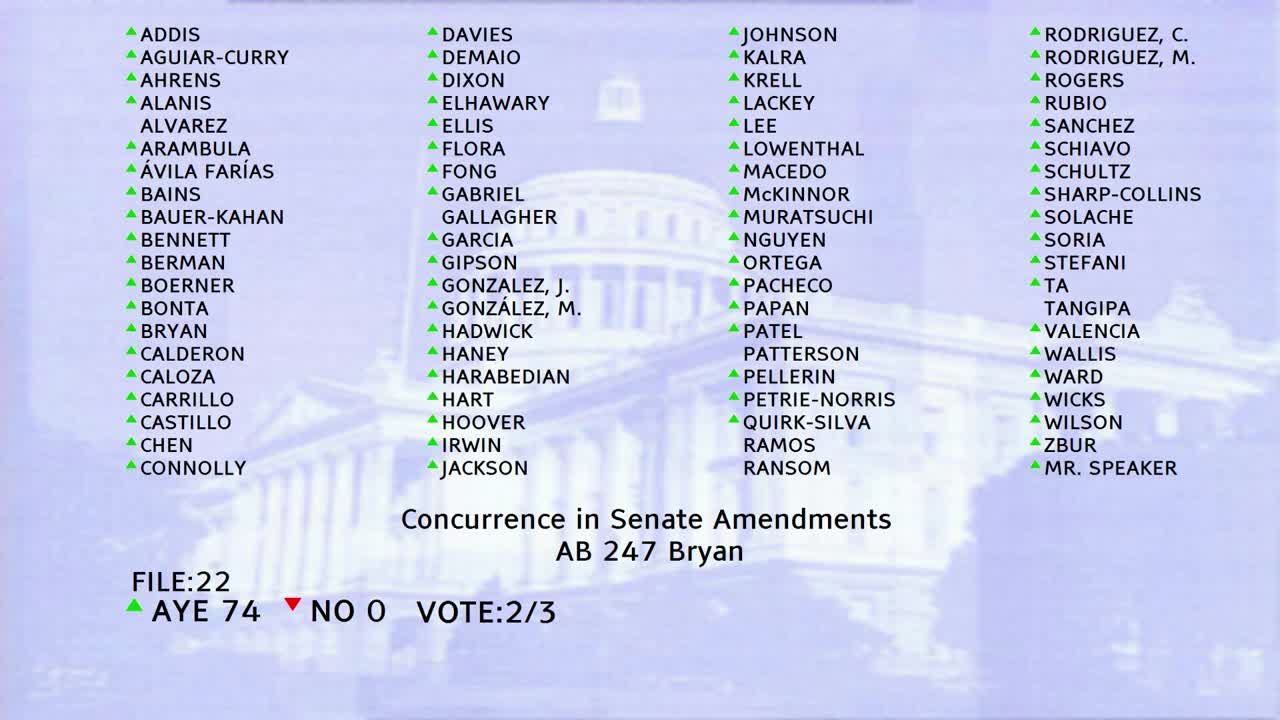 47SEC
Assembly Floor
 1MIN
Senate Floor
 2MIN
Senate Floor
 33SEC
Senate Standing Committee on Appropriations
 3MIN
Senate Standing Committee on Housing
 5MIN
Senate Standing Committee on Judiciary
 1MIN
Assembly Floor
 1MIN
Assembly Standing Committee on Judiciary
Bill Author