AB 2073: Child protection: safe surrender.
- Session Year: 2025-2026
- House: Assembly
- Latest Version Date: 2026-02-18
Current Status:
In Progress
(2026-04-14: In committee: Set, final hearing. Testimony taken.)
Introduced
In Committee
Awaiting First Chamber Vote
Passed First Chamber
In Committee
Awaiting Second Chamber Vote
Passed Second Chamber
Enacted
Existing law defines a safe-surrender site to mean a location designated by the board of supervisors of a county or by a local fire agency, or a location within a public or private hospital that is designated by that hospital, to be responsible for accepting physical custody of a minor child who is 72 hours old or younger from a parent or individual who has lawful custody of that child and who surrenders the child. Existing law requires personnel on duty at a safe-surrender site to accept physical custody of the minor child, and to notify child protective services or a county agency providing child welfare services as soon as possible, but no later than 48 hours of accepting custody of the child. Existing law makes a violation of these provisions a crime.
This bill would authorize, but not require, a safe-surrender site to install an infant safety device, as defined. The bill would require that an infant safety device be climate controlled, equipped with a dual alarm system, as described, and provide for a process or mechanism that maintains the anonymity of an individual who is surrendering a minor child. The bill would require a safe-surrender site that does install an infant safety device to visually check the device and test the above-described alarm system at specified intervals. Because a violation of the provisions relating to safe-surrender sites is a crime, this bill would impose a state-mandated local program.
Under existing law, a parent or other individual with lawful custody of a minor child 72 hours old or younger who voluntarily surrenders physical custody of the child to personnel on duty at a safe-surrender site cannot be prosecuted for child abandonment.
This bill would additionally prevent a parent or other above-described individual from being prosecuted for child abandonment if the parent or individual voluntarily places the minor child in an infant safety device at a safe-surrender site.
The California Constitution requires the state to reimburse local agencies and school districts for certain costs mandated by the state. Statutory provisions establish procedures for making that reimbursement.
This bill would provide that no reimbursement is required by this act for a specified reason.
(a)(1)For purposes of this section, safe-surrender the following definitions apply:
(1)(A)Infant safety device means a device that meets all of the following criteria:
(i)It is voluntarily installed by a safe-surrender site.
(ii)It is physically located inside a safe-surrender site that is staffed 24 hours a day by medical or emergency personnel.
(iii)It is placed in a conspicuous location that is visible to personnel on duty at the safe-surrender site.
(iv)It is equipped with an adequate dual alarm system that is connected to the physical location of the device and that alerts staff immediately when a child is placed inside.
(v)It is climate-controlled and locks automatically upon closure.
(vi)It provides for a process or mechanism that maintains the anonymity of an individual who is surrendering a minor child to a safe-surrender site.
(B)A safe-surrender site that installs an infant safety device shall ensure that the alarm system described in clause (iv)_is tested at least one time per week, and that the device is visually checked at least two times per day.
(2)Lawful custody means physical custody of a minor 72 hours old or younger accepted by a person from a parent of the minor, who the person believes in good faith is the parent of the minor, with the specific intent and promise of effecting the safe surrender of the minor.
(3)Parent means a birth parent of a minor child who is 72 hours old or younger.
(4)Personnel means a person who is an officer or employee of a safe-surrender site or who has staff privileges at the site.
(5)Safe-surrender site means either of the following:
(A)A location designated by the board of supervisors of a county or by a local fire agency, upon the approval of the appropriate local governing body of the agency, to be responsible for accepting physical custody of a minor child who is 72 hours old or younger from a parent or individual who has lawful custody of the child and who surrenders the child pursuant to Section 271.5 of the Penal Code. Before designating a location as a safe-surrender site pursuant to this subdivision, the designating entity shall consult with the governing body of a city, if the site is within the city limits, and with representatives of a fire department and a child welfare agency that may provide services to a child who is surrendered at the site, if that location is selected.
(B)A location within a public or private hospital that is designated by that hospital to be responsible for accepting physical custody of a minor child who is 72 hours old or younger from a parent or individual who has lawful custody of the child and who surrenders the child pursuant to Section 271.5 of the Penal Code.
(2)For purposes of this section, parent means a birth parent of a minor child who is 72 hours old or younger.(3)For purposes of this section, personnel means a person who is an officer or employee of a safe-surrender site or who has staff privileges at the site.(4)(b)A hospital and a safe-surrender site designated by the county board of supervisors or by a local fire agency, upon the approval of the appropriate local governing body of the agency, shall post a sign displaying a statewide logo that has been adopted by the State Department of Social Services that notifies the public of the location where a minor child 72 hours old or younger may be safely surrendered pursuant to this section.
(b)(c)Personnel on duty at a safe-surrender site shall accept physical custody of a minor child 72 hours old or younger pursuant to this section if a parent or other individual having lawful custody of the child voluntarily surrenders physical custody of the child to personnel who are on duty at the safe-surrender site. Safe-surrender site personnel shall ensure that a qualified person does all of the following:
(1)Places a coded, confidential ankle bracelet on the child.
(2)Provides, or makes a good faith effort to provide, to the parent or other individual surrendering the child a copy of a unique, coded, confidential ankle bracelet identification in order to facilitate reclaiming the child pursuant to subdivision (f). If the child is surrendered in an infant safety device, this requirement is met by placing the ankle bracelet identification inside the device. However, possession of the ankle bracelet identification, in and of itself, does not establish parentage or a right to custody of the child.
(3)Provides, or makes a good faith effort to provide, to the parent or other individual surrendering the child a medical information questionnaire, which may be declined, voluntarily filled out and returned at the time the child is surrendered, or later filled out and mailed in the envelope provided for this purpose. If the child is surrendered in an infant safety device, this requirement is met by placing the medical information questionnaire inside the device. This medical information questionnaire shall not require identifying information about the child or the parent or individual surrendering the child, other than the identification code provided in the ankle bracelet placed on the child. Every questionnaire provided pursuant to this section shall begin with the following notice in no less than 12-point type:
NOTICE: THE BABY YOU HAVE BROUGHT IN TODAY MAY HAVE SERIOUS MEDICAL NEEDS IN THE FUTURE THAT WE DONT KNOW ABOUT TODAY. SOME ILLNESSES, INCLUDING CANCER, ARE BEST TREATED WHEN WE KNOW ABOUT FAMILY MEDICAL HISTORIES. IN ADDITION, SOMETIMES RELATIVES ARE NEEDED FOR LIFE-SAVING TREATMENTS. TO MAKE SURE THIS BABY WILL HAVE A HEALTHY FUTURE, YOUR ASSISTANCE IN COMPLETING THIS QUESTIONNAIRE FULLY IS ESSENTIAL. THANK YOU.
(d)Personnel of a safe-surrender site that has physical custody of a minor child pursuant to this section shall ensure that a medical screening examination and any necessary medical care is provided to the minor child. Notwithstanding any other provision of law, the consent of the parent or other relative shall not be required to provide that care to the minor child.
(d)(e)(1)As soon as possible, but in no event later than 48 hours after the physical custody of a child has been accepted pursuant to this section, personnel of the safe-surrender site that has physical custody of the child shall notify child protective services or a county agency providing child welfare services pursuant to Section 16501 of the Welfare and Institutions Code, that the safe-surrender site has physical custody of the child pursuant to this section. In addition, medical information pertinent to the childs health, including, but not limited to, information obtained pursuant to the medical information questionnaire described in paragraph (3) of subdivision (b) that has been received by or is in the possession of the safe-surrender site shall be provided to that child protective services or county agency.
(2)Any personal identifying information that pertains to a parent or individual who surrenders a child that is obtained pursuant to the medical information questionnaire is confidential and shall be exempt from disclosure by the child protective services or county agency under the California Public Records Act (Division 10 (commencing with Section 7920.000) of Title 1 of the Government Code). Personal identifying information that pertains to a parent or individual who surrenders a child shall be redacted from any medical information provided to child protective services or the county agency providing child welfare services.
(e)(f)Child protective services or the county agency providing child welfare services pursuant to Section 16501 of the Welfare and Institutions Code shall assume temporary custody of the child pursuant to Section 300 of the Welfare and Institutions Code immediately upon receipt of notice under subdivision (d). Child protective services or the county agency providing child welfare services pursuant to Section 16501 of the Welfare and Institutions Code shall immediately investigate the circumstances of the case and file a petition pursuant to Section 311 of the Welfare and Institutions Code. Child protective services or the county agency providing child welfare services pursuant to Section 16501 of the Welfare and Institutions Code shall immediately notify the State Department of Social Services of each child to whom this subdivision applies upon taking temporary custody of the child pursuant to Section 300 of the Welfare and Institutions Code. As soon as possible, but no later than 24 hours after temporary custody is assumed, child protective services or the county agency providing child welfare services pursuant to Section 16501 of the Welfare and Institutions Code shall report all known identifying information concerning the child, except personal identifying information pertaining to the parent or individual who surrendered the child, to the California Missing Children Clearinghouse and to the National Crime Information Center.
(f)(g)If, prior to the filing of a petition under subdivision (e), a parent or individual who has voluntarily surrendered a child pursuant to this section requests that the safe-surrender site that has physical custody of the child pursuant to this section return the child and the safe-surrender site still has custody of the child, personnel of the safe-surrender site shall either return the child to the parent or individual or contact a child protective agency if any personnel at the safe-surrender site knows or reasonably suspects that the child has been the victim of child abuse or neglect. The voluntary surrender of a child pursuant to this section is not in and of itself a sufficient basis for reporting child abuse or neglect. The terms child abuse, child protective agency, mandated reporter, neglect, and reasonably suspects shall be given the same meanings as in Article 2.5 (commencing with Section 11164) of Title 1 of Part 4 of the Penal Code.
(g)(h)Subsequent to the filing of a petition under subdivision (e), if, within 14 days of the voluntary surrender described in this section, the parent or individual who surrendered custody returns to claim physical custody of the child, the child welfare agency shall verify the identity of the parent or individual, conduct an assessment of that persons circumstances and ability to parent, and request that the juvenile court dismiss the petition for dependency and order the release of the child, if the child welfare agency determines that none of the conditions described in subdivisions (a) to (d), inclusive, of Section 319 of the Welfare and Institutions Code currently exist.
(h)(i)A safe-surrender site, or the personnel of a safe-surrender site, shall not have liability of any kind for a surrendered child prior to taking actual physical custody of the child. A safe-surrender site, or personnel of the safe-surrender site, that accepts custody of a surrendered child pursuant to this section shall not be subject to civil, criminal, or administrative liability for accepting the child and caring for the child in the good faith belief that action is required or authorized by this section, including, but not limited to, instances where the child is older than 72 hours or the parent or individual surrendering the child did not have lawful physical custody of the child. A safe-surrender site, or the personnel of a safe-surrender site, shall not be subject to civil, criminal, or administrative liability for a surrendered child prior to the time that the site or its personnel know, or should know, that the child has been surrendered. This subdivision does not confer immunity from liability for personal injury or wrongful death, including, but not limited to, injury resulting from medical malpractice. malpractice or acts or omissions constituting gross negligence or willful or wanton misconduct.
(i)(j)(1)In order to encourage assistance to persons who voluntarily surrender physical custody of a child pursuant to this section or Section 271.5 of the Penal Code, no person who, without compensation and in good faith, provides assistance for the purpose of effecting the safe surrender of a minor 72 hours old or younger shall be civilly liable for injury to or death of the minor child as a result of the persons acts or omissions. This immunity does not apply to an act or omission constituting gross negligence, recklessness, or willful misconduct.
(2)For purposes of this section, paragraph, assistance means transporting the minor child to the safe-surrender site as a person with lawful custody, or transporting or accompanying the parent or person with lawful custody at the request of that parent or person to effect the safe surrender, or performing any other act in good faith for the purpose of effecting the safe surrender of the minor.
(j) For purposes of this section, lawful custody means physical custody of a minor 72 hours old or younger accepted by a person from a parent of the minor, who the person believes in good faith is the parent of the minor, with the specific intent and promise of effecting the safe surrender of the minor.(k)Any identifying information that pertains to a parent or individual who surrenders a child pursuant to this section, that is obtained as a result of the questionnaire described in paragraph (3) of subdivision (b) or in any other manner, is confidential, shall be exempt from disclosure under the California Public Records Act (Division 10 (commencing with Section 7920.000) of Title 1 of the Government Code), and shall not be disclosed by any personnel of a safe-surrender site that accepts custody of a child pursuant to this section.
SEC. 2.Section 271.5 of the Penal Code is amended to read:271.5.(a)No A parent or other individual having lawful custody of a minor child 72 hours old or younger may shall not be prosecuted for a violation of Section 270, 270.5, 271, or 271a if he or she that parent or individual voluntarily surrenders physical custody of the child to personnel on duty at a safe-surrender site. site or voluntarily places the child in an infant safety device at a safe-surrender site.
(b)For purposes of this section,infant safety device, lawful custody, personnel, and safe-surrender site has have the same meaning as defined in paragraph (1) of subdivision (a) of Section 1255.7 of the Health and Safety Code.
(c)(1)For purposes of this section, lawful custody has the same meaning as defined in subdivision (j) of Section 1255.7 of the Health and Safety Code.(2)For purposes of this section, personnel has the same meaning as defined in paragraph (3) of subdivision (a) of Section 1255.7 of the Health and Safety Code.SEC. 3.No reimbursement is required by this act pursuant to Section 6 of Article XIIIB of the California Constitution because the only costs that may be incurred by a local agency or school district will be incurred because this act creates a new crime or infraction, eliminates a crime or infraction, or changes the penalty for a crime or infraction, within the meaning of Section 17556 of the Government Code, or changes the definition of a crime within the meaning of Section 6 of Article XIIIB of the California Constitution.
|
Date
|
Status
|
|---|---|
| Apr 14, 2026 | In committee: Set, final hearing. Testimony taken. |
| Apr 7, 2026 | In committee: Set, second hearing. Hearing canceled at the request of author. |
| Mar 24, 2026 | In committee: Set, first hearing. Hearing canceled at the request of author. |
| Mar 9, 2026 | Referred to Coms. on PUB. S. and JUD. |
| Feb 19, 2026 | From printer. May be heard in committee March 21. |
| Feb 18, 2026 | Read first time. To print. |
This list shows positions taken on this bill by organizations on the date displayed, which is linked to the original source.
Positions by individuals are not included.
|
Organization
|
Position
|
Date
|
|---|---|---|
| 1 Private Individual | ** Support | |
| Adoptee Advocates of Michigan | ** Against | |
| Bastard Nation: the Adoptee Rights Organization | ** Against | |
| California Baptist for Biblical Values | ** Support | |
| California Family Council | ** Support | |
| Concerned Women for America | ** Support | |
| Real Impact. | ** Support | |
| San Joaquin County Republican Assembly | ** Support | |
| The California Baptist Capitol Ministry | ** Support |
Date of Hearing:
Counsel: Dustin Weber
ASSEMBLY COMMITTEE ON
Nick Schultz, Chair
ABPCA Bill Id:
Author:() – As Ver:
SUMMARY:
Exempts from prosecution, for willfully omitting from a child certain necessities of life, among other defined crimes against children, an individual who voluntarily places a child 72 hours old or younger in an infant safety device at a safe-surrender site. Specifically, this bill:
- States that a parent or other individual having lawful custody of a minor child 72 hours old or younger shall not be prosecuted for specified violations of the Penal Code, if that parent or individual voluntarily places the child in an infant safety device at a safe-surrender site.
- Provides that personnel at a safe surrender site generally shall not have liability for a child surrendered at a safe surrender site, however, immunity is not conferred for injury resulting from acts or omissions constituting gross negligence or willful or wanton misconduct.
- Requires a safe-surrender site that installs an infant safety device to ensure that the alarm system described is tested at least one time per week, and that the device is visually checked at least two times per day.
- Defines “infant safety device” as a device that meets all of the following criteria:
- It is voluntarily installed by a safe-surrender site;
- It is physically located inside a safe-surrender site that is staffed 24 hours a day by medical or emergency personnel;
- It is placed in a conspicuous location that is visible to personnel on duty at the safe-surrender site;
- It is equipped with an adequate dual alarm system that is connected to the physical location of the device and that alerts staff immediately when a child is placed inside;
- It is climate-controlled and locks automatically upon closure; and,
- It provides for a process or mechanism that maintains the anonymity of an individual who is surrendering a minor child to a safe-surrender site.
EXISTING LAW:
- States that a parent of a minor child who willfully omits to furnish necessary clothing, food, shelter or medical attendance, or other remedial care for his or her child, he or she is guilty of a misdemeanor punishable by a fine not exceeding two thousand dollars ($2,000), or by imprisonment in the county jail not exceeding one year, or by both such fine and imprisonment. This statute shall not be construed so as to relieve such parent from the criminal liability defined herein for such omission merely because the other parent of such child is legally entitled to the custody of such child nor because the other parent of such child or any other person or organization voluntarily or involuntarily furnishes such necessary food, clothing, shelter or medical attendance or other remedial care for such child or undertakes to do so. (Pen. Code, § 270.)
- Provides that proof of abandonment or desertion of a child by such parent, or the omission by such parent to furnish necessary food, clothing, shelter or medical attendance or other remedial care for his or her child is prima facie evidence that such abandonment or desertion or omission to furnish necessary food, clothing, shelter or medical attendance or other remedial care is willful and without lawful excuse. (Pen. Code, § 270.)
- Establishes that every parent who refuses to accept his or her minor child into the parent’s home, or, failing to do so, to provide alternative shelter, upon being requested to do so by a child protective agency and after being informed of the duty imposed by this statute to do so, is guilty of a misdemeanor and shall be punished by a fine of not more than five hundred dollars ($500). (Pen. Code, § 270.5, subd. (a).)
- States that every parent of any child under the age of 14 years, and every person to whom any such child has been confided for nurture, or education, who deserts such child in any place whatever with intent to abandon it, is punishable by a wobbler. (Pen. Code, § 271.)
- States that every person who knowingly and willfully abandons, or who, having ability so to do, fails or refuses to maintain his or her minor child under the age of 14 years, or who falsely, knowing the same to be false, represents to any manager, officer or agent of any orphan asylum or charitable institution for the care of orphans, that any child for whose admission into that asylum or institution application has been made is an orphan, is punishable by as a wobbler. (Pen. Code, § 271a.)
- Provides that no parent or other individual having lawful custody of a minor child 72 hours old or younger may be prosecuted for defined violations if he or she voluntarily surrenders physical custody of the child to personnel on duty at a safe-surrender site. (Pen. Code, § 271.5, subd. (a).)
- States that a hospital and a safe-surrender site designated by the county board of supervisors or by a local fire agency, upon the approval of the appropriate local governing body of the agency, shall post a sign displaying a statewide logo that has been adopted by the State Department of Social Services (DSS) that notifies the public of the location where a minor child 72 hours old or younger may be safely surrendered. (Health & Saf. Code, § 1255.7, subd. (a)(4).)
- Requires personnel on duty at a safe-surrender site shall accept physical custody of a minor child 72 hours old or younger pursuant to this section if a parent or other individual having lawful custody of the child voluntarily surrenders physical custody of the child to personnel who are on duty at the safe-surrender site. Safe-surrender site personnel shall ensure that a qualified person does all of the following:
- Places a coded, confidential ankle bracelet on the child;
- Provides, or makes a good faith effort to provide, to the parent or other individual surrendering the child a copy of a unique, coded, confidential ankle bracelet identification in order to facilitate reclaiming the child. However, possession of the ankle bracelet identification, in and of itself, does not establish parentage or a right to custody of the child; and,
- Provides, or makes a good faith effort to provide, to the parent or other individual surrendering the child a medical information questionnaire, which may be declined, voluntarily filled out and returned at the time the child is surrendered, or later filled out and mailed in the envelope provided for this purpose. This medical information questionnaire shall not require identifying information about the child or the parent or individual surrendering the child, other than the identification code provided in the ankle bracelet placed on the child. (Health & Saf. Code, § 1255.7, subd. (b).)
- Requires personnel of a safe-surrender site that has physical custody of a minor child to ensure that a medical screening examination and any necessary medical care is provided to the minor child. (Health & Saf. Code, § 1255.7, subd. (c).)
- Provides that as soon as possible, but in no event later than 48 hours after the physical custody of a child has been accepted, personnel of the safe-surrender site that has physical custody of the child shall notify child protective services or a county agency providing child welfare services, as specified, that the safe-surrender site has physical custody of the child. (Health & Saf. Code, § 1255.7, subd. (d)(1).)
- States that any personal identifying information that pertains to a parent or individual who surrenders a child that is obtained pursuant to the medical information questionnaire is confidential and shall be exempt from disclosure by the child protective services or county agency under the California Public Records Act. (Health & Saf. Code, § 1255.7, subd. (d)(2).)
- Personal identifying information that pertains to a parent or individual who surrenders a child shall be redacted from any medical information provided to child protective services or the county agency providing child welfare services. (Health & Saf. Code, § 1255.7, subd. (d)(2).)
- Requires child protective services or the county agency providing child welfare services to assume temporary custody of the child immediately upon receipt of notice. (Health & Saf. Code, § 1255.7, subd. (e).)
- Requires child protective services or the county agency providing child welfare services to immediately investigate the circumstances of the case and file a petition. (Health & Saf. Code, § 1255.7, subd. (e).)
- Requires child protective services or the county agency providing child welfare services to immediately notify the DSS of each surrendered child upon taking temporary custody of the child. (Health & Saf. Code, § 1255.7, subd. (e).)
- Provides that, as soon as possible, but no later than 24 hours after temporary custody is assumed, child protective services or the county agency providing child welfare services shall report all known identifying information concerning the child, except personal identifying information pertaining to the parent or individual who surrendered the child, to the California Missing Children Clearinghouse and to the National Crime Information Center. (Health & Saf. Code, § 1255.7, subd. (e).)
- States that if, prior to the filing of a petition, a parent or individual who has voluntarily surrendered a child requests that the safe-surrender site that has physical custody of the child return the child and the safe-surrender site still has custody of the child, personnel of the safe-surrender site shall either return the child to the parent or individual or contact a child protective agency if any personnel at the safe-surrender site knows or reasonably suspects that the child has been the victim of child abuse or neglect. The voluntary surrender of a child is not in and of itself a sufficient basis for reporting child abuse or neglect. (Health & Saf. Code, § 1255.7, subd. (f).)
- Provides that subsequent to the filing of a petition, if, within 14 days of the voluntary surrender, the parent or individual who surrendered custody returns to claim physical custody of the child, the child welfare agency shall verify the identity of the parent or individual, conduct an assessment of that person’s circumstances and ability to parent, and request that the juvenile court dismiss the petition for dependency and order the release of the child, if the child welfare agency determines that none of the specified conditions currently exist. (Health & Saf. Code, § 1255.7, subd. (g).)
- States that a safe-surrender site, or the personnel of a safe-surrender site, shall not have liability of any kind for a surrendered child prior to taking actual physical custody of the child, and shall not be subject to civil, criminal, or administrative liability for accepting the child and caring for the child in the good faith belief that action is required or authorized. (Health & Saf. Code, § 1255.7, subd. (h).)
- States that in order to encourage assistance to persons who voluntarily surrender physical custody of a child, no person who, without compensation and in good faith, provides assistance for the purpose of effecting the safe surrender of a minor 72 hours old or younger shall be civilly liable for injury to or death of the minor child as a result of the person’s acts or omissions. This immunity does not apply to an act or omission constituting gross negligence, recklessness, or willful misconduct. (Health & Saf. Code, § 1255.7, subd. (i)(1).)
- Provides that any identifying information that pertains to a parent or individual who surrenders a child, that is obtained as a result of the questionnaire or in any other manner, is confidential, shall be exempt from disclosure, and shall not be disclosed by any personnel of a safe-surrender site that accepts custody of a child pursuant to this section. (Health & Saf. Code, § 1255.7, subd. (k).)
FISCAL EFFECT:
Unknown
COMMENTS:
- Author's Statement: According to the author, “I am proud to author AB 2073, which will provide local governments with a new legal mechanism to reduce unsafe abandonments and custody surrenders. This bill modernizes California's Safely Surrendered Baby Law by authorizing the optional installation of regulated infant safety devices to address a critical deficiency in current law: the requirement for a face-to-face handoff. While existing statutes provide legal confidentiality, the lack of a truly anonymous option remains a significant barrier for parents in extreme crisis who are deterred by the fear of judgment or a lack of privacy. This fear often leads to infants being abandoned in unsafe environments like dumpsters or parks. By authorizing climate-controlled, alarm-equipped devices, this bill provides a 100% anonymous and legal last-resort option that prevents illegal abandonment and ensures newborns are retrieved by medical personnel within minutes.”
- Effect of the Bill: AB 2073 would provide for optional safe surrender sites with infant safety devices, which are colloquially known as “baby boxes.”
A safe surrender site is generally defined as a location designated by a local governing agency, established in consultation with local fire departments and child welfare agencies that may provide services for surrendered infants. (Health & Saf. Code, § 1255.7, subd. (a)(5)(A).) A public or private hospital with the responsibility and capacity to take in a surrendered infant is also permissible. (Health & Saf. Code, § 1255.7, subd. (a)(5)(B).) Safe surrender sites shall post signage notifying the public of its location and qualified personnel must be on duty at safe surrender sites. (Health & Saf. Code, § 1255.7, subds. (b) & (c).)
AB 2073 would make installment of defined infant safety devices optional for localities that choose to use them. Should a locality choose to install an infant safety device, the person or individual surrendering a child in an infant safety device would be immune from prosecution for certain acts prohibited by law that harm children (See Pen. Code, §§ 270-271a.). It is unclear whether these devices would improve on the existing system California has implemented for safe surrender of children.
- Need for the Bill: AB 2073 would provide another option for surrendering infants in designated infant safety devices. The bill does not mandate installation of infant safety devices but instead permits them. By offering installation of infant safety devices only as an option, this bill offers localities the ability to decide for themselves what best suits the needs of their communities. California has relatively well-established surrender laws, however, so it is unclear whether there is a need for this legislation.
There may be a concern that the “overwhelming majority of the more than 200 active baby boxes currently in place in at least 15 states are provided by one company: a nonprofit called Safe Haven Baby Boxes Inc.”[1] This article notes the recent growth of baby boxes in states that have more restrictive abortion laws.[2] At least 19 states permit newborn drop-off boxes, though more than half of those devices installed are in Indiana, which is the home state of the company that makes them.[3]
It is similarly unclear whether these boxes are as effective relative to different remedies for individuals in crisis who feel they need to surrender their infant. One bioethicist at Yale School of Medicine describes baby boxes as a “poor solution to infant abandonment because we know things like prenatal care are more integral to the health of an infant, as well as to the birthing parent.”[4] Rather than baby boxes, she suggests states should consider authorizing women to deliver at hospitals anonymously, which would provide for relinquishing their newborns in a safer setting.[5] Certain experts are also concerned by the inability to establish informed consent or medical histories.[6] Some scholars question whether surrender is truly voluntary in the context of baby box drop-offs.[7]
There does not appear to be much uniformity in safe surrender laws across the country making data collection and analysis difficult.[8] One of the few recognized evidence-based approaches is led by Dr. Micah Orliss, who leads safe surrender program at the Children’s Hospital Los Angeles.[9] In one study led by Dr. Orliss, his team found over half of surrendered infants had medical issues, while the majority were surrendered in communities with low median incomes.[10] The National Safe Haven Alliance, however, estimates more than 4,500 babies have been surrendered pursuant to safe haven laws since 1999.[11] They additionally estimate another roughly 1,600 babies were illegally abandoned, of which fewer than 50% were found alive.[12]
There appears to be genuine controversy over the need for this type of intervention. Bipartisan votes have been taken in many states supporting installation of these infant safety devices, but some experts caution that votes funding these baby boxes are poor replacements for investing in evidence-based prenatal and postnatal care.[13] California is a national leader in prenatal and postnatal services, according to the March of Dimes, ranking seventh nationally.[14] According to Forbes, California ranks third in the nation in best states to have a baby.[15] Given the available data, it is difficult to establish a clear need for this bill.
- Argument in Support: According to the California Family Council, “On behalf of tens of thousands of constituents, allied organizations, and more than 2,000 churches across California, the California Family Council proudly supports AB 2073, legislation that strengthens California’s commitment to protecting vulnerable newborns.
“California’s Safe Surrender law was established to provide a compassionate, life-affirming option for women in crisis. AB 2073 builds on that foundation by helping ensure safe surrender is as safe, accessible, and effective as possible for mothers facing overwhelming circumstances.
“AB 2073 allows designated Safe Surrender locations to install regulated infant safety devices commonly known in other states as “baby boxes.” These devices place surrendered infants in a secure, climate-controlled environment and immediately alert on-site staff to respond. This rapid notification system increases response speed, ensuring that trained personnel attend to the infant within minutes. These devices are designed to work in tandem with, not replace, in-person Safe Surrender options.
“According to Safe Haven Baby Boxes, over 300 boxes have been installed across 20 states as of January 2025, each equipped with cutting-edge technology to ensure the safety and immediate care of surrendered infants.
“For some parents overwhelmed by fear, trauma, or stigma, directly approaching personnel may feel unthinkable. Infant safety devices provide a critical last resort alternative for those in desperate situations who might otherwise abandon a child in an unsafe location. AB 2073 upholds and reinforces the intent of California’s Safe Surrender law: to protect life, reduce unsafe abandonment, and give every newborn the opportunity for safety and care. For these reasons, California Family Council respectfully urges a yes vote on AB 2073.”
- Argument in Opposition: According to Bastard Nation: The Adoption Rights Organization and Stop Safe Haven Baby Boxes Now, “Safe Haven Baby Box advocates claim that traditional Safe Haven laws, with their anonymous personal hand-off ‘relinquishment’ provisions, are tricky and dangerous. ‘Women demand anonymity’ leading proponents insist--granted total anonymity in child relinquishment, in order to be protected from shame and guilt. But what says more about shame and guilt than promoting a program where women are taught how to hide pregnancy and childbirth, skip pre-and post- natal care, and encouraged to skulk around dark obscure (but “prominent”) spots outside of hospitals and fire or police stations to drop their babies into a box, like trash, and walk away. ‘No one will ever have to know.’ But people will know!
“Under AB2073, babies up to 3 days of age can be dropped off at state-designated locations such as hospitals and fire stations or just left in a box. These babies potentially have known identities parent(s), families, medical providers, social connections, birth certificates, Social Security cards, and any number of other ties to their families and communities. With passage of AB2073, they will be unceremoniously disappeared inside a box. And no one will ask ‘Where's the baby?’???? Seriously!
“This personal hand-off practice that occurs currently in California offers but does not force interventions: crisis counseling services, support, family preservation options. In other words, decompression and reconsideration. Traditional safe haven advocates, in fact, report that about 30% of mothers who initially plan to use their state's safe haven law, change their minds and retain custody, transfer custody to a family member, or place their babies in open adoptions. According to the Office of Child Abuse Prevention see above link) 65 babies have reclaimed by their parents.
“The secret Safe Haven Baby Box procedure makes retrieval nearly impossible.”
- Related Legislation: AB 1628 (M. Rodriguez) would establish a parent or other individual with lawful custody of a minor child 30 days of age or younger, who voluntarily surrenders physical custody of the child to personnel on duty at a safe-surrender site, cannot be prosecuted for child abandonment. AB 1628 is currently set for a later hearing in this committee.
- Prior Legislation:
- AB 1048 (Torrico), Chapter 567, Statutes of 2010, requires a designating entity to consult with the governing body of a city, if the site is within city limits, and with representatives of the applicable fire department and child welfare agency, as specified. The bill would permit a local fire agency, upon the approval of the appropriate local governing body of the agency, to designate a safe-surrender site.
- AB 81 (Torrico), of the 2007-2008 Legislative Session, would have permitted a local fire agency, upon the approval of the appropriate local governing body of the agency, to designate a safe-surrender site. The bill would have specified certain circumstances in which a safe-surrender site and its personnel have no liability for a surrendered child. AB 81 was vetoed by the Governor.
- AB 2262 (Torrico), of the 2007-2008 Legislative Session, would have permitted a local fire agency, upon the approval of the appropriate local governing body of the agency, to designate a safe-surrender site. The bill would have specified certain circumstances in which a safe-surrender site and its personnel have no liability for a surrendered child. AB 81 was vetoed by the Governor.
- SB 116 (Dutton), Chapter 625, Statutes of 2005, repealed the sunset date for laws that made it a crime, among other things, for a parent of a minor child, without lawful excuse, to not furnish necessary clothing, food, shelter, or medical or remedial care for the child, or to refuse, without lawful excuse, to accept the child in his or her home or provide alternate shelter.
- AB 1873 (Torrico), of the 2005-2006 Legislative Session, would have designated certain locations as safe‑surrender sites for the safe surrender of newborn children who are 30 days of age or younger. AB 1873 was vetoed by the Governor.
- SB 1413 (Brulte), Chapter 103, Statutes of 2004, provides that no person who, without compensation and in good faith, provides assistance for the purpose of effecting the safe surrender of a minor 72 hours old or younger shall be civilly liable for injury to, or the death of, the minor child as a result of any of his or her acts or omissions.
- SB 139 (Brulte), Chapter 139, Statutes of 2003, eliminated the requirement that the child be surrendered to a designated employee on duty in the emergency room of a hospital or location designated by the board of supervisors. SB 139 allows the surrender of the child to a safe-surrender site, as defined, at a hospital or location designated for this purpose by a county board of supervisors.
- AB 1048 (Torrico), Chapter 567, Statutes of 2010, requires a designating entity to consult with the governing body of a city, if the site is within city limits, and with representatives of the applicable fire department and child welfare agency, as specified. The bill would permit a local fire agency, upon the approval of the appropriate local governing body of the agency, to designate a safe-surrender site.
REGISTERED SUPPORT / OPPOSITION:
Support
California Baptist for Biblical Values
California Family Council
Concerned Women for America
Real Impact.
San Joaquin County Republican Assembly
The California Baptist Capitol Ministry
1 Private Individual
Opposition
Adoptee Advocates of Michigan
Bastard Nation: the Adoptee Rights Organization
Analysis Prepared by:
Vollers, A.C. More places install drop-off boxes for surrendered babies. Critics say they’re a gimmick. (Feb. 26, 2024) Stateline <https://stateline.org/2024/02/26/more-places-install-drop-off-boxes-for-surrendered-babies-critics-say-theyre-a-gimmick/> [as of Mar. 18, 2026]. ↑
Ibid. ↑
Ibid. ↑
Ibid. ↑
Ibid. ↑
Ibid. ↑
Ibid. ↑
Lewis, C and Oberman, M. Wildly Inconsistent Safe Haven Laws Put Surrendered Infants, Parents at Risk (Jan. 17, 2023) Governing < https://www.governing.com/now/wildly-inconsistent-safe-haven-laws-put-surrendered-infants-parents-at-risk> [as of Mar. 18, 2026] (The author of this analysis attended law school where one author of this article, Professor Michelle Oberman, teaches courses. However, the analysis’ author did not have a class taught by Professor Oberman.). ↑
Ibid. ↑
Orliss, M, et al. Safely surrendered infants in Los Angeles County: A medically vulnerable population (July 30, 2019) National Institute of Health (NIH) <https://pubmed.ncbi.nlm.nih.gov/31322754/> [as of Mar. 18, 2026]. ↑
Ibid. ↑
Ibid. ↑
Ibid. ↑
2025 Report Card for California <https://www.marchofdimes.org/peristats/reports/california/report-card> [as of Mar. 18, 2026]. ↑
Galan, F. What’s the best state in the US to have a baby? Here’s where California ranked (Sep. 17, 2024) https://www.sacbee.com/news/california/article292451854.html#storylink=cpy> [as of Mar. 18, 2026]. ↑
Discussed in Hearing
 5MIN
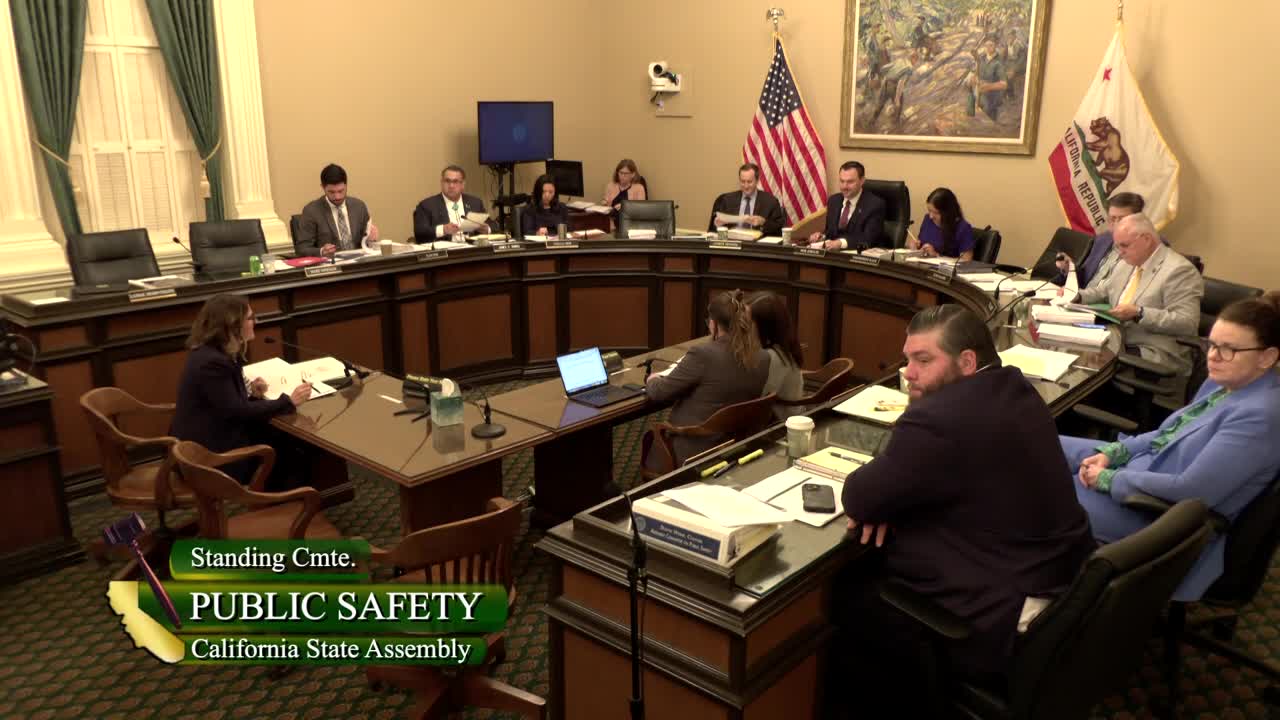
Assembly Standing Committee on Public Safety
Bill Author

Bill Co-Author(s):