AB 2462: Unsafe products: disposal: penalties.
- Session Year: 2025-2026
- House: Assembly
- Latest Version Date: 2026-02-20
Current Status:
In Progress
(2026-05-14: In committee: Held under submission.)
Introduced
In Committee
Awaiting First Chamber Vote
Passed First Chamber
In Committee
Awaiting Second Chamber Vote
Passed Second Chamber
Enacted
What does this bill do?
The bill lets the Department of Resources Recycling and Recovery impose daily fines on businesses that break California product‑recall rules — $2,500 per day or $5,000 per day if the violation was intentional. It also narrows who counts as a “manufacturer” to someone who makes a product and owns or licenses the brand it’s sold under, and requires manufacturers to provide free return or proper disposal to end consumers, recycling centers, municipal and permitted waste facilities, household hazardous waste collection sites, retailers, and thrift stores.
The summary is provided by generative AI which can make mistakes. For original language, please view the details in the table below.
Existing law, the Product Recall Safety and Protection Act, provides for the establishment and enforcement of various product safety standards for consumer products, and prohibits a commercial dealer, manufacturer, importer, distributor, wholesaler, or retailer from placing into the stream of commerce a product that is unsafe, knowing that the product is unsafe. For purposes of the act, a manufacturer is any person who makes, and places into the stream of commerce, a product.
This bill would instead state that a manufacturer is a person who manufactures a product and who owns or is the licensee of the brand or trademark under which the product is sold, as specified.
Under the act, a manufacturer is required to provide for the safe return or appropriate disposal of an unsafe product at no cost to the end consumer or retailer in a manner that is in compliance with all applicable federal, state, and local laws, regulations, and ordinances.
This bill would instead require the safe return or appropriate disposal of the unsafe product to be at no cost to the end consumer, a recycling center, a municipal facility that accepts the product for recycling or disposal, a retailer that sells the product, a permitted solid waste facility, a household hazardous waste collection facility, and a thrift retail store.
Existing law provides that any violation of the act is subject to a civil penalty of up to $1,000 per occurrence, up to a maximum of $20,000.
This bill would instead authorize the Department of Resources Recycling and Recovery to administratively impose an administrative penalty on a person in violation of the act of $2,500 per day or $5,000 per day if the violation is intentional or knowing, as specified. The bill would require the department to establish through regulations a process by which the penalties will be assessed, including an informal hearing, as specified. The bill would create the Product Recall Penalty Account in the State Treasury and would require the department to deposit the penalties collected into the account. The bill would require moneys in the account, upon appropriation by the Legislature, to be available for expenditure by the department for certain purposes. The bill would authorize the department to refer enforcement to the Department of Toxic Substances Control for unsafe products identified as hazardous waste, and would create the Hazardous Product Recall Penalty Account in the State Treasury. The bill would require moneys in the account, upon appropriation by the Legislature, to be available for expenditure by the Department of Toxic Substances Control for certain purposes.
As used in this chapter, the following terms have the following meanings:
(a)Brand means a trademark, including both a registered trademark and an unregistered trademark, a logo, a name, a symbol, a word, an identifier, or a traceable mark that identifies a product and identifies the owner or licensee of the brand.
(a)(b)Commercial dealer means any person who deals in products or who otherwise by his or her their occupation holds himself or herself themself out as having knowledge or skill peculiar to products, or any person who is in the business of remanufacturing, retrofitting, selling, leasing, subletting, or otherwise placing into the stream of commerce, commerce a product.
(c)Department means the Department of Resources Recycling and Recovery or a successor.
(b)(d)Distributor and wholesaler means any person, other than a manufacturer or retailer, who sells or resells, or otherwise places into the stream of commerce, a product.
(c)(e)End consumer means a person who purchases a product for any purpose other than resale.
(d)(f)First seller means any retailer selling a product that has not been used or has not previously been owned. A first seller does not include an entity such as a secondhand retail dealer, thrift shop, resale store, or any other establishment or individual, agent, or employee thereof that sells, distributes, rents, or leases products of any kind.
(e)(g)Importer means any person who brings into this country, and places into the stream of commerce, a product.
(f)(h)(1)Manufacturer means any person who makes, and places into the stream of commerce, a product. manufactures a product and who owns or is the licensee of the brand or trademark under which that product is sold, offered for sale, or distributed for sale in, or into, the state.
(2)For purposes of this chapter, the sale of a product shall be deemed to occur in the state if the product is delivered to the purchaser in the state.
(g)(i)Person means a natural person, firm, corporation, limited liability company, or association, or an employee or agent thereof.
(h)(j)Product means any article, or component part thereof, produced or distributed (1) for sale to a consumer for use in or around a permanent or temporary household or residence, a school, in recreation, or otherwise, or (2) for personal use, consumption, or enjoyment of a consumer in or around a permanent or temporary household or residence, a school, in recreation, or otherwise. Product does not include food, drugs, cosmetics, pesticides (as defined by the Federal Insecticide, Fungicide, and Rodenticide Act (7 U.S.C. Sec. 136 et seq.)), medical devices, firearms and ammunition, boats, motor vehicles, motor vehicle equipment, aircraft, or tobacco and tobacco products.
(i)(k)Recall means any repair, replacement, or refund program implemented in accordance with the federal Consumer Product Safety Act (15 U.S.C. Sec. 2051 et seq.) upon the determination of commission staff that a consumer product violates a commission statute or regulation, and notification to the product manufacturer, importer, distributor, or retailer that corrective action to address the violation is warranted. Recall includes a voluntary recall where a product is returned to the manufacturer for repair or replacement, usually due to defects or safety concerns, or public notice that a product is defective and must be returned to the manufacturer or retailer.
(j)(l)Retailer means any person other than a manufacturer, distributor, or wholesaler who sells, distributes, sublets, or leases consumer goods of any kind.
(m)Thrift retail store has the same meaning as subdivision (a) of Section 65631 of the Government Code.
(k)(n) Sell or sale means a transfer for consideration of title or of the right to use, by lease or sales contract, including, but not limited to, transactions conducted through sales outlets, catalogs, or the Internet internet or any other similar electronic means.
SEC. 2.Section 108046 of the Health and Safety Code is amended to read:108046.(a)A commercial dealer, manufacturer, importer, distributor, or wholesaler that has placed into the stream of commerce any unsafe product for which a recall or warning has subsequently been issued, shall initiate the following steps within 24 hours after issuing or receiving the recall notice or warning:
(1)Contact all of its customers, other than end consumers, to whom it sold, leased, sublet, or transferred that particular product. The contact shall be made to a person designated for that product by the customer and shall include a copy of the recall notice or warning.
(2)If the commercial dealer, manufacturer, importer, distributor, or wholesaler maintains an Internet Web site, internet website, the entity shall place prominently on the homepage home page or first point of entry of its Web site, internet website a link to recall or warning information that contains the specific recall notice or warning that was issued for the product in question. The recall or warning information shall include a description of the product, the reason for the recall or warning, a picture of the product, and instructions on how to participate in the recall or warning. The information shall include only the product recall or warning information and shall not include sales or marketing information on that product or any other product, excluding return and exchange policies. The recall or warning information shall permit participation in the recall or warning through the Web site internet website of the commercial dealer, manufacturer, importer, distributor, or wholesaler.
(b)(1)The manufacturer of the product shall provide for the safe return of the product to the manufacturer or the appropriate disposal of the product in the manner required pursuant to paragraph (2) at no cost to the end consumer or retailer. any of the following:
(A)The end consumer.
(B)A recycling center.
(C)A municipal facility that accepts the product for recycling or disposal.
(D)A retailer that sells the product.
(E)A permitted solid waste facility.
(F)A household hazardous waste collection facility, as defined in Section 25218.1.
(G)A thrift retail store.
(2)The manufacturer shall properly dispose of the product in a manner that is in compliance with all applicable federal, state, and local laws, regulations, and ordinances, and shall not export the product, or permit it to be exported, for disposal in a manner that poses a significant risk to the public health or the environment.
(3)The manufacturer or retailer may provide a for corrective action or retrofit onsite at the consumers home or premises for any product for which a recall or warning has been issued.
(c)If a retailer receives notice of a recall or warning regarding a product from a commercial dealer, manufacturer, importer, distributor, wholesaler, or state or federal agency, and if the retailer during the previous 18 months offered the product for sale, then the retailer shall do the following:
(1)Within three days after receiving the notice or warning by the person designated by the retailer, the retailer shall remove the product from the shelves of its stores or program its registers to ensure that the item cannot be sold.
(2)If the product was sold through the retailers Internet Web site, internet website, then within three days after receiving the notice or warning by the person designated by the retailer, the retailer shall remove the product from the Web site internet website or remove the ability to purchase the product through the Web site. internet website.
(3)Within three days after receiving the recall notice or warning by the person designated by the retailer, the retailer shall post in paper form or electronically in a prominent location in each retail store the recall notice or warning. The notice or warning shall remain posted for at least 60 days.
(4)If the product for which a recall or warning was issued was sold on the retailers Internet Web site, internet website, the retailer shall, within three days after receiving the recall notice or warning by the person designated by the retailer, post on the homepage home page or first point of entry of its Web site internet website a link to recall or warning information that contains the specific recall notice or warning that was issued for the product in question. The recall or warning information shall include a description of the product, the reason for the recall or warning, a picture of the product, if one was provided, and instructions on how to participate in the recall or warning. The information shall include only the product recall or warning information and shall not include sales or marketing information on that product or any other product, excluding return and exchange policies.
(5)A retailer who is not a first seller shall comply with this subdivision, except that the retailer has five days to comply with paragraphs (1) and (2).
(6)A retailer who is a first seller shall accept any recalled product for the purpose of returning it to the manufacturer or distributor.
(d)A commercial dealer, manufacturer, importer, wholesaler, or distributor who is also a retailer shall comply with subdivisions (a), (b), and (c), as applicable.
SEC. 3.Section 108050 of the Health and Safety Code is amended to read:108050.(a)Any violation of this chapter shall be subject to a civil penalty of up to one thousand dollars ($1,000) for each occurrence, up to a maximum of twenty thousand dollars ($20,000).108050.(a)An administrative penalty up to the following amounts may be administratively imposed by the department on any person who is in violation of any provision of this chapter:
(1)Two thousand five hundred dollars ($2,500) per day.
(2)Five thousand dollars ($5,000) per day if the violation is intentional or knowing.
(b)In assessing or reviewing the amount of an administrative penalty imposed pursuant to subdivision (a) for a violation of this chapter, the department or the court shall consider all of the following:
(1)The nature and extent of the violation.
(2)The number and severity of the violation or violations.
(3)The economic effect of the penalty on the violator.
(4)Whether the violator took good faith measures to comply with this chapter and the period of time over which these measures were taken.
(5)The willfulness of the violators misconduct.
(6)The deterrent effect that the imposition of the penalty would have on both the violator and the regulated community.
(7)Any other factor that justice may require.
(c)The department shall establish, through regulations adopted pursuant to Section 42984.2 of the Public Resources Code, a process that shall include an informal hearing process by which the penalties will be assessed.
(d)The department shall deposit all penalties collected pursuant to this section into the Product Recall Penalty Account, which is hereby created in the State Treasury. Upon appropriation by the Legislature, moneys in the Product Recall Penalty Account shall be available for expenditure by the department on activities related to the collection and recycling of products, grants for related purposes, and the administration and enforcement of this chapter.
(e)The Administrative Adjudication Bill of Rights, as set forth in Article 6 (commencing with Section 11425.10) of Chapter 4.5 of Part 1 of Division 3 of Title 2 of the Government Code, applies to hearings conducted under this chapter and mandates minimum due process.
(f)The department may refer enforcement to the Department of Toxic Substances Control for products identified as hazardous waste. If the department defers to the Department of Toxic Substances Control, any penalties collected pursuant to this section shall be deposited into the Hazardous Product Recall Penalty Account, which is hereby created in the State Treasury. Upon appropriation by the Legislature, moneys in the Hazardous Product Recall Penalty Account shall be available for expenditure by the Department of Toxic Substances Control for activities related to the collection and recycling of products, grants for related purposes, and the administration and enforcement of this chapter.
(b)(g)The remedies under this section are in addition to, and do not supersede or limit, any and all other remedies, civil or criminal.
|
Date
|
Status
|
|---|---|
| May 14, 2026 | In committee: Held under submission. |
| Apr 15, 2026 | In committee: Set, first hearing. Referred to APPR. suspense file. |
| Apr 8, 2026 | In committee: Hearing postponed by committee. |
| Mar 25, 2026 | From committee: Do pass and re-refer to Com. on APPR. (Ayes 5. Noes 1.) (March 24). Re-referred to Com. on APPR. |
| Mar 9, 2026 | Referred to Com. on E.S & T.M. |
| Feb 21, 2026 | From printer. May be heard in committee March 23. |
| Feb 20, 2026 | Read first time. To print. |
|
Date
|
Description
|
Location
|
Votes
|
|
|---|---|---|---|---|
| Mar 24, 2026 | Do pass and be re-referred to the Committee on [Appropriations] | Assembly Standing Committee on Environmental Safety and Toxic Materials |
Passed |
This list shows positions taken on this bill by organizations on the date displayed, which is linked to the original source.
Positions by individuals are not included.
|
Organization
|
Position
|
Date
|
|---|---|---|
| California Manufacturers And Technology Association | ** Against | |
| California Product Stewardship Council | ** Support | |
| California State Association Of Counties | ** Support | |
| Californians Against Waste | ** Support | |
| cleanearth4kids.org | ** Support | |
| Consumer Brands Association | ** Against | |
| Eco-Catalyst | ** Support | |
| EkoLinq | ** Support | |
| Landbell USA | ** Support | |
| League Of California Cities | ** Support | |
| National Stewardship Action Council | ** Support | |
| Recology | ** Support | |
| Reuse Alliance | ** Support | |
| Rural County Representatives of California | ** Support | |
| Sustainable Works | ** Support |
Date of Hearing: April 15, 2026
ASSEMBLY COMMITTEE ON APPROPRIATIONS
Buffy Wicks, Chair
ABPCA Bill Id:AB 2462
Author:(Pellerin) – As Introduced Ver:February 20, 2026
Policy Committee: | Environmental Safety and Toxic Materials | Vote: | 5 - 1 |
|
| ||
|
|
Urgency: No State Mandated Local Program: No Reimbursable: No
SUMMARY:
This bill amends the Product Recall Safety and Protection Act (Act) (1) to expand the list of entities from which a manufacturer of a recalled product is to provide for the safe, no-cost return of the product and (2) authorizes the Department of Resources Recycling and Recovery (CalRecycle) and the Department of Toxic Substances Control (DTSC) to enforce violations of the Act.
Specifically, this bill, among other things:
1) Requires the manufacturer of a recalled product to provide for the safe return of the product to the manufacturer or the appropriate disposal of the product at no cost to any of the following (in addition to the end consumer or retailer, as already required by existing law): a recycling center, a municipal facility that accepts the product for recycling or disposal, a retailer that sells the product, a permitted solid waste facility, a household hazardous waste (HHW) collection facility, and a thrift retail store.
2) Strikes the current civil penalty for any violation of the Act (up to $1,000 for each occurrence, up to a maximum of $20,000) and instead authorizes CalRecycle to impose an administrative penalty of $2,500 per day or $5,000 per day if the violation is intentional or knowing; allows CalRecycle to consider various specified factors in assessing or reviewing the penalty amount; and requires CalRecycle to establish through regulations a process that includes an informal hearing by which the penalties will be assessed, as specified.
3) Requires CalRecycle to deposit all penalties collected pursuant to item 2, above, into the Product Recall Penalty Account, which the bill establishes in the State Treasury and makes moneys in the Product Recall Penalty Account, upon appropriation by the Legislature, available for expenditure by CalRecycle on activities related to the collection and recycling of products, grants for related purposes, and the administration and enforcement of the Act.
4) Authorizes CalRecycle to refer enforcement to DTSC for products identified as hazardous waste; requires DTSC, if CalRecycle defers to it, to deposit any penalties collected pursuant to this bill into the Hazardous Product Recall Penalty Account, which the bill establishes in the State Treasury; and makes moneys in the Hazardous Product Recall Penalty Account, upon appropriation by the Legislature, available for the same purposes enumerated in item 3, above.
FISCAL EFFECT:
1) CalRecycle will incur significant ongoing costs, likely in the low millions of dollars annually, to implement this bill. Currently, CalRecycle does not regulate, track, or manage recalled products. Therefore, the department will need resources to build the subject matter expertise necessary to develop and adopt regulations; identify, document, and track recalled products; verify compliance; create a database for tracking and monitoring; and other related tasks.
For its part, CalRecycle estimates costs of approximately $4 million in fiscal year (FY) 2027-28 for 18 positions, a one-time contract, and consolidated data costs. The department expects these costs to increase to $4.5 million for FY 2029-30 through FY 2032-33 for 21 positions and consolidated data costs, followed by ongoing costs beginning in FY 2033-34 of $4.2 million for 21 positions.
While the bill creates the Product Recall Penalty Account and authorizes CalRecycle to spend penalty revenue on activities related to the collection and recycling of products, grants for related purposes, and the administration and enforcement of this bill, it is not clear to the committee when penalty revenue will begin accumulating in the account and whether this revenue will be sufficient to support CalRecycle’s ongoing costs. Therefore, the department may require a loan from a different fund to cover its initial – and possibly a portion of ongoing – implementation costs.
2) Under the existing Hazardous Waste Control Law (HWCL), DTSC deposits the penalties it collects for the mismanagement of hazardous waste (including for recalled products that become hazardous waste) into the Toxic Substances Control Account (TSCA). It is not entirely clear to DTSC or the committee if this bill requires the department to enforce violations of the bill beyond DTSC’s existing authority under the HWCL. If DTSC is, in fact, required to collect penalties from a manufacturer who violates this bill (by failing to provide for the safe and free return of a product identified as hazardous waste), DTSC anticipates it would incur ongoing costs of an unknown but significant amount, possibly in the millions of dollars annually (General Fund or special fund).
The exact cost to the department will depend on, among other factors, the number, scope, and complexity of the cases referred by CalRecycle. DTSC notes, given that studies indicate the rate of product recalls is on the rise and that many products would be considered hazardous waste upon disposal as part of a recall, it is possible DTSC will require significant resources to enforce the bill. However, the bill does not explicitly give DTSC the authority to collect penalties and to enforce against manufacturers who violate the provisions of this bill. Therefore, the bill, as written, may not make the Hazardous Product Recall Penalty Account available or accessible to the department.
COMMENTS:
1) Purpose. According to the author:
When products are recalled, especially when they violate the law or present a safety hazard, the responsibility should remain with the companies that made and sold them—not with taxpayers or local agencies. This is already required by federal and state laws that have been in place for decades; however, there is ambiguity in current law that allows manufacturers to shift the cost and responsibility of handling recalled products onto local governments, public waste facilities, and reuse businesses, if not properly removed from the market. AB 2462 clarifies that manufacturers and responsible parties must take back recalled products at no cost to consumers, retailers, charity thrifts, and local governments, and strengthens enforcement to ensure compliance.
2) Background. When the Federal Consumer Product Safety Commission issues a product recall, the Act requires the manufacturer of that product to provide consumers and retailers with a means to return the recalled product at no additional cost to them. According to research cited in the Assembly Environmental Safety and Toxic Materials (ESTM) Committee’s analysis of this bill, there were nearly 900 injuries linked to unsafe consumer products in 2025 as recalls hit an 18-year high. If the number of recalled products is, in fact, rising, then the original reasons for the introduction of the Act remain; recalled products stay in circulation long after the recall and end up with local governments or recycling centers instead of with the manufacturer.
A coalition of organizations writes in support of this bill that the Act did not account for consumers and retailers who send the products to recycling or waste collection sites or secondhand retailers – thereby imposing a cost on local governments, public entities, and secondhand retailers to receive and properly manage these recalled products to avoid the risk of fines. This bill seeks to address this challenge by ensuring local governments, including solid waste facilities, recycling centers, HHW collection facilities, and thrift retail stores can send recalled products back to the manufacturer at no cost.
Writing in opposition, the California Manufacturers and Technology Association and the Consumer Brands Association argue the bill significantly expands manufacturer obligations under the Act “in ways that create substantial logistical, operational, and financial
burdens without clearly improving recall effectiveness.” The opposition also objects to the penalty amounts, stating manufacturers frequently lack visibility into when recalled products appear at recycling centers, municipal facilities, or thrift stores. Finally, the opposition writes, “[The] U.S. resale market is projected to reach $74 billion by 2029, and millions of products enter resale channels annually. Tracking recalled products in these secondary markets would be extremely difficult and costly for manufacturers.”
Analysis Prepared by: Nikita Koraddi / APPR. / (916) 319-2081
Date of Hearing: March 24, 2026
ASSEMBLY COMMITTEE ON ENVIRONMENTAL SAFETY AND TOXIC MATERIALS
Damon Connolly, Chair
ABPCA Bill Id:AB 2462 (
Author:Pellerin) – As Introduced Ver:February 20, 2026
SUBJECT: Unsafe products: disposal: penalties
SUMMARY: Amends the Product Recall Safety Act (Act), to require manufacturers of recalled products to provide for the safe return of the recalled product to the manufacturer at no cost to a recycling, permitted solid waste facility, municipal facility, household hazardous waste (HHW) collection facility, and a thrift retail store, in addition to a retailer and an end consumer. Authorizes the Department of Resources, Recycling, and Recovery (CalRecycle) to levy administrative penalties for violations of the Act. Specifically, this bill:
1) Requires the manufacturer of a recalled product to provide for the safe return of the product to the manufacturer or the appropriate disposal of the product at no cost to any of the following:
a) The end consumer;
b) A recycling center;
c) A municipal facility that accepts the product for recycling or disposal;
d) A retailer that sells the product;
e) A permitted solid waste facility;
f) A household hazardous waste collection facility, and,
g) A thrift retail store.
2) Defines "manufacturer" as any person who manufactures a product and who owns or is the licensee of the brand or trademark under which that product is sold, offered for sale, or distributed for sale in, or into, the state.
3) Authorizes CalRecycle to impose an administrative penalty for any person who is in violation of any provision of this bill in the amounts of two thousand five hundred dollars ($2,500) per day or five thousand dollars ($5,000) per day if the violation is intentional or knowing.
4) Requires CalRecycle to establish through regulations a process that includes an informal hearing process by which the penalties will be assessed.
5) Authorizes CalRecycle to refer enforcement, of the provisions of the bill, to the Department of Toxic Substances Control (DTSC) for products identified as hazardous waste.
EXISTING LAW:
1) Creates the Hazardous Waste Control Law (HWCL), which DTSC to regulate the management of hazardous wastes in California. (Health and Safety Code (HSC) § 25100, et seq.)
2) Defines "waste" as any solid, liquid, semisolid, or contained gaseous discarded material. (HSC § 25124)
3) Defines "hazardous waste" as waste, that, because of its quantity, concentration, or physical, chemical, or infectious characteristics:
- Causes, or significantly contributes to, an increase in mortality or an increase in serious irreversible, or incapacitating reversible, illness; or,
- Poses a substantial present or potential hazard to human health or the environment, due to factors including, but not limited to, carcinogenicity, acute toxicity, chronic toxicity, bio accumulative properties, or persistence in the environment, when improperly treated, stored, transported, disposed of, or otherwise managed. (HSC § 25141(b))
4) Defines "household hazardous waste" as hazardous waste generated incidental to owning or maintaining a place of residence, but does not include waste generated in the course of operating a business at a residence. (HSC § 25218.1(e))
5) Establishes that counties and cities will provide services for the collection of HHW and that the state will provide an expedited and streamlined regulatory structure to facilitate the collection of HHW. (HSC § 25218)
6) Enacts the Product Recall Safety and Protection Act, which requires immediate removal from the market and notice to consumers for products subject to recall or warnings, as specified. (HSC § 108040)
FISCAL EFFECT: Unknown.
COMMENTS:
Need for the bill: According to the author, "When products are recalled, especially when they violate the law or present a safety hazard, the responsibility should remain with the companies that made and sold them—not with taxpayers or local agencies. This is already required by federal and state laws that have been in place for decades; however, there is ambiguity in current law that allows manufacturers to shift the cost and responsibility of handling recalled products onto local governments, public waste facilities, and reuse businesses, if not properly removed from the market. AB 2462 clarifies that manufacturers and responsible parties must take back recalled products at no cost to consumers, retailers, charity thrifts, and local governments, and strengthens enforcement to ensure compliance. By restoring accountability, AB 2462 protects public resources while ensuring recalled products are managed safely and responsibly."
California Hazardous Waste Control Law (HWCL): The HWCL is the state's program that implements and enforces federal hazardous waste law in California and directs DTSC to oversee and implement the state's HWCL. Any person who stores, treats, or disposes of hazardous waste must obtain a permit from DTSC. The HWCL covers the entire management of hazardous waste, from the point the hazardous waste is generated, to management, transportation, and ultimately disposal into a state or federal authorized facility. DTSC's hazardous waste regulatory program is supported by fees on those that generate and manage hazardous waste in California.
Retail Waste Working Group: SB 423 (Bates, Chapter 771, Statutes of 2016) required DTSC to convene a Retail Waste Workgroup (Workgroup) tasked with identifying regulatory and policy directives that need clarification for managing consumer products. The Workgroup was comprised of representatives of large retailers, small retailers, district attorneys, certified unified program agencies, non-government organizations, local governments, other relevant state agencies as determined by DTSC (such as the California Department of Public Health and CalRecycle), manufacturers, reverse distributors, and other interested stakeholders.
The Workgroup was required to adopt consensus recommendations for waste reduction opportunities and completed its work in the summer of 2017. The primary topics discussed were: salvage and donation of surplus products; management of products that are recalled; assignment of credit/financial reconciliation for surplus products by product manufacturers; and, appropriate requirements to regulate surplus pharmaceuticals and products with drug facts.
In August 2017, the Workgroup submitted its report to the Legislature (Report), Surplus Household Consumer Products and Wastes. Below are excerpts from the report discussing recalls and the retail and reverse logistics supply chain:
"Recalls: Every year, thousands of consumer products are "recalled" because someone determines that such products should not be sold in California. In some cases, a governmental agency, such as the FDA or the Consumer Product Safety Commission (CPSC), orders the recall. More commonly, private parties, such as manufacturers, distributors, or retailers, will initiate a "voluntary" recall. As used in this document, "recall" refers to both the recalls ordered by a government agency, as well as voluntary recalls initiated to recover unsafe, defective, mislabeled, or non-compliant products even though there is no government-ordered recall. The Product Recall Safety and Protection Act (HSC sections 108040 et. seq.) (PRSPA) is helpful in considering the issue of recalls of products that may become hazardous waste. Pursuant to PRSPA, manufacturers are required to provide and pay for the safe return of recalled products back to the manufacturer (HSC section 108046), and retailers must accept a return of a recalled product from customers "for the purpose of returning it to the manufacturer." Safe and effective recalls require the segregation, quarantining, tracking, securing, evaluation, and, in some cases, witnessed secure destruction, of recalled products. In addition, parties such as retailers may receive credit for recalled items and need to provide evidence of the number of items actually recalled. For these reasons, parties undertaking recalls often rely on third parties to collect recalled products in centralized locations where they can be counted, tracked, and safely held until a determination has been made as to an appropriate and secure disposition.
The Retail and reverse retail supply chain: Consumer products typically are sent directly to a retailer (or via a distributor) at a number of different locations to offer for sale. A consumer usually has access to the product directly at a retail store. While manufacturers, distributors, and retailers make every effort to sell their products to consumers, a household consumer product may become unsellable or surplus through the forward supply chain for a variety of reasons, including because the product is seasonal or expired, because consumer demand has declined, or because the product’s packaging is slightly worn. Products also may be unsellable when they are recalled because they are deemed unsafe, defective, mislabeled, or non-compliant. Very often, due to economies of scale, the most economical method for managing these surplus products through the "reverse supply chain" is to consolidate them at reverse logistics centers (RLC). Some retailers use their own RLCs, while other retailers use third party reverse logistics providers that either they or their suppliers select. RLCs have been operating throughout the United States for many decades and perform important business functions, including; product consolidation for donation/liquidation and disposition; product condition assessment (i.e., to determine if packaging needs to be changed to reduce future unsellables); evaluation for manufacturer credit; accounting (including tax); and, recall management."
Product Recall Safety and Protection Act (PRSPA): AB 1860 (Huffman, Chapter 569, Statutes of 2008) enacted the Product Recall Safety and Protection Act, which requires immediate removal from the market and notice to consumers for products subject to recall or warnings, as specified. According to the ESTM analysis of AB 1860, the reason the author introduced AB 1860 is as follows: "The author has introduced this bill in order to protect California from products that are known to be unsafe. According to the author, "beginning with the recall of 1.5 million 'Thomas the Tank Engine' toys in June [2007], 46 toy products have been recalled for excessive levels of lead – totaling approximately 6 million toys this year. Many recalled products stay in circulation long after recalls have been announced, either because sellers don't know about the problems, or choose to profit from them. If recalled products are taken out of circulation, it is unclear what happens to them." The author is concerned that toxic materials may thus end up in landfills, endangering the public and possibly contaminating groundwater. This bill creates a comprehensive system to protect consumers for the life of the product --from manufacture to past the point of sale."
The number of recalled products may be on the rise: According to a report, Safe At Home 2026? by the United States Public Interest Research Group (PIRG) Education Fund, there have been nearly 900 injuries linked to unsafe consumer products in 2025 as recalls hit an 18-year high. Some of the reports highlights (relevant to this bill):
1) The CPSC’s 420 recall announcements in 2025 covered more than 40 million items. That is a huge jump from the 305 announcements in 2024 and the largest annual total since 2007;
2) More than one-fourth of the recalls involved children’s products: toys, infant sleep products, clothing and various other items for children; and,
3) Besides pools and pressure cookers, some of the other biggest recalls of the year involved dumbbells, burst-proof hoses, attic fan motors, countertop ovens and power banks [note: power banks would be considered hazardous waste].
If this report is accurate and the number of recalled products is rising, then the original reasons for the introduction of the PRSPA remain; recalled products remain in circulation long after the recall and end up with local governments or recycling centers instead of with the manufacturer.
This bill: AB 2462 seeks to address the problem raised above by ensuring that local governments, including solid waste facilities, recycling centers, HHW collection facilities, and thrift retail stores have the ability to send recalled products back to the manufacturer at no cost.
Policy choice: Should manufacturers be responsible for all of their products that are recalled or should thrift stores and local governments (funded by taxpayers) be responsible for some of these recalled products.
This bill: AB 2462 requires manufacturers to be responsible for the safe return of a recalled product. Currently within the logistics and supply chain industries there exist RLC that manage recalls on behalf of manufacturers. Additionally, according to reports there is an increasing number of products being recalled, which for products not returned to the manufacturer, could leave potentially dangerous and harmful products in use and or end up in a recycling or similar facility where it could pose harm and be costly to manage for that local government.
Technical consideration: As the bill moves through the process, the author and stakeholders may wish to consider clarify the enforcement roles and responsibilities of CalRecycle and DTSC.
Arguments in support: According to a coalition of organizations including California Product Stewardship Council, California State Association of Counties, Californians Against Waste, League of California Cities, and the Rural County Representatives of California,
"The Product Recall Safety and Protection Act protects consumers and creates clear standards for manufacturers to follow for recalled and defective products. Unfortunately, due to a lack of enforcement and transparency, recalled items end up in reuse, recycling, or other solid waste programs, putting consumers, businesses, and local government at risk.
As required by AB 1860 (Huffman, 2008), when the Federal Consumer Product Safety Commission issues a product recall, the manufacturer of that product is responsible for providing consumers and retailers with a means to return the recalled product at no additional cost. However, the law didn’t account for consumers and retailers who instead send the products to recycling or waste collection sites or secondhand retailers, in many instances at the direction of the manufacturer. Current law also does not account for the cost to local governments, public entities, and secondhand retailers of receiving recalled products and properly managing them. Seventeen years after the passage of AB 1860, recalled products continue to end up at public collection sites and resale donation sites, becoming a financial and logistical burden for those program operators.
In 2025 alone, there were a total of 422 individual product recalls wherein the Federal Consumer Product Safety Commission deemed these covered products unsafe for consumers. This represented over 34 million recalled units. Of these recalled units, just under 25 million required a refund and/or replacement by the manufacturer. The remaining 9 million were offered a repair part, if the consumer chose to request one.
This bill would add local governments and secondhand retailers to the list of entities able to return a recalled product to the manufacturer at no cost to that entity. The bill would also increase the civil penalties for violations and provide the Department of Resources Recycling and Recovery with clear enforcement authority."
Arguments in opposition: According to the California Manufacturers and Technology Association,
"Manufacturers share the goal of ensuring unsafe products are promptly removed from the marketplace and properly managed when recalls occur. However, AB 2462 would significantly expand manufacturer obligations under the Product Recall Safety and Protection Act in ways that create substantial logistical, operational, and financial burdens without clearly improving recall effectiveness.
AB 2462 would require manufacturers to accept the return or disposal of recalled products not only from consumers and retailers but also from recycling centers, municipal waste facilities, permitted solid waste facilities, household hazardous waste programs, and thrift stores. While well-intentioned, this expansion would effectively require manufacturers to manage returns from a wide range of waste management and secondary market actors that are not part of traditional recall systems.
The bill authorizes CalRecycle to impose administrative penalties of up to $2,500 per day, or $5,000 per day for knowing or intentional violations. Daily penalties of this magnitude raise concerns about disproportionate enforcement for compliance challenges that may arise from factors outside a manufacturer’s control.
Including thrift stores and resale organizations in the bill expands recall obligations into the secondhand market, which is growing rapidly. Tracking recalled products in these secondary markets would be extremely difficult and costly for manufacturers."
Related legislation:
1) AB 2660 (Quirk, 2018). Would have allowed a retailer, without having to make a waste determination, to ship a surplus household consumer product, as defined, to a reverse distributor, who would have then either re-sold or donated the product, and then been responsible for making a waste determination for that surplus consumer product if it becomes a waste. This bill was held in the Senate Environmental Quality Committee.
2) SB 423 (Bates, Chapter 771, Statutes of 2016). Required DTSC to convene a Retail Waste Working Group to identify regulatory and policy directives that need clarification for managing consumer products, and adopt consensus recommendations for waste reduction opportunities.
3) AB 1860 (Huffman, Chapter 569, Statutes of 2008). Enacts the Product Recall Safety and Protection Act, which requires immediate removal from the market and notice to consumers for products subject to recall or warnings, as specified.
REGISTERED SUPPORT / OPPOSITION:
Support
California Product Stewardship Council
California State Association of Counties
Californians Against Waste
Cleanearth4kids.org
Eco-Catalyst
EkoLinq
Landbell USA
League of California Cities
National Stewardship Action Council
Recology
Reuse Alliance
Rural County Representatives of California
Sustainable Works
Opposition
California Manufacturers and Technology Association
Consumer Brand Association
Analysis Prepared by: Josh Tooker / E.S. & T.M. / (916) 319-3965
Discussed in Hearing
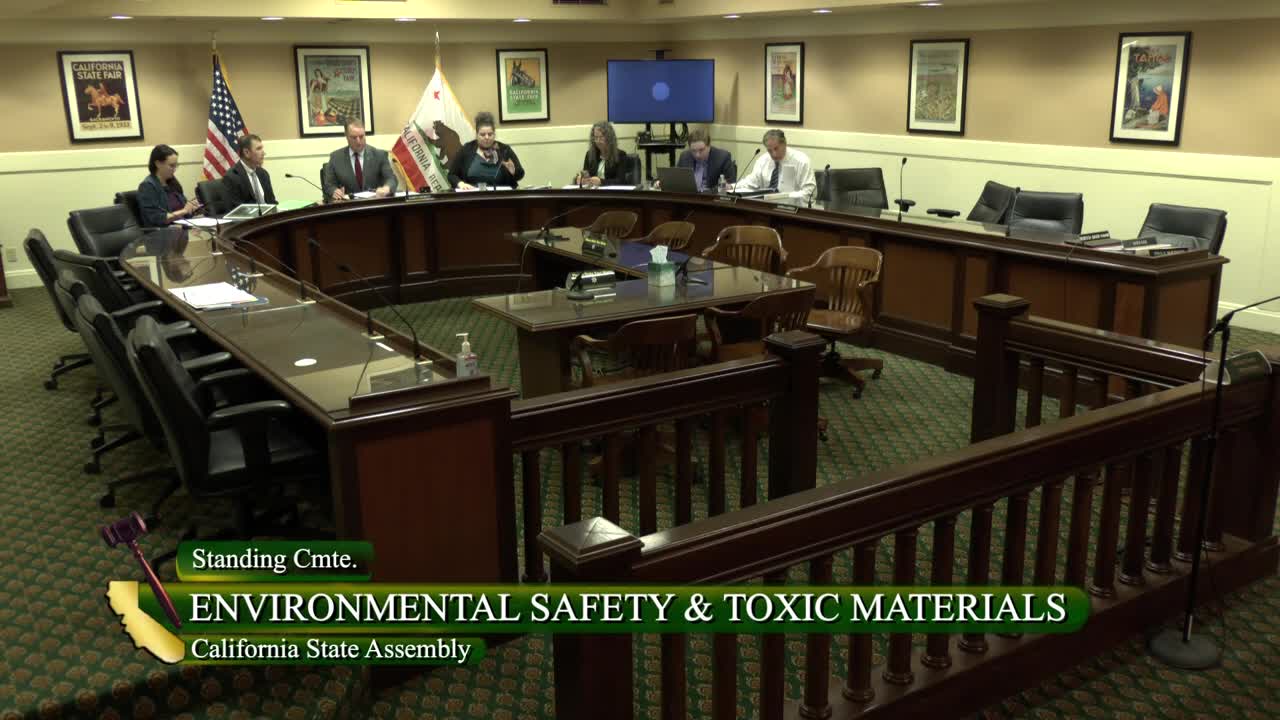 15MIN
Assembly Standing Committee on Environmental Safety and Toxic Materials
Bill Author

Bill Co-Author(s):