AB 351: Campaign contributions: agency officers.
- Session Year: 2025-2026
- House: Assembly
- Latest Version Date: 2025-01-30
Current Status:
Failed
(2026-02-02: From committee: Filed with the Chief Clerk pursuant to Joint Rule 56.)
Introduced
In Committee
Awaiting First Chamber Vote
Passed First Chamber
In Committee
Awaiting Second Chamber Vote
Passed Second Chamber
Enacted
The Political Reform Act of 1974 prohibits an officer of an agency from accepting, soliciting, or directing a contribution of more than $500 from any party, participant, or a party or participants agent, while a proceeding involving a license, permit, or other entitlement for use is pending before the agency and for 12 months following the date a final decision is rendered in the proceeding, if the officer knows or has reason to know that the participant has a financial interest, as defined. The act also prohibits an officer of an agency from making, participating in making, or in any way attempting to use the officers official position to influence the decision in a proceeding involving a license, permit, or other entitlement for use pending before the agency if the officer has willfully or knowingly received a contribution of more than $500 within the preceding 12 months from a party or a partys agent, or from any participant or a participants agent, if the officer knows or has reason to know that the participant has a financial interest in the decision, as defined.
This bill would increase the contribution thresholds described above from $500 to $1500. The bill would require the commission to adjust these contribution thresholds to reflect any increase or decrease in the Consumer Price Index beginning January, 2027, and in January of each odd-numbered year thereafter, as specified.
The Political Reform Act of 1974, an initiative measure, provides that the Legislature may amend the act to further the acts purposes upon a 2/3 vote of each house of the Legislature and compliance with specified procedural requirements.
This bill would declare that it furthers the purposes of the act.
(a)The definitions set forth in this subdivision shall govern the interpretation of this section.
(1)Party means any person who files an application for, or is the subject of, a proceeding involving a license, permit, or other entitlement for use.
(2)Participant means any person who is not a party but who actively supports or opposes a particular decision in a proceeding involving a license, permit, or other entitlement for use and who has a financial interest in the decision, as described in Article 1 (commencing with Section 87100) of Chapter 7. A person actively supports or opposes a particular decision in a proceeding if that person lobbies in person the officers or employees of the agency, testifies in person before the agency, or otherwise acts to influence officers of the agency. A person is not a participant under this paragraph if their financial interest in the decision results solely from an increase or decrease in membership dues.
(3)Agency means an agency as defined in Section 82003 except that it does not include the courts or any agency in the judicial branch of government, the Legislature, the Board of Equalization, or constitutional officers. However, this section applies to any person who is a member of an exempted agency but is acting as a voting member of another agency.
(4)Officer means any elected or appointed officer of an agency, any alternate to an elected or appointed officer of an agency, and any candidate for elective office in an agency, other than a city attorney or county counsel providing legal advice to the agency who does not have the authority to make a final decision in the proceeding.
(5)(A)Except as provided in subparagraph (B), license, permit, or other entitlement for use means all business, professional, trade, and land use licenses and permits and all other entitlements for use, including all entitlements for land use, all contracts, and all franchises.
(B)License, permit, or other entitlement for use does not include any of the following:
(i)Competitively bid contracts that are required by law, agency policy, or agency rule to be awarded pursuant to a competitive process.
(ii)Labor contracts.
(iii)Personal employment contracts.
(iv)Contracts valued under fifty thousand dollars ($50,000).
(v)Contracts where no party receives financial compensation.
(vi)Contracts between two or more agencies.
(vii)The periodic review or renewal of development agreements unless there is a material modification or amendment proposed to the agreement. Non-material modifications or amendments may be approved by agency staff.
(viii)The periodic review or renewal of competitively bid contracts unless there are material modifications or amendments proposed to the agreement that are valued at more than 10 percent of the value of the contract or fifty thousand dollars ($50,000), whichever is less. Non-material modifications or amendments may be approved by agency staff.
(ix)Modification of or amendments to contracts that are exempt under this subparagraph, other than competitively bid contracts.
(6)Contribution includes contributions to candidates and committees in federal, state, or local elections.
(7)Pending in a proceeding involving a license, permit, or other entitlement for use means either of the following:
(A)For an officer, when either of the following occurs:
(i)An item involving the license, permit, or other entitlement for use is placed on the agenda for discussion or decision at a public meeting of the body of which the officer is a member.
(ii)The officer knows a proceeding involving a license, permit, or other entitlement for use is within the jurisdiction of the officers agency for its decision or other action, and it is reasonably foreseeable that the decision will come before the officer in the officers decisionmaking capacity.
(B)For a party or partys agent, or a participant or participants agent, when an application is filed with an agency, or, if the proceeding process does not require an application, when the proceeding is before the agency for its decision or other action.
(b)(1)While a proceeding involving a license, permit, or other entitlement for use is pending, and for 12 months following the date a final decision is rendered in the proceeding, an officer of an agency shall not accept, solicit, or direct a contribution of more than five hundred dollars ($500) one thousand five hundred dollars ($1,500) from any party or a partys agent, or from any participant or a participants agent if the officer knows or has reason to know that the participant has a financial interest, as that term is used in Article 1 (commencing with Section 87100) of Chapter 7. This prohibition applies regardless of whether the officer accepts, solicits, or directs the contribution on the officers own behalf, or on behalf of any other officer, or on behalf of any candidate for office or on behalf of any committee.
(2)With respect to elected officers, paragraph (1) applies only if the elected officer or the body of which they are a member has the authority to make any decision or recommendation in the proceeding.
(c)(1)Before rendering any decision in a proceeding involving a license, permit, or other entitlement for use, each officer of the agency who received a contribution within the preceding 12 months in an amount of more than five hundred dollars ($500) one thousand five hundred dollars ($1,500) from a party or from any participant shall disclose that fact on the record of the proceeding. An officer of an agency shall not make, participate in making, or in any way attempt to use the officers official position to influence the decision in a proceeding involving a license, permit, or other entitlement for use if the officer has willfully or knowingly received a contribution in an amount of more than five hundred dollars ($500) one thousand five hundred dollars ($1,500) within the preceding 12 months from a party or a partys agent, or from any participant or a participants agent if the officer knows or has reason to know that the participant has a financial interest in the decision, as that term is described with respect to public officials in Article 1 (commencing with Section 87100) of Chapter 7.
(2)With respect to elected officers, paragraph (1) applies only if the elected officer or the body of which they are a member has the authority to make any decision or recommendation in the proceeding.
(d)(1)If an officer receives a contribution that would otherwise require disqualification under this section, and returns the contribution within 30 days from the time the officer makes any decision, or knows, or should have known, about the contribution and the proceeding involving a license, permit, or other entitlement for use, whichever comes last, the officer shall be permitted to participate in the proceeding.
(2)(A)Subject to subparagraph (B), if an officer accepts, solicits, or directs a contribution of more than five hundred dollars ($500) one thousand five hundred dollars ($1,500) during the 12 months after the date the final decision is rendered in violation of subdivision (b), the officer may cure the violation by returning the contribution, or the portion of the contribution in excess of five hundred dollars ($500), one thousand five hundred dollars ($1,500), within 30 days of accepting, soliciting, or directing the contribution, whichever comes latest.
(B)An officer may cure a violation as specified in subparagraph (A) only if the officer did not knowingly and willfully accept, solicit, or direct the prohibited contribution.
(C)An officers controlled committee, or the officer if no controlled committee exists, shall maintain records of curing any violation pursuant to this paragraph.
(e)(1)A party to a proceeding before an agency involving a license, permit, or other entitlement for use shall disclose on the record of the proceeding any contribution in an amount of more than five hundred dollars ($500) one thousand five hundred dollars ($1,500) made within the preceding 12 months before the date that any decision is rendered by the agency by the party or the partys agent.
(2)A party to a proceeding involving a license, permit, or other entitlement for use pending before any agency or a participant in the proceeding shall not make a contribution of more than five hundred dollars ($500) one thousand five hundred dollars ($1,500) to any officer of that agency during the proceeding and for 12 months following the date the final decision is rendered by the agency in the proceeding.
(3)An agent to a party or participant shall not make a contribution in any amount to an officer during the time periods described in paragraph (2).
(4)When a closed corporation is a party to, or a participant in, a proceeding involving a license, permit, or other entitlement for use pending before an agency, the majority shareholder is subject to the disclosure and prohibition requirements specified in this section.
(f)This section shall not be construed to imply that any contribution subject to being reported under this title shall not be so reported.
(g)For the purposes of this section, in determining whether a contribution has exceeded five hundred dollars ($500), one thousand five hundred dollars ($1,500), the contributions of an agent shall not be aggregated with contributions from a party or participant.
(h)Beginning on January, 2027, and in January of every odd-numbered year thereafter, the commission shall adjust the contribution limitations in this section to reflect any increase or decrease in the Consumer Price Index, rounded to the nearest ten dollars ($10).
(h)(i)(1)A person is the agent of a party to, or a participant in, a pending proceeding involving a license, permit, or other entitlement for use only if the person represents that party or participant for compensation and appears before or otherwise communicates with an agency for the purpose of influencing the proceeding on behalf of a party or participant.
(2)If an individual acting as an agent is also acting as an employee or member of a law, architectural, engineering, or consulting firm, or a similar entity or corporation, both the entity or corporation and the individual are agents.
(3)Agent includes a lobbyist registered to lobby the agency and who otherwise meets the requirements of paragraph (1).
(4)Communicate with the agency for the purpose of influencing the proceeding does not include either of the following:
(A)Preparing drawings or submissions of an architectural, engineering, or similar nature for a client to submit in a proceeding before the agency if both of the following conditions are met:
(i)The work is performed pursuant to the persons profession.
(ii)The person does not make any contact with the agency other than contact with agency staff concerning the process or evaluation of the documents prepared by the person.
(B)Providing technical data or analysis to an agency if the person does not otherwise engage in direct communication for the purpose of influencing the proceeding.
(i)(j)(1)Except as provided in paragraph (2), the provisions of this act are severable. If any provision of this act or its application is held invalid, that invalidity shall not affect other provisions or applications that can be given effect without the invalid provision or application.
(2)Subdivision (g) is not severable from paragraph (3) of subdivision (e) if paragraph (3) of subdivision (e) is held invalid in a final decision of a court of competent jurisdiction. If that occurs, subdivision (g) shall become inoperative on the date of that final decision.
SEC. 2.The Legislature finds and declares that this bill furthers the purposes of the Political Reform Act of 1974 within the meaning of subdivision (a) of Section 81012 of the Government Code.
|
Date
|
Status
|
|---|---|
| Feb 2, 2026 | From committee: Filed with the Chief Clerk pursuant to Joint Rule 56. |
| Jan 31, 2026 | Died pursuant to Art. IV, Sec. 10(c) of the Constitution. |
| Apr 30, 2025 | In committee: Set, second hearing. Failed passage. Reconsideration granted. |
| Apr 7, 2025 | In committee: Set, first hearing. Hearing canceled at the request of author. |
| Feb 18, 2025 | Referred to Com. on ELECTIONS. |
| Jan 31, 2025 | From printer. May be heard in committee March 2. |
| Jan 30, 2025 | Read first time. To print. |
|
Date
|
Description
|
Location
|
Votes
|
|
|---|---|---|---|---|
| Apr 30, 2025 | Reconsideration. | Assembly Standing Committee on Elections |
Passed |
|
| Apr 30, 2025 | Do pass and be re-referred to the Committee on [Appropriations] | Assembly Standing Committee on Elections |
Failed |
This list shows positions taken on this bill by organizations on the date displayed, which is linked to the original source.
Positions by individuals are not included.
|
Organization
|
Position
|
Date
|
|---|---|---|
| California Building Industry Association | ** Support | |
| California Clean Money Campaign | ** Against | |
| California Clerk Of The Board Of Supervisors Association | ** Support | |
| California Common Cause | ** Against | |
| California Contract Cities Association | ** Support | |
| City of Norwalk | ** Support | |
| Consumer Watchdog | ** Against | |
| County of Fresno | ** Support | |
| County of Los Angeles Board of Supervisors | ** Support | |
| Courage California | ** Against | |
| Indivisible California Green Team | ** Against | |
| Indivisible Media City Burbank | ** Against | |
| Indivisible San Francisco | ** Against | |
| Indivisible West Side Los Angeles | ** Against | |
| League Of Women Voters Of California | ** Against | |
| Los Angeles for Democracy Vouchers | ** Against | |
| Money Out Voters In | ** Against | |
| Represent.Us | ** Against | |
| Starting Over Strong | ** Against | |
| the River Project | ** Against | |
| Unrig LA | ** Against | |
| Working Partnerships USA | ** Against |
Date of Hearing: April 30, 2025
ASSEMBLY COMMITTEE ON ELECTIONS
Gail Pellerin, Chair
ABPCA Bill Id:AB 351 (
Author:McKinnor) – As Introduced Ver:January 30, 2025
SUBJECT: Campaign contributions: agency officers.
SUMMARY: Increases, from $500 to $1,500, the threshold at which campaign contributions received by specified public officials can cause those officials to be disqualified from participating in or influencing decisions related to licensing, permitting, and similar entitlements for use if the contributions were received from an entity with a financial interest in that decision, as specified. Requires that threshold to be automatically adjusted for inflation beginning in 2027. Specifically, this bill:
- Increases, from $500 to $1,500, the campaign contribution threshold that triggers the applicability of the following provisions of the Levine Act of 1982 (Levine Act), as amended in 2022 and 2024:
- A prohibition on an officer of the agency accepting, soliciting, or directing a campaign contribution of more than the threshold from a party, party’s agent, participant, or participant’s agent with a matter pending before the agency involving a license, permit, or other entitlement for use during the time the matter is pending before the agency and for 12 months following the date a final decision is rendered in the matter.
- A requirement for an officer of the agency to disclose on the record of a proceeding the receipt of any campaign contribution of more than the threshold from a party to or participant in the proceeding in the preceding 12 months if the proceeding involves a license, permit, or other entitlement for use.
- A prohibition on an officer of the agency making, participating in, or attempting to influence the decision in any proceeding involving a license, permit, or other entitlement for use if the officer willfully or knowingly received a contribution of more than the threshold from a party or party’s agent, or from a participant or participant’s agent if the officer knows or has reason to know that the participant has a financial interest in the decision, as specified, in the 12 months before the proceeding, provided that the officer did not return that contribution within 30 days of the time the officer makes any decision, or knows or should have known, of the contribution and the proceeding, whichever comes last.
- A requirement for a party to a proceeding before an agency involving a license, permit, or other entitlement for use to disclose on the record of the proceeding any contribution that the party or party’s agent made to an officer of the agency of more than the threshold within the 12 months before the date that any decision is rendered by the agency.
- A prohibition on a party to or participant in a proceeding involving a license, permit, or other entitlement for use pending before an agency from making a contribution of more than the threshold to an officer of that agency during the proceeding and for 12 months following the date a final decision is rendered by the agency in the proceeding.
- A prohibition on an officer of the agency accepting, soliciting, or directing a campaign contribution of more than the threshold from a party, party’s agent, participant, or participant’s agent with a matter pending before the agency involving a license, permit, or other entitlement for use during the time the matter is pending before the agency and for 12 months following the date a final decision is rendered in the matter.
- Requires the Fair Political Practices Commission (FPPC) to adjust the campaign contribution threshold that triggers the applicability of the Levine Act in every odd-numbered year beginning in 2027 to reflect any increase or decrease in the Consumer Price Index, rounded to the nearest $10.
- Makes conforming changes.
EXISTING LAW:
- Creates the FPPC, and makes it responsible for the impartial, effective administration and implementation of the Political Reform Act (PRA). (Government Code §§83100, 83111)
- Does all the following pursuant to the Levine Act:
- Defines the following terms, for the purposes of the Levine Act:
- “Party” to mean any person who files an application for, or is the subject of, a proceeding involving a license, permit, or other entitlement for use.
- “Participant” to mean any person who is not a party but who actively supports or opposes a particular decision in a proceeding involving a license, permit, or other entitlement for use and who has a financial interest in the decision, as specified.
- “Agency” to mean a state or local government agency, except that it does not include the courts or any agency in the judicial branch of government, the Legislature, the Board of Equalization (BOE), or constitutional officers. (Government Code §84308(a))
- “Party” to mean any person who files an application for, or is the subject of, a proceeding involving a license, permit, or other entitlement for use.
- Prohibits an officer of an agency from accepting, soliciting, or directing a contribution of more than $500 from a party or agent of a party with a license, permit, or other entitlement for use pending before the agency, or from a participant in that matter or an agent of the participant if the officer knows or has reason to know that the participant has a financial interest in the matter, during the time the matter is pending before the agency and for 12 months following the date a final decision is rendered in the matter, as specified. (Government Code §84308(b))
- Requires any officer of an agency, as defined, who received a contribution of more than $500 from a party with a matter pending before the agency involving a license, permit, or other entitlement for use, or a participant in that matter, in the 12 months before the proceeding, to disclose the contribution on the record of the proceeding. (Government Code §84308(c))
- Prohibits any officer of an agency, as defined, who willfully or knowingly received a contribution of more than $500 from a party or agent of the party with a matter pending before the agency involving a license, permit, or other entitlement for use, or a participant or agent of the participant in that matter if the officer knows or has reason to know that the participant has a financial interest in the decision, in the 12 months before the proceeding from making, participating in making, or attempting to influence the decision in the proceeding, as specified. (Government Code §84308(c)) Allows an officer to participate in the proceeding if the officer returns the contribution within 30 days of the latter of making any decision, or from the time that the officer knows, or should have known, of the contribution and the proceeding. (Government Code §84308(d)(1))
- Permits an officer who accepts, solicits, or directs a contribution of more than $500 during the 12 months after the date a final decision is rendered in a proceeding involving a license, permit, or other entitlement for use from a party, party’s agent, participant, or participant’s agent, to cure the violation by returning the contribution or the portion exceeding $500 within 30 days of accepting, soliciting, or directing the contribution, whichever comes last. Provides that an officer is permitted to cure such a violation only if the officer did not knowingly and willfully accept, solicit, or direct the prohibited contribution, and requires the officer or the officer’s controlled committee to maintain records of curing the violation. (Government Code §84308(d)(2))
- Requires a party to a proceeding before an agency involving a license, permit, or other entitlement for use to disclose on the record of the proceeding any contribution of more than $500 made by the party or party’s agent to any officer of the agency within the preceding 12 months before the date that any decision is rendered by the agency. Prohibits a party to or participant in a proceeding involving a license, permit, or other entitlement for use pending before an agency from making a contribution of more than $500 to an officer of that agency during the proceeding and for 12 months following the date a final decision is rendered by the agency in the proceeding. Prohibits an agent to the party or participant from making a contribution in any amount to an officer of that agency during that time period. (Government Code §84308(e))
- Defines the following terms, for the purposes of the Levine Act:
FISCAL EFFECT: Unknown
COMMENTS:
- Purpose of the Bill: According to the author:
The arbitrarily low campaign contribution limit established in the Levine Act has made it difficult for state and local candidates to communicate directly with voters and has resulted in an increased use of non-candidate controlled independent expenditures financed with dark money. The Legislature has increased this threshold only twice, in 1989, from “$250 or more” to “more than $250”, and in 2024 to $500…
As a result, current law limits the ability of citizen candidates, including minority candidates from competitively participating in local elections. A study (Avis et al, “Money and Politics: The Effects of Campaign Spending Limits on Political Entry and Competition.” 2021) concluded that policies that set limits might “reduce the concentration of political power in the hands of richer individuals.” Further, the City and County of San Francisco, and the County of Santa Clara have recognized this problem, and considered that an increased threshold would help address the current disparity in fundraising ability between incumbent officials and non-officeholders.
AB 351 would encourage campaign donors to contribute directly to a candidate, increase the transparency of those donations and discourage the use of dark money in state and local elections. By increasing the campaign finance donation limits to be in excess of $1,500, candidates will be able to better communicate directly with voters and reduce the need for dark money in local elections.
AB 351 would also reduce the negative financial and operational impacts that compliance with the Act has had on local governments. Staff have expended extensive time and resources to ensure compliance, as numerous agenda items fall under current law. In just the past three years, compliance with the Act has cost local governments millions of dollars, resources that would be better spent supporting local public safety programs, infrastructure or efforts to address California’s housing and homelessness crisis.
- Levine Act of 1982 and Recent Modifications: The Levine Act, named after its author Assemblymember Mel Levine, restricts campaign contributions made to officers of state and local agencies by parties to a proceeding pending before those agencies. Enacted in 1982, the Levine Act was a response to reports that members of a state agency sought to raise money from individuals and entities that had permit requests pending before the agency. The Levine Act is unique among the provisions of the PRA in that it is the only area in which a campaign contribution can be the basis for a disqualifying conflict of interest. The PRA otherwise does not treat campaign contributions as a potential basis for conflicts of interest.
The Levine Act is narrowly drafted to apply only to proceedings involving licenses, permits, or other entitlements for use. Proceedings of a more general nature and with broader applicability are not covered by the Levine Act. Additionally, until recently, the Levine Act only applied to decisions made by agencies with membership that was not directly elected by voters. It did not apply to the judicial branch, local governmental bodies whose members were elected directly by the voters, members of the Legislature and the BOE, or constitutional officers. Aside from clean-up legislation in 1984 (AB 2992 (M. Waters), Chapter 1681, Statutes of 1984) that made various clarifying and other changes to facilitate enforcement, the Levine Act was largely unchanged for the first 40 years that it was in effect.
In 2022, the Legislature passed and Governor Newsom signed SB 1439 (Glazer), Chapter 848, Statutes of 2022, which made substantial changes to the Levine Act. Perhaps most notably, SB 1439 significantly broadened the reach of the Levine Act by making it applicable to local agencies whose members are directly elected by the voters. As a result, since January 1, 2023, the restrictions of the Levine Act have applied to every county board of supervisors, city council, and school board in the state, along with special districts that were not previously subject to the law.
SB 1439 also made various other changes to the Levine Act, including increasing the period of time following a covered agency action, from three months to 12 months, during which an officer subject to the Levine Act is prohibited from accepting, soliciting or directing a contribution of more than a specified amount from a party or participant in the matter, and during which a party or participant in the matter is prohibited from making such a contribution. SB 1439 also created a “cure” process to allow an officer to avoid liability if the officer returned a prohibited contribution that the officer received in the 12 months following a covered action within 14 days, as specified.
Supporters of SB 1439 argued that the changes made by that bill were important for protecting against quid pro quo corruption and its appearance in the types of governmental decisions – licensing, permitting, and contracting – that pose a high risk of pay-to-play exchanges because the impacts of those decisions are disproportionately felt by the parties that are seeking the award of those licenses, permits, and contracts. SB 1439 was approved by this committee by a 5-0 vote and was approved by the Assembly by a 66-0 vote.
Last year, the Legislature considered three bills to make modifications to the Levine Act in response to questions and concerns about the implementation of SB 1439 after it was signed into law. AB 2911 (McKinnor) of 2024 proposed increasing the campaign contribution threshold that triggers the Levine Act from $250 to $1,500. AB 2911 moved through this committee and through the Assembly as negotiations continued over potential modifications to the Levine Act, but it was held in the Senate Elections & Constitutional Amendments Committee without recommendation.
Separately, SB 1181 (Glazer), Chapter 785, Statutes of 2024 and SB 1243 (Dodd), Chapter 1017, Statutes of 2024 both proposed making various changes to the Levine Act, as amended by SB 1439. Both bills were the subject of extensive stakeholder negotiations over potential policy changes to the Levine Act, and both bills were amended late in the legislative process to reflect agreements reached through those negotiations. The final versions of those bills that reflected those negotiated agreements had no formal opposition, and both bills were approved in both the Senate and the Assembly without any “no” votes (SB 1181 was approved by the Assembly by a 74-0 vote, and by the Senate by a 40-0 vote. SB 1243 was approved by the Assembly by a 71-0 vote, and by the Senate by a 40-0 vote.) Among other provisions, SB 1181 exempted various types of proceedings from coverage under the Levine Act, extended the “cure” period during which public officials may return contributions that otherwise would violate the Levine Act, and codified various regulations adopted by the FPPC. SB 1243 increased the campaign contribution threshold that triggers the Levine Act from $250 to $500, exempted various types of proceedings from coverage under the Levine Act, extended the “cure” period during which public officials may return contributions that otherwise would violate the Levine Act, and provided that the Levine Act’s restrictions do not apply to elected officers in situations where the officer is not in a position to make a decision or recommendation in the proceeding, among other provisions. - Levine Act Restrictions vs. Contribution Limits: While the Levine Act can serve to limit the size of campaign contributions that an elected official can legally receive from a source in certain circumstances, the Levine Act is not a “campaign contribution limit” as that term is generally understood, nor do the provisions of the Levine Act override otherwise applicable campaign contribution limits that apply to a candidate for elective office. Instead, the restrictions imposed by the Levine Act operate independently of any contribution limits that apply in a jurisdiction. That is, a contribution made to a candidate for office is subject to any relevant campaign contribution limit even if that contribution would not trigger the provisions of the Levine Act. Similarly, a contribution made to a candidate may trigger the restrictions of the Levine Act even if that contribution is below the campaign contribution limit for an office that the candidate is seeking.
As a result, an elected official who serves on a body that is subject to the Levine Act is able to accept campaign contributions larger than $500 if allowed by the relevant campaign contribution limit, even though such a contribution exceeds the threshold that can trigger the Levine Act’s provisions. Similarly, a $450 campaign contribution could exceed a local jurisdiction’s campaign contribution limits even though the same contribution would not trigger the restrictions of the Levine Act.
Notably, as discussed in more detail above, the Levine Act applies only to campaign contributions that are made by parties to or participants in proceedings related to licenses, permits, and other entitlements for use. Those types of decisions tend to have a disproportionate impact on a small group of individuals, including the parties that are seeking the award of those licenses, permits, and contracts.
Decisions that affect the public more broadly, however, do not trigger the Levine Act’s restrictions. Thus, a person is not prohibited from contributing more than $500 to a public official under the Levine Act if that person is not a party to or participant in a license, permit, or other entitlement for use before that public official’s body. Even if the person regularly appears before the governmental body to advocate on actions taken by that body, the Levine Act’s restrictions would not apply unless the person had a financial interest in a license, permit, or other entitlement before the body. - Levine Act’s Disqualification Threshold: When the Levine Act was first enacted in 1982, the campaign contribution threshold that triggered its provisions were contributions of $250 or more. SB 491 (Marks), Chapter 764, Statutes of 1989, changed the threshold from contributions of $250 or more to contributions of more than $250, effectively an increase of $0.01. Last year, SB 1243 (Dodd), discussed in more detail above, increased the threshold to contributions of more than $500.
According to an inflation calculator operated by the federal Bureau of Labor Statistics, when adjusted for inflation, $250 at the time the Levine Act originally was enacted has approximately the same purchasing power as about $820 today. - Arguments in Support: The sponsor of this bill, the Los Angeles County Board of Supervisors, writes in support:
[AB 351] will ease costly administrative burdens and compliance challenges, especially for large counties like Los Angeles, which handle a high volume of complex agenda items under these provisions. Increasing the threshold strikes a balance between ensuring transparency in campaign contributions and eliminating unnecessary procedural constraints that can impede the efficient functioning of local government.
The Board of Supervisors is committed to upholding public trust while ensuring that governance remains effective and efficient. AB 351 provides a necessary and reasonable adjustment to contribution limits, allowing agencies to focus on their work without undue administrative strain.
- Arguments in Opposition: In a joint letter of opposition to this bill, California Common Cause, California Clean Money Campaign, and the League of Women Voters of California write:
The Legislature just overhauled the Levine Act, part of the legendary Political Reform Act, in 2024 through SB 1243 (Dodd) and SB 1181 (Glazer), the result of an extensive, months-long negotiation involving county counsel, city attorneys, unions, business associations, and good government groups. Through this collective effort, the contribution threshold was doubled from $250 to $500 and other reforms were adopted, a carefully calibrated compromise that balanced compliance ease with strong anti-corruption protections.
AB 351 would undermine progress. Raising the threshold to $1,500 – a 300% increase – would drastically weaken the Levine Act’s effectiveness in deterring pay-to-play abuses and their appearance. For example, many California cities already have contribution limits that are lower than the proposed $1,500 limit, signaling that locals want to ensure good governance and fair play…
- Political Reform Act of 1974: California voters passed an initiative, Proposition 9, in 1974 that created the FPPC and codified significant restrictions and prohibitions on candidates, officeholders, and lobbyists. That initiative is commonly known as the PRA. Amendments to the PRA that are not submitted to the voters, such as those contained in this bill, must further the purposes of the initiative and require a two-thirds vote of both houses of the Legislature.
REGISTERED SUPPORT / OPPOSITION:
Support
County of Los Angeles Board of Supervisors (Sponsor)
California Building Industry Association
California Clerk of the Board of Supervisors Association
California Contract Cities Association
City of Norwalk
County of Fresno
Opposition
California Clean Money Campaign
California Common Cause
Consumer Watchdog
Courage California
Indivisible California Green Team
Indivisible Media City Burbank
Indivisible San Francisco
Indivisible Westside Los Angeles
League of Women Voters of California
Los Angeles for Democracy Vouchers
Money Out Voters In
Represent.us
Starting Over Strong
The River Project
Unrig LA
Working Partnerships USA
1 individual
Analysis Prepared by: Ethan Jones / ELECTIONS / (916) 319-2094
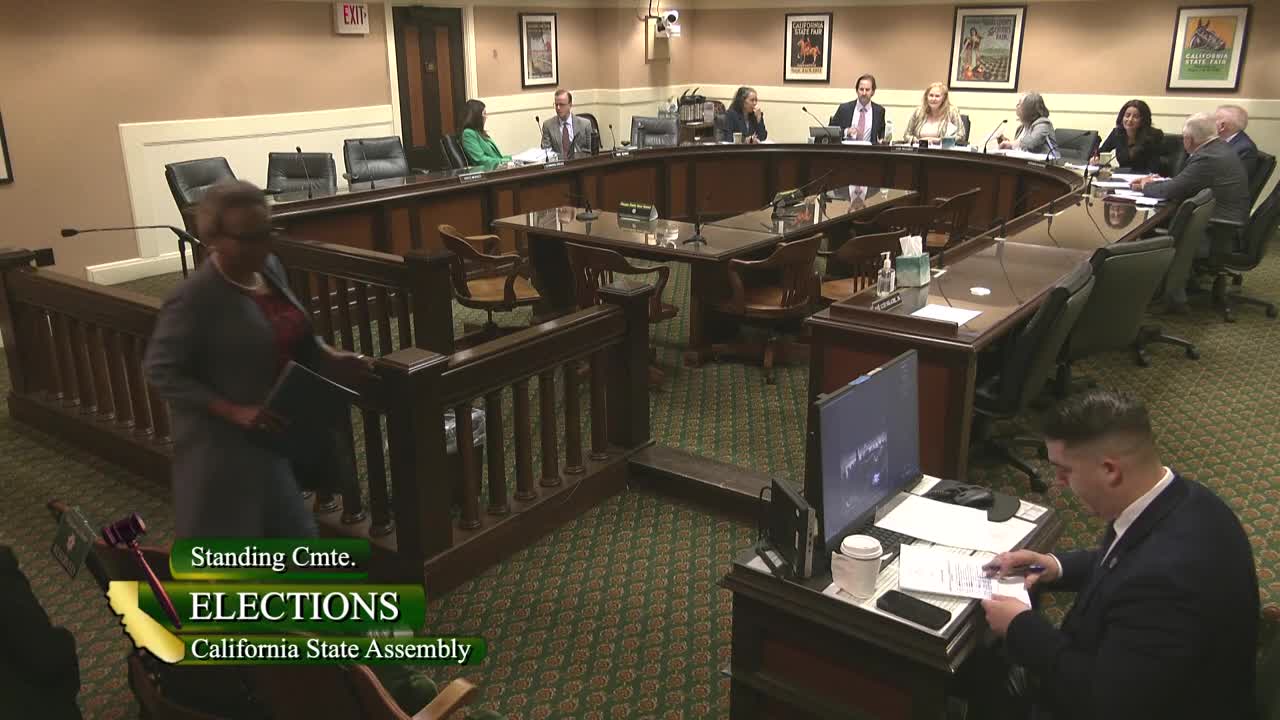
Discussed in Hearing
 19MIN
Assembly Standing Committee on Elections
Bill Author

Bill Co-Author(s):