AB 401: California Career Technical Education Incentive Grant Program: annual adjustment: renewal grants.
- Session Year: 2025-2026
- House: Assembly
- Latest Version Date: 2025-02-25
Current Status:
Failed
(2026-02-02: From committee: Filed with the Chief Clerk pursuant to Joint Rule 56.)
Introduced
In Committee
Awaiting First Chamber Vote
Passed First Chamber
In Committee
Awaiting Second Chamber Vote
Passed Second Chamber
Enacted
Existing law establishes the California Career Technical Education Incentive Grant Program, administered by the State Department of Education, with the purpose of encouraging, maintaining, and strengthening the delivery of high-quality career technical education programs. Existing law requires, for the 202122 fiscal year and each fiscal year thereafter, $300,000,000 to be available to the department, upon appropriation by the Legislature, for the program. Existing law requires a grant applicant to demonstrate a proportional dollar-for-dollar match and sets that amount at $2 for every $1 received from the program. Existing law prohibits an applicant from being awarded an amount higher than the amount that the allocation formula determines them to be eligible to receive under the program. Existing law authorizes a grant recipient under the program to consist of one or more, or any combination, of school districts, county offices of education, charter schools, or regional occupational centers or programs operated by joint powers authorities or county offices of education, as provided. Existing law provides that an applicant receiving a grant from the program in a prior fiscal year is eligible to apply to receive a renewal grant if the applicants career technical education program continues to meet specified requirements, as provided.
This bill would delete the latter provision. prohibition against an applicant being awarded more than the amount determined by the allocation formula and would provide, for the 202526 fiscal year, and each fiscal year thereafter, that the amount to be made available to the department, upon appropriation by the Legislature, for the program to be the amount appropriated in the prior fiscal year as adjusted by a specified percentage, as provided. The bill would instead provide that an applicant receiving a grant from the program in a prior fiscal year is required to receive a renewal grant for 3 additional years, as provided. The bill would instead require the department to, commencing require, beginning with the 202627 202526 fiscal year, designate a portion up to 90% of the grants awarded pursuant to the program as 4-year grants, to be designated for renewal grants and up to 10% to be designated for grants for new applicants, unless otherwise determined by the Superintendent of Public Instruction, as provided. The bill would authorize require the department Superintendent to revoke a 4-year grant for specified reasons, including if the department determines that cease distribution of funding and recover previously distributed funding if certain conditions occur, including, among others, that the grant recipient did not implement the program substantively as was initially proposed, as provided.
Existing law establishes the California Career Technical Education Incentive Grant Program, administered by the State Department of Education, with the purpose of encouraging, maintaining, and strengthening the delivery of high-quality career technical education programs. Existing law requires, for the 202122 fiscal year and each fiscal year thereafter, $300,000,000 to be available to the department, upon appropriation by the Legislature, for the program. Existing law authorizes a grant recipient under the program to consist of one or more, or any combination, of school districts, county offices of education, charter schools, or regional occupational centers or programs operated by joint powers authorities or county offices of education, as provided. Existing law provides that an applicant receiving a grant from the program in a prior fiscal year is eligible to apply to receive a renewal grant if the applicants career technical education program continues to meet specified requirements, as provided.
This bill would delete the latter provision. The bill would instead require the department to, commencing with the 202627 fiscal year, designate a portion of the grants awarded pursuant to the program as 4-year grants, as provided. The bill would authorize the department to revoke a 4-year grant for specified reasons, including if the department determines that the grant recipient did not implement the program substantively as was initially proposed, as provided.
It is the intent of the Legislature to provide greater increased stability and to reflect increases in the cost of living in the funding for career technical education by automatically renewing grants awarded pursuant to available through the California Career Technical Education Incentive Grant Program for three years if the grant recipient remains in compliance with the provisions of Chapter 16.5 (commencing with Section 53070) of Part 28 of Division 4 of Title 2 of the Education Code. by allowing grants to be automatically renewed for four years to support high-quality career technical education courses and pathways and to ensure all pupils have the opportunity to be college and career ready.
SEC. 2.Section 53073 of the Education Code is repealed.SEC. 3.Section 53073 is added to the Education Code, to read:53073.(a)The department shall designate a portion of the grants awarded pursuant to this program as four-year grants, as follows:(1)For the 202627 fiscal year, 25 percent of grants shall be four-year grants.(2)For the 202728 fiscal year, 50 percent of grants shall be four-year grants.(3)For the 202829 fiscal year, and each fiscal year thereafter, 75 percent of grants shall be four-year grants.(b)The department may revoke a four-year grant for any of the following reasons:(1)The grant recipient indicates in writing that it no longer wants the grant.(2)The department determines that the grant recipient did not implement the program substantively as was initially proposed in the grant application pursuant to subdivision (c) of Section 53071.(3)The department determines that the grant recipient did not comply with the matching fund requirements pursuant to paragraph (1) of subdivision (a) of Section 53071.SEC. 2.Section 53070 of the Education Code is amended to read:53070.(a)The California Career Technical Education Incentive Grant Program is hereby established as a state education, economic, and workforce development initiative with the goal of providing pupils in kindergarten and grades 1 to 12, inclusive, with the knowledge and skills necessary to transition to employment and postsecondary education. The purpose of the competitive program is to encourage, maintain, and strengthen the delivery of high-quality career technical education programs.
(b)The following amounts are hereby appropriated to the department from the General Fund for the program established pursuant to this chapter:
(1)For the 201516 fiscal year, four hundred million dollars ($400,000,000).
(2)For the 201617 fiscal year, three hundred million dollars ($300,000,000).
(3)For the 201718 fiscal year, two hundred million dollars ($200,000,000).
(c)For the 201819 fiscal year to the 202021 fiscal year, inclusive, one hundred fifty million dollars ($150,000,000) shall be made available to the department, upon appropriation by the Legislature in the annual Budget Act or another statute, for the program established pursuant to this chapter.
(d)For the 202122 fiscal year and each fiscal year thereafter, to the 202425 fiscal year, inclusive, three hundred million dollars ($300,000,000) shall be made available to the department, upon appropriation by the Legislature in the annual Budget Act or another statute, for the program established pursuant to this chapter.
(e)For the 202526 fiscal year and each fiscal year thereafter, the amount to be made available to the department, upon appropriation by the Legislature in the annual Budget Act or another statute, for the program established pursuant to this chapter shall be the amount appropriated pursuant to this section in the prior fiscal year as adjusted by the percentage change in the annual average value of the Implicit Price Deflator for State and Local Government Purchases of Goods and Services for the United States, as published by the United States Department of Commerce for the 12-month period ending in the third quarter of the prior fiscal year. This percentage change shall be determined using the latest data available as of May 10 of the preceding fiscal year compared with the annual average value of the same deflator for the 12-month period ending in the third quarter of the second preceding fiscal year, using the latest data available as of May 10 of the preceding fiscal year, as reported by the Department of Finance.
(e)(f)Of the amounts appropriated pursuant to subdivisions (b), (c), and (d), (d), and (e), 4 percent is designated for applicants with average daily attendance of less than or equal to 140, 8 percent is designated for applicants with average daily attendance of more than 140 and less than or equal to 550, and 88 percent is designated for applicants with average daily attendance of more than 550, unless otherwise determined by the Superintendent in collaboration with the executive director of the state board. For purposes of this section, average daily attendance shall be those figures that are reported at the time of the second principal apportionment for the previous fiscal year for pupils in grades 7 to 12, inclusive. For any applicant consisting of more than one school district, county office of education, charter school, or regional occupational center or program (ROCP) operated by a joint powers authority or county office of education, or of any combination of those entities, the sum of the average daily attendance for each of the constituent entities shall be used for purposes of this subdivision.
SEC. 3.Section 53071 of the Education Code is amended to read:53071.The department shall administer this program as a competitive grant program. An applicant shall demonstrate all of the following to be considered for a grant award:
(a)(1)A proportional dollar-for-dollar match as follows for any funding that an applicant is determined to be eligible to receive under the allocation formula established pursuant to Section 53076:
(A)For the fiscal year beginning July 1, 2015, one dollar ($1) for every one dollar ($1) received from this program.
(B)For the fiscal year beginning July 1, 2016, one dollar and fifty cents ($1.50) for every one dollar ($1) received from this program.
(C)For the fiscal year beginning July 1, 2017, two dollars ($2) for every one dollar ($1) received from this program.
(D)(i)For the fiscal year beginning July 1, 2018, and each fiscal year thereafter, two dollars ($2) for every one dollar ($1) received from this program.
(ii)Beginning July 1, 2021, the proportional dollar-for-dollar match shall be encumbered in the fiscal year for which an applicant is applying to receive a grant under the program.
(2)In the event an applicant is unable to fully match the amount of funding that the allocation formula determines that they are eligible to receive, the applicants award shall be reduced to the amount necessary for the applicant to meet the requirements of this subdivision. Under no circumstances shall an applicant be awarded an amount higher than the amount that the allocation formula determines them to be eligible to receive under the program.
(3)That local match may include funding from school district and charter school local control funding formula apportionments pursuant to Section 42238.02, the federal Strengthening Career and Technical Education for the 21st Century Act (Perkins V) (Public Law 115-224), the California Partnership Academies, the Agricultural Career Technical Education Incentive Grant, or any other allowable source except as provided in paragraph (4).
(4)That local match shall not include funding from the K12 component of the Strong Workforce Program established pursuant to Section 88827 or the Career Technical Education Facilities Program established pursuant to Section 17078.72.
(5)An applicants matching funds shall be used to support the program or programs for which the applicant was awarded a grant.
(b)A three-year plan for continued financial and administrative support of career technical education programs that demonstrates a financial commitment of no less than the amount expended on those programs in the previous fiscal year. The plan, at a minimum, shall include the identification of available funding within an applicants current or projected budget to continue to support career technical education programs and a written commitment to do so. If an applicant consisting of more than one school district, county office of education, charter school, or regional occupational center or program operated by a joint powers authority or county office of education, or any combination of these entities, is applying for grant funding from this program, identification of available funding and a written commitment shall be demonstrated by each participating constituent entity.
(c)The applicant, or the applicants career technical education program, as applicable, meets all of the following minimum eligibility standards:
(1)Offers high-quality curriculum and instruction aligned with the California Career Technical Education Model Curriculum Standards, including, but not limited to, providing a coherent sequence of career technical education courses that enable pupils to transition to postsecondary education programs that lead to a career pathway or attain employment or industry certification upon graduation from high school, including programs that integrate academic and career technical education and that offer the opportunity for participants to prepare for postsecondary enrollment and to earn postsecondary credits through Advanced Placement courses, International Baccalaureate courses, or by formal agreement with a postsecondary partner to provide dual enrollment opportunities.
(2)Provides pupils with quality career exploration, guidance, and a continuum of work-based learning opportunities aligned with academic coursework, which may include paid internships.
(3)Provides pupil support services, including counseling and leadership development, to address pupils social, emotional, career, and academic needs.
(4)Provides for system alignment, coherence, and articulation, including ongoing and structural regional or local partnerships with postsecondary educational institutions, documented through formal written agreements allowing for dual enrollment opportunities.
(5)Forms ongoing and meaningful industry and labor partnerships, evidenced by written agreements and through participation on advisory committees and collaboration with business and labor organizations to provide opportunities for pupils to gain access to preapprenticeships, internships, industry certifications, and work-based learning opportunities as well as opportunities for industry to provide input to the career technical education programs and curriculum.
(6)Provides opportunities for pupils to participate in after school, extended day, and out-of-school internships, competitions, leadership development opportunities, career and technical education student organizations, and other work-based learning opportunities.
(7)Reflects regional or local labor market demands, and focuses on current or emerging high-skill, high-wage, or high-demand occupations, and is informed by the regional plan of the local Strong Workforce Program consortium.
(8)Leads to an industry-recognized credential or certificate, or appropriate postsecondary education or training, employment, or a postsecondary degree.
(9)Is staffed by skilled teachers or faculty, and provides professional development opportunities for any teachers or faculty members supporting pupils in those programs.
(10)Provides opportunities for pupils who are individuals with exceptional needs to participate in all programs.
(11)(A)Reports data to the Superintendent, no later than November 1 of each fiscal year, as a program participation requirement, to allow for an evaluation of the program.
(B)Data reported pursuant to this paragraph shall include, but not be limited to, the quality indicators described in the California State Plan for Career Technical Education required by the federal Strengthening Career and Technical Education for the 21st Century Act (Perkins V), and each of the following metrics, disaggregated by race and gender:
(i)The high school graduation rate.
(ii)The number of pupils completing career technical education coursework.
(iii)The number of pupils meeting academic and career-readiness standards as defined in the College/Career Indicator associated with the California School Dashboard.
(iv)The number of pupils obtaining an industry-recognized credential, certificate, license, or other measure of technical skill attainment.
(v)The number of former pupils employed and the types of businesses in which they are employed.
(vi)The number of former pupils enrolled in each of the following:
(I)A postsecondary educational institution.
(II)A state apprenticeship program.
(III)A form of job training other than a state apprenticeship program.
(C)No later than November 30 of each fiscal year, the California Workforce Pathways Joint Advisory Committee, established pursuant to Section 12053, shall review the data metrics specified in subparagraph (B) and make recommendations to the Department of Finance, the Governor, and the appropriate policy and fiscal committees of the Legislature as to both of the following topics:
(i)Whether these data metrics remain the most appropriate metrics to measure and evaluate program outcomes for both new and renewal applicants.
(ii)Whether other metrics should be included.
(D)The department shall make the data reported pursuant to subparagraph (B) available to the office of the Chancellor of the California Community Colleges, in the manner and form requested by the office of the Chancellor of the California Community Colleges, on or before December 30 of each fiscal year to ensure that data is included in the California Community Colleges LaunchBoard data platform.
SEC. 4.Section 53073 of the Education Code is amended to read:53073.(a)An applicant receiving a grant from this program in a prior fiscal year shall be eligible to apply to receive a renewal grant for three additional years if the applicants career technical education program meets the requirements specified in Section 53071, and, to the extent practicable, has been evaluated and deemed successful by the Superintendent, in collaboration with the executive director of the state board, based on the metrics specified in paragraph (1) of subdivision (b). (d).
(b)The Superintendent shall cease distribution of funding and recover previously distributed funding if any of the following occurs:
(1)The grant recipient failed to implement the program substantively as was initially proposed in the grant application pursuant to subdivision (c) of Section 53071.
(2)The grant recipient did not comply with the matching fund requirements pursuant to paragraph (1) of subdivision (a) of Section 53071.
(3)The grant recipient no longer requires the grant.
(c)Beginning with the 202526 fiscal year, of the amount appropriated pursuant to subdivision (e) of Section 53070, up to 90 percent shall be designated for renewal grants pursuant to subdivision (a) and up to 10 percent shall be designated for grants to new applicants, unless otherwise determined by the Superintendent, in collaboration with the executive director of the state board.
(b)(d)(1)The department, in collaboration with the executive director of the state board, shall determine reporting requirements and renewal grant eligibility using metrics identified pursuant to paragraph (11) of subdivision (c) of Section 53071.
(2)If an applicant for a renewal grant is subject to the requirements of Sections 52060 and 52061, Sections 52066 and 52067, or Section 47606.5, the inclusion of career technical education programs in the applicants local control and accountability plan and annual update shall be required to be eligible for a renewal grant.
REVISIONS: HeadingLine 2.It is the intent of the Legislature to provide greater stability in funding for career technical education by automatically renewing grants awarded pursuant to the California Career Technical Education Incentive Grant Program for three years if the grant recipient remains in compliance with the provisions of Chapter 16.5 (commencing with Section 53070) of Part 28 of Division 4 of Title 2 of the Education Code.
SEC. 2.Section 53073 of the Education Code is repealed.53073.(a)An applicant receiving a grant from this program in a prior fiscal year shall be eligible to apply to receive a renewal grant if the applicants career technical education program meets the requirements specified in Section 53071, and, to the extent practicable, has been evaluated and deemed successful by the Superintendent, in collaboration with the executive director of the state board, based on the metrics specified in paragraph (1) of subdivision (b).(b)(1)The department, in collaboration with the executive director of the state board, shall determine reporting requirements and renewal grant eligibility using metrics identified pursuant to paragraph (11) of subdivision (c) of Section 53071.(2)If an applicant for a renewal grant is subject to the requirements of Sections 52060 and 52061, Sections 52066 and 52067, or Section 47606.5, the inclusion of career technical education programs in the applicants local control and accountability plan and annual update shall be required to be eligible for a renewal grant.SEC. 3.Section 53073 is added to the Education Code, to read:53073.(a)The department shall designate a portion of the grants awarded pursuant to this program as four-year grants, as follows:
(1)For the 202627 fiscal year, 25 percent of grants shall be four-year grants.
(2)For the 202728 fiscal year, 50 percent of grants shall be four-year grants.
(3)For the 202829 fiscal year, and each fiscal year thereafter, 75 percent of grants shall be four-year grants.
(b)The department may revoke a four-year grant for any of the following reasons:
(1)The grant recipient indicates in writing that it no longer wants the grant.
(2)The department determines that the grant recipient did not implement the program substantively as was initially proposed in the grant application pursuant to subdivision (c) of Section 53071.
(3)The department determines that the grant recipient did not comply with the matching fund requirements pursuant to paragraph (1) of subdivision (a) of Section 53071.
|
Date
|
Status
|
|---|---|
| Feb 2, 2026 | From committee: Filed with the Chief Clerk pursuant to Joint Rule 56. |
| Jan 31, 2026 | Died pursuant to Art. IV, Sec. 10(c) of the Constitution. |
| May 23, 2025 | In committee: Held under submission. |
| Apr 23, 2025 | In committee: Set, first hearing. Referred to suspense file. |
| Mar 27, 2025 | Coauthors revised. |
| Mar 27, 2025 | From committee: Do pass and re-refer to Com. on APPR. (Ayes 9. Noes 0.) (March 26). Re-referred to Com. on APPR. |
| Feb 26, 2025 | Re-referred to Com. on ED. |
| Feb 25, 2025 | From committee chair, with author's amendments: Amend, and re-refer to Com. on ED. Read second time and amended. |
| Feb 18, 2025 | Referred to Com. on ED. |
| Feb 5, 2025 | From printer. May be heard in committee March 7. |
| Feb 4, 2025 | Read first time. To print. |
|
Date
|
Description
|
Location
|
Votes
|
|
|---|---|---|---|---|
| Mar 26, 2025 | Do pass and be re-referred to the Committee on [Appropriations] | Assembly Standing Committee on Education |
Passed |
This list shows positions taken on this bill by organizations on the date displayed, which is linked to the original source.
Positions by individuals are not included.
|
Organization
|
Position
|
Date
|
|---|---|---|
| Alameda County Office Of Education | ** Support | |
| Baldy View Regional Occupational Program | ** Support | |
| Bret Harte Union High School District | ** Support | |
| CalChamber | ** Support | |
| California Charter Schools Association | ** Support | |
| California County Superintendents | ** Support | |
| California High School District Coalition | ** Support | |
| California School Employees Association | ** Support | |
| Campbell Union High School District | ** Support | |
| Career Technical Education Joint Powers Authority Coalition | ** Support | |
| CAROCP - the Association of Career and College Readiness Organizations | ** Support | |
| Centinela Valley Union High School District | ** Support | |
| CFT- a Union of Educators & Classified Professionals | ** Support | |
| Coalition For Career Technical Education | ** Support | |
| Coastline Rop | ** Support | |
| Contra Costa County Office of Education | ** Support | |
| Dublin Unified School District | ** Support | |
| East San Gabriel Valley Regional Occupational Program And Technical Center | ** Support | |
| Eden Area ROP | ** Support | |
| Fullerton Joint Union High School District | ** Support | |
| Humboldt County Office Of Education | ** Support | |
| Huntington Beach Union High School District | ** Support | |
| Jefferson Union High School District | ** Support | |
| Lake County Office Of Education | ** Support | |
| Lemoore Union High School District | ** Support | |
| Livermore Valley Joint Unified School District | ** Support | |
| Mendocino County Office Of Education | ** Support | |
| Merced County Office Of Education | ** Support | |
| Merced Union High School District | ** Support | |
| Mission Trails Regional Occupational Program | ** Support | |
| Murrieta Valley Unified School District | ** Support | |
| Napa County Office Of Education | ** Support | |
| Nevada County Superintendent of Schools | ** Support | |
| Newport-Mesa Unified School District | ** Support | |
| North Orange County Regional Occupational Program | ** Support | |
| Northern California Youth Policy Coalition | ** Support | |
| Office of the Riverside County Superintendent of Schools | ** Support | |
| Orange County Department Of Education | ** Support | |
| Oxnard Union High School District | ** Support | |
| Pleasanton Unified School District | ** Support | |
| Project Lead the Way | ** Support | |
| Roseville Joint Union High School District | ** Support | |
| San Benito County Office Of Education | ** Support | |
| San Benito High School District | ** Support | |
| San Joaquin County Office Of Education | ** Support | |
| Santa Maria Joint Union High School District | ** Support | |
| Sierra Sands Unified School District | ** Support | |
| Southern California Regional Occupational Center | ** Support | |
| Summerville Union High School District | ** Support | |
| Sutter County Superintendent of Schools | ** Support | |
| Taft Union High School District | ** Support | |
| Tri-Cities Regional Occupational Program | ** Support | |
| Tri-Valley Regional Occupational Program | ** Support | |
| Tulare Joint Union High School District | ** Support | |
| Valley Regional Occupational Program | ** Support | |
| Wheatland Union High School District | ** Support |
Date of Hearing: April 23, 2025
ASSEMBLY COMMITTEE ON APPROPRIATIONS
Buffy Wicks, Chair
ABPCA Bill Id:AB 401
Author:(Muratsuchi) – As Amended Ver:February 25, 2025
Policy Committee: | Education | Vote: | 9 - 0 |
|
| ||
|
|
Urgency: No State Mandated Local Program: No Reimbursable: No
SUMMARY:
This bill applies an annual cost-of-living adjustment (COLA) to the California Career Technical Education Incentive Grant Program (CTEIG), subject to an appropriation, allows a grant recipient to automatically continue receiving grant funds for up to four years total, and requires the State Superintendent of Public Instruction (SSPI) to recover grant funds from LEAs out of compliance with specified requirements.
Specifically, this bill applies the same annual COLA applied to the Local Control Funding Formula to the CTEIG, subject to an appropriation. Additionally, the bill provides grant recipients with an additional three years of grant funding (meaning one grant award provides funding across four years total) so long as the recipients are meeting required program metrics and the SSPI evaluates and deems them successful. This bill also sets aside 90% of each year’s appropriation for the automatic renewal of grants and the remaining 10% for new grants, unless otherwise determined by the SSPI and State Board of Education (SBE), and allows a grant recipient to receive funding above the statutory formula if they have additional matching funds available. Lastly, the bill requires the SSPI to terminate funding, and recover previously allocated funding if any of the following occur: (a) a grant recipient fails to implement the program as initially proposed in their application, (b) a grant recipient fails to comply with matching fund requirements, or (c) a grant recipient no longer requires the grant.
FISCAL EFFECT:
- Ongoing Proposition 98 General Fund cost pressures in the low millions to tens of millions of dollars for the Legislature to apply an annual COLA to the CTEIG. The 2025-26 Governor’s Budget estimates a COLA for TK/K-12 education programs for fiscal year 2025-26 of 2.43%, a $7.3 million increase over the existing CTEIG annual appropriation of $300 million.
- Ongoing General Fund costs to the California Department of Education (CDE) of $480,480 to hire four additional staff to annually determine if a grant recipient merits continued eligibility (up to the full four years) and monitor grant recipient compliance with program requirements and recover funds as needed.
COMMENTS:
- Purpose. According to the author:
AB 401 will provide an opportunity for LEAs to receive CTEIG grants for up to four years, provided they meet the quality standards and have available matching funds. By removing the limitation on grants above the allocation formula, applicants will be eligible to receive grant awards up to the level of their matching funds, thereby ensuring that all CTEIG funding is distributed in a timely fashion. Finally, AB 401 provides an annual COLA for CTEIG in recognition of the rising costs of salaries, equipment, and materials needed to offer high-quality CTE programs.
- Background.
Limited State Funding Earmarked for CTE. Originally established in 2015 as a one-time investment of $900 million to cover a three-year span, CTEIG is a state education, economic, and workforce development initiative providing students in kindergarten through grade twelve with the knowledge and skills necessary to transition from secondary education to postsecondary education and living-wage employment. The CDE administers the program, in consultation with the SBE. LEAs submit applications outlining the ways in which they meet the statutorily defined requirements, including a two-to-one match of local to state funding. In 2018, the Legislature appropriated ongoing funding of $150 million for CTEIG and increased the annual funding amount to $300 million, effective 2021. Additionally, the California Community Colleges Chancellor’s Office administers the Strong Workforce Program, with $150 million appropriated annually for K-12 LEAs to compete for regionally across eight regional consortia to fund CTE programs and pathways aligned with industry needs.
Prior to the adoption of the LCFF, the state provided funding for CTE through a number of categorical programs, including $400 million for the Regional Occupational Centers/Programs (ROC/P). In 2013 the Local Control Funding Formula (LCFF) folded this funding into LEA base funding amounts, permanently making the funding discretionary and available for other K-12 priorities. However, the LCFF does include a base grant rate adjustment for the high school grade span (grades 9 through 12) of 2.6%, an acknowledgment of the fact that most CTE course offerings are for high school students. While the state provides limited earmarked funding for K-12 CTE programs, it provides nearly double the amount of funding to LEAs in fiscal year 2024-25 than it provided in 2013-14 through the LCFF ($42.6 billion compared to an estimated $80.5 billion) and the LCFF’s accountability system provides discretion for LEAs to determine how best to meet the needs of their communities, including providing CTE coursework, if desired.
Savings Available from Prior Years’ Allocations. According to grant award data from the CDE, as of April, 2025, of the total of $900 million in CTEIG funds appropriated between fiscal years 2021-22 and 2023-24, the CDE identified $102.5 million in carryover savings. All of this savings then returned to the Proposition 98 General Fund re-appropriation account which the Legislature appropriated for another K-12 education purpose. Therefore, it may be premature to increase CTEIG resources when it is unclear whether (a) sufficient demand for funding by LEAs exists and (b) CDE can efficiently administer the program and take on the additional administrative burden required by this bill.
Analysis Prepared by: Aaron Heredia / APPR. / (916) 319-2081
Date of Hearing: March 26, 2025
ASSEMBLY COMMITTEE ON EDUCATION
Al Muratsuchi, Chair
ABPCA Bill Id:AB 401 (
Author:Muratsuchi) – As Amended Ver:February 25, 2025
SUBJECT: California Career Technical Education Incentive Grant Program: annual adjustment: renewal grants
SUMMARY: Requires Career Technical Education Incentive Grant (CTEIG) program recipients to be granted renewal grants for a total of four years, subject to specified conditions, and requires the Superintendent of Public Instruction (SPI) to designate 90% of the CTEIG funds for renewal grants and 10% for new applicants; adds a cost-of-living adjustment (COLA) to the CTEIG appropriation; and removes a limitation on grant awards above a specified level. Specifically, this bill:
- Requires that recipients of grants from the CTEIG program receive renewal grants for three additional years provided they meet quality standards, as specified.
- Requires the SPI to cease funding and recover previously disbursed funds if the applicant fails to substantively implement the program as proposed in their initial application, fails to meet the matching funds requirements, or no longer requires the grant funds.
- Requires that 90% of the CTEIG funds be designated for renewal grants and 10% designated for new applicants each year.
- Adds a COLA to the CTEIG appropriation.
- Removes the limitation that no applicant be awarded an amount higher than they are eligible for under the allocation formula.
EXISTING LAW:
- Authorizes the CTEIG Program as a state education, economic, and workforce development initiative with the goal of providing students in kindergarten through 12th grade with the knowledge and skills necessary to transition to employment and postsecondary education, and:
- Identifies the purpose of the competitive CTEIG program as the encouragement and maintenance of the delivery of career technical education (CTE) programs by school districts and charter schools.
- Appropriates funding for the CTEIG program as follows: $400 million for 2015-16; $300 million for 2016-17; $200 million for 2017-18; and $150 million per year for 2018-19 to 2020-21; and $300 million per year beginning in the 2021-22 fiscal year and every year thereafter.
- Specifies the distribution of the funds appropriated by school size as follows: 4% to applicants with an average daily attendance (ADA) of 140 or less; 8% to applicants with an ADA of 141 to 550; and 88% to applicants with an ADA of more than 550. (Education Code (EC) 53070)
- Requires that applicants demonstrate the ability to provide local matching funds as follows:
- $1.00 for every $1 received in 2015-16;
- $1.50 for every $1 received in 2016-17;
- $2.00 for every $1 received in 2017-18, and each fiscal year thereafter; and
- As of July 1, 2021, requires the proportional match to be encumbered in the fiscal year for which the applicant is applying for a grant under the program. (EC 53071)
- Requires applicants for the CTEIG Program to demonstrate that their CTE programs provides all of the following to meet minimum eligibility standards:
- High-quality curriculum and instruction aligned with the California CTE Model Curriculum Standards, including a coherent sequence of CTE courses that enable students to transition to postsecondary education programs, that lead to a career pathway or attain employment or industry certification upon graduation from high school, including programs that integrate academic and CTE and that offer the opportunity for participants to prepare for postsecondary enrollment and to earn postsecondary credits through Advanced Placement courses, International Baccalaureate courses, or dual enrollment opportunities;
- Career exploration, guidance, and a continuum of work-based learning opportunities aligned with academic coursework, which may include paid internships;
- Student support services, including counseling and leadership development to address students’ social, emotional, career, and academic needs;
- System alignment, coherence, and articulation with postsecondary institutions, allowing for dual enrollment opportunities;
- Ongoing and meaningful industry and labor partnerships, evidenced by written agreements and through participation on advisory committees and collaboration with business and labor organizations to provide opportunities for students to gain access to pre-apprenticeships, internships, industry certifications, and work-based learning opportunities as well as opportunities for industry to provide input to the CTE programs and curriculum;
- Opportunities for students to participate in after-school, extended day, and out-of-school internships, competitions, leadership development opportunities, and other work-based learning opportunities;
- Connection to regional or local labor market demands and a focus on current or emerging high-skill, high-wage, or high-demand occupations and is informed by the regional plan of the local Strong Workforce Program consortium;
- Pathway to an industry-recognized credential or certificate, or appropriate postsecondary education or training, employment, or a postsecondary degree;
- Staffing by skilled teachers or faculty and the provision of professional development opportunities for any teachers or faculty members supporting students in those programs;
- Opportunities for students with exceptional needs to participate in all programs; and
- Annual data reporting to allow for an evaluation of the program. (EC 53071)
- Requires CTEIG grantees to report data, including the core metrics required by the federal Strengthening Career and Technical Education for the 21st Century Act (Perkins V), the quality indicators described in the California State Plan for CTE, as well as additional specified metrics. Requires the California Workforce Pathways Joint Advisory Committee to review the data metrics annually and make recommendations on whether these data metrics remain the most appropriate metrics to evaluate program outcomes for new and renewal applicants, or whether other metrics should be included. (EC 53071)
- Defines grant recipients for CTEIG as one or more school districts, county offices of education (COEs), charter schools, regional occupational centers or programs (ROCPs) operated by joint power authorities (JPAs) or COEs, or any combination of these. (EC 53072)
- Requires the California Department of Education (CDE) to annually submit the list of recommended new and renewal grant recipients to the State Board of Education (SBE) for review and approval prior to making annual grant awards. CDE and SBE, in determining proposed grant recipients, are required to give positive consideration and the greatest weight to those applicants who:
- Serve unduplicated students or subgroups with higher than average dropout rates;
- Are located in an area of the state with a high unemployment rate; and
- Offer an existing high-quality regional-based CTE program as a JPA or COE.
Requires the CDE and the SBE, in determining proposed grant recipients to also give positive consideration to those applicants who:
- Successfully leverage existing CTE resources and funding, including Perkins, California Partnership Academies, or Agricultural CTE Incentive Grants, as well as contributions from industry, labor, and philanthropic sources;
- Engage in regional collaborations with postsecondary education or other local educational agencies (LEAs), including the Strong Workforce Program (SWP) consortium operating in their areas, as well as pathway programs provided under an adopted California and Career Access Pathways partnership agreement;
- Make significant investments in CTE infrastructure, equipment, and facilities; and
- Operate within rural districts. (EC 53075)
- Requires that CTEIG grantees be eligible to receive a renewal grant if their CTE program meets the specified requirements and has been evaluated and deemed successful by the SPI in collaboration with the SBE, based upon the metrics identified. Requires that renewal grant recipients include the CTE program within their local control accountability plan (LCAP) and annual update. (EC 53073)
- Authorizes the K-12 component of the SWP to create, support, or expand high-quality CTE programs at the K-12 level that are aligned with the workforce development efforts occurring through the SWP, and authorizes, commencing with the 2018-19 fiscal year, and subject to an annual appropriation, $150 million to be apportioned annually by the California Community College Chancellor’s Office (CCCCO) to local consortia. (EC 88827)
- Establishes the California Golden State Pathways Program (GSPP) to provide LEAs with the resources to promote pathways in high-wage, high-skill, high-growth areas, including technology, health care, education, and climate-related fields that, among other things, allow students to advance seamlessly from high school to college and career and provide the workforce needed for economic growth. (EC 53020)
- Federal law, the Strengthening Career and Technical Education for the 21st Century Act, reauthorizes the Carl D. Perkins Career and Technical Education Act of 2006 (Perkins), provides federal support for CTE programs and focuses on improving the academic and technical achievement of CTE students, strengthening the connections between secondary and postsecondary education and improving accountability.
FISCAL EFFECT: Unknown
COMMENTS:
Need for the bill. According to the author, “CTE ensures that students are better prepared for life after graduation, whether that includes college or leads straight to the workforce. In order to enable schools to offer high quality CTE courses and pathways and to collaborate with their labor and business partners, they need stable funding to ensure they can continue to meet the needs of students.
AB 401 will provide an opportunity for LEAs to receive CTEIG grants for up to four years, provided they meet the quality standards and have available matching funds. By removing the limitation on grants above the allocation formula, applicants will be eligible to receive grant awards up to the level of their matching funds, thereby ensuring that all CTEIG funding is distributed in a timely fashion. Finally, AB 401 provides an annual COLA for CTEIG in recognition of the rising costs of salaries, equipment, and materials needed to offer high-quality CTE programs.”
Master plan for career education identifies need for sustained funding. In August 2023, Governor Newsom issued an Executive Order calling for a new Master Plan for Career Education to increase equitable access to living wage jobs by creating and strengthening education and training pathways specific to sectors, regions, and individuals’ skills and experience. Initial input from the agencies focused on four primary concepts: creating stronger coordination mechanisms, building skills-based pathways, expanding work-based learning, and increasing access to public benefits and career pathways.
Additional input gained from numerous stakeholder input sessions held around the state identified numerous barriers to achieving the goals of universal access to high quality CTE opportunities within the TK-12 education system. The lack of sustained and coordinated funding for programs was identified as a key barrier. Participants noted that siloed funding streams, “nonsustainable funding sources,” and “competitive/unpredictable funding” for career education posed challenges to long-term planning, collaboration, and sustained programming. Participants reported a need for long-term, “sustained, consistent funding” for college and career readiness programs, as opposed to relying on annual one-time grants or competitive funding.
Renewal versus new applicants. This bill would provide greater stability in CTEIG funding by setting aside 90% of funding for renewal grants and reserving 10% of the funding for new applicants each year. According to the CDE, in recent years, up to 5% of the total available CTEIG funding has gone to new applicants:
2022-23 | 2023-24 | 2024-25 | |
New applications received | 39 | 54 | 52 |
New applicants approved for funding | 32 | 46 | 49 |
Total funding for new applicants | $8,166,344 | $12,962,746 | $13,023,468 |
% of Total CTEIG funding | 2.7% | 4.3% | 4.3% |
Defining Career Technical Education. CTE prepares students for the world of work by introducing them to workplace competencies, and makes academic content accessible to students by providing it in a hands-on context. Along the way, students develop career-relevant, real-world 21st Century skills.
CTE is a program of study that involves a multiyear sequence of courses that integrates core academic knowledge with technical and occupational knowledge to provide students with a pathway to postsecondary education and careers. CTE programs in California are organized into 15 industry sectors, covering 58 pathways that identify the knowledge and skills students need. Partnerships are usually developed between high schools, businesses, and postsecondary schools, providing pathways to employment and associate, Bachelor’s, and advanced degrees.
CTE courses and pathways may be offered in comprehensive high schools with CTE programs, as well as through regional CTE programs or centers operated by JPAs or COEs. Some CTE programs are blended with academic programs in what is known as a “linked learning model.” Community colleges and technical institutes also offer CTE at the postsecondary level.
Improved outcomes for CTE students. A wide body of research indicates that involvement in CTE coursework provides improved academic outcomes and other benefits to students with findings, such as the following:
- Students with greater exposure to CTE are more likely to graduate from high school, enroll in a two-year college, be employed, and earn higher wages;
- The average high school graduation rate for students concentrating in CTE programs is 93%, compared to an average national graduation rate of 80%;
- Students taking more CTE classes are just as likely to pursue a four-year degree as their peers;
- 91% of high school graduates who earned 2-3 CTE credits enrolled in college;
- CTE provides the greatest boost to students who need it most – boys and students from low-income families; and
- 80% of students taking a college preparatory academic curriculum with rigorous CTE met college and career readiness goals, compared to only 63% of students taking the same academic core who did not experience rigorous CTE.
College and career readiness is a state priority. Each LEA’s local control and accountability plan (LCAP) must demonstrate, among other priorities, how they are ensuring that all students are being prepared to be college and career ready. The College and Career Readiness Index displayed on each LEA’s dashboard includes data on the number of students completing a CTE pathway.
Current K-12 CTE programs. There are a number of initiatives supporting K-12 CTE programs supported by state and federal funds, including two large competitive grant programs with ongoing funding:
- The Career Technical Education Incentive Grant Program was originally established in 2015 as a one-time investment of $900 million to cover a three-year span, and acted as a bridge for LEAs to support CTE programs until the Local Control Funding Formula (LCFF) was fully funded. It was created as a state education, economic, and workforce development initiative to provide students in kindergarten through grade twelve with the knowledge and skills necessary to transition from secondary education to postsecondary education and living-wage employment. The purpose of the program is to encourage, maintain, and strengthen the delivery of high-quality CTE programs. The program is administered by the CDE. In 2018, ongoing funding of $150 million for CTEIG was appropriated. In 2021, the annual funding for CTEIG was increased to $300 million.
Prior to the adoption of the LCFF, the state provided funding for CTE through a number of categorical programs, including the Regional Occupational Centers/Programs (ROC/P), which was funded at $400 million at the time. This funding was folded into the Local Control Funding Formula (LCFF), increasing the LCFF base rate for high schools by 2.6%.
Grants are awarded under the CTEIG program by CDE, in consultation with the SBE, in response to applications submitted by LEAs outlining the ways in which they meet the statutorily defined requirements, including a 2:1 match of local to state funding. Recent funding results are shown at the table below:
Date | Funding Round | # Grantees | Allocations |
|---|---|---|---|
March 2025 | 10B | 24 | $10,911,790 |
January 2025 | 10A | 413 | $285,752,277 |
March 2024 | 9B | 15 | $6,442,074 |
January 2024 | 9A | 399 | $275,520,924 |
March 2023 | 8B | 10 | $4,662,276 |
January 2023 | 8A | 375 | $265,572,347 |
March 2022 | 342 | $240,896,054 | |
January 2021 | 341 | $150,000,000 | |
March 2020 | 336 | $150,000,000 |
- The K-12 Strong Workforce Program (K-12 SWP) was established in 2018 as a component of the Community Colleges’ SWP to create, support, or expand high-quality CTE programs at the secondary level that are aligned with the workforce development efforts occurring through the SWP. As is the case for CTEIG, the K-12 SWP is meant to support the overall development of high-quality K-12 CTE programs, courses, course sequences, programs of study, and pathways. The program is administered by the California Community College Chancellor’s Office (CCCCO). The program is currently funded at $150 million per year for the LEAs, $12 million for 72 K-12 Pathway Coordinators and 8 regional K-14 Technical Assistance Providers, and $1.5 million for consortia administrative costs, for a total of $163.5 million.
Unlike the CTEIG program, which is administered at the state level, the CCCCO allocates K-12 SWP grant funding to eight regional consortia according to a statutory formula. Each regional consortium is required to administer a competitive grant program it receives to LEAs in the region. Each consortium establishes a selection committee made up of individuals with expertise in K-12 CTE and workforce development, including teachers, administrators, community college faculty or administrators, and other K-12 education stakeholders. Employees of LEAs applying for grants under the program may serve as members of the selection committees. Each selection committee has exclusive authority under state law to determine the recipients of K-12 SWP grants in its region and the specific amount for each grant.
Date | Funding Round | # Pathways* | Allocations |
January 2025 | 7 | 224 | $142,672,564 with 2nd round pending |
April 2024 | 6B | 13 | $2,859,130 |
February 2024 | 6 | 219 | $146,585,242 |
*LEAs may receive funding for more than one pathway.
Arguments in support. The Coalition for Career Technical Education writes, “The primary state funding for CTE programs at the K-12 level is provided through the CTEIG program. Unfortunately, that program currently provides only one-year grants, which makes it difficult for local agencies to build and support sustained programs that address both student and workforce needs. AB 401 would address this serious problem by providing that 90% of the grants awarded under CTEIG would be four-year grants. This significant change would increase the ability of local agencies to enter into multi-year partnerships with colleges and community and labor organizations that offer valuable pathways for students to achieve their college and career objectives.
In addition, AB 401 would provide an annual COLA for the CTEIG program, a change that is vitally needed to avoid CTE programs being cut back each year due to increased costs. Our estimate is that since 2021, the CTEIG program has lost about $50 million in purchasing power due to the lack on an annual COLA. AB 401 will make CTEIG a more stable and effective program, which will lead to improved opportunities for students across the state.”
Related legislation. SB 612 (Valladares) of the 2025-26 Session would require, subject to an appropriation, a one-semester course in CTE as a graduation requirement beginning with students graduating in the 2031-32 school year and require LEAs serving students in grades 9 to 12 to offer at least one course in CTE at all of its high schools.
SB 845 (Pérez) of the 2025-26 Session would require the CDE to coordinate the updating of CTE model curriculum standards and framework at least every 5 years, convene CTE industry advisory groups for each CTE subject area including specified representatives, to provide input to the updating of the standards and frameworks, identify various work-based learning opportunities, including apprenticeship and pre-apprenticeship programs, as well as outlining the responsibilities of the LEA in sponsoring work-based learning.
SB 721 (Dahle) of the 2025-26 Session would include participation in CTE enhancement, as defined, as an excused absence.
AB 1929 (McKinnor) Chapter 145, Statutes of 2024, requires that LEAs receiving specified CTE state grants and the California Community College Chancellor’s Office disaggregate program and performance accountability outcome data by race and gender.
AB 3131 (McCarty) Chapter 434, Statutes of 2024, requires that LEAs receiving Equity Multiplier funding through the LCFF be given positive consideration for the K-12 SWP, a career technical education initiative.
AB 377 (Muratsuchi) of the 2023-24 Session, would have required the consolidation of specified K-12 CTE programs, increased ongoing funding for the CTEIG, administered by the CDE, to $450 million per year; requires specified CTE staffing at the state and regional level to support local CTE programs and pathways; and deletes authorization for the K-12 SWP administered by the Chancellor of the California Community Colleges (CCCCO). Also, requires the CDE to establish a stakeholder workgroup to consider improvements to the CTEIG program.
AB 2058 (O’Donnell) of the 2021-22 Session was substantially similar to this bill. The bill was held in the Senate Education Committee.
AB 181 (Committee on Budget) Chapter 52, Statutes of 2022, appropriates $500 million in one-time Proposition 98 funding for the Golden State Pathways Program to support the development and implementation of college and career educational pathways in critically needed sectors of the economy. Authorizes the CDE to contract with up to 10 LEAs for the provision of technical assistance to LEAs, applicants, and grant recipients.
AB 1923 (Mathis) Chapter 114, Statutes of 2022, requires the SPI to prioritize proposals for new California Partnership Academies based on a school district’s enrollment of socioeconomically disadvantaged students, and for school districts located in a rural or economically disadvantaged area.
AB 130 (Committee on Budget) Chapter 44, Statutes of 2021, provides that, for the 2021–22 fiscal year and each fiscal year thereafter, $300 million would be made available to the CDE, upon appropriation for the CTEIG program. Also makes adjustments to program provisions relating to eligibility requirements for grant applicants, and for ensuring compliance with program requirements.
AB 1808 (Committee on Budget) Chapter 32, Statutes of 2018, appropriates in the 2018–19 fiscal year and each fiscal year thereafter, $150 million to the CTEIG program administered through CDE. Also establishes a K–12 component of the SWP to create, support, or expand high-quality CTE programs at the K–12 level aligned with the workforce development efforts and, commencing with the 2018–19 fiscal year, requires the CCCCO to allocate $150 million for this program to regional CTE consortia.
AB 1743 (O’Donnell) of the 2017-18 Session would have extended funding for the CTEIG Program by providing ongoing funding of $500 million per year with a 1:1 local match and $12 million per year for regional K-12 CTE coordinators to provide technical assistance and support to local CTE providers. This bill was held in the Senate Education Committee.
AB 104 (Committee on Budget) Chapter 13, Statutes of 2015, establishes the CTEIG, a competitive grant program administered by the CDE, to provide support for career technical education in grades K-12, and provides $400 million in 2015-16, $300 million in 2016-17, and $200 million in 2017-18 for this program.
REGISTERED SUPPORT / OPPOSITION:
Support
California High School District Coalition (Co-sponsor)
Coalition for Career Technical Education (Co-sponsor)
Alameda County Office of Education
Baldy View Regional Occupational Program
Bret Harte Union High School District
CalChamber
California Charter Schools Association
California County Superintendents
California School Employees Association
Campbell Union High School District
Career Technical Education Joint Powers Authority Coalition
CAROCP - the Association of Career and College Readiness Organizations
Centinela Valley Union High School District
CFT- a Union of Educators & Classified Professionals
Coastline ROP
Contra Costa County Office of Education
Dublin Unified School District
East San Gabriel Valley Regional Occupational Program and Technical Center
Eden Area ROP
Fullerton Joint Union High School District
Humboldt County Office of Education
Huntington Beach Union High School District
Jefferson Union High School District
Lake County Office of Education
Lemoore Union High School District
Livermore Valley Joint Unified School District
Mendocino County Office of Education
Merced County Office of Education
Merced Union High School District
Mission Trails Regional Occupational Program
Murrieta Valley Unified School District
Napa County Office of Education
Nevada County Superintendent of Schools
Newport-mesa Unified School District
North Orange County Regional Occupational Program
Northern California Youth Policy Coalition
Office of The Riverside County Superintendent of Schools
Orange County Department of Education
Oxnard Union High School District
Pleasanton Unified School District
Project Lead the Way
Roseville Joint Union High School District
San Benito County Office of Education
San Benito High School District
San Joaquin County Office of Education
Santa Maria Joint Union High School District
Sierra Sands Unified School District
Southern California Regional Occupational Center
Summerville Union High School District
Sutter County Superintendent of Schools
Taft Union High School District
Tri-Cities Regional Occupational Program
Tri-Valley Regional Occupational Program
Tulare Joint Union High School District
Valley Regional Occupational Program
Wheatland Union High School District
Opposition
None on file
Analysis Prepared by: Debbie Look / ED. / (916) 319-2087
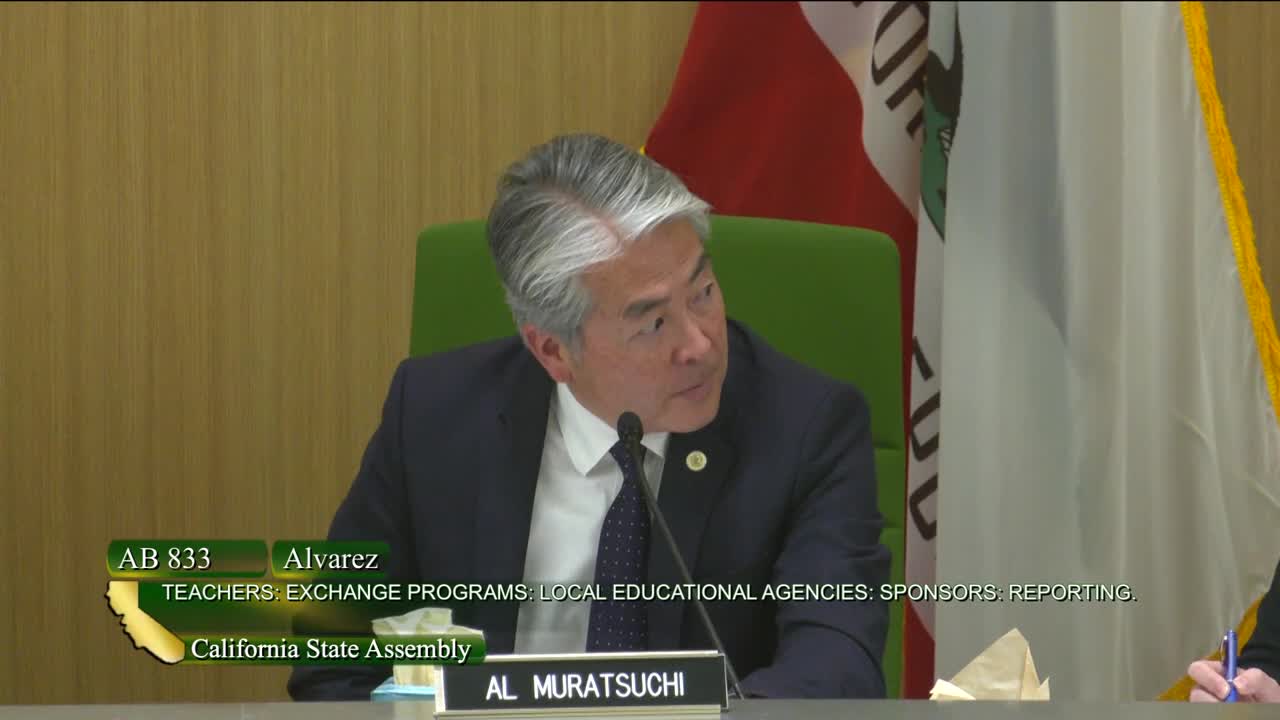
Discussed in Hearing
 21MIN
Assembly Standing Committee on Education
Bill Author