AB 567: Insurance: residential and commercial.
- Session Year: 2025-2026
- House: Assembly
- Latest Version Date: 2025-03-10
Current Status:
Failed
(2026-02-02: From committee: Filed with the Chief Clerk pursuant to Joint Rule 56.)
Introduced
In Committee
Awaiting First Chamber Vote
Passed First Chamber
In Committee
Awaiting Second Chamber Vote
Passed Second Chamber
Enacted
Existing law establishes the Department of Insurance, headed by the Insurance Commissioner, which regulates insurers and insurance practices. Existing law divides insurance into classes, including, among others, life insurance, fire insurance, and marine insurance. Under existing law, an insurer is entitled to payment of the premium as soon as the subject matter insured is exposed to the peril insured against.
This bill would state the intent of the Legislature to enact legislation related to reforming the insurance market.This bill would require, upon an appropriation, the state to pay for any annual increase in residential property insurance rates that is above either an annual increase of 7% or the annual national average increase in residential insurance premiums, whichever is lower. The bill would require, by March 31, 2026, the Department of Insurance, in consultation with insurers in the insurance industry, to provide a report to the Legislature on, among other things, how to slash regulations on the insurance market to achieve efficiencies to keep residential property insurance rates at or below the annual national average increase in residential insurance premiums. The bill would repeal these provisions on January 1, 2030.
Existing law imposes a gross premiums tax of 2.35% on all insurers doing business in this state, as set forth in the California Constitution.
This bill would, until January 1, 2030, set the gross premiums tax rate for premiums received for residential property insurance policies at 0% for premiums received on or after January 1, 2026.
Existing law establishes the Department of Insurance, headed by the Insurance Commissioner, which regulates insurers and insurance practices. Existing law divides insurance into classes, including, among others, life insurance, fire insurance, and marine insurance.
This bill would state the intent of the Legislature to enact legislation related to reforming the insurance market.
This act shall be known, and may be referred to, as the Cap and Cut Cost of Insurance through Reform Act.
SEC. 2.Section 2063 is added to the Insurance Code, to read:2063.(a)Upon an appropriation for the express purpose of this subdivision, until January 1, 2030, the State of California shall pay any annual increase in residential property insurance rates approved by the Insurance Commissioner that is above either of the following, whichever is lower:
(1)An annual increase of 7 percent.
(2)The annual national average increase in residential insurance premiums.
(b)By March 31, 2026, the Department of Insurance shall provide a report to the Legislature addressing all of the following:
(1)How to slash regulations on the insurance market, in consultation with insurers in the insurance industry, to achieve efficiencies to keep residential property insurance rates at or below the annual national average increase in residential insurance premiums.
(2)How to strategically allocate one billion dollars ($1,000,000,000) a year for four years, in consultation with insurers in the insurance industry, on fire fuel reduction to lower fire risks in a manner that will decrease insurance rates and restore commercial insurance coverage to areas forced into the FAIR Plan.
(3)How to suspend or reform all regulations, including, but not limited to, regulations authorized pursuant to the California Environmental Quality Act (Division 13 (commencing with Section 21000)) of the Public Resources Code or imposed by the State Air Resources Board or the California Coastal Commission, that limit or prohibit a property owner from clearing defensible space around their property or would increase the cost of brush management for fire risk reduction purposes.
(4)A report to be submitted pursuant to this subdivision shall be submitted in compliance with Section 9795 of the Government Code.
(c)The Legislature urges the Governor to initiate dialogue with the federal government with regard to a national reinsurance relief program that would involve regulatory reform and a federal reinsurance bridge financing program that will be run by the federal government to help insurance companies afford reinsurance.
(d)This section shall remain in effect only until January 1, 2030, and as of that date is repealed.
SEC. 3.Section 12221 of the Revenue and Taxation Code is amended to read:12221.(a)In the case of an insurer not transacting title insurance in this State, state, the basis of the tax is, in respect to each year, the amount of gross premiums, less return premiums, received in such year by such insurer upon its business done in this State. state. Gross premiums do not include premiums received for reinsurance and for ocean marine insurance. Gross premiums of reciprocal or interinsurance exchanges shall be determined as provided in Section 1530 of the Insurance Code. For purposes of the tax imposed by this chapter, gross premiums shall be deemed to include home protection contract fees defined in Section 12740 of the Insurance Code. Notwithstanding the rate specified in Section 12202, for annuity policies or contracts that constitute qualified funding assets pursuant to Section 130(d) of Title 26 of the United States Code, the gross premiums tax rate for premiums received for those annuity policies and contracts shall be 0 percent for premiums received on or after January 1, 2023.
(b)Notwithstanding the rate specified by Section 12202, the gross premiums tax rate for premiums received for residential property insurance policies, as defined in Section 10087 of the Insurance Code, shall be 0 percent for premiums that are received on or after January 1, 2026.
(c)This section shall remain in effect only until January 1, 2030, and as of that date is repealed.
SEC. 4.Section 12221 is added to the Revenue and Taxation Code, to read:12221.(a)In the case of an insurer not transacting title insurance in this state, the basis of the tax is, in respect to each year, the amount of gross premiums, less return premiums, received in such year by such insurer upon its business done in this state. Gross premiums do not include premiums received for reinsurance and for ocean marine insurance. Gross premiums of reciprocal or interinsurance exchanges shall be determined as provided in Section 1530 of the Insurance Code. For purposes of the tax imposed by this chapter, gross premiums shall be deemed to include home protection contract fees defined in Section 12740 of the Insurance Code. Notwithstanding the rate specified in Section 12202, for annuity policies or contracts that constitute qualified funding assets pursuant to Section 130(d) of Title 26 of the United States Code, the gross premiums tax rate for premiums received for those annuity policies and contracts shall be 0 percent for premiums received on or after January 1, 2023.
(b)This section shall become operative on January 1, 2030.
SECTION 1.It is the intent of the Legislature to enact legislation related to reforming the insurance market.It is the intent of the Legislature to enact legislation related to reforming the insurance market.
|
Date
|
Status
|
|---|---|
| Feb 2, 2026 | From committee: Filed with the Chief Clerk pursuant to Joint Rule 56. |
| Jan 31, 2026 | Died pursuant to Art. IV, Sec. 10(c) of the Constitution. |
| Apr 28, 2025 | In committee: Set, second hearing. Held under submission. |
| Apr 21, 2025 | In committee: Set, first hearing. Referred to suspense file. |
| Mar 28, 2025 | (Ayes 46. Noes 17. Page 908.) |
| Mar 28, 2025 | Re-referred to Coms. on REV. & TAX. and INS. pursuant to Assembly Rule 96. |
| Mar 11, 2025 | Re-referred to Com. on INS. |
| Mar 10, 2025 | From committee chair, with author's amendments: Amend, and re-refer to Com. on INS. Read second time and amended. |
| Mar 10, 2025 | Referred to Coms. on INS. and REV. & TAX. |
| Feb 13, 2025 | From printer. May be heard in committee March 15. |
| Feb 12, 2025 | Read first time. To print. |
This list shows positions taken on this bill by organizations on the date displayed, which is linked to the original source.
Positions by individuals are not included.
Date of Hearing: April 28, 2025
ASSEMBLY COMMITTEE ON REVENUE AND TAXATION
Mike Gipson, Chair
ABPCA Bill Id:AB 567 (
Author:DeMaio) – As Amended Ver:March 10, 2025
SUSPENSE
Majority vote. Fiscal committee.
SUBJECT: Insurance: residential and commercial
SUMMARY: Modifies provisions of the tax on insurers. Specifically, this bill:
- Reduces to 0% the rate of tax on gross premiums received for "residential property insurance policies" on or after January 1, 2026.
- Requires the state to subsidize, upon an appropriation, and until January 1, 2030, the annual increase in residential property insurance rates approved by the Insurance Commissioner that is above the lower of an annual increase of 7%, or the annual national average increase in residential insurance premiums.
- Requires the Department of Insurance to provide, by March 31, 2026, a report to the Legislature addressing how to:
- Slash regulation on the insurance market, in consultation with insurers in the insurance industry, to achieve efficiencies to keep residential property insurance rates at or below the annual national average increase in residential insurance premiums;
- Strategically allocate $1 billion a year for four years, in consultation with insurers in the insurance industry, on fire fuel reduction to lower fire risks in a manner that will decrease insurance rates and restore commercial insurance coverage to areas forced into the FAIR Plan; and,
- Suspend or reform all regulations, including, but not limited to, regulations authorized pursuant to the California Environmental Quality Act, or imposed by the State Air Resources Board or the California Coastal Commission, that limit or prohibit a property owner from clearing defensible space around their property or would increase the cost of brush management for fire risk reduction purposes.
- Urges the Governor to initiate dialogue with the federal government with regard to a national reinsurance relief program that would involve regulatory reform and a federal "reinsurance bridge financing" program that will be run by the federal government to help insurance companies afford reinsurance.
- Repeals this bill's provision on January 1, 2030, and reauthorizes the existing rate for the tax on insurers.
EXISTING LAW imposes a tax on each insurer doing business in the state. This tax is levied at a rate of 2.35% on the basis, as defined. The basis of the tax varies based on whether the insurance company is or is not engaged in providing title insurance. In the case of an insurer not transacting title insurance in this state, the annual basis for the tax is the difference between gross premiums and return premiums, as restricted. (California Constitution, Article XIII, Section 28 and Revenue and Taxation Code (R&TC) Section 12001 et seq.)
FISCAL EFFECT: Pending an estimate by the Department of Insurance, which notes that any proposed reduction would be significant; however, Committee staff notes that this bill almost certainly results in a General Fund revenue loss in excess of this Committee's Suspense File threshold.
COMMENTS:
- The author has submitted the following statement in support of this bill:
AB 567 is essential to providing relief to both homeowners and insurers, through keeping homeowner rate increases capped while insurers are able to receive payment from the state for amounts over that cap. AB 567 will also help to revitalize and restore the insurance market by requiring the Department of Insurance to work with insurers to determine what policies and regulations must change in order to keep insurance rate increases at or below the national average increase.
- Committee Staff Comments:
- National homeowner's insurance market: While the author points to the unaffordability of homeowner's insurance premiums in California as the impetus for this bill, and suggests that its cause is overregulation and over-taxation, the phenomenon of expensive homeowner's insurance premiums appears to be national. Between 2023 and 2024, rates across the nation rose by an average of 24.4%[1], and the national average rate for homeowner's insurance in 2025 is $2,601 per $300,000 of dwelling and liability coverage. California, by comparison, experienced rate increases of 25.2% over the 2023-24 period, and has an average rate of $1,405 for the same level of coverage[2] in 2025. When covering the period between 2019 and 2024, the national average rate increase was nearly 45%, with an average California rate increase of 55.3%[3].
Indeed, many states often considered low-taxed jurisdictions with constrained regulatory environments generally represent the most expensive homeowner's insurance markets. The most expensive state for homeowner's insurance is Oklahoma, with an average annual rate of $5,858. The average annual rates for Kansas, Nebraska, and Florida range from nearly $4,900 to about $4,400. Alabama, Mississippi, Texas, and Louisiana all have higher rates than California as well, with rates ranging between approximately $3,100 and $3,900[4]. This is understandable, given these states experience annual disasters, much like California.
Regardless, when compared to other surrounding states, California's home insurance market remains relatively affordable. Arizona's annual average rate is just below $2,500. Rates in Oregon, Washington and Nevada are likewise higher than California's, at an annual average of $1,755, $1,612, and $1,467, respectively[5].
- A California-specific problem? As noted previously, it appears that insurance rates throughout the nation are increasing, and this is not specific to California. The two major contributors to increased homeowner's insurance premiums are rising insurer costs and climate change[6]. The Insurance Information Institute, an industry-funded research organization, notes that between 2020 and 2022 the average replacement cost related to homeowner's insurance rose by 55%[7]. This increase may only be exacerbated by various federal policies, such as import tariffs. In particular, input goods with significant non-domestic sourcing that are vital for construction, such as lumber, are under threat of increased prices as a result of potential tariff actions[8].
Climate change has also contributed to increasing homeowner's insurance premium rates. Between 1990 and 2024, the number of ignitions declined by approximately 10%, but the total acreage burned increased by nearly 60%, nationwide[9]. These catastrophes have correspondingly led to an increase in insurance claims by victims seeking to rebuild. As such, insurers' loss exposure has risen dramatically, causing insurers to increase their capital reserves, purchase more reinsurance, or both[10].
- California's response: While California's homeowner's insurance market is objectively affordable by comparison to most other states that experience annual disasters, there is an ongoing market response to the increasing incidence of disasters in this state. California law conditions rate increases for homeowner's insurance on approval by the State Insurance Commissioner (Commissioner). Enacted in 1988, Proposition 103 required that the Commissioner approve any rate premium increase of certain insurance coverage, including homeowner's insurance. While rate increases authorized by the Commissioner are on a per-company basis, California's rate increases have remained generally consistent with the national average since 2023. The Commissioner announced last month that he would authorize a rate increase of 22% for State Farm Group, an increase that is generally consistent with average national increases.
- This bill: As currently drafted, this bill makes three changes to existing law. The first is to suspend the insurance tax until January 1, 2030. The second would establish a mechanism to authorize a reimbursement from the General Fund for homeowner's insurance premium rate increases above certain percentages. Finally, this bill would require the Department of Insurance to issue a report on certain policy recommendations to address rate increases.
- What is a "tax expenditure"? Existing law provides various credits, deductions, exclusions, and exemptions for particular taxpayer groups. In the late 1960s, U.S. Treasury officials began arguing that these features of the tax law should be referred to as "expenditures" since they are generally enacted to accomplish some governmental purpose and there is a determinable cost associated with each (in the form of foregone revenues).
As the Department of Finance notes in its annual Tax Expenditure Report, there are several key differences between tax expenditures and direct expenditures. First, tax expenditures are typically reviewed less frequently than direct expenditures. Second, there is generally no control over the amount of revenue losses associated with any given tax expenditure. Finally, it should also be noted that, once enacted, it takes a two-thirds vote to rescind an existing tax expenditure absent a sunset date. This effectively results in a "one-way ratchet" whereby tax expenditures can be conferred by majority vote, but cannot be rescinded, irrespective of their efficacy or cost, without a supermajority vote. This bill suspends the rate for the tax on insurers until January 1, 2030, thereby qualifying as a tax expenditure.
- Committee's tax expenditure policy: SB 1335 (Leno), Chapter 845, Statutes of 2014, added R&TC Section 41, which recognized that the Legislature should apply the same level of review used for government spending programs to tax credits introduced on or after January 1, 2015. AB 263 (Burke), Chapter 743, Statutes of 2019, extended the requirements in R&TC Section 41 to all tax expenditure measures under the Personal Income Tax Law, the Corporation Tax Law, and the Sales and Use Tax Law introduced on or after January 1, 2020. While existing statute does not require that tax expenditures under the tax on insurers' gross premiums be subject to the same treatment, this Committee's policy requires application of R&TC Section 41 to all tax expenditures. A tax expenditure proposal must outline specific goals, purposes, and objectives that the tax expenditure will achieve, along with detailed performance indicators for the Legislature to use when measuring whether the tax expenditure meets those stated goals, purposes, and objectives. In addition to the R&TC Section 41 requirements, this Committee's policy also requires that all tax expenditure proposals contain an appropriate sunset provision to be eligible for a vote[11]. Sunsets are required because eliminating a tax expenditure generally requires a 2/3 vote. These requirements must be satisfied before a bill can receive a vote in this Committee. This bill does contain an appropriate five-year sunset, but does not comply with the requirements of R&TC Section 41.
- Double-referral: This bill has been referred to this Committee and the Assembly Committee on Insurance.
- Related legislation:
- AB 232 (Calderon) excludes from gross income amounts contributed to, and interest earned in, a "catastrophe savings accounts" for certain taxable years. AB 232 will be heard by this Committee today.
- AB 376 (Tangipa) excludes from gross income any amount received by a "qualified taxpayer" as "qualified insurance proceeds." AB 376 is pending hearing by this Committee.
REGISTERED SUPPORT / OPPOSITION:
Support
None on file
Opposition
None on file
Analysis Prepared by: Harrison Bowlby / REV. & TAX. / (916) 319-2098
Woleben, US Homeowners Rates Rise by Double digits for 2nd Straight year in 2024, S&P Global (January 2025). https://www.spglobal.com/market-intelligence/en/news-insights/articles/2025/1/us-homeowners-rates-rise-by-double-digits-for-2nd-straight-year-in-2024-87061085, accessed April 2025. ↑
Kasperowicz, Average Homeowners Insurance Rates by State in 2025, Insurance.com (March 2025). https://www.insurance.com/home-and-renters-insurance/home-insurance-basics/average-homeowners-insurance-rates-by-state, accessed April 2025. ↑
Woleben. ↑
Ibid. ↑
Ibid. ↑
Fowlie, et al., How is Climate Change Impacting Home Insurance Markets?, Brookings Institute (January 2025). https://www.brookings.edu/articles/how-is-climate-change-impacting-home-insurance-markets/, accessed April 2025. ↑
Rising Homeowners Insurance Costs Since Pandemic Driven by Persistent inflation, Replacement Cost Increases, Prolonged Supply Chain Issues, and Legal System Abuse, Insurance Information Institute (July 2024). https://www.iii.org/press-release/rising-homeowners-insurance-costs-since-pandemic-driven-by-persistent-inflation-replacement-cost-increases-prolonged-supply-chain-issues-and-legal-system-abuse-071624, accessed April 2025. ↑
Strong, How Tariffs Impact the Home Building Industry, National Association of Home Builders. https://www.nahb.org/advocacy/top-priorities/building-materials-trade-policy/how-tariffs-impact-home-building, accessed April 2025. ↑
Wibbenmeyer and Tastet, Wildfires in the United States 101: Context and Consequences," Resources for the Future (July 2021). https://www.rff.org/publications/explainers/wildfires-in-the-united-states-101-context-and-consequences/, accessed April 2025. ↑
Fowlie, et al. ↑
An "appropriate sunset provision" shall mean five years, except in the case of a tax expenditure measure providing relief to California veterans, in which case "appropriate sunset provision" shall mean 10 years. ↑
Date of Hearing: April 21, 2025
ASSEMBLY COMMITTEE ON REVENUE AND TAXATION
Mike Gipson, Chair
ABPCA Bill Id:AB 567 (
Author:DeMaio) – As Amended Ver:March 10, 2025
Majority vote. Fiscal committee.
SUBJECT: Insurance: residential and commercial
SUMMARY: Modifies provisions of the tax on insurers. Specifically, this bill:
- Reduces to 0% the rate of tax on gross premiums received for "residential property insurance policies" on or after January 1, 2026.
- Requires the state to subsidize, upon an appropriation, and until January 1, 2030, the annual increase in residential property insurance rates approved by the Insurance Commissioner that is above the lower of an annual increase of 7%, or the annual national average increase in residential insurance premiums.
- Requires the Department of Insurance to provide, by March 31, 2026, a report to the Legislature addressing how to:
- Slash regulation on the insurance market, in consultation with insurers in the insurance industry, to achieve efficiencies to keep residential property insurance rates at or below the annual national average increase in residential insurance premiums;
- Strategically allocate $1 billion a year for four years, in consultation with insurers in the insurance industry, on fire fuel reduction to lower fire risks in a manner that will decrease insurance rates and restore commercial insurance coverage to areas forced into the FAIR Plan; and,
- Suspend or reform all regulations, including, but not limited to, regulations authorized pursuant to the California Environmental Quality Act, or imposed by the State Air Resources Board or the California Coastal Commission, that limit or prohibit a property owner from clearing defensible space around their property or would increase the cost of brush management for fire risk reduction purposes.
- Urges the Governor to initiate dialogue with the federal government with regard to a national reinsurance relief program that would involve regulatory reform and a federal "reinsurance bridge financing" program that will be run by the federal government to help insurance companies afford reinsurance.
- Repeals this bill's provision on January 1, 2030, and reauthorizes the existing rate for the tax on insurers.
EXISTING LAW imposes a tax on each insurer doing business in the state. This tax is levied at a rate of 2.35% on the basis, as defined. The basis of the tax varies based on whether the insurance company is or is not engaged in providing title insurance. In the case of an insurer not transacting title insurance in this state, the annual basis for the tax is the difference between gross premiums and return premiums, as restricted. (California Constitution, Article XIII, Section 28 and Revenue and Taxation Code (R&TC) Section 12001 et seq.)
FISCAL EFFECT: Pending an estimate by the Department of Insurance; however, Committee staff notes that this bill almost certainly results in a General Fund revenue loss in excess of this Committee's Suspense File threshold.
COMMENTS:
- The author has submitted the following statement in support of this bill:
AB 567 is essential to providing relief to both homeowners and insurers, through keeping homeowner rate increases capped while insurers are able to receive payment from the state for amounts over that cap. AB 567 will also help to revitalize and restore the insurance market by requiring the Department of Insurance to work with insurers to determine what policies and regulations must change in order to keep insurance rate increases at or below the national average increase.
- Committee Staff Comments:
- National homeowner's insurance market: While the author points to the unaffordability of homeowner's insurance premiums in California as the impetus for this bill, and suggests that its cause is overregulation and over-taxation, the phenomenon of expensive homeowner's insurance premiums appears to be national. Between 2023 and 2024, rates across the nation rose by an average of 24.4%[1], and the national average rate for homeowner's insurance in 2025 is $2,601 per $300,000 of dwelling and liability coverage. California, by comparison, experienced rate increases of 25.2% over the 2023-24 period, and has an average rate of $1,405 for the same level of coverage[2] in 2025. When covering the period between 2019 and 2024, the national average rate increase was nearly 45%, with an average California rate increase of 55.3%[3].
Indeed, many states often considered low-taxed jurisdictions with constrained regulatory environments generally represent the most expensive homeowner's insurance markets. The most expensive state for homeowner's insurance is Oklahoma, with an average annual rate of $5,858. The average annual rates for Kansas, Nebraska, and Florida range from nearly $4,900 to about $4,400. Alabama, Mississippi, Texas, and Louisiana all have higher rates than California as well, with rates ranging between approximately $3,100 and $3,900[4]. This is understandable, given these states experience annual disasters, much like California.
Regardless, when compared to other surrounding states, California's home insurance market remains relatively affordable. Arizona's annual average rate is just below $2,500. Rates in Oregon, Washington and Nevada are likewise higher than California's, at an annual average of $1,755, $1,612, and $1,467, respectively[5].
- A California-specific problem? As noted previously, it appears that insurance rates throughout the nation are increasing, and this is not specific to California. The two major contributors to increased homeowner's insurance premiums are rising insurer costs and climate change[6]. The Insurance Information Institute, an industry-funded research organization, notes that between 2020 and 2022 the average replacement cost related to homeowner's insurance rose by 55%[7]. This increase may only be exacerbated by various federal policies, such as import tariffs. In particular, input goods with significant non-domestic sourcing that are vital for construction, such as lumber, are under threat of increased prices as a result of potential tariff actions[8].
Climate change has also contributed to increasing homeowner's insurance premium rates. Between 1990 and 2024, the number of ignitions declined by approximately 10%, but the total acreage burned increased by nearly 60%, nationwide[9]. These catastrophes have correspondingly led to an increase in insurance claims by victims seeking to rebuild. As such, insurers' loss exposure has risen dramatically, causing insurers to increase their capital reserves, purchase more reinsurance, or both[10].
- California's response: While California's homeowner's insurance market is objectively affordable by comparison to most other states that experience annual disasters, there is an ongoing market response to the increasing incidence of disasters in this state. California law conditions rate increases for homeowner's insurance on approval by the State Insurance Commissioner (Commissioner). Enacted in 1988, Proposition 103 required that the Commissioner approve any rate premium increase of certain insurance coverage, including homeowner's insurance. While rate increases authorized by the Commissioner are on a per-company basis, California's rate increases have remained generally consistent with the national average since 2023. The Commissioner announced last month that he would authorize a rate increase of 22% for State Farm Group, an increase that is generally consistent with average national increases.
- This bill: As currently drafted, this bill makes three changes to existing law. The first is to suspend the insurance tax until January 1, 2030. The second would establish a mechanism to authorize a reimbursement from the General Fund for homeowner's insurance premium rate increases above certain percentages. Finally, this bill would require the Department of Insurance to issue a report on certain policy recommendations to address rate increases.
- What is a "tax expenditure"? Existing law provides various credits, deductions, exclusions, and exemptions for particular taxpayer groups. In the late 1960s, U.S. Treasury officials began arguing that these features of the tax law should be referred to as "expenditures" since they are generally enacted to accomplish some governmental purpose and there is a determinable cost associated with each (in the form of foregone revenues).
As the Department of Finance notes in its annual Tax Expenditure Report, there are several key differences between tax expenditures and direct expenditures. First, tax expenditures are typically reviewed less frequently than direct expenditures. Second, there is generally no control over the amount of revenue losses associated with any given tax expenditure. Finally, it should also be noted that, once enacted, it takes a two-thirds vote to rescind an existing tax expenditure absent a sunset date. This effectively results in a "one-way ratchet" whereby tax expenditures can be conferred by majority vote, but cannot be rescinded, irrespective of their efficacy or cost, without a supermajority vote. This bill suspends the rate for the tax on insurers until January 1, 2030, thereby qualifying as a tax expenditure.
- Committee's tax expenditure policy: SB 1335 (Leno), Chapter 845, Statutes of 2014, added R&TC Section 41, which recognized that the Legislature should apply the same level of review used for government spending programs to tax credits introduced on or after January 1, 2015. AB 263 (Burke), Chapter 743, Statutes of 2019, extended the requirements in R&TC Section 41 to all tax expenditure measures under the Personal Income Tax Law, the Corporation Tax Law, and the Sales and Use Tax Law introduced on or after January 1, 2020. While existing statute does not require that tax expenditures under the tax on insurers' gross premiums be subject to the same treatment, this Committee's policy requires application of R&TC Section 41 to all tax expenditures. A tax expenditure proposal must outline specific goals, purposes, and objectives that the tax expenditure will achieve, along with detailed performance indicators for the Legislature to use when measuring whether the tax expenditure meets those stated goals, purposes, and objectives. In addition to the R&TC Section 41 requirements, this Committee's policy also requires that all tax expenditure proposals contain an appropriate sunset provision to be eligible for a vote[11]. Sunsets are required because eliminating a tax expenditure generally requires a 2/3 vote. These requirements must be satisfied before a bill can receive a vote in this Committee. This bill does contain an appropriate five-year sunset, but does not comply with the requirements of R&TC Section 41.
- Double-referral: This bill has been referred to this Committee and the Assembly Committee on Insurance.
- Related legislation:
- AB 232 (Calderon) excludes from gross income amounts contributed to, and interest earned in, a "catastrophe savings accounts" for certain taxable years. AB 232 will be heard by this Committee today.
- AB 376 (Tangipa) excludes from gross income any amount received by a "qualified taxpayer" as "qualified insurance proceeds." AB 376 is pending hearing by this Committee.
REGISTERED SUPPORT / OPPOSITION:
Support
None on file
Opposition
None on file
Analysis Prepared by: Harrison Bowlby / REV. & TAX. / (916) 319-2098
Woleben, US Homeowners Rates Rise by Double digits for 2nd Straight year in 2024, S&P Global (January 2025). https://www.spglobal.com/market-intelligence/en/news-insights/articles/2025/1/us-homeowners-rates-rise-by-double-digits-for-2nd-straight-year-in-2024-87061085, accessed April 2025. ↑
Kasperowicz, Average Homeowners Insurance Rates by State in 2025, Insurance.com (March 2025). https://www.insurance.com/home-and-renters-insurance/home-insurance-basics/average-homeowners-insurance-rates-by-state, accessed April 2025. ↑
Woleben. ↑
Ibid. ↑
Ibid. ↑
Meredith, et al., How is Climate Change Impacting Home Insurance Markets?, Brookings Institute (January 2025). https://www.brookings.edu/articles/how-is-climate-change-impacting-home-insurance-markets/, accessed April 2025. ↑
Rising Homeowners Insurance Costs Since Pandemic Driven by Persistent inflation, Replacement Cost Increases, Prolonged Supply Chain Issues, and Legal System Abuse, Insurance Information Institute (July 2024). https://www.iii.org/press-release/rising-homeowners-insurance-costs-since-pandemic-driven-by-persistent-inflation-replacement-cost-increases-prolonged-supply-chain-issues-and-legal-system-abuse-071624, accessed April 2025. ↑
Strong, How Tariffs Impact the Home Building Industry, National Association of Home Builders. https://www.nahb.org/advocacy/top-priorities/building-materials-trade-policy/how-tariffs-impact-home-building, accessed April 2025. ↑
Wibbenmeyer and Tastet, Wildfires in the United States 101: Context and Consequences," Resources for the Future (July 2021). https://www.rff.org/publications/explainers/wildfires-in-the-united-states-101-context-and-consequences/, accessed April 2025. ↑
Fowlie, et al. ↑
An "appropriate sunset provision" shall mean five years, except in the case of a tax expenditure measure providing relief to California veterans, in which case "appropriate sunset provision" shall mean 10 years. ↑
Discussed in Hearing
 10MIN
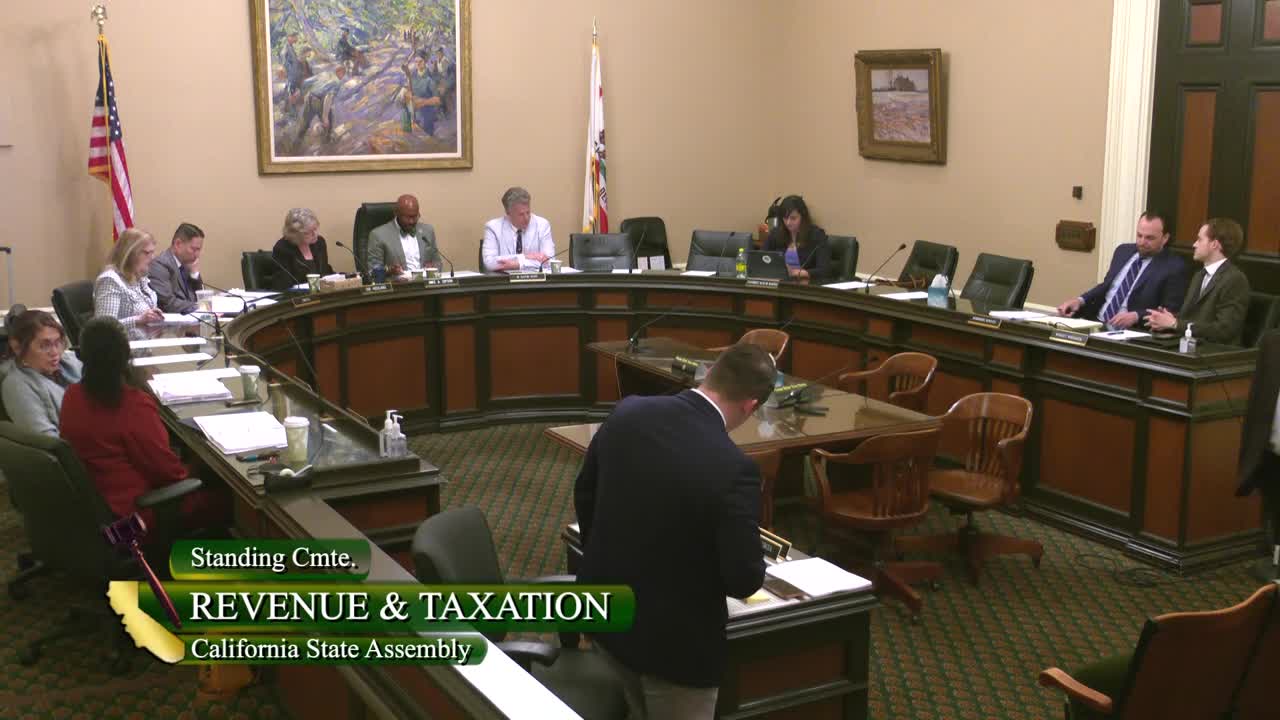
Assembly Standing Committee on Revenue and Taxation
Bill Author

Bill Co-Author(s):