SB 1118: Personal Income Tax Law: Corporation Tax Law: tax credits: backup generators: solar batteries.
- Session Year: 2025-2026
- House: Senate
- Latest Version Date: 2026-02-17
Current Status:
In Progress
(2026-05-06: May 6 set for first hearing. Held in committee without recommendation.)
Introduced
In Committee
Awaiting First Chamber Vote
Passed First Chamber
In Committee
Awaiting Second Chamber Vote
Passed Second Chamber
Enacted
What does this bill do?
Creates a state income tax credit equal to 50% of the cost to buy a backup electricity generator or a solar battery for use at a home or commercial property, with a $5,000 limit for generators and $7,500 for batteries per property. The credit applies only for purchases in designated high wildfire‑risk (tier 3) areas, is available to individuals and small businesses, and covers tax years beginning in 2027 through 2031.
The summary is provided by generative AI which can make mistakes. For original language, please view the details in the table below.
The Personal Income Tax Law and the Corporation Tax Law allow various credits against the taxes imposed by those laws.
This bill would, for taxable years beginning on or after January 1, 2027, and before January 1, 2032, allow a credit against those taxes equal to 50% of the cost of a backup electricity generator or solar battery, as specified, by a qualified taxpayer, as defined, for use in a residence or commercial property. The bill would limit the credit to $5,000 per residence or commercial property in the case of the purchase of a backup electricity generator, and to $7,500 in the case of a solar battery. The bill would only apply these provisions in taxable years for which an appropriation is made in the Budget Act or another statute for the purposes of administering the credits.
Existing law requires any bill authorizing a new tax expenditure to contain, among other things, specific goals the tax expenditure will achieve, detailed performance indicators, and data collection requirements.
This bill would include additional information required for any bill authorizing a new tax expenditure.
This bill would take effect immediately as a tax levy.
(a)(1)For each taxable year beginning on or after January 1, 2027, and before January 1, 2032, there shall be allowed as a credit against the net tax, as defined in Section 17039, an amount equal to the amount specified in paragraph (2) for qualified expenditures paid or incurred by the qualified taxpayer during the taxable year.
(2)The amount of the credit allowed pursuant to this section shall be equal to 50 percent of the amount paid or incurred by a qualified taxpayer during the taxable year for qualified expenditures, subject to the following limitations:
(A)If the qualified expenditure is the purchase of a backup electricity generator, then the credit shall not exceed five thousand dollars ($5,000) per residence or commercial property, per taxable year.
(B)If the qualified expenditure is the purchase of a solar battery, then the credit shall not exceed seven thousand five hundred dollars ($7,500) per residence or commercial property, per taxable year.
(b)For purposes of this section, the following definitions apply:
(1)Backup electricity generator means a standby or portable device that meets all of the following requirements:
(A)The device can generate at least 10 kilowatts.
(B)The device is designed and manufactured exclusively for the purpose of generating electricity.
(C)The device complies with applicable air quality standards promulgated by the State Air Resources Board.
(2)Designated wildfire zone means territory within a high fire threat district designated a tier 3 fire threat area, as determined by the Public Utilities Commission.
(3)Qualified expenditure means the purchase of one of the following:
(A)A backup electricity generator for use in a residence or commercial property in a designated wildfire zone.
(B)A solar battery for use in a residence or commercial property in a designated wildfire zone.
(4)Qualified taxpayer means a natural person or a small business that incurs a qualified expenditure.
(5)Small business means a business that has average annual gross receipts of fifteen million dollars ($15,000,000) or less over the previous three taxable years.
(c)In the case where the credit allowed by this section exceeds the net tax, the excess may be carried over to reduce the net tax in the following taxable year, and succeeding six years if necessary, until the credit is exhausted.
(d)This section shall only be operative for taxable years for which an appropriation is made for its purposes in the annual Budget Act or another statute.
(e)(1)For the purposes of complying with Section 41, as it relates to the credit allowed pursuant to this section or Section 23634, the Legislature finds and declares the following:
(A)The specific goal of the credit is to encourage the purchase of backup electricity generators and solar batteries that are necessary to protect the health and safety of residents and businesses.
(B)The performance indicators for the Legislature to use when measuring whether the credit meets the goal specified in subparagraph (A) are the number of taxpayers allowed a credit, and the total dollar value of credits allowed.
(2)(A)The Franchise Tax Board, no later than April 1, 2029, and annually thereafter, shall submit a report to the Legislature, in accordance with Section 9795 of the Government Code, detailing the number of taxpayers allowed a credit under this section or Section 23634, and the total dollar value of credits allowed.
(B)The disclosure provisions of this paragraph shall be treated as an exception to Section 19542.
(f)This section shall remain operative only until December 1, 2032, and as of that date is repealed.
SEC. 2.Section 23634 is added to the Revenue and Taxation Code, to read:23634.(a)(1)For each taxable year beginning on or after January 1, 2027, and before January 1, 2032, there shall be allowed as a credit against the tax, as defined in Section 23036, an amount as specified in paragraph (2) for qualified expenditures paid or incurred by a qualified taxpayer during the taxable year.
(2)The amount of the credit allowed pursuant to this section shall be equal to 50 percent of the amount paid or incurred by a qualified taxpayer during the taxable year for qualified expenditures, subject to the following limitations:
(A)If the qualified expenditure is the purchase of a backup electricity generator, then the credit shall not exceed five thousand dollars ($5,000) per commercial property, per taxable year.
(B)If the qualified expenditure is the purchase of a solar battery, then the credit shall not exceed seven thousand five hundred dollars ($7,500) per commercial property, per taxable year.
(b)For purposes of this section, the following definitions apply:
(1)Backup electricity generator means a standby or portable device that meets all of the following requirements:
(A)The device can generate at least 10 kilowatts.
(B)The device is designed and manufactured exclusively for the purpose of generating electricity.
(C)The device complies with applicable air quality standards promulgated by the State Air Resources Board.
(2)Designated wildfire zone means territory within a high fire threat district designated a tier 3 fire threat area, as determined by the Public Utilities Commission.
(3)Qualified expenditure means the purchase of one of the following:
(A)A backup electricity generator for use in a commercial property in a designated wildfire zone.
(B)A solar battery for use in a commercial property in a designated wildfire zone.
(4)Qualified taxpayer means a small business that incurs a qualified expenditure.
(5)Small business means a business that has average annual gross receipts of fifteen million dollars ($15,000,000) or less over the previous three taxable years.
(c)In the case where the credit allowed by this section exceeds the tax, the excess may be carried over to reduce the tax in the following taxable year, and succeeding six years if necessary, until the credit is exhausted.
(d)This section shall only be operative for taxable years for which an appropriation is made for its purposes in the annual Budget Act or another statute.
(e)This section shall remain operative only until December 1, 2032, and as of that date is repealed.
SEC. 3.This act provides for a tax levy within the meaning of Article IV of the California Constitution and shall go into immediate effect.
|
Date
|
Status
|
|---|---|
| May 6, 2026 | May 6 set for first hearing. Held in committee without recommendation. |
| Apr 9, 2026 | Set for hearing May 6. |
| Feb 26, 2026 | Referred to Com. on REV. & TAX. |
| Feb 18, 2026 | From printer. May be acted upon on or after March 20. |
| Feb 17, 2026 | Introduced. Read first time. To Com. on RLS. for assignment. To print. |
This list shows positions taken on this bill by organizations on the date displayed, which is linked to the original source.
Positions by individuals are not included.
|
Organization
|
Position
|
Date
|
|---|---|---|
| California Teachers Association | ** Against | |
| County of Inyo | ** Support | |
| El Dorado County Fire Protection District | ** Support | |
| Mariposa County Sheriff's Office | ** Support | |
| Town of Truckee | ** Support |
SENATE COMMITTEE ON REVENUE AND TAXATION
Senator Jerry McNerney, Chair
2025 - 2026 Regular
Bill No: | SB 1118 | Hearing Date: | 5/6/26 |
Author: | Alvarado-Gil | Tax Levy: | Yes |
Version: | 2/17/26 | Fiscal: | Yes |
Consultant: | Summers | ||
Personal Income Tax Law: Corporation Tax Law: tax credits: backup generators: solar batteries
Authorizes an income tax credit for tax years 2027 through 2031 for the purchase of a backup electricity generator or solar battery for use in a designated wildfire zone.
Background
Tax expenditures. California law allows various income tax credits, deductions, exemptions, and exclusions. When a tax law is determined to have a cost in the form of foregone revenues, such as a tax exemption, state law refers to them as “tax expenditures.” The Legislature enacts such tax incentives to compensate taxpayers for incurring certain expenses, such as child adoption, or to influence certain behaviors, such as participating in charitable giving. The Legislature uses tax incentives to encourage taxpayers to do something they would otherwise not do “but for” the tax incentive. The Department of Finance must publish an annual list of tax expenditures, currently totaling around $94.2 billion in forgone general fund revenue.
Credits. Tax credits reduce the amount of tax owed by a taxpayer on a dollar-for-dollar basis. Credit amounts that exceed the taxpayer’s current tax year liability can either be refunded to the taxpayer or carried forward to reduce tax in future years. However, except for the Earned Income Tax Credit, the Young Child Tax Credit, the Foster Youth Tax Credit, and the Motion Picture and Television Production Credit, all credits against California Personal Income and Corporation Tax are nonrefundable.
California Fires. Over the last decade, California has experienced increased, intense, and record-breaking wildfires. These fires have resulted in a devastating loss of life and billions of dollars in damage to property and infrastructure. According to the California Department of Forestry and Fire Protection (CAL FIRE), in 2025 alone, there were 608,571 emergency responses; 8,232 wildfires; 507,817 acres burned; 16,627 structures damaged or destroyed; and 31 fatalities. As of April 13, 2026, for the year 2026, there have already been 172,125 emergency responses; 707 wildfires; 6,812 acres burned; 1 structure damaged or destroyed; and 0 fatalities.
Governor Newsom’s State Emergency Proclamation to Fast-track Critical Wildfire Prevention Projects Statewide. On March 1, 2025, Governor Newsom proclaimed a state of emergency due to the escalating risk of catastrophic wildfires driven by widespread tree die-offs, deteriorating forest conditions, and extreme shifts between rain and drought. This state of emergency proclamation was made following a series of catastrophic fires in Los Angeles County that began on January 7, 2025, and were not contained until January 31, 2025. The two primary fires, the Palisades and Eaton fires, burned 37,728 acres, destroyed 18,298 structures, and claimed 29 lives. The proclamation directed that state statutes, rules, regulations, and requirements that fall within the jurisdiction of boards, departments, and offices within the California Environmental Protection Agency and the California Natural Resources Agency be suspended, allowing critical fuel reduction projects to be accelerated. Critical fuel reduction projects include:
- Removal of hazardous, dead, and/or dying trees;
- Removal of vegetation for the creation of strategic fuel breaks identified by approved fire prevention plans, including CAL FIRE Unit Fire Plans or Community Wildfire Preparedness Plans;
- Removal of vegetation for community defensible space;
- Removal of vegetation along roadways, highways, and freeways for the creation of safer ingress and egress routes for the public and responders and to reduce roadside ignitions;
- Removal of vegetation using cultural traditional ecological knowledge for cultural burning and/or prescribed fire treatments for fuel reduction; or
- Maintenance of previously established fuel breaks or fuel modification projects.
Governor’s Budget Proposal 2025-26. The 2024 Climate Bond invests $10 billion in projects that strengthen communities and support stewardship of natural resources and the environment (SB 867, Allen 2023; Proposition 4, 2024). The Governor’s Proposed Budget builds on existing investments in wildfire resilience and forest health projects with $314 million investments from the Climate Bond in 2026-27 for the following wildfire and forest resilience efforts:
- Local Fire Prevention Grants ($58 million) for wildfire prevention and hazardous fuels reduction projects in and near wildfire-threatened communities;
- Fire Resilience ($19.6 million) for technical and financial assistance to homeowners in wildfire-vulnerable areas to implement defensible space mitigations, including Zone 0 ember-resistant space; and
- Wildfire Risk Reduction Related to Electricity Transmission ($15.2 million) for grants, in coordination with the Office of Energy Infrastructure Safety, to support fuel reduction around wildfire-vulnerable communities and reduce wildfire ignitions.
High Fire-Threat District map. In 2008, the California Public Utilities Commission (CPUC) began a regulatory process to reduce the risk to the public posed by potential fire hazards associated with overhead powerline facilities and nearby aerial communication facilities. On October 30, 2015, Governor Brown issued a proclamation declaring a state of emergency due to an epidemic of tree mortality. The proclamation directs CAL FIRE and other state agencies to identify areas that represent high hazard zones (HHZs) for wildfire and falling trees and to endeavor to remove dead or dying trees in HHZs. On January 19, 2018, CPUC adopted the Fire-Threat Map, which is comprised of two map sources and includes three fire-threat areas:
- Zone 1 consists of Tier 1 HHZs from the United States Forest Service (USFS) and CAL FIRE joint map of Tree Mortality HHZs. Tier 1 HHZs are in direct proximity to communities, roads, and utility lines, and are a direct threat to public safety.
- Tier 2 consists of areas on the CPUC Fire-Threat Map where there is an elevated risk to people and property from wildfires associated with overhead utility power lines or overhead utility power-line facilities.
- Tier 3 consists of areas on the CPUC Fire-Threat Map where there is an extreme risk to people and property from wildfires associated with overhead utility power lines or overhead utility power-line facilities. Tier 3 is distinguished from Tier 2 by having the highest likelihood of utility-associated fire initiation and growth that would impact people or property, and where the most restrictive utility regulations are necessary to reduce utility fire risk.
Together, Zone 1, Tier 2, and Tier 3 constitute the High Fire-Threat District.
California Air Resources Board (CARB) regulations for generators and solar batteries. CARB has also promulgated regulations governing the use of backup engines for power during public safety power shutoff events. CARB’s Airborne Toxic Control Measure (ATCM) for Stationary Compression Ignition Engines (Stationary Engine ATCM) establishes emission limits and usage restrictions for stationary compression-ignition engines with greater than 50 brake horsepower. The Stationary Engine ATCM allows the use of older, more polluting “emergency standby engines” when a facility experiences a loss of normal electrical service beyond the facility’s reasonable control, but limits their use during non-emergency activities such as maintenance and testing. CARB also allows for the temporary operation of otherwise unregistered and/or unpermitted engines during an “Emergency Event” so long as certain conditions are met.
Portable engines, as defined by the Stationary Engine ATCM, and spark-ignition engines are not subject to the requirements of the Stationary Engine ATCM. Small off-road engines, such as those used in small generators sold at retail stores, are required to be certified by CARB to be able to be sold in California.[1] In 2021, CARB approved a measure that would require portable generators to meet more stringent standards in 2024 and meet zero-emission standards starting in 2028.[2]
CARB regulations define zero-emission generators as equipment that “generates or stores energy and distributes electrical power while producing zero emissions” (13 CCR 2401) and contain “a zero-emission power generation device, an energy storage device, or any combination of both of these devices” (13 CCR 2408.2). As a result, a solar battery system would also likely be considered a zero-emission generator.
The author wants to authorize a personal income tax credit and a corporate income tax credit to encourage the purchase of backup electricity generators and solar batteries that are necessary to protect the health and safety of residents and businesses.
Proposed Law
Senate Bill 1118 authorizes a personal income tax credit and corporate income tax credit, for tax years 2027 through 2031, in an amount equal to 50% of the expenses incurred during the taxable year by an individual or small business for the purchase of a backup electricity generator or solar battery for use in a designated wildfire zone. The credit amount allowed per residence or commercial property cannot exceed $5,000 in the case of a backup electricity generator or $7,500 in the case of a solar battery. The measure defines several terms, including:
- “Backup electricity generator,” which means a standby or portable device that is designed and manufactured exclusively for the purpose of generating electricity, can generate at least 10 kilowatts, and complies with applicable CARB air quality standards.
- “Designated wildfire zone,” which means territory within a high fire threat district designated a tier 3 fire threat area, as determined by the PUC.
- “Small business,” which means a business that has average annual gross receipts of $15,000,000 or less over the previous three taxable years.
The bill also allows a seven-year carry forward for excess credit amounts over the taxpayer’s net tax; it shall only be operative for years in which an appropriation is made for the credit’s purpose; and it contains legislative findings and declarations to comply with Section 41 of the Revenue and Taxation Code.
State Revenue Impact
According to the Franchise Tax Board (FTB), SB 1118 would result in revenue losses of $90 million in FY 2026-27, $200 million in FY 2027-28, and $250 million in 2028-29.
Comments
1. Purpose of the bill. According to the author, “Reliable access to electricity is no longer just a convenience, but rather a matter of public health and safety. As California continues to face power shutoffs and grid instability, small businesses and residents are increasingly vulnerable to the loss of essential services, refrigeration for medications, and operational continuity for local economies. SB 1118 offers a solution to this by offering tax credits for the purchase of backup electricity generators and solar batteries. This bill targets small businesses and residents, particularly those in Tier 3 fire threat areas, providing credits of up to $5,000 for generators and $7,500 for solar batteries. Lowering the cost of these critical systems ensures that our most at-risk communities have the tools they need to stay safe and operational during emergencies. This is a common-sense investment in the resilience and safety of California’s residents and small business owners.”
2. “Windfall” or “but for” tax benefit? Tax expenditures produce two different outcomes. The first outcome is a “windfall,” in which the tax expenditure rewards behavior that would have occurred even without the tax benefit. The second outcome is a “but for tax benefit,” where a particular activity would not have occurred without the incentive created by the tax expenditure. Here, some taxpayers, particularly higher-income households and businesses with electrical continuity needs, would likely purchase backup power systems regardless of the credit due. However, for cost-constrained households and businesses, the up-front expense of these systems is a significant barrier, and the credit may induce purchases that would not otherwise occur. On balance, this credit may serve as a “windfall” for some taxpayers and a “but for” incentive for others.
3. Revenue loss. Existing tax law provides various credits, deductions, exclusions, and exemptions for certain taxpayers. By authorizing a credit against personal income tax, SB 1118 will result in the State General Fund receiving less revenue. As a result, the state will have to reduce spending or increase taxes to offset the loss. Additionally, because Proposition 98 establishes a minimum funding guarantee for K-14 education in California, which generally represents roughly 40% of the state’s General Fund revenues, every dollar of General Fund loss results in approximately 40 cents less of funding for K-14 education.
4. Precedent. If the Legislature allows an income tax credit for the purchase of backup electricity generators and solar batteries in designated wildfire zones, why should it not allow other income tax credits for related emergency preparedness, such as home hardening improvements, water storage systems, and air filtration systems? This may lead to a slippery slope in which more income tax credits are authorized for an expanding range of personal consumption expenses, thereby eroding the income tax base and reducing General Fund revenues.
5. Equity. When a utility provider de-energizes its power lines, the risk of the system sparking a wildfire is greatly reduced. However, power loss has many negative impacts, especially to vulnerable populations (including residential customers that need reliable electric service to power life-saving medical devices), medical and emergency service providers (including hospitals, fire departments, and police stations), and important public service providers (such as water agencies, gas stations, and grocery stores). To mitigate the damage from power outages, individuals and businesses may rely on solar batteries or lower-cost backup generators to replace lost power. However, many backup generators are used to power homes and businesses that run on diesel, further contributing to the already low air quality worsened by fires.
6. Who benefits? California’s progressive income tax rate system means households with lower income levels often cannot utilize the full credit amounts, unless they are refundable. As a result, households with the most need often do not benefit from nonrefundable credits. However, existing refundable credits, such as the Earned Income Tax Credit and the Young Child Tax Credit, have had lower-than-expected take-up rates. The Committee may wish to consider whether grants or other forms of direct payments would produce a more equitable outcome.
7. Best way? The Tier 2 and Tier 3 fire-threat areas on the CPUC Fire-Threat Map, which were adopted in 2018, are updated every 10 years. However, the Tier 1 HHZs on the Tree Mortality HHZ Map, which is not owned or maintained by the CPUC, are updated about once a year. Further, the Tier 2 and Tier 3 fire-threat areas on the CPUC Fire-Threat Map may overlap with the Tier 1 HHZs on the Tree Mortality HHZ Map.[3] The Committee may wish to consider whether SB 1118’s requirement that the backup generator or solar battery be used in Tier 3 designated wildfire zones, designated over 8 years ago, provides targeted relief where the present-day risk is greatest.
8. Section 41. Section 41 of the Revenue and Taxation Code requires any bill enacting a new tax expenditure to contain, among other things, specific goals, purposes, and objectives that the tax expenditure will achieve and detailed performance indicators, along with data collection and reporting requirements (SB 1335, Leno, 2014). A bill that would authorize a new gross income exclusion is exempt from the requirement that the bill contain detailed performance indicators and data collection reporting if the Legislature determines there is no available data to collect and report (AB 3289, Committee on Revenue and Taxation, 2024). To satisfy these requirements, SB 1118 states that the specific goal of the credit is to encourage the purchase of backup electricity generators and solar batteries that are necessary to protect the health and safety of residents and businesses. The specific performance indicators shall be the number of taxpayers allowed a credit, and the total dollar value of credits allowed. To aid the Legislature in determining whether this act meets the goals, purposes, and objectives, SB 1118 directs the FTB, no later than April 1, 2029, and annually thereafter, to submit a report to the Legislature detailing the number of taxpayers allowed a credit and the total dollar value of credits allowed.
9. Related legislation. Also set to be heard at the committee’s May 6th hearing is SB 1084 (Alvarado-Gil), the Fire Safe Home Tax Credits Act, which authorizes a home hardening credit and vegetation management credit against the Personal Income Tax.
Support and Opposition
(5/1/26)
Support: County of Inyo
El Dorado County Fire Protection District
Mariposa County Sheriff's Office
Town of Truckee
Opposition: California Teachers Association
-- END --
https://ww2.arb.ca.gov/resources/documents/use-back-engines-electricity-generation-during-public-safety-power-shutoff ↑
https://ww2.arb.ca.gov/news/carb-approves-updated-regulations-requiring-most-new-small-road-engines-be-zero-emission-2024 ↑
https://www.cpuc.ca.gov/industries-and-topics/wildfires/fire-threat-maps-and-fire-safety-rulemaking; https://experience.arcgis.com/experience/7dfb589984a442e79b1441e791341db0 ↑
Discussed in Hearing
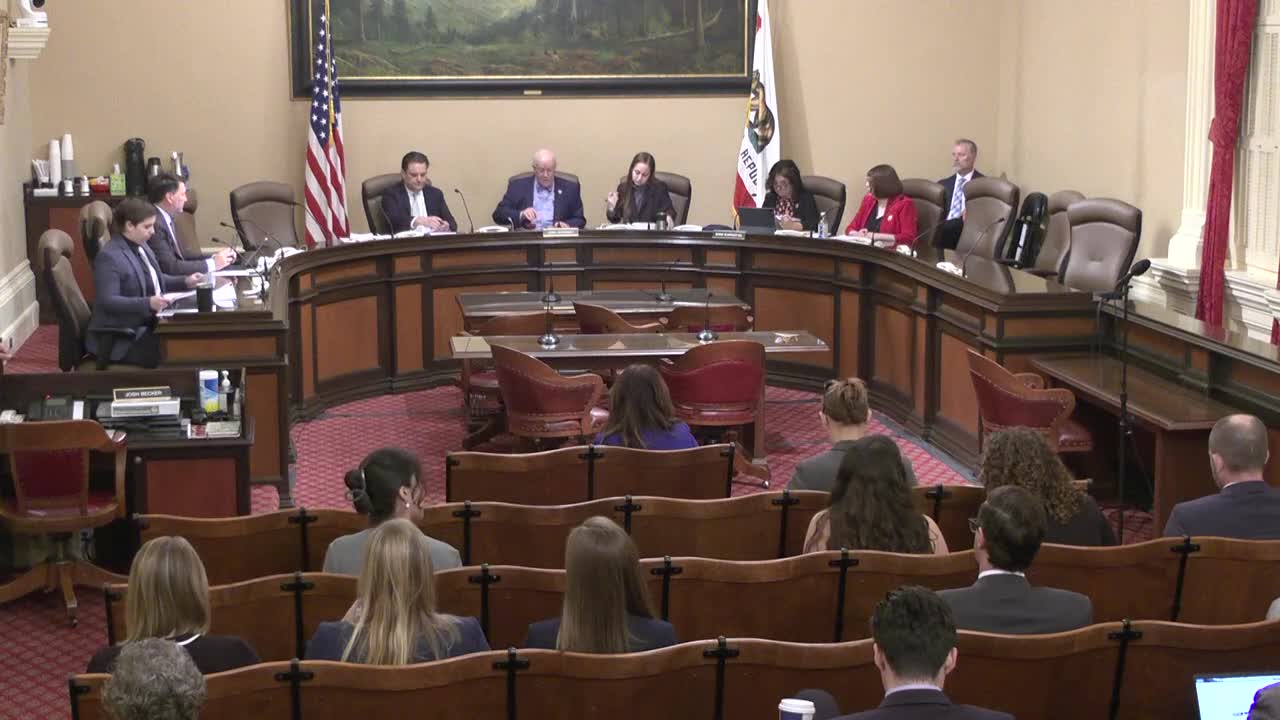 24MIN
Senate Standing Committee on Revenue and Taxation
Bill Author

Bill Co-Author(s):