SB 469: Department of Industrial Relations: task force: public infrastructure: employment: underrepresented communities.
- Session Year: 2025-2026
- House: Senate
- Latest Version Date: 2025-02-19
Current Status:
Failed
(2026-02-02: Returned to Secretary of Senate pursuant to Joint Rule 56.)
Introduced
In Committee
Awaiting First Chamber Vote
Passed First Chamber
In Committee
Awaiting Second Chamber Vote
Passed Second Chamber
Enacted
Existing law creates in the Labor and Workforce Development Agency the Department of Industrial Relations to foster, promote, and develop the welfare of wage earners of California, to improve their working conditions, and to advance their opportunities for profitable employment.
This bill would require the department to establish the California Public Infrastructure Task Force, composed of representatives of specified agencies to promote employment in public infrastructure projects for underrepresented communities and to provide compliance assistance to contractors and subcontractors in public infrastructure projects regarding their nondiscrimination obligations, as specified.
(a)The department shall establish the California Public Infrastructure Task Force, composed of representatives of all of the following:
(1)The Labor and Workforce Development Agency.
(2)The Transportation Agency.
(3)The Department of Transportation.
(4)The Department of General Services.
(5)The Civil Rights Department.
(6)The California Workforce Development Board.
(7)Local workforce development boards.
(8)Unions.
(9)Contractors and subcontractors.
(10)Nonprofit organizations.
(b)The task force shall do all of the following:
(1)Conduct regular meetings to make recommendations regarding recruiting from underrepresented communities and removing barriers to employment in public infrastructure projects for underrepresented communities.
(2)Conduct outreach and engagement activities with contractors and subcontractors to promote employment in public infrastructure projects for underrepresented communities.
(3)Provide ongoing compliance assistance at the prebid and postbid stages to contractors and subcontractors in public infrastructure projects regarding their nondiscrimination obligations.
(4)Evaluate the efforts of contractors and subcontractors to recruit and utilize talent from underrepresented communities in public infrastructure projects.
|
Date
|
Status
|
|---|---|
| Feb 2, 2026 | Returned to Secretary of Senate pursuant to Joint Rule 56. |
| May 6, 2025 | May 12 set for first hearing canceled at the request of author. |
| May 2, 2025 | Set for hearing May 12. |
| Apr 30, 2025 | From committee: Do pass and re-refer to Com. on APPR. (Ayes 4. Noes 1. Page 966.) (April 30). Re-referred to Com. on APPR. |
| Apr 11, 2025 | Set for hearing April 30. |
| Apr 4, 2025 | April 9 set for second hearing canceled at the request of author. |
| Apr 1, 2025 | Set for hearing April 9. |
| Mar 26, 2025 | March 26 set for first hearing canceled at the request of author. |
| Mar 18, 2025 | Set for hearing March 26. |
| Feb 26, 2025 | Referred to Com. on L., P.E. & R. |
| Feb 20, 2025 | From printer. May be acted upon on or after March 22. |
| Feb 19, 2025 | Introduced. Read first time. To Com. on RLS. for assignment. To print. |
|
Date
|
Description
|
Location
|
Votes
|
|
|---|---|---|---|---|
| Apr 30, 2025 | Do pass, but first be re-referred to the Committee on [Appropriations] | Senate Standing Committee on Labor, Public Employment and Retirement |
Passed |
This list shows positions taken on this bill by organizations on the date displayed, which is linked to the original source.
Positions by individuals are not included.
|
Organization
|
Position
|
Date
|
|---|---|---|
| California Association Of Sheet Metal Air Conditioning Contractors National Association | ** Against | |
| California Chapters of the National Electrical Contractors Association | ** Against | |
| California Electric Transportation Coalition | ** Support | |
| California Legislative Conference Of Plumbing, Heating & Piping Industry | ** Against | |
| Construction Employers Association | ** Against | |
| Southern California Contractors Association | ** Against | |
| United Contractors | ** Against | |
| Wall and Ceiling Alliance | ** Against | |
| Western Wall And Ceiling Contractors Association | ** Against |
SENATE COMMITTEE ON LABOR, PUBLIC EMPLOYMENT AND RETIREMENT
Senator Lola Smallwood-Cuevas, Chair
2025 - 2026 Regular
Bill No: SB 469 Hearing Date: April 30, 2025
Author: | Smallwood-Cuevas | ||
Version: | February 19, 2025 | ||
Urgency: | No | Fiscal: | Yes |
Consultant: | Emma Bruce | ||
SUBJECT: Department of Industrial Relations: task force: public infrastructure: employment: underrepresented communities
KEY ISSUE
This bill directs the Department of Industrial Relations (DIR) to establish the California Public Infrastructure Task Force (Task Force) and tasks it with, among other things, making recommendations for increasing the participation of underrepresented communities in public infrastructure projects.
ANALYSIS
Existing law:
- Establishes the Labor and Workforce Development Agency (LWDA) to serve California workers and businesses by improving access to employment and training programs; enforcing California labor laws to protect workers and create an even playing field for employers; and administering benefits that include workers’ compensation, unemployment insurance, disability insurance, and paid family leave. (Government Code §15550 et seq.)
- Establishes DIR in the LWDA and vests it with various powers and duties to foster, promote, and develop the welfare of the wage earners of California, to improve their working conditions, and to advance their opportunities for profitable employment. (Labor Code §50.5)
- Establishes procedures for state agencies to enter into contracts for goods and services, including generally requiring that certain contracts by a state agency to construct, alter, improve, repair, or maintain public property be approved by the Department of General Services (DGS). (Government Code §10300 et seq.)
- Requires the Director of General Services and the heads of other state agencies that enter into contracts for the acquisition of services, goods, information technology, and for the construction of state facilities to among other things, establish a minimum goal of 25 percent participation for small businesses and microbusinesses and give special consideration and assistance to small businesses, as specified. (Government Code §14838)
- Requires DGS to contract for a statewide procurement and contracting disparity study, in order to guide outreach strategies, state government program development, and improvements to contracting policies. (Government Code §14844)
- Requires specified state agencies, including the LWDA, to convene relevant stakeholders to develop and provide contractual and procurement model recommendations that maximize benefits to disadvantaged communities to the Governor and Legislature by March 30, 2024. (Public Contract Code §6990.1)
- Provides that it is the intent of the Legislature in enacting the provisions described in 6) to develop procurement models in alignment with initiatives that enhance the state’s training and access pipeline for quality jobs and the application of community benefits on infrastructure and manufacturing investments funded by specified federal law. (Public Contract Code §6999)
This bill:
- Directs DIR to establish the California Public Infrastructure Task Force (Task Force), composed of representatives of all of the following:
- The Labor and Workforce Development Agency.
- The Transportation Agency.
- The Department of Transportation.
- The Department of General Services.
- The Civil Rights Department.
- The California Workforce Development Board.
- Local workforce development boards.
- Unions.
- Contractors and subcontractors.
- Nonprofit organizations.
- Directs the Task Force to do all of the following:
- Conduct regular meetings to make recommendations regarding recruiting from underrepresented communities and removing barriers to employment in public infrastructure projects for underrepresented communities.
- Conduct outreach and engagement activities with contractors and subcontractors to promote employment in public infrastructure projects for underrepresented communities.
- Provide ongoing compliance assistance at the prebid and postbid stages to contractors and subcontractors in public infrastructure projects regarding their nondiscrimination obligations.
- Evaluate the efforts of contractors and subcontractors to recruit and utilize talent from underrepresented communities in public infrastructure projects.
COMMENTS
1. Background:
Federal Investments and SB 150 (Durazo, Statutes of 2023)
Over the course of 2021 and 2022, the federal government made significant investments in infrastructure and the green economy through the Infrastructure Investment and Jobs Act (IIJA), the Inflation Reduction Act (IRA), and the CHIPS and Science Act. Combined, the money from these three pieces of legislation amounts to over a trillion dollars.[1] Former President Biden also issued Executive Order 14008, Tackling the Climate Crisis at Home and Abroad, to direct 40 percent of the overall benefits of certain federal climate, clean energy, affordable and sustainable housing, and other investments to disadvantaged communities.
In response, the Legislature passed and the Governor signed a slate of bills aimed at maximizing the above federal investments. One of these bills, SB 150 (2023) directed the LWDA, Government Operations Agency, and Transportation Agency to convene stakeholders to provide input on recommendations to develop procurement models for investments funded by the IIJA, IRA, and CHIPS and Science Act. The recommendations developed through the SB 150 process were finalized in an April 2, 2024 report titled “SB 150 Stakeholder Workshops Update & Recommendations: Report to the Governor and Legislature.” Among other policies, the report recommended increasing project apprenticeship ratios, shifting bidding policies to “best value” or “most qualified,” establishing local hire goals, incentivizing contractors to hire disadvantaged workers, and improving data collection to increase accountability.
On President Trump’s first day of his second term, he issued an executive order commanding federal agencies to immediately pause the disbursement of funds under the IIJA and IRA. In doing so, the President blocked congressionally approved spending and refused to honor contracts in which the federal government promised funding for states, cities, and other recipients.[2] Furthermore, in the President’s March 4, 2025 joint address to Congress, he called for the repeal of the CHIPS Act. Although these actions are the subject of several lawsuits aimed at unfreezing the money, currently, the funding pause remains in place.
The background sheet provided by the author presents SB 469 as a way to further SB 150’s efforts to ensure federal investments reach disadvantaged workers. Currently, there is no guarantee that the state will receive any more money from the IIJA, IRA, and CHIPS and Science Act. However, this bill would still apply to state investments in public infrastructure.
Procurement and Contracting Disparity Study
California spends $10-12 billion annually on contracts for goods and services.[3] Recently, the state has taken steps to advance the equitable inclusion of small and diverse businesses in procurement and contracting opportunities. State agencies must establish a minimum goal of 25 percent participation for small businesses, including microbusinesses, in the provision of goods, IT, and services to the state, and in the construction of state facilities. DGS also operates a Minority-Owned Small Business Task Force to provide a forum for diverse small businesses and affiliate organizations to identify ways to improve the state’s procurement process for state-certified small and micro businesses.
In 2022, AB 2019 (Petrie-Norris) authorized a disparity study to assess whether the state has engaged in any exclusionary practices in the procurement of goods and services. Specifically, it will examine the state's contracting processes to determine if minority-owned, woman-owned, LGBTQ-owned, certified small businesses, and disabled veteran-owned businesses have equitable access to state contracting opportunities. The study will also recommend equitable contracting practices. DGS expects the study to be completed in December 2025.
The Task Force proposed by this bill is in line with existing efforts to diversify public contractors.
2. Committee Comment:
DIR’s mission is to improve working conditions for California’s wage earners and to advance opportunities for profitable employment. DIR administers and enforces laws governing wages, hours and breaks, overtime, retaliation, workplace safety and health, apprenticeship training programs, and medical care and other benefits for injured workers. DGS serves as the business manager for the state and provides a variety of services to state agencies, including procurement, real estate management, printing, web design, and more. The procurement division within DGS sets state procurement policies and provides purchasing services. The division also certifies small and/or disabled veteran businesses and sponsors the Small Business Council.
This bill directs the Task Force to provide ongoing compliance assistance at the prebid and postbid stages to contractors and subcontractors in public infrastructure projects regarding their nondiscrimination obligations. Unlike the other directives, which include making recommendations to increase the participation of underrepresented communities and conducting outreach, it is unclear what compliance assistance at the prebid and postbid stages looks like. What sort of technical support could the Task Force provide? Furthermore, is it appropriate for a Task Force housed within DIR to provide this sort of support when DGS is the procurement policy expert?
- Need for this bill?
According to the author:
“When SB 150 (Durazo, 2023) was signed in to law, the Labor and Workforce Development Agency, the Government Operations Agency, and the Transportation Agency were required to convene stakeholders to provide input and recommendations for establishing terms to be included as a material part of a contract, including measurable results to ensure that investments maximize benefits to marginalized and disadvantaged communities. These recommendations were required to be catalogued and listed in a report to the governor in Spring of 2024.
According to the report, stakeholders had a wide variety of recommendations such as: expanding the skilled and trained workforce, development of community benefit plans (CBP’s), incentives to private companies for more equitable CBP’s, inclusion of union and non-union contractors, a need for greater interagency collaboration and capacity to design and administer workforce standards, more robust tracking and reporting on hiring, and many other recommendations…
Since SB 150’s passage, it is still unclear to what degree, if any, the state’s departments are following the stakeholder recommendations to ensure public infrastructure community plans are achieving their maximum benefit.
Under the current federal administration, as more Diversity, Equity, & Inclusion (DEI) efforts are shut down every day across the country, it is critical, now more than ever to protect and expand all resources and forms of DEI the state of California has to offer…
SB 469 will ensure the vision and intention of SB 150 and help ensure California’s workforce development in public infrastructure and construction is diverse, equitable, and inclusionary.”
4. Proponent Arguments:
According to the California Electric Transportation Coalition:
“As California accelerates its investment in infrastructure—particularly in clean transportation, electrification, and climate-resilient projects—it is essential that this economic opportunity extends to underrepresented communities across the state. SB 469 creates a comprehensive and collaborative structure to advance that goal.
The California Public Infrastructure Task Force would be composed of representatives from key state agencies, local workforce development boards, unions, contractors, subcontractors, and nonprofit organizations. This inclusive group would work together to promote equitable hiring practices and provide much-needed compliance assistance to contractors and subcontractors to ensure adherence to nondiscrimination obligations.
By strengthening coordination across agencies and stakeholders, SB 469 will help ensure that California’s infrastructure investments not only deliver environmental and mobility benefits but also drive inclusive economic growth and workforce opportunity.”
5. Opponent Arguments:
A coalition of opponents, including the California Association of Sheet Metal and Air Conditioning Contractors National Association and the Construction Employers Association, argue:
“As drafted, the measure would require the newly created California Public Infrastructure Task Force to perform certain outreach activities with contractors and subcontractors concerning their hiring practices. For union-signatory contractors and subcontractors, hiring practices are dictated by collective bargaining agreements (CBAs), and as such, your measure should not apply to employers covered by CBAs.
The listed organizations are comprised of union contractors and subcontractors who are subject to collective bargaining agreements. These contractors are bound by CBAs and must hire employees from the local union hall and pay them the collectively bargained rate established for the type of work done in a certain location. Your measure requires the newly created California Public Infrastructure Task Force to a) ‘Conduct outreach and engagement activities with contractors and subcontractors to promote employment in public infrastructure projects for underrepresented communities’, and b) ‘Evaluate the efforts of contractors and subcontractors to recruit and utilize talent from underrepresented communities in public infrastructure projects.’ As previously noted, signatory contractors and subcontractors are obligated to utilize workers dispatched from hiring halls and do not have latitude to dictate that workers must come from underutilized communities. Directing the California Public Infrastructure Task Force to conduct outreach and evaluate hiring practices for employers who do not control hiring practices serves no purpose. Arguably, information gathered by the Task Force would make signatory employers look worse than their non-union counterparts because signatory employers cannot adopt practices that deviate from their CBAs.”
6. Prior Legislation:
SB 1340 (Smallwood-Cuevas, Chapter 626, Statutes of 2024) authorized local enforcement of employment discrimination complaints under the Fair Employment and Housing Act, as specified. An earlier version of this bill included language nearly identical to SB 469 that would have established a California Public Infrastructure Task Force. This language was amended out on August 23, 2024.
SB 150 (Durazo et al., Chapter 61, Statutes of 2023) required the LWDA, the Government Operations Agency, and the Transportation Agency to convene stakeholders and develop recommendations for procurement models to ensure that federal IIJA, IRA, and CHIPS Act investments include enforceable commitments to job quality and to consult with the Civil Rights Department, other relevant state agencies, and a UC research institution to develop and finalize recommendations by March 30, 2024.
AB 2019 (Petrie-Norris, Chapter 730, Statutes of 2022) codified a 25 percent small business goal for state procurement and directed DGS to conduct a statewide procurement and contracting disparity study.
SUPPORT
California Electric Transportation Coalition
OPPOSITION
California Association of Sheet Metal & Air Conditioning Contractors National Association
California Chapters of the National Electrical Contractors Association
California Legislative Conference of Plumbing, Heating & Piping Industry
Construction Employers Association
Southern California Contractors Association
United Contractors
Wall and Ceiling Alliance
Western Wall and Ceiling Contractors Association
-- END --
UC Berkeley Labor Center, “Research Update on Federal Investments” https://slper.senate.ca.gov/sites/slper.senate.ca.gov/files/UCB%20Labor%20Center%20Research%20Update.pdf ↑
Timothy Cama, “Trump kicks off potentially messy fight over Biden’s infrastructure money”
https://www.politico.com/news/2025/01/21/trump-fight-biden-infrastructure-money-00199796 ↑
SENATE COMMITTEE ON LABOR, PUBLIC EMPLOYMENT AND RETIREMENT
Senator Lola Smallwood-Cuevas, Chair
2025 - 2026 Regular
Bill No: SB 469 Hearing Date: March 26, 2025
Author: | Smallwood-Cuevas | ||
Version: | February 19, 2025 | ||
Urgency: | No | Fiscal: | Yes |
Consultant: | Emma Bruce | ||
SUBJECT: Department of Industrial Relations: task force: public infrastructure: employment: underrepresented communities
KEY ISSUE
This bill directs the Department of Industrial Relations (DIR) to establish the California Public Infrastructure Task Force (Task Force) and tasks it with, among other things, making recommendations for increasing the participation of underrepresented communities in public infrastructure projects.
ANALYSIS
Existing law:
- Establishes the Labor and Workforce Development Agency (LWDA) to serve California workers and businesses by improving access to employment and training programs; enforcing California labor laws to protect workers and create an even playing field for employers; and administering benefits that include workers’ compensation, unemployment insurance, disability insurance, and paid family leave. (Government Code §15550 et seq.)
- Establishes DIR in the LWDA and vests it with various powers and duties to foster, promote, and develop the welfare of the wage earners of California, to improve their working conditions, and to advance their opportunities for profitable employment. (Labor Code §50.5)
- Establishes procedures for state agencies to enter into contracts for goods and services, including generally requiring that certain contracts by a state agency to construct, alter, improve, repair, or maintain public property be approved by the Department of General Services (DGS). (Government Code §10300 et seq.)
- Requires the Director of General Services and the heads of other state agencies that enter into contracts for the acquisition of services, goods, information technology, and for the construction of state facilities to among other things, establish a minimum goal of 25 percent participation for small businesses and microbusinesses and give special consideration and assistance to small businesses, as specified. (Government Code §14838)
- Requires DGS to contract for a statewide procurement and contracting disparity study, in order to guide outreach strategies, state government program development, and improvements to contracting policies. (Government Code §14844)
- Requires specified state agencies, including the LWDA, to convene relevant stakeholders to develop and provide contractual and procurement model recommendations that maximize benefits to disadvantaged communities to the Governor and Legislature by March 30, 2024. (Public Contract Code §6990.1)
- Provides that it is the intent of the Legislature in enacting the provisions described in 6) to develop procurement models in alignment with initiatives that enhance the state’s training and access pipeline for quality jobs and the application of community benefits on infrastructure and manufacturing investments funded by specified federal law. (Public Contract Code §6999)
This bill:
- Directs DIR to establish the California Public Infrastructure Task Force (Task Force), composed of representatives of all of the following:
- The Labor and Workforce Development Agency.
- The Transportation Agency.
- The Department of Transportation.
- The Department of General Services.
- The Civil Rights Department.
- The California Workforce Development Board.
- Local workforce development boards.
- Unions.
- Contractors and subcontractors.
- Nonprofit organizations.
- Directs the Task Force to do all of the following:
- Conduct regular meetings to make recommendations regarding recruiting from underrepresented communities and removing barriers to employment in public infrastructure projects for underrepresented communities.
- Conduct outreach and engagement activities with contractors and subcontractors to promote employment in public infrastructure projects for underrepresented communities.
- Provide ongoing compliance assistance at the prebid and postbid stages to contractors and subcontractors in public infrastructure projects regarding their nondiscrimination obligations.
- Evaluate the efforts of contractors and subcontractors to recruit and utilize talent from underrepresented communities in public infrastructure projects.
COMMENTS
1. Background:
Federal Investments and SB 150 (Durazo, Statutes of 2023)
Over the course of 2021 and 2022, the federal government made significant investments in infrastructure and the green economy through the Infrastructure Investment and Jobs Act (IIJA), the Inflation Reduction Act (IRA), and the CHIPS and Science Act. Combined, the money from these three pieces of legislation amounts to over a trillion dollars.[1] Former President Biden also issued Executive Order 14008, Tackling the Climate Crisis at Home and Abroad, to direct 40 percent of the overall benefits of certain federal climate, clean energy, affordable and sustainable housing, and other investments to disadvantaged communities.
In response, the Legislature passed and the Governor signed a slate of bills aimed at maximizing the above federal investments. One of these bills, SB 150 (2023) directed the LWDA, Government Operations Agency, and Transportation Agency to convene stakeholders to provide input on recommendations to develop procurement models for investments funded by the IIJA, IRA, and CHIPS and Science Act. The recommendations developed through the SB 150 process were finalized in an April 2, 2024 report titled “SB 150 Stakeholder Workshops Update & Recommendations: Report to the Governor and Legislature.” Among other policies, the report recommended increasing project apprenticeship ratios, shifting bidding policies to “best value” or “most qualified,” establishing local hire goals, incentivizing contractors to hire disadvantaged workers, and improving data collection to increase accountability.
On President Trump’s first day of his second term, he issued an executive order commanding federal agencies to immediately pause the disbursement of funds under the IIJA and IRA. In doing so, the President blocked congressionally approved spending and refused to honor contracts in which the federal government promised funding for states, cities, and other recipients.[2] Furthermore, in the President’s March 4, 2025 joint address to Congress, he called for the repeal of the CHIPS Act. Although these actions are the subject of several lawsuits aimed at unfreezing the money, currently, the funding pause remains in place.
The background sheet provided by the author presents SB 469 as a way to further SB 150’s efforts to ensure federal investments reach disadvantaged workers. Currently, there is no guarantee that the state will receive any more money from the IIJA, IRA, and CHIPS Act. However, this bill would still apply to state investments in public infrastructure.
Procurement and Contracting Disparity Study
California spends $10-12 billion annually on contracts for goods and services.[3] Recently, the state has taken steps to advance the equitable inclusion of small and diverse businesses in procurement and contracting opportunities. State agencies must establish a minimum goal of 25 percent participation for small businesses, including microbusinesses, in the provision of goods, IT, and services to the state, and in the construction of state facilities. DGS also operates a Minority-Owned Small Business Task Force to provide a forum for diverse small businesses and affiliate organizations to identify ways to improve the state’s procurement process for state-certified small and micro businesses.
In 2022, AB 2019 (Petrie-Norris) authorized a disparity study to assess whether the state has engaged in any exclusionary practices in the procurement of goods and services. Specifically, it will examine the state's contracting processes to determine if minority-owned, woman-owned, LGBTQ-owned, certified small businesses, and disabled veteran-owned businesses have equitable access to state contracting opportunities. The study will also recommend equitable contracting practices. DGS expects the study to be completed in December 2025.
The Task Force proposed by this bill is in line with existing efforts to diversify public contractors.
2. Committee Comment:
DIR’s mission is to improve working conditions for California’s wage earners and to advance opportunities for profitable employment. DIR administers and enforces laws governing wages, hours and breaks, overtime, retaliation, workplace safety and health, apprenticeship training programs, and medical care and other benefits for injured workers. DGS serves as the business manager for the state and provides a variety of services to state agencies, including procurement, real estate management, printing, web design, and more. The procurement division within DGS sets state procurement policies and provides purchasing services. The division also certifies small and/or disabled veteran business to do business with the state and sponsors the Small Business Council.
This bill directs the Task Force to provide ongoing compliance assistance at the prebid and postbid stages to contractors and subcontractors in public infrastructure projects regarding their nondiscrimination obligations. Unlike the other directives, which include making recommendations to increase the participation of underrepresented communities and conducting outreach, it is unclear what compliance assistance at the prebid and postbid stages looks like. What sort of technical support could the Task Force provide? Furthermore, is it appropriate for a Task Force housed within DIR to provide this sort of support when DGS is the procurement policy expert?
- Need for this bill?
According to the author:
“When SB 150 (Durazo, 2023) was signed in to law, the Labor and Workforce Development Agency, the Government Operations Agency, and the Transportation Agency were required to convene stakeholders to provide input and recommendations for establishing terms to be included as a material part of a contract, including measurable results to ensure that investments maximize benefits to marginalized and disadvantaged communities. These recommendations were required to be catalogued and listed in a report to the governor in Spring of 2024.
According to the report, stakeholders had a wide variety of recommendations such as: expanding the skilled and trained workforce, development of community benefit plans (CBP’s), incentives to private companies for more equitable CBP’s, inclusion of union and non-union contractors, a need for greater interagency collaboration and capacity to design and administer workforce standards, more robust tracking and reporting on hiring, and many other recommendations…
Since SB 150’s passage, it is still unclear to what degree, if any, the state’s departments are following the stakeholder recommendations to ensure public infrastructure community plans are achieving their maximum benefit.
Under the current federal administration, as more Diversity, Equity, & Inclusion (DEI) efforts are shut down every day across the country, it is critical, now more than ever to protect and expand all resources and forms of DEI the state of California has to offer…
SB 469 will ensure the vision and intention of SB 150 and help ensure California’s workforce development in public infrastructure and construction is diverse, equitable, and inclusionary.”
4. Proponent Arguments:
None received.
5. Opponent Arguments:
None received.
6. Prior Legislation:
SB 1340 (Smallwood-Cuevas, Chapter 626, Statutes of 2024) authorized local enforcement of employment discrimination complaints under the Fair Employment and Housing Act, as specified. An earlier version of this bill included language nearly identical to SB 469 that would have established a California Public Infrastructure Task Force. This language was amended out on August 23, 2024.
SB 150 (Durazo et al., Chapter 61, Statutes of 2023) required the LWDA, the Government Operations Agency, and the Transportation Agency to convene stakeholders and develop recommendations for procurement models to ensure that federal IIJA, IRA, and CHIPS Act investments include enforceable commitments to job quality and to consult with the Civil Rights Department, other relevant state agencies, and a UC research institution to develop and finalize recommendations by March 30, 2024.
AB 2019 (Petrie-Norris, Chapter 730, Statutes of 2022) codified a 25 percent small business goal for state procurement and directed DGS to conduct a statewide procurement and contracting disparity study.
SUPPORT
None received.
OPPOSITION
None received.
-- END --
UC Berkeley Labor Center, “Research Update on Federal Investments” https://slper.senate.ca.gov/sites/slper.senate.ca.gov/files/UCB%20Labor%20Center%20Research%20Update.pdf ↑
Timothy Cama, “Trump kicks off potentially messy fight over Biden’s infrastructure money”
https://www.politico.com/news/2025/01/21/trump-fight-biden-infrastructure-money-00199796 ↑
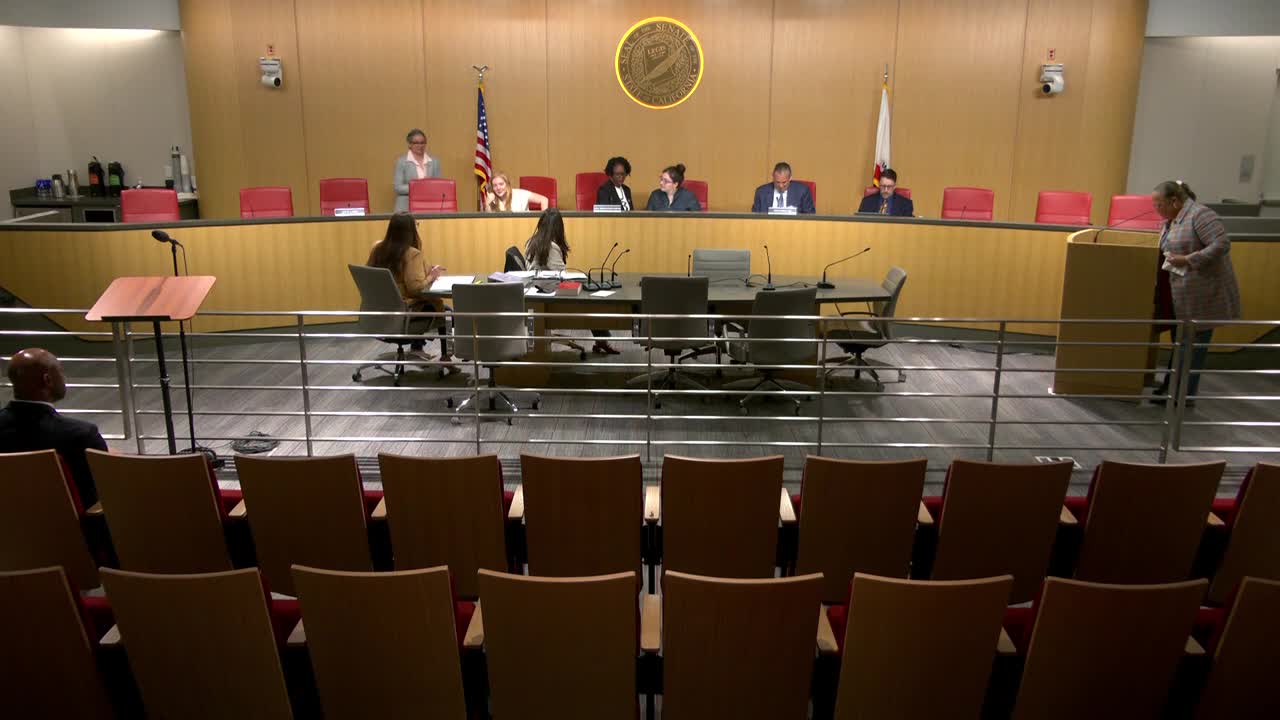
Discussed in Hearing
 11MIN
Senate Standing Committee on Labor, Public Employment and Retirement
Bill Author

Bill Co-Author(s):