AB 247: Animal control officers.
- Session Year: 2015-2016
- House: Assembly
- Latest Version Date: 2015-03-24
(1)Existing law establishes the Commission on Peace Officer Standards and Training within the Department of Justice. Existing law requires the commission to carry out various duties related to the education and training of peace officers, as defined.
Existing law provides that animal control officers are not peace officers but may exercise the powers of arrest of a peace officer and the power to serve warrants, as specified, during the course and within the scope of their employment, if those officers successfully complete a course in the exercise of those powers.
This bill would require every person appointed as an animal control officer prior to July 1, 2016, to complete a course in the exercise of the powers of arrest and to serve warrants no later than July 1, 2017. This bill would require every person appointed as an animal control officer, and every person appointed as a director, manager, or supervisor, or any person in direct control of the officers employed by an animal control agency, on or after July 1, 2016, to complete a course in the exercise of the powers of arrest and to serve warrants within one year of his or her appointment, as specified. This bill would require every animal control officer, prior to the exercise of the powers of arrest and to serve warrants, arrest, to have satisfactorily completed the required course of training.
This bill would also require every animal control officer appointed prior to July 1, 2016, to satisfactorily complete at least 40 hours of continuing education and training relating to the powers and duties of an animal control officer, no later than July 1, 2019, and every 3 years thereafter, as specified. The bill would require every animal control officer appointed on or after July 1, 2016, to comply with those requirements within 3 years of the date of his or her appointment, and every 3 years thereafter.
The bill would specify that the above training and continuing training requirements do not apply to an animal control officer who is a peace officer.
By imposing new training requirements on local employees, this bill would impose a state-mandated local program.
(2)Existing law provides for the regulation and licensing of dogs, including the issuance of dog license tags. Existing law requires that fees for the issuance of dog license tags and fines collected for a violation of the provisions regulating and licensing dogs be paid into the county, city, or city and county treasury and that they be used for specified purposes, including to pay costs and expenses for the enforcement of those provisions.
This bill would expand the list of purposes for which those fees and fines shall are required to be used to include paying for initial and in-service training for persons charged with enforcing animal control laws, including animal control officers.
(3)The California Constitution requires the state to reimburse local agencies and school districts for certain costs mandated by the state. Statutory provisions establish procedures for making that reimbursement.
This bill would provide that, if the Commission on State Mandates determines that the bill contains costs mandated by the state, reimbursement for those costs shall be made pursuant to these statutory provisions.
(1)Existing law establishes the Commission on Peace Officer Standards and Training within the Department of Justice. Existing law requires the commission to carry out various duties related to the education and training of peace officers, as defined.
Existing law provides that animal control officers are not peace officers but may exercise the powers of arrest of a peace officer and the power to serve warrants, as specified, during the course and within the scope of their employment, if those officers successfully complete a course in the exercise of those powers.
This bill would require every person appointed as an animal control officer prior to July 1, 2016, to complete a course in the exercise of the powers of arrest and to serve warrants no later than July 1, 2017. This bill would require every person appointed as an animal control officer, and every person appointed as a director, manager, or supervisor, or any person in direct control of an animal control agency, on or after July 1, 2016, to complete a course in the exercise of the powers of arrest and to serve warrants within one year of his or her appointment, as specified. This bill would require every animal control officer, prior to the exercise of the powers of arrest and to serve warrants, to have satisfactorily completed the required course of training.
This bill would also require every animal control officer appointed prior to July 1, 2016, to satisfactorily complete at least 40 hours of continuing education and training relating to the powers and duties of an animal control officer, no later than July 1, 2019, and every 3 years thereafter, as specified. The bill would require every animal control officer appointed on or after July 1, 2016, to comply with those requirements within 3 years of the date of his or her appointment, and every 3 years thereafter.
The bill would specify that the above training and continuing training requirements do not apply to an animal control officer who is a peace officer.
By imposing new training requirements on local employees, this bill would impose a state-mandated local program.
(2)Existing law provides for the regulation and licensing of dogs, including the issuance of dog license tags. Existing law requires that fees for the issuance of dog license tags and fines collected for a violation of the provisions regulating and licensing dogs be paid into the county, city, or city and county treasury and that they be used for specified purposes, including to pay costs and expenses for the enforcement of those provisions.
This bill would expand the list of purposes for which those fees and fines shall be used to include paying for initial and in-service training for persons charged with enforcing animal control laws, including animal control officers.
(3)The California Constitution requires the state to reimburse local agencies and school districts for certain costs mandated by the state. Statutory provisions establish procedures for making that reimbursement.
This bill would provide that, if the Commission on State Mandates determines that the bill contains costs mandated by the state, reimbursement for those costs shall be made pursuant to these statutory provisions.
Existing law designates which persons are peace officers, and provides that no person is a peace officer if not so designated.
This bill would make a technical, nonsubstantive change to that provision.
Existing law designates which persons are peace officers, and provides that no person is a peace officer if not so designated.
This bill would make a technical, nonsubstantive change to that provision.
All fees for the issuance of dog license tags and all fines collected pursuant to this division shall be paid into the county, city, or city and county treasury, as the case may be, and shall be used:
(a)First, to pay fees for the issuance of dog license tags.
(b)Second, to pay fees, salaries, costs, expenses, or any or all of them for the enforcement of this division and all ordinances which are made pursuant to this division.
(c)Third, to pay damages to owners of livestock which are killed by dogs.
(d)Fourth, to pay costs of any hospitalization or emergency care of animals pursuant to Section 597f of the Penal Code.
(e)Fifth, to pay for initial and in-service training for persons charged with enforcing animal control laws, including animal control officers.
SEC. 2.Section 830.9 of the Penal Code is amended to read:830.9.(a) Animal control officers are not peace officers but may exercise the powers of arrest of a peace officer as specified in Section 836 and the power to serve warrants as specified in Sections 1523 and 1530 during the course and within the scope of their employment, if those officers successfully complete a course in the exercise of those powers pursuant to Section 832.
(b)(1)Every person appointed as an animal control officer prior to July 1, 2016, shall complete a course in the exercise of the powers of arrest and to serve warrants pursuant to Section 832 no later than July 1, 2017. That part of the training course specified in Section 832 pertaining to the carrying and use of firearms shall not be required for any animal control officer whose employing agency prohibits the use of firearms.
(2)An animal control officer who completed a course in the exercise of the powers of arrest and to serve warrants pursuant to Section 832 prior to January 1, 2016, and who has not had a break in employment, as an animal control officer or other position that utilized a peace officers powers of arrest and to serve warrants, of longer than three years, shall be deemed to have satisfied the training requirements described in paragraph (1).
(c)Every person appointed as an animal control officer on or after July 1, 2016, shall complete a course in the exercise of the powers of arrest and to serve warrants pursuant to Section 832 within one year of his or her appointment. That part of the training course specified in Section 832 pertaining to the carrying and use of firearms shall not be required for any animal control officer whose employing agency prohibits the use of firearms.
(d)Every animal control officer described in this section, prior to the exercise of the powers of arrest and to serve warrants, arrest, shall have satisfactorily completed the course of training described in Section 832. An animal control officer is not required to repeat the course of training described in Section 832 if the officer has not had a break in employment, as an animal control officer or other position that utilized a peace officers powers of arrest and to serve warrants, of longer than three years.
(e)Every person appointed as a director, manager, or supervisor, or any person in direct control of the officers employed by an animal control agency, on or after July 1, 2016, shall complete a course in the exercise of the powers of arrest and to serve warrants pursuant to Section 832 within one year of his or her appointment.
(f)(1)During each three-year period following the date described in paragraph (2), every animal control officer shall satisfactorily complete at least 40 hours of continuing education and training relating to the powers and duties of an animal control officer, which education and training shall be sponsored or provided by an accredited postsecondary institution, the Commission on Peace Officer Standards and Training, a law enforcement agency, the National Animal Care and Control Association, the California Animal Control Directors Association, the California Veterinary Medical Association, or the State Humane Association of California.
(2)Every animal control officer appointed prior to July 1, 2016, shall comply with the requirements of paragraph (1) no later than July 1, 2019, and every three years thereafter. Every animal control officer appointed on or after July 1, 2016, shall comply with the requirements of paragraph (1) within three years of the date of his or her appointment, and every three years thereafter.
(3)The minimum hours and required topics of continuing education and training may be determined by the California Animal Control Directors Association. Continuing education and training shall include at least four hours of course work coursework in the exercise of the powers of arrest and to serve warrants taught by a Commission on Peace Officer Standards and Training certified instructor. instructor, four hours of coursework in officer safety, four hours of coursework in animal-related laws, four hours of coursework in conducting investigations, and four hours of coursework in one or more of the topics of animal handling, animal care, animal diseases, or public health. This section does not restrict the ability of an agency employing an animal control officer from providing the training required by this subdivision utilizing instructors or curriculum from within the agency or from an allied agency, provided the topic and length of instruction otherwise comply with this subdivision.
(4)Records of training shall be maintained by the animal control officers employing agency.
(5)The failure to satisfactorily complete the continuing education and training requirements under this subdivision within 90 days after the expiration of each three-year period shall result in the immediate suspension of the authority granted under subdivision (a).
(g)This section does not supersede any existing training requirements, including, but not limited to, the training requirements set forth in subdivision (g) of Section 22295.
(h)This section does not apply to an animal control officer who is a peace officer pursuant to Section 830.1.
(i)For the purposes of this section, firearms includes capture guns, blowguns, carbon dioxide operated rifles and pistols, air guns, handguns, rifles, and shotguns.
SEC. 3.If the Commission on State Mandates determines that this act contains costs mandated by the state, reimbursement to local agencies and school districts for those costs shall be made pursuant to Part 7 (commencing with Section 17500) of Division 4 of Title 2 of the Government Code.
All fees for the issuance of dog license tags and all fines collected pursuant to this division shall be paid into the county, city, or city and county treasury, as the case may be, and shall be used:
(a)First, to pay fees for the issuance of dog license tags.
(b)Second, to pay fees, salaries, costs, expenses, or any or all of them for the enforcement of this division and all ordinances which are made pursuant to this division.
(c)Third, to pay damages to owners of livestock which are killed by dogs.
(d)Fourth, to pay costs of any hospitalization or emergency care of animals pursuant to Section 597f of the Penal Code.
(e)Fifth, to pay for initial and in-service training for persons charged with enforcing animal control laws, including animal control officers.
SEC. 2.Section 830.9 of the Penal Code is amended to read:830.9.(a) Animal control officers are not peace officers but may exercise the powers of arrest of a peace officer as specified in Section 836 and the power to serve warrants as specified in Sections 1523 and 1530 during the course and within the scope of their employment, if those officers successfully complete a course in the exercise of those powers pursuant to Section 832. That part of the training course specified in Section 832 pertaining to the carrying and use of firearms shall not be required for any animal control officer whose employing agency prohibits the use of firearms.
(b)(1)Every person appointed as an animal control officer prior to July 1, 2016, shall complete a course in the exercise of the powers of arrest and to serve warrants pursuant to Section 832 no later than July 1, 2017. That part of the training course specified in Section 832 pertaining to the carrying and use of firearms shall not be required for any animal control officer whose employing agency prohibits the use of firearms.
(2)An animal control officer who completed a course in the exercise of the powers of arrest and to serve warrants pursuant to Section 832 prior to January 1, 2016, shall be deemed to have satisfied the training requirements described in paragraph (1).
(c)Every person appointed as an animal control officer on or after July 1, 2016, shall complete a course in the exercise of the powers of arrest and to serve warrants pursuant to Section 832 within one year of his or her appointment. That part of the training course specified in Section 832 pertaining to the carrying and use of firearms shall not be required for any animal control officer whose employing agency prohibits the use of firearms.
(d)Every animal control officer described in this section, prior to the exercise of the powers of arrest and to serve warrants, shall have satisfactorily completed the course of training described in Section 832.
(e)Every person appointed as a director, manager, or supervisor, or any person in direct control of an animal control agency, on or after July 1, 2016, shall complete a course in the exercise of the powers of arrest and to serve warrants pursuant to Section 832 within one year of his or her appointment.
(f)(1)During each three-year period following the date described in paragraph (2), every animal control officer shall satisfactorily complete at least 40 hours of continuing education and training relating to the powers and duties of an animal control officer, which education and training shall be sponsored or provided by an accredited postsecondary institution, the Commission on Peace Officer Standards and Training, a law enforcement agency, the National Animal Care and Control Association, the California Animal Control Directors Association, the California Veterinary Medical Association, or the State Humane Association of California.
(2)Every animal control officer appointed prior to July 1, 2016, shall comply with the requirements of paragraph (1) no later than July 1, 2019, and every three years thereafter. Every animal control officer appointed on or after July 1, 2016, shall comply with the requirements of paragraph (1) within three years of the date of his or her appointment, and every three years thereafter.
(3)The minimum hours and required topics of continuing education and training may be determined by the California Animal Control Directors Association. Continuing education and training shall include at least four hours of course work in the exercise of the powers of arrest and to serve warrants taught by a Commission on Peace Officer Standards and Training certified instructor. This section does not restrict the ability of an agency employing an animal control officer from providing the training required by this subdivision utilizing instructors or curriculum from within the agency or from an allied agency, provided the topic and length of instruction otherwise comply with this subdivision.
(4)Records of training shall be maintained by the animal control officers employing agency.
(5)The failure to satisfactorily complete the continuing education and training requirements under this subdivision within 90 days after the expiration of each three-year period shall result in the immediate suspension of the authority granted under subdivision (a).
(g)This section does not supersede any existing training requirements, including, but not limited to, the training requirements set forth in subdivision (g) of Section 22295.
(h)This section does not apply to an animal control officer who is a peace officer pursuant to Section 830.1.
For
(i)For the purposes of this section, firearms includes capture guns, blowguns, carbon dioxide operated rifles and pistols, air guns, handguns, rifles, and shotguns.
SEC. 3.If the Commission on State Mandates determines that this act contains costs mandated by the state, reimbursement to local agencies and school districts for those costs shall be made pursuant to Part 7 (commencing with Section 17500) of Division 4 of Title 2 of the Government Code.
SECTION 1.Section 830 of the Penal Code is amended to read:830.Any person who comes within the provisions of this chapter and who otherwise meets all standards imposed by law on a peace officer is a peace officer. Notwithstanding any other law, only a person designated in this chapter is a peace officer. The restriction of peace officer functions of any public officer or employee shall not affect his or her status for purposes of retirement.
Any person who comes within the provisions of this chapter and who otherwise meets all standards imposed by law on a peace officer is a peace officer, and notwithstanding any other provision of law, no person other than those officer. Notwithstanding any other law, only a person designated in this chapter is a peace officer. The restriction of peace officer functions of any public officer or employee shall not affect his or her status for purposes of retirement.
|
Date
|
Status
|
|---|---|
| Feb 9, 2015 | Read first time. To print. |
| Feb 10, 2015 | From printer. May be heard in committee March 12. |
| Mar 12, 2015 | Referred to Com. on PUB. S. |
| Mar 16, 2015 | From committee chair, with author's amendments: Amend, and re-refer to Com. on PUB. S. Read second time and amended. |
| Mar 17, 2015 | Re-referred to Com. on PUB. S. |
| Mar 24, 2015 | From committee chair, with author's amendments: Amend, and re-refer to Com. on PUB. S. Read second time and amended. |
| Mar 25, 2015 | Re-referred to Com. on PUB. S. |
| Apr 8, 2015 | From committee: Do pass and re-refer to Com. on APPR. (Ayes 6. Noes 0.) (April 7). Re-referred to Com. on APPR. |
| Apr 29, 2015 | In committee: Set, first hearing. Referred to APPR. suspense file. |
| May 28, 2015 | In committee: Held under submission. |
| Jan 31, 2016 | Died pursuant to Article IV, Sec. 10(c) of the Constitution. |
| Feb 1, 2016 | From committee: Filed with the Chief Clerk pursuant to Joint Rule 56. |
|
Date
|
Description
|
Location
|
Votes
|
|
|---|---|---|---|---|
| Apr 7, 2015 | Do pass and be re-referred to the Committee on [Appropriations] | Assembly Standing Committee on Public Safety |
Passed |
This list shows positions taken on this bill by organizations on the date displayed, which is linked to the original source.
Positions by individuals are not included.
|
Organization
|
Position
|
Date
|
|---|---|---|
| California Attorneys For Criminal Justice | * Support | Apr 7, 2015 |
| Humane Society Of The United States, The | * Support | Apr 7, 2015 |
| Laborers' International Union Of North America Local 777 | * Support | Apr 7, 2015 |
| LIUNA Locals 777 & 792 | * Support | Apr 7, 2015 |
| Roy Marcum Foundation | * Support | Apr 7, 2015 |
| Sacramento County | * Support | Apr 7, 2015 |
| Urban Counties Caucus | * Against | Apr 7, 2015 |
| Urban Counties Caucus | * Against Unless Amend | Apr 7, 2015 |
AB 247
Page 3
Date of Hearing: April 29, 2015
ASSEMBLY COMMITTEE ON APPROPRIATIONS
Jimmy Gomez, Chair
AB 247
(Waldron) – As Amended March 24, 2015
Policy Committee: |
Public Safety |
Vote: |
6 - 0 |
|
|
|
|
|
|
|
|
Urgency: No State Mandated Local Program: Yes Reimbursable: Yes
SUMMARY:
This bill establishes initial and continuing education/training requirements for animal control officers (ACO), and includes this education/training in the list of items for which revenue from dog license tag fees may be used. Specifically, this bill:
Requires persons appointed as animal control officers (ACOs) to complete a course in the exercise of the powers of arrest. ACOs appointed before January 1, 2016 shall complete training by January 1, 2017. Any ACOs appointed after that date shall complete the training within one year of appointment.
Requires 40 hours of continuing education and training relating to the duties of an animal control officer during each three year period from July 1, 2016, or from date of appointment.
Allows revenues from the issuance of dog license tag fees, and fines collected in enforcement of license tags, to be used to pay for initial and in-service training for persons charged with enforcing animal control laws, including animal control officers.
FISCAL EFFECT:
Local government annual costs in excess of $380,000, (a) $290,000 to provide the proposed ongoing training of 40 hours every 3 years to the existing 1,200 ACOs in the state, and (b) $92,000 to provide the initial powers of arrest training to new ACOs; and one-time-cost of over $26,000 for the 35 ACOs that currently lack the powers of arrest training. Local agencies can increase local dog license fees to cover the additional costs; however, if the license fee increases do not create sufficient revenue to offset the additional local agencies costs, there is a potential reimbursable state mandated cost.
No costs to state agencies.
COMMENTS:
Purpose. According to the author, "AB 247 requires ACOs to complete a standardized training course in the powers of arrest and the powers of serving warrants. The bill also requires ACOs to complete continuing education and training courses once every three years. The provisions of the bill are self-regulating and give local jurisdictions flexibility how they want to meet the training guidelines set by the California Animal Control Directors Association, including no-cost and in-house training."
"Animal control officers (ACOs) need training throughout their career to properly to carry out the job’s responsibilities. Additional training will ensure the safety of the ACOs and allow them to adequately handle dangerous situations. AB 247 will ensure that ACOs safely conduct their duties and will prevent unintended abuse of authority.”Background. Current law states that animal control officers are not peace officers but may exercise the powers of arrest of a peace officer and the power to serve warrants during the course and within the scope of their employment, if those officers successfully complete a course in the exercise of those powers pursuant to California Penal Code. However, they are not required to take the corresponding training provided by the Commission on Peace Officer Standards Training (POST).
Argument in Support: According to the Humane Society of the United States, “Animal control officers (ACOs) are no longer just dog catchers. They are animal law enforcement officers, with all of the obligations, authority—and dangers—of peace officers. They respond to life-threatening emergency calls daily, protecting the lives of both people and animals.
“Almost all are unarmed—usually having only a clipboard and a catch pole for protection—yet they investigate felony crimes, from murder to the most heinous and sadistic animal abuse, putting people in state prison. They are usually alone day and night—without the assistance of peace officers.
“Despite the duties of enforcing state and local laws, including felonies, there is no standardized training or in-service training for ACOs."Argument in Opposition: According to Jolena Voorhis of the Urban Counties Caucus, “While generally we are in support of training, by requiring animal control officials to receive specific training, this bill would have a fiscal impact on counties. For urban counties, many of which may have several animal control officers, this could be a significant fiscal impact. The bill does allow dog licenses fees to be used to provide funding, however, our counties have noted that this will not cover the cost of this training. Until the bill provides a funding source to cover the cost of this training, UCC will have to remain opposed.”
Related Legislation: SB 237 (Anderson and Leno), pending in Senate Appropriations, requires training for animal control officers in the exercise of the powers of arrest and to serve warrants. The bill would also require animal control officers to complete at least 40 hours of continuing education and training during each three year period. Adds training of animal control officers to the list of beneficiaries of dog license fees.
Prior Legislation:
AB 1511 (Gaines), Chapter 449, Statutes of 2014, allowed animal control officers to access summary criminal history information from a criminal justice agency when necessary for the performance of his or her official duties and upon a showing of compelling need.
SB 1278 (Leno and Wyland), of the 2013 – 2014 Legislative Session, would have required initial training of animal control officers and 40 hours of continuing education every three years. Proposed use of dog license fees to be used for the training of animal control officers. SB 1278 was held in the Senate Appropriations.
SB 1162 (Runner), Chapter 594, Statutes of 2012, authorized animal control officers to possess and administer a tranquilizer that contains a controlled substance to wild, stray, or abandoned animal, with direct or indirect supervision as determined by a licensed veterinarian, provided that the officer meets prescribed training requirements.
SB 1190 (Cedillo), Chapter 109, Statutes of 2012, removed the requirement that animal control officers and illegal dumping enforcement officers complete training, certified by the Department of Consumer Affairs, in order to be permitted to carry a club or baton and instead required the officers to complete training approved by the Commission on Peace Officer Standards and Training in the carrying and use of the club or baton.
Analysis Prepared by: Pedro R. Reyes / APPR. / (916) 319-2081
AB 247
Page 6
Date of Hearing: April 7, 2015
Counsel: David Billingsley
ASSEMBLY COMMITTEE ON PUBLIC SAFETY
Bill Quirk, Chair
AB 247
(Waldron) – As Amended March 24, 2015
SUMMARY:
Establishes continuing education training for animal control officers and includes initial and continuing education for animal control officers in the list of items for which fees from dog license tags may be used. Specifically, this bill:
Requires persons appointed as an animal control officer (ACO) complete a course in the exercise of the powers of arrest. ACOs appointed before January 1, 2016 shall complete training by January 1, 2017. Any ACOs appointed after that date shall complete the training within one year of appointment.
Requires 40 hours of continuing education and training relating to the duties of an animal control officer during each three year period from July 1, 2016, or from date of appointment.
Requires that continuing education include at least four hours of course work in the exercise of powers of arrest and to serve warrants taught by a Commission on Peace Officer Standards and Training certified instructor, four hours of coursework in officer safety, four hours or coursework in animal-related laws, four hours of coursework in conducting investigations, and four hours of coursework in one or more of the topics of animal handling, animal care, animal diseases, or public health.
Requires the continuing education be provided by an accredited postsecondary institution, the Commission on Peace Officer Standards and Training, a law enforcement agency, the National Animal Care and Control Association, the California Animal Control Directors Association, the California Veterinary Medical Association, or the State Humane Association of California.
Requires every person appointed as a director, manager, or supervisor to complete a course in the exercise of the power of arrest within one year of appointment.
Provides that failure to satisfactorily complete the continuing education and training requirements within 90 days after the expiration of each three-year period shall result in the immediate suspension of the authority to arrest and serve warrants.
Allows fees from the issuance of dog license tags and fines collected in enforcement of license tags may be used to pay for initial and in-service training for persons charged with enforcing animal control laws, including animal control officers.
EXISTING LAW:
States that animal control officers are not peace officers but may exercise the powers of arrest of a peace officer as specified in California Penal Code section 836 and the power to serve warrants as specified in California Penal Code sections 1523 and 1530 during the course and with the scope of their employment, if those officers successfully complete a course in the exercise of those powers pursuant to California Penal Code section 832. (Pen. Code, § 830.9.)
That part of the training course pertaining to the carrying and use of firearms shall not be required for any animal control officer whose employing agency prohibits the use of firearms. (Pen. Code, § 830.9.)
Requires peace officers, and specified other public officers “not a peace officer,” including animal control officers, to complete training prescribed by the Commission on Peace Officer Standards and Training (POST) and to pass an appropriate POST examination. ((Pen. Code, § §, 830.9, 832.)
States that an arrest is taking a person into custody, in a case and in the manner authorized by law and that an arrest may be made by a peace officer or a private person. ((Pen. Code, § 834.)
An arrest is made by an actual restraint of the person, or by submission to the custody of an officer. The person arrested may be subjected to such restraint as is reasonable for his or her arrest and detention. ((Pen. Code, § 835.)
A private person may arrest another person for a public offense committed or attempted in his or her presence, when the person arrested has committed a felony regardless of whether it was committed in his or her presence, and when a felony has been committed and he or she has reasonable cause for believing the person to be arrested has committed it. ((Pen. Code, § 837.)
With limited exceptions, a peace officer may arrest a person when the officer has reasonable cause to believe the person to be arrested has committed a public offense in the officer's presence, when the person arrested has committed a felony regardless of whether it was committed in the officer's presence, and when the officer has reasonable cause to believe the person to be arrested has committed a felony. ((Pen. Code, § 836.)
FISCAL EFFECT:
Unknown
COMMENTS:
Author's Statement: According to the author, "AB 247 requires ACOs to complete a standardized training course in the powers of arrest and the powers of serving warrants. The bill also requires ACOs to complete continuing education and training courses once every three years. The provisions of the bill are self-regulating and give local jurisdictions flexibility how they want to meet the training guidelines set by the California Animal Control Directors Association, including no-cost and in-house training.
"Animal control officers (ACOs) need training throughout their career to properly to carry out the job’s responsibilities. Additional training will ensure the safety of the ACOs and allow them to adequately handle dangerous situations. AB 247 will ensure that ACOs safely conduct their duties and will prevent unintended abuse of authority.”
Cost Concerns of Counties: Rural County Representatives of California (RCRC) and the California State Association of Counties (CSAC) expressed concerns that training would still impose costs on the county in spite of state reimbursement and that state funding for the training might be eliminated in future years after the public has a new level of expectation of service.
Current Training Materials Available for Animal Control Officers. POST currently provides a DVD specifically on warrant service and building entry tactics. POST has other training materials on DVD and Webinar which include Officer Safety, Stress Management, Search Warrant Fundamentals, Surviving Deadly Assaults. American Society for the Prevention of Cruelty to Animals (ASPCA) has webinars which have content related to the duties of animal control officers.
2012 death of Animal Control Officer Roy Marcum: In November 2012, an unarmed animal control officer was shot and killed in Sacramento County . . . while trying to retrieve pets from a home whose owner was evicted the previous day.
The officer had gone to the home to rescue dogs and cats authorities thought had been left behind, a day after Joseph Francis Corey was served an eviction notice and a sheriff’s deputy changed the locks.
The officer — Roy Curtis Marcum, 45, of Elk Grove — and a bank employee knocked on the door when Corey fired a shotgun through the door, striking the officer in the torso, Sacramento County Sheriff’s Sgt. Jason Ramos said. (Calif. animal control officer killed in eviction, The Daily Republic, November 30, 2012.)
The Humane Society and Roy Curtis Marcum Foundations are co-sponsoring the legislation and feel that additional training will help avoid more situations like Roy Marcum’s. According to the Humane Society and the Roy Curtis Marcum Foundation, who are co-sponsoring this legislation:
“Despite the duties of enforcing state and local laws, including felonies, there is no standardized training or in-service training for ACOs. In fact, humane officers and security guards have stricter training requirements than ACOs. The lack of officer training can contribute to tragic results. In 2012, Sacramento County Animal Care and Regulation Officer Roy C. Marcum was fatally shot through the front door by an irate animal owner. Despite Officer Marcum’s years of experience, he lacked the necessary and ongoing training to safely address the hazards he faced.” They support that the proposed legislation seeks to standardize training on the powers of arrest and requires continuing education and training.
Argument in Support: According to the Humane Society of the United States, “Animal control officers (ACOs) are no longer just dog catchers. They are animal law enforcement officers, with all of the obligations, authority—and dangers—of peace officers. They respond to life-threatening emergency calls daily, protecting the lives of both people and animals.
“Almost all are unarmed—usually having only a clipboard and a catch pole for protection—yet they investigate felony crimes, from murder to the most heinous and sadistic animal abuse, putting people in state prison. They are usually alone day and night—without the assistance of peace officers.
“Despite the duties of enforcing state and local laws, including felonies, there is no standardized training or in-service training for ACOs. In fact, humane officers and security guards have stricter training requirements than ACOs. The lack of officer training can contribute to tragic results. In 2012, Sacramento County Animal Care and Regulation Officer Roy C. Marcum was fatally shot through the front door by an irate animal owner. Despite Officer Marcum’s years of experience, he lacked the necessary and ongoing training to safely address the hazards he faced.
“AB 247 requires all ACOs to complete a standardized training course in the powers of arrest and to serve warrants and requires a minimum 40 hours of continuing education and training every three years to protect ACOs as they perform their duties. This will ensure that ACOs safely conduct their duties and will prevent inadvertent abuse of authority. The confidence that comes with training will also increase appropriate protection of even more animals and people.
“AB 247 does not change a local jurisdiction’s ability to decide the level of authority that ACOs may ultimately exercise. Additionally, the bill does not change ACOs status as a non-peace officer, and will not provide a pathway for peace officer status nor expand the use of firearms. The bill simply seeks to standardize and provide continuing ACO training in existing powers and duties. AB 247 takes the necessary action to ensure that all ACOs have basic training in approaching potentially dangerous situations, are better prepared to address combatant animal owners, and know the boundaries of their duties. In addition, the training will help reduce a jurisdiction’s costs related to liability and workers’ compensation claims.”
Argument in Opposition: According to Jolena Voorhis of the Urban Counties Caucus, “While generally we are in support of training, by requiring animal control officials to receive specific training, this bill would have a fiscal impact on counties. For urban counties, many of which may have several animal control officers, this could be a significant fiscal impact. The bill does allow dog licenses fees to be used to provide funding, however, our counties have noted that this will not cover the cost of this training. Until the bill provides a funding source to cover the cost of this training, UCC will have to remain opposed.”
Related Legislation: SB 237 (Anderson and Leno), of this legislative session, requires training for animal control officers in the exercise of the powers of arrest and to serve warrants. The bill would also require animal control officers to complete at least 40 hours of continuing education and training during each three year period. Adds training of animal control officers to the list of beneficiaries of dog license fees. SB 237 is pending hearing by the Senate Appropriations Committee.
Prior Legislation:
AB 1511 (Gaines), Chapter 449, Statutes of 2014, allowed animal control officers to access summary criminal history information from a criminal justice agency when necessary for the performance of his or her official duties and upon a showing of compelling need.
SB 1278 (Leno and Wyland), of the 2013 – 2014 Legislative Session, , would have required initial training of animal control officers and 40 hours of continuing education every three years. Proposed use of dog license fees to be used for the training of animal control officers. SB 1278 was held in the Senate Appropriations Committee.
SB 1162 (Runner), Chapter 594, Statutes of 2012, authorized animal control officers to possess and administer a tranquilizer that contains a controlled substance to wild, stray, or abandoned animal, with direct or indirect supervision as determined by a licensed veterinarian, provided that the officer meets prescribed training requirements.
SB 1190 (Cedillo), Chapter 109, Statutes of 2012, removed the requirement that animal control officers and illegal dumping enforcement officers complete training, certified by the Department of Consumer Affairs, in order to be permitted to carry a club or baton and instead required the officers to complete training approved by the Commission on Peace Officer Standards and Training in the carrying and use of the club or baton.
REGISTERED SUPPORT / OPPOSITION:
Support
California Attorneys for Criminal Justice
LIUNA Locals 777 & 792
The Humane Society
Opposition
Urban Counties Caucus
Analysis Prepared by:
David Billingsley / PUB. S. / (916) 319-3744
Discussed in Hearing
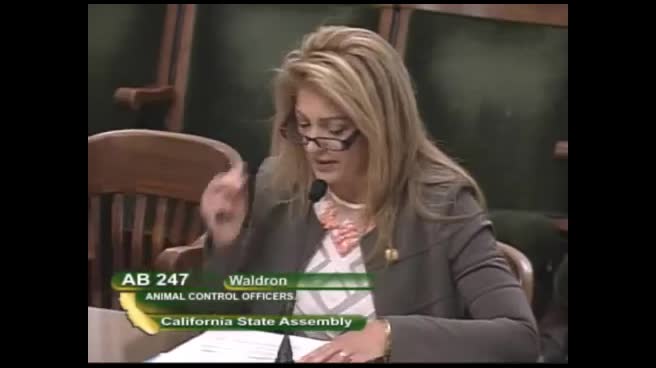 11MIN
Assembly Standing Committee on Public Safety
Bill Author

Bill Co-Author(s):