AB 2477: Victim restitution: jurisdiction.
- Session Year: 2015-2016
- House: Assembly
- Latest Version Date: 2016-02-19
Existing law requires a court to impose a separate and additional restitution fine in each case in which a person is convicted of a crime. If the economic losses of a victim cannot be ascertained at the time of sentencing, existing law requires a court to retain jurisdiction over a person subject to a restitution order for purposes of imposing or modifying restitution until such time as the losses may be determined. Two state appellate court decisions have held that under state law a court acts in excess of its jurisdiction by ordering restitution or modifying a restitution order after the explanation of a defendants probation.
This bill would expressly abrogate the holdings in those decisions by requiring the court to retain jurisdiction over a defendant for purposes of imposing or modifying restitution at any time.
It is the intent of the Legislature to clarify the proper application of Section 1202.46 of the Penal Code and to abrogate the holdings in Hilton v. Superior Court (2014) 239 Cal.App.4th 766 and People v. Waters (2015) 241 Cal.App.4th 822.
SEC. 2.Section 1202.46 of the Penal Code is amended to read:1202.46.Notwithstanding Section 1170, when the economic losses of a victim cannot be ascertained at the time of sentencing pursuant to subdivision (f) of Section 1202.4, Sections 1170, 1202.4, and 1203.3, or any other law, and regardless of the type of sentence imposed or suspended, the court shall retain jurisdiction over a person subject to a restitution order a defendant for purposes of imposing or modifying restitution until such time as the losses may be determined. Nothing in this section shall be construed as prohibiting at any time. This section does not prohibit a victim, the district attorney, or a court on its own motion from requesting correction, at any time, of a sentence when the sentence is invalid due to the omission of a restitution order or fine without a finding of compelling and extraordinary reasons pursuant to Section 1202.4. fine.
|
Date
|
Status
|
|---|---|
| Feb 19, 2016 | Introduced. To print. |
| Feb 21, 2016 | From printer. May be heard in committee March 22. |
| Feb 22, 2016 | Read first time. |
| Mar 8, 2016 | Referred to Com. on PUB. S. |
| Mar 29, 2016 | In committee: Set, first hearing. Failed passage. Reconsideration granted. |
| Apr 20, 2016 | In committee: Set, second hearing. Failed passage. |
| Apr 21, 2016 | From committee: Without further action pursuant to Joint Rule 62(a). |
|
Date
|
Description
|
Location
|
Votes
|
|
|---|---|---|---|---|
| Apr 20, 2016 | Do pass and be re-referred to the Committee on [Appropriations] | Assembly Standing Committee on Public Safety |
Failed |
|
| Mar 29, 2016 | Reconsideration. | Assembly Standing Committee on Public Safety |
Passed |
|
| Mar 29, 2016 | Do pass and be re-referred to the Committee on [Appropriations] | Assembly Standing Committee on Public Safety |
Failed |
This list shows positions taken on this bill by organizations on the date displayed, which is linked to the original source.
Positions by individuals are not included.
|
Organization
|
Position
|
Date
|
|---|---|---|
| California Attorneys For Criminal Justice | ** Against | Mar 29, 2016 |
| California District Attorneys Association | ** Support | Mar 29, 2016 |
| California Police Chiefs Association | ** Support | Mar 29, 2016 |
| California Probation, Parole, and Correctional Association | ** Support | Mar 29, 2016 |
| California Public Defenders Association | ** Against | Mar 29, 2016 |
| California State Sheriffs' Association | ** Support | Mar 29, 2016 |
| Crime Victims United Of California | ** Support | Mar 29, 2016 |
| Page J | ** Support | Mar 29, 2016 |
| PUB. S. | ** Against | Mar 29, 2016 |
Date of Hearing:
Counsel: Sandra Uribe
ASSEMBLY COMMITTEE ON PUBLIC SAFETY
Reginald Byron Jones-Sawyer, Sr., Chair
ABPCA Bill Id:AB 2477
Author:(Patterson) – As Introduced Ver:February 19, 2016
VOTE ONLY
SUMMARY:
Overturns case law holding that a court lacks jurisdiction to modify a restitution order after the defendant's probation expires, thereby extending jurisdiction for restitution indefinitely. Specifically, this bill:
- States legislative intent to abrogate the holdings in Hilton v. Superior Court (2014) 239 Cal.App.4th 766, and People v. Waters (2015) 241 Cal.App.4th 822.
- Provides that the court retains jurisdiction to impose or modify restitution regardless of the type of sentence imposed or suspended and notwithstanding any other law.
EXISTING LAW:
- Establishes the right of crime victims to receive restitution directly from the persons convicted of the crimes for losses they suffer. (Cal. Const. art I, § 28, subd. (b).)
- Requires victim restitution from adult criminal defendants who have been sentenced by the court in every case in which a victim has suffered an economic loss as a result of the defendant's conduct. (Pen. Code, § 1202.4, subd. (f).)
- Defines probation as "the suspension of the imposition or execution of a sentence and the order of conditional release in the community under the supervision of a probation officer." (Pen. Code, § 1203, subd. (a).)
- Gives the court discretion in felony cases to grant probation for up to five years, or no longer than the prison term that can be imposed when the prison term exceeds five years. (Pen. Code, § 1203.1, subd. (a).)
- Gives the court discretion in misdemeanor cases to generally grant probation for up to three years, or no longer than the consecutive sentence imposed if more than three years. (Pen. Code, § 1203a.)
- Authorizes the extension of probation for five years in certain misdemeanor cases, such as driving under the influence. (Veh. Code, § 23600, subd. (b)(1).)
- Requires a court which grants probation to make the payment of the victim restitution order a condition of probation. (Pen. Code, § 1202.4, subd. (m).)
- Authorizes the court to revoke, modify, extend, or terminate its order of probation. (Pen. Code, §§ 1203.2 & 1203.3.)
- Authorizes the court to modify the dollar amount of restitution at any time during the term of probation. (Pen. Code, § 1203.3, subd. (b)(5).)
- Prohibits the court from modifying the restitution obligations due to the defendant's good conduct. (Pen. Code, § 1203.3, subd. (b)(4).)
FISCAL EFFECT:
Unknown
COMMENTS:
- Author's Statement: According to the author, "AB 2477 is a measure which will clarify that the courts retain jurisdiction over a case for purposes of restitution even after the probationary period expires. By doing this we will uphold the Constitutional right of crime victims to receive the restitution that they deserve.
"In two recent state appellate court decisions, questions arose when it came to deciding whether or not the court had jurisdiction to impose restitution on a person who has committed a crime, after their probationary period has expired. This is problematic because the initial court hearing and restitution hearing are totally separate from one another. Often times restitution hearings can be delayed due to extraneous circumstances. Generally restitution is not granted at the initial hearing because the court still does not have the exact figure that must be paid because some costs may be ongoing or not yet determined, such as medical bills.
"AB 2477 clarifies that the court will retain jurisdiction over a case for purposes of restitution. This bill will ensure that victims receive the just restitution that they are owed and that they are provided with the correct amount to compensate their losses." - Constitutionally Protected Right to Victim Restitution: The right of a victim to restitution from the person convicted of a crime from which the victim suffers a loss as result of the criminal activity became a constitutional right when adopted by vote of the people in June 1982 as part of Proposition 8. Proposition 8 added article I, section 28, subdivision (b), to the California Constitution, and provided:
"It is the unequivocal intention of the People of the State of California that all persons who suffer losses as a result of criminal activity shall have the right to restitution from the persons convicted of the crimes for losses they suffer.
"Restitution shall be ordered from the convicted persons in every case, regardless of the sentence or disposition imposed, in which a crime victim suffers a loss, unless compelling and extraordinary reasons exist to the contrary. The Legislature shall adopt provisions to implement this section during the calendar year following adoption of this section."
The Proposition was not self-executing, but rather directed the Legislature to adopt implementing legislation. (People v. Vega-Hernández (1986) 179 Cal.App.3d 1084.) In response, the Legislature enacted Penal Code sections 1202.4 and 1203.04 (repealed section related to restitution as condition of probation). (People v. Ortiz (1997) 53 Cal.App.4th 791, 795, fn. 3.)
The constitutional provisions regarding restitution were amended by the voters again in 2008, when they approved Proposition 9, the Victims' Bill of Rights Act of 2008, also known as Marsy's Law. The amendments, among other things, make clear that a victim is entitled to restitution, expanded the definition of a victim to include a representative of a deceased victim, and gave that representative the ability to enforce a victim's right. (See People v. Runyan (2012) 54 Cal.4th 849, 858-859.) - Restitution as a Condition of Probation: When the court grants probation, payment of restitution must be made a condition of probation. (Pen. Code, 1202.4, subd. (m).)
The court has broader discretion to order restitution as a condition of probation than it does when a defendant is not granted probation. (People v. Anderson (2010) 50 Cal.4th 19, 26-27.) When ordering restitution as a condition of probation, the court is not restricted to directing payment to only those victims as defined in the restitution statute. Additionally, the court can order restitution as a condition of probation even when the losses are not necessarily caused by the conduct underlying the defendant's conviction. Rather than having a causal connection, the restitution condition must only be reasonably related to either the defendant's crime or to the goal of deterring future criminality. (Ibid; see also People v Carbajal (1995) 10 Cal4th. 1114, 1121–1124.)
If part of a restitution order has not been paid after a defendant is no longer on probation, it remains enforceable by the victim as though it were a civil judgment. (Pen. Code, 1202.4, subd. (m).) - Recent Case Law: Two recent appellate court cases have held that a trial court acts in excess of its jurisdiction when it orders or modifies restitution after the expiration of a defendant's probationary period.[1]
In Hilton v. Superior Court (2014) 239 Cal.App.4th 766, the Court of Appeal held that once probation expires, the judge cannot modify a restitution order. In Hilton, the defendant pled to driving under the influence and the court placed him on probation for three years. At a subsequent restitution hearing, the court ordered the defendant to pay $3,000 restitution to the victim, which he did. (Id. at pp. 769-770.) The victim then sued the defendant civilly and won $3.5 million. Probation then expired on the criminal case. One year and seven months after probation exprired, the victim went back to court and requested that the court could order $886,000 more in restitution, to pay for the costs of the civil suit as well as additional lost wages. The defendant objected based on lack of jurisdiction. (Id. at 770.) The Court of Appeal reversed the order, holding that once probation expires, the court loses jurisdiction to modify a restitution order and that any extension of probation was an act in excess of jurisdiction and void. (Id. at p. 772.) The court noted that termination of probation occurs by operation of law at the end of the probationary period. (Id. at p. 773.) The court also held that the language of Penal Code section 1203.3, reflects legislative intent, consistent with pre-exisiting law on probation, that the trial court lacks jurisdiction to impose restitution once probation expires. (Id. at pp. 775-776.)
People v. Waters (2015) 241 Cal.App.4th 822, agreed with the holding in Hilton. In this case, the court sought to order restitution two years after the probationary period expired, even though the victim impact statement seeking $20,000 was filed before the entry of the plea. (Id. at p. 825.) The court noted that Penal Code section 1202.4, subdivision (f) requires the trial court to order victim restitution unless the trial court finds compelling and extraordinary reasons for not doing so. Regarding jurisdiction, a trial court's power to modify a sentence usually expires 120 days after judgment. (See Pen. Code, § 1170, subd. (d).) (Id. at p. 827.) But there is an exception where victim restitution cannot be ascertained at the time of sentencing and the trial court retains jurisdiction to order restitution. (Pen. Code, § 1202.46.) However, section 1202.46 must be harmonized with the preexisting statutory scheme concerning probation, which limits a trial court's jurisdiction to modify probation to the term of probation (Pen. Code, § 1203.3, subds. (a), (b)(4).) (Id. at p. 830-831.) Therefore, the court concluded that the trial court lacked jurisdiction to order restitution after the expiration of the defendant's probationary period. (Id. at p. 831.)[2]
This bill seeks to overturn these cases.
- Argument in Support: According to the California District Attorneys Association, the sponsor of this bill, "Current law (Penal Code 1202.46) provides that if a crime victim’s economic losses cannot be determined at the time of sentencing, the court retains jurisdiction over a defendant for purposes of imposing or modifying restitution until the losses can be determined. Recently, in Hilton v. Superior Court (2014) 224 Cal.App.4th 47, the Fourth District Court of Appeal held that the court loses jurisdiction to modify or impose a restitution amount once probation expires. Common practice, prior to the Hilton decision, was that the court retained jurisdiction for the limited purpose of modifying or imposing a restitution order.
"While the law provides elsewhere (PC 1214(b) & (c); PC 1202.4(m)) that restitution orders survive the expiration of probation, parole, mandatory supervision, and post release community supervision, the holding in Hilton precludes a court from ordering or correcting the restitution amount.
"This is contrary to the California Constitution, which requires a restitution order in every case, regardless of sentence or disposition (Article I Section 28 subdivision (b)(13)). The Victims’ Bill of Rights (Proposition 8 in June 1982) and Marsy’s Law (Proposition 9 in November 2008) support a court’s continuing jurisdiction to deal with victim restitution issues, and clearly provide that every case where a victim has suffered a loss must have a restitution order.
"In the vast majority of cases, the victim restitution amount is finite, and the victim will not have to come back to court to get the amount increased because of ongoing expenses, such as additional medical bills or counseling fees. However, there are at least three scenarios in which the court needs to be able to deal with restitution issues post-supervision: (1) when it is discovered that victim restitution was overlooked; (2) when it is discovered that the original restitution amount was incorrect and needs to be reduced, increased, or eliminated; or (3) when victim restitution was contemplated by the parties, but the period of supervision expired before it could be ordered.
"The bottom line is that the law needs to be flexible enough to deal with victim restitution in all cases. We need to be able to set the victim restitution amount in the first place, whenever it becomes known, and we need to be able to correct the amount of victim restitution when it is discovered to be incorrect." - Argument in Opposition: According to the California Attorneys for Criminal Justice, "The bill would infinitely expand a defendant’s liability for restitution long after he or she completes her probationary term.
"Currently, the precedents hold that the trial court’s jurisdiction ends upon the termination of a defendant’s probationary term. This encourages a claimant to use due diligence in presenting a claim for restitution. It also provides an incentive for a defendant to satisfy the restitution order prior to the expiration of probation in order to prevent the probation term from being extended to satisfy the debt. It provides further incentive to a defendant to pay restitution early in his probationary term in support of a request for early termination of that term.
"The proposed legislation would not only be contrary to current case law; it would be contrary to the above-mentioned goals and incentives. By expressly providing that the trial court would have jurisdiction over a defendant for purposes of imposing or modifying restitution “at any time,” the bill would exceed even the boundaries of civil liability statutes of limitation in many cases (particularly those involving personal injury). …
"Defendants could be forced at attempting to defend against claims made decades after the successful completion of probation, and as stated in Waters at page 832, a defendant's estate could even be subjected to liability. The court in Waters goes on to state, '[w]hile we are sensitive to concerns about making crime victims whole, there must be some discernible limit to a trial court’s power over a defendant after he or she completes a sentence.' (Id.)" - Related Legislation: AB 2295 (Baker) eliminates court discretion to order less than full restitution when there are compelling and extraordinary reasons not to do so. AB 2295 is pending hearing in this committee.
- Prior Legislation: AB 2645 (Dababneh), Chapter 111, Statutes of 2014, requires a court transferring a probation or mandatory supervision case to another county to determine the amount of victim restitution before the transfer is made.
REGISTERED SUPPORT / OPPOSITION:
Support
California District Attorneys Association (Sponsor)
California Police Chiefs Association
California Probation, Parole, and Correctional Association
California State Sheriffs' Association
Crime Victims United of California
Opposition
American Civil Liberties Union
California Attorneys for Criminal Justice
California Public Defenders Association
Legal Services for Prisoners with Children
Analysis Prepared by:
Sandy Uribe / PUB. S. / (916) 319-3744
These cases are not contrary to the recent California Supreme Court case of People v. Ford (2015) 61 Cal.4th 282, which held that agreeing to a hearing on restitution outside the probationary period estops the defense from later challenging lack of jurisdiction.
↑It is unclear why in People v. Waters, supra, 241 Cal.App.4th 822, the People did not file an appeal claiming that a judgment lacking a victim restitution order was an unauthorized sentence. (See e.g. People v. Rowland (1997) 51 Cal.App.4th 1745 [when the court fails to issue a restitution award altogether, the sentence is invalid].) ↑
Date of Hearing: March 29, 2016
Counsel: Sandra Uribe
ASSEMBLY COMMITTEE ON
, Sr., Chair
ABPCA Bill Id:
Author:() – As Ver:
SUMMARY:
Overturns case law holding that a court lacks jurisdiction to modify a restitution order after the defendant's probation expires, thereby extending jurisdiction for restitution indefinitely. Specifically, this bill:
- States legislative intent to abrogate the holdings in Hilton v. Superior Court (2014) 239 Cal.App.4th 766, and People v. Waters (2015) 241 Cal.App.4th 822.
- Provides that the court retains jurisdiction to impose or modify restitution regardless of the type of sentence imposed or suspended and notwithstanding any other law.
EXISTING LAW:
- Establishes the right of crime victims to receive restitution directly from the persons convicted of the crimes for losses they suffer. (Cal. Const. art I, § 28, subd. (b).)
- Requires victim restitution from adult criminal defendants who have been sentenced by the court in every case in which a victim has suffered an economic loss as a result of the defendant's conduct. (Pen. Code, § 1202.4, subd. (f).)
- Defines probation as "the suspension of the imposition or execution of a sentence and the order of conditional release in the community under the supervision of a probation officer." (Pen. Code, § 1203, subd. (a).)
- Gives the court discretion in felony cases to grant probation for up to five years, or no longer than the prison term that can be imposed when the prison term exceeds five years. (Pen. Code, § 1203.1, subd. (a).)
- Gives the court discretion in misdemeanor cases to generally grant probation for up to three years, or no longer than the consecutive sentence imposed if more than three years. (Pen. Code, § 1203a.)
- Authorizes the extension of probation for five years in certain misdemeanor cases, such as driving under the influence. (Veh. Code, § 23600, subd. (b)(1).)
- Requires a court which grants probation to make the payment of the victim restitution order a condition of probation. (Pen. Code, § 1202.4, subd. (m).)
- Authorizes the court to revoke, modify, extend, or terminate its order of probation. (Pen. Code, §§ 1203.2 & 1203.3.)
- Authorizes the court to modify the dollar amount of restitution at any time during the term of probation. (Pen. Code, § 1203.3, subd. (b)(5).)
- Prohibits the court from modifying the restitution obligations due to the defendant's good conduct. (Pen. Code, § 1203.3, subd. (b)(4).)
FISCAL EFFECT:
Unknown
COMMENTS:
- Author's Statement: According to the author, "AB 2477 is a measure which will clarify that the courts retain jurisdiction over a case for purposes of restitution even after the probationary period expires. By doing this we will uphold the Constitutional right of crime victims to receive the restitution that they deserve.
"In two recent state appellate court decisions, questions arose when it came to deciding whether or not the court had jurisdiction to impose restitution on a person who has committed a crime, after their probationary period has expired. This is problematic because the initial court hearing and restitution hearing are totally separate from one another. Often times restitution hearings can be delayed due to extraneous circumstances. Generally restitution is not granted at the initial hearing because the court still does not have the exact figure that must be paid because some costs may be ongoing or not yet determined, such as medical bills.
"AB 2477 clarifies that the court will retain jurisdiction over a case for purposes of restitution. This bill will ensure that victims receive the just restitution that they are owed and that they are provided with the correct amount to compensate their losses." - Constitutionally Protected Right to Victim Restitution: The right of a victim to restitution from the person convicted of a crime from which the victim suffers a loss as result of the criminal activity became a constitutional right when adopted by vote of the people in June 1982 as part of Proposition 8. Proposition 8 added article I, section 28, subdivision (b), to the California Constitution, and provided:
"It is the unequivocal intention of the People of the State of California that all persons who suffer losses as a result of criminal activity shall have the right to restitution from the persons convicted of the crimes for losses they suffer.
"Restitution shall be ordered from the convicted persons in every case, regardless of the sentence or disposition imposed, in which a crime victim suffers a loss, unless compelling and extraordinary reasons exist to the contrary. The Legislature shall adopt provisions to implement this section during the calendar year following adoption of this section."
The Proposition was not self-executing, but rather directed the Legislature to adopt implementing legislation. (People v. Vega-Hernández (1986) 179 Cal.App.3d 1084.) In response, the Legislature enacted Penal Code sections 1202.4 and 1203.04 (repealed section related to restitution as condition of probation). (People v. Ortiz (1997) 53 Cal.App.4th 791, 795, fn. 3.)
The constitutional provisions regarding restitution were amended by the voters again in 2008, when they approved Proposition 9, the Victims' Bill of Rights Act of 2008, also known as Marsy's Law. The amendments, among other things, make clear that a victim is entitled to restitution, expanded the definition of a victim to include a representative of a deceased victim, and gave that representative the ability to enforce a victim's right. (See People v. Runyan (2012) 54 Cal.4th 849, 858-859.) - Restitution as a Condition of Probation: When the court grants probation, payment of restitution must be made a condition of probation. (Pen. Code, 1202.4, subd. (m).)
The court has broader discretion to order restitution as a condition of probation than it does when a defendant is not granted probation. (People v. Anderson (2010) 50 Cal.4th 19, 26-27.) When ordering restitution as a condition of probation, the court is not restricted to directing payment to only those victims as defined in the restitution statute. Additionally, the court can order restitution as a condition of probation even when the losses are not necessarily caused by the conduct underlying the defendant's conviction. Rather than having a causal connection, the restitution condition must only be reasonably related to either the defendant's crime or to the goal of deterring future criminality. (Ibid; see also People v Carbajal (1995) 10 Cal4th. 1114, 1121–1124.)
If part of a restitution order has not been paid after a defendant is no longer on probation, it remains enforceable by the victim as though it were a civil judgment. (Pen. Code, 1202.4, subd. (m).) - Recent Case Law: Two recent appellate court cases have held that a trial court acts in excess of its jurisdiction when it orders or modifies restitution after the expiration of a defendant's probationary period.[1]
In Hilton v. Superior Court (2014) 239 Cal.App.4th 766, the Court of Appeal held that once probation expires, the judge cannot modify a restitution order. In Hilton, the defendant pled to driving under the influence and the court placed him on probation for three years. At a subsequent restitution hearing, the court ordered the defendant to pay $3,000 restitution to the victim, which he did. (Id. at pp. 769-770.) The victim then sued the defendant civilly and won $3.5 million. Probation then expired on the criminal case. One year and seven months after probation exprired, the victim went back to court and requested that the court could order $886,000 more in restitution, to pay for the costs of the civil suit as well as additional lost wages. The defendant objected based on lack of jurisdiction. (Id. at 770.) The Court of Appeal reversed the order, holding that once probation expires, the court loses jurisdiction to modify a restitution order and that any extension of probation was an act in excess of jurisdiction and void. (Id. at p. 772.) The court noted that termination of probation occurs by operation of law at the end of the probationary period. (Id. at p. 773.) The court also held that the language of Penal Code section 1203.3, reflects legislative intent, consistent with pre-exisiting law on probation, that the trial court lacks jurisdiction to impose restitution once probation expires. (Id. at pp. 775-776.)
People v. Waters (2015) 241 Cal.App.4th 822, agreed with the holding in Hilton. In this case, the court sought to order restitution two years after the probationary period expired, even though the victim impact statement seeking $20,000 was filed before the entry of the plea. (Id. at p. 825.) The court noted that Penal Code section 1202.4, subdivision (f) requires the trial court to order victim restitution unless the trial court finds compelling and extraordinary reasons for not doing so. Regarding jurisdiction, a trial court's power to modify a sentence usually expires 120 days after judgment. (See Pen. Code, § 1170, subd. (d).) (Id. at p. 827.) But there is an exception where victim restitution cannot be ascertained at the time of sentencing and the trial court retains jurisdiction to order restitution. (Pen. Code, § 1202.46.) However, section 1202.46 must be harmonized with the preexisting statutory scheme concerning probation, which limits a trial court's jurisdiction to modify probation to the term of probation (Pen. Code, § 1203.3, subds. (a), (b)(4).) (Id. at p. 830-831.) Therefore, the court concluded that the trial court lacked jurisdiction to order restitution after the expiration of the defendant's probationary period. (Id. at p. 831.)[2]
This bill seeks to overturn these cases.
- Argument in Support: According to the California District Attorneys Association, the sponsor of this bill, "Current law (Penal Code 1202.46) provides that if a crime victim’s economic losses cannot be determined at the time of sentencing, the court retains jurisdiction over a defendant for purposes of imposing or modifying restitution until the losses can be determined. Recently, in Hilton v. Superior Court (2014) 224 Cal.App.4th 47, the Fourth District Court of Appeal held that the court loses jurisdiction to modify or impose a restitution amount once probation expires. Common practice, prior to the Hilton decision, was that the court retained jurisdiction for the limited purpose of modifying or imposing a restitution order.
"While the law provides elsewhere (PC 1214(b) & (c); PC 1202.4(m)) that restitution orders survive the expiration of probation, parole, mandatory supervision, and post release community supervision, the holding in Hilton precludes a court from ordering or correcting the restitution amount.
"This is contrary to the California Constitution, which requires a restitution order in every case, regardless of sentence or disposition (Article I Section 28 subdivision (b)(13)). The Victims’ Bill of Rights (Proposition 8 in June 1982) and Marsy’s Law (Proposition 9 in November 2008) support a court’s continuing jurisdiction to deal with victim restitution issues, and clearly provide that every case where a victim has suffered a loss must have a restitution order.
"In the vast majority of cases, the victim restitution amount is finite, and the victim will not have to come back to court to get the amount increased because of ongoing expenses, such as additional medical bills or counseling fees. However, there are at least three scenarios in which the court needs to be able to deal with restitution issues post-supervision: (1) when it is discovered that victim restitution was overlooked; (2) when it is discovered that the original restitution amount was incorrect and needs to be reduced, increased, or eliminated; or (3) when victim restitution was contemplated by the parties, but the period of supervision expired before it could be ordered.
"The bottom line is that the law needs to be flexible enough to deal with victim restitution in all cases. We need to be able to set the victim restitution amount in the first place, whenever it becomes known, and we need to be able to correct the amount of victim restitution when it is discovered to be incorrect." - Argument in Opposition: According to the California Attorneys for Criminal Justice, "The bill would infinitely expand a defendant’s liability for restitution long after he or she completes her probationary term.
"Currently, the precedents hold that the trial court’s jurisdiction ends upon the termination of a defendant’s probationary term. This encourages a claimant to use due diligence in presenting a claim for restitution. It also provides an incentive for a defendant to satisfy the restitution order prior to the expiration of probation in order to prevent the probation term from being extended to satisfy the debt. It provides further incentive to a defendant to pay restitution early in his probationary term in support of a request for early termination of that term.
"The proposed legislation would not only be contrary to current case law; it would be contrary to the above-mentioned goals and incentives. By expressly providing that the trial court would have jurisdiction over a defendant for purposes of imposing or modifying restitution “at any time,” the bill would exceed even the boundaries of civil liability statutes of limitation in many cases (particularly those involving personal injury). …
"Defendants could be forced at attempting to defend against claims made decades after the successful completion of probation, and as stated in Waters at page 832, a defendant's estate could even be subjected to liability. The court in Waters goes on to state, '[w]hile we are sensitive to concerns about making crime victims whole, there must be some discernible limit to a trial court’s power over a defendant after he or she completes a sentence.' (Id.)" - Related Legislation: AB 2295 (Baker) eliminates court discretion to order less than full restitution when there are compelling and extraordinary reasons not to do so. AB 2295 is pending hearing in this committee.
- Prior Legislation: AB 2645 (Dababneh), Chapter 111, Statutes of 2014, requires a court transferring a probation or mandatory supervision case to another county to determine the amount of victim restitution before the transfer is made.
REGISTERED SUPPORT / OPPOSITION:
Support
California District Attorneys Association (Sponsor)
California Police Chiefs Association
California Probation, Parole, and Correctional Association
California State Sheriffs' Association
Crime Victims United of California
Opposition
American Civil Liberties Union
California Attorneys for Criminal Justice
California Public Defenders Association
Legal Services for Prisoners with Children
Analysis Prepared by:
These cases are not contrary to the recent California Supreme Court case of People v. Ford (2015) 61 Cal.4th 282, which held that agreeing to a hearing on restitution outside the probationary period estops the defense from later challenging lack of jurisdiction.
↑It is unclear why in People v. Waters, supra, 241 Cal.App.4th 822, the People did not file an appeal claiming that a judgment lacking a victim restitution order was an unauthorized sentence. (See e.g. People v. Rowland (1997) 51 Cal.App.4th 1745 [when the court fails to issue a restitution award altogether, the sentence is invalid].) ↑
Discussed in Hearing
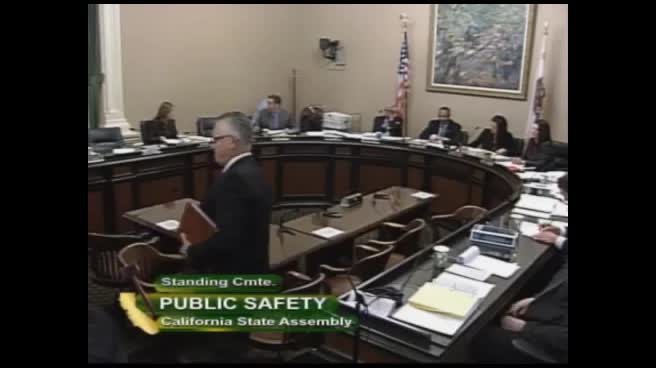 14MIN
Assembly Standing Committee on Public Safety
Bill Author


