AB 2606: Crimes against children, elders, dependent adults, and persons with disabilities.
- Session Year: 2015-2016
- House: Assembly
- Latest Version Date: 2016-05-03
The Child Abuse and Neglect Reporting Act requires a law enforcement agency that receives a report of child abuse to report to an appropriate licensing agency every known or suspected instance of child abuse or neglect that occurs while the child is being cared for in a child day care facility or community care facility or that involves a licensed staff person of the facility.
Existing law proscribes the commission of certain crimes against elders and dependent adults, including, but not limited to, inflicting upon an elder or dependent adult unjustifiable physical pain or mental suffering, as specified. Existing law proscribes the commission of a hate crime, as defined, against certain categories of persons, including disabled persons.
Existing law provides for the licensure of various healing arts professionals, and specifies that the commission of any act of sexual abuse, misconduct, or relations with a patient, client, or customer constitutes unprofessional conduct and grounds for disciplinary action against the licensee. Existing law also establishes that the crime of sexual exploitation by a physician and surgeon, psychotherapist, or alcohol and drug abuse counselor has occurred when the licensee engages in specified sexual acts with a patient, client, or former patient or client.
This bill would require, if a law enforcement agency receives a report, or if a law enforcement officer makes a report, that a person who holds a state professional or occupational credential, license, or permit that allows the person to provide services to children, elders, dependent adults, or persons with disabilities is alleged to have committed one or more of specified crimes, the law enforcement agency to promptly send a copy of the report to the state licensing agency that issued the credential, license, or permit. permit, except as specified. The bill would require a state agency to prioritize and process the report pursuant to applicable law in the same manner as similar reports received by that agency in order to ensure due process of law and equal protection of the laws. By imposing additional duties on law enforcement agencies, this bill would impose a state-mandated local program.
The California Constitution requires the state to reimburse local agencies and school districts for certain costs mandated by the state. Statutory provisions establish procedures for making that reimbursement.
This bill would provide that, if the Commission on State Mandates determines that the bill contains costs mandated by the state, reimbursement for those costs shall be made pursuant to these statutory provisions.
The Child Abuse and Neglect Reporting Act requires a law enforcement agency that receives a report of child abuse to report to an appropriate licensing agency every known or suspected instance of child abuse or neglect that occurs while the child is being cared for in a child day care facility or community care facility or that involves a licensed staff person of the facility.
Existing law proscribes the commission of certain crimes against elders and dependent adults, including, but not limited to, inflicting upon an elder or dependent adult unjustifiable physical pain or mental suffering, as specified. Existing law proscribes the commission of a hate crime, as defined, against certain categories of persons, including disabled persons.
Existing law provides for the licensure of various healing arts professionals, and specifies that the commission of any act of sexual abuse, misconduct, or relations with a patient, client, or customer constitutes unprofessional conduct and grounds for disciplinary action against the licensee. Existing law also establishes that the crime of sexual exploitation by a physician and surgeon, psychotherapist, or alcohol and drug abuse counselor has occurred when the licensee engages in specified sexual acts with a patient, client, or former patient or client.
This bill would require, if a law enforcement agency receives a report, or if a law enforcement officer makes a report, that a person who holds a state professional or occupational credential, license, or permit that allows the person to provide services to children, elders, dependent adults, or persons with disabilities is alleged to have committed one or more of specified crimes, the law enforcement agency to promptly send a copy of the report to the state licensing agency that issued the credential, license, or permit. By imposing additional duties on law enforcement agencies, this bill would impose a state-mandated local program.
The California Constitution requires the state to reimburse local agencies and school districts for certain costs mandated by the state. Statutory provisions establish procedures for making that reimbursement.
This bill would provide that, if the Commission on State Mandates determines that the bill contains costs mandated by the state, reimbursement for those costs shall be made pursuant to these statutory provisions.
If a law enforcement agency receives a report, or if a law enforcement officer makes a report, that a person who holds a state professional or occupational credential, license, or permit that allows the person to provide services to children, elders, dependent adults, or persons with disabilities is alleged to have committed one or more of the crimes described in subdivisions (a) to (f), (d), inclusive, the law enforcement agency shall promptly send a copy of the report to the state agency that issued the credential, license, or permit. If the law enforcement agency determines that sending the copy of the report to the state agency would jeopardize an ongoing investigation, however, the law enforcement agency shall delay sending the copy to the state agency until the investigation is complete or the law enforcement agency determines that sending the report to the state agency would no longer jeopardize the investigation.
(a)Sexual exploitation by a physician and surgeon, psychotherapist, or drug or alcohol abuse counselor, as described in Section 729 of the Business and Professions Code.
(b)Rape or other crimes described in Chapter 1 (commencing with Section 261).
(c)
(b)Elder or dependent adult abuse, failure to report elder or dependent adult abuse, interfering with a report of elder or dependent adult abuse abuse, or other crimes, as described in Chapter 13.
(d)A hate crime motivated by antidisability bias, as described in Chapter 1 (commencing with Section 422.55) of Title 11.6.
(e)
(c)Sexual abuse, as defined in Section 11165.1.
(f)
(d)Child abuse, failure to report child abuse, or interfering with a report of child abuse.
368.8.When a state agency receives a report pursuant to this chapter, the agency shall prioritize and process the report pursuant to applicable law in the same manner as similar reports received by that agency in order to ensure due process of law and equal protection of the laws.
SEC. 2.If the Commission on State Mandates determines that this act contains costs mandated by the state, reimbursement to local agencies and school districts for those costs shall be made pursuant to Part 7 (commencing with Section 17500) of Division 4 of Title 2 of the Government Code.
If a law enforcement agency receives a report, or if a law enforcement officer makes a report, that a person who holds a state professional or occupational credential, license, or permit that allows the person to provide services to children, elders, dependent adults, or persons with disabilities is alleged to have committed one or more of the crimes described in subdivisions (a) to (f), inclusive, the law enforcement agency shall promptly send a copy of the report to the state agency that issued the credential, license, or permit.
(a)Sexual exploitation by a physician and surgeon, psychotherapist, or drug or alcohol abuse counselor, as described in Section 729 of the Business and Professions Code.
(b)Rape or other crimes described in Chapter 1 (commencing with Section 261).
(c)Elder or dependent adult abuse, failure to report elder or dependent adult abuse, interfering with a report of elder or dependent adult abuse or other crimes, as described in Chapter 13.
(d)A hate crime motivated by antidisability bias, as described in Chapter 1 (commencing with Section 422.55) of Title 11.6.
(e)Sexual abuse, as defined in Section 11165.1.
(f)Child abuse, failure to report child abuse, or interfering with a report of child abuse.
SEC. 2.If the Commission on State Mandates determines that this act contains costs mandated by the state, reimbursement to local agencies and school districts for those costs shall be made pursuant to Part 7 (commencing with Section 17500) of Division 4 of Title 2 of the Government Code.
|
Date
|
Status
|
|---|---|
| Feb 19, 2016 | Introduced. To print. |
| Feb 21, 2016 | From printer. May be heard in committee March 22. |
| Feb 22, 2016 | Read first time. |
| Mar 10, 2016 | Referred to Com. on PUB. S. |
| Apr 12, 2016 | In committee: Set, first hearing. Failed passage. Reconsideration granted. |
| Apr 21, 2016 | From committee: Do pass and re-refer to Com. on APPR. (Ayes 4. Noes 2.) (April 20). Re-referred to Com. on APPR. |
| May 3, 2016 | From committee chair, with author's amendments: Amend, and re-refer to Com. on APPR. Read second time and amended. |
| May 4, 2016 | Re-referred to Com. on APPR. |
| May 18, 2016 | In committee: Set, first hearing. Referred to APPR. suspense file. |
| May 27, 2016 | In committee: Held under submission. |
|
Date
|
Description
|
Location
|
Votes
|
|
|---|---|---|---|---|
| Apr 20, 2016 | Do pass and be re-referred to the Committee on [Appropriations] | Assembly Standing Committee on Public Safety |
Passed |
|
| Apr 12, 2016 | Reconsideration. | Assembly Standing Committee on Public Safety |
Passed |
|
| Apr 12, 2016 | Do pass and be re-referred to the Committee on [Appropriations] | Assembly Standing Committee on Public Safety |
Failed |
This list shows positions taken on this bill by organizations on the date displayed, which is linked to the original source.
Positions by individuals are not included.
|
Organization
|
Position
|
Date
|
|---|---|---|
| California Chamber Of Commerce | * Support | Jun 20, 2018 |
| California Enviornmental Justice Alliance | * Against | Jun 20, 2018 |
| Center on Race, Poverty, and the Environment | * Against | Jun 20, 2018 |
| Chemical Industry Council Of California | * Support | Jun 20, 2018 |
| Clean Harbors Environmental Services | * Support | Jun 20, 2018 |
| Leadership Council for Justice and Accountability | * Against | Jun 20, 2018 |
| Navy Region Southwest | * Support | Jun 20, 2018 |
| Sierra Club California | * Against | Jun 20, 2018 |
| Solano County Board of Supervisors | * Support | Jun 20, 2018 |
Date of Hearing: May 18, 2016
ASSEMBLY COMMITTEE ON APPROPRIATIONS
Lorena Gonzalez, Chair
ABPCA Bill Id:AB 2606
Author:(Grove) – As Amended Ver:May 3, 2016
Policy Committee: | Public Safety | Vote: | 4 - 2 |
|
Urgency: No State Mandated Local Program: Yes Reimbursable: Yes
SUMMARY:
This bill requires a law enforcement agency that receives or makes a report of the commission of specified crimes by a person who holds a state professional or occupational credential, license, or permit allowing the person to provide services to children, elders, dependent adults, or persons with disabilities, to provide a copy of that report to the state agency which issued the credential, license, or permit. When the report is received by the state agency, it is required to prioritize and process the report pursuant to existing law.
FISCAL EFFECT:
Unknown significant costs to various state agencies, bureaus, or boards that provide state professional or occupational credential, license or permit to provide personal services in California to investigate the hundreds of reports that may be received. For example, the Department of Consumer Affairs (DCA) estimates an increase of over 150 cases of sexual misconduct assigned to it is Health Quality Investigations Unit and at least 50 additional cases to its Investigations and Enforcement Unit, the cost associated with these activities are in excess of $1 million. The provisions of this bill apply to all agencies that provide a license to persons who provide services to the general population and may also come in contact with children, elders, dependent adults, or persons with disabilities, such as the Contractor’s License Board, the Board of Barbering and Cosmetology, the Dental Board, the Bureau of Real Estate Appraisers, etc. (various Special Funds)
Unknown reimbursable state mandated costs (GF) to local law enforcement agencies who are required to submit a report for an allegation, whether or not a crime actually occurred.
COMMENTS:
- Purpose. According to the author, "The developmentally disabled, elderly, and children are the most vulnerable members of our community and we have an obligation to help protect them. People with disabilities are subject to violent crimes – especially sexual assault and abuse -- at much higher rates than the general population. Many of these crimes are committed by caretakers. This bill requires law enforcement agencies to cross-report abuse, neglect, and sexual misconduct to the appropriate state licensing agency.
The reporting requirement in this bill is triggered when a specified crime is alleged to have been committed by a person who holds a state professional or occupational credential, a license, or permit allowing the person to provide services to children, elders, dependent adults, or persons with disabilities. As drafted, this bill applies to an extremely broad range of professionals who provide services to the general population, including realtors, dentists, lawyers, contractors, cosmetologists, etc. Furthermore, the report is required for an alleged commission of a crime, before, or whether or not, a conviction occurs. There is no requirement that the law enforcement agency conduct any sort of investigation before submitting a report to the licensing/permitting agency.
This bill requires the licensing agency to prioritize and process the report pursuant to applicable law in the same manner as other reports are received. Some agencies have their own investigation units, while other rely on conviction reports to take action.
- Support: According to the Arc and United Cerebral Palsy California Collaboration, the sponsor of this bill, "A large body of research shows that adults and children with disabilities are subject to violent crime—especially sexual assault and abuse – at much higher rates than the general population. Arrest and conviction rates are often very low, in some cases, because mandated reporters often fail to report because of interference by supervisors and fear of retaliation.”
- Opposition:
According to the California Association of Psychiatric Technicians (CAPT), "CAPT opposes this bill for several reasons, one of which is that, if passed, this bill would require law enforcement to transmit a report of abuse, neglect, or sexual misconduct without having first done an investigation to sustain the allegation. Many CAPT members work with a population of individuals that have severe mental illness. At the state mental hospitals, hundreds of false reports are made a year by patients that are incompetent to stand trial or not guilty by reason of insanity.
"The reporting to the licensing body of a health care worker without investigation or substantiation of the allegation would clog the licensing body's investigating case load, forcing investigators to investigate hundreds of false allegations a year."
The California State Sheriffs' Association writes, “While it is appropriate for a licensing agency to know when its licensees are accused of crime particularly when they relate to their profession, processes exist to accomplish this."
Analysis Prepared by: Pedro Reyes / APPR. / (916) 319-2081
Date of Hearing: April 19, 2016
Counsel: Sandra Uribe
ASSEMBLY COMMITTEE ON
Reginald Byron Jones-Sawyer, Sr., Chair
ABPCA Bill Id:
Author:() – As Ver:
VOTE ONLY
SUMMARY:
Requires law enforcement to send a copy of a report alleging specified crimes committed against elderly or developmentally disabled people to state licensing agencies. Specifically, this bill:
- Requires a law enforcement agency that receives or makes a report of the commission of specified crimes by a person who holds a state professional or occupational credential, a license, or permit allowing the person to provide services to children, elders, dependent adults, or persons with disabilities, to provide a copy of that report to the state agency which issued the credential, license, or permit.
- Applies these reporting requirements to the following crimes:
- Sexual exploitation by a physician and surgeon, psychotherapist, or drug/alcohol abuse counselor, as specified in the Business and Professions Code;
- Rape and other sex crimes;
- Elder or dependent adult abuse, failure to report by mandated report, or interfering with a report;
- A hate crime motivated by anti-disability bias;
- Sexual abuse, as specified; and,
- Child abuse, failure to report by mandated report, or interfering with a report.
- Sexual exploitation by a physician and surgeon, psychotherapist, or drug/alcohol abuse counselor, as specified in the Business and Professions Code;
EXISTING LAW:
- Establishes the Elder Abuse and Dependent Adult Civil Protection Act. (Welf. and Inst. Code, § 15600 et seq.)
- Enumerates categories of persons who are mandated reporters under the Act. (Welf. and Inst. Code, § 15630.)
- Provides that failure to report specified conduct committed against an elder or dependent adult, or impeding or inhibiting such a report is a misdemeanor punishable by up to six months in jail, by a fine of up to $1,000, or both. (Welf. and Inst. Code, § 15630, subd. (h).)
- Provides that failure to report specified conduct committed against an elder or dependent adult resulting in serious bodily injury or death, or impeding or inhibiting such a report is a misdemeanor punishable by up to one year in jail, by a fine of up to $5,000, or both. (Welf. and Inst. Code, § 15630, subd. (h).)
- Establishes the Child Abuse Neglect Reporting Act (CANRA) for the purpose of protecting children from abuse and neglect. (Pen. Code, § 11164.)
- Enumerates categories of persons who are mandated reporters under CANRA. (Pen. Code, § 11165.7, subd. (a).)
- Provides that when two or more persons, who are required to report, jointly have knowledge of a known or suspected instance of child abuse or neglect, and when there is agreement among them, the telephone report may be made by a member of the team selected by mutual agreement and a single report may be made and signed by the selected member of the reporting team. Any member who has knowledge that the member designated to report has failed to do so shall thereafter make the report. (Pen. Code, § 11166, subd. (h).)
- States that the reporting duties under CANRA are individual and no supervisor or administrator may impede or inhibit the reporting duties, and no person making a report shall be subject to sanction for making the report. However, internal procedures to facilitate reporting and apprise supervisors and administrators of reports may be established provided they are not inconsistent with CANRA. (Pen. Code, § 11166, subd. (i)(1).)
- Provides that any mandated reporter who fails to report an incident of known or reasonably suspected child abuse or neglect as required by this section is guilty of a misdemeanor punishable by up to six months confinement in a county jail or by a fine of $1,000 or by both that imprisonment and fine. (Pen. Code, § 11166, subd. (c).)
- States that if a mandated reporter intentionally conceals his or her failure to report an incident known by the mandated reporter to be abuse or severe neglect under this section, the failure to report is a continuing offense until a specified agency discovers the offense. (Pen. Code, § 11166, subd. (c).)
- Provides that any supervisor or administrator who interferes or inhibits a mandated reporter from reporting suspected child abuse or neglect shall be punished by not more than six months in a county jail, by a fine of not more than one thousand dollars ($1,000), or by both imprisonment and a fine. (Pen. Code, § 11166.01, subd. (a).)
- States that "sexual abuse" means "sexual assault or sexual exploitation." (Pen. Code, § 11165.1.)
FISCAL EFFECT:
Unknown
COMMENTS:
- Author's Statement: According to the author, "The developmentally disabled, elderly, and children are the most vulnerable members of our community and we have an obligation to help protect them. People with disabilities are subject to violent crimes – especially sexual assault and abuse -- at much higher rates than the general population. Arrest and conviction rates are often very low. One reason is because mandated reporters often fail to report because of interference by supervisors and fear of retaliation. Many of these crimes are committed by caretakers. Those who are not arrested or convicted are simply fired and are legally free to go on to other jobs and continue their abuse because their licenses are not affected. Children and the elderly can be subject to the same kinds of assault and abuse. The bill addresses the problem by strengthening the law protecting mandated reporters from anyone who would impede their reports or retaliate against them for making the reports. Additionally, it requires law enforcement agencies to cross-report abuse, neglect, and sexual misconduct to the provider's state licensing agency."
- Practical Considerations: The reporting requirement in this bill is triggered when a specified crime is alleged to have been committed by a person who holds a state professional or occupational credential, a license, or permit allowing the person to provide services to children, elders, dependent adults, or persons with disabilities. As drafted, this bill applies to an extremely broad range of professionals, including realtors, dentists, lawyers, contractors, cosmetologists, etc. Should this bill be limited to those persons who hold state licenses or permits to provide care for children, elders, dependent adults, or persons with disabilities?
Given the many licensing agencies implicated, will law enforcement agency or officer know where to file the required report? Moreover, will the receiving agency necessarily have a process in place for investigating this type of allegation?
It should be noted that as to reports received by law enforcement, there is no requirement that law enforcement conduct any sort of investigation before forwarding a copy of the report. A report may be uncorroborated or unfounded and yet law enforcement must still forward a copy of the report.
Additionally, this bill does not state, what if anything, the licensing agency is supposed to do with the report. It is possible that some agencies will conduct an investigation, but there is no requirement for action of any kind.
Nor are there any due process protections of any kind for the person who is the subject of the report. Might a person lose his or her license and livelihood based on an unsubstantiated report?
- Argument in Support: According to the Arc and United Cerebral Palsy California Collaboration, the sponsor of this bill, "A large body of research shows that adults and children with disabilities are subject to violent crime—especially sexual assault and abuse – at much higher rates than the general population. Arrest and conviction rates are often very low, in some cases, because mandated reporters often fail to report because of interference by supervisors and fear of retaliation.
"Many of these crimes are committed by caretakers. Those who are not arrested or convicted are simply fired and are legally free to go on to other jobs and continue their abuse.
"Children and elders can be subject to the same kinds of assault and abuse. …
"This bill attacks the problem in two ways:
"First, it strengthens the law protecting mandated reporters from anyone who would impeded their reports or retaliate against them for making the reports.
"Second, it requires law enforcement agencies to cross-report sex crimes and abuse, and also failure to report, to state licensing agencies. As under current law, the state agencies will investigate the reports and, if they substantiate them, take appropriate disciplinary action, up to and including license suspension or revocation – whether or not law enforcement agencies and prosecutors are able to arrest or convince (sic) them." - Arguments in Opposition:
- According to the California Association of Psychiatric Technicians (CAPT), "CAPT opposes this bill for several reasons, one of which is that, if passed, this bill would require law enforcement to transmit a report or abuse, neglect, or sexual misconduct without having first done an investigation to sustain the allegation. Many CAPT members work with a population of individuals that have severe mental illness. At the state mental hospitals, hundreds of false reports are made a year by patients that are incompetent to stand trial or not guilty by reason of insanity.
"The reporting to the licensing body of a health care worker without investigation or substantiation of the allegation would clog the licensing body's investigating case load, forcing investigators to investigate hundreds of false allegations a year." - The California State Sheriffs' Association writes, "We appreciate your effort to ensure that licensing agencies are informed when alleged criminal acts take place. However, there are processes in place to achieve this goal. We are concerned that your measure is an unfunded mandate on law enforcement that could inadvertently require peace officers to disclose reports and unintentionally jeopardize investigations. If law enforcement becomes aware of an alleged offense, it has a protocol in place to investigate the matter and then file a report with the prosecutor if an arrest is made and there is probable cause to believe a crime has been committed.
"AB 2606 requires a notification of an alleged offense to a licensing agency that almost certainly receives subsequent arrest notification for persons who have been the subject of a background check. In other words, when a person who has undergone a background check for the purposes of a professional licensure is arrested, the Department of Justice generally provides a notification to the licensing agency of the arrest. By inserting law enforcement into this process, we may end up jeopardizing an investigation. While it is appropriate for a licensing agency to know when its licensees are accused of crime particularly when they relate to their profession, processes exist to accomplish this."
- According to the California Association of Psychiatric Technicians (CAPT), "CAPT opposes this bill for several reasons, one of which is that, if passed, this bill would require law enforcement to transmit a report or abuse, neglect, or sexual misconduct without having first done an investigation to sustain the allegation. Many CAPT members work with a population of individuals that have severe mental illness. At the state mental hospitals, hundreds of false reports are made a year by patients that are incompetent to stand trial or not guilty by reason of insanity.
- Related Legislation:
- AB 1272 (Grove) requires the court to make reasonable efforts to avoid scheduling a case involving a crime committed against a person with a developmental disability when the prosecutor has another trial set. AB 1272 is pending hearing in the Senate Public Safety Committee.
- AB 1821 (Maienschein) makes specified sex crimes committed against victims with mental disorders or physical or developmental disabilities qualifying crimes for the "One Strike Sex Law" and the vulnerable victim enhancement. AB 1821 is pending a hearing in the Assembly Appropriations Committee.
- AB 1272 (Grove) requires the court to make reasonable efforts to avoid scheduling a case involving a crime committed against a person with a developmental disability when the prosecutor has another trial set. AB 1272 is pending hearing in the Senate Public Safety Committee.
REGISTERED SUPPORT / OPPOSITION:
Support
The Arc & United Cerebral Palsy California Collaboration (Sponsor)
The Arc of Riverside County
Association of Regional Center Agencies
California Advocates for Nursing Home Reform
California Long-Term Care Ombudsman Association
California State Retirees
Disability Rights California
The Alliance
Opposition
California Association of Psychiatric Technicians
California Attorneys for Criminal Justice
California Public Defenders Association
California State Sheriffs' Association
Legal Services for Prisoners with Children
Analysis Prepared by:
Date of Hearing: April 12, 2016
Counsel: Sandra Uribe
ASSEMBLY COMMITTEE ON
Reginald Byron Jones-Sawyer, Sr., Chair
ABPCA Bill Id:
Author:() – As Ver:
SUMMARY:
Requires law enforcement to send a copy of a report alleging specified crimes committed against elderly or developmentally disabled people to state licensing agencies. Specifically, this bill:
- Requires a law enforcement agency that receives or makes a report of the commission of specified crimes by a person who holds a state professional or occupational credential, a license, or permit allowing the person to provide services to children, elders, dependent adults, or persons with disabilities, to provide a copy of that report to the state agency which issued the credential, license, or permit.
- Applies these reporting requirements to the following crimes:
- Sexual exploitation by a physician and surgeon, psychotherapist, or drug/alcohol abuse counselor, as specified in the Business and Professions Code;
- Rape and other sex crimes;
- Elder or dependent adult abuse, failure to report by mandated report, or interfering with a report;
- A hate crime motivated by anti-disability bias;
- Sexual abuse, as specified; and,
- Child abuse, failure to report by mandated report, or interfering with a report.
- Sexual exploitation by a physician and surgeon, psychotherapist, or drug/alcohol abuse counselor, as specified in the Business and Professions Code;
EXISTING LAW:
- Establishes the Elder Abuse and Dependent Adult Civil Protection Act. (Welf. and Inst. Code, § 15600 et seq.)
- Enumerates categories of persons who are mandated reporters under the Act. (Welf. and Inst. Code, § 15630.)
- Provides that failure to report specified conduct committed against an elder or dependent adult, or impeding or inhibiting such a report is a misdemeanor punishable by up to six months in jail, by a fine of up to $1,000, or both. (Welf. and Inst. Code, § 15630, subd. (h).)
- Provides that failure to report specified conduct committed against an elder or dependent adult resulting in serious bodily injury or death, or impeding or inhibiting such a report is a misdemeanor punishable by up to one year in jail, by a fine of up to $5,000, or both. (Welf. and Inst. Code, § 15630, subd. (h).)
- Establishes the Child Abuse Neglect Reporting Act (CANRA) for the purpose of protecting children from abuse and neglect. (Pen. Code, § 11164.)
- Enumerates categories of persons who are mandated reporters under CANRA. (Pen. Code, § 11165.7, subd. (a).)
- Provides that when two or more persons, who are required to report, jointly have knowledge of a known or suspected instance of child abuse or neglect, and when there is agreement among them, the telephone report may be made by a member of the team selected by mutual agreement and a single report may be made and signed by the selected member of the reporting team. Any member who has knowledge that the member designated to report has failed to do so shall thereafter make the report. (Pen. Code, § 11166, subd. (h).)
- States that the reporting duties under CANRA are individual and no supervisor or administrator may impede or inhibit the reporting duties, and no person making a report shall be subject to sanction for making the report. However, internal procedures to facilitate reporting and apprise supervisors and administrators of reports may be established provided they are not inconsistent with CANRA. (Pen. Code, § 11166, subd. (i)(1).)
- Provides that any mandated reporter who fails to report an incident of known or reasonably suspected child abuse or neglect as required by this section is guilty of a misdemeanor punishable by up to six months confinement in a county jail or by a fine of $1,000 or by both that imprisonment and fine. (Pen. Code, § 11166, subd. (c).)
- States that if a mandated reporter intentionally conceals his or her failure to report an incident known by the mandated reporter to be abuse or severe neglect under this section, the failure to report is a continuing offense until a specified agency discovers the offense. (Pen. Code, § 11166, subd. (c).)
- Provides that any supervisor or administrator who interferes or inhibits a mandated reporter from reporting suspected child abuse or neglect shall be punished by not more than six months in a county jail, by a fine of not more than one thousand dollars ($1,000), or by both imprisonment and a fine. (Pen. Code, § 11166.01, subd. (a).)
- States that "sexual abuse" means "sexual assault or sexual exploitation." (Pen. Code, § 11165.1.)
FISCAL EFFECT:
Unknown
COMMENTS:
- Author's Statement: According to the author, "The developmentally disabled, elderly, and children are the most vulnerable members of our community and we have an obligation to help protect them. People with disabilities are subject to violent crimes – especially sexual assault and abuse -- at much higher rates than the general population. Arrest and conviction rates are often very low. One reason is because mandated reporters often fail to report because of interference by supervisors and fear of retaliation. Many of these crimes are committed by caretakers. Those who are not arrested or convicted are simply fired and are legally free to go on to other jobs and continue their abuse because their licenses are not affected. Children and the elderly can be subject to the same kinds of assault and abuse. The bill addresses the problem by strengthening the law protecting mandated reporters from anyone who would impede their reports or retaliate against them for making the reports. Additionally, it requires law enforcement agencies to cross-report abuse, neglect, and sexual misconduct to the provider's state licensing agency."
- Practical Considerations: The reporting requirement in this bill is triggered when a specified crime is alleged to have been committed by a person who holds a state professional or occupational credential, a license, or permit allowing the person to provide services to children, elders, dependent adults, or persons with disabilities. As drafted, this bill applies to an extremely broad range of professionals, including realtors, dentists, lawyers, contractors, cosmetologists, etc. Should this bill be limited to those persons who hold state licenses or permits to provide care for children, elders, dependent adults, or persons with disabilities?
Given the many licensing agencies implicated, will law enforcement agency or officer know where to file the required report? Moreover, will the receiving agency necessarily have a process in place for investigating this type of allegation?
It should be noted that as to reports received by law enforcement, there is no requirement that law enforcement conduct any sort of investigation before forwarding a copy of the report. A report may be uncorroborated or unfounded and yet law enforcement must still forward a copy of the report.
Additionally, this bill does not state, what if anything, the licensing agency is supposed to do with the report. It is possible that some agencies will conduct an investigation, but there is no requirement for action of any kind.
Nor are there any due process protections of any kind for the person who is the subject of the report. Might a person lose his or her license and livelihood based on an unsubstantiated report?
- Argument in Support: According to the Arc and United Cerebral Palsy California Collaboration, the sponsor of this bill, "A large body of research shows that adults and children with disabilities are subject to violent crime—especially sexual assault and abuse – at much higher rates than the general population. Arrest and conviction rates are often very low, in some cases, because mandated reporters often fail to report because of interference by supervisors and fear of retaliation.
"Many of these crimes are committed by caretakers. Those who are not arrested or convicted are simply fired and are legally free to go on to other jobs and continue their abuse.
"Children and elders can be subject to the same kinds of assault and abuse. …
"This bill attacks the problem in two ways:
"First, it strengthens the law protecting mandated reporters from anyone who would impeded their reports or retaliate against them for making the reports.
"Second, it requires law enforcement agencies to cross-report sex crimes and abuse, and also failure to report, to state licensing agencies. As under current law, the state agencies will investigate the reports and, if they substantiate them, take appropriate disciplinary action, up to and including license suspension or revocation – whether or not law enforcement agencies and prosecutors are able to arrest or convince (sic) them." - Arguments in Opposition:
- According to the California Association of Psychiatric Technicians (CAPT), "CAPT opposes this bill for several reasons, one of which is that, if passed, this bill would require law enforcement to transmit a report or abuse, neglect, or sexual misconduct without having first done an investigation to sustain the allegation. Many CAPT members work with a population of individuals that have severe mental illness. At the state mental hospitals, hundreds of false reports are made a year by patients that are incompetent to stand trial or not guilty by reason of insanity.
"The reporting to the licensing body of a health care worker without investigation or substantiation of the allegation would clog the licensing body's investigating case load, forcing investigators to investigate hundreds of false allegations a year." - The California State Sheriffs' Association writes, "We appreciate your effort to ensure that licensing agencies are informed when alleged criminal acts take place. However, there are processes in place to achieve this goal. We are concerned that your measure is an unfunded mandate on law enforcement that could inadvertently require peace officers to disclose reports and unintentionally jeopardize investigations. If law enforcement becomes aware of an alleged offense, it has a protocol in place to investigate the matter and then file a report with the prosecutor if an arrest is made and there is probable cause to believe a crime has been committed.
"AB 2606 requires a notification of an alleged offense to a licensing agency that almost certainly receives subsequent arrest notification for persons who have been the subject of a background check. In other words, when a person who has undergone a background check for the purposes of a professional licensure is arrested, the Department of Justice generally provides a notification to the licensing agency of the arrest. By inserting law enforcement into this process, we may end up jeopardizing an investigation. While it is appropriate for a licensing agency to know when its licensees are accused of crime particularly when they relate to their profession, processes exist to accomplish this."
- According to the California Association of Psychiatric Technicians (CAPT), "CAPT opposes this bill for several reasons, one of which is that, if passed, this bill would require law enforcement to transmit a report or abuse, neglect, or sexual misconduct without having first done an investigation to sustain the allegation. Many CAPT members work with a population of individuals that have severe mental illness. At the state mental hospitals, hundreds of false reports are made a year by patients that are incompetent to stand trial or not guilty by reason of insanity.
- Related Legislation:
- AB 1272 (Grove) requires the court to make reasonable efforts to avoid scheduling a case involving a crime committed against a person with a developmental disability when the prosecutor has another trial set. AB 1272 is pending hearing in the Senate Public Safety Committee.
- AB 1821 (Maienschein) makes specified sex crimes committed against victims with mental disorders or physical or developmental disabilities qualifying crimes for the "One Strike Sex Law" and the vulnerable victim enhancement. AB 1821 is pending a hearing in the Assembly Appropriations Committee.
- AB 1272 (Grove) requires the court to make reasonable efforts to avoid scheduling a case involving a crime committed against a person with a developmental disability when the prosecutor has another trial set. AB 1272 is pending hearing in the Senate Public Safety Committee.
REGISTERED SUPPORT / OPPOSITION:
Support
The Arc & United Cerebral Palsy California Collaboration (Sponsor)
The Arc of Riverside County
Association of Regional Center Agencies
California Advocates for Nursing Home Reform
California Long-Term Care Ombudsman Association
Disability Rights California
The Alliance
Opposition
California Association of Psychiatric Technicians
California Attorneys for Criminal Justice
California Public Defenders Association
California State Sheriffs' Association
Legal Services for Prisoners with Children
Analysis Prepared by:
Discussed in Hearing
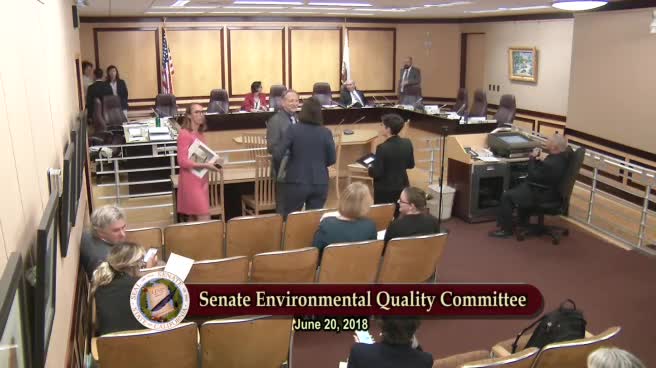 10MIN
Senate Standing Committee on Environmental Quality
Bill Author