SB 1026: Department of Fish and Wildlife: lake or streambed alteration agreements.
- Session Year: 2015-2016
- House: Senate
- Latest Version Date: 2016-02-12
Existing law prohibits an entity from substantially diverting or obstructing the natural flow of, or substantially changing or using any material from the bed, channel, or bank of, any river, stream, or lake, or from depositing certain material where it may pass into any river, stream, or lake, without first notifying the Department of Fish and Wildlife of that activity, and entering into a lake or streambed alteration agreement if required by the department to protect fish and wildlife resources.
This bill would limit the diversions and obstructions governed by these alteration agreement requirements to the diversions and obstructions that alter the bed, channel, or bank of a river, stream, or lake. The bill would exempt routine maintenance and repair of facilities for instream agricultural diversions from the alteration agreement requirements.
(a)An entity may shall not substantially divert or obstruct alter the bed, channel, or bank of any river, stream, or lake in a manner that diverts or obstructs the natural flow of, or of the river, stream, or lake, substantially change or use any material from the bed, channel, or bank of, of any river, stream, or lake, or deposit or dispose of debris, waste, or other material containing crumbled, flaked, or ground pavement where it may pass into any river, stream, or lake, unless all of the following occur:
(1)The department receives written notification regarding the activity in the manner prescribed by the department. The notification shall include, but is not limited to, all of the following:
(A)A detailed description of the projects location and a map.
(B)The name, if any, of the river, stream, or lake affected.
(C)A detailed project description, including, but not limited to, construction plans and drawings, if applicable.
(D)A copy of any document prepared pursuant to Division 13 (commencing with Section 21000) of the Public Resources Code.
(E)A copy of any other applicable local, state, or federal permit or agreement already issued.
(F)Any other information required by the department.
(2)The department determines the notification is complete in accordance with Chapter 4.5 (commencing with Section 65920) of Division 1 of Title 7 of the Government Code, irrespective of whether the activity constitutes a development project for the purposes of that chapter.
(3)The entity pays the applicable fees, pursuant to Section 1609.
(4)One of the following occurs:
(A)
(i)
(A)(i)The department informs the entity, in writing, that the activity will not substantially adversely affect an existing fish or wildlife resource, and that the entity may commence the activity without an agreement, if the entity conducts the activity as described in the notification, including any measures in the notification that are intended to protect fish and wildlife resources.
(ii)Each region of the department shall log the notifications of activities where no agreement is required. The log shall list the date the notification was received by the department, a brief description of the proposed activity, and the location of the activity. Each item shall remain on the log for one year. Upon written request by any person, a regional office shall send the log to that person monthly for one year. A request made pursuant to this clause may be renewed annually.
(B)The department determines that the activity may substantially adversely affect an existing fish or wildlife resource and issues a final agreement to the entity that includes reasonable measures necessary to protect the resource, and the entity conducts the activity in accordance with the agreement.
(C)A panel of arbitrators issues a final agreement to the entity in accordance with subdivision (b) of Section 1603, and the entity conducts the activity in accordance with the agreement.
(D)The department does not issue a draft agreement to the entity within 60 days from the date notification is complete, and the entity conducts the activity as described in the notification, including any measures in the notification that are intended to protect fish and wildlife resources.
(b)(1)If an activity involves the routine maintenance and operation of water supply, drainage, flood control, or waste treatment and disposal facilities, notice to and agreement with the department shall not be required after the initial notification and agreement, unless the department determines either of the following:
(A)The work described in the agreement has substantially changed.
(B)Conditions affecting fish and wildlife resources have substantially changed, and those resources are adversely affected by the activity conducted under the agreement.
(2)This subdivision applies only if notice to, and agreement with, the department was attained prior to January 1, 1977, and the department has been provided a copy of the agreement or other proof of the existence of the agreement that satisfies the department, if requested.
(c)This section does not apply to the routine maintenance and repair of facilities for instream agricultural irrigation diversions.
(c)
(d)It is unlawful for any person to violate this chapter.
|
Date
|
Status
|
|---|---|
| Feb 12, 2016 | Introduced. Read first time. To Com. on RLS. for assignment. To print. |
| Feb 16, 2016 | From printer. May be acted upon on or after March 17. |
| Feb 25, 2016 | Referred to Com. on N.R. & W. |
| Mar 24, 2016 | Set for hearing April 12. |
| Apr 12, 2016 | April 12 set for first hearing. Failed passage in committee. (Ayes 3. Noes 4. Page 3495.) |
| Apr 12, 2016 | April 12 set for first hearing. Failed passage in committee. (Ayes 3. Noes 4.) |
|
Date
|
Description
|
Location
|
Votes
|
|
|---|---|---|---|---|
| Apr 12, 2016 | Do pass, but first be re-referred to the Committee on [Appropriations] | Senate Standing Committee on Natural Resources and Water |
Failed |
This list shows positions taken on this bill by organizations on the date displayed, which is linked to the original source.
Positions by individuals are not included.
|
Organization
|
Position
|
Date
|
|---|---|---|
| California Cattlemen'S Association | ** Support | Apr 12, 2016 |
| California Central Valley Flood Control Association | ** Support | Apr 12, 2016 |
| California Farm Bureau | ** Support | Apr 12, 2016 |
| Defenders Of Wildlife | * Against | Apr 12, 2016 |
| Gorrill Ranch | * Support | Apr 12, 2016 |
| Reed Government Relations | * Support | Apr 12, 2016 |
| San Gabriel Basin Water Quality Authority | * Against | Apr 12, 2016 |
SENATE COMMITTEE ON NATURAL RESOURCES AND WATER
Senator Fran Pavley, Chair
2015 - 2016 Regular
Bill No: SB Hearing Date: April 12, 2016
Author: | Nielsen | ||
Version: | February 12, 2016 | ||
Urgency: | No | Fiscal: | Yes |
Consultant: | William Craven | ||
Subject: Department of Fish and Wildlife: lake or streambed alteration agreements
BACKGROUND AND EXISTING LAW
- Fish and Game Code.
California has numerous state laws designed to protect fish and wildlife. This bill would affect Fish and Game Code Section 1602 which is commonly referred to as one part of the “streambed alteration” statute which begins at Section 1600. It contains the provisions relating to permits for streambed and lake agreements that, when issued, determine the extent to which a planned activity within a stream or river may adversely affect fish or wildlife or habitat and what off-setting mitigation may be required. In the absence of a permit, the section states that an entity may not substantially divert or obstruct the natural flow of stream or deposit or dispose of material. Existing law requires the entity to notify the Department of Fish and Wildlife (DFW) which triggers the negotiation of the standards that may apply to the request. At that point the entity and DFW enter into a streambed alteration agreement (SAA) that contains any necessary provisions to mitigate the planned activity’s potentially adverse consequences.
This law was enacted first in 1970, reenacted in 1976, and amended in 2003, but the purpose of the law has never changed. The law declares “the protection and conservation of the fish and wildlife resources of this state are of utmost public interest. Fish and wildlife are the property of the people and provide a major contribution to the economy of the state, as well as providing a significant part of the people’s food supply; therefore their conservation is a proper responsibility of the state.”
A permit fee is required, and the law provides for binding arbitration in the event of a disagreement.
Existing law and determinations made by DFW do not require physical alteration of a streambed for the permitting provisions to apply, although that was contested in recent and unsuccessful litigation brought by the Siskiyou County Farm Bureau and which this bill seeks to address.
Specifically, section 1602 prohibits, in relevant part, those diversions that substantially divert or obstruct the natural flow of the river in the absence of the permit described earlier.
The section does not apply to the routine maintenance and operation of water supply, drainage, flood control, or waste treatment and disposal facilities except when the work described in the SAA has substantially changed, or the conditions affecting fish and wildlife resources have substantially changed.
- Water Law.
Water use by those with appropriative or riparian rights is limited by the “reasonable use” doctrine which forbids the waste of water or its unreasonable use. In addition, the public trust doctrine vests the state with sovereign authority over all navigable waterways.
Although the term “water rights” is often rhetorically discussed as an absolute concept of ownership, the water in California is in fact owned by the people of California. Water Code Section 102. The right to use water may be acquired in the manner provided by law.
The "public trust doctrine" requires the state, as a trustee, to manage its public trust resources (including wildlife and water) to derive the maximum benefit for its citizenry. The benefits to be considered and balanced include economic, recreational, aesthetic and environmental; if at any time the trustee determines that a use of water other than the then current use would better serve the public trust, the state has the power and the obligation to reallocate that water in accordance with the public's interest. Even if the water at issue has been put to beneficial use (and relied upon) for decades, it
can be taken from one user in favor of another need or use. The public trust doctrine therefore means that no water rights in California are truly "vested" in the traditional sense of property rights. Sawyer, Primer on California Water Law, 10.
In all contexts, what constitutes a reasonable use of water depends on many factors and often involve “statewide considerations of transcendent importance.” These statewide considerations, as defined in court decisions and the state constitution, are that ‘limited water resources be put only to those beneficial uses “to the fullest extent of which they are capable,” that “waste or unreasonable use” be prevented, and that conservation be exercised “in the interest of the people and for the public welfare.”
PROPOSED LAW
This bill limits and re-defines the threshold for a streambed alteration agreement to require substantial alterations of the “bed, channel, or bank” of any river or stream. It also adds an exemption to section 1602 of the Fish and Game Code that would apply to “routine maintenance and repair of facilities for instream agricultural irrigation diversions.”
ARGUMENTS IN SUPPORT
According to the author, the original intent of section 1602 was limited to large construction projects and mining operations that could substantially alter a streambed or channel and thereby physically divert the flow of a river or stream. The author argues that in 2005 DFW expanded its interpretation of the section to require agricultural water right owners to obtain permit for extracting water in routine and ongoing operations. In addition to the burdensome nature of the permitting process, the author predicts that in low water years, permits will not be issued.
The California Central Valley Flood Control Association is particularly supportive of the provision regarding routine maintenance and repair of diversion facilities not being subject to a SAA. The group believes that the potential threat to streams or fisheries from routine maintenance and repair of facilities is very low, especially when best management practices could be developed and used.
The California Cattlemen’s Association agrees with the author regarding the original purpose of the Section 1600 permits, and is concerned about the burden on farmers and ranchers. It also says that DFW is now expanding the scope of the permits into certain floodplains. It is concerned that the new regulations of the state water board to require all diversions greater than 10 acre-feet to monitor and report water use within statutory parameters could also trigger the need for Section 1600 permits unless this bill is passed.
The California Farm Bureau states that farmers and ranchers should not be required to obtain 1600 agreements “simply to open a headgate and exercise their existing water right to irrigate their crops or pastures.”
ARGUMENTS IN OPPOSITION
None received.
COMMENTS
- The policy arguments in support advanced by the author were considered and rejected in a unanimous, published Court of Appeal decision in 2015. Siskiyou Farm Bureau v. Department of Fish and Wildlife.
The court disposed of the arguments as follows:
- The word “divert” clearly and without ambiguity includes diversions that do not alter the streambed itself. A diversion can and does mean a diversion of water, whether or not the streambed or channel is physically altered. It rejected all of the Farm Bureau arguments that questioned that conclusion. The court did point out that the Legislature created the statutory balance that is currently in effect, and theoretically could alter that balance. However, the court noted that such a step could risk the de-watering of streams that provide important fish habitat, especially in drought years.
- The court did not accept the Farm Bureau view that DFW abruptly changed its policy and began enforcing Section 1602 in a way that it had never done before. However, even if DFW had not enforced 1602 in such a way previously, the statute does not preclude it from doing so “in the face of extreme drought and piscatorial peril.” DFW has the legal authority to prevent “substantial dewatering of streams absent physical alteration to the streambeds.”
- Whether a diversion is substantial depends on a number of factors “including the amount of water taken relative to the supply, the use to which the water is applied, the historical usage by the diverter, and the needs of the fish, given the palpable fact that—due to yet another in a series of recurring drought conditions in California—there simply is not enough water to satisfy all legitimate needs.”
- The water law considerations that were recited earlier came from this decision.
- The court rejected the Farm Bureau position that the use of this statute casts DFW as another arbiter of water rights, usurping authority from the State Water Board. That argument was opposed in court by the State Water Board itself and the court pointed out that the section does not blur the lines of authority between the two agencies.
- In its conclusion, the court cited Dr. Seuss for the proposition that the existing statute is not ambiguous and that the Legislature created the statutory balance knowing exactly what the words mean—“I meant what I said and I said what I meant,” Dr. Seuss wrote in Horton Hatches the Egg.
- It is worth noting that the one of the important fish species that is at risk in Siskiyou County when streams are inadequate to provide habitat is Coho salmon. In 2005, the coho salmon was listed as threatened under the California Endangered Species Act.
The National Marine Fisheries Service has divided West Coast coho into six evolutionary significant units, including the South Oregon/Northern California Coasts (SONCC), which is comprised of 41 populations. Once numbering 150,000 to 400,000 naturally spawning fish in the mid-twentieth century, populations have declined to a mere 10,000. In light of this trend, the U.S. government in 1997 listed the SONCC coho unit as endangered under the federal Endangered Species Act. (Note: The overall Coho population has declined further since this report was published in 2012.)
It is a threatened species under California law.
Coho runs in particular will likely continue to be extremely low because of warm oceans which is a lingering effect of the warm North Pacific “Blob” and this year’s El Niño weather system, and what appears to be an ongoing, but less severe drought, notwithstanding the rains of 2016.
The overall picture of coho salmon in California is one of severely depleted populations. The main factors and threats affecting population viability of coho salmon, as listed in the DFW Recovery Strategy, have not changed substantially over several decades: That document states: “The ongoing population declines are thought to be largely attributable to human causes, such as water diversions, stream flow regulation, forestry and man-made barriers affecting migration. Of particular concern is the loss and degradation of suitable freshwater and estuarine habitat conditions for juvenile rearing and adult reproduction (emphasis added).
That report continues: “However, in recent years, the primary causes of population decline have been compounded by natural environmental factors, specifically poor ocean conditions in 2005 and 2006, which led to low adult survival in the marine environment and poor returns in both 2006-07 and 2007-08. In addition, recent ongoing drought conditions have further hampered population recovery through the adverse effects of low flow conditions on adult spawning and juvenile survival in coastal watersheds.”
Many observers believe that northern California Coho salmon are at great risk of extinction within several decades if the current rate of decline continues.
Since 1986, DFW, through its Fisheries Restoration Grant Program, has spent $250 million on 433 projects in northern California to benefit Coho salmon. Of that, more than $100 million has been spent since 2004.
- Staff suggested to the author’s staff and the representative of the California Central Valley Flood Control Association that a conversation with DFW about routine maintenance of facilities and the best management practices that might be developed may be useful. Existing law has a current exemption for routine maintenance and operation of water supply, drainage, flood control, or waste treatment and disposal facilities following notification to the department unless the work or conditions affecting fish and wildlife resources have substantially changes and those resources are adversely affected by the activity under the agreement. Such a conversation to see if things can be worked out should occur prior to legislation on an additional exemption for the routine maintenance and repair of facilities of instream agricultural irrigation diversions as proposed in this bill.
SUPPORT
California Central Valley Flood Control Association
California Cattlemen’s Association
California Farm Bureau
OPPOSITION
None Received
-- END --
Discussed in Hearing
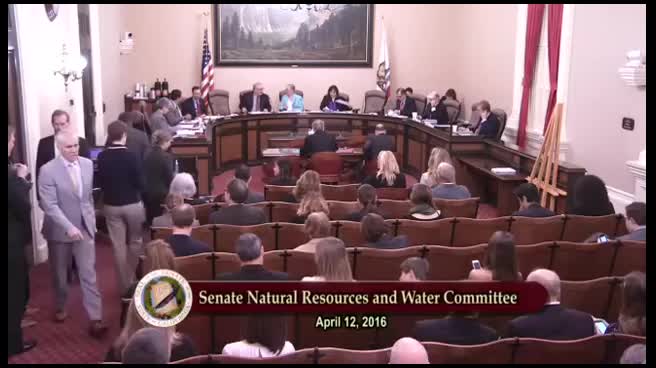 33MIN
Senate Standing Committee on Natural Resources and Water
Bill Author

Bill Co-Author(s):