SB 32: California Global Warming Solutions Act of 2006: emissions limit.
- Session Year: 2015-2016
- House: Senate
- Latest Version Date: 2016-09-08
(1)The California Global Warming Solutions Act of 2006 designates the State Air Resources Board as the state agency charged with monitoring and regulating sources of emissions of greenhouse gases. The state board is required to approve a statewide greenhouse gas emissions limit equivalent to the statewide greenhouse gas emissions level in 1990 to be achieved by 2020 and to adopt rules and regulations in an open public process to achieve the maximum, technologically feasible, and cost-effective greenhouse gas emissions reductions.
This bill would require the state board to ensure that statewide greenhouse gas emissions are reduced to 40% below the 1990 level by 2030.
(2)This bill would become operative only if AB 197 of the 201516 Regular Session is enacted and becomes effective on or before January 1, 2017.
(1)The California Global Warming Solutions Act of 2006 designates the State Air Resources Board as the state agency charged with monitoring and regulating sources of emissions of greenhouse gases. The state board is required to approve a statewide greenhouse gas emissions limit equivalent to the statewide greenhouse gas emissions level in 1990 to be achieved by 2020 and to adopt rules and regulations in an open public process to achieve the maximum, technologically feasible, and cost-effective greenhouse gas emissions reductions.
This bill would require the state board to ensure that statewide greenhouse gas emissions are reduced to 40% below the 1990 level by 2030.
The California Global Warming Solutions Act of 2006 designates the State Air Resources Board as the state agency charged with monitoring and regulating sources of emissions of greenhouse gases. The state board is required to approve a statewide greenhouse gas emissions limit equivalent to the statewide greenhouse gas emissions level in 1990 to be achieved by 2020 and to adopt rules and regulations in an open public process to achieve the maximum, technologically feasible, and cost-effective greenhouse gas emissions reductions.
This bill would require the state board to approve a statewide greenhouse gas emissions limit that is equivalent to 40% below the 1990 level to be achieved by 2030. The bill would also require the state board, on or before January 1, 2018, and each year thereafter, to prepare and submit to the Joint Legislative Budget Committee and appropriate policy committees a report relating to the greenhouse gas emissions reductions achieved toward those limits.
This bill also would make conforming changes and provide that its provisions are severable.
This
(2)This bill would become operative only if AB 197 of the 201516 Regular Session is enacted and becomes effective on or before January 1, 2017.
The California Global Warming Solutions Act of 2006 designates the State Air Resources Board as the state agency charged with monitoring and regulating sources of emissions of greenhouse gases. The state board is required to adopt approve a statewide greenhouse gas emissions limit equivalent to the statewide greenhouse gas emissions level in 1990 to be achieved by 2020 and to adopt rules and regulations in an open public process to achieve the maximum, technologically feasible, and cost-effective greenhouse gas emissions reductions.
This bill would require the state board to approve a statewide greenhouse gas emissions limit that is equivalent to 40% below the 1990 level to be achieved by 2030. The bill would also require the state board, on or before January 1, 2018, and each year thereafter, to prepare and submit to the Joint Legislative Budget Committee and appropriate policy committees a report relating to the greenhouse gas emissions reductions achieved toward those limits.
This bill also would make conforming changes and provide that its provisions are severable.
This bill would become operative only if AB 197 of the 201516 Regular Session is enacted and becomes effective on or before January 1, 2017.
(1)The
The California Global Warming Solutions Act of 2006 designates the State Air Resources Board as the state agency charged with monitoring and regulating sources of emissions of greenhouse gases. The state board is required to adopt a statewide greenhouse gas emissions limit equivalent to the statewide greenhouse gas emissions level in 1990 to be achieved by 2020 and to adopt rules and regulations in an open public process to achieve the maximum, technologically feasible, and cost-effective greenhouse gas emissions reductions.
This bill would require the state board to approve a statewide greenhouse gas emissions limit that is equivalent to 40% below the 1990 level to be achieved by 2030. The bill also would state the intent of the Legislature for the Legislature and appropriate agencies to adopt complementary policies that ensure the long-term emissions reductions advance specified criteria.
(2)The California Global Warming Solutions Act of 2006 requires the State Air Resources Board to prepare and approve a scoping plan for achieving the maximum technologically feasible and cost-effective reductions in greenhouse gas emissions and to update the scoping plan at least once every 5 years.
This bill would prohibit the state board from taking any action to implement the next update of the scoping plan until a draft of, and the final version of, the next update to the scoping plan have been submitted to the Joint Legislative Budget Committee and the appropriate policy committees of the Legislature, as specified, before adoption of the updated scoping plan and until the state board has conducted specified evaluations relating to reducing greenhouse gas emissions. The bill would require the Legislature to hold at least one oversight hearing to review that draft and one oversight hearing to review the final version. The bill would require the state board, on or before January 1, 2017, and each year thereafter, to prepare and submit to the Joint Legislative Budget Committee and appropriate policy committees a report relating to achieving the greenhouse gas emissions limits required by the California Global Warming Solutions Act of 2006. The bill would require the Office of Environmental Health Hazard Assessment, on or before July 1, 2017, to prepare and make available to the public and the Legislature a report analyzing the impacts of the greenhouse gas emissions limits adopted by the state board on disadvantaged communities, as specified.
(3)This bill would also
This bill also would make conforming changes and would provide that its provisions are severable.
(1)The California Global Warming Solutions Act of 2006 designates the State Air Resources Board as the state agency charged with monitoring and regulating sources of emissions of greenhouse gases. The state board is required to adopt a statewide greenhouse gas emissions limit equivalent to the statewide greenhouse gas emissions level in 1990 to be achieved by 2020 and to adopt rules and regulations in an open public process to achieve the maximum, technologically feasible, and cost-effective greenhouse gas emissions reductions.
This bill would require the state board to approve a statewide greenhouse gas emissions limits that are the limit that is equivalent to 40% below the 1990 level to be achieved by 2030 and 80% below the 1990 level to be achieved by 2050, as specified. The bill would authorize the state board to approve an interim greenhouse gas emissions level target to be achieved by 2040. 2030. The bill also would state the intent of the Legislature for the Legislature and appropriate agencies to adopt complementary policies that ensure the long-term emissions reductions advance specified criteria.
(2)The California Global Warming Solutions Act of 2006 requires the State Air Resources Board to prepare and approve a scoping plan for achieving the maximum technologically feasible and cost-effective reductions in greenhouse gas emissions and to update the scoping plan at least once every 5 years.
This bill would prohibit the state board from taking any action to implement the next update of the scoping plan until a draft of, and the final version of, the next update to the scoping plan have been submitted to the Joint Legislative Budget Committee and the appropriate policy committees of the Legislature, as specified, before adoption of the updated scoping plan and until the state board has conducted specified evaluations relating to reducing greenhouse gas emissions. The bill would require the Legislature to hold at least one oversight hearing to review that draft and one oversight hearing to review the final version. The bill would require the state board, on or before January 1, 2017, and each year thereafter, to prepare and submit to the Joint Legislative Budget Committee and appropriate policy committees a report relating to achieving the greenhouse gas emissions limits required by the California Global Warming Solutions Act of 2006. The bill would require the Office of Environmental Health Hazard Assessment, on or before July 1, 2017, to prepare and make available to the public and the Legislature a report analyzing the impacts of the greenhouse gas emissions limits adopted by the state board on disadvantaged communities, as specified.
(3)This bill would also make conforming changes and would provide that its provisions are severable.
(1)The California Global Warming Solutions Act of 2006 designates the State Air Resources Board as the state agency charged with monitoring and regulating sources of emissions of greenhouse gases. The state board is required to adopt a statewide greenhouse gas emissions limit equivalent to the statewide greenhouse gas emissions level in 1990 to be achieved by 2020 and to adopt rules and regulations in an open public process to achieve the maximum, technologically feasible, and cost-effective greenhouse gas emissions reductions.
This bill would require the state board to approve statewide greenhouse gas emissions limits that are the equivalent to 40% below the 1990 level to be achieved by 2030 and 80% below the 1990 level to be achieved by 2050, as specified. The bill would authorize the state board to approve an interim greenhouse gas emissions level target to be achieved by 2040. The bill also would state the intent of the Legislature for the Legislature and appropriate agencies to adopt complementary policies that ensure the long-term emissions reductions advance specified criteria.
(2)The California Global Warming Solutions Act of 2006 requires the State Air Resources Board to prepare and approve a scoping plan for achieving the maximum technologically feasible and cost-effective reductions in greenhouse gas emissions and to update the scoping plan at least once every 5 years.
This bill would prohibit the state board from taking any action to implement the next update of the scoping plan until a draft of, and the final version of, the next update to the scoping plan have been submitted to the Joint Legislative Budget Committee and the appropriate policy committees of the Legislature, at least one year and at least 60 days, respectively, as specified, before adoption of the updated scoping plan and until the state board has conducted specified evaluations relating to reducing greenhouse gas emissions. The bill would require the Legislature to hold at least one oversight hearing to review that draft and one oversight hearing to review the final version. The bill would require the state board, on or before January 1, 2017, and each year thereafter, to prepare and submit to the Joint Legislative Budget Committee and appropriate policy committees a report relating to achieving the greenhouse gas emissions limits required by the California Global Warming Solutions Act of 2006. The bill would require the Office of Environmental Health Hazard Assessment, on or before July 1, 2017, to prepare and make available to the public and the Legislature a report analyzing the impacts of the greenhouse gas emissions limits adopted by the state board on disadvantaged communities, as specified.
(3)This bill would also make conforming changes. changes and would provide that its provisions are severable.
The
(1)The California Global Warming Solutions Act of 2006 designates the State Air Resources Board as the state agency charged with monitoring and regulating sources of emissions of greenhouse gases. The state board is required to adopt a statewide greenhouse gas emissions limit equivalent to the statewide greenhouse gas emissions level in 1990 to be achieved by 2020 and to adopt rules and regulations in an open public process to achieve the maximum, technologically feasible, and cost-effective greenhouse gas emissions reductions.
This bill would require the state board to approve statewide greenhouse gas emissions limits that are the equivalent to 40% below the 1990 level to be achieved by 2030 and 80% below the 1990 level to be achieved by 2050, as specified. The bill would authorize the state board to adopt approve an interim greenhouse gas emissions level target to be achieved by 2040. The bill also would state the intent of the Legislature for the Legislature and appropriate agencies to adopt complementary policies that ensure the long-term emissions reductions advance specified criteria. The bill would make conforming changes.
(2)The California Global Warming Solutions Act of 2006 requires the State Air Resources Board to prepare and approve a scoping plan for achieving the maximum technologically feasible and cost-effective reductions in greenhouse gas emissions and to update the scoping plan at least once every 5 years.
This bill would prohibit the state board from taking any action to implement the next update of the scoping plan until a draft of, and the final version of, the next update to the scoping plan have been submitted to the Joint Legislative Budget Committee and the appropriate policy committees of the Legislature, at least one year and at least 60 days, respectively, before adoption of the updated scoping plan and until the state board has conducted specified evaluations relating to reducing greenhouse gas emissions. The bill would require the Legislature to hold at least one oversight hearing to review that draft and one oversight hearing to review the final version. The bill would require the state board, on or before January 1, 2017, and each year thereafter, to prepare and submit to the Joint Legislative Budget Committee and appropriate policy committees a report relating to achieving the greenhouse gas emissions limits required by the California Global Warming Solutions Act of 2006.
(3)This bill would also make conforming changes.
The California Global Warming Solutions Act of 2006 designates the State Air Resources Board as the state agency charged with monitoring and regulating sources of emissions of greenhouse gases. The state board is required to adopt a statewide greenhouse gas emissions limit equivalent to the statewide greenhouse gas emissions level in 1990 to be achieved by 2020 and to adopt rules and regulations in an open public process to achieve the maximum, technologically feasible, and cost-effective greenhouse gas emissions reductions.
This bill would require the state board to approve a statewide greenhouse gas emissions limit that is equivalent to limits that are the equivalent to 40% below the 1990 level to be achieved by 2030 and 80% below the 1990 level to be achieved by 2050, as specified. The bill would authorize the state board to adopt an interim greenhouse gas emissions level targets target to be achieved by 2030 and 2040. The bill also would state the intent of the Legislature for the Legislature and appropriate agencies to adopt complementary policies that ensure the long-term emissions reductions advance specified criteria. The bill would make conforming changes.
The California Global Warming Solutions Act of 2006 designates the State Air Resources Board as the state agency charged with monitoring and regulating sources of emissions of greenhouse gases. The state board is required to adopt a statewide greenhouse gas emissions limit equivalent to the statewide greenhouse gas emissions level in 1990 to be achieved by 2020 and to adopt rules and regulations in an open public process to achieve the maximum, technologically feasible, and cost-effective greenhouse gas emissions reductions.
This bill would require the state board to approve a statewide greenhouse gas emissions limit that is equivalent to 80% below the 1990 level to be achieved by 2050, as specified. The bill would authorize the state board to adopt interim greenhouse gas emissions level targets to be achieved by 2030 and 2040. The bill also would state the intent of the Legislature for the Legislature and appropriate agencies to adopt complementary policies that ensure the long-term emissions reductions advance specified criteria. The bill would make conforming changes.
The California Global Warming Solutions Act of 2006 designates the State Air Resources Board as the state agency charged with monitoring and regulating sources of emissions of greenhouse gases. The state board is required to adopt a statewide greenhouse gas emissions limit equivalent to the statewide greenhouse gas emissions level in 1990 to be achieved by 2020 and to adopt rules and regulations in an open public process to achieve the maximum, technologically feasible, and cost-effective greenhouse gas emissions reductions.
This bill would require the state board to approve a statewide greenhouse gas emission emissions limit that is equivalent to 80% below the 1990 level to be achieved by 2050, as specified. The bill would authorize the state board to adopt interim greenhouse gas emissions level targets to be achieved by 2030 and 2040. The bill also would state the intent of the Legislature for the Legislature and appropriate agencies to adopt complementary policies that ensure the long-term emissions reductions advance specified criteria.
The California Global Warming Solutions Act of 2006 designates the State Air Resources Board as the state agency charged with monitoring and regulating sources of emissions of greenhouse gases. The state board is required to adopt a statewide greenhouse gas emissions limit equivalent to the statewide greenhouse gas emissions level in 1990 to be achieved by 2020 and to adopt rules and regulations in an open public process to achieve the maximum, technologically feasible, and cost-effective greenhouse gas emissions reductions.
This bill would require the state board to approve a statewide greenhouse gas emission limit that is equivalent to 80% below the 1990 level to be achieved by 2050, as specified. The bill would authorize the state board to adopt interim greenhouse gas emissions level targets to be achieved by 2030 and 2040. The bill also would state the intent of the Legislature for the Legislature and appropriate agencies to adopt complementary policies that ensure long-term emissions reductions advance specified criteria.
The Legislature finds and declares all of the following:
(a)The California Global Warming Solutions Act of 2006 (Division 25.5 (commencing with Section 38500) of the Health and Safety Code) authorizes the State Air Resources Board to adopt regulations to achieve the maximum technologically feasible and cost-effective greenhouse gas emissions reductions.
(b)The California Global Warming Solutions Act of 2006 (Division 25.5 (commencing with Section 38500) of the Health and Safety Code) requires the State Air Resources Board to reduce statewide emissions of greenhouse gases to at least the 1990 emissions level by 2020 and to maintain and continue reductions thereafter.
(c)Continuing to reduce greenhouse gas emissions is critical for the protection of all areas of the state, but especially for the states most disadvantaged communities, as those communities are affected first, and, most frequently, by the adverse impacts of climate change, including an increased frequency of extreme weather events, such as drought, heat, and flooding. The states most disadvantaged communities also are disproportionately impacted by the deleterious effects of climate change on public health.
(d)The State Air Resources Board shall achieve the states more stringent greenhouse gas emission reductions in a manner that benefits the states most disadvantaged communities and is transparent and accountable to the public and the Legislature.
SEC. 2.Section 38566 is added to the Health and Safety Code, to read:38566.In adopting rules and regulations to achieve the maximum technologically feasible and cost-effective greenhouse gas emissions reductions authorized by this division, the state board shall ensure that statewide greenhouse gas emissions are reduced to at least 40 percent below the statewide greenhouse gas emissions limit no later than December 31, 2030.
SEC. 3.This act shall become operative only if Assembly Bill 197 of the 201516 Regular Session is enacted and becomes effective on or before January 1, 2017.
SECTION 1.It is the intent of the Legislature that all relevant provisions of the California Global Warming Solutions Act of 2006 (Division 25.5 (commencing with Section 38500) of the Health and Safety Code) apply to the sections of this act amending sections within the California Global Warming Solutions Act of 2006 (Division 25.5 (commencing with Section 38500) of the Health and Safety Code).
SEC. 2.Section 38505 of the Health and Safety Code is amended to read:38505.For purposes of this division, the following terms have the following meanings:
(a)Allowance means an authorization to emit, during a specified year, up to one ton of carbon dioxide equivalent.
(b)Alternative compliance mechanism means an action undertaken by a greenhouse gas emission source that achieves the equivalent reduction of greenhouse gas emissions over the same time period as a direct emission reduction, and that is approved by the state board. Alternative compliance mechanism includes, but is not limited to, a flexible compliance schedule, alternative control technology, a process change, or a product substitution.
(c)Carbon dioxide equivalent means the amount of carbon dioxide by weight that would produce the same global warming impact as a given weight of another greenhouse gas, based on the best available science, including from the Intergovernmental Panel on Climate Change.
(d)Cost-effective or cost-effectiveness means the cost per unit of reduced emissions of greenhouse gases adjusted for its global warming potential.
(e)Direct emission reduction means a greenhouse gas emission reduction action made by a greenhouse gas emission source at that source.
(f)Emissions reduction measure means programs, measures, standards, and alternative compliance mechanisms authorized pursuant to this division, applicable to sources or categories of sources, that are designed to reduce emissions of greenhouse gases.
(g)Greenhouse gas or greenhouse gases includes all of the following gases:
(1)Carbon dioxide.
(2)Methane.
(3)Nitrous oxide.
(4)Hydrofluorocarbons.
(5)Perfluorocarbons.
(6)Sulfur hexafluoride.
(7)Nitrogen trifluoride.
(h)Greenhouse gas emissions limit means an authorization, during a specified year, to emit up to a level of greenhouse gases specified by the state board, expressed in tons of carbon dioxide equivalents.
(i)Greenhouse gas emission source or source means any source, or category of sources, of greenhouse gas emissions whose emissions are at a level of significance, as determined by the state board, that its participation in the program established under this division will enable the state board to effectively reduce greenhouse gas emissions and monitor compliance with the statewide greenhouse gas emissions limit.
(j)Leakage means a reduction in emissions of greenhouse gases within the state that is offset by an increase in emissions of greenhouse gases outside the state.
(k)Market-based compliance mechanism means either of the following:
(1)A system of market-based declining annual aggregate emissions limitations for sources or categories of sources that emit greenhouse gases.
(2)Greenhouse gas emissions exchanges, banking, credits, and other transactions, governed by rules and protocols established by the state board, that result in the same greenhouse gas emission reduction, over the same time period, as direct compliance with a greenhouse gas emission limit or emissions reduction measure adopted by the state board pursuant to this division.
(l)State board means the State Air Resources Board.
(m)Statewide greenhouse gas emissions means the total annual emissions of greenhouse gases in the state, including all emissions of greenhouse gases from the generation of electricity delivered to and consumed in California, accounting for transmission and distribution line losses, whether the electricity is generated in state or imported. Statewide emissions shall be expressed in tons of carbon dioxide equivalents.
(n)Statewide greenhouse gas emissions limit or statewide emissions limit means the maximum allowable level of statewide greenhouse gas emissions, as determined by the state board pursuant to Part 3 (commencing with Section 38550).
SEC. 3.Section 38550 of the Health and Safety Code is amended to read:38550.(a)By January 1, 2008, the state board shall, after one or more public workshops, with public notice, and an opportunity for all interested parties to comment, determine what the statewide greenhouse gas emissions level was in 1990, and approve in a public hearing, a statewide greenhouse gas emissions limit that is equivalent to that level, to be achieved by 2020. In order to ensure the most accurate determination feasible, the state board shall evaluate the best available scientific, technological, and economic information on greenhouse gas emissions to determine the 1990 level of greenhouse gas emissions.
(b)(1)Notwithstanding subdivision (a), the state board shall approve in a public hearing, based on the best available scientific, technological, and economic assessments, a statewide greenhouse gas emissions limit that is equivalent to 40 percent below the 1990 level, as determined pursuant to subdivision (a) or Section 39730, to be achieved by 2030.
(2)For the purposes of this subdivision, a greenhouse gas emissions limit shall include short-lived climate pollutants, as defined in Section 39730.
(c)In furtherance of subdivision (b), the state board shall consider historic efforts to reduce greenhouse gas emissions and objectively seek and account for cost-effective actions to reduce greenhouse gas emissions across all sectors.
(d)On or before January 1, 2018, and each year thereafter, the state board shall prepare and submit to the Joint Legislative Budget Committee and appropriate policy committees a report detailing the amounts, sources, and locations of greenhouse gas emissions reductions achieved toward the statewide emissions limits adopted pursuant to this section.
SEC. 4.Section 38551 of the Health and Safety Code is amended to read:38551.(a)Each of the statewide greenhouse gas emissions limits shall remain in effect unless otherwise amended or repealed.
(b)It is the intent of the Legislature that the statewide greenhouse gas emissions limits established pursuant to Section 38550 continue in existence and be used to maintain and continue reductions in emissions of greenhouse gases.
(c)The state board shall make recommendations to the Governor and the Legislature on how to continue reductions of greenhouse gas emissions beyond 2030.
SEC. 5.Section 38561 of the Health and Safety Code is amended to read:38561.(a)(1)On or before January 1, 2009, the state board shall prepare and approve a scoping plan, as that term is understood by the state board, for achieving the maximum technologically feasible and cost-effective reductions in greenhouse gas emissions from sources or categories of sources of greenhouse gases under this division.
(2)The state board shall consult with all state agencies with jurisdiction over sources of greenhouse gases, including the Public Utilities Commission and the State Energy Resources Conservation and Development Commission, on all elements of its plan that pertain to energy-related matters including, but not limited to, electrical generation, load-based standards or requirements, the provision of reliable and affordable electrical service, petroleum refining, and statewide fuel supplies to ensure the greenhouse gas emissions reduction activities to be adopted and implemented by the state board are complementary, nonduplicative, and can be implemented in an efficient and cost-effective manner.
(b)The plan shall identify and make recommendations on direct emissions reduction measures, alternative compliance mechanisms, market-based compliance mechanisms, and potential monetary and nonmonetary incentives for sources and categories of sources that the state board finds are necessary or desirable to facilitate the achievement of the maximum feasible and cost-effective reductions of greenhouse gas emissions under this division.
(c)In making the determinations required by subdivision (b), the state board shall consider all relevant information pertaining to greenhouse gas emissions reduction programs in other states, localities, and nations, including the northeastern states of the United States, Canada, and the European Union.
(d)The state board shall evaluate the total potential costs and total potential economic and noneconomic benefits of the plan for reducing greenhouse gases to Californias economy, environment, and public health, using the best available economic models, emission estimation techniques, and other scientific methods.
(e)In developing its plan, the state board shall take into account the relative contribution of each source or source category to statewide greenhouse gas emissions, and the potential for adverse effects on small businesses, and shall recommend a de minimis threshold of greenhouse gas emissions below which emissions reduction requirements will not apply.
(f)In developing its plan, the state board shall identify opportunities for emissions reduction measures from all verifiable and enforceable voluntary actions, including, but not limited to, carbon sequestration projects and best management practices.
(g)The state board shall conduct a series of public workshops to give interested parties an opportunity to comment on the plan. The state board shall conduct a portion of these workshops in regions of the state that have the most significant exposure to air pollutants, including, but not limited to, communities with minority populations, communities with low-income populations, or both.
(h)The state board shall update its plan for achieving the maximum technologically feasible and cost-effective reductions of greenhouse gas emissions at least once every five years.
SEC. 6.The provisions of this act are severable. If any provision of this act or its application is held invalid, that invalidity shall not affect other provisions or applications that can be given effect without the invalid provision or application.
SEC. 7.This act shall become operative only if Assembly Bill 197 of the 201516 Regular Session is enacted and becomes effective on or before January 1, 2017.
It is the intent of the Legislature that all relevant provisions of the California Global Warming Solutions Act of 2006 (Division 25.5 (commencing with Section 38500) of the Health and Safety Code) apply to the sections of this act amending sections within the California Global Warming Solutions Act of 2006 (Division 25.5 (commencing with Section 38500) of the Health and Safety Code).
SEC. 2.Section 38505 of the Health and Safety Code is amended to read:38505.For purposes of this division, the following terms have the following meanings:
(a)Allowance means an authorization to emit, during a specified year, up to one ton of carbon dioxide equivalent.
(b)Alternative compliance mechanism means an action undertaken by a greenhouse gas emission source that achieves the equivalent reduction of greenhouse gas emissions over the same time period as a direct emission reduction, and that is approved by the state board. Alternative compliance mechanism includes, but is not limited to, a flexible compliance schedule, alternative control technology, a process change, or a product substitution.
(c)Carbon dioxide equivalent means the amount of carbon dioxide by weight that would produce the same global warming impact as a given weight of another greenhouse gas, based on the best available science, including from the Intergovernmental Panel on Climate Change.
(d)Cost-effective or cost-effectiveness means the cost per unit of reduced emissions of greenhouse gases adjusted for its global warming potential.
(e)Direct emission reduction means a greenhouse gas emission reduction action made by a greenhouse gas emission source at that source.
(f)Emissions reduction measure means programs, measures, standards, and alternative compliance mechanisms authorized pursuant to this division, applicable to sources or categories of sources, that are designed to reduce emissions of greenhouse gases.
(g)Greenhouse gas or greenhouse gases includes all of the following gases:
(1)Carbon dioxide.
(2)Methane.
(3)Nitrous oxide.
(4)Hydrofluorocarbons.
(5)Perfluorocarbons.
(6)Sulfur hexafluoride.
(7)Nitrogen trifluoride.
(h)Greenhouse gas emissions limit means an authorization, during a specified year, to emit up to a level of greenhouse gases specified by the state board, expressed in tons of carbon dioxide equivalents.
(i)Greenhouse gas emission source or source means any source, or category of sources, of greenhouse gas emissions whose emissions are at a level of significance, as determined by the state board, that its participation in the program established under this division will enable the state board to effectively reduce greenhouse gas emissions and monitor compliance with the statewide greenhouse gas emissions limit.
(j)Leakage means a reduction in emissions of greenhouse gases within the state that is offset by an increase in emissions of greenhouse gases outside the state.
(k)Market-based compliance mechanism means either of the following:
(1)A system of market-based declining annual aggregate emissions limitations for sources or categories of sources that emit greenhouse gases.
(2)Greenhouse gas emissions exchanges, banking, credits, and other transactions, governed by rules and protocols established by the state board, that result in the same greenhouse gas emission reduction, over the same time period, as direct compliance with a greenhouse gas emission limit or emissions reduction measure adopted by the state board pursuant to this division.
(l)State board means the State Air Resources Board.
(m)Statewide greenhouse gas emissions means the total annual emissions of greenhouse gases in the state, including all emissions of greenhouse gases from the generation of electricity delivered to and consumed in California, accounting for transmission and distribution line losses, whether the electricity is generated in state or imported. Statewide emissions shall be expressed in tons of carbon dioxide equivalents.
(n)Statewide greenhouse gas emissions limit or statewide emissions limit means the maximum allowable level of statewide greenhouse gas emissions, as determined by the state board pursuant to Part 3 (commencing with Section 38550).
SEC. 3.Section 38550 of the Health and Safety Code is amended to read:38550.(a)By January 1, 2008, the state board shall, after one or more public workshops, with public notice, and an opportunity for all interested parties to comment, determine what the statewide greenhouse gas emissions level was in 1990, and approve in a public hearing, a statewide greenhouse gas emissions limit that is equivalent to that level, to be achieved by 2020. In order to ensure the most accurate determination feasible, the state board shall evaluate the best available scientific, technological, and economic information on greenhouse gas emissions to determine the 1990 level of greenhouse gas emissions.
(b)(1)Notwithstanding subdivision (a), the state board shall approve in a public hearing, based on the best available scientific, technological, and economic assessments, a statewide greenhouse gas emissions limit that is equivalent to 40 percent below the 1990 level, as determined pursuant to subdivision (a) or Section 39730, to be achieved by 2030.
(2)For the purposes of this subdivision, a greenhouse gas emissions limit shall include short-lived climate pollutants, as defined in Section 39730.
(c)In furtherance of subdivision (b), the state board shall consider historic efforts to reduce greenhouse gas emissions and objectively seek and account for cost-effective actions to reduce greenhouse gas emissions across all sectors.
(d)On or before January 1, 2018, and each year thereafter, the state board shall prepare and submit to the Joint Legislative Budget Committee and appropriate policy committees a report detailing the amounts, sources, and locations of greenhouse gas emissions reductions achieved toward the statewide emissions limits adopted pursuant to this section.
SEC. 4.Section 38551 of the Health and Safety Code is amended to read:38551.(a)Each of the statewide greenhouse gas emissions limits shall remain in effect unless otherwise amended or repealed.
(b)It is the intent of the Legislature that the statewide greenhouse gas emissions limits established pursuant to Section 38550 continue in existence and be used to maintain and continue reductions in emissions of greenhouse gases.
(c)The state board shall make recommendations to the Governor and the Legislature on how to continue reductions of greenhouse gas emissions beyond 2030.
SEC. 5.Section 38561 of the Health and Safety Code is amended to read:38561.(a)(1)On or before January 1, 2009, the state board shall prepare and approve a scoping plan, as that term is understood by the state board, for achieving the maximum technologically feasible and cost-effective reductions in greenhouse gas emissions from sources or categories of sources of greenhouse gases under this division.
(2)The state board shall consult with all state agencies with jurisdiction over sources of greenhouse gases, including the Public Utilities Commission and the State Energy Resources Conservation and Development Commission, on all elements of its plan that pertain to energy-related matters including, but not limited to, electrical generation, load-based standards or requirements, the provision of reliable and affordable electrical service, petroleum refining, and statewide fuel supplies to ensure the greenhouse gas emissions reduction activities to be adopted and implemented by the state board are complementary, nonduplicative, and can be implemented in an efficient and cost-effective manner.
(b)The plan shall identify and make recommendations on direct emissions reduction measures, alternative compliance mechanisms, market-based compliance mechanisms, and potential monetary and nonmonetary incentives for sources and categories of sources that the state board finds are necessary or desirable to facilitate the achievement of the maximum feasible and cost-effective reductions of greenhouse gas emissions under this division.
(c)In making the determinations required by subdivision (b), the state board shall consider all relevant information pertaining to greenhouse gas emissions reduction programs in other states, localities, and nations, including the northeastern states of the United States, Canada, and the European Union.
(d)The state board shall evaluate the total potential costs and total potential economic and noneconomic benefits of the plan for reducing greenhouse gases to Californias economy, environment, and public health, using the best available economic models, emission estimation techniques, and other scientific methods.
(e)In developing its plan, the state board shall take into account the relative contribution of each source or source category to statewide greenhouse gas emissions, and the potential for adverse effects on small businesses, and shall recommend a de minimis threshold of greenhouse gas emissions below which emissions reduction requirements will not apply.
(f)In developing its plan, the state board shall identify opportunities for emissions reduction measures from all verifiable and enforceable voluntary actions, including, but not limited to, carbon sequestration projects and best management practices.
(g)The state board shall conduct a series of public workshops to give interested parties an opportunity to comment on the plan. The state board shall conduct a portion of these workshops in regions of the state that have the most significant exposure to air pollutants, including, but not limited to, communities with minority populations, communities with low-income populations, or both.
(h)The state board shall update its plan for achieving the maximum technologically feasible and cost-effective reductions of greenhouse gas emissions at least once every five years.
SEC. 6.The provisions of this act are severable. If any provision of this act or its application is held invalid, that invalidity shall not affect other provisions or applications that can be given effect without the invalid provision or application.
SEC. 7.This act shall become operative only if Assembly Bill 197 of the 201516 Regular Session is enacted and becomes effective on or before January 1, 2017.
It is the intent of the Legislature that all relevant provisions of Division the California Global Warming Solutions Act of 2006 (Division 25.5 (commencing with Section 38500) of the Health and Safety Code Code) apply to the sections of this act amending sections within Division the California Global Warming Solutions Act of 2006 (Division 25.5 (commencing with Section 38500) of the Health and Safety Code. Code).
SEC. 2.Chapter 6 (commencing with Section 12897) is added to Part 2.5 of Division 3 of Title 2 of the Government Code, to read:6.Legislative Accountability and Oversight of California Greenhouse Gas Emissions Reduction Policies12897.(a)The Legislature finds and declares that developing regulations and policies by the State Air Resources Board or other state agencies for purposes of implementing Division 25.5 (commencing with Section 38500) of the Health and Safety Code should be conducted transparently and in a timely manner to afford the Legislature the opportunity to shape and oversee the implementation of that division on an ongoing basis.
(b)The purpose of this chapter is to establish new legislative oversight and accountability over any regulations and policies undertaken to implement Division 25.5 (commencing with Section 38500) of the Health and Safety Code.
12898.(a)The State Air Resources Board shall not take any action to implement the next update of the scoping plan described in Section 38561 of the Health and Safety Code unless all of the following have occurred:
(1)The State Air Resources Board has conducted, with input from an independent advisory committee, an evaluation of both of the following:
(A)The current and projected actions other jurisdictions within the United States and around the world are taking to reduce greenhouse gas emissions and how those actions compare to and complement Californias efforts.
(B)The cost-effectiveness of the various emissions reduction strategies the State Air Resources Board has undertaken to achieve the 2020 statewide greenhouse gas emissions limit pursuant to Section 38550 of the Health and Safety Code, which shall consider the marginal costs of the strategies and associated benefits to the health, safety, and welfare of state residents, worker safety, quality of life in the state, and the states environment.
(2)A draft of the next update to the scoping plan has been submitted to the Joint Legislative Budget Committee and the appropriate policy committees of the Legislature.
(3)The final version of the update to the scoping plan has been submitted to the Joint Legislative Budget Committee and the appropriate policy committees of the Legislature at least 60 days before approval of the updated scoping plan.
(b)The Legislature shall hold at least one oversight hearing to review the draft of the next update to the scoping plan and at least one oversight hearing to review the final version of the update to the scoping plan before approval.
(c)After holding the oversight hearings required pursuant to subdivision (b), the Legislature may act to modify, reject, or delay some or all of the scoping plan before its approval.
(d)On or before January 1, 2017, and each year thereafter, the State Air Resources Board shall prepare and submit to the Joint Legislative Budget Committee and appropriate policy committees a report that contains both of the following:
(1)A detailed list of regulatory policies that have been adopted and implemented by a state agency in furtherance of achieving the greenhouse gas emissions limits adopted by the State Air Resources Board pursuant to Division 25.5 (commencing with Section 38500) of the Health and Safety Code.
(2)The amounts, sources, and locations of greenhouse gas emissions reductions achieved toward the statewide emissions limit, as defined in Section 38505 of the Health and Safety Code.
(e)On or before July 1, 2017, the Office of Environmental Health Hazard Assessment shall prepare a report analyzing the impacts of the greenhouse gas emissions limits adopted by the State Air Resources Board pursuant to Division 25.5 (commencing with Section 38500) of the Health and Safety Code on disadvantaged communities and make the report available to the public and the Legislature. The report shall include, but shall not be limited to, all of the following:
(1)Tracking and analysis of greenhouse gas emissions, criteria air pollutants, and other pollutant emission levels in disadvantaged communities.
(2)California Global Warming Solutions Act of 2006 (Division 25.5 (commencing with Section 38500) of the Health and Safety Code) compliance strategies used for greenhouse gas emissions sources in disadvantaged communities.
(3)Analysis of public health and other relevant environmental health exposure indicators related to air pollutants in disadvantaged communities.
(f)The State Air Resources Board may include relevant reports required pursuant to Section 12894 within the report required pursuant to subdivision (d).
(g)Nothing in this section affects in any manner the authority or responsibility of the State Air Resources Board or a district, as defined in Section 39025 of the Health and Safety Code, under the federal Clean Air Act (42 U.S.C. Sec. 7401 et seq.), under Division 26 (commencing with Section 39000) of the Health and Safety Code, or to implement regulations or other measures adopted prior to the approval of the next update to the scoping plan.
(h)It is the intent of the Legislature that this chapter be interpreted in a manner that does not violate Article IV of the California Constitution.
(i)The provisions of this chapter are severable. If any provision of this chapter or its application is held invalid, that invalidity shall not affect other provisions or applications that can be given effect without the invalid provision or application.
SEC. 3.SEC. 2.Section 38505 of the Health and Safety Code is amended to read:38505.For purposes of this division, the following terms have the following meanings:
(a)Allowance means an authorization to emit, during a specified year, up to one ton of carbon dioxide equivalent.
(b)Alternative compliance mechanism means an action undertaken by a greenhouse gas emission source that achieves the equivalent reduction of greenhouse gas emissions over the same time period as a direct emission reduction, and that is approved by the state board. Alternative compliance mechanism includes, but is not limited to, a flexible compliance schedule, alternative control technology, a process change, or a product substitution.
(c)Carbon dioxide equivalent means the amount of carbon dioxide by weight that would produce the same global warming impact as a given weight of another greenhouse gas, based on the best available science, including from the Intergovernmental Panel on Climate Change.
(d)Cost-effective or cost-effectiveness means the cost per unit of reduced emissions of greenhouse gases adjusted for its global warming potential.
(e)Direct emission reduction means a greenhouse gas emission reduction action made by a greenhouse gas emission source at that source.
(f)Emissions reduction measure means programs, measures, standards, and alternative compliance mechanisms authorized pursuant to this division, applicable to sources or categories of sources, that are designed to reduce emissions of greenhouse gases.
(g)Greenhouse gas or greenhouse gases includes all of the following gases:
(1)Carbon dioxide.
(2)Methane.
(3)Nitrous oxide.
(4)Hydrofluorocarbons.
(5)Perfluorocarbons.
(6)Sulfur hexafluoride.
(7)Nitrogen trifluoride.
(h)Greenhouse gas emissions limit means an authorization, during a specified year, to emit up to a level of greenhouse gases specified by the state board, expressed in tons of carbon dioxide equivalents.
(i)Greenhouse gas emission source or source means any source, or category of sources, of greenhouse gas emissions whose emissions are at a level of significance, as determined by the state board, that its participation in the program established under this division will enable the state board to effectively reduce greenhouse gas emissions and monitor compliance with the statewide greenhouse gas emissions limit.
(j)Leakage means a reduction in emissions of greenhouse gases within the state that is offset by an increase in emissions of greenhouse gases outside the state.
(k)Market-based compliance mechanism means either of the following:
(1)A system of market-based declining annual aggregate emissions limitations for sources or categories of sources that emit greenhouse gases.
(2)Greenhouse gas emissions exchanges, banking, credits, and other transactions, governed by rules and protocols established by the state board, that result in the same greenhouse gas emission reduction, over the same time period, as direct compliance with a greenhouse gas emission limit or emissions reduction measure adopted by the state board pursuant to this division.
(l)State board means the State Air Resources Board.
(m)Statewide greenhouse gas emissions means the total annual emissions of greenhouse gases in the state, including all emissions of greenhouse gases from the generation of electricity delivered to and consumed in California, accounting for transmission and distribution line losses, whether the electricity is generated in state or imported. Statewide emissions shall be expressed in tons of carbon dioxide equivalents.
(n)Statewide greenhouse gas emissions limit or statewide emissions limit means the maximum allowable level of statewide greenhouse gas emissions, as determined by the state board pursuant to Part 3 (commencing with Section 38550).
SEC. 4.SEC. 3.Section 38550 of the Health and Safety Code is amended to read:38550.(a)By January 1, 2008, the state board shall, after one or more public workshops, with public notice, and an opportunity for all interested parties to comment, determine what the statewide greenhouse gas emissions level was in 1990, and approve in a public hearing, a statewide greenhouse gas emissions limit that is equivalent to that level, to be achieved by 2020. In order to ensure the most accurate determination feasible, the state board shall evaluate the best available scientific, technological, and economic information on greenhouse gas emissions to determine the 1990 level of greenhouse gas emissions.
(b)(1)Notwithstanding subdivision (a), the state board shall approve in a public hearing, based on the best available scientific, technological, and economic assessments, a statewide greenhouse gas emissions limit that is equivalent to 40 percent below the 1990 level, as determined pursuant to subdivision (a) or Section 39730, to be achieved by 2030.
(2)For the purposes of this subdivision, a greenhouse gas emissions limit shall include short-lived climate pollutants, as defined in Chapter 4.2 (commencing with Section 39730) of Part 2 of Division 26. 39730.
(c)In furtherance of subdivision (b), the state board shall consider historic efforts to reduce greenhouse gas emissions and objectively seek, seek and account for, for cost-effective actions to reduce greenhouse gas emissions across all sectors.
SEC. 5.SEC. 4.Section 38551 of the Health and Safety Code is amended to read:38551.(a)Each of the statewide greenhouse gas emissions limits shall remain in effect unless otherwise amended or repealed.
(b)It is the intent of the Legislature that the statewide greenhouse gas emissions limits established pursuant to Section 38550 continue in existence and be used to maintain and continue reductions in emissions of greenhouse gases.
(c)The state board shall make recommendations to the Governor and the Legislature on how to continue reductions of greenhouse gas emissions beyond 2030.
(d)In implementing subdivision (b) of Section 38550, it is the intent of the Legislature for the Legislature and appropriate agencies to adopt complementary policies that ensure the long-term emissions reductions adopted pursuant to subdivision (b) of Section 38550 advance all of the following:
(1)Job growth and local economic benefits in California.
(2)Public health benefits for California residents, particularly in disadvantaged communities, that result from direct onsite reductions of greenhouse gas emissions.
(3)Innovation in technology and energy, water, and resource management practices.
(4)Regional and international collaboration to adopt similar greenhouse gas emissions reduction policies.
SEC. 6.SEC. 5.Section 38561 of the Health and Safety Code is amended to read:38561.(a)(1)On or before January 1, 2009, the state board shall prepare and approve a scoping plan, as that term is understood by the state board, for achieving the maximum technologically feasible and cost-effective reductions in greenhouse gas emissions from sources or categories of sources of greenhouse gases under this division.
(2)The state board shall consult with all state agencies with jurisdiction over sources of greenhouse gases, including the Public Utilities Commission and the State Energy Resources Conservation and Development Commission, on all elements of its plan that pertain to energy-related matters including, but not limited to, electrical generation, load-based standards or requirements, the provision of reliable and affordable electrical service, petroleum refining, and statewide fuel supplies to ensure the greenhouse gas emissions reduction activities to be adopted and implemented by the state board are complementary, nonduplicative, and can be implemented in an efficient and cost-effective manner.
(b)The plan shall identify and make recommendations on direct emissions reduction measures, alternative compliance mechanisms, market-based compliance mechanisms, and potential monetary and nonmonetary incentives for sources and categories of sources that the state board finds are necessary or desirable to facilitate the achievement of the maximum feasible and cost-effective reductions of greenhouse gas emissions under this division.
(c)In making the determinations required by subdivision (b), the state board shall consider all relevant information pertaining to greenhouse gas emissions reduction programs in other states, localities, and nations, including the northeastern states of the United States, Canada, and the European Union.
(d)The state board shall evaluate the total potential costs and total potential economic and noneconomic benefits of the plan for reducing greenhouse gases to Californias economy, environment, and public health, using the best available economic models, emission estimation techniques, and other scientific methods.
(e)In developing its plan, the state board shall take into account the relative contribution of each source or source category to statewide greenhouse gas emissions, and the potential for adverse effects on small businesses, and shall recommend a de minimis threshold of greenhouse gas emissions below which emissions reduction requirements will not apply.
(f)In developing its plan, the state board shall identify opportunities for emissions reduction measures from all verifiable and enforceable voluntary actions, including, but not limited to, carbon sequestration projects and best management practices.
(g)The state board shall conduct a series of public workshops to give interested parties an opportunity to comment on the plan. The state board shall conduct a portion of these workshops in regions of the state that have the most significant exposure to air pollutants, including, but not limited to, communities with minority populations, communities with low-income populations, or both.
(h)The state board shall update its plan for achieving the maximum technologically feasible and cost-effective reductions of greenhouse gas emissions at least once every five years in accordance with Chapter 6 (commencing with Section 12897) of Part 2.5 of Division 3 of Title 2 of the Government Code. years.
SEC. 7.SEC. 6.The provisions of this act are severable. If any provision of this act or its application is held invalid, that invalidity shall not affect other provisions or applications that can be given effect without the invalid provision or application.
It is the intent of the Legislature that all relevant provisions of Division 25.5 (commencing with Section 38500) of the Health and Safety Code apply to the sections of this act amending sections within Division 25.5 (commencing with Section 38500) of the Health and Safety Code.
SEC. 2.Chapter 6 (commencing with Section 12897) is added to Part 2.5 of Division 3 of Title 2 of the Government Code, to read:6.Legislative Accountability and Oversight of California Greenhouse Gas Emissions Reduction Policies12897.(a)The Legislature finds and declares that developing regulations and policies by the State Air Resources Board or other state agencies for purposes of implementing Division 25.5 (commencing with Section 38500) of the Health and Safety Code should be conducted transparently and in a timely manner to afford the Legislature the opportunity to shape and oversee the implementation of that division on an ongoing basis.
(b)The purpose of this chapter is to establish new legislative oversight and accountability over any regulations and policies undertaken to implement Division 25.5 (commencing with Section 38500) of the Health and Safety Code.
12898.(a)The State Air Resources Board shall not take any action to implement the next update of the scoping plan described in Section 38561 of the Health and Safety Code unless all of the following have occurred:
(1)The State Air Resources Board has conducted, with input from an independent advisory committee, an evaluation of both of the following:
(A)The current and projected actions other jurisdictions within the United States and around the world are taking to reduce greenhouse gas emissions and how those actions compare to and complement Californias efforts.
(B)The cost-effectiveness of the various emissions reduction strategies the State Air Resources Board has undertaken to achieve the 2020 statewide greenhouse gas emissions limit pursuant to Section 38550 of the Health and Safety Code, which shall consider the marginal costs of the strategies and associated benefits to the health, safety, and welfare of state residents, worker safety, quality of life in the state, and the states environment.
(2)A draft of the next update to the scoping plan has been submitted to the Joint Legislative Budget Committee and the appropriate policy committees of the Legislature.
(3)The final version of the update to the scoping plan has been submitted to the Joint Legislative Budget Committee and the appropriate policy committees of the Legislature at least 60 days before approval of the updated scoping plan.
(b)The Legislature shall hold at least one oversight hearing to review the draft of the next update to the scoping plan and at least one oversight hearing to review the final version of the update to the scoping plan before approval.
(c)After holding the oversight hearings required pursuant to subdivision (b), the Legislature may act to modify, reject, or delay some or all of the scoping plan before its approval.
(d)On or before January 1, 2017, and each year thereafter, the State Air Resources Board shall prepare and submit to the Joint Legislative Budget Committee and appropriate policy committees a report that contains both of the following:
(1)A detailed list of regulatory policies that have been adopted and implemented by a state agency in furtherance of achieving the greenhouse gas emissions limits adopted by the State Air Resources Board pursuant to Division 25.5 (commencing with Section 38500) of the Health and Safety Code.
(2)The amounts, sources, and locations of greenhouse gas emissions reductions achieved toward the statewide emissions limit, as defined in Section 38505 of the Health and Safety Code.
(e)On or before July 1, 2017, the Office of Environmental Health Hazard Assessment shall prepare a report analyzing the impacts of the greenhouse gas emissions limits adopted by the State Air Resources Board pursuant to Division 25.5 (commencing with Section 38500) of the Health and Safety Code on disadvantaged communities and make the report available to the public and the Legislature. The report shall include, but shall not be limited to, all of the following:
(1)Tracking and analysis of greenhouse gas emissions, criteria air pollutants, and other pollutant emission levels in disadvantaged communities.
(2)California Global Warming Solutions Act of 2006 (Division 25.5 (commencing with Section 38500) of the Health and Safety Code) compliance strategies used for greenhouse gas emissions sources in disadvantaged communities.
(3)Analysis of public health and other relevant environmental health exposure indicators related to air pollutants in disadvantaged communities.
(f)The State Air Resources Board may include relevant reports required pursuant to Section 12894 within the report required pursuant to subdivision (d).
(g)Nothing in this section affects in any manner the authority or responsibility of the State Air Resources Board or a district, as defined in Section 39025 of the Health and Safety Code, under the federal Clean Air Act (42 U.S.C. Sec. 7401 et seq.), under Division 26 (commencing with Section 39000) of the Health and Safety Code, or to implement regulations or other measures adopted prior to the approval of the next update to the scoping plan.
(h)It is the intent of the Legislature that this chapter be interpreted in a manner that does not violate Section 8 of Article IV of the California Constitution.
(i)The provisions of this chapter are severable. If any provision of this chapter or its application is held invalid, that invalidity shall not affect other provisions or applications that can be given effect without the invalid provision or application.
SEC. 3.Section 38505 of the Health and Safety Code is amended to read:38505.For purposes of this division, the following terms have the following meanings:
(a)Allowance means an authorization to emit, during a specified year, up to one ton of carbon dioxide equivalent.
(b)Alternative compliance mechanism means an action undertaken by a greenhouse gas emission source that achieves the equivalent reduction of greenhouse gas emissions over the same time period as a direct emission reduction, and that is approved by the state board. Alternative compliance mechanism includes, but is not limited to, a flexible compliance schedule, alternative control technology, a process change, or a product substitution.
(c)Carbon dioxide equivalent means the amount of carbon dioxide by weight that would produce the same global warming impact as a given weight of another greenhouse gas, based on the best available science, including from the Intergovernmental Panel on Climate Change.
(d)Cost-effective or cost-effectiveness means the cost per unit of reduced emissions of greenhouse gases adjusted for its global warming potential.
(e)Direct emission reduction means a greenhouse gas emission reduction action made by a greenhouse gas emission source at that source.
(f)Emissions reduction measure means programs, measures, standards, and alternative compliance mechanisms authorized pursuant to this division, applicable to sources or categories of sources, that are designed to reduce emissions of greenhouse gases.
(g)Greenhouse gas or greenhouse gases includes all of the following gases:
(1)Carbon dioxide.
(2)Methane.
(3)Nitrous oxide.
(4)Hydrofluorocarbons.
(5)Perfluorocarbons.
(6)Sulfur hexafluoride.
(7)Nitrogen trifluoride.
(h)Greenhouse gas emissions limit means an authorization, during a specified year, to emit up to a level of greenhouse gases specified by the state board, expressed in tons of carbon dioxide equivalents.
(i)Greenhouse gas emission source or source means any source, or category of sources, of greenhouse gas emissions whose emissions are at a level of significance, as determined by the state board, that its participation in the program established under this division will enable the state board to effectively reduce greenhouse gas emissions and monitor compliance with the statewide greenhouse gas emissions limit.
(j)Leakage means a reduction in emissions of greenhouse gases within the state that is offset by an increase in emissions of greenhouse gases outside the state.
(k)Market-based compliance mechanism means either of the following:
(1)A system of market-based declining annual aggregate emissions limitations for sources or categories of sources that emit greenhouse gases.
(2)Greenhouse gas emissions exchanges, banking, credits, and other transactions, governed by rules and protocols established by the state board, that result in the same greenhouse gas emission reduction, over the same time period, as direct compliance with a greenhouse gas emission limit or emissions reduction measure adopted by the state board pursuant to this division.
(l)State board means the State Air Resources Board.
(m)Statewide greenhouse gas emissions means the total annual emissions of greenhouse gases in the state, including all emissions of greenhouse gases from the generation of electricity delivered to and consumed in California, accounting for transmission and distribution line losses, whether the electricity is generated in state or imported. Statewide emissions shall be expressed in tons of carbon dioxide equivalents.
(n)Statewide greenhouse gas emissions limit or statewide emissions limit means the maximum allowable level of statewide greenhouse gas emissions, as determined by the state board pursuant to Part 3 (commencing with Section 38550).
SEC. 4.Section 38550 of the Health and Safety Code is amended to read:38550.(a)By January 1, 2008, the state board shall, after one or more public workshops, with public notice, and an opportunity for all interested parties to comment, determine what the statewide greenhouse gas emissions level was in 1990, and approve in a public hearing, a statewide greenhouse gas emissions limit that is equivalent to that level, to be achieved by 2020. In order to ensure the most accurate determination feasible, the state board shall evaluate the best available scientific, technological, and economic information on greenhouse gas emissions to determine the 1990 level of greenhouse gas emissions.
(b)(1)(A)Notwithstanding subdivision (a), the state board shall approve in a public hearing, based on the best available scientific, technological, and economic assessments, all of the following: assessments, a statewide greenhouse gas emissions limit that is equivalent to 40 percent below the 1990 level, as determined pursuant to subdivision (a) or Section 39730, to be achieved by 2030.
(i)A statewide greenhouse gas emissions limit that is equivalent to 40 percent below the 1990 level, as determined pursuant to subdivision (a) or Section 39730, to be achieved by 2030.
(ii)A statewide greenhouse gas emissions limit that is equivalent to 80 percent below the 1990 level, as determined pursuant to subdivision (a) or Section 39730, to be achieved by 2050.
(B)
(2)For the purposes of this paragraph, subdivision, a greenhouse gas emissions limit shall include short-lived climate pollutants, as defined in Chapter 4.2 (commencing with Section 39730) of Part 2 of Division 26.
(2)The state board also may approve an interim greenhouse gas emissions level target to be achieved by 2040 consistent with paragraph (1).
(c)In furtherance of subdivision (b), the state board shall consider historic efforts to reduce greenhouse gas emissions and objectively seek, and account for, cost-effective actions to reduce greenhouse gas emissions across all sectors.
SEC. 5.Section 38551 of the Health and Safety Code is amended to read:38551.(a)Each of the statewide greenhouse gas emissions limits shall remain in effect unless otherwise amended or repealed.
(b)It is the intent of the Legislature that the statewide greenhouse gas emissions limits established pursuant to Section 38550 continue in existence and be used to maintain and continue reductions in emissions of greenhouse gases.
(c)The state board shall make recommendations to the Governor and the Legislature on how to continue reductions of greenhouse gas emissions beyond 2050. 2030.
(d)In implementing subdivision (b) of Section 38550, it is the intent of the Legislature for the Legislature and appropriate agencies to adopt complementary policies that ensure the long-term emissions reductions adopted pursuant to subdivision (b) of Section 38550 advance all of the following:
(1)Job growth and local economic benefits in California.
(2)Public health benefits for California residents, particularly in disadvantaged communities, that result from direct onsite reductions of greenhouse gas emissions.
(3)Innovation in technology and energy, water, and resource management practices.
(4)Regional and international collaboration to adopt similar greenhouse gas emissions reduction policies.
SEC. 6.Section 38561 of the Health and Safety Code is amended to read:38561.(a)(1)On or before January 1, 2009, the state board shall prepare and approve a scoping plan, as that term is understood by the state board, for achieving the maximum technologically feasible and cost-effective reductions in greenhouse gas emissions from sources or categories of sources of greenhouse gases under this division.
(2)The state board shall consult with all state agencies with jurisdiction over sources of greenhouse gases, including the Public Utilities Commission and the State Energy Resources Conservation and Development Commission, on all elements of its plan that pertain to energy-related matters including, but not limited to, electrical generation, load-based standards or requirements, the provision of reliable and affordable electrical service, petroleum refining, and statewide fuel supplies to ensure the greenhouse gas emissions reduction activities to be adopted and implemented by the state board are complementary, nonduplicative, and can be implemented in an efficient and cost-effective manner.
(b)The plan shall identify and make recommendations on direct emissions reduction measures, alternative compliance mechanisms, market-based compliance mechanisms, and potential monetary and nonmonetary incentives for sources and categories of sources that the state board finds are necessary or desirable to facilitate the achievement of the maximum feasible and cost-effective reductions of greenhouse gas emissions under this division.
(c)In making the determinations required by subdivision (b), the state board shall consider all relevant information pertaining to greenhouse gas emissions reduction programs in other states, localities, and nations, including the northeastern states of the United States, Canada, and the European Union.
(d)The state board shall evaluate the total potential costs and total potential economic and noneconomic benefits of the plan for reducing greenhouse gases to Californias economy, environment, and public health, using the best available economic models, emission estimation techniques, and other scientific methods.
(e)In developing its plan, the state board shall take into account the relative contribution of each source or source category to statewide greenhouse gas emissions, and the potential for adverse effects on small businesses, and shall recommend a de minimis threshold of greenhouse gas emissions below which emissions reduction requirements will not apply.
(f)In developing its plan, the state board shall identify opportunities for emissions reduction measures from all verifiable and enforceable voluntary actions, including, but not limited to, carbon sequestration projects and best management practices.
(g)The state board shall conduct a series of public workshops to give interested parties an opportunity to comment on the plan. The state board shall conduct a portion of these workshops in regions of the state that have the most significant exposure to air pollutants, including, but not limited to, communities with minority populations, communities with low-income populations, or both.
(h)The state board shall update its plan for achieving the maximum technologically feasible and cost-effective reductions of greenhouse gas emissions at least once every five years in accordance with Chapter 6 (commencing with Section 12897) of Part 2.5 of Division 3 of Title 2 of the Government Code.
SEC. 7.Section 38566 is added to the Health and Safety Code, to read:38566.(a)For purposes of this section, appropriate public entities includes metropolitan planning organizations, districts, as defined in Section 39025, the League of California Cities, the California State Association of Counties, local transportation agencies, and members of the public, including homebuilders, environmental organizations, including environmental justice organizations, planning organizations, affordable housing organizations, and others.
(b)The state board, in consultation with appropriate public entities, shall ensure that the 2050 greenhouse gas emissions limit required pursuant to clause (ii) of subparagraph (A) of paragraph (1) of subdivision (b) of Section 38550 is achieved without imposing disproportionate greenhouse gas emissions reduction requirements on land use and permitting decisions made by lead agencies, as defined in Section 21067 of the Public Resources Code.
SEC. 8.SEC. 7.The provisions of this act are severable. If any provision of this act or its application is held invalid, that invalidity shall not affect other provisions or applications that can be given effect without the invalid provision or application.
It is the intent of the Legislature that all relevant provisions of Division 25.5 (commencing with Section 38500) of the Health and Safety Code apply to the sections of this act amending sections within Division 25.5 (commencing with Section 38500) of the Health and Safety Code.
SECTION 1.SEC. 2.Chapter 6 (commencing with Section 12897) is added to Part 2.5 of Division 3 of Title 2 of the Government Code, to read:6.Legislative Accountability and Oversight of California Greenhouse Gas Emissions Reduction Policies12897.(a)The Legislature finds and declares that developing regulations and policies by the State Air Resources Board or other state agencies for purposes of implementing Division 25.5 (commencing with Section 38500) of the Health and Safety Code should be conducted transparently and in a timely manner to afford the Legislature the opportunity to shape and oversee the implementation of that division on an ongoing basis.
(b)The purpose of this section chapter is to establish new legislative oversight and accountability over any regulations and policies undertaken to implement Division 25.5 (commencing with Section 38500) of the Health and Safety Code.
(c)
12898.(a)The State Air Resources Board shall not take any action to implement the next update of the scoping plan described in Section 38561 of the Health and Safety Code unless all of the following have occurred:
(1)The State Air Resources Board has conducted, with input from an independent advisory committee, an evaluation of both of the following:
(A)The current and projected actions other jurisdictions within the United States and around the world are taking to reduce greenhouse gas emissions and how those actions compare to and complement Californias efforts.
(B)The cost-effectiveness of the various emissions reduction strategies the State Air Resources Board has undertaken to achieve the 2020 statewide greenhouse gas emissions limit pursuant to Section 38550 of the Health and Safety Code, which may shall consider the marginal costs of the strategies and associated benefits to the health, safety, and welfare of state residents, worker safety, quality of life in the state, and the states environment.
(2)A draft of the next update to the scoping plan has been submitted to the Joint Legislative Budget Committee and the appropriate policy committees of the Legislature at least one year before adoption of the updated scoping plan.
(3)The final version of the update to the scoping plan has been submitted to the Joint Legislative Budget Committee and the appropriate policy committees of the Legislature at least 60 days before adoption approval of the updated scoping plan.
(d)
(b)The Legislature shall hold at least one oversight hearing to review the draft of the next update to the scoping plan and at least one oversight hearing to review the final version of the update to the scoping plan before adoption. approval.
(e)
(c)After holding the oversight hearings required pursuant to subdivision (d), (b), the Legislature may act to modify, reject, or delay some or all of the scoping plan before its adoption. approval.
(f)
(d)On or before January 1, 2017, and each year thereafter, the State Air Resources Board shall prepare and submit to the Joint Legislative Budget Committee and appropriate policy committees a report that contains both of the following:
(1)A detailed list of regulatory policies that have been adopted and implemented by a state agency in furtherance of achieving the greenhouse gas emissions limits adopted by the State Air Resources Board pursuant to Division 25.5 (commencing with Section 38500) of the Health and Safety Code.
(2)The amounts, sources, and locations of greenhouse gas emissions reductions achieved toward the statewide emissions limit, as defined in Section 38505 of the Health and Safety Code.
(e)On or before July 1, 2017, the Office of Environmental Health Hazard Assessment shall prepare a report analyzing the impacts of the greenhouse gas emissions limits adopted by the State Air Resources Board pursuant to Division 25.5 (commencing with Section 38500) of the Health and Safety Code on disadvantaged communities and make the report available to the public and the Legislature. The report shall include, but shall not be limited to, all of the following:
(1)Tracking and analysis of greenhouse gas emissions, criteria air pollutants, and other pollutant emission levels in disadvantaged communities.
(2)California Global Warming Solutions Act of 2006 (Division 25.5 (commencing with Section 38500) of the Health and Safety Code) compliance strategies used for greenhouse gas emissions sources in disadvantaged communities.
(3)Analysis of public health and other relevant environmental health exposure indicators related to air pollutants in disadvantaged communities.
(g)
(f)The State Air Resources Board may include relevant reports required pursuant to Section 12894 within the report required pursuant to subdivision (f). (d).
(g)Nothing in this section affects in any manner the authority or responsibility of the State Air Resources Board or a district, as defined in Section 39025 of the Health and Safety Code, under the federal Clean Air Act (42 U.S.C. Sec. 7401 et seq.), under Division 26 (commencing with Section 39000) of the Health and Safety Code, or to implement regulations or other measures adopted prior to the approval of the next update to the scoping plan.
(h)It is the intent of the Legislature that this chapter be interpreted in a manner that does not violate Section 8 of Article IV of the California Constitution.
(i)The provisions of this chapter are severable. If any provision of this chapter or its application is held invalid, that invalidity shall not affect other provisions or applications that can be given effect without the invalid provision or application.
SEC. 2.SEC. 3.Section 38505 of the Health and Safety Code is amended to read:38505.For purposes of this division, the following terms have the following meanings:
(a)Allowance means an authorization to emit, during a specified year, up to one ton of carbon dioxide equivalent.
(b)Alternative compliance mechanism means an action undertaken by a greenhouse gas emission source that achieves the equivalent reduction of greenhouse gas emissions over the same time period as a direct emission reduction, and that is approved by the state board. Alternative compliance mechanism includes, but is not limited to, a flexible compliance schedule, alternative control technology, a process change, or a product substitution.
(c)Carbon dioxide equivalent means the amount of carbon dioxide by weight that would produce the same global warming impact as a given weight of another greenhouse gas, based on the best available science, including from the Intergovernmental Panel on Climate Change.
(d)Cost-effective or cost-effectiveness means the cost per unit of reduced emissions of greenhouse gases adjusted for its global warming potential.
(e)Direct emission reduction means a greenhouse gas emission reduction action made by a greenhouse gas emission source at that source.
(f)Emissions reduction measure means programs, measures, standards, and alternative compliance mechanisms authorized pursuant to this division, applicable to sources or categories of sources, that are designed to reduce emissions of greenhouse gases.
(g)Greenhouse gas or greenhouse gases includes all of the following gases:
(1)Carbon dioxide.
(2)Methane.
(3)Nitrous oxide.
(4)Hydrofluorocarbons.
(5)Perfluorocarbons.
(6)Sulfur hexafluoride.
(7)Nitrogen trifluoride.
(h)Greenhouse gas emissions limit means an authorization, during a specified year, to emit up to a level of greenhouse gases specified by the state board, expressed in tons of carbon dioxide equivalents.
(i)Greenhouse gas emission source or source means any source, or category of sources, of greenhouse gas emissions whose emissions are at a level of significance, as determined by the state board, that its participation in the program established under this division will enable the state board to effectively reduce greenhouse gas emissions and monitor compliance with the statewide greenhouse gas emissions limit.
(j)Leakage means a reduction in emissions of greenhouse gases within the state that is offset by an increase in emissions of greenhouse gases outside the state.
(k)Market-based compliance mechanism means either of the following:
(1)A system of market-based declining annual aggregate emissions limitations for sources or categories of sources that emit greenhouse gases.
(2)Greenhouse gas emissions exchanges, banking, credits, and other transactions, governed by rules and protocols established by the state board, that result in the same greenhouse gas emission reduction, over the same time period, as direct compliance with a greenhouse gas emission limit or emissions reduction measure adopted by the state board pursuant to this division.
(l)State board means the State Air Resources Board.
(m)Statewide greenhouse gas emissions means the total annual emissions of greenhouse gases in the state, including all emissions of greenhouse gases from the generation of electricity delivered to and consumed in California, accounting for transmission and distribution line losses, whether the electricity is generated in state or imported. Statewide emissions shall be expressed in tons of carbon dioxide equivalents.
(n)Statewide greenhouse gas emissions limit or statewide emissions limit means the maximum allowable level of statewide greenhouse gas emissions, as determined by the state board pursuant to Part 3 (commencing with Section 38550).
SEC. 3.SEC. 4.Section 38550 of the Health and Safety Code is amended to read:38550.(a)By January 1, 2008, the state board shall, after one or more public workshops, with public notice, and an opportunity for all interested parties to comment, determine what the statewide greenhouse gas emissions level was in 1990, and approve in a public hearing, a statewide greenhouse gas emissions limit that is equivalent to that level, to be achieved by 2020. In order to ensure the most accurate determination feasible, the state board shall evaluate the best available scientific, technological, and economic information on greenhouse gas emissions to determine the 1990 level of greenhouse gas emissions.
(b)(1)(A)Notwithstanding subdivision (a), the state board shall approve in a public hearing, based on the best available scientific, technological, and economic assessments, all of the following:
(i)A statewide greenhouse gas emissions limit that is equivalent to 40 percent below the 1990 level, as determined pursuant to subdivision (a) or Section 39730, to be achieved by 2030.
(ii)A statewide greenhouse gas emissions limit that is equivalent to 80 percent below the 1990 level, as determined pursuant to subdivision (a) or Section 39730, to be achieved by 2050.
(B)For the purposes of this paragraph, a greenhouse gas emissions limit shall include short-lived climate pollutants, as defined in Chapter 4.2 (commencing with Section 39730) of Part 2 of Division 26.
(2)The state board also may approve an interim greenhouse gas emissions level target to be achieved by 2040 consistent with paragraph (1).
(c)In furtherance of subdivision (b), the state board shall consider historic efforts to reduce greenhouse gas emissions and objectively seek, and account for, cost-effective actions to reduce greenhouse gas emissions across all sectors.
SEC. 4.SEC. 5.Section 38551 of the Health and Safety Code is amended to read:38551.(a)Each of the statewide greenhouse gas emissions limits shall remain in effect unless otherwise amended or repealed.
(b)It is the intent of the Legislature that the statewide greenhouse gas emissions limits established pursuant to Section 38550 continue in existence and be used to maintain and continue reductions in emissions of greenhouse gases.
(c)The state board shall make recommendations to the Governor and the Legislature on how to continue reductions of greenhouse gas emissions beyond 2050.
(d)In implementing subdivision (b) of Section 38550, it is the intent of the Legislature for the Legislature and appropriate agencies to adopt complementary policies that ensure the long-term emissions reductions adopted pursuant to subdivision (b) of Section 38550 advance all of the following:
(1)Job growth and local economic benefits in California.
(2)Public health benefits for California residents, particularly in disadvantaged communities. communities, that result from direct onsite reductions of greenhouse gas emissions.
(3)Innovation in technology and energy, water, and resource management practices.
(4)Regional and international collaboration to adopt similar greenhouse gas emissions reduction policies.
SEC. 5.SEC. 6.Section 38561 of the Health and Safety Code is amended to read:38561.(a)(1)On or before January 1, 2009, the state board shall prepare and approve a scoping plan, as that term is understood by the state board, for achieving the maximum technologically feasible and cost-effective reductions in greenhouse gas emissions from sources or categories of sources of greenhouse gases under this division.
(2)The state board shall consult with all state agencies with jurisdiction over sources of greenhouse gases, including the Public Utilities Commission and the State Energy Resources Conservation and Development Commission, on all elements of its plan that pertain to energy-related matters including, but not limited to, electrical generation, load-based standards or requirements, the provision of reliable and affordable electrical service, petroleum refining, and statewide fuel supplies to ensure the greenhouse gas emissions reduction activities to be adopted and implemented by the state board are complementary, nonduplicative, and can be implemented in an efficient and cost-effective manner.
(b)The plan shall identify and make recommendations on direct emissions reduction measures, alternative compliance mechanisms, market-based compliance mechanisms, and potential monetary and nonmonetary incentives for sources and categories of sources that the state board finds are necessary or desirable to facilitate the achievement of the maximum feasible and cost-effective reductions of greenhouse gas emissions under this division.
(c)In making the determinations required by subdivision (b), the state board shall consider all relevant information pertaining to greenhouse gas emissions reduction programs in other states, localities, and nations, including the northeastern states of the United States, Canada, and the European Union.
(d)The state board shall evaluate the total potential costs and total potential economic and noneconomic benefits of the plan for reducing greenhouse gases to Californias economy, environment, and public health, using the best available economic models, emission estimation techniques, and other scientific methods.
(e)In developing its plan, the state board shall take into account the relative contribution of each source or source category to statewide greenhouse gas emissions, and the potential for adverse effects on small businesses, and shall recommend a de minimis threshold of greenhouse gas emissions below which emissions reduction requirements will not apply.
(f)In developing its plan, the state board shall identify opportunities for emissions reduction measures from all verifiable and enforceable voluntary actions, including, but not limited to, carbon sequestration projects and best management practices.
(g)The state board shall conduct a series of public workshops to give interested parties an opportunity to comment on the plan. The state board shall conduct a portion of these workshops in regions of the state that have the most significant exposure to air pollutants, including, but not limited to, communities with minority populations, communities with low-income populations, or both.
(h)The state board shall update its plan for achieving the maximum technologically feasible and cost-effective reductions of greenhouse gas emissions at least once every five years in accordance with Chapter 6 (commencing with Section 12897) of Part 2.5 of Division 3 of Title 2 of the Government Code.
SEC. 7.Section 38566 is added to the Health and Safety Code, to read:38566.(a)For purposes of this section, appropriate public entities includes metropolitan planning organizations, districts, as defined in Section 39025, the League of California Cities, the California State Association of Counties, local transportation agencies, and members of the public, including homebuilders, environmental organizations, including environmental justice organizations, planning organizations, affordable housing organizations, and others.
(b)The state board, in consultation with appropriate public entities, shall ensure that the 2050 greenhouse gas emissions limit required pursuant to clause (ii) of subparagraph (A) of paragraph (1) of subdivision (b) of Section 38550 is achieved without imposing disproportionate greenhouse gas emissions reduction requirements on land use and permitting decisions made by lead agencies, as defined in Section 21067 of the Public Resources Code.
SEC. 8.The provisions of this act are severable. If any provision of this act or its application is held invalid, that invalidity shall not affect other provisions or applications that can be given effect without the invalid provision or application.
(a)The Legislature finds and declares that developing regulations and policies by the State Air Resources Board or other state agencies for purposes of implementing Division 25.5 (commencing with Section 38500) of the Health and Safety Code should be conducted transparently and in a timely manner to afford the Legislature the opportunity to shape and oversee the implementation of that division on an ongoing basis.
(b)The purpose of this section is to establish new legislative oversight and accountability over any regulations and policies undertaken to implement Division 25.5 (commencing with Section 38500) of the Health and Safety Code.
(c)The State Air Resources Board shall not take any action to implement the next update of the scoping plan described in Section 38561 of the Health and Safety Code unless all of the following have occurred:
(1)The State Air Resources Board has conducted, with input from an independent advisory committee, an evaluation of both of the following:
(A)The current and projected actions other jurisdictions within the United States and around the world are taking to reduce greenhouse gas emissions and how those actions compare to and complement Californias efforts.
(B)The cost effectiveness of the various emissions reduction strategies the State Air Resources Board has undertaken to achieve the 2020 statewide greenhouse gas emissions limit pursuant to Section 38550 of the Health and Safety Code, which may consider the marginal costs of the strategies and associated benefits to the health, safety, and welfare of state residents, worker safety, quality of life in the state, and the states environment.
(2)A draft of the next update to the scoping plan has been submitted to the Joint Legislative Budget Committee and the appropriate policy committees of the Legislature at least one year before adoption of the updated scoping plan.
(3)The final version of the update to the scoping plan has been submitted to the Joint Legislative Budget Committee and the appropriate policy committees of the Legislature at least 60 days before adoption of the updated scoping plan.
(d)The Legislature shall hold at least one oversight hearing to review the draft of the next update to the scoping plan and at least one oversight hearing to review the final version of the update to the scoping plan before adoption.
(e)After holding the oversight hearings required pursuant to subdivision (d), the Legislature may act to modify, reject, or delay some or all of the scoping plan before its adoption.
(f)On or before January 1, 2017, and each year thereafter, the State Air Resources Board shall prepare and submit to the Joint Legislative Budget Committee and appropriate policy committees a report that contains both of the following:
(1)A list of regulatory policies that have been adopted and implemented by a state agency in furtherance of achieving the greenhouse gas emissions limits adopted by the State Air Resources Board pursuant to Division 25.5 (commencing with Section 38500) of the Health and Safety Code.
(2)The amounts, sources, and locations of greenhouse gas emissions reductions achieved toward the statewide emissions limit, as defined in Section 38505 of the Health and Safety Code.
(g)The State Air Resources Board may include relevant reports required pursuant to Section 12894 within the report required pursuant to subdivision (f).
SECTION 1.SEC. 2.Section 38505 of the Health and Safety Code is amended to read:38505.For purposes of this division, the following terms have the following meanings:
(a)Allowance means an authorization to emit, during a specified year, up to one ton of carbon dioxide equivalent.
(b)Alternative compliance mechanism means an action undertaken by a greenhouse gas emission source that achieves the equivalent reduction of greenhouse gas emissions over the same time period as a direct emission reduction, and that is approved by the state board. Alternative compliance mechanism includes, but is not limited to, a flexible compliance schedule, alternative control technology, a process change, or a product substitution.
(c)Carbon dioxide equivalent means the amount of carbon dioxide by weight that would produce the same global warming impact as a given weight of another greenhouse gas, based on the best available science, including from the Intergovernmental Panel on Climate Change.
(d)Cost-effective or cost-effectiveness means the cost per unit of reduced emissions of greenhouse gases adjusted for its global warming potential.
(e)Direct emission reduction means a greenhouse gas emission reduction action made by a greenhouse gas emission source at that source.
(f)Emissions reduction measure means programs, measures, standards, and alternative compliance mechanisms authorized pursuant to this division, applicable to sources or categories of sources, that are designed to reduce emissions of greenhouse gases.
(g)Greenhouse gas or greenhouse gases includes all of the following gases:
(1)Carbon dioxide.
(2)Methane.
(3)Nitrous oxide.
(4)Hydrofluorocarbons.
(5)Perfluorocarbons.
(6)Sulfur hexafluoride.
(7)Nitrogen trifluoride.
(h)Greenhouse gas emissions limit means an authorization, during a specified year, to emit up to a level of greenhouse gases specified by the state board, expressed in tons of carbon dioxide equivalents.
(i)Greenhouse gas emission source or source means any source, or category of sources, of greenhouse gas emissions whose emissions are at a level of significance, as determined by the state board, that its participation in the program established under this division will enable the state board to effectively reduce greenhouse gas emissions and monitor compliance with the statewide greenhouse gas emissions limit.
(j)Leakage means a reduction in emissions of greenhouse gases within the state that is offset by an increase in emissions of greenhouse gases outside the state.
(k)Market-based compliance mechanism means either of the following:
(1)A system of market-based declining annual aggregate emissions limitations for sources or categories of sources that emit greenhouse gases.
(2)Greenhouse gas emissions exchanges, banking, credits, and other transactions, governed by rules and protocols established by the state board, that result in the same greenhouse gas emission reduction, over the same time period, as direct compliance with a greenhouse gas emission limit or emissions reduction measure adopted by the state board pursuant to this division.
(l)State board means the State Air Resources Board.
(m)Statewide greenhouse gas emissions means the total annual emissions of greenhouse gases in the state, including all emissions of greenhouse gases from the generation of electricity delivered to and consumed in California, accounting for transmission and distribution line losses, whether the electricity is generated in state or imported. Statewide emissions shall be expressed in tons of carbon dioxide equivalents.
(n)Statewide greenhouse gas emissions limit or statewide emissions limit means the maximum allowable level of statewide greenhouse gas emissions, as determined by the state board pursuant to Part 3 (commencing with Section 38550).
SEC. 2.SEC. 3.Section 38550 of the Health and Safety Code is amended to read:38550.(a)By January 1, 2008, the state board shall, after one or more public workshops, with public notice, and an opportunity for all interested parties to comment, determine what the statewide greenhouse gas emissions level was in 1990, and approve in a public hearing, a statewide greenhouse gas emissions limit that is equivalent to that level, to be achieved by 2020. In order to ensure the most accurate determination feasible, the state board shall evaluate the best available scientific, technological, and economic information on greenhouse gas emissions to determine the 1990 level of greenhouse gas emissions.
(b)(1)(A)Notwithstanding subdivision (a), the state board shall approve in a public hearing, based on the best available scientific, technological, and economic assessments, all of the following:
(i)A statewide greenhouse gas emissions limit that is equivalent to 40 percent below the 1990 level, as determined pursuant to subdivision (a) or Section 39730, to be achieved by 2030.
(ii)A statewide greenhouse gas emissions limit that is equivalent to 80 percent below the 1990 level, as determined pursuant to subdivision (a) or Section 39730, to be achieved by 2050.
(B)For the purposes of this paragraph, a greenhouse gas emissions limit shall include short-lived climate pollutants, as defined in Chapter 4.2 (commencing with Section 39730) of Part 2 of Division 26.
(2)The state board also may approve an interim greenhouse gas emissions level target to be achieved by 2040 consistent with paragraph (1).
(c)In furtherance of subdivision (b), the state board shall consider historic efforts to reduce greenhouse gas emissions and objectively seek, and account for, cost-effective actions to reduce greenhouse gas emissions across all sectors.
SEC. 3.SEC. 4.Section 38551 of the Health and Safety Code is amended to read:38551.(a)Each of the statewide greenhouse gas emissions limits shall remain in effect unless otherwise amended or repealed.
(b)It is the intent of the Legislature that the statewide greenhouse gas emissions limits established pursuant to Section 38550 continue in existence and be used to maintain and continue reductions in emissions of greenhouse gases.
(c)The state board shall make recommendations to the Governor and the Legislature on how to continue reductions of greenhouse gas emissions beyond 2050.
(d)In implementing subdivision (b) of Section 38550, it is the intent of the Legislature for the Legislature and appropriate agencies to adopt complementary policies that ensure the long-term emissions reductions adopted pursuant to subdivision (b) of Section 38550 advance all of the following:
(1)Job growth and local economic benefits in California.
(2)Public health benefits for California residents, particularly in disadvantaged communities.
(3)Innovation in technology and energy, water, and resource management practices.
(4)Regional and international collaboration to adopt similar greenhouse gas emissions reduction policies.
SEC. 4.SEC. 5.Section 38561 of the Health and Safety Code is amended to read:38561.(a)(1)On or before January 1, 2009, the state board shall prepare and approve a scoping plan, as that term is understood by the state board, for achieving the maximum technologically feasible and cost-effective reductions in greenhouse gas emissions from sources or categories of sources of greenhouse gases under this division.
(2)The state board shall consult with all state agencies with jurisdiction over sources of greenhouse gases, including the Public Utilities Commission and the State Energy Resources Conservation and Development Commission, on all elements of its plan that pertain to energy-related matters including, but not limited to, electrical generation, load based-standards load-based standards or requirements, the provision of reliable and affordable electrical service, petroleum refining, and statewide fuel supplies to ensure the greenhouse gas emissions reduction activities to be adopted and implemented by the state board are complementary, nonduplicative, and can be implemented in an efficient and cost-effective manner.
(b)The plan shall identify and make recommendations on direct emissions reduction measures, alternative compliance mechanisms, market-based compliance mechanisms, and potential monetary and nonmonetary incentives for sources and categories of sources that the state board finds are necessary or desirable to facilitate the achievement of the maximum feasible and cost-effective reductions of greenhouse gas emissions under this division.
(c)In making the determinations required by subdivision (b), the state board shall consider all relevant information pertaining to greenhouse gas emissions reduction programs in other states, localities, and nations, including the northeastern states of the United States, Canada, and the European Union.
(d)The state board shall evaluate the total potential costs and total potential economic and noneconomic benefits of the plan for reducing greenhouse gases to Californias economy, environment, and public health, using the best available economic models, emission estimation techniques, and other scientific methods.
(e)In developing its plan, the state board shall take into account the relative contribution of each source or source category to statewide greenhouse gas emissions, and the potential for adverse effects on small businesses, and shall recommend a de minimis threshold of greenhouse gas emissions below which emissions reduction requirements will not apply.
(f)In developing its plan, the state board shall identify opportunities for emissions reduction measures from all verifiable and enforceable voluntary actions, including, but not limited to, carbon sequestration projects and best management practices.
(g)The state board shall conduct a series of public workshops to give interested parties an opportunity to comment on the plan. The state board shall conduct a portion of these workshops in regions of the state that have the most significant exposure to air pollutants, including, but not limited to, communities with minority populations, communities with low-income populations, or both.
(h)The state board shall update its plan for achieving the maximum technologically feasible and cost-effective reductions of greenhouse gas emissions at least once every five years. years in accordance with Chapter 6 (commencing with Section 12897) of Part 2.5 of Division 3 of Title 2 of the Government Code.
For purposes of this division, the following terms have the following meanings:
(a)Allowance means an authorization to emit, during a specified year, up to one ton of carbon dioxide equivalent.
(b)Alternative compliance mechanism means an action undertaken by a greenhouse gas emission source that achieves the equivalent reduction of greenhouse gas emissions over the same time period as a direct emission reduction, and that is approved by the state board. Alternative compliance mechanism includes, but is not limited to, a flexible compliance schedule, alternative control technology, a process change, or a product substitution.
(c)Carbon dioxide equivalent means the amount of carbon dioxide by weight that would produce the same global warming impact as a given weight of another greenhouse gas, based on the best available science, including from the Intergovernmental Panel on Climate Change.
(d)Cost-effective or cost-effectiveness means the cost per unit of reduced emissions of greenhouse gases adjusted for its global warming potential.
(e)Direct emission reduction means a greenhouse gas emission reduction action made by a greenhouse gas emission source at that source.
(f)Emissions reduction measure means programs, measures, standards, and alternative compliance mechanisms authorized pursuant to this division, applicable to sources or categories of sources, that are designed to reduce emissions of greenhouse gases.
(g)Greenhouse gas or greenhouse gases includes all of the following gases:
(1)Carbon dioxide.
(2)Methane.
(3)Nitrous oxide.
(4)Hydrofluorocarbons.
(5)Perfluorocarbons.
(6)Sulfur hexafluoride.
(7)Nitrogen trifluoride.
(h)Greenhouse gas emissions limit means an authorization, during a specified year, to emit up to a level of greenhouse gases specified by the state board, expressed in tons of carbon dioxide equivalents.
(i)Greenhouse gas emission source or source means any source, or category of sources, of greenhouse gas emissions whose emissions are at a level of significance, as determined by the state board, that its participation in the program established under this division will enable the state board to effectively reduce greenhouse gas emissions and monitor compliance with the statewide greenhouse gas emissions limit.
(j)Leakage means a reduction in emissions of greenhouse gases within the state that is offset by an increase in emissions of greenhouse gases outside the state.
(k)Market-based compliance mechanism means either of the following:
(1)A system of market-based declining annual aggregate emissions limitations for sources or categories of sources that emit greenhouse gases.
(2)Greenhouse gas emissions exchanges, banking, credits, and other transactions, governed by rules and protocols established by the state board, that result in the same greenhouse gas emission reduction, over the same time period, as direct compliance with a greenhouse gas emission limit or emissions reduction measure adopted by the state board pursuant to this division.
(l)State board means the State Air Resources Board.
(m)Statewide greenhouse gas emissions means the total annual emissions of greenhouse gases in the state, including all emissions of greenhouse gases from the generation of electricity delivered to and consumed in California, accounting for transmission and distribution line losses, whether the electricity is generated in state or imported. Statewide emissions shall be expressed in tons of carbon dioxide equivalents.
(n)Statewide greenhouse gas emissions limit or statewide emissions limit means the maximum allowable level of statewide greenhouse gas emissions, as determined by the state board pursuant to Part 3 (commencing with Section 38550).
SEC. 2.Section 38550 of the Health and Safety Code is amended to read:38550.(a)By January 1, 2008, the state board shall, after one or more public workshops, with public notice, and an opportunity for all interested parties to comment, determine what the statewide greenhouse gas emissions level was in 1990, and approve in a public hearing, a statewide greenhouse gas emissions limit that is equivalent to that level, to be achieved by 2020. In order to ensure the most accurate determination feasible, the state board shall evaluate the best available scientific, technological, and economic information on greenhouse gas emissions to determine the 1990 level of greenhouse gas emissions.
(b)(1)Notwithstanding subdivision (a), the state board shall approve in a public hearing a statewide greenhouse gas emissions limit that is equivalent to 80 percent below the 1990 level, as determined pursuant to subdivision (a) or Section 39730, to be achieved by 2050 based on the best available scientific, technological, and economic assessments. The greenhouse gas emissions limit shall include short-lived climate pollutants, as defined in Chapter 4.2 (commencing with Section 39730) of Part 2 of Division 26.
(b)(1)(A)Notwithstanding subdivision (a), the state board shall approve in a public hearing, based on the best available scientific, technological, and economic assessments, all of the following:
(i)A statewide greenhouse gas emissions limit that is equivalent to 40 percent below the 1990 level, as determined pursuant to subdivision (a) or Section 39730, to be achieved by 2030.
(ii)A statewide greenhouse gas emissions limit that is equivalent to 80 percent below the 1990 level, as determined pursuant to subdivision (a) or Section 39730, to be achieved by 2050.
(B)For the purposes of this paragraph, a greenhouse gas emissions limit shall include short-lived climate pollutants, as defined in Chapter 4.2 (commencing with Section 39730) of Part 2 of Division 26.
(2)The state board also may approve an interim greenhouse gas emissions level targets target to be achieved by 2030 and 2040 consistent with paragraph (1).
SEC. 3.Section 38551 of the Health and Safety Code is amended to read:38551.(a)The Each of the statewide greenhouse gas emissions limit limits shall remain in effect unless otherwise amended or repealed.
(b)It is the intent of the Legislature that the 2050 statewide greenhouse gas emissions limit limits established pursuant to Section 38550 continue in existence and be used to maintain and continue reductions in emissions of greenhouse gases beyond 2050. gases.
(c)The state board shall make recommendations to the Governor and the Legislature on how to continue reductions of greenhouse gas emissions beyond 2050.
(d)In implementing subdivision (b) of Section 38550, it is the intent of the Legislature for the Legislature and appropriate agencies to adopt complementary policies that ensure the long-term emissions reductions adopted pursuant to subdivision (b) of Section 38550 advance all of the following:
(1)Job growth and local economic benefits in California.
(2)Public health benefits for California residents, particularly in disadvantaged communities.
(3)Innovation in technology and energy, water, and resource management practices.
(4)Regional and international collaboration to adopt similar greenhouse gas emissions reduction policies.
SEC. 4.Section 38561 of the Health and Safety Code is amended to read:38561.(a)(1)On or before January 1, 2009, the state board shall prepare and approve a scoping plan, as that term is understood by the state board, for achieving the maximum technologically feasible and cost-effective reductions in greenhouse gas emissions from sources or categories of sources of greenhouse gases under this division.
(2)The state board shall consult with all state agencies with jurisdiction over sources of greenhouse gases, including the Public Utilities Commission and the State Energy Resources Conservation and Development Commission, on all elements of its plan that pertain to energy-related matters including, but not limited to, electrical generation, load based-standards or requirements, the provision of reliable and affordable electrical service, petroleum refining, and statewide fuel supplies to ensure the greenhouse gas emissions reduction activities to be adopted and implemented by the state board are complementary, nonduplicative, and can be implemented in an efficient and cost-effective manner.
(b)The plan shall identify and make recommendations on direct emissions reduction measures, alternative compliance mechanisms, market-based compliance mechanisms, and potential monetary and nonmonetary incentives for sources and categories of sources that the state board finds are necessary or desirable to facilitate the achievement of the maximum feasible and cost-effective reductions of greenhouse gas emissions under this division.
(c)In making the determinations required by subdivision (b), the state board shall consider all relevant information pertaining to greenhouse gas emissions reduction programs in other states, localities, and nations, including the northeastern states of the United States, Canada, and the European Union.
(d)The state board shall evaluate the total potential costs and total potential economic and noneconomic benefits of the plan for reducing greenhouse gases to Californias economy, environment, and public health, using the best available economic models, emission estimation techniques, and other scientific methods.
(e)In developing its plan, the state board shall take into account the relative contribution of each source or source category to statewide greenhouse gas emissions, and the potential for adverse effects on small businesses, and shall recommend a de minimis threshold of greenhouse gas emissions below which emissions reduction requirements will not apply.
(f)In developing its plan, the state board shall identify opportunities for emissions reduction measures from all verifiable and enforceable voluntary actions, including, but not limited to, carbon sequestration projects and best management practices.
(g)The state board shall conduct a series of public workshops to give interested parties an opportunity to comment on the plan. The state board shall conduct a portion of these workshops in regions of the state that have the most significant exposure to air pollutants, including, but not limited to, communities with minority populations, communities with low-income populations, or both.
(h)The state board shall update its plan for achieving the maximum technologically feasible and cost-effective reductions of greenhouse gas emissions at least once every five years.
For the purposes of this division, the following terms have the following meanings:
(a)Allowance means an authorization to emit, during a specified year, up to one ton of carbon dioxide equivalent.
(b)Alternative compliance mechanism means an action undertaken by a greenhouse gas emission source that achieves the equivalent reduction of greenhouse gas emissions over the same time period as a direct emission reduction, and that is approved by the state board. Alternative compliance mechanism includes, but is not limited to, a flexible compliance schedule, alternative control technology, a process change, or a product substitution.
(c)Carbon dioxide equivalent means the amount of carbon dioxide by weight that would produce the same global warming impact as a given weight of another greenhouse gas, based on the best available science, including from the Intergovernmental Panel on Climate Change.
(d)Cost-effective or cost-effectiveness means the cost per unit of reduced emissions of greenhouse gases adjusted for its global warming potential.
(e)Direct emission reduction means a greenhouse gas emission reduction action made by a greenhouse gas emission source at that source.
(f)Emissions reduction measure means programs, measures, standards, and alternative compliance mechanisms authorized pursuant to this division, applicable to sources or categories of sources, that are designed to reduce emissions of greenhouse gases.
(g)Greenhouse gas or greenhouse gases includes all of the following gases:
(1)Carbon dioxide.
(2)Methane.
(3)Nitrous oxide.
(4)Hydrofluorocarbons.
(5)Perfluorocarbons.
(6)Sulfur hexafluoride.
(7)Nitrogen trifluoride.
(h)Greenhouse gas emissions limit means an authorization, during a specified year, to emit up to a level of greenhouse gases specified by the state board, expressed in tons of carbon dioxide equivalents.
(i)Greenhouse gas emission source or source means any source, or category of sources, of greenhouse gas emissions whose emissions are at a level of significance, as determined by the state board, that its participation in the program established under this division will enable the state board to effectively reduce greenhouse gas emissions and monitor compliance with the statewide greenhouse gas emissions limit.
(j)Leakage means a reduction in emissions of greenhouse gases within the state that is offset by an increase in emissions of greenhouse gases outside the state.
(k)Market-based compliance mechanism means either of the following:
(1)A system of market-based declining annual aggregate emissions limitations for sources or categories of sources that emit greenhouse gases.
(2)Greenhouse gas emissions exchanges, banking, credits, and other transactions, governed by rules and protocols established by the state board, that result in the same greenhouse gas emission reduction, over the same time period, as direct compliance with a greenhouse gas emission limit or emission emissions reduction measure adopted by the state board pursuant to this division.
(l)State board means the State Air Resources Board.
(m)Statewide greenhouse gas emissions means the total annual emissions of greenhouse gases in the state, including all emissions of greenhouse gases from the generation of electricity delivered to and consumed in California, accounting for transmission and distribution line losses, whether the electricity is generated in state or imported. Statewide emissions shall be expressed in tons of carbon dioxide equivalents.
(n)Statewide greenhouse gas emissions limit or statewide emissions limit means the maximum allowable level of statewide greenhouse gas emissions in 2020, emissions, as determined by the state board pursuant to Part 3 (commencing with Section 38550).
SECTION 1.SEC. 2.Section 38550 of the Health and Safety Code is amended to read:38550.(a)By January 1, 2008, the state board shall, after one or more public workshops, with public notice, and an opportunity for all interested parties to comment, determine what the statewide greenhouse gas emissions level was in 1990, and approve in a public hearing, a statewide greenhouse gas emissions limit that is equivalent to that level, to be achieved by 2020. In order to ensure the most accurate determination feasible, the state board shall evaluate the best available scientific, technological, and economic information on greenhouse gas emissions to determine the 1990 level of greenhouse gas emissions.
(b)(1)Notwithstanding subdivision (a), the state board shall approve in a public hearing a statewide greenhouse gas emissions limit that is equivalent to 80 percent below the 1990 level, as determined pursuant to subdivision (a) or Section 39730, to be achieved by 2050 based on the best available scientific, technological, and economic assessments. The greenhouse gas emissions limit shall include short-lived climate pollutants, as defined in Chapter 4.2 (commencing with Section 39730) of Part 2 of Division 26.
(2)The state board also may approve interim greenhouse gas emissions level targets to be achieved by 2030 and 2040 consistent with paragraph (1).
SEC. 2.SEC. 3.Section 38551 of the Health and Safety Code is amended to read:38551.(a)The statewide greenhouse gas emissions limit shall remain in effect unless otherwise amended or repealed.
(b)It is the intent of the Legislature that the 2050 statewide greenhouse gas emissions limit established pursuant to Section 38550 continue in existence and be used to maintain and continue reductions in emissions of greenhouse gases beyond 2050.
(c)The state board shall make recommendations to the Governor and the Legislature on how to continue reductions of greenhouse gas emissions beyond 2050.
(d)In implementing subdivision (b) of Section 38550, it is the intent of the Legislature for the Legislature and appropriate agencies to adopt complementary policies that ensure the long-term emissions reductions adopted pursuant to subdivision (b) of Section 38550 advance all of the following:
(1)Job growth and local economic benefits in California.
(2)Public health benefits for California residents, particularly in disadvantaged communities.
(3)Innovation in technology and energy, water, and resource management practices.
(4)Regional and international collaboration to adopt similar greenhouse gas emissions reduction policies.
SEC. 4.Section 38561 of the Health and Safety Code is amended to read:38561.(a)(1)On or before January 1, 2009, the state board shall prepare and approve a scoping plan, as that term is understood by the state board, for achieving the maximum technologically feasible and cost-effective reductions in greenhouse gas emissions from sources or categories of sources of greenhouse gases by 2020 under this division. The
(2)The state board shall consult with all state agencies with jurisdiction over sources of greenhouse gases, including the Public Utilities Commission and the State Energy Resources Conservation and Development Commission, on all elements of its plan that pertain to energy related energy-related matters including, but not limited to, electrical generation, load based-standards or requirements, the provision of reliable and affordable electrical service, petroleum refining, and statewide fuel supplies to ensure the greenhouse gas emissions reduction activities to be adopted and implemented by the state board are complementary, nonduplicative, and can be implemented in an efficient and cost-effective manner.
(b)The plan shall identify and make recommendations on direct emission emissions reduction measures, alternative compliance mechanisms, market-based compliance mechanisms, and potential monetary and nonmonetary incentives for sources and categories of sources that the state board finds are necessary or desirable to facilitate the achievement of the maximum feasible and cost-effective reductions of greenhouse gas emissions by 2020. under this division.
(c)In making the determinations required by subdivision (b), the state board shall consider all relevant information pertaining to greenhouse gas emissions reduction programs in other states, localities, and nations, including the northeastern states of the United States, Canada, and the European Union.
(d)The state board shall evaluate the total potential costs and total potential economic and noneconomic benefits of the plan for reducing greenhouse gases to Californias economy, environment, and public health, using the best available economic models, emission estimation techniques, and other scientific methods.
(e)In developing its plan, the state board shall take into account the relative contribution of each source or source category to statewide greenhouse gas emissions, and the potential for adverse effects on small businesses, and shall recommend a de minimis threshold of greenhouse gas emissions below which emission emissions reduction requirements will not apply.
(f)In developing its plan, the state board shall identify opportunities for emission reductions emissions reduction measures from all verifiable and enforceable voluntary actions, including, but not limited to, carbon sequestration projects and best management practices.
(g)The state board shall conduct a series of public workshops to give interested parties an opportunity to comment on the plan. The state board shall conduct a portion of these workshops in regions of the state that have the most significant exposure to air pollutants, including, but not limited to, communities with minority populations, communities with low-income populations, or both.
(h)The state board shall update its plan for achieving the maximum technologically feasible and cost-effective reductions of greenhouse gas emissions at least once every five years.
(a)By January 1, 2008, the state board shall, after one or more public workshops, with public notice, and an opportunity for all interested parties to comment, determine what the statewide greenhouse gas emissions level was in 1990, and approve in a public hearing, a statewide greenhouse gas emissions limit that is equivalent to that level, to be achieved by 2020. In order to ensure the most accurate determination feasible, the state board shall evaluate the best available scientific, technological, and economic information on greenhouse gas emissions to determine the 1990 level of greenhouse gas emissions.
(b)(1)Notwithstanding subdivision (a), the state board shall approve in a public hearing a statewide greenhouse gas emissions limit that is equivalent to 80 percent below the 1990 level, as determined pursuant to subdivision (a) or Section 39730, to be achieved by 2050 based on the best available scientific, technological, and economic assessments. The greenhouse gas emissions limit shall include short-lived climate pollutants, as defined in Chapter 4.2 (commencing with Section 39730) of Part 2 of Division 26.
(2)The state board also may approve interim greenhouse gas emissions level targets to be achieved by 2030 and 2040 consistent with paragraph (1).
SEC. 2.Section 38551 of the Health and Safety Code is amended to read:38551.(a)The statewide greenhouse gas emissions limit shall remain in effect unless otherwise amended or repealed.
(b)It is the intent of the Legislature that the 2050 statewide greenhouse gas emissions limit established pursuant to Section 38550 continue in existence and be used to maintain and continue reductions in emissions of greenhouse gases beyond 2050.
(c)The state board shall make recommendations to the Governor and the Legislature on how to continue reductions of greenhouse gas emissions beyond 2050.
(d)In implementing subdivision (b) of Section 38550, it is the intent of the Legislature for the Legislature and appropriate agencies to adopt complementary policies that ensure the long-term emissions reductions adopted pursuant to subdivision (b) of Section 38550 advance all of the following:
(1)Job growth and local economic benefits in California.
(2)Public health benefits for California residents, particularly in disadvantaged communities.
(3)Innovation in technology and energy, water, and resource management practices.
(4)Regional and international collaboration to adopt similar greenhouse gas emissions reduction policies.
(a)By January 1, 2008, the state board shall, after one or more public workshops, with public notice, and an opportunity for all interested parties to comment, determine what the statewide greenhouse gas emissions level was in 1990, and approve in a public hearing, a statewide greenhouse gas emissions limit that is equivalent to that level, to be achieved by 2020. In order to ensure the most accurate determination feasible, the state board shall evaluate the best available scientific, technological, and economic information on greenhouse gas emissions to determine the 1990 level of greenhouse gas emissions.
(b)(1)Notwithstanding subdivision (a), the state board shall approve in a public hearing a statewide greenhouse gas emissions limit that is equivalent to 80 percent below the 1990 level, as determined pursuant to subdivision (a) or Section 39730, to be achieved by 2050 based on the best available scientific, technological, and economic assessments. The greenhouse gas emissions limit shall include short-lived climate pollutants, as defined in Chapter 4.2 (commencing with Section 39730) of Part 2 of Division 26.
(2)The state board also may approve interim greenhouse gas emissions level targets to be achieved by 2030 and 2040 consistent with paragraph (1).
SEC. 2.Section 38551 of the Health and Safety Code is amended to read:38551.(a)The statewide greenhouse gas emissions limit shall remain in effect unless otherwise amended or repealed.
(b)It is the intent of the Legislature that the 2050 statewide greenhouse gas emissions limit established pursuant to Section 38550 continue in existence and be used to maintain and continue reductions in emissions of greenhouse gases beyond 2020. 2050.
(c)The state board shall make recommendations to the Governor and the Legislature on how to continue reductions of greenhouse gas emissions beyond 2020. 2050.
(d)In implementing subdivision (b) of Section 38550, it is the intent of the Legislature for the Legislature and appropriate agencies to adopt complementary policies that ensure long-term emissions reductions adopted pursuant to subdivision (b) of Section 38550 advance all of the following:
(1)Job growth and local economic benefits in California.
(2)Public health benefits for California residents, particularly in disadvantaged communities.
(3)Innovation in technology and energy, water, and resource management practices.
(4)Regional and international collaboration to adopt similar greenhouse gas emissions reduction policies.
|
Date
|
Status
|
|---|---|
| Jun 30, 2016 | Read second time and amended. Re-referred to Com. on APPR. |
| Sep 4, 2015 | Read third time and amended. |
| Sep 4, 2015 | Read third time and amended. (Ayes 45. Noes 28. Page 2896.) |
| Sep 8, 2015 | Motion to reconsider made by Assembly Member Ridley-Thomas. |
| Sep 8, 2015 | Read third time. Refused passage. |
| Sep 8, 2015 | Read third time. Refused passage. (Ayes 30. Noes 35. Page 2975.) |
| Sep 9, 2015 | (Ayes 43. Noes 29. Page 3034.) |
| Sep 9, 2015 | Ordered to third reading. |
| Sep 9, 2015 | Reconsideration granted. |
| Sep 9, 2015 | Reconsideration granted. (Ayes 43. Noes 29. Page 3034.) |
| Sep 10, 2015 | From committee with author's amendments. Read second time and amended. Re-referred to Com. on NAT. RES. |
| Sep 10, 2015 | Re-referred to Com. on NAT. RES. pursuant to Assembly Rule 97. |
| Jun 10, 2016 | From committee with author's amendments. Read second time and amended. Re-referred to Com. on NAT. RES. |
| Jun 29, 2016 | From committee: Do pass as amended and re-refer to Com. on APPR. (Ayes 6. Noes 2.) (June 27). |
| Sep 4, 2015 | Ordered to third reading. |
| Aug 3, 2016 | August 3 set for first hearing. Placed on APPR. suspense file. |
| Aug 12, 2016 | From committee: Do pass. (Ayes 11. Noes 4.) (August 11). |
| Aug 15, 2016 | Read second time. Ordered to third reading. |
| Aug 19, 2016 | Ordered to third reading. |
| Aug 19, 2016 | Read third time and amended. |
| Aug 19, 2016 | Read third time and amended. (Ayes 44. Noes 21. Page 5986.) |
| Aug 23, 2016 | Read third time. Passed. Ordered to the Senate. |
| Aug 23, 2016 | Read third time. Passed. (Ayes 48. Noes 31. Page 6083.) Ordered to the Senate. |
| Aug 24, 2016 | Assembly amendments concurred in. (Ayes 25. Noes 13.) Ordered to engrossing and enrolling. |
| Aug 24, 2016 | In Senate. Concurrence in Assembly amendments pending. |
| Aug 26, 2016 | Enrolled and presented to the Governor at 12:30 p.m. |
| Sep 8, 2016 | Approved by the Governor. |
| Sep 8, 2016 | Chaptered by Secretary of State. Chapter 249, Statutes of 2016. |
| May 28, 2015 | From committee: Do pass. (Ayes 5. Noes 2.) (May 28). |
| Dec 2, 2014 | From printer. May be acted upon on or after January 1. |
| Jan 15, 2015 | Referred to Com. on E.Q. |
| Mar 16, 2015 | From committee with author's amendments. Read second time and amended. Re-referred to Com. on E.Q. |
| Mar 17, 2015 | Set for hearing April 15. |
| Mar 19, 2015 | April 15 set for first hearing canceled at the request of author. |
| Apr 10, 2015 | Set for hearing April 29. |
| May 4, 2015 | From committee: Do pass as amended and re-refer to Com. on APPR. (Ayes 5. Noes 2. Page 857.) (April 29). |
| May 4, 2015 | From committee: Do pass as amended and re-refer to Com. on APPR. (Ayes 5. Noes 2.) (April 29). |
| May 5, 2015 | Read second time and amended. Re-referred to Com. on APPR. |
| May 8, 2015 | Set for hearing May 18. |
| May 18, 2015 | May 18 hearing: Placed on APPR. suspense file. |
| May 23, 2015 | Set for hearing May 28. |
| May 28, 2015 | From committee: Do pass. (Ayes 5. Noes 2. Page 1146.) (May 28). |
| Dec 1, 2014 | Introduced. Read first time. To Com. on RLS. for assignment. To print. |
| May 28, 2015 | Read second time. Ordered to third reading. |
| Jun 1, 2015 | Ordered to second reading. |
| Jun 1, 2015 | Read third time and amended. |
| Jun 2, 2015 | Read second time. Ordered to third reading. |
| Jun 3, 2015 | Read third time. Passed. (Ayes 24. Noes 15. Page 1285.) Ordered to the Assembly. |
| Jun 3, 2015 | Read third time. Passed. (Ayes 24. Noes 15.) Ordered to the Assembly. |
| Jun 4, 2015 | In Assembly. Read first time. Held at Desk. |
| Jun 15, 2015 | Referred to Com. on NAT. RES. |
| Jul 14, 2015 | From committee: Do pass and re-refer to Com. on APPR. (Ayes 6. Noes 3.) (July 13). Re-referred to Com. on APPR. |
| Aug 19, 2015 | August 19 set for first hearing. Placed on APPR. suspense file. |
| Aug 28, 2015 | From committee: Do pass as amended. (Ayes 12. Noes 5.) (August 27). |
| Aug 31, 2015 | Read second time and amended. Ordered to second reading. |
| Sep 1, 2015 | Read second time. Ordered to third reading. |
|
Date
|
Description
|
Location
|
Votes
|
|
|---|---|---|---|---|
| Aug 24, 2016 | Unfinished Business (Supplemental File 1) SB32 Pavley Concurrence | Senate Floor |
Passed |
|
| Aug 23, 2016 | SB 32 Pavley Senate Third Reading By GARCIA, E. | Assembly Floor |
Passed |
|
| Aug 19, 2016 | SB 32 Pavley Senate Third Reading Amend By GARCIA, E. Set #1 | Assembly Floor |
Passed |
|
| Aug 11, 2016 | Do pass. | Assembly Standing Committee on Appropriations |
Passed |
|
| Jun 27, 2016 | Do pass as amended and be re-referred to the Committee on [Appropriations] | Assembly Standing Committee on Natural Resources |
Passed |
|
| Sep 9, 2015 | SB 32 Pavley Motion to Reconsider | Assembly Floor |
Passed |
|
| Sep 8, 2015 | SB 32 Pavley Senate Third Reading By RIDLEY-THOMAS | Assembly Floor |
Failed |
|
| Sep 4, 2015 | SB 32 Pavley Senate Third Reading Amend By WILLIAMS Set #1 | Assembly Floor |
Passed |
|
| Aug 27, 2015 | Do pass as amended. | Assembly Standing Committee on Appropriations |
Passed |
|
| Jul 13, 2015 | Do pass and be re-referred to the Committee on [Appropriations] | Assembly Standing Committee on Natural Resources |
Passed |
|
| Jun 3, 2015 | Senate 3rd Reading SB32 Pavley | Senate Floor |
Passed |
|
| May 28, 2015 | Do pass | Senate Standing Committee on Appropriations |
Passed |
|
| May 18, 2015 | Placed on suspense file | Senate Standing Committee on Appropriations |
Passed |
|
| Apr 29, 2015 | Do pass as amended, but first amend, and re-refer to the Committee on [Appropriations] | Senate Standing Committee on Environmental Quality |
Passed |
This list shows positions taken on this bill by organizations on the date displayed, which is linked to the original source.
Positions by individuals are not included.
|
Organization
|
Position
|
Date
|
|---|---|---|
| 350 Bay Area | ** Support | Aug 24, 2016 |
| 350 Sacramento | ** Support | Aug 24, 2016 |
| Access to Independence | ** Support | Aug 24, 2016 |
| Adam Schiff, US Representative, 28th District | ** Support | Jun 3, 2015 |
| Added Edge | ** Support | Jun 27, 2016 |
| Advanced Energy Economy | ** Support | Aug 24, 2016 |
| African American Farmers | ** Support | Jun 27, 2016 |
| African American Farmers of California | ** Against | Aug 24, 2016 |
| Agility Fuel Systems | ** Support | Aug 24, 2016 |
| Agoura Hills Mayor Ilece Buckley | ** Support | Aug 24, 2016 |
| Agricultural Council Of California | ** Against | Aug 24, 2016 |
| Aidagen | * Indeterminate | Apr 29, 2015 |
| American Academy of Pediatrics - California District IX | ** Support | Aug 24, 2016 |
| American Alliance Authority and Compliance | ** Against | Aug 24, 2016 |
| American Alliance Drug Testing | ** Against | Aug 24, 2016 |
| American Cancer Society | * Support | Jun 27, 2016 |
| American Cancer Society Cancer Action Network, California | * Support | Jun 27, 2016 |
| American College of Physicians, California Service Chapter | ** Support | Aug 24, 2016 |
| American Farmland Trust | ** Support | Aug 24, 2016 |
| American Forest and Paper Association | ** Against | Aug 24, 2016 |
| American Heart Association | ** Support | Aug 24, 2016 |
| American Lung Association in California | ** Support | Aug 24, 2016 |
| American Stroke Association | ** Support | Aug 24, 2016 |
| American Wood Council | ** Against | Aug 24, 2016 |
| Annie's Inc. | ** Support | Aug 24, 2016 |
| Apartment Association of Greater Los Angeles | ** Against | Aug 24, 2016 |
| Apartment Association Of Orange County | ** Against | Aug 24, 2016 |
| Apartment Association, California Southern Cities | ** Against | Aug 24, 2016 |
| Applied LNG Technologies | ** Support | Aug 24, 2016 |
| Apricus | ** Support | Jun 27, 2016 |
| Asian Pacific Environmental Network | * Support | Jun 27, 2016 |
| Associated Builders And Contractors Of California | ** Against | Aug 24, 2016 |
| Association of Califronia Car Clubs | * Against | Jul 13, 2015 |
| Asthma Coalition of Los Angeles County | ** Support | Aug 24, 2016 |
| Atmos Energy | ** Support | Aug 24, 2016 |
| Audubon | ** Support | Jun 3, 2015 |
| Audubon California | ** Support | Jun 27, 2016 |
| Audubon Society of California | ** Support | Aug 24, 2016 |
| Autobahn California | * Support | Jun 27, 2016 |
| Autodesk, Inc. | ** Support | Aug 24, 2016 |
| Azul | ** Support | Aug 24, 2016 |
| Bagito | ** Support | Aug 24, 2016 |
| Barbara Boxer, US Senator, California | ** Support | Jun 3, 2015 |
| Bay Area Air Quality Management District | ** Support | Aug 24, 2016 |
| Baz Allergy, Asthma & Sinus Center | ** Support | Aug 24, 2016 |
| Ben & Jerry's | ** Support | Aug 24, 2016 |
| Benicia Mayor Elizabeth Patterson | ** Support | Aug 24, 2016 |
| Berkeley, City Of | ** Support | Aug 24, 2016 |
| Big Sur Land Trust | ** Support | Aug 24, 2016 |
| Biodico | ** Support | Jun 3, 2015 |
| Biodico Sustainable Biorefineries | ** Support | Aug 24, 2016 |
| Bioenergy Association of California | ** Support | Aug 24, 2016 |
| Blue Sky Biochar | ** Support | Aug 24, 2016 |
| Bonnie J. Adario Lung Cancer Foundation | ** Support | Aug 24, 2016 |
| Brea Chamber of Commerce | ** Against | Aug 24, 2016 |
| Breathe California | ** Support | Aug 24, 2016 |
| Building Doctors | ** Support | Aug 24, 2016 |
| Building Owners and Managers Association | ** Against | Aug 24, 2016 |
| Business for Innovative Climate and Energy Policy | ** Support | Aug 24, 2016 |
| C&C Development Co. | ** Support | Aug 24, 2016 |
| Calabasas Mayor Lucy Martin | ** Support | Aug 24, 2016 |
| CalCan | * Support | Jun 27, 2016 |
| California Agricultural Aircraft Association | ** Against | Aug 24, 2016 |
| California Apartment Association | ** Against | Aug 24, 2016 |
| California Association Of Local Conservation Corps | * Support | Jun 27, 2016 |
| California Association Of Nurseries And Garden Centers | ** Against | Aug 24, 2016 |
| California Association Of Realtors | ** Against | Aug 24, 2016 |
| California Bicycle Coalition | ** Support | Aug 24, 2016 |
| California Biodiesel Alliance | ** Support | Aug 24, 2016 |
| California Biomass Energy Alliance | ** Support | Aug 24, 2016 |
| California Black Health Network | ** Support | Aug 24, 2016 |
| California Building Industry Association | ** Against | Aug 24, 2016 |
| California Business Properties Association | ** Against | Aug 24, 2016 |
| California Business Roundtable | ** Against | Aug 24, 2016 |
| California Catholic Conference | ** Support | Jun 27, 2016 |
| California Cattlemen'S Association | ** Against | Aug 24, 2016 |
| California Chamber Of Commerce | ** Against | Aug 24, 2016 |
| California Climate and Agriculture Network | ** Support | Aug 24, 2016 |
| California Concrete Pumpers Alliance | ** Against | Aug 24, 2016 |
| California Conference of Directors of Environmental Health | ** Support | Aug 24, 2016 |
| California Construction Trucking Association | ** Against | Aug 24, 2016 |
| California Contract Cities Association | ** Support | Aug 24, 2016 |
| California Cotton Ginners Association | ** Against | Aug 24, 2016 |
| California Cotton Growers Association | ** Against | Aug 24, 2016 |
| California Dairies | ** Against | Aug 24, 2016 |
| California Dairy Campaign | ** Against | Aug 24, 2016 |
| California Electric Transportation Coalition | ** Support | Aug 24, 2016 |
| California Energy Efficiency Industry Council | ** Support | Aug 24, 2016 |
| California Energy Storage Alliance | ** Support | Aug 24, 2016 |
| California Energy Storage Association | ** Support | Jun 3, 2015 |
| California Equity Leaders Network | ** Support | Aug 24, 2016 |
| California Farm Bureau Association | ** Against | Aug 24, 2016 |
| California Fresh Fruit Association | ** Against | Jun 3, 2015 |
| California Green Business Network | ** Support | Aug 24, 2016 |
| California Independent Oil Marketers Association | ** Against | Jun 3, 2015 |
| California Independent Petroleum Association (Cipa) | * Against | Jun 27, 2016 |
| California Interfaith Power & Light | ** Support | Aug 24, 2016 |
| California League Of Conservation Voters | ** Support | Aug 24, 2016 |
| California League of Food Processors | * Against | Jul 13, 2015 |
| California Manufacturers And Technology Association | * Against | Jun 27, 2016 |
| California Municipal Utilities Association | ** Support | Aug 24, 2016 |
| California Natural Gas Vehicle Coalition | ** Support | Aug 24, 2016 |
| California Nurses Association | ** Support | Aug 24, 2016 |
| California Pan-Ethnic Health Network | ** Support | Aug 24, 2016 |
| California Public Health Association | ** Support | Jun 27, 2016 |
| California Public Health Association, North | ** Support | Aug 24, 2016 |
| California Public Health Association, North California Service Chapter | ** Support | Jun 3, 2015 |
| California Relief and the California Urban Forest Council | * Support | Jun 27, 2016 |
| California Resource Conservation Districts | ** Support | Jun 27, 2016 |
| California Service Chapter, American College of Physicians | ** Support | Jun 27, 2016 |
| California Ski Industry Association | ** Support | Aug 24, 2016 |
| California Solar Energy Industries Association | ** Support | Aug 24, 2016 |
| California Solar Energy Industry Association | ** Support | Aug 24, 2016 |
| California State Council Of Laborers | ** Support | Aug 24, 2016 |
| California Taxpayers' Association | * Against | Jun 27, 2016 |
| California Thoracic Society | ** Support | Aug 24, 2016 |
| California Transit Association | ** Support | Aug 24, 2016 |
| California Trout | ** Support | Aug 24, 2016 |
| California Trucking Association | ** Against | Apr 29, 2015 |
| California Urban Forests | ** Support | Jun 27, 2016 |
| California Urban Forests Council | ** Support | Aug 24, 2016 |
| California Wind Energy Association | ** Support | Aug 24, 2016 |
| Californians Against Waste | ** Support | Aug 24, 2016 |
| Calpine Corporation | ** Support | Aug 24, 2016 |
| CALPIRG | ** Support | Aug 24, 2016 |
| Calstar | * Indeterminate | Apr 29, 2015 |
| Calstart | ** Support | Aug 24, 2016 |
| Camarillo Chamber of Commerce | ** Against | Apr 29, 2015 |
| Carbon Cycle Institute | ** Support | Aug 24, 2016 |
| Cathedral City Mayor Pro Tem Greg Pettis | ** Support | Aug 24, 2016 |
| Catholic Charities, Diocese of Stockton | ** Support | Aug 24, 2016 |
| Center For Biological Diversity, Inc. | ** Support | Aug 24, 2016 |
| Center for Climate Change and Health | ** Support | Aug 24, 2016 |
| Center for Climate Protection | ** Support | Aug 24, 2016 |
| Center for Community Action and Environmental Justice | * Support | Jun 27, 2016 |
| Central California Asthma Collaborative | ** Support | Aug 24, 2016 |
| Chamber of Commerce Alliance of Ventura and Santa Barbara County | * Against | Jul 13, 2015 |
| ChargePoint | ** Support | Aug 24, 2016 |
| Chart Industries | ** Support | Aug 24, 2016 |
| Circulate San Diego | ** Support | Aug 24, 2016 |
| City and County of San Francisco | ** Support | Aug 24, 2016 |
| City Heights Community Development Corporation | ** Support | Aug 24, 2016 |
| City of Agoura Hills, Mayor Weber | ** Support | Jun 27, 2016 |
| City of Arcata | ** Support | Aug 24, 2016 |
| City of Calabasas, Mayor, Lucy Martin | ** Support | Jun 27, 2016 |
| City of Lancaster, Mayor, Rex Parris | ** Support | Jun 27, 2016 |
| City of Maywood | ** Support | Aug 24, 2016 |
| City of Moorpark | ** Support | Aug 24, 2016 |
| City of Oxnard | ** Support | Aug 24, 2016 |
| City of Santa Monica, Mayor, Kevin McKeown | ** Support | Jun 27, 2016 |
| City of Sebastopol | ** Support | Aug 24, 2016 |
| City of Simi Valley, Mayor Huber | ** Support | Jun 27, 2016 |
| City of West Hollywood | ** Support | Aug 24, 2016 |
| City of West Hollywood, Mayor Horvath | ** Support | Jun 27, 2016 |
| Clean Energy | ** Support | Aug 24, 2016 |
| Clean Energy Renewables | * Support | Jun 27, 2016 |
| Clean Power Campaign | * Support | Jun 27, 2016 |
| Clean Power Finance | ** Support | Aug 24, 2016 |
| Clean Water Action | ** Support | Aug 24, 2016 |
| CleanTech San Diego | ** Support | Aug 24, 2016 |
| Cleveland National Forest Foundation | ** Support | Aug 24, 2016 |
| Clif Bar, Inc | ** Support | Aug 24, 2016 |
| Climate Action Campaign | ** Support | Aug 24, 2016 |
| Climate Action Reserve | ** Support | Aug 24, 2016 |
| Climate Parents | ** Support | Aug 24, 2016 |
| Climate Ready Solutions LLC | ** Support | Aug 24, 2016 |
| Climate Resolve | ** Support | Aug 24, 2016 |
| Coalition For Clean Air | * Support | Jun 27, 2016 |
| Coalition For Renewable Natural Gas | ** Support | Jun 27, 2016 |
| Coalition of Energy Users | * Against | Jul 13, 2015 |
| Coastal Environmental Right Foundation | ** Support | Jun 27, 2016 |
| Communications Workers of American, AFL-CIO District 9 | ** Support | Aug 24, 2016 |
| Communitas Financial Planning | ** Support | Aug 24, 2016 |
| Communities for a Better Environment | * Support | Jun 27, 2016 |
| Community Action to Fight Asthma | ** Support | Aug 24, 2016 |
| Consumers Union | ** Support | Aug 24, 2016 |
| Cosmodyne | ** Support | Aug 24, 2016 |
| County Of Los Angeles | ** Support | Aug 24, 2016 |
| County of Los Angeles, Public Health | ** Support | Jun 27, 2016 |
| County of Los Angeles, Supervisor Kuehl | ** Support | Jun 27, 2016 |
| County of Los Angeles, Supervisor Ridley-Thomas | ** Support | Jun 27, 2016 |
| County of Los Angeles, Supervisor Solis | ** Support | Jun 27, 2016 |
| County of Marin | ** Support | Aug 24, 2016 |
| County of San Francisco | * Indeterminate | Apr 29, 2015 |
| County of Santa Barbara | ** Support | Aug 24, 2016 |
| County of Sonoma | ** Support | Aug 24, 2016 |
| County of Ventura | ** Support | Aug 24, 2016 |
| Covanta | ** Support | Jun 27, 2016 |
| Cummins Westport Inc. | ** Support | Aug 24, 2016 |
| Davis Mayor Dan Wolk | ** Support | Aug 24, 2016 |
| Denfenders of Wildlife | * Support | Jun 27, 2016 |
| Department of Public Health, Los Angeles County | ** Support | Jun 3, 2015 |
| Dignity Health | ** Support | Aug 24, 2016 |
| Distance Learning Consulting | ** Support | Aug 24, 2016 |
| Doctors for Climate Change | ** Support | Jun 27, 2016 |
| Doctors for Climate Health | ** Support | Aug 24, 2016 |
| Double Bottom Line Investors Group | * Indeterminate | Apr 29, 2015 |
| Eagle Creek | ** Support | Aug 24, 2016 |
| East Bay Municipal Utility District | ** Support | Aug 24, 2016 |
| Ecogate, Inc | ** Support | Jun 3, 2015 |
| Encina Advisors | * Against | Jul 13, 2015 |
| Endangered Habitats League | ** Support | Aug 24, 2016 |
| Environment California | ** Support | Aug 24, 2016 |
| Environmental Action Committee of West Marin | ** Support | Aug 24, 2016 |
| Environmental Action Defense Fund | ** Support | Jun 3, 2015 |
| Environmental California | * Support | Jun 27, 2016 |
| Environmental Defense Fund | ** Support | Aug 24, 2016 |
| Environmental Entrepreneurs | ** Support | Aug 24, 2016 |
| Environmental Health Coalition | ** Support | Aug 24, 2016 |
| Environmental Health Department, County of Los Angeles | ** Support | Aug 24, 2016 |
| EPC Resource Management Solution | * Against | Jul 13, 2015 |
| Estart | * Support | Jun 27, 2016 |
| Etagen Inc. | ** Support | Aug 24, 2016 |
| FastTech | ** Support | Aug 24, 2016 |
| Fiat Chrysler Automobiles | ** Support | Aug 24, 2016 |
| Ford Motor Company | ** Support | Aug 24, 2016 |
| Fossil Free California | * Support | Jun 27, 2016 |
| Freightliner | ** Support | Aug 24, 2016 |
| Fresno Chamber of Commerce | ** Against | Apr 29, 2015 |
| Fresno Economic Opportunities Commission | * Support | Jun 27, 2016 |
| Fresno Mayor Ashley Swearengin | ** Support | Aug 24, 2016 |
| Friends Committee On Legislation Of California | ** Support | Aug 24, 2016 |
| Friends of the River | ** Support | Aug 24, 2016 |
| Fullerton Chamber of Commerce | ** Against | Apr 29, 2015 |
| Gap Inc. | ** Support | Aug 24, 2016 |
| Gladstein Neandross & Associates | ** Support | Aug 24, 2016 |
| Global Green Usa | ** Support | Aug 24, 2016 |
| Grand Boulevard Initiative | ** Support | Aug 24, 2016 |
| Greater Bakersfield Chamber of Commerce | ** Against | Apr 29, 2015 |
| Green Education, Inc. | ** Support | Jun 27, 2016 |
| Greenbelt Alliance | ** Support | Aug 24, 2016 |
| Harvest Power | ** Support | Aug 24, 2016 |
| Harvest Power California | ** Support | Jun 27, 2016 |
| Health Care Without Harm | ** Support | Aug 24, 2016 |
| Health Officers Association Of California | ** Support | Aug 24, 2016 |
| Honda | ** Support | Aug 24, 2016 |
| House Kombucha | ** Support | Aug 24, 2016 |
| Housing California | ** Support | Aug 24, 2016 |
| Human Rights Committee | * Support | Jun 27, 2016 |
| Humane Society International | ** Support | Aug 24, 2016 |
| Humane Society Of The United States, The | ** Support | Aug 24, 2016 |
| Illece Buckley, Mayor of City of Agoura Hills | ** Support | Jun 3, 2015 |
| Impco Automotive | ** Support | Aug 24, 2016 |
| Imperial County | * Support | Jun 27, 2016 |
| Integrated | ** Against | Apr 29, 2015 |
| International Council of Shopping Centers | ** Against | Apr 29, 2015 |
| International Warehouse Logistics Association | * Against | Jul 13, 2015 |
| Irvine Chamber of Commerce | ** Against | Apr 29, 2015 |
| Jewish Family Services of Los Angeles | ** Support | Aug 24, 2016 |
| KB Home | ** Support | Aug 24, 2016 |
| Klean Kanteen | ** Support | Aug 24, 2016 |
| Lancaster Mayor R. Rex Parris | ** Support | Aug 24, 2016 |
| Land Trust Of Santa Cruz County | ** Support | Aug 24, 2016 |
| Landirenzo | ** Support | Aug 24, 2016 |
| Large-Scale Solar Association | ** Support | Aug 24, 2016 |
| Leadership Counsel for Justice and Accountability | ** Support | Aug 24, 2016 |
| League Of Women Voters Of California | ** Support | Aug 24, 2016 |
| League of Women Voters of Orange Coast | ** Support | Aug 24, 2016 |
| Levi Strauss | ** Support | Aug 24, 2016 |
| Levy Strauss & Co. | ** Support | Jun 27, 2016 |
| Liberty Hill Foundation | ** Support | Aug 24, 2016 |
| Long Beach Mayor Robert Garcia | ** Support | Aug 24, 2016 |
| Los Angeles Alliance for a New Economy | ** Support | Aug 24, 2016 |
| Los Angeles Business Council | ** Support | Aug 24, 2016 |
| Los Angeles County Board of Supervisors | * Support | Jun 27, 2016 |
| Los Angeles County Medical Association | ** Support | Aug 24, 2016 |
| Los Angeles County Solid Waste Management Committee | ** Against | Apr 29, 2015 |
| Los Angeles County Supervisor Hilda Solis | ** Support | Aug 24, 2016 |
| Los Angeles County Supervisor Mark Ridley-Thomas | ** Support | Aug 24, 2016 |
| Los Angeles County Supervisor Sheila Kuehl | ** Support | Aug 24, 2016 |
| Los Angeles Mayor Eric Garcetti | ** Support | Aug 24, 2016 |
| Los Angeles, City Of | ** Support | Aug 24, 2016 |
| Lucy Martin, Mayor of City of Calabasas | ** Support | Jun 3, 2015 |
| Lyft, Inc. | ** Support | Aug 24, 2016 |
| MAAC | ** Support | Aug 24, 2016 |
| Marin Agricultural Land Trust | ** Support | Aug 24, 2016 |
| Marin Clean Energy | ** Support | Aug 24, 2016 |
| Mars Incorporated | ** Support | Aug 24, 2016 |
| Medical Advocates for Healthy Air | ** Support | Aug 24, 2016 |
| Member of Congress, Adam B. Schiff | ** Support | Aug 24, 2016 |
| Member of Congress, Alan Lowenthal | ** Support | Aug 24, 2016 |
| Member of Congress, Ted W. Lieu | ** Support | Aug 24, 2016 |
| Mercury Press International | ** Support | Aug 24, 2016 |
| Moms Clean Air Force | ** Support | Aug 24, 2016 |
| Morgner Construction | ** Support | Aug 24, 2016 |
| Motiv | ** Support | Aug 24, 2016 |
| Mountains Recreation And Conservation Authority | ** Support | Aug 24, 2016 |
| Move LA | ** Support | Aug 24, 2016 |
| NAIOP-Commercial Real Estate Development Association | ** Against | Apr 29, 2015 |
| National Association of Royalty Owners | * Against | Jul 13, 2015 |
| National Federation Of Independent Business | * Against | Jun 27, 2016 |
| National Hmong American Farmers | ** Against | Apr 29, 2015 |
| National Parks Conservation Association | ** Support | Aug 24, 2016 |
| Natural Resources Defense Council | ** Support | Aug 24, 2016 |
| NextGen Climate | ** Support | Aug 24, 2016 |
| Nisei Farmers League | ** Against | Apr 29, 2015 |
| Oakland Mayor Libby Schaaf | ** Support | Aug 24, 2016 |
| Oxnard Chamber of Commerce | ** Against | Apr 29, 2015 |
| Pacific Forest Trust | ** Support | Aug 24, 2016 |
| Pacific Gas and Electric | ** Support | Aug 24, 2016 |
| Pacoima Beautiful | ** Support | Aug 24, 2016 |
| Patagonia Works | ** Support | Aug 24, 2016 |
| Peninsula Open Space Trust | ** Support | Aug 24, 2016 |
| People Organizing to Demand Environmental and Economic Rights | ** Support | Aug 24, 2016 |
| Physicians for Social Responsibility, Los Angeles | ** Support | Aug 24, 2016 |
| Physicians for Social Responsibility--SF-Bay Area Chapter | ** Support | Aug 24, 2016 |
| Planning And Conservation League | ** Support | Aug 24, 2016 |
| Plug In America | ** Support | Aug 24, 2016 |
| Power2Sustain | ** Support | Aug 24, 2016 |
| Prevention Institute | ** Support | Aug 24, 2016 |
| Progressive Asset Management, Inc. | ** Support | Aug 24, 2016 |
| Public Health Institute | ** Support | Aug 24, 2016 |
| Puma Springs Vineyards | ** Support | Aug 24, 2016 |
| Purple Wine & Spirits | ** Support | Aug 24, 2016 |
| Quest | ** Support | Aug 24, 2016 |
| Questar Fueling | ** Support | Aug 24, 2016 |
| Rancho Cordova Chamber of Commerce | ** Against | Apr 29, 2015 |
| RC Cubed, Inc | ** Support | Jun 3, 2015 |
| Redlands Area Democratic Club | ** Support | Aug 24, 2016 |
| Redlands Mayor Pro Tempore Jon Harrison | ** Support | Aug 24, 2016 |
| Redondo Beach Chamber of Commerce and Visitor Bureau | ** Against | Apr 29, 2015 |
| ReFuel | ** Support | Aug 24, 2016 |
| Regional Asthma Management and Prevention | ** Support | Aug 24, 2016 |
| Regional Hispanic Chamber of Commerce in Long Beach | * Against | Jul 13, 2015 |
| ReLeaf | ** Support | Jun 27, 2016 |
| Republic Services | ** Support | Aug 24, 2016 |
| Sacramento Mayor Kevin Johnson | ** Support | Aug 24, 2016 |
| Sacramento Municipal Utility District | ** Support | Aug 24, 2016 |
| San Diego 350 | ** Support | Jun 27, 2016 |
| San Diego Housing Federation | ** Support | Aug 24, 2016 |
| San Diego-Imperial Counties Labor Council | ** Support | Aug 24, 2016 |
| San Francisco Asthma Task Force | ** Support | Aug 24, 2016 |
| San Francisco Mayor Edwin Lee | ** Support | Aug 24, 2016 |
| San Jose Mayor Sam Liccardo | ** Support | Aug 24, 2016 |
| San Jose Silicon Valley Chamber of Commerce | ** Against | Apr 29, 2015 |
| Santa Ana Mayor Miguel Pulido | ** Support | Aug 24, 2016 |
| Santa Clara County Medical Society | ** Support | Aug 24, 2016 |
| Santa Clara Valley Open Space Authority | ** Support | Aug 24, 2016 |
| Santa Clarita Organization for Planning and the Environment | ** Support | Aug 24, 2016 |
| Santa Monica Mountains Conservancy | ** Support | Aug 24, 2016 |
| Santa Monica, City Of | ** Support | Aug 24, 2016 |
| Santa Rosa, City Of | ** Support | Aug 24, 2016 |
| Save the Redwoods League | ** Support | Aug 24, 2016 |
| Sempra Energy | ** Support | Aug 24, 2016 |
| Senior Advocates League | * Against | Jul 13, 2015 |
| Sequioa Riverlands Trust | ** Support | Jun 3, 2015 |
| Sequoia Riverlands Trust | ** Support | Aug 24, 2016 |
| Sidel Systems USA | ** Support | Aug 24, 2016 |
| Sierra Business Council | ** Support | Aug 24, 2016 |
| Sierra Club California | ** Support | Aug 24, 2016 |
| Silicon Valley Leadership Group | ** Support | Aug 24, 2016 |
| Simi Valley Chamber of Commerce | ** Against | Apr 29, 2015 |
| Simi Valley, City Of | ** Support | Aug 24, 2016 |
| SmartWool | ** Support | Aug 24, 2016 |
| Solano County Transit | ** Support | Aug 24, 2016 |
| Solar Energy Industries Association | ** Support | Aug 24, 2016 |
| Sonoma Agricultural Preservation and Open Space District | ** Support | Aug 24, 2016 |
| Sonoma Clean Power | ** Support | Aug 24, 2016 |
| Sonoma County Asthma Coalition | ** Support | Aug 24, 2016 |
| Sonoma County Water Agency | ** Support | Aug 24, 2016 |
| South Bay Association of Chambers of Commerce | ** Against | Apr 29, 2015 |
| South Coast Air Quality Management District | ** Support | Aug 24, 2016 |
| Southern California Edison | ** Support | Aug 24, 2016 |
| Southern California Gas Company | ** Support | Aug 24, 2016 |
| Southern California Public Power Authority | ** Support | Aug 24, 2016 |
| Southwest California Legislative Council | ** Against | Apr 29, 2015 |
| Southwest Wetlands | ** Support | Jun 27, 2016 |
| Southwest Wetlands Interpretive Association | ** Support | Aug 24, 2016 |
| Spectrum LNG | ** Support | Aug 24, 2016 |
| State Controller Betty Yee | ** Support | Aug 24, 2016 |
| Stop Waste | ** Support | Aug 24, 2016 |
| Sustainable North Bay | ** Support | Aug 24, 2016 |
| Symantec | ** Support | Aug 24, 2016 |
| Tamalpais Nature Works | ** Support | Aug 24, 2016 |
| The Hampstead Companies | ** Support | Aug 24, 2016 |
| The Nature Conservancy | ** Support | Aug 24, 2016 |
| The North Face | ** Support | Aug 24, 2016 |
| Thousand Oaks, City Of | ** Support | Aug 24, 2016 |
| Torrance Area Chamber of Commerce | * Against | Jul 13, 2015 |
| Transform | ** Support | Aug 24, 2016 |
| Treepeople | ** Support | Aug 24, 2016 |
| Trillium CNG | ** Support | Aug 24, 2016 |
| Trust For Public Land, The | ** Support | Aug 24, 2016 |
| U.S. Green Building Council California | ** Support | Aug 24, 2016 |
| UC Berkeley | * Indeterminate | Apr 29, 2015 |
| UCLA North American Intengration and Development Center | * Support | Jun 27, 2016 |
| Union Of Concerned Scientists | ** Support | Aug 24, 2016 |
| United States Representative, Adam Schiff | ** Support | Jun 27, 2016 |
| United States Senator Barbara Boxer | ** Support | Aug 24, 2016 |
| United States Senator Dianne Feinstein | ** Support | Aug 24, 2016 |
| Ventura Climate Care Options Organized Locally | ** Support | Jun 3, 2015 |
| Ventura County Board of Supervisors | ** Support | Jun 27, 2016 |
| Voices for Progress | ** Support | Aug 24, 2016 |
| Wakeland Housing & Development Corporation | ** Support | Aug 24, 2016 |
| Waste Management | ** Support | Aug 24, 2016 |
| Waste Management Task Force | ** Against | Apr 29, 2015 |
| Waterplanet Alliance | ** Support | Aug 24, 2016 |
| Watersmart Software, Inc. | ** Support | Aug 24, 2016 |
| Western Growers Association | * Against | Jul 13, 2015 |
| Western States Petroleum Association | * Against | Jun 27, 2016 |
| Western United Dairymen | * Against | Jun 27, 2016 |
| Westport Innovations | ** Support | Aug 24, 2016 |
| Wholly Hemp | ** Support | Jun 3, 2015 |
Office of Senate Floor Analyses (916) 651-1520 Fax: (916) 327-4478 | SB |
UNFINISHED BUSINESS
Bill No: SB 32
: 8/19/16
SENATE ENVIRONMENTAL QUALITY COMMITTEE: 5-2, 4/29/15
AYES: Wieckowski, Hill, Jackson, Leno, Pavley
NOES: Gaines, Bates
SENATE APPROPRIATIONS COMMITTEE: 5-2, 5/28/15
AYES: Lara, Beall, Hill, Leyva, Mendoza
NOES: Bates, Nielsen
SENATE FLOOR: 24-15, 6/3/15
AYES: Allen, Beall, Block, De León, Glazer, Hall, Hancock, Hernandez, Hertzberg, Hill, Hueso, Jackson, Lara, Leno, Leyva, Liu, McGuire, Mendoza, Mitchell, Monning, Pan, Pavley, Wieckowski, Wolk
NOES: Anderson, Bates, Berryhill, Cannella, Fuller, Gaines, Galgiani, Huff, Moorlach, Morrell, Nguyen, Roth, Runner, Stone, Vidak
NO VOTE RECORDED: Nielsen
ASSEMBLY FLOOR: 30-35, 9/8/15 - See last page for vote (FAIL)
ASSEMBLY FLOOR: 49-30, 8/23/16 - See last page for vote
DIGEST: This bill requires the Air Resources Board (ARB) to ensure that statewide greenhouse gas (GHG) emissions are reduced to at least 40% below the 1990 level by 2030.
Assembly Amendments add intent language and strike the requirement that ARB approve a statewide GHG emissions target of 80% below the 1990 level, to be achieved by 2050.
Existing law, under the California Global Warming Solutions Act of 2006 (also known as AB 32):
- Requires ARB to determine the 1990 statewide GHG emissions level and approve a statewide GHG emissions limit that is equivalent to that level, to be achieved by 2020, and to adopt GHG emissions reductions measures by regulation.
- Authorizes ARB to adopt a regulation that establishes a system of market-based declining annual aggregate emission limits for sources or categories of sources that emit GHGs, applicable from January 1, 2012, to December 31, 2020, inclusive.
- Specifies that the statewide GHG emissions limit remains in effect unless otherwise amended or repealed.
- Expresses Legislative intent that the statewide emissions limit continue in existence and be used to maintain and continue GHG emissions reductions beyond 2020.
- Requires ARB to make recommendations to the Governor and the Legislature on how to continue GHG emissions reductions beyond 2020.
This bill:
- Makes findings and declarations regarding requirements and authority of ARB under AB 32; the need to continue to reduce GHG emissions to protect all areas of the state, especially the state's most disadvantaged communities; and that ARB shall achieve the state's more stringent GHG emission reductions in a manner that benefits the state's most disadvantaged communities and is transparent and accountable to the public and the Legislature.
- Requires ARB to ensure that statewide GHG emissions are reduced to at least 40% below the 1990 statewide GHG emissions level no later than December 31, 2030, when adopting rules and regulations to achieve the maximum technologically feasible and cost-effective GHG emissions reductions authorized by AB 32.
- Specifies that the bill shall become operative only if AB 197 (Garcia) is enacted and becomes effective on or before January 1, 2017.
Background
- The Global Warming Solutions Act of 2006. In 2006, the Global Warming Solutions Act of 2006, AB 32 (Núñez, Pavley, Chapter 488, Statutes of 2006), requires the ARB to determine the 1990 statewide GHG emissions level and approve a statewide GHG emissions limit that is equivalent to that level, to be achieved by 2020.
AB 32 requires the ARB, among other things, to inventory GHG emissions in California; implement regulations that achieve the maximum technologically feasible and cost-effective reduction of GHG emissions and impose fees for administrative implementation costs; identify and adopt regulations for discrete early action measures; and prepare and approve a scoping plan to achieve the maximum technologically feasible and cost-effective reduction of GHG emissions by 2020, to be updated every five years.
The statute also specifies that the ARB may include market-based compliance mechanisms in the AB 32 regulations, after considering the potential for direct, indirect, and cumulative emission impacts from these mechanisms.
- AB 32 Scoping Plan. Pursuant to AB 32, the ARB approved the first Scoping Plan in 2008. The Scoping Plan outlined a suite of measures aimed at achieving 1990-level emissions, a reduction of 80 million metric tons of CO2 (MMT CO2e). Average emission data in the Scoping Plan reveal that transportation accounts for almost 40% of statewide GHG emissions, and electricity and commercial and residential energy sector account for over 30% of statewide GHG emissions. The industrial sector, including refineries, oil and gas production, cement plants, and food processors, was shown to contribute 20% of California’s total GHG emissions.
The 2008 Scoping Plan recommended that reducing GHG emissions from the wide variety of sources that make up the state’s emissions profile could best be accomplished through a cap-and-trade program along with a mix of other strategies including a low carbon fuel standard (LCFS), light-duty vehicle GHG standards, expanding and strengthening existing energy efficiency programs, and building and appliance standards, a 33% Renewable Portfolio Standard (RPS), and regional transportation-related GHG targets. Pursuant to authority under AB 32, the ARB adopted a Low Carbon Fuel Standard in 2009, and a cap-and-trade program, approved on December 13, 2011.
Scoping Plan update. The ARB approved an update to the Scoping Plan on May 22, 2014. The update describes policies, actions, and strategies in the energy, transportation, fuels, agriculture, waste, and natural lands sectors as a means to continue emissions reductions in each of these sectors. The update also asserts that California is on track to meet the near-term 2020 GHG limit and is well positioned to maintain and continue reductions beyond 2020 as required by AB 32.
- Executive Orders. In 2005, Governor Schwarzenegger issued Executive Order S-3-05 and called for GHG emissions reductions to 1990 levels by 2020 and 80% below 1990 levels by 2050.
On April 29, 2015, Governor Brown issued Executive Order B-30-15, which established an interim statewide GHG emission reduction target to reduce GHG emissions to 40% below 1990 levels by 2030, “in order to ensure California meets its target of reducing greenhouse gas emissions to 80 percent below 1990 levels by 2050.” The EO also directed all state agencies with jurisdiction over sources of GHG emissions to implement measures, pursuant to statutory authority, to achieve reductions of GHG emissions to meet the 2030 and 2050 greenhouse gas emissions reductions targets.
- 2030 Concept Paper. On June 17, 2016, ARB released a "2030 Target Scoping Plan Update Concept Paper." The paper includes four potential high-level concepts for achieving a 40% GHG reduction below the 1990 GHG level by 2030. Concept 1 calls for enhancements to existing, successful programs and implementation of SB 350 (de Leon, Chapter 547, Statutes of 2015). It suggests investment of funds from the cap-and-trade program in areas that would further the goals of AB 32. Concept 2 extends the actions in Concept 1 to specifically address the industrial sector through industrial facility caps. It would have no cap-and-trade regulation post-2020 and no statewide limit on GHG emissions. Concept 3 focuses on transportation-oriented policy aimed at ambitious reductions in vehicle miles traveled and increased number of zero-emission and plug-in vehicles by 2030. It would not continue cap-and-trade regulation post-2020. Concept 4 includes the same complementary policies as Concept 1, but in lieu of a cap-and-trade program, suggests a carbon tax applied at a value predetermined by a method such as economic modeling or the use of United States Environmental Protection Agency social cost of carbon. According to the paper, it is not clear if the scenario outlined in Concept 4 would ultimately achieve the 2030 target because it would not include a statewide limit on GHG emissions, and it is unknown how the moneys generated by a carbon tax would be used.
Comments
Purpose of the bill. According to the author, “California has consistently set the pace in investing in a new, clean energy economy, and in communities battling climate change at the front lines. In the decade since the passage of AB 32 (Núñez-Pavley, 2006), the state has seen billions of dollars pour into investments in state-of-the-art technology, which has in turn created hundreds of thousands of jobs in the service of cleaning our air, making our energy sources more independent and reliable, and safeguarding our climate for our children.
“Now, as the legislature considers this year's SB 32--and its companion bill, AB 197--the state has the opportunity to build a new coalition that ensures that we continue the historic progress we've made on climate, and to write the next chapter of our state's climate policy with three guiding principles at its core: equity, accountability, and transparency. SB 32 sets a 2030 climate pollution reduction target of 40% below 1990 levels. Doing so now provides critical certainty and predictability to businesses that need to know California will continue to support their work to clean our air and water. The bill also highlights the critical role that the legislature plays in developing state climate policy, and ensures that the policy is made transparently, and designed to help lift our most disadvantaged citizens up together with all Californians.
“We know that the communities hardest hit by climate pollution--those that will suffer first and most frequently from the impacts of a heat wave, or a drought, or a flood, or poor air quality, or unavailable water--are disadvantaged communities, and disproportionately communities of color. That is why our climate package requires that our state's agencies ensure our programs are equitably designed, and that investments in climate pollution reduction provide the most benefits to those who need them most.
“The good news is that the state and the private sector are largely already on track to accomplish so many of these goals. Governor Schwarzenegger signed Executive Order S-03-05, which set a long-term greenhouse gas emissions reduction target for California of 80 percent below 1990 levels by 2050; Governor Brown signed Executive Order B-30-15, which set a mid-term greenhouse gas emissions reduction target for California of 40% below 1990 levels by 2030; and the Legislature already codified a 40% below 1990 levels by 2030 target for the power sector in SB 350 last year. Businesses have risen to these calls with California's spirit of ingenuity, and have created a global model for clean energy technology, entrepreneurship, and policy innovation that countries around the world seek to replicate. SB 32 represents the next step of this critical policy, and to ensure that when the state drafts its climate policy, it does so with the interests of those who need our protection the most in mind.”
FISCAL EFFECT: Appropriation: Fiscal Com.: Local:
According to the Assembly Appropriations Committee:
- Unknown annual costs, at least in the hundreds of millions of dollars, from various special funds for additional programs to achieve the new required emissions reductions.
- Minor, absorbable costs for the ARB to set the 2030 target (Cost of Implementation Account).
State Controller Betty Yee
350 Bay Area
350 Sacramento
Access to Independence
Advanced Energy Economy
Agility Fuel Systems
Agoura Hills Mayor Ilece Buckley
American Academy of Pediatrics - California District IX
American Cancer Society, California Division
American College of Physicians, California Service Chapter
American Farmland Trust
American Heart Association
American Lung Association in California
American Stroke Association
Annie's Inc.
Applied LNG Technologies
Apricus Inc.
Asthma Coalition of Los Angeles County
Atmos Energy
Audubon Society of California
Autodesk, Inc.
Azul
Bagito
Bay Area Air Quality Management District
Baz Allergy, Asthma & Sinus Center (San Joaquin Valley)
Ben & Jerry's
Benicia Mayor Elizabeth Patterson
Big Sur Land Trust
Biodico Sustainable Biorefineries
Bioenergy Association of California
Biosynthetic Technologies
Blue Sky Biochar
Bonnie J. Adario Lung Cancer Foundation
Breathe California
Building Doctors
Business for Innovative Climate and Energy Policy
C&C Development Co.
Calabasas Mayor Lucy Martin
California Bicycle Coalition
California Biodiesel Alliance
California Biomass Energy Alliance
California Black Health Network
California Catholic Conference, Inc.
California Climate and Agriculture Network
California Conference of Directors of Environmental Health
California Contract Cities Association
California Electric Transportation Coalition
California Energy Efficiency Industry Council
California Energy Storage Alliance
California Equity Leaders Network
California Green Business Network
California Interfaith Power & Light
California League of Conservation Voters
California Municipal Utilities Association
California Natural Gas Vehicle Coalition
California Nurses Association
California Pan-Ethnic Health Network
California Public Health Association, North
California Ski Industry Association
California Solar Energy Industries Association
California Solar Energy Industry Association
California State Council of Laborers
California Thoracic Society
California Transit Association
California Trout
California Urban Forests Council
California Wind Energy Association
Californians Against Waste
Calpine Corporation
CalPIRG
CALSTART
Carbon Cycle Institute
Cathedral City Mayor Pro Tem Greg Pettis
Catholic Charities, Diocese of Stockton
Center for Biological Diversity
Center for Climate Change and Health
Center for Climate Protection
Center for Sustainable Suburban Development at University California, Riverside
Central California Asthma Collaborative
Ceres
ChargePoint
Chart Industries
Circulate San Diego
City and County of San Francisco
City Heights Community Development Corporation
City of Arcata
City of Berkeley
City of Los Angeles
City of Maywood
City of Moorpark
City of Oxnard
City of Santa Monica
City of Santa Rosa
City of Sebastopol
City of Simi Valley
City of Thousand Oaks
City of West Hollywood
Clean Energy
Clean Power Finance
Clean Water Action
CleanTech San Diego
Cleveland National Forest Foundation
Clif Bar, Inc
Climate Action Campaign
Climate Action Reserve
Climate Parents
Climate Ready Solutions LLC
Climate Resolve
Communications Workers of American, AFL-CIO District 9
Communitas Financial Planning
Community Action to Fight Asthma
Consumers Union
Cosmodyne
County of Los Angeles
County of Marin
County of Santa Barbara
County of Sonoma
County of Ventura
Covanta Energy Corporation
Cummins Westport Inc.
Davis Mayor Dan Wolk
Dignity Health
Distance Learning Consulting
Doctors for Climate Health
Eagle Creek
East Bay Municipal Utility District
eBay
Ecogate, Inc.
El Proyecto del Barrio, Inc
Endangered Habitats League
Environment California
Environmental Action Committee of West Marin
Environmental Defense Fund
Environmental Entrepreneurs (E2)
Environmental Health Coalition
Environmental Health Department, County of Los Angeles
EtaGen
FastTech
Fiat Chrysler Automobiles
Ford Motor Company
Freightliner
Fresno Mayor Ashley Swearengin
Friends Committee on Legislation of California
Friends of the River
Gap, Inc.
General Motors Company
Gladstein Neandross & Associates
Global Green USA
Grand Boulevard Initiative
Green Education
Greenbelt Alliance
Harvest Power
Health Care Without Harm
Health Officers Association of California
Honda
House Kombucha
Housing California
Humane Society International
Humane Society of the United States
Impco Automotive
Jewish Family Services of Los Angeles
KB Home
Klean Kanteen
Lancaster Mayor R. Rex Parris
Land Trust of Santa Cruz County
Landirenzo
Large-Scale Solar Association
Leadership Counsel for Justice and Accountability
League of Women Voters of California
League of Women Voters of Orange Coast
Levi Strauss & Co
Liberty Hill Foundation
Long Beach Mayor Robert Garcia
Los Angeles Alliance for a New Economy
Los Angeles Business Council
Los Angeles County Medical Association
Los Angeles County Supervisor Hilda Solis
Los Angeles County Supervisor Mark Ridley-Thomas
Los Angeles County Supervisor Sheila Kuehl
Los Angeles Mayor Eric Garcetti
Lyft
MAAC
Marin Agricultural Land Trust
Marin Clean Energy
Mars Incorporated
Medical Advocates for Healthy Air
Member of Congress, Adam B. Schiff
Member of Congress, Alan Lowenthal
Member of Congress, Ted W. Lieu
Mercury Press International
Moms Clean Air Force
Morgner Construction
Motiv
Mountains Recreation and Conservation Authority
Move LA
National Parks Conservation Association
Natural Resources Defense Council
Nature Conservancy
NextGen Climate
Oakland Mayor Libby Schaaf
Pacific Forest Trust
Pacific Gas and Electric
Pacoima Beautiful
Patagonia Works
Patagonia, Inc.
Peninsula Open Space Trust
People Organizing to Demand Environmental and Economic Rights
Physicians for Social Responsibility, Los Angeles
Physicians for Social Responsibility--SF-Bay Area Chapter
Planning and Conservation League
Plug In America
Power2Sustain
Prevention Institute
Progressive Asset Management, Inc.
Progressive Baptist State Convention of California and the West
Proterra Inc.
Public Health Institute
Puma Springs Vineyards
Purple Wine & Spirits
Quest
Questar Fueling
RC Cubed, Inc.
Redlands Area Democratic Club
Redlands Mayor Pro Tempore Jon Harrison
ReFuel
Regional Asthma Management and Prevention
Republic Services, Inc.
Sacramento Mayor Kevin Johnson
Sacramento Municipal Utility District
San Diego Housing Federation
San Diego-Imperial Counties Labor Council
San Francisco Asthma Task Force
San Francisco Mayor Edwin Lee
San Jose Mayor Sam Liccardo
Santa Ana Mayor Miguel Pulido
Santa Clara County Medical Society
Santa Clara Valley Open Space Authority
Santa Clarita Organization for Planning and the Environment
Santa Monica Mountains Conservancy
Save the Redwoods League
Sempra Energy
Sequoia Riverlands Trust
Service Employees International Union
Sidel Systems USA
Sierra Business Council
Sierra Club California
Silicon Valley Leadership Group
SmartWool
Solano County Transit
Solar Energy Industries Association
Sonoma Agricultural Preservation and Open Space District
Sonoma Clean Power
Sonoma County Asthma Coalition
Sonoma County Water Agency
South Coast Air Quality Management District
Southern California Edison
Southern California Gas Company
Southern California Public Power Authority
Southwest Wetlands Interpretive Association
Spectrum LNG
Stop Waste
Sustainable North Bay
Symantec
Tamalpais Nature Works
The Added Edge
The Hampstead Companies
The North Face
TransForm
TreePeople
Trillium CNG
Trust for Public Land
U.S. Green Building Council California
Union of Concerned Scientists
United States Senator Barbara Boxer
United States Senator Dianne Feinstein
UPS
VNG
Voices for Progress
Wakeland Housing & Development Corporation
Waste Management, Inc.
Waterplanet Alliance
WaterSmart Software
Westport Innovations
OPPOSITION: (Verified 8/23/16)
African American Farmers of California
Agricultural Council of California
American Alliance Authority and Compliance
American Alliance Drug Testing
American Forest and Paper Association
American Wood Council
Apartment Association of Greater Los Angeles
Apartment Association of Orange County
Apartment Association, California Southern Cities
Associated Builders and Contractors of California
Brea Chamber of Commerce
Building Owners and Managers Association
California Agricultural Aircraft Association
California Apartment Association
California Association of Nurseries and Garden Centers
California Association of Realtors
California Building Industry Association
California Business Properties Association
California Business Roundtable
California Cattlemen's Association
California Chamber of Commerce
California Concrete Pumpers Alliance
California Construction Trucking Association
California Cotton Ginners Association
California Cotton Growers Association
California Dairies, Inc.
California Dairy Campaign
California Farm Bureau Association
California Farm Bureau Federation
California Fresh Fruit Association
California Independent Oil Marketers Association
California Independent Petroleum Association
California League of Food Processors
California Manufacturers and Technology Association
California Political Consulting Group
California Small Business Association
California Taxpayers Association
California Trucking Association
Californians for Affordable and Reliable Energy
Camarillo Chamber of Commerce
Chambers of Commerce Alliance of Ventura & Santa Barbara Counties
Coalition of American Latino Truckers
East Bay Rental Housing Association
Family Business Association
Fullerton Chamber of Commerce
Greater Bakersfield Chamber of Commerce
Greater Fresno Area Chamber of Commerce
Greater Riverside Chamber of Commerce
Heavy-Haul Conference
Inland Empire Economic Partnership
International Council of Shopping Centers
Irvine Chamber of Commerce
Kern County Board of Supervisors
Los Angeles County Business Federation
Milk Producers Council
NAIOP of California, the Commercial Real Estate Development Association
National Federation of Independent Business
National Hmong American Farmers
Nisei Farmers League
North Orange County Chamber
North Valley Property Owners Association
Orange County Business Council
Oxnard Chamber of Commerce
Rancho Cordova Chamber of Commerce
Redondo Beach Chamber of Commerce & Visitors Bureau
San Jose Silicon Valley Chamber of Commerce
Santa Barbara Rental Property Association
Santa Maria Valley Chamber of Commerce and Visitors Convention Bureau
Simi Valley Chamber of Commerce
South Bay Association of Chambers of Commerce
Southwest California Legislative Council
Torrance Chamber of Commerce
Valley Industry and Commerce Association
Ventura County Economic Development Association
Western Agricultural Processors Association
Western Growers Association
Western Plant Health Association
Western States Petroleum Association
Western Trucking Alliance
Western United Dairymen
ASSEMBLY FLOOR: 30-35, 9/8/15 (FAIL)
AYES: Bloom, Bonilla, Bonta, Chau, Chiu, Chu, Dababneh, Eggman, Cristina Garcia, Gatto, Gomez, Gonzalez, Holden, Jones-Sawyer, Levine, Lopez, McCarty, Mullin, Nazarian, Quirk, Rendon, Ridley-Thomas, Santiago, Mark Stone, Thurmond, Ting, Weber, Williams, Wood, Atkins
NOES: Achadjian, Travis Allen, Baker, Bigelow, Brough, Chang, Cooley, Dahle, Daly, Frazier, Beth Gaines, Gallagher, Gray, Grove, Hadley, Harper, Jones, Kim, Lackey, Linder, Low, Maienschein, Mathis, Mayes, Medina, Melendez, Obernolte, Olsen, Patterson, Perea, Salas, Steinorth, Wagner, Waldron, Wilk
NO VOTE RECORDED: Alejo, Brown, Burke, Calderon, Campos, Chávez, Cooper, Dodd, Eduardo Garcia, Gipson, Gordon, Roger Hernández, Irwin, O'Donnell, Rodriguez
ASSEMBLY FLOOR: 49-30, 8/23/16
AYES: Alejo, Arambula, Atkins, Baker, Bloom, Bonilla, Bonta, Brown, Burke, Calderon, Campos, Chau, Chiu, Chu, Cooley, Cooper, Dababneh, Dodd, Eggman, Cristina Garcia, Eduardo Garcia, Gatto, Gipson, Gomez, Gonzalez, Gordon, Roger Hernández, Holden, Irwin, Jones-Sawyer, Levine, Lopez, Low, McCarty, Medina, Mullin, Nazarian, O'Donnell, Quirk, Ridley-Thomas, Rodriguez, Santiago, Mark Stone, Thurmond, Ting, Weber, Williams, Wood, Rendon
NOES: Achadjian, Travis Allen, Bigelow, Brough, Chang, Chávez, Dahle, Frazier, Beth Gaines, Gallagher, Gray, Grove, Hadley, Harper, Jones, Kim, Lackey, Linder, Maienschein, Mathis, Mayes, Melendez, Obernolte, Olsen, Patterson, Salas, Steinorth, Wagner, Waldron, Wilk
NO VOTE RECORDED: Daly
8/24/16 10:20:34
SENATE THIRD READING
STR Bill Id:SB 32
Author:(Pavley)
As Amended Ver:August 19, 2016
Majority vote
SENATE VOTE: 24-15
Committee | Votes | Ayes | Noes |
Natural Resources | 6-2 | Williams, Cristina Garcia, Gomez, McCarty, Mark Stone, Wood | Hadley, Harper |
Appropriations | 11-4 | Gonzalez, Bloom, Bonilla, Bonta, Eggman, Eduardo Garcia, Quirk, Santiago, Weber, Wood, McCarty | Bigelow, Chang, Jones, Obernolte |
SUMMARY: Requires the Air Resources Board (ARB) to ensure that statewide greenhouse gas (GHG) emissions are reduced to at least 40% below the 1990 level by 2030. Specifically, this bill:
- States the following findings:
- The California Global Warming Solutions Act of 2006 (AB 32 (Núñez), Chapter 488) authorizes ARB to adopt regulations to achieve the maximum technologically feasible and cost-effective GHG emissions reductions.
- AB 32 requires ARB to reduce statewide GHG emissions to at least the 1990 emissions level by 2020 and to maintain and continue reductions thereafter.
- Continuing to reduce GHG emissions is critical for the protection of all areas of the state, but especially for the state's most disadvantaged communities, as those communities are affected first, and, most frequently, by the adverse impacts of climate change, including an increased frequency of extreme weather events, such as drought, heat, and flooding. The state's most disadvantaged communities also are disproportionately impacted by the deleterious effects of climate change on public health.
- ARB shall achieve the state's more stringent GHG emission reductions in a manner that benefits the state's most disadvantaged communities and is transparent and accountable to the public and the Legislature.
- Requires ARB, in adopting rules and regulations to achieve the maximum technologically feasible and cost-effective GHG emissions reductions authorized by AB 32, to ensure that statewide GHG emissions are reduced to at least 40% below the statewide GHG emissions limit (i.e., 1990 levels) no later than December 31, 2030.
- Provides the bill becomes operative only if AB 197 (E. Garcia) of the current legislative session is enacted and becomes effective on or before January 1, 2017.
EXISTING LAW:
- Requires ARB, pursuant to AB 32, to adopt a statewide GHG emissions limit equivalent to the 1990 level by 2020 and adopt regulations to achieve maximum technologically feasible and cost-effective GHG emission reductions.
- Authorizes ARB to permit the use of market-based compliance mechanisms, applicable from January 1, 2012 to December 31, 2020, to comply with GHG reduction regulations, once specified conditions are met. Pursuant to this authority, ARB has adopted a cap-and-trade regulation which applies to large industrial facilities and electricity generators emitting more than 25,000 metric tons of CO2 equivalent per year, as well as distributors of fuels, including gasoline, diesel and natural gas.
- Requires ARB, pursuant to SB 605 (Lara), Chapter 523, Statutes of 2014, to complete, by January 1, 2016, a comprehensive strategy to reduce emissions of SLCPs in the state.
FISCAL EFFECT: According to the Assembly Appropriations Committee:
- Unknown annual costs, at least in the hundreds of millions of dollars, from various special funds for additional programs to achieve the new required emissions reductions.
- Minor, absorbable costs for ARB to set the 2030 target (Cost of Implementation Account).
COMMENTS: The 5th assessment report from the Intergovernmental Panel on Climate Change (IPCC) notes that atmospheric concentrations of global warming pollutants have risen to levels unseen in the past 800,000 years. Carbon dioxide concentrations have increased by 40% since pre-industrial times. There is broad scientific consensus that these global GHG emission increases are leading to higher air and water temperatures as well as rising sea levels. Sea level is expected to rise 17 to 66 inches by 2100, and the frequency of extreme events such as heat waves, wildfires, floods, and droughts is expected to increase.
Pursuant to AB 32, ARB approved the first Scoping Plan in 2008. The Scoping Plan outlined a suite of measures aimed at achieving 1990-level emissions, a reduction of 80 million metric tons of CO2 (MMT CO2e). Average emission data in the Scoping Plan reveal that transportation accounts for almost 40% of statewide GHG emissions, and electricity and commercial and residential energy sector account for over 30% of statewide GHG emissions. The industrial sector, including refineries, oil and gas production, cement plants, and food processors, was shown to contribute 20% of California's total GHG emissions.
The 2008 Scoping Plan recommended that reducing GHG emissions from the wide variety of sources that make up the state's emissions profile could best be accomplished through a cap-and-trade program along with a mix of other strategies including a low carbon fuel standard (LCFS), light-duty vehicle GHG standards, expanding and strengthening existing energy efficiency programs, and building and appliance standards, a 33% Renewable Portfolio Standard (RPS), and regional transportation-related GHG targets. Pursuant to authority under AB 32, the ARB adopted a Low Carbon Fuel Standard in 2009, and a cap-and-trade program, approved on December 13, 2011.
ARB approved an update to the Scoping Plan in 2014. The update describes policies, actions, and strategies in the energy, transportation, fuels, agriculture, waste, and natural lands sectors as a means to continue emissions reductions in each of these sectors. The update also asserts that California is on track to meet the near-term 2020 GHG limit and is well positioned to maintain and continue reductions beyond 2020 as required by AB 32.
In 2005, Governor Schwarzenegger issued Executive Order S-3-05 and called for GHG emissions reductions to 1990 levels by 2020 and 80% below 1990 levels by 2050. On April 29, 2015, Governor Brown issued Executive Order B-30-15, which established an interim statewide GHG emission reduction target to reduce GHG emissions to 40% below 1990 levels by 2030, "in order to ensure California meets its target of reducing greenhouse gas emissions to 80% below 1990 levels by 2050." The order also directed all state agencies with jurisdiction over sources of GHG emissions to implement measures, pursuant to statutory authority, to achieve reductions of GHG emissions to meet the 2030 and 2050 GHG emissions reduction targets.
On June 17, 2016, ARB released a "2030 Target Scoping Plan Update Concept Paper." The paper includes four potential high-level concepts for achieving a 40% GHG reduction by 2030. Concept 1 calls for enhancements to existing, successful programs and implementation of SB 350. It suggests investment of funds from the cap-and-trade program in areas that would further the goals of AB 32. Concept 2 extends the actions in Concept 1 to specifically address the industrial sector through industrial facility caps. It would have no cap-and-trade regulation post-2020 and no statewide limit on GHG emissions. Concept 3 focuses on transportation-oriented policy aimed at ambitious reductions in vehicle miles traveled (VMT) and increased number of zero-emission and plug-in vehicles by 2030. It would not continue cap-and-trade regulation post-2020. Concept 4 includes the same complementary policies as Concept 1, but in lieu of a cap-and-trade program, suggests a carbon tax applied at a value predetermined by a method such as economic modeling or the use of United States Environmental Protection Agency (US EPA) social cost of carbon. It is not clear if this scenario would ultimately achieve the 2030 target because it would not include a statewide limit on GHG emissions, and it is unknown how the monies generated by a carbon tax would be used.
According to the author, this bill attempts to solve three major problems: dangerous climate pollution, an uncertain investment environment for clean energy businesses, and an inequitable distribution of both the consequences of climate change and the benefits of the state's policy to address it. First, it will bring the state's economy-wide climate pollution targets in line with the mandates of the scientific community, by increasing the limits the state imposes on the biggest polluters. Second, it will send a clear signal to the market that will allow for business certainty and predictability, so that California companies can continue building jobs for the clean energy economy. And third, as part of a broader legislative package to ensure that the state makes investments where they are needed most, it serves as the foundation for the next chapter of California's leadership in environmental justice.
Analysis Prepared by: Lawrence Lingbloom / NAT. RES. / (916) 319-2092 FN: 0004667
SENATE THIRD READING
STR Bill Id:
Author:(Pavley)
As Amended Ver:
Majority vote
SENATE VOTE: 24-15
Committee | Votes | Ayes | Noes |
Natural Resources | 6-2 | Williams, Cristina Garcia, Gomez, McCarty, Mark Stone, Wood | Hadley, Harper |
Appropriations | 11-4 | Gonzalez, Bloom, Bonilla, Bonta, Eggman, Eduardo Garcia, Quirk, Santiago, Weber, Wood, McCarty | Bigelow, Chang, Jones, Obernolte |
SUMMARY: Requires the Air Resources Board (ARB) to approve a statewide greenhouse gas (GHG) emissions limit equivalent to 40% below the 1990 level by 2030. Specifically, this bill:
- Requires ARB to approve in a public hearing, based on the best available scientific, technological, and economic assessments, a statewide limit on GHG emissions, including short-lived climate pollutants (SLCPs), that is equivalent to 40% below the 1990 level, to be achieved by 2030.
- Requires ARB to consider historic efforts to reduce GHG emissions and objectively seek and account for cost-effective actions to reduce GHG emissions across all sectors.
- Makes conforming amendments to other provisions of AB 32 (Núñez), Chapter 488, Statutes of 2006, to reflect the addition of a 2030 target, except for the market-based compliance mechanism authority.
- Require ARB to prepare an annual report detailing the amounts, sources, and locations of GHG emissions reductions achieved toward the statewide emissions limits.
- States that the provisions of the bill are severable.
- Provides the bill becomes operative only if AB 197 (Eduardo Garcia) of the current legislative session is enacted and becomes effective on or before January 1, 2017.
EXISTING LAW:
- Requires ARB, pursuant to California Global Warming Solutions Act of 2006 [AB 32 (Núñez), Chapter 488, Statutes of 2006], to adopt a statewide GHG emissions limit equivalent to the 1990 level by 2020 and adopt regulations to achieve maximum technologically feasible and cost-effective GHG emission reductions.
- Authorizes ARB to permit the use of market-based compliance mechanisms, applicable from January 1, 2012 to December 31, 2020, to comply with GHG reduction regulations, once specified conditions are met. Pursuant to this authority, ARB has adopted a cap-and-trade regulation which applies to large industrial facilities and electricity generators emitting more than 25,000 metric tons of CO2 equivalent per year, as well as distributors of fuels, including gasoline, diesel and natural gas.
- Requires ARB, pursuant to SB 605 (Lara), Chapter 523, Statutes of 2014, to complete, by January 1, 2016, a comprehensive strategy to reduce emissions of SLCPs in the state.
FISCAL EFFECT: According to the Assembly Appropriations Committee:
- Unknown annual costs, at least in the hundreds of millions of dollars, from various special funds for additional programs to achieve the new required emissions reductions.
- Minor, absorbable costs for ARB to set the 2030 target (Cost of Implementation Account).
COMMENTS: The 5th assessment report from the Intergovernmental Panel on Climate Change (IPCC) notes that atmospheric concentrations of global warming pollutants have risen to levels unseen in the past 800,000 years. Carbon dioxide concentrations have increased by 40% since pre-industrial times. There is broad scientific consensus that these global GHG emission increases are leading to higher air and water temperatures as well as rising sea levels. Sea level is expected to rise 17 to 66 inches by 2100, and the frequency of extreme events such as heat waves, wildfires, floods, and droughts is expected to increase.
Pursuant to AB 32, ARB approved the first Scoping Plan in 2008. The Scoping Plan outlined a suite of measures aimed at achieving 1990-level emissions, a reduction of 80 million metric tons of CO2 (MMT CO2e). Average emission data in the Scoping Plan reveal that transportation accounts for almost 40% of statewide GHG emissions, and electricity and commercial and residential energy sector account for over 30% of statewide GHG emissions. The industrial sector, including refineries, oil and gas production, cement plants, and food processors, was shown to contribute 20% of California’s total GHG emissions.
The 2008 Scoping Plan recommended that reducing GHG emissions from the wide variety of sources that make up the state's emissions profile could best be accomplished through a cap-and-trade program along with a mix of other strategies including a low carbon fuel standard (LCFS), light-duty vehicle GHG standards, expanding and strengthening existing energy efficiency programs, and building and appliance standards, a 33% Renewable Portfolio Standard (RPS), and regional transportation-related GHG targets. Pursuant to authority under AB 32, the ARB adopted a Low Carbon Fuel Standard in 2009, and a cap-and-trade program, approved on December 13, 2011.
ARB approved an update to the Scoping Plan in 2014. The update describes policies, actions, and strategies in the energy, transportation, fuels, agriculture, waste, and natural lands sectors as a means to continue emissions reductions in each of these sectors. The update also asserts that California is on track to meet the near-term 2020 GHG limit and is well positioned to maintain and continue reductions beyond 2020 as required by AB 32.
In 2005, Governor Schwarzenegger issued Executive Order S-3-05 and called for GHG emissions reductions to 1990 levels by 2020 and 80% below 1990 levels by 2050. On April 29, 2015, Governor Brown issued Executive Order B-30-15, which established an interim statewide GHG emission reduction target to reduce GHG emissions to 40% below 1990 levels by 2030, "in order to ensure California meets its target of reducing greenhouse gas emissions to 80% below 1990 levels by 2050." The order also directed all state agencies with jurisdiction over sources of GHG emissions to implement measures, pursuant to statutory authority, to achieve reductions of GHG emissions to meet the 2030 and 2050 GHG emissions reduction targets.
On June 17, 2016, ARB released a "2030 Target Scoping Plan Update Concept Paper." The paper includes four potential high-level concepts for achieving a 40% GHG reduction by 2030. Concept 1 calls for enhancements to existing, successful programs and implementation of SB 350. It suggests investment of funds from the cap-and-trade program in areas that would further the goals of AB 32. Concept 2 extends the actions in Concept 1 to specifically address the industrial sector through industrial facility caps. It would have no cap-and-trade regulation post-2020 and no statewide limit on GHG emissions. Concept 3 focuses on transportation-oriented policy aimed at ambitious reductions in vehicle-miles traveled (VMT) and increased number of zero-emission and plug-in vehicles by 2030. It would not continue cap-and-trade regulation post-2020. Concept 4 includes the same complementary policies as Concept 1, but in lieu of a cap-and-trade program, suggests a carbon tax applied at a value predetermined by a method such as economic modeling or the use of United States Environmental Protection Agency (US EPA) social cost of carbon. It is not clear if this scenario would ultimately achieve the 2030 target because it would not include a statewide limit on GHG emissions, and it is unknown how the monies generated by a carbon tax would be used.
According to the author, this bill attempts to solve three major problems: dangerous climate pollution, an uncertain investment environment for clean energy businesses, and an inequitable distribution of both the consequences of climate change and the benefits of the state’s policy to address it. First, it will bring the state's economy-wide climate pollution targets in line with the mandates of the scientific community, by increasing the limits the state imposes on the biggest polluters. Second, it will send a clear signal to the market that will allow for business certainty and predictability, so that California companies can continue building jobs for the clean energy economy. And third, as part of a broader legislative package to ensure that the state makes investments where they are needed most, it serves as the foundation for the next chapter of California's leadership in environmental justice.
Analysis Prepared by: Lawrence Lingbloom / NAT. RES. / (916) 319-2092 FN: 0004077
Date of Hearing: August 3, 2016
ASSEMBLY COMMITTEE ON APPROPRIATIONS
Lorena Gonzalez, Chair
SBPCA Bill Id:SB 32
Author:(Pavley) – As Amended Ver:June 30, 2016
Policy Committee: | Natural Resources | Vote: | 6 - 2 |
Urgency: No State Mandated Local Program: No Reimbursable: No
SUMMARY:
This bill requires the Air Resources Board (ARB) to approve statewide greenhouse gas (GHG) emissions limits equivalent to 40% below 1990 levels by 2030. Specifically, this bill:
- Requires ARB to approve the 2030 emission limit in a public hearing, based on the best available scientific, technological, and economic assessments.
- Requires ARB to consider historic efforts to reduce GHG emissions and objectively seek and account for cost-effective actions to reduce GHG emissions across all sectors.
- Requires ARB to annually report to the Legislature, beginning January 1, 2018, on GHG emissions reductions achieved towards the 2030 limit.
- States that the provisions of the bill are serverable.
- Makes conforming amendments to other provisions of AB 32 to reflect the addition of a 2030 target, except for the market-based compliance mechanism authority.
- Provides the provisions of this bill are only operative if AB 197 (E. Garcia) is enacted and becomes law on or before January 1, 2017.
FISCAL EFFECT:
- Unknown annual costs, at least in the hundreds of millions of dollars, from various special funds for additional programs to achieve the new required emissions reductions.
- Minor, absorbable costs for the ARB to set the 2030 target (Cost of Implementation Account).
COMMENTS:
- Purpose. According to the author, there are three major problems this bill is attempting to solve: a) dangerous climate pollution; b)an uncertain investment environment for clean energy businesses; and c) an inequitable distribution of both the consequences of climate change and the benefits of the state’s policy to address it. This bill addresses those concerns by setting an achievable target to provide accountability and certainty.
- Background. The California Global Warming Solutions Act of 2006 (AB 32) requires ARB to adopt a statewide GHG emissions limit equivalent to 1990 levels by 2020, and to adopt regulations, including market-based compliance mechanisms, to achieve maximum technologically feasible and cost-effective GHG emission reductions.
As part of the implementation of AB 32 market-based compliance measures, ARB adopted a cap-and-trade program that caps the allowable statewide emissions and provides for the auctioning of emission credits, the proceeds of which are quarterly deposited into the Greenhouse Gas Reduction Fund (GGRF) available for appropriation by the Legislature.
- AB 32 Scoping Plan Update. ARB approved an update to the AB 32 Scoping Plan on May 22, 2014. The update asserts that California is on track to meet the near-term 2020 greenhouse gas limit and is well positioned to maintain and continue reductions beyond 2020 as required by AB 32. The update emphasizes the need for California to establish a mid-term statewide emission reduction target informed by climate science. Consistent with this recommendation, this bill provides a mid-term statewide emission reduction target of 40% below 1990 levels by 2030.
On June 17, ARB released a "2030 Target Scoping Plan Update Concept Paper." The paper includes four potential high-level concepts for achieving a 40% GHG reduction by 2030.
Concept 1 calls for enhancements to existing, successful programs and the implementation of SB 350 (increase retail sales of renewable electricity to 50% by 2030, and double the energy efficiency savings in electricity and natural gas end uses by 2030). It suggests investment of funds from the cap-and-trade program in areas that would further the goals of AB 32.
Concept 2 extends the actions in Concept 1 to specifically address the industrial sector through industrial facility caps on GHG emissions. It would have no cap-and-trade regulation post-2020 and no statewide limit on GHG emissions.
Concept 3 focuses on transportation-oriented policy aimed at ambitious reductions in vehicle miles traveled (VMT) and increased numbers of zero-emission and plug-in vehicles by 2030. It would not continue cap-and-trade regulation post-2020.
Concept 4 includes the same complementary policies as Concept 1, but in lieu of a cap-and-trade program, suggests a carbon tax.
- Beyond 20-20. In 2005, Governor Schwarzenegger issued Executive Order S-3-05 and called for GHG emissions reductions to 1990 levels by 2020 and 80% below 1990 levels by 2050.
On April 29, 2015, Governor Brown issued Executive Order B-30-15, which established an interim statewide GHG emission reduction target to reduce GHG emissions to 40% below 1990 levels by 2030. The order also directed all state agencies with jurisdiction over sources of GHG emissions to implement measures, pursuant to statutory authority, to achieve reductions of GHG emissions to meet the 2030 and 2050 GHG emissions reduction targets.
ARB staff is currently developing a proposal to amend the cap-and-trade regulation to extend the program beyond 2020, broaden the program through linkages with other jurisdictions, comply with the federal Clean Power Plan, and generally enhance ARB’s ability to oversee and implement the regulation. ARB plans to consider the amendments at a hearing in September 2016 and vote at a hearing in spring 2017.
ARB contends the amendments are consistent with their existing authority to meet the 2020 statewide GHG emissions limit and maintain and continue emissions reductions beyond 2020. ARB views a post-2020 Cap-and-Trade program as essential to meeting these requirements.
In contrast, Legislative Counsel Diane Boyer-Vine issued an opinion in April, 2016, stating that the governor, and by extension the ARB, do not have the authority to extend the AB 32 past 2020 without legislative action.
- Prior Hearing in this Committee. This committee passed a more expansive version of this bill on August 28, 2015 that included 2050 GHG emissions reduction targets and other provisions relating to job growth, public health and regional and international collaboration. This bill failed on the Assembly floor on September 8, 2015, and was amended and returned to Assembly Natural Resources for further action.
Analysis Prepared by: Jennifer Galehouse / APPR. / (916) 319-2081
Date of Hearing: June 27, 2016
ASSEMBLY COMMITTEE ON NATURAL RESOURCES
Das Williams, Chair
SBPCA Bill Id:SB 32
Author:(Pavley) – As Amended Ver:June 10, 2016
SENATE VOTE: 24-15
SUBJECT: California Global Warming Solutions Act of 2006: emissions limit
SUMMARY: Requires the Air Resources Board (ARB) to approve a statewide greenhouse gas (GHG) emissions limit equivalent to 40% below the 1990 level by 2030.
EXISTING LAW:
- Requires ARB, pursuant to California Global Warming Solutions Act of 2006 [AB 32 (Nunez), Chapter 488, Statutes of 2006], to adopt a statewide GHG emissions limit equivalent to the 1990 level by 2020 and adopt regulations to achieve maximum technologically feasible and cost-effective GHG emission reductions.
- Authorizes ARB to permit the use of market-based compliance mechanisms, applicable from January 1, 2012 to December 31, 2020, to comply with GHG reduction regulations, once specified conditions are met. Pursuant to this authority, ARB has adopted a cap-and-trade regulation which applies to large industrial facilities and electricity generators emitting more than 25,000 metric tons of CO2 equivalent per year, as well as distributors of fuels, including gasoline, diesel and natural gas.
- Requires ARB, pursuant to SB 605 (Lara), Chapter 523, Statutes of 2014, to complete, by January 1, 2016, a comprehensive strategy to reduce emissions of short-lived climate pollutants (SLCPs) in the state.
THIS BILL:
- Requires ARB to approve in a public hearing, based on the best available scientific, technological, and economic assessments, a statewide limit on GHG emissions, including SLCPs, that is equivalent to 40% below the 1990 level, to be achieved by 2030.
- Requires ARB to consider historic efforts to reduce GHG emissions and objectively seek and account for cost-effective actions to reduce GHG emissions across all sectors.
- Makes conforming amendments to other provisions of AB 32 to reflect the addition of a 2030 target, except for the market-based compliance mechanism authority.
- States that the provisions of the bill are severable.
FISCAL EFFECT: According to the Assembly Appropriations Committee (prior version):
- Unknown annual costs, at least in the hundreds of millions of dollars, from various special funds for additional programs to achieve the new required emissions reductions.
- Minor, absorbable costs for the ARB to set the 2030, 2040, and 2050 GHG targets (Cost of Implementation Account).
COMMENTS:
- Background. The 5th assessment report from the Intergovernmental Panel on Climate Change (IPCC) notes that atmospheric concentrations of global warming pollutants have risen to levels unseen in the past 800,000 years. Carbon dioxide concentrations have increased by 40% since pre-industrial times. There is broad scientific consensus that these global GHG emission increases are leading to higher air and water temperatures as well as rising sea levels. Sea level is expected to rise 17 to 66 inches by 2100, and the frequency of extreme events such as heat waves, wildfires, floods, and droughts is expected to increase.
Pursuant to AB 32, ARB approved the first Scoping Plan in 2008. The Scoping Plan outlined a suite of measures aimed at achieving 1990-level emissions, a reduction of 80 million metric tons of CO2 (MMT CO2e). Average emission data in the Scoping Plan reveal that transportation accounts for almost 40% of statewide GHG emissions, and electricity and commercial and residential energy sector account for over 30% of statewide GHG emissions. The industrial sector, including refineries, oil and gas production, cement plants, and food processors, was shown to contribute 20% of California’s total GHG emissions.
The 2008 Scoping Plan recommended that reducing GHG emissions from the wide variety of sources that make up the state’s emissions profile could best be accomplished through a cap-and-trade program along with a mix of other strategies including a low carbon fuel standard (LCFS), light-duty vehicle GHG standards, expanding and strengthening existing energy efficiency programs, and building and appliance standards, a 33% Renewable Portfolio Standard (RPS), and regional transportation-related GHG targets. Pursuant to authority under AB 32, the ARB adopted a Low Carbon Fuel Standard in 2009, and a cap-and-trade program, approved on December 13, 2011.
ARB approved an update to the Scoping Plan on May 22, 2014. The update describes policies, actions, and strategies in the energy, transportation, fuels, agriculture, waste, and natural lands sectors as a means to continue emissions reductions in each of these sectors. The update also asserts that California is on track to meet the near-term 2020 GHG limit and is well positioned to maintain and continue reductions beyond 2020 as required by AB 32.
CO2 remains in the atmosphere for centuries, which makes it the most critical GHG to reduce in order to limit long-term climate change. However, climate pollutants including methane, hydrofluorocarbons (HFCs), and soot (black carbon), are relatively short-lived (anywhere from a few weeks to 15 years), but have much higher global warming potentials than CO2. New research suggests that aggressively reducing these short-lived climate pollutants in the short-term, compared to only cutting CO2 emissions, can do more to slow sea level rise and other climate change impacts in the near-term. SB 605 (Lara, Chapter 523, Statutes of 2014) requires the ARB to complete a comprehensive strategy to reduce emissions of short-lived climate pollutants by January 1, 2016.
- Post-2020 Executive Actions. In 2005, Governor Schwarzenegger issued Executive Order S-3-05 and called for GHG emissions reductions to 1990 levels by 2020 and 80% below 1990 levels by 2050.
On April 29, 2015, Governor Brown issued Executive Order B-30-15, which established an interim statewide GHG emission reduction target to reduce GHG emissions to 40% below 1990 levels by 2030, “in order to ensure California meets its target of reducing greenhouse gas emissions to 80 percent below 1990 levels by 2050.” The order also directed all state agencies with jurisdiction over sources of GHG emissions to implement measures, pursuant to statutory authority, to achieve reductions of GHG emissions to meet the 2030 and 2050 GHG emissions reduction targets.
On June 17, ARB released a "2030 Target Scoping Plan Update Concept Paper." The paper includes four potential high-level concepts for achieving a 40% GHG reduction by 2030. Concept 1 calls for enhancements to existing, successful programs and implementation of SB 350. It suggests investment of funds from the cap-and-trade program in areas that would further the goals of AB 32. Concept 2 extends the actions in Concept 1 to specifically address the industrial sector through industrial facility caps. It would have no cap-and-trade regulation post-2020 and no statewide limit on GHG emissions. Concept 3 focuses on transportation-oriented policy aimed at ambitious reductions in VMT and increased number of zero-emission and plug-in vehicles by 2030. It would not continue cap-and-trade regulation post-2020. Concept 4 includes the same complementary policies as Concept 1, but in lieu of a cap-and-trade program, suggests a carbon tax applied at a value predetermined by a method such as economic modeling or the use of United States Environmental Protection Agency (US EPA) social cost of carbon. It is not clear if this scenario would ultimately achieve the 2030 target because it would not include a statewide limit on GHG emissions, and it is unknown how the monies generated by a carbon tax would be used.
- Author's statement:
There are three major problems this bill is attempting to solve: dangerous climate pollution, an uncertain investment environment for clean energy businesses, and an inequitable distribution of both the consequences of climate change and the benefits of the state’s policy to address it.
First, it will bring the state’s economy-wide climate pollution targets in line with the mandates of the scientific community, by increasing the limits the state imposes on the biggest polluters. Second, it will send a clear signal to the market, that will allow for business certainty and predictability, so that California companies can continue building jobs for the clean energy economy. And third, as part of a broader legislative package to ensure that the state makes investments where they are needed most, it serves as the foundation for the next chapter of California’s leadership in environmental justice.
Executive Order S-03-05 established a target to reduce GHG emissions, by 2050, to 80 percent below 1990 levels. On April 29, 2015, Governor Brown issued Executive Order B-30-15 establishing a midterm target to reduce GHG emissions, by 2030, to 40 percent below 1990 levels. Neither executive order has been codified into statute. While ARB retains authority under existing law to adopt a variety of regulatory mechanisms to reduce greenhouse gas emissions and short lived climate pollutants beyond 2020, codifying a 2030 pollution reduction target provides broad market certainty to businesses investing in emissions reductions technologies, practices and projects, which often require multi-year planning horizons to finance cost-effectively…Existing law would be strengthened by providing additional certainty regarding the Legislature's long term commitment to decoupling economic growth from pollution.
In May 2014, the ARB identified a number of cost-effective, technologically feasible pathways to emissions reductions required by 2030, 2040 and 2050 to adequately protect the health, safety and welfare of Californians from the mounting costs of unabated climate change. However, the Legislature has not yet given direction to shape future reduction strategies.
Setting clear, achievable climate pollution reduction targets in law and identifying priorities to guide implementation will provide critical accountability, as well as certainty to businesses investing for the long term in California.
- What about cap-and-trade? In addition to requiring ARB to approve a statewide GHG emissions limit for 2030, this bill makes conforming changes to other sections of AB 32 that refer to the 2020 limit to reflect the commitment to continue the AB 32 program beyond 2020. However, the bill does not extend the "market-based compliance mechanism" provision, under which ARB has adopted a cap-and-trade regulation applicable through 2020. The cap-and-trade regulation is a key element in the regulatory program to achieve the 2020 limit and, through the auction of emissions allowances, produces revenues that are invested in programs to produce additional GHG emission reductions.
- Where will the emission reductions come from? The author and the committee may wish to consider restoring an amendment the author agreed to when the committee approved this bill last July to require ARB to report annually regarding the amounts, sources, and locations of GHG reductions achieved toward the statewide limits.
REGISTERED SUPPORT / OPPOSITION:
Support
350 Bay Area
350 Sacramento
Access to Independence
Added Edge
Advanced Energy Economy (AEE)
African American Farmers
American Academy of Pediatrics
American Cancer Society Cancer Action Network, California
American College of Physicians, California Service Chapter
American Farmland Trust
American Heart Association
American Lung Association in California
American Stroke Association
Annie’s
Apricus
Asthma Coalition of Log Angeles County
Audubon California
Autodesk
Azul
Bagito
Bay Area Air Quality Management District
Baz Allergy, Asthma & Sinus Center
Berkeley City Council
Big Sur Land Trust
Biodico Sustainable Biorefineries
Bioenergy Association of California
Biosynthetic Technologies
Blue Sky Biochar
Bolsa Chica Land Trust
Bonnie J. Adario Lung Cancer Foundation
Breathe California
Building Doctors
Business for Innovative Climate & Energy Policy
C&C Development Co.
CALSTART
California Bicycle Coalition
California Biodiesel Alliance
California Black Health Network
California Catholic Conference
California Climate and Agriculture Network
California Conference of Directors of Environmental Health
California Energy Efficiency Industry Council
California Energy Storage Alliance
California Equity Leaders Network
California Green Business Network
California Interfaith Power & Light
California League of Conservation Voters
California Municipal Utilities Association
California Nurses Association
Californians Against Waste
California Pan Ethnic Health Network
California Public Health Association
California Resource Conservation Districts
California Service Chapter, American College of Physicians
California Ski Industry Association
California Thoracic Society
California Transit Association
California Urban Forests
California Voices for Progress
California Wind Energy Association
Calpine Corporation
CALPIRG
CalTrout
Catholic Charities, Diocese of Stockton
Center for Biological Diversity
Center for Climate Change and Health
Center for Climate Change and Health; Public Health Institute
Center for Climate Protection
Central California Asthma Collaborative
Ceres
ChargePoint
Circulate San Diego
City and County of San Francisco
City Heights Community Development Corporation
City of Agoura Hills, Mayor Weber
City of Calabasas, Mayor, Lucy Martin
City of Lancaster, Mayor, Rex Parris
City of Oxnard
City of Santa Rosa
City of Santa Monica, Mayor, Kevin McKeown
City of Simi Valley, Mayor Huber
City of Thousand Oaks
City of West Hollywood, Mayor Horvath
Clean Power Campaign
Clean Power Finance
Clean Tech San Diego
Clean Water Action
Cleveland National Forest Foundation
Climate Action Reserve
Climate Parents
Climate Ready Solutions
Climate Resolve
Coalition for Clean Air
Coalition for Renewable Natural Gas
Coastal Environmental Right Foundation
Communitas Financial Planning
Communications Workers of America, District 9, AFL-CIO
Consumers Union
County of Los Angeles, Public Health
County of Los Angeles, Supervisor Kuehl
County of Los Angeles, Supervisor Ridley-Thomas
County of Los Angeles, Supervisor Solis
County of Santa Barbara, Board of Supervisors
County of Ventura
Covanta
Dignity Health
Distance Learning Consulting
Doctors for Climate Change
Eagle Creek
East Bay Municipal Utility District
eBay
Ecogate
El Proyecto del Barrio, Inc.
Endangered Habitats League
Environment California
Environmental Defense Action Fund (EDAF)
Environmental Defense Fund
Environmental Entrepreneurs
EtaGen
Friends Committee on Legislation of California
Friends of the River
Gap, Inc.
Grand Boulevard Initiative
Greenbelt Alliance
Green Education, Inc.
Harvest Power California
Health Care Without Harm
Health Officers Association of California
House Kombucha
Humane Society of the United States
Klean Kanteen
Land Trust of Santa Cruz County
Large Scale Solar Association
League of Women Voters of California
League of Women Voters of Orange Coast
Levy Strauss & Co.
Liberty Hill Foundation
Los Angeles Business Council
Los Angeles County Supervisor Hilda L. Solis
Lyft
MAAC
Marin Agricultural Land Trust
Marin Clean Energy
Medical Advocates for Healthy Air
Mercury Press International
Moms Clean Air Force
Mountains Recreation and Conservation Authority
Move LA
National Parks Conservation Association
Natural Resources Defense Council
Nature Conservancy
Nextgen Climate
North Face, The
Pacific Forest Trust
Patagonia, Inc.
Patagonia Works
Peninsula Open Space Trust
Physicians for Social Responsibility, Los Angeles
Physicians for Social Responsibility, San Francisco
Planning and Conservation League
Power2Sustain
Progressive Asset Management
Puma Springs Vineyards
Public Health Institute
Purple Wine & Spirits
Quest
RC Cubed
Regional Asthma Management and Prevention
Releaf
San Diego 350
San Diego Housing Federation
San Francisco Asthma Task Force
Santa Clara County Medical Society
Santa Clara Valley Open Space Authority
Santa Clarita Organization for Planning and the Environment
Save the Redwoods League
Sequoia Riverlands Trust
Sidel Systems USA
Sierra Business Council
Sierra Club
Silicon Valley Leadership Group
SmartWool
Sonoma County Agricultural Preservation and Open Space District
Sonoma County Asthma Coalition
Sonoma County Water Agency
South Coast Air Quality Management District
Southern California Edison
Southern California Public Power Authority
Southwest Wetlands
StopWaste
Sustainable North Bay
Symantec Corporation
Tamalpais Nature Works
TransForm
TreePeople
Trust for Public Lands
U.S. Green Building Council, California
Union of Concerned Scientists
United States Representative, Adam Schiff
United States Senator, Barbara Boxer
Ventura County Board of Supervisors
Voices for Progress
Wakeland Housing and Development Corporation
Waterplanet Alliance
West Marin Environmental Action Committee
31 individuals
Opposition
African American Farmers of California
Agricultural Council of California
American Alliance Authority & Compliance
American Alliance Drug Testing
American Forest and Paper Association
American Wood Council
Apartment Association California Southern Cities
Apartment Association of Greater Los Angeles
Apartment Association of Orange County
Associated Builders and Contractors of California
BOMA California
Building Owners and Managers Association
Brea Chamber of Commerce
California Agricultural Aircraft Association
California Apartment Association
California Association of Nurseries and Garden Centers
California Building Industry Association
California Business Properties Association
California Cattlemen’s Association
California Chamber of Commerce
California Concrete Pumpers Alliance
California Construction Trucking Association
California Cotton Ginners Association
California Cotton Growers Association
California Dairies Inc.
California Farm Bureau Association
California Fresh Fruit Association
California Independent Oil Marketers Association
California Independent Petroleum Association
California League of Food Processors
California Manufacturers & Technology Association
California Political Consulting Group
California Small Business Association
California Taxpayers Association
California Trucking Association
Camarillo Chamber of Commerce
Chambers of Commerce Alliance of Ventura and Santa Barbara Counties
Coalition of American Latino Truckers
East Bay Rental Housing Association
Family Business Association
Fullerton Chamber of Commerce
Greater Bakersfield Chamber of Commerce
Greater Fresno Chamber of Commerce
Greater Riverside Chambers of Commerce
Heavy-Haul Conference
Inland Empire Economic Partnership
International Council of Shopping Centers
Irvine Chamber of Commerce
Kern County Board of Supervisors
Los Angeles County Business Federation
NAIOP – Commercial Real Estate Development Association
National Federation of Independent Business
National Hmong American Farmers
Nisei Farmers League
North Orange County Chamber
North Valley Property Owners
Orange County Business Council
Oxnard Chamber of Commerce
Rancho Cordova Chamber of Commerce
Redondo Beach Chamber of Commerce
San Jose Silicon Valley Chamber of Commerce
Santa Maria Valley Chamber of Commerce and Visitor Bureau
SBAPA
Simi Valley Chamber of Commerce
South Bay Association of Chambers of Commerce
Southwest California Legislative Council
Torrance Chamber of Commerce
Valley Industry and Commerce Association
Western Agricultural Processors Association
Western Growers Association
Western Plant Health Association
Western States Petroleum Association
Western Trucking Alliance
Analysis Prepared by: Lawrence Lingbloom / NAT. RES. / (916) 319-2092
SB 32
Page 5
SENATE THIRD READING
SB 32
(Pavley)
As Amended September 4, 2015
Majority vote
SENATE VOTE: 24-15
Committee |
Votes |
Ayes |
Noes |
Natural Resources |
6-3 |
Williams, Cristina Garcia, McCarty, Rendon, Mark Stone, Wood |
Dahle, Hadley, Harper |
Appropriations |
12-5 |
Gomez, Bloom, Bonta, Calderon, Nazarian, Eggman, Eduardo Garcia, Holden, Quirk, Rendon, Weber, Wood |
Bigelow, Chang, Gallagher, Jones, Wagner |
SUMMARY: Requires the Air Resources Board (ARB) to approve statewide greenhouse gas (GHG) emissions limits equivalent to 40% below the 1990 level by 2030 and 80% below the 1990 level by 2050. Prohibits ARB from implementing the next update of the California Global Warming Solutions Act of 2006 (AB 32) Scoping Plan until ARB has taken specified actions, including submitting the Scoping Plan to the Legislature for review. Specifically, this bill:
Requires ARB to approve, based on the best available scientific, technological, and economic assessments, the following statewide limits on GHG emissions, including short-lived climate pollutants:
40% below the 1990 level by 2030.
80% below the 1990 level by 2050.
Authorizes ARB to approve an interim GHG emissions target to be achieved by 2040.
States the intent of the Legislature for the Legislature and appropriate agencies to adopt complementary policies that ensure the long-term emissions reductions adopted pursuant to the 2030 and 2050 limits advance all of the following:
Job growth and local economic benefits in California.
Public health benefits for California residents, particularly in disadvantaged communities.
Innovation in technology and energy, water, and resource management practices.
Regional and international collaboration to adopt similar GHG emissions reduction policies.
Prohibits ARB from taking any action to implement the "next update" of the AB 32 (Núñez), Chapter 488, Statutes of 2006, Scoping Plan unless ARB has:
Conducted an evaluation, with input from an independent advisory committee, of the current and projected GHG reduction actions other jurisdictions are taking, as well as the cost-effectiveness of the various GHG reduction strategies ARB has undertaken, including considering the marginal costs of the strategies.
Submitted the draft Scoping Plan to the Joint Legislative Budget Committee and appropriate policy committees, and submitted the final version at least 60 days before adoption.
Requires the Legislature to hold at least one oversight hearing on the draft and final Scoping Plans before adoption by ARB.
Authorizes the Legislature to act to modify, reject or delay some or all of the Scoping Plan before its adoption.
Requires ARB to submit an annual report including:
A list of regulatory policies that have been adopted and implemented by a state agency in furtherance of achieving the GHG emissions limits adopted by ARB pursuant to AB 32.
The amounts, sources, and locations of GHG emissions reductions achieved toward the statewide emissions limit.
Requires ARB, in furtherance of approving statewide GHG emissions limits, to consider historic efforts to reduce GHG emissions and objectively seek, and account for, cost-effective actions to reduce GHG emission across all sectors.
Requires the Office of Environmental Health Hazard Assessment (OEHHA) to prepare a report analyzing the impacts of the GHG emissions limits on disadvantaged communities.
States that nothing in the section affects the authority of ARB or a local air district under the federal Clean Air Act or state air resources laws, or to implement measures adopted prior to the approval of the next update to the Scoping Plan.
States the intent of the Legislature that the chapter be interpreted in a manner that does not violate California Constitution Article IV, Section 8.
States that the provisions of the chapter are severable.
Requires ARB, in consultation with various specified public entities, to ensure that the 2050 GHG emissions limit is achieved without imposing disproportionate GHG emissions reduction requirements on land use and permitting decisions.
EXISTING LAW:
Requires ARB, pursuant to AB 32, to adopt a statewide GHG emissions limit equivalent to the 1990 level by 2020 and adopt regulations to achieve maximum technologically feasible and cost-effective GHG emission reductions.
Authorizes ARB to permit the use of market-based compliance mechanisms, applicable from January 1, 2012, to December 31, 2020, to comply with GHG reduction regulations, once specified conditions are met. Pursuant to this authority, ARB has adopted a cap-and-trade regulation which applies to large industrial facilities and electricity generators emitting more than 25,000 metric tons of carbon dioxide (CO2) equivalent per year, as well as distributors of fuels, including gasoline, diesel and natural gas.
FISCAL EFFECT: According to the Assembly Appropriations Committee:
Unknown annual costs, at least in the hundreds of millions of dollars, from various special funds for additional programs to achieve the new required emissions reductions.
Minor, absorbable costs for the ARB to set the 2030, 2040 and 2050 GHG targets (Cost of Implementation Account).
COMMENTS:
The 5th assessment report from the Intergovernmental Panel on Climate Change (IPCC) notes that atmospheric concentrations of global warming pollutants have risen to levels unseen in the past 800,000 years. Carbon dioxide concentrations have increased by 40% since pre-industrial times. There is broad scientific consensus that these global GHG emission increases are leading to higher air and water temperatures as well as rising sea levels. Sea level is expected to rise 17 to 66 inches by 2100, and the frequency of extreme events such as heat waves, wildfires, floods, and droughts is expected to increase.
Pursuant to AB 32, ARB approved the first Scoping Plan in 2008. The Scoping Plan outlined a suite of measures aimed at achieving 1990-level emissions, a reduction of 80 million metric tons of CO2 (MMT CO2e). Average emission data in the Scoping Plan reveal that transportation accounts for almost 40% of statewide GHG emissions, and electricity and commercial and residential energy sector account for over 30% of statewide GHG emissions. The industrial sector, including refineries, oil and gas production, cement plants, and food processors, was shown to contribute 20% of California’s total GHG emissions.
The 2008 Scoping Plan recommended that reducing GHG emissions from the wide variety of sources that make up the state’s emissions profile could best be accomplished through a cap-and-trade program along with a mix of other strategies including a low carbon fuel standard (LCFS), light-duty vehicle GHG standards, expanding and strengthening existing energy efficiency programs, and building and appliance standards, a 33% Renewables Portfolio Standard (RPS), and regional transportation-related GHG targets. Pursuant to authority under AB 32, the ARB adopted a Low Carbon Fuel Standard in 2009, and a cap-and-trade program, approved on December 13, 2011.
ARB approved an update to the Scoping Plan on May 22, 2014. The update describes policies, actions, and strategies in the energy, transportation, fuels, agriculture, waste, and natural lands sectors as a means to continue emissions reductions in each of these sectors. The update also asserts that California is on track to meet the near-term 2020 GHG limit and is well positioned to maintain and continue reductions beyond 2020 as required by AB 32.
CO2 remains in the atmosphere for centuries, which makes it the most critical GHG to reduce in order to limit long-term climate change. However, climate pollutants including methane, hydrofluorocarbons (HFCs), and soot (black carbon), are relatively short-lived (anywhere from a few weeks to 15 years), but have much higher global warming potentials than CO2. New research suggests that aggressively reducing these short-lived climate pollutants in the short-term, compared to only cutting CO2 emissions, can do more to slow sea level rise and other climate change impacts in the near-term. SB 605 (Lara, Chapter 523, Statutes of 2014) requires the ARB to complete a comprehensive strategy to reduce emissions of short-lived climate pollutants by January 1, 2016.
In 2005, Governor Schwarzenegger issued Executive Order S-3-05 and called for GHG emissions reductions to 1990 levels by 2020 and 80% below 1990 levels by 2050. On April 29, 2015, Governor Brown issued Executive Order B-30-15, which established an interim statewide GHG emission reduction target to reduce GHG emissions to 40% below 1990 levels by 2030, "in order to ensure California meets its target of reducing greenhouse gas emissions to 80 percent below 1990 levels by 2050." The EO also directed all state agencies with jurisdiction over sources of GHG emissions to implement measures, pursuant to statutory authority, to achieve reductions of GHG emissions to meet the 2030 and 2050 GHG emissions reductions targets.
According to the author:
SB 32 sets an enforceable greenhouse gas reduction target of 80% below 1990 levels by 2050, the level identified by the international scientific community as necessary to stave off the worst effects of climate change on California's health and safety. The target is guided by science, but this bill provides the flexibility inherent in the existing AB 32 framework to adjust pathways to the goal along the way based on changing technological and economic conditions, and ongoing evaluations of policy efficacy. The legislation also identifies goals to ensure that greenhouse gas reductions advance job creation; public health improvement, especially in disadvantaged communities; innovation; and policy collaboration beyond our borders.
To ensure that the state accomplishes our 2050 target through the most cost-effective pathway, SB 32 incorporates the Governor’s midterm target of reducing climate pollution to 40 percent below 1990 levels by 2030.
By simply amending the existing AB 32 framework without any major mechanical changes to the regulatory implementation process, SB32 ensures that the policy tools currently being utilized to achieve the existing 2020 greenhouse gas target remain available for the achievement of targets beyond 2020 – including, but not limited to, energy efficiency requirements for buildings and appliances, tailpipe emissions standards for mobile sources, power sector renewable portfolio and emissions performance standards, sustainable land use policies, fuel-related emissions standards, and market based mechanisms – to maximize the effectiveness of our climate policies overall.
In addition to requiring ARB to approve 2030 and 2050 statewide GHG emissions limits, this bill makes conforming changes to other sections of AB 32 that refer to the 2020 limit to reflect the commitment to continue the AB 32 program beyond 2020. However, this bill does not extend the "market-based compliance mechanism" provision, under which ARB has adopted a cap-and-trade regulation applicable through 2020. The cap-and-trade regulation is a key element in the regulatory program to achieve the 2020 limit and, through the auction of emissions allowances, produces revenues that are invested in programs to produce additional GHG emission reductions.
Unlike AB 32, which required ARB to approve the 2020 limit one year after the bill was enacted, this bill provides no deadline for ARB to approve the 2030 and 2050 limits. Because the 1990 level has already been determined by ARB and this bill prescribes the reduction percentages, there is little question about what the limits will be, but it's unclear when ARB will approve them.
Analysis Prepared by: Lawrence Lingbloom / NAT. RES. / (916) 319-2092 FN: 0002163
SB 32
Page 4
SENATE THIRD READING
SB 32
(Pavley)
As Amended August 31, 2015
Majority vote
SENATE VOTE: 24-15
Committee |
Votes |
Ayes |
Noes |
Natural Resources |
6-3 |
Williams, Cristina Garcia, McCarty, Rendon, Mark Stone, Wood |
Dahle, Hadley, Harper |
Appropriations |
12-5 |
Gomez, Bloom, Bonta, Calderon, Nazarian, Eggman, Eduardo Garcia, Holden, Quirk, Rendon, Weber, Wood |
Bigelow, Chang, Gallagher, Jones, Wagner |
SUMMARY: Requires the Air Resources Board (ARB) to approve statewide greenhouse gas (GHG) emissions limits equivalent to 40% below the 1990 level by 2030 and 80% below the 1990 level by 2050. Prohibits ARB from implementing the next update of the California Global Warming Solutions Act of 2006 (AB 32 (Núñez), Chapter 488, Statutes of 2006) Scoping Plan until ARB has taken specified actions, including submitting the draft Scoping Plan to the Legislature and waiting at least one year before adopting the Scoping Plan. Specifically, this bill:
Requires ARB to approve, based on the best available scientific, technological, and economic assessments, the following statewide limits on GHG emissions, including short-lived climate pollutants:
40% below the 1990 level by 2030.
80% below the 1990 level by 2050.
Authorizes ARB to approve an interim GHG emissions target to be achieved by 2040.
States the intent of the Legislature for the Legislature and appropriate agencies to adopt complementary policies that ensure the long-term emissions reductions adopted pursuant to the 2030 and 2050 limits advance all of the following:
Job growth and local economic benefits in California.
Public health benefits for California residents, particularly in disadvantaged communities.
Innovation in technology and energy, water, and resource management practices.
Regional and international collaboration to adopt similar GHG emissions reduction policies.
Prohibits ARB from taking any action to implement the "next update" of the AB 32 Scoping Plan unless ARB has:
Conducted an evaluation, with input from an independent advisory committee, of the current and projected GHG reduction actions other jurisdictions are taking, as well as the cost-effectiveness of the various GHG reduction strategies ARB has undertaken.
Submitted the draft Scoping Plan to the Joint Legislative Budget Committee and appropriate policy committees at least one year before adoption, and submitted the final version at least 60 days before adoption.
Requires the Legislature to hold at least one oversight hearing on the draft and final Scoping Plans before adoption by ARB.
Authorizes the Legislature to act to modify, reject or delay some or all of the Scoping Plan before its adoption.
Requires ARB to submit an annual report including:
A list of regulatory policies that have been adopted and implemented by a state agency in furtherance of achieving the GHG emissions limits adopted by ARB pursuant to AB 32.
The amounts, sources, and locations of GHG emissions reductions achieved toward the statewide emissions limit.
Requires ARB, in furtherance of approving statewide GHG emissions limits, to consider historic efforts to reduce GHG emissions and objectively seek, and account for, cost-effective actions to reduce GHG emission across all sectors.
EXISTING LAW:
Requires ARB, pursuant to AB 32, to adopt a statewide GHG emissions limit equivalent to the 1990 level by 2020 and adopt regulations to achieve maximum technologically feasible and cost-effective GHG emission reductions.
Authorizes ARB to permit the use of market-based compliance mechanisms, applicable from January 1, 2012 to December 31, 2020, to comply with GHG reduction regulations, once specified conditions are met. Pursuant to this authority, ARB has adopted a cap-and-trade regulation which applies to large industrial facilities and electricity generators emitting more than 25,000 metric tons of carbon dioxide (CO2) equivalent per year, as well as distributors of fuels, including gasoline, diesel and natural gas.
FISCAL EFFECT: According to the Assembly Appropriations Committee:
Unknown annual costs, at least in the hundreds of millions of dollars, from various special funds for additional programs to achieve the new required emissions reductions.
Minor, absorbable costs for the ARB to set the 2030, 2040 and 2050 GHG targets (Cost of Implementation Account).
COMMENTS:
The 5th assessment report from the Intergovernmental Panel on Climate Change (IPCC) notes that atmospheric concentrations of global warming pollutants have risen to levels unseen in the past 800,000 years. Carbon dioxide concentrations have increased by 40% since pre-industrial times. There is broad scientific consensus that these global GHG emission increases are leading to higher air and water temperatures as well as rising sea levels. Sea level is expected to rise 17 to 66 inches by 2100, and the frequency of extreme events such as heat waves, wildfires, floods, and droughts is expected to increase.
Pursuant to AB 32, ARB approved the first Scoping Plan in 2008. The Scoping Plan outlined a suite of measures aimed at achieving 1990-level emissions, a reduction of 80 million metric tons of CO2 (MMT CO2e). Average emission data in the Scoping Plan reveal that transportation accounts for almost 40% of statewide GHG emissions, and electricity and commercial and residential energy sector account for over 30% of statewide GHG emissions. The industrial sector, including refineries, oil and gas production, cement plants, and food processors, was shown to contribute 20% of California’s total GHG emissions.
The 2008 Scoping Plan recommended that reducing GHG emissions from the wide variety of sources that make up the state’s emissions profile could best be accomplished through a cap-and-trade program along with a mix of other strategies including a low carbon fuel standard (LCFS), light-duty vehicle GHG standards, expanding and strengthening existing energy efficiency programs, and building and appliance standards, a 33% Renewables Portfolio Standard (RPS), and regional transportation-related GHG targets. Pursuant to authority under AB 32, the ARB adopted a Low Carbon Fuel Standard in 2009, and a cap-and-trade program, approved on December 13, 2011.
ARB approved an update to the Scoping Plan on May 22, 2014. The update describes policies, actions, and strategies in the energy, transportation, fuels, agriculture, waste, and natural lands sectors as a means to continue emissions reductions in each of these sectors. The update also asserts that California is on track to meet the near-term 2020 GHG limit and is well positioned to maintain and continue reductions beyond 2020 as required by AB 32.
CO2 remains in the atmosphere for centuries, which makes it the most critical GHG to reduce in order to limit long-term climate change. However, climate pollutants including methane, hydrofluorocarbons (HFCs), and soot (black carbon), are relatively short-lived (anywhere from a few weeks to 15 years), but have much higher global warming potentials than CO2. New research suggests that aggressively reducing these short-lived climate pollutants in the short-term, compared to only cutting CO2 emissions, can do more to slow sea level rise and other climate change impacts in the near-term. SB 605 (Lara), Chapter 523, Statutes of 2014, requires the ARB to complete a comprehensive strategy to reduce emissions of short-lived climate pollutants by January 1, 2016.
In 2005, Governor Schwarzenegger issued Executive Order (EO) S-3-05 and called for GHG emissions reductions to 1990 levels by 2020 and 80% below 1990 levels by 2050. On April 29, 2015, Governor Brown issued Executive Order B-30-15, which established an interim statewide GHG emission reduction target to reduce GHG emissions to 40% below 1990 levels by 2030, "in order to ensure California meets its target of reducing greenhouse gas emissions to 80 percent below 1990 levels by 2050." The EO also directed all state agencies with jurisdiction over sources of GHG emissions to implement measures, pursuant to statutory authority, to achieve reductions of GHG emissions to meet the 2030 and 2050 GHG emissions reductions targets.
According to the author:
SB 32 sets an enforceable greenhouse gas reduction target of 80% below 1990 levels by 2050, the level identified by the international scientific community as necessary to stave off the worst effects of climate change on California's health and safety. The target is guided by science, but this bill provides the flexibility inherent in the existing AB 32 framework to adjust pathways to the goal along the way based on changing technological and economic conditions, and ongoing evaluations of policy efficacy. The legislation also identifies goals to ensure that greenhouse gas reductions advance job creation; public health improvement, especially in disadvantaged communities; innovation; and policy collaboration beyond our borders.
To ensure that the state accomplishes our 2050 target through the most cost-effective pathway, SB 32 incorporates the Governor's midterm target of reducing climate pollution to 40% below 1990 levels by 2030.
By simply amending the existing AB 32 framework without any major mechanical changes to the regulatory implementation process, SB32 ensures that the policy tools currently being utilized to achieve the existing 2020 greenhouse gas target remain available for the achievement of targets beyond 2020 – including, but not limited to, energy efficiency requirements for buildings and appliances, tailpipe emissions standards for mobile sources, power sector renewable portfolio and emissions performance standards, sustainable land use policies, fuel-related emissions standards, and market based mechanisms – to maximize the effectiveness of our climate policies overall.
In addition to requiring ARB to approve 2030 and 2050 statewide GHG emissions limits, this bill makes conforming changes to other sections of AB 32 that refer to the 2020 limit to reflect the commitment to continue the AB 32 program beyond 2020. However, the bill does not extend the "market-based compliance mechanism" provision, under which ARB has adopted a cap-and-trade regulation applicable through 2020. The cap-and-trade regulation is a key element in the regulatory program to achieve the 2020 limit and, through the auction of emissions allowances, produces revenues that are invested in programs to produce additional GHG emission reductions.
Unlike AB 32, which required ARB to approve the 2020 limit one year after the bill was enacted, this bill provides no deadline for ARB to approve the 2030 and 2050 limits. Because the 1990 level has already been determined by ARB and this bill prescribes the reduction percentages, there is little question about what the limits will be, but it's unclear when ARB will approve them.
Analysis Prepared by: Lawrence Lingbloom / NAT. RES. / (916) 319-2092 FN: 0001977
Date of Hearing: August 19, 2015
ASSEMBLY COMMITTEE ON APPROPRIATIONS
Jimmy Gomez, Chair
SB 32
(Pavley) – As Amended June 1, 2015
Policy Committee: |
Natural Resources |
Vote: |
6 - 3 |
|
|
|
|
|
|
|
|
Urgency: No State Mandated Local Program: No Reimbursable: No
SUMMARY:
This bill requires the Air Resources Board (ARB) to approve statewide greenhouse gas (GHG) emissions limits equivalent to 40% below 1990 levels by 2030 and 80% below 1990 levels by 2050. Specifically, this bill:
Requires ARB to approve the statewide GHG emissions limits, including short-lived climate pollutants, based on the best available scientific, technological, and economic assessments.
Authorizes ARB to approve an interim GHG emissions target to be achieved by 2040.
States the intent of the Legislature that policies adopted to achieve the 2030 and 2050 limits advance the following:
Job growth and local economic benefits in California.
Public health benefits for California residents, particularly in disadvantaged communities.
Innovation in technology and energy, water, and resource management practices.
Regional and international collaboration to adopt similar GHG emissions reduction policies.
FISCAL EFFECT:
Unknown annual costs, at least in the hundreds of millions of dollars, from various special funds for additional programs to achieve the new required emissions reductions.
Minor, absorbable costs for the ARB to set the 2030, 2040 and 2050 GHG targets (Cost of Implementation Account).
COMMENTS:
Purpose. According to the author, an enforceable GHG target of 80 percent below 1990 levels by 2050 is the level identified by the international scientific community as necessary to stave off the worst effects of climate change on California's health and safety.
This bill adopts that target, but provides the same flexibility in the existing AB 32 framework to make adjustments based on changing technological and economic conditions, and ongoing evaluations of policy efficacy.
Background. The California Global Warming Solutions Act of 2006 (AB 32) requires ARB to adopt a statewide GHG emissions limit equivalent to 1990 levels by 2020 and adopt regulations, including market-based compliance mechanisms, to achieve maximum technologically feasible and cost-effective GHG emission reductions.
As part of the implementation of AB 32 market-based compliance measures, ARB adopted a cap-and-trade program that caps the allowable statewide emissions and provides for the auctioning of emission credits, the proceeds of which are quarterly deposited into the GGRF available for appropriation by the Legislature.
AB 32 Scoping Plan Update. ARB approved an update to the AB 32 Scoping Plan on May 22, 2014. The update asserts that California is on track to meet the near-term 2020 greenhouse gas limit and is well positioned to maintain and continue reductions beyond 2020 as required by AB 32.
The update emphasizes the need for California to establish a mid-term statewide emission reduction target informed by climate science, to frame the additional suite of policy measures, regulations, planning efforts, and investments in clean technologies that are needed to continue driving down emissions.
Consistent with this recommendation , this bill provides a mid-term statewide emission reduction target of 45% below 1990 levels by 2030.
Related legislation. AB 1288 (Atkins), which is pending in the Senate Appropriations Committee, eliminates the December 31, 2020 limit on applicability of a market-based compliance mechanism under AB 32.
Analysis Prepared by: Jennifer Galehouse / APPR. / (916) 319-2081
SB 32
Page 9
Date of Hearing: July 13, 2015
ASSEMBLY COMMITTEE ON NATURAL RESOURCES
Das Williams, Chair
SB 32
(Pavley) – As Amended June 1, 2015
SENATE VOTE: 24-15
SUBJECT: California Global Warming Solutions Act of 2006: emissions limit.
SUMMARY: Requires the Air Resources Board (ARB) to approve statewide greenhouse gas (GHG) emissions limits equivalent to 40% below the 1990 level by 2030 and 80% below the 1990 level by 2050.
EXISTING LAW:
Requires ARB, pursuant to California Global Warming Solutions Act of 2006 (AB 32), to adopt a statewide GHG emissions limit equivalent to the 1990 level by 2020 and adopt regulations to achieve maximum technologically feasible and cost-effective GHG emission reductions.
Authorizes ARB to permit the use of market-based compliance mechanisms, applicable from January 1, 2012 to December 31, 2020, to comply with GHG reduction regulations, once specified conditions are met. Pursuant to this authority, ARB has adopted a cap-and-trade regulation which applies to large industrial facilities and electricity generators emitting more than 25,000 metric tons of CO2 equivalent per year, as well as distributors of fuels, including gasoline, diesel and natural gas.
THIS BILL:
Requires ARB to approve, based on the best available scientific, technological, and economic assessments, the following statewide limits on GHG emissions, including short-lived climate pollutants:
40% below the 1990 level by 2030.
80% below the 1990 level by 2050.
Authorizes ARB to approve an interim GHG emissions target to be achieved by 2040.
States the intent of the Legislature for the Legislature and appropriate agencies to adopt complementary policies that ensure the long-term emissions reductions adopted pursuant to the 2030 and 2050 limits advance all of the following:
Job growth and local economic benefits in California.
Public health benefits for California residents, particularly in disadvantaged communities.
Innovation in technology and energy, water, and resource management practices.
Regional and international collaboration to adopt similar GHG emissions reduction policies.
FISCAL EFFECT: According to the Senate Appropriations Committee, minor and absorbable costs to the Cost of Implementation Account to ARB to set the 2050 target and unknown annual costs, at least in the hundreds of millions of dollars, from various special funds for additional programs to achieve the required emission reductions.
COMMENTS:
Background. The 5th assessment report from the Intergovernmental Panel on Climate Change (IPCC) notes that atmospheric concentrations of global warming pollutants have risen to levels unseen in the past 800,000 years. Carbon dioxide concentrations have increased by 40% since pre-industrial times. There is broad scientific consensus that these global GHG emission increases are leading to higher air and water temperatures as well as rising sea levels. Sea level is expected to rise 17 to 66 inches by 2100, and the frequency of extreme events such as heat waves, wildfires, floods, and droughts is expected to increase.
Pursuant to AB 32, ARB approved the first Scoping Plan in 2008. The Scoping Plan outlined a suite of measures aimed at achieving 1990-level emissions, a reduction of 80 million metric tons of CO2 (MMT CO2e). Average emission data in the Scoping Plan reveal that transportation accounts for almost 40% of statewide GHG emissions, and electricity and commercial and residential energy sector account for over 30% of statewide GHG emissions. The industrial sector, including refineries, oil and gas production, cement plants, and food processors, was shown to contribute 20% of California’s total GHG emissions.
The 2008 Scoping Plan recommended that reducing GHG emissions from the wide variety of sources that make up the state’s emissions profile could best be accomplished through a cap-and-trade program along with a mix of other strategies including a low carbon fuel standard (LCFS), light-duty vehicle GHG standards, expanding and strengthening existing energy efficiency programs, and building and appliance standards, a 33% Renewable Portfolio Standard (RPS), and regional transportation-related GHG targets. Pursuant to authority under AB 32, the ARB adopted a Low Carbon Fuel Standard in 2009, and a cap-and-trade program, approved on December 13, 2011.
ARB approved an update to the Scoping Plan on May 22, 2014. The update describes policies, actions, and strategies in the energy, transportation, fuels, agriculture, waste, and natural lands sectors as a means to continue emissions reductions in each of these sectors. The update also asserts that California is on track to meet the near-term 2020 GHG limit and is well positioned to maintain and continue reductions beyond 2020 as required by AB 32.
CO2 remains in the atmosphere for centuries, which makes it the most critical GHG to reduce in order to limit long-term climate change. However, climate pollutants including methane, hydrofluorocarbons (HFCs), and soot (black carbon), are relatively short-lived (anywhere from a few weeks to 15 years), but have much higher global warming potentials than CO2. New research suggests that aggressively reducing these short-lived climate pollutants in the short-term, compared to only cutting CO2 emissions, can do more to slow sea level rise and other climate change impacts in the near-term. SB 605 (Lara, Chapter 523, Statutes of 2014) requires the ARB to complete a comprehensive strategy to reduce emissions of short-lived climate pollutants by January 1, 2016.
Executive Orders. In 2005, Governor Schwarzenegger issued Executive Order S-3-05 and called for GHG emissions reductions to 1990 levels by 2020 and 80% below 1990 levels by 2050.
On April 29, 2015, Governor Brown issued Executive Order B-30-15, which established an interim statewide GHG emission reduction target to reduce GHG emissions to 40% below 1990 levels by 2030, “in order to ensure California meets its target of reducing greenhouse gas emissions to 80 percent below 1990 levels by 2050.” The EO also directed all state agencies with jurisdiction over sources of GHG emissions to implement measures, pursuant to statutory authority, to achieve reductions of GHG emissions to meet the 2030 and 2050 GHG emissions reductions targets.
Author's statement:
SB 32 sets an enforceable greenhouse gas reduction target of 80 percent below 1990 levels by 2050, the level identified by the international scientific community as necessary to stave off the worst effects of climate change on California's health and safety. The target is guided by science, but this bill provides the flexibility inherent in the existing AB 32 framework to adjust pathways to the goal along the way based on changing technological and economic conditions, and ongoing evaluations of policy efficacy. The legislation also identifies goals to ensure that greenhouse gas reductions advance job creation; public health improvement, especially in disadvantaged communities; innovation; and policy collaboration beyond our borders.
To ensure that the state accomplishes our 2050 target through the most cost-effective pathway, SB 32 incorporates the Governor’s midterm target of reducing climate pollution to 40 percent below 1990 levels by 2030.
By simply amending the existing AB 32 framework without any major mechanical changes to the regulatory implementation process, SB32 ensures that the policy tools currently being utilized to achieve the existing 2020 greenhouse gas target remain available for the achievement of targets beyond 2020 – including, but not limited to, energy efficiency requirements for buildings and appliances, tailpipe emissions standards for mobile sources, power sector renewable portfolio and emissions performance standards, sustainable land use policies, fuel-related emissions standards, and market based mechanisms – to maximize the effectiveness of our climate policies overall.
What about-cap and-trade? In addition to requiring ARB to approve 2030 and 2050 statewide GHG emissions limits, this bill makes conforming changes to other sections of AB 32 that refer to the 2020 limit to reflect the commitment to continue the AB 32 program beyond 2020. However, the bill does not extend the "market-based compliance mechanism" provision, under which ARB has adopted a cap-and-trade regulation applicable through 2020. The cap-and-trade regulation is a key element in the regulatory program to achieve the 2020 limit and, through the auction of emissions allowances, produces revenues that are invested in programs to produce additional GHG emission reductions.
When will the 2030 and 2050 limits be adopted? Unlike AB 32, which required ARB to approve the 2020 limit one year after the bill was enacted, this bill provides no deadline for ARB to approve the 2030 and 2050 limits. Because the 1990 level has already been determined by ARB and this bill prescribes the reduction percentages, there is little question about what the limits will be. The main question is when will ARB approve them?
Where will the emission reductions come from? The author and the committee may wish to consider amending this bill to require ARB to report annually regarding the amounts, sources and locations of GHG reductions achieved toward the statewide limits.
Related legislation. AB 1288 (Atkins), which is pending in the Senate Environmental Quality Committee, eliminates the December 31, 2020 limit on applicability of a market-based compliance mechanism under AB 32.
REGISTERED SUPPORT / OPPOSITION:
Support
350 Bay Area
350 Sacramento
Access to Independence
Added Edge
Advanced Energy Economy (AEE)
African American Farmers
American Academy of Pediatrics
American Cancer Society Cancer Action Network, California
American College of Physicians, California Service Chapter
American Farmland Trust
American Heart Association
American Lung Association in California
American Stroke Association
Annie’s
Apricus
Asthma Coalition of Log Angeles County
Audubon California
Autodesk
Azul
Bagito
Bay Area Air Quality Management District
Baz Allergy, Asthma & Sinus Center
Berkeley City Council
Big Sur Land Trust
Biodico Sustainable Biorefineries
Bioenergy Association of California
Biosynthetic Technologies
Blue Sky Biochar
Bonnie J. Adario Lung Cancer Foundation
Breathe California
Building Doctors
Business for Innovative Climate & Energy Policy
C&C Development Co.
CALSTART
California Bicycle Coalition
California Biodiesel Alliance
California Black Health Network
California Catholic Conference
California Climate and Agriculture Network
California Conference of Directors of Environmental Health
California Energy Efficiency Industry Council
California Energy Storage Alliance
California Equity Leaders Network
California Green Business Network
California Interfaith Power & Light
California League of Conservation Voters
California Municipal Utilities Association
California Nurses Association
Californians Against Waste
California Pan Ethnic Health Network
California Public Health Association
California Ski Industry Association
California Thoracic Society
California Transit Association
California Voices for Progress
California Wind Energy Association
CalTrout
Catholic Charities, Diocese of Stockton
Center for Biological Diversity
Center for Climate Change and Health
Center for Climate Change and Health; Public Health Institute
Center for Climate Protection
Central California Asthma Collaborative
Ceres
ChargePoint
Circulate San Diego
City and County of San Francisco
City Heights Community Development Corporation
City of Agoura Hills, Mayor Weber
City of Calabasas, Mayor, Lucy Martin
City of Lancaster, Mayor, Rex Parris
City of Oxnard
City of Santa Rosa
City of Santa Monica, Mayor, Kevin McKeown
City of Simi Valley, Mayor Huber
City of Thousand Oaks
City of West Hollywood, Mayor Horvath
Clean Power Campaign
Clean Power Finance
Clean Tech San Diego
Clean Water Action
Cleveland National Forest Foundation
Climate Action Reserve
Climate Parents
Climate Ready Solutions
Climate Resolve
Coalition for Clean Air
Coastal Environmental Right Foundation
Communitas Financial Planning
Communications Workers of America, District 9, AFL-CIO
Consumers Union
County of Los Angeles, Public Health
County of Los Angeles, Supervisor Kuehl
County of Los Angeles, Supervisor Ridley-Thomas
County of Los Angeles, Supervisor Solis
County of Santa Barbara, Board of Supervisors
Covanta
Dignity Health
Distance Learning Consulting
Doctors for Climate Change
Eagle Creek
eBay
Ecogate
Endangered Habitats League
Environment California
Environmental Defense Action Fund (EDAF)
Environmental Defense Fund
Environmental Entrepreneurs
EtaGen
Friends Committee on Legislation of California
Friends of the River
Gap, Inc.
Grand Boulevard Initiative
Greenbelt Alliance
Green Education, Inc.
Harvest Power California
Health Care Without Harm
Health Officers Association of California
House Kombucha
Humane Society of the United States
Klean Kanteen
Land Trust of Santa Cruz County
Large Scale Solar Association
League of Women Voters of California
League of Women Voters of Orange Coast
Levy Strauss & Co.
Liberty Hill Foundation
Los Angeles Business Council
MAAC
Marin Agricultural Land Trust
Marin Clean Energy
Medical Advocates for Healthy Air
Mercury Press International
Moms Clean Air Force
Mountains Recreation and Conservation Authority
Move LA
National Parks Conservation Association
Natural Resources Defense Council
Nature Conservancy
Nextgen Climate
North Face, The
Pacific Forest Trust
Patagonia, Inc.
Patagonia Works
Peninsula Open Space Trust
Physicians for Social Responsibility, Los Angeles
Physicians for Social Responsibility, San Francisco
Planning and Conservation League
Power2Sustain
Progressive Asset Management
Puma Springs Vineyards
Public Health Institute
Purple Wine & Spirits
Quest
RC Cubed
Regional Asthma Management and Prevention
Releaf
San Diego 350
San Diego Housing Federation
San Francisco Asthma Task Force
Santa Clara County Medical Society
Santa Clara Valley Open Space Authority
Santa Clarita Organization for Planning and the Environment
Sequoia Riverlands Trust
Sidel Systems USA
Sierra Business Council
Sierra Club
Silicon Valley Leadership Group
SmartWool
Sonoma County Agricultural Preservation and Open Space District
Sonoma County Asthma Coalition
Sonoma County Water Agency
South Coast Air Quality Management District
Southern California Public Power Authority
Southwest Wetlands
StopWaste
Sustainable North Bay
Symantec Corporation
Tamalpais Nature Works
TransForm
TreePeople
Trust for Public Lands
U.S. Green Building Council, California
Union of Concerned Scientists
United States Representative, Adam Schiff
United States Senator, Barbara Boxer
Ventura County Board of Supervisors
Voices for Progress
Wakeland Housing and Development Corporation
Waterplanet Alliance
West Marin Environmental Action Committee
31 individuals
Opposition
African American Farmers of California
Agricultural Council of California
American Alliance Authority & Compliance
American Alliance Drug Testing
American Forest and Paper Association
American Wood Council
Associated Builders and Contractors of California
Building Owners and Managers Association
Brea Chamber of Commerce
California Agricultural Aircraft Association
California Association of Nurseries and Garden Centers
California Building Industry Association
California Business Properties Association
California Cattlemen’s Association
California Chamber of Commerce
California Concrete Pumpers Alliance
California Construction Trucking Association
California Cotton Ginners Association
California Cotton Growers Association
California Dairies Inc.
California Farm Bureau Association
California Fresh Fruit Association
California Independent Oil Marketers Association
California Independent Petroleum Association
California League of Food Processors
California Manufacturers & Technology Association
California Taxpayers Association
California Trucking Association
Camarillo Chamber of Commerce
Chambers of Commerce Alliance of Ventura and Santa Barbara Counties
Coalition of American Latino Truckers
Family Business Association
Fullerton Chamber of Commerce
Greater Bakersfield Chamber of Commerce
Greater Fresno Chamber of Commerce
Heavy-Haul Conference
Inland Empire Economic Partnership
International Council of Shopping Centers
Irvine Chamber of Commerce
Kern County Board of Supervisors
Los Angeles County Business Federation
NAIOP – Commercial Real Estate Development Association
National Federation of Independent Business
National Hmong American Farmers
Nisei Farmers League
Orange County Business Council
Oxnard Chamber of Commerce
Rancho Cordova Chamber of Commerce
Redondo Beach Chamber of Commerce
San Jose Silicon Valley Chamber of Commerce
Santa Maria Valley Chamber of Commerce and Visitor Bureau
Simi Valley Chamber of Commerce
South Bay Association of Chambers of Commerce
Southwest California Legislative Council
Torrance Chamber of Commerce
Valley Industry and Commerce Association
Western Agricultural Processors Association
Western Growers Association
Western Plant Health Association
Western States Petroleum Association
Western Trucking Alliance
Analysis Prepared by: Lawrence Lingbloom / NAT. RES. / (916) 319-2092
SB 32
Page 13
|
Office of Senate Floor Analyses (916) 651-1520 Fax: (916) 327-4478 |
THIRD READING
Bill No: SB 32
Amended: 6/1/15
SENATE ENVIRONMENTAL QUALITY COMMITTEE: 5-2, 4/29/15
AYES: Wieckowski, Hill, Jackson, Leno, Pavley
NOES: Gaines, Bates
SENATE APPROPRIATIONS COMMITTEE: 5-2, 5/28/15
AYES: Lara, Beall, Hill, Leyva, Mendoza
NOES: Bates, Nielsen
SUBJECT: California Global Warming Solutions Act of 2006: emissions limit
DIGEST: This bill requires the California Air Resources Board (ARB) to approve statewide greenhouse gas (GHG) emissions limits of 40% below the 1990 level of GHG emissions, to be achieved by 2030, and 80% below the 1990 level, to be achieved by 2050.
Senate Floor Amendments of 6/1/15 require ARB to establish a statewide GHG emissions limit of 40% below the 1990 level of GHG emissions, to be achieved by 2030 based on the best available scientific, technological, and economic assessments, and which includes short-lived climate pollutants.
Existing law, under the California Global Warming Solutions Act of 2006 (Health and Safety Code §38500 et seq.):
Requires the ARB to determine the 1990 statewide GHG emissions level and approve a statewide GHG emissions limit that is equivalent to that level, to be achieved by 2020, and to adopt GHG emissions reductions measures by regulation.
Authorizes the ARB to adopt a regulation that establishes a system of market-based declining annual aggregate emission limits for sources or categories of sources that emit GHGs, applicable from January 1, 2012, to December 31, 2020, inclusive.
Specifies that the statewide GHG emissions limit remains in effect unless otherwise amended or repealed.
Expresses Legislative intent that the statewide emissions limit continue in existence and be used to maintain and continue GHG emissions reductions beyond 2020.
Requires the ARB to make recommendations to the Governor and the Legislature on how to continue GHG emissions reductions beyond 2020.
This bill:
Requires the ARB to approve in a public hearing a statewide GHG emissions limit of 40% below the 1990 level of GHG emissions, to be achieved by 2030, and a statewide GHG emissions limit of 80% below the 1990 level of GHG emissions, to be achieved by 2050, and requires both limits be based on the best available scientific, technological, and economic assessments, and include short-lived climate pollutants, as defined.
Authorizes the ARB to approve a 2040 interim GHG emission target, consistent with the 2030 and 2050 statewide GHG emissions limits.
Specifies that the statewide GHG emissions limits remain in effect unless otherwise amended or repealed.
Specifies legislative intent that the statewide GHG limits continue in existence and be used to maintain and continue GHG emissions reductions.
Requires the ARB to make recommendations to the Governor and the Legislature on how to continue GHG emissions reductions beyond 2050.
Specifies that it is the intent of the Legislature for the Legislature and appropriate agencies, in achieving the 2050 GHG emissions limit, to adopt policies that ensure those long-term emission reductions advance the following:
Job growth and local economic benefits in the state.
Public health benefits for Californians, particularly in disadvantaged communities.
Innovation in technology and energy and resource management practices.
Regional and international collaboration to adopt similar GHG emission reduction policies.
Background
Climate change. The 5th assessment report from the Intergovernmental Panel on Climate Change (IPCC) notes that atmospheric concentrations of global warming pollutants have risen to levels unseen in the past 800,000 years. Carbon dioxide concentrations have increased by 40% since pre-industrial times. There is broad scientific consensus that these global GHG emission increases are leading to higher air and water temperatures as well as rising sea levels. Sea level is expected to rise 17 to 66 inches by 2100, and the frequency of extreme events such as heat waves, wildfires, floods, and droughts is expected to increase.
The Global Warming Solutions Act of 2006. In 2006, the Global Warming Solutions Act of 2006, AB 32 (Núñez, Pavley, Chapter 488, Statutes of 2006), requires the ARB to determine the 1990 statewide GHG emissions level and approve a statewide GHG emissions limit that is equivalent to that level, to be achieved by 2020.
AB 32 requires the ARB, among other things, to:
Inventory GHG emissions in California.
Implement regulations that achieve the maximum technologically feasible and cost-effective reduction of GHG emissions and impose fees for administrative implementation costs.
Identify and adopt regulations for discrete early action measures.
Prepare and approve a scoping plan to achieve the maximum technologically feasible and cost-effective reduction of GHG emissions by 2020, to be updated every five years.
The statute also specifies that the ARB may include market-based compliance mechanisms in the AB 32 regulations, after considering the potential for direct, indirect, and cumulative emission impacts from these mechanisms.
AB 32 Scoping Plan. Pursuant to AB 32, the ARB approved the first Scoping Plan in 2008. The Scoping Plan outlined a suite of measures aimed at achieving 1990-level emissions, a reduction of 80 million metric tons of CO2 (MMT CO2e). Average emission data in the Scoping Plan reveal that transportation accounts for almost 40% of statewide GHG emissions, and electricity and commercial and residential energy sector account for over 30% of statewide GHG emissions. The industrial sector, including refineries, oil and gas production, cement plants, and food processors, was shown to contribute 20% of California’s total GHG emissions.
The 2008 Scoping Plan recommended that reducing GHG emissions from the wide variety of sources that make up the state’s emissions profile could best be accomplished through a cap-and-trade program along with a mix of other strategies including a low carbon fuel standard (LCFS), light-duty vehicle GHG standards, expanding and strengthening existing energy efficiency programs, and building and appliance standards, a 33% Renewable Portfolio Standard (RPS), and regional transportation-related GHG targets. Pursuant to authority under AB 32, the ARB adopted a Low Carbon Fuel Standard in 2009, and a cap-and-trade program, approved on December 13, 2011.
Scoping Plan update. ARB approved an update to the Scoping Plan on May 22, 2014. The update describes policies, actions, and strategies in the energy, transportation, fuels, agriculture, waste, and natural lands sectors as a means to continue emissions reductions in each of these sectors. The update also asserts that California is on track to meet the near-term 2020 GHG limit and is well positioned to maintain and continue reductions beyond 2020 as required by AB 32.
Short-lived climate pollutants. CO2 remains in the atmosphere for centuries, which makes it the most critical GHG to reduce in order to limit long-term climate change. However, climate pollutants including methane, hydrofluorocarbons (HFCs), and soot (black carbon), are relatively short-lived (anywhere from a few weeks to 15 years), but have much higher global warming potentials than CO2. New research suggests that aggressively reducing these short-lived climate pollutants in the short-term, compared to only cutting CO2 emissions, can do more to slow sea level rise and other climate change impacts in the near-term.
SB 605 (Lara, Chapter 523, Statutes of 2014) requires the ARB to complete a comprehensive strategy to reduce emissions of short-lived climate pollutants by January 1, 2016.
Executive Orders. In 2005, Governor Schwarzenegger issued Executive Order S-3-05 and called for GHG emissions reductions to 1990 levels by 2020 and 80% below 1990 levels by 2050.
On April 29, 2015, Governor Brown issued Executive Order B-30-15, which established an interim statewide GHG emission reduction target to reduce GHG emissions to 40% below 1990 levels by 2030, “in order to ensure California meets its target of reducing greenhouse gas emissions to 80 percent below 1990 levels by 2050.” The EO also directed all state agencies with jurisdiction over sources of GHG emissions to implement measures, pursuant to statutory authority, to achieve reductions of GHG emissions to meet the 2030 and 2050 greenhouse gas emissions reductions targets.
Comments
Purpose of Bill. According to the author, “Following the issuance of Executive Order S-03-05, which set a long-term greenhouse gas emissions reduction target for California of 80 percent below 1990 levels by 2050, the Legislature enacted AB 32 (Núñez-Pavley, 2006). The express intent of AB 32 was for the California Air Resources Board (ARB) to continue reducing greenhouse gas emissions beyond the 2020 limit established therein. The Legislature also directed the ARB to develop regional greenhouse gas emissions reduction targets for automobiles and light trucks for 2035 in SB 375 (Steinberg, 2008).
“In the Scoping Plan Update issued in May 2014, the ARB identified a number of cost-effective, technologically feasible pathways to emissions reductions required by 2030, 2040 and 2050 to adequately protect the health, safety and welfare of Californians from the mounting costs of unabated climate change. While the courts have affirmed this ongoing authority to reduce greenhouse gas emissions beyond 2020 (See Cleveland National Forest Foundation v. San Diego Association of Governments (4th Dist., Div. 1, No. D063288, Nov. 24. 2014)), the Legislature has not yet given direction to shape future reduction strategies.
“SB 32 would provide regulatory certainty by establishing the greenhouse gas reduction limit of 80 percent below 1990 levels by 2050 in law. This level of climate pollution has been identified by the international scientific community as necessary to stave off the worst effects of climate change on California's health and safety. The target is guided by science, but this bill provides the flexibility inherent in the existing AB 32 framework to adjust pathways to the goal along the way based on changing technological and economic conditions, and ongoing evaluations of policy efficacy. The legislation also identifies goals to ensure that greenhouse gas reductions advance job creation; public health improvement, especially in disadvantaged communities; innovation; and policy collaboration beyond our borders.
“By simply amending the existing AB 32 framework without any major mechanical changes to the regulatory implementation process, SB 32 ensures that the policy tools currently being utilized to achieve the existing 2020 greenhouse gas target remain available for the achievement of targets beyond 2020 – including, but not limited to, energy efficiency requirements for buildings and appliances, tailpipe emissions standards for mobile sources, power sector renewable portfolio and emissions performance standards, sustainable land use policies, fuel-related emissions standards, and market based mechanisms – to maximize the effectiveness of our climate policies overall.”
Related/Prior Legislation
AB 32 (Núñez, Pavley, Chapter 418, Statutes of 2006) required the ARB to establish a GHG emissions limit equal to 1990 level of emissions, to be achieved by 2020.
SB 1125 (Pavley, 2014) would have required the ARB, in consultation with other entities, to develop reduction targets for GHG emissions for 2030 in an open and public process by January 1, 2016. SB 1125 was held on the Senate Appropriations Committee suspense file.
FISCAL EFFECT: Appropriation: No Fiscal Com.: Yes Local: No
According to the Senate Appropriations Committee:
Minor and absorbable costs to the Cost of Implementation Account (special) to the Air Resources Board to set the 2050 target.
Unknown annual costs, at least in the hundreds of millions of dollars, from various special funds for additional programs to achieve the required emission reductions.
Barbara Boxer, US Senator, California
350 Bay Area
350 Sacramento
Access to Independence
Adam Schiff, US Representative, 28th District
American Academy of Pediatrics, California
American Cancer Society Cancer Action Network, California
American College of Physicians, California Service Chapter
American Farmland Trust
American Heart Association, California
American Lung Association, California
Annie’s Inc.
Asthma Coalition of Los Angeles County
Audubon
Autodesk
Azul
Bagito
Bay Area Air Quality Management District
Baz Allergy, Asthma and Sinus Center
Big Sur Land Trust
Biodico
Bioenergy Association of California
Biosynthetic Technologies
Bonnie J. Adario Lung Cancer Foundation
Breathe CA
Building Doctors
Business for Innovative Climate and Energy Policy
C&C Development Company
California Bicycle Coalition
California Biodiesel Alliance
California Black Health Network
California Climate & Agriculture Network
California Conference of Directors of Environmental Health
California Energy Efficiency Industry Council
California Energy Storage Association
California Green Business Network
California Interfaith Power & Light
California League of Conservation Voters
California Nurses Association
California Pan Ethnic Health Network
California Public Health Association, North California Service Chapter
California Ski Industry Association
California Solar Energy Industry Association
California Thoracic Society
California Transit Association
California Wind Energy Association
Californians Against Waste
CALSTART
CalTrout
Carbon Cycle Institute
Catholic Charities, Diocese of Stockton
Center for Biological Diversity
Center for Climate Change and Health
Center for Food Safety
Central California Asthma Collaborative
CERES
Circulate San Diego
City and County of San Francisco
City Heights Community Development Corporation
City of Berkeley
City of Oxnard
City of Santa Monica
City of Thousand Oaks
City of West Hollywood
Clean Power Finance
Clean Water Action
Cleveland National Forest Foundation
Climate Parents
Climate Ready Solutions LLC
Climate Resolve
Coalition for Renewable Natural Gas
Coastal Environmental Rights Foundation
Communications Workers of America – District 9
Communitas Financial Planning
County of Ventura
Department of Public Health, Los Angeles County
Dignity Health
Distance Learning Consulting
Doctors for Climate Health
Eagle Creek
eBay, Inc
Ecogate, Inc
Endangered Habitats League
Environment California
Environmental Action Committee of West Marin
Environmental Action Defense Fund
Environmental Entrepreneurs
EtaGen
Friends Committee on Legislation of California
Friends of the River
Gap, Inc.
Global Green USA
Greenbelt Alliance
Health Care Without Harm
Health Officers Association of California
House Kombucha
Housing California
Humane Society
Illece Buckley, Mayor of City of Agoura Hills
Klean Kanteen
Land Trust of Santa Cruz County
Large Scale Solar
League of Women Voters of California
League of Women Voters of Orange Coast
Levi Strauss & Co
Los Angeles Business Council
Lucy Martin, Mayor of City of Calabasas
MAAC
Medical Advocates for Healthy Air
Mercury Press International
Moms Clean Air Force
Mountains Recreation and Conservation Authority
National Parks Conservation Association
Natural Resources Defense Council
NextGen Climate
Patagonia Works
Peninsula Open Space Trust
Physicians for Social Responsibility, Los Angeles
Physicians for Social Responsibility, San Francisco Bay Area Chapter
Power2Sustain
Progressive Asset Management, Inc.
Public Health Institute
Puma Springs Vineyards
Purple Wine & Spirits
Quest
RC Cubed, Inc
Redland’s Area Democratic Club
Regional Asthma Management and Prevention
ReLeaf
San Diego Housing Federation
San Diego-Imperial Counties Labor Council
San Francisco Asthma Task Force
Santa Clara County Medical Society
Santa Clara Valley Open Space Authority
Santa Clarita Organization for Planning and the Environment
Sequioa Riverlands Trust
Sidel Systems USA
Sierra Business Council
Sierra Club
Silicon Valley Leadership Group
SmartWool
Solar Energy Industry Association
Sonoma Agricultural Preservation and Open Space District
Sonoma County Asthma Coalition
South Coast Air Quality Management District
Southwest Wetlands Interpretive Association
Sustainable North Bay
Symantec Corporation
Tamalpais NatureWorks
The Hampstead Companies
The Liberty Hill Foundation
The Nature Conservancy
The North Face
TransForm
Trust for Public Lands
Union of Concerned Scientists
US Green Buildings Council
Ventura Climate Care Options Organized Locally
Wakeland Housing and Development Corporation
Waterplanet Alliance
Wholly Hemp
48 Individuals
OPPOSITION: (Verified 6/1/15)
African American Farmers of California
Agricultural Council of California
American Forest and Paper Association
American Wood Council
Brea Chamber of Commerce
Building Owners and Managers Association
California Agricultural Aircraft Association
California Association of Nurseries and Garden Centers
California Business Properties Association
California Cattlemen’s Association
California Chamber of Commerce
California Construction Trucking Association
California Cotton Ginners Association
California Cotton Growers Association
California Dairies, Inc.
California Farm Bureau Federation
California Fresh Fruit Association
California Independent Oil Marketers Association
California Independent Petroleum Association
California League of Food Processors
California Manufacturers and Technology Association
California Taxpayers Association
California Trucking Association
Camarillo Chamber of Commerce
Chamber of Commerce Alliance of Ventura and Santa Barbara
Fresno Chamber of Commerce
Fullerton Chamber of Commerce
Greater Bakersfield Chamber of Commerce
International Council of Shopping Centers
Irvine Chamber of Commerce
Los Angeles County Solid Waste Management Committee/Integrated Waste Management Task Force
NAIOP-Commercial Real Estate Development Association
National Federation of Independent Business
National Hmong American Farmers
Nisei Farmers League
Oxnard Chamber of Commerce
Rancho Cordova Chamber of Commerce
Redondo Beach Chamber of Commerce and Visitor Bureau
San Jose Silicon Valley Chamber of Commerce
Santa Maria Valley Chamber of Commerce and Visitor Bureau
Simi Valley Chamber of Commerce
South Bay Association of Chambers of Commerce
Southwest California Legislative Council
Torrance Chamber of Commerce
Western Agricultural Processors Association
Western Growers Association
Western Plant Health Association
Western States Petroleum Association
ARGUMENTS IN SUPPORT: Supporters state that SB 32 provides the regulatory certainty that investors and the business community need in order to make long-term climate goals attainable. They also note that SB 32 would help protect public health of Californians, affirms the state’s commitment to provide resources and solutions to communities that will be most impacted by climate change, and advances California’s climate leadership on the world stage. Supporters further state that SB 32 is critical to continue the progress that California has made in reducing GHG emissions, attracting investments in clean energy and energy efficiency, and diversifying California’s fuels.
ARGUMENTS IN OPPOSITION: Opponents state that SB 32 will increase the cost to California’s businesses, make them less competitive, and discourage economic growth by mandating a reduction in the GHG emissions to 80% below 1990 levels by 2050 with no consideration of the economic side effects. Opponents note that before any additional GHG emission reduction targets are set, there must be a credible and independent marginal cost analysis on the strategies adopted thus far in order to educate and guide GHG reductions post 2020, and understand what has and what has not worked.
Prepared by: Rebecca Newhouse / E.Q. / (916) 651-4108
6/2/15 11:40:24
**** END ****
SB 32
Page 12
|
Office of Senate Floor Analyses (916) 651-1520 Fax: (916) 327-4478 |
THIRD READING
Bill No: SB 32
Amended: 5/5/15
SENATE ENVIRONMENTAL QUALITY COMMITTEE: 5-2, 4/29/15
AYES: Wieckowski, Hill, Jackson, Leno, Pavley
NOES: Gaines, Bates
SENATE APPROPRIATIONS COMMITTEE: 5-2, 5/28/15
AYES: Lara, Beall, Hill, Leyva, Mendoza
NOES: Bates, Nielsen
SUBJECT: California Global Warming Solutions Act of 2006: emissions limit
DIGEST: This bill requires the California Air Resources Board (ARB) to approve a statewide greenhouse gas (GHG) emissions limit of 80% below the 1990 level of GHG emissions, to be achieved by 2050.
Existing law, under the California Global Warming Solutions Act of 2006 (Health and Safety Code §38500 et seq.):
Requires the ARB to determine the 1990 statewide GHG emissions level and approve a statewide GHG emissions limit that is equivalent to that level, to be achieved by 2020, and to adopt GHG emissions reductions measures by regulation.
Authorizes the ARB to adopt a regulation that establishes a system of market-based declining annual aggregate emission limits for sources or categories of sources that emit GHGs, applicable from January 1, 2012, to December 31, 2020, inclusive.
Specifies that the statewide GHG emissions limit remains in effect unless otherwise amended or repealed.
Expresses Legislative intent that the emissions limit be used to maintain and continue GHG emissions reductions beyond 2020.
Requires the ARB to make recommendations to the Governor and the Legislature on how to continue GHG emissions reductions beyond 2020.
This bill:
Requires the ARB to approve in a public hearing a statewide GHG emission limit of 80% below the 1990 level of GHG emissions, to be achieved by 2050 and based on the best available scientific, technological, and economic assessments, and requires the limit include short-lived climate pollutants, as defined.
Authorizes the ARB to approve 2030 and 2040 interim GHG emission targets, consistent with the 2050 limit.
Specifies Legislative intent that the 2050 limit remain in effect and be used to maintain and continue emissions reductions beyond 2050.
Requires the ARB to make recommendations to the Governor and the Legislature on how to continue GHG emissions reductions beyond 2050.
Specifies that it is the intent of the Legislature for the Legislature and appropriate agencies, in achieving the 2050 GHG emissions limit, to adopt policies that ensure those long-term emission reductions advance the following:
Job growth and local economic benefits in the state.
Public health benefits for Californians, particularly in disadvantaged communities.
Innovation in technology and energy and resource management practices.
Regional and international collaboration to adopt similar GHG emission reduction policies.
Background
Climate change. The 5th assessment report from the Intergovernmental Panel on Climate Change (IPCC) notes that atmospheric concentrations of global warming pollutants have risen to levels unseen in the past 800,000 years. Carbon dioxide concentrations have increased by 40% since pre-industrial times. There is broad scientific consensus that these global GHG emission increases are leading to higher air and water temperatures as well as rising sea levels. Sea level is expected to rise 17 to 66 inches by 2100, and the frequency of extreme events such as heat waves, wildfires, floods, and droughts is expected to increase.
The Global Warming Solutions Act of 2006. In 2006, the Global Warming Solutions Act of 2006, AB 32 (Núñez, Pavley, Chapter 488, Statutes of 2006), requires the ARB to determine the 1990 statewide GHG emissions level and approve a statewide GHG emissions limit that is equivalent to that level, to be achieved by 2020.
AB 32 requires the ARB, among other things, to:
Inventory GHG emissions in California.
Implement regulations that achieve the maximum technologically feasible and cost-effective reduction of GHG emissions and impose fees for administrative implementation costs.
Identify and adopt regulations for discrete early action measures.
Prepare and approve a scoping plan to achieve the maximum technologically feasible and cost-effective reduction of GHG emissions by 2020, to be updated every five years.
The statute also specifies that the ARB may include market-based compliance mechanisms in the AB 32 regulations, after considering the potential for direct, indirect, and cumulative emission impacts from these mechanisms.
AB 32 Scoping Plan. Pursuant to AB 32, the ARB approved the first Scoping Plan in 2008. The Scoping Plan outlined a suite of measures aimed at achieving 1990-level emissions, a reduction of 80 million metric tons of CO2 (MMT CO2e). Average emission data in the Scoping Plan reveal that transportation accounts for almost 40% of statewide GHG emissions, and electricity and commercial and residential energy sector account for over 30% of statewide GHG emissions. The industrial sector, including refineries, oil and gas production, cement plants, and food processors, was shown to contribute 20% of California’s total GHG emissions.
The 2008 Scoping Plan recommended that reducing GHG emissions from the wide variety of sources that make up the state’s emissions profile could best be accomplished through a cap-and-trade program along with a mix of other strategies including a low carbon fuel standard (LCFS), light-duty vehicle GHG standards, expanding and strengthening existing energy efficiency programs, and building and appliance standards, a 33% Renewable Portfolio Standard (RPS), and regional transportation-related GHG targets. Pursuant to authority under AB 32, the ARB adopted a Low Carbon Fuel Standard in 2009, and a cap-and-trade program, approved on December 13, 2011.
Scoping Plan update. ARB approved an update to the Scoping Plan on May 22, 2014. The update describes policies, actions, and strategies in the energy, transportation, fuels, agriculture, waste, and natural lands sectors as a means to continue emissions reductions in each of these sectors. The update also asserts that California is on track to meet the near-term 2020 GHG limit and is well positioned to maintain and continue reductions beyond 2020 as required by AB 32.
Short-lived climate pollutants. CO2 remains in the atmosphere for centuries, which makes it the most critical GHG to reduce in order to limit long-term climate change. However, climate pollutants including methane, hydrofluorocarbons (HFCs), and soot (black carbon), are relatively short-lived (anywhere from a few weeks to 15 years), but have much higher global warming potentials than CO2. New research suggests that aggressively reducing these short-lived climate pollutants in the short-term, compared to only cutting CO2 emissions, can do more to slow sea level rise and other climate change impacts in the near-term.
SB 605 (Lara, Chapter 523, Statutes of 2014) requires the ARB to complete a comprehensive strategy to reduce emissions of short-lived climate pollutants by January 1, 2016.
Executive Orders. In 2005, Governor Schwarzenegger issued Executive Order S-3-05 and called for GHG emissions reductions to 1990 levels by 2020 and 80% below 1990 levels by 2050.
On April 29, 2015, Governor Brown issued Executive Order B-30-15, which established an interim statewide GHG emission reduction target to reduce GHG emissions to 40% below 1990 levels by 2030, “in order to ensure California meets its target of reducing greenhouse gas emissions to 80 percent below 1990 levels by 2050.” The EO also directed all state agencies with jurisdiction over sources of GHG emissions to implement measures, pursuant to statutory authority, to achieve reductions of GHG emissions to meet the 2030 and 2050 greenhouse gas emissions reductions targets.
Comments
Purpose of Bill. According to the author, “Following the issuance of Executive Order S-03-05, which set a long-term greenhouse gas emissions reduction target for California of 80 percent below 1990 levels by 2050, the Legislature enacted AB 32 (Núñez-Pavley, 2006). The express intent of AB 32 was for the California Air Resources Board (ARB) to continue reducing greenhouse gas emissions beyond the 2020 limit established therein. The Legislature also directed the ARB to develop regional greenhouse gas emissions reduction targets for automobiles and light trucks for 2035 in SB 375 (Steinberg, 2008).
“In the Scoping Plan Update issued in May 2014, the ARB identified a number of cost-effective, technologically feasible pathways to emissions reductions required by 2030, 2040 and 2050 to adequately protect the health, safety and welfare of Californians from the mounting costs of unabated climate change. While the courts have affirmed this ongoing authority to reduce greenhouse gas emissions beyond 2020 (See Cleveland National Forest Foundation v. San Diego Association of Governments (4th Dist., Div. 1, No. D063288, Nov. 24. 2014)), the Legislature has not yet given direction to shape future reduction strategies.
“SB 32 would provide regulatory certainty by establishing the greenhouse gas reduction limit of 80 percent below 1990 levels by 2050 in law. This level of climate pollution has been identified by the international scientific community as necessary to stave off the worst effects of climate change on California's health and safety. The target is guided by science, but this bill provides the flexibility inherent in the existing AB 32 framework to adjust pathways to the goal along the way based on changing technological and economic conditions, and ongoing evaluations of policy efficacy. The legislation also identifies goals to ensure that greenhouse gas reductions advance job creation; public health improvement, especially in disadvantaged communities; innovation; and policy collaboration beyond our borders.
“By simply amending the existing AB 32 framework without any major mechanical changes to the regulatory implementation process, SB 32 ensures that the policy tools currently being utilized to achieve the existing 2020 greenhouse gas target remain available for the achievement of targets beyond 2020 – including, but not limited to, energy efficiency requirements for buildings and appliances, tailpipe emissions standards for mobile sources, power sector renewable portfolio and emissions performance standards, sustainable land use policies, fuel-related emissions standards, and market based mechanisms – to maximize the effectiveness of our climate policies overall.”
Related/Prior Legislation
AB 32 (Núñez, Pavley, Chapter 418, Statutes of 2006) required the ARB to establish a GHG emissions limit equal to 1990 level of emissions, to be achieved by 2020.
SB 1125 (Pavley, 2014) would have required the ARB, in consultation with other entities, to develop reduction targets for GHG emissions for 2030 in an open and public process by January 1, 2016. SB 1125 was held on the Senate Appropriations Committee suspense file.
FISCAL EFFECT: Appropriation: No Fiscal Com.: Yes Local: No
According to the Senate Appropriations Committee:
Minor and absorbable costs to the Cost of Implementation Account (special) to the Air Resources Board to set the 2050 target.
Unknown annual costs, at least in the hundreds of millions of dollars, from various special funds for additional programs to achieve the required emission reductions.
Barbara Boxer, US Senator, California
350 Bay Area
350 Sacramento
Access to Independence
Adam Schiff, US Representative, 28th District
American Academy of Pediatrics, California
American Cancer Society Cancer Action Network, California
American College of Physicians, California Service Chapter
American Farmland Trust
American Heart Association, California
American Lung Association, California
Annie’s Inc.
Asthma Coalition of Los Angeles County
Audubon
Autodesk
Azul
Bagito
Bay Area Air Quality Management District
Baz Allergy, Asthma and Sinus Center
Big Sur Land Trust
Bioenergy Association of California
Biosynthetic Technologies
Bonnie J. Adario Lung Cancer Foundation
Breathe CA
Building Doctors
Business for Innovative Climate and Energy Policy
C&C Development Company
California Bicycle Coalition
California Biodiesel Alliance
California Black Health Network
California Climate & Agriculture Network
California Conference of Directors of Environmental Health
California Energy Efficiency Industry Council
California Energy Storage Association
California Green Business Network
California Interfaith Power & Light
California League of Conservation Voters
California Nurses Association
California Pan Ethnic Health Network
California Public Health Association, North California Service Chapter
California Ski Industry Association
California Solar Energy Industry Association
California Thoracic Society
California Transit Association
California Wind Energy Association
Californians Against Waste
CALSTART
CalTrout
Carbon Cycle Institute
Catholic Charities, Diocese of Stockton
Center for Biological Diversity
Center for Climate Change and Health
Center for Food Safety
Central California Asthma Collaborative
CERES
Circulate San Diego
City and County of San Francisco
City Heights Community Development Corporation
City of Berkeley
City of Oxnard
City of Santa Monica
City of Thousand Oaks
City of West Hollywood
Clean Power Finance
Clean Water Action
Cleveland National Forest Foundation
Climate Parents
Climate Ready Solutions LLC
Climate Resolve
Coalition for Renewable Natural Gas
Coastal Environmental Rights Foundation
Communications Workers of America – District 9
Communitas Financial Planning
County of Ventura
Department of Public Health, Los Angeles County
Dignity Health
Distance Learning Consulting
Doctors for Climate Health
Eagle Creek
eBay, Inc
Ecogate, Inc
Endangered Habitats League
Environment California
Environmental Action Committee of West Marin
Environmental Action Defense Fund
Environmental Entrepreneurs
EtaGen
Friends Committee on Legislation of California
Friends of the River
Gap, Inc.
Global Green USA
Greenbelt Alliance
Health Care Without Harm
Health Officers Association of California
House Kombucha
Housing California
Humane Society
Klean Kanteen
Land Trust of Santa Cruz County
Large Scale Solar
League of Women Voters of California
League of Women Voters of Orange Coast
Levi Strauss & Co
Los Angeles Business Council
MAAC
Medical Advocates for Healthy Air
Mercury Press International
Moms Clean Air Force
Mountains Recreation and Conservation Authority
National Parks Conservation Association
Natural Resources Defense Council
NextGen Climate
Patagonia Works
Peninsula Open Space Trust
Physicians for Social Responsibility, Los Angeles
Physicians for Social Responsibility, San Francisco Bay Area Chapter
Power2Sustain
Progressive Asset Management, Inc.
Public Health Institute
Puma Springs Vineyards
Purple Wine & Spirits
Quest
RC Cubed, Inc
Redland’s Area Democratic Club
Regional Asthma Management and Prevention
ReLeaf
San Diego Housing Federation
San Diego-Imperial Counties Labor Council
San Francisco Asthma Task Force
Santa Clara County Medical Society
Santa Clara Valley Open Space Authority
Santa Clarita Organization for Planning and the Environment
Sequioa Riverlands Trust
Sidel Systems USA
Sierra Business Council
Sierra Club
Silicon Valley Leadership Group
SmartWool
Solar Energy Industry Association
Sonoma Agricultural Preservation and Open Space District
Sonoma County Asthma Coalition
South Coast Air Quality Management District
Southwest Wetlands Interpretive Association
Sustainable North Bay
Symantec Corporation
Tamalpais NatureWorks
The Hampstead Companies
The Nature Conservancy
The North Face
TransForm
Trust for Public Lands
Union of Concerned Scientists
US Green Buildings Council
Ventura Climate Care Options Organized Locally
Wakeland Housing and Development Corporation
Waterplanet Alliance
Wholly Hemp
47 Individuals
OPPOSITION: (Verified 5/28/15)
African American Farmers of California
Agricultural Council of California
American Forest and Paper Association
American Wood Council
Brea Chamber of Commerce
Building Owners and Managers Association
California Agricultural Aircraft Association
California Association of Nurseries and Garden Centers
California Business Properties Association
California Cattlemen’s Association
California Chamber of Commerce
California Construction Trucking Association
California Cotton Ginners Association
California Cotton Growers Association
California Dairies, Inc.
California Farm Bureau Federation
California Fresh Fruit Association
California Independent Oil Marketers Association
California Independent Petroleum Association
California League of Food Processors
California Manufacturers and Technology Association
California Taxpayers Association
California Trucking Association
Camarillo Chamber of Commerce
Chamber of Commerce Alliance of Ventura and Santa Barbara
Fresno Chamber of Commerce
Fullerton Chamber of Commerce
Greater Bakersfield Chamber of Commerce
International Council of Shopping Centers
Irvine Chamber of Commerce
Los Angeles County Solid Waste Management Committee/Integrated Waste Management Task Force
NAIOP-Commercial Real Estate Development Association
National Federation of Independent Business
National Hmong American Farmers
Nisei Farmers League
Oxnard Chamber of Commerce
Rancho Cordova Chamber of Commerce
Redondo Beach Chamber of Commerce and Visitor Bureau
San Jose Silicon Valley Chamber of Commerce
Santa Maria Valley Chamber of Commerce and Visitor Bureau
Simi Valley Chamber of Commerce
South Bay Association of Chambers of Commerce
Southwest California Legislative Council
Torrance Chamber of Commerce
Western Agricultural Processors Association
Western Growers Association
Western Plant Health Association
Western States Petroleum Association
ARGUMENTS IN SUPPORT: Supporters state that SB 32 provides the regulatory certainty that investors and the business community need in order to make long-term climate goals attainable. They also note that SB 32 would help protect public health of Californians, affirms the state’s commitment to provide resources and solutions to communities that will be most impacted by climate change, and advances California’s climate leadership on the world stage. Supporters further state that SB 32 is critical to continue the progress that California has made in reducing GHG emissions, attracting investments in clean energy and energy efficiency, and diversifying California’s fuels.
ARGUMENTS IN OPPOSITION: Opponents state that SB 32 will increase the cost to California’s businesses, make them less competitive, and discourage economic growth by mandating a reduction in the GHG emissions to 80% below 1990 levels by 2050 with no consideration of the economic side effects. Opponents note that before any additional GHG emission reduction targets are set, there must be a credible and independent marginal cost analysis on the strategies adopted thus far in order to educate and guide GHG reductions post 2020, and understand what has and what has not worked.
Prepared by: Rebecca Newhouse / E.Q. / (916) 651-4108
5/31/15 11:27:50
**** END ****
SB 32 (Pavley) Page 2 of 2
SENATE COMMITTEE ON APPROPRIATIONS
Senator Ricardo Lara, Chair
2015 - 2016 Regular Session
SB 32 (Pavley) - California Global Warming Solutions Act of 2006: emissions limit
|
|
Version: May 5, 2015 |
Policy Vote: E.Q. 5 - 2 |
Urgency: No |
Mandate: No |
Hearing Date: May 18, 2015 |
Consultant: Marie Liu |
This bill meets the criteria for referral to the Suspense File.
Bill Summary:
SB 32 would require the California Air Resources Board (ARB) to approve a greenhouse gas (GHG) emission limit that is equivalent to 80% below the 1990 level to be achieved boy 2050.
Fiscal Impact:
Minor and absorbable costs to the Cost of Implementation Account (special) to the Air Resources Board to set the 2050 target.
Unknown annual costs, at least in the hundreds of millions of dollars, from various special funds for additional programs to achieve the required emission reductions.
Background:
In 2006, the Legislature passed the California Global Warming Solutions Act of 2006 (Health and Safety Code §38500 et seq.), which is frequently referred to as AB 32. The act requires the ARB to determine the 1990 statewide greenhouse gas (GHG) emissions level and approve a statewide GHG emissions limit that is equivalent to that level, to be achieved by 2020, and to adopt GHG emissions reductions measures by regulation. ARB is also authorized to adopt a system of market-based declining annual aggregate emission limits for sources or categories of sources that emit GHGs, applicable from January 1, 2012, to December 31, 2020, inclusive. This program is known as the cap-and-trade program.
AB 32 specifies that the statewide GHG emissions limit remains in effect unless otherwise amended or repealed and that it is the Legislature’s intent that the emissions limit be used to maintain and continue in GHG emissions reductions beyond 2020.
ARB is also required to make recommendations to the Governor and the Legislature on how to continue GHG emissions reductions beyond 2020.
Proposed Law:
This bill would direct the ARB to adopt a 2050 GHG emission limit that is equivalent to 80% of the state’s 1990 emission levels, as previously calculated for AB 32. The 2050 emissions limit would be required to include short-lived climate pollutants.
ARB would be authorized to approve interim GHG emission level targets for 2030 and 2040.
This bill would also add legislative intent language that appropriate agencies adopt complementary policies that ensure long-term GHG emissions and advance job growth and local economic benefits, public health benefits, and innovation in technology and resource management policies.
Staff Comments:
Since the ARB has already established the 1990 emission levels as part of the AB 32 implementation, calculating 80% of this amount to create the 2050 limit as required by this bill would be straightforward. As such, the ARB believes that the requirement to adopt a 2050 limit will require minor and absorbable costs.
However, to achieve the new 2050 limit will have significant costs to the state, at least in the tens of millions of dollars, for staff and programs to reduce GHG emissions. ARB notes that their near-term costs will not change as a result of this bill because the ARB has already moved towards a 2050 target in response to executive orders. However, the their near-term costs are not yet covered by the current budget baseline as ARB continues to submit budget change proposals for additional activities to reduce GHG emissions, including this year.
While it is not possible to predict how much it will actually cost the state to achieve an 80% reduction in GHG emissions compared to 1990 levels, staff notes that the cost per ton of GHG emissions reduced is expected to increase with time as the relatively simple emissions are generally achieved first. As the emission reductions become more difficult to achieve, implementation costs will increase.
-- END --
SB 32 (Pavley) Page 13 of 13
SENATE COMMITTEE ON ENVIRONMENTAL QUALITY
Senator Bob Wieckowski, Chair
2015 - 2016 Regular
Bill No: SB 32 Hearing Date: 4/29/2015
Author: |
Pavley |
||
Version: |
3/16/2015 |
||
Urgency: |
No |
Fiscal: |
Yes |
Consultant: |
Rebecca Newhouse |
||
Subject: California Global Warming Solutions Act of 2006: emissions limit
ANALYSIS:
Existing law, under the California Global Warming Solutions Act of 2006 (Health and Safety Code §38500 et seq.):
Requires the California Air Resources Control Board (ARB) to determine the 1990 statewide greenhouse gas (GHG) emissions level and approve a statewide GHG emissions limit that is equivalent to that level, to be achieved by 2020, and to adopt GHG emissions reductions measures by regulation.
Authorizes ARB to adopt a regulation that establishes a system of market-based declining annual aggregate emission limits for sources or categories of sources that emit GHGs, applicable from January 1, 2012, to December 31, 2020, inclusive.
Specifies that the statewide GHG emissions limit remains in effect unless otherwise amended or repealed.
Expresses Legislative intent that the emissions limit be used to maintain and continue in GHG emissions reductions beyond 2020.
Requires ARB to make recommendations to the Governor and the Legislature on how to continue GHG emissions reductions beyond 2020.
This bill:
Requires ARB to approve in a public hearing a statewide GHG emission limit of 80% below the 1990 level of GHG emissions, to be achieved by 2050 and based on the best available scientific, technological, and economic assessments, and requires the limit include short-lived climate pollutants, as defined.
Authorizes ARB to approve 2030 and 2040 interim GHG emission targets, consistent with the 2050 limit.
Specifies that the 2050 limit remain in effect and be used to maintain and continue emissions reductions beyond 2050.
Requires ARB to make recommendations to the Governor and the Legislature on how to continue GHG emissions reductions beyond 2050.
Specifies that it is the intent of the Legislature for the Legislature and appropriate agencies, in achieving the 2050 GHG emissions limit, to adopt policies that ensure those long-term emission reductions advance all of the following:
Job growth and local economic benefits in the state.
Public health benefits for Californians, particularly in disadvantaged communities.
Innovation in technology and energy and resource management practices.
Regional and international collaboration to adopt similar GHG emission reduction policies.
Background
Climate Change.
The 5th assessment report from the Intergovernmental Panel on Climate Change (IPCC) notes that atmospheric concentrations of global warming pollutants have risen to levels unseen in the past 800,000 years. Carbon dioxide concentrations have increased by 40% since pre-industrial times. There is broad scientific consensus that these global greenhouse gases emission increases are leading to higher air and water temperatures as well as rising sea levels, with serious consequences for California.
Sea level is expected to rise 17 to 66 inches by 2100, and the frequency of extreme events such as heat waves, wildfires, floods, and droughts is expected to increase.
Higher temperatures will result in more rain and less snow, diminishing the reserves of water in California’s Sierra Nevada snowpack. Even if all GHG emissions ceased today, some of these developments would be unavoidable because the climate system changes slowly.
There are significant public health risks associated with climate change. According to the US EPA, warmer average temperatures will likely lead to hotter days and more frequent and longer heat waves and could increase the number of heat-related illnesses and deaths. Increases in the frequency or severity of extreme weather events could increase the risk of dangerous flooding, high winds, concentrations of unhealthy air, and water pollutants, and potentially enhance the spread of certain diseases.
Along with the potential costs associated with public health impacts, climate change also represents a very real threat to California’s infrastructure, and could lead to billions of dollars in property damage. The Pacific Institute estimates that $100 billion worth of property in California is at risk of flooding during a 100-year flood with a projected 1.4 meters of sea level rise.
As the evidence for anthropogenic climate change has mounted over the last few decades, the state has implemented a broad climate portfolio to mitigate global warming impacts by pursuing policies that reduce GHGs.
The Global Warming Solutions Act of 2006.
In 2006, the Global Warming Solutions Act of 2006, AB 32 (Núñez, Pavley), Chapter 488, Statutes of 2006, established a statewide GHG emissions limit by 2020. AB 32 defines greenhouse gasses (GHGs) as carbon dioxide (CO2), methane, nitrous oxide, hydrofluorocarbons, perfluorocarbons, and sulfur hexafluoride and requires ARB to determine the 1990 statewide GHG emissions level and approve a statewide GHG emissions limit that is equivalent to that level, to be achieved by 2020.
AB 32 requires ARB, among other things, to:
Inventory greenhouse gas emissions in California.
Implement regulations that achieve the maximum technologically feasible and cost-effective reduction of GHG emissions and impose fees for administrative implementation costs.
Identify and adopt regulations for discrete early action measures.
Prepare and approve a scoping plan to achieve the maximum technologically feasible and cost-effective reduction of GHG emissions by 2020, to be updated every five years.
Convene an Environmental Justice Advisory Committee to advise ARB in the development of the scoping plan.
Appoint an economic advisory committee to obtain recommendations for GHG reduction measures.
The statute also specifies that ARB may include market-based compliance mechanisms in the AB 32 regulations, after considering the potential for direct, indirect, and cumulative emission impacts from these mechanisms, including localized impacts in communities that are already adversely impacted by air pollution, and must design any market-based compliance mechanisms to prevent any increase in the emissions of toxic air contaminants or criteria air pollutants. The statute also specifies that market-based compliance mechanisms must also maximize additional environmental and economic benefits for California, as appropriate.
AB 32 Scoping Plan.
Pursuant to AB 32, ARB approved the first Scoping Plan in 2008. The Scoping Plan outlined a suite of measures aimed at achieving 1990-level emissions, a reduction of 80 million metric tons of CO2 (MMT CO2e). Average emission data in the Scoping Plan reveal that transportation accounts for almost 40% of statewide GHG emissions, and electricity and commercial and residential energy sector account for over 30% of statewide GHG emissions. The industrial sector, including refineries, oil and gas production, cement plants, and food processors, was shown to contribute 20% of California’s total GHG emissions.
The 2008 Scoping Plan recommended that reducing GHG emissions from the wide variety of sources that make up the state’s emissions profile could best be accomplished through a cap-and-trade program along with a mix of other strategies including:
a low carbon fuel standard (LCFS);
light-duty vehicle GHG standards;
expanding and strengthening existing energy efficiency programs, and building and appliance standards;
achieving a 33% Renewable Portfolio Standard (RPS);
regional transportation-related GHG targets; and
creating targeted fees on water use and high global warming potential pollutants.
The basic design of the program, as recommended by the original Scoping Plan, is that the combination of direct regulatory measures and cap-and-trade is intended to achieve the emission reduction target by 2020. An overall limit on greenhouse gas emissions from most of the California economy will be established by the “cap” portion of a cap-and-trade program, and direct regulations within both capped and uncapped sectors would achieve additional emissions reductions.
Pursuant to authority under AB 32, ARB adopted a Low Carbon Fuel Standard in 2009, and a cap-and-trade program, approved on December 13, 2011.
Of the 80 MMTCO2 of GHG emissions reductions required to reach the 2020 AB 32 target, four programs are estimated by ARB to result in the largest emissions reductions, including cap and trade, LCFS, energy efficiency measures and the RPS. Together, they are projected to result in 70% of the total emissions reductions necessary to meet the 2020 goal. The measures that make up the other 30% include the Advanced Clean Cars program, which sets GHG emissions standards for passenger vehicles, the Sustainable Communities and Climate Protection Act of 2008, created by SB 375 (Steinberg), Chapter 728, Statutes of 2008, which requires ARB to set regional targets for GHG emissions reductions from passenger vehicle use, programs for the reduction of high global warming potential gasses, and others.
Scoping Plan Update: ARB approved an update to the Scoping Plan on May 22, 2014. The update asserts that California is on track to meet the near-term 2020 greenhouse gas limit and is well positioned to maintain and continue reductions beyond 2020 as required by AB 32.
The February 2014 updated Scoping Plan draft describes policies, actions, and strategies in the energy, transportation, fuels, agriculture, waste, and natural lands sectors as a means to continue emissions reductions in each of these sectors. The update also emphasizes the need for California to establish a mid-term statewide emission reduction target “informed by climate science, to frame the additional suite of policy measures, regulations, planning efforts, and investments in clean technologies that are needed to continue driving down emissions.”
The update also includes a summary of the recent science on short-lived climate pollutants.
Short-lived Climate Pollutants.
The updated draft Scoping Plan notes that ARB will develop a short-lived climate pollutant strategy by 2015 that will include an inventory of sources and emissions, the identification of additional research needs, and a plan for developing necessary control measures. CO2 remains in the atmosphere for centuries, which makes it the most critical greenhouse gas to reduce in order to limit long-term climate change. However, climate pollutants including methane, tropospheric ozone, hydrofluorocarbons (HFCs), and soot (black carbon), are relatively short-lived (anywhere from a few weeks to 15 years), but have much higher global warming potentials than CO2.
New research suggests that black carbon is the second largest man-made contributor to global warming and its influence on the climate has been greatly underestimated.
Another study published in the journal Nature Climate Change found that reducing emissions of short-lived climate pollutants, including soot and methane, by 30 to 60% by 2050 would slow the annual rate of sea level rise by about 18% by 2050. In addition, the study found that, compared to just cutting CO2 emissions, reducing the release of short-lived climate pollutants would do more to slow sea level rise before 2050, but that lowering CO2 emissions would be required to limit warming and warming-related impacts beyond that point.
According to the updated Scoping Plan, the three short-lived climate pollutants with the greatest implications for California are the following:
Black carbon: Black carbon, a component of soot, also known as PM 2.5, comes from diesel engines and incomplete burning of carbon sources. Wildfires contribute almost 50% of the total black carbon emissions in the state. In addition to being a powerful global warming pollutant, black carbon is associated with numerous negative health impacts and is designated a potential human carcinogen. Black carbon is not listed under AB 32 as a greenhouse gas subject to AB 32 regulations. However, due to known health and air quality impacts, ARB adopted truck and bus regulations in 2008 to control diesel PM emissions. ARB also administers the Carl Moyer Program, which provides grants to fund “cleaner than required” engine upgrades, or retrofits that reduce PM 2.5 and other pollutants.
Methane: Methane (CH4) is the principal component of natural gas and is also produced biologically under anaerobic conditions in ruminants, landfills, and waste handling. Atmospheric methane concentrations have been increasing as a result of human activities related to agriculture, fossil fuel extraction and distribution, and waste generation and processing. Many emissions sources of methane are unregulated (e.g., methane from dairy production and fugitive methane emissions from landfills and natural gas distribution) and recent scientific reports indicate that the US Environmental Protection Agency has underestimated methane emissions by as much as 50%.
Hydrofluorocarbons (HFC): HFCs are synthetic gases used in refrigeration, air conditioning, insulation foams, solvents, aerosol products, and fire protection. They are primarily produced for use as substitutes for ozone-depleting substances which are currently being globally phased out. Currently, HFCs are a small fraction of the total climate forcing (<1%), but their emissions are growing relatively more rapidly than those of CO2. ARB has implemented several measures to reduce HFC emissions including low-global warming potential (GWP) requirements for aerosol propellants, a deposit-return recycling program for small cans of air conditioner refrigerant and a refrigerant management program.
Comments
Purpose of Bill.
According to the author, “Following the issuance of Executive Order S-03-05, which set a long-term greenhouse gas emissions reduction target for California of 80 percent below 1990 levels by 2050, the Legislature enacted AB 32 (Núñez-Pavley, 2006). The express intent of AB 32 was for the California Air Resources Board (ARB) to continue reducing greenhouse gas emissions beyond the 2020 limit established therein. The Legislature also directed ARB to develop regional greenhouse gas emissions reduction targets for automobiles and light trucks for 2035 in SB 375 (Steinberg, 2008).
“In the Scoping Plan Update issued in May 2014, the ARB identified a number of cost-effective, technologically feasible pathways to emissions reductions required by 2030, 2040 and 2050 to adequately protect the health, safety and welfare of Californians from the mounting costs of unabated climate change. While the courts have affirmed this ongoing authority to reduce greenhouse gas emissions beyond 2020 (See Cleveland National Forest Foundation v. San Diego Association of Governments (4th Dist., Div. 1, No. D063288, Nov. 24. 2014)), the Legislature has not yet given direction to shape future reduction strategies.
“SB 32 would provide regulatory certainty by establishing the greenhouse gas reduction limit of 80 percent below 1990 levels by 2050 in law. This level of climate pollution has been identified by the international scientific community as necessary to stave off the worst effects of climate change on California's health and safety. The target is guided by science, but this bill provides the flexibility inherent in the existing AB32 framework to adjust pathways to the goal along the way based on changing technological and economic conditions, and ongoing evaluations of policy efficacy. The legislation also identifies goals to ensure that greenhouse gas reductions advance job creation; public health improvement, especially in disadvantaged communities; innovation; and policy collaboration beyond our borders.
“By simply amending the existing AB32 framework without any major mechanical changes to the regulatory implementation process, SB 32 ensures that the policy tools currently being utilized to achieve the existing 2020 greenhouse gas target remain available for the achievement of targets beyond 2020 – including, but not limited to, energy efficiency requirements for buildings and appliances, tailpipe emissions standards for mobile sources, power sector renewable portfolio and emissions performance standards, sustainable land use policies, fuel-related emissions standards, and market based mechanisms – to maximize the effectiveness of our climate policies overall.”
Updating the GHGs.
AB 32 defines GHGs as CO2, methane, nitrous oxide, hydrofluorocarbons, perfluorocarbons, sulfur hexafluoride and nitrogen trifluoride.
However, research since the passage of AB 32 clearly indicates that black carbon is a potent climate forcer, in addition to its numerous negative health impacts.
Should the list of GHGs in AB 32 be updated with black carbon? Additionally, should the definition of GHG in AB 32 allow for additional GHGs that may be identified pursuant to ARB’s short-lived climate pollutant strategy, due in January 2016?
Technical Amendments for Consistency of the Act.
Several provisions of AB 32 reference the 2020 greenhouse gas emissions limit. As the bill establishes a 2050 GHG emissions limit equal to 80% below the 1990 GHG emissions level, several technical, conforming amendments are needed to ensure consistency between the bill and existing law.
Related/Prior Legislation
AB 32 (Núñez, Pavley), Chapter 418, Statutes of 2006, requires ARB to establish a GHG emissions limit equal to 1990 level of emissions, to be achieved by 2020.
SB 1125 (Pavley) of 2014 requires ARB, in consultation with other entities, to develop reduction targets for GHG emissions for 2030 in an open and public process by January 1, 2016.
SOURCE:
Author
SUPPORT:
American Academy of Pediatrics, California
American Cancer Society Cancer Action network, California
American Farmland Trust
American Heart Association, California
American Lung Association, California
Asthma Coalition of Los Angeles County
Audubon
Autodesk
Azul
Bagito
Bay Area Air Quality Management District
Baz Allergy, Asthma and Sinus Center
Bioenergy Association of California
Biosynthetic Technologies
Bonnie J. Adario Lung Cancer Foundation
Breathe CA
Building Doctors
Business for Innovative Climate and Energy Policy
California Black Health Network
California Climate and Agriculture Network
California Conference of Directors of Environmental Health
California Energy Efficiency Industry Council
California Interfaith Power & Light
California League of Conservation Voters
California Nurses Association
California Pan Ethnic Health Network
California Public Health Association, North
California Service Chapter, American College of Physicians
California Ski Industry Association
California Solar Energy Industry Association
California Thoracic Society
California Wind Energy Association
Californians Against Waste
CALSTART
CalTrout
Carbon Cycle Institute
Catholic Charities, Diocese of Stockton
Center for Biological Diversity
Center for Climate Change and Health; Public Health Institute
Central California Asthma Collaborative
Ceres
Circulate San Diego
Clean Power Finance
Clean Water Action
Cleveland National Forest Foundation
Climate Ready Solutions LLC
Climate Resolve
Coastal Environmental Rights Foundation
Communications Workers of America, District 9, AFL-CIO
Communitas Financial Planning
Department of Public Health, Los Angeles County
Dignity Health
Distance Learning Consulting
Doctors for Climate Health
Eagle Creek
eBay, Inc
Ecogate, Inc
Endangered Habitats League
Environment California
Environmental Action Committee of West Marin
Environmental Defense Fund
Environmental Entrepreneurs
EtaGen
Friends of the River
Gap, Inc.
Greenbelt Alliance
Health Care Without Harm
House Kombucha
Klean Kanteen
Land Trust of Santa Cruz County
Large-scale Solar Association
League of Women Voters of California
Levi Strauss & Co
Los Angeles Business Council
Medical Advocates for Healthy Air
Mercury Press International
Moms Clean Air Force
National Parks Conservation Association
Natural Resources Defense Council
NextGen Climate
Physicians for Social Responsibility, Los Angeles
Physicians for Social Responsibility, San Francisco Bay Area Chapter
Planning and Conservation League
Power2Sustain
Progressive Asset Management, Inc.
Public Health Institute
Purple Wine & Spirits
Quest
RC Cubed, Inc
Regional Asthma Management and Prevention
ReLeaf
San Francisco Asthma Task Force
Santa Clara County Medical Society
Sequoia Riverlands Trust
Sidel Systems USA
Sierra Club
Silicon Valley Leadership Group
SmartWool
Solar Energy Industries Association
Sonoma County Asthma Coalition
Southwest Wetlands Interpretive Association
Sustainable North Bay
Symantec Corporation
Tamalpais NatureWorks
The Humane Society of the United States
The Nature Conservancy
The North Face
TransForm
TreePeople
Trust for Public Lands
Union of Concerned Scientists
Waterplanet Alliance
OPPOSITION:
African American Farmers of California
Agricultural Council of California
American Forest and Paper Association
American Wood Council
Brea Chamber of Commerce
Building Owners and Managers Association
California Agricultural Aircraft Association
California Association of Nurseries and Garden Centers
California Business Properties Association
California Cattlemen’s Association
California Chamber of Commerce
California Cotton Ginners Association
California Cotton Growers Association
California Dairies, Inc.
California Farm Bureau Federation
California Fresh Fruit Association
California Independent Oil Marketers Association
California Independent Petroleum Association
California League of Food Processors
California Taxpayers Association
California Trucking Association
Camarillo Chamber of Commerce
Chamber of Commerce Alliance of Ventura and Santa Barbara
Fresno Chamber of Commerce
Fullerton Chamber of Commerce
Greater Bakersfield Chamber of Commerce
International Council of Shopping Centers
Irvine Chamber of Commerce
Los Angeles County Solid Waste Management Committee/Integrated Waste Management Task Force
M-S-R Public Power Agency
NAIOP-Commercial Real Estate Development Association
National Federation of Independent Business
National Hmong American Farmers
Nisei Farmers League
Oxnard Chamber of Commerce
Rancho Cordova Chamber of Commerce
Redondo Beach Chamber of Commerce and Visitor Bureau
San Jose Silicon Valley Chamber of Commerce
Santa Maria Valley Chamber of Commerce and Visitor Bureau
Simi Valley Chamber of Commerce
South Bay Association of Chambers of Commerce
Southwest California Legislative Council
Torrance Chamber of Commerce
Western Agricultural Processors Association
Western Growers Association
Western Plant Health Association
Western States Petroleum Association
-- END --
Discussed in Hearing
 1H
Senate Floor
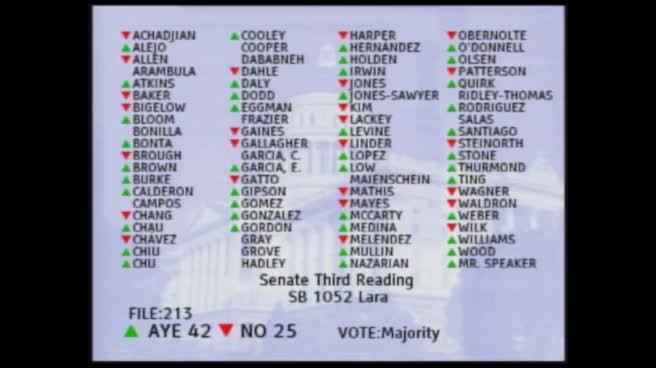 49MIN
Assembly Floor
 2MIN
Assembly Floor
 33MIN
Assembly Standing Committee on Natural Resources
 4MIN
Assembly Floor
 59SEC
Assembly Floor
 30SEC
Assembly Standing Committee on Appropriations
 37MIN
Assembly Standing Committee on Natural Resources
Bill Author
Bill Co-Author(s):