SB 666: Felons: coming upon prison property.
- Session Year: 2015-2016
- House: Senate
- Latest Version Date: 2015-04-15
Existing law makes it a felony for a person who was previously convicted of a felony and confined in the state prison to come upon the grounds of a prison, prison camp, prison farm, jail, or other place where prisoners are located under the custody of prison officials, or lands belonging or adjacent thereto, without the consent of the warden or other officer in charge.
This bill would require that the person know or should know that he or she is required to obtain consent in order to be guilty of the above felony, and would expand the application of the above felony crime to a person who was previously convicted of a felony under the laws of the United States or any other state and who was confined in a federal prison or a prison of another state. The bill would also expand application of the crime to a person who was convicted of a felony and confined in a county jail. By expanding the application of a crime, this bill would impose a state-mandated local program.
The California Constitution requires the state to reimburse local agencies and school districts for certain costs mandated by the state. Statutory provisions establish procedures for making that reimbursement.
This bill would provide that no reimbursement is required by this act for a specified reason.
Existing law makes it a felony for a person who was previously convicted of a felony and confined in the state prison to come upon the grounds of a prison, prison camp, prison farm, jail, or other place where prisoners are located under the custody of prison officials, or lands belonging or adjacent thereto, without the consent of the warden or other officer in charge.
This bill would expand the application of the above felony to a person who was previously convicted of a felony under the laws of the United States or any other state and who was confined in a federal prison or a prison of another state. The bill would also expand application of the crime to a person who was convicted of a felony and confined in a county jail. By expanding the application of a crime, this bill would impose a state-mandated local program.
The California Constitution requires the state to reimburse local agencies and school districts for certain costs mandated by the state. Statutory provisions establish procedures for making that reimbursement.
This bill would provide that no reimbursement is required by this act for a specified reason.
(a)Every person who, having been previously convicted of a felony under the laws of the United States, the State of California, or any other state, and confined in the state prison, a prison of any other state, a federal prison, or a county jail pursuant to subdivision (h) of Section 1170, without the consent of the warden or other officer in charge of the state prison or prison road camp, or prison forestry camp, or other prison camp or prison farm or any other place where prisoners of the state prison are located under the custody of prison officials, officers or employees, or a jail or a county road camp in this state, and who knows or should know that he or she is required to obtain consent, comes upon the grounds of any of those institutions, or lands belonging or adjacent thereto, is guilty of a felony.
(b)For purposes of this section, a person was confined in a county jail pursuant to subdivision (h) of Section 1170 if he or she served an executed felony sentence pursuant to paragraph (1), (2), or (5) of subdivision (h) of Section 1170.
SEC. 2.No reimbursement is required by this act pursuant to Section 6 of Article XIIIB of the California Constitution because the only costs that may be incurred by a local agency or school district will be incurred because this act creates a new crime or infraction, eliminates a crime or infraction, or changes the penalty for a crime or infraction, within the meaning of Section 17556 of the Government Code, or changes the definition of a crime within the meaning of Section 6 of Article XIIIB of the California Constitution.
Every person who, having been previously convicted of a felony under the laws of the United States, the State of California, or any other state, and confined in any State prison in this State, the state prison, a prison of any other state, a federal prison, or a county jail pursuant to subdivision (h) of Section 1170, without the consent of the warden or other officer in charge of any State the state prison or prison road camp, or prison forestry camp, or other prison camp or prison farm or any other place where prisoners of the State state prison are located under the custody of prison officials, officers or employees, or any a jail or any a county road camp in this State, state, comes upon the grounds of any such institution, of those institutions, or lands belonging or adjacent thereto, is guilty of a felony.
SEC. 2.No reimbursement is required by this act pursuant to Section 6 of Article XIIIB of the California Constitution because the only costs that may be incurred by a local agency or school district will be incurred because this act creates a new crime or infraction, eliminates a crime or infraction, or changes the penalty for a crime or infraction, within the meaning of Section 17556 of the Government Code, or changes the definition of a crime within the meaning of Section 6 of Article XIIIB of the California Constitution.
|
Date
|
Status
|
|---|---|
| Feb 27, 2015 | Introduced. To Com. on RLS. for assignment. To print. |
| Mar 2, 2015 | From printer. May be acted upon on or after April 1. |
| Mar 2, 2015 | Read first time. |
| Mar 12, 2015 | Referred to Com. on PUB. S. |
| Mar 27, 2015 | Set for hearing April 7. |
| Apr 14, 2015 | From committee: Do pass as amended and re-refer to Com. on APPR. (Ayes 6. Noes 0. Page 508.) (April 7). |
| Apr 15, 2015 | Read second time and amended. Re-referred to Com. on APPR. |
| Apr 17, 2015 | Set for hearing April 27. |
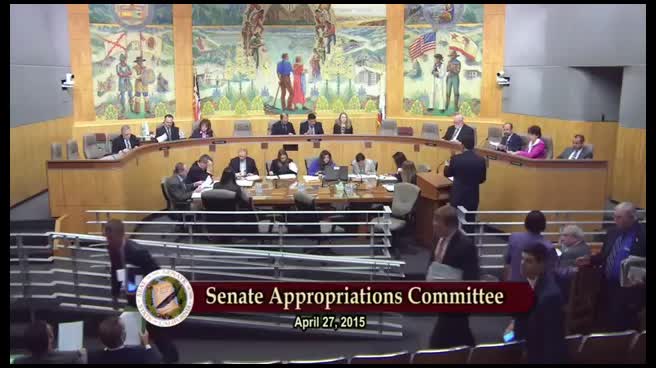
| Apr 27, 2015 | April 27 hearing: Placed on APPR. suspense file. |
| May 23, 2015 | Set for hearing May 28. |
| May 28, 2015 | May 28 hearing: Held in committee and under submission. |
| Feb 1, 2016 | Returned to Secretary of Senate pursuant to Joint Rule 56. |
|
Date
|
Description
|
Location
|
Votes
|
|
|---|---|---|---|---|
| Apr 27, 2015 | Placed on suspense file | Senate Standing Committee on Appropriations |
Passed |
|
| Apr 7, 2015 | Do pass as amended, but first amend, and re-refer to the Committee on [Appropriations] | Senate Standing Committee on Public Safety |
Passed |
This list shows positions taken on this bill by organizations on the date displayed, which is linked to the original source.
Positions by individuals are not included.
|
Organization
|
Position
|
Date
|
|---|---|---|
| American Civil Liberties Union Foundation Of Southern California | * Indeterminate | Apr 7, 2015 |
| California Public Defenders Association | * Indeterminate | Apr 7, 2015 |
| Legal Services for Prisoners with Children | * Indeterminate | Apr 7, 2015 |
SB 666 (Stone) Page 3 of 3
SENATE COMMITTEE ON APPROPRIATIONS
Senator Ricardo Lara, Chair
2015 - 2016 Regular Session
SB 666 (Stone) - Felons: coming upon prison property
|
|
Version: April 15, 2015 |
Policy Vote: PUB. S. 6 - 0 |
Urgency: No |
Mandate: Yes |
Hearing Date: April 27, 2015 |
Consultant: Jolie Onodera |
This bill meets the criteria for referral to the Suspense File.
Bill Summary:
SB 666 would expand the felony offense applicable to a previously convicted felon who has been confined in a California prison from coming upon the grounds of a prison or jail without consent, as specified, to a person who has served a term in federal prison, a prison in another state, or a felony jail term, as specified. This bill specifies a violation of this provision requires that the person knows or should know that he or she is required to obtain consent.
Fiscal Impact:
Potential increase in state costs (General Fund) to the extent expanding the existing felony offense to a larger population of previously convicted felons leads to additional state prison commitments. Data from the DOJ indicates 318 arrests and 51 convictions over the past three years under this provision of law, and the CDCR indicates less than 10 new admissions to state prison per year. Future annual cumulative costs for even two additional commitments per year would cost $68,000 at the current in-state contract bed cost per case.
Potential increase in non-reimbursable local law enforcement costs (Local Fund) for enforcement to the extent the expansion of the felony offense results in additional arrests and convictions, offset to a degree by fine revenue.
Background:
Existing law specifically provides that a person who has been previously convicted of a felony and confined in a state prison is guilty of a felony if he or she “comes upon the grounds of” a prison, prison camp, prison forestry camp, jail, or county road camp without the consent of the warden or other officer in charge. Under existing law, a violation of this provision of law is punishable by a sentence of 16 months, two years, or three years in state prison. (Penal Code (PC) § 4571.)
Under existing law, the provisions of PC § 4571 do not apply to a person previously convicted of a felony and confined in a county jail, in federal prison, or a prison in another state. This bill seeks to expand existing law to apply to this population.
Proposed Law:
This bill would expand the existing felony offense applicable to a previously convicted felon who has been confined in a California prison from coming upon the grounds of a prison or jail without consent, as follows:
Specifies that every person previously convicted of a felony under the laws of the United States, the State of California, or any other state, and confined in the state prison, a prison of any other state, a federal prison, or a county jail pursuant to PC § 1170(h), without the consent of the warden or other officer in charge of the prison, prison camp, jail, or county road camp, and who knows or should know that he or she is required to obtain consent, comes upon the grounds of any of those institutions, or lands belonging or adjacent thereto, is guilty of a felony.
Specifies for purposes of this section, a person was confined in a county jail pursuant to PC § 1170(h) if he or she served an executed felony sentence, as specified.
Related Legislation:
None applicable.
Staff Comments:
By expanding the definition of the existing felony offense applicable to previously convicted felons “coming upon the grounds” of a prison or jail, as specified, this bill could result in additional arrests, convictions, and commitments to state prison. Over the past three years, 318 arrests and 51 convictions have been obtained under the existing provision of law, and the CDCR indicates less than 10 new admissions to state prison per year. While the number of prospective violations is unknown, future annual cumulative costs for even two additional commitments per year would cost $68,000 (General Fund), assuming an average length of stay of 12 months (under the middle term of two years and accounting for good time credits) at the current in-state contract bed cost per case of $34,000.
This bill adds a knowing standard provision that is required in order to meet the threshold for a violation of the existing offense. The CDCR indicates that a PC § 4571 notice of required informed consent is currently posted at all prison entrances. As a result, it is not estimated that this added provision would have an impact on the number of admissions to state prison that otherwise would occur for individuals currently subject to this provision under current law.
Under 2011 Realignment Legislation, the State provided funding to the counties to place offenders in county jail for specified felonies that previously would have required a state prison sentence. Pursuant to Proposition 30 (2012), legislation enacted after September 30, 2012, that has an overall effect of increasing the costs already borne by a local agency for programs or levels of service mandated by the 2011 Realignment Legislation apply to local agencies only to the extent that the state provides annual funding for the cost increase. Proposition 30 specifies that legislation defining a new crime or changing the definition of an existing crime is not subject to this provision. As a result, any increase in local costs due to the change in the definition of the existing felony offense is not estimated to require the state to provide additional funding to local agencies.
The Three-Judge Court has ordered the State to reduce its prison population to 137.5 percent of the prison system’s design capacity by February 28, 2016. Pursuant to its February 10, 2014, order, the Court has ordered the CDCR to implement several population reduction measures, prohibited an increase in the population of inmates placed in out-of-state facilities, and indicated the Court will maintain jurisdiction over the State for as long as necessary to ensure the State’s compliance with the 137.5 percent final benchmark is durable, and that such durability is firmly established. Any future increases to the State's prison population challenge the ability of the State to reach and maintain such a “durable solution,” and could require the State to pursue one of several options, including contracting-out for additional bed space or releasing current inmates early onto parole.
-- END --
SB 666 (Stone ) Page 4 of 4
SENATE COMMITTEE ON PUBLIC SAFETY
Senator Loni Hancock, Chair
2015 - 2016 Regular
Bill No: SB 666 Hearing Date: April 7, 2015
Author: |
Stone |
||
Version: |
February 27, 2015 |
||
Urgency: |
No |
Fiscal: |
Yes |
Consultant: |
JM |
||
Subject: Felons: Coming Upon Prison Property
HISTORY
Source: Author
Prior Legislation: SB 1412 (Nielsen), Ch. 759, Stats. 2014
Support: Unknown
Opposition: California Public Defenders Association
PURPOSE
The purpose of this bill is to extend the existing statute requiring former California prison inmates to obtain permission before entering the grounds of a prison or jail to persons who have served term in a federal prison, a prison in another state or a felony jail term as specified.
Existing law includes a series of statutes describing misdemeanors and felonies committed by non-inmates that involve access to correctional facilities, contact with inmates and bringing contraband into a facility or camp. (Penal Code §§ 4570-4578.)
Existing law specifically provides that a person who has been previously convicted of a felony and confined in a prison is guilty of a felony if he or she “comes onto the grounds of” a prison, prison camp, prison forestry camp, jail or county road camp without the consent of the warden “or other officer in charge.” The sentence for this felony is a prison term of 16 months, two years or three years and a fine of up to $10,000. (Penal Code § 4571.)
This bill extends this prohibition to any person who has previously served a prison term in a federal prison, a prison of any other state, or a county jail pursuant to Penal Code Section 1170, subdivision (h).
RECEIVERSHIP/OVERCROWDING CRISIS AGGRAVATION
For the past eight years, this Committee has scrutinized legislation referred to its jurisdiction for any potential impact on prison overcrowding. Mindful of the United States Supreme Court ruling and federal court orders relating to the state’s ability to provide a constitutional level of health care to its inmate population and the related issue of prison overcrowding, this Committee has applied its “ROCA” policy as a content-neutral, provisional measure necessary to ensure that the Legislature does not erode progress in reducing prison overcrowding.
On February 10, 2014, the federal court ordered California to reduce its in-state adult institution population to 137.5% of design capacity by February 28, 2016, as follows:
143% of design bed capacity by June 30, 2014;
141.5% of design bed capacity by February 28, 2015; and,
137.5% of design bed capacity by February 28, 2016.
In February of this year the administration reported that as “of February 11, 2015, 112,993 inmates were housed in the State’s 34 adult institutions, which amounts to 136.6% of design bed capacity, and 8,828 inmates were housed in out-of-state facilities. This current population is now below the court-ordered reduction to 137.5% of design bed capacity.”( Defendants’ February 2015 Status Report In Response To February 10, 2014 Order, 2:90-cv-00520 KJM DAD PC, 3-Judge Court, Coleman v. Brown, Plata v. Brown (fn. omitted).
While significant gains have been made in reducing the prison population, the state now must stabilize these advances and demonstrate to the federal court that California has in place the “durable solution” to prison overcrowding “consistently demanded” by the court. (Opinion Re: Order Granting in Part and Denying in Part Defendants’ Request For Extension of December 31, 2013 Deadline, NO. 2:90-cv-0520 LKK DAD (PC), 3-Judge Court, Coleman v. Brown, Plata v. Brown (2-10-14). The Committee’s consideration of bills that may impact the prison population therefore will be informed by the following questions:
Whether a proposal erodes a measure which has contributed to reducing the prison population;
Whether a proposal addresses a major area of public safety or criminal activity for which there is no other reasonable, appropriate remedy;
Whether a proposal addresses a crime which is directly dangerous to the physical safety of others for which there is no other reasonably appropriate sanction;
Whether a proposal corrects a constitutional problem or legislative drafting error; and
Whether a proposal proposes penalties which are proportionate, and cannot be achieved through any other reasonably appropriate remedy.
COMMENTS
State Need for This Bill
According to the author:
California law clearly states that a person that has been previously convicted of a Felony and has been confined in a prison in the State of California cannot enter the grounds of any prison, prison camp or jail in the State.
However, there exists a loophole in the current law. The statute does not exclude a person who has been previously convicted of a Felony and has been confined in a County Jail. The statute is also silent about those who have been convicted of a Felony in a different state or if they have been confined in a Federal Prison upon conviction of a Felony.
SB 666 closes the loophole in current law by stating that, in addition to current law, no one that has been previously convicted of a Felony and served time in a County Jail, a prison in another state, or in a Federal prison, will be allowed on the grounds of a prison, prison camp, or jail in the state of California.
Recent Appellate Decision Requires Full Disclosure by Person Seeking Entry to Custodial Facility
People v. Gjersolvd (2014) 230 Cal.App.4th 746 interpreted and applied Penal Code Section 4571, the statute amended by this bill. As noted in the “Purpose” section above, the statute requires a convicted felon who has served a prison term to obtain permission to come “upon the grounds of [a prison or jail] or lands adjacent thereto…” Violation of Section 4571 is a felony. The defendant in Gjersolvd was convicted of entering the Riverside County Jail without informing institution officials that he had been convicted of a felony and served a prison term. Gjersolvd falsely told a deputy who screened visitors that he was a private investigator and showed the deputy his revoked private investigator’s license.
The court - citing a 1980 opinion of the Attorney General1 - found that a former prisoner must obtain “informed consent” from prison or jail authorities. To obtain informed consent, the former prisoner must clearly reveal his or her record. Informed consent allows “the warden or other officer in charge … the opportunity to exercise wide discretion whether … an ex-convict may receive consent to enter upon jail grounds.” (Id., at pp. 750-751.)
The court in Gjersolvd observed “a notice is posted [at the jail] that states that persons convicted of a felony are not authorized to visit without approval.” (Id., at p. 749.) Many other sections in the chapter that restrict access to prisoners or prohibit bringing contraband onto prison or jail grounds require the institution to post a notice of the prohibition or restriction. Section 4571 does not require such notice. Committee members may wish to consider whether this bill should be amended to include a notice requirement, especially in light of the expansion of the law in this bill.
What Constitutes being “Confined in a County Jail Pursuant to Penal Subdivision (h) of Penal Code Section 1170”?
Under existing law, it is clear who is covered by the statute amended by this bill – those persons convicted of a felony, sentenced to prison and actually confined in prison pursuant to an executed prison term. No other persons are confined in prison. Where a defendant is convicted of a felony and placed on probation, he or she would not be confined in a prison unless probation is revoked and a prison term is imposed and executed, although the terms of probation often include a period of jail confinement. A person who succeeds on felony probation would not be subject to the law amended by this bill, regardless of whether the person was confined in jail as a condition of probation.
However, it is not entirely clear to whom the phrase “confined in a county jail … pursuant to subdivision (h) of Section 1170” applies. The phrase would likely be interpreted to refer to a convicted defendant who served an “executed” felony sentence in jail after denial or revocation of probation. However “pursuant to subdivision (h) of Section 1170” could be interpreted to mean any felony crime for which the sentence is to be served in jail. Such a crime is commonly or colloquially described as “an 1170 (h) crime.” Further, a person is confined in jail if incarceration is a condition of felony probation.
There are three classes of persons convicted of a felony and confined in a county jail:
Those defendants who were convicted of an 1170 (h) crime who served an executed sentence in the county jail. An executed sentence is one that is imposed and actually served.
Those defendants who were convicted of an 1170 (h) crime who served an executed “split sentence.” A split sentence is an executed jail sentence for which the final portion of the sentence is served under “mandatory supervision” in the community. The supervision provided under mandatory supervision is equivalent to probation supervision.
Persons who were convicted of an 1170 (h) felony, granted probation and
ordered to serve a term in a county jail as a condition of probation. As with prison sentences, in granting probation, the court can either impose the sentence, but stay execution of the sentence if while the defendant remains on probation, or stay imposition of sentence per se.
Defendants/inmates in classes 1) and 2) are equivalent to those who actually served a prison term under existing law. Defendants in class 3) are not equivalent to those covered by current law.
Members may wish to consider whether this bill should be clarified to provide that it applies to defendants who served an executed jail sentence pursuant to Section 1170, subdivision (h); for example:
For purposes of this section, “confined in a county jail pursuant to subdivision (h) of Section 1170” means that a person served an executed felony jail sentence pursuant to paragraph (1) or (2) of subdivision (h) of Section 1170, including a split sentence imposed pursuant to paragraph (5).
-- END –
1 (63 Ops. Cal.Atty.Gen. 80-112)
Discussed in Hearing
 3MIN
Senate Standing Committee on Appropriations
 12MIN
Senate Standing Committee on Public Safety
Bill Author

Bill Co-Author(s):