SB 713: State government: federal immigration policy enforcement.
- Session Year: 2015-2016
- House: Senate
- Latest Version Date: 2015-02-27
Existing federal law authorizes any authorized immigration officer to issue an immigration detainer that serves to advise another law enforcement agency that the federal department seeks custody of an alien presently in the custody of that agency, for the purpose of arresting and removing the alien. Existing federal law provides that the detainer is a request that the agency advise the department, prior to release of the alien, in order for the department to arrange to assume custody in situations when gaining immediate physical custody is either impracticable or impossible.
Existing state law prohibits a law enforcement official, as defined, from detaining an individual on the basis of a United States Immigration and Customs Enforcement hold after that individual becomes eligible for release from custody, unless, at the time that the individual becomes eligible for release from custody, certain conditions are met, including, among other things, that the individual has been convicted at any time of a felony for specified offenses and the continued detention of the individual on the basis of the immigration hold would not violate any federal, state, or local law, or any local policy.
This bill would expand the list of prior felony convictions to include the conviction of a felony which formed the basis upon which the individual was previously deported, thereby allowing a law enforcement official, if the continued detention of the individual on the basis of the immigration hold would not violate any federal, state, or local law, or any local policy, to detain an individual with that felony conviction on the basis of a United States Immigration and Customs Enforcement hold after that individual becomes eligible for release from custody.
(a)A law enforcement official shall have discretion to cooperate with federal immigration officials by detaining an individual on the basis of an immigration hold after that individual becomes eligible for release from custody only if the continued detention of the individual on the basis of the immigration hold would not violate any federal, state, or local law, or any local policy, and only under any of the following circumstances:
(1)The individual has been convicted of a serious or violent felony identified in subdivision (c) of Section 1192.7 of, or subdivision (c) of Section 667.5 of, the Penal Code.
(2)The individual has been convicted of a felony punishable by imprisonment in the state prison.
(3)The individual has been convicted within the past five years of a misdemeanor for a crime that is punishable as either a misdemeanor or a felony for, or has been convicted at any time of a felony for, any of the following offenses:
(A)Assault, as specified in, but not limited to, Sections 217.1, 220, 240, 241.1, 241.4, 241.7, 244, 244.5, 245, 245.2, 245.3, 245.5, 4500, and 4501 of the Penal Code.
(B)Battery, as specified in, but not limited to, Sections 242, 243.1, 243.3, 243.4, 243.6, 243.7, 243.9, 273.5, 347, 4501.1, and 4501.5 of the Penal Code.
(C)Use of threats, as specified in, but not limited to, Sections 71, 76, 139, 140, 422, 601, and 11418.5 of the Penal Code.
(D)Sexual abuse, sexual exploitation, or crimes endangering children, as specified in, but not limited to, Sections 266, 266a, 266b, 266c, 266d, 266f, 266g, 266h, 266i, 266j, 267, 269, 288, 288.5, 311.1, 311.3, 311.4, 311.10, 311.11, and 647.6 of the Penal Code.
(E)Child abuse or endangerment, as specified in, but not limited to, Sections 270, 271, 271a, 273a, 273ab, 273d, 273.4, and 278 of the Penal Code.
(F)Burglary, robbery, theft, fraud, forgery, or embezzlement, as specified in, but not limited to, Sections 211, 215, 459, 463, 470, 476, 487, 496, 503, 518, 530.5, 532, and 550 of the Penal Code.
(G)Driving under the influence of alcohol or drugs, but only for a conviction that is a felony.
(H)Obstruction of justice, as specified in, but not limited to, Sections 69, 95, 95.1, 136.1, and 148.10 of the Penal Code.
(I)Bribery, as specified in, but not limited to, Sections 67, 67.5, 68, 74, 85, 86, 92, 93, 137, 138, and 165 of the Penal Code.
(J)Escape, as specified in, but not limited to, Sections 107, 109, 110, 4530, 4530.5, 4532, 4533, 4534, 4535, and 4536 of the Penal Code.
(K)Unlawful possession or use of a weapon, firearm, explosive device, or weapon of mass destruction, as specified in, but not limited to, Sections 171b, 171c, 171d, 246, 246.3, 247, 417, 417.3, 417.6, 417.8, 4574, 11418, 11418.1, 12021.5, 12022, 12022.2, 12022.3, 12022.4, 12022.5, 12022.53, 12022.55, 18745, 18750, and 18755 of, and subdivisions (c) and (d) of Section 26100 of, the Penal Code.
(L)Possession of an unlawful deadly weapon, under the Deadly Weapons Recodification Act of 2010 (Part 6 (commencing with Section 16000) of the Penal Code).
(M)An offense involving the felony possession, sale, distribution, manufacture, or trafficking of controlled substances.
(N)Vandalism with prior convictions, as specified in, but not limited to, Section 594.7 of the Penal Code.
(O)Gang-related offenses, as specified in, but not limited to, Sections 186.22, 186.26, and 186.28 of the Penal Code.
(P)An attempt, as defined in Section 664 of, or a conspiracy, as defined in Section 182 of, the Penal Code, to commit an offense specified in this section.
(Q)A crime resulting in death, or involving the personal infliction of great bodily injury, as specified in, but not limited to, subdivision (d) of Section 245.6 of, and Sections 187, 191.5, 192, 192.5, 12022.7, 12022.8, and 12022.9 of, the Penal Code.
(R)Possession or use of a firearm in the commission of an offense.
(S)An offense that would require the individual to register as a sex offender pursuant to Section 290, 290.002, or 290.006 of the Penal Code.
(T)False imprisonment, slavery, and human trafficking, as specified in, but not limited to, Sections 181, 210.5, 236, 236.1, and 4503 of the Penal Code.
(U)Criminal profiteering and money laundering, as specified in, but not limited to, Sections 186.2, 186.9, and 186.10 of the Penal Code.
(V)Torture and mayhem, as specified in, but not limited to, Section 203 of the Penal Code.
(W)A crime threatening the public safety, as specified in, but not limited to, Sections 219, 219.1, 219.2, 247.5, 404, 404.6, 405a, 451, and 11413 of the Penal Code.
(X)Elder and dependent adult abuse, as specified in, but not limited to, Section 368 of the Penal Code.
(Y)A hate crime, as specified in, but not limited to, Section 422.55 of the Penal Code.
(Z)Stalking, as specified in, but not limited to, Section 646.9 of the Penal Code.
(AA)Soliciting the commission of a crime, as specified in, but not limited to, subdivision (c) of Section 286 of, and Sections 653j and 653.23 of, the Penal Code.
(AB)An offense committed while on bail or released on his or her own recognizance, as specified in, but not limited to, Section 12022.1 of the Penal Code.
(AC)Rape, sodomy, oral copulation, or sexual penetration, as specified in, but not limited to, paragraphs (2) and (6) of subdivision (a) of Section 261 of, paragraphs (1) and (4) of subdivision (a) of Section 262 of, Section 264.1 of, subdivisions (c) and (d) of Section 286 of, subdivisions (c) and (d) of Section 288a of, and subdivisions (a) and (j) of Section 289 of, the Penal Code.
(AD)Kidnapping, as specified in, but not limited to, Sections 207, 209, and 209.5 of the Penal Code.
(AE)A violation of subdivision (c) of Section 20001 of the Vehicle Code.
(AF)A felony which formed the basis upon which the individual was previously deported.
(4)The individual is a current registrant on the California Sex and Arson Registry.
(5)The individual is arrested and taken before a magistrate on a charge involving a serious or violent felony, as identified in subdivision (c) of Section 1192.7 or subdivision (c) of Section 667.5 of the Penal Code, a felony punishable by imprisonment in state prison, or any felony listed in paragraph (2) or (3) other than domestic violence, and the magistrate makes a finding of probable cause as to that charge pursuant to Section 872 of the Penal Code.
(6)The individual has been convicted of a federal crime that meets the definition of an aggravated felony as set forth in subparagraphs (A) to (P), inclusive, of paragraph (43) of subsection (a) of Section 101 of the federal Immigration and Nationality Act (8 U.S.C. Sec. 1101), or is identified by the United States Department of Homeland Securitys Immigration and Customs Enforcement as the subject of an outstanding federal felony arrest warrant.
(b)If none of the conditions listed in subdivision (a) is satisfied, an individual shall not be detained on the basis of an immigration hold after the individual becomes eligible for release from custody.
|
Date
|
Status
|
|---|---|
| Feb 27, 2015 | Introduced. To Com. on RLS. for assignment. To print. |
| Mar 2, 2015 | From printer. May be acted upon on or after April 1. |
| Mar 2, 2015 | Read first time. |
| Mar 19, 2015 | Referred to Com. on PUB. S. |
| Mar 20, 2015 | Set for hearing April 21. |
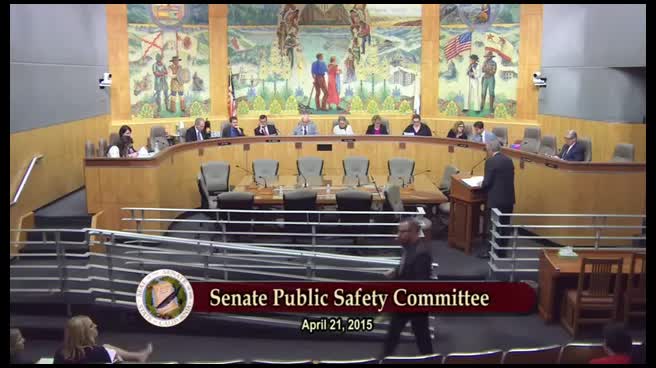
| Apr 29, 2015 | April 21 set for first hearing. Failed passage in committee. (Ayes 2. Noes 5. Page 731.) Reconsideration granted. |
| Feb 1, 2016 | Returned to Secretary of Senate pursuant to Joint Rule 56. |
|
Date
|
Description
|
Location
|
Votes
|
|
|---|---|---|---|---|
| Apr 21, 2015 | [First] hearing set for [04-29-2015]: Failed passage in Committee. Reconsideration granted | Senate Standing Committee on Public Safety |
Passed |
|
| Apr 21, 2015 | Do pass | Senate Standing Committee on Public Safety |
Failed |
This list shows positions taken on this bill by organizations on the date displayed, which is linked to the original source.
Positions by individuals are not included.
|
Organization
|
Position
|
Date
|
|---|---|---|
| California Public Defenders Association | * Indeterminate | Apr 22, 2015 |
| Mexican American Legal Defense and Educational Fund | * Indeterminate | Apr 22, 2015 |
SB 713 (Nielsen ) Page 6 of 6
SENATE COMMITTEE ON PUBLIC SAFETY
Senator Loni Hancock, Chair
2015 - 2016 Regular
Bill No: SB 713 Hearing Date: April 21, 2015
Author: |
Nielsen |
||
Version: |
February 27, 2015 |
||
Urgency: |
No |
Fiscal: |
No |
Consultant: |
MK |
||
Subject: State Government: Federal Immigration Policy Enforcement
HISTORY
Source: Author
Prior Legislation: SB 1664 (Poochigian) Failed Senate Public Safety, 2006
Support: California State Sheriffs’ Association
Opposition: Orange County Immigrant Youth United; Asian American’s Advancing Justice Sacramento; American Civil Liberties Union; SFOPPIA; Centro Legal de la Raza; Congregations Building Community; Orange County Immigrant Youth United; National Day Laborer Organizing Network Organizing Network; California immigrant Policy Center; Graton Day Labor Center; Napa Valley Dream Team
PURPOSE
The purpose of this bill is to allow for an immigration hold when a person has been convicted of a felony which formed the basis upon which the individual was previously deported.
Federal law provides that a person who was deported from the United States because of specified misdemeanors or felonies and enters, attempts to enter or is found in the United States shall be imprisoned not more than 10 years. If he or she had been deported for specified aggravated felonies then penalty shall be not more than 20 years. (8 USCS § 1326 (b).)
Existing law provides that a law enforcement official shall have the discretion to cooperate with federal immigration officials by detaining an individual on the basis of an immigration hold after that individual becomes eligible for release from custody only if the continued detention of the individual on the basis of the immigration hold would not violate any federal, state or local policy and only under the following circumstances:
The individual has committed a serious or violent felony;
The individual has been convicted of a felony punishable by imprisonment in the state prison;
The individual has been convicted within the past five years of a misdemeanor for a crime that is punishable as a wobbler or has been convicted at any time of a felony for any of the following offenses:
Assault;
Battery;
Use of threats;
Sexual abuse, sexual exploitation, or crimes endangering children, as specified;
Child abuse or endangerment;
Burglary, robbery, theft, fraud, forgery, and embezzlement;
Felony DUI;
Obstruction of justice;
Bribery;
Escape;
Unlawful possession or use of a weapon, firearm, explosive device; or weapon of mass destruction;
Possession of an unlawfully deadly weapon;
Felony possession, sale, distribution, manufacture or trafficking of controlled substances;
Vandalism with prior convictions;
Gang-related offenses;
An attempt or conspiracy to commit one of the listed offenses;
A crime resulting in death or involving great bodily injury;
Possession of a firearm in the commission of an offense;
A registerable sex offense;
False imprisonment, slavery, human trafficking;
Criminal profiteering and money laundering;
Torture and mayhem;
A crime threatening the public safety;
Elder and dependent adult abuse;
A hate crime;
Stalking;
Soliciting the commission of a crime;
A crime committed on bail or released on his or her own recognizance;
Rape, sodomy, oral copulation or sexual penetration;
Kidnapping; or,
Fleeing the scene of a vehicular manslaughter.
The individual is a current registrant on the California Sex and Arson registry;
The individual is arrested and taken before a magistrate on a charge involving a serious or violent felony, a felony punishable by imprisonment in the state prison or any of the listed felonies and the magistrate makes a finding of probable cause;
The individual has been convicted of a federal crime that meets the definition of an aggravated felony or is identified as the subject of an outstanding federal felony arrest warrant; and,
If none of the conditions are met an individual shall not be detained on an immigration hold after the individual becomes eligible for release from custody. (Government Code § 7282.5)
This bill provides that a person may also be detained on an immigration hold for a felony which formed the basis upon which the individual was previously deported.
RECEIVERSHIP/OVERCROWDING CRISIS AGGRAVATION
For the past eight years, this Committee has scrutinized legislation referred to its jurisdiction for any potential impact on prison overcrowding. Mindful of the United States Supreme Court ruling and federal court orders relating to the state’s ability to provide a constitutional level of health care to its inmate population and the related issue of prison overcrowding, this Committee has applied its “ROCA” policy as a content-neutral, provisional measure necessary to ensure that the Legislature does not erode progress in reducing prison overcrowding.
On February 10, 2014, the federal court ordered California to reduce its in-state adult institution population to 137.5% of design capacity by February 28, 2016, as follows:
143% of design bed capacity by June 30, 2014;
141.5% of design bed capacity by February 28, 2015; and,
137.5% of design bed capacity by February 28, 2016.
In February of this year the administration reported that as “of February 11, 2015, 112,993 inmates were housed in the State’s 34 adult institutions, which amounts to 136.6% of design bed capacity, and 8,828 inmates were housed in out-of-state facilities. This current population is now below the court-ordered reduction to 137.5% of design bed capacity.”( Defendants’ February 2015 Status Report In Response To February 10, 2014 Order, 2:90-cv-00520 KJM DAD PC, 3-Judge Court, Coleman v. Brown, Plata v. Brown (fn. omitted).
While significant gains have been made in reducing the prison population, the state now must stabilize these advances and demonstrate to the federal court that California has in place the “durable solution” to prison overcrowding “consistently demanded” by the court. (Opinion Re: Order Granting in Part and Denying in Part Defendants’ Request For Extension of December 31, 2013 Deadline, NO. 2:90-cv-0520 LKK DAD (PC), 3-Judge Court, Coleman v. Brown, Plata v. Brown (2-10-14). The Committee’s consideration of bills that may impact the prison population therefore will be informed by the following questions:
Whether a proposal erodes a measure which has contributed to reducing the prison population;
Whether a proposal addresses a major area of public safety or criminal activity for which there is no other reasonable, appropriate remedy;
Whether a proposal addresses a crime which is directly dangerous to the physical safety of others for which there is no other reasonably appropriate sanction;
Whether a proposal corrects a constitutional problem or legislative drafting error; and
Whether a proposal proposes penalties which are proportionate, and cannot be achieved through any other reasonably appropriate remedy.
COMMENTS
1. Need for This Bill
According to the author:
Existing law prohibits law enforcement from detaining an individual on the basis of a United States Immigration and Customs Enforcement (ICE) hold unless he or she was previously convicted of certain enumerated felonies.
This bill would expand that list to include the conviction of a felony for which the individual was previously deported. If an individual has been deported following a felony conviction and illegally re-enters the country he or she is subject to federal prosecution and imprisonment of between 2 to 20 years depending upon the gravity of the underlying offense. This bill would authorize California law enforcement to detain such an individual on the basis of an ICE hold.
Luis Enrique Monroy-Bracamonte (A.K.A. Marcelo Marquez) was twice deported from the United States, re-entering the country in each instance. Immigration authorities say his fingerprints have been matched to biometric records showing that he was first deported after being convicted in Arizona for selling drugs in 1997.
Immigration officials say Monroy-Bracamonte was last deported in 2001 following arrest for drug and weapons violations. On April 21, 2003 Monroy-Bracamonte using the name “Marcelo Marquez” was arrested for misdemeanor hit-and-run and making a false police report. He pleaded guilty, received a year of probation and was fined about $500. Utah court records indicate that Monroy-Bracamonte accumulated 10 misdemeanor vehicle violations between 2003 and 2009.
Under current California law, none of these prior offenses would be sufficient to permit local law enforcement to detain Monroy- Bracamonte subject to an ICE hold.
Last year, Monroy-Bracamonte engaged in a six hour crime spree during which Placer County Detective Michael Davis Jr. and Sacramento County Deputy Danny Oliver were both shot and killed. He has since been charged with 14 felony counts including the murders of Officers Davis and Oliver, four car- jackings and the attempted murder of three deputies and a civilian.
This case exposes impediments in the criminal justice process that shielded Monroy-Bracamonte from being returned to federal custody for prosecution prior to his violent rampage.
SB 713 would simply close a gap in current law so that local law enforcement would be authorized to honor an ICE hold if the subject is a previously deported felon.
2. Immigration Holds
Existing law permits law enforcement to detain an individual on an immigration hold upon release from custody only if certain conditions are met including whether the individual has been convicted of one of a number of specified offenses. This bill would add to the list of crimes which allow for an immigration hold “a felony which formed the basis upon which the individual was previously deported.”
It is not clear how the law enforcement official will be able to determine whether a felony formed the basis on which the individual was deported without a transcript of the deportation proceedings. Evidence of a past felony is not in and of itself proof that that was the reason for deportation. Will this only apply when the agency can show the connection between the felony and the deportation?
3. Support
In support the California State Sheriffs’ Association states:
California law prohibits law enforcement from detaining an individual on the basis of an ICE hold unless that person was previously convicted of specified felonies, but fails to include the conviction of a felony for which the individual was previously deported. Senate Bill 713 amends California law to conform to the Policies for Apprehension, Detention and Removal of Undocumented Immigrants memorandum as set forth by the Department of Homeland Security on November 20, 2014.
4. Opposition
A number of groups oppose this bill stating:
Just four months after the law's enactment, a ruling from a federal district judge in Oregon confirmed this warning and found that ICE holds violate the United States Constitution. In Miranda-Olivares vs. Clackamas, the court held that the detention of a woman in Clackamas County, Oregon, on an ICE hold violated the Fourth Amendment's protection against unreasonable search and seizure and ordered that damages be paid. Since then, hundreds of jurisdictions across the nation have stopped submitting to these unconstitutional requests altogether.
The TRUST Act and the city and county policies which have built on its protections are key public safety tools, helping communities across California gain the confidence to work with their local law enforcement to solve crimes. This is particular vital in light of research demonstrating that local law enforcement's entanglement with the deportation system has severely undercut confidence in police and Sheriffs in Latino and immigrant communities.
We believe it is imperative that the isolated actions of one individual not be held against entire communities of people who are part of the fabric of our state. We express in the strongest terms our condemnation of the murders of Sacramento County Sheriff's Deputy Danny Oliver and Placer County Sheriff's Detective Michael David Davis, Jr.
As the Sacramento Bee Editorial Board powerfully noted in its October 29, 2014 Editorial, this is "[a] story about murder, not immigration failure". The editorial board lamented the response of "anti-immigration zealots" to this tragic case, who "can hang most any calamity at the feet of the millions of undocumented immigrants."
The
way forward must be anchored in our values of accountability,
equality, and fairness - not fear-mongering.
-- END –
Discussed in Hearing
 11MIN
Senate Standing Committee on Public Safety
Bill Author

Bill Co-Author(s):