SB 999: Health care coverage: contraceptives: annual supply.
- Session Year: 2015-2016
- House: Senate
- Latest Version Date: 2016-09-23
Existing law, the Knox-Keene Health Care Service Plan Act of 1975, provides for the licensure and regulation of health care service plans by the Department of Managed Health Care and makes a willful violation of the act a crime. Existing law also provides for the regulation of health insurers by the Department of Insurance. Existing law also provides for the Medi-Cal program, which is administered by the State Department of Health Care Services, under which qualified low-income individuals receive health care services through, among other things, managed care plans licensed under the act that contract with the State Department of Health Care Services. Existing law requires a health care service plan contract or health insurance policy issued, amended, or renewed on or after January 1, 2016, to provide coverage for women for all prescribed and FDA-approved female contraceptive drugs, devices, and products, as well as voluntary sterilization procedures, contraceptive education and counseling, and related followup services.
This bill would require a health care service plan or a health insurance policy issued, amended, renewed, or delivered on or after January 1, 2017, to cover up to a 12-month supply of FDA-approved, self-administered hormonal contraceptives when dispensed at one time for an enrollee or insured at one time by a provider, pharmacist, or at a location licensed or authorized to dispense drugs or supplies. The bill would specifically provide that a health care service plan contract or an insurance policy is not required to cover contraceptives provided by an out-of-network provider, pharmacy, or other location, except as authorized by state or federal law or by the plan or insurers policies governing out-of-network coverage. The bill would also prohibit a health care service plan or health insurer, in the absence of clinical contraindications, from imposing utilization controls limiting the supply of FDA-approved, self-administered hormonal contraceptives that may be furnished by a provider or pharmacist, or at a location licensed or otherwise authorized to dispense drugs or supplies to an amount that is less than a 12-month supply. The bill would include Medi-Cal managed care plans, as specified, in the definition of a health care service plan for purposes of these provisions, and would require the State Department of Health Care Services to seek federal approval, if necessary, and to issue all-plan letters or similar instructions to implement these provisions. Because a willful violation of the bills requirements by a health care service plan would be a crime, the bill would impose a state-mandated local program.
Existing law authorizes a pharmacist to dispense not more than a 90-day supply of a dangerous drug other than a controlled substance pursuant to a valid prescription that specifies an initial quantity of less than a 90-day supply followed by periodic refills of that amount if the patient has met specified requirements, including having completed an initial 30-day supply of the drug. Existing law prohibits a pharmacist from dispensing a greater supply of a dangerous drug if the prescriber indicates no change to quantity on the prescription. Existing law authorizes a pharmacist to furnish self-administered hormonal contraceptives in accordance with standardized procedures or protocols developed and approved by both the board and the Medical Board of California, as specified.
This bill would require a pharmacist to dispense, at a patients request, up to a 12-month supply of an FDA-approved, self-administered hormonal contraceptive pursuant to a valid prescription that specifies an initial quantity followed by periodic refills. The bill would authorize a pharmacist furnishing an FDA-approved, self-administered hormonal contraceptive, pursuant to the authorization described above, to furnish up to a 12-month supply at one time at the patients request.
This bill would incorporate changes to Section 4064.5 of the Business and Professions Code proposed by both this bill and SB 253, which would become operative only if both bills are enacted and become effective on or before January 1, 2017, and this bill is chaptered last.
The California Constitution requires the state to reimburse local agencies and school districts for certain costs mandated by the state. Statutory provisions establish procedures for making that reimbursement.
This bill would provide that no reimbursement is required by this act for a specified reason.
Existing law, the Knox-Keene Health Care Service Plan Act of 1975, provides for the licensure and regulation of health care service plans by the Department of Managed Health Care and makes a willful violation of the act a crime. Existing law also provides for the regulation of health insurers by the Department of Insurance. Existing law also provides for the Medi-Cal program, which is administered by the State Department of Health Care Services, under which qualified low-income individuals receive health care services through, among other things, managed care plans licensed under the act that contract with the State Department of Health Care Services. Existing law requires a health care service plan contract or health insurance policy issued, amended, or renewed on or after January 1, 2016, to provide coverage for women for all prescribed and FDA-approved female contraceptive drugs, devices, and products, as well as voluntary sterilization procedures, contraceptive education and counseling, and related followup services.
This bill would require a health care service plan or a health insurance policy issued, amended, renewed, or delivered on or after January 1, 2017, to cover up to a 12-month supply of FDA-approved, self-administered hormonal contraceptives when dispensed at one time for an enrollee or insured at one time by a provider, pharmacist, or at a location licensed or authorized to dispense drugs or supplies. The bill would specifically provide that a health care service plan contract or an insurance policy is not required to cover contraceptives provided by an out-of-network provider, pharmacy, or other location, except as authorized by state or federal law or by the plan or insurers policies governing out-of-network coverage. The bill would also prohibit a health care service plan or health insurer, in the absence of clinical contraindications, from imposing utilization controls limiting the supply of FDA-approved, self-administered hormonal contraceptives that may be furnished by a provider or pharmacist, or at a location licensed or otherwise authorized to dispense drugs or supplies to an amount that is less than a 12-month supply. The bill would include Medi-Cal managed care plans, as specified, in the definition of a health care service plan for purposes of these provisions, and would require the State Department of Health Care Services to seek federal approval, if necessary, and to issue all-plan letters or similar instructions to implement these provisions. Because a willful violation of the bills requirements by a health care service plan would be a crime, the bill would impose a state-mandated local program.
Existing law authorizes a pharmacist to dispense not more than a 90-day supply of a dangerous drug other than a controlled substance pursuant to a valid prescription that specifies an initial quantity of less than a 90-day supply followed by periodic refills of that amount if the patient has met specified requirements, including having completed an initial 30-day supply of the drug. Existing law prohibits a pharmacist from dispensing a greater supply of a dangerous drug if the prescriber indicates no change to quantity on the prescription. Existing law authorizes a pharmacist to furnish self-administered hormonal contraceptives in accordance with standardized procedures or protocols developed and approved by both the board and the Medical Board of California, as specified.
This bill would require a pharmacist to dispense, at a patients request, up to a 12-month supply of an FDA-approved, self-administered hormonal contraceptive pursuant to a valid prescription that specifies an initial quantity followed by periodic refills. The bill would authorize a pharmacist furnishing an FDA-approved, self-administered hormonal contraceptive, pursuant to the authorization described above, to furnish up to a 12-month supply at one time at the patients request.
This bill would incorporate changes to Section 4064.5 of the Business and Professions Code proposed by both this bill and SB 253, which would become operative only if both bills are enacted and become effective on or before January 1, 2017, and this bill is chaptered last.
The California Constitution requires the state to reimburse local agencies and school districts for certain costs mandated by the state. Statutory provisions establish procedures for making that reimbursement.
This bill would provide that no reimbursement is required by this act for a specified reason.
Existing law, the Knox-Keene Health Care Service Plan Act of 1975, provides for the licensure and regulation of health care service plans by the Department of Managed Health Care and makes a willful violation of the act a crime. Existing law also provides for the regulation of health insurers by the Department of Insurance. Existing law also provides for the Medi-Cal program, which is administered by the State Department of Health Care Services, under which qualified low-income individuals receive health care services through, among other things, managed care plans licensed under the act that contract with the State Department of Health Care Services. Existing law requires a health care service plan contract or health insurance policy issued, amended, or renewed on or after January 1, 2016, to provide coverage for women for all prescribed and FDA-approved female contraceptive drugs, devices, and products, as well as voluntary sterilization procedures, contraceptive education and counseling, and related followup services.
This bill would require a health care service plan or a health insurance policy issued, amended, renewed, or delivered on or after January 1, 2017, to cover up to a 12-month supply of FDA-approved, self-administered hormonal contraceptives when dispensed at one time for an enrollee or insured at one time by a provider, pharmacist, or at a location licensed or authorized to dispense drugs or supplies. The bill would specifically provide that a health care service plan contract or an insurance policy is not required to cover contraceptives provided by an out-of-network provider, pharmacy, or other location, except as authorized by state or federal law or by the plan or insurers policies governing out-of-network coverage. The bill would also prohibit a health care service plan or health insurer, in the absence of clinical contraindications, from imposing utilization controls limiting the supply of FDA-approved FDA-approved, self-administered hormonal contraceptives that may be furnished by a provider or pharmacist, or at a location licensed or otherwise authorized to dispense drugs or supplies to an amount that is less than a 12-month supply. The bill would include Medi-Cal managed plans, as specified, in the definition of a health care service plan for purposes of these provisions, and would require the State Department of Health Care Services to seek federal approval, if necessary, and to issue all-plan letters or similar instructions to implement these provisions. Because a willful violation of the bills requirements by a health care service plan would be a crime, the bill would impose a state-mandated local program.
Existing law authorizes a pharmacist to dispense not more than a 90-day supply of a dangerous drug other than a controlled substance pursuant to a valid prescription that specifies an initial quantity of less than a 90-day supply followed by periodic refills of that amount if the patient has met specified requirements, including having completed an initial 30-day supply of the drug. Existing law prohibits a pharmacist from dispensing a greater supply of a dangerous drug if the prescriber indicates no change to quantity on the prescription. Existing law authorizes a pharmacist to furnish self-administered hormonal contraceptives in accordance with standardized procedures or protocols developed and approved by both the board and the Medical Board of California, as specified.
This bill would require a pharmacist to dispense, at a patients request, up to a 12-month supply of an FDA-approved FDA-approved, self-administered hormonal contraceptive pursuant to a valid prescription that specifies an initial quantity followed by periodic refills. The bill would authorize a pharmacist furnishing an FDA-approved FDA-approved, self-administered hormonal contraceptive, pursuant to the authorization described above, to furnish up to a 12-month supply at one time at the patients request.
This bill would incorporate changes to Section 4064.5 of the Business and Professions Code proposed by both this bill and SB 253, which would become operative only if both bills are enacted and become effective on or before January 1, 2017, and this bill is chaptered last.
The California Constitution requires the state to reimburse local agencies and school districts for certain costs mandated by the state. Statutory provisions establish procedures for making that reimbursement.
This bill would provide that no reimbursement is required by this act for a specified reason.
Existing law, the Knox-Keene Health Care Service Plan Act of 1975, provides for the licensure and regulation of health care service plans by the Department of Managed Health Care and makes a willful violation of the act a crime. Existing law also provides for the regulation of health insurers by the Department of Insurance. Existing law also provides for the Medi-Cal program, which is administered by the State Department of Health Care Services, under which qualified low-income individuals receive health care services through, among other things, managed care plans licensed under the act that contract with the State Department of Health Care Services. Existing law requires a health care service plan contract or health insurance policy issued, amended, or renewed on or after January 1, 2016, to provide coverage for women for all prescribed and FDA-approved female contraceptive drugs, devices, and products, as well as voluntary sterilization procedures, contraceptive education and counseling, and related followup services.
This bill would require a health care service plan or a health insurance policy issued, amended, renewed, or delivered on or after January 1, 2017, to cover up to a 12-month supply of FDA-approved, self-administered hormonal contraceptives when dispensed at one time for an enrollee or insured at one time by a provider, pharmacist, or at a location licensed or authorized to dispense drugs or supplies. The bill would specifically provide that a health care service plan contract or an insurance policy is not required to cover contraceptives provided by an out-of-network provider, pharmacy, or other location, except as authorized by state or federal law or by the plan or insurers policies governing out-of-network coverage. The bill would also prohibit a health care service plan or health insurer, in the absence of clinical contraindications, from imposing utilization controls limiting the supply of FDA-approved self-administered hormonal contraceptives that may be furnished by a provider or pharmacist, or at a location licensed or otherwise authorized to dispense drugs or supplies to an amount that is less than a 12-month supply. The bill would include Medi-Cal managed plans, as specified, in the definition of a health care service plan for purposes of these provisions, and would require the State Department of Health Care Services to issue all-plan letters or similar instructions to implement these provisions. Because a willful violation of the bills requirements by a health care service plan would be a crime, the bill would impose a state-mandated local program.
Existing law authorizes a pharmacist to dispense not more than a 90-day supply of a dangerous drug other than a controlled substance pursuant to a valid prescription that specifies an initial quantity of less than a 90-day supply followed by periodic refills of that amount if the patient has met specified requirements, including having completed an initial 30-day supply of the drug. Existing law prohibits a pharmacist from dispensing a greater supply of a dangerous drug if the prescriber indicates no change to quantity on the prescription. Existing law authorizes a pharmacist to furnish self-administered hormonal contraceptives in accordance with standardized procedures or protocols developed and approved by both the board and the Medical Board of California, as specified.
This bill would require a pharmacist to dispense, at a patients request, up to a 12-month supply of an FDA-approved self-administered hormonal contraceptive pursuant to a valid prescription that specifies an initial quantity followed by periodic refills. The bill would authorize a pharmacist furnishing an FDA-approved self-administered hormonal contraceptive, pursuant to the authorization described above, to furnish up to a 12-month supply at one time at the patients request.
The California Constitution requires the state to reimburse local agencies and school districts for certain costs mandated by the state. Statutory provisions establish procedures for making that reimbursement.
This bill would provide that no reimbursement is required by this act for a specified reason.
Existing law, the Knox-Keene Health Care Service Plan Act of 1975, provides for the licensure and regulation of health care service plans by the Department of Managed Health Care and makes a willful violation of the act a crime. Existing law also provides for the regulation of health insurers by the Department of Insurance. Existing law requires a health care service plan contract or health insurance policy issued, amended, or renewed on or after January 1, 2016, to provide coverage for women for all prescribed and FDA-approved female contraceptive drugs, devices, and products, as well as voluntary sterilization procedures, contraceptive education and counseling, and related followup services.
This bill would require a health care service plan or a health insurance policy issued, amended, renewed, or delivered on or after January 1, 2017, to cover up to a 12-month supply of FDA-approved, self-administered hormonal contraceptives when dispensed at one time for an enrollee or insured at one time by a provider, pharmacist, or at a location licensed or authorized to dispense drugs or supplies. The bill would specifically provide that a health care service plan contract or an insurance policy is not required to cover contraceptives provided by an out-of-network provider, pharmacy, or other location, except as authorized by state or federal law or by the plan or insurers policies governing out-of-network coverage. The bill would also prohibit a health care service plan or health insurer, in the absence of clinical contraindications, from imposing utilization controls limiting the supply of FDA-approved self-administered hormonal contraceptives that may be furnished by a provider or pharmacist, or at a location licensed or otherwise authorized to dispense drugs or supplies to an amount that is less than a 12-month supply. Because a willful violation of the bills requirements by a health care service plan would be a crime, the bill would impose a state-mandated local program.
Existing law authorizes a pharmacist to dispense not more than a 90-day supply of a dangerous drug other than a controlled substance pursuant to a valid prescription that specifies an initial quantity of less than a 90-day supply followed by periodic refills of that amount if the patient has met specified requirements, including having completed an initial 30-day supply of the drug. Existing law prohibits a pharmacist from dispensing a greater supply of a dangerous drug if the prescriber indicates no change to quantity on the prescription. Existing law authorizes a pharmacist to furnish self-administered hormonal contraceptives in accordance with standardized procedures or protocols developed and approved by both the board and the Medical Board of California, as specified.
This bill would authorize a pharmacist to dispense FDA-approved, self-administered hormonal contraceptives as provided on the prescription, including a prescription for a 12-month supply, or, when dispensing pursuant to protocols developed by the Board of Pharmacy, up to a 12-month supply at one time. require a pharmacist to dispense, at a patients request, up to a 12-month supply of an FDA-approved self-administered hormonal contraceptive pursuant to a valid prescription that specifies an initial quantity followed by periodic refills. The bill would authorize a pharmacist furnishing an FDA-approved self-administered hormonal contraceptive, pursuant to the authorization described above, to furnish up to a 12-month supply at one time at the patients request.
The California Constitution requires the state to reimburse local agencies and school districts for certain costs mandated by the state. Statutory provisions establish procedures for making that reimbursement.
This bill would provide that no reimbursement is required by this act for a specified reason.
Existing law, the Knox-Keene Health Care Service Plan Act of 1975, provides for the licensure and regulation of health care service plans by the Department of Managed Health Care and makes a willful violation of the act a crime. Existing law also provides for the regulation of health insurers by the Department of Insurance. Existing law requires a health care service plan contract or health insurance policy issued, amended, or renewed on or after January 1, 2016, to provide coverage for women for all prescribed and FDA-approved female contraceptive drugs, devices, and products, as well as voluntary sterilization procedures, contraceptive education and counseling, and related followup services.
This bill would require a health care service plan or a health insurance policy issued, amended, renewed, or delivered on or after January 1, 2017, to cover up to a 12-month supply of FDA-approved, self-administered hormonal contraceptives when dispensed at one time by a prescriber, pharmacy, or onsite for an enrollee or insured at one time by a provider, pharmacist, or at a location licensed or authorized to dispense drugs or supplies. The bill would specifically provide that a health care service plan contract or an insurance policy is not required to cover contraceptives provided by an out-of-network provider, pharmacy, or other location, except as authorized by state or federal law or by the plan or insurers policies governing out-of-network coverage. Because a willful violation of the bills requirements by a health care service plan would be a crime, the bill would impose a state-mandated local program.
Existing law authorizes a pharmacist to dispense not more than a 90-day supply of a dangerous drug other than a controlled substance pursuant to a valid prescription that specifies an initial quantity of less than a 90-day supply followed by periodic refills of that amount if the patient has met specified requirements, including having completed an initial 30-day supply of the drug. Existing law prohibits a pharmacist from dispensing a greater supply of a dangerous drug if the prescriber indicates no change to quantity on the prescription.
This bill would authorize a pharmacist to dispense FDA-approved, self-administered hormonal contraceptives as provided on the prescription, including a prescription for a 12-month supply, or, when dispensing pursuant to protocols developed by the Board of Pharmacy, up to a 12-month supply at one time.
The California Constitution requires the state to reimburse local agencies and school districts for certain costs mandated by the state. Statutory provisions establish procedures for making that reimbursement.
This bill would provide that no reimbursement is required by this act for a specified reason.
Existing law, the Knox-Keene Health Care Service Plan Act of 1975, provides for the licensure and regulation of health care service plans by the Department of Managed Health Care and makes a willful violation of the act a crime. Existing law also provides for the regulation of health insurers by the Department of Insurance. Existing law requires a health care service plan contract or health insurance policy issued, amended, or renewed on or after January 1, 2016, to provide coverage for women for all prescribed and FDA-approved female contraceptive drugs, devices, and products, as well as voluntary sterilization procedures, contraceptive education and counseling, and related followup services.
This bill would require a health care service plan or a health insurance policy issued, amended, or renewed renewed, or delivered on or after January 1, 2017, to cover a 12-month supply of FDA-approved, self-administered hormonal contraceptives dispensed at one time by a prescriber, pharmacy, or onsite at a location licensed or authorized to dispense drugs or supplies. Because a willful violation of the bills requirements by a health care service plan would be a crime, the bill would impose a state-mandated local program.
Existing law authorizes a pharmacist to dispense not more than a 90-day supply of a dangerous drug other than a controlled substance pursuant to a valid prescription that specifies an initial quantity of less than a 90-day supply followed by periodic refills of that amount if the patient has met specified requirements, including having completed an initial 30-day supply of the drug. Existing law prohibits a pharmacist from dispensing a greater supply of a dangerous drug if the prescriber indicates no change to quantity on the prescription.
This bill would authorize a pharmacist to dispense prescribed, FDA-approved, self-administered hormonal contraceptives either as prescribed or, at the patients request, in a 12-month supply, unless the prescriber specifically indicates no change to quantity. FDA-approved, self-administered hormonal contraceptives as provided on the prescription, including a prescription for a 12-month supply, or, when dispensing pursuant to protocols developed by the Board of Pharmacy, up to a 12-month supply at one time.
The California Constitution requires the state to reimburse local agencies and school districts for certain costs mandated by the state. Statutory provisions establish procedures for making that reimbursement.
This bill would provide that no reimbursement is required by this act for a specified reason.
Existing law, the Knox-Keene Health Care Service Plan Act of 1975, provides for the licensure and regulation of health care service plans by the Department of Managed Health Care and makes a willful violation of the act a crime. Existing law also provides for the regulation of health insurers by the Department of Insurance. Existing law requires a health care service plan contract or health insurance policy issued, amended, or renewed on or after January 1, 2016, to provide coverage for women for all prescribed and FDA-approved female contraceptive drugs, devices, and products, as well as voluntary sterilization procedures, contraceptive education and counseling, and related followup services.
This bill would require a health care service plan or a health insurance policy issued, amended, or renewed on or after January 1, 2017, to cover a 12-month supply of FDA-approved, self-administered hormonal contraceptives dispensed at one time by a prescriber, pharmacy, or onsite at a location licensed or authorized to dispense drugs or supplies. Because a willful violation of the bills requirements by a health care service plan would be a crime, the bill would impose a state-mandated local program.
Existing law authorizes a pharmacist to dispense not more than a 90-day supply of a dangerous drug other than a controlled substance pursuant to a valid prescription that specifies an initial quantity of less than a 90-day supply followed by periodic refills of that amount if the patient has met specified requirements, including having completed an initial 30-day supply of the drug. Existing law prohibits a pharmacist from dispensing a greater supply of a dangerous drug if the prescriber indicates no change to quantity on the prescription.
This bill would authorize a pharmacist to dispense prescribed, FDA-approved, self-administered hormonal contraceptives either as prescribed or, at the patients request, in a 12-month supply, unless the prescriber specifically indicates no change to quantity.
The California Constitution requires the state to reimburse local agencies and school districts for certain costs mandated by the state. Statutory provisions establish procedures for making that reimbursement.
This bill would provide that no reimbursement is required by this act for a specified reason.
(a)The Legislature hereby finds all of the following:
(1)California has a long history of, and commitment to, expanding access to services that aim to reduce the risk of unintended pregnancies and improving reproductive health outcomes.
(2)Californias Family Planning, Access, Care, and Treatment (Family PACT) Waiver Program, created in 1999, is viewed nationally as the gold standard of publicly funded programs providing access to reproductive health care. The program has long recognized the value and importance of providing women with a years supply of birth control.
(3)The Affordable Care Act (ACA) and subsequent federal regulations made contraceptive coverage a national policy by requiring most private health insurance plans to provide coverage for a broad range of preventive services without cost sharing, including FDA-approved prescription contraceptives.
(4)Since the passage of the ACA, many states have passed laws strengthening or expanding this federal contraceptive coverage requirement. In 2014, California passed the Contraceptive Coverage Equity Act of 2014, which requires plans to cover all prescribed FDA-approved contraceptives for women without cost sharing, and requires plans to cover at least one therapeutic equivalent of a prescribed contraceptive drug, device, or product.
(5)Numerous studies support what California has determined for decades in the Family PACT program: dispensing a 12-month supply of birth control at one time has numerous benefits, including, but not limited to, reducing a womans odds of having an unintended pregnancy by 30 percent, increasing contraception continuation rates, and decreasing costs per client to insurers by reducing the number of pregnancy tests and pregnancies.
(6)Access to contraception is a key element in shaping womens health and well-being. Nearly all women have used contraceptives at some point in their lives, and 62 percent are currently using at least one method.
(7)Several states have mirrored the year-supply requirement for contraceptive coverage in their publicly funded family planning or Medicaid programs, recognizing the health benefits of reducing barriers to continuous and effective use of contraception. Recently, Oregon and Washington, D.C., have gone further to require private health care service plans and health insurance policies to also cover a 12-month supply of contraceptives. With Californias history of leadership in establishing public policies that increase access to contraceptives, adopting a similar requirement is a natural progression of our states commitment to reducing unintended pregnancy.
(b)It is therefore the intent of the Legislature to expand on Californias existing contraceptive coverage policy by requiring all health care service plans and health insurance policies, including both commercial and Medi-Cal managed care plans, to cover a 12-month supply of a prescribed FDA-approved contraceptive, such as the ring, the patch, and oral contraceptives.
SEC. 2.Section 4064.5 of the Business and Professions Code is amended to read:4064.5.(a)A pharmacist may dispense not more than a 90-day supply of a dangerous drug other than a controlled substance pursuant to a valid prescription that specifies an initial quantity of less than a 90-day supply followed by periodic refills of that amount if all of the following requirements are satisfied:
(1)The patient has completed an initial 30-day supply of the dangerous drug.
(2)The total quantity of dosage units dispensed does not exceed the total quantity of dosage units authorized by the prescriber on the prescription, including refills.
(3)The prescriber has not specified on the prescription that dispensing the prescription in an initial amount followed by periodic refills is medically necessary.
(4)The pharmacist is exercising his or her professional judgment.
(b)For purposes of this section, if the prescription continues the same medication as previously dispensed in a 90-day supply, the initial 30-day supply under paragraph (1) of subdivision (a) is not required.
(c)A pharmacist dispensing an increased supply of a dangerous drug pursuant to this section shall notify the prescriber of the increase in the quantity of dosage units dispensed.
(d)In no case shall a pharmacist dispense a greater supply of a dangerous drug pursuant to this section if the prescriber personally indicates, either orally or in his or her own handwriting, No change to quantity, or words of similar meaning. Nothing in this subdivision shall prohibit a prescriber from checking a box on a prescription marked No change to quantity, provided that the prescriber personally initials the box or checkmark. To indicate that an increased supply shall not be dispensed pursuant to this section for an electronic data transmission prescription as defined in subdivision (c) of Section 4040, a prescriber may indicate No change to quantity, or words of similar meaning, in the prescription as transmitted by electronic data, or may check a box marked on the prescription No change to quantity. In either instance, it shall not be required that the prohibition on an increased supply be manually initialed by the prescriber.
(e)This section shall not apply to psychotropic medication or psychotropic drugs as described in subdivision (d) of Section 369.5 of the Welfare and Institutions Code.
(f)Except for the provisions of subdivision (d), this section does not apply to FDA-approved, self-administered hormonal contraceptives.
(1)A pharmacist shall dispense, at a patients request, up to a 12-month supply of an FDA-approved, self-administered hormonal contraceptive pursuant to a valid prescription that specifies an initial quantity followed by periodic refills.
(2)A pharmacist furnishing an FDA-approved, self-administered hormonal contraceptive pursuant to Section 4052.3 under protocols developed by the Board of Pharmacy may furnish, at the patients request, up to a 12-month supply at one time.
(3)Nothing in this subdivision shall be construed to require a pharmacist to dispense or furnish a drug if it would result in a violation of Section 733.
(g)Nothing in this section shall be construed to require a health care service plan, health insurer, workers compensation insurance plan, pharmacy benefits manager, or any other person or entity, including, but not limited to, a state program or state employer, to provide coverage for a dangerous drug in a manner inconsistent with a beneficiarys plan benefit.
SEC. 2.5.Section 4064.5 of the Business and Professions Code is amended to read:4064.5.(a)A pharmacist may dispense not more than a 90-day supply of a dangerous drug other than a controlled substance pursuant to a valid prescription that specifies an initial quantity of less than a 90-day supply followed by periodic refills of that amount if all of the following requirements are satisfied:
(1)The patient has completed an initial 30-day supply of the dangerous drug.
(2)The total quantity of dosage units dispensed does not exceed the total quantity of dosage units authorized by the prescriber on the prescription, including refills.
(3)The prescriber has not specified on the prescription that dispensing the prescription in an initial amount followed by periodic refills is medically necessary.
(4)The pharmacist is exercising his or her professional judgment.
(b)For purposes of this section, if the prescription continues the same medication as previously dispensed in a 90-day supply, the initial 30-day supply under paragraph (1) of subdivision (a) is not required.
(c)A pharmacist dispensing an increased supply of a dangerous drug pursuant to this section shall notify the prescriber of the increase in the quantity of dosage units dispensed.
(d)In no case shall a pharmacist dispense a greater supply of a dangerous drug pursuant to this section if the prescriber personally indicates, either orally or in his or her own handwriting, No change to quantity, or words of similar meaning. Nothing in this subdivision shall prohibit a prescriber from checking a box on a prescription marked No change to quantity, provided that the prescriber personally initials the box or checkmark. To indicate that an increased supply shall not be dispensed pursuant to this section for an electronic data transmission prescription as defined in subdivision (c) of Section 4040, a prescriber may indicate No change to quantity, or words of similar meaning, in the prescription as transmitted by electronic data, or may check a box marked on the prescription No change to quantity. In either instance, it shall not be required that the prohibition on an increased supply be manually initialed by the prescriber.
(e)This section does not apply to psychotropic medication or psychotropic drugs as described in Sections 369.5 and 739.5 of the Welfare and Institutions Code.
(f)Except for the provisions of subdivision (d), this section does not apply to FDA-approved, self-administered hormonal contraceptives.
(1)A pharmacist shall dispense, at a patients request, up to a 12-month supply of an FDA-approved, self-administered hormonal contraceptive pursuant to a valid prescription that specifies an initial quantity followed by periodic refills.
(2)A pharmacist furnishing an FDA-approved, self-administered hormonal contraceptive pursuant to Section 4052.3 under protocols developed by the Board of Pharmacy may furnish, at the patients request, up to a 12-month supply at one time.
(3)Nothing in this subdivision shall be construed to require a pharmacist to dispense or furnish a drug if it would result in a violation of Section 733.
(g)Nothing in this section shall be construed to require a health care service plan, health insurer, workers compensation insurance plan, pharmacy benefits manager, or any other person or entity, including, but not limited to, a state program or state employer, to provide coverage for a dangerous drug in a manner inconsistent with a beneficiarys plan benefit.
SEC. 3.Section 1367.25 of the Health and Safety Code is amended to read:1367.25.(a)A group health care service plan contract, except for a specialized health care service plan contract, that is issued, amended, renewed, or delivered on or after January 1, 2000, to December 31, 2015, inclusive, and an individual health care service plan contract that is amended, renewed, or delivered on or after January 1, 2000, to December 31, 2015, inclusive, except for a specialized health care service plan contract, shall provide coverage for the following, under general terms and conditions applicable to all benefits:
(1)A health care service plan contract that provides coverage for outpatient prescription drug benefits shall include coverage for a variety of federal Food and Drug Administration (FDA)-approved prescription contraceptive methods designated by the plan. In the event the patients participating provider, acting within his or her scope of practice, determines that none of the methods designated by the plan is medically appropriate for the patients medical or personal history, the plan shall also provide coverage for another FDA-approved, medically appropriate prescription contraceptive method prescribed by the patients provider.
(2)Benefits for an enrollee under this subdivision shall be the same for an enrollees covered spouse and covered nonspouse dependents.
(b)(1)A health care service plan contract, except for a specialized health care service plan contract, that is issued, amended, renewed, or delivered on or after January 1, 2016, shall provide coverage for all of the following services and contraceptive methods for women:
(A)Except as provided in subparagraphs (B) and (C) of paragraph (2), all FDA-approved contraceptive drugs, devices, and other products for women, including all FDA-approved contraceptive drugs, devices, and products available over the counter, as prescribed by the enrollees provider.
(B)Voluntary sterilization procedures.
(C)Patient education and counseling on contraception.
(D)Followup services related to the drugs, devices, products, and procedures covered under this subdivision, including, but not limited to, management of side effects, counseling for continued adherence, and device insertion and removal.
(2)(A)Except for a grandfathered health plan, a health care service plan subject to this subdivision shall not impose a deductible, coinsurance, copayment, or any other cost-sharing requirement on the coverage provided pursuant to this subdivision. Cost sharing shall not be imposed on any Medi-Cal beneficiary.
(B)If the FDA has approved one or more therapeutic equivalents of a contraceptive drug, device, or product, a health care service plan is not required to cover all of those therapeutically equivalent versions in accordance with this subdivision, as long as at least one is covered without cost sharing in accordance with this subdivision.
(C)If a covered therapeutic equivalent of a drug, device, or product is not available, or is deemed medically inadvisable by the enrollees provider, a health care service plan shall provide coverage, subject to a plans utilization management procedures, for the prescribed contraceptive drug, device, or product without cost sharing. Any request by a contracting provider shall be responded to by the health care service plan in compliance with the Knox-Keene Health Care Service Plan Act of 1975, as set forth in this chapter and, as applicable, with the plans Medi-Cal managed care contract.
(3)Except as otherwise authorized under this section, a health care service plan shall not impose any restrictions or delays on the coverage required under this subdivision.
(4)Benefits for an enrollee under this subdivision shall be the same for an enrollees covered spouse and covered nonspouse dependents.
(5)For purposes of paragraphs (2) and (3) of this subdivision, and subdivision (d), health care service plan shall include Medi-Cal managed care plans that contract with the State Department of Health Care Services pursuant to Chapter 7 (commencing with Section 14000) and Chapter 8 (commencing with Section 14200) of Part 3 of Division 9 of the Welfare and Institutions Code.
(c)Notwithstanding any other provision of this section, a religious employer may request a health care service plan contract without coverage for FDA-approved contraceptive methods that are contrary to the religious employers religious tenets. If so requested, a health care service plan contract shall be provided without coverage for contraceptive methods.
(1)For purposes of this section, a religious employer is an entity for which each of the following is true:
(A)The inculcation of religious values is the purpose of the entity.
(B)The entity primarily employs persons who share the religious tenets of the entity.
(C)The entity serves primarily persons who share the religious tenets of the entity.
(D)The entity is a nonprofit organization as described in Section 6033(a)(3)(A)(i) or (iii) of the Internal Revenue Code of 1986, as amended.
(2)Every religious employer that invokes the exemption provided under this section shall provide written notice to prospective enrollees prior to enrollment with the plan, listing the contraceptive health care services the employer refuses to cover for religious reasons.
(d)(1)Every health care service plan contract that is issued, amended, renewed, or delivered on or after January 1, 2017, shall cover up to a 12-month supply of FDA-approved, self-administered hormonal contraceptives when dispensed or furnished at one time for an enrollee by a provider, pharmacist, or at a location licensed or otherwise authorized to dispense drugs or supplies.
(2)Nothing in this subdivision shall be construed to require a health care service plan contract to cover contraceptives provided by an out-of-network provider, pharmacy, or location licensed or otherwise authorized to dispense drugs or supplies, except as may be otherwise authorized by state or federal law or by the plans policies governing out-of-network coverage.
(3)Nothing in this subdivision shall be construed to require a provider to prescribe, furnish, or dispense 12 months of self-administered hormonal contraceptives at one time.
(4)A health care service plan subject to this subdivision, in the absence of clinical contraindications, shall not impose utilization controls or other forms of medical management limiting the supply of FDA-approved, self-administered hormonal contraceptives that may be dispensed or furnished by a provider or pharmacist, or at a location licensed or otherwise authorized to dispense drugs or supplies to an amount that is less than a 12-month supply.
(e)This section shall not be construed to exclude coverage for contraceptive supplies as prescribed by a provider, acting within his or her scope of practice, for reasons other than contraceptive purposes, such as decreasing the risk of ovarian cancer or eliminating symptoms of menopause, or for contraception that is necessary to preserve the life or health of an enrollee.
(f)This section shall not be construed to deny or restrict in any way the departments authority to ensure plan compliance with this chapter when a plan provides coverage for contraceptive drugs, devices, and products.
(g)This section shall not be construed to require an individual or group health care service plan contract to cover experimental or investigational treatments.
(h)For purposes of this section, the following definitions apply:
(1)Grandfathered health plan has the meaning set forth in Section 1251 of PPACA.
(2)PPACA means the federal Patient Protection and Affordable Care Act (Public Law 111-148), as amended by the federal Health Care and Education Reconciliation Act of 2010 (Public Law 111-152), and any rules, regulations, or guidance issued thereunder.
(3)With respect to health care service plan contracts issued, amended, or renewed on or after January 1, 2016, provider means an individual who is certified or licensed pursuant to Division 2 (commencing with Section 500) of the Business and Professions Code, or an initiative act referred to in that division, or Division 2.5 (commencing with Section 1797) of this code.
SEC. 4.Section 10123.196 of the Insurance Code is amended to read:10123.196.(a)An individual or group policy of disability insurance issued, amended, renewed, or delivered on or after January 1, 2000, through December 31, 2015, inclusive, that provides coverage for hospital, medical, or surgical expenses, shall provide coverage for the following, under the same terms and conditions as applicable to all benefits:
(1)A disability insurance policy that provides coverage for outpatient prescription drug benefits shall include coverage for a variety of federal Food and Drug Administration (FDA)-approved prescription contraceptive methods, as designated by the insurer. If an insureds health care provider determines that none of the methods designated by the disability insurer is medically appropriate for the insureds medical or personal history, the insurer shall, in the alternative, provide coverage for some other FDA-approved prescription contraceptive method prescribed by the patients health care provider.
(2)Coverage with respect to an insured under this subdivision shall be identical for an insureds covered spouse and covered nonspouse dependents.
(b)(1)A group or individual policy of disability insurance, except for a specialized health insurance policy, that is issued, amended, renewed, or delivered on or after January 1, 2016, shall provide coverage for all of the following services and contraceptive methods for women:
(A)Except as provided in subparagraphs (B) and (C) of paragraph (2), all FDA-approved, contraceptive drugs, devices, and other products for women, including all FDA-approved, contraceptive drugs, devices, and products available over the counter, as prescribed by the insureds provider.
(B)Voluntary sterilization procedures.
(C)Patient education and counseling on contraception.
(D)Followup services related to the drugs, devices, products, and procedures covered under this subdivision, including, but not limited to, management of side effects, counseling for continued adherence, and device insertion and removal.
(2)(A)Except for a grandfathered health plan, a disability insurer subject to this subdivision shall not impose a deductible, coinsurance, copayment, or any other cost-sharing requirement on the coverage provided pursuant to this subdivision.
(B)If the FDA has approved one or more therapeutic equivalents of a contraceptive drug, device, or product, a disability insurer is not required to cover all of those therapeutically equivalent versions in accordance with this subdivision, as long as at least one is covered without cost sharing in accordance with this subdivision.
(C)If a covered therapeutic equivalent of a drug, device, or product is not available, or is deemed medically inadvisable by the insureds provider, a disability insurer shall provide coverage, subject to an insurers utilization management procedures, for the prescribed contraceptive drug, device, or product without cost sharing. Any request by a contracting provider shall be responded to by the disability insurer in compliance with Section 10123.191.
(3)Except as otherwise authorized under this section, an insurer shall not impose any restrictions or delays on the coverage required under this subdivision.
(4)Coverage with respect to an insured under this subdivision shall be identical for an insureds covered spouse and covered nonspouse dependents.
(c)This section shall not be construed to deny or restrict in any way any existing right or benefit provided under law or by contract.
(d)This section shall not be construed to require an individual or group disability insurance policy to cover experimental or investigational treatments.
(e)Notwithstanding any other provision of this section, a religious employer may request a disability insurance policy without coverage for contraceptive methods that are contrary to the religious employers religious tenets. If so requested, a disability insurance policy shall be provided without coverage for contraceptive methods.
(1)For purposes of this section, a religious employer is an entity for which each of the following is true:
(A)The inculcation of religious values is the purpose of the entity.
(B)The entity primarily employs persons who share the religious tenets of the entity.
(C)The entity serves primarily persons who share the religious tenets of the entity.
(D)The entity is a nonprofit organization pursuant to Section 6033(a)(3)(A)(i) or (iii) of the Internal Revenue Code of 1986, as amended.
(2)Every religious employer that invokes the exemption provided under this section shall provide written notice to any prospective employee once an offer of employment has been made, and prior to that person commencing that employment, listing the contraceptive health care services the employer refuses to cover for religious reasons.
(f)(1)A group or individual policy of disability insurance, except for a specialized health insurance policy, that is issued, amended, renewed, or delivered on or after January 1, 2017, shall cover up to a 12-month supply of FDA-approved, self-administered hormonal contraceptives when dispensed or furnished at one time for an insured by a provider, pharmacist, or at a location licensed or otherwise authorized to dispense drugs or supplies.
(2)Nothing in this subdivision shall be construed to require a policy to cover contraceptives provided by an out-of-network provider, pharmacy, or location licensed or otherwise authorized to dispense drugs or supplies, except as may be otherwise authorized by state or federal law or by the insurers policies governing out-of-network coverage.
(3)Nothing in this subdivision shall be construed to require a provider to prescribe, furnish, or dispense 12 months of self-administered hormonal contraceptives at one time.
(4)A health insurer subject to this subdivision, in the absence of clinical contraindications, shall not impose utilization controls or other forms of medical management limiting the supply of FDA-approved, self-administered hormonal contraceptives that may be dispensed or furnished by a provider or pharmacist, or at a location licensed or otherwise authorized to dispense drugs or supplies to an amount that is less than a 12-month supply.
(g)This section shall not be construed to exclude coverage for contraceptive supplies as prescribed by a provider, acting within his or her scope of practice, for reasons other than contraceptive purposes, such as decreasing the risk of ovarian cancer or eliminating symptoms of menopause, or for contraception that is necessary to preserve the life or health of an insured.
(h)This section only applies to disability insurance policies or contracts that are defined as health benefit plans pursuant to subdivision (a) of Section 10198.6, except that for accident only, specified disease, or hospital indemnity coverage, coverage for benefits under this section applies to the extent that the benefits are covered under the general terms and conditions that apply to all other benefits under the policy or contract. This section shall not be construed as imposing a new benefit mandate on accident only, specified disease, or hospital indemnity insurance.
(i)For purposes of this section, the following definitions apply:
(1)Grandfathered health plan has the meaning set forth in Section 1251 of PPACA.
(2)PPACA means the federal Patient Protection and Affordable Care Act (Public Law 111-148), as amended by the federal Health Care and Education Reconciliation Act of 2010 (Public Law 111-152), and any rules, regulations, or guidance issued thereunder.
(3)With respect to policies of disability insurance issued, amended, or renewed on or after January 1, 2016, health care provider means an individual who is certified or licensed pursuant to Division 2 (commencing with Section 500) of the Business and Professions Code, or an initiative act referred to in that division, or Division 2.5 (commencing with Section 1797) of the Health and Safety Code.
SEC. 5.Section 14000.01 is added to the Welfare and Institutions Code, to read:14000.01.The department shall seek federal approval, if necessary, and shall issue all-plan letters or similar instructions to implement subdivision (d) of Section 1367.25 of the Health and Safety Code.
SEC. 6.Section 2.5 of this bill incorporates amendments to Section 4064.5 of the Business and Professions Code proposed by both this bill and Senate Bill 253. It shall only become operative if (1) both bills are enacted and become effective on or before January 1, 2017, (2) each bill amends Section 4064.5 of the Business and Professions Code, and (3) this bill is enacted after Senate Bill 253, in which case Section 2 of this bill shall not become operative.
SEC. 7.No reimbursement is required by this act pursuant to Section 6 of Article XIIIB of the California Constitution because the only costs that may be incurred by a local agency or school district will be incurred because this act creates a new crime or infraction, eliminates a crime or infraction, or changes the penalty for a crime or infraction, within the meaning of Section 17556 of the Government Code, or changes the definition of a crime within the meaning of Section 6 of Article XIIIB of the California Constitution.
(a)The Legislature hereby finds all of the following:
(1)California has a long history of, and commitment to, expanding access to services that aim to reduce the risk of unintended pregnancies and improving reproductive health outcomes.
(2)Californias Family Planning, Access, Care, and Treatment (Family PACT) Waiver Program, created in 1999, is viewed nationally as the gold standard of publicly funded programs providing access to reproductive health care. The program has long recognized the value and importance of providing women with a years supply of birth control.
(3)The Affordable Care Act (ACA) and subsequent federal regulations made contraceptive coverage a national policy by requiring most private health insurance plans to provide coverage for a broad range of preventive services without cost sharing, including FDA-approved prescription contraceptives.
(4)Since the passage of the ACA, many states have passed laws strengthening or expanding this federal contraceptive coverage requirement. In 2014, California passed the Contraceptive Coverage Equity Act of 2014, which requires plans to cover all prescribed FDA-approved contraceptives for women without cost sharing, and requires plans to cover at least one therapeutic equivalent of a prescribed contraceptive drug, device, or product.
(5)Numerous studies support what California has determined for decades in the Family PACT program: dispensing a 12-month supply of birth control at one time has numerous benefits, including, but not limited to, reducing a womans odds of having an unintended pregnancy by 30 percent, increasing contraception continuation rates, and decreasing costs per client to insurers by reducing the number of pregnancy tests and pregnancies.
(6)Access to contraception is a key element in shaping womens health and well-being. Nearly all women have used contraceptives at some point in their lives, and 62 percent are currently using at least one method.
(7)Several states have mirrored the year-supply requirement for contraceptive coverage in their publicly funded family planning or Medicaid programs, recognizing the health benefits of reducing barriers to continuous and effective use of contraception. Recently, Oregon and Washington, D.C., have gone further to require private health care service plans and health insurance policies to also cover a 12-month supply of contraceptives. With Californias history of leadership in establishing public policies that increase access to contraceptives, adopting a similar requirement is a natural progression of our states commitment to reducing unintended pregnancy.
(b)It is therefore the intent of the Legislature to expand on Californias existing contraceptive coverage policy by requiring all health care service plans and health insurance policies, including both commercial and Medi-Cal managed care plans, to cover a 12-month supply of a prescribed FDA-approved contraceptive, such as the ring, the patch, and oral contraceptives.
SEC. 2.Section 4064.5 of the Business and Professions Code is amended to read:4064.5.(a)A pharmacist may dispense not more than a 90-day supply of a dangerous drug other than a controlled substance pursuant to a valid prescription that specifies an initial quantity of less than a 90-day supply followed by periodic refills of that amount if all of the following requirements are satisfied:
(1)The patient has completed an initial 30-day supply of the dangerous drug.
(2)The total quantity of dosage units dispensed does not exceed the total quantity of dosage units authorized by the prescriber on the prescription, including refills.
(3)The prescriber has not specified on the prescription that dispensing the prescription in an initial amount followed by periodic refills is medically necessary.
(4)The pharmacist is exercising his or her professional judgment.
(b)For purposes of this section, if the prescription continues the same medication as previously dispensed in a 90-day supply, the initial 30-day supply under paragraph (1) of subdivision (a) is not required.
(c)A pharmacist dispensing an increased supply of a dangerous drug pursuant to this section shall notify the prescriber of the increase in the quantity of dosage units dispensed.
(d)In no case shall a pharmacist dispense a greater supply of a dangerous drug pursuant to this section if the prescriber personally indicates, either orally or in his or her own handwriting, No change to quantity, or words of similar meaning. Nothing in this subdivision shall prohibit a prescriber from checking a box on a prescription marked No change to quantity, provided that the prescriber personally initials the box or checkmark. To indicate that an increased supply shall not be dispensed pursuant to this section for an electronic data transmission prescription as defined in subdivision (c) of Section 4040, a prescriber may indicate No change to quantity, or words of similar meaning, in the prescription as transmitted by electronic data, or may check a box marked on the prescription No change to quantity. In either instance, it shall not be required that the prohibition on an increased supply be manually initialed by the prescriber.
(e)This section shall not apply to psychotropic medication or psychotropic drugs as described in subdivision (d) of Section 369.5 of the Welfare and Institutions Code.
(f)Except for the provisions of subdivision (d), this section does not apply to FDA-approved, self-administered hormonal contraceptives.
(1)A pharmacist shall dispense, at a patients request, up to a 12-month supply of an FDA-approved, self-administered hormonal contraceptive pursuant to a valid prescription that specifies an initial quantity followed by periodic refills.
(2)A pharmacist furnishing an FDA-approved, self-administered hormonal contraceptive pursuant to Section 4052.3 under protocols developed by the Board of Pharmacy may furnish, at the patients request, up to a 12-month supply at one time.
(3)Nothing in this subdivision shall be construed to require a pharmacist to dispense or furnish a drug if it would result in a violation of Section 733.
(g)Nothing in this section shall be construed to require a health care service plan, health insurer, workers compensation insurance plan, pharmacy benefits manager, or any other person or entity, including, but not limited to, a state program or state employer, to provide coverage for a dangerous drug in a manner inconsistent with a beneficiarys plan benefit.
SEC. 2.5.Section 4064.5 of the Business and Professions Code is amended to read:4064.5.(a)A pharmacist may dispense not more than a 90-day supply of a dangerous drug other than a controlled substance pursuant to a valid prescription that specifies an initial quantity of less than a 90-day supply followed by periodic refills of that amount if all of the following requirements are satisfied:
(1)The patient has completed an initial 30-day supply of the dangerous drug.
(2)The total quantity of dosage units dispensed does not exceed the total quantity of dosage units authorized by the prescriber on the prescription, including refills.
(3)The prescriber has not specified on the prescription that dispensing the prescription in an initial amount followed by periodic refills is medically necessary.
(4)The pharmacist is exercising his or her professional judgment.
(b)For purposes of this section, if the prescription continues the same medication as previously dispensed in a 90-day supply, the initial 30-day supply under paragraph (1) of subdivision (a) is not required.
(c)A pharmacist dispensing an increased supply of a dangerous drug pursuant to this section shall notify the prescriber of the increase in the quantity of dosage units dispensed.
(d)In no case shall a pharmacist dispense a greater supply of a dangerous drug pursuant to this section if the prescriber personally indicates, either orally or in his or her own handwriting, No change to quantity, or words of similar meaning. Nothing in this subdivision shall prohibit a prescriber from checking a box on a prescription marked No change to quantity, provided that the prescriber personally initials the box or checkmark. To indicate that an increased supply shall not be dispensed pursuant to this section for an electronic data transmission prescription as defined in subdivision (c) of Section 4040, a prescriber may indicate No change to quantity, or words of similar meaning, in the prescription as transmitted by electronic data, or may check a box marked on the prescription No change to quantity. In either instance, it shall not be required that the prohibition on an increased supply be manually initialed by the prescriber.
(e)This section does not apply to psychotropic medication or psychotropic drugs as described in Sections 369.5 and 739.5 of the Welfare and Institutions Code.
(f)Except for the provisions of subdivision (d), this section does not apply to FDA-approved, self-administered hormonal contraceptives.
(1)A pharmacist shall dispense, at a patients request, up to a 12-month supply of an FDA-approved, self-administered hormonal contraceptive pursuant to a valid prescription that specifies an initial quantity followed by periodic refills.
(2)A pharmacist furnishing an FDA-approved, self-administered hormonal contraceptive pursuant to Section 4052.3 under protocols developed by the Board of Pharmacy may furnish, at the patients request, up to a 12-month supply at one time.
(3)Nothing in this subdivision shall be construed to require a pharmacist to dispense or furnish a drug if it would result in a violation of Section 733.
(g)Nothing in this section shall be construed to require a health care service plan, health insurer, workers compensation insurance plan, pharmacy benefits manager, or any other person or entity, including, but not limited to, a state program or state employer, to provide coverage for a dangerous drug in a manner inconsistent with a beneficiarys plan benefit.
SEC. 3.Section 1367.25 of the Health and Safety Code is amended to read:1367.25.(a)A group health care service plan contract, except for a specialized health care service plan contract, that is issued, amended, renewed, or delivered on or after January 1, 2000, to December 31, 2015, inclusive, and an individual health care service plan contract that is amended, renewed, or delivered on or after January 1, 2000, to December 31, 2015, inclusive, except for a specialized health care service plan contract, shall provide coverage for the following, under general terms and conditions applicable to all benefits:
(1)A health care service plan contract that provides coverage for outpatient prescription drug benefits shall include coverage for a variety of federal Food and Drug Administration (FDA)-approved prescription contraceptive methods designated by the plan. In the event the patients participating provider, acting within his or her scope of practice, determines that none of the methods designated by the plan is medically appropriate for the patients medical or personal history, the plan shall also provide coverage for another FDA-approved, medically appropriate prescription contraceptive method prescribed by the patients provider.
(2)Benefits for an enrollee under this subdivision shall be the same for an enrollees covered spouse and covered nonspouse dependents.
(b)(1)A health care service plan contract, except for a specialized health care service plan contract, that is issued, amended, renewed, or delivered on or after January 1, 2016, shall provide coverage for all of the following services and contraceptive methods for women:
(A)Except as provided in subparagraphs (B) and (C) of paragraph (2), all FDA-approved contraceptive drugs, devices, and other products for women, including all FDA-approved contraceptive drugs, devices, and products available over the counter, as prescribed by the enrollees provider.
(B)Voluntary sterilization procedures.
(C)Patient education and counseling on contraception.
(D)Followup services related to the drugs, devices, products, and procedures covered under this subdivision, including, but not limited to, management of side effects, counseling for continued adherence, and device insertion and removal.
(2)(A)Except for a grandfathered health plan, a health care service plan subject to this subdivision shall not impose a deductible, coinsurance, copayment, or any other cost-sharing requirement on the coverage provided pursuant to this subdivision. Cost sharing shall not be imposed on any Medi-Cal beneficiary.
(B)If the FDA has approved one or more therapeutic equivalents of a contraceptive drug, device, or product, a health care service plan is not required to cover all of those therapeutically equivalent versions in accordance with this subdivision, as long as at least one is covered without cost sharing in accordance with this subdivision.
(C)If a covered therapeutic equivalent of a drug, device, or product is not available, or is deemed medically inadvisable by the enrollees provider, a health care service plan shall provide coverage, subject to a plans utilization management procedures, for the prescribed contraceptive drug, device, or product without cost sharing. Any request by a contracting provider shall be responded to by the health care service plan in compliance with the Knox-Keene Health Care Service Plan Act of 1975, as set forth in this chapter and, as applicable, with the plans Medi-Cal managed care contract.
(3)Except as otherwise authorized under this section, a health care service plan shall not impose any restrictions or delays on the coverage required under this subdivision.
(4)Benefits for an enrollee under this subdivision shall be the same for an enrollees covered spouse and covered nonspouse dependents.
(5)For purposes of paragraphs (2) and (3) of this subdivision, and subdivision (d), health care service plan shall include Medi-Cal managed care plans that contract with the State Department of Health Care Services pursuant to Chapter 7 (commencing with Section 14000) and Chapter 8 (commencing with Section 14200) of Part 3 of Division 9 of the Welfare and Institutions Code.
(c)Notwithstanding any other provision of this section, a religious employer may request a health care service plan contract without coverage for FDA-approved contraceptive methods that are contrary to the religious employers religious tenets. If so requested, a health care service plan contract shall be provided without coverage for contraceptive methods.
(1)For purposes of this section, a religious employer is an entity for which each of the following is true:
(A)The inculcation of religious values is the purpose of the entity.
(B)The entity primarily employs persons who share the religious tenets of the entity.
(C)The entity serves primarily persons who share the religious tenets of the entity.
(D)The entity is a nonprofit organization as described in Section 6033(a)(3)(A)(i) or (iii) of the Internal Revenue Code of 1986, as amended.
(2)Every religious employer that invokes the exemption provided under this section shall provide written notice to prospective enrollees prior to enrollment with the plan, listing the contraceptive health care services the employer refuses to cover for religious reasons.
(d)(1)Every health care service plan contract that is issued, amended, renewed, or delivered on or after January 1, 2017, shall cover up to a 12-month supply of FDA-approved, self-administered hormonal contraceptives when dispensed or furnished at one time for an enrollee by a provider, pharmacist, or at a location licensed or otherwise authorized to dispense drugs or supplies.
(2)Nothing in this subdivision shall be construed to require a health care service plan contract to cover contraceptives provided by an out-of-network provider, pharmacy, or location licensed or otherwise authorized to dispense drugs or supplies, except as may be otherwise authorized by state or federal law or by the plans policies governing out-of-network coverage.
(3)Nothing in this subdivision shall be construed to require a provider to prescribe, furnish, or dispense 12 months of self-administered hormonal contraceptives at one time.
(4)A health care service plan subject to this subdivision, in the absence of clinical contraindications, shall not impose utilization controls or other forms of medical management limiting the supply of FDA-approved, self-administered hormonal contraceptives that may be dispensed or furnished by a provider or pharmacist, or at a location licensed or otherwise authorized to dispense drugs or supplies to an amount that is less than a 12-month supply.
(e)This section shall not be construed to exclude coverage for contraceptive supplies as prescribed by a provider, acting within his or her scope of practice, for reasons other than contraceptive purposes, such as decreasing the risk of ovarian cancer or eliminating symptoms of menopause, or for contraception that is necessary to preserve the life or health of an enrollee.
(f)This section shall not be construed to deny or restrict in any way the departments authority to ensure plan compliance with this chapter when a plan provides coverage for contraceptive drugs, devices, and products.
(g)This section shall not be construed to require an individual or group health care service plan contract to cover experimental or investigational treatments.
(h)For purposes of this section, the following definitions apply:
(1)Grandfathered health plan has the meaning set forth in Section 1251 of PPACA.
(2)PPACA means the federal Patient Protection and Affordable Care Act (Public Law 111-148), as amended by the federal Health Care and Education Reconciliation Act of 2010 (Public Law 111-152), and any rules, regulations, or guidance issued thereunder.
(3)With respect to health care service plan contracts issued, amended, or renewed on or after January 1, 2016, provider means an individual who is certified or licensed pursuant to Division 2 (commencing with Section 500) of the Business and Professions Code, or an initiative act referred to in that division, or Division 2.5 (commencing with Section 1797) of this code.
SEC. 4.Section 10123.196 of the Insurance Code is amended to read:10123.196.(a)An individual or group policy of disability insurance issued, amended, renewed, or delivered on or after January 1, 2000, through December 31, 2015, inclusive, that provides coverage for hospital, medical, or surgical expenses, shall provide coverage for the following, under the same terms and conditions as applicable to all benefits:
(1)A disability insurance policy that provides coverage for outpatient prescription drug benefits shall include coverage for a variety of federal Food and Drug Administration (FDA)-approved prescription contraceptive methods, as designated by the insurer. If an insureds health care provider determines that none of the methods designated by the disability insurer is medically appropriate for the insureds medical or personal history, the insurer shall, in the alternative, provide coverage for some other FDA-approved prescription contraceptive method prescribed by the patients health care provider.
(2)Coverage with respect to an insured under this subdivision shall be identical for an insureds covered spouse and covered nonspouse dependents.
(b)(1)A group or individual policy of disability insurance, except for a specialized health insurance policy, that is issued, amended, renewed, or delivered on or after January 1, 2016, shall provide coverage for all of the following services and contraceptive methods for women:
(A)Except as provided in subparagraphs (B) and (C) of paragraph (2), all FDA-approved, contraceptive drugs, devices, and other products for women, including all FDA-approved, contraceptive drugs, devices, and products available over the counter, as prescribed by the insureds provider.
(B)Voluntary sterilization procedures.
(C)Patient education and counseling on contraception.
(D)Followup services related to the drugs, devices, products, and procedures covered under this subdivision, including, but not limited to, management of side effects, counseling for continued adherence, and device insertion and removal.
(2)(A)Except for a grandfathered health plan, a disability insurer subject to this subdivision shall not impose a deductible, coinsurance, copayment, or any other cost-sharing requirement on the coverage provided pursuant to this subdivision.
(B)If the FDA has approved one or more therapeutic equivalents of a contraceptive drug, device, or product, a disability insurer is not required to cover all of those therapeutically equivalent versions in accordance with this subdivision, as long as at least one is covered without cost sharing in accordance with this subdivision.
(C)If a covered therapeutic equivalent of a drug, device, or product is not available, or is deemed medically inadvisable by the insureds provider, a disability insurer shall provide coverage, subject to an insurers utilization management procedures, for the prescribed contraceptive drug, device, or product without cost sharing. Any request by a contracting provider shall be responded to by the disability insurer in compliance with Section 10123.191.
(3)Except as otherwise authorized under this section, an insurer shall not impose any restrictions or delays on the coverage required under this subdivision.
(4)Coverage with respect to an insured under this subdivision shall be identical for an insureds covered spouse and covered nonspouse dependents.
(c)This section shall not be construed to deny or restrict in any way any existing right or benefit provided under law or by contract.
(d)This section shall not be construed to require an individual or group disability insurance policy to cover experimental or investigational treatments.
(e)Notwithstanding any other provision of this section, a religious employer may request a disability insurance policy without coverage for contraceptive methods that are contrary to the religious employers religious tenets. If so requested, a disability insurance policy shall be provided without coverage for contraceptive methods.
(1)For purposes of this section, a religious employer is an entity for which each of the following is true:
(A)The inculcation of religious values is the purpose of the entity.
(B)The entity primarily employs persons who share the religious tenets of the entity.
(C)The entity serves primarily persons who share the religious tenets of the entity.
(D)The entity is a nonprofit organization pursuant to Section 6033(a)(3)(A)(i) or (iii) of the Internal Revenue Code of 1986, as amended.
(2)Every religious employer that invokes the exemption provided under this section shall provide written notice to any prospective employee once an offer of employment has been made, and prior to that person commencing that employment, listing the contraceptive health care services the employer refuses to cover for religious reasons.
(f)(1)A group or individual policy of disability insurance, except for a specialized health insurance policy, that is issued, amended, renewed, or delivered on or after January 1, 2017, shall cover up to a 12-month supply of FDA-approved, self-administered hormonal contraceptives when dispensed or furnished at one time for an insured by a provider, pharmacist, or at a location licensed or otherwise authorized to dispense drugs or supplies.
(2)Nothing in this subdivision shall be construed to require a policy to cover contraceptives provided by an out-of-network provider, pharmacy, or location licensed or otherwise authorized to dispense drugs or supplies, except as may be otherwise authorized by state or federal law or by the insurers policies governing out-of-network coverage.
(3)Nothing in this subdivision shall be construed to require a provider to prescribe, furnish, or dispense 12 months of self-administered hormonal contraceptives at one time.
(4)A health insurer subject to this subdivision, in the absence of clinical contraindications, shall not impose utilization controls or other forms of medical management limiting the supply of FDA-approved, self-administered hormonal contraceptives that may be dispensed or furnished by a provider or pharmacist, or at a location licensed or otherwise authorized to dispense drugs or supplies to an amount that is less than a 12-month supply.
(g)This section shall not be construed to exclude coverage for contraceptive supplies as prescribed by a provider, acting within his or her scope of practice, for reasons other than contraceptive purposes, such as decreasing the risk of ovarian cancer or eliminating symptoms of menopause, or for contraception that is necessary to preserve the life or health of an insured.
(h)This section only applies to disability insurance policies or contracts that are defined as health benefit plans pursuant to subdivision (a) of Section 10198.6, except that for accident only, specified disease, or hospital indemnity coverage, coverage for benefits under this section applies to the extent that the benefits are covered under the general terms and conditions that apply to all other benefits under the policy or contract. This section shall not be construed as imposing a new benefit mandate on accident only, specified disease, or hospital indemnity insurance.
(i)For purposes of this section, the following definitions apply:
(1)Grandfathered health plan has the meaning set forth in Section 1251 of PPACA.
(2)PPACA means the federal Patient Protection and Affordable Care Act (Public Law 111-148), as amended by the federal Health Care and Education Reconciliation Act of 2010 (Public Law 111-152), and any rules, regulations, or guidance issued thereunder.
(3)With respect to policies of disability insurance issued, amended, or renewed on or after January 1, 2016, health care provider means an individual who is certified or licensed pursuant to Division 2 (commencing with Section 500) of the Business and Professions Code, or an initiative act referred to in that division, or Division 2.5 (commencing with Section 1797) of the Health and Safety Code.
SEC. 5.Section 14000.01 is added to the Welfare and Institutions Code, to read:14000.01.The department shall seek federal approval, if necessary, and shall issue all-plan letters or similar instructions to implement subdivision (d) of Section 1367.25 of the Health and Safety Code.
SEC. 6.Section 2.5 of this bill incorporates amendments to Section 4064.5 of the Business and Professions Code proposed by both this bill and Senate Bill 253. It shall only become operative if (1) both bills are enacted and become effective on or before January 1, 2017, (2) each bill amends Section 4064.5 of the Business and Professions Code, and (3) this bill is enacted after Senate Bill 253, in which case Section 2 of this bill shall not become operative.
SEC. 7.No reimbursement is required by this act pursuant to Section 6 of Article XIIIB of the California Constitution because the only costs that may be incurred by a local agency or school district will be incurred because this act creates a new crime or infraction, eliminates a crime or infraction, or changes the penalty for a crime or infraction, within the meaning of Section 17556 of the Government Code, or changes the definition of a crime within the meaning of Section 6 of Article XIIIB of the California Constitution.
(a)The Legislature hereby finds all of the following:
(1)California has a long history of, and commitment to, expanding access to services that aim to reduce the risk of unintended pregnancies and improving reproductive health outcomes.
(2)Californias Family Planning, Access, Care, and Treatment (Family PACT) Waiver Program, created in 1999, is viewed nationally as the gold standard of publicly funded programs providing access to reproductive health care. The program has long recognized the value and importance of providing women with a years supply of birth control.
(3)The Affordable Care Act (ACA) and subsequent federal regulations made contraceptive coverage a national policy by requiring most private health insurance plans to provide coverage for a broad range of preventive services without cost sharing, including FDA-approved prescription contraceptives.
(4)Since the passage of the ACA, many states have passed laws strengthening or expanding this federal contraceptive coverage requirement. In 2014, California passed the Contraceptive Coverage Equity Act of 2014, which requires plans to cover all prescribed FDA-approved contraceptives for women without cost sharing, and requires plans to cover at least one therapeutic equivalent of a prescribed contraceptive drug, device, or product.
(5)Numerous studies support what California has determined for decades in the Family PACT program: dispensing a 12-month supply of birth control at one time has numerous benefits, including, but not limited to, reducing a womans odds of having an unintended pregnancy by 30 percent, increasing contraception continuation rates, and decreasing costs per client to insurers by reducing the number of pregnancy tests and pregnancies.
(6)Access to contraception is a key element in shaping womens health and well-being. Nearly all women have used contraceptives at some point in their lives, and 62 percent are currently using at least one method.
(7)Several states have mirrored the year-supply requirement for contraceptive coverage in their publicly funded family planning or Medicaid programs, recognizing the health benefits of reducing barriers to continuous and effective use of contraception. Recently, Oregon and Washington D.C. Washington, D.C., have gone further to require private health care service plans and health insurance policies to also cover a 12-month supply of contraceptives. With Californias history of leadership in establishing public policies that increase access to contraceptives, adopting a similar requirement is a natural progression of our states commitment to reducing unintended pregnancy.
(b)It is therefore the intent of the Legislature to expand on Californias existing contraceptive coverage policy by requiring all health care service plans and health insurance policies, including both commercial and Medi-Cal managed care plans, to cover a 12-month supply of a prescribed FDA-approved contraceptive, such as the ring, the patch, and oral contraceptives.
SEC. 2.Section 4064.5 of the Business and Professions Code is amended to read:4064.5.(a)A pharmacist may dispense not more than a 90-day supply of a dangerous drug other than a controlled substance pursuant to a valid prescription that specifies an initial quantity of less than a 90-day supply followed by periodic refills of that amount if all of the following requirements are satisfied:
(1)The patient has completed an initial 30-day supply of the dangerous drug.
(2)The total quantity of dosage units dispensed does not exceed the total quantity of dosage units authorized by the prescriber on the prescription, including refills.
(3)The prescriber has not specified on the prescription that dispensing the prescription in an initial amount followed by periodic refills is medically necessary.
(4)The pharmacist is exercising his or her professional judgment.
(b)For purposes of this section, if the prescription continues the same medication as previously dispensed in a 90-day supply, the initial 30-day supply under paragraph (1) of subdivision (a) is not required.
(c)A pharmacist dispensing an increased supply of a dangerous drug pursuant to this section shall notify the prescriber of the increase in the quantity of dosage units dispensed.
(d)In no case shall a pharmacist dispense a greater supply of a dangerous drug pursuant to this section if the prescriber personally indicates, either orally or in his or her own handwriting, No change to quantity, or words of similar meaning. Nothing in this subdivision shall prohibit a prescriber from checking a box on a prescription marked No change to quantity, provided that the prescriber personally initials the box or checkmark. To indicate that an increased supply shall not be dispensed pursuant to this section for an electronic data transmission prescription as defined in subdivision (c) of Section 4040, a prescriber may indicate No change to quantity, or words of similar meaning, in the prescription as transmitted by electronic data, or may check a box marked on the prescription No change to quantity. In either instance, it shall not be required that the prohibition on an increased supply be manually initialed by the prescriber.
(e)This section shall not apply to psychotropic medication or psychotropic drugs as described in subdivision (d) of Section 369.5 of the Welfare and Institutions Code.
(f)Except for the provisions of subdivision (d), this section does not apply to FDA-approved, self-administered hormonal contraceptives.
(1)A pharmacist shall dispense, at a patients request, up to a 12-month supply of an FDA-approved, self-administered hormonal contraceptive pursuant to a valid prescription that specifies an initial quantity followed by periodic refills.
(2)A pharmacist furnishing an FDA-approved FDA-approved, self-administered hormonal contraceptive pursuant to Section 4052.3 under protocols developed by the Board of Pharmacy may furnish, at the patients request, up to a 12-month supply at one time.
(3)Nothing in this subdivision shall be construed to require a pharmacist to dispense or furnish a drug if it would result in a violation of Section 733.
(g)Nothing in this section shall be construed to require a health care service plan, health insurer, workers compensation insurance plan, pharmacy benefits manager, or any other person or entity, including, but not limited to, a state program or state employer, to provide coverage for a dangerous drug in a manner inconsistent with a beneficiarys plan benefit.
SEC. 2.5.Section 4064.5 of the Business and Professions Code is amended to read:4064.5.(a)A pharmacist may dispense not more than a 90-day supply of a dangerous drug other than a controlled substance pursuant to a valid prescription that specifies an initial quantity of less than a 90-day supply followed by periodic refills of that amount if all of the following requirements are satisfied:
(1)The patient has completed an initial 30-day supply of the dangerous drug.
(2)The total quantity of dosage units dispensed does not exceed the total quantity of dosage units authorized by the prescriber on the prescription, including refills.
(3)The prescriber has not specified on the prescription that dispensing the prescription in an initial amount followed by periodic refills is medically necessary.
(4)The pharmacist is exercising his or her professional judgment.
(b)For purposes of this section, if the prescription continues the same medication as previously dispensed in a 90-day supply, the initial 30-day supply under paragraph (1) of subdivision (a) is not required.
(c)A pharmacist dispensing an increased supply of a dangerous drug pursuant to this section shall notify the prescriber of the increase in the quantity of dosage units dispensed.
(d)In no case shall a pharmacist dispense a greater supply of a dangerous drug pursuant to this section if the prescriber personally indicates, either orally or in his or her own handwriting, No change to quantity, or words of similar meaning. Nothing in this subdivision shall prohibit a prescriber from checking a box on a prescription marked No change to quantity, provided that the prescriber personally initials the box or checkmark. To indicate that an increased supply shall not be dispensed pursuant to this section for an electronic data transmission prescription as defined in subdivision (c) of Section 4040, a prescriber may indicate No change to quantity, or words of similar meaning, in the prescription as transmitted by electronic data, or may check a box marked on the prescription No change to quantity. In either instance, it shall not be required that the prohibition on an increased supply be manually initialed by the prescriber.
(e)This section shall does not apply to psychotropic medication or psychotropic drugs as described in subdivision (d) of Section 369.5 Sections 369.5 and 739.5 of the Welfare and Institutions Code.
(f)Except for the provisions of subdivision (d), this section does not apply to FDA-approved, self-administered hormonal contraceptives.
(1)A pharmacist shall dispense, at a patients request, up to a 12-month supply of an FDA-approved, self-administered hormonal contraceptive pursuant to a valid prescription that specifies an initial quantity followed by periodic refills.
(2)A pharmacist furnishing an FDA-approved, self-administered hormonal contraceptive pursuant to Section 4052.3 under protocols developed by the Board of Pharmacy may furnish, at the patients request, up to a 12-month supply at one time.
(3)Nothing in this subdivision shall be construed to require a pharmacist to dispense or furnish a drug if it would result in a violation of Section 733.
(f)
(g)Nothing in this section shall be construed to require a health care service plan, health insurer, workers compensation insurance plan, pharmacy benefits manager, or any other person or entity, including, but not limited to, a state program or state employer, to provide coverage for a dangerous drug in a manner inconsistent with a beneficiarys plan benefit.
SEC. 3.Section 1367.25 of the Health and Safety Code is amended to read:1367.25.(a) A group health care service plan contract, except for a specialized health care service plan contract, that is issued, amended, renewed, or delivered on or after January 1, 2000, to December 31, 2015, inclusive, and an individual health care service plan contract that is amended, renewed, or delivered on or after January 1, 2000, to December 31, 2015, inclusive, except for a specialized health care service plan contract, shall provide coverage for the following, under general terms and conditions applicable to all benefits:
(1) A health care service plan contract that provides coverage for outpatient prescription drug benefits shall include coverage for a variety of federal Food and Drug Administration (FDA)-approved prescription contraceptive methods designated by the plan. In the event the patients participating provider, acting within his or her scope of practice, determines that none of the methods designated by the plan is medically appropriate for the patients medical or personal history, the plan shall also provide coverage for another FDA-approved, medically appropriate prescription contraceptive method prescribed by the patients provider.
(2) Benefits for an enrollee under this subdivision shall be the same for an enrollees covered spouse and covered nonspouse dependents.
(b)(1)A health care service plan contract, except for a specialized health care service plan contract, that is issued, amended, renewed, or delivered on or after January 1, 2016, shall provide coverage for all of the following services and contraceptive methods for women:
(A)Except as provided in subparagraphs (B) and (C) of paragraph (2), all FDA-approved contraceptive drugs, devices, and other products for women, including all FDA-approved contraceptive drugs, devices, and products available over the counter, as prescribed by the enrollees provider.
(B)Voluntary sterilization procedures.
(C)Patient education and counseling on contraception.
(D)Followup services related to the drugs, devices, products, and procedures covered under this subdivision, including, but not limited to, management of side effects, counseling for continued adherence, and device insertion and removal.
(2)(A)Except for a grandfathered health plan, a health care service plan subject to this subdivision shall not impose a deductible, coinsurance, copayment, or any other cost-sharing requirement on the coverage provided pursuant to this subdivision. Cost sharing shall not be imposed on any Medi-Cal beneficiary.
(B)If the FDA has approved one or more therapeutic equivalents of a contraceptive drug, device, or product, a health care service plan is not required to cover all of those therapeutically equivalent versions in accordance with this subdivision, as long as at least one is covered without cost sharing in accordance with this subdivision.
(C)If a covered therapeutic equivalent of a drug, device, or product is not available, or is deemed medically inadvisable by the enrollees provider, a health care service plan shall provide coverage, subject to a plans utilization management procedures, for the prescribed contraceptive drug, device, or product without cost sharing. Any request by a contracting provider shall be responded to by the health care service plan in compliance with the Knox-Keene Health Care Service Plan Act of 1975, as set forth in this chapter and, as applicable, with the plans Medi-Cal managed care contract.
(3)Except as otherwise authorized under this section, a health care service plan shall not impose any restrictions or delays on the coverage required under this subdivision.
(4)Benefits for an enrollee under this subdivision shall be the same for an enrollees covered spouse and covered nonspouse dependents.
(5)For purposes of paragraphs (2) and (3) of this subdivision, and subdivision (d), health care service plan shall include Medi-Cal managed care plans that contract with the State Department of Health Care Services pursuant to Chapter 7 (commencing with Section 14000) and Chapter 8 (commencing with Section 14200) of Part 3 of Division 9 of the Welfare and Institutions Code.
(c)Notwithstanding any other provision of this section, a religious employer may request a health care service plan contract without coverage for FDA-approved contraceptive methods that are contrary to the religious employers religious tenets. If so requested, a health care service plan contract shall be provided without coverage for contraceptive methods.
(1) For purposes of this section, a religious employer is an entity for which each of the following is true:
(A) The inculcation of religious values is the purpose of the entity.
(B) The entity primarily employs persons who share the religious tenets of the entity.
(C) The entity serves primarily persons who share the religious tenets of the entity.
(D) The entity is a nonprofit organization as described in Section 6033(a)(3)(A)(i) or (iii) of the Internal Revenue Code of 1986, as amended.
(2) Every religious employer that invokes the exemption provided under this section shall provide written notice to prospective enrollees prior to enrollment with the plan, listing the contraceptive health care services the employer refuses to cover for religious reasons.
(d)(1)Every health care service plan contract that is issued, amended, renewed, or delivered on or after January 1, 2017, shall cover up to a 12-month supply of FDA-approved, self-administered hormonal contraceptives when dispensed or furnished at one time for an enrollee by a provider, pharmacist, or at a location licensed or otherwise authorized to dispense drugs or supplies.
(2)Nothing in this subdivision shall be construed to require a health care service plan contract to cover contraceptives provided by an out-of-network provider, pharmacy, or location licensed or otherwise authorized to dispense drugs or supplies, except as may be otherwise authorized by state or federal law or by the plans policies governing out-of-network coverage.
(3)Nothing in this subdivision shall be construed to require a provider to prescribe, furnish, or dispense 12 months of self-administered hormonal contraceptives at one time.
(4)A health care service plan subject to this subdivision, in the absence of clinical contraindications, shall not impose utilization controls or other forms of medical management limiting the supply of FDA-approved FDA-approved, self-administered hormonal contraceptives that may be dispensed or furnished by a provider or pharmacist, or at a location licensed or otherwise authorized to dispense drugs or supplies to an amount that is less than a 12-month supply.
(e)This section shall not be construed to exclude coverage for contraceptive supplies as prescribed by a provider, acting within his or her scope of practice, for reasons other than contraceptive purposes, such as decreasing the risk of ovarian cancer or eliminating symptoms of menopause, or for contraception that is necessary to preserve the life or health of an enrollee.
(f)This section shall not be construed to deny or restrict in any way the departments authority to ensure plan compliance with this chapter when a plan provides coverage for contraceptive drugs, devices, and products.
(g)This section shall not be construed to require an individual or group health care service plan contract to cover experimental or investigational treatments.
(h)For purposes of this section, the following definitions apply:
(1)Grandfathered health plan has the meaning set forth in Section 1251 of PPACA.
(2)PPACA means the federal Patient Protection and Affordable Care Act (Public Law 111-148), as amended by the federal Health Care and Education Reconciliation Act of 2010 (Public Law 111-152), and any rules, regulations, or guidance issued thereunder.
(3)With respect to health care service plan contracts issued, amended, or renewed on or after January 1, 2016, provider means an individual who is certified or licensed pursuant to Division 2 (commencing with Section 500) of the Business and Professions Code, or an initiative act referred to in that division, or Division 2.5 (commencing with Section 1797) of this code.
SEC. 4.Section 10123.196 of the Insurance Code is amended to read:10123.196.(a)An individual or group policy of disability insurance issued, amended, renewed, or delivered on or after January 1, 2000, through December 31, 2015, inclusive, that provides coverage for hospital, medical, or surgical expenses, shall provide coverage for the following, under the same terms and conditions as applicable to all benefits:
(1)A disability insurance policy that provides coverage for outpatient prescription drug benefits shall include coverage for a variety of federal Food and Drug Administration (FDA)-approved prescription contraceptive methods, as designated by the insurer. If an insureds health care provider determines that none of the methods designated by the disability insurer is medically appropriate for the insureds medical or personal history, the insurer shall, in the alternative, provide coverage for some other FDA-approved prescription contraceptive method prescribed by the patients health care provider.
(2)Coverage with respect to an insured under this subdivision shall be identical for an insureds covered spouse and covered nonspouse dependents.
(b)(1)A group or individual policy of disability insurance, except for a specialized health insurance policy, that is issued, amended, renewed, or delivered on or after January 1, 2016, shall provide coverage for all of the following services and contraceptive methods for women:
(A)Except as provided in subparagraphs (B) and (C) of paragraph (2), all FDA-approved FDA-approved, contraceptive drugs, devices, and other products for women, including all FDA-approved FDA-approved, contraceptive drugs, devices, and products available over the counter, as prescribed by the insureds provider.
(B)Voluntary sterilization procedures.
(C)Patient education and counseling on contraception.
(D)Followup services related to the drugs, devices, products, and procedures covered under this subdivision, including, but not limited to, management of side effects, counseling for continued adherence, and device insertion and removal.
(2)(A)Except for a grandfathered health plan, a disability insurer subject to this subdivision shall not impose a deductible, coinsurance, copayment, or any other cost-sharing requirement on the coverage provided pursuant to this subdivision.
(B)If the FDA has approved one or more therapeutic equivalents of a contraceptive drug, device, or product, a disability insurer is not required to cover all of those therapeutically equivalent versions in accordance with this subdivision, as long as at least one is covered without cost sharing in accordance with this subdivision.
(C)If a covered therapeutic equivalent of a drug, device, or product is not available, or is deemed medically inadvisable by the insureds provider, a disability insurer shall provide coverage, subject to an insurers utilization management procedures, for the prescribed contraceptive drug, device, or product without cost sharing. Any request by a contracting provider shall be responded to by the disability insurer in compliance with Section 10123.191.
(3)Except as otherwise authorized under this section, an insurer shall not impose any restrictions or delays on the coverage required under this subdivision.
(4)Coverage with respect to an insured under this subdivision shall be identical for an insureds covered spouse and covered nonspouse dependents.
(c)This section shall not be construed to deny or restrict in any way any existing right or benefit provided under law or by contract.
(d)This section shall not be construed to require an individual or group disability insurance policy to cover experimental or investigational treatments.
(e)Notwithstanding any other provision of this section, a religious employer may request a disability insurance policy without coverage for contraceptive methods that are contrary to the religious employers religious tenets. If so requested, a disability insurance policy shall be provided without coverage for contraceptive methods.
(1)For purposes of this section, a religious employer is an entity for which each of the following is true:
(A)The inculcation of religious values is the purpose of the entity.
(B)The entity primarily employs persons who share the religious tenets of the entity.
(C)The entity serves primarily persons who share the religious tenets of the entity.
(D)The entity is a nonprofit organization pursuant to Section 6033(a)(3)(A)(i) or (iii) of the Internal Revenue Code of 1986, as amended.
(2)Every religious employer that invokes the exemption provided under this section shall provide written notice to any prospective employee once an offer of employment has been made, and prior to that person commencing that employment, listing the contraceptive health care services the employer refuses to cover for religious reasons.
(f)(1)A group or individual policy of disability insurance, except for a specialized health insurance policy, that is issued, amended, renewed, or delivered on or after January 1, 2017, shall cover up to a 12-month supply of FDA-approved, self-administered hormonal contraceptives when dispensed or furnished at one time for an insured by a provider, pharmacist, or at a location licensed or otherwise authorized to dispense drugs or supplies.
(2)Nothing in this subdivision shall be construed to require a policy to cover contraceptives provided by an out-of-network provider, pharmacy, or location licensed or otherwise authorized to dispense drugs or supplies, except as may be otherwise authorized by state or federal law or by the insurers policies governing out-of-network coverage.
(3)Nothing in this subdivision shall be construed to require a provider to prescribe, furnish, or dispense 12 months of self-administered hormonal contraceptives at one time.
(4)A health insurer subject to this subdivision, in the absence of clinical contraindications, shall not impose utilization controls or other forms of medical management limiting the supply of FDA-approved FDA-approved, self-administered hormonal contraceptives that may be dispensed or furnished by a provider or pharmacist, or at a location licensed or otherwise authorized to dispense drugs or supplies to an amount that is less than a 12-month supply.
(g)This section shall not be construed to exclude coverage for contraceptive supplies as prescribed by a provider, acting within his or her scope of practice, for reasons other than contraceptive purposes, such as decreasing the risk of ovarian cancer or eliminating symptoms of menopause, or for contraception that is necessary to preserve the life or health of an insured.
(h)This section only applies to disability insurance policies or contracts that are defined as health benefit plans pursuant to subdivision (a) of Section 10198.6, except that for accident only, specified disease, or hospital indemnity coverage, coverage for benefits under this section applies to the extent that the benefits are covered under the general terms and conditions that apply to all other benefits under the policy or contract. This section shall not be construed as imposing a new benefit mandate on accident only, specified disease, or hospital indemnity insurance.
(i)For purposes of this section, the following definitions apply:
(1)Grandfathered health plan has the meaning set forth in Section 1251 of PPACA.
(2)PPACA means the federal Patient Protection and Affordable Care Act (Public Law 111-148), as amended by the federal Health Care and Education Reconciliation Act of 2010 (Public Law 111-152), and any rules, regulations, or guidance issued thereunder.
(3)With respect to policies of disability insurance issued, amended, or renewed on or after January 1, 2016, health care provider means an individual who is certified or licensed pursuant to Division 2 (commencing with Section 500) of the Business and Professions Code, or an initiative act referred to in that division, or Division 2.5 (commencing with Section 1797) of the Health and Safety Code.
SEC. 5.Section 14000.01 is added to the Welfare and Institutions Code, to read:14000.01.The department shall seek federal approval, if necessary, and shall issue all-plan letters or similar instructions to implement subdivision (d) of Section 1367.25 of the Health and Safety Code.
SEC. 6.Section 2.5 of this bill incorporates amendments to Section 4064.5 of the Business and Professions Code proposed by both this bill and Senate Bill 253. It shall only become operative if (1) both bills are enacted and become effective on or before January 1, 2017, (2) each bill amends Section 4064.5 of the Business and Professions Code, and (3) this bill is enacted after Senate Bill 253, in which case Section 2 of this bill shall not become operative.
SEC. 6.SEC. 7.No reimbursement is required by this act pursuant to Section 6 of Article XIIIB of the California Constitution because the only costs that may be incurred by a local agency or school district will be incurred because this act creates a new crime or infraction, eliminates a crime or infraction, or changes the penalty for a crime or infraction, within the meaning of Section 17556 of the Government Code, or changes the definition of a crime within the meaning of Section 6 of Article XIIIB of the California Constitution.
(a)The Legislature hereby finds all of the following:
(1)California has a long history of, and commitment to, expanding access to services that aim to reduce the risk of unintended pregnancies and improving reproductive health outcomes.
(2)Californias Family Planning, Access, Care, and Treatment (Family PACT) Waiver Program, created in 1999, is viewed nationally as the gold standard of publicly funded programs providing access to reproductive health care. The program has long recognized the value and importance of providing women with a years supply of birth control.
(3)The Affordable Care Act (ACA) and subsequent federal regulations made contraceptive coverage a national policy by requiring most private health insurance plans to provide coverage for a broad range of preventive services without cost sharing, including FDA-approved prescription contraceptives.
(4)Since the passage of the ACA, many states have passed laws strengthening or expanding this federal contraceptive coverage requirement. In 2014, California passed the Contraceptive Coverage Equity Act of 2014, which requires plans to cover all prescribed FDA-approved contraceptives for women without cost sharing, and requires plans to cover at least one therapeutic equivalent of a prescribed contraceptive drug, device, or product.
(5)Numerous studies support what California has determined for decades in the Family PACT program: dispensing a 12-month supply of birth control at one time has numerous benefits, including, but not limited to, reducing a womans odds of having an unintended pregnancy by 30 percent, increasing contraception continuation rates, and decreasing costs per client to insurers by reducing the number of pregnancy tests and pregnancies.
(6)Access to contraception is a key element in shaping womens health and well-being. Nearly all women have used contraceptives at some point in their lives, and 62 percent are currently using at least one method.
(7)Several states have mirrored the year-supply requirement for contraceptive coverage in their publicly funded family planning or Medicaid programs, recognizing the health benefits of reducing barriers to continuous and effective use of contraception. Recently, Oregon and Washington D.C. have gone further to require private health care service plans and health insurance policies to also cover a 12-month supply of contraceptives. With Californias history of leadership in establishing public policies that increase access to contraceptives, adopting a similar requirement is a natural progression of our states commitment to reducing unintended pregnancy.
(b)It is therefore the intent of the Legislature to expand on Californias existing contraceptive coverage policy by requiring all health care service plans and health insurance policies, including both commercial and Medi-Cal managed care plans, to cover a 12-month supply of a prescribed FDA-approved contraceptive, such as the ring, the patch, and oral contraceptives.
SEC. 2.Section 4064.5 of the Business and Professions Code is amended to read:4064.5.(a)A pharmacist may dispense not more than a 90-day supply of a dangerous drug other than a controlled substance pursuant to a valid prescription that specifies an initial quantity of less than a 90-day supply followed by periodic refills of that amount if all of the following requirements are satisfied:
(1)The patient has completed an initial 30-day supply of the dangerous drug.
(2)The total quantity of dosage units dispensed does not exceed the total quantity of dosage units authorized by the prescriber on the prescription, including refills.
(3)The prescriber has not specified on the prescription that dispensing the prescription in an initial amount followed by periodic refills is medically necessary.
(4)The pharmacist is exercising his or her professional judgment.
(b)For purposes of this section, if the prescription continues the same medication as previously dispensed in a 90-day supply, the initial 30-day supply under paragraph (1) of subdivision (a) is not required.
(c)A pharmacist dispensing an increased supply of a dangerous drug pursuant to this section shall notify the prescriber of the increase in the quantity of dosage units dispensed.
(d)In no case shall a pharmacist dispense a greater supply of a dangerous drug pursuant to this section if the prescriber personally indicates, either orally or in his or her own handwriting, No change to quantity, or words of similar meaning. Nothing in this subdivision shall prohibit a prescriber from checking a box on a prescription marked No change to quantity, provided that the prescriber personally initials the box or checkmark. To indicate that an increased supply shall not be dispensed pursuant to this section for an electronic data transmission prescription as defined in subdivision (c) of Section 4040, a prescriber may indicate No change to quantity, or words of similar meaning, in the prescription as transmitted by electronic data, or may check a box marked on the prescription No change to quantity. In either instance, it shall not be required that the prohibition on an increased supply be manually initialed by the prescriber.
(e)This section shall not apply to psychotropic medication or psychotropic drugs as described in subdivision (d) of Section 369.5 of the Welfare and Institutions Code.
(f)Except for the provisions of subdivision (d), this section does not apply to FDA-approved, self-administered hormonal contraceptives.
(1)A pharmacist shall dispense, at a patients request, up to a 12-month supply of an FDA-approved, self-administered hormonal contraceptive pursuant to a valid prescription that specifies an initial quantity followed by periodic refills.
(2)A pharmacist furnishing an FDA-approved self-administered hormonal contraceptive pursuant to Section 4052.3 under protocols developed by the Board of Pharmacy may furnish, at the patients request, up to a 12-month supply at one time.
(3)Nothing in this subdivision shall be construed to require a pharmacist to dispense or furnish a drug if it would result in a violation of Section 733.
(g)Nothing in this section shall be construed to require a health care service plan, health insurer, workers compensation insurance plan, pharmacy benefits manager, or any other person or entity, including, but not limited to, a state program or state employer, to provide coverage for a dangerous drug in a manner inconsistent with a beneficiarys plan benefit.
SEC. 3.Section 1367.25 of the Health and Safety Code is amended to read:1367.25.(a) A group health care service plan contract, except for a specialized health care service plan contract, that is issued, amended, renewed, or delivered on or after January 1, 2000, to December 31, 2015, inclusive, and an individual health care service plan contract that is amended, renewed, or delivered on or after January 1, 2000, to December 31, 2015, inclusive, except for a specialized health care service plan contract, shall provide coverage for the following, under general terms and conditions applicable to all benefits:
(1) A health care service plan contract that provides coverage for outpatient prescription drug benefits shall include coverage for a variety of federal Food and Drug Administration (FDA)-approved prescription contraceptive methods designated by the plan. In the event the patients participating provider, acting within his or her scope of practice, determines that none of the methods designated by the plan is medically appropriate for the patients medical or personal history, the plan shall also provide coverage for another FDA-approved, medically appropriate prescription contraceptive method prescribed by the patients provider.
(2) Benefits for an enrollee under this subdivision shall be the same for an enrollees covered spouse and covered nonspouse dependents.
(b)(1)A health care service plan contract, except for a specialized health care service plan contract, that is issued, amended, renewed, or delivered on or after January 1, 2016, shall provide coverage for all of the following services and contraceptive methods for women:
(A)Except as provided in subparagraphs (B) and (C) of paragraph (2), all FDA-approved contraceptive drugs, devices, and other products for women, including all FDA-approved contraceptive drugs, devices, and products available over the counter, as prescribed by the enrollees provider.
(B)Voluntary sterilization procedures.
(C)Patient education and counseling on contraception.
(D)Followup services related to the drugs, devices, products, and procedures covered under this subdivision, including, but not limited to, management of side effects, counseling for continued adherence, and device insertion and removal.
(2)(A)Except for a grandfathered health plan, a health care service plan subject to this subdivision shall not impose a deductible, coinsurance, copayment, or any other cost-sharing requirement on the coverage provided pursuant to this subdivision. Cost sharing shall not be imposed on any Medi-Cal beneficiary.
(B)If the FDA has approved one or more therapeutic equivalents of a contraceptive drug, device, or product, a health care service plan is not required to cover all of those therapeutically equivalent versions in accordance with this subdivision, as long as at least one is covered without cost sharing in accordance with this subdivision.
(C)If a covered therapeutic equivalent of a drug, device, or product is not available, or is deemed medically inadvisable by the enrollees provider, a health care service plan shall provide coverage, subject to a plans utilization management procedures, for the prescribed contraceptive drug, device, or product without cost sharing. Any request by a contracting provider shall be responded to by the health care service plan in compliance with the Knox-Keene Health Care Service Plan Act of 1975, as set forth in this chapter and, as applicable, with the plans Medi-Cal managed care contract.
(3)Except as otherwise authorized under this section, a health care service plan shall not impose any restrictions or delays on the coverage required under this subdivision.
(4)Benefits for an enrollee under this subdivision shall be the same for an enrollees covered spouse and covered nonspouse dependents.
(5)For purposes of paragraphs (2) and (3) of this subdivision, and subdivision (d), health care service plan shall include Medi-Cal managed care plans that contract with the State Department of Health Care Services pursuant to Chapter 7 (commencing with Section 14000) and Chapter 8 (commencing with Section 14200) of Part 3 of Division 9 of the Welfare and Institutions Code.
(c)Notwithstanding any other provision of this section, a religious employer may request a health care service plan contract without coverage for FDA-approved contraceptive methods that are contrary to the religious employers religious tenets. If so requested, a health care service plan contract shall be provided without coverage for contraceptive methods.
(1) For purposes of this section, a religious employer is an entity for which each of the following is true:
(A) The inculcation of religious values is the purpose of the entity.
(B) The entity primarily employs persons who share the religious tenets of the entity.
(C) The entity serves primarily persons who share the religious tenets of the entity.
(D) The entity is a nonprofit organization as described in Section 6033(a)(3)(A)(i) or (iii) of the Internal Revenue Code of 1986, as amended.
(2) Every religious employer that invokes the exemption provided under this section shall provide written notice to prospective enrollees prior to enrollment with the plan, listing the contraceptive health care services the employer refuses to cover for religious reasons.
(d)(1)Every health care service plan contract that is issued, amended, renewed, or delivered on or after January 1, 2017, shall cover up to a 12-month supply of FDA-approved, self-administered hormonal contraceptives when dispensed or furnished at one time for an enrollee by a provider, pharmacist, or at a location licensed or otherwise authorized to dispense drugs or supplies.
(2)Nothing in this subdivision shall be construed to require a health care service plan contract to cover contraceptives provided by an out-of-network provider, pharmacy, or location licensed or otherwise authorized to dispense drugs or supplies, except as may be otherwise authorized by state or federal law or by the plans policies governing out-of-network coverage.
(3)Nothing in this subdivision shall be construed to require a provider to prescribe, furnish, or dispense 12 months of self-administered hormonal contraceptives at one time.
(4)A health care service plan subject to this subdivision, in the absence of clinical contraindications, shall not impose utilization controls or other forms of medical management limiting the supply of FDA-approved self-administered hormonal contraceptives that may be dispensed or furnished by a provider or pharmacist, or at a location licensed or otherwise authorized to dispense drugs or supplies to an amount that is less than a 12-month supply.
(e)This section shall not be construed to exclude coverage for contraceptive supplies as prescribed by a provider, acting within his or her scope of practice, for reasons other than contraceptive purposes, such as decreasing the risk of ovarian cancer or eliminating symptoms of menopause, or for contraception that is necessary to preserve the life or health of an enrollee.
(f)This section shall not be construed to deny or restrict in any way the departments authority to ensure plan compliance with this chapter when a plan provides coverage for contraceptive drugs, devices, and products.
(g)This section shall not be construed to require an individual or group health care service plan contract to cover experimental or investigational treatments.
(h)For purposes of this section, the following definitions apply:
(1)Grandfathered health plan has the meaning set forth in Section 1251 of PPACA.
(2)PPACA means the federal Patient Protection and Affordable Care Act (Public Law 111-148), as amended by the federal Health Care and Education Reconciliation Act of 2010 (Public Law 111-152), and any rules, regulations, or guidance issued thereunder.
(3)With respect to health care service plan contracts issued, amended, or renewed on or after January 1, 2016, provider means an individual who is certified or licensed pursuant to Division 2 (commencing with Section 500) of the Business and Professions Code, or an initiative act referred to in that division, or Division 2.5 (commencing with Section 1797) of this code.
SEC. 4.Section 10123.196 of the Insurance Code is amended to read:10123.196.(a)An individual or group policy of disability insurance issued, amended, renewed, or delivered on or after January 1, 2000, through December 31, 2015, inclusive, that provides coverage for hospital, medical, or surgical expenses, shall provide coverage for the following, under the same terms and conditions as applicable to all benefits:
(1)A disability insurance policy that provides coverage for outpatient prescription drug benefits shall include coverage for a variety of federal Food and Drug Administration (FDA)-approved prescription contraceptive methods, as designated by the insurer. If an insureds health care provider determines that none of the methods designated by the disability insurer is medically appropriate for the insureds medical or personal history, the insurer shall, in the alternative, provide coverage for some other FDA-approved prescription contraceptive method prescribed by the patients health care provider.
(2)Coverage with respect to an insured under this subdivision shall be identical for an insureds covered spouse and covered nonspouse dependents.
(b)(1)A group or individual policy of disability insurance, except for a specialized health insurance policy, that is issued, amended, renewed, or delivered on or after January 1, 2016, shall provide coverage for all of the following services and contraceptive methods for women:
(A)Except as provided in subparagraphs (B) and (C) of paragraph (2), all FDA-approved contraceptive drugs, devices, and other products for women, including all FDA-approved contraceptive drugs, devices, and products available over the counter, as prescribed by the insureds provider.
(B)Voluntary sterilization procedures.
(C)Patient education and counseling on contraception.
(D)Followup services related to the drugs, devices, products, and procedures covered under this subdivision, including, but not limited to, management of side effects, counseling for continued adherence, and device insertion and removal.
(2)(A)Except for a grandfathered health plan, a disability insurer subject to this subdivision shall not impose a deductible, coinsurance, copayment, or any other cost-sharing requirement on the coverage provided pursuant to this subdivision.
(B)If the FDA has approved one or more therapeutic equivalents of a contraceptive drug, device, or product, a disability insurer is not required to cover all of those therapeutically equivalent versions in accordance with this subdivision, as long as at least one is covered without cost sharing in accordance with this subdivision.
(C)If a covered therapeutic equivalent of a drug, device, or product is not available, or is deemed medically inadvisable by the insureds provider, a disability insurer shall provide coverage, subject to an insurers utilization management procedures, for the prescribed contraceptive drug, device, or product without cost sharing. Any request by a contracting provider shall be responded to by the disability insurer in compliance with Section 10123.191.
(3)Except as otherwise authorized under this section, an insurer shall not impose any restrictions or delays on the coverage required under this subdivision.
(4)Coverage with respect to an insured under this subdivision shall be identical for an insureds covered spouse and covered nonspouse dependents.
(c)This section shall not be construed to deny or restrict in any way any existing right or benefit provided under law or by contract.
(d)This section shall not be construed to require an individual or group disability insurance policy to cover experimental or investigational treatments.
(e)Notwithstanding any other provision of this section, a religious employer may request a disability insurance policy without coverage for contraceptive methods that are contrary to the religious employers religious tenets. If so requested, a disability insurance policy shall be provided without coverage for contraceptive methods.
(1)For purposes of this section, a religious employer is an entity for which each of the following is true:
(A)The inculcation of religious values is the purpose of the entity.
(B)The entity primarily employs persons who share the religious tenets of the entity.
(C)The entity serves primarily persons who share the religious tenets of the entity.
(D)The entity is a nonprofit organization pursuant to Section 6033(a)(3)(A)(i) or (iii) of the Internal Revenue Code of 1986, as amended.
(2)Every religious employer that invokes the exemption provided under this section shall provide written notice to any prospective employee once an offer of employment has been made, and prior to that person commencing that employment, listing the contraceptive health care services the employer refuses to cover for religious reasons.
(f)(1)A group or individual policy of disability insurance, except for a specialized health insurance policy, that is issued, amended, renewed, or delivered on or after January 1, 2017, shall cover up to a 12-month supply of FDA-approved, self-administered hormonal contraceptives when dispensed or furnished at one time for an insured by a provider, pharmacist, or at a location licensed or otherwise authorized to dispense drugs or supplies.
(2)Nothing in this subdivision shall be construed to require a policy to cover contraceptives provided by an out-of-network provider, pharmacy, or location licensed or otherwise authorized to dispense drugs or supplies, except as may be otherwise authorized by state or federal law or by the insurers policies governing out-of-network coverage.
(3)Nothing in this subdivision shall be construed to require a provider to prescribe, furnish, or dispense 12 months of self-administered hormonal contraceptives at one time.
(4)A health insurer subject to this subdivision, in absence of clinical contraindications, shall not impose utilization controls or other forms of medical management limiting the supply of FDA-approved self-administered hormonal contraceptives that may be dispensed or furnished by a provider or pharmacist, or at a location licensed or otherwise authorized to dispense drugs or supplies to an amount that is less than a 12-month supply.
(g)This section shall not be construed to exclude coverage for contraceptive supplies as prescribed by a provider, acting within his or her scope of practice, for reasons other than contraceptive purposes, such as decreasing the risk of ovarian cancer or eliminating symptoms of menopause, or for contraception that is necessary to preserve the life or health of an insured.
(h)This section only applies to disability insurance policies or contracts that are defined as health benefit plans pursuant to subdivision (a) of Section 10198.6, except that for accident only, specified disease, or hospital indemnity coverage, coverage for benefits under this section applies to the extent that the benefits are covered under the general terms and conditions that apply to all other benefits under the policy or contract. This section shall not be construed as imposing a new benefit mandate on accident only, specified disease, or hospital indemnity insurance.
(i)For purposes of this section, the following definitions apply:
(1)Grandfathered health plan has the meaning set forth in Section 1251 of PPACA.
(2)PPACA means the federal Patient Protection and Affordable Care Act (Public Law 111-148), as amended by the federal Health Care and Education Reconciliation Act of 2010 (Public Law 111-152), and any rules, regulations, or guidance issued thereunder.
(3)With respect to policies of disability insurance issued, amended, or renewed on or after January 1, 2016, health care provider means an individual who is certified or licensed pursuant to Division 2 (commencing with Section 500) of the Business and Professions Code, or an initiative act referred to in that division, or Division 2.5 (commencing with Section 1797) of the Health and Safety Code.
SEC. 5.Section 14000.01 is added to the Welfare and Institutions Code, to read:14000.01.The department shall issue all-plan letters or similar instructions to implement subdivision (d) of Section 1367.25 of the Health and Safety Code.
SEC. 5.SEC. 6.No reimbursement is required by this act pursuant to Section 6 of Article XIIIB of the California Constitution because the only costs that may be incurred by a local agency or school district will be incurred because this act creates a new crime or infraction, eliminates a crime or infraction, or changes the penalty for a crime or infraction, within the meaning of Section 17556 of the Government Code, or changes the definition of a crime within the meaning of Section 6 of Article XIIIB of the California Constitution.
(a)The Legislature hereby finds all of the following:
(1)California has a long history of, and commitment to, expanding access to services that aim to reduce the risk of unintended pregnancies and improving reproductive health outcomes.
(2)Californias Family Planning, Access, Care, and Treatment (Family PACT) Waiver Program, created in 1999, is viewed nationally as the gold standard of publicly funded programs providing access to reproductive health care. The program has long recognized the value and importance of providing women with a years supply of birth control.
(3)The Affordable Care Act (ACA) and subsequent federal regulations made contraceptive coverage a national policy by requiring most private health insurance plans to provide coverage for a broad range of preventive services without cost sharing, including FDA-approved prescription contraceptives.
(4)Since the passage of the ACA, many states have passed laws strengthening or expanding this federal contraceptive coverage requirement. In 2014, California passed the Contraceptive Coverage Equity Act of 2014, which requires plans to cover all prescribed FDA-approved contraceptives for women without cost sharing, and requires plans to cover at least one therapeutic equivalent of a prescribed contraceptive drug, device, or product.
(5)Numerous studies support what California has determined for decades in the Family PACT program: dispensing a 12-month supply of birth control at one time has numerous benefits, including, but not limited to, reducing a womans odds of having an unintended pregnancy by 30 percent, increasing contraception continuation rates, and decreasing costs per client to insurers by reducing the number of pregnancy tests and pregnancies.
(6)Access to contraception is a key element in shaping womens health and well-being. Nearly all women have used contraceptives at some point in their lives, and 62 percent are currently using at least one method.
(7)Several states have mirrored the year-supply requirement for contraceptive coverage in their publicly funded family planning or Medicaid programs, recognizing the health benefits of reducing barriers to continuous and effective use of contraception. Recently, Oregon and Washington D.C. have gone further to require private health care service plans and health insurance policies to also cover a 12-month supply of contraceptives. With Californias history of leadership in establishing public policies that increase access to contraceptives, adopting a similar requirement is a natural progression of our states commitment to reducing unintended pregnancy.
(b)It is therefore the intent of the Legislature to expand on Californias existing contraceptive coverage policy by requiring all health care service plans and health insurance policies, including both commercial and Medi-Cal managed care plans, to cover a 12-month supply of a prescribed FDA-approved contraceptive, such as the ring, the patch, and oral contraceptives.
SEC. 2.Section 4064.5 of the Business and Professions Code is amended to read:4064.5.(a)A pharmacist may dispense not more than a 90-day supply of a dangerous drug other than a controlled substance pursuant to a valid prescription that specifies an initial quantity of less than a 90-day supply followed by periodic refills of that amount if all of the following requirements are satisfied:
(1)The patient has completed an initial 30-day supply of the dangerous drug.
(2)The total quantity of dosage units dispensed does not exceed the total quantity of dosage units authorized by the prescriber on the prescription, including refills.
(3)The prescriber has not specified on the prescription that dispensing the prescription in an initial amount followed by periodic refills is medically necessary.
(4)The pharmacist is exercising his or her professional judgment.
(b)For purposes of this section, if the prescription continues the same medication as previously dispensed in a 90-day supply, the initial 30-day supply under paragraph (1) of subdivision (a) is not required.
(c)A pharmacist dispensing an increased supply of a dangerous drug pursuant to this section shall notify the prescriber of the increase in the quantity of dosage units dispensed.
(d)In no case shall a pharmacist dispense a greater supply of a dangerous drug pursuant to this section if the prescriber personally indicates, either orally or in his or her own handwriting, No change to quantity, or words of similar meaning. Nothing in this subdivision shall prohibit a prescriber from checking a box on a prescription marked No change to quantity, provided that the prescriber personally initials the box or checkmark. To indicate that an increased supply shall not be dispensed pursuant to this section for an electronic data transmission prescription as defined in subdivision (c) of Section 4040, a prescriber may indicate No change to quantity, or words of similar meaning, in the prescription as transmitted by electronic data, or may check a box marked on the prescription No change to quantity. In either instance, it shall not be required that the prohibition on an increased supply be manually initialed by the prescriber.
(e)This section shall not apply to psychotropic medication or psychotropic drugs as described in subdivision (d) of Section 369.5 of the Welfare and Institutions Code.
(f)Except for the provisions of subdivision (d), this section does not apply to FDA-approved, self-administered hormonal contraceptives.
(1)A prescription for FDA-approved, self-administered hormonal contraceptives shall be dispensed as provided on the prescription, including, but not limited to, a prescription for a 12-month supply.
(1)A pharmacist shall dispense, at a patients request, up to a 12-month supply of an FDA-approved, self-administered hormonal contraceptive pursuant to a valid prescription that specifies an initial quantity followed by periodic refills.
(2)When a A pharmacist furnishes furnishing an FDA-approved self-administered hormonal contraception contraceptive pursuant to Section 4052.3 under protocols developed by the Board of Pharmacy, he or she Pharmacy may dispense, furnish, at the patients request, up to a 12-month supply at one time.
(3)Nothing in this subdivision shall be construed to require a provider to prescribe, furnish, or dispense 12 months of self-administered hormonal contraceptives at one time.
(3)Nothing in this subdivision shall be construed to require a pharmacist to dispense or furnish a drug if it would result in a violation of Section 733.
(g)Nothing in this section shall be construed to require a health care service plan, health insurer, workers compensation insurance plan, pharmacy benefits manager, or any other person or entity, including, but not limited to, a state program or state employer, to provide coverage for a dangerous drug in a manner inconsistent with a beneficiarys plan benefit.
SEC. 3.Section 1367.25 of the Health and Safety Code is amended to read:1367.25.(a) A group health care service plan contract, except for a specialized health care service plan contract, that is issued, amended, renewed, or delivered on or after January 1, 2000, to December 31, 2015, inclusive, and an individual health care service plan contract that is amended, renewed, or delivered on or after January 1, 2000, to December 31, 2015, inclusive, except for a specialized health care service plan contract, shall provide coverage for the following, under general terms and conditions applicable to all benefits:
(1) A health care service plan contract that provides coverage for outpatient prescription drug benefits shall include coverage for a variety of federal Food and Drug Administration (FDA)-approved prescription contraceptive methods designated by the plan. In the event the patients participating provider, acting within his or her scope of practice, determines that none of the methods designated by the plan is medically appropriate for the patients medical or personal history, the plan shall also provide coverage for another FDA-approved, medically appropriate prescription contraceptive method prescribed by the patients provider.
(2) Benefits for an enrollee under this subdivision shall be the same for an enrollees covered spouse and covered nonspouse dependents.
(b)(1)A health care service plan contract, except for a specialized health care service plan contract, that is issued, amended, renewed, or delivered on or after January 1, 2016, shall provide coverage for all of the following services and contraceptive methods for women:
(A)Except as provided in subparagraphs (B) and (C) of paragraph (2), all FDA-approved contraceptive drugs, devices, and other products for women, including all FDA-approved contraceptive drugs, devices, and products available over the counter, as prescribed by the enrollees provider.
(B)Voluntary sterilization procedures.
(C)Patient education and counseling on contraception.
(D)Followup services related to the drugs, devices, products, and procedures covered under this subdivision, including, but not limited to, management of side effects, counseling for continued adherence, and device insertion and removal.
(2)(A)Except for a grandfathered health plan, a health care service plan subject to this subdivision shall not impose a deductible, coinsurance, copayment, or any other cost-sharing requirement on the coverage provided pursuant to this subdivision. Cost sharing shall not be imposed on any Medi-Cal beneficiary.
(B)If the FDA has approved one or more therapeutic equivalents of a contraceptive drug, device, or product, a health care service plan is not required to cover all of those therapeutically equivalent versions in accordance with this subdivision, as long as at least one is covered without cost sharing in accordance with this subdivision.
(C)If a covered therapeutic equivalent of a drug, device, or product is not available, or is deemed medically inadvisable by the enrollees provider, a health care service plan shall provide coverage, subject to a plans utilization management procedures, for the prescribed contraceptive drug, device, or product without cost sharing. Any request by a contracting provider shall be responded to by the health care service plan in compliance with the Knox-Keene Health Care Service Plan Act of 1975, as set forth in this chapter and, as applicable, with the plans Medi-Cal managed care contract.
(3)Except as otherwise authorized under this section, a health care service plan shall not impose any restrictions or delays on the coverage required under this subdivision.
(4)Benefits for an enrollee under this subdivision shall be the same for an enrollees covered spouse and covered nonspouse dependents.
(5)For purposes of paragraphs (2) and (3) of this subdivision, health care service plan shall include Medi-Cal managed care plans that contract with the State Department of Health Care Services pursuant to Chapter 7 (commencing with Section 14000) and Chapter 8 (commencing with Section 14200) of Part 3 of Division 9 of the Welfare and Institutions Code.
(c)Notwithstanding any other provision of this section, a religious employer may request a health care service plan contract without coverage for FDA-approved contraceptive methods that are contrary to the religious employers religious tenets. If so requested, a health care service plan contract shall be provided without coverage for contraceptive methods.
(1) For purposes of this section, a religious employer is an entity for which each of the following is true:
(A) The inculcation of religious values is the purpose of the entity.
(B) The entity primarily employs persons who share the religious tenets of the entity.
(C) The entity serves primarily persons who share the religious tenets of the entity.
(D) The entity is a nonprofit organization as described in Section 6033(a)(3)(A)(i) or (iii) of the Internal Revenue Code of 1986, as amended.
(2) Every religious employer that invokes the exemption provided under this section shall provide written notice to prospective enrollees prior to enrollment with the plan, listing the contraceptive health care services the employer refuses to cover for religious reasons.
(d)(1)Every health care service plan contract that is issued, amended, renewed, or delivered on or after January 1, 2017, shall cover up to a 12-month supply of FDA-approved, self-administered hormonal contraceptives when dispensed or furnished at one time for an enrollee by a provider, pharmacist, or at a location licensed or otherwise authorized to dispense drugs or supplies.
(2)Nothing in this subdivision shall be construed to require a health care service plan contract to cover contraceptives provided by an out-of-network provider, pharmacy, or location licensed or otherwise authorized to dispense drugs or supplies, except as may be otherwise authorized by state or federal law or by the plans policies governing out-of-network coverage.
(3)Nothing in this subdivision shall be construed to require a provider to prescribe, furnish, or dispense 12 months of self-administered hormonal contraceptives at one time.
(4)A health care service plan subject to this subdivision, in the absence of clinical contraindications, shall not impose utilization controls or other forms of medical management limiting the supply of FDA-approved self-administered hormonal contraceptives that may be dispensed or furnished by a provider or pharmacist, or at a location licensed or otherwise authorized to dispense drugs or supplies to an amount that is less than a 12-month supply.
(e)This section shall not be construed to exclude coverage for contraceptive supplies as prescribed by a provider, acting within his or her scope of practice, for reasons other than contraceptive purposes, such as decreasing the risk of ovarian cancer or eliminating symptoms of menopause, or for contraception that is necessary to preserve the life or health of an enrollee.
(f)This section shall not be construed to deny or restrict in any way the departments authority to ensure plan compliance with this chapter when a plan provides coverage for contraceptive drugs, devices, and products.
(g)This section shall not be construed to require an individual or group health care service plan contract to cover experimental or investigational treatments.
(h)For purposes of this section, the following definitions apply:
(1)Grandfathered health plan has the meaning set forth in Section 1251 of PPACA.
(2)PPACA means the federal Patient Protection and Affordable Care Act (Public Law 111-148), as amended by the federal Health Care and Education Reconciliation Act of 2010 (Public Law 111-152), and any rules, regulations, or guidance issued thereunder.
(3)With respect to health care service plan contracts issued, amended, or renewed on or after January 1, 2016, provider means an individual who is certified or licensed pursuant to Division 2 (commencing with Section 500) of the Business and Professions Code, or an initiative act referred to in that division, or Division 2.5 (commencing with Section 1797) of this code.
SEC. 4.Section 10123.196 of the Insurance Code is amended to read:10123.196.(a)An individual or group policy of disability insurance issued, amended, renewed, or delivered on or after January 1, 2000, through December 31, 2015, inclusive, that provides coverage for hospital, medical, or surgical expenses, shall provide coverage for the following, under the same terms and conditions as applicable to all benefits:
(1)A disability insurance policy that provides coverage for outpatient prescription drug benefits shall include coverage for a variety of federal Food and Drug Administration (FDA)-approved prescription contraceptive methods, as designated by the insurer. If an insureds health care provider determines that none of the methods designated by the disability insurer is medically appropriate for the insureds medical or personal history, the insurer shall, in the alternative, provide coverage for some other FDA-approved prescription contraceptive method prescribed by the patients health care provider.
(2)Coverage with respect to an insured under this subdivision shall be identical for an insureds covered spouse and covered nonspouse dependents.
(b)(1)A group or individual policy of disability insurance, except for a specialized health insurance policy, that is issued, amended, renewed, or delivered on or after January 1, 2016, shall provide coverage for all of the following services and contraceptive methods for women:
(A)Except as provided in subparagraphs (B) and (C) of paragraph (2), all FDA-approved contraceptive drugs, devices, and other products for women, including all FDA-approved contraceptive drugs, devices, and products available over the counter, as prescribed by the insureds provider.
(B)Voluntary sterilization procedures.
(C)Patient education and counseling on contraception.
(D)Followup services related to the drugs, devices, products, and procedures covered under this subdivision, including, but not limited to, management of side effects, counseling for continued adherence, and device insertion and removal.
(2)(A)Except for a grandfathered health plan, a disability insurer subject to this subdivision shall not impose a deductible, coinsurance, copayment, or any other cost-sharing requirement on the coverage provided pursuant to this subdivision.
(B)If the FDA has approved one or more therapeutic equivalents of a contraceptive drug, device, or product, a disability insurer is not required to cover all of those therapeutically equivalent versions in accordance with this subdivision, as long as at least one is covered without cost sharing in accordance with this subdivision.
(C)If a covered therapeutic equivalent of a drug, device, or product is not available, or is deemed medically inadvisable by the insureds provider, a disability insurer shall provide coverage, subject to an insurers utilization management procedures, for the prescribed contraceptive drug, device, or product without cost sharing. Any request by a contracting provider shall be responded to by the disability insurer in compliance with Section 10123.191.
(3)Except as otherwise authorized under this section, an insurer shall not impose any restrictions or delays on the coverage required under this subdivision.
(4)Coverage with respect to an insured under this subdivision shall be identical for an insureds covered spouse and covered nonspouse dependents.
(c)This section shall not be construed to deny or restrict in any way any existing right or benefit provided under law or by contract.
(d)This section shall not be construed to require an individual or group disability insurance policy to cover experimental or investigational treatments.
(e)Notwithstanding any other provision of this section, a religious employer may request a disability insurance policy without coverage for contraceptive methods that are contrary to the religious employers religious tenets. If so requested, a disability insurance policy shall be provided without coverage for contraceptive methods.
(1)For purposes of this section, a religious employer is an entity for which each of the following is true:
(A)The inculcation of religious values is the purpose of the entity.
(B)The entity primarily employs persons who share the religious tenets of the entity.
(C)The entity serves primarily persons who share the religious tenets of the entity.
(D)The entity is a nonprofit organization pursuant to Section 6033(a)(3)(A)(i) or (iii) of the Internal Revenue Code of 1986, as amended.
(2)Every religious employer that invokes the exemption provided under this section shall provide written notice to any prospective employee once an offer of employment has been made, and prior to that person commencing that employment, listing the contraceptive health care services the employer refuses to cover for religious reasons.
(f)(1)A group or individual policy of disability insurance, except for a specialized health insurance policy, that is issued, amended, renewed, or delivered on or after January 1, 2017, shall cover up to a 12-month supply of FDA-approved, self-administered hormonal contraceptives when dispensed or furnished at one time for an insured by a provider, pharmacist, or at a location licensed or otherwise authorized to dispense drugs or supplies.
(2)Nothing in this subdivision shall be construed to require a policy to cover contraceptives provided by an out-of-network provider, pharmacy, or location licensed or otherwise authorized to dispense drugs or supplies, except as may be otherwise authorized by state or federal law or by the insurers policies governing out-of-network coverage.
(3)Nothing in this subdivision shall be construed to require a provider to prescribe, furnish, or dispense 12 months of self-administered hormonal contraceptives at one time.
(4)A health insurer subject to this subdivision, in absence of clinical contraindications, shall not impose utilization controls or other forms of medical management limiting the supply of FDA-approved self-administered hormonal contraceptives that may be dispensed or furnished by a provider or pharmacist, or at a location licensed or otherwise authorized to dispense drugs or supplies to an amount that is less than a 12-month supply.
(g)This section shall not be construed to exclude coverage for contraceptive supplies as prescribed by a provider, acting within his or her scope of practice, for reasons other than contraceptive purposes, such as decreasing the risk of ovarian cancer or eliminating symptoms of menopause, or for contraception that is necessary to preserve the life or health of an insured.
(h)This section only applies to disability insurance policies or contracts that are defined as health benefit plans pursuant to subdivision (a) of Section 10198.6, except that for accident only, specified disease, or hospital indemnity coverage, coverage for benefits under this section applies to the extent that the benefits are covered under the general terms and conditions that apply to all other benefits under the policy or contract. This section shall not be construed as imposing a new benefit mandate on accident only, specified disease, or hospital indemnity insurance.
(i)For purposes of this section, the following definitions apply:
(1)Grandfathered health plan has the meaning set forth in Section 1251 of PPACA.
(2)PPACA means the federal Patient Protection and Affordable Care Act (Public Law 111-148), as amended by the federal Health Care and Education Reconciliation Act of 2010 (Public Law 111-152), and any rules, regulations, or guidance issued thereunder.
(3)With respect to policies of disability insurance issued, amended, or renewed on or after January 1, 2016, health care provider means an individual who is certified or licensed pursuant to Division 2 (commencing with Section 500) of the Business and Professions Code, or an initiative act referred to in that division, or Division 2.5 (commencing with Section 1797) of the Health and Safety Code.
SEC. 5.No reimbursement is required by this act pursuant to Section 6 of Article XIIIB of the California Constitution because the only costs that may be incurred by a local agency or school district will be incurred because this act creates a new crime or infraction, eliminates a crime or infraction, or changes the penalty for a crime or infraction, within the meaning of Section 17556 of the Government Code, or changes the definition of a crime within the meaning of Section 6 of Article XIIIB of the California Constitution.
(a)The Legislature hereby finds all of the following:
(1)California has a long history of, and commitment to, expanding access to services that aim to reduce the risk of unintended pregnancies and improving reproductive health outcomes.
(2)Californias Family Planning, Access, Care, and Treatment (Family PACT) Waiver Program Program, created in 1999, is viewed nationally as the gold standard of publicly funded programs providing access to reproductive health care. The program has long recognized the value and importance of providing women with a years supply of birth control.
(3)The Affordable Care Act (ACA) and subsequent federal regulations made contraceptive coverage a national policy by requiring most private health insurance plans to provide coverage for a broad range of preventive services without cost sharing, including FDA-approved prescription contraceptives.
(4)Since the passage of the ACA, many states have passed laws strengthening or expanding this federal contraceptive coverage requirement. In 2014, California passed the Contraceptive Coverage Equity Act of 2014, which requires plans to cover all prescribed FDA-approved contraceptives for women without cost sharing, and requires plans to cover at least one therapeutic equivalent of a prescribed contraceptive drug, device, or product.
(5)Numerous studies support what California has determined for decades in the Family PACT program: dispensing a 12-month supply of birth control at one time has numerous benefits, including, but not limited to, reducing a womans odds of having an unintended pregnancy by 30 percent, increasing contraception continuation rates, and decreasing costs per client to insurers by reducing the number of pregnancy tests and pregnancies.
(6)Access to contraception is a key element in shaping womens health and well-being. Nearly all women have used contraceptives at some point in their lives, and 62 percent are currently using at least one method.
(7)Several states have mirrored the year-supply requirement for contraceptive coverage in their publicly funded family planning or Medicaid programs, recognizing the health benefits of reducing barriers to continuous and effective use of contraception. Recently, Oregon and Washington D.C. have gone further to require private health care service plans and health insurance policies to also cover a 12-month supply of contraceptives. With Californias history of leadership in establishing public policies that increase access to contraceptives, adopting a similar requirement is a natural progression of our states commitment to reducing unintended pregnancy.
(b)It is therefore the intent of the Legislature to expand on Californias existing contraceptive coverage policy by requiring all health care service plans and health insurance policies, including both commercial and Medi-Cal managed care plans, to cover a 12-month supply of a prescribed FDA-approved contraceptive, such as the ring, the patch, and oral contraceptives.
SEC. 2.Section 4064.5 of the Business and Professions Code is amended to read:4064.5.(a)A pharmacist may dispense not more than a 90-day supply of a dangerous drug other than a controlled substance pursuant to a valid prescription that specifies an initial quantity of less than a 90-day supply followed by periodic refills of that amount if all of the following requirements are satisfied:
(1)The patient has completed an initial 30-day supply of the dangerous drug.
(2)The total quantity of dosage units dispensed does not exceed the total quantity of dosage units authorized by the prescriber on the prescription, including refills.
(3)The prescriber has not specified on the prescription that dispensing the prescription in an initial amount followed by periodic refills is medically necessary.
(4)The pharmacist is exercising his or her professional judgment.
(b)For purposes of this section, if the prescription continues the same medication as previously dispensed in a 90-day supply, the initial 30-day supply under paragraph (1) of subdivision (a) is not required.
(c)A pharmacist dispensing an increased supply of a dangerous drug pursuant to this section shall notify the prescriber of the increase in the quantity of dosage units dispensed.
(d)In no case shall a pharmacist dispense a greater supply of a dangerous drug pursuant to this section if the prescriber personally indicates, either orally or in his or her own handwriting, No change to quantity, or words of similar meaning. Nothing in this subdivision shall prohibit a prescriber from checking a box on a prescription marked No change to quantity, provided that the prescriber personally initials the box or checkmark. To indicate that an increased supply shall not be dispensed pursuant to this section for an electronic data transmission prescription as defined in subdivision (c) of Section 4040, a prescriber may indicate No change to quantity, or words of similar meaning, in the prescription as transmitted by electronic data, or may check a box marked on the prescription No change to quantity. In either instance, it shall not be required that the prohibition on an increased supply be manually initialed by the prescriber.
(e)This section shall not apply to psychotropic medication or psychotropic drugs as described in subdivision (d) of Section 369.5 of the Welfare and Institutions Code.
(f)Except for the provisions of subdivision (d), this section does not apply to FDA-approved, self-administered hormonal contraceptives.
(1)A prescription for FDA-approved, self-administered hormonal contraceptives shall be dispensed as provided on the prescription, including, but not limited to, a prescription for a 12-month supply.
(2)When a pharmacist furnishes self-administered hormonal contraception pursuant to Section 4052.3 under protocols developed by the Board of Pharmacy, he or she may dispense, at the patients request, up to a 12-month supply at one time.
(3)Nothing in this subdivision shall be construed to require a provider to prescribe, furnish, or dispense 12 months of self-administered hormonal contraceptives at one time.
(g)Nothing in this section shall be construed to require a health care service plan, health insurer, workers compensation insurance plan, pharmacy benefits manager, or any other person or entity, including, but not limited to, a state program or state employer, to provide coverage for a dangerous drug in a manner inconsistent with a beneficiarys plan benefit.
SEC. 3.Section 1367.25 of the Health and Safety Code is amended to read:1367.25.(a) A group health care service plan contract, except for a specialized health care service plan contract, that is issued, amended, renewed, or delivered on or after January 1, 2000, to December 31, 2015, inclusive, and an individual health care service plan contract that is amended, renewed, or delivered on or after January 1, 2000, to December 31, 2015, inclusive, except for a specialized health care service plan contract, shall provide coverage for the following, under general terms and conditions applicable to all benefits:
(1) A health care service plan contract that provides coverage for outpatient prescription drug benefits shall include coverage for a variety of federal Food and Drug Administration (FDA)-approved prescription contraceptive methods designated by the plan. In the event the patients participating provider, acting within his or her scope of practice, determines that none of the methods designated by the plan is medically appropriate for the patients medical or personal history, the plan shall also provide coverage for another FDA-approved, medically appropriate prescription contraceptive method prescribed by the patients provider.
(2) Benefits for an enrollee under this subdivision shall be the same for an enrollees covered spouse and covered nonspouse dependents.
(b)(1)A health care service plan contract, except for a specialized health care service plan contract, that is issued, amended, renewed, or delivered on or after January 1, 2016, shall provide coverage for all of the following services and contraceptive methods for women:
(A)Except as provided in subparagraphs (B) and (C) of paragraph (2), all FDA-approved contraceptive drugs, devices, and other products for women, including all FDA-approved contraceptive drugs, devices, and products available over the counter, as prescribed by the enrollees provider.
(B)Voluntary sterilization procedures.
(C)Patient education and counseling on contraception.
(D)Followup services related to the drugs, devices, products, and procedures covered under this subdivision, including, but not limited to, management of side effects, counseling for continued adherence, and device insertion and removal.
(2)(A)Except for a grandfathered health plan, a health care service plan subject to this subdivision shall not impose a deductible, coinsurance, copayment, or any other cost-sharing requirement on the coverage provided pursuant to this subdivision. Cost sharing shall not be imposed on any Medi-Cal beneficiary.
(B)If the FDA has approved one or more therapeutic equivalents of a contraceptive drug, device, or product, a health care service plan is not required to cover all of those therapeutically equivalent versions in accordance with this subdivision, as long as at least one is covered without cost sharing in accordance with this subdivision.
(C)If a covered therapeutic equivalent of a drug, device, or product is not available, or is deemed medically inadvisable by the enrollees provider, a health care service plan shall provide coverage, subject to a plans utilization management procedures, for the prescribed contraceptive drug, device, or product without cost sharing. Any request by a contracting provider shall be responded to by the health care service plan in compliance with the Knox-Keene Health Care Service Plan Act of 1975, as set forth in this chapter and, as applicable, with the plans Medi-Cal managed care contract.
(3)Except as otherwise authorized under this section, a health care service plan shall not impose any restrictions or delays on the coverage required under this subdivision.
(4)Benefits for an enrollee under this subdivision shall be the same for an enrollees covered spouse and covered nonspouse dependents.
(5)For purposes of paragraphs (2) and (3) of this subdivision, health care service plan shall include Medi-Cal managed care plans that contract with the State Department of Health Care Services pursuant to Chapter 7 (commencing with Section 14000) and Chapter 8 (commencing with Section 14200) of Part 3 of Division 9 of the Welfare and Institutions Code.
(c)Notwithstanding any other provision of this section, a religious employer may request a health care service plan contract without coverage for FDA-approved contraceptive methods that are contrary to the religious employers religious tenets. If so requested, a health care service plan contract shall be provided without coverage for contraceptive methods.
(1) For purposes of this section, a religious employer is an entity for which each of the following is true:
(A) The inculcation of religious values is the purpose of the entity.
(B) The entity primarily employs persons who share the religious tenets of the entity.
(C) The entity serves primarily persons who share the religious tenets of the entity.
(D) The entity is a nonprofit organization as described in Section 6033(a)(3)(A)(i) or (iii) of the Internal Revenue Code of 1986, as amended.
(2) Every religious employer that invokes the exemption provided under this section shall provide written notice to prospective enrollees prior to enrollment with the plan, listing the contraceptive health care services the employer refuses to cover for religious reasons.
(d)(1)Every health care service plan contract that is issued, amended, renewed, or delivered on or after January 1, 2017, shall cover up to a 12-month supply of FDA-approved, self-administered hormonal contraceptives when dispensed by a prescriber or pharmacy at one time to an enrollee. at one time for an enrollee by a provider, pharmacist, or at a location licensed or otherwise authorized to dispense drugs or supplies.
(2)If a 12-month supply of FDA-approved, self-administered hormonal contraceptives is dispensed onsite at a location licensed or otherwise authorized to dispense drugs or supplies, the health care service plan shall cover the 12-month supply.
(2)Nothing in this subdivision shall be construed to require a health care service plan contract to cover contraceptives provided by an out-of-network provider, pharmacy, or location licensed or otherwise authorized to dispense drugs or supplies, except as may be otherwise authorized by state or federal law or by the plans policies governing out-of-network coverage.
(3)Nothing in this subdivision shall be construed to require a provider to prescribe, furnish, or dispense 12 months of self-administered hormonal contraceptives at one time.
(e)This section shall not be construed to exclude coverage for contraceptive supplies as prescribed by a provider, acting within his or her scope of practice, for reasons other than contraceptive purposes, such as decreasing the risk of ovarian cancer or eliminating symptoms of menopause, or for contraception that is necessary to preserve the life or health of an enrollee.
(f)This section shall not be construed to deny or restrict in any way the departments authority to ensure plan compliance with this chapter when a plan provides coverage for contraceptive drugs, devices, and products.
(g)This section shall not be construed to require an individual or group health care service plan contract to cover experimental or investigational treatments.
(h)For purposes of this section, the following definitions apply:
(1)Grandfathered health plan has the meaning set forth in Section 1251 of PPACA.
(2)PPACA means the federal Patient Protection and Affordable Care Act (Public Law 111-148), as amended by the federal Health Care and Education Reconciliation Act of 2010 (Public Law 111-152), and any rules, regulations, or guidance issued thereunder.
(3)With respect to health care service plan contracts issued, amended, or renewed on or after January 1, 2016, provider means an individual who is certified or licensed pursuant to Division 2 (commencing with Section 500) of the Business and Professions Code, or an initiative act referred to in that division, or Division 2.5 (commencing with Section 1797) of this code.
SEC. 4.Section 10123.196 of the Insurance Code is amended to read:10123.196.(a)An individual or group policy of disability insurance issued, amended, renewed, or delivered on or after January 1, 2000, through December 31, 2015, inclusive, that provides coverage for hospital, medical, or surgical expenses, shall provide coverage for the following, under the same terms and conditions as applicable to all benefits:
(1)A disability insurance policy that provides coverage for outpatient prescription drug benefits shall include coverage for a variety of federal Food and Drug Administration (FDA)-approved prescription contraceptive methods, as designated by the insurer. If an insureds health care provider determines that none of the methods designated by the disability insurer is medically appropriate for the insureds medical or personal history, the insurer shall, in the alternative, provide coverage for some other FDA-approved prescription contraceptive method prescribed by the patients health care provider.
(2)Coverage with respect to an insured under this subdivision shall be identical for an insureds covered spouse and covered nonspouse dependents.
(b)(1)A group or individual policy of disability insurance, except for a specialized health insurance policy, that is issued, amended, renewed, or delivered on or after January 1, 2016, shall provide coverage for all of the following services and contraceptive methods for women:
(A)Except as provided in subparagraphs (B) and (C) of paragraph (2), all FDA-approved contraceptive drugs, devices, and other products for women, including all FDA-approved contraceptive drugs, devices, and products available over the counter, as prescribed by the insureds provider.
(B)Voluntary sterilization procedures.
(C)Patient education and counseling on contraception.
(D)Followup services related to the drugs, devices, products, and procedures covered under this subdivision, including, but not limited to, management of side effects, counseling for continued adherence, and device insertion and removal.
(2)(A)Except for a grandfathered health plan, a disability insurer subject to this subdivision shall not impose a deductible, coinsurance, copayment, or any other cost-sharing requirement on the coverage provided pursuant to this subdivision.
(B)If the FDA has approved one or more therapeutic equivalents of a contraceptive drug, device, or product, a disability insurer is not required to cover all of those therapeutically equivalent versions in accordance with this subdivision, as long as at least one is covered without cost sharing in accordance with this subdivision.
(C)If a covered therapeutic equivalent of a drug, device, or product is not available, or is deemed medically inadvisable by the insureds provider, a disability insurer shall provide coverage, subject to an insurers utilization management procedures, for the prescribed contraceptive drug, device, or product without cost sharing. Any request by a contracting provider shall be responded to by the disability insurer in compliance with Section 10123.191.
(3)Except as otherwise authorized under this section, an insurer shall not impose any restrictions or delays on the coverage required under this subdivision.
(4)Coverage with respect to an insured under this subdivision shall be identical for an insureds covered spouse and covered nonspouse dependents.
(c)This section shall not be construed to deny or restrict in any way any existing right or benefit provided under law or by contract.
(d)This section shall not be construed to require an individual or group disability insurance policy to cover experimental or investigational treatments.
(e)Notwithstanding any other provision of this section, a religious employer may request a disability insurance policy without coverage for contraceptive methods that are contrary to the religious employers religious tenets. If so requested, a disability insurance policy shall be provided without coverage for contraceptive methods.
(1)For purposes of this section, a religious employer is an entity for which each of the following is true:
(A)The inculcation of religious values is the purpose of the entity.
(B)The entity primarily employs persons who share the religious tenets of the entity.
(C)The entity serves primarily persons who share the religious tenets of the entity.
(D)The entity is a nonprofit organization pursuant to Section 6033(a)(3)(A)(i) or (iii) of the Internal Revenue Code of 1986, as amended.
(2)Every religious employer that invokes the exemption provided under this section shall provide written notice to any prospective employee once an offer of employment has been made, and prior to that person commencing that employment, listing the contraceptive health care services the employer refuses to cover for religious reasons.
(f)(1)A group or individual policy of disability insurance, except for a specialized health insurance policy, that is issued, amended, renewed, or delivered on or after January 1, 2017, shall cover up to a 12-month supply of FDA-approved, self-administered hormonal contraceptives when dispensed by a prescriber or pharmacy at one time to an insured. at one time for an insured by a provider, pharmacist, or at a location licensed or otherwise authorized to dispense drugs or supplies.
(2)If a 12-month supply of FDA-approved, self-administered hormonal contraceptives is dispensed onsite at a location licensed or otherwise authorized to dispense drugs or supplies, the insurer shall cover the 12-month supply.
(2)Nothing in this subdivision shall be construed to require a policy to cover contraceptives provided by an out-of-network provider, pharmacy, or location licensed or otherwise authorized to dispense drugs or supplies, except as may be otherwise authorized by state or federal law or by the insurers policies governing out-of-network coverage.
(3)Nothing in this subdivision shall be construed to require a provider to prescribe, furnish, or dispense 12 months of self-administered hormonal contraceptives at one time.
(g)This section shall not be construed to exclude coverage for contraceptive supplies as prescribed by a provider, acting within his or her scope of practice, for reasons other than contraceptive purposes, such as decreasing the risk of ovarian cancer or eliminating symptoms of menopause, or for contraception that is necessary to preserve the life or health of an insured.
(h)This section only applies to disability insurance policies or contracts that are defined as health benefit plans pursuant to subdivision (a) of Section 10198.6, except that for accident only, specified disease, or hospital indemnity coverage, coverage for benefits under this section applies to the extent that the benefits are covered under the general terms and conditions that apply to all other benefits under the policy or contract. This section shall not be construed as imposing a new benefit mandate on accident only, specified disease, or hospital indemnity insurance.
(i)For purposes of this section, the following definitions apply:
(1)Grandfathered health plan has the meaning set forth in Section 1251 of PPACA.
(2)PPACA means the federal Patient Protection and Affordable Care Act (Public Law 111-148), as amended by the federal Health Care and Education Reconciliation Act of 2010 (Public Law 111-152), and any rules, regulations, or guidance issued thereunder.
(3)With respect to policies of disability insurance issued, amended, or renewed on or after January 1, 2016, health care provider means an individual who is certified or licensed pursuant to Division 2 (commencing with Section 500) of the Business and Professions Code, or an initiative act referred to in that division, or Division 2.5 (commencing with Section 1797) of the Health and Safety Code.
SEC. 5.No reimbursement is required by this act pursuant to Section 6 of Article XIIIB of the California Constitution because the only costs that may be incurred by a local agency or school district will be incurred because this act creates a new crime or infraction, eliminates a crime or infraction, or changes the penalty for a crime or infraction, within the meaning of Section 17556 of the Government Code, or changes the definition of a crime within the meaning of Section 6 of Article XIIIB of the California Constitution.
(a)The Legislature hereby finds all of the following:
(1)California has a long history of, and commitment to, expanding access to services that aim to reduce the risk of unintended pregnancies and improving reproductive health outcomes.
(2)Californias Family Planning, Access, Care, and Treatment (PACT) program, (Family PACT) Waiver Program created in 1999, is viewed nationally as the gold standard of publicly funded programs providing access to reproductive health care. The program has long recognized the value and importance of providing women with a years supply of birth control.
(3)The Affordable Care Act (ACA) and subsequent federal regulations made contraceptive coverage a national policy by requiring most private health insurance plans to provide coverage for a broad range of preventive services without cost-sharing, including FDA-approved prescription contraceptives.
(4)Since the passage of the ACA, many states have passed laws strengthening or expanding this federal contraceptive coverage requirement. In 2014, California passed the Contraceptive Coverage Equity Act of 2014, which requires plans to cover all prescribed FDA-approved contraceptives for women without cost-sharing, and requires plans to cover at least one therapeutic equivalent of a prescribed contraceptive drug, device, or product.
(5)Numerous studies support what California has determined for decades in the Family PACT program: dispensing a 12-month supply of birth control at one time has numerous benefits, including, but not limited to, reducing a womans odds of having an unintended pregnancy by 30 percent, increasing contraception continuation rates, and decreasing costs per client to insurers by reducing the number of pregnancy tests and pregnancies.
(6)Access to contraception is a key element in shaping womens health and well-being. Nearly all women have used contraceptives at some point in their lives, and 62 percent are currently using at least one method.
(7)Several states have mirrored the year-supply requirement for contraceptive coverage in their publicly funded family planning or Medicaid programs, recognizing the health benefits of reducing barriers to continuous and effective use of contraception. Recently, Oregon and Washington D.C. have gone further to require private health care service plans and health insurance policies to also cover a 12-month supply of contraceptives. With Californias history of leadership in establishing public policies that increase access to contraceptives, adopting a similar requirement is a natural progression of our states commitment to reducing unintended pregnancy.
(b)It is therefore the intent of the Legislature to expand on Californias existing contraceptive coverage policy by requiring all health care service plans and health insurance policies, including both commercial and Medi-Cal managed care plans, to cover a 12-month supply of a prescribed FDA-approved contraceptive, such as the ring, the patch, and oral contraceptives.
SEC. 2.Section 4064.5 of the Business and Professions Code is amended to read:4064.5.(a)A pharmacist may dispense not more than a 90-day supply of a dangerous drug other than a controlled substance pursuant to a valid prescription that specifies an initial quantity of less than a 90-day supply followed by periodic refills of that amount if all of the following requirements are satisfied:
(1)The patient has completed an initial 30-day supply of the dangerous drug.
(2)The total quantity of dosage units dispensed does not exceed the total quantity of dosage units authorized by the prescriber on the prescription, including refills.
(3)The prescriber has not specified on the prescription that dispensing the prescription in an initial amount followed by periodic refills is medically necessary.
(4)The pharmacist is exercising his or her professional judgment.
(b)For purposes of this section, if the prescription continues the same medication as previously dispensed in a 90-day supply, the initial 30-day supply under paragraph (1) of subdivision (a) is not required.
(c)A pharmacist dispensing an increased supply of a dangerous drug pursuant to this section shall notify the prescriber of the increase in the quantity of dosage units dispensed.
(d)In no case shall a pharmacist dispense a greater supply of a dangerous drug pursuant to this section if the prescriber personally indicates, either orally or in his or her own handwriting, No change to quantity, or words of similar meaning. Nothing in this subdivision shall prohibit a prescriber from checking a box on a prescription marked No change to quantity, provided that the prescriber personally initials the box or checkmark. To indicate that an increased supply shall not be dispensed pursuant to this section for an electronic data transmission prescription as defined in subdivision (c) of Section 4040, a prescriber may indicate No change to quantity, or words of similar meaning, in the prescription as transmitted by electronic data, or may check a box marked on the prescription No change to quantity. In either instance, it shall not be required that the prohibition on an increased supply be manually initialed by the prescriber.
(e)This section shall not apply to psychotropic medication or psychotropic drugs as described in subdivision (d) of Section 369.5 of the Welfare and Institutions Code.
(f)Except for the provisions of subdivision (d), this section does not apply to a prescription for FDA-approved, self-administered hormonal contraceptives approved by the FDA. A prescription for FDA-approved, self-administered hormonal contraceptives shall be dispensed either as provided on the prescription or, at the patients request, up to a 12-month supply.
(f)Except for the provisions of subdivision (d), this section does not apply to FDA-approved, self-administered hormonal contraceptives.
(1)A prescription for FDA-approved, self-administered hormonal contraceptives shall be dispensed as provided on the prescription, including, but not limited to, a prescription for a 12-month supply.
(2)When a pharmacist furnishes self-administered hormonal contraception pursuant to Section 4052.3 under protocols developed by the Board of Pharmacy, he or she may dispense, at the patients request, up to a 12-month supply at one time.
(g)Nothing in this section shall be construed to require a health care service plan, health insurer, workers compensation insurance plan, pharmacy benefits manager, or any other person or entity, including, but not limited to, a state program or state employer, to provide coverage for a dangerous drug in a manner inconsistent with a beneficiarys plan benefit.
SEC. 3.Section 1367.25 of the Health and Safety Code is amended to read:1367.25.(a) A group health care service plan contract, except for a specialized health care service plan contract, that is issued, amended, renewed, or delivered on or after January 1, 2000, through to December 31, 2015, inclusive, and an individual health care service plan contract that is amended, renewed, or delivered on or after January 1, 2000, through to December 31, 2015, inclusive, except for a specialized health care service plan contract, shall provide coverage for the following, under general terms and conditions applicable to all benefits:
(1) A health care service plan contract that provides coverage for outpatient prescription drug benefits shall include coverage for a variety of federal Food and Drug Administration (FDA)-approved prescription contraceptive methods designated by the plan. In the event the patients participating provider, acting within his or her scope of practice, determines that none of the methods designated by the plan is medically appropriate for the patients medical or personal history, the plan shall also provide coverage for another FDA-approved, medically appropriate prescription contraceptive method prescribed by the patients provider.
(2) Benefits for an enrollee under this subdivision shall be the same for an enrollees covered spouse and covered nonspouse dependents.
(b)(1)A health care service plan contract, except for a specialized health care service plan contract, that is issued, amended, renewed, or delivered on or after January 1, 2016, shall provide coverage for all of the following services and contraceptive methods for women:
(A)Except as provided in subparagraphs (B) and (C) of paragraph (2), all FDA-approved contraceptive drugs, devices, and other products for women, including all FDA-approved contraceptive drugs, devices, and products available over the counter, as prescribed by the enrollees provider.
(B)Voluntary sterilization procedures.
(C)Patient education and counseling on contraception.
(D)Followup services related to the drugs, devices, products, and procedures covered under this subdivision, including, but not limited to, management of side effects, counseling for continued adherence, and device insertion and removal.
(2)(A)Except for a grandfathered health plan, a health care service plan subject to this subdivision shall not impose a deductible, coinsurance, copayment, or any other cost-sharing requirement on the coverage provided pursuant to this subdivision. Cost sharing shall not be imposed on any Medi-Cal beneficiary.
(B)If the FDA has approved one or more therapeutic equivalents of a contraceptive drug, device, or product, a health care service plan is not required to cover all of those therapeutically equivalent versions in accordance with this subdivision, as long as at least one is covered without cost sharing in accordance with this subdivision.
(C)If a covered therapeutic equivalent of a drug, device, or product is not available, or is deemed medically inadvisable by the enrollees provider, a health care service plan shall provide coverage, subject to a plans utilization management procedures, for the prescribed contraceptive drug, device, or product without cost sharing. Any request by a contracting provider shall be responded to by the health care service plan in compliance with the Knox-Keene Health Care Service Plan Act of 1975, as set forth in this chapter and, as applicable, with the plans Medi-Cal managed care contract.
(3)Except as otherwise authorized under this section, a health care service plan shall not impose any restrictions or delays on the coverage required under this subdivision.
(4)Benefits for an enrollee under this subdivision shall be the same for an enrollees covered spouse and covered nonspouse dependents.
(5)For purposes of paragraphs (2) and (3) of this subdivision, health care service plan shall include Medi-Cal managed care plans that contract with the State Department of Health Care Services pursuant to Chapter 7 (commencing with Section 14000) and Chapter 8 (commencing with Section 14200) of Part 3 of Division 9 of the Welfare and Institutions Code.
(c)Notwithstanding any other provision of this section, a religious employer may request a health care service plan contract without coverage for FDA-approved contraceptive methods that are contrary to the religious employers religious tenets. If so requested, a health care service plan contract shall be provided without coverage for contraceptive methods.
(1) For purposes of this section, a religious employer is an entity for which each of the following is true:
(A) The inculcation of religious values is the purpose of the entity.
(B) The entity primarily employs persons who share the religious tenets of the entity.
(C) The entity serves primarily persons who share the religious tenets of the entity.
(D) The entity is a nonprofit organization as described in Section 6033(a)(3)(A)(i) or (iii) of the Internal Revenue Code of 1986, as amended.
(2) Every religious employer that invokes the exemption provided under this section shall provide written notice to prospective enrollees prior to enrollment with the plan, listing the contraceptive health care services the employer refuses to cover for religious reasons.
(d)(1)Every health care service plan contract that is issued, amended, renewed, or delivered on or after January 1, 2017, shall cover a 12-month supply of FDA-approved, self-administered hormonal contraceptives dispensed by a prescriber or pharmacy at one time to an enrollee.
(2)If a 12-month supply of FDA-approved, self-administered hormonal contraceptives is dispensed onsite at a location licensed or otherwise authorized to dispense drugs or supplies, the health care service plan shall cover the 12-month supply.
(e)This section shall not be construed to exclude coverage for contraceptive supplies as prescribed by a provider, acting within his or her scope of practice, for reasons other than contraceptive purposes, such as decreasing the risk of ovarian cancer or eliminating symptoms of menopause, or for contraception that is necessary to preserve the life or health of an enrollee.
(f)This section shall not be construed to deny or restrict in any way the departments authority to ensure plan compliance with this chapter when a plan provides coverage for contraceptive drugs, devices, and products.
(g)This section shall not be construed to require an individual or group health care service plan contract to cover experimental or investigational treatments.
(h)For purposes of this section, the following definitions apply:
(1)Grandfathered health plan has the meaning set forth in Section 1251 of PPACA.
(2)PPACA means the federal Patient Protection and Affordable Care Act (Public Law 111-148), as amended by the federal Health Care and Education Reconciliation Act of 2010 (Public Law 111-152), and any rules, regulations, or guidance issued thereunder.
(3)With respect to health care service plan contracts issued, amended, or renewed on or after January 1, 2016, provider means an individual who is certified or licensed pursuant to Division 2 (commencing with Section 500) of the Business and Professions Code, or an initiative act referred to in that division, or Division 2.5 (commencing with Section 1797) of this code.
SEC. 4.Section 10123.196 of the Insurance Code is amended to read:10123.196.(a)An individual or group policy of disability insurance issued, amended, renewed, or delivered on or after January 1, 2000, through December 31, 2015, inclusive, that provides coverage for hospital, medical, or surgical expenses, shall provide coverage for the following, under the same terms and conditions as applicable to all benefits:
(1)A disability insurance policy that provides coverage for outpatient prescription drug benefits shall include coverage for a variety of federal Food and Drug Administration (FDA)-approved prescription contraceptive methods, as designated by the insurer. If an insureds health care provider determines that none of the methods designated by the disability insurer is medically appropriate for the insureds medical or personal history, the insurer shall, in the alternative, provide coverage for some other FDA-approved prescription contraceptive method prescribed by the patients health care provider.
(2)Coverage with respect to an insured under this subdivision shall be identical for an insureds covered spouse and covered nonspouse dependents.
(b)(1)A group or individual policy of disability insurance, except for a specialized health insurance policy, that is issued, amended, renewed, or delivered on or after January 1, 2016, shall provide coverage for all of the following services and contraceptive methods for women:
(A)Except as provided in subparagraphs (B) and (C) of paragraph (2), all FDA-approved contraceptive drugs, devices, and other products for women, including all FDA-approved contraceptive drugs, devices, and products available over the counter, as prescribed by the insureds provider.
(B)Voluntary sterilization procedures.
(C)Patient education and counseling on contraception.
(D)Followup services related to the drugs, devices, products, and procedures covered under this subdivision, including, but not limited to, management of side effects, counseling for continued adherence, and device insertion and removal.
(2)(A)Except for a grandfathered health plan, a disability insurer subject to this subdivision shall not impose a deductible, coinsurance, copayment, or any other cost-sharing requirement on the coverage provided pursuant to this subdivision.
(B)If the FDA has approved one or more therapeutic equivalents of a contraceptive drug, device, or product, a disability insurer is not required to cover all of those therapeutically equivalent versions in accordance with this subdivision, as long as at least one is covered without cost sharing in accordance with this subdivision.
(C)If a covered therapeutic equivalent of a drug, device, or product is not available, or is deemed medically inadvisable by the insureds provider, a disability insurer shall provide coverage, subject to an insurers utilization management procedures, for the prescribed contraceptive drug, device, or product without cost sharing. Any request by a contracting provider shall be responded to by the disability insurer in compliance with Section 10123.191.
(3)Except as otherwise authorized under this section, an insurer shall not impose any restrictions or delays on the coverage required under this subdivision.
(4)Coverage with respect to an insured under this subdivision shall be identical for an insureds covered spouse and covered nonspouse dependents.
(c)This section shall not be construed to deny or restrict in any way any existing right or benefit provided under law or by contract.
(d)This section shall not be construed to require an individual or group disability insurance policy to cover experimental or investigational treatments.
(e)Notwithstanding any other provision of this section, a religious employer may request a disability insurance policy without coverage for contraceptive methods that are contrary to the religious employers religious tenets. If so requested, a disability insurance policy shall be provided without coverage for contraceptive methods.
(1)For purposes of this section, a religious employer is an entity for which each of the following is true:
(A)The inculcation of religious values is the purpose of the entity.
(B)The entity primarily employs persons who share the religious tenets of the entity.
(C)The entity serves primarily persons who share the religious tenets of the entity.
(D)The entity is a nonprofit organization pursuant to Section 6033(a)(3)(A)(i) or (iii) of the Internal Revenue Code of 1986, as amended.
(2)Every religious employer that invokes the exemption provided under this section shall provide written notice to any prospective employee once an offer of employment has been made, and prior to that person commencing that employment, listing the contraceptive health care services the employer refuses to cover for religious reasons.
(f)(1)A group or individual policy of disability insurance, except for a specialized health insurance policy, that is issued, amended, renewed, or delivered on or after January 1, 2017, shall cover a 12-month supply of FDA-approved, self-administered hormonal contraceptives dispensed by a prescriber or pharmacy at one time to an insured.
(2)If a 12-month supply of FDA-approved, self-administered hormonal contraceptives is dispensed onsite at a location licensed or otherwise authorized to dispense drugs or supplies, the insurer shall cover the 12-month supply.
(g)This section shall not be construed to exclude coverage for contraceptive supplies as prescribed by a provider, acting within his or her scope of practice, for reasons other than contraceptive purposes, such as decreasing the risk of ovarian cancer or eliminating symptoms of menopause, or for contraception that is necessary to preserve the life or health of an insured.
(h)This section only applies to disability insurance policies or contracts that are defined as health benefit plans pursuant to subdivision (a) of Section 10198.6, except that for accident only, specified disease, or hospital indemnity coverage, coverage for benefits under this section applies to the extent that the benefits are covered under the general terms and conditions that apply to all other benefits under the policy or contract. This section shall not be construed as imposing a new benefit mandate on accident only, specified disease, or hospital indemnity insurance.
(i)For purposes of this section, the following definitions apply:
(1)Grandfathered health plan has the meaning set forth in Section 1251 of PPACA.
(2)PPACA means the federal Patient Protection and Affordable Care Act (Public Law 111-148), as amended by the federal Health Care and Education Reconciliation Act of 2010 (Public Law 111-152), and any rules, regulations, or guidance issued thereunder.
(3)With respect to policies of disability insurance issued, amended, or renewed on or after January 1, 2016, health care provider means an individual who is certified or licensed pursuant to Division 2 (commencing with Section 500) of the Business and Professions Code, or an initiative act referred to in that division, or Division 2.5 (commencing with Section 1797) of the Health and Safety Code.
SEC. 5.No reimbursement is required by this act pursuant to Section 6 of Article XIIIB of the California Constitution because the only costs that may be incurred by a local agency or school district will be incurred because this act creates a new crime or infraction, eliminates a crime or infraction, or changes the penalty for a crime or infraction, within the meaning of Section 17556 of the Government Code, or changes the definition of a crime within the meaning of Section 6 of Article XIIIB of the California Constitution.
(a)The Legislature hereby finds all of the following:
(1)California has a long history of, and commitment to, expanding access to services that aim to reduce the risk of unintended pregnancies and improving reproductive health outcomes.
(2)Californias Family Planning, Access, Care, and Treatment (PACT) program, created in 1999, is viewed nationally as the gold standard of publicly funded programs providing access to reproductive health care. The program has long recognized the value and importance of providing women with a years supply of birth control.
(3)The Affordable Care Act (ACA) and subsequent federal regulations made contraceptive coverage a national policy by requiring most private health insurance plans to provide coverage for a broad range of preventive services without cost-sharing, including FDA-approved prescription contraceptives.
(4)Since the passage of the ACA, many states have passed laws strengthening or expanding this federal contraceptive coverage requirement. In 2014, California passed the Contraceptive Coverage Equity Act of 2014, which requires plans to cover all prescribed FDA-approved contraceptives for women without cost-sharing, and requires plans to cover at least one therapeutic equivalent of a prescribed contraceptive drug, device, or product.
(5)Numerous studies support what California has determined for decades in the Family PACT program: dispensing a 12-month supply of birth control at one time has numerous benefits, including, but not limited to, reducing a womans odds of having an unintended pregnancy by 30 percent, increasing contraception continuation rates, and decreasing costs per client to insurers by reducing the number of pregnancy tests and pregnancies.
(6)Access to contraception is a key element in shaping womens health and well-being. Nearly all women have used contraceptives at some point in their lives, and 62 percent are currently using at least one method.
(7)Several states have mirrored the year-supply requirement for contraceptive coverage in their publicly funded family planning or Medicaid programs, recognizing the health benefits of reducing barriers to continuous and effective use of contraception. Recently, Oregon and Washington D.C. have gone further to require private health care service plans and health insurance policies to also cover a 12-month supply of contraceptives. With Californias history of leadership in establishing public policies that increase access to contraceptives, adopting a similar requirement is a natural progression of our states commitment to reducing unintended pregnancy.
(b)It is therefore the intent of the Legislature to expand on Californias existing contraceptive coverage policy by requiring all health care service plans and health insurance policies, including both commercial and Medi-Cal managed care plans, to cover a 12-month supply of a prescribed FDA-approved contraceptive, such as the ring, the patch, and oral contraceptives.
SEC. 2.Section 4064.5 of the Business and Professions Code is amended to read:4064.5.(a)A pharmacist may dispense not more than a 90-day supply of a dangerous drug other than a controlled substance pursuant to a valid prescription that specifies an initial quantity of less than a 90-day supply followed by periodic refills of that amount if all of the following requirements are satisfied:
(1)The patient has completed an initial 30-day supply of the dangerous drug.
(2)The total quantity of dosage units dispensed does not exceed the total quantity of dosage units authorized by the prescriber on the prescription, including refills.
(3)The prescriber has not specified on the prescription that dispensing the prescription in an initial amount followed by periodic refills is medically necessary.
(4)The pharmacist is exercising his or her professional judgment.
(b)For purposes of this section, if the prescription continues the same medication as previously dispensed in a 90-day supply, the initial 30-day supply under paragraph (1) of subdivision (a) is not required.
(c)A pharmacist dispensing an increased supply of a dangerous drug pursuant to this section shall notify the prescriber of the increase in the quantity of dosage units dispensed.
(d)In no case shall a pharmacist dispense a greater supply of a dangerous drug pursuant to this section if the prescriber personally indicates, either orally or in his or her own handwriting, No change to quantity, or words of similar meaning. Nothing in this subdivision shall prohibit a prescriber from checking a box on a prescription marked No change to quantity, provided that the prescriber personally initials the box or checkmark. To indicate that an increased supply shall not be dispensed pursuant to this section for an electronic data transmission prescription as defined in subdivision (c) of Section 4040, a prescriber may indicate No change to quantity, or words of similar meaning, in the prescription as transmitted by electronic data, or may check a box marked on the prescription No change to quantity. In either instance, it shall not be required that the prohibition on an increased supply be manually initialed by the prescriber.
(e)This section shall not apply to psychotropic medication or psychotropic drugs as described in subdivision (d) of Section 369.5 of the Welfare and Institutions Code.
(f)Except for the provisions of subdivision (d), this section does not apply to a prescription for FDA-approved, self-administered hormonal contraceptives approved by the FDA. A prescription for FDA-approved, self-administered hormonal contraceptives shall be dispensed either as provided on the prescription or, at the patients request, up to a 12-month supply.
(f)
(g)Nothing in this section shall be construed to require a health care service plan, health insurer, workers compensation insurance plan, pharmacy benefits manager, or any other person or entity, including, but not limited to, a state program or state employer, to provide coverage for a dangerous drug in a manner inconsistent with a beneficiarys plan benefit.
SEC. 3.Section 1367.25 of the Health and Safety Code is amended to read:1367.25.(a) A group health care service plan contract, except for a specialized health care service plan contract, that is issued, amended, renewed, or delivered on or after January 1, 2000, through December 31, 2015, inclusive, and an individual health care service plan contract that is amended, renewed, or delivered on or after January 1, 2000, through December 31, 2015, inclusive, except for a specialized health care service plan contract, shall provide coverage for the following, under general terms and conditions applicable to all benefits:
(1) A health care service plan contract that provides coverage for outpatient prescription drug benefits shall include coverage for a variety of federal Food and Drug Administration (FDA)-approved prescription contraceptive methods designated by the plan. In the event the patients participating provider, acting within his or her scope of practice, determines that none of the methods designated by the plan is medically appropriate for the patients medical or personal history, the plan shall also provide coverage for another FDA-approved, medically appropriate prescription contraceptive method prescribed by the patients provider.
(2) Benefits for an enrollee under this subdivision shall be the same for an enrollees covered spouse and covered nonspouse dependents.
(b)(1)A health care service plan contract, except for a specialized health care service plan contract, that is issued, amended, renewed, or delivered on or after January 1, 2016, shall provide coverage for all of the following services and contraceptive methods for women:
(A)Except as provided in subparagraphs (B) and (C) of paragraph (2), all FDA-approved contraceptive drugs, devices, and other products for women, including all FDA-approved contraceptive drugs, devices, and products available over the counter, as prescribed by the enrollees provider.
(B)Voluntary sterilization procedures.
(C)Patient education and counseling on contraception.
(D)Followup services related to the drugs, devices, products, and procedures covered under this subdivision, including, but not limited to, management of side effects, counseling for continued adherence, and device insertion and removal.
(2)(A)Except for a grandfathered health plan, a health care service plan subject to this subdivision shall not impose a deductible, coinsurance, copayment, or any other cost-sharing requirement on the coverage provided pursuant to this subdivision. Cost sharing shall not be imposed on any Medi-Cal beneficiary.
(B)If the FDA has approved one or more therapeutic equivalents of a contraceptive drug, device, or product, a health care service plan is not required to cover all of those therapeutically equivalent versions in accordance with this subdivision, as long as at least one is covered without cost sharing in accordance with this subdivision.
(C)If a covered therapeutic equivalent of a drug, device, or product is not available, or is deemed medically inadvisable by the enrollees provider, a health care service plan shall provide coverage, subject to a plans utilization management procedures, for the prescribed contraceptive drug, device, or product without cost sharing. Any request by a contracting provider shall be responded to by the health care service plan in compliance with the Knox-Keene Health Care Service Plan Act of 1975, as set forth in this chapter and, as applicable, with the plans Medi-Cal managed care contract.
(3)Except as otherwise authorized under this section, a health care service plan shall not impose any restrictions or delays on the coverage required under this subdivision.
(4)Benefits for an enrollee under this subdivision shall be the same for an enrollees covered spouse and covered nonspouse dependents.
(5)For purposes of paragraphs (2) and (3) of this subdivision, health care service plan shall include Medi-Cal managed care plans that contract with the State Department of Health Care Services pursuant to Chapter 7 (commencing with Section 14000) and Chapter 8 (commencing with Section 14200) of Part 3 of Division 9 of the Welfare and Institutions Code.
(c)Notwithstanding any other provision of this section, a religious employer may request a health care service plan contract without coverage for FDA-approved contraceptive methods that are contrary to the religious employers religious tenets. If so requested, a health care service plan contract shall be provided without coverage for contraceptive methods.
(1) For purposes of this section, a religious employer is an entity for which each of the following is true:
(A) The inculcation of religious values is the purpose of the entity.
(B) The entity primarily employs persons who share the religious tenets of the entity.
(C) The entity serves primarily persons who share the religious tenets of the entity.
(D) The entity is a nonprofit organization as described in Section 6033(a)(3)(A)(i) or (iii) of the Internal Revenue Code of 1986, as amended.
(2) Every religious employer that invokes the exemption provided under this section shall provide written notice to prospective enrollees prior to enrollment with the plan, listing the contraceptive health care services the employer refuses to cover for religious reasons.
(d)(1)Every health care service plan contract that is issued, amended, renewed, or delivered on or after January 1, 2017, shall cover a 12-month supply of FDA-approved, self-administered hormonal contraceptives dispensed by a prescriber or pharmacy at one time to an enrollee.
(2)If a 12-month supply of FDA-approved, self-administered hormonal contraceptives is dispensed onsite at a location licensed or otherwise authorized to dispense drugs or supplies, the health care service plan shall cover the 12-month supply.
(d)
(e)This section shall not be construed to exclude coverage for contraceptive supplies as prescribed by a provider, acting within his or her scope of practice, for reasons other than contraceptive purposes, such as decreasing the risk of ovarian cancer or eliminating symptoms of menopause, or for contraception that is necessary to preserve the life or health of an enrollee.
(e)
(f)This section shall not be construed to deny or restrict in any way the departments authority to ensure plan compliance with this chapter when a plan provides coverage for contraceptive drugs, devices, and products.
(f)
(g)This section shall not be construed to require an individual or group health care service plan contract to cover experimental or investigational treatments.
(g)
(h)For purposes of this section, the following definitions apply:
(1)Grandfathered health plan has the meaning set forth in Section 1251 of PPACA.
(2)PPACA means the federal Patient Protection and Affordable Care Act (Public Law 111-148), as amended by the federal Health Care and Education Reconciliation Act of 2010 (Public Law 111-152), and any rules, regulations, or guidance issued thereunder.
(3)With respect to health care service plan contracts issued, amended, or renewed on or after January 1, 2016, provider means an individual who is certified or licensed pursuant to Division 2 (commencing with Section 500) of the Business and Professions Code, or an initiative act referred to in that division, or Division 2.5 (commencing with Section 1797) of this code.
SEC. 4.Section 10123.196 of the Insurance Code is amended to read:10123.196.(a)An individual or group policy of disability insurance issued, amended, renewed, or delivered on or after January 1, 2000, through December 31, 2015, inclusive, that provides coverage for hospital, medical, or surgical expenses, shall provide coverage for the following, under the same terms and conditions as applicable to all benefits:
(1)A disability insurance policy that provides coverage for outpatient prescription drug benefits shall include coverage for a variety of federal Food and Drug Administration (FDA)-approved prescription contraceptive methods, as designated by the insurer. If an insureds health care provider determines that none of the methods designated by the disability insurer is medically appropriate for the insureds medical or personal history, the insurer shall, in the alternative, provide coverage for some other FDA-approved prescription contraceptive method prescribed by the patients health care provider.
(2)Coverage with respect to an insured under this subdivision shall be identical for an insureds covered spouse and covered nonspouse dependents.
(b)(1)A group or individual policy of disability insurance, except for a specialized health insurance policy, that is issued, amended, renewed, or delivered on or after January 1, 2016, shall provide coverage for all of the following services and contraceptive methods for women:
(A)Except as provided in subparagraphs (B) and (C) of paragraph (2), all FDA-approved contraceptive drugs, devices, and other products for women, including all FDA-approved contraceptive drugs, devices, and products available over the counter, as prescribed by the insureds provider.
(B)Voluntary sterilization procedures.
(C)Patient education and counseling on contraception.
(D)Followup services related to the drugs, devices, products, and procedures covered under this subdivision, including, but not limited to, management of side effects, counseling for continued adherence, and device insertion and removal.
(2)(A)Except for a grandfathered health plan, a disability insurer subject to this subdivision shall not impose a deductible, coinsurance, copayment, or any other cost-sharing requirement on the coverage provided pursuant to this subdivision.
(B)If the FDA has approved one or more therapeutic equivalents of a contraceptive drug, device, or product, a disability insurer is not required to cover all of those therapeutically equivalent versions in accordance with this subdivision, as long as at least one is covered without cost sharing in accordance with this subdivision.
(C)If a covered therapeutic equivalent of a drug, device, or product is not available, or is deemed medically inadvisable by the insureds provider, a disability insurer shall provide coverage, subject to an insurers utilization management procedures, for the prescribed contraceptive drug, device, or product without cost sharing. Any request by a contracting provider shall be responded to by the disability insurer in compliance with Section 10123.191.
(3)Except as otherwise authorized under this section, an insurer shall not impose any restrictions or delays on the coverage required under this subdivision.
(4)Coverage with respect to an insured under this subdivision shall be identical for an insureds covered spouse and covered nonspouse dependents.
(c)This section shall not be construed to deny or restrict in any way any existing right or benefit provided under law or by contract.
(d)This section shall not be construed to require an individual or group disability insurance policy to cover experimental or investigational treatments.
(e)Notwithstanding any other provision of this section, a religious employer may request a disability insurance policy without coverage for contraceptive methods that are contrary to the religious employers religious tenets. If so requested, a disability insurance policy shall be provided without coverage for contraceptive methods.
(1)For purposes of this section, a religious employer is an entity for which each of the following is true:
(A)The inculcation of religious values is the purpose of the entity.
(B)The entity primarily employs persons who share the religious tenets of the entity.
(C)The entity serves primarily persons who share the religious tenets of the entity.
(D)The entity is a nonprofit organization pursuant to Section 6033(a)(3)(A)(i) or (iii) of the Internal Revenue Code of 1986, as amended.
(2)Every religious employer that invokes the exemption provided under this section shall provide written notice to any prospective employee once an offer of employment has been made, and prior to that person commencing that employment, listing the contraceptive health care services the employer refuses to cover for religious reasons.
(f)(1)A group or individual policy of disability insurance, except for a specialized health insurance policy, that is issued, amended, renewed, or delivered on or after January 1, 2017, shall cover a 12-month supply of FDA-approved, self-administered hormonal contraceptives dispensed by a prescriber or pharmacy at one time to an insured.
(2)If a 12-month supply of FDA-approved, self-administered hormonal contraceptives is dispensed onsite at a location licensed or otherwise authorized to dispense drugs or supplies, the insurer shall cover the 12-month supply.
(f)
(g)This section shall not be construed to exclude coverage for contraceptive supplies as prescribed by a provider, acting within his or her scope of practice, for reasons other than contraceptive purposes, such as decreasing the risk of ovarian cancer or eliminating symptoms of menopause, or for contraception that is necessary to preserve the life or health of an insured.
(g)
(h)This section only applies to disability insurance policies or contracts that are defined as health benefit plans pursuant to subdivision (a) of Section 10198.6, except that for accident only, specified disease, or hospital indemnity coverage, coverage for benefits under this section applies to the extent that the benefits are covered under the general terms and conditions that apply to all other benefits under the policy or contract. This section shall not be construed as imposing a new benefit mandate on accident only, specified disease, or hospital indemnity insurance.
(h)
(i)For purposes of this section, the following definitions apply:
(1)Grandfathered health plan has the meaning set forth in Section 1251 of PPACA.
(2)PPACA means the federal Patient Protection and Affordable Care Act (Public Law 111-148), as amended by the federal Health Care and Education Reconciliation Act of 2010 (Public Law 111-152), and any rules, regulations, or guidance issued thereunder.
(3)With respect to policies of disability insurance issued, amended, or renewed on or after January 1, 2016, health care provider means an individual who is certified or licensed pursuant to Division 2 (commencing with Section 500) of the Business and Professions Code, or an initiative act referred to in that division, or Division 2.5 (commencing with Section 1797) of the Health and Safety Code.
SEC. 5.No reimbursement is required by this act pursuant to Section 6 of Article XIIIB of the California Constitution because the only costs that may be incurred by a local agency or school district will be incurred because this act creates a new crime or infraction, eliminates a crime or infraction, or changes the penalty for a crime or infraction, within the meaning of Section 17556 of the Government Code, or changes the definition of a crime within the meaning of Section 6 of Article XIIIB of the California Constitution.
|
Date
|
Status
|
|---|---|
| Aug 3, 2016 | From committee: Do pass. (Ayes 15. Noes 3.) (August 3). |
| May 17, 2016 | Read second time. Ordered to third reading. |
| May 23, 2016 | In Assembly. Read first time. Held at Desk. |
| May 23, 2016 | Read third time. Passed. (Ayes 29. Noes 6. Page 3929.) Ordered to the Assembly. |
| May 23, 2016 | Read third time. Passed. (Ayes 29. Noes 6.) Ordered to the Assembly. |
| May 27, 2016 | Referred to Coms. on HEALTH and B. & P. |
| Jun 15, 2016 | From committee: Do pass and re-refer to Com. on B. & P. (Ayes 13. Noes 0.) (June 14). Re-referred to Com. on B. & P. |
| Jun 20, 2016 | From committee with author's amendments. Read second time and amended. Re-referred to Com. on B. & P. |
| Jun 28, 2016 | From committee: Do pass and re-refer to Com. on APPR. (Ayes 13. Noes 2.) (June 28). Re-referred to Com. on APPR. |
| Aug 1, 2016 | From committee with author's amendments. Read second time and amended. Re-referred to Com. on APPR. |
| May 16, 2016 | From committee: Do pass. (Ayes 5. Noes 1.) (May 16). |
| Aug 4, 2016 | Read second time. Ordered to third reading. |
| Aug 19, 2016 | Ordered to third reading. |
| Aug 19, 2016 | Read third time and amended. |
| Aug 19, 2016 | Read third time and amended. (Ayes 73. Noes 0. Page 5950.) |
| Aug 24, 2016 | Read third time. Passed. Ordered to the Senate. |
| Aug 25, 2016 | In Senate. Concurrence in Assembly amendments pending. |
| Aug 26, 2016 | Assembly amendments concurred in. (Ayes 30. Noes 6. Page 5447.) Ordered to engrossing and enrolling. |
| Aug 26, 2016 | Assembly amendments concurred in. (Ayes 30. Noes -6.) Ordered to engrossing and enrolling. |
| Sep 1, 2016 | Enrolled and presented to the Governor at 5 p.m. |
| Apr 14, 2016 | From committee: Do pass as amended and re-refer to Com. on APPR. (Ayes 7. Noes 1. Page 3559.) (April 13). |
| Feb 11, 2016 | From printer. May be acted upon on or after March 12. |
| Feb 18, 2016 | Referred to Coms. on B., P. & E.D. and HEALTH. |
| Mar 11, 2016 | Set for hearing April 4. |
| Mar 29, 2016 | From committee with author's amendments. Read second time and amended. Re-referred to Com. on B., P. & E.D. |
| Mar 30, 2016 | April 13 hearing postponed by committee. |
| Mar 30, 2016 | Set for hearing April 13. |
| Mar 30, 2016 | Set for hearing April 13 in HEALTH. |
| Apr 5, 2016 | From committee: Do pass and re-refer to Com. on HEALTH. (Ayes 7. Noes 0. Page 3377.) (April 4). Re-referred to Com. on HEALTH. |
| Apr 6, 2016 | Set for hearing April 13. |
| Feb 10, 2016 | Introduced. Read first time. To Com. on RLS. for assignment. To print. |
| Apr 14, 2016 | From committee: Do pass as amended and re-refer to Com. on APPR. (Ayes 7. Noes 1.) (April 13). |
| Apr 18, 2016 | Read second time and amended. Re-referred to Com. on APPR. |
| Apr 22, 2016 | Set for hearing May 2. |
| May 2, 2016 | May 2 set for first hearing canceled at the request of author. |
| May 3, 2016 | Set for hearing May 9. |
| May 9, 2016 | May 9 set for second hearing canceled at the request of author. |
| May 10, 2016 | Set for hearing May 16. |
| May 16, 2016 | From committee: Do pass. (Ayes 5. Noes 1. Page 3888.) (May 16). |
|
Date
|
Description
|
Location
|
Votes
|
|
|---|---|---|---|---|
| Aug 26, 2016 | Unfinished Business SB999 Pavley Concurrence | Senate Floor |
Passed |
|
| Aug 24, 2016 | SB 999 Pavley Senate Third Reading By GONZALEZ | Assembly Floor |
Passed |
|
| Aug 19, 2016 | SB 999 Pavley Senate Third Reading Amendment Set #1 | Assembly Floor |
Passed |
|
| Aug 3, 2016 | Do pass. | Assembly Standing Committee on Appropriations |
Passed |
|
| Jun 28, 2016 | Do pass and be re-referred to the Committee on [Appropriations] | Assembly Standing Committee on Business and Professions |
Passed |
|
| Jun 14, 2016 | Do pass and be re-referred to the Committee on [Business and Professions] | Assembly Standing Committee on Health |
Passed |
|
| May 23, 2016 | Senate 3rd Reading SB999 Pavley | Senate Floor |
Passed |
|
| May 16, 2016 | Do pass | Senate Standing Committee on Appropriations |
Passed |
|
| Apr 13, 2016 | Do pass as amended, but first amend, and re-refer to the Committee on [Appropriations] | Senate Standing Committee on Health |
Passed |
|
| Apr 4, 2016 | Do pass, but first be re-referred to the Committee on [Health] | Senate Standing Committee on Business, Professions and Economic Development |
Passed |
This list shows positions taken on this bill by organizations on the date displayed, which is linked to the original source.
Positions by individuals are not included.
|
Organization
|
Position
|
Date
|
|---|---|---|
| Access Women's Health Justice | ** Support | Aug 26, 2016 |
| Act for Women and Girls | ** Support | Aug 26, 2016 |
| Alameda County Board of Supervisors | ** Support | Aug 26, 2016 |
| American Civil Liberties Union of California | ** Support | Aug 3, 2016 |
| American Congress of Obstetricians and Gynecologists for California | * Support | Jun 14, 2016 |
| American Health Insurance Plans | * Against | Jun 14, 2016 |
| American Medical Women's Association | ** Support | Aug 26, 2016 |
| Asian American Advancing Justice | ** Support | Aug 26, 2016 |
| Asian and Pacific Islander Obesity Prevention Alliance | ** Support | Aug 26, 2016 |
| Asian Law Alliance | ** Support | Aug 26, 2016 |
| Association Of California Life & Health Insurance Companies | * Against | Aug 3, 2016 |
| Auburn, California | * Against | Jun 26, 2018 |
| Barber | * Against | Jun 26, 2018 |
| Bayer Corporation | ** Support | Aug 26, 2016 |
| black women for wellness | ** Support | Aug 26, 2016 |
| Board of Barbering and Cosmetology | * Against | Jun 26, 2018 |
| Business Owner | * Against | Jun 26, 2018 |
| California Academy Of Family Physicians | ** Support | Aug 26, 2016 |
| California Academy of Physician Assistants | ** Support | Aug 26, 2016 |
| California Academy of Physicians Assisstants | * Support | Jun 28, 2016 |
| California Association Of Health Plans | ** Against | Aug 26, 2016 |
| California Association Of Private Postsecondary Schools | * Against | Jun 26, 2018 |
| California Catholic Conference | ** Against | Aug 26, 2016 |
| California Disability Rights | * Support | Aug 3, 2016 |
| California Family Health Council Inc. | ** Support | Aug 26, 2016 |
| California Immigrant Policy Center | ** Support | Aug 26, 2016 |
| California Labor Federation | * Against | Jun 26, 2018 |
| California Latinas for Reproductive Justice | ** Support | Aug 26, 2016 |
| California Medical Association, Inc. | ** Support | Aug 26, 2016 |
| California Pan-Ethnic Health Network | ** Support | Aug 26, 2016 |
| California Partnership | ** Support | Aug 26, 2016 |
| California Pharmacist Association | * Neutral | Jun 28, 2016 |
| California Primary Care Association | ** Support | Aug 26, 2016 |
| California Religious Coalition for Reproductive Choice | ** Support | Aug 26, 2016 |
| California Women's Law Center | ** Support | Aug 26, 2016 |
| Cambodian Family Community Center | ** Support | Aug 26, 2016 |
| Carmichael | * Against | Jun 26, 2018 |
| Carmichael, California | * Against | Jun 26, 2018 |
| Central Valley Partnership for Citizenship | ** Support | Aug 26, 2016 |
| Chico | * Against | Jun 26, 2018 |
| City of Dixon | * Against | Jun 26, 2018 |
| City of Elk Grove | * Against | Jun 26, 2018 |
| City of Richmond | * Against | Jun 26, 2018 |
| City Of Salinas | * Against | Jun 26, 2018 |
| City of San Jose | * Against | Jun 26, 2018 |
| City of Santa Rosa | * Against | Jun 26, 2018 |
| City of Stockton | * Against | Jun 26, 2018 |
| City of West Hollywood | ** Support | Aug 26, 2016 |
| City of Woodland | * Against | Jun 26, 2018 |
| Coalition of Human Immigrant Rights of Los Angeles | ** Support | Aug 26, 2016 |
| Community Clinic Association of Los Angeles County | ** Support | Aug 3, 2016 |
| Community Health Partnership of Santa Clara | ** Support | Aug 26, 2016 |
| Cosmetologist | * Against | Jun 26, 2018 |
| Cosmetologist | * Against | Jun 26, 2018 |
| Council of Mexican Federations | ** Support | Aug 26, 2016 |
| County of Monterey | * Against | Jun 26, 2018 |
| County of Santa Cruz | * Against | Jun 26, 2018 |
| El Centro Binacional para el Desarrollo Indigena Oaxaquexf1o | ** Support | Aug 26, 2016 |
| El Dorado Hills | * Against | Jun 26, 2018 |
| El Quinto Sol De America | ** Support | Aug 26, 2016 |
| Fathers and Families of San Joaquin Valley | ** Support | Aug 26, 2016 |
| Federico Beauty Institute | * Against | Jun 26, 2018 |
| Federico Beauty Institute | * Support | Jun 26, 2018 |
| Forward Together | ** Support | Aug 26, 2016 |
| Fresno Center of New Americans | ** Support | Aug 26, 2016 |
| Galt | * Against | Jun 26, 2018 |
| Grass Valley | * Support | Jun 26, 2018 |
| Having Our Say | ** Support | Aug 26, 2016 |
| Health Access of California | ** Support | Aug 26, 2016 |
| IATSE Local 706 | * Against | Jun 26, 2018 |
| Inland Empire Immigrant Youth Coalition | ** Support | Aug 26, 2016 |
| Inspire Academy of Barbering and Cosmetology | * Against | Jun 26, 2018 |
| Inspire Academy of Barbering and Cosmetology | * Against | Jun 26, 2018 |
| Jewish Family Service of Los Angeles | ** Support | Aug 3, 2016 |
| Jewish Family Support Services | ** Support | Aug 26, 2016 |
| Kaiser Permanente | ** Support | Aug 26, 2016 |
| Korean Community Center of the East Bay | ** Support | Aug 26, 2016 |
| Korean Resource Center | ** Support | Aug 26, 2016 |
| Latino Coalition for a Healthy California | ** Support | Aug 26, 2016 |
| Local Health Plans Of California | ** Support | Aug 26, 2016 |
| Los Angeles City Of | * Support | Apr 13, 2016 |
| Los Angeles, CA | * Against | Jun 26, 2018 |
| Madera Coalition | ** Support | Aug 26, 2016 |
| March Of Dimes Foundation | ** Support | Aug 26, 2016 |
| Maternal and Child Health Access | ** Support | Apr 13, 2016 |
| Mid-City CAN | ** Support | Aug 26, 2016 |
| NARAL Pro-Choice California | ** Support | Aug 26, 2016 |
| National Association of Social Workers | * Support | Jun 28, 2016 |
| National Association Of Social Workers, California Chapter | ** Support | Aug 26, 2016 |
| Natomas, Sacramento | * Against | Jun 26, 2018 |
| Natomas, Sacramento | * Against | Jun 26, 2018 |
| Natomas, Sacramento | * Against | Jun 26, 2018 |
| Nevada County Citizens for Choice | ** Support | Aug 26, 2016 |
| Nile Sisters Development Initiative | ** Support | Aug 26, 2016 |
| Northeast Valley Health Corporation | ** Support | Aug 26, 2016 |
| PALS for Health | ** Support | Aug 26, 2016 |
| Paul Mitchell Schools | * Support | Jun 26, 2018 |
| Physicians for Reproductive Health | ** Support | Aug 26, 2016 |
| Physicians Reproductive Health | * Support | Apr 13, 2016 |
| Planned Parenthood Action Fund of the Pacific Southwest | ** Support | Aug 26, 2016 |
| Planned Parenthood Advocacy Project Los Angeles County | ** Support | Aug 26, 2016 |
| Planned Parenthood Advocates Pasadena and San Gabriel Valley | ** Support | Aug 26, 2016 |
| Planned Parenthood Affiliates Of California | ** Support | Aug 26, 2016 |
| Planned Parenthood Northern California Action Fund | ** Support | Aug 26, 2016 |
| Professional Beauty Association | * Against | Jun 26, 2018 |
| Professional Beauty Federation Of California (Pbfc) | * Against | Jun 26, 2018 |
| Right to Life Committee | ** Against | Aug 26, 2016 |
| Roots Community Clinic | ** Support | Aug 26, 2016 |
| Roseville | * Against | Jun 26, 2018 |
| Sacramento | * Against | Jun 26, 2018 |
| Sacramento | * Against | Jun 26, 2018 |
| Sacramento, CA | * Against | Jun 26, 2018 |
| Sacramento, CA | * Against | Jun 26, 2018 |
| Sacramento, CA | * Against | Jun 26, 2018 |
| SalonCentric | * Against | Jun 26, 2018 |
| San Fransisco Institute of Esthetics and Cosmetology | * Against | Jun 26, 2018 |
| Santa Clara County Democratic Activists for Women Now | ** Support | Aug 26, 2016 |
| Secular Coalition for California | ** Support | Aug 26, 2016 |
| Services, Immigrant Rights, and Education Network | ** Support | Aug 26, 2016 |
| SFIEC | * Against | Jun 26, 2018 |
| SFIEC | * Against | Jun 26, 2018 |
| SFIEC | * Against | Jun 26, 2018 |
| SFIEC | * Against | Jun 26, 2018 |
| Sonoma County | * Against | Jun 26, 2018 |
| South Asian Network | ** Support | Aug 26, 2016 |
| South East Asian Resource Action Center | ** Support | Aug 26, 2016 |
| Street Level Health Project | ** Support | Aug 26, 2016 |
| Support of bill as introduced 2 | ** Against | Apr 4, 2016 |
| Technet | * Support | Jun 26, 2018 |
| UC Davis | * Support | Jun 14, 2016 |
| University of California Davis - Familly Planning | * Support | Jun 28, 2016 |
| Village Connection, Inc. | ** Support | Aug 26, 2016 |
| Vision y Compromiso | ** Support | Aug 26, 2016 |
Office of Senate Floor Analyses (916) 651-1520 Fax: (916) 327-4478 | SB |
UNFINISHED BUSINESS
Bill No: SB 999
:
SENATE BUS., PROF. & ECON. DEV. COMMITTEE: 7-0, 4/4/16
AYES: Hill, Block, Galgiani, Hernandez, Jackson, Mendoza, Wieckowski
NO VOTE RECORDED: Bates, Berryhill
SENATE HEALTH COMMITTEE: 7-1, 4/13/16
AYES: Hernandez, Hall, Mitchell, Monning, Pan, Roth, Wolk
NOES: Nielsen
NO VOTE RECORDED: Nguyen
SENATE APPROPRIATIONS COMMITTEE: 5-1, 5/16/16
AYES: Lara, Beall, Hill, McGuire, Mendoza
NOES: Nielsen
NO VOTE RECORDED: Bates
SENATE FLOOR: 29-6, 5/23/16
AYES: Allen, Beall, Berryhill, Block, Cannella, De León, Galgiani, Glazer, Hall, Hancock, Hernandez, Hertzberg, Hill, Hueso, Huff, Jackson, Lara, Leno, Leyva, Liu, McGuire, Mendoza, Mitchell, Monning, Moorlach, Pan, Pavley, Roth, Wolk
NOES: Anderson, Gaines, Morrell, Nielsen, Stone, Vidak
NO VOTE RECORDED: Bates, Fuller, Nguyen, Runner, Wieckowski
ASSEMBLY FLOOR: 68-8, 8/24/16 - See last page for vote
SOURCE: California Family Health Council
NARAL Pro-Choice California
Planned Parenthood Affiliates of California
DIGEST: This bill authorizes a pharmacist to dispense a 12-month supply of United States Food and Drug Administration (FDA)-approved, self-administered hormonal contraceptives (SAHC), requires insurance to cover the cost, and incorporates chaptering amendments for SB 253 (Monning).
Assembly Amendments clarify provisions relating to pharmacist dispensing and furnishing of SAHC; prohibit a health care service plan or health care insurer from imposing utilization controls or other forms of medical management limiting the supply of FDA-approved SAHC; require the Department of Managed Health Care to issue all-plan letters or similar instructions to implement the provisions of this bill; and incorporate chaptering amendments to SB 253.
Existing law:
- Establishes the Board of Pharmacy to administer the Pharmacy Law. (Business and Professions Code (BPC) Sections 4000 et seq.)
- Authorizes a pharmacist to dispense a 90-day supply of a dangerous drug other than a controlled substance pursuant to a valid prescription that specifies an initial quantity of less than a 90-day supply under certain circumstances. Prohibits a pharmacist from dispensing a greater supply if the prescriber indicates otherwise. (BPC § 4064.5)
- Authorizes a pharmacist to furnish SAHC in accordance with standardized procedures or protocols. (BPC § 4052.3)
This bill:
- Makes findings related to the benefits of providing a 12-month supply of FDA-approved SAHC.
- Provides an exception to the prohibition on pharmacists dispensing no more than a 90-day supply of a dangerous drug for FDA-approved SAHC.
- Requires a pharmacist to dispense, at a patient’s request, up to a 12-month supply of an FDA-approved, SAHC pursuant to a valid prescription that specifies an initial quantity followed by periodic refills.
- Authorizes a pharmacist furnishing FDA-approved SAHC pursuant to a protocol to dispense, at the patient's request, up to a 12-month supply at one time.
- States that nothing in this bill shall be construed to require a pharmacist to dispense or furnish a drug if it would result in a violation of specified law.
- Does not require a policy or health care service plan to cover contraceptives provided by an out-of-network provider, pharmacy, or location licensed or otherwise authorized to dispense drugs or supplies, except as may be otherwise authorized by state or federal law or by the insurer’s policies governing out-of-network coverage.
- Requires every health care service plan contract and every group or individual policy of disability insurance, except for a specialized health insurance policy, that is issued, amended, renewed, or delivered on or after January 1, 2017, to cover up to a 12-month supply of FDA-approved SAHC when dispensed or furnished at one time for an insured or an enrollee by a provider, pharmacist, or at a location licensed or otherwise authorized to dispense drugs or supplies.
- States that a health care service plan or health care insurer subject to this subdivision, in the absence of clinical contraindications, shall not impose utilization controls or other forms of medical management limiting the supply of FDA-approved SAHC that may be dispensed or furnished by a provider or pharmacist, or at a location licensed or otherwise authorized to dispense drugs or supplies to an amount that is less than a 12-month supply.
- Requires the Department of Managed Health Care to issue all-plan letters or similar instructions to implement the provisions of this bill.
Background
Pharmacies are constrained by state law from providing more than a three-month supply of SAHC pursuant to a prescription. However, certain clinics that dispense SAHC through a Medi-Cal program, Family Planning, Access, Care and Treatment, may provide up to a year’s supply. This provided an ideal environment to study the effects of an increase in SAHC supply on unintended pregnancies.
The results were published in a 2011 edition of Obstetrics and Gynecology, the medical journal of the American College of Obstetricians and Gynecologists (ACOG). In the “Number of Oral Contraceptive Pill Packages Dispensed and Subsequent Unintended Pregnancies,” researchers found that women who received a full year’s worth of pills at one time were 30 percent less likely to have an unintended pregnancy than women who received either a one-month or three-month supply of pills. There was no definitive reason for this reduction in unintended pregnancies, but analysts believe that several factors contributed including: (1) having a larger supply on hand reduced the opportunity for lapse in dosages due to the need to restock, and (2) each visit to get more SAHC was an opportunity to reconsider taking it -- an extensive supply reinforced the idea that this method of birth control was effective and safe.
Although minorities of women have complications from SAHCs, such as blood clots, ACOG determined in a 2012 report that the risk of getting a blood clot from a SAHC is less than it is for a clot during or immediately following pregnancy. If these results were to be borne across the state, significant individual health benefits and financial savings could be realized by preventing unintended pregnancies.
Endorsements and Other States’ Practices
- The United States Centers for Disease Control recommended that women be provided with a year’s supply of SAHC in its publication, “U.S. Selected Practice Recommendations for Contraceptive Use, 2013: Adapted from the World Health Organization Selected Practice Recommendations for Contraceptive Use, 2nd Edition.”
- ACOG recommended that payment and practice policies support providing individuals with a 3- to 13-month supply of oral contraceptives in January 2015.
- On February 5, 2015, the California Department of Health Care Services began requiring all Medi-Cal managed care and their delegates to pay for 12-month dispensing for SAHC.
- Oregon and the District of Columbia passed laws in 2015 authorizing a 12-month supply of SAHC.
FISCAL EFFECT: Appropriation: Fiscal Com.: Local:
According to the Assembly Appropriations Committee:
- According to the California Health Benefits Review Program (CHBRP), this bill will result in overall health savings in the health care industry due to reduced office visits and reduced unintended pregnancies, which will reduce prenatal care, abortions, and labor and delivery costs. Costs by payer are as follows:
- No significant costs or savings to Medi-Cal managed care (GF/federal). CHBRP notes utilization of hormonal contraceptives by Medi-Cal enrollees is not expected to increase significantly, because Medi-Cal already covers up to a 12-month supply of oral contraceptives and utilization of the other covered forms of contraception is very low. Therefore, there is no significant increase in utilization anticipated nor is there an anticipated reduction in health care services related to unintended pregnancy.
- Annual premium cost savings to the California Public Employees’ Retirement System of about $2 million per year, due to reduced health care costs associated with unintended pregnancies (GF/ special/ federal/ local). Cost savings are split approximately 50-50 between state and local government.
- Annual employer-funded premium cost savings in the private insurance market of approximately $12.5 million.
- Decreased premium expenditures by employees and individuals purchasing insurance of $9.4 million, and reduced total out-of-pocket expenses of $18.7 million.
- The Department of Health Care Services notes an impact to fee-for-service Medi-Cal and Family Planning Access to Care and Treatment in the amount of $38.3 million ($7.9 million GF/remainder federal). Based on CHBRP's analysis of the impact of a 12-month supply on unintended pregnancies, this cost appears likely to be fully offset by reductions in costs for unintended pregnancies, office visits, abortions, and other services.
- Minor costs to the California Department of Insurance (Insurance Fund) and the Department of Managed Health Care (Managed Care Fund) to verify plans and insurers comply with this requirement.
California Family Health Council (co-source)
NARAL Pro-Choice California (co-source)
Planned Parenthood Affiliates of California (co-source)
ACCESS Women’s Health Justice
ACT for Women and Girls
Alameda County Board of Supervisors
American Civil Liberties Union
American Congress of Obstetricians and Gynecologists, District IX California
American Medical Women’s Association
Asian American Advancing Justice
Asian Law Alliance
Asian and Pacific Islander Obesity Prevention Alliance
Bayer Corporation
Black Women for Wellness
California Academy of Family Physicians
California Academy of Physician Assistants
California Immigrant policy Center
California Latinas for Reproductive Justice
California Medical Association
California Pan-Ethnic Health Network
California Partnership
California Primary Care Association
California Religious Coalition for Reproductive Choice
California Women’s Law Center
Cambodian Family Community Center
Central Valley Partnership for Citizenship
City of West Hollywood
Coalition of Human Immigrant Rights of Los Angeles
Community Health Partnership of Santa Clara
Council of Mexican Federations
El Centro Binacional para el Desarrollo Indigena Oaxaqueño (Fresno, Greenfield)
El Quinto Sol de America
El Proyecto del Barrio, Inc.
Fathers and Families of San Joaquin Valley
Fresno Center of New Americans
Forward Together
Having Our Say
Health Access of California
Inland Empire Immigrant Youth Coalition
Jewish Family Support Services
Kaiser Permanente
Korean Community Center of the East Bay
Korean Resource Center
Latino Coalition for a Healthy California
Local Health Plans of California
Madera Coalition
March of Dimes Foundation
Mid-City CAN
National Association of Social Workers, California Chapter
Nevada County Citizens for Choice
Nile Sisters Development Initiative
Northeast Valley Health Corporation
PALS for Health
Physicians for Reproductive Health
Planned Parenthood Action Fund of the Pacific Southwest
Planned Parenthood Advocacy Project Los Angeles County
Planned Parenthood Advocates Pasadena and San Gabriel Valley
Planned Parenthood Advocates Santa Barbara, Ventura & San Luis Obispo Counties
Planned Parenthood Northern California Action Fund
Roots Community Clinic
Santa Clara County Democratic Activists for Women Now
Secular Coalition for California
Services, Immigrant Rights, and Education Network
South Asian Network
South East Asian Resource Action Center
Street Level Health Project
Village Connection, Inc.
Vision y Compromiso
OPPOSITION: (Verified 8/24/16)
America’s Health Insurance Plans
Association of California Life and Health Insurance Companies
California Association of Health Plans
California Catholic Conference
Right to Life Committee
ARGUMENTS IN SUPPORT: Supporters like Planned Parenthood Affiliates of California believe this bill will improve access to contraceptives by allowing a woman to receive a year’s supply of prescribed hormonal contraceptives rather than requiring her to return every 30 to 90 days to obtain a refill. Supporters states that for birth control to be effective, consistency is essential. For many women, particularly those who live in low income rural areas, receiving only short supply of contraception can impede their ability to use birth control on a consistent basis. Additionally, studies show that dispensing a 12-month supply of birth control at one time reduces a woman’s odds of having an unintended pregnancy by 30%.
ARGUMENTS IN OPPOSITION: Opponents do not believe that dispensing a full year of birth control at one time is a practical solution and state that the consequences of this bill could very well result in the duplication of coverage by different insurers, and an increase in wasted medication. Opponents are also concerned that the bill does not specify that for new medication, an insurer may require a patient to try an initial 30- or 90-day supply prior to filling the 12-month supply and without incorporating a mandatory trial period, it is inevitable that there will be a rise in unused medication, as some women will choose to switch medications due to unexpected side effects, or even a change in the desire or need to use contraceptives. Opponents state that the 12-month supply would likely end up either partially used or altogether unused, which inevitably would increase the amount of pharmaceutical waste.
ASSEMBLY FLOOR: 68-8, 8/24/16
AYES: Achadjian, Alejo, Travis Allen, Arambula, Atkins, Baker, Bloom, Bonilla, Bonta, Brown, Burke, Calderon, Campos, Chau, Chávez, Chiu, Chu, Cooley, Cooper, Dababneh, Daly, Dodd, Eggman, Frazier, Cristina Garcia, Eduardo Garcia, Gatto, Gipson, Gomez, Gonzalez, Gordon, Gray, Hadley, Roger Hernández, Holden, Irwin, Jones-Sawyer, Kim, Lackey, Levine, Linder, Lopez, Low, Maienschein, Mayes, McCarty, Medina, Mullin, Nazarian, Obernolte, O'Donnell, Olsen, Quirk, Ridley-Thomas, Rodriguez, Salas, Santiago, Steinorth, Mark Stone, Thurmond, Ting, Wagner, Waldron, Weber, Wilk, Williams, Wood, Rendon
NOES: Bigelow, Brough, Grove, Harper, Jones, Mathis, Melendez, Patterson
NO VOTE RECORDED: Chang, Dahle, Beth Gaines, Gallagher
8/25/16 17:34:53
**** END ****
SENATE THIRD READING
STR Bill Id:SB 999
Author:(Pavley)
As Amended Ver:August 19, 2016
Majority vote
SENATE VOTE: 29-6
Committee | Votes | Ayes | Noes |
Health | 13-0 | Wood, Maienschein, Bonilla, Campos, Chiu, Roger Hernández, Lackey, Nazarian, Olsen, Ridley-Thomas, Rodriguez, Thurmond, Waldron | |
Business & Professions | 13-2 | Salas, Baker, Bloom, Campos, Chávez, Dodd, Eggman, Gatto, Gomez, Holden, Mullin, Ting, Wood | Brough, Jones |
Appropriations | 15-3 | Gonzalez, Bloom, Bonilla, Bonta, Calderon, Daly, Eggman, Eduardo Garcia, Holden, Obernolte, Quirk, Santiago, Weber, Wood, Chau | Bigelow, Jones, Wagner |
SUMMARY: Requires coverage for up to a 12-month supply of Food and Drug Administration (FDA) approved, self-administered hormonal contraceptives (contraceptives) and permits pharmacists to dispense these contraceptives consistent with existing protocols and upon a patient's request. States that this bill and SB 253 (Monning) both amend the same code sections, and each should be amended to avoid chaptering out the other, should both bills be enacted.
FISCAL EFFECT: According to the Assembly Appropriations Committee:
- According to the California Health Benefits Review Program (CHBRP), this bill will result in overall health savings in the health care industry due to reduced office visits and reduced unintended pregnancies, which will reduce prenatal care, abortions, and labor and delivery costs. Costs by payer are as follows:
- No significant costs or savings to Medi-Cal managed care (General Fund (GF)/federal). CHBRP notes utilization of hormonal contraceptives by Medi-Cal enrollees is not expected to increase significantly, because Medi-Cal already covers up to a 12-month supply of oral contraceptives and utilization of the other covered forms of contraception is very low. Therefore, there is no significant increase in utilization anticipated nor is there an anticipated reduction in health care services related to unintended pregnancy.
- Annual premium cost savings to California Public Employees' Retirement System of about $2 million per year, due to reduced health care costs associated with unintended pregnancies (GF/ special/ federal/ local). Cost savings are split approximately 50/50 between state and local government.
- Annual employer-funded premium cost savings in the private insurance market of approximately $12.5 million.
- Decreased premium expenditures by employees and individuals purchasing insurance of $9.4 million, and reduced total out-of-pocket expenses of $18.7 million.
- The Department of Health Care Services (DHCS) notes an impact to fee-for-service Medi-Cal and Family Planning Access to Care and Treatment (Family PACT) in the amount of $38.3 million ($7.9 million GF/remainder federal). Based on CHBRP's analysis of the impact of a 12-month supply on unintended pregnancies, this cost appears likely to be fully offset by reductions in costs for unintended pregnancies, office visits, abortions, and other services.
- Minor costs to the California Department of Insurance (CDI Insurance Fund) and the Department of Managed Health Care (DMHC Managed Care Fund) to verify plans and insurers comply with this requirement.
COMMENTS: According to the author, California has required insurance coverage for FDA-approved contraception since 1998, but many hurdles remain. Under current law, health insurance companies and plans must limit coverage of birth control to a one or three month supply. This practice can lead to unwanted gaps in birth control use and an increased incidence of unintended pregnancies. The author cites a University of California San Francisco study that found that women who received a full year's worth of birth control pills at one time were 30% less likely to have an unintended pregnancy than women who received a one or three month supply. The author states that there is growing momentum nationwide to provide annual dispensing.
CHBRP analysis. CHBRP estimates that in 2016, 25.2 million Californians have state-regulated coverage that would be subject to this bill. CHBRP estimates that total net annual expenditures would decrease by $42.8 million or 0.03% for enrollees with DMHC-regulated plans and CDI-regulated policies. This represents the anticipated savings in 2017 due to the avoidance of unintended pregnancies (leading to reduced delivery, miscarriage, and abortion costs) and the reduced number of office visits in the first year postmandate. The decrease in total expenditures is due to a $24 million decrease in total health insurance premiums paid by employers and enrollees, along with a decrease in enrollee out-of-pocket expenditures ($18.7 million), for an overall net decrease of $42.8 million. Additionally, there is a preponderance of evidence to indicate that dispensing oral contraceptives in larger quantities leads to a reduction in unintended pregnancy and related outcomes. However, fewer studies examine the effect of the amount of dispensed supply of self-administered hormonal contraceptives, the primary impact of this bill.
California Family Planning Program. Family PACT is a reproductive health program for clinical family planning services. Family PACT provides comprehensive family planning services to women and men including all FDA-approved forms of contraception, emergency contraception, pregnancy testing with counseling, preconception counseling, male and female sterilization, limited infertility services, sexually transmitted infection testing and treatment, cancer screening, and HIV screening. Individual client reproductive health education and counseling is an ongoing component of all services. Family PACT clients are female and male residents of California with a family income at or below 200% of the federal poverty level with no other source of family planning coverage. Clients are individuals with a medical necessity for family planning services who do not have Medi-Cal and do not have access to health insurance. Medi-Cal clients with an unmet share of cost may also be eligible. Eligibility determination and enrollment are conducted at the provider's office with point of service activation of a client membership card.
Medi-Cal requirements. According to a recently revised All Plan Letter (APL) issued by the DHCS, effective May 1, 2016, Medi-Cal managed care plans (MCPs) must pay for up to 13 cycles of oral contraceptives, up to 12 patches in a 90 day period, and up to four vaginal rings in a 90 day period if such quantity is dispensed in an onsite clinic and billed by a qualified family planning provider, including out-of-plan providers. The APL also states that under federal law, a primary care case management system, a health maintenance organization, or a similar entity shall not restrict the choice of the qualified person from whom the individual may receive such services under 1396d(a)(4)(C) of Title 42. Therefore MCP beneficiaries must be allowed freedom of choice of family planning providers, and may receive such services from any qualified family planning provider, including out-of-plan providers, without prior authorization. In addition to applying to MCPs, this bill requires DHCS to issue APLs or similar instructions to implement this bill.
Analysis Prepared by: Kristene Mapile / HEALTH / (916) 319-2097 FN: 0004609
SENATE THIRD READING
STR Bill Id:SB 999
Author:(Pavley)
As Amended Ver:August 1, 2016
Majority vote
SENATE VOTE: 29-6
Committee | Votes | Ayes | Noes |
Health | 13-0 | Wood, Maienschein, Bonilla, Campos, Chiu, Roger Hernández, Lackey, Nazarian, Olsen, Ridley-Thomas, Rodriguez, Thurmond, Waldron | |
Business & Professions | 13-2 | Salas, Baker, Bloom, Campos, Chávez, Dodd, Eggman, Gatto, Gomez, Holden, Mullin, Ting, Wood | Brough, Jones |
Appropriations | 15-3 | Gonzalez, Bloom, Bonilla, Bonta, Calderon, Daly, Eggman, Eduardo Garcia, Holden, Obernolte, Quirk, Santiago, Weber, Wood, Chau | Bigelow, Jones, Wagner |
SUMMARY: Requires coverage for up to a 12-month supply of Food and Drug Administration (FDA) approved, self-administered hormonal contraceptives (contraceptives) and permits pharmacists to dispense these contraceptives consistent with existing protocols and upon a patient's request.
FISCAL EFFECT: According to the Assembly Appropriations Committee:
- According to the California Health Benefits Review Program (CHBRP), this bill will result in overall health savings in the health care industry due to reduced office visits and reduced unintended pregnancies, which will reduce prenatal care, abortions, and labor and delivery costs. Costs by payer are as follows:
- No significant costs or savings to Medi-Cal managed care (General Fund (GF)/federal). CHBRP notes utilization of hormonal contraceptives by Medi-Cal enrollees is not expected to increase significantly, because Medi-Cal already covers up to a 12-month supply of oral contraceptives and utilization of the other covered forms of contraception is very low. Therefore, there is no significant increase in utilization anticipated nor is there an anticipated reduction in health care services related to unintended pregnancy.
- Annual premium cost savings to California Public Employees' Retirement System of about $2 million per year, due to reduced health care costs associated with unintended pregnancies (GF/ special/ federal/ local). Cost savings are split approximately 50/50 between state and local government.
- Annual employer-funded premium cost savings in the private insurance market of approximately $12.5 million.
- Decreased premium expenditures by employees and individuals purchasing insurance of $9.4 million, and reduced total out-of-pocket expenses of $18.7 million.
- The Department of Health Care Services (DHCS) notes an impact to fee-for-service Medi-Cal and Family Planning Access to Care and Treatment (Family PACT) in the amount of $38.3 million ($7.9 million GF/remainder federal). Based on CHBRP's analysis of the impact of a 12-month supply on unintended pregnancies, this cost appears likely to be fully offset by reductions in costs for unintended pregnancies, office visits, abortions, and other services.
- Minor costs to the California Department of Insurance (CDI Insurance Fund) and the Department of Managed Health Care (DMHC Managed Care Fund) to verify plans and insurers comply with this requirement.
COMMENTS: According to the author, California has required insurance coverage for FDA-approved contraception since 1998, but many hurdles remain. Under current law, health insurance companies and plans must limit coverage of birth control to a one or three month supply. This practice can lead to unwanted gaps in birth control use and an increased incidence of unintended pregnancies. The author cites a University of California San Francisco study that found that women who received a full year's worth of birth control pills at one time were 30% less likely to have an unintended pregnancy than women who received a one or three month supply. The author states that there is growing momentum nationwide to provide annual dispensing.
CHBRP analysis. CHBRP estimates that in 2016, 25.2 million Californians have state-regulated coverage that would be subject to this bill. CHBRP estimates that total net annual expenditures would decrease by $42.8 million or 0.03% for enrollees with DMHC-regulated plans and CDI-regulated policies. This represents the anticipated savings in 2017 due to the avoidance of unintended pregnancies (leading to reduced delivery, miscarriage, and abortion costs) and the reduced number of office visits in the first year postmandate. The decrease in total expenditures is due to a $24 million decrease in total health insurance premiums paid by employers and enrollees, along with a decrease in enrollee out-of-pocket expenditures ($18.7 million), for an overall net decrease of $42.8 million. Additionally, there is a preponderance of evidence to indicate that dispensing oral contraceptives in larger quantities leads to a reduction in unintended pregnancy and related outcomes. However, fewer studies examine the effect of the amount of dispensed supply of self-administered hormonal contraceptives, the primary impact of this bill.
California Family Planning Program. Family PACT is a reproductive health program for clinical family planning services. Family PACT provides comprehensive family planning services to women and men including all FDA-approved forms of contraception, emergency contraception, pregnancy testing with counseling, preconception counseling, male and female sterilization, limited infertility services, sexually transmitted infection testing and treatment, cancer screening, and human immunodeficiency disorder (HIV) screening. Individual client reproductive health education and counseling is an ongoing component of all services. Family PACT clients are female and male residents of California with a family income at or below 200% of the federal poverty level with no other source of family planning coverage. Clients are individuals with a medical necessity for family planning services who do not have Medi-Cal and do not have access to health insurance. Medi-Cal clients with an unmet share of cost may also be eligible. Eligibility determination and enrollment are conducted at the provider's office with point of service activation of a client membership card.
Medi-Cal requirements. According to a recently revised All Plan Letter (APL) issued by the DHCS, effective May 1, 2016, Medi-Cal managed care plans (MCPs) must pay for up to 13 cycles of oral contraceptives, up to 12 patches in a 90 day period, and up to four vaginal rings in a 90 day period if such quantity is dispensed in an onsite clinic and billed by a qualified family planning provider, including out-of-plan providers. The APL also states that under federal law, a primary care case management system, a health maintenance organization, or a similar entity shall not restrict the choice of the qualified person from whom the individual may receive such services under 42 United States Code 1396d(a)(4)(C). Therefore MCP beneficiaries must be allowed freedom of choice of family planning providers, and may receive such services from any qualified family planning provider, including out-of-plan providers, without prior authorization. In addition to applying to MCPs, this bill requires DHCS to issue APLs or similar instructions to implement this bill.
Other states. Currently, only Oregon and the District of Columbia have laws in effect that are similar to this bill. At the time of CHBRP's publication of its analysis, several other states have considered such legislation, including Alaska, New York, Rhode Island, Washington, and Wisconsin. Additionally, some state Medicaid programs and state family planning programs for low-income residents already require a 12-month supply of contraceptives to be dispensed at one time, including the Oregon Contraceptive Care program.
This bill is sponsored by Planned Parenthood Affiliates of California, NARAL Pro-Choice California, and the California Family Health Council, who believe this bill will reduce burdens on women, as well as lead to more consistent contraceptive use and fewer unintended pregnancies.
The Association of California Life and Health Insurance Companies and California Association of Health Plans are opposed unless amended, seeking amendments to allow a health insurer to request that a patient be stabilized on the medication prior to the 12-month supply being filled as well as a one-year implementation delay. The California Right to Life Committee is in opposition.
Analysis Prepared by: Kristene Mapile / HEALTH / (916) 319-2097 FN: 0003758
Date of Hearing: June 14, 2016
ASSEMBLY COMMITTEE ON HEALTH
Jim Wood, Chair
SBPCA Bill Id:SB 999
Author:(Pavley) – As Amended Ver:April 18, 2016
SENATE VOTE: 29-6
SUBJECT: Health insurance: contraceptives: annual supply.
SUMMARY: Requires coverage for up to a 12-month supply of Food and Drug Administration (FDA) approved, self-administered hormonal contraceptives (contraceptives) and permits pharmacists to dispense these contraceptives consistent with existing protocols and upon a patient’s request. Specifically, this bill:
- Requires health care service plan (health plan) contracts and health insurance policies, issued, amended, renewed, or delivered on or after January 1, 2017, to provide coverage for up to a 12-month supply of FDA-approved contraceptives when dispensed at one time for an enrollee by a provider, pharmacist, or at a location licensed or otherwise authorized to dispense drugs or supplies.
- Prohibits construing this bill to require contraceptive coverage by an out-of-network provider, pharmacy, or location licensed or otherwise authorized to dispense drugs or supplies, except as otherwise authorized by state or federal law or by the health plan’s policies regarding out-of-network coverage.
- Prohibits construing this bill to require a provider to prescribe, furnish, or dispense 12 months of contraceptives at one time.
- Provides that a pharmacist furnishing self-administered hormonal contraction pursuant to the Board of Pharmacy (BOP) protocols may dispense, at the patient’s request, up to a 12-month supply at one time.
EXISTING LAW:
- Establishes the Department of Managed Care (DMHC) to regulate health plans under the Knox-Keene Health Care Service Plan Act of 1975 and the Department of Insurance (CDI) to regulate health insurers under the Insurance Code.
- Establishes the Medi-Cal program, which is administered by the State Department of Health Care Services (DHCS), under which qualified low-income persons receive health care benefits and, in part, governed and funded by federal Medicaid program provisions.
- Establishes the BOP to regulate the practice of pharmacy, including the licensure of pharmacists.
- Requires a health plan contract, or a group or individual policy of disability insurance, except for a specialized health plan contract or a specialized health insurance policy, that is issued, amended, renewed, or delivered on or after January 1, 2016, to provide coverage for all of the following services and contraceptive methods for women:
- All FDA-approved contraceptive drugs, devices, and other products for women, including all FDA-approved contraceptive drugs, devices, and products available over the counter, as prescribed by the enrollee’s or insured’s provider;
- Voluntary sterilization procedures;
- Patient education and counseling on contraception; and,
- Follow-up services related to the drugs, devices, products, and procedures, including, but not limited to, management of side effects, counseling for continued adherence, and device insertion and removal.
- Prohibits a health plan or disability insurer from imposing a deductible, coinsurance, copayment, or any other cost-sharing requirement on the coverage provided pursuant to contraceptive coverage, except in the case of a grandfathered health plan. Prohibits cost sharing from being imposed on any Medi-Cal beneficiary.
- Permits a religious employer to request a health plan contract or disability insurance policy without coverage for FDA-approved contraceptive methods that are contrary to the religious employer’s religious tenets, and requires a health plan contract or disability insurance policy to be provided without coverage for contraceptive methods, if requested.
- Establishes as California's essential health benefits (EHBs) as the Kaiser Small Group HMO plan, along with the following 10 federally mandated benefits under the Patient Protection and Affordable Care Act (ACA), as well as other existing state mandated benefits:
- Ambulatory patient services;
- Emergency services;
- Hospitalization;
- Maternity and newborn care;
- Mental health and substance use disorder services, including behavioral health treatment;
- Prescription drugs;
- Rehabilitative and habilitative services and devices;
- Laboratory services;
- Preventive and wellness services and chronic disease management; and,
- Pediatric services, including oral and vision care.
- Permits a pharmacist to dispense no more than a 90-day supply of a dangerous drug other than a controlled substance pursuant to a valid prescription that specifies an initial quantity of less than a 90-day supply followed by periodic refills of that amount, if specified requirements are satisfied, such as the patient has completed an initial 30-day supply of the dangerous drug. Prohibits a pharmacist from dispensing a greater supply of a dangerous drug if the prescriber personally indicates, either orally or in his or her own handwriting, “No change to quantity,” or words of similar meaning.
- Permits a pharmacist to furnish self-administered hormonal contraceptives in accordance with standardized procedures or protocols developed and approved by both the BOP and the Medical Board of California in consultation with the American Congress of Obstetricians and Gynecologists (ACOG), the California Pharmacists Association, and other appropriate entities.
- Requires the standardized procedure or protocol in 9) above to require that the patient use a self-screening tool that will identify patient risk factors for use of self-administered hormonal contraceptives, based on the current United States Medical Eligibility Criteria for Contraceptive Use developed by the federal Centers for Disease Control and Prevention (CDC), and that the pharmacist refer the patient to the patient’s primary care provider or, if the patient does not have a primary care provider, to nearby clinics, upon furnishing a self-administered hormonal contraceptive, or if it is determined that use of a self-administered hormonal contraceptive is not recommended.
- Requires the pharmacist to provide the patient a standardized fact sheet that includes, but is not limited to, the indications and contraindications for use of the drug, the appropriate method for using the drug, the need for medical follow-up, and other appropriate information, developed, as specified.
FISCAL EFFECT: According to the Senate Appropriations Committee:
- Minor costs to review information from health insurers by the CDI (Insurance Fund).
- No significant costs are anticipated to review health plan information by the DMHC (Managed Care Fund).
- No significant costs or savings are projected for the Medi-Cal program (General Fund (GF) and federal funds). According to an analysis of the bill by the California Health Benefits Review Program (CHBRP), utilization of hormonal contraceptives by Medi-Cal enrollees is not expected to increase significantly. This is because Medi-Cal already covers up to a 12-month supply of oral contraceptives and utilization of the other covered forms of contraception is very low. Therefore, there is no significant increase in utilization anticipated nor is there an anticipated reduction in health care services related to unintended pregnancy.
- Annual premium savings to the California Public Employees' Retirement System of about $2 million per year, due to reduced health care costs associated with unintended pregnancies (GF, special funds, local funds). About half of those savings would accrue to the GF and special funds and half would accrue to local governments.
- No state costs to subsidize coverage through Covered California are anticipated. Under federal law, the costs of any state-imposed benefit mandate that exceeds the EHBs included in the state’s benchmark plan is a state responsibility. In other words, if the state imposes a new benefit mandate on health plans or health insurers that sell coverage through Covered California, the state is obligated to pay for the cost to subsidize that benefit mandate for enrollees receiving federal subsidies. Because the bill does not impose a new benefit mandate, but only changes the terms of an existing mandate to cover contraceptives, this bill does not expand the state’s EHBs.
COMMENTS:
- PURPOSE OF THIS BILL. According to the author, California has required insurance coverage for FDA-approved contraception since 1998, but many hurdles remain. Under current law, health insurance companies and plans must limit coverage of birth control to a one or three month supply. This practice can lead to unwanted gaps in birth control use and an increased incidence of unintended pregnancies. The author cites a University of California (UC) San Francisco study that found that women who received a full year’s worth of birth control pills at one time were 30% less likely to have an unintended pregnancy than women who received a one or three month supply. The author states that there is growing momentum nationwide to provide annual dispensing. For example, in 2013, the CDC recommended that women be provided with a year’s supply of self-administered hormonal contraceptives. Also, in January 2015, ACOG issued guidelines that recommended that payment and practice policies support annual dispensing of contraceptives.
Additionally, the author notes that the language in this bill requires health plans to cover up to a 12-month supply of contraception and what is ultimately dispensed is the product of a conversation between the patient and the provider. This bill mandates that insurers cover instances when providers conclude that dispensing 12 months at one time is in the best interests of the patient. Finally, the author notes other states enacting similar laws, including Oregon, and cites to the Oregon Health Plan and the Oregon Contraception Care Program which found that it was rare for annual dispensing to result in an oversupply of contraception.
- BACKGROUND.
- CHBRP analysis. AB 1996 (Thomson), Chapter 795, Statutes of 2002, requests UC to assess legislation proposing a mandated benefit or service and prepare a written analysis with relevant data on the medical, economic, and public health impacts of proposed health plan and health insurance benefit mandate legislation. CHBRP was created in response to AB 1996. SB 125 (Hernandez), Chapter 9, Statutes of 2015, added an impact assessment on EHBs, and legislation that impacts health insurance benefit designs, cost sharing, premiums, and other health insurance topics. CHBRP states in its analysis of this bill the following:
- Enrollees covered. CHBRP estimates that in 2016, 25.2 million Californians have state-regulated coverage that would be subject to this bill.
- Impact on expenditures. CHBRP estimates that total net annual expenditures would decrease by $42.8 million or 0.03% for enrollees with DMHC-regulated plans and CDI-regulated policies. This represents the anticipated savings in 2017 due to the avoidance of unintended pregnancies (leading to reduced delivery, miscarriage, and abortion costs) and the reduced number of office visits in the first year postmandate. The decrease in total expenditures is due to a $24 million decrease in total health insurance premiums paid by employers and enrollees, along with a decrease in enrollee out-of-pocket expenditures ($18.7 million), for an overall net decrease of $42.8 million.
- EHBs. This bill does not constitute a new benefit but rather, alters the terms and conditions (i.e., supply dispensed) of an existing benefit (coverage for self-administered hormonal contraceptives). This bill does not exceed the EHBs.
- Medical effectiveness. There is a preponderance of evidence to indicate that dispensing oral contraceptives in larger quantities leads to a reduction in unintended pregnancy and related outcomes. However, fewer studies examine the effect of the amount of dispensed supply of self-administered hormonal contraceptives, the primary impact of this bill. There is a preponderance of evidence from studies with moderate research designs that conclude that dispensing oral contraceptives in larger quantities leads to a reduction in unintended pregnancy and related outcomes. There was no known literature on the impact of dispensing patterns for vaginal ring and contraceptive patch. Two studies were conducted examining data on women receiving oral contraceptive pills through the California Family PACT (Planning, Access, Care and Treatment) Program to compare pregnancy rates between women given a 12-month supply to those given a one or three month supply (Foster et al., 2011; Foster et al., 2006b). The results indicated that women who were given a 12-month supply had reduced rates of unintended pregnancy (1.2% of women who received a 12-month supply and 3.3% of women who received a three month supply) (Foster et al., 2011). There was an associated 30% decrease in the odds of having an unintended pregnancy, as well as a 46% decrease in the odds of an abortion when dispensing a 12-month supply compared to dispensing 1- or 3 month supplies (Foster et al., 2011).
- Benefit coverage. CHBRP estimates that coverage for an annual supply of self-administered hormonal contraceptives (including oral contraceptive pill, patch, and ring) would increase from 0% to 100% of enrollees of DMHC-regulated plans and CDI-regulated policies.
- Utilization. Postmandate, CHBRP estimates that the number of active self-administered hormonal contraceptive prescriptions will remain the same, but more women will receive a 12-month supply at once and office visits are expected to decrease.
- Public Health. As a result of SB 999, CHBRP estimates a decrease in unintended pregnancies of 15,000 (which includes 6,000 fewer live births, 2,000 fewer miscarriages, and 7,000 fewer abortions). Obtaining a 12-month supply of self-administered hormonal contraceptives at one time reduces the potential for delays in refills between cycles. Consistent, continuous contraceptive use helps to prevent any extension of the usual hormone-free interval; extension of this interval results in an increased possibility of unintended pregnancy. CHBRP estimates that among the 744,000 enrollees using self-administered hormonal contraceptives, 280,000 enrollees will shift to using a 12-month prescription postmandate (resulting in 285,000 total enrollees using a 12-month supply). Among the 285,000 enrollees using a 12-month prescription for self-administered hormonal contraceptives, CHBRP estimates that this bill will result in 15,000 averted unintended pregnancies. Based on estimates by Kost (2015) that 45% of unintended pregnancies in California end in abortion and 13% result in miscarriage, CHBRP estimates that 7,000 abortions and 2,000 miscarriages would be averted due to decreases in unintended pregnancies resulting from SB 999.
- Long-term impacts. CHBRP projects that SB 999 would result in a decrease in the rate of unintended pregnancies and abortions over the long term, resulting in a corresponding decrease in the risk of maternal mortality, adverse child health outcomes, behavioral problems in children, and negative psychological outcomes associated with unintended pregnancies for both mothers and children. Avoiding unintended pregnancies also helps women to delay childbearing and pursue additional education, spend additional time in their careers, and have increased earning power over the long term.
- California Family Planning Program. Family PACT is a reproductive health program for clinical family planning services. Family PACT provides comprehensive family planning services to women and men including all FDA-approved forms of contraception, emergency contraception, pregnancy testing with counseling, preconception counseling, male and female sterilization, limited infertility services, sexually transmitted infection testing and treatment, cancer screening, and HIV screening. Individual client reproductive health education and counseling is an ongoing component of all services. Family PACT clients are female and male residents of California with a family income at or below 200% of the federal poverty level with no other source of family planning coverage. Clients are individuals with a medical necessity for family planning services who do not have Medi-Cal and do not have access to health insurance. Medi-Cal clients with an unmet share of cost may also be eligible. Eligibility determination and enrollment are conducted at the provider’s office with point of service activation of a client membership card.
- Medi-Cal requirements. According to a recently revised All Plan Letter (APL) issued by DHCS, effective May 1, 2016, Medi-Cal managed care plans (MCPs) must pay for up to 13 cycles of oral contraceptives, up to 12 patches in a 90 day period, and up to four vaginal rings in a 90 day period if such quantity is dispensed in an onsite clinic and billed by a qualified family planning provider, including out-of-plan providers. A qualified provider is a provider who is licensed to furnish family planning services within their scope of practice, is an enrolled Medi-Cal provider, and is willing to furnish family planning services to an enrollee, as specified in regulation. A physician, physician assistant (under the supervision of a physician), certified nurse midwife, and nurse practitioner are authorized to dispense medications. Pursuant to current state law, if these contraceptives are dispensed by a registered nurse (RN), the RN must have completed required training, and the contraceptives must be billed with Evaluation and Management procedure codes, as specified.
The APL also states that under federal law, a primary care case management system, a health maintenance organization, or a similar entity shall not restrict the choice of the qualified person from whom the individual may receive such services under 1396d(a)(4)(C) of Title 42. Therefore MCP beneficiaries must be allowed freedom of choice of family planning providers, and may receive such services from any qualified family planning provider, including out-of-plan providers, without prior authorization. - Other states. Currently, only Oregon and the District of Columbia have laws in effect that are similar to this bill. In 2015, Oregon became the first state in the country to require that private insurers cover a 12-month supply of contraceptives, including oral contraceptives, the patch, and the ring dispensed at one time. Following Oregon, the District of Columbia passed similar legislation. At the time of CHBRP’s publication of its analysis, several other states have considered such legislation, including Alaska, New York, Rhode Island, Washington, and Wisconsin. Additionally, some state Medicaid programs and state family planning programs for low-income residents already require a 12-month supply of contraceptives to be dispensed at one time, including the Oregon Contraceptive Care program.
- CHBRP analysis. AB 1996 (Thomson), Chapter 795, Statutes of 2002, requests UC to assess legislation proposing a mandated benefit or service and prepare a written analysis with relevant data on the medical, economic, and public health impacts of proposed health plan and health insurance benefit mandate legislation. CHBRP was created in response to AB 1996. SB 125 (Hernandez), Chapter 9, Statutes of 2015, added an impact assessment on EHBs, and legislation that impacts health insurance benefit designs, cost sharing, premiums, and other health insurance topics. CHBRP states in its analysis of this bill the following:
- SUPPORT. Planned Parenthood Affiliates of California (PPAC) states that consistency is essential for birth control to be effective. Additionally, for many women, particularly those who live in low income rural areas, receiving only a short supply of contraception can impede their ability to use birth control on a consistent basis. PPAC states that studies show that dispensing a 12-month supply of birth control at one time reduces a woman’s odds of having an unintended pregnancy by 30%.
- OPPOSE UNLESS AMENDED. The Association of California Life and Health Insurance Companies (ACLHIC) and California Association of Health Plans (CAHP) are concerned with the potential for pharmaceutical waste, and are therefore requesting this bill be amended to allow an insurer to request that a patient be stabilized on the medication prior to the 12-month supply being filled. Additionally, ACLHIC and CAHP are requesting that the implementation date be extended to January 1, 2018, to allow health plans and insurers the necessary time to integrate this new process into their systems and update their policies to reflect the change in their products.
- OPPOSITION. The California Right to Life Committee, Inc. states that they oppose any measure that expands access to abortifacients (drugs causing abortions).
- DOUBLE-REFFERAL. This bill was heard in the Senate Business, Professions and Economic Development Committee on April 4, 2016 and was approved with a vote of 7-2. This bill will also be heard in the Assembly Business and Professions Committee.
- RELATED LEGISLATION. AB 1954 (Burke) creates the Direct Access to Reproductive Health Care Act which prohibits health plans or health insurance policies from requiring an enrollee or insured to receive a referral before receiving coverage of services for reproductive or sexual health care. AB 1954 is currently pending in the Senate.
- PREVIOUS LEGISLATION.
- SB 1053 (Mitchell), Chapter 576, Statutes of 2014, requires a health plan contract or health insurance policy issued, amended, or renewed on or after January 1, 2016, to provide coverage for women for all prescribed and FDA-approved female contraceptive drugs, devices, and products, as well as voluntary sterilization procedures, contraceptive education and counseling, and related follow-up services. Prohibits a nongrandfathered plan contract or health insurance policy from imposing any cost-sharing requirements or other restrictions or delays with respect to this coverage, as specified.
- SB 493 (Hernandez), Chapter, 469, Statutes of 2013, authorizes advanced practice pharmacists to perform other functions, including, among other things, furnishing self-administered hormonal contraceptives, nicotine replacement products, and prescription medications not requiring a diagnosis that are recommended for international travelers, as specified.
REGISTERED SUPPORT / OPPOSITION:
Support
California Family Health Council (co-sponsor)
NARAL Pro-Choice California (co- sponsor)
Planned Parenthood Affiliates of California (co-sponsor)
Alameda County Board of Supervisors
American Civil Liberties Union of California
American Congress of Obstetricians and Gynecologists, District IX California
American Medical Women’s Association
Asian Law Alliance
Bayer Corporation
Black Women for Wellness
California Academy of Family Physicians
California Academy of Physician Assistants
California Medical Association
California Pan-Ethnic Health Network
California Primary Care Association
California Religious Coalition for Reproductive Choice
California Women’s Law Center
Citizens for Choice
Community Action Fund of Planned Parenthood of Orange and San Bernardino Counties
Community Clinic Association of Los Angeles County
El Proyecto del Barrio, Inc.
Forward Together
Having Our Say Coalition
Health Access California
Jewish Family Service of Los Angeles
Kaiser Permanente
Local Health Plans of California
March of Dimes Foundation in California
National Association of Social Workers, California Chapter
Northeast Valley Health Corporation
Physicians for Reproductive Health
Planned Parenthood Action Fund of Santa Barbara, Bentura, & San Luis Obispo Counties
Planned Parenthood Action Fund of the Pacific Southwest
Planned Parenthood Advocacy Project Los Angeles County
Planned Parenthood Advocates Pasadena and San Gabriel Valley
Planned Parenthood Affiliates of California
Planned Parenthood Mar Monte
Planned Parenthood Northern California Action Fund
Secular Coalition for California
Opposition
America’s Health Insurance Plans
Association of California Life and Health Insurance Companies
California Association of Health Plans
California Catholic Conference, Inc.
California Right to Life Committee
Analysis Prepared by: Kristene Mapile / HEALTH / (916) 319-2097
Date of Hearing: August 3, 2016
ASSEMBLY COMMITTEE ON APPROPRIATIONS
Lorena Gonzalez, Chair
SBPCA Bill Id:SB 999
Author:(Pavley) – As Amended Ver:August 1, 2016
Policy Committee: | Health | Vote: | 13 - 0 |
Business and Professions | 13 - 2 |
Urgency: No State Mandated Local Program: Yes Reimbursable: No
SUMMARY:
This bill requires coverage for up to a 12-month supply of Food and Drug Administration-approved, self-administered hormonal contraceptives (contraceptives) and permits pharmacists to dispense these contraceptives consistent with existing protocols and upon a patient’s request.
FISCAL EFFECT:
- According to the California Health Benefits Review Program (CHBRP), this bill will result in overall health savings in the health care industry due to reduced office visits and reduced unintended pregnancies, which will reduce prenatal care, abortions, and labor and delivery costs. Costs by payer are as follows:
- No significant costs or savings to Medi-Cal managed care (GF/federal). CHBRP notes utilization of hormonal contraceptives by Medi-Cal enrollees is not expected to increase significantly, because Medi-Cal already covers up to a 12-month supply of oral contraceptives and utilization of the other covered forms of contraception is very low. Therefore, there is no significant increase in utilization anticipated nor is there an anticipated reduction in health care services related to unintended pregnancy.
- Annual premium cost savings to CalPERS of about $2 million per year, due to reduced health care costs associated with unintended pregnancies (GF/ special/ federal/ local). Cost savings are split approximately 50-50 between state and local government.
- Annual employer-funded premium cost savings in the private insurance market of approximately $12.5 million.
- Decreased premium expenditures by employees and individuals purchasing insurance of $9.4 million, and reduced total out-of-pocket expenses of $18.7 million.
- The Department of Health Care Services notes an impact to fee-for-service Medi-Cal and Family Planning Access to Care and Treatment (Family PACT) in the amount of $38.3 million ($7.9 million GF/remainder federal). Based on CHBRP's analysis of the impact of a 12-month supply on unintended pregnancies, this cost appears likely to be fully offset by reductions in costs for unintended pregnancies, office visits, abortions, and other services.
- Minor costs to the California Department of Insurance (Insurance Fund) and the Department of Managed Health Care (Managed Care Fund) to verify plans and insurers comply with this requirement.
COMMENTS:
- Purpose. This bill seeks to reduce gaps in birth control use by facilitating adherence to prescription contraceptives. The author notes it can be difficult and burdensome for women, particularly those who are low-income and/or live in rural areas, to visit a pharmacy every month or 90 days to refill prescriptions for contraceptives. The author notes a recent study found women who received a full year’s worth of birth control pills at one time were 30% less likely to have an unintended pregnancy than women who received a one-month or three-month supply.
- Background. Current law limits dispensing of drugs at pharmacies to a maximum of a 90-day supply. Dispensing 12-month supplies of contraceptives has been recommended by experts and has been allowed in some state Medicaid programs and state family planning programs, including California's Medi-Cal and Family PACT programs, which currently provide 12-month supplies of oral contraceptives. In 2013, the federal Centers for Disease Control and Prevention recommended that women be provided with 12-month supplies of self-administered hormonal contraceptives, and in January 2015, American Congress of Obstetricians and Gynecologists also issued guidelines that recommended payment and practice policies that support such annual dispensing. A number of other states have 12-month dispensing laws, or have such laws under consideration.
- CHBRP Findings. Currently, most contraceptives are dispensed in a 30-day supply, while about a third are dispensed in a 90-day supply. As a result of this bill, CHBRP estimates a decrease in unintended pregnancies of 15,000 (which includes 6,000 fewer live births, 2,000 fewer miscarriages, and 7,000 fewer abortions). CHBRP projects this bill would also result in a decrease in the rate of unintended pregnancies over the long term, reducing negative outcomes associated with unintended pregnancies for both mothers and children. CHBRP also notes avoiding unintended pregnancies also helps women to delay childbearing and pursue additional education, spend additional time in their careers, and have increased earning power.
- Support. This bill is sponsored by Planned Parenthood Affiliates of California, NARAL Pro-Choice California, and the California Family Health Council, who believe this bill will reduce burdens on women, as well as lead to more consistent contraceptive use and fewer unintended pregnancies.
- Opposition. The Association of California Life and Health Insurance Companies (ACLHIC) and California Association of Health Plans (CAHP) are opposed unless amended, seeking amendments to allow an insurer to request that a patient be stabilized on the medication prior to the 12-month supply being filled as well as a one-year implementation delay. The California Right to Life Committee is in opposition.
Analysis Prepared by: Lisa Murawski / APPR. / (916) 319-2081
Date of Hearing:
ASSEMBLY COMMITTEE ON BUSINESS AND PROFESSIONS
Rudy Salas, Chair
SBPCA Bill Id:
Author:() – As Ver:
SENATE VOTE:
NOTE: This bill is double-referred, having been previously heard by the Assembly Committee on Health on June 14, 2016 and approved on a 13-0 vote.
SUBJECT:
SUMMARY: Authorizes a pharmacist to dispense a 12-month supply of United States Food and Drug Administration (FDA)-approved, self-administered hormonal contraceptives and requires insurance to cover the cost.
EXISTING LAW:
- Establishes the Department of Managed Care (DMHC) to regulate health plans under the Knox-Keene Health Care Service Plan Act of 1975 and the Department of Insurance (CDI) to regulate health insurers under the Insurance Code. (Health and Safety Code §§ 1340, et seq.)
- Establishes the Medi-Cal program, which is administered by the State Department of Health Care Services (DHCS), under which qualified low-income persons receive health care benefits and, in part, governed and funded by federal Medicaid program provisions. (Welfare and Institutions Code §§ 14000, et seq.)
- Establishes the Board of Pharmacy (BOP) to regulate the practice of pharmacy, including the licensure of pharmacists. (Business and Professions Code (BPC) §§ 4000, et seq.)
- Requires a health plan contract, or a group or individual policy of disability insurance, except for a specialized health plan contract or a specialized health insurance policy, that is issued, amended, renewed, or delivered on or after January 1, 2016, to provide coverage for all of the following services and contraceptive methods for women: (Insurance Code (INS) § 10123.196(b)(1))
- All FDA-approved contraceptive drugs, devices, and other products for women, including all FDA-approved contraceptive drugs, devices, and products available over the counter, as prescribed by the enrollee’s or insured’s provider;
- Voluntary sterilization procedures;
- Patient education and counseling on contraception; and,
- Follow-up services related to the drugs, devices, products, and procedures, including, but not limited to, management of side effects, counseling for continued adherence, and device insertion and removal.
- Prohibits a health plan or disability insurer from imposing a deductible, coinsurance, copayment, or any other cost-sharing requirement on the coverage provided pursuant to contraceptive coverage, except in the case of a grandfathered health plan. Prohibits cost sharing from being imposed on any Medi-Cal beneficiary. (INS § 10123.196(b)(2))
- Permits a religious employer to request a health plan contract or disability insurance policy without coverage for FDA-approved contraceptive methods that are contrary to the religious employer’s religious tenets, and requires a health plan contract or disability insurance policy to be provided without coverage for contraceptive methods, if requested. (INS § 10123.196(e))
- Establishes as California's essential health benefits (EHBs) as the Kaiser Small Group HMO plan, along with the following 10 federally mandated benefits under the Patient Protection and Affordable Care Act (ACA), as well as other existing state mandated benefits: (INS § 10112.27)
- Ambulatory patient services;
- Emergency services;
- Hospitalization;
- Maternity and newborn care;
- Mental health and substance use disorder services, including behavioral health treatment;
- Prescription drugs;
- Rehabilitative and habilitative services and devices;
- Laboratory services;
- Preventive and wellness services and chronic disease management; and,
- Pediatric services, including oral and vision care.
- Permits a pharmacist to dispense no more than a 90-day supply of a dangerous drug other than a controlled substance pursuant to a valid prescription that specifies an initial quantity of less than a 90-day supply followed by periodic refills of that amount, if specified requirements are satisfied, such as the patient has completed an initial 30-day supply of the dangerous drug. Prohibits a pharmacist from dispensing a greater supply of a dangerous drug if the prescriber personally indicates, either orally or in his or her own handwriting, “No change to quantity,” or words of similar meaning. (BPC § 4064.5)
- Permits a pharmacist to furnish self-administered hormonal contraceptives in accordance with standardized procedures or protocols developed and approved by both the BOP and the Medical Board of California in consultation with the American Congress of Obstetricians and Gynecologists (ACOG), the California Pharmacists Association, and other appropriate entities. (BPC § 4052.3)
- Requires the standardized procedure or protocol in 9) above to require that the patient use a self-screening tool that will identify patient risk factors for use of self-administered hormonal contraceptives, based on the current United States Medical Eligibility Criteria for Contraceptive Use developed by the federal Centers for Disease Control and Prevention (CDC), and that the pharmacist refer the patient to the patient’s primary care provider or, if the patient does not have a primary care provider, to nearby clinics, upon furnishing a self-administered hormonal contraceptive, or if it is determined that use of a self-administered hormonal contraceptive is not recommended. (BPC § 4052.3(a)(1))
- Requires the pharmacist to provide the patient a standardized fact sheet that includes, but is not limited to, the indications and contraindications for use of the drug, the appropriate method for using the drug, the need for medical follow-up, and other appropriate information, developed, as specified. (BPC § 4052.3(c))
THIS BILL:
- Requires health care service plan (health plan) contracts and health insurance policies, issued, amended, renewed, or delivered on or after January 1, 2017, to provide coverage for up to a 12-month supply of FDA-approved contraceptives when dispensed at one time for an enrollee by a provider, pharmacist, or at a location licensed or otherwise authorized to dispense drugs or supplies.
- Prohibits construing this bill to require contraceptive coverage by an out-of-network provider, pharmacy, or location licensed or otherwise authorized to dispense drugs or supplies, except as otherwise authorized by state or federal law or by the health plan’s policies regarding out-of-network coverage.
- Prohibits construing this bill to require a provider to prescribe, furnish, or dispense 12 months of contraceptives at one time.
- Provides that a pharmacist furnishing self-administered hormonal contraction pursuant to the BOP protocols may dispense, at the patient’s request, up to a 12-month supply at one time.
FISCAL EFFECT: According to the Senate Committee on Appropriations, this bill will result in:
- Minor costs to review information from health insurers by the [CDI].
- No significant costs are anticipated to review health plan information by the [DMHC].
- No significant costs or savings are projected for the Medi-Cal program. According to an analysis of the bill by the California Health Benefits Review Program, utilization of hormonal contraceptives by Medi-Cal enrollees is not expected to increase significantly. This is because Medi-Cal already covers up to a 12-month supply of oral contraceptives and utilization of the other covered forms of contraception is very low. Therefore, there is no significant increase in utilization anticipated nor is there an anticipated reduction in health care services related to unintended pregnancy.
- Annual premium savings to the CalPERS system of about $2 million per year, due to reduced health care costs associated with unintended pregnancies. About half of those savings would accrue to the state General Fund and special funds and half would accrue to local governments.
- No state costs to subsidize coverage through Covered California are anticipated. Under federal law, the costs of any state-imposed benefit mandate that exceeds the essential health benefits included in the state’s benchmark plan is a state responsibility. In other words, if the state imposes a new benefit mandate on health plans or health insurers that sell coverage through Covered California, the state is obligated to pay for the cost to subsidize that benefit mandate for enrollees receiving federal subsidies. Because the bill does not impose a new benefit mandate, but only changes the terms of an existing mandate to cover contraceptives, the bill does not expand the state’s essential health benefits.
COMMENTS:
Purpose. This bill is sponsored by Planned Parenthood Affiliates of California, the California Family Health Council, and NARAL, Pro-Choice America. According to the author, “SB 999 addresses a leading barrier to obtaining consistent access to contraception by changing the timing of contraception dispensing. Under current law, health insurance companies and plans must limit their coverage of birth control to a one-or- three- month supply. This practice can lead to unwanted gaps in use and increase unintended pregnancies. Inconsistent supplies of birth control are problematic for many women who have unpredictable work hours, difficulty accessing transportation, or other barriers preventing them from accessing a provider, pharmacy or clinic, in a timely manner. By allowing women to receive up to a 12 month supply of birth control at one time, women can better control their birth control use. The CA Health Benefits Review Panel estimates that under the bill, costs to employers and consumers would be reduced by over $42 million annually, with 15,000 fewer unintended pregnancies, and 7000 fewer abortions each year. The report cited that the program found no difference in medical health risks in 3, 6, or 12 month dispensation. Given that California has a continued access to care crisis, a provider shortage and high rates of unintended pregnancy, California must continue to find inventive ways to remove barriers to providing consistent contraception.”
Background. Methods of Birth Control. Contraceptives prescribed by a healthcare provider are in hormonal or non-hormonal forms. Hormonal contraceptives are made up of female sex hormones: estrogen or progestin (a synthetic form of progesterone). The most popular hormonal contraceptive is the combination pill, or oral contraceptive. Other hormonal contraceptives include injected progestins, subdermal implants that release progestins, transdermal patch, and vaginal rings. Non-hormonal methods include use of an intrauterine device, cervical cap, diaphragm, and contraceptive sponge.
Pharmacists’ Procedures and Protocols for Furnishing Hormonal Contraceptives. Section 4052.3(a)(1) of the BPC authorizes a pharmacist to furnish self-administered hormonal contraceptives in accordance with a protocol approved by the BOP and the MBC. The purpose of the protocol is to ensure timely access to self-administered hormonal contraception medication and that the patient receives adequate information to successfully comply with therapy.
When a patient requests self-administered hormonal contraception, the pharmacist measures and record the patient’s seated blood pressure, if combined hormonal contraceptives are requested or recommended. The pharmacist also ensures that the patient is appropriately trained in the administration of the requested or recommended contraceptive medication, and has the patient complete an annual self-screening tool that will identify patient risk factors for use of self-administered hormonal contraceptives, based on the current United States Medical Eligibility Criteria (USMEC) for Contraceptive Use developed by the federal Centers for Disease Control and Prevention.
Health Insurance Plans. Under current law, health insurance companies and plans must limit their coverage of birth control to a one or three month supply. This practice can lead to unwanted gaps in birth control use and an increased incidence of unintended pregnancies. According to the author, inconsistent supplies of birth control are particularly problematic for many women who have unpredictable work hours, difficulty accessing transportation, or other barriers preventing them from accessing a provider, pharmacy, or clinic, in a timely manner.
Studies and Reports of the Impact of Annual Dispensing of Hormonal Contraceptives. In 2013, the CDC recommended that women be provided with a year’s supply of self-administered hormonal contraceptives. In January of 2015, the ACOG issued guidelines that recommend that payment and practice policies support annual dispensing of contraceptives.
According to a study from the University of California San Francisco (UCSF), women who received a full year’s worth of pills at one time were 30 percent less likely to have an unintended pregnancy than women who received either a one-month or three-month supply of pills. California’s Family Pact Program for low-income women has successfully provided annual dispensing of contraception the last two decades. In addition, as of February 5, 2016, the DHCS is now requiring all Medi-Cal managed care plans to pay for 12 month dispensing.
On March 28, 2016, the California Health Benefits Review Program (CHBRP) released its analysis of SB 999. The report cited, “there is a preponderance of evidence that annual dispensing leads to a reduction in unintended pregnancy and related outcomes.” It estimated that costs to employers and consumers would be reduced by over $42 million annually, and estimated that as a result of the bill, there would be 15,000 fewer unintended pregnancies, and 7000 fewer abortions each year. In addition, the report cited that the program found no difference in medical health risks in three, six, or twelve month dispensation.
Other States. This past year, both Oregon and the District of Columbia enacted new laws requiring the annual dispensing of contraception. Similar legislation is being considered in Colorado Washington, Wisconsin, New York, and Hawaii.
REGISTERED SUPPORT:
Alameda County Board of Supervisors
American Congress of Obstetricians and Gynecologists
California Academy of Family Physicians
California Pan Ethnic Health Network
City Council of West Hollywood
Having Our Say
Health Access
March of Dimes California
Planned Parenthood Affiliates of California
Planned Parenthood Pasadena and San Gabriel Valley
Planned Parenthood LA County
Planned Parenthood San Bernardino
Planned Parenthood Ventura
Planned Parenthood San Luis Obispo
Planned Parenthood Mar Monte
Planned Parenthood Northern California Action Fund
Planned Parenthood Community Action Fund of Orange and San Bernardino
Santa Clara County Democratic Activists for Women Now
REGISTERED OPPOSITION:
Association of California Life and Health Insurance Companies
Analysis Prepared by: Le Ondra Clark Harvey, Ph.D. / B. & P. / (916) 319-3301
Office of Senate Floor Analyses (916) 651-1520 Fax: (916) 327-4478 | SB |
THIRD READING
Bill No: SB 999
:
SENATE BUS., PROF. & ECON. DEV. COMMITTEE: 7-0, 4/4/16
AYES: Hill, Block, Galgiani, Hernandez, Jackson, Mendoza, Wieckowski
NO VOTE RECORDED: Bates, Berryhill
SENATE HEALTH COMMITTEE: 7-1, 4/13/16
AYES: Hernandez, Hall, Mitchell, Monning, Pan, Roth, Wolk
NOES: Nielsen
NO VOTE RECORDED: Nguyen
SENATE APPROPRIATIONS COMMITTEE: 5-1, 5/16/16
AYES: Lara, Beall, Hill, McGuire, Mendoza
NOES: Nielsen
NO VOTE RECORDED: Bates
SOURCE: California Family Health Council
NARAL Pro-Choice California
Planned Parenthood Affiliates of California
DIGEST: This bill authorizes a pharmacist to dispense a 12-month supply of United States Food and Drug Administration (FDA)-approved, self-administered hormonal contraceptives (SAHC) and requires insurance to cover the cost.
Existing law:
- Establishes the Board of Pharmacy to administer the Pharmacy Law. (Business and Professions Code (BPC) Sections 4000 et seq.)
- Authorizes a pharmacist to dispense a 90-day supply of a dangerous drug other than a controlled substance pursuant to a valid prescription that specifies an initial quantity of less than a 90-day supply under certain circumstances. Prohibits a pharmacist from dispensing a greater supply if the prescriber indicates otherwise. (BPC § 4064.5)
- Authorizes a pharmacist to furnish SAHC in accordance with standardized procedures or protocols. (BPC § 4052.3)
This bill:
- Makes findings related to the benefits of providing a 12-month supply of FDA-approved SAHC.
- Provides an exception to the prohibition on pharmacists dispensing no more than a 90-day supply of a dangerous drug for FDA-approved SAHC.
- Requires that a prescription for FDA-approved SAHC be dispensed as provided on the prescription, including, but not limited to, a prescription for a 12-month supply.
- Authorizes a pharmacist furnishing FDA-approved SAHC pursuant to a protocol to dispense, at the patient's request, up to a 12-month supply at one time.
- Does not require a provider to prescribe, furnish, or dispense 12 months of SAHC at one time.
- Does not require a policy or health care service plan to cover contraceptives provided by an out-of-network provider, pharmacy, or location licensed or otherwise authorized to dispense drugs or supplies, except as may be otherwise authorized by state or federal law or by the insurer’s policies governing out-of-network coverage.
- Requires every health care service plan contract and every group or individual policy of disability insurance, except for a specialized health insurance policy, that is issued, amended, renewed, or delivered on or after January 1, 2017, to cover up to a 12-month supply of FDA-approved SAHC when dispensed at one time for an insured or an enrollee by a provider, pharmacist, or at a location licensed or otherwise authorized to dispense drugs or supplies.
Background
Pharmacies are constrained by state law from providing more than a three-month supply of SAHC pursuant to a prescription. However, certain clinics that dispense SAHC through a Medi-Cal program, Family Planning, Access, Care and Treatment (PACT), may provide up to a year’s supply. This provided an ideal environment to study the effects of an increase in SAHC supply on unintended pregnancies.
The results were published in a 2011 edition of Obstetrics and Gynecology, the medical journal of the American College of Obstetricians and Gynecologists (ACOG). In the “Number of Oral Contraceptive Pill Packages Dispensed and Subsequent Unintended Pregnancies,” researchers found that women who received a full year’s worth of pills at one time were 30 percent less likely to have an unintended pregnancy than women who received either a one-month or three-month supply of pills. There was no definitive reason for this reduction in unintended pregnancies, but analysts believe that several factors contributed including: (1) having a larger supply on hand reduced the opportunity for lapse in dosages due to the need to restock, and (2) each visit to get more SAHC was an opportunity to reconsider taking it -- an extensive supply reinforced the idea that this method of birth control was effective and safe.
Although minorities of women have complications from SAHCs, such as blood clots, ACOG determined in a 2012 report that the risk of getting a blood clot from a SAHC is less than it is for a clot during or immediately following pregnancy. If these results were to be borne across the state, significant individual health benefits and financial savings could be realized by preventing unintended pregnancies.
Endorsements and Other States’ Practices
- The United States Centers for Disease Control recommended that women be provided with a year’s supply of SAHC in its publication, “U.S. Selected Practice Recommendations for Contraceptive Use, 2013: Adapted from the World Health Organization Selected Practice Recommendations for Contraceptive Use, 2nd Edition.”
- ACOG recommended that payment and practice policies support providing individuals with a 3- to 13-month supply of oral contraceptives in January 2015.
- On February 5, 2015, the California Department of Health Care Services began requiring all Medi-Cal managed care and their delegates to pay for 12-month dispensing for SAHC.
- Oregon and the District of Columbia passed laws in 2015 authorizing a 12-month supply of SAHC.
FISCAL EFFECT: Appropriation: Fiscal Com.: Local:
According to the Senate Appropriations Committee analysis dated May 2, 2016, this bill will result in minor costs to review information from health insurers by the Department of Insurance and annual premium savings to the California Public Employees’ Retirement System of about $2 million per year due to reduced health care costs associated with unintended pregnancies. This bill is not anticipated to result in significant costs to review health plan information by the Department of Managed Health Care (Managed Care Fund), there are no significant costs or savings projected for the Medi-Cal program and no state costs to subsidize coverage through Covered California are anticipated.
California Family Health Council (co-source)
NARAL Pro-Choice California (co-source)
Planned Parenthood Affiliates of California (co-source)
Alameda County Board of Supervisors
American Civil Liberties Union
American Congress of Obstetricians and Gynecologists, District IX California
American Medical Women’s Association
Asian Law Alliance
Bayer Corporation
Black Women for Wellness
California Academy of Family Physicians
California Academy of Physician Assistants
California Medical Association
California Pan-Ethnic Health Network
California Primary Care Association
California Religious Coalition for Reproductive Choice
California Women’s Law Center
El Proyecto del Barrio, Inc.
Forward Together
Health Access of California
Jewish Family Support Services
March of Dimes Foundation
National Association of Social Workers, California Chapter
Physicians for Reproductive Health
Planned Parenthood Action Fund of the Pacific Southwest
Planned Parenthood Advocacy Project Los Angeles County
Planned Parenthood Northern California Action Fund
OPPOSITION: (Verified 5/17/16)
America’s Health Insurance Plans
Association of California Life and Health Insurance Companies
California Association of Health Plans
California Catholic Conference, Inc.
California Right to Life Committee
ARGUMENTS IN SUPPORT: Supporters like Planned Parenthood Affiliates of California believe this bill will improve access to contraceptives by allowing a woman to receive a year’s supply of prescribed hormonal contraceptives rather than requiring her to return every 30 to 90 days to obtain a refill. Supporters states that for birth control to be effective, consistency is essential. For many women, particularly those who live in low income rural areas, receiving only short supply of contraception can impede their ability to use birth control on a consistent basis. Additionally, studies show that dispensing a 12-month supply of birth control at one time reduces a woman’s odds of having an unintended pregnancy by 30%.
ARGUMENTS IN OPPOSITION: Opponents do not believe that dispensing a full year of birth control at one time is a practical solution and state that the consequences of this bill could very well result in the duplication of coverage by different insurers, and an increase in wasted medication. Opponents are also concerned that the bill does not specify that for new medication, an insurer may require a patient to try an initial 30- or 90-day supply prior to filling the 12-month supply and without incorporating a mandatory trial period, it is inevitable that there will be a rise in unused medication, as some women will choose to switch medications due to unexpected side effects, or even a change in the desire or need to use contraceptives. Opponents state that the 12-month supply would likely end up either partially used or altogether unused, which inevitably would increase the amount of pharmaceutical waste.
5/18/16 16:27:53
**** END ****
SENATE COMMITTEE ON APPROPRIATIONS
Senator Ricardo Lara, Chair
2015 - 2016 Regular Session
SB 999 (Pavley) - Health insurance: contraceptives: annual supply
Version: April 18, 2016 | Policy Vote: B., P. & E.D. 7 - 0, HEALTH 7 - 1 |
Urgency: No | Mandate: Yes |
Hearing Date: May 2, 2016 | Consultant: Brendan McCarthy |
This bill does not meet the criteria for referral to the Suspense File.
Bill Summary:
SB 999 would require health insurers and health plans to cover up to a 12-month supply of self-administered hormonal contraceptives.
Fiscal Impact:
- Minor costs to review information from health insurers by the Department of Insurance (Insurance Fund).
- No significant costs are anticipated to review health plan information by the Department of Managed Health Care (Managed Care Fund).
- No significant costs or savings are projected for the Medi-Cal program (General Fund and federal funds). According to an analysis of the bill by the California Health Benefits Review Program, utilization of hormonal contraceptives by Medi-Cal enrollees is not expected to increase significantly. This is because Medi-Cal already covers up to a 12-month supply of oral contraceptives and utilization of the other covered forms of contraception is very low. Therefore, there is no significant increase in utilization anticipated nor is there an anticipated reduction in health care services related to unintended pregnancy.
- Annual premium savings to the CalPERS system of about $2 million per year, due to reduced health care costs associated with unintended pregnancies (General Fund, special funds, local funds). About half of those savings would accrue to the state General Fund and special funds and half would accrue to local governments.
- No state costs to subsidize coverage through Covered California are anticipated. Under federal law, the costs of any state-imposed benefit mandate that exceeds the essential health benefits included in the state’s benchmark plan is a state responsibility. In other words, if the state imposes a new benefit mandate on health plans or health insurers that sell coverage through Covered California, the state is obligated to pay for the cost to subsidize that benefit mandate for enrollees receiving federal subsidies. Because the bill does not impose a new benefit mandate, but only changes the terms of an existing mandate to cover contraceptives, the bill does not expand the state’s essential health benefits.
Background:
Current law requires all health insurance policies or health plans issued after January 1, 2016 to provide coverage for all FDA-approved contraceptive drugs, devices, and other products for women. Current law prohibits imposing cost-sharing requirements on enrollees when receiving those benefits. (Current law prohibits cost sharing in the Medi-Cal program generally.)
Current regulation governing the Medi-Cal program requires Medi-Cal managed care plans to provide coverage for up to a 12-month supply of oral contraceptives.
Under the Affordable Care Act, the federal government provides subsidies for coverage purchased through health benefit exchanges, based on the applicant’s income level. Federal law and guidance provide that the subsidies will include the costs of any state-imposed benefit mandates that are covered under the essential health benefits benchmark plan. Should a state adopt any new benefit mandate after January 1, 2012 federal subsidies would not be available to pay for the cost of that benefit. In other words, whenever the state mandates a new benefit on health insurers or health plans in Covered California, the state will have to pay the cost to subsidize that additional benefit.
Proposed Law:
SB 999 would require health insurers and health plans to cover up to a 12-month supply of self-administered hormonal contraceptives.
Specific provisions of the bill would:
- Permit a pharmacist who furnishes self-administered hormonal contraception to dispense up to a 12-month supply;
- Require health insurance policies and health plans issued after January 1, 2017 to cover up to a 12-month supply of FDA-approved, self-administered hormonal contraceptives;
- Specify that the bill does not require a health insurer or health plan to cover contraceptives provided by an out-of-network provider;
- Specify that the bill does not require a provider to prescribe, furnish, or dispense a 12-month supply at one time.
Related Legislation:
AB 1954 (Burke) would require health insurers and health plans to provide coverage for reproductive and sexual health care services through out-of-network providers. That bill is pending in the Assembly.
Staff Comments:
According to the California Health Benefits Review Program, the bill will result in overall health savings in the health care industry. This is due to reduced office visits needed to get a prescription for contraception and due to reduced unintended pregnancies, which will reduce prenatal care, abortions, and labor and delivery costs.
The only costs that may be incurred by a local agency relate to crimes and infractions. Under the California Constitution, such costs are not reimbursable by the state.
-- END --
SENATE COMMITTEE ON APPROPRIATIONS
Senator Ricardo Lara, Chair
2015 - 2016 Regular Session
SB 999 (Pavley) - Health insurance: contraceptives: annual supply
Version: April 18, 2016 | Policy Vote: B., P. & E.D. 7 - 0, HEALTH 7 - 1 |
Urgency: No | Mandate: Yes |
Hearing Date: May 2, 2016 | Consultant: Brendan McCarthy |
This bill does not meet the criteria for referral to the Suspense File.
Bill Summary:
SB 999 would require health insurers and health plans to cover up to a 12-month supply of self-administered hormonal contraceptives.
Fiscal Impact:
- Minor costs to review information from health insurers by the Department of Insurance (Insurance Fund).
- No significant costs are anticipated to review health plan information by the Department of Managed Health Care (Managed Care Fund).
- No significant costs or savings are projected for the Medi-Cal program (General Fund and federal funds). According to an analysis of the bill by the California Health Benefits Review Program, utilization of hormonal contraceptives by Medi-Cal enrollees is not expected to increase significantly. This is because Medi-Cal already covers up to a 12-month supply of oral contraceptives and utilization of the other covered forms of contraception is very low. Therefore, there is no significant increase in utilization anticipated nor is there an anticipated reduction in health care services related to unintended pregnancy.
- Annual premium savings to the CalPERS system of about $2 million per year, due to reduced health care costs associated with unintended pregnancies (General Fund, special funds, local funds). About half of those savings would accrue to the state General Fund and special funds and half would accrue to local governments.
- No state costs to subsidize coverage through Covered California are anticipated. Under federal law, the costs of any state-imposed benefit mandate that exceeds the essential health benefits included in the state’s benchmark plan is a state responsibility. In other words, if the state imposes a new benefit mandate on health plans or health insurers that sell coverage through Covered California, the state is obligated to pay for the cost to subsidize that benefit mandate for enrollees receiving federal subsidies. Because the bill does not impose a new benefit mandate, but only changes the terms of an existing mandate to cover contraceptives, the bill does not expand the state’s essential health benefits.
Background:
Current law requires all health insurance policies or health plans issued after January 1, 2016 to provide coverage for all FDA-approved contraceptive drugs, devices, and other products for women. Current law prohibits imposing cost-sharing requirements on enrollees when receiving those benefits. (Current law prohibits cost sharing in the Medi-Cal program generally.)
Current regulation governing the Medi-Cal program requires Medi-Cal managed care plans to provide coverage for up to a 12-month supply of oral contraceptives.
Under the Affordable Care Act, the federal government provides subsidies for coverage purchased through health benefit exchanges, based on the applicant’s income level. Federal law and guidance provide that the subsidies will include the costs of any state-imposed benefit mandates that are covered under the essential health benefits benchmark plan. Should a state adopt any new benefit mandate after January 1, 2012 federal subsidies would not be available to pay for the cost of that benefit. In other words, whenever the state mandates a new benefit on health insurers or health plans in Covered California, the state will have to pay the cost to subsidize that additional benefit.
Proposed Law:
SB 999 would require health insurers and health plans to cover up to a 12-month supply of self-administered hormonal contraceptives.
Specific provisions of the bill would:
- Permit a pharmacist who furnishes self-administered hormonal contraception to dispense up to a 12-month supply;
- Require health insurance policies and health plans issued after January 1, 2017 to cover up to a 12-month supply of FDA-approved, self-administered hormonal contraceptives;
- Specify that the bill does not require a health insurer or health plan to cover contraceptives provided by an out-of-network provider;
- Specify that the bill does not require a provider to prescribe, furnish, or dispense a 12-month supply at one time.
Related Legislation:
AB 1954 (Burke) would require health insurers and health plans to provide coverage for reproductive and sexual health care services through out-of-network providers. That bill is pending in the Assembly.
Staff Comments:
According to the California Health Benefits Review Program, the bill will result in overall health savings in the health care industry. This is due to reduced office visits needed to get a prescription for contraception and due to reduced unintended pregnancies, which will reduce prenatal care costs, abortions, and labor and delivery costs.
The only costs that may be incurred by a local agency relate to crimes and infractions. Under the California Constitution, such costs are not reimbursable by the state.
-- END --
SENATE COMMITTEE ON HEALTH
Senator Ed Hernandez, O.D., Chair
BILL NO: SB 999
AUTHOR: | Pavley | ||
VERSION: | March 29, 2016 | ||
HEARING DATE: | April 13, 2016 | ||
CONSULTANT: | Teri Boughton | ||
SUBJECT: Health insurance: contraceptives: annual supply
SUMMARY:
Requires health plans and health insurers to cover a 12-month supply of self-administered hormonal contraceptives approved by the Food and Drug Administration, and permits pharmacists who furnish self-administered hormonal contraceptives under protocol developed by the Board of Pharmacy to dispense up to a 12-month supply at one time.
Existing law:
- Establishes the Department of Managed Health Care (DMHC) to regulate health care service plans (health plans), the California Department of Insurance (CDI) to regulate insurers, including health insurers, the Board of Pharmacy (BOP) to administer the Pharmacy Law, and the Department of Health Care Services (DHCS) to administer the Medi-Cal program.
- Requires a health plan contract, or a group or individual policy of disability insurance, except for a specialized health plan contract or a specialized health insurance policy, that is issued, amended, renewed, or delivered on or after January 1, 2016, to provide coverage for all of the following services and contraceptive methods for women:
- All Food and Drug Administration (FDA)-approved contraceptive drugs, devices, and other products for women, including all FDA-approved contraceptive drugs, devices, and products available over the counter, as prescribed by the enrollee’s or insured’s provider;
- Voluntary sterilization procedures;
- Patient education and counseling on contraception; and,
- Follow-up services related to the drugs, devices, products, and procedures, including, but not limited to, management of side effects, counseling for continued adherence, and device insertion and removal.
- Prohibits a health plan or disability insurer from imposing a deductible, coinsurance, copayment, or any other cost-sharing requirement on the coverage provided pursuant to 2) above, except in the case of a grandfathered health plan. Prohibits cost sharing from being imposed on any Medi-Cal beneficiary.
- Permits a religious employer to request a health plan contract or disability insurance policy without coverage for FDA-approved contraceptive methods that are contrary to the religious employer’s religious tenets, and requires a health plan contract or disability insurance policy to be provided without coverage for contraceptive methods, if requested.
- Establishes as California's essential health benefits (EHBs) the Kaiser Small Group HMO plan along with the following 10 federally mandated benefits under the Patient Protection and Affordable Care Act (ACA) as well as other existing state mandated benefits:
- Ambulatory patient services;
- Emergency services;
- Hospitalization;
- Maternity and newborn care;
- Mental health and substance use disorder services, including behavioral health treatment;
- Prescription drugs;
- Rehabilitative and habilitative services and devices;
- Laboratory services;
- Preventive and wellness services and chronic disease management; and,
- Pediatric services, including oral and vision care.
- Permits a pharmacist to dispense not more than a 90-day supply of a dangerous drug other than a controlled substance pursuant to a valid prescription that specifies an initial quantity of less than a 90-day supply followed by periodic refills of that amount if specified requirements are satisfied, such as the patient has completed an initial 30-day supply of the dangerous drug. Prohibits a pharmacist from dispensing a greater supply of a dangerous drug if the prescriber personally indicates, either orally or in his or her own handwriting, “No change to quantity,” or words of similar meaning.
- Permits a pharmacist to furnish self-administered hormonal contraceptives in accordance with standardized procedures or protocols developed and approved by both the BOP and the Medical Board of California in consultation with the American Congress of Obstetricians and Gynecologists, the California Pharmacists Association, and other appropriate entities.
- Requires the standardized procedure or protocol in 7) above to require that the patient use a self-screening tool that will identify patient risk factors for use of self-administered hormonal contraceptives, based on the current United States Medical Eligibility Criteria for Contraceptive Use developed by the federal Centers for Disease Control and Prevention, and that the pharmacist refer the patient to the patient’s primary care provider or, if the patient does not have a primary care provider, to nearby clinics, upon furnishing a self-administered hormonal contraceptive, or if it is determined that use of a self-administered hormonal contraceptive is not recommended.
- Requires the pharmacist to provide the recipient a standardized factsheet that includes, but is not limited to, the indications and contraindications for use of the drug, the appropriate method for using the drug, the need for medical follow-up, and other appropriate information, developed, as specified.
This bill:
- Requires every health plan contract, group or individual policy of disability insurance that is issued, amended, renewed, or delivered on or after January 1, 2017, to cover a 12-month supply of FDA-approved, self-administered hormonal contraceptives dispensed by a prescriber or pharmacy at one time to an enrollee.
- Requires the health plan or insurer to cover the 12-month supply if a 12-month supply of FDA-approved, self-administered hormonal contraceptives is dispensed onsite at a location licensed or otherwise authorized to dispense drugs or supplies.
- Exempts FDA-approved, self-administered hormonal contraceptives from the 90-day dispensing supply limitation in existing BOP law, except when the prescriber indicates “no change to quantity,” as specified.
- Requires a prescription for FDA-approved, self-administered hormonal contraceptives to be dispensed as provided on the prescription, including, but not limited to, a prescription for a 12-month supply.
- Permits a pharmacist who furnishes self-administered hormonal contraception pursuant to protocols developed by the BOP to dispense, at the patient’s request, up to a 12-month supply at one time.
FISCAL EFFECT:
This bill has not been analyzed by a fiscal committee.
COMMENTS:
- Author’s statement. According to the author, SB 999 addresses a leading barrier to obtaining consistent, uninterrupted contraception. Under current law, health insurance companies and plans must limit their coverage of birth control to a one-or- three- month supply. This practice can lead to unwanted gaps in use and increase unintended pregnancies. Inconsistent supplies of birth control are problematic for many women who have unpredictable work hours, difficulty accessing transportation, or other barriers preventing them from accessing a provider, pharmacy or clinic, in a timely manner. By allowing women to receive up to a 12 month supply of birth control at one time, women can better control their birth control use. The California Health Benefits Review Panel (CHBRP) estimates that under this bill, costs to employers and consumers would be reduced by over $42 million annually, with 15,000 fewer unintended pregnancies, and 7000 fewer abortions each year. The report cited that the program found no difference in medical health risks in three, six, or 12 month dispensation. Given that California has a continued access to care crisis, a provider shortage and high rates of unintended pregnancy, California must continue to find inventive ways to remove barriers to providing consistent contraception.
- Contraception. According to the CHBRP analysis of this bill, the FDA categorizes contraceptives into five methods – permanent sterilization, long-acting reversible contraceptives, short-acting hormonal methods, barrier methods, and emergency contraception. This bill only impacts self-administered hormonal contraceptives, which includes oral contraceptives (pill, mini-pill, and extended/continuous use pill), and the contraceptive ring (NuvaRing®) or patch (OrthoEvra®). In the United States, 68% of women at risk of unintended pregnancy use contraception correctly and consistently throughout any given year and account for only five percent of unintended pregnancies. In California, nearly half of the over 818,700 pregnancies per year are unintended.
- CA Family Planning Program. Family Planning, Access, Care, and Treatment (PACT) is a reproductive health program for clinical family planning services. Family PACT provides comprehensive family planning services to women and men including all FDA approved forms of contraception, emergency contraception, pregnancy testing with counseling, preconception counseling, male and female sterilization, limited infertility services, sexually transmitted infection testing and treatment, cancer screening, and HIV screening. Individual client reproductive health education and counseling is an ongoing component of all services. Family PACT clients are female and male residents of California with a family income at or below 200% of the federal poverty level with no other source of family planning coverage. Clients are individuals with a medical necessity for family planning services who do not have Medi-Cal and do not have access to health insurance. Medi-Cal clients with an unmet share of cost may also be eligible. Eligibility determination and enrollment are conducted at the provider’s office with point of service activation of a client membership card.
- Medi-Cal requirements. According to a recently revised All Plan Letter (APL) issued by DHCS, effective May 1, 2016, Medi-Cal managed care plans must pay for up to thirteen cycles of oral contraceptives, up to twelve patches in a 90 day period, and up to four vaginal rings in a 90 day period if such quantity is dispensed in an onsite clinic and billed by a qualified family planning provider, including out-of-plan providers. A qualified provider is a provider who is licensed to furnish family planning services within their scope of practice, is an enrolled Medi-Cal provider, and is willing to furnish family planning services to an enrollee, as specified in regulation. A physician, physician assistant (under the supervision of a physician), certified nurse midwife, and nurse practitioner are authorized to dispense medications. Pursuant to California law, if these contraceptives are dispensed by a registered nurse (RN), the RN must have completed required training, and the contraceptives must be billed with Evaluation and Management procedure codes, as specified.
The APL also states that under federal law, a primary care case management system, a health maintenance organization, or a similar entity shall not restrict the choice of the qualified person from whom the individual may receive such services under 1396d(a)(4)(C) of Title 42. Therefore Medi-Cal managed care plan beneficiaries must be allowed freedom of choice of family planning providers, and may receive such services from any qualified family planning provider, including out-of-plan providers, without prior authorization. - CHBRP analysis. AB 1996 (Thomson, Chapter 795, Statutes of 2002), requests the University of California to assess legislation proposing a mandated benefit or service and prepare a written analysis with relevant data on the medical, economic, and public health impacts of proposed health plan and health insurance benefit mandate legislation. CHBRP was created in response to AB 1996, and reviewed this bill. Key findings include:
- Coverage impacts and enrollees covered. In 2016, 25.2 million Californians have state-regulated coverage that would be subject to this bill. Medi-Cal already has a policy in place that allows enrollees to receive a 12-month supply at one time of oral contraceptives (but not the ring or patch). CHBRP estimates that 744,000 women aged 15 to 44 currently have active prescriptions for self-administered hormonal contraceptives. Of the 744,000, 67% currently receive a one month supply per prescription refill, 32% currently receive a three month supply at a time, and six percent receive 12 months at one time. In the insured population under the current distribution of self-administered hormonal contraceptives there are 67,000 unintended pregnancies, which CHBRP estimates results in 28,000 live births, 9,000 miscarriages, and 30,000 abortions. Coverage for an annual supply of self-administered hormonal contraceptives (including oral contraceptive pill, patch, and ring) is estimated to increase from zero percent to 100% of enrollees of DMHC-regulated plans and CDI-regulated policies;
- Essential Health Benefits. This bill does not constitute a new benefit but rather, alters the terms and conditions (i.e., supply dispensed) of an existing benefit (coverage for self-administered hormonal contraceptives), therefor this bill does not exceed essential health benefits;
- Medical effectiveness. According to CHBRP, one study conducted in California found that among a group of 28,000 women receiving oral contraceptives from clinics that can dispense a 12-month supply at no cost to the patient, 11% were dispensed pills in a one month supply, 27% were dispensed in a three month supply, seven percent were dispensed in a six month supply, four percent were dispensed in a ten month supply, 34% were dispensed in a 12-month supply, and 17% were dispensed in other quantities (Foster et al., 2011). As there was only one study identified that looked at this topic, CHBRP concludes that there is insufficient evidence to determine the impact of policies allowing for dispensing of 12-month supply of self-administered oral contraceptives on dispensing patterns. However, CHBRP states that there is a preponderance of evidence from studies with moderate research designs that conclude that dispensing oral contraceptives in larger quantities leads to a reduction in unintended pregnancy and related outcomes. There was no known literature on the impact of dispensing patterns for vaginal ring and contraceptive patch;
- Utilization. Postmandate, the number of active self-administered hormonal contraceptive prescriptions is estimated to remain the same, but more women will receive a 12-month supply at once. Office visits are expected to decrease;
- Impact on expenditures. Total net annual expenditures are estimated to decrease by $42,799,000 or 0.03% for enrollees with DMHC-regulated plans and CDI-regulated policies. Savings are attributed to prevented unintended pregnancies as a result of access to a longer supply of self-administered hormonal contraceptives and fewer office visits; and,
- Public Health. A decrease in unintended pregnancies of 15,000 (which includes 6,000 fewer live births, 2,000 fewer miscarriages, and 7,000 fewer abortions) are estimated to result from this bill.
- Oregon. In 2015, Oregon passed legislation to require a prescription drug benefit program, a prescription drug benefit offered under a health benefit plan, as defined, or under a student health insurance policy, to reimburse a health care provider or dispensing entity for dispensing contraceptives intended to last for a three-month period for the first dispensing of the contraceptive to an insured; and twelve month period for subsequent dispensing of the same contraceptive to the insured regardless of whether the insured was enrolled in the program, plan or policy at the time of the first dispensing.
- Double referral. This bill was heard in the Senate Business, Professions and Economic Development Committee on April 4, 2016 and was approved with a vote of 7-2.
- Related legislation. AB 1954 (Burke) would require every health plan contract or health insurance policy issued, amended, renewed, or delivered on or after January 1, 2017, to provide coverage for reproductive and sexual health care services, as defined, through out-of-network providers under specified circumstances, and prohibits those plan contracts or insurance policies from requiring an enrollee or insured to receive a referral in order to receive reproductive or sexual health care services. AB 1954 is scheduled for a hearing in the Assembly Health Committee on April 19, 2016.
- Prior legislation. SB 493 (Hernandez, Chapter 469, Statutes of 2013), updates Pharmacy Law to authorize pharmacists to perform certain functions according to specified requirements; including permitting a pharmacist to furnish self-administered hormonal contraceptives, nicotine replacement products, and prescription medications not requiring a diagnosis that are recommended by the federal Centers for Disease Control and Prevention for individuals traveling outside of the U.S., in addition to emergency contraception drug therapy.
SB 1053 (Mitchell, Chapter 576, Statutes of 2014), requires, effective January 1, 2016, most health plans and insurers to cover a variety of FDA-approved contraceptive drugs, devices, and products for women, as well as related counseling and follow-up services and voluntary sterilization procedures. Prohibits cost-sharing, restrictions, or delays in the provision of covered services, but allows cost-sharing and utilization management procedures if a therapeutic equivalent drug or device is offered by the plan with no cost-sharing.
- Support. The American Civil Liberties Union of California states that this bill aligns with California’s historic leadership in establishing public policies that increase access to contraceptives. Planned Parenthood Action Fund of the Pacific Southwest writes for birth control to be effective, consistency is essential. For many women, particularly those who live in low income rural areas, receiving only short supply of contraception can impede their ability to use birth control on a consistent basis. Planned Parenthood Mar Monte and Planned Parenthood Affiliates of California write that studies show that dispensing a 12-month supply of birth control at one time reduces a woman’s odds of having an unintended pregnancy by 30%. Health Access California writes providing women with annual supplies instead of making them visit a clinic or refill their scripts every month means they will be less likely to run out of birth control, less likely to get pregnant, and less likely to have an abortion. This means health plans and public programs such as Medi-Cal will avoid paying for more costly unintended pregnancies. SB 999 is particularly beneficial to women living in low-income communities where there are fewer pharmacies.
- Support if amended. Kaiser Permanente is generally supportive of this policy as it removes access barriers to contraception and believes the bill represents good public policy for all women and families. Kaiser requests that the bill be amended to clarify that the health plan coverage up to an annual supply of birth control only applies to a product that is prescribed/furnished by in-network providers and dispensed at in-network pharmacies.
- Opposition. According to the California Association of Health Plans (CAHP), the bill will lead to multiple unnecessary prescriptions and there is concern with filling a 12-month supply without the prior use of the contraceptive by the enrollee. If the patient needs to change prescriptions for any reason, the health plans will have to purchase an additional 12-month supply. CAHP writes that the bill does not specify that the prescriptions must be picked up at an in-network pharmacy, and it exceeds the parameters for Medi-Cal managed care. CAHP also states that the inclusion of the non-oral contraceptive that has a shelf life of less than a year is problematic because it will expire prior to being used, resulting in product waste. In a joint letter, CAHP, the Association of California Life and Health Insurance Companies, and America’s Health Insurance Plans write that when a state passes a benefit mandate, the mandate remains static and often does not reflect changes in the practice of medicine, new medical technology, or other medical advances or knowledge that may make the mandate obsolete, or even harmful, to patients. The adoption of benefit mandates that do not promote evidence-based medicine may lead to lower quality of care, over-utilization, and high costs for possibly non-effective treatments. The California Catholic Conference writes that this bill would reduce the standard of care for women seeking help and information regarding the variety of proven contraception methods available. The Conference suggests to reduce the number of pregnancies women ought to be made aware of other safe and effective pregnancy-prevention methods, such as natural family planning, which is medically endorsed tool for couples to making parenting decisions, especially those struggling with contraceptive-infertility issues.
- Policy Comments.
- Initial Use Period. Some have raised concerns that dispensing a 12-month supply upon first time use by the enrollee or insured could result in waste if the enrollee or insured finds that she is not proficient or comfortable using of the type of contraceptive after a period of initial use. Existing California law requires use of an initial 30-day supply prior to the dispensing of a 90-day supply. Oregon requires coverage for 12-month supply after an initial use period of three months. Should this bill require an initial use period prior to a requirement for dispensing a 12-month supply?
- In network only. A tenet of closed network managed care is a requirement that enrollees use network providers for non-emergency services. This bill appears to require coverage of a 12-month supply of self-administered hormonal contraceptives dispensed by a prescriber or pharmacy, or if dispensed onsite at a location licensed or otherwise authorized to dispense drugs or supplies, whether or not these prescribers, providers, locations are in the health plan network. Medi-Cal is required under federal law to allow freedom of choice of family planning providers, including out-of-plan providers, without prior authorization. Is there a reason to extend freedom of choice to commercially covered enrollees?
- Dispensing requirements. The manufacturer’s guidance indicates that prior to dispensing to the user NuvaRing should be stored at 2-8ºC (36-46ºF). After dispensing to the user NuvaRing can be stored for up to four months at 25ºC (77ºF). The manufacturer indicates that when NuvaRing is dispensed to the user, the dispenser must place a date on the label. The date should not exceed either four months from the date of dispensing or the expiration, whichever comes first. The manufacturer indicates it must provide guidance in accordance with their label. Do pharmacists have discretion to dispense in a manner that is inconsistent with the manufacturer labeling requirements?
- Amendments. The author has agreed to take amendments in response to Kaiser’s request. The amendments would revise sections 3 and 4. Parallel changes as seen below would be amended into the Insurance Code section.
(d)(1) Every health care service plan contract that is issued, amended, renewed, or delivered on or after January 1, 2017, shall cover up to a 12-month supply of FDA-approved, self-administered hormonal contraceptives when dispensed at one time for an enrollee by a provider, pharmacist, or at a location licensed or otherwise authorized to dispense drugs or supplies.
(2) If a 12-month supply of FDA-approved, self-administered hormonal contraceptives is dispensed onsite at a location licensed or otherwise authorized to dispense drugs or supplies, the health care service plan shall cover the 12-month supply.
(2) Nothing in this subdivision shall be construed to require a health care service plan contract to cover contraceptives provided by an out-of-network provider, pharmacy, or location licensed or otherwise authorized to dispense drugs or supplies except as may be otherwise authorized by state or federal law or by the plan’s policies governing out-of-network coverage.
(3) Nothing in this subdivision shall be construed to require providers to prescribe, furnish or dispense 12 months of self-administered hormonal contraceptives at one time.
SUPPORT AND OPPOSITION:
Support: Planned Parenthood Affiliates of California (cosponsor)
California Family Health Council (cosponsor)
NARAL Pro Choice California (cosponsor)
American Civil Liberties Union
American Congress of Obstetricians and Gynecologists District IX
American Medical Women’s Association
Asian Law Alliance
Bayer
Black Women for Wellness
California Academy of PAs
California Family Health Council
California Medical Association
California Pan-Ethnic Health Network
California Primary Care Association
California Religious Coalition for Reproductive Choice
California Women’s Law Center
Citizens for Choice
Community Action Fund of Planned Parenthood of Orange and San Bernardino Counties
Forward Together
Health Access California
National Association of Social Workers – California Chapter
Maternal and Child Health Access
Physicians for Reproductive Health
Planned Parenthood Action Fund of Santa Barbara, Ventura, & San Luis Obispo Counties
Planned Parenthood Action Fund of the Pacific Southwest
Planned Parenthood Advocacy Project Los Angeles County
Planned Parenthood Advocates Pasadena and San Gabriel Valley
Planned Parenthood Mar Monte
Planned Parenthood Northern California Action Fund
Oppose: America’s Health Insurance Plans
Association of California Life and Health Insurance Companies
California Association of Health Plans
California Catholic Conference
California Right to Life Committee
-- END --
SENATE COMMITTEE ON
BUSINESS, PROFESSIONS AND ECONOMIC DEVELOPMENT
Senator Jerry Hill, Chair
2015 - 2016 Regular
Bill No: SB 999 Hearing Date: April 4, 2016
Author: | Pavley | ||
Version: |
| ||
Urgency: | Fiscal: | ||
Consultant: | |||
Subject: Health insurance: contraceptives: annual supply
SUMMARY:
Authorizes a pharmacist to dispense a 12-month supply of United States Food and Drug Administration (FDA)-approved, self-administered hormonal contraceptives (SAHC) and requires insurance to cover the cost.
Existing law:
- Establishes the Board of Pharmacy (BOP) to administer the Pharmacy Law. (Business and Professions Code (BPC) Sections 4000 et seq.)
- Authorizes a pharmacist to dispense a 90-day supply of a dangerous drug other than a controlled substance pursuant to a valid prescription that specifies an initial quantity of less than a 90-day supply under certain circumstances. Prohibits a pharmacist from dispensing a greater supply if the prescriber indicates otherwise. (BPC § 4064.5)
- Authorizes a pharmacist to furnish SAHC in accordance with standardized procedures or protocols. (BPC § 4052.3)
This bill:
- Makes findings related to the benefits of providing a 12-month supply of FDA-approved SAHC.
- Provides an exception to the prohibition on pharmacists dispensing no more than a 90-day supply of a dangerous drug for FDA-approved SAHC.
- Requires that a prescription for FDA-approved SAHC be dispensed as provided on the prescription, including, but not limited to, a prescription for a 12-month supply.
- Authorizes a pharmacist furnishing FDA-approved SAHC pursuant to a protocol to dispense, at the patient's request, up to a 12-month supply at one time.
- Requires every health care service plan contract and every group or individual policy of disability insurance, except for a specialized health insurance policy, that is issued, amended, renewed, or delivered on or after January 1, 2017, to cover a
12-month supply of FDA-approved SAHC dispensed by a prescriber or pharmacy at one time to an enrollee. - States that if a 12-month supply of FDA-approved SAHC is dispensed onsite at a location licensed or otherwise authorized to dispense drugs or supplies, the health care service plan or insurer shall cover the 12-month supply.
- States that no reimbursement is required by this bill pursuant to the California Constitution.
FISCAL EFFECT:
Unknown. This bill has been keyed “fiscal” by Legislative Counsel.
COMMENTS:
- Purpose. This bill is sponsored by Planned Parenthood Affiliates of California, California Family Health Council, and NARAL Pro-Choice California. According to the Author, “This bill seeks to address the lack of consistent access to prescription contraception in California. California has required insurance coverage for prescription medications since 1998, but many hurdles to providing consistent coverage remain.
“Specifically, this bill addresses current barriers to obtaining consistent, uninterrupted contraception. Under current law, health insurance companies and plans must limit their coverage of birth control to a one- or three- month supply. This practice can lead to unwanted gaps in birth control use and an increased incidence of unintended pregnancies. Inadequate supplies of birth control are particularly problematic for many women who have unpredictable work hours, difficulty accessing transportation, or other barriers preventing them from getting to a pharmacy or clinic.”
- Background. Pharmacies are constrained by state law from providing more than a three-month supply of SAHC pursuant to a prescription. However, certain clinics that dispense SAHC through a Medi-Cal program, Family Planning, Access, Care and Treatment (PACT), may provide up to a year’s supply. This provided an ideal environment to study the effects of an increase in SAHC supply on unintended pregnancies.
The results were published in a 2011 edition of Obstetrics and Gynecology, the medical journal of the American College of Obstetricians and Gynecologists (ACOG). In the “Number of Oral Contraceptive Pill Packages Dispensed and Subsequent Unintended Pregnancies,” researchers found that women who received a full year’s worth of pills at one time were 30 percent less likely to have an unintended pregnancy than women who received either a one-month or three-month supply of pills. There was no definitive reason for this reduction in unintended pregnancies, but analysts believe that several factors contributed including: (1) having a larger supply on hand reduced the opportunity for lapse in dosages due to the need to restock, and (2) each visit to get more SAHC was an opportunity to reconsider taking it -- an extensive supply reinforced the idea that this method of birth control was effective and safe.
Although a minority of women have complications from SAHCs, such as blood clots, AGOG determined in a 2012 report that the risk of getting a blood clot from a SAHC is less than it is for a clot during or immediately following pregnancy. If these results were to be borne across the state, significant individual health benefits and financial savings could be realized by preventing unintended pregnancies.
- Endorsements and Other States’ Practices.
- The United States Centers for Disease Control (CDC) recommended that women be provided with a year’s supply of SAHC in its publication, “U.S. Selected Practice Recommendations for Contraceptive Use, 2013: Adapted from the World Health Organization Selected Practice Recommendations for Contraceptive Use, 2nd Edition.”
- ACOG recommended that payment and practice policies support providing individuals with a 3- to 13-month supply of oral contraceptives in January 2015.
- On February 5, 2015, the California Department of Health Care Services began requiring all Medi-Cal managed care and their delegates to pay for 12 month dispensing for SAHC.
- Oregon and the District of Columbia passed laws in 2015 authorizing a 12 month supply of SAHC.
- Arguments in Support. Planned Parenthood Affiliates of California write, “On behalf of Planned Parenthood Affiliates of California and the more than 115 health centers throughout the state, we are pleased to support SB 999 (Pavley). This bill would require all health care service plans and health insurers to cover up to
12-months of FDA-approved self-administered hormonal contraceptives when dispensed at one time.
“This bill will improve access to contraceptives by allowing a woman to receive a year’s supply of prescribed hormonal contraceptives rather than requiring her to return every 30 to 90 days to obtain a refill. For birth control to be effective, consistency is essential. For many women, particularly those who live in low income rural areas, receiving only short supply of contraception can impede their ability to use birth control on a consistent basis. Additionally, studies show that dispensing a 12-month supply of birth control at one time reduces a woman’s odds of having an unintended pregnancy by 30%.
“This bill makes dispensing a 12-month supply of birth control a best practice in the commercial and Medi-Cal managed care settings and for these reasons, we strongly support SB 999 (Pavley) and urge your AYE vote when it is heard in the Senate Business, Professions and Economic Development Committee.”
- Arguments in Opposition. The California Catholic Conference, Inc. writes,
“SB 999 would reduce the standard of care for women seeking help and information regarding the variety of proven contraception methods available. If the author’s rationale for this bill is to reduce the number of pregnancies in our state, then women ought to also be made aware of other safe and effective pregnancy-prevention methods, such as natural family planning, which is a medically endorsed tool for couples to making parenting decisions, especially those struggling with contraceptive-related infertility issues. Natural techniques respect the dignity of the human person through emphasizing shared responsibility, intimate communication, and mutual respect.”
Association of California Life and Health Insurance Companies writes, “While we appreciate the author’s intent and are supportive of medication adherence, we do not believe that dispensing a full year of birth control at one time is a practical solution. The consequences of this measure could very well result in the duplication of coverage by different insurers, and an increase in wasted medication.
“Additionally, for similar reasons as stated above, we are concerned that the bill does not specify that for new medication, an insurer may require a patient to try an initial 30 or 90 day supply prior to filling the 12 month supply. Without incorporating a mandatory trial period, it is inevitable that we will see a rise in unused medication as some women will choose to switch medications due to unexpected side effects, or even a change in the desire or need to use contraceptives. In all of these instances the 12 month supply would likely end up either partially used or altogether unused, which inevitably would increase the amount of pharmaceutical waste.”
- Related Legislation. SB 1193 (Hill) extends the sunset date on the BOP until 2021. (Status: This bill is pending in Senate Business, Professions and Economic Development Committee.)
- Prior Related Legislation. SB 493 (Hernandez, Chapter 469, Statutes of 2013) expanded the scope of practice of a pharmacist to recognize an "advanced practice pharmacist"; permited pharmacists to furnish certain hormonal contraceptives, nicotine replacement products, and prescription medications for travel, as specified; and authorized pharmacists to independently initiate and administer certain vaccines and treatments for severe allergic reactions.
NOTE:
Double-referral to the Senate Committee on Health which will address the health insurance implications of this measure.
SUPPORT AND OPPOSITION:
Support of bill as introduced 2/10/16:
Planned Parenthood Affiliates of California (Sponsor)
California Family Health Council (Sponsor)
NARAL Pro-Choice California (Sponsor)
American Civil Liberties Union of California
American College of Obstetricians and Gynecologists
American Medical Women’s Association
Asian Law Alliance
Bayer
California Academy of PAs
California Medical Association
California Primary Care Association
California Religious Coalition for Reproductive Choice
California Women’s Law Center
Citizens for Choice
Community Action Fund of Planned Parenthood of Orange and San Bernardino
Counties
Health Access California
National Association of Social Workers, California Chapter
Physicians for Reproductive Health
Planned Parenthood Action Fund of Santa Barbara, Ventura, and San Luis Obispo
Planned Parenthood Advocates Pasadena and San Gabriel Valley
Planned Parenthood Mar Monte
Planned Parenthood Northern California Action Fund
Opposition to bill as introduced 2/10/16:
Association of California Life and Health Insurance Companies
California Association of Health Plans
California Catholic Conference, Inc.
California Right to Life Committee
America’s Health Insurance Plans
-- END --
Discussed in Hearing
 41MIN
Assembly Standing Committee on Business and Professions
 3MIN
Senate Floor
 1MIN
Assembly Floor
 6MIN
Assembly Standing Committee on Appropriations
 12MIN
Assembly Standing Committee on Business and Professions
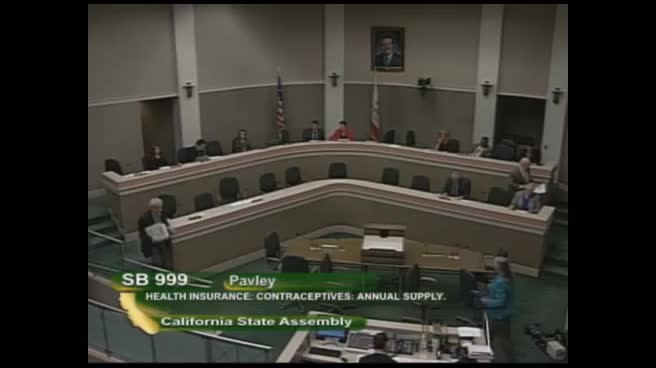 31MIN
Assembly Standing Committee on Health
 10MIN
Senate Floor
 6MIN
Senate Standing Committee on Appropriations
Bill Author

Bill Co-Author(s):