AB 2467: Controlled substances: fentanyl.
- Session Year: 2017-2018
- House: Assembly
- Latest Version Date: 2018-02-14
Existing law classifies controlled substances into 5 schedules and places the greatest restrictions and penalties on the use of those substances placed in Schedule I. Opiates, including fentanyl, are classified in Schedule II. Existing law prohibits a person from possessing for sale or purchasing for purposes of sale specified controlled substances, including fentanyl, and punishes a violation of that prohibition by imprisonment in a county jail for 2, 3, or 4 years. Existing law also prohibits transporting, importing into this state, selling, furnishing, administering, or giving away specified controlled substances, including fentanyl, and punishes a violation of that prohibition by imprisonment in a county jail for 3, 4, or 5 years. Existing law also prohibits the trafficking of specified controlled substances, including fentanyl, and punishes a violation of that prohibition by imprisonment in a county jail for 3, 6, or 9 years.
The bill would punish the possession, sale, or purchase for sale of fentanyl by imprisonment in a county jail for 4, 5, or 6 years, the transportation, importation, sale, furnishing, administering, or giving away of fentanyl by imprisonment in a county jail for 7, 8, or 9 years, and the trafficking of fentanyl by imprisonment in a county jail for 7, 10, or 13 years.
By increasing the penalty for a crime, this bill would impose a state-mandated local program.
The California Constitution requires the state to reimburse local agencies and school districts for certain costs mandated by the state. Statutory provisions establish procedures for making that reimbursement.
This bill would provide that no reimbursement is required by this act for a specified reason.
(a)Except as otherwise provided in this division, every person who possesses for sale or purchases for purposes of sale (1) any controlled substance specified in subdivision (b), (c), or (e) of Section 11054, specified in paragraph (14), (15), or (20) of subdivision (d) of Section 11054, or specified in subdivision (b) or (c) of Section 11055, or specified in subdivision (h) of Section 11056, or (2) any controlled substance classified in Schedule III, IV, or V which is a narcotic drug, shall be punished by imprisonment pursuant to subdivision (h) of Section 1170 of the Penal Code for two, three, or four years.
(b)Every person who possesses for sale or purchases for purposes of sale any fentanyl as specified in subdivision (c) of Section 11055 shall be punished by imprisonment pursuant to subdivision (h) of Section 1170 of the Penal Code for four, five, or six years.
SEC. 2.Section 11352 of the Health and Safety Code is amended to read:11352.(a)Except as otherwise provided in this division, every person who transports, imports into this state, sells, furnishes, administers, or gives away, or offers to transport, import into this state, sell, furnish, administer, or give away, or attempts to import into this state or transport (1) any controlled substance specified in subdivision (b), (c), or (e), or paragraph (1) of subdivision (f) of Section 11054, specified in paragraph (14), (15), or (20) of subdivision (d) of Section 11054, or specified in subdivision (b) or (c) of Section 11055, or specified in subdivision (h) of Section 11056, or (2) any controlled substance classified in Schedule III, IV, or V which is a narcotic drug, unless upon the written prescription of a physician, dentist, podiatrist, or veterinarian licensed to practice in this state, shall be punished by imprisonment pursuant to subdivision (h) of Section 1170 of the Penal Code for three, four, or five years.
(b)Notwithstanding the penalty provisions of subdivision (a), any person who transports any controlled substances specified in subdivision (a) within this state from one county to another noncontiguous county shall be punished by imprisonment pursuant to subdivision (h) of Section 1170 of the Penal Code for three, six, or nine years.
(c)(1)Every person who transports, imports into this state, sells, furnishes, administers, or gives away, or offers to transport, import into this state, sell, furnish, administer, or give away, or attempts to import into this state or transport any fentanyl as specified in subdivision (c) of Section 11055 shall be punished by imprisonment pursuant to subdivision (h) of Section 1170 of the Penal Code for seven, eight, or nine years.
(c)(2)Notwithstanding the penalty provisions of paragraph (1), any person who transports any fentanyl within this state from one county to another noncontiguous county shall be punished by imprisonment pursuant to subdivision (h) of Section 1170 of the Penal Code for 7, 10, or 13 years.
(d)For purposes of this section, transports means to transport for sale.
(d)(e)This section does not preclude or limit the prosecution of an individual for aiding and abetting the commission of, or conspiring to commit, or acting as an accessory to, any act prohibited by this section.
SEC. 3.No reimbursement is required by this act pursuant to Section 6 of Article XIIIB of the California Constitution because the only costs that may be incurred by a local agency or school district will be incurred because this act creates a new crime or infraction, eliminates a crime or infraction, or changes the penalty for a crime or infraction, within the meaning of Section 17556 of the Government Code, or changes the definition of a crime within the meaning of Section 6 of Article XIIIB of the California Constitution.
|
Date
|
Status
|
|---|---|
| Apr 26, 2018 | From committee: Without further action pursuant to Joint Rule 62(a). |
| Apr 24, 2018 | In committee: Set, second hearing. Failed passage. |
| Apr 3, 2018 | In committee: Set, first hearing. Failed passage. Reconsideration granted. |
| Mar 5, 2018 | Referred to Com. on PUB. S. |
| Feb 15, 2018 | From printer. May be heard in committee March 17. |
| Feb 14, 2018 | Read first time. To print. |
|
Date
|
Description
|
Location
|
Votes
|
|
|---|---|---|---|---|
| Apr 24, 2018 | Do pass and be re-referred to the Committee on [Appropriations] | Assembly Standing Committee on Public Safety |
Failed |
|
| Apr 3, 2018 | Reconsideration. | Assembly Standing Committee on Public Safety |
Passed |
|
| Apr 3, 2018 | Do pass and be re-referred to the Committee on [Appropriations] | Assembly Standing Committee on Public Safety |
Failed |
This list shows positions taken on this bill by organizations on the date displayed, which is linked to the original source.
Positions by individuals are not included.
|
Organization
|
Position
|
Date
|
|---|---|---|
| American Civil Liberties Union of California | ** Against | Apr 23, 2018 |
| Association of Deputy District Attorneys | ** Support | Apr 23, 2018 |
| California Attorneys For Criminal Justice | ** Against | Apr 23, 2018 |
| california peace officers' association | ** Support | Apr 23, 2018 |
| California Police Chiefs Association | ** Support | Apr 23, 2018 |
| California Public Defenders Association | ** Against | Apr 23, 2018 |
| California State Sheriffs' Association | ** Support | Apr 23, 2018 |
| Drug Policy Alliance | ** Against | Apr 23, 2018 |
| Fresno Deputy Sheriff's Association | ** Support | Apr 23, 2018 |
| Los Angeles County Sheriff'S Department | ** Support | Apr 23, 2018 |
| Mothers and Men Against Gangs Coalition | * Support | Apr 3, 2018 |
| Parents and Addicts in Need | * Support | Apr 3, 2018 |
| Peace Officers Research Association Of California | ** Support | Apr 23, 2018 |
Date of Hearing: April 24, 2018
Counsel: David Billingsley
ASSEMBLY COMMITTEE ON
Reginald Byron Jones-Sawyer, Sr., Chair
ABPCA Bill Id:
Author:() – As Ver:
VOTE ONLY
SUMMARY: Increases the punishment for specified drug crimes involving fentanyl. Specifically, this bill:
- Specifies that possession of fentanyl for purposes of sale shall be punished as a realigned felony for four, five, or six years in county jail or state prison as specified.
- States that a person who transports, imports into this state, sells, furnishes, administers, or gives away, or offers to transport, import into this state, sell, furnish, administer, or give away, or attempts to import into this state or transport any fentanyl shall be punished as a realigned felony for seven, eight, or nine years in county jail or state prison as specified.
- Provides that any person who transports any fentanyl within this state from one county to another noncontiguous county shall be punished as a realigned felony for 7, 10, or 13 years in county jail or state prison as specified.
EXISTING LAW:
- Lists controlled substances in five “schedules” - intended to list drugs in decreasing order of harm and increasing medical utility or safety - and provides penalties for possession of and commerce in controlled substances. Schedule I includes the most serious and heavily controlled substances, with Schedule V being the least serious and most lightly controlled substances. (Health & Saf. Code §§ 11054-11058.)
- Fentanyl is listed on Schedule II. ((Health & Saf. Code §§ 11055.)
- Provides the following penalties for trafficking of cocaine, cocaine base, heroin and specified opiates, including fentanyl:
- Possession for sale is punishable as felony, by imprisonment for two, three, or four years (as specified under Realignment); and (Health and Saf. Code § 11351.)
- Sale is punishable as a felony, by imprisonment for three, four, or five years (as specified under Realignment). Sale includes any transfer or distribution. Transportation of fentanyl, to a noncontiguous county, for purposes of sale is punishable as a felony, by imprisonment for up to nine years (as specified under Realignment). (Health and Saf. Code § 11352.)
- Possession for sale is punishable as felony, by imprisonment for two, three, or four years (as specified under Realignment); and (Health and Saf. Code § 11351.)
- Specifies that it is a felony to manufacture specified controlled substances, including fentanyl, punishable by imprisonment for three, five, or seven years (as specified under Realignment). (Health and Saf. Code § 11379.6.)
- Provides that, except as specified, the term "controlled substance analog" means either of the following:
- A substance the chemical structure of which is substantially similar to the chemical structure of specified controlled substances; or (Health & Saf. Code, § 11401, subd. (b)(1).)
- A substance which has, is represented as having, or is intended to have a stimulant, depressant, or hallucinogenic effect on the central nervous system that is substantially similar to, or greater than, the stimulant, depressant, or hallucinogenic effect on the central nervous system of specified controlled substances. (Health & Saf. Code, § 11401, subd. (b)(2).)
- A substance the chemical structure of which is substantially similar to the chemical structure of specified controlled substances; or (Health & Saf. Code, § 11401, subd. (b)(1).)
- Specifies that the term "controlled substance analog" does not mean “any substance for which there is an approved new drug application as specified under the federal Food, Drug, and Cosmetic Act or which is generally recognized as safe and effective as specified by the federal Food, Drug, and Cosmetic Act.” (Health & Saf. Code, § 11401, subd. (c)(1).)
- Provides the following additional sentencing enhancements based on the weight of the heroin, opiate (including fentanyl), or cocaine possessed for sale or sold. (Health and Saf. Code §§ 11370.4, subd. (a).)
- 1 kilogram = 3 years
- 4 kilograms = 5 years
- 10 kilograms = 10 years
- 20 kilograms = 15 years
- 40 kilograms = 20 years
- 80 kilograms = 25 years
- 1 kilogram = 3 years
FISCAL EFFECT: Unknown.
COMMENTS:
- Author's Statement: According to the author, " Despite the minuscule amount it takes to kill someone, the number of people dying of fentanyl overdoses is on the rise. A trafficker can transform a kilogram of fentanyl into thousands of pills sold for millions of dollars in profit. To prevent the spread of this highly lethal drug on our streets, AB 2467 will increase the penalties for possession for sale, transportation for sale, and transportation of fentanyl across state lines. While many people intentionally abuse fentanyl, there are some who unknowingly take it after it has been cut into other drugs. Regardless of the intended use, it is imperative that we do all that we can to fight and stop the spread of fentanyl by targeting the dealers who prosper from destroying lives..”
- Fentanyl and Fentanyl Analogs: Fentanyl was synthesized in the 1960s and has been used medically since 1968. The Centers for Disease Control and Prevention (CDC) website provides this description of fentanyl:
Fentanyl, a synthetic and short-acting opioid analgesic, is 50-100 times more potent than morphine and approved for managing acute or chronic pain associated with advanced cancer. …[M]ost cases of fentanyl-related morbidity and mortality have been linked to illicitly manufactured fentanyl and fentanyl analogs, collectively referred to as non-pharmaceutical fentanyl (NPF). NPF is sold via illicit drug markets for its heroin-like effect and often mixed with heroin and/or cocaine as a combination product—with or without the user’s knowledge—to increase its euphoric effects. While NPF-related overdoses can be reversed with naloxone, a higher dose or multiple number of doses per overdose event may be required …due to the high potency of NPF. (Internal quotation marks and footnotes omitted.) (http://emergency.cdc.gov/han/han00384.asp)
The DEA has reported to the United States Senate that most illicit fentanyl is produced in Mexico “with its analogs and precursors obtained from distributors in China. Fentanyl is smuggled across the [Southwest U.S. border] in kilogram quantities…” (http://www.dea.gov/pr/speeches-testimony/2015t/111715t.pdf)
- Increasing Sentences for Fentanyl: Criminal justice experts and commentators have noted that, with regard to sentencing, “a key question for policy development regards whether enhanced sanctions or an enhanced possibility of being apprehended provide any additional deterrent benefits.
Research to date generally indicates that increases in the certainty of punishment, as opposed to the severity of punishment, are more likely to produce deterrent benefits. (http://www.sentencingproject.org/doc/Deterrence%20Briefing%20.pdf.)
A comprehensive report published in 2014, entitled The Growth of Incarceration in the United States, discusses the effects on crime reduction through incapacitation and deterrence, and describes general deterrence compared to specific deterrence:
A large body of research has studied the effects of incarceration and other criminal penalties on crime. Much of this research is guided by the hypothesis that incarceration reduces crime through incapacitation and deterrence. Incapacitation refers to the crimes averted by the physical isolation of convicted offenders during the period of their incarceration. Theories of deterrence distinguish between general and specific behavioral responses. General deterrence refers to the crime prevention effects of the threat of punishment, while specific deterrence concerns the aftermath of the failure of general deterrence—that is, the effect on reoffending that might result from the experience of actually being punished. Most of this research studies the relationship between criminal sanctions and crimes other than drug offenses. A related literature focuses specifically on enforcement of drug laws and the relationship between those criminal sanctions and the outcomes of drug use and drug prices. (http://johnjay.jjay.cuny.edu/nrc/NAS_report_on_incarceration.pdf)
In regard to deterrence, the authors note that in “the classical theory of deterrence, crime is averted when the expected costs of punishment exceed the benefits of offending. Much of the empirical research on the deterrent power of criminal penalties has studied sentence enhancements and other shifts in penal policy. . . .
Deterrence theory is underpinned by a rationalistic view of crime. In this view, an individual considering commission of a crime weighs the benefits of offending against the costs of punishment. Much offending, however, departs from the strict decision calculus of the rationalistic model. Robinson and Darley (2004) review the limits of deterrence through harsh punishment. They report that offenders must have some knowledge of criminal penalties to be deterred from committing a crime, but in practice often do not.” (Id.)
The authors of the 2014 report discussed above conclude that incapacitation of certain dangerous offenders can have “large crime prevention benefits,” but that incremental, lengthy prison sentences are ineffective for crime deterrence:
Whatever the estimated average effect of the incarceration rate on the crime rate, the available studies on imprisonment and crime have limited utility for policy. The incarceration rate is the outcome of policies affecting who goes to prison and for how long and of policies affecting parole revocation. Not all policies can be expected to be equally effective in preventing crime. Thus, it is inaccurate to speak of the crime prevention effect of incarceration in the singular. Policies that effectively target the incarceration of highly dangerous and frequent offenders can have large crime prevention benefits, whereas other policies will have a small prevention effect or, even worse, increase crime in the long run if they have the effect of increasing postrelease criminality.
Evidence is limited on the crime prevention effects of most of the policies that contributed to the post-1973 increase in incarceration rates. Nevertheless, the evidence base demonstrates that lengthy prison sentences are ineffective as a crime control measure. Specifically, the incremental deterrent effect of increases in lengthy prison sentences is modest at best. Also, because recidivism rates decline markedly with age and prisoners necessarily age as they serve their prison sentence, lengthy prison sentences are an inefficient approach to preventing crime by incapacitation unless they are specifically targeted at very high-rate or extremely dangerous offenders. For these reasons, statutes mandating lengthy prison sentences cannot be justified on the basis of their effectiveness in preventing crime. (Id.)
With regard to the drug trade, the authors state:
For several categories of offenders, an incapacitation strategy of crime prevention can misfire because most or all of those sent to prison are rapidly replaced in the criminal networks in which they participate. Street-level drug trafficking is the paradigm case. Drug dealing is part of a complex illegal market with low barriers to entry. Net earnings are low, and probabilities of eventual arrest and imprisonment are high . . . Drug policy research has nonetheless shown consistently that arrested dealers are quickly replaced by new recruits . . . . At the corner of Ninth and Concordia in Milwaukee in the mid-1990s, for example, 94 drug arrests were made within a 3-month period. “These arrests, [the police officer] pointed out, were easy to prosecute to conviction. But . . . the drug market continued to thrive at the intersection” . . . .
Despite the risks of drug dealing and the low average profits, many young disadvantaged people with little social capital and limited life chances sell drugs on street corners because it appears to present opportunities not otherwise available. However, [they] … overestimate the benefits of that activity and underestimate the risks. This perception is compounded by peer influences, social pressures, and deviant role models provided by successful dealers who live affluent lives and… avoid arrest. Similar analyses apply to members of deviant youth groups and gangs: as members … are arrested and removed from circulation, others take their place. Arrests and imprisonments of easily replaceable offenders create illicit “opportunities” for others. (Id.)
- Jail Overcrowding: Realignment began in October 2011. Since that time county jails have had oversight over most non-serious, non-violent, non-sexual felons and parolees who violate their parole. Before realignment, the maximum sentence in county jail was one year. Now that lower-level felons serve sentences in county jail a certain portion of the jail population is serving sentences that are much longer than one year. Those factors related to realignment have served to increase population pressure on county jails.
In November of 2017, the Public Policy Institute of California published a report discussing population impacts on California jails related to Realignment and Proposition 47. After realignment began, the jail population began to rise; as of October 2014, the month before the passage of Proposition 47, it stood at 82,005 inmates, a gain of 14%—and about 2,000 inmates over the rated capacity of 80,000 (set by the California Board of State and Community Corrections). To address these capacity constraints, counties released 14,321 pre-sentenced and sentenced inmates in October 2014—an increase of 4,102 (or 40%) from September 2011. (http://www.ppic.org/publication/californias-county-jails/)
Voters approved Proposition 47 in November 2014, reclassifying several property and drug crimes from felonies to misdemeanors. Prop 47 has had an immediate and lasting impact: the average daily population dropped by almost 10,000 between October 2014 and January 2015. The jail population has remained relatively flat since January 2015, and as of December 2016 it stood at 73,460 inmates, a decrease of 8,545 (or 10.4%) from October 2014. At the end of 2016, 28 jails housed populations that exceeded their rated capacities, compared to 53 jails in October 2014. (Id.)
This bill would dramatically increase sentences for individuals convicted of specified criminal offenses involving fentanyl. The sentences served by the individuals sentenced pursuant to the provisions of this bill would predominately be served in county jail. The balance of the individuals sentenced under this bill would serve their sentences in the state prison, if based on prior convictions of specified offenses. - Related Legislation:
- AB 1948 (Jones-Sawyer), would add fentanyl to the list of controlled substances for which interception of wire or electronic communications may be ordered. AB 1948 is awaiting hearing in the Assembly Appropriations Committee.
- AB 2405 (Patterson), would classify carfentanil in Schedule II of the drug schedule and increase penalties for trafficking in carfentanil. AB 2405 is set for hearing in the Assembly Public Safety Committee on April 3, 2018.
- SB 1103 (Bates), would apply the weight enhancement for possession for sale, or sale, of specified drugs, to fentanyl. SB 1103 is set for hearing in the Senate Public Safety Committee on April 10, 2018.
- AB 3105 (Waldron), would make sale of fentanyl punishable by a term of 10 years to life in a case involving 20 grams or more of a mixture or substance containing a detectable amount of fentanyl, as defined, or 5 grams or more of a mixture or substance containing an analogue. AB 3105 would dramatically raise penalties for sale of fentanyl at defined lower amounts. AB 3105 is awaiting hearing in the Assembly Public Safety Committee.
- Prior Legislation:
- SB 176 (Bates), of the 2017-2018 Legislative Session, would have classified carfentanil in Schedule II. SB 176 would have applied the weight enhancement to a substance containing carfentanil or fentanyl. SB 176 failed passage in the Senate Public Safety Committee.
- SB 1323 (Bates), of the 2015-2016 Legislative Session, would have applied the weight enhancement for possession for sale, or sale, of specified drugs, to fentanyl. SB 1323 was held on the Assembly Appropriations Committee Suspense File.
- Argument in Support: According to the Peace Officers Research Association of California, "This bill would punish the possession, sale, or purchase for sale of fentanyl by imprisonment in a county jail for 4,5, or 6 years, the transportation, importation, sale, furnishing, administering, or giving away of fentanyl by imprisonment in a county jail for 7, 8, 9 years, and the trafficking of fentanyl by imprisonment in a county jail for 7, 10. Or 13 years. This bill contains other related provisions and other existing laws.”
- Argument in Opposition: According to the Drug Policy Alliance, "AB 2467 would not reduce the distribution of fentanyl nor prevent overdoses. Instead, it could undermine current efforts to address the opioid overdose crisis. Substantial evidence demonstrates that criminal penalties do not have any effect on reducing either the supply of drugs or the demand for them. Studies on tough on crime policies clearly show that incarceration does not decrease the demand for drugs. One study found that states that increase their incarceration rates do not experience a decrease in drug use. When a drug seller is incarcerated, the supply of drugs is not reduced nor is the drug market impacted. Because the drug market is driven by demand rather than supply, research indicates that an incarcerated seller will simply be replaced by another individual to fill the market demand.
“When we incarcerate people for distribution of drugs we often inadvertently lock up people impacted by the opioid overdose crisis. A Bureau of Justice report found that 70% of people incarcerated for drug trafficking at state prisons used drugs prior to the offense. These individuals often distribute drugs, not for profit, but as a way to support their own substance use disorder.
“While AB 2467 seeks to reduce opioid overdoes in California, there is no evidence its criminalization tactics would reduce fentanyl or fatal overdoes. Rather than diminishing the harms of drug misuse, criminalizing people who sell and use drugs amplifies the risk of fatal overdoes and diseases, increases stigma and marginalization and drives people away from needed treatment, health, and harm reduction services.”
REGISTERED SUPPORT / OPPOSITION:
Support
Association of Deputy District Attorneys
California Peace Officers’ Association
California Police Chiefs Association
California State Sheriffs’ Association
Fresno Deputy Sheriff’s Association
Los Angeles County Sheriff’s Department
Peace Officers Research Association of California
Opposition
American Civil Liberties Union of California
California Attorneys for Criminal Justice
California Public Defenders Association
Drug Policy Alliance
Analysis Prepared by:
Date of Hearing:
Counsel: David Billingsley
ASSEMBLY COMMITTEE ON PUBLIC SAFETY
Reginald Byron Jones-Sawyer, Sr., Chair
ABPCA Bill Id:AB 2467
Author:(Patterson) – As Introduced Ver:February 14, 2018
SUMMARY: Increases the punishment for specified drug crimes involving fentanyl. Specifically, this bill:
- Specifies that possession of fentanyl for purposes of sale shall be punished as a realigned felony for four, five, or six years in county jail or state prison as specified.
- States that a person who transports, imports into this state, sells, furnishes, administers, or gives away, or offers to transport, import into this state, sell, furnish, administer, or give away, or attempts to import into this state or transport any fentanyl shall be punished as a realigned felony for seven, eight, or nine years in county jail or state prison as specified.
- Provides that any person who transports any fentanyl within this state from one county to another noncontiguous county shall be punished as a realigned felony for 7, 10, or 13 years in county jail or state prison as specified.
EXISTING LAW:
- Lists controlled substances in five “schedules” - intended to list drugs in decreasing order of harm and increasing medical utility or safety - and provides penalties for possession of and commerce in controlled substances. Schedule I includes the most serious and heavily controlled substances, with Schedule V being the least serious and most lightly controlled substances. (Health & Saf. Code §§ 11054-11058.)
- Fentanyl is listed on Schedule II. ((Health & Saf. Code §§ 11055.)
- Provides the following penalties for trafficking of cocaine, cocaine base, heroin and specified opiates, including fentanyl:
- Possession for sale is punishable as felony, by imprisonment for two, three, or four years (as specified under Realignment); and (Health and Saf. Code § 11351.)
- Sale is punishable as a felony, by imprisonment for three, four, or five years (as specified under Realignment). Sale includes any transfer or distribution. Transportation of fentanyl, to a noncontiguous county, for purposes of sale is punishable as a felony, by imprisonment for up to nine years (as specified under Realignment). (Health and Saf. Code § 11352.)
- Possession for sale is punishable as felony, by imprisonment for two, three, or four years (as specified under Realignment); and (Health and Saf. Code § 11351.)
- Specifies that it is a felony to manufacture specified controlled substances, including fentanyl, punishable by imprisonment for three, five, or seven years (as specified under Realignment). (Health and Saf. Code § 11379.6.)
- Provides that, except as specified, the term "controlled substance analog" means either of the following:
- A substance the chemical structure of which is substantially similar to the chemical structure of specified controlled substances; or (Health & Saf. Code, § 11401, subd. (b)(1).)
- A substance which has, is represented as having, or is intended to have a stimulant, depressant, or hallucinogenic effect on the central nervous system that is substantially similar to, or greater than, the stimulant, depressant, or hallucinogenic effect on the central nervous system of specified controlled substances. (Health & Saf. Code, § 11401, subd. (b)(2).)
- A substance the chemical structure of which is substantially similar to the chemical structure of specified controlled substances; or (Health & Saf. Code, § 11401, subd. (b)(1).)
- Specifies that the term "controlled substance analog" does not mean “any substance for which there is an approved new drug application as specified under the federal Food, Drug, and Cosmetic Act or which is generally recognized as safe and effective as specified by the federal Food, Drug, and Cosmetic Act.” (Health & Saf. Code, § 11401, subd. (c)(1).)
- Provides the following additional sentencing enhancements based on the weight of the heroin, opiate (including fentanyl), or cocaine possessed for sale or sold. (Health and Saf. Code §§ 11370.4, subd. (a).)
- 1 kilogram = 3 years
- 4 kilograms = 5 years
- 10 kilograms = 10 years
- 20 kilograms = 15 years
- 40 kilograms = 20 years
- 80 kilograms = 25 years
- 1 kilogram = 3 years
FISCAL EFFECT: Unknown.
COMMENTS:
- Author's Statement: According to the author, " Despite the minuscule amount it takes to kill someone, the number of people dying of fentanyl overdoses is on the rise. A trafficker can transform a kilogram of fentanyl into thousands of pills sold for millions of dollars in profit. To prevent the spread of this highly lethal drug on our streets, AB 2467 will increase the penalties for possession for sale, transportation for sale, and transportation of fentanyl across state lines. While many people intentionally abuse fentanyl, there are some who unknowingly take it after it has been cut into other drugs. Regardless of the intended use, it is imperative that we do all that we can to fight and stop the spread of fentanyl by targeting the dealers who prosper from destroying lives..”
- Fentanyl and Fentanyl Analogs: Fentanyl was synthesized in the 1960s and has been used medically since 1968. The Centers for Disease Control and Prevention (CDC) website provides this description of fentanyl:
Fentanyl, a synthetic and short-acting opioid analgesic, is 50-100 times more potent than morphine and approved for managing acute or chronic pain associated with advanced cancer. …[M]ost cases of fentanyl-related morbidity and mortality have been linked to illicitly manufactured fentanyl and fentanyl analogs, collectively referred to as non-pharmaceutical fentanyl (NPF). NPF is sold via illicit drug markets for its heroin-like effect and often mixed with heroin and/or cocaine as a combination product—with or without the user’s knowledge—to increase its euphoric effects. While NPF-related overdoses can be reversed with naloxone, a higher dose or multiple number of doses per overdose event may be required …due to the high potency of NPF. (Internal quotation marks and footnotes omitted.) (http://emergency.cdc.gov/han/han00384.asp)
The DEA has reported to the United States Senate that most illicit fentanyl is produced in Mexico “with its analogs and precursors obtained from distributors in China. Fentanyl is smuggled across the [Southwest U.S. border] in kilogram quantities…” (http://www.dea.gov/pr/speeches-testimony/2015t/111715t.pdf)
- Increasing Sentences for Fentanyl: Criminal justice experts and commentators have noted that, with regard to sentencing, “a key question for policy development regards whether enhanced sanctions or an enhanced possibility of being apprehended provide any additional deterrent benefits.
Research to date generally indicates that increases in the certainty of punishment, as opposed to the severity of punishment, are more likely to produce deterrent benefits. (http://www.sentencingproject.org/doc/Deterrence%20Briefing%20.pdf.)
A comprehensive report published in 2014, entitled The Growth of Incarceration in the United States, discusses the effects on crime reduction through incapacitation and deterrence, and describes general deterrence compared to specific deterrence:
A large body of research has studied the effects of incarceration and other criminal penalties on crime. Much of this research is guided by the hypothesis that incarceration reduces crime through incapacitation and deterrence. Incapacitation refers to the crimes averted by the physical isolation of convicted offenders during the period of their incarceration. Theories of deterrence distinguish between general and specific behavioral responses. General deterrence refers to the crime prevention effects of the threat of punishment, while specific deterrence concerns the aftermath of the failure of general deterrence—that is, the effect on reoffending that might result from the experience of actually being punished. Most of this research studies the relationship between criminal sanctions and crimes other than drug offenses. A related literature focuses specifically on enforcement of drug laws and the relationship between those criminal sanctions and the outcomes of drug use and drug prices. (http://johnjay.jjay.cuny.edu/nrc/NAS_report_on_incarceration.pdf)
In regard to deterrence, the authors note that in “the classical theory of deterrence, crime is averted when the expected costs of punishment exceed the benefits of offending. Much of the empirical research on the deterrent power of criminal penalties has studied sentence enhancements and other shifts in penal policy. . . .
Deterrence theory is underpinned by a rationalistic view of crime. In this view, an individual considering commission of a crime weighs the benefits of offending against the costs of punishment. Much offending, however, departs from the strict decision calculus of the rationalistic model. Robinson and Darley (2004) review the limits of deterrence through harsh punishment. They report that offenders must have some knowledge of criminal penalties to be deterred from committing a crime, but in practice often do not.” (Id.)
The authors of the 2014 report discussed above conclude that incapacitation of certain dangerous offenders can have “large crime prevention benefits,” but that incremental, lengthy prison sentences are ineffective for crime deterrence:
Whatever the estimated average effect of the incarceration rate on the crime rate, the available studies on imprisonment and crime have limited utility for policy. The incarceration rate is the outcome of policies affecting who goes to prison and for how long and of policies affecting parole revocation. Not all policies can be expected to be equally effective in preventing crime. Thus, it is inaccurate to speak of the crime prevention effect of incarceration in the singular. Policies that effectively target the incarceration of highly dangerous and frequent offenders can have large crime prevention benefits, whereas other policies will have a small prevention effect or, even worse, increase crime in the long run if they have the effect of increasing postrelease criminality.
Evidence is limited on the crime prevention effects of most of the policies that contributed to the post-1973 increase in incarceration rates. Nevertheless, the evidence base demonstrates that lengthy prison sentences are ineffective as a crime control measure. Specifically, the incremental deterrent effect of increases in lengthy prison sentences is modest at best. Also, because recidivism rates decline markedly with age and prisoners necessarily age as they serve their prison sentence, lengthy prison sentences are an inefficient approach to preventing crime by incapacitation unless they are specifically targeted at very high-rate or extremely dangerous offenders. For these reasons, statutes mandating lengthy prison sentences cannot be justified on the basis of their effectiveness in preventing crime. (Id.)
With regard to the drug trade, the authors state:
For several categories of offenders, an incapacitation strategy of crime prevention can misfire because most or all of those sent to prison are rapidly replaced in the criminal networks in which they participate. Street-level drug trafficking is the paradigm case. Drug dealing is part of a complex illegal market with low barriers to entry. Net earnings are low, and probabilities of eventual arrest and imprisonment are high . . . Drug policy research has nonetheless shown consistently that arrested dealers are quickly replaced by new recruits . . . . At the corner of Ninth and Concordia in Milwaukee in the mid-1990s, for example, 94 drug arrests were made within a 3-month period. “These arrests, [the police officer] pointed out, were easy to prosecute to conviction. But . . . the drug market continued to thrive at the intersection” . . . .
Despite the risks of drug dealing and the low average profits, many young disadvantaged people with little social capital and limited life chances sell drugs on street corners because it appears to present opportunities not otherwise available. However, [they] … overestimate the benefits of that activity and underestimate the risks. This perception is compounded by peer influences, social pressures, and deviant role models provided by successful dealers who live affluent lives and… avoid arrest. Similar analyses apply to members of deviant youth groups and gangs: as members … are arrested and removed from circulation, others take their place. Arrests and imprisonments of easily replaceable offenders create illicit “opportunities” for others. (Id.)
- Jail Overcrowding: Realignment began in October 2011. Since that time county jails have had oversight over most non-serious, non-violent, non-sexual felons and parolees who violate their parole. Before realignment, the maximum sentence in county jail was one year. Now that lower-level felons serve sentences in county jail a certain portion of the jail population is serving sentences that are much longer than one year. Those factors related to realignment have served to increase population pressure on county jails.
In November of 2017, the Public Policy Institute of California published a report discussing population impacts on California jails related to Realignment and Proposition 47. After realignment began, the jail population began to rise; as of October 2014, the month before the passage of Proposition 47, it stood at 82,005 inmates, a gain of 14%—and about 2,000 inmates over the rated capacity of 80,000 (set by the California Board of State and Community Corrections). To address these capacity constraints, counties released 14,321 pre-sentenced and sentenced inmates in October 2014—an increase of 4,102 (or 40%) from September 2011. (http://www.ppic.org/publication/californias-county-jails/)
Voters approved Proposition 47 in November 2014, reclassifying several property and drug crimes from felonies to misdemeanors. Prop 47 has had an immediate and lasting impact: the average daily population dropped by almost 10,000 between October 2014 and January 2015. The jail population has remained relatively flat since January 2015, and as of December 2016 it stood at 73,460 inmates, a decrease of 8,545 (or 10.4%) from October 2014. At the end of 2016, 28 jails housed populations that exceeded their rated capacities, compared to 53 jails in October 2014. (Id.)
This bill would dramatically increase sentences for individuals convicted of specified criminal offenses involving fentanyl. The sentences served by the individuals sentenced pursuant to the provisions of this bill would predominately be served in county jail. The balance of the individuals sentenced under this bill would serve their sentences in the state prison, if based on prior convictions of specified offenses. - Related Legislation:
- AB 1948 (Jones-Sawyer), would add fentanyl to the list of controlled substances for which interception of wire or electronic communications may be ordered. AB 1948 is awaiting hearing in the Assembly Appropriations Committee.
- AB 2405 (Patterson), would classify carfentanil in Schedule II of the drug schedule and increase penalties for trafficking in carfentanil. AB 2405 is set for hearing in the Assembly Public Safety Committee on April 3, 2018.
- SB 1103 (Bates), would apply the weight enhancement for possession for sale, or sale, of specified drugs, to fentanyl. SB 1103 is set for hearing in the Senate Public Safety Committee on April 10, 2018.
- AB 3105 (Waldron), would make sale of fentanyl punishable by a term of 10 years to life in a case involving 20 grams or more of a mixture or substance containing a detectable amount of fentanyl, as defined, or 5 grams or more of a mixture or substance containing an analogue. AB 3105 would dramatically raise penalties for sale of fentanyl at defined lower amounts. AB 3105 is awaiting hearing in the Assembly Public Safety Committee.
- Prior Legislation:
- SB 176 (Bates), of the 2017-2018 Legislative Session, would have classified carfentanil in Schedule II. SB 176 would have applied the weight enhancement to a substance containing carfentanil or fentanyl. SB 176 failed passage in the Senate Public Safety Committee.
- SB 1323 (Bates), of the 2015-2016 Legislative Session, would have applied the weight enhancement for possession for sale, or sale, of specified drugs, to fentanyl. SB 1323 was held on the Assembly Appropriations Committee Suspense File.
- Argument in Support: According to the Peace Officers Research Association of California, "This bill would punish the possession, sale, or purchase for sale of fentanyl by imprisonment in a county jail for 4,5, or 6 years, the transportation, importation, sale, furnishing, administering, or giving away of fentanyl by imprisonment in a county jail for 7, 8, 9 years, and the trafficking of fentanyl by imprisonment in a county jail for 7, 10. Or 13 years. This bill contains other related provisions and other existing laws.”
- Argument in Opposition: According to the Drug Policy Alliance, "AB 2467 would not reduce the distribution of fentanyl nor prevent overdoses. Instead, it could undermine current efforts to address the opioid overdose crisis. Substantial evidence demonstrates that criminal penalties do not have any effect on reducing either the supply of drugs or the demand for them. Studies on tough on crime policies clearly show that incarceration does not decrease the demand for drugs. One study found that states that increase their incarceration rates do not experience a decrease in drug use. When a drug seller is incarcerated, the supply of drugs is not reduced nor is the drug market impacted. Because the drug market is driven by demand rather than supply, research indicates that an incarcerated seller will simply be replaced by another individual to fill the market demand.
“When we incarcerate people for distribution of drugs we often inadvertently lock up people impacted by the opioid overdose crisis. A Bureau of Justice report found that 70% of people incarcerated for drug trafficking at state prisons used drugs prior to the offense. These individuals often distribute drugs, not for profit, but as a way to support their own substance use disorder.
“While AB 2467 seeks to reduce opioid overdoes in California, there is no evidence its criminalization tactics would reduce fentanyl or fatal overdoes. Rather than diminishing the harms of drug misuse, criminalizing people who sell and use drugs amplifies the risk of fatal overdoes and diseases, increases stigma and marginalization and drives people away from needed treatment, health, and harm reduction services.”
REGISTERED SUPPORT / OPPOSITION:
Support
Association of Deputy District Attorneys
California Peace Officers’ Association
California Police Chiefs Association
California State Sheriffs’ Association
Fresno Deputy Sheriff’s Association
Los Angeles County Sheriff’s Department
Peace Officers Research Association of California
Opposition
American Civil Liberties Union of California
California Attorneys for Criminal Justice
Drug Policy Alliance
Analysis Prepared by:
David Billingsley / PUB. S. / (916) 319-3744
Discussed in Hearing
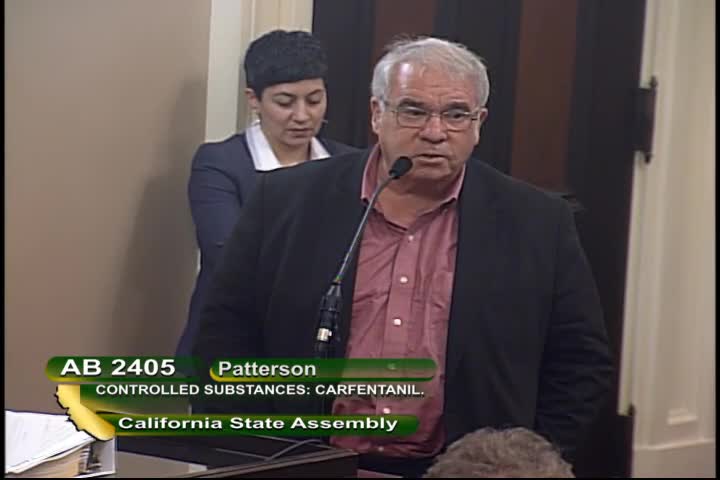 14MIN
Assembly Standing Committee on Public Safety
Bill Author

Bill Co-Author(s):