AB 2733: Firearms: unsafe handguns: imprinting.
- Session Year: 2017-2018
- House: Assembly
- Latest Version Date: 2018-02-15
Existing law, subject to exceptions, generally makes it an offense to manufacture or sell a handgun that is not safe. Existing law establishes criteria for determining if a handgun is unsafe. Existing law generally requires manufacturers to submit samples of new handgun models for testing to determine if they are unsafe or may be approved for sale, as specified. Existing law requires the Department of Justice to compile a roster listing all of the handguns that have been tested and determined not to be unsafe.
Existing law, defines as unsafe a semiautomatic pistol that is not, as of January 1, 2010, listed on the roster if it is not designed and equipped with a microscopic array of characters that identify the make, model, and serial number of the pistol, etched or imprinted in 2 or more places on the interior surface or internal working parts of the pistol that are transferred by imprinting on each cartridge case when the firearm is fired. Existing law conditions this requirement on certification by the Department of Justice that this technology is available to more than one manufacturer unencumbered by patent restrictions.
This bill would delete the requirement that a firearm be designed and equipped with this imprinting technology to be listed on the roster of handguns that have been determined not to be unsafe.
As used in this part, unsafe handgun means any pistol, revolver, or other firearm capable of being concealed upon the person, for which any of the following is true:
(a)For a revolver:
(1)It does not have a safety device that, either automatically in the case of a double-action firing mechanism, or by manual operation in the case of a single-action firing mechanism, causes the hammer to retract to a point where the firing pin does not rest upon the primer of the cartridge.
(2)It does not meet the firing requirement for handguns.
(3)It does not meet the drop safety requirement for handguns.
(b)For a pistol:
(1)It does not have a positive manually operated safety device, as determined by standards relating to imported guns promulgated by the federal Bureau of Alcohol, Tobacco, Firearms and Explosives.
(2)It does not meet the firing requirement for handguns.
(3)It does not meet the drop safety requirement for handguns.
(4)Commencing January 1, 2006, for a center fire semiautomatic pistol that is not already listed on the roster pursuant to Section 32015, it does not have either a chamber load indicator, or a magazine disconnect mechanism.
(5)Commencing January 1, 2007, for all center fire semiautomatic pistols that are not already listed on the roster pursuant to Section 32015, it does not have both a chamber load indicator and if it has a detachable magazine, a magazine disconnect mechanism.
(6)Commencing January 1, 2006, for all rimfire semiautomatic pistols that are not already listed on the roster pursuant to Section 32015, it does not have a magazine disconnect mechanism, if it has a detachable magazine.
(7)(A)Commencing January 1, 2010, for all semiautomatic pistols that are not already listed on the roster pursuant to Section 32015, it is not designed and equipped with a microscopic array of characters that identify the make, model, and serial number of the pistol, etched or otherwise imprinted in two or more places on the interior surface or internal working parts of the pistol, and that are transferred by imprinting on each cartridge case when the firearm is fired, provided that the Department of Justice certifies that the technology used to create the imprint is available to more than one manufacturer unencumbered by any patent restrictions.(B)The Attorney General may also approve a method of equal or greater reliability and effectiveness in identifying the specific serial number of a firearm from spent cartridge casings discharged by that firearm than that which is set forth in this paragraph, to be thereafter required as otherwise set forth by this paragraph where the Attorney General certifies that this new method is also unencumbered by any patent restrictions. Approval by the Attorney General shall include notice of that fact via regulations adopted by the Attorney General for purposes of implementing that method for purposes of this paragraph.(C)The microscopic array of characters required by this section shall not be considered the name of the maker, model, manufacturers number, or other mark of identification, including any distinguishing number or mark assigned by the Department of Justice, within the meaning of Sections 23900 and 23920.|
Date
|
Status
|
|---|---|
| Apr 26, 2018 | From committee: Without further action pursuant to Joint Rule 62(a). |
| Apr 24, 2018 | In committee: Set, second hearing. Failed passage. |
| Apr 3, 2018 | In committee: Set, first hearing. Failed passage. Reconsideration granted. |
| Mar 8, 2018 | Referred to Com. on PUB. S. |
| Feb 16, 2018 | From printer. May be heard in committee March 18. |
| Feb 15, 2018 | Read first time. To print. |
|
Date
|
Description
|
Location
|
Votes
|
|
|---|---|---|---|---|
| Apr 24, 2018 | Do pass and be re-referred to the Committee on [Appropriations] | Assembly Standing Committee on Public Safety |
Failed |
|
| Apr 3, 2018 | Reconsideration. | Assembly Standing Committee on Public Safety |
Passed |
|
| Apr 3, 2018 | Do pass and be re-referred to the Committee on [Appropriations] | Assembly Standing Committee on Public Safety |
Failed |
This list shows positions taken on this bill by organizations on the date displayed, which is linked to the original source.
Positions by individuals are not included.
|
Organization
|
Position
|
Date
|
|---|---|---|
| American Academy of Pediatrics | ** Against | Apr 23, 2018 |
| Giffords Law Center | ** Against | Apr 23, 2018 |
| Gun Owners of California | ** Support | Apr 23, 2018 |
| National Rifle Association | ** Support | Apr 23, 2018 |
| National Shooting Sports Foundation | ** Support | Apr 23, 2018 |
Date of Hearing: April 24, 2018
Chief Counsel: Gregory Pagan
ASSEMBLY COMMITTEE ON
Reginald Byron Jones-Sawyer, Sr., Chair
ABPCA Bill Id:
Author:() – As Ver:
VOTE ONLY
SUMMARY:
Deletes the requirement that a firearm be designed and equipped with microscopic characters that leave an imprint, as specified, on each cartridge when the firearm is fired in order to be listed on the roster of not unsafe handguns.
EXISTING LAW:
- Requires commencing January 1, 2010 for all semiautomatic pistols that are not already listed on the roster of not unsafe handguns, be designed and equipped with a microscopic array of characters that identify the make, model, and serial number of the pistol, etched or otherwise imprinted in two or more places on the interior surface or internal working parts of the pistol, and that are transferred by imprinting on each cartridge case when the firearm is fired, provided that the Department of Justice (DOJ) certifies that the technology is available to more than one manufacturer unencumbered by any patent restrictions. (Pen. Code, § 31910, subd. (b)(7)(A).)
- Requires commencing January 1, 2001, that any person in California who manufactures or causes to be manufactured, imports into the state for sale, keeps for sale, offers or exposes for sale, gives, or lends any unsafe handgun shall be punished by imprisonment in a county jail not exceeding one year. (Pen. Code, § 32000, subd. (a).) Specifies that this section shall not apply to any of the following:
- The manufacture in California, or importation into this state, of any prototype pistol, revolver, or other firearm capable of being concealed upon the person when the manufacture or importation is for the sole purpose of allowing an independent laboratory certified by the DOJ to conduct an independent test to determine whether that pistol, revolver, or other firearm capable of being concealed upon the person is prohibited, inclusive, and, if not, allowing the department to add the firearm to the roster of pistols, revolvers, and other firearms capable of being concealed upon the person that may be sold in this;
- The importation or lending of a pistol, revolver, or other firearm capable of being concealed upon the person by employees or authorized agents of entities determining whether the weapon is prohibited by this section;
- Firearms listed as curios or relics, as defined in federal law; and
- The sale or purchase of any pistol, revolver, or other firearm capable of being concealed upon the person, if the pistol, revolver, or other firearm is sold to, or purchased by, the Department of Justice, any police department, any sheriff's official, any marshal's office, the Youth and Adult Correctional Agency, the California Highway Patrol, any district attorney's office, or the military or naval forces of this state or of the United States for use in the discharge of their official duties. Nor shall anything in this section prohibit the sale to, or purchase by, sworn members of these agencies of any pistol, revolver, or other firearm capable of being concealed upon the person. (Pen. Code, § 32000, subd. (b).)
- The manufacture in California, or importation into this state, of any prototype pistol, revolver, or other firearm capable of being concealed upon the person when the manufacture or importation is for the sole purpose of allowing an independent laboratory certified by the DOJ to conduct an independent test to determine whether that pistol, revolver, or other firearm capable of being concealed upon the person is prohibited, inclusive, and, if not, allowing the department to add the firearm to the roster of pistols, revolvers, and other firearms capable of being concealed upon the person that may be sold in this;
- Specifies that violations of the unsafe handgun provisions are cumulative with respect to each handgun and shall not be construed as restricting the application of any other law.
(Pen. Code, § 32000, subd. (c).) - Defines "unsafe handgun" as “any pistol, revolver, or other firearm capable of being concealed upon the person, as specified, which lacks various safety mechanisms, as specified.” (Pen. Code, § 31910.)
- Requires any concealable firearm manufactured in California, imported for sale, kept for sale, or offered for sale to be tested within a reasonable period of time by an independent laboratory, certified by the state Department of Justice (DOJ), to determine whether it meets required safety standards, as specified. (Pen. Code, § 32010, subd. (a).)
- Requires DOJ, on and after January 1, 2001, to compile, publish, and thereafter maintain a roster listing all of the pistols, revolvers, and other firearms capable of being concealed upon the person that have been tested by a certified testing laboratory, have been determined not to be unsafe handguns, and may be sold in this state, as specified. The roster shall list, for each firearm, the manufacturer, model number, and model name. (Pen. Code, § 32015, subd. (a).)
- Provides that DOJ may charge every person in California who is licensed as a manufacturer of firearms, as specified, and any person in California who manufactures or causes to be manufactured, imports into California for sale, keeps for sale, or offers or exposes for sale any pistol, revolver, or other firearm capable of being concealed upon the person in California, an annual fee not exceeding the costs of preparing, publishing, and maintaining the roster of firearms determined not be unsafe, and the costs of research and development, report analysis, firearms storage, and other program infrastructure costs, as specified. (Pen. Code § 32015, subd. (b)(1).)
- Provides that the Attorney General (AG) may annually test up to 5 percent of the handgun models listed on the roster that have been found to be not unsafe. (Pen. Code, § 30020, subd. (a).)
- States that a handgun removed from the roster for failing the above retesting may be reinstated to the roster if all of the following are met:
- The manufacturer petitions the AG for reinstatement of the handgun model;
- The manufacturer pays the DOJ for all the costs related to the reinstatement testing of the handgun model, including purchase of the handgun, prior to reinstatement testing;
- The reinstatement testing of the handguns shall be in accordance with specified retesting procedures;
- The three handguns samples shall only be tested once. If the sample fails it may not be retested;
- If the handgun model successfully passes testing for reinstatement, as specified, the AG shall reinstate the handgun model on the roster of not unsafe handguns;
- Requires the handgun manufacturer to provide the AG with the complete testing history for the handgun model; and,
- Allows the AG, at any time, to further retest any handgun model that has been reinstated to the roster. (Pen. Code, § 32025, subds. (a)-(g).)
- The manufacturer petitions the AG for reinstatement of the handgun model;
- Provides that a firearm may be deemed to be listed on the roster of not unsafe handguns if a firearm made by the same manufacturer is already listed and the unlisted firearm differs from the listed firearm in one or more of the following features:
- Finish, including, but not limited to bluing, chrome plating or engraving;
- The material from which the grips are made;
- The shape or texture of the grips, so long as the difference in grip shape or texture that does not in any way alter the dimensions, material, linkage, or functioning of the magazine well, the barrel, the chamber, or any of the components of the firing mechanism of the firearm.
- Any other purely cosmetic feature that does not in any way alter the dimensions, material, linkage, or functioning of the magazine well, the barrel, the chamber, or any of the components of the firing mechanism of the firearm. (Pen Code, § 32030, subd. (a).)
- Finish, including, but not limited to bluing, chrome plating or engraving;
- Requires any manufacturer seeking to have a firearm listed as being similar to an already listed firearm to provide the DOJ with the following::
- The model designation of the listed firearm;
- The model designation of each firearm that the manufacturer seeks to have listed on the roster of not unsafe handguns;
- Requires a manufacturer to make a statement under oath that each unlisted firearm for which listing is sought differs from the listed firearm in only one or more specified ways, and is otherwise identical to the listed firearm. (Pen Code, § 32030, subd. (b).)
- The model designation of the listed firearm;
FISCAL EFFECT:
Unknown
COMMENTS:
- Author's Statement: According to the author, "The microstamping requirement chills market forces and limits the pool of technologically superior firearms to Californians. This bill will reverse this; the removal of the microstamping mandate will expand the availability of affordable, reliable handguns while preserving current safe handgun certifications as provided under California statute.
- Attorney General Certification: AB 1427 (Feuer) of the 2007 Legislative Session required, effective January 1, 2010, semiautomatic pistols not already designated as a safe handgun, to be equipped with microscopic identifying markings which are transferred to each cartridge case when the firearm is fired in order for the firearm to be placed on the roster of not unsafe handguns. The implementation of AB 1427 was delayed until the AG certified that the technology used to create the imprint is available to more than one manufacturer unencumbered by any patent restrictions.
On May 17, 2013, the DOJ certified the microstamping technology required by AB 1407 (2013-BOF-03). The DOJ stated, "The purpose of this bulletin is to inform California licensed firearms dealers, California DOJ certified laboratories, firearm manufacturers with firearms listed on the Roster of Handguns Certified for Sale in California, and all other interested persons/entities of the DOJ's certification on May 17, 2013 pursuant to Penal Code Section 31910, subd. (b)(7)(A) that the microstamping technology is available to more than one manufacturer unencumbered by any patent restrictions." - Argument in Support: According to the Gun Owners of California, "As you know, the Department of Justice (DOJ) maintains a roster of handguns certified for sale in the state. According to the DOJ, there are currently 791 guns are on this list; this is, however, a sharp reduction from a high of approximately 1,400. In 2007, legislation required new semi-automatic pistols be equipped with microstamping, but first, DOJ was required to certify “that the technology used to create the microstamp imprint is available to more than one manufacturer unencumbered by any patent restrictions”. This certification did not happen until 2013.
“Not surprisingly, however, since the certification, no manufacturer has attempted to implement the technology due to basic, yet dramatic inconsistencies that defeat microstamping’s intended purpose. This technology is unreliable at best and can be easily manipulated with something as common as a drug store emery board, which is why Gun Owners of California has been a consistent opponent of such a requirement. What’s more, forensic science confirms that marks left by the internal components of a gun are altered after normal use which can render the microstamp defective. Your legislation recognizes such flaws.
“The intent of the original microstamping mandate was to reduce/aid in the solving of firearm related crimes, yet this has not occurred. And, microstamping has no bearing whatsoever on the safety of a firearm and as such, should not be a requirement to be included on the safe handgun roster. There is no logical reason to limit the number of handguns - particularly if they are technologically sound and safe - to law abiding citizens of our state. AB 2733 seeks to remove this unnecessary barrier.”
- Argument in Opposition: According to the California Chapters of the Brady Campaign to Prevent Gun Violence, "Existing law requires new models of semiautomatic handguns to be equipped with ‘microstamping’ technology. This technology consists of engraving microscopic characters onto the firing pin and other interior surfaces, which would be transferred onto the cartridge casing when the handgun is fired. Microstamping technology would substantially enhance law enforcement’s ability to rapidly identify and link shell casings found at a crime scene to the individual semi-automatic handgun from which it was fired and to the gun’s last lawful possessor. AB 2733 would repeal this requirement.
“California Brady Chapter members were instrumental in the enactment of the microstamping law in 2007. We know that nearly half of the homicides in California are unsolved and new tools for finding and apprehending armed criminals are needed. We also know that microstamping could help enforcement solve murders and other handgun crimes as the information provided by a microstamped cartridge casing can give crucial early leads. In fact, sixty-five individual chiefs and sheriffs as well as the California Police Chiefs Association and Police Officers Research Association of CA supported AB 1471 (microstamping) in 2007.
‘In protest of the microstamping requirement, as well as other requirements added to the Unsafe Handgun Act in 2003, the gun industry has refused to submit new models for testing and certification in California. Further, they claim microstamping cannot be done. We believe otherwise but, in the end, the courts will decide.”
- Prior Legislation: AB 1471 (Feuer), Chapter 572, Statutes of 2007, required semiautomatic pistols not already designated as a safe handgun, to be equipped with microscopic identifying markings which are transferred to each cartridge case when the firearm is fired in order for the firearm to be placed on the roster of not unsafe handguns.
REGISTERED SUPPORT / OPPOSITION:
Support
Gun Owners of California
National Rifle Association
National Shooting Sports Foundation
Opposition
American Academy of Pediatrics
California Chapters of the Brady Campaign to Prevent Gun Violence
Giffords Law Center
Analysis Prepared by:
Date of Hearing:
Chief Counsel: Gregory Pagan
ASSEMBLY COMMITTEE ON PUBLIC SAFETY
Reginald Byron Jones-Sawyer, Sr., Chair
ABPCA Bill Id:AB 2733
Author:(Harper) – As Introduced Ver:February 15, 2018
SUMMARY:
Deletes the requirement that a firearm be designed and equipped with microscopic characters that leave an imprint, as specified, on each cartridge when the firearm is fired in order to be listed on the roster of not unsafe handguns.
EXISTING LAW:
- Requires commencing January 1, 2010 for all semiautomatic pistols that are not already listed on the roster of not unsafe handguns, be designed and equipped with a microscopic array of characters that identify the make, model, and serial number of the pistol, etched or otherwise imprinted in two or more places on the interior surface or internal working parts of the pistol, and that are transferred by imprinting on each cartridge case when the firearm is fired, provided that the Department of Justice (DOJ) certifies that the technology is available to more than one manufacturer unencumbered by any patent restrictions. (Pen. Code, § 31910, subd. (b)(7)(A).)
- Requires commencing January 1, 2001, that any person in California who manufactures or causes to be manufactured, imports into the state for sale, keeps for sale, offers or exposes for sale, gives, or lends any unsafe handgun shall be punished by imprisonment in a county jail not exceeding one year. (Pen. Code, § 32000, subd. (a).) Specifies that this section shall not apply to any of the following:
- The manufacture in California, or importation into this state, of any prototype pistol, revolver, or other firearm capable of being concealed upon the person when the manufacture or importation is for the sole purpose of allowing an independent laboratory certified by the DOJ to conduct an independent test to determine whether that pistol, revolver, or other firearm capable of being concealed upon the person is prohibited, inclusive, and, if not, allowing the department to add the firearm to the roster of pistols, revolvers, and other firearms capable of being concealed upon the person that may be sold in this;
- The importation or lending of a pistol, revolver, or other firearm capable of being concealed upon the person by employees or authorized agents of entities determining whether the weapon is prohibited by this section;
- Firearms listed as curios or relics, as defined in federal law; and
- The sale or purchase of any pistol, revolver, or other firearm capable of being concealed upon the person, if the pistol, revolver, or other firearm is sold to, or purchased by, the Department of Justice, any police department, any sheriff's official, any marshal's office, the Youth and Adult Correctional Agency, the California Highway Patrol, any district attorney's office, or the military or naval forces of this state or of the United States for use in the discharge of their official duties. Nor shall anything in this section prohibit the sale to, or purchase by, sworn members of these agencies of any pistol, revolver, or other firearm capable of being concealed upon the person. (Pen. Code, § 32000, subd. (b).)
- The manufacture in California, or importation into this state, of any prototype pistol, revolver, or other firearm capable of being concealed upon the person when the manufacture or importation is for the sole purpose of allowing an independent laboratory certified by the DOJ to conduct an independent test to determine whether that pistol, revolver, or other firearm capable of being concealed upon the person is prohibited, inclusive, and, if not, allowing the department to add the firearm to the roster of pistols, revolvers, and other firearms capable of being concealed upon the person that may be sold in this;
- Specifies that violations of the unsafe handgun provisions are cumulative with respect to each handgun and shall not be construed as restricting the application of any other law.
(Pen. Code, § 32000, subd. (c).) - Defines "unsafe handgun" as “any pistol, revolver, or other firearm capable of being concealed upon the person, as specified, which lacks various safety mechanisms, as specified.” (Pen. Code, § 31910.)
- Requires any concealable firearm manufactured in California, imported for sale, kept for sale, or offered for sale to be tested within a reasonable period of time by an independent laboratory, certified by the state Department of Justice (DOJ), to determine whether it meets required safety standards, as specified. (Pen. Code, § 32010, subd. (a).)
- Requires DOJ, on and after January 1, 2001, to compile, publish, and thereafter maintain a roster listing all of the pistols, revolvers, and other firearms capable of being concealed upon the person that have been tested by a certified testing laboratory, have been determined not to be unsafe handguns, and may be sold in this state, as specified. The roster shall list, for each firearm, the manufacturer, model number, and model name. (Pen. Code, § 32015, subd. (a).)
- Provides that DOJ may charge every person in California who is licensed as a manufacturer of firearms, as specified, and any person in California who manufactures or causes to be manufactured, imports into California for sale, keeps for sale, or offers or exposes for sale any pistol, revolver, or other firearm capable of being concealed upon the person in California, an annual fee not exceeding the costs of preparing, publishing, and maintaining the roster of firearms determined not be unsafe, and the costs of research and development, report analysis, firearms storage, and other program infrastructure costs, as specified. (Pen. Code § 32015, subd. (b)(1).)
- Provides that the Attorney General (AG) may annually test up to 5 percent of the handgun models listed on the roster that have been found to be not unsafe. (Pen. Code, § 30020, subd. (a).)
- States that a handgun removed from the roster for failing the above retesting may be reinstated to the roster if all of the following are met:
- The manufacturer petitions the AG for reinstatement of the handgun model;
- The manufacturer pays the DOJ for all the costs related to the reinstatement testing of the handgun model, including purchase of the handgun, prior to reinstatement testing;
- The reinstatement testing of the handguns shall be in accordance with specified retesting procedures;
- The three handguns samples shall only be tested once. If the sample fails it may not be retested;
- If the handgun model successfully passes testing for reinstatement, as specified, the AG shall reinstate the handgun model on the roster of not unsafe handguns;
- Requires the handgun manufacturer to provide the AG with the complete testing history for the handgun model; and,
- Allows the AG, at any time, to further retest any handgun model that has been reinstated to the roster. (Pen. Code, § 32025, subds. (a)-(g).)
- The manufacturer petitions the AG for reinstatement of the handgun model;
- Provides that a firearm may be deemed to be listed on the roster of not unsafe handguns if a firearm made by the same manufacturer is already listed and the unlisted firearm differs from the listed firearm in one or more of the following features:
- Finish, including, but not limited to bluing, chrome plating or engraving;
- The material from which the grips are made;
- The shape or texture of the grips, so long as the difference in grip shape or texture that does not in any way alter the dimensions, material, linkage, or functioning of the magazine well, the barrel, the chamber, or any of the components of the firing mechanism of the firearm.
- Any other purely cosmetic feature that does not in any way alter the dimensions, material, linkage, or functioning of the magazine well, the barrel, the chamber, or any of the components of the firing mechanism of the firearm. (Pen Code, § 32030, subd. (a).)
- Finish, including, but not limited to bluing, chrome plating or engraving;
- Requires any manufacturer seeking to have a firearm listed as being similar to an already listed firearm to provide the DOJ with the following::
- The model designation of the listed firearm;
- The model designation of each firearm that the manufacturer seeks to have listed on the roster of not unsafe handguns;
- Requires a manufacturer to make a statement under oath that each unlisted firearm for which listing is sought differs from the listed firearm in only one or more specified ways, and is otherwise identical to the listed firearm. (Pen Code, § 32030, subd. (b).)
- The model designation of the listed firearm;
FISCAL EFFECT:
Unknown
COMMENTS:
- Author's Statement: According to the author, "The microstamping requirement chills market forces and limits the pool of technologically superior firearms to Californians. This bill will reverse this; the removal of the microstamping mandate will expand the availability of affordable, reliable handguns while preserving current safe handgun certifications as provided under California statute.
- Attorney General Certification: AB 1427 (Feuer) of the 2007 Legislative Session required, effective January 1, 2010, semiautomatic pistols not already designated as a safe handgun, to be equipped with microscopic identifying markings which are transferred to each cartridge case when the firearm is fired in order for the firearm to be placed on the roster of not unsafe handguns. The implementation of AB 1427 was delayed until the AG certified that the technology used to create the imprint is available to more than one manufacturer unencumbered by any patent restrictions.
On May 17, 2013, the DOJ certified the microstamping technology required by AB 1407 (2013-BOF-03). The DOJ stated, "The purpose of this bulletin is to inform California licensed firearms dealers, California DOJ certified laboratories, firearm manufacturers with firearms listed on the Roster of Handguns Certified for Sale in California, and all other interested persons/entities of the DOJ's certification on May 17, 2013 pursuant to Penal Code Section 31910, subd. (b)(7)(A) that the microstamping technology is available to more than one manufacturer unencumbered by any patent restrictions." - Argument in Support: According to the Gun Owners of California, "As you know, the Department of Justice (DOJ) maintains a roster of handguns certified for sale in the state. According to the DOJ, there are currently 791 guns are on this list; this is, however, a sharp reduction from a high of approximately 1,400. In 2007, legislation required new semi-automatic pistols be equipped with microstamping, but first, DOJ was required to certify “that the technology used to create the microstamp imprint is available to more than one manufacturer unencumbered by any patent restrictions”. This certification did not happen until 2013.
“Not surprisingly, however, since the certification, no manufacturer has attempted to implement the technology due to basic, yet dramatic inconsistencies that defeat microstamping’s intended purpose. This technology is unreliable at best and can be easily manipulated with something as common as a drug store emery board, which is why Gun Owners of California has been a consistent opponent of such a requirement. What’s more, forensic science confirms that marks left by the internal components of a gun are altered after normal use which can render the microstamp defective. Your legislation recognizes such flaws.
“The intent of the original microstamping mandate was to reduce/aid in the solving of firearm related crimes, yet this has not occurred. And, microstamping has no bearing whatsoever on the safety of a firearm and as such, should not be a requirement to be included on the safe handgun roster. There is no logical reason to limit the number of handguns - particularly if they are technologically sound and safe - to law abiding citizens of our state. AB 2733 seeks to remove this unnecessary barrier.”
- Argument in Opposition: According to the California Chapters of the Brady Campaign to Prevent Gun Violence, "Existing law requires new models of semiautomatic handguns to be equipped with ‘microstamping’ technology. This technology consists of engraving microscopic characters onto the firing pin and other interior surfaces, which would be transferred onto the cartridge casing when the handgun is fired. Microstamping technology would substantially enhance law enforcement’s ability to rapidly identify and link shell casings found at a crime scene to the individual semi-automatic handgun from which it was fired and to the gun’s last lawful possessor. AB 2733 would repeal this requirement.
“California Brady Chapter members were instrumental in the enactment of the microstamping law in 2007. We know that nearly half of the homicides in California are unsolved and new tools for finding and apprehending armed criminals are needed. We also know that microstamping could help enforcement solve murders and other handgun crimes as the information provided by a microstamped cartridge casing can give crucial early leads. In fact, sixty-five individual chiefs and sheriffs as well as the California Police Chiefs Association and Police Officers Research Association of CA supported AB 1471 (microstamping) in 2007.
‘In protest of the microstamping requirement, as well as other requirements added to the Unsafe Handgun Act in 2003, the gun industry has refused to submit new models for testing and certification in California. Further, they claim microstamping cannot be done. We believe otherwise but, in the end, the courts will decide.”
- Prior Legislation: AB 1471 (Feuer), Chapter 572, Statutes of 2007, required semiautomatic pistols not already designated as a safe handgun, to be equipped with microscopic identifying markings which are transferred to each cartridge case when the firearm is fired in order for the firearm to be placed on the roster of not unsafe handguns.
REGISTERED SUPPORT / OPPOSITION:
Support
Gun Owners of California
National Rifle Association
National Shooting Sports Foundation
Opposition
American Academy of Pediatrics
California Chapters of the Brady Campaign to Prevent Gun Violence
Giffords Law Center
Analysis Prepared by:
Gregory Pagan / PUB. S. / (916) 319-3744
Discussed in Hearing
 15MIN
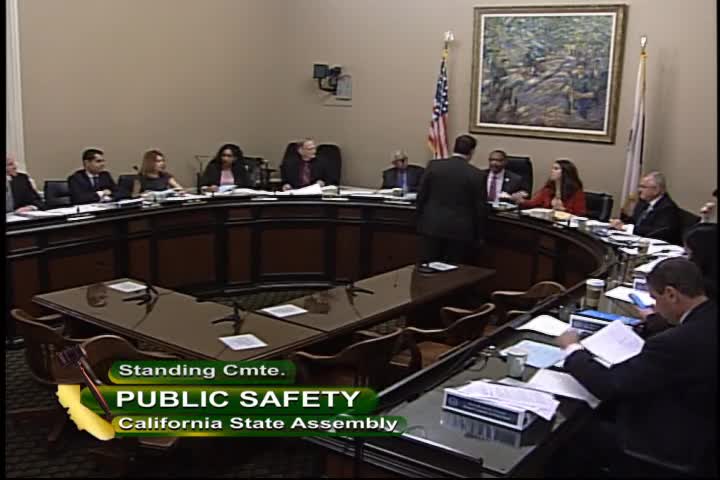
Assembly Standing Committee on Public Safety
Bill Author

Bill Co-Author(s):
