AB 3169: Internet: social media or search engine service: censorship.
- Session Year: 2017-2018
- House: Assembly
- Latest Version Date: 2018-02-16
Existing law prohibits an employer from requiring or requesting an employee or applicant for employment to disclose a username or password for the purpose of accessing personal social media, to access personal social media in the presence of the employer, or to divulge any personal social media.
This bill would prohibit a person who operates a social media Internet Web site located in California from removing or manipulating content from that site on the basis of the political affiliation or political viewpoint of that content. The bill would also prohibit any person who operates an Internet search engine located in California from removing or manipulating content from the search results generated by that service on the basis of the political affiliation or political viewpoint of that content.
(a)Any person who operates a social media Internet Web site located in California shall not remove or manipulate content from that Internet Web site on the basis of the political affiliation or political viewpoint of that content.
(b)Any person who operates an Internet search engine located in California shall not remove or manipulate content from the search results generated by that service on the basis of the political affiliation or political viewpoint of the content.
(c)As used in this section:
(1)Internet search engine means an Internet Web site that provides the user a method, either via a query search or any other means, to search the Internet.
(2)Located in California means either the person operating the services described in subdivisions (a) and (b) above maintains a business in California, or the user of that service is located in California.
(3)Social media means an electronic service or account, or electronic content, including, but not limited to, videos, still photographs, blogs, video blogs, podcasts, instant and text messages, email, online services or accounts, or Internet Web site profiles or locations.
|
Date
|
Status
|
|---|---|
| Apr 3, 2018 | In committee: Set, first hearing. Failed passage. Reconsideration granted. |
| Mar 15, 2018 | Referred to Coms. on P. & C.P. and A.,E.,S.,T., & I.M. |
| Feb 17, 2018 | From printer. May be heard in committee March 19. |
| Feb 16, 2018 | Read first time. To print. |
|
Date
|
Description
|
Location
|
Votes
|
|
|---|---|---|---|---|
| Apr 3, 2018 | Do pass as amended and be re-referred to the Committee on [Arts, Entertainment, Sports, Tourism, and Internet Media] | Assembly Standing Committee on Privacy and Consumer Protection |
Passed |
This list shows positions taken on this bill by organizations on the date displayed, which is linked to the original source.
Positions by individuals are not included.
|
Organization
|
Position
|
Date
|
|---|---|---|
| California Chamber Of Commerce | * Against | Apr 3, 2018 |
| Internet Association | * Against | Apr 3, 2018 |
Date of Hearing: April 3, 2018
ASSEMBLY COMMITTEE ON PRIVACY AND CONSUMER PROTECTION
Ed Chau, Chair
ABPCA Bill Id:AB 3169 (
Author:Gallagher) – As Introduced Ver:February 16, 2018
SUBJECT: Internet: social media or search engine service: censorship
SUMMARY: This bill seeks to prohibit any person who operates a social media internet website or search engine located in California, as specified, from removing or manipulating content on the basis of the political affiliation or political viewpoint of that content. Specifically, this bill would:
- Provide that any person who operates a social media internet website located in California shall not remove or manipulate content from that internet website on the basis of the political affiliation or political viewpoint of that content. “Social media” for these purposes would be defined to mean an electronic service or account, or electronic content, including, but not limited to, videos, still photographs, blogs, video blogs, podcasts, instant and text messages, email, online services or accounts, or internet website profiles or locations.
- Provide that any person who operates an internet search engine located in California shall not remove or manipulate content from the search results generated by that service on the basis of the political affiliation or political viewpoint of the content. “Internet search engine” for these purposes would be defined to mean an internet website that provides the user a method, either via a query search or any other means, to search the internet.
- Define for these purposes “located in California” to mean either the person operating the services described above maintains a business in California, or the user of that service is located in California.
EXISTING LAW:
- Provides, under the U.S. Constitution, that “Congress shall make no law . . . abridging the freedom of speech, or of the press, or the right of the people peaceably to assemble, and to petition the government for a redress of grievances.” (U.S. Const., 1st Amend., as applied to the states through the 14th Amendment’s Due Process Clause; see Gitlow v. New York (1925) 268 U.S. 652.)
- Provides under the California Constitution for the right of every person to freely speak, write and publish his or her sentiments on all subjects, being responsible for the abuse of this right. Existing law further provides that a law may not restrain or abridge liberty of speech or press. (Cal. Const., art. I, Sec. 2(a).)
- Prohibits an employer from requiring or requesting that an employee or applicant disclose a username or password for the purpose of accessing personal social media; accessing personal social media in the presence of the employer; or divulging any personal social media, except as specified. Nothing in this law precludes an employer from requiring or requesting an employee to disclose a username, password, or other method for the purpose of accessing an employer-issued electronic device. (Lab. Code Sec. 980(b), (d).)
- Defines “social media” for the above proposes to mean an electronic service or account, or electronic content, including, but not limited to, videos, still photographs, blogs, video blogs, podcasts, instant and text messages, email, online services or accounts, or internet website profiles or locations. (Lab. Code Sec. 980(a).)
FISCAL EFFECT: None. This bill has been keyed nonfiscal by the Legislative Counsel.
COMMENTS:
- Purpose of this bill: This bill is intended to prevent social media internet websites and search engines in California from removing or manipulating content based on a person’s political affiliation or viewpoint in order to prevent discrimination by privately owned technology companies. This is an author-sponsored bill.
- Author’s statement: According to the author, “[t]here have been several stories in the media about YouTube and Google censoring and removing videos posted by conservative groups. We have also seen stories about Twitter and Facebook removing posts with conservative viewpoints. [citations omitted.] Additionally, a lawsuit was recently filed in California by a former Google employee claiming that Google and Twitter discriminate [against] conservatives. [U]sers have been blocked or suspended for sharing a conservative viewpoint that do not violate any terms of use. Social media companies arbitrarily ban and censor users without a clear set of criteria. [We understand] that Social media platforms are private companies that can censor what people share on their pages but also [know] that the free speech in social media is controlled and limited by algorithms, which are not clearly explained to the audience. [We believe] that because California prides itself on being a leader when it comes to free speech, the state should urge social media companies to allow free speech to those who use their platforms, no matter their political views or affiliations. At the very least, companies should establish a clear set of criteria made available to users that show their process for censoring users.”
- Recent lawsuits alleging discrimination against conservative voices by technology companies: A January 2018 article in the Washington Post highlights recent lawsuits against companies such as Google and Twitter alleging discrimination by individuals who identify as conservative on the political spectrum. One such individual identified by the lawsuit is James Damore, the former Google engineer who was fired after distributing a memo questioning the company’s diversity policies, wherein he argued that men may simply be more suited to working in the tech industry than women because women are biologically less capable of or suited to engineering. (See Damore, Google’s Ideological Echo Chamber: How bias clouds our thinking about diversity and inclusion (July 2017), published online, available at <https://assets.documentcloud.org/documents/3914586/Googles-Ideological-Echo-Chamber.pdf> [as of Mar. 19, 2018].) Damore filed a class-action lawsuit Monday claiming that the technology giant discriminates against white men and conservatives. According to the Washington Post article:
Damore’s suit came on the same day that conservative publisher Charles C. Johnson sued Twitter for banning him from the platform in 2015. The cases are the latest signs of a broad effort by some conservatives to challenge technology companies on the grounds that they favor liberal or moderate voices, reflecting the prevailing political sensibilities in Silicon Valley. The technology industry’s crackdown against users accused of ‘hate speech’ after August’s ‘Unite the Right’ rally in Charlottesville has fueled allegations of political bias against companies that are playing a crucial role is disseminating speech worldwide.
The suit by Damore, filed in Santa Clara, Calif., alleges discrimination by Google against men, people of the “Caucasian race,” and people with perceived conservative political views. The suit says that Google employees who expressed views deviating from the majority at Google on politics or on employment practices, including “diversity hiring policies, bias sensitivity, and social justice,” were “singled out, mistreated, and systematically punished and terminated from Google,” in violation of their legal rights. [ . . . ]
Johnson sued Twitter for allegedly violating his right to free speech by permanently suspending his account after a tweet in which he sought to raise money for “taking out” a Black Lives Matter activist.
Johnson filed the suit in state superior court in San Francisco, where Twitter is headquartered. He has long maintained that he was seeking not violence but an investigation that might damage the public standing of the activist, DeRay McKesson. Johnson asserted in the suit that Twitter’s real motivation in banning him was to quash conservative voices online and that the company failed to follow its own “vague and subjective rules” for suspending user accounts. [ . . . ] (Dwoskin and Timberg, Washington Post, Google, Twitter face new lawsuits alleging discrimination against conservative voices (Jan. 8, 2018) <https://www.washingtonpost.com/news/the-switch/wp/2018/01/08/google-faces-a-lawsuit-over-discriminating-against-white-men-and-conservatives/?utm_term=.50199ed3cc43> [as of Mar. 19, 2018].)
- Free speech protects speech regardless political affiliation or viewpoint, but does so against government censorship, not private: These individuals are examples of cases that appear to be of concern to the author, but also illustrate, in particular in the case of Damore, the potential for existing California labor and anti-discrimination laws to address such situations. With that in mind, the broader concern of the author, here, appears to be protecting internet platforms against political censorship by private companies.
Notably, Johnson’s lawsuit against Twitter, referenced in Comment 3, above, includes a free speech claim for banning him from the company’s platform. Of course, Twitter, too, is protected by the First Amendment. Frequently, private individuals misguidedly complain about their First Amendment rights being trampled upon by other individuals or companies, but, in fact, the Constitution says nothing about the ability of private actors to regulate the speech of other private actors. Of relevance to this bill, speech regulations, per se, become a constitutional problem when government attempts to regulate speech of private actors (natural persons and corporations alike, since the 2010 U.S. Supreme Court ruling in Citizens United v. FEC (2010) 130 S.Ct. 876.)
- Balancing the consumers’ right to information against the free speech rights of social media internet website and search engine operators: On the one hand, this bill seeks to promote fair and open access to internet platforms to consumers of all political affiliations, as well as to promote the notion that the information provided directly to consumers is comprehensive by ensuring that content on websites or results on search engines is not removed or manipulated based on political affiliation or political viewpoints. In that sense, the bill arguably promotes a content-neutral framework that appears consistent with First Amendment principles. On the other hand, the bill provides these speech protections by way of government regulation, which invariably forces individuals or entities to associate themselves with speech that they may not wish to be associated with, which necessarily implicates First Amendment problems.
As a matter of constitutional law, rights do not exist in a vacuum; in fact, they often clash with other rights, including those of other individuals. As such, public policy can often necessitate a balancing of those competing rights. For example, the right of one private individual to obtain information in as neutral, fair, full, and comprehensive a fashion as possible is not guaranteed when it comes at the expense of another private individual’s right to choose what speech they wish to be associated with. The right of that individual to speak, does not mean that they can speak as loudly as they want, in any manner that they want, in any space that they want if it infringes on the First Amendment rights of the private property owner, or violates neutral time, place, manner restrictions placed by the government in public spaces. By prohibiting social media internet website and search engine operators from removing or manipulating content on the basis of political affiliations or political viewpoints, this bill triggers a question as to whether or not the balance is disrupted and the speech and associational rights of some will be unconstitutionally infringed upon in violation of the First Amendment, and the California Constitution.
In what might be surprising to some, while the language of the First Amendment appears to reflect an absolute prohibition in stating that Congress shall make “no law,” the Supreme Court has never accepted the view that the First Amendment prohibits all government regulation of expression,” and has in fact rejected the view that this right is an absolute right. (Chemerinksy, Constitutional Law Principles and Policies (2006) 3rd Edition, pp. 924-925). Where the line falls in what is protected and unprotected depends in large part on the type of regulation that the government is engaging in.
The fact that this bill does not represent a form of “prior restraint” (which bears a heavy presumption of unconstitutionality and is among the least tolerable and most serious infringements of First Amendment rights for attempting to stop speech in advance) and does not appear to expressly punish those who violate this provision (the ability of government to punish speech is limited) avoids some of the traditional areas of heightened concerns as matter of constitutional law. Still, other potential constitutional issues remain and are further explored below.
- Content-neutral regulation versus content-based restrictions: The U.S. Supreme Court has frequently made clear that at the very core of the First Amendment is the principle that the government may not regulate speech based on its content, and that content-based restrictions are presumptively invalid. (See RAV v. City of St. Paul (1992) 505 U.S. 377, 382.) The concern here, with content-based restrictions, is that government will target particular messages it does not agree with, and attempt to control thoughts on a particular topic by targeting particular messages and regulating speech. “Laws of this sort pose the inherent risk that the Government seeks not to advance a legitimate regulator goal, but to suppress unpopular ideas or information or to manipulate the public debate through coercion rather than persuasion.” (Turner Broadcast System v. Federal Communication Commission (1994, 512 U.S. 622, 641.) As such, these types of content-based restrictions are subject to strict scrutiny (the highest level of scrutiny, requiring that the law be narrowly tailored to achieve a compelling governmental interest, where the government must have chosen the “least restrictive” means of achieving the compelling interest), whereas content-neutral regulations need meet intermediate scrutiny (a less stringent analysis, requiring that the law serve a significant state interest; be narrowly tailored so as not to burden substantially more speech than is necessary to protect that interest; and it leave open ample alternative means of communication). This general rule, however, does not apply to certain categories of speech that are considered unprotected or less protected by the First Amendment, such as obscenity, defamation, or even incitement, despite being content-based restrictions.
A law may be deemed content-based whether it is a subject matter regulation or viewpoint regulation. In other words, to be content-neutral, it must be neither of these things. A law regulating speech is content-neutral if it applies to all speech regardless of the message. A law that prohibits any speech about war would also be content-based, as a subject matter regulation, whereas a law prohibiting anti-war protests would be content-based as a viewpoint regulation. Similarly, a law making picketing illegal, except if it is labor picketing, would be content-based. In contrast, a law prohibiting the posting of all signs on public utility poles would be content-neutral.
Interestingly, this bill seeks to apply rules that have been applied only to government regulations in the private context. Thus, under this bill, private actors could be prohibited from engaging in this type of speech or content-regulation that could similarly suppress unpopular ideas or information, or manipulate the public debate on public internet platforms. It must be underscored, however, the actors engaging in that activity, are private actors and not public actors (see Comment 4 for more on that distinction). However, by creating a bill proposal that would subject these private actors to standards that normally only restrict the ability of government to infringe upon the speech rights of private persons, the Committee is now faced with a government regulation that potentially infringes upon speech. Nonetheless, insofar as this bill proposes a government regulation related to the ability of private actors to choose the speech they wish to allow and potentially be associated with on their privately owned/operated platforms, this bill appears to be both subject matter-neutral and viewpoint-neutral as it does not favor (or, inversely, target) certain speech with particular messages or viewpoints or subject matters over others. This bill merely states that content is not to be removed or manipulated on the basis of political affiliation or political viewpoint, and in doing so, does not elevate one political party or ideology over another.
This bill does not, however, appear to make any exceptions for removals or manipulations of content that some people may perceive as “based on political affiliation or political viewpoint” and others in fact believe arise to the level of unprotected “obscenity, defamation, or incitement” that should be removed by the operator of a social media webpage or search engine. Thus, as a matter of law, this bill may appear sufficiently sound in that it is content-neutral regulation, but as a matter of practice, this Committee may wish to consider whether operators of these websites and search engines would be unreasonably restrained, beyond what even the government faces when it comes to First Amendment jurisprudence—again, even though the government is generally prohibited from infringing upon speech, certain categories of speech are seen as unprotected or less protected because the First Amendment is not absolute. As a matter of public policy, then, this bill raises a question as to whether companies should be able to make these types of subjective determinations such that they can limit “less protected” or “unprotected’ categories of speech, which ultimately may reflect upon their companies and shareholders, and be attributed to their own beliefs and values given that “corporations are persons” for purposes of speech rights under U.S. Supreme Court precedent (see Comments 7 and 8 below). Accordingly, the author has agreed to the following amendment to provide for that leeway, which also strikes a more reasonable balance of competing First Amendment rights:
Suggested amendment:
On page 2, after line 26, insert “(d) Nothing in this section prohibits any person who operates a social media Internet Web site located in California or any person who operates a search engine located in California from removing or manipulating content on their website or search engine on the basis that such content constitutes obscenity, defamation, or incitement.”
Staff notes it may be worth considering whether to include “hate speech” in the above list of recognizable reasons to remove or manipulate content from the operator’s website or engine.
- Compelled speech or compelled use of private property for speech purposes: Another context in which free speech is implicated in relation to this bill, alluded to in Comment 6 above, is in the context of compelled expression. There is inherent in the right of free speech, the right not to speak; thus, constitutional issues arise when the government seems to be forcing associational activities or when it forces people to use their property for speech by others. According to a treatise by one preeminent constitutional law scholar:
The cases in this area are difficult to reconcile. In some instances, the Court has held that the First Amendment is violated if the government forces owners to make their property available for expressive purposes. For example, in Miami Herald Publishing Co. v. Tornillo, the Supreme Court unanimously invalidated a state law that required newspapers to provide space to political candidates who had been verbally attacked in print. The court emphasized that freedom of the press gave to the newspaper the right to decide what was included or excluded. [ . . . ]
In contrast, in PruneYard Shopping Center v. Robins, shopping center owners argued that their First Amendment rights were violated by a California Supreme Court ruling that protestors had a right to use their property for speech under the state constitution. [ . . . ] The Supreme Court disagreed and found no violation of the First Amendment from a state constitutional rule that created a right of access to shopping centers for speech purposes [, explaining] that the shopping center is “not limited to the personal use of appellants, … (but) is instead a business establishment that is open to the public to come and go as they please. The views expressed by members of the public in passing out pamphlets or seeking signatures for a petition thus will not likely be identified with those of the owner.” Moreover, the Court said that “no specific message is dictated by the State to be displayed on appellants’ property … (and) appellants can expressly disavow any connection with the message by simply posting signs in the area where the speakers or handbillers stand.” (Chemerinsky, Constitutional Law Principles and Policies (2006) 3rd Edition, pp. 974-975 (internal citations omitted).)
Staff notes that, following this line of reasoning, it is plausible that the courts could uphold a law such as that envisioned by this bill insofar as some websites like Twitter function more like the shopping center model than the Miami Herald/newspaper model. Other websites could, however, function in the more traditional model of a newspaper, such as blogs, newspapers, and other social media sites where viewpoints posted could be attributed to those of the property owner and this bill could be seen as unlawfully compelling the use of private property for speech purposes in violation of the First Amendment.
As currently drafted however, the definition of social media is seemingly too broad and captures both types of scenarios, contrasted by the Miami Herald and Pruneyard cases above. In practice, this bill could even capture a person’s personal Facebook page, such that said person could not remove an offensive comment of a family member or stranger (friend of a friend, perhaps) whose viewpoints they do not wish to see on their own personal page in response to one of their own posts. This is in part because the bill uses a definition of social media from the Labor Code, which requires a much broader definition to address the public policy goals of that law generally prohibiting employers from requesting their employees to provide usernames or passwords for the purposes of accessing personal social media in the presence of the employer or divulging any personal social media.
In order to potentially help withstand constitutional challenge, the author has agreed to narrow the bill by limiting its provisions to search engines (proposed subdivision (b) of the bill) and to social media websites that have open platforms that are distinguishable from blogs or news media or other forms where the information posted may reasonably be attributable to the viewpoints of the owner/operator of the site or the personal page of a user of the site, as follows:
Author’s amendment:
On page 2, strike lines 22-26 and insert “Social media is an electronic service or account held open to the general public to post, in either a public or semi-public page dedicated to a particular user, electronic content or communication, including, but not limited to videos, still photographs, or messages, intended to facilitate the sharing of information, ideas, personal messages, and other content. Social media does not include the public or semi-public page of a person, where any posted electronic content or communication may reasonably be attributed to that person to whom that page belongs or is assigned.”
- Technical amendment: As currently drafted, the bill defines “located in California” to mean “either the person operating the services described in subdivisions (a) and (b) above maintains a business in California, or the user of that service is located in California.” This suggests that the person must be operating both of the services. The author has agreed to the following technical amendment to address this issue:
Technical amendment:
On page 2, strike lines 18-21 and insert “‘Located in California’ means either the person operating the service described in subdivision (a) or (b) above maintains a business in California or the user of that service is located in California.”
- Double-referral: This bill is double-referred to the Arts, Entertainment, Sports, Tourism, & Internet Media Committee, where it will be heard if passed by this Committee.
REGISTERED SUPPORT / OPPOSITION:
Support
None on file
Opposition
None on file
Analysis Prepared by: Ronak Daylami / P. & C.P. / (916) 319-2200
Discussed in Hearing
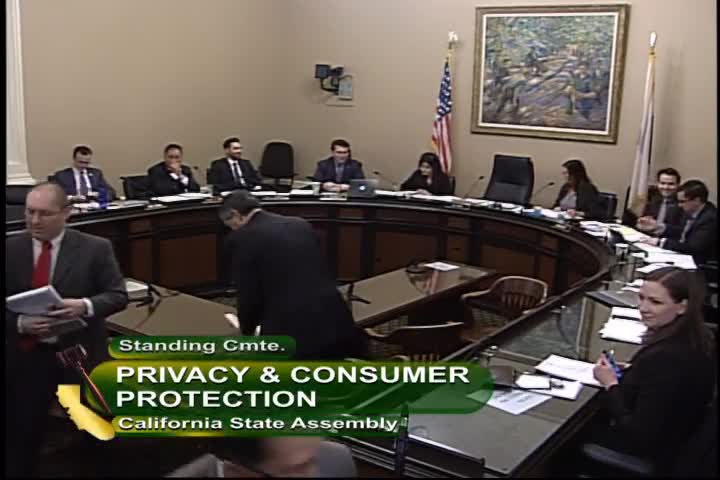 31MIN
Assembly Standing Committee on Privacy and Consumer Protection
Bill Author

Bill Co-Author(s):