AB 463: Student financial aid: Assumption Program of Loans for Education.
- Session Year: 2017-2018
- House: Assembly
- Latest Version Date: 2017-02-13
Existing law establishes the Assumption Program of Loans for Education, administered by the Student Aid Commission, under which any person enrolled in a participating institution of postsecondary education, or any person who agrees to participate in a teacher trainee or teacher internship program, is eligible to enter into an agreement for loan assumption, to be redeemed pursuant to a prescribed procedure upon becoming employed as a teacher if he or she satisfies certain conditions. Existing law prohibits the commission from awarding more than the number of loan assumption agreements that are authorized by the Governor and the Legislature in the annual Budget Act, as provided.
This bill would, among other things, require a program participant to demonstrate financial need, remove references to the Academic Performance Index, revise the information that the Superintendent is required to furnish to the commission annually regarding the program, and make conforming changes. The bill would require the program to continue to be implemented as it read on January 1, 2017, for specified purposes relating to loan assumption agreements entered into before January 1, 2018. The bill would require the commission to issue 7,200 new warrants for the assumption of loans under the program commencing with the 201718 fiscal year.
(a)The Legislature finds and declares all of the following:
(1)The growing shortage of high-quality teachers is most serious in particular subject areas, partly due to the shortage of students in these fields who enter the teaching profession.
(2)Many school districts have difficulty recruiting and retaining high-quality teachers for schools ranked in decile 1 or 2 on the Academic Performance Index, for pupils with special needs, for schools serving rural areas or large populations of pupils from low-income and linguistic minority families, and for schools with a high percentage of teachers holding emergency-type permits.
(3)The rising costs of higher education, coupled with a shift in available financial aid from scholarships and grants to loans, make the availability of financial aid and loan repayment assistance options an important consideration in a students decision to pursue a postsecondary education.
(b)It is, therefore, the intent of the Legislature that the Assumption Program of Loans for Education be designed to provide veteran teachers and outstanding postsecondary students, particularly economically disadvantaged students, with the assurance of financial assistance to encourage them to complete postsecondary education programs leading to teaching credentials, and to seek employment as teachers in designated subject-matter shortage areas and self-contained classrooms or in schools serving a large population of pupils from low-income families, families or schools with a high percentage of teachers holding emergency-type permits, or schools ranked in the lowest two deciles on the Academic Performance Index. permits.
SEC. 2.Section 69612.5 of the Education Code is amended to read:69612.5.For purposes of this article, the following terms have the following definitions:
(a)Eligible institution means a postsecondary institution that is determined by the Student Aid Commission to meet both of the following requirements:
(1)The institution is eligible to participate in state and federal financial aid programs.
(2)The institution maintains a program of professional preparation that has been approved by the Commission on Teacher Credentialing.
(b)Eligible school means a school that meets any of the following criteria:
(1)It serves a large population of pupils from low-income families, as designated percentage of unduplicated pupils, as defined in Section 42238.02, as determined by the Superintendent of Public Instruction.
(2)The institution has 20 percent or more teachers holding emergency-type permits including, but not limited to, any of the following:
(A)Provisional internships.
(B)Short-term staff permits.
(C)Credential waivers.
(D)Substitute permits.
(3)It is a school that is ranked in the lowest two deciles on the Academic Performance Index. serves a rural area.
(4)It is a school that serves a rural area.SEC. 3.Section 69613 of the Education Code is amended to read:69613.(a)Program participants shall meet all of the following eligibility criteria prior to selection in the program and shall continue to meet these criteria, as appropriate, during the payment periods:
(1)The applicant has completed at least 60 semester units, or the equivalent, and is enrolled in an academic program leading to a baccalaureate degree at an eligible institution, has agreed to participate in a teacher internship program, or has been admitted to a program of professional preparation that has been approved by the Commission on Teacher Credentialing.
(2)The applicant is currently enrolled in, or has been admitted to, a program in which he or she will be enrolled on at least a half-time basis, as determined by the participating institution. The applicant shall agree to maintain satisfactory academic progress and a minimum of half-time enrollment, as defined by the participating eligible institution.
(A)Except as provided in subparagraphs (B) and (C), if a person participating in the program fails to maintain at least half-time enrollment, as required by this article, under the terms of the agreement pursuant to paragraph (2), the loan assumption agreement shall be invalidated and the participant shall retain full liability for all student loan obligations. This subparagraph shall not apply if the participant is in his or her final semester or quarter in school and has no additional coursework required to obtain his or her teaching credential.
(B)Notwithstanding subparagraph (A), if a program participant is unable to maintain at least half-time enrollment due to serious illness, pregnancy, or other natural causes, or is called to active military duty status, the participant is not required to retain full liability for the student loan obligation for a period not to exceed one calendar year, unless approved by the commission for a longer period.
(C)If a natural disaster prevents a program participant from maintaining at least half-time enrollment due to the interruption of instruction at the eligible institution, the term of the loan assumption agreement shall be extended for a period not to exceed one calendar year, unless approved by the commission for a longer period.
(3)The applicant has been judged by his or her postsecondary institution, school district, or county office of education to have outstanding ability on the basis of criteria that may include, but need not be limited to, any of the following:
(A)Grade point average.
(B)Test scores.
(C)Faculty evaluations.
(D)Interviews.
(E)Other recommendations.
(4)The applicant has received, or is approved to receive, a loan under one or more of the following designated loan programs: an educational loan from a program approved by the Student Aid Commission.
(A)The Federal Family Education Loan Program (20 U.S.C. Sec. 1071 et seq.).(B)Any educational loan program approved by the Student Aid Commission.(5)The applicant has agreed to teach full time for at least four consecutive academic years, or on a part-time basis for the equivalent of four full-time academic years, after obtaining a teaching credential in a public elementary or secondary school in this state, in a subject area that is designated as a current or projected shortage area by the Superintendent of Public Instruction, or, on the date the teacher is hired, at an eligible school.
(6)The applicant has demonstrated financial need.
(b)An agreement shall remain valid even if the subject area under which an applicant becomes eligible to enter into an agreement ceases to be a designated shortage field by the time the applicant becomes a teacher.
(c)For the purposes of calculating eligible years of teaching for the redemption of an award, the inclusion by the Superintendent of Public Instruction of a school on a list prepared pursuant to Section 69613.1 shall apply retroactively from the date the school first opened.
(d)A person participating in the program pursuant to this section shall not enter into more than one agreement.
(e)A person participating in the program pursuant to this section shall not owe a refund on any state or federal educational grant or have defaulted on any student loan.
(f)Notwithstanding any other provision of this section, a credentialed teacher teaching in a public school ranked in the lowest two deciles on the Academic Performance Index pursuant to Section 52052, possesses a clear multiple subject or single subject teaching credential or level II education specialist credential and who has not otherwise participated in the program established by this article, is eligible to enter into an agreement for loan assumption pursuant to this article. The number of loan assumption agreements provided pursuant to this subdivision shall not exceed 400 per year. The commission shall develop and adopt regulations for the implementation of this subdivision by January 1, 2010.SEC. 4.Section 69613.1 of the Education Code is amended to read:69613.1.On or before January 1 of each year, the Superintendent of Public Instruction shall furnish the commission with all of the following:
(a)A list of teaching fields that have the most critical shortage of teachers. The Superintendent shall review this list annually and revise the list as he or she deems necessary. The list of shortage areas furnished pursuant to this subdivision shall include the state special schools as a category separate from special education.
(b)A list of schools that serve a large population of pupils from low-income families, as designated for purposes of the Perkins Loan Program, or according to standards the Superintendent deems appropriate. meet the requirement of paragraph (1) of subdivision (b) of Section 69612.5.
(c)A list of schools with a high percentage of teachers holding emergency-type permits. The list shall be established according to criteria determined by the Superintendent.
(d)A list of schools serving rural areas. The list shall be established according to standards deemed appropriate by the Superintendent.
(e)A list of schools ranked in the lowest two deciles on the Academic Performance Index.(f)A list of high priority schools.SEC. 5.Section 69613.7 of the Education Code is repealed.69613.7.(a)For the purposes of this article, subject matter shortage area may not be construed to include teaching in a self-contained classroom or teaching pursuant to a multiple subject credential.(b)The list, furnished by the Superintendent of Public Instruction pursuant to Section 69613.1 and relating to teaching fields that have the most critical shortage of teachers, shall not include teaching in a self-contained classroom or teaching pursuant to a multiple subject credential.SEC. 6.Section 69613.7 is added to the Education Code, to read:69613.7.In addition to the amounts set forth in subdivision (a) of Section 69613.4, for each of the four years of classroom instruction referenced in that subdivision, loan assumption benefits shall be granted as follows:
(a)One thousand dollars ($1,000) of additional liability per year shall be assumed for a person who holds a credential appropriate for teaching, and who teaches mathematics, science, or special education.
(b)Not more than a total of five million dollars ($5,000,000) shall be expended in any academic year for purposes of this section.
(c)The commission shall award benefits payable under this section upon receipt of all documentation necessary to establish eligibility for the additional loan assumption benefits. Payments shall be made to applicants in the order that full documentation is received until the five million dollars ($5,000,000) authorized by subdivision (b) has been expended.
SEC. 7.Section 69613.8 of the Education Code is repealed.69613.8.In addition to the amounts set forth in subdivision (a) of Section 69613.4, for each of the four years of classroom instruction referenced in subdivision (a) of Section 69613.4, the following loan assumption benefits shall be granted:(a)One thousand dollars ($1,000) of additional liability per year shall be assumed for a person who holds a credential appropriate for teaching, and who teaches, mathematics, science, or special education in the lowest 60 percentile of Academic Performance Index rankings.(b)One thousand dollars ($1,000) of additional liability per year shall be assumed for a person who teaches in a school in the lowest two deciles on the Academic Performance Index rankings. Eligibility for the benefit set forth in this subdivision shall be limited to a person who holds a credential appropriate for teaching, and who teaches, mathematics, science, or special education.(c)Not more than a total of five million dollars ($5,000,000) shall be expended in any academic year for the purposes of this section.(d)The commission shall award benefits payable under this section upon receipt of all documentation necessary to establish eligibility for the additional loan assumption benefits. Payments shall be made to applicants in the order received until the five million dollars ($5,000,000) authorized by subdivision (c) has been expended.SEC. 8.Section 69615.4 of the Education Code is amended to read:69615.4.The commission shall report annually to the Legislature regarding all of the following, on the basis of sex, age, and ethnicity:
(a)The total number of program participants.
(b)The number of agreements entered into with juniors, seniors, students enrolled in teacher training programs, and persons who agree to enroll in teacher internship programs.
(c)The number of participants who agree to teach in a subject matter shortage area.
(d)The number of participants who agree to teach in schools with a high ratio of pupils from low-income families and in schools ranked in the lowest two deciles on the Academic Performance Index. serving rural areas.
(e)The number of participants who agree to teach in schools serving rural areas.(f)(e)The number of participants who agree to teach in schools with a high percentage of teachers holding provisional internship permits.
(g)(f)The number of participants who receive a loan assumption benefit, classified by payment year.
(h)(g)The number of out-of-state teachers who enter into agreements.
(i)(h)The number of participants who have participated in teacher internship programs, classified by school district or county office of education.
SEC. 9.Section 69615.8 of the Education Code is amended to read:69615.8.Notwithstanding any other law, in any fiscal year, commencing with the 201718 fiscal year, the commission shall award no more than the number of loan assumption agreements that are authorized by the Governor and the Legislature in the annual Budget Act for that year issue 7,200 new warrants for the assumption of loans pursuant to this article.
SEC. 10.Section 69615.9 is added to the Education Code, to read:69615.9.The commission shall continue to implement the program as it read on January 1, 2017, for the allocation of funds for loan assumption agreements made before January 1, 2018, and for the collection of payments from former program participants required to repay program costs for failing to satisfy the programs requirements under a loan assumption agreement made before January 1, 2018.
REVISIONS: HeadingLines 1 and 2.|
Date
|
Status
|
|---|---|
| Feb 1, 2018 | From committee: Filed with the Chief Clerk pursuant to Joint Rule 56. |
| Jan 31, 2018 | Died pursuant to Art. IV, Sec. 10(c) of the Constitution. |
| May 26, 2017 | In committee: Held under submission. |
| Apr 26, 2017 | In committee: Set, first hearing. Referred to APPR. suspense file. |
| Apr 19, 2017 | From committee: Do pass and re-refer to Com. on APPR. (Ayes 13. Noes 0.) (April 18). Re-referred to Com. on APPR. |
| Apr 6, 2017 | Coauthors revised. |
| Mar 27, 2017 | Coauthors revised. |
| Feb 27, 2017 | Referred to Com. on HIGHER ED. |
| Feb 14, 2017 | From printer. May be heard in committee March 16. |
| Feb 13, 2017 | Read first time. To print. |
|
Date
|
Description
|
Location
|
Votes
|
|
|---|---|---|---|---|
| Apr 18, 2017 | Do pass and be re-referred to the Committee on [Appropriations] | Assembly Standing Committee on Higher Education |
Passed |
This list shows positions taken on this bill by organizations on the date displayed, which is linked to the original source.
Positions by individuals are not included.
|
Organization
|
Position
|
Date
|
|---|---|---|
| California School Boards Association | * Support | Apr 18, 2017 |
| Education Trust-West | ** Support | Apr 17, 2017 |
| Kern County Superintendent Of Schools | ** Support | Apr 17, 2017 |
Date of Hearing: April 26, 2017
ASSEMBLY COMMITTEE ON APPROPRIATIONS
Lorena Gonzalez Fletcher, Chair
ABPCA Bill Id:AB 463
Author:(Salas) – As Introduced Ver:February 13, 2017
Policy Committee: | Higher Education | Vote: | 13 - 0 |
|
| ||
|
|
Urgency: No State Mandated Local Program: No Reimbursable: No
SUMMARY:
This bill makes various programmatic changes to the Assumption Program of Loans for Education (APLE). Specifically, this bill:
- Authorizes the California Student Aid Commission (CSAC), commencing with the 2017-18 fiscal year, to issue 7,200 new APLE warrants.
- Amends the definition of “eligible school” to mean one that meets, among others, any of the following criteria: a percentage of unduplicated pupils or serves a rural area.
- Eliminates the requirement that an eligible school must rank in the lowest two deciles on the Academic Performance Index (API).
- Requires that an applicant teach in a shortage area, as determined by the SPI.
- Amends the provision allowing loan forgiveness of $1,000 per year for those who teach math, science or special education by eliminating the requirement that the school is in the lowest 60 percentile of the API.
- Modifies requirements for the annual report that CSAC is required to submit to the Legislature.
- Authorizes CSAC to continue to implement APLE as it read on January 1, 2017, for the allocation of funds for loan agreements made before January 1, 2018, and for the purpose of collecting payments from former program participants.
FISCAL EFFECT:
- Approximately $45 million General Fund (GF) to fund 7,200 new warrants for years one through five of implementation.
- $800,000 GF in on-going administrative cost to CSAC. CSAC will need 8 new personnel years (PY’s) to implement this bill. The costs include $119,000 in one-time funds for new equipment and office space.
COMMENTS:
- Background. APLE was established in 1983 to provide loan assumption benefits to credentialed teachers, and is administered by CSAC. Generally, APLE warrants are given to credential candidates; the warrants are then redeemed for the loan assumption benefit once the candidate has earned a credential and completed a year of eligible teaching. The program forgives up to $11,000 of college loan debt for a person who teaches for four consecutive years in a qualifying school or subject area (paying $2,000 for the first year of teaching service and $3,000 for each of the next three years of teaching); and, provides additional loan forgiveness of $1,000 per year for up to four years for those who teach math, science or special education (for a total of $15,000) and an additional $1,000 for those who teach math, science or special education in schools with an API of 1 or 2 (for a total of $19,000).
- Purpose. According to the author, "The APLE program still exists in code, but it hasn't been funded in several years." The author contends that by the Legislature passing his measure, he hopes that it will serve as an incentive to college students not only entering the teaching profession, but encouraging them to teach in high need areas and in subjects most impacted by the current teacher shortages.
- Related Legislation. AB 234 (Steinorth) is in conflict with AB 463 (Salas). AB 234 requires CSAC to award 7,200 new warrants for the Assumption Program of Loans for Education (APLE) and appropriates $5 million from the General Fund (GF) to fund the new warrants without amending provisions that are in conflict with California’s new accountability system. AB 234 was heard in the Assembly Appropriations on April 5, 2017 and currently on the Suspense File.
Analysis Prepared by: Daisy Gonzales / APPR. / (916) 319-2081
Date of Hearing: April 18, 2017
ASSEMBLY COMMITTEE ON HIGHER EDUCATION
Jose Medina, Chair
ABPCA Bill Id:AB 463 (
Author:Salas) – As Introduced Ver:February 13, 2017
SUBJECT: Student financial aid: Assumption Program of Loans for Education.
SUMMARY: Makes various programmatic changes to the Assumption Program of Loans for Education (APLE). Specifically, this bill:
- Authorizes the California Student Aid Commission (CSAC), commencing with the 2017-18 fiscal year, to issue 7,200 new APLE warrants.
- Amends the definition of “eligible school” to mean one that meets, among others, any of the following criteria:
- Serves a percentage of unduplicated pupils (defined as a pupil enrolled in a school district or a charter school who is either classified as an English learner, eligible for a free or reduced-price meal, or is a foster youth), as determined by the Superintendent of Public Instruction (SPI); and,
- Serves a rural area.
- Eliminates the requirement that an eligible school must rank in the lowest two deciles on the Academic Performance Index (API).
- Eliminates the requirement that an applicant has received or is approved to receive a loan under the Federal Family Education Loan Program and replaces it with the requirement that an applicant has demonstrated financial need.
- Requires that an applicant will teach in a shortage area, as determined by the SPI.
- Removes the provision allowing up to 400 APLE loan assumption agreements to go to credentialed teachers, as specified, each year.
- Modifies the list of schools (serving a percentage of unduplicated pupils) that the SPI is required to provide to the CSAC each year.
- Eliminates the prohibitions on teachers in self-contained classrooms and multi-subject credential holders from participating in the APLE; and allows the list of teaching shortage areas that the SPI must develop each year to include teaching in a self-contained classroom and multi-subject credentials.
- Amends the provision allowing loan forgiveness of $1,000 per year for those who teach math, science or special education by eliminating the requirement that the school is in the lowest 60 percentile of the API.
- Modifies the annual report that CSAC is required to submit to the Legislature, as specified.
- Authorizes CSAC to continue to implement APLE as it read on January 1, 2017, for the allocation of funds for loan agreements made before January 1, 2018, and for the purpose of collecting payments from former program participants.
EXISTING LAW:
- Establishes CSAC as the primary state agency to administer state-authorized student financial aid programs available to eligible students attending all eligible segments of postsecondary education (Education Code Section 69510, et seq.).
- Establishes the APLE program, administered by the CSAC, to provide loan assumption benefits to credentialed teachers; specifies that qualifying schools include those with high proportions of low-income youth or emergency permit teachers and those located in rural areas; and, requires the subject area shortages to annually be determined by the SPI (EC Section 69612, et seq.).
- Forgives up to $11,000 of college loan debt for a person who teaches for four consecutive years in a qualifying school or subject area (paying $2,000 for the first year of teaching service and $3,000 for each of the next three years of teaching); and, provides additional loan forgiveness of $1,000 per year for up to four years for those who teach math, science or special education (for a total of $15,000) and an additional $1,000 for those who teach math, science or special education in schools with an Academic Performance Index of 1 or 2 (for a total of $19,000) (EC Sections 69613.4 and 69613.8).
- Prohibits CSAC from awarding a greater number of agreements than is authorized in the annual Budget Act (EC 69615.8).
FISCAL EFFECT: Unknown.
COMMENTS: Background. According to a February 2017 research brief by the Learning Policy Institute, in the past year, the overall teacher workforce trends in the state have worsened, with severe consequences in special education, mathematics, science, and bilingual education. The Institute, via survey data, finds that in addition to cancelling courses and increasing class sizes, some school districts are responding to shortages by hiring underprepared teachers (teachers who have not yet completed the subject matter and teacher preparation requirements for a full credential), assigning some teachers out of their fields of preparation, and hiring substitutes.
To note, the Institute finds that high attrition rates of underprepared teachers creates a continuous demand for new teachers and only exacerbates the teacher shortages in the state. Additionally, schools serving the most underrepresented students (high-poverty, high-minority, and/or high-English Learner), disproportionately turn to underprepared teachers to meet their hiring needs.
Additionally, according to the California Commission on Teacher Credentialing (CTC), the number of CTC newly-issued credentials for teachers has fallen every year for the past decade, and the California Teachers Association contends that one-third of California's teachers are at or near retirement age.
Need for the measure. According to the author, "The APLE program still exists in code, but it hasn't been funded in several years." The author contends that by the Legislature passing his measure, he hopes that it will serve as an incentive to college students not only entering the teaching profession, but encouraging them to teach in high need areas and in subjects most impacted by the current teacher shortages.
Assumption Program of Loans for Education (APLE). The APLE warrants are given to credential candidates; the warrants are then redeemed for the loan assumption benefit once the candidate has earned a credential and completed a year of eligible teaching. The program “forgives” up to $11,000 of college loan debt for a person who teaches for four consecutive years in a qualifying school or subject area (paying $2,000 for the first year of teaching service and $3,000 for each of the next three years of teaching). Qualifying schools include those with high proportions of low-income youth or emergency permit teachers and those located in rural areas.
The 2012-13 Budget Act included language authorizing a total of 7,300 warrants for loan assumption, but the Governor line item vetoed said provision. The 2017-18 budget proposal currently does not include funding for new APLE warrants. To note, since the line item veto, no new funding has been appropriated for APLE.
Committee comments. In response to concerns that public financial aid dollars are being utilized at institutions of questionable quality, both the state and federal level have enacted policies requiring institutions to meet specified performance standards. In the Cal Grant program, institutions are required to meet graduation rate and loan default rate requirements.
If the intent of the author is to support qualified teachers in underserved communities, the author may wish to consider a review of the institutional eligibility requirements for APLE. That is to say, should the Cal Grant standards be applicable for APLE institutional eligibility?
Additionally, this measure seeks to reinstate and improve APLE in order to meet California's current teaching demands. It is presently unclear as to how this measure will be funded and implemented since the 2017-18 budget proposal does not include funding for new APLE warrants.
The author may wish to work with the Department of Finance and the Legislative Budget Committees in order to determine if funds can and will be appropriated to CSAC for the purpose of issuing new APLE warrants for loan assumption.
Lastly, AB 234 (Steinorth), as described in the "related legislation" section of this analysis, was unanimously passed by this Committee, on March 14, 2017, by a vote of 13-0, appears to be in conflict with this measure. As the two measures move through the Legislative Process, Committee staff recommends the authors working together to achieve a shared goal.
Related legislation. AB 234 (Steinorth), which is pending a hearing in the Assembly Appropriations Committee, in part, appropriates $5,000,000 from the General Fund to CSAC for the express purpose of funding 7,200 new warrants for APLE for the 2017-18 fiscal year.
SB 62 (Pavley) of 2015, which, as introduced, made various changes to APLE. However, on August 30, 2016, this measure was amended out of the jurisdiction of this Committee; the amended version was subsequently chaptered.
SB 1264 (Pavley) of 2014, which was held in the Senate Appropriations Committee, proposed to establish the Educator Excellence Program, an assumption loan program for up to 6,500 teachers who satisfied specified criteria.
SB 212 (Pavley) of 2013, which was held in the Senate Appropriations Committee, sought to appropriate $5 million, from an unspecified funding source, for 7,200 new warrants for the assumption of school loans for teachers in areas with identified teacher shortages.
REGISTERED SUPPORT / OPPOSITION:
Support
Education Trust-West
Kern County Superintendent of Schools
Opposition
None on file
Analysis Prepared by: Jeanice Warden / HIGHER ED. / (916) 319-3960
Discussed in Hearing
 1H
Assembly Standing Committee on Appropriations
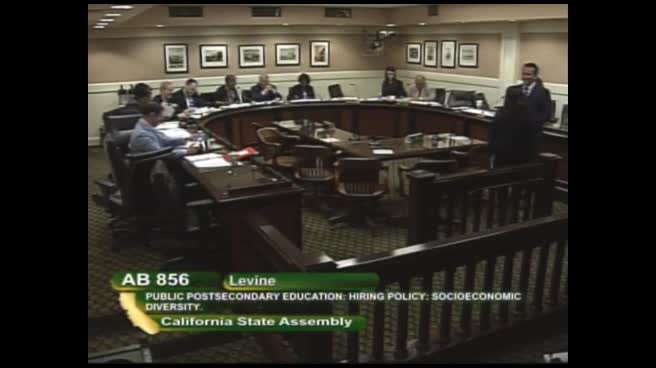 4MIN
Assembly Standing Committee on Higher Education


Bill Co-Author(s):