AB 856: Public postsecondary education: hiring policy: socioeconomic diversity.
- Session Year: 2017-2018
- House: Assembly
- Latest Version Date: 2017-04-04
(1)Existing law establishes the University of California, under the administration of the Regents of the University of California, the California State University, under the administration of the Trustees of the California State University, and the California Community Colleges, under the administration of the Board of Governors of the California Community Colleges, as the 3 segments of public postsecondary education in this state. Existing law, known as the Donahoe Higher Education Act, among other things, sets forth the missions and functions of these segments. Provisions of the Donahoe Higher Education Act apply to the University of California only to the extent that the regents act, by resolution, to make them applicable.
This bill would declare it to be the policy of the State of California that a goal of the segments of public postsecondary education, when hiring and promoting high-profile administrative personnel, as defined, shall be that the persons hired to fill these positions shall be competent and well qualified, and as much as practicable, shall reflect the geographic and socioeconomic diversity of the population of the State of California. The bill, in furtherance of this policy,This bill would require the trustees, the board of governors, trustees and the governing board of each community college district, and request the regents, to ensure that, when filling a high-profile administrative position, serious consideration is given to candidates from geographic areas and socioeconomic sectors of the state that are underrepresented among the administrative personnel of the segment, district, or campus for which the position is to be filled. The bill would define serious consideration to mean, but not necessarily be limited to, that, to the extent practicable, the segment, district, or campus filling the high-profile administrative position would interview at least one candidate for that position from a geographic area or socioeconomic sector that is currently underrepresented among its administrative personnel. faculty or athletic coaching positions, consideration is given to candidates with socioeconomic backgrounds that are underrepresented among existing faculty or athletic coaching staff on the campus for which the position is to be filled.
To the extent that the bill would impose new duties on community college districts, it would constitute a state-mandated local program.
(2)The California Constitution requires the state to reimburse local agencies and school districts for certain costs mandated by the state. Statutory provisions establish procedures for making that reimbursement.
This bill would provide that, if the Commission on State Mandates determines that the bill contains costs mandated by the state, reimbursement for those costs shall be made pursuant to the statutory provisions noted above.
(1)Existing law establishes the University of California, under the administration of the Regents of the University of California, the California State University, under the administration of the Trustees of the California State University, and the California Community Colleges, under the administration of the Board of Governors of the California Community Colleges, as the 3 segments of public postsecondary education in this state. Existing law, known as the Donahoe Higher Education Act, among other things, sets forth the missions and functions of these segments. Provisions of the Donahoe Higher Education Act apply to the University of California only to the extent that the regents act, by resolution, to make them applicable.
This bill would declare it to be the policy of the State of California that a goal of the segments of public postsecondary education, when hiring and promoting high-profile administrative personnel, as defined, shall be that the persons hired to fill these positions shall be competent and well qualified, and as much as practicable, shall reflect the geographic and socioeconomic diversity of the population of the State of California.
The bill, in furtherance of this policy, would require the trustees, the board of governors, and the governing board of each community college district, and request the regents, to ensure that, when filling a high-profile administrative position, serious consideration is given to candidates from geographic areas and socioeconomic sectors of the state that are underrepresented among the administrative personnel of the segment, district, or campus for which the position is to be filled. The bill would define serious consideration to mean, but not necessarily be limited to, that, to the extent practicable, the segment, district, or campus filling the high-profile administrative position would interview at least one candidate for that position from a geographic area or socioeconomic sector that is currently underrepresented among its administrative personnel.
To the extent that the bill would impose new duties on community college districts, it would constitute a state-mandated local program.
(2)The California Constitution requires the state to reimburse local agencies and school districts for certain costs mandated by the state. Statutory provisions establish procedures for making that reimbursement.
This bill would provide that, if the Commission on State Mandates determines that the bill contains costs mandated by the state, reimbursement for those costs shall be made pursuant to the statutory provisions noted above.
The Trustees of the California State University and the governing board of each community college district shall, and the Regents of the University of California are requested to, ensure that, when filling faculty or athletic coaching positions, consideration is given to candidates with socioeconomic backgrounds that are underrepresented among existing faculty or athletic coaching staff on the campus for which the position is to be filled.
SEC. 2.If the Commission on State Mandates determines that this act contains costs mandated by the state, reimbursement to local agencies and school districts for those costs shall be made pursuant to Part 7 (commencing with Section 17500) of Division 4 of Title 2 of the Government Code.
(a)It is hereby declared to be the policy of the State of California that a goal of the segments of public postsecondary education, when hiring and promoting high-profile administrative personnel, including, but not necessarily limited to, campus presidents and chancellors, segmental vice-presidents and vice-chancellors, deans, and athletic directors and coaches, shall be that the persons hired to fill these positions shall be competent and well qualified, and as much as practicable, shall reflect the geographic and socioeconomic diversity of the population of the State of California.
(b)(1)In furtherance of the policy set forth in subdivision (a), the Trustees of the California State University, the Board of Governors of the California Community Colleges, and the governing board of each community college district shall, and the Regents of the University of California are requested to, ensure that, when filling a high-profile administrative position within the meaning of subdivision (a), candidates from geographic areas and socioeconomic sectors of the state that are underrepresented among the administrative personnel of the segment, district, or campus for which the position is to be filled are given serious consideration.
(2)For purposes of this section, serious consideration means, but is not necessarily limited to, that, to the extent practicable, the segment, district, or campus filling the high-profile administrative position shall interview at least one candidate for that position from a geographic area or socioeconomic sector that is currently underrepresented among its administrative personnel.
SEC. 2.If the Commission on State Mandates determines that this act contains costs mandated by the state, reimbursement to local agencies and school districts for those costs shall be made pursuant to Part 7 (commencing with Section 17500) of Division 4 of Title 2 of the Government Code.
|
Date
|
Status
|
|---|---|
| Feb 1, 2018 | From committee: Filed with the Chief Clerk pursuant to Joint Rule 56. |
| Jan 31, 2018 | Died pursuant to Art. IV, Sec. 10(c) of the Constitution. |
| May 26, 2017 | In committee: Held under submission. |
| May 3, 2017 | In committee: Set, first hearing. Referred to APPR. suspense file. |
| Apr 19, 2017 | From committee: Do pass and re-refer to Com. on APPR. (Ayes 11. Noes 2.) (April 18). Re-referred to Com. on APPR. |
| Apr 5, 2017 | Re-referred to Com. on HIGHER ED. |
| Apr 4, 2017 | From committee chair, with author's amendments: Amend, and re-refer to Com. on HIGHER ED. Read second time and amended. |
| Mar 2, 2017 | Referred to Com. on HIGHER ED. |
| Feb 17, 2017 | From printer. May be heard in committee March 19. |
| Feb 16, 2017 | Read first time. To print. |
|
Date
|
Description
|
Location
|
Votes
|
|
|---|---|---|---|---|
| Apr 18, 2017 | Do pass and be re-referred to the Committee on [Appropriations] | Assembly Standing Committee on Higher Education |
Passed |
This list shows positions taken on this bill by organizations on the date displayed, which is linked to the original source.
Positions by individuals are not included.
Date of Hearing: May 3, 2017
ASSEMBLY COMMITTEE ON APPROPRIATIONS
Lorena Gonzalez Fletcher, Chair
ABPCA Bill Id:AB 856
Author:(Levine) – As Amended Ver:April 4, 2017
Policy Committee: | Higher Education | Vote: | 11 - 2 |
Urgency: No State Mandated Local Program: Yes Reimbursable: No
SUMMARY:
This bill requires the Trustees of the California State University (CSU) and the governing board of each California Community College District (CCCD), and requests the Regents of the University of California (UC), when filling faculty or athletic coaching positions, to give consideration to candidates with socioeconomic backgrounds that are underrepresented among existing faculty or coaching staff on the campus where the position is to be filled.
FISCAL EFFECT:
To implement this bill, each campus of the three segments would first have to obtain and compile information on the socioeconomic backgrounds of each of their existing faculty members and coaches. The campuses would then have to analyze this data to determine how underrepresentation is to be defined and the extent to which it exists. Presumably, the same information on socioeconomic background would also have to be obtained from prospective candidates for faculty and coaching positions.
- Unknown cost to the California Community Colleges (CCC’s). The California Community Colleges Chancellor’s Office estimates absorbable cost to add a question for future applicants, but significant cost associated with determining the socioeconomic background of 60,000 faculty and coaching staff.
- Approximately $250,000 in cost to the CSU to implement this bill. This estimate includes the CSU Chancellor’s Office developing policies and training hiring managers on the new recruitment process. CSU also estimates significant liability costs associated with this bill.
- Unknown, but likely significant costs the UC to determine the socioeconomic background of 21,000 faculty and coaching staff and change future hiring practice policies. The UC is only requested to comply, not required.
COMMENTS:
- Background. Existing law prohibits the State from discriminating against, or granting preferential treatment to, any individual or group on the basis of race, sex, color, ethnicity, or national origin in the operation of public employment, public education, or public contracting. This applies to the State itself, any city, county, city and county, public university system, including the UC, community college district, school district, special district, or any other political subdivision or governmental instrumentality of or within the State.
- Purpose. Citing several studies regarding the benefits of having a diverse university faculty, but given the limitations imposed by Proposition 209, the author believes that incorporating socioeconomic background as a consideration in hiring provides a race-neutral means of diversifying the candidate pool for faculty and coaching positions at the state's public postsecondary institutions.
- Staff comments. The 2016 Budget Act provided $2 million in one-time funding to UC and to CSU to support Equal Employment Opportunity (EEO) practices and an increase of $2 million in ongoing funding, and $2.3 million in one-time funds, for the CCC's EEO categorical program. The segments are using these funds to enhance a variety of EEO activities. Using these funds to obtain and compile information on the socioeconomic backgrounds of existing faculty members and coaches would not be a proper use for these funds. To implement this bill, the segments will require an appropriation or be instructed to use existing funds.
Analysis Prepared by: Daisy Gonzales / APPR. / (916) 319-2081
Date of Hearing: April 18, 2017
ASSEMBLY COMMITTEE ON HIGHER EDUCATION
Jose Medina, Chair
ABPCA Bill Id:AB 856 (
Author:Levine) – As Amended Ver:April 4, 2017
SUBJECT: Public postsecondary education: hiring policy: socioeconomic diversity
SUMMARY: Requires the Trustees of the California State University (CSU) and the governing board of each community college district, and requests the Regents of the University of California (UC), when filling faculty or athletic coaching positions, to give consideration to candidates with socioeconomic backgrounds that are underrepresented among existing faculty or coaching staff on the campus where the position is to be filled.
EXISTING LAW:
- Prohibits the State from discriminating against, or granting preferential treatment to, any individual or group on the basis of race, sex, color, ethnicity, or national origin in the operation of public employment, public education, or public contracting. This applies to the State itself, any city, county, city and county, public university system, including the UC, community college district, school district, special district, or any other political subdivision or governmental instrumentality of or within the State. (California Constitution, Article 1, Section 31, as added by Proposition 209 (1996).)
- Declares that a work force that is continually responsive to the needs of a diverse student population may be achieved by ensuring that all persons receive an equal opportunity to compete for employment and promotion within the community college districts and by eliminating barriers to equal employment opportunity. (Education Code Sect. 87100.)
- Requires each state agency to be responsible for an effective equal employment opportunity program, including statewide advocacy, coordination, enforcement, and monitoring. (Government Code Sect. 19790 et al.)
FISCAL EFFECT: Unknown, but likely significant costs for each UC, CSU, and California Community College (CCC) campus to determine the socioeconomic background of its faculty and coaching staff, in order to assess underrepresentation within these groups.
COMMENTS:
Purpose. Citing several studies regarding the benefits of having a diverse university faculty, but given the limitations imposed by Proposition 209, the author believes that incorporating socioeconomic background as a consideration in hiring provides a race-neutral means of diversifying the candidate pool for faculty and coaching positions at the state's public postsecondary institutions.
Recent Oversight Hearing. In October 2016, this Committee and the Assembly Budget Subcommittee No. 2 on Education Finance held a joint oversight hearing on improving faculty diversity at UC, CSU, and the CCC. Background information provided for the hearing showed that while diversity at each of the three segments increased between 2005 and 2015, the faculty is still predominantly white, as shown in the table below.
Percentage White Faculty | |||
Year | UC | CSU | CCC |
2005 | 78 | 72 | 71 |
2015 | 72 | 63 | 60 |
Benefits of Faculty Diversity. A growing body of research indicates the educational benefits of a diverse campus faculty, both in terms of closing achievement gaps, improving campus climate and expanding areas of instruction, research and public service. A 2011 study at DeAnza Community College in the Bay Area found that underrepresented minority students were less likely to drop out of classes and more likely to earn a grade of B or higher in classes with underrepresented instructors, for example. Other studies have shown a strong connection between faculty diversity and academic validation among diverse students and increased faculty diversity providing overall institutional benefits, such as more student-centered approaches to learning and more research focused on issues of race/ethnicity and gender.
Segment Efforts. All three public segments in California have ongoing systemwide and campus-based efforts to improve faculty diversity. For example, CSU published a report in April 2016, entitled "Faculty Recruitment and Retention in the CSU" that lists more than 20 best practices for recruiting underrepresented faculty. These practices include mandatory trainings for search committees on effective outreach to women and underrepresented groups, required review of screening documents to ensure equal and fair treatment of candidates, and the creation of cluster hires.
Likewise, in early 2016 the CCC Chancellor's Office held a series of seven “Equal Employment Opportunity [EEO] and Equity in Faculty Hiring” regional training sessions throughout the state. Each regional training session focused on the educational benefits of workforce diversity, the elimination of bias in hiring decisions, and best practices in serving on a selection or screening committee. These regional training sessions were geared toward faculty, classified professionals, students, hiring managers, EEO Advisory Committees, and administrators. Additionally, the community college system has a categorical program that provides funding to help districts implement equal employment opportunity practices.
Recent Budget Augmentations. The 2016 Budget Act provided $2 million in one-time funding to UC and to CSU to support EEO practices and an increase of $2 million in ongoing funding and $2.3 million in one-time funds for the CCC's EEO categorical program. The segments are using these funds to enhance a variety of EEO activities.
Committee Comments. AB 856 requires consideration of socioeconomic background as an attribute of candidates for faculty or coaching positions, and the extent to which any candidate has a socioeconomic background that is underrepresented among existing campus faculty and coaching staff. In this regard, the bill is similar to the UC's comprehensive review of prospective students, which was implemented in 2002, and considers the socioeconomic background of applicants among criteria for admission to the university. This bill notably does not require that any preference, with respect to this attribute, be provided when making hiring decisions. Applicants would continue to be assessed based on their qualifications and experience.
A particular challenge in implementing this bill would be determining what constitutes underrepresentation with regard to socioeconomic background of existing campus faculty and coaching staff. Each campus of the three segments presumably would first have to obtain and compile information on the socioeconomic backgrounds of each of their existing faculty members and coaches, which might include variables such as where a person grew up, their family structure and income during childhood/adolescence, and their educational opportunities, among other factors. The campuses would then have to analyze this data to determine how underrepresentation is to be defined and the extent to which it exists. Presumably, the same information on socioeconomic background would also have to be obtained from prospective candidates for faculty and coaching positions.
Faculty headcounts at each segment, which provide an idea of the scope of the above task, are as follows: UC—21,000 (1,900 per campus); CSU—25,000 (1,100 per campus); CCC—60,000 (530 per campus).
REGISTERED SUPPORT / OPPOSITION:
Support
None of file.
Opposition
None on file.
Analysis Prepared by: Chuck Nicol / HIGHER ED. / (916) 319-3960
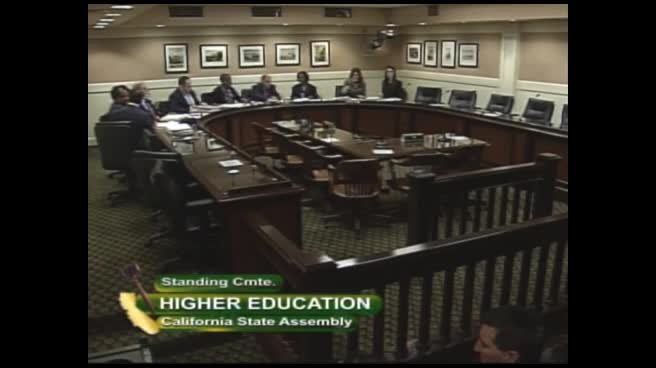
Discussed in Hearing
 1H
Assembly Standing Committee on Appropriations
 11MIN
Assembly Standing Committee on Higher Education
Bill Author

Bill Co-Author(s):
