SB 1221: Schools: trespassing.
- Session Year: 2017-2018
- House: Senate
- Latest Version Date: 2018-04-10
Existing law makes it a misdemeanor for any person who is required to register as a sex offender to come into any school building or upon any school grounds without lawful business and written permission from the chief administrative official of that school. Existing law defines school, for purposes of those provisions, to include, among others, any public or private elementary school, junior high school, 4-year high school, senior high school, adult school, evening high school, or technical school. Existing law defines chief administrative officer, for purposes of those provisions, as the principal of the school, and other persons designated by the principal who have specified credentials.
This bill would make those provisions also applicable to a public or private preschool. preschool and would expand the definition of a chief administrative official to include the owner, director, or general manager of a preschool.
By changing the definition of a crime, the bill would impose a state-mandated local program.
The California Constitution requires the state to reimburse local agencies and school districts for certain costs mandated by the state. Statutory provisions establish procedures for making that reimbursement.
This bill would provide that no reimbursement is required by this act for a specified reason.
Existing law makes it a misdemeanor for any person who is required to register as a sex offender to come into any school building or upon any school grounds without lawful business and written permission from the chief administrative official of that school. Existing law defines school, for purposes of those provisions, to include, among others, any public or private elementary school, junior high school, 4-year high school, senior high school, adult school, evening high school, or technical school.
This bill would make those provisions also applicable to a public or private preschool.
By changing the definition of a crime, the bill would impose a state-mandated local program.
The California Constitution requires the state to reimburse local agencies and school districts for certain costs mandated by the state. Statutory provisions establish procedures for making that reimbursement.
This bill would provide that no reimbursement is required by this act for a specified reason.
(a)A person who is required to register as a sex offender pursuant to Section 290, who comes into any school building or upon any school ground without lawful business thereon and written permission indicating the date or dates and times for which permission has been granted from the chief administrative official of that school, is guilty of a misdemeanor.
(b)(1)The chief administrative official of a school may grant a person who is subject to this section and not a family member of a pupil who attends that school, permission to come into a school building or upon the school grounds to volunteer at the school, provided that, notwithstanding subdivisions (a) and (c) of Section 290.45, at least 14 days prior to the first date for which permission has been granted, the chief administrative official notifies or causes to be notified the parent or guardian of each child attending the school that a person who is required to register as a sex offender pursuant to Section 290 has been granted permission to come into a school building or upon school grounds, the date or dates and times for which permission has been granted, and his or her right to obtain information regarding the person from a designated law enforcement entity pursuant to Section 290.45. The notice required by this paragraph shall be provided by one of the methods identified in Section 48981 of the Education Code.
(2)Any chief administrative official or school employee who in good faith disseminates the notification and information as required by paragraph (1) shall be immune from civil liability for action taken in accordance with that paragraph.
(c)For purposes of this section, school also includes a private or public preschool. preschool, and chief administrative official includes the owner, director, or general manager of a preschool.
(d)Punishment for a violation of this section shall be as follows:
(1)Upon a first conviction by a fine of not exceeding five hundred dollars ($500), by imprisonment in a county jail for a period of not more than six months, or by both the fine and imprisonment.
(2)If the defendant has been previously convicted once of a violation of this section, by imprisonment in a county jail for a period of not less than 10 days or more than six months, or by both imprisonment and a fine of not exceeding five hundred dollars ($500), and shall not be released on probation, parole, or any other basis until he or she has served not less than 10 days.
(3)If the defendant has been previously convicted two or more times of a violation of this section, by imprisonment in a county jail for a period of not less than 90 days or more than six months, or by both imprisonment and a fine of not exceeding five hundred dollars ($500), and shall not be released on probation, parole, or any other basis until he or she has served not less than 90 days.
(e)Nothing in this section shall preclude or prohibit prosecution under any other law.
SEC. 2.No reimbursement is required by this act pursuant to Section 6 of Article XIIIB of the California Constitution because the only costs that may be incurred by a local agency or school district will be incurred because this act creates a new crime or infraction, eliminates a crime or infraction, or changes the penalty for a crime or infraction, within the meaning of Section 17556 of the Government Code, or changes the definition of a crime within the meaning of Section 6 of Article XIIIB of the California Constitution.
(a)A person who is required to register as a sex offender pursuant to Section 290, who comes into any school building or upon any school ground without lawful business thereon and written permission indicating the date or dates and times for which permission has been granted from the chief administrative official of that school, is guilty of a misdemeanor.
(b)(1)The chief administrative official of a school may grant a person who is subject to this section and not a family member of a pupil who attends that school, permission to come into a school building or upon the school grounds to volunteer at the school, provided that, notwithstanding subdivisions (a) and (c) of Section 290.45, at least 14 days prior to the first date for which permission has been granted, the chief administrative official notifies or causes to be notified the parent or guardian of each child attending the school that a person who is required to register as a sex offender pursuant to Section 290 has been granted permission to come into a school building or upon school grounds, the date or dates and times for which permission has been granted, and his or her right to obtain information regarding the person from a designated law enforcement entity pursuant to Section 290.45. The notice required by this paragraph shall be provided by one of the methods identified in Section 48981 of the Education Code.
(2)Any chief administrative official or school employee who in good faith disseminates the notification and information as required by paragraph (1) shall be immune from civil liability for action taken in accordance with that paragraph.
(c)For purposes of this section, school also includes a private or public preschool.
(c)(d)Punishment for a violation of this section shall be as follows:
(1)Upon a first conviction by a fine of not exceeding five hundred dollars ($500), by imprisonment in a county jail for a period of not more than six months, or by both the fine and imprisonment.
(2)If the defendant has been previously convicted once of a violation of this section, by imprisonment in a county jail for a period of not less than 10 days or more than six months, or by both imprisonment and a fine of not exceeding five hundred dollars ($500), and shall not be released on probation, parole, or any other basis until he or she has served not less than 10 days.
(3)If the defendant has been previously convicted two or more times of a violation of this section, by imprisonment in a county jail for a period of not less than 90 days or more than six months, or by both imprisonment and a fine of not exceeding five hundred dollars ($500), and shall not be released on probation, parole, or any other basis until he or she has served not less than 90 days.
(d)(e)Nothing in this section shall preclude or prohibit prosecution under any other provision of law.
SEC. 2.No reimbursement is required by this act pursuant to Section 6 of Article XIIIB of the California Constitution because the only costs that may be incurred by a local agency or school district will be incurred because this act creates a new crime or infraction, eliminates a crime or infraction, or changes the penalty for a crime or infraction, within the meaning of Section 17556 of the Government Code, or changes the definition of a crime within the meaning of Section 6 of Article XIIIB of the California Constitution.
|
Date
|
Status
|
|---|---|
| May 25, 2018 | May 25 hearing: Held in committee and under submission. |
| May 18, 2018 | Set for hearing May 25. |
| Apr 30, 2018 | April 30 hearing: Placed on APPR. suspense file. |
| Apr 20, 2018 | Set for hearing April 30. |
| Apr 17, 2018 | From committee: Do pass and re-refer to Com. on APPR. (Ayes 7. Noes 0.) (April 17). Re-referred to Com. on APPR. |
| Apr 10, 2018 | From committee with author's amendments. Read second time and amended. Re-referred to Com. on PUB. S. |
| Apr 3, 2018 | Set for hearing April 17. |
| Mar 1, 2018 | Referred to Com. on PUB. S. |
| Feb 16, 2018 | From printer. May be acted upon on or after March 18. |
| Feb 15, 2018 | Introduced. Read first time. To Com. on RLS. for assignment. To print. |
|
Date
|
Description
|
Location
|
Votes
|
|
|---|---|---|---|---|
| Apr 30, 2018 | Placed on suspense file | Senate Standing Committee on Appropriations |
Passed |
|
| Apr 17, 2018 | Do pass, but first be re-referred to the Committee on [Appropriations] | Senate Standing Committee on Public Safety |
Passed |
This list shows positions taken on this bill by organizations on the date displayed, which is linked to the original source.
Positions by individuals are not included.
|
Organization
|
Position
|
Date
|
|---|---|---|
| California District Attorneys Association | * Support | Apr 17, 2018 |
| California Public Defenders Association | * Against | Apr 17, 2018 |
| California State Sheriff's Association | * Support | Apr 17, 2018 |
| Placer County | * Support | Apr 17, 2018 |
| PURPOSE | ** Against | Apr 16, 2018 |
SENATE COMMITTEE ON
Senator Ricardo Lara, Chair
2017 - 2018 Regular Session
SB 1221 (Gaines) - Schools: trespassing
Version: | Policy Vote: |
Urgency: | Mandate: |
Hearing Date: | Consultant: |
This bill meets the criteria for referral to the Suspense File.
Bill Summary:
SB 1221 would make it a misdemeanor for a person who is on the sex offender registry to enter the building or grounds of a public or private preschool without permission, as specified.
Fiscal Impact:
- Court: Unknown, potentially-significant cost pressures (General Fund*) to the court to adjudicate charges brought against defendants who enter a preschool without permission as proscribed by this measure. While the superior courts are not funded on a workload basis, an increase in workload could result in delayed court services and would put pressure on the General Fund to fund additional staff and resources.
- Prosecution & incarceration: Unknown potential increase in non-reimbursable local enforcement and incarceration costs (local funds) to prosecute and incarcerate those charged with and found guilty of conduct proscribed by this bill. Costs would be offset, to a degree, by fee and assessment revenue.
*Trial Court Trust Fund
Background:
Any person who has been convicted of specified sex offenses must register according to the Sex Offender Registration Act. The person must register with the chief of police of the city in which he or she resides or the sheriff of the county if he or she lives in an unincorporated area or city that has no police department. Additionally, the Sex Offender Punishment, Control, and Containment Act of 2006 prohibits a person who is on the registry from being in any school building or upon any school grounds without lawful business and without written permission from the chief administrative official of that school. School, for purposes of these provisions, include, among others, any public or private elementary school, junior high school, four-year high school, senior high school, adult school, evening high school, or technical school. A violation of this prohibition is a misdemeanor with a graduating penalty scheme that includes a mandatory minimum sentence in county jail. The first offense is punishable by imprisonment in the county jail for up to six months and/or a base fine of no more than $500. A second conviction of this offense, in addition to the possible fine, requires imprisonment of at least ten days but no more than six months. A third or subsequent violation of this crime, in addition to the possible fine, requires imprisonment of at least ninety days but no more than six months.
The chief administrative official of a school is allowed to grant permission to a person on the registry and not a family member of a pupil who attends the school to enter school premises to volunteer at the school, provided that at least fourteen days prior to the first date for which permission has been granted, the chief administrative official notifies the parent or guardian of each child attending the school that a person has been granted permission to enter the premises, the date or dates and times for which permission has been granted, and the parent’s right to obtain information regarding the person from a designated law enforcement entity.
Existing law also prohibits a person who is on the registry from residing within 2,000 feet of any public or private school or park where children regularly gather. Additionally, it prohibits those registrants whose sex crime was against a victim under age sixteen from working as an employee or volunteer with minors if the registrant would be working with minors directly and in an unaccompanied setting on more than an incidental or occasional basis or would have supervisory or disciplinary power over the child. If a registrant’s crime was not against a victim under sixteen years of age, the registrant must notify the employer or volunteer organization of his or her status as a registrant. Failure to comply with this law is a misdemeanor offense.
Proposed Law:
This bill would expand the law prohibiting a person who is on the sex offender registry to enter a school premises without permission, as specified, to encompass private and public preschools. It also would specify that “chief administrative official” includes the owner, director, or general manager of a preschool.
Related Legislation:
SB 1128 (Alquist, Ch. 337, Stats. 2006) made it a misdemeanor, with a graduated punishment scheme, for a person who is on the sex offender registry to go into a school building or on school grounds without lawful business and written permission from the school’s chief administrative official.
SB 326 (Beall, Ch. 279, Stats. 2013) required that the written permission from school’s chief administrative official include the date or date range and time for which permission is granted. It also allowed the school to grant permission to a person who is on the sex offender registry, and who is a non-family member of a child attending the school, to volunteer at the school, provided that the school notifies the parent or guardian of each child attending the school.
SB 26 (Leyva, 2017) would have deleted the requirement that the person on the registry have written permission and, instead, would have made it a misdemeanor for a person who is on the registry to enter a school premises without lawful business, except as specified. SB 26 was held on the Suspense File of this Committee.
Staff Comments:
SB 1221 would expand the locations that a registrant on the sex offender registry may not go without written permission to include private and public preschools. The California Department of Education currently contracts with over 700 nonprofit, private, and public entities to assist low-income families with preschool and care services. These represent only a portion of the total number of preschools operating in California. Public preschool must be provided in licensed centers or family child care homes. It is unclear what setting restrictions are placed on private preschools or how they are distinguishable to the public from other child care establishments. To the extent that it is unclear if a location (e.g., a home-based business) is a private preschool or some other child care setting, this bill may lead to additional prosecutions of registrants who believed they were in a permissible location not requiring written permission but were incorrect.
The fiscal impact of this bill cannot be known with certainty, as the actual impact will be dependent on numerous factors, including, but not limited to, judicial and prosecutorial discretion, the criminal history of a defendant, and the factors unique to each case. As entering a preschool premises without permission by a person who is on the sex offender registry is punishable as a misdemeanor with the potential for incarceration—and mandatory incarceration for a second or subsequent offense—certain rights to the defendants are attached to the proceedings, including the right to a jury trial and the right to counsel (at public expense if the defendants are unable to afford the costs of representation) which could lead to lengthier and more complex court proceedings. Consequently, to the extent that the court adjudicates a dozen or more of these new crimes, on average, that otherwise would not have been filed or resulted in a criminal action but for the alleged violation, court costs of this bill would surpass the Suspense File threshold.
-- END --
SENATE COMMITTEE ON PUBLIC SAFETY
Senator Nancy Skinner, Chair
2017 - 2018 Regular
Bill No: SB 1221 Hearing Date: April 17, 2018
Author: | Gaines | ||
Version: | April 10, 2018 Amended | ||
Urgency: | No | Fiscal: | Yes |
Consultant: | GC | ||
Subject: Schools: trespassing
HISTORY
Source: Author
Prior Legislation: SB 1128 (Alquist), Ch. 337, Stats. of 2006
SB 326 (Beall), Ch. 279, Stats. of 2013
Support: California District Attorneys Association; California State Sheriffs’ Association; Nevada City Police Officers Association
Opposition: California Public Defenders Association
PURPOSE
The purpose of this bill is to expand the existing limitations on sex offenders entering K-12 school grounds without the written permission of the school administration to include preschools.
Existing law requires any person who has been convicted of specified sexual offenses to register as a sex offender, for a specified period, while residing in California. The person must register with the chief of police of the city in which he or she is residing, or the sheriff of the county if he or she is residing in an unincorporated area or city that has no police department. (Penal Code § 290)
Existing law prohibits a registered sex offender from being in any school building or upon any school grounds without lawful business thereon and without written permission from the chief administrative official of that school. A person violating this prohibition is guilty of a misdemeanor. Multiple violations of this misdemeanor offense result in mandatory minimum jail time of up to 90-days in the county jail on a third or subsequent offense. (Penal Code § 626.81)
Existing law authorizes the chief administrative official of a school to grant a person who is a registered sex offender and not a family member of a pupil who attends that school, permission to come into a school building or upon the school grounds to volunteer at the school, provided that at least 14 days prior to the first date for which permission has been granted, the chief administrative official notifies the parent or guardian of each child attending the school that a
person who is required to register as a sex offender has been granted permission to come into a
school building or upon school grounds, the date or dates and times for which permission has been granted, and his or her right to obtain information regarding the person from a designated law enforcement entity. (Penal Code § 626.81)
Existing law prohibits a registered sex offender from residing within 2,000 feet of any public or private school, or park where children regularly gather. (Penal Code § 3003.5)
Existing law prohibits sex offender registrants, whose sex crime was against a victim under age 16, from working as an employee or volunteer with minors if the registrants would be working with minors directly and in an unaccompanied setting on more than an incidental or occasional basis or would have supervisory or disciplinary power over the child. If a registrant’s crime was not against a victim under age 16, the registrant must notify the employer or volunteer organization of his status as a registrant. Failure to comply with this law is a misdemeanor offense. (Penal Code § 290.95)
Existing law specifies when a school district or county office of education requests from the Department of Justice (DOJ), records involving criminal offenses committed by a prospective volunteer, the school district or county office of education may request that the DOJ provide subsequent arrest notification service and specifies that the DOJ shall comply with that request. (Education Code § 35021.2)
Existing law provides parents and guardians with certain rights, including the right to volunteer their time and resources for the improvement of school facilities and programs under the direct supervision of district employees, including but not limited to providing assistance in the classroom with the approval of and under the direct supervision of the teacher. In adopting policies that outline the manner in which parents or guardians, school staff, and pupils may share responsibility for the intellectual, physical, emotional, and social development and well-being of pupils, school district governing boards must specify the manner in which the parents and guardians of pupils may support the learning environment, including volunteering in their children’s classrooms or for other activities at the school. School districts are not authorized to permit participation by a parent or guardian if it conflicts with a valid restraining order, protective order, or order for custody or visitation issued by a court of competent jurisdiction. (Education Code § 51101)
Existing law defines a chief administrative officer as "the principal of the school, a person who possesses a standard supervision credential or a standard administrative credential and who is designated by the principal, or a person who carries out the same functions as a person who possesses a credential and who is designated by the principal." (Pen. Code, § 626, subd. (a)(5)(B).)
This bill expands the prohibition on sex offenders entering school grounds, without first obtaining written permission from a school official, to include any public or private pre-school.
COMMENTS
- Need for This Bill
According to the author:
Existing law makes if misdemeanor for any person who is required to register as a sex offender to come into any school building or upon any school grounds without certain permissions. “School” for these purposes is defined as public or private elementary school; junior high school; 4-year high school; senior high school; adult school; evening high school; and technical school.
Preschools are excluded from the current definition. By adding preschools, we will provide those students with the same level of protection as received by their older peers.
- Sex Offenders on School Grounds
Current law prohibits registered sex offenders from being on a school campus without lawful business and written permission of the school principal, including parents. Current law provides parents with certain rights, including the right to volunteer at their child's school. School districts are not authorized to permit participation by a parent or guardian if it conflicts with a valid restraining order, protective order, or order for custody or visitation issued by a court of competent jurisdiction. Under current law “schools” include any public or private:
- Elementary schools
- Junior high schools
- 4-year high schools
- Senior high schools
- Adult schools
- Evening high schools
- Technical schools
This bill expands the prohibition to include in the definition of a “school” any and all public or private preschool.
California has enacted several laws attempting to keep sex offenders away from children. Most notably, Jessica's Law prohibits registered sex offenders from residing within 2,000 feet "of any public or private school, or park where children regularly gather." (Pen. Code, § 3003.5, subd. (b).) Additionally, registered sex offenders are not allowed to loiter about schools or public places or near which children attend or normally congregate. (Pen. Code, § 653, subd. (b).)
An offender who is required to register as a sex offender must register for a specified period of time in accordance with California’s new tiered sex registration system. Registration falls into three-tiers, either ten-years, twenty-years, or lifetime registration. Registration shall be with the local law enforcement in the place of residence. (Pen. Code, § 290, subd. (b).) The registrant must update the registration annually, within five working days of his or her birthday. (Pen. Code, § 290.012, subd. (a).) If the registrant changes his or her name, the registrant must inform the local law enforcement agency with which he or she is currently registered within five working days. (Pen. Code, § 290.014.)
A person who moves, whether within the same jurisdiction where currently registered or to a new jurisdiction inside or outside California, must, in person, within five working days of the move, inform the law enforcement agency or agencies with which he or she last registered of the move, the new address or transient location, if known, and any plans he or she has to return to California. (Pen. Code, § 290.013.) When a sex offender moves from one county to another in California without notifying law enforcement in both the county that the offender departs and the county into which the offender moves, he or she has committed two offenses: one under Pen. Code, § 290(b), and another under Pen. Code, § 290.013.
Additionally, if a person required to register as a sex offender spends more than 14 days, or an aggregate period exceeding 30 days in a calendar year, enrolled as a college student or employed or at such an institution, that person must register with the campus police department. (Pen. Code, § 290.009.)
Re-registration is required upon release from incarceration, unless the person was incarcerated for less than 30 days and is returning to the last registered address. (Pen. Code, § 290.015(a).)
A defendant may be charged with and convicted of multiple violations of the Sex Offender Registration Act, for example, based on a failure to register within five days of his or her birthday and a separate failure to register within five days of changing his or her address.
- Suggested Amendment
In order to avoid any confusion about who can grant permission, the author should consider broadening the term “chief administration official.” Many pre-schools are not as formalized as traditional K-12 educational institutions. The following amendment would address that concern:
626.81. (a) A person who is required to register as a sex offender pursuant to Section 290, who comes into any school building or upon any school ground without lawful business thereon and written permission indicating the date or dates and times for which permission has been granted from the chief administrative official, owner, director, or general manager of that school, is guilty of a misdemeanor.
(b) (1) The chief administrative official, owner, director, or general manager of a school may grant a person who is subject to this section and not a family member of a pupil who attends that school, permission to come into a school building or upon the school grounds to volunteer at the school, provided that, notwithstanding subdivisions (a) and (c) of Section 290.45, at least 14 days prior to the first date for which permission has been granted, the chief administrative official notifies or causes to be notified the parent or guardian of each child attending the school that a person who is required to register as a sex offender pursuant to Section 290 has been granted permission to come into a school building or upon school grounds, the date or dates and times for which permission has been granted, and his or her right to obtain information regarding the person from a designated law enforcement entity pursuant to Section 290.45.The notice required by this paragraph shall be provided by one of the methods identified in Section 48981 of the Education Code.
-- END –
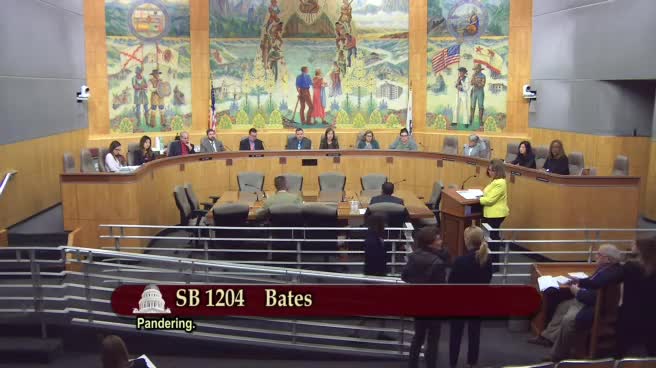
Discussed in Hearing
 5MIN
Senate Standing Committee on Public Safety
Bill Author
Bill Co-Author(s):