SB 1233: Sentencing: community service: education programs.
- Session Year: 2017-2018
- House: Senate
- Latest Version Date: 2018-02-15
Existing law authorizes a court to sentence a person convicted of an infraction to perform community service in lieu of the total fine, as defined, that would otherwise be imposed, upon a showing that payment of the total fine would pose a hardship on the defendant or his or her family. Existing law requires the defendant to perform community service at the hourly rate applicable to community service work performed by criminal defendants.
This bill would authorize a person convicted of an infraction, a misdemeanor for failure to appear or pay bail for specified violations, or who has suffered a civil assessment for failure to appear, to perform community service in the defendants county of residence in lieu of part or all of the fine or assessment imposed by participating in specified educational programs. The bill would specify that the court has discretion in determining whether the defendant has successfully completed his or her educational program.
To the extent that the bill would expand the scope of persons performing community service and would increase the supervisory duties of county officials, the bill would impose a state-mandated local program.
The California Constitution requires the state to reimburse local agencies and school districts for certain costs mandated by the state. Statutory provisions establish procedures for making that reimbursement.
This bill would provide that, if the Commission on State Mandates determines that the bill contains costs mandated by the state, reimbursement for those costs shall be made pursuant to the statutory provisions noted above.
(a)Notwithstanding any other provision of law, any person convicted of an infraction law, a person subject to a criminal fine or a civil assessment as described in subdivision (b) may, upon a showing that payment of all or part of the total fine or assessment would pose a hardship on the defendant or his or her family, be sentenced to perform community service in lieu of all or part of the total fine or civil assessment that would otherwise be imposed. The defendant shall perform community service in the defendants county of residence at the hourly rate applicable to community service work performed by criminal defendants. For
(b)Subdivision (a) applies to a person who has suffered any of the following:
(1)A conviction for an infraction.
(2)A conviction for a misdemeanor for a failure to appear or to pay bail pursuant to subdivision (a) or (b) of Section 40508 of the Vehicle Code.
(3)A civil assessment for a failure to appear in court or to pay a fine pursuant to Section 1214.1.
(c)(1)The court shall permit a defendant to perform community service by participating in educational programs with local, state, federal, nonprofit, and private entities including high schools, community colleges, universities, vocational institutions, and public libraries.
(2)The court shall have discretion in determining whether a defendant has successfully completed his or her educational program. When determining whether a defendant has successfully completed the educational program, the court may consider the following:
(A)Whether the defendant has a verification of enrollment form and a verification of completion of all hours form signed by his or her instructor if the defendant is enrolled in an educational program described in subparagraph (A) to (G), inclusive, of paragraph (1) of subdivision (d).
(B)Whether the defendant has a grade of C or higher if he or she is enrolled in an educational program described in subparagraph (H) of paragraph (1) of subdivision (d).
(d)(1)Educational programs for purposes of this section include, but are not limited to, the following:
(A)Writing classes.
(B)Literacy courses.
(C)Computer classes.
(D)English as a second language courses.
(E)General education development courses.
(F)Adult education, including, but not limited to, parenting, financial literacy, and mental and physical health workshops, classes, and programs.
(G)Preapprenticeship programs.
(H)College and university courses.
(2)Higher education programs at for-profit institutions and education programs that are part of a state or federally mandated work activity requirement are not eligible education programs for purposes of this section.
(e)For purposes of this section, the term total fine means the base fine and all assessments, penalties, and additional moneys to be paid by the defendant. For purposes of this section, the hourly rate applicable to community service work by criminal defendants shall be determined by dividing the total fine by the number of hours of community service ordered by the court to be performed in lieu of the total fine.
SEC. 2.If the Commission on State Mandates determines that this act contains costs mandated by the state, reimbursement to local agencies and school districts for those costs shall be made pursuant to Part 7 (commencing with Section 17500) of Division 4 of Title 2 of the Government Code.
|
Date
|
Status
|
|---|---|
| May 25, 2018 | May 25 hearing: Held in committee and under submission. |
| May 18, 2018 | Set for hearing May 25. |
| Apr 23, 2018 | April 23 hearing: Placed on APPR. suspense file. |
| Apr 13, 2018 | Set for hearing April 23. |
| Apr 11, 2018 | From committee: Do pass and re-refer to Com. on APPR. (Ayes 7. Noes 0.) (April 10). Re-referred to Com. on APPR. |
| Mar 12, 2018 | Set for hearing April 10. |
| Mar 1, 2018 | Referred to Com. on PUB. S. |
| Feb 16, 2018 | From printer. May be acted upon on or after March 18. |
| Feb 15, 2018 | Introduced. Read first time. To Com. on RLS. for assignment. To print. |
|
Date
|
Description
|
Location
|
Votes
|
|
|---|---|---|---|---|
| Apr 23, 2018 | Placed on suspense file | Senate Standing Committee on Appropriations |
Passed |
|
| Apr 10, 2018 | Do pass, but first be re-referred to the Committee on [Appropriations] | Senate Standing Committee on Public Safety |
Passed |
This list shows positions taken on this bill by organizations on the date displayed, which is linked to the original source.
Positions by individuals are not included.
|
Organization
|
Position
|
Date
|
|---|---|---|
| ACLU California | * Support | Apr 10, 2018 |
| Community Housing Partnership | * Support | Apr 10, 2018 |
| Greenlighting Institute | * Support | Apr 10, 2018 |
| Legal Services for Prisoners with Children | * Support | Apr 10, 2018 |
| The Western Center on Law and Poverty | * Support | Apr 10, 2018 |
| The Women's Foundation of California | * Support | Apr 10, 2018 |
SENATE COMMITTEE ON APPROPRIATIONS
Senator Ricardo Lara, Chair
2017 - 2018 Regular Session
SB 1233 (McGuire) - Sentencing: community service: education programs
Version: February 15, 2018 | Policy Vote: PUB. S. 7 - 0 |
Urgency: No | Mandate: Yes |
Hearing Date: April 23, 2018 | Consultant: Shaun Naidu |
This bill meets the criteria for referral to the Suspense File.
Bill Summary:
SB 1233 would allow a person who is convicted of an infraction or a specified misdemeanor to complete an educational program, as specified, in lieu of paying all or part of the fine.
Fiscal Impact:
Unknown, potentially-significant loss of revenue to the state and local jurisdictions. Various surcharges, assessments, and penalties are attached to statutory fines resulting from criminal convictions. The base fine and these added amounts get divided up among the state and the local jurisdiction and go towards funding a variety of purposes, such as courthouse construction, court operation, emergency medical services, county general funds, and the state General Fund. The actual loss of revenue to the state and local governments would be dependent on how many individuals, who otherwise would have paid the total fine, choose instead to participate in the education program community service alternative and successfully complete the program. (General Fund, various special funds, local funds)
For example, Penal Code section 1465.7 imposes a 20 percent surcharge on every base fine resulting from a criminal conviction, with the revenue collected being allocated to the state General Fund. One of the misdemeanor offenses for which this measure would allow the completion of the educational program to satisfy has a maximum base fine of $1,000. Taking just that offense, if 250 individuals were convicted and sentenced to pay the maximum base fine but choose to perform the education program community service alternative instead of paying, the state General Fund would incur a loss of $50,000 from that one surcharge alone.
The court and the Department of Motor Vehicles both anticipate minor and absorbable implementation costs associated with this measure. (General Fund, Motor Vehicle Account)
Background:
The court is allowed to sentence a person who has been convicted of an infraction to perform community service in lieu of paying the total fine, which includes the base fine and all assessments, penalties, and additional moneys, that otherwise would be imposed, upon a showing by the defendant that payment of the total fine would pose a hardship to him or her or his or her family. Existing law requires the defendant to perform community service at the hourly rate applicable to community service work performed by defendants convicted of other offense classifications.
Proposed Law:
This bill would allow a person, who (1) is convicted of an infraction, (2) is convicted of a misdemeanor for failure to appear in court or pay bail for specified violations, or (3) has suffered a civil assessment for failure to appear, to perform community service in the his or her county of residence in lieu of part or all of the fine or assessment imposed by participating in specified educational programs. It would provide the court the discretion in determining whether the person has successfully completed his or her educational program.
Specifically, SB 1233 would require the court to allow a defendant to perform community service by participating in educational programs with local, state, federal, nonprofit, and private entities, including high schools, community colleges, universities, vocational institutions, and public libraries. It also would specify that the following non-exhaustive list of activities would be considered “educational programs” for the purpose of this bill:
- Writing classes
- Literacy courses
- Computer classes
- English as a second language courses
- General education development courses
- Adult education, including, but not limited to, parenting, financial literacy, and mental and physical health workshops, classes, and programs
- Pre-apprenticeship programs
- College and university courses
This bill would provide, however, that higher education programs at for-profit institutions and education programs that are part of a state- or federally-mandated work activity requirement are not eligible.
Related Legislation:
SB 185 (Hertzberg, 2017) would have reformed court procedures and fine determinations related to infraction offenses and prohibited the suspension or hold of a driver license for a failure to pay fines, as specified. SB 185 was held on the Suspense File of the Assembly Committee on Appropriations.
SB 881 (Hertzberg, Ch. 779, Stats. 2016) modified the temporary traffic amnesty program that was enacted as a part of the 2015-16 budget.
SB 405 (Hertzberg, Ch. 385, Stats. 2015) required the court to allow individuals to schedule court proceedings, even if bail or a civil assessment has been imposed and made specified clarifications to the traffic amnesty program.
Staff Comments:
Existing law provides defendants convicted of infractions the ability to perform community service in lieu of paying fines related to the offense. SB 1233 would expand this ability to misdemeanor convictions for the failure to appear in court or pay bail or a fine related to traffic offenses and to a specified civil assessment. Additionally, this bill would allow the community service option to be satisfied by participation in education programs. Certain individuals who may be convicted of an infraction or the specified misdemeanor offense may be required to or already voluntarily participate in an education program that this bill specifies would satisfy the community service alternative (e.g., a youth attending high school or a student enrolled in college) and would have continued that participation irrespective of the financial obligation associated with the conviction. This bill could provide those individuals an incentive to not pay the fines or assessments associated with a conviction and not change their current practices but still allow them to satisfy the obligations imposed by the court.
-- END --
SENATE COMMITTEE ON PUBLIC SAFETY
Senator Nancy Skinner, Chair
2017 - 2018 Regular
Bill No: SB 1233 Hearing Date: April 10, 2018
Author: | McGuire | ||
Version: | February 15, 2018 | ||
Urgency: | No | Fiscal: | Yes |
Consultant: | MK | ||
Subject: Sentencing: Community Service: Education Programs
HISTORY
Source: The Women’s Foundation of California, Women’s Policy Institute
Prior Legislation: SB 185 (Hertzberg) held in Assembly Appropriations 2017
SB 881 (Hertzberg) Chapter 779, Stats. 2016
SB 405 (Hertzberg) Chapter 385, Stats. 2015
Support: AFT 2121; American Civil Liberties Union; A New Way of Life Reentry Project; A New Path; California Public Defenders Association; Causa Justa :: Just Cause; Community Housing Partnership; Courage Campaign; Delivering Innovation in Supportive Housing; Disability Rights of California (if amended); East Bay Community Law Center; Ella Baker Center for Human Rights; Equal Rights Advocates; Friends Committee on Legislation of California; Glide Foundation; Greenlining Institute; Homeboy Industries; Legal Aid at Work; Legal Services for Prisoners with Children; Lutheran Social Services of Northern CA; National Immigration Law Center; Reentry Solutions Group; Riverside Temple Beth El; Root and Rebound; San Francisco Financial Justice Project; San Francisco Public Defender; Services, Immigrant Rights and Education Network; Tenderloin Neighborhood Development Corporation; Tides Advocacy; UCLA Labor Center; Western Center on Law and Poverty
Opposition: None known
PURPOSE
This bill provides that a person convicted of an infraction or of a misdemeanor failure to appear may perform community service in lieu of all or part of the fine by participating in specified educational programs.
Existing law authorizes a court to notify the state Department of Motor Vehicles (DMV) when an individual fails to pay a traffic fine (FTP), fails to appear in court (FTA), or fails to comply with a court order (FTC). Existing law requires the court to notify the DMV if the individual later pays the fine. (Vehicle Code § 40509.5)
Existing law requires DMV to suspend the driver’s license of an individual when DMV receives a notice from the court of an FTP or FTA for that individual, until the individual’s driving record is cleared. (Vehicle Code §§ 13365 et seq.)
Existing law provides that, in addition to any other penalty in infraction, misdemeanor, or felony cases, the court may impose a civil assessment of up to $300 against a defendant who fails, after notice and without good cause, to appear in court for proceeding authorized by law or who fails to pay all or any portion of a fine ordered by the court or to pay an installment of bail. This assessment shall be deposited in the Trial Court Trust fund. (Penal Code § 1214.1 (a))
Existing law provides that the $300 assessment shall not become effective until at least 20 calendar days after the court mails a warning to the defendant by first-class mail to the address on the notice to appear to the defendant’s last known address. If the defendant appears within the time specified in the notice and shows good cause for the failure to appear or the failure to pay a fine or installment of bail, the court shall vacate the assessment. (Penal Code § 1241.1 (b))
Existing law provides that payment of bail, fines, penalties, fees, or a civil assessment shall not be required to schedule a court hearing on a pending underlying charge. (Penal Code § 1241.1(b)(2)
Existing law provides that the $300 civil assessment shall be subject to the due process requirements governing defense and collection civil money judgments generally. (Penal Code § 1241.1(d))
Existing law provides that any county or court that operates a comprehensive collection program may deduct the costs of operating that program, excluding capital expenditures, from any revenues collected under that program. (Penal Code § 2463.007)
Existing law provides that a comprehension collection program is a separate and distinct revenue collection activity that meets the following criteria: the program identifies and collects amounts arising from delinquent court-ordered debt, whether or not a warrant has been issued against the alleged violator. (Penal Code 1463.007(c))
Existing law provides that a person willfully violating his or her written promise to appear in court or before a person authorized to receive a deposit of bail is guilty of a misdemeanor regardless of the disposition of the charge upon which he or she was originally arrested. (Vehicle Code § 40508)
Existing law provides that a person willfully failing to pay bail in installments as agreed to or a lawfully imposed fine for a violation of a provision of this code or a local ordinance adopted pursuant to this code within the time authorized by the court and without lawful excuse having been presented to the court on or before the date the bail or fine is due is guilty of a misdemeanor regardless of the full payment of the bail or fine after that time. (Vehicle Code § 40508 (b))
Existing law provides that if a person violates the promise to appear or pay a fine the court may give notice of the FTA or FTP to DMV and if the fine is subsequently paid the court shall inform DMV of that fact. (Vehicle Code §§ 40509 and 4509.5)
Existing law provides that any person who FTA as provided by law may be deemed to have elected to have a trial by written declaration upon any alleged infraction, as charged by the citing officer. (Vehicle Code § 40903 (a))
Existing law provides that notwithstanding any other law, a person convicted of an infraction may, upon a showing that payment of the total fine would pose a hardship on the defendant or his or her family, be sentenced to perform community service in lieu of the total fine that would otherwise be imposed. The defendant shall perform community service at the hourly rate applicable to community service work performed by criminal defendants. (Penal Code § 1209.5)
Existing law provides that “total fine” means the base fine and all the assessments, penalties and additional moneys to be paid by the defendant. (Penal Code § 1209.5)
Existing law provides for that the purposes of this section the hourly rate applicable to community service work by criminal defendants shall be determined by dividing the total fine by the number of hours of community service ordered by the court to be performed in lieu of the total fine. (Penal Code § 1209.5)
This bill provides instead that a person subject to a criminal fine or civil assessment may, upon a showing that payment of all or part of the total fine or assessment would pose a hardship on the defendant or his or her family, be sentenced to perform community service in lieu of all or part of the total fine or civil assessment that would otherwise be imposed. This would apply to a person who suffered: a conviction or an infraction; a misdemeanor failure to appear or failure to pay bail under the Vehicle Code; or, a civil assessment for failure to appear in court or pay a fine.
This bill provides that the court shall permit a defendant to perform community service by participating in educational programs with local, state, federal, nonprofit, and private entities including high school, community colleges, universities, vocational institutions, and public libraries.
This bill provides that the court shall have discretion in determining whether a defendant has successfully completed his or her educational program.
This bill provides that when determining whether a defendant has successfully completed the educational program, the court may consider the following:
- Whether the defendant has a verification of enrollment form and a verification of completion of all hours form signed by his or her instructor if the defendant is enrolled in a specified educational program.
- Whether the defendant has a grade C or higher if he or she is enrolled in a specified educational program.
This bill defines educational program as including but not limited to the following:
- Writing classes.
- Literacy courses.
- Computer classes.
- English as a second language courses.
- General Education development courses.
- Adult education, including, but not limited to, parenting, financial literacy, and mental and physical health workshops, classes and programs.
- Preapprenticeship programs.
- College and university courses.
This bill provides that higher education programs at for-profit institutions and education programs that are part of a state or federally mandated work activity requirement are not eligible education programs for purposes of this bill.
COMMENTS
1. Need for This Bill
According to the author:
California’s traffic fines and fees are some of the highest in the country considering the large number of add-on-fees. This means that a ticket that is meant to be $100—the base fine that the legislature originally imposed for the offense-automatically becomes $490, a price that may middle-to low-income families are unable to pay.[1]
Currently law allows judges to provide alternative payment options of individuals who would face financial hardship in paying the mandated traffic fees. Options may include paying in installments or completing community service hours in lieu of the total fine.
The community service alternative offers middle-to-low income families the opportunity to satisfy their financial obligation to the court by working a number of unpaid hours for a qualifying nonprofit organization or a government agency as provided by the court. Community service duties may consist of performing manual labor (cleaning, raking, trash clean-up, etc.).
This alternative, which is intended to aid struggling families, can become inaccessible and overwhelming when the hours to complete are steep. For low-income households, completing the community service hour requirements can become a hindrance for individuals to successfully maintain employment, attend school and/or care for the family.
In 2017, the Lawyers’ Committee for Civil Rights of the San Francisco Bay Area recommended that flexibility be the guiding principle for community service options. Weekend or evening community service should be available and credit should be allowed for hours committed to job training, education, or for participating in other approved public interest or personal improvement activities.
Offering educational programs as an option for community service could not only increase access to this alternative, but also encourage individuals to seek opportunities that can improve their quality of life. Educational opportunities to the public can have long lasting benefits to working families, such as fostering lifelong learning and providing affordable and accessible pathways into all of higher education’s opportunities.
2. Background
In the 2015-2016 budget act the Legislature adopted the Governor’s proposal for amnesty program to provide a remedy for people who got their licenses suspended for an FTA or FTP. Beginning in October 205 the courts began accepting applications and approximately 200,000 California’s have taken advantage of the program and had their driving privilege restored. That amnesty program ended April 4, 2017.
3. Educational Programs for Community Service
Under existing law a court has the authority to allow a court has the authority to allow a person who would face a hardship when paying a fine for an infraction to be sentenced to perform community service.
This bill would expand that authority to allow a court which finds that paying all or part of the fine or civil assessment on an infraction or misdemeanor failure to appear would cause a hardship to allow the person to perform community services in lieu of the fine. In addition, the bill expands the definition of community service to include participating in educational programs with local, state, federal, nonprofit, and private entities including high schools, community colleges, universities, vocational institutions and public libraries. The court will have the discretion in determining whether a defendant has successfully completed his or her educational program and the bill suggests that the court may consider either a signature from the instructor that the hours were completed for specified courses and where applicable a grade of a C or higher.
The sponsor of the bill, the Women’s Foundation of California, Women’s Policy Institute believes that “[i]ncluding educational programs as an option for community service will not only lead to personal improvement, but also serves the public’s interest.”
4. Argument in Support
Root and Rebound states:
…For some individuals, choosing this more affordable option could mean completing 150+ hours of community service in the assigned time frame. This option may be the most affordable but, for many individuals facing financial hardships, ultimately impossible because it requires participation during time that must be spent caregiving, working, or looking for work. Further, the individual dedicates time they could have invested improve their and their family’s quality of life, which ultimately benefits society around them at a deeper level, performing labor that does nothing to end the cycle of poverty.
5. Disability Rights of California requested amendment.
Disability Rights of California states:
We request that SB 1233 be amended to provide that all community service and educational sites offered pursuant to Penal Code 1209.5 shall be accessible to persons with disabilities to allow their participation on an equal basis to nondisabled persons and, to the extent necessary, reasonable accommodations be made to allow their participation. Existing state and federal law already require accessibility and accommodations but they often go unheeded. It is necessary to specifically restate the existing requirements in this statute and include the requirement in court orders to ensure equal access.
-- END –
https://lccr.com/wp-content/uploads/LCCR-Report-Paying-More-for-Being-Poor-May-May-2017-5.4.17.pdf ↑
Discussed in Hearing
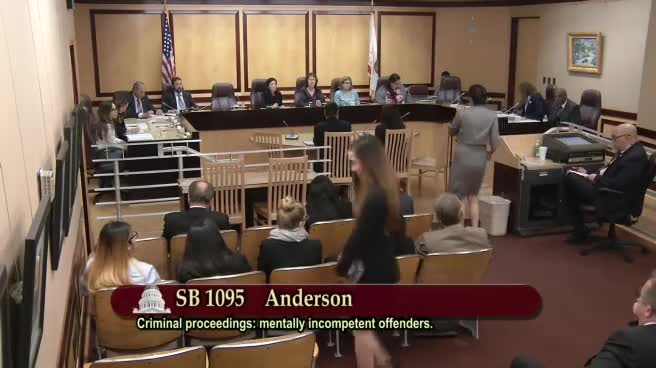 20MIN
Senate Standing Committee on Public Safety
Bill Author
Bill Co-Author(s):