SB 1271: Crime: masks and disguises.
- Session Year: 2017-2018
- House: Senate
- Latest Version Date: 2018-02-16
Existing law makes it a misdemeanor to wear a mask, false whiskers, or any personal disguise, as specified, with the purpose of evading or escaping discovery, recognition, or identification while committing a public offense, or for concealment, flight, evasion, or escape from arrest or conviction for any public offense.
This bill would make technical, nonsubstantive changes to these provisions, and would delete false whiskers from the list of identity-concealing items.
Existing law authorizes the chief administrative officer of an educational campus or facility, as specified, or his or her designee to withdraw a persons consent to remain at the campus or facility when there is reasonable belief that the person has willfully disrupted the orderly operation of the campus or facility. Under existing law, a person who willfully and knowingly enters or remains at a campus or facility while consent is withdrawn is guilty of a misdemeanor.
This bill would make it a misdemeanor to fail to remove a mask or personal disguise at the demand of a law enforcement officer or public safety official, as specified, while in a public space of a campus or other facility of a community college, California State University, University of California, or public school, as defined, if the officer or official has a reasonable suspicion that the individual has been or is currently involved in a crime. By creating a new crime, this bill would impose a state-mandated local program.
The California Constitution requires the state to reimburse local agencies and school districts for certain costs mandated by the state. Statutory provisions establish procedures for making that reimbursement.
This bill would provide that no reimbursement is required by this act for a specified reason.
(a)It is unlawful for any person to wear any mask, false whiskers, a mask or any personal disguise (whether disguise, whether complete or partial) partial, for the purpose of:
OneEvading(1)Evading or escaping discovery, recognition, or identification in the commission of any public offense.
TwoConcealment,(2)Concealment, flight, or escape, when charged with, arrested for, or convicted of, any public offense. Any
(b)A person violating any of the provisions of who violates this section shall be deemed is guilty of a misdemeanor.
SEC. 2.Section 626.5 is added to the Penal Code, to read:626.5.(a)A federal, state, or local law enforcement officer or campus or facility public safety official may require a person to remove a mask or personal disguise, whether complete or partial, to identify the person if the person is in a public space of a campus or other facility of a community college, a state university, the University of California, or a public school and the officer or official has a reasonable suspicion that the individual has been or is currently involved in a crime.
(b)A person who fails to comply with the demand made pursuant to subdivision (a) has willfully disrupted the orderly operation of a campus or facility and is guilty of a misdemeanor.
SEC. 3.No reimbursement is required by this act pursuant to Section 6 of Article XIIIB of the California Constitution because the only costs that may be incurred by a local agency or school district will be incurred because this act creates a new crime or infraction, eliminates a crime or infraction, or changes the penalty for a crime or infraction, within the meaning of Section 17556 of the Government Code, or changes the definition of a crime within the meaning of Section 6 of Article XIIIB of the California Constitution.
|
Date
|
Status
|
|---|---|
| Apr 11, 2018 | April 10 set for first hearing. Failed passage in committee. (Ayes 2. Noes 3.) Reconsideration granted. |
| Mar 15, 2018 | Set for hearing April 10. |
| Mar 1, 2018 | Referred to Com. on PUB. S. |
| Feb 20, 2018 | From printer. May be acted upon on or after March 22. |
| Feb 16, 2018 | Introduced. Read first time. To Com. on RLS. for assignment. To print. |
|
Date
|
Description
|
Location
|
Votes
|
|
|---|---|---|---|---|
| Apr 10, 2018 | [04-10-2018] hearing: Motion to Reconsider. [Reconsideration Granted.] | Senate Standing Committee on Public Safety |
Passed |
|
| Apr 10, 2018 | Do pass, but first be re-referred to the Committee on [Appropriations] | Senate Standing Committee on Public Safety |
Failed |
This list shows positions taken on this bill by organizations on the date displayed, which is linked to the original source.
Positions by individuals are not included.
|
Organization
|
Position
|
Date
|
|---|---|---|
| . . . . | ** Against | Apr 9, 2018 |
| 1. Need For This Bill | ** Against | Apr 9, 2018 |
| 2. 'Anti-Mask' Laws And Constitutional Restraints | ** Against | Apr 9, 2018 |
| 2017 | ** Against | Apr 9, 2018 |
| 3. Similar Legislative Efforts | ** Against | Apr 9, 2018 |
| 4. Reasonable Suspicion Standard | ** Against | Apr 9, 2018 |
| 5. Argument In Opposition | ** Against | Apr 9, 2018 |
| According To The Author Of This Bill: | ** Against | Apr 9, 2018 |
| ACLU of California | * Against | Apr 10, 2018 |
| Masks-Protests-Antifa-Black-Bloc-Explainer | ** Against | Apr 9, 2018 |
| politics | ** Against | Apr 9, 2018 |
| PURPOSE | ** Against | Apr 9, 2018 |
| Www.Motherjones.Com | ** Against | Apr 9, 2018 |
SENATE COMMITTEE ON PUBLIC SAFETY
Senator Nancy Skinner, Chair
2017 - 2018 Regular
Bill No: SB 1271 Hearing Date: April 10, 2018
Author: | Nielsen | ||
Version: | February 16, 2018 | ||
Urgency: | No | Fiscal: | Yes |
Consultant: | SC | ||
Subject: Crime: Masks and Disguises
HISTORY
Source: Author
Prior Legislation: Ch. 438, Stats. 1984
Support: Unknown
Opposition: American Civil Liberties Union of California; California Public Defenders Association
PURPOSE
The purpose of this bill is to create a new misdemeanor for failing to remove a mask or disguise while in the public space of a school when asked by a law enforcement officer or school official to remove the mask or disguise, as specified.
Existing law states that it is a misdemeanor to wear a mask, false whiskers, or any personal disguise, complete or partial, for the purpose of evading or escaping discovery, recognition, or identification while committing a public offense, or for concealment, flight, or escape from arrest or conviction for any public offense. (Pen. Code, § 185.)
Existing law provides that it is a misdemeanor for a student or employee who has been suspended or dismissed from school for disrupting the orderly operation of the campus or facility of the institution, and who, as a condition of the suspension or dismissal, has been denied access to the campus or facility of the institution, to willfully and knowingly enter the campus or facility of the institution without express written permission of the chief administrative officer of the campus or facility. (Pen. Code, § 626.2.)
This bill authorizes a federal, state, or local law enforcement officer or campus or facility public safety public official to require a person to remove a mask or personal disguise, whether complete or partial, to identify the person if the person is in a public space of a campus or other facility of a community college, a state university, the University of California, or a public school and the officer or official has reasonable suspicion that the individual has been or is currently involved in a crime.
This bill states that a person who fails to comply with the officer or official’s demand has willfully disrupted the orderly operation of a campus or facility and is guilty of a misdemeanor.
COMMENTS
1. Need for this Bill
According to the author of this bill:
In 2017, a number of otherwise-peaceful protests at college and university campuses were hijacked by small, violent groups of masked individuals. In early February, one such protest at UC Berkeley devolved into a riot when a group of masked individuals began smashing windows, tossing smoke bombs, setting fires, and fighting with police. Ultimately, the rioting caused an estimated $100,000 of damage to the campus and upwards of $400,000 of damage to the surrounding area, and resulted in six people being injured. The school released a statement condemning the actions of “agitators who invaded the campus and disrupted nearly 1,500 peaceful protesters.”
Students should be able to exercise their First Amendment rights free from the violence of militant, masked rioters. Unfortunately, student safety – and their ability to participate in the “marketplace of ideas” that is our public school system – has been placed at risk because of the behavior of a small group of people.
It has become evident that a key distinction of these violent groups is their propensity to hide their identities with masks, a tactic that allows them to commit crimes without risk of identification.
SB 1271 builds on existing law by making it a misdemeanor to refuse to remove a mask or personal disguise at the request of a law enforcement officer or public safety official while on the campus of a community college, state university, or public school. The officer or official must have a reasonable suspicion that the individual has been or is currently involved in a crime prior to requesting removal of the mask.
Through these measures, SB 1271 gives local law enforcement and public safety officials the tools they need to keep California’s public campuses safe and allow all students to peacefully exercise their right to speak freely.
2. “Anti-Mask” Laws and Constitutional Restraints
Existing law makes it a misdemeanor to wear a mask or any disguise for the purpose of avoiding recognition while committing any public offense or to facilitate escape from arrest or conviction for any offense. (Pen. Code, § 185.)
California had a broader anti-mask law that was enacted in 1923, and was later repealed (Ch. 438, Stats. 1984). Former Penal Code section 650a provided that “It is a misdemeanor for any person, either alone or in company with others, to appear on any street or highway, or in other public places or any place open to view by the general public, with his face partially or completely concealed by means of a mask or other regalia or paraphernalia, with intent thereby to conceal his identity. This section does not prohibit the wearing of such means of concealment in good faith for the purposes of amusement, entertainment or in compliance with any public health order." (Ghafari v. Mun. Court for San Francisco Judicial Dist. (1978) 87 Cal.App.3d 255, 259-260.) This statute was challenged on First and Fourteenth Amendment grounds and held to be unconstitutional. (Id. at p. 259.)
In Ghafari, defendants, Iranian nationals and members of the Iranian Students Association, challenged the statute after being arrested for violating Penal Code section 650a, specifically wearing a disguise (leaflets between their face and glasses) while picketing peacefully with others in front of the Iranian consulate. Defendants claimed that they hid their faces in order to protest anonymously because had their identity became known retaliatory measures might be taken against them and their relatives. The defendants challenged statute as being “overbroad on its face because it flatly prohibits anonymity under circumstances where these protected activities may be involved and because the restriction is not required by a compelling state interest nor is it implemented in the least restrictive manner possible.” (Ghafari, supra, 87 Cal.App.3d at 260.)
The appellate court agreed that Penal Code section 650a was unconstitutional on its face. The court held that the statute serves no legitimate law enforcement function, is unconstitutionally overbroad and the state's interests are fully protected by more narrowly drawn prohibitions, such as Penal Code section 185:
It is clear that in flatly prohibiting anonymous public appearances by persons exercising their First Amendment rights, section 650a sweeps too broadly. It must be emphasized that appellants do not assert that there is an absolute right to anonymity while engaging in First Amendment activities. Nor do they fail to recognize that the state has a legitimate interest in crime prevention and detection, and that under certain circumstances concealment of identity may give rise to law enforcement problems. But, as they point out, other statutes presently exist which prohibit illegitimate and improper use of concealment of identity and any dangers potentially arising from First Amendment activity which is undertaken by masked participants.
(Id. at p. 261.) The court disagreed with the prosecution’s argument that Penal Code Section 185 can only be used to prosecute someone after a crime had occurred:
Section 185 prohibits the use of a mask for the purpose of "evading or escaping . . . recognition, or identification in the commission of any public offense." The plain meaning of this language covers the situation where a mask is worn prior to the actual commission of the offense.
. . . . Furthermore, without delineating them all, a number of other penal statutes [could] come into play, such as section 404 (riot), sections 406-407 (rout, unlawful assembly), section 415 (disturbing the peace), section 416 (refusing to disperse), . . . section 647c (obstruction of thoroughfares and public places), and sections 726-727 (arrest after refusal to disperse), thereby providing the police with the legal armamentarium to deal effectively with such a disturbance.
(Id. at p. 262.) The court also found that the “amusement or entertainment” exception was vague and violated the equal protection clause and had a chilling effect on the exercise of a fundamental right. (Id. at pp. 264-265.) The court concluded by stating,
The People's assertion that this case does not involve the exercise of any First Amendment right is untenable. Underlying, and occasionally surfacing in their briefs and oral argument to this court appears an unfounded fear that the mere appearance of anonymous persons in public will inevitably lead to violence and other illegal activities. If, in a given situation, those fears prove justified, narrowly drawn statutes exist to protect legitimate state interests. But where, as here, anonymous public appearance is related to the exercise of First Amendment rights, the following observation of Justice Tobriner seems apropos: "Protest may disrupt the placidity of the vacant mind just as a stone dropped in a still pool may disturb the tranquillity of the surface waters, but the courts have never held that such 'disruption' falls outside the boundaries of the First Amendment." (Braxton v. Municipal Court, supra, 10 Cal.3d at p. 146.)
(Id. at p. 266.) Penal Code 650a was eventually repealed by the Legislature in 1984.
This bill, while not as broad as Penal Code 650a was, still raises constitutional concerns. While costumes and disguises may be used to evade being identified during the commission of a crime, they are often worn as a form of expression, including expressing political views, although the First Amendment protects more than just political speech. (In re Giannini (1968) 69 Cal.2d 563, 570 [“courts must . . . cast a wide net over all forms of communication in order to protect that which is of potential political relevance"].) Because freedom of speech and expression are fundamental rights protected by the First Amendment, any laws that infringe on those rights must be tested under strict scrutiny which requires that the statute to be narrowly drawn to protect a compelling state interest. According to the author’s statement, the stated interest here is student safety and “the ability to participate in the ‘marketplace of ideas’ that is our public school system . . . . placed at risk because of the behavior of a small group of people.” This statute is not narrowly drawn because, as stated by the court in Ghafari, there are other statutes that exist that already punish violent or riotous behavior, without infringing on a person’s freedom of expression or speech.
Considering that California already has a statute that punishes wearing a mask or disguise while committing a crime, as well as other statutes that punish riotous, disruptive, and violent acts regardless of the location of the crimes, is this bill necessary?
3. Similar Legislative Efforts
The earliest anti-mask law was enacted in New York in 1845 in response to farmer uprisings—in particular a clash between a landowner and some farmer-tenants he sought to evict. (Ahmed and Pauley, Wearing Masks at Protests Didn’t Start With the Far Left, Mother Jones (Sept. 29, 2017) <https://www.motherjones.com/politics/2017/09/masks-protests-antifa-black-bloc-explainer/> [as of Apr. 2, 2018].) Most of the other anti-mask laws were enacted between the 1920s and 1950s in reaction to the Ku Klux Klan. (Southern Poverty Law Center, Unmasking the Clan (Summer 1999).) Some of these laws were stricken down based violating freedom of speech and equal protection. (See Ghafari, supra, 87 Cal.App.3d 255; American Knights of the Ku Klux Klan v. Goshen, Indiana (1999) 50 F. Supp. 2d 835).
Recently, there have been efforts to enact this type of legislation to in response a string of mass protests where protesters wore masks or bandanas covering their faces. Some of these protests experienced instances of violence. In Arizona, House Bill 2007 would have made it illegal for anyone to wear a mask or hood to conceal their identity during political demonstrations or parade. The bill was later narrowed to allow harsher penalties for people who try to use masks to evade law enforcement during or immediately after committing a crime. In Washington, Senate Bill 5941 would make it a misdemeanor for a person to wear any mask, hood, or device that covers any portion of the person’s face in public spaces. In Missouri, House Bill 179 would make it a misdemeanor to wear a mask at an unlawful assembly or riot. These bills have faced criticism for violating the First Amendment and have thus far not been signed into law.
4. Reasonable Suspicion Standard
In general, there are three categories of law enforcement encounters: (1) consensual stops, (2) stop and frisks based on reasonable suspicion, and (3) arrests based on probable cause. The latter two are considered detentions, meaning that the subject of the stop is not free to end the encounter and leave. Any detention, even brief, is subject to protections under the Fourth Amendment which requires that any intrusion into a person’s liberty must be reasonable. Probable cause requires the officer to have sufficient facts and circumstances as would lead a reasonable person to believe that evidence or contraband relating to criminal activity will be found in the location to be searched. Reasonable suspicion requires less than probable cause and authorizes a shorter term detention. For a stop and frisk to be valid, the law enforcement officer must be able to point to specific and articulable facts which, taken together with rational inferences from those facts, reasonably warrant that intrusion. (Terry v. Ohio (1968) 392 U.S. 1, 21.) The officer is also allowed to do a cursory frisk of the individual if the officer believes the individual to be armed and dangerous. A frisk is a limited search of the outer clothing of such persons in an attempt to discover weapons which might be used to assault him. (Id. at p. 30.)
However, an individual who is being stopped by law enforcement typically does not know whether they can walk away from the encounter or refuse to answer questions. Additionally, reasonable suspicion gives officers a great deal of discretion and can at times be abused or disproportionately enforced in among certain demographics or to target certain individuals. If an officer arrests a person based on something that was found during a stop and frisk, including an arrest based on failing to follow and officer’s instructions or obstructing an officer in his or her duties, the person has to go through the criminal process and challenge the officer’s stop through motions and hearings in order to get the evidence and eventually the case dismissed. Often times, a person will choose to plead guilty to quickly resolve the case rather than pursue valid challenges to the search and seizure.
Does codifying “reasonable suspicion” in this bill authorize too much discretion to officers to target certain individuals in enforcing the law? As raised by the opposition, the bill could be used as a pretext for content-based censorship in the context of lawful campus protests.
5. Argument in Opposition
The American Civil Liberties Union of California opposes this bill and writes:
It is already a misdemeanor in California to wear a mask for the purpose of evading or escaping identification in the commission of a crime. (Penal Code, §185). It is also a misdemeanor in California to wear a mask for the purpose of concealment, flight, or escape when charged with, arrested for, or convicted of a crime. (Id.) This law applies to people in public spaces on school, college, and university campuses, as it does in any other public place. We do not need a separate crime to punish the behavior contemplated in SB 1271. (Fn. omitted.)
. . . .
Without questioning the particular public safety decisions made by law enforcement on the night of the protest or commenting on the actions of those involved with the protest, there is no question that current law would have permitted law enforcement officers to arrest anyone who they had probable cause to believe was committing a crime, violent or otherwise. If a law enforcement officer had arrested a person for committing a crime, the officer could have required the person to remove the mask upon arrest.
Permitting law enforcement officers to require a person to remove a mask when there is no probable cause for arrest, as SB 1271 proposes, could easily lead to differential enforcement of the proposed law based on the content of a masked person’s message, appearance or identifying characteristics, or the manner of protest. It is also unclear whether the standard of “reasonable suspicion that the person has been or is currently involved in a crime” is sufficiently tailored to balance legitimate state interests against lawful First Amendment speech.
-- END –
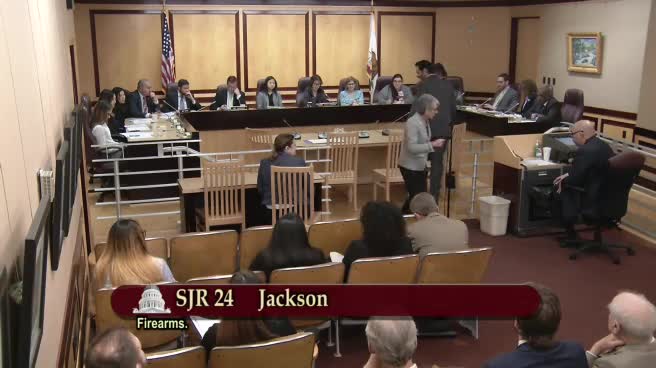
Discussed in Hearing
 13MIN
Senate Standing Committee on Public Safety
Bill Author

Bill Co-Author(s):