SB 1441: Animal cruelty: declawing.
- Session Year: 2017-2018
- House: Senate
- Latest Version Date: 2018-04-02
Existing law prohibits a person from performing, or otherwise procuring or arranging for the performance of, surgical claw removal, declawing, onychectomy, or tendonectomy on any cat that is a member of an exotic or native wild cat species. Existing law also prohibits a person from otherwise altering such a cats toes, claws, or paws to prevent the normal function of the cats toes, claws, or paws. Except as specified, a person who violates these prohibitions is guilty of a misdemeanor.
This bill would make the protections of that prohibition applicable to domestic cats, as defined. The bill would make a violation of these prohibitions with a domestic cat an infraction punishable by a fine not to exceed $250 for a first offense, and as a misdemeanor for a 2nd or subsequent offense. By creating a new crime, the bill would impose a state-mandated local program.
The California Constitution requires the state to reimburse local agencies and school districts for certain costs mandated by the state. Statutory provisions establish procedures for making that reimbursement.
This bill would provide that no reimbursement is required by this act for a specified reason.
The Veterinary Medicine Practice Act provides for the licensure and regulation of veterinarians and the practice of veterinary medicine by the Veterinary Medical Board, which is within the Department of Consumer Affairs, and authorizes the Governor to remove any member of the board for neglect of duty or other sufficient cause, after due notice and hearing.This bill would make a nonsubstantive change to that provision.The Veterinary Medicine Practice Act provides for the licensure and regulation of veterinarians and the practice of veterinary medicine by the Veterinary Medical Board, which is within the Department of Consumer Affairs, and authorizes the Governor to remove any member of the board for neglect of duty or other sufficient cause, after due notice and hearing.
This bill would make a nonsubstantive change to that provision.
(a)(1)No A person may shall not perform, or otherwise procure or arrange for the performance of, surgical claw removal, declawing, onychectomy, or tendonectomy on any cat that is a member of an exotic or native wild cat species, and shall not otherwise alter such cats toes, claws, or paws to prevent the normal function of the cats toes, claws, or paws.
(2)This subdivision does not apply to a procedure performed solely for a therapeutic purpose.(b)Any(2)A person who violates this section subdivision is guilty of a misdemeanor punishable by imprisonment in a county jail for a period not to exceed one year, by a fine of ten thousand dollars ($10,000), or by both that imprisonment and fine.
(b)(1)A person shall not perform, or otherwise procure or arrange for the performance of, surgical claw removal, declawing, onychectomy, or tendonectomy on any cat that is a member of a domestic cat species, and shall not otherwise alter that cats toes, claws, or paws to prevent the normal function of the cats toes, claws, or paws.
(2)A person who violates this subdivision is guilty of an infraction punishable by a fine not to exceed two hundred fifty dollars ($250) for a first offense, and is guilty of a misdemeanor for a second or subsequent violation.
(c)This section does not apply to a procedure performed solely for a therapeutic purpose.
(d)This section does not prohibit the enforcement of a local ordinance that provides a more severe punishment for acts prohibited under this section.
(c)(e)For purposes of this section, the following terms have the following meanings:
(1)Declawing and onychectomy mean any surgical procedure in which a portion of the animals paw is amputated in order to remove the animals claws.
(2)Tendonectomy means a procedure in which the tendons to an animals limbs, paws, or toes are cut or modified so that the claws cannot be extended.
(3)Domestic cat species means Felis Silvestris Catus, Felis Catus, or Felis Domesticus, or hybrids of those species and wild cats that are greater than three generations removed from an exotic or native cat.
(3)(4)Exotic or native wild cat species include all members of the taxonomic family Felidae, except domestic cats (Felis catus or Felis domesticus) or hybrids of wild and domestic cats that are greater than three generations removed from an exotic or native cat. cats. Exotic or native wild cat species include, but are not limited to, lions, tigers, cougars, leopards, lynxes, bobcats, caracals, ocelots, margays, servals, cheetahs, snow leopards, clouded leopards, jungle cats, leopard cats, and jaguars, or any hybrid thereof.
(4)(5)Therapeutic purpose means for the purpose of addressing an existing or recurring infection, disease, injury, or abnormal condition in the claw that jeopardizes the cats health, where addressing the infection, disease, injury, or abnormal condition is a medical necessity.
SEC. 2.No reimbursement is required by this act pursuant to Section 6 of Article XIIIB of the California Constitution because the only costs that may be incurred by a local agency or school district will be incurred because this act creates a new crime or infraction, eliminates a crime or infraction, or changes the penalty for a crime or infraction, within the meaning of Section 17556 of the Government Code, or changes the definition of a crime within the meaning of Section 6 of Article XIIIB of the California Constitution.
SECTION 1.Section 4803 of the Business and Professions Code is amended to read:4803.The Governor may, in his or her judgment, remove any member of the board for neglect of duty or other sufficient cause, after due notice and hearing.The Governor may, in his or her judgment, remove any member of the board for neglect of duty or other sufficient cause, after due notice and hearing.
|
Date
|
Status
|
|---|---|
| Apr 25, 2018 | April 24 set for second hearing. Failed passage in committee. (Ayes 3. Noes 2.) |
| Apr 18, 2018 | Set for hearing April 24. |
| Apr 17, 2018 | April 17 set for first hearing canceled at the request of author. |
| Apr 5, 2018 | Set for hearing April 17. |
| Apr 4, 2018 | Re-referred to Com. on PUB. S. |
| Apr 2, 2018 | From committee with author's amendments. Read second time and amended. Re-referred to Com. on RLS. |
| Mar 8, 2018 | Referred to Com. on RLS. |
| Feb 20, 2018 | From printer. May be acted upon on or after March 22. |
| Feb 16, 2018 | Introduced. Read first time. To Com. on RLS. for assignment. To print. |
|
Date
|
Description
|
Location
|
Votes
|
|
|---|---|---|---|---|
| Apr 24, 2018 | Do pass as amended, but first amend, and re-refer to the Committee on [Appropriations] | Senate Standing Committee on Public Safety |
Passed |
This list shows positions taken on this bill by organizations on the date displayed, which is linked to the original source.
Positions by individuals are not included.
|
Organization
|
Position
|
Date
|
|---|---|---|
| Paw project | * Support | Apr 24, 2018 |
| Paw project | * Indeterminate | Apr 24, 2018 |
| PURPOSE | ** Against | Apr 23, 2018 |
| Unknown affiliation | * Support | Apr 24, 2018 |
SENATE COMMITTEE ON PUBLIC SAFETY
Senator Nancy Skinner, Chair
2017 - 2018 Regular
Bill No: SB 1441 Hearing Date: April 24, 2018
Author: | Stern | ||
Version: | April 2, 2018 | ||
Urgency: | No | Fiscal: | Yes |
Consultant: | MK | ||
Subject: Animal Cruelty: Declawing
HISTORY
Source: The Paw Project
Prior Legislation: SB 1229 (Pavley) Chapter 596, States. 2012
AB 1857 (Koretz) Chapter 876, Stats. 2004
Support: Alley Cat Allies; Animal Advocate; California Potbellied Pig Association; Cat Care Clinic of Ashville; The Feline Medical Center; Forever Meow; Friends of Animals; Friends of Culver City Animals; Fundamentally Feline; Humane Society Veterinary Medical Association; The Humane Society of the United States; In Defense of Animals; Jameson Animal Rescue Ranch; Last Chance for Animals; Los Angeles Animal Services Department; Paws Whiskers & Claws; Red Barn Cat Clinic; RedRover; Social Compassion in Legislation; Stray Cat Alliance; Thornhill Pet Hospital, Inc.; Veterinary Association for the Protection of Animals; Zen Cat; several individuals
Opposition: California Veterinary Medical Association; Cats Only Veterinary Hospital; Codornices Veterinary Clinic; Equine Solutions; Oak Park Veterinary Clinic; Palmdale Veterinary Hospital; Ukiah Veterinary Hospital; VCA Clarmar Animal Hospital; several individuals
PURPOSE
The purpose of this bill is to prohibit a person from performing the surgical declawing of a domestic cat.
Existing law provides that a property manager cannot refuse to rent to a person because or he or she refuses to declaw or devocalize their animal. (Civil Code § 1942.7)
Existing law provides no city, county or city and county shall prohibit a healing arts professional licensed with the state or licensed or certified by an entity established under the law from engaging in any act or performing any procedure that falls within the professionally recognized scope of practice of that license. (Business and Professions Code § 460)
Existing law provides makes it a misdemeanor for a person form performing or otherwise procuring or arranging for the performance of, surgical claw removal, declawing, onychectomy, or tendonectomy on any cat that is a member of an exotic or native wild cat species. (Penal Code § 597.6 (a))
Existing law also makes it a misdemeanor for a person from altering an exotic or native wild cat’s toes, claws or paws to prevent the normal function of the cat’s toes, claws or paws. (Penal Code § 597.6(a))
Existing law provides that a violation of the above is a misdemeanor punishable by imprisonment in the county jail for up to a year and/or a fine of not more than $10,000. (Penal Code § 597.6 (a))
This bill provides that a person shall not perform or otherwise procure or arrange for the performance of, surgical claw removal, declawing, onychectomy, or tendonectomy on any cat that is a member of a domestic cat species and shall not otherwise alter that cat’s toes , claws, or paws to prevent the normal function of the cat’s toes, claws, or paws.
This bill provides that a person who violates the above is guilty of an infraction punishable by a fine not to exceed $250 for the first offense ($1025 with approximately 310% penalty assessments). A second or subsequent violation is a misdemeanor punishable by the standard up to 6 months in county jail and/ or a fine of up to $1,000 ($4,100 with penalty assessments).
This bill provides that it does not apply to a procedure performed solely for a therapeutic purpose.
This bill provides that it does not prohibit the enforcement of a local ordinance that provides a more severe punishment for acts prohibited in this bill.
This bill defines “domestic cat species” means Felis Silvestris Catus, Felis Catus, or Felis Domesticus, or hybrids of those species and wild cats that are greater than three generations removed form an exotic or native cat.
COMMENTS
1. Need for This Bill
According to the author:
Declawing is a procedure, also known as onychectomy, in which a cat’s toes are amputated at the last joint. Existing law prohibits a person from performing or procuring the surgical removal of an exotic or native wild cat’s claws, except when medically necessary for the health of the cat. A violation of this law is a misdemeanor, punishable by up to one year in a county jail and a $10,000 fine.
SB 1441 would extend the same restrictions on the declaw procedure to domestic cats. Under SB 1441, a violation would result in an escalating punishment: the first offense would result in a fine of no more than $250 and a second or subsequent violation would result in a misdemeanor.
Why is this bill necessary?
Elective declawing is an unnecessary medical procedure that can lead to many life-long negative behavioral and health impacts. Most people do not realize that the declaw procedure involves multiple amputations to remove a portion of bone, not just the nail. Removing claws can lead to chronic pain, lameness, damage to nerves, infection, back pain, painful calluses, chronic inflammation, and altered gait. Without claws to defend themselves and decreased climbing ability, cats are prone to biting and aggressive behaviors. In addition, pain in their paws can lead cats to avoid their litter box.
Elective declawing is also completely unnecessary. There are multiple humane and effective methods to prevent unwanted scratching, including keeping nails trimmed, providing scratching posts, proper training and soft vinyl caps placed on the nail. With all these safe alternatives, removing a cat’s nail ought to be done only when medically necessary for the cat.
Have any jurisdictions banned the procedure already?
In California, Los Angeles, San Francisco, Berkeley, Burbank, Culver City, West Hollywood, Santa Monica, and Beverly Hills, have banned declawing. In the US, Denver has banned declawing, and New Jersey, New York, West Virginia, and Rhode Island have pending legislation to ban the procedure. The procedure is also banned throughout the world, including in Australia, Austria, Brazil, Croatia, Germany, Ireland, New Zealand, Norway, Sweden, Switzerland, and the United Kingdom.
Will banning elective declawing lead to more cats in shelters?
The concern that banning the declaw procedure will result in more cats relinquished to animal shelters is not supported by the facts. In cities that banned the procedure, the number of cats given to animal shelters has actually declined. Furthermore, many cats are relinquished to shelters for behavioral issues, including biting and litterbox avoidance issues, two behaviors that actually increase as a result of declawing.
Are there human health reasons for declawing a cat?
Human health authorities agree that declawing is not an effective or reasonable means for protecting human health. According to the National Institutes of Health, Centers for Disease Control, and Infectious Diseases Society of America said “declawing is not advised” in their joint position paper, Guidelines for the Prevention and Treatment of Opportunistic Infections in HIV-infected Adults and Adolescents. In Reducing the Risk of pet-associated zoonotic infections (2015), the Canadian Medical Association Journal said “exercise caution when playing with cats to limit scratches; keep cat’s nails short (declawing is not recommended)” in order to limit infections.
2. Bans De-clawing of Cats
Existing law already bans the “de-clawing” and related procedures on exotic and wild cats. This bill would extend that prohibition on domestic cats. A violation would be an infraction for a first violation and a misdemeanor for repeat violations. The bill does not prohibit the procedures for therapeutic purpose, such as when a cat has a recurring infection, disease or injury.
The penalties would apply to both the veterinarian who performs the surgery and the person who requests the surgery.
3. Arguments in Support
According to the sponsor The Paw Project:
Compelling evidence exists that behavioral changes following declawing can result in the relinquishment of animals to shelters. The CDC and NIH advise pet owners to “not declaw” their animals since declawing is not an effective means to prevent opportunistic disease in immunocompromised individuals. In recent months, the Canadian Veterinary Medical Association and the American Association of Feline Practitioners (AAFP) have issued statement strongly opposing declawing. The AAFP states, “There is no current peer-reviewed data definitively proving that cats with destructive behavior are more likely to be euthanized, abandoned or relinquished. The decision (by veterinarians) of whether or not to declaw should not be impacted by these considerations.”
In May 2017, a peer-reviewed scientific article in the Journal of Feline Medicine and Surgery reported that “declawing increases the risk of long-term or persistent pain, manifesting as unwanted behaviors such as inappropriate elimination (soiling/urinating outside of the litter box) and aggression/biting. This is not only detrimental to the cat (pain is a major welfare issue and these behaviors are common reasons for relinquishment of cats to shelters), but also has health implications for their human companions, as cat bites can be serious.” For the above reasons, we proudly support SB1441
The Los Angeles Animal Services Department states:
Opponents to anti-declaw legislation often speculate that there will be a deluge of cats coming into the public shelters system if legal declawing is not available. This emotional claim is not supported by the hard statistics gathered by the Los Angeles Animal Services Department, which serves a city of over 4 million people. There were 26,942 owner-surrendered cats that came into the Los Angeles Shelter system in five years before the Los Angeles declaw ban went into effect, compared to 15,276 owner-surrendered cats in the five years afterward, a reduction of 43.3%.
In addition to protecting animals form harm, our ordinance has helped foster the growing knowledge and understanding that, in addition to the grossly inhumane procedure of declawing, declawed cats often develop behaviors that make them much less desirable as pets or cripple them for life. I attribute the decrease in relinquishment, noted above, of cats to our shelters to the decrease in behavioral problems, particularly biting and litter box avoidance, that are widely recognized to be the result of declawing and that are known to be the reason for cats to be surrendered to shelters. We at LAAS strongly believe that a ban on declawing saves the lives of cats.
4. Arguments in Opposition
The California Veterinary Medical Association opposes this bill stating:
SB 1441 attempts to circumvent [Business and Professions Code] Section 460 by amending Section 597.6 of the Penal Code where there is a current prohibition on the surgical declaw of exotic or native wild cate species-to add domestic cats. Under this proposal, veterinarians would be subject to fines and then a misdemeanor, and perhaps additional criminal penalties for performing a medical surgery at the request of a client. Additionally, we believe clients would be subject to the same penalties for “procuring or arranging” the declawing.
The CVMA is very concerned with the precedent that would be set by Senator Stern’s bill, as it would send that message that when an activist group is not in favor of a certain medical procedure, they would run legislation to place a prohibition on that procedure in the Penal Code in order to get around the restrictions in Section 460. We wonder what procedures would be next to be placed in the Penal Code—spay and neuter procedures, or even those pertaining to human surgeries…
The CVMA wants to stress that declawing is not a regularly performed procedure and the decision to declaw a cat is not made lightly. The decision is made by the animal owner who requests the surgery, and only after the veterinarian has educated the client about the procedure and the possible alternatives….When the procedure is performed, advancements in surgical technique and pain management have greatly reduced patient discomfort and recovery time. If a client is unable to obtain this surgical procedure from a veterinarian, the client faces a tremendous personal conflict of deciding whether to declaw the cat or relinquish that cat to an already over-burdened animal shelter, where it may be euthanized. This is an untenable situation for an owner, particularly an owner who may be undergoing chemotherapy treatment and cannot afford to risk infection brought on by a cat scratch.
Equine Solutions opposes stating:
The decision to declaw a cat should be one left between the veterinarian and animal owner (client) to be made on a case-by-case basis. The profession takes this subject very seriously and performs this procedure far less frequently than in the past because we now counsel our clients on alternatives. In some instances, clients will not be able to keep their cat unless it is declawed, which negatively impacts them and the cat since the alternatives are relinquishment, abandonment, or euthanasia. In the rare instances when veterinarians declaw cats, advancements in the procedure technique and feline pain medications have resulted in minimal pain following the procedure.
The profession is adequately policing itself in regard to this procedure and it, along with any veterinary treatment or procedure, should not be determined by popular vote. There are many procedures that occur in both humans and animals that some may disagree with, but the ability to perform them should be protected by our legislature by keeping the decision in the hands of the doctor and the client.
-- END –
SENATE COMMITTEE ON PUBLIC SAFETY
Senator Nancy Skinner, Chair
2017 - 2018 Regular
Bill No: SB 1441 Hearing Date: April 17, 2018
Author: | Stern | ||
Version: | April 2, 2018 | ||
Urgency: | No | Fiscal: | Yes |
Consultant: | MK | ||
Subject: Animal Cruelty: Declawing
HISTORY
Source: The Paw Project
Prior Legislation: SB 1229 (Pavley) Chapter 596, States. 2012
AB 1857 (Koretz) Chapter 876, Stats. 2004
Support: Alley Cat Allies; Animal Advocate; California Potbellied Pig Association; The Feline Medical Center; Forever Meow; Friends of Animals; Friends of Culver City Animals; Fundamentally Feline; Humane Society Veterinary Medical Association; The Humane Society of the United States; Jameson Animal Rescue Ranch; Los Angeles Animal Services Department; Red Barn Cat Clinic; Social Compassion in Legislation; Zen Cat; several individuals
Opposition: California Veterinary Medical Association; Cats Only Veterinary Hospital; Equine Solutions; Palmdale Veterinary Hospital; Ukiah Veterinary Hospital; VCA Clarmar Animal Hospital; several individuals
PURPOSE
The purpose of this bill is to prohibit a person from performing the surgical declawing of a domestic cat.
Existing law provides that a property manager cannot refuse to rent to a person because or he or she refuses to declaw or devocalize their animal. (Civil Code § 1942.7)
Existing law provides no city, county or city and county shall prohibit a healing arts professional licensed with the state or licensed or certified by an entity established under the law from engaging in any act or performing any procedure that falls within the professionally recognized scope of practice of that license. (Business and Professions Code § 460)
Existing law provides makes it a misdemeanor for a person form performing or otherwise procuring or arranging for the performance of, surgical claw removal, declawing, onychectomy, or tendonectomy on any cat that is a member of an exotic or native wild cat species. (Penal Code § 597.6 (a))
Existing law also makes it a misdemeanor for a person from altering an exotic or native wild cat’s toes, claws or paws to prevent the normal function of the cat’s toes, claws or paws. (Penal Code § 597.6(a))
Existing law provides that a violation of the above is a misdemeanor punishable by imprisonment in the county jail for up to a year and/or a fine of not more than $10,000. (Penal Code § 597.6 (a))
This bill provides that a person shall not perform or otherwise procure or arrange for the performance of, surgical claw removal, declawing, onychectomy, or tendonectomy on any cat that is a member of a domestic cat species and shall not otherwise alter that cat’s toes , claws, or paws to prevent the normal function of the cat’s toes, claws, or paws.
This bill provides that a person who violates the above is guilty of an infraction punishable by a fine not to exceed $250 for the first offense ($1025 with approximately 310% penalty assessments). A second or subsequent violation is a misdemeanor punishable by the standard up to 6 months in county jail and/ or a fine of up to $1,000 ($4,100 with penalty assessments).
This bill provides that it does not apply to a procedure performed solely for a therapeutic purpose.
This bill provides that it does not prohibit the enforcement of a local ordinance that provides a more severe punishment for acts prohibited in this bill.
This bill defines “domestic cat species” means Felis Silvestris Catus, Felis Catus, or Felis Domesticus, or hybrids of those species and wild cats that are greater than three generations removed form an exotic or native cat.
COMMENTS
1. Need for This Bill
According to the author:
Declawing is a procedure, also known as onychectomy, in which a cat’s toes are amputated at the last joint. Existing law prohibits a person from performing or procuring the surgical removal of an exotic or native wild cat’s claws, except when medically necessary for the health of the cat. A violation of this law is a misdemeanor, punishable by up to one year in a county jail and a $10,000 fine.
SB 1441 would extend the same restrictions on the declaw procedure to domestic cats. Under SB 1441, a violation would result in an escalating punishment: the first offense would result in a fine of no more than $250 and a second or subsequent violation would result in a misdemeanor.
Why is this bill necessary?
Elective declawing is an unnecessary medical procedure that can lead to many life-long negative behavioral and health impacts. Most people do not realize that the declaw procedure involves multiple amputations to remove a portion of bone, not just the nail. Removing claws can lead to chronic pain, lameness, damage to nerves, infection, back pain, painful calluses, chronic inflammation, and altered gait. Without claws to defend themselves and decreased climbing ability, cats are prone to biting and aggressive behaviors. In addition, pain in their paws can lead cats to avoid their litter box.
Elective declawing is also completely unnecessary. There are multiple humane and effective methods to prevent unwanted scratching, including keeping nails trimmed, providing scratching posts, proper training and soft vinyl caps placed on the nail. With all these safe alternatives, removing a cat’s nail ought to be done only when medically necessary for the cat.
Have any jurisdictions banned the procedure already?
In California, Los Angeles, San Francisco, Berkeley, Burbank, Culver City, West Hollywood, Santa Monica, and Beverly Hills, have banned declawing. In the US, Denver has banned declawing, and New Jersey, New York, West Virginia, and Rhode Island have pending legislation to ban the procedure. The procedure is also banned throughout the world, including in Australia, Austria, Brazil, Croatia, Germany, Ireland, New Zealand, Norway, Sweden, Switzerland, and the United Kingdom.
Will banning elective declawing lead to more cats in shelters?
The concern that banning the declaw procedure will result in more cats relinquished to animal shelters is not supported by the facts. In cities that banned the procedure, the number of cats given to animal shelters has actually declined. Furthermore, many cats are relinquished to shelters for behavioral issues, including biting and litterbox avoidance issues, two behaviors that actually increase as a result of declawing.
Are there human health reasons for declawing a cat?
Human health authorities agree that declawing is not an effective or reasonable means for protecting human health. According to the National Institutes of Health, Centers for Disease Control, and Infectious Diseases Society of America said “declawing is not advised” in their joint position paper, Guidelines for the Prevention and Treatment of Opportunistic Infections in HIV-infected Adults and Adolescents. In Reducing the Risk of pet-associated zoonotic infections (2015), the Canadian Medical Association Journal said “exercise caution when playing with cats to limit scratches; keep cat’s nails short (declawing is not recommended)” in order to limit infections.
2. Bans De-clawing of Cats
Existing law already bans the “de-clawing” and related procedures on exotic and wild cats. This bill would extend that prohibition on domestic cats. A violation would be an infraction for a first violation and a misdemeanor for repeat violations. The bill does not prohibit the procedures for therapeutic purpose, such as when a cat has a recurring infection, disease or injury.
The penalties would apply to both the veterinarian who performs the surgery and the person who requests the surgery.
3. Arguments in Support
According to the sponsor The Paw Project:
Compelling evidence exists that behavioral changes following declawing can result in the relinquishment of animals to shelters. The CDC and NIH advise pet owners to “not declaw” their animals since declawing is not an effective means to prevent opportunistic disease in immunocompromised individuals. In recent months, the Canadian Veterinary Medical Association and the American Association of Feline Practitioners (AAFP) have issued statement strongly opposing declawing. The AAFP states, “There is no current peer-reviewed data definitively proving that cats with destructive behavior are more likely to be euthanized, abandoned or relinquished. The decision (by veterinarians) of whether or not to declaw should not be impacted by these considerations.”
In May 2017, a peer-reviewed scientific article in the Journal of Feline Medicine and Surgery reported that “declawing increases the risk of long-term or persistent pain, manifesting as unwanted behaviors such as inappropriate elimination (soiling/urinating outside of the litter box) and aggression/biting. This is not only detrimental to the cat (pain is a major welfare issue and these behaviors are common reasons for relinquishment of cats to shelters), but also has health implications for their human companions, as cat bites can be serious.” For the above reasons, we proudly support SB1441
The Los Angeles Animal Services Department states:
Opponents to anti-declaw legislation often speculate that there will be a deluge of cats coming into the public shelters system if legal declawing is not available. This emotional claim is not supported by the hard statistics gathered by the Los Angeles Animal Services Department, which serves a city of over 4 million people. There were 26,942 owner-surrendered cats that came into the Los Angeles Shelter system in five years before the Los Angeles declaw ban went into effect, compared to 15,276 owner-surrendered cats in the five years afterward, a reduction of 43.3%.
In addition to protecting animals form harm, our ordinance has helped foster the growing knowledge and understanding that, in addition to the grossly inhumane procedure of declawing, declawed cats often develop behaviors that make them much less desirable as pets or cripple them for life. I attribute the decrease in relinquishment, noted above, of cats to our shelters to the decrease in behavioral problems, particularly biting and litter box avoidance, that are widely recognized to be the result of declawing and that are known to be the reason for cats to be surrendered to shelters. We at LAAS strongly believe that a ban on declawing saves the lives of cats.
4. Arguments in Opposition
The California Veterinary Medical Association opposes this bill stating:
SB 1441 attempts to circumvent [Business and Professions Code] Section 460 by amending Section 597.6 of the Penal Code where there is a current prohibition on the surgical declaw of exotic or native wild cate species-to add domestic cats. Under this proposal, veterinarians would be subject to fines and then a misdemeanor, and perhaps additional criminal penalties for performing a medical surgery at the request of a client. Additionally, we believe clients would be subject to the same penalties for “procuring or arranging” the declawing.
The CVMA is very concerned with the precedent that would be set by Senator Stern’s bill, as it would send that message that when an activist group is not in favor of a certain medical procedure, they would run legislation to place a prohibition on that procedure in the Penal Code in order to get around the restrictions in Section 460. We wonder what procedures would be next to be placed in the Penal Code—spay and neuter procedures, or even those pertaining to human surgeries…
The CVMA wants to stress that declawing is not a regularly performed procedure and the decision to declaw a cat is not made lightly. The decision is made by the animal owner who requests the surgery, and only after the veterinarian has educated the client about the procedure and the possible alternatives….When the procedure is performed, advancements in surgical technique and pain management have greatly reduced patient discomfort and recovery time. If a client is unable to obtain this surgical procedure from a veterinarian, the client faces a tremendous personal conflict of deciding whether to declaw the cat or relinquish that cat to an already over-burdened animal shelter, where it may be euthanized. This is an untenable situation for an owner, particularly an owner who may be undergoing chemotherapy treatment and cannot afford to risk infection brought on by a cat scratch.
Equine Solutions opposes stating:
The decision to declaw a cat should be one left between the veterinarian and animal owner (client) to be made on a case-by-case basis. The profession takes this subject very seriously and performs this procedure far less frequently than in the past because we now counsel our clients on alternatives. In some instances, clients will not be able to keep their cat unless it is declawed, which negatively impacts them and the cat since the alternatives are relinquishment, abandonment, or euthanasia. In the rare instances when veterinarians declaw cats, advancements in the procedure technique and feline pain medications have resulted in minimal pain following the procedure.
The profession is adequately policing itself in regard to this procedure and it, along with any veterinary treatment or procedure, should not be determined by popular vote. There are many procedures that occur in both humans and animals that some may disagree with, but the ability to perform them should be protected by our legislature by keeping the decision in the hands of the doctor and the client.
-- END –
Discussed in Hearing
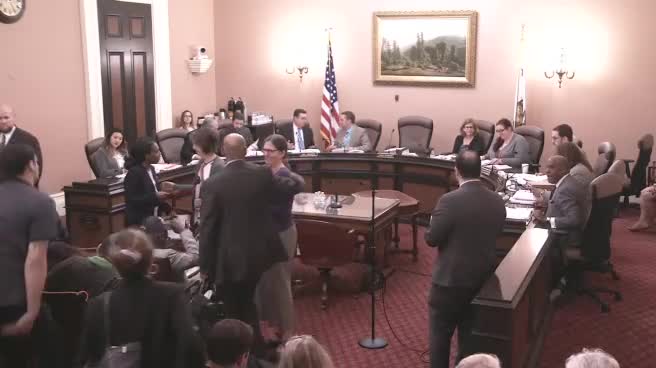 35MIN
Senate Standing Committee on Public Safety
Bill Author

Bill Co-Author(s):
