SB 416: Elder abuse: isolation.
- Session Year: 2017-2018
- House: Senate
- Latest Version Date: 2017-05-02
Existing law makes it a crime for a person who knows or reasonably should know that a person is an elder or dependent adult to inflict unjustifiable physical pain or mental suffering on that elder or dependent adult.
This bill would specify that mental suffering may be proven by a pattern of isolation, as defined.
The California Constitution requires the state to reimburse local agencies and school districts for certain costs mandated by the state. Statutory provisions establish procedures for making that reimbursement.
This bill would provide that no reimbursement is required by this act for a specified reason.
Existing law makes it a crime for a person who knows or reasonably should know that a person is an elder or dependent adult and has the care or custody of any elder of dependent adult to willfully cause or permit the person or health of the elder or dependent adult to be injured, or willfully cause or permit the elder or dependent adult to be placed in a situation in which his or her person or health is endangered. Existing law requires a person who causes great bodily injury to the victim during the commission of that crime to receive an additional 3 years in prison if the victim is under 70 years of age, and an additional 5 years in prison if the victim is 70 years of age or older. Existing law requires a person who proximately causes the death of the victim during the commission of that crime to serve an additional 5 years in prison if the victim is under 70 years of age, and an additional 7 years in prison if the victim is 70 years of age or older. Existing law requires the court, upon a conviction for elder abuse, to consider issuing an order restraining the defendant from any contact with the victim, as specified. The bill would require a person who causes great bodily injury to the victim during the commission of the above-specified crime to serve 5 additional years in prison, regardless of the age of the victim, and would require a person who proximately causes the death of the victim during the commission of the above-specified crime to serve 7 additional years in the state prison, regardless of the age of the victim. This bill would additionally make it a crime for a caretaker of an elder or dependent adult to willfully isolate that adult, as specified. The bill would make this crime a misdemeanor punishable by imprisonment in the county jail not exceeding 6 months or by a fine not exceeding $1,000, or by both that fine and imprisonment. The bill would require the court, upon a conviction for this crime, to consider issuing an order restraining the defendant from any contact with the victim, as specified. By expanding the definition of a crime, the bill would impose a state-mandated local program.The California Constitution requires the state to reimburse local agencies and school districts for certain costs mandated by the state. Statutory provisions establish procedures for making that reimbursement.This bill would provide that no reimbursement is required by this act for a specified reason.Existing law makes it a crime for a person who knows or reasonably should know that a person is an elder or dependent adult and has the care or custody of any elder of dependent adult to willfully cause or permit the person or health of the elder or dependent adult to be injured, or willfully cause or permit the elder or dependent adult to be placed in a situation in which his or her person or health is endangered. Existing law requires a person who causes great bodily injury to the victim during the commission of that crime to receive an additional 3 years in prison if the victim is under 70 years of age, and an additional 5 years in prison if the victim is 70 years of age or older. Existing law requires a person who proximately causes the death of the victim during the commission of that crime to serve an additional 5 years in prison if the victim is under 70 years of age, and an additional 7 years in prison if the victim is 70 years of age or older. Existing law requires the court, upon a conviction for elder abuse, to consider issuing an order restraining the defendant from any contact with the victim, as specified.
The bill would require a person who causes great bodily injury to the victim during the commission of the above-specified crime to serve 5 additional years in prison, regardless of the age of the victim, and would require a person who proximately causes the death of the victim during the commission of the above-specified crime to serve 7 additional years in the state prison, regardless of the age of the victim.
This bill would additionally make it a crime for a caretaker of an elder or dependent adult to willfully isolate that adult, as specified. The bill would make this crime a misdemeanor punishable by imprisonment in the county jail not exceeding 6 months or by a fine not exceeding $1,000, or by both that fine and imprisonment. The bill would require the court, upon a conviction for this crime, to consider issuing an order restraining the defendant from any contact with the victim, as specified. By expanding the definition of a crime, the bill would impose a state-mandated local program.
The California Constitution requires the state to reimburse local agencies and school districts for certain costs mandated by the state. Statutory provisions establish procedures for making that reimbursement.
This bill would provide that no reimbursement is required by this act for a specified reason.
(a)The Legislature finds and declares that crimes against elders and dependent adults are deserving of special consideration and protection, not unlike the special protections provided for minor children, because elders and dependent adults may be confused, on various medications, mentally or physically impaired, or incompetent, and therefore less able to protect themselves, to understand or report criminal conduct, or to testify in court proceedings on their own behalf.
(b)(1)Any person who knows or reasonably should know that a person is an elder or dependent adult and who, under circumstances or conditions likely to produce great bodily harm or death, willfully causes or permits any elder or dependent adult to suffer, or inflicts thereon unjustifiable physical pain or mental suffering, or having the care or custody of any elder or dependent adult, willfully causes or permits the person or health of the elder or dependent adult to be injured, or willfully causes or permits the elder or dependent adult to be placed in a situation in which his or her person or health is endangered, is punishable by imprisonment in a county jail not exceeding one year, or by a fine not to exceed six thousand dollars ($6,000), or by both that fine and imprisonment, or by imprisonment in the state prison for two, three, or four years.
(2)If, in the commission of an offense described in paragraph (1), the victim suffers great bodily injury, as defined in Section 12022.7, the defendant shall receive an additional term in the state prison as follows:
(A)Three years if the victim is under 70 years of age.
(B)Five years if the victim is 70 years of age or older.
(3)If, in the commission of an offense described in paragraph (1), the defendant proximately causes the death of the victim, the defendant shall receive an additional term in the state prison as follows:
(A)Five years if the victim is under 70 years of age.
(B)Seven years if the victim is 70 years of age or older.
(c)Any person who knows or reasonably should know that a person is an elder or dependent adult and who, under circumstances or conditions other than those likely to produce great bodily harm or death, willfully causes or permits any elder or dependent adult to suffer, or inflicts thereon unjustifiable physical pain or mental suffering, or having the care or custody of any elder or dependent adult, willfully causes or permits the person or health of the elder or dependent adult to be injured or willfully causes or permits the elder or dependent adult to be placed in a situation in which his or her person or health may be endangered, is guilty of a misdemeanor. A second or subsequent violation of this subdivision is punishable by a fine not to exceed two thousand dollars ($2,000), or by imprisonment in a county jail not to exceed one year, or by both that fine and imprisonment.
(d)Any person who is not a caretaker who violates any provision of law proscribing theft, embezzlement, forgery, or fraud, or who violates Section 530.5 proscribing identity theft, with respect to the property or personal identifying information of an elder or a dependent adult, and who knows or reasonably should know that the victim is an elder or a dependent adult, is punishable as follows:
(1)By a fine not exceeding two thousand five hundred dollars ($2,500), or by imprisonment in a county jail not exceeding one year, or by both that fine and imprisonment, or by a fine not exceeding ten thousand dollars ($10,000), or by imprisonment pursuant to subdivision (h) of Section 1170 for two, three, or four years, or by both that fine and imprisonment, when the moneys, labor, goods, services, or real or personal property taken or obtained is of a value exceeding nine hundred fifty dollars ($950).
(2)By a fine not exceeding one thousand dollars ($1,000), by imprisonment in a county jail not exceeding one year, or by both that fine and imprisonment, when the moneys, labor, goods, services, or real or personal property taken or obtained is of a value not exceeding nine hundred fifty dollars ($950).
(e)Any caretaker of an elder or a dependent adult who violates any provision of law proscribing theft, embezzlement, forgery, or fraud, or who violates Section 530.5 proscribing identity theft, with respect to the property or personal identifying information of that elder or dependent adult, is punishable as follows:
(1)By a fine not exceeding two thousand five hundred dollars ($2,500), or by imprisonment in a county jail not exceeding one year, or by both that fine and imprisonment, or by a fine not exceeding ten thousand dollars ($10,000), or by imprisonment pursuant to subdivision (h) of Section 1170 for two, three, or four years, or by both that fine and imprisonment, when the moneys, labor, goods, services, or real or personal property taken or obtained is of a value exceeding nine hundred fifty dollars ($950).
(2)By a fine not exceeding one thousand dollars ($1,000), by imprisonment in a county jail not exceeding one year, or by both that fine and imprisonment, when the moneys, labor, goods, services, or real or personal property taken or obtained is of a value not exceeding nine hundred fifty dollars ($950).
(f)Any person who commits the false imprisonment of an elder or a dependent adult by the use of violence, menace, fraud, or deceit is punishable by imprisonment pursuant to subdivision (h) of Section 1170 for two, three, or four years.
(g)As used in this section, elder means any person who is 65 years of age or older.
(h)As used in this section, dependent adult means any person who is between the ages of 18 and 64, who has physical or mental limitations which restrict his or her ability to carry out normal activities or to protect his or her rights, including, but not limited to, persons who have physical or developmental disabilities or whose physical or mental abilities have diminished because of age. Dependent adult includes any person between the ages of 18 and 64 who is admitted as an inpatient to a 24-hour health facility, as defined in Sections 1250, 1250.2, and 1250.3 of the Health and Safety Code.
(i)As used in this section, caretaker means any person who has the care, custody, or control of, or who stands in a position of trust with, an elder or a dependent adult.
(j)As used in this section, mental suffering may be proven by a pattern of isolation, as defined in Section 15610.43 of the Welfare and Institutions Code.
(k)As used in this section, a pattern consists of multiple acts over a period of time.
(j)(l)Nothing in this section shall preclude prosecution under both this section and Section 187 or 12022.7 or any other provision of law. However, a person shall not receive an additional term of imprisonment under both paragraphs (2) and (3) of subdivision (b) for any single offense, nor shall a person receive an additional term of imprisonment under both Section 12022.7 and paragraph (2) or (3) of subdivision (b) for any single offense.
(k)(m)In any case in which a person is convicted of violating these provisions, the court may require him or her to receive appropriate counseling as a condition of probation. Any defendant ordered to be placed in a counseling program shall be responsible for paying the expense of his or her participation in the counseling program as determined by the court. The court shall take into consideration the ability of the defendant to pay, and no defendant shall be denied probation because of his or her inability to pay.
(l)(n)Upon conviction for a violation of subdivision (b), (c), (d), (e), or (f), the sentencing court shall also consider issuing an order restraining the defendant from any contact with the victim, which may be valid for up to 10 years, as determined by the court. It is the intent of the Legislature that the length of any restraining order be based upon the seriousness of the facts before the court, the probability of future violations, and the safety of the victim and his or her immediate family. This protective order may be issued by the court whether the defendant is sentenced to state prison or county jail, or if imposition of sentence is suspended and the defendant is placed on probation.
SEC. 2.No reimbursement is required by this act pursuant to Section 6 of Article XIIIB of the California Constitution because the only costs that may be incurred by a local agency or school district will be incurred because this act creates a new crime or infraction, eliminates a crime or infraction, or changes the penalty for a crime or infraction, within the meaning of Section 17556 of the Government Code, or changes the definition of a crime within the meaning of Section 6 of Article XIIIB of the California Constitution.
SECTION 1.Section 368 of the Penal Code is amended to read:368.(a)The Legislature finds and declares that crimes against elders and dependent adults are deserving of special consideration and protection, not unlike the special protections provided for minor children, because elders and dependent adults may be confused, cognitively affected by medications, mentally or physically impaired, or incompetent, and therefore less able to protect themselves, to understand or report criminal conduct, or to testify in court proceedings on their own behalf.(b)(1)A person who knows or reasonably should know that a person is an elder or dependent adult and who, under circumstances or conditions likely to produce great bodily harm or death, willfully causes or permits any elder or dependent adult to suffer, or inflicts thereon unjustifiable physical pain or mental suffering, or having the care or custody of any elder or dependent adult, willfully causes or permits the person or health of the elder or dependent adult to be injured, or willfully causes or permits the elder or dependent adult to be placed in a situation in which his or her person or health is endangered, is punishable by imprisonment in a county jail not exceeding one year, or by a fine not to exceed six thousand dollars ($6,000), or by both that fine and imprisonment, or by imprisonment in the state prison for two, three, or four years.(2)If, in the commission of an offense described in paragraph (1), the victim suffers great bodily injury, as defined in Section 12022.7, the defendant shall receive an additional term of five years in the state prison.(3)If, in the commission of an offense described in paragraph (1), the defendant proximately causes the death of the victim, the defendant shall receive an additional term of seven years in the state prison.(c)Any person who knows or reasonably should know that a person is an elder or dependent adult and who, under circumstances or conditions other than those likely to produce great bodily harm or death, willfully causes or permits any elder or dependent adult to suffer, or inflicts thereon unjustifiable physical pain or mental suffering, or having the care or custody of any elder or dependent adult, willfully causes or permits the person or health of the elder or dependent adult to be injured or willfully causes or permits the elder or dependent adult to be placed in a situation in which his or her person or health may be endangered, is guilty of a misdemeanor. A second or subsequent violation of this subdivision is punishable by a fine not to exceed two thousand dollars ($2,000), or by imprisonment in a county jail not to exceed one year, or by both that fine and imprisonment.(d)Any person who is not a caretaker who violates any provision of law proscribing theft, embezzlement, forgery, or fraud, or who violates Section 530.5 proscribing identity theft, with respect to the property or personal identifying information of an elder or a dependent adult, and who knows or reasonably should know that the victim is an elder or a dependent adult, is punishable as follows:(1)By a fine not exceeding two thousand five hundred dollars ($2,500), or by imprisonment in a county jail not exceeding one year, or by both that fine and imprisonment, or by a fine not exceeding ten thousand dollars ($10,000), or by imprisonment pursuant to subdivision (h) of Section 1170 for two, three, or four years, or by both that fine and imprisonment, if the moneys, labor, goods, services, or real or personal property taken or obtained is of a value exceeding nine hundred fifty dollars ($950).(2)By a fine not exceeding one thousand dollars ($1,000), by imprisonment in a county jail not exceeding one year, or by both that fine and imprisonment, if the moneys, labor, goods, services, or real or personal property taken or obtained is of a value not exceeding nine hundred fifty dollars ($950).(e)Any caretaker of an elder or a dependent adult who violates any law proscribing theft, embezzlement, forgery, or fraud, or who violates Section 530.5 proscribing identity theft, with respect to the property or personal identifying information of that elder or dependent adult, is punishable as follows:(1)By a fine not exceeding two thousand five hundred dollars ($2,500), or by imprisonment in a county jail not exceeding one year, or by both that fine and imprisonment, or by a fine not exceeding ten thousand dollars ($10,000), or by imprisonment pursuant to subdivision (h) of Section 1170 for two, three, or four years, or by both that fine and imprisonment, if the moneys, labor, goods, services, or real or personal property taken or obtained is of a value exceeding nine hundred fifty dollars ($950).(2)By a fine not exceeding one thousand dollars ($1,000), by imprisonment in a county jail not exceeding one year, or by both that fine and imprisonment, if the moneys, labor, goods, services, or real or personal property taken or obtained is of a value not exceeding nine hundred fifty dollars ($950).(f)Any person who commits the false imprisonment of an elder or a dependent adult by the use of violence, menace, fraud, or deceit is punishable by imprisonment pursuant to subdivision (h) of Section 1170 for two, three, or four years.(g)Any caretaker of an elder or a dependent adult who willfully isolates that elder or dependent adult is guilty of a misdemeanor.(h)As used in this section:(1)Elder means any person who is 65 years of age or older.(2)Dependent adult means any person who is between the ages of 18 and 64, who has physical or mental limitations which restrict his or her ability to carry out normal activities or to protect his or her rights, including, but not limited to, persons who have physical or developmental disabilities or whose physical or mental abilities have diminished because of age. Dependent adult includes any person between the ages of 18 and 64 who is admitted as an inpatient to a 24-hour health facility, as defined in Sections 1250, 1250.2, and 1250.3 of the Health and Safety Code.(3)Caretaker means any person who has the care, custody, or control of, or who stands in a position of trust with, an elder or a dependent adult, including, but not limited to, a conservator or an attorney-in-fact.(4)Isolate means restricting the personal rights retained by the elder or dependent adult, including, but not limited to, the right to receive visitors, telephone calls, and personal mail unless specifically authorized by a court order.(i)Nothing in this section shall preclude prosecution under both this section and Section 187 or 12022.7 or any other law. However, a person shall not receive an additional term of imprisonment under both paragraphs (2) and (3) of subdivision (b) for any single offense, nor shall a person receive an additional term of imprisonment under both Section 12022.7 and paragraph (2) or (3) of subdivision (b) for any single offense.(j)In any case in which a person is convicted of violating this section, the court may require him or her to receive appropriate counseling as a condition of probation. Any defendant ordered to be placed in a counseling program shall be responsible for paying the expense of his or her participation in the counseling program as determined by the court. The court shall take into consideration the ability of the defendant to pay, and a defendant shall not be denied probation because of his or her inability to pay.(k)Upon conviction for a violation of subdivision (b), (c), (d), (e), (f), or (g), the sentencing court shall also consider issuing an order restraining the defendant from any contact with the victim, which may be valid for up to 10 years, as determined by the court. It is the intent of the Legislature that the length of any restraining order be based upon the seriousness of the facts before the court, the probability of future violations, and the safety of the victim and his or her immediate family. This protective order may be issued by the court whether the defendant is sentenced to state prison or county jail, or if imposition of sentence is suspended and the defendant is placed on probation.SEC. 2.No reimbursement is required by this act pursuant to Section 6 of Article XIIIB of the California Constitution because the only costs that may be incurred by a local agency or school district will be incurred because this act creates a new crime or infraction, eliminates a crime or infraction, or changes the penalty for a crime or infraction, within the meaning of Section 17556 of the Government Code, or changes the definition of a crime within the meaning of Section 6 of Article XIIIB of the California Constitution.(a)The Legislature finds and declares that crimes against elders and dependent adults are deserving of special consideration and protection, not unlike the special protections provided for minor children, because elders and dependent adults may be confused, on various cognitively affected by medications, mentally or physically impaired, or incompetent, and therefore less able to protect themselves, to understand or report criminal conduct, or to testify in court proceedings on their own behalf.
(b)(1)Any A person who knows or reasonably should know that a person is an elder or dependent adult and who, under circumstances or conditions likely to produce great bodily harm or death, willfully causes or permits any elder or dependent adult to suffer, or inflicts thereon unjustifiable physical pain or mental suffering, or having the care or custody of any elder or dependent adult, willfully causes or permits the person or health of the elder or dependent adult to be injured, or willfully causes or permits the elder or dependent adult to be placed in a situation in which his or her person or health is endangered, is punishable by imprisonment in a county jail not exceeding one year, or by a fine not to exceed six thousand dollars ($6,000), or by both that fine and imprisonment, or by imprisonment in the state prison for two, three, or four years.
(2)If, in the commission of an offense described in paragraph (1), the victim suffers great bodily injury, as defined in Section 12022.7, the defendant shall receive an additional term in the state prison as follows: of five years in the state prison.
(A)Three years if the victim is under 70 years of age.(B)Five years if the victim is 70 years of age or older.(3)If, in the commission of an offense described in paragraph (1), the defendant proximately causes the death of the victim, the defendant shall receive an additional term in the state prison as follows: of seven years in the state prison.
(A)Five years if the victim is under 70 years of age.(B)Seven years if the victim is 70 years of age or older.(c)Any person who knows or reasonably should know that a person is an elder or dependent adult and who, under circumstances or conditions other than those likely to produce great bodily harm or death, willfully causes or permits any elder or dependent adult to suffer, or inflicts thereon unjustifiable physical pain or mental suffering, or having the care or custody of any elder or dependent adult, willfully causes or permits the person or health of the elder or dependent adult to be injured or willfully causes or permits the elder or dependent adult to be placed in a situation in which his or her person or health may be endangered, is guilty of a misdemeanor. A second or subsequent violation of this subdivision is punishable by a fine not to exceed two thousand dollars ($2,000), or by imprisonment in a county jail not to exceed one year, or by both that fine and imprisonment.
(d)Any person who is not a caretaker who violates any provision of law proscribing theft, embezzlement, forgery, or fraud, or who violates Section 530.5 proscribing identity theft, with respect to the property or personal identifying information of an elder or a dependent adult, and who knows or reasonably should know that the victim is an elder or a dependent adult, is punishable as follows:
(1)By a fine not exceeding two thousand five hundred dollars ($2,500), or by imprisonment in a county jail not exceeding one year, or by both that fine and imprisonment, or by a fine not exceeding ten thousand dollars ($10,000), or by imprisonment pursuant to subdivision (h) of Section 1170 for two, three, or four years, or by both that fine and imprisonment, when if the moneys, labor, goods, services, or real or personal property taken or obtained is of a value exceeding nine hundred fifty dollars ($950).
(2)By a fine not exceeding one thousand dollars ($1,000), by imprisonment in a county jail not exceeding one year, or by both that fine and imprisonment, when if the moneys, labor, goods, services, or real or personal property taken or obtained is of a value not exceeding nine hundred fifty dollars ($950).
(e)Any caretaker of an elder or a dependent adult who violates any provision of law proscribing theft, embezzlement, forgery, or fraud, or who violates Section 530.5 proscribing identity theft, with respect to the property or personal identifying information of that elder or dependent adult, is punishable as follows:
(1)By a fine not exceeding two thousand five hundred dollars ($2,500), or by imprisonment in a county jail not exceeding one year, or by both that fine and imprisonment, or by a fine not exceeding ten thousand dollars ($10,000), or by imprisonment pursuant to subdivision (h) of Section 1170 for two, three, or four years, or by both that fine and imprisonment, when if the moneys, labor, goods, services, or real or personal property taken or obtained is of a value exceeding nine hundred fifty dollars ($950).
(2)By a fine not exceeding one thousand dollars ($1,000), by imprisonment in a county jail not exceeding one year, or by both that fine and imprisonment, when if the moneys, labor, goods, services, or real or personal property taken or obtained is of a value not exceeding nine hundred fifty dollars ($950).
(f)Any person who commits the false imprisonment of an elder or a dependent adult by the use of violence, menace, fraud, or deceit is punishable by imprisonment pursuant to subdivision (h) of Section 1170 for two, three, or four years.
(g)Any caretaker of an elder or a dependent adult who willfully isolates that elder or dependent adult is guilty of a misdemeanor.
(h)As used in this section:
(g)As used in this section, elder(1)Elder means any person who is 65 years of age or older.
(h)As used in this section, dependent(2)Dependent adult means any person who is between the ages of 18 and 64, who has physical or mental limitations which restrict his or her ability to carry out normal activities or to protect his or her rights, including, but not limited to, persons who have physical or developmental disabilities or whose physical or mental abilities have diminished because of age. Dependent adult includes any person between the ages of 18 and 64 who is admitted as an inpatient to a 24-hour health facility, as defined in Sections 1250, 1250.2, and 1250.3 of the Health and Safety Code.
(i)As used in this section, caretaker(3)Caretaker means any person who has the care, custody, or control of, or who stands in a position of trust with, an elder or a dependent adult. adult, including, but not limited to, a conservator or an attorney-in-fact.
(4)Isolate means restricting the personal rights retained by the elder or dependent adult, including, but not limited to, the right to receive visitors, telephone calls, and personal mail unless specifically authorized by a court order.
(j)(i)Nothing in this section shall preclude prosecution under both this section and Section 187 or 12022.7 or any other provision of law. However, a person shall not receive an additional term of imprisonment under both paragraphs (2) and (3) of subdivision (b) for any single offense, nor shall a person receive an additional term of imprisonment under both Section 12022.7 and paragraph (2) or (3) of subdivision (b) for any single offense.
(k)(j)In any case in which a person is convicted of violating these provisions, this section, the court may require him or her to receive appropriate counseling as a condition of probation. Any defendant ordered to be placed in a counseling program shall be responsible for paying the expense of his or her participation in the counseling program as determined by the court. The court shall take into consideration the ability of the defendant to pay, and no a defendant shall not be denied probation because of his or her inability to pay.
(l)(k)Upon conviction for a violation of subdivision (b), (c), (d), (e), or (f), (f), or (g), the sentencing court shall also consider issuing an order restraining the defendant from any contact with the victim, which may be valid for up to 10 years, as determined by the court. It is the intent of the Legislature that the length of any restraining order be based upon the seriousness of the facts before the court, the probability of future violations, and the safety of the victim and his or her immediate family. This protective order may be issued by the court whether the defendant is sentenced to state prison or county jail, or if imposition of sentence is suspended and the defendant is placed on probation.
SEC. 2.No reimbursement is required by this act pursuant to Section 6 of Article XIIIB of the California Constitution because the only costs that may be incurred by a local agency or school district will be incurred because this act creates a new crime or infraction, eliminates a crime or infraction, or changes the penalty for a crime or infraction, within the meaning of Section 17556 of the Government Code, or changes the definition of a crime within the meaning of Section 6 of Article XIIIB of the California Constitution.
|
Date
|
Status
|
|---|---|
| Feb 1, 2018 | Returned to Secretary of Senate pursuant to Joint Rule 56. |
| May 25, 2017 | May 25 hearing: Held in committee and under submission. |
| May 19, 2017 | Set for hearing May 25. |
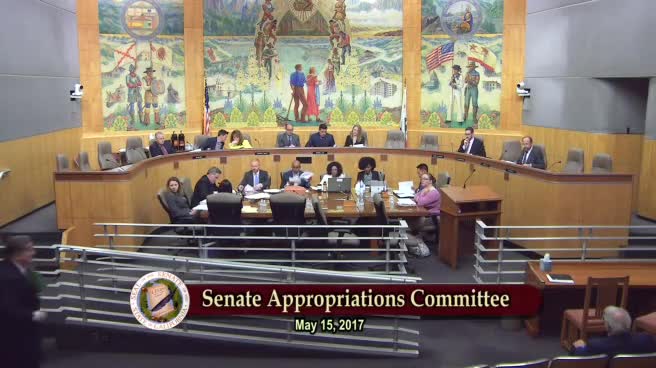
| May 15, 2017 | May 15 hearing: Placed on APPR. suspense file. |
| May 4, 2017 | Set for hearing May 15. |
| May 2, 2017 | Read second time and amended. Re-referred to Com. on APPR. |
| May 1, 2017 | From committee: Do pass as amended and re-refer to Com. on APPR. (Ayes 7. Noes 0. Page 855.) (April 25). |
| Mar 29, 2017 | Set for hearing April 25. |
| Feb 23, 2017 | Referred to Com. on PUB. S. |
| Feb 16, 2017 | From printer. May be acted upon on or after March 18. |
| Feb 15, 2017 | Introduced. Read first time. To Com. on RLS. for assignment. To print. |
|
Date
|
Description
|
Location
|
Votes
|
|
|---|---|---|---|---|
| May 15, 2017 | Placed on suspense file | Senate Standing Committee on Appropriations |
Passed |
|
| Apr 25, 2017 | Do pass as amended, but first amend, and re-refer to the Committee on [Appropriations] | Senate Standing Committee on Public Safety |
Passed |
This list shows positions taken on this bill by organizations on the date displayed, which is linked to the original source.
Positions by individuals are not included.
|
Organization
|
Position
|
Date
|
|---|---|---|
| 1. Elder Abuse Laws | ** Against | Apr 24, 2017 |
| 2. New Crime Of Isolation | ** Against | Apr 24, 2017 |
| ACLU of California | * Against | Apr 25, 2017 |
| Arc and United Cerebral Palsy California Coalition | * Support | Apr 25, 2017 |
| California District Attorney's Association | * Support | Apr 25, 2017 |
| Catherine Falk Organization | * Support | Apr 25, 2017 |
| Cedar | * Support | Apr 25, 2017 |
| National Association to Stop Guardian Abuse | * Support | Apr 25, 2017 |
| PURPOSE | ** Against | Apr 24, 2017 |
SENATE COMMITTEE ON APPROPRIATIONS
Senator Ricardo Lara, Chair
2017 - 2018 Regular Session
SB 416 (Anderson) - Elder abuse: isolation
Version: May 2, 2017 | Policy Vote: PUB. S. 7 - 0 |
Urgency: No | Mandate: Yes |
Hearing Date: May 15, 2017 | Consultant: Shaun Naidu |
This bill meets the criteria for referral to the Suspense File.
Bill Summary:
SB 416 would specify that mental suffering, in the context of criminal elder or dependent adult abuse, may be proven by a pattern of isolation, as defined.
Fiscal Impact:
Potential unknown increase in local cost and state costs (local funds, General Fund) for any new commitments to county jail or state prison to the extent that the new definition of an element of elder and dependent adult abuse would make it easier to convict a person of those offenses. To the extent that the provisions of this measure lead to even one additional commitment to state prison, it would result in additional General Fund costs of $75,560 annually to house that person in a state institution.
Background:
Existing law provides that any person who knows or reasonably should know that a person is an elder adult and who, under circumstances or conditions likely to produce great bodily harm or death, willfully causes or permits any elder or dependent adult to suffer, or inflicts thereon unjustifiable physical pain or mental suffering, or having the care or custody of any elder or dependent adult, willfully causes or permits the person or health of the elder or dependent adult to be injured, or willfully causes or permits the elder or dependent adult to be placed in a situation in which his or her person or health is endangered, is punishable by imprisonment in a county jail up to one year, by a fine not exceeding $6000, or by both that fine and imprisonment, or by imprisonment in the state prison for two, three or four years. If the victim suffers great bodily injury, as defined, the person is required to serve another three years of incarceration if the victim is under 70 years of age or five years if the victim is 70 years of age or older.
Existing law provides that any person who knows or reasonably should know that a person is an elder or dependent adult and who, under circumstances or conditions other than those likely to produce great bodily harm or death, willfully causes or permits an elder or dependent adult to suffer, or inflicts thereon unjustifiable physical pain or mental suffering, or having the care or custody of an elder or dependent adult, willfully causes or permits the person or health of the elder or dependent adult to be injured or willfully causes or permits the elder or dependent adult to be placed in a situation in which his or her person or health may be endangered is guilty of a misdemeanor, punishable by up to 6 months in the county jail, a fine of up to $1,000, or both jail and fine. A second or subsequent violation is punishable by up to one year in county jail, a fine of up to $2,000 or both jail and fine.
Proposed Law:
This bill would specify that mental suffering may be proven by a pattern of isolation and that a pattern consists of multiple acts over a period of time.
Prior Legislation:
AB 441 (Wilk, 2015) would have created a sentencing enhancement of two additional years of imprisonment for any person convicted of identity theft if the victim was 65 years of age or older at the time of the offense. AB 441 failed passage in the Assembly Committee on Public Safety.
SB 338 (Morrell, 2015) would have created an alternate felony-misdemeanor offense for causing substantial mental suffering in an elder or dependent adult. SB 338 was never heard by the Senate Committee on Public Safety.
Staff Comments:
According to information from the Department of Justice, from 2012 to 2015, there were 1,803 felony convictions for violations of Penal Code section 368, subdivision (b)(1), which provides for a state prison sentence for two, three, or four years.
-- END --
SENATE COMMITTEE ON PUBLIC SAFETY
Senator Nancy Skinner, Chair
2017 - 2018 Regular
Bill No: SB 416 Hearing Date: April 25, 2017
Author: | Anderson | ||
Version: | February 15, 2017 | ||
Urgency: | No | Fiscal: | Yes |
Consultant: | SC | ||
Subject: Elder Abuse: Isolation
HISTORY
Source: Unknown
Prior Legislation: SB 338 (Morrell), failed passage in Senate Public Safety (2015)
AB 441 (Wilk), failed passage in Assembly Public Safety (2015)
Support: California Advocates for Nursing Home Reform; California Association for Health Services at Home; California District Attorneys Association; California Long-Term Care Ombudsman Association; California Police Chiefs; Coalition for Elder and Disability Rights (CEDAR); Congress of California Seniors
Opposition: American Civil Liberties Union; California Attorneys for Criminal Justice
PURPOSE
The purpose of this bill is to make isolating an elder person or dependent person a misdemeanor and to increase existing felony enhancements that would be imposed if the victim suffered great bodily injury and is between the age of 65 and 70.
Existing law defines an “elder” to mean any person who is 65 years of age or older. (Pen. Code § 368, subd. (g).)
Existing law defines “dependent adult” to mean any person who is between the ages of 18 and 64, who has physical or mental limitations which restrict his or her ability to carry out normal activities or to protect his or her rights, including, but not limited to, persons who have physical or developmental disabilities or whose physical or mental abilities have diminished because of age. “Dependent adult” also includes any person between the ages of 18 and 64 who is admitted as an inpatient to a 24-hour health facility. (Pen. Code § 368, subd. (h).)
Existing law provides that any person who knows or reasonably should know that a person is an elder adult and who, under circumstances or conditions likely to produce great bodily harm or death, willfully causes or permits any elder or dependent adult to suffer, or inflicts thereon unjustifiable physical pain or mental suffering, or having the care or custody of any elder or dependent adult, willfully causes or permits the person or health of the elder or dependent adult to be injured, or willfully causes or permits the elder or dependent adult to be placed in a situation in which his or her person or health is endangered, is punishable by imprisonment in a county jail not exceeding one year, or by a fine not to exceed $6000, or by both that fine and imprisonment, or by imprisonment in the state prison for two, three or four years. (Pen. Code § 368, subd. (b)(1).)
Existing law states that if during the commission of the offense described above, the victim suffers great bodily injury, as defined, the defendant shall receive an additional term in the state prison as follows:
- Three years if the victim is under the age of 70; and,
- Five years if the victim is 70 years of age or older.
This bill provides instead that a defendant shall receive an additional term of five years when the victim is 65 years of age or older.
Existing law provides that any person who knows or reasonably should know that a person is an elder or dependent adult and who, under circumstances or conditions other than those likely to produce great bodily harm or death, willfully causes or permits and elder or dependent adult to suffer, or inflicts thereon unjustifiable physical pain or mental suffering, or having the care or custody of an elder or dependent adult, willfully causes or permits the person or health of the elder or dependent adult to be injured or willfully causes or permits the elder or dependent adult to be placed in a situation in which his or her person or health may be endangered is guilty of a misdemeanor, punishable by up to 6 months in the county jail, a fine of up to $1,000 or both jail and fine. A second or subsequent violation is punishable by up to one year in county jail, a fine of up to $2,000 or both jail and fine. (Pen. Code § 368, subd. (c).)
Existing law provides that any caretaker of an elder or a dependent adult who violates any provision of law proscribing theft, embezzlement, forgery, fraud, or identity theft, with respect to the property or personal identifying information of that elder or dependent adult, is punishable as follows:
- By a fine not exceeding $2,500, or by imprisonment in a county jail not exceeding one year, or by both that fine and imprisonment, or by a fine not exceeding $10,000, or by imprisonment in the county jail for two, three, or four years, or by both that fine and imprisonment, when the moneys, labor, goods, services, or real or personal property taken or obtained is of a value exceeding $950; or
- By a fine not exceeding $1,000, by imprisonment in a county jail not exceeding one year, or by both that fine and imprisonment, when the moneys, labor, goods, services, or real or personal property taken or obtained is of a value not exceeding $950. (Pen. Code § 368, subd. (e).)
Existing law provides that false imprisonment is the unlawful violation of the personal liberty of another, and generally punishes false imprisonment as a misdemeanor with a fine of up to $1000, imprisonment in county jail for up to one year, or both the fine and imprisonment. (Pen. Code §§ 368, 367.)
Existing law states that any person who commits the false imprisonment of an elder or a dependent adult by the use of violence, menace, fraud, or deceit is punishable by imprisonment in county jail for 2, 3 or 4 years. (Pen. Code § 368, subd. (f).)
Existing law states that upon conviction of any felony it shall be considered a circumstance in aggravation in imposing the upper term if the victim of an offense is particularly vulnerable, or unable to defend himself or herself, due to age or significant disability. (Pen. Code § 1170.85, subd. (b).)
This bill creates a new misdemeanor offense for the willful isolation of an elder or dependent adult by a caretaker.
This bill defines “isolate” to mean restricting the personal rights retained by the elder or dependent adult, including, but not limited to, the right to receive visitors, telephone calls, and personal mail unless specifically authorized by a court order.
Existing law defines “caretaker” to mean means any person who has the care, custody, or control of, or who stands in a position of trust with, an elder or a dependent adult. (Pen. Code § 368, subd. (i).)
This bill adds a conservator or an attorney-in-fact to the definition of caretaker.
COMMENTS
1. Elder Abuse Laws
Elder abuse can either be a criminal offense or a civil violation. Existing criminal law provides for enhanced penalties for specified crimes such as theft, embezzlement, forgery, fraud, and identity theft committed against elderly or dependent persons. (Pen. Code § 368, subd. (d).) The law also punishes willfully causing or permitting an elder or dependent adult to suffer or inflicting unjustifiable physical pain or mental suffering; or as a caretaker willfully causes or permits injury or the health to be endangered. (Pen. Code § 368, subds. (b)-(c).) If the crime is committed under circumstances or conditions likely to cause great bodily injury or death, the punishment is a felony. If the crime is committed under circumstances or conditions not likely to cause produce great bodily harm or death, the punishment is a misdemeanor. (Id.) If great bodily injury is incurred, the defendant must be sentenced to an additional 3 years if the victim is under 70 years of age, or 5 years if the victim is 70 or older. If the offense causes death of the victim, the defendant must be sentenced to an additional 5 years if the victim was under 70 years old and 7 years if the victim was 70 or older. (Id.) Existing law also provides that false imprisonment of an elder or dependent adult is punishable as a felony. (Pen. Code § 368, subd. (f).)
Under civil laws, a person or organization may be sued for harming an elder or dependent adult. Civil elder abuse includes financial abuse, physical abuse, neglect, abandonment, isolation, abduction, or other treatment with resulting physical harm or pain or mental suffering. It also includes the deprivation by a care custodian of goods or services that are necessary to avoid physical harm or mental suffering. (Welf. & Inst. Code § 15610.07.) Civil law provides for civil remedies which may include actual damages, punitive damages and attorney’s fees. (Welf. & Inst. Code § 15657.)
Existing civil laws also provide that certain persons are mandated reporters and required to report suspected elder abuse to local law enforcement or adult protective services. (Welf. & Inst. Code § 15630.) A mandated reporter is any person who has assumed full or intermittent responsibility for the care or custody of an elder or dependent adult, whether or not he or she receives compensation, including administrators, supervisors, and any licensed staff of a public or private facility that provides care or services for elder or dependent adults, or any elder or dependent adult care custodian, health practitioner, clergy member, or employee of a county adult protective services agency or a local law enforcement agency. (Id.) A failure to report elder or dependent abuse by a mandated reporter may be punished as a misdemeanor. (Id.)
Local and state law enforcement have concurrent jurisdiction with Adult Protective Services and the local long-term care ombudsman programs to investigate elder and dependent adult abuse and criminal neglect. (Pen. Code § 368.5.)
2. New Crime of Isolation
This bill creates a new crime of isolation which punishes as a misdemeanor the restriction of personal rights retained by the elder or dependent adult, including, but not limited to, the right to receive visitors, telephone calls, and personal mail unless specifically authorized by a court.
While existing criminal law does not specify isolation of an elder or dependent adult as a crime, it does specify that the unlawful violation of the personal liberty of another is false imprisonment and punishable as a misdemeanor. (Pen. Code, §§ 368, 367.) Additionally, the law specifies that false imprisonment of an elder or dependent adult by the use of violence, menace, fraud, or deceit is a felony. If the false imprisonment is not achieved through use of violence, menace, fraud or deceit, the general crime of false imprisonment could be prosecuted.
This bill seeks to punish the restriction of personal rights of an elder or dependent adult as a misdemeanor, but it appears that this conduct may already be punished as misdemeanor false imprisonment. And when committed against an elder or dependent adult by the use of violence, menace, fraud, or deceit, the offense could be prosecuted as a felony.
Additionally, this bill creates a new definition of “isolation” that is different from existing law. “Isolation” is defined for purposes of mandated reporters to include the following:
- Acts intentionally committed for the purpose of preventing, and that do serve to prevent, an elder or dependent adult from receiving his or her mail or telephone calls;
- Telling a caller or prospective visitor that an elder or dependent adult is not present, or does not wish to talk with the caller, or does not wish to meet with the visitor where the statement is false, is contrary to the express wishes of the elder or the dependent adult, whether he or she is competent or not, and is made for the purpose of preventing the elder or dependent adult from having contact with family, friends, or concerned persons;
- False imprisonment, as defined in Section 236 of the Penal Code; or
- Physical restraint of an elder or dependent adult, for the purpose of preventing the elder or dependent adult from meeting with visitors. (Welf. & Inst. Code, § 1510.43, subd. (a).)
Existing law also provides a rebuttable presumption that the acts described above do not constitute isolation if they are performed pursuant to the instructions of a doctor who is caring for the elder or dependent adult at the time the instructions are given, and who gives the instructions as part of his or her medical care. (Welf. & Inst. Code, § 1510.43, subd. (b).) These acts also do not constitute isolation if they are performed in response to a reasonably perceived threat of danger to property or physical safety. (Welf. & Inst. Code, § 1510.43, subd. (b).)
3. Sentencing Enhancements and Ongoing Concerns over Prison Overcrowding
On February 10, 2014, the federal court ordered California to reduce its in-state adult institution population to 137.5% of design capacity by February 28, 2016, as follows:
- 143% of design bed capacity by June 30, 2014;
- 141.5% of design bed capacity by February 28, 2015; and,
- 137.5% of design bed capacity by February 28, 2016.
The court also ordered California to implement the following population reduction measures in its prisons:
- Increase prospective credit earnings for non‑violent second‑strike inmates as well as minimum custody inmates.
- Allow non‑violent second‑strike inmates who have reached 50 percent of their total sentence to be referred to the Board of Parole Hearings (BPH) for parole consideration.
- Release inmates who have been granted parole by BPH but have future parole dates.
- Expand the CDCR’s medical parole program.
- Allow inmates age 60 and over who have served at least 25 years of incarceration to be considered for parole.
- Increase its use of reentry services and alternative custody programs.
(Opinion Re: Order Granting in Part and Denying in Part Defendants’ Request For Extension of December 31, 2013 Deadline, NO. 2:90-cv-0520 LKK DAD (PC), 3-Judge Court, Coleman v. Brown, Plata v. Brown (2-10-14).) Following the implementation of these measures along with the passage of Proposition 47, approved by California voters in November 2014, California met the federal court’s population cap in December 2015. (Defendants’ December 2015 Status Report in Response to February 10, 2014 Order, 2:90-cv-00520 KJM DAD PC, 3-Judge Court, Coleman v. Brown, Plata v. Brown.) The administration’s most recent status report states that as “of December 14, 2016, 114,031 inmates were housed in the State’s 34 adult institutions” which amounts to approximately 135.3% of design capacity, and 4,704 inmates were housed in out-of-state facilities. (Defendants’ December 2016 Status Report in Response to February 10, 2014 Order, 2:90-cv-00520 KJM DAD PC, 3-Judge Court, Coleman v. Brown, Plata v. Brown (fn. omitted).)
While significant gains have been made in reducing the prison population, the state must stabilize these advances and demonstrate to the federal court that California has in place the “durable solution” to prison overcrowding “consistently demanded” by the court. (Opinion Re: Order Granting in Part and Denying in Part Defendants’ Request For Extension of December 31, 2013 Deadline, NO. 2:90-cv-0520 LKK DAD (PC), 3-Judge Court, Coleman v. Brown, Plata v. Brown (2-10-14).
This bill increases existing sentencing enhancements for crimes against elder and dependent adults. Existing law contains a variety of enhancements that can be used to increase the amount of time a defendant will serve. Enhancements can range from adding a specified number of years to a person’s sentence, or doubling a person’s sentence or even converting a determinate sentence into a life sentence. Multiple enhancements can be imposed in a single case to significantly increase the person’s sentence. Currently, when elder abuse causes great bodily injury, the court must impose an additional 3 or 5 years depending on whether the victim is under 70 years old or 70 and over. This bill would require a 5 year sentencing enhancement if the defendant causes great bodily injury of anyone 65 years of age or older. Existing law also provides for a sentencing enhancement when elder abuse causes death – 5 years or 7 years depending on whether the victim is under 70 years old or 70 and over. This bill would require a 7 year sentencing enhancement if the defendant causes the death of anyone 65 years of age or older.
Although the state is currently in compliance with the court-ordered population cap, creating new enhancements, or expanding upon existing ones, will increase the length of time that an inmate must serve in prison and reverse the progress made in reducing the state prison population. This is contrary to the court's order for a durable solution to prison overcrowding.
4. Argument in Support
According to the Congress of California Seniors:
Elder abuse – both physical and financial – is already a crime in California. Seniors and dependent adults often survive only because of the attention and efforts of their caretakers. SB 416 will add years of prison time to the existing sentences if the victim suffers great bodily injury or death as a result of abuse by their caretaker.
Your bill will also make it a misdemeanor for a caretaker to purposefully isolate an elder or dependent adult. Isolation is defined as the general restriction of personal rights, including the right to receive visitors, make and receive telephone calls, and freely use mail and email. Isolation has been shown to be a first step toward domination by a caretaker, often followed by financial abuse.
5. Argument in Opposition
According to the California Attorneys for Criminal Justice (CACJ):
CACJ opposes SB 416’s effort to expand the five (5) year enhancement for inflicting great bodily injury under PC 12022.7 to victims under the age of 70. We also oppose the bill’s effort to expand the seven (7) year enhancement for inflicting death on a victim who is under 70.
SB 416 seeks to establish a new misdemeanor offense of “isolating” an elder. However, the definition of the term “isolate” in (h)(4) is unconstitutionally over broad for criminal law purposes. The term “isolate” is defined as “restricting the personal rights….” of the elder. That phrase is so broad as to be meaningless and thus fails to put a potential defendant on notice as to what conduct constitutes committing this crime. That is the sine qua non of over breadth for criminal law purposes. It also fails to give adequate notice to the individual of what behavior on his/her part would constitute criminal acts and thus violates his/her constitutional rights to due process of law. This language also impairs the ability of the caretaker to make decisions in what she/he determines to be the best interests of the elder who is entrusted to their care.
It is clear to CACJ that this language would also cause many people to refuse to take on the role of caretaker for fear that they could be charged with a crime for simply doing what they thought was in the elder’s best interests. Finally, this language and the misdemeanor of “isolating” the elder is ripe for abuse by those who may have ulterior motives for wanting the current caretaker to be removed so as to advance their own nefarious interests.
-- END –
Discussed in Hearing
 48MIN
Senate Standing Committee on Appropriations
 1MIN
Senate Standing Committee on Appropriations
 13MIN
Senate Standing Committee on Public Safety
Bill Author

Bill Co-Author(s):