SB 545: Vehicles: 24/7 Sobriety program.
- Session Year: 2017-2018
- House: Senate
- Latest Version Date: 2017-03-20
Existing law prohibits a person who has 0.08% or more, by weight, of alcohol in his or her blood from driving a vehicle. Existing law also prohibits a person while having 0.08% or more, by weight, of alcohol in his or her blood from driving a vehicle and concurrently doing any act forbidden by law, or neglecting any duty imposed by law in driving the vehicle, when the act or neglect proximately causes bodily injury to a person other than the driver. A violation of either of these prohibitions is a crime. Existing law authorizes a court, in addition to imposing penalties and sanctions for those violations, to require the person to enroll and participate in, and successfully complete, a driving-under-the-influence program, which may include, among other things, education, group counseling, and individual interview sessions.
This bill would authorize the court to order a person convicted of a crime described above to enroll and participate in, and successfully complete, a qualified 24/7 Sobriety program, as defined, as a condition of probation, if the program is available and deemed appropriate, and the person committed the crime within 10 years of one or more separate crimes described above that resulted in a conviction. The bill would define a 24/7 Sobriety program, in part, as requiring a person in the program to abstain from alcohol and unauthorized controlled substances and be subject to frequent testing for alcohol and controlled substances, as specified. The bill would require a person participating in the program to pay the program costs, commensurate with the persons ability to pay, as specified. The bill would require the Department of Motor Vehicles to establish statewide uniform collection and reporting of specified data about the 24/7 Sobriety program. The bill would authorize a county to establish a 24/7 Sobriety program.
Existing law generally regulates the size and weight of, and loads upon, vehicles when operated upon the highways. Existing law exempts authorized emergency vehicles owned or operated by a governmental agency when used under specified circumstances from those size, weight, and load limitations.This bill would express the intent of the Legislature to enact legislation relating to regulating the weight of vehicles.Existing law generally regulates the size and weight of, and loads upon, vehicles when operated upon the highways. Existing law exempts authorized emergency vehicles owned or operated by a governmental agency when used under specified circumstances from those size, weight, and load limitations.
This bill would express the intent of the Legislature to enact legislation relating to regulating the weight of vehicles.
(a)The court may order a person convicted of a violation of Section 23152 or 23153 to enroll and participate in, and successfully complete, a qualified 24/7 Sobriety program, as described in subdivision (b), as a condition of probation, parole, sentence, or work permit if the program is available and deemed appropriate, and the person committed the current violation within 10 years of one or more separate violations of Section 23152 or 23153 that resulted in a conviction.
(b)For purposes of this section, a 24/7 Sobriety program requires a participant to abstain from alcohol or controlled substance use for a designated period of time and be subject to at least twice-per-day breath testing for alcohol or periodic testing for controlled substances at a testing location. In the event of a hardship, testing for alcohol may be accomplished by a continuous transdermal monitoring device or by an alternative method approved by the National Highway Traffic Safety Administration. Methodologies that provide immediate, in-person positive reinforcement for compliant behavior and the most immediate sanctions for noncompliant events are preferred testing methodologies under this program. However, a participants ability to maintain employment, schooling, or family life, usually due to lack of proximity to a testing location, may be considered a hardship for the purposes of this subdivision. The 24/7 Sobriety program methodology shall be evidence-based.
(c)A person ordered into a 24/7 Sobriety program may also be required to participate in any other driving-under-the-influence program required under California law, including, but not limited to, programs provided in Section 11836 of the Health and Safety Code.
(d)In order to enable all required defendants to participate, each person shall pay the program costs commensurate with the persons ability to pay as determined pursuant to Section 11837.4 of the Health and Safety Code.
(e)The department shall establish statewide uniform collection and reporting of all of the following data:
(1)Participant demographic information.
(2)Participant case history information.
(3)Testing information, including testing duration, test results, testing attendance, and testing compliance.
(4)Fees and fee payments.
(f)A county may establish a 24/7 Sobriety program as defined in subdivision (b), but this section does not require a county to establish a 24/7 Sobriety program.
SECTION 1.It is the intent of the Legislature to enact legislation relating to regulating the weight of vehicles.It is the intent of the Legislature to enact legislation relating to regulating the weight of vehicles.
|
Date
|
Status
|
|---|---|
| Feb 1, 2018 | Returned to Secretary of Senate pursuant to Joint Rule 56. |
| May 25, 2017 | May 25 hearing: Held in committee and under submission. |
| May 19, 2017 | Set for hearing May 25. |
| May 1, 2017 | May 1 hearing: Placed on APPR. suspense file. |
| Apr 21, 2017 | Set for hearing May 1. |
| Apr 19, 2017 | From committee: Do pass and re-refer to Com. on APPR. (Ayes 7. Noes 0. Page 748.) (April 18). Re-referred to Com. on APPR. |
| Apr 4, 2017 | Set for hearing April 18. |
| Mar 29, 2017 | Re-referred to Com. on PUB. S. |
| Mar 20, 2017 | From committee with author's amendments. Read second time and amended. Re-referred to Com. on RLS. |
| Mar 2, 2017 | Referred to Com. on RLS. |
| Feb 17, 2017 | From printer. May be acted upon on or after March 19. |
| Feb 16, 2017 | Introduced. Read first time. To Com. on RLS. for assignment. To print. |
|
Date
|
Description
|
Location
|
Votes
|
|
|---|---|---|---|---|
| May 1, 2017 | Placed on suspense file | Senate Standing Committee on Appropriations |
Passed |
|
| Apr 18, 2017 | Do pass, but first be re-referred to the Committee on [Appropriations] | Senate Standing Committee on Public Safety |
Passed |
This list shows positions taken on this bill by organizations on the date displayed, which is linked to the original source.
Positions by individuals are not included.
|
Organization
|
Position
|
Date
|
|---|---|---|
| Chief Probation Officers Of California | ** Against | Apr 17, 2017 |
| Montana Highway Patrol | ** Support | Apr 17, 2017 |
| PURPOSE | ** Against | Apr 17, 2017 |
SENATE COMMITTEE ON
Senator Ricardo Lara, Chair
2017 - 2018 Regular Session
SB 545 (Beall) - Vehicles: 24/7 Sobriety program
Version: | Policy Vote: |
Urgency: | Mandate: |
Hearing Date: | Consultant: |
This bill meets the criteria for referral to the Suspense File.
Bill Summary:
SB 545 would allow a court to require a person convicted of a repeat driving under the influence (DUI) offense to participate in a 24/7 Sobriety program.
Fiscal Impact:
- Determining appropriate programs: Unknown, potentially significant workload costs (General Fund) to the entity that must determine which programs are deemed appropriate to constitute a qualified 24/7 Sobriety program.
- Data collection and reporting: Minor and absorbable implementation and ongoing costs (General Fund) to the Department of Motor Vehicles (DMV) to establish statewide uniform collection and reporting of specified data.
- Probation supervision: Unknown workload costs (local funds) to county probation departments the extent that defendants who otherwise would not be placed on formal probation are placed as such by the court to monitor compliance with the person’s participation in a 24/7 Sobriety program.
Background:
Existing law prohibits a person who has 0.08% or more, by weight, of alcohol in his or her blood from driving a vehicle. Additionally, a person who has 0.08% or more, by weight, of alcohol in his or her blood is prohibited from driving a vehicle and concurrently doing any act forbidden by law, or neglecting any duty imposed by law in driving the vehicle, when the act or neglect proximately causes bodily injury to a person other than the driver. A violation of either of these prohibitions is a crime.
Existing law authorizes the court, in addition to imposing penalties and sanctions such as installation of an ignition interlock device on the defendant’s vehicles, to require the person to enroll and participate in, and successfully complete, a DUI program, which may include, among other things, education, group counseling, and individual interview sessions.
Proposed Law:
This bill would:
- Authorize the court to order a person convicted of a DUI within ten years of a prior DUI conviction to enroll and participate in, and successfully complete, a qualified “24/7 Sobriety program,” as defined, as a condition of probation, if the program is available and deemed appropriate.
- Define a “24/7 Sobriety program,” in part, as requiring a person in the program to abstain from alcohol and unauthorized controlled substances and be subject to frequent testing for alcohol and controlled substances, as specified.
- Require a person participating in the program to pay the program costs, commensurate with the person’s ability to pay, as specified.
- Require DMV to establish statewide uniform collection and reporting of specified data about the 24/7 Sobriety program.
- Authorize a county to establish a 24/7 Sobriety program.
Prior Legislation:
AB 933 (Frazier, 2016) would have allowed the court to require a person convicted of a repeat DUI offense to participate in a 24/7 Sobriety program. AB 933 was held in the Senate Committee on Rules.
Staff Comments:
This bill would allow the court to require a repeat DUI offender to participate in a 24/7 Sobriety program that is “deemed appropriate.” It is unclear which entity—the court, DMV, county probation departments—would be responsible for determining which programs would qualify as an approved 24/7 Sobriety program in which the court could require the defendant to participate. Additionally, the determining entity would need to establish guidelines of what would constitute an appropriate program and requalify or validate programs on a routine basis, entailing unknown costs.
In addition to sentencing a defendant to participate in a 24/7 Sobriety program, the court also may require him or her to be actively supervised by the probation department to ensure compliance and report progress to the court. To the extent that this defendant otherwise would not have been placed on formal probation, this bill would result in additional costs incurred by county probation departments to monitor compliance with the court’s requirement.
-- END --
SENATE COMMITTEE ON PUBLIC SAFETY
Senator Nancy Skinner, Chair
2017 - 2018 Regular
Bill No: SB 545 Hearing Date: April 18, 2017
Author: | Beall | ||
Version: | March 20, 2017 | ||
Urgency: | No | Fiscal: | Yes |
Consultant: | MK | ||
Subject: Vehicles: 24/7 Sobriety program
HISTORY
Source: Author
Prior Legislation: SB 1046(Hill) Chapter 783, Stats. 2016
SB 1066 (Beall) as GandA June 29; held Assembly Appropriations 2016
AB 2367 (Cooley) held Assembly Appropriations 2016
SB 61 (Hill) Chaptered 350, Stats. 2015
SB 55 (Hill) held in Assembly Appropriations (2013)
AB 520 (Ammiano) Chapter 657, Stats. 2011
SB 598 (Huff) Chapter 193, Stats. 2009
AB 91 (Feuer) Chapter 217, Stats. 2009
SB 1190 (Oropeza) Chapter 392, Stats. 2008
SB 1361 (Correa) Vetoed (2008)
SB 1388 (Torlakson) Chapter 404, Stats. 2008
AB 2784 (Feuer) until August 28, 2008 version
SB 177 (Migden) did not move (2007)
AB 4 (Bogh) held in Assembly Appropriations (2005)
AB 979 (Runner) Chapter 646, Stats. of 2005
AB 638 (Longville) prior to 7/2/2003 amends died on Concurrence (2003)
AB 1026 (Levine) failed Senate Public Safety (2003)
AB 762 (Torlakson) Chapter 756, Stats. of 1998
Support: Montana Highway Patrol
Opposition: Chief Probation Officers of California
PURPOSE
The purpose of this bill is to permit a court to require a person convicted of a repeat DUI to participate in a 24/7 Sobriety program in addition to other court ordered or Department of Motor Vehicle (DMV) required sanctions.
Existing law provides it is unlawful for any person who is under the influence of any alcoholic beverage or drug, or under the combined influence of any alcoholic beverage and drug, to drive a vehicle. (Vehicle Code § 23152(a).)
Existing law provides that it is unlawful for any person, while having 0.08 percent or more, by weight, of alcohol in his or her blood to drive a vehicle. (Vehicle Code § 23152(b).)
Existing law provides that if a person is convicted of a DUI within 10 years of a separate DUI that person shall be punished by imprisonment in the county jail for 90 days to one year and a fine of $390 ($1,599 with penalty assessments) and $1,000 ($4,000 with penalty assessments) and the person’s driver’s license shall be suspended for 2 years. (Vehicle Code § 23540)
Existing law provides that if a person is granted probation for a conviction of a DUI that occurred within 10 years of a conviction for another DUI then the following shall apply:
- County jail for 96 hours to one year a fine of $390 ($1,599 with penalty assessments) and $1,000 ($4,000 with penalty assessments).
- 2 year license suspension
- Enrollment in either an 18 month or 30 month drinking driver treatment program.
- A restricted license may be issued if the person:
- Shows proof of enrollment in the drinking driver treatment program;
- The person installs a function ignition interlock device (beginning 1/1/19);
- The person shows proof of insurance;
- The person pays any required fees to DMV. (Vehicle Code § 13352(a)(c))
This bill provides that upon conviction of a DUI within 10 years of a prior DUI the court may order a person to participate in and successfully complete, a qualified 24/7 Sobriety program if the program is available and deemed appropriate.
This bill defines a 24/7 Sobriety program requires a participant to abstain from alcohol or controlled substance use for a designated period of time and be subject to at least twice-per-day breath testing for alcohol or periodic testing for controlled substances at a testing location. In the event of a hardship, testing for alcohol may be accomplished by a continuous transdermal monitoring device or by an alternative method approved by the National Highway Traffic Safety Administration.
This bill provides that methodologies that provide immediate, in-person positive reinforcement for compliant behavior and the most immediate sanctions for noncompliant events are preferred testing methodologies under this program.
This bill provides that a participant’s ability to maintain employment, schooling or family life, usually due to lack of proximity to a testing location, may be considered a hardship for purposes of ordering a 24/7 program.
This bill provides that the 24/7 Sobriety program methodology shall be evidence-based.
This bill provides that a person ordered into a 24/7 Sobriety program may also be required to participate in any other driving-under-the-influence-program required under California law.
This bill requires that the Department of Transportation shall establish statewide uniform collection and reporting of all of the following data:
- Participant demographic information.
- Participant case history information.
- Testing information, including testing duration, test results, testing attendance, and testing compliance.
- Fees and fee payments.
This bill provides that a county may, but is not required to establish a 24/7 Sobriety program.
COMMENTS
1. Need for This Bill
According to the author:
All 50 states and the District of Columbia have laws in place to protect the public from impaired drivers yet about 1 out of every 3 traffic deaths in the United States involve a drunk driver. According to the Centers for Disease Control and Prevention, 10,327 people were killed in crashes involving a drunk driver in California between the year 2003-2012 and 1.8% of adults in California report driving after drinking too much over the last 30 days. SB 545 seeks to implement a 24/7 Sobriety Program, a proven effective program used to combat the problem of impaired driving.
SB 545 would allow counties to opt into participating in the evidence-based 24/7 Sobriety Program and required the DMV to collect information in order to be able to effectively measure the outcome of the implementation. Under SB 545, the court would be authorized to order a person convicted of a second or subsequent DUI offense, within a 10-year period, to participate in, and successfully complete a qualified evidence based 24/7 Sobriety Program as a condition of probation. A judge have the ability to order a repeat DUI offenders to participate in the 24/7 Sobriety Program if the program is available and deemed appropriate for the individual as determined by the judge.
24/7 Sobriety began as a pilot program in South Dakota in 2005 and required those convicted of alcohol-related offenses to take twice-a-day breathalyzer tests or wear a continuous alcohol monitoring bracelet. If alcohol was detected in a participant's system, they would typically have to spend one or two nights in jail. The program grew to include more jurisdictions and offenses. By the end of 2013, studies found that the total number of repeat driving under the influence arrests in areas operating the program fell by 12%, and the total number of arrests for domestic violence dropped by 9%. 24/7 Sobriety programs have subsequently been implemented in several other states and Congress recently approved federal grant money for startup and administrative costs of such programs.
2. 24/7 Sobriety program
This bill specifically permits a court to order a repeat DUI offender to attend a 24/7 Sobriety program in addition to the jail time, fines, suspended, drinking-driver-treatment program and installation of ignition interlock (IID) that already must be imposed. According to research from the author, similar programs have been successful in South Dakota, North Dakota and Montana.
a. Is statutory authorization necessary?
Under their broad general discretion to fashion and impose additional probation conditions that are particularized to the defendant (People v. Smith (2007) 152, Cal.App.4th 1245, 1249.) a court may order a DUI offender to participate in a program such as the one suggested in this bill In fact some courts are already imposing conditions of probation which limit or prohibit the use of alcohol or other drugs under this discretion to fashion reasonable conditions related to the defendant’s criminal conduct and rehabilitative needs. Courts can utilize programs provided through their county probation department, private companies, or non-profit organizations.
b. Monitoring
This bill provides that a 24/7 Sobriety program requires a participant to abstain from alcohol or controlled substance use for a designated period of time and be subject to at least twice-per-day breath and alcohol testing for alcohol or periodic testing for controlled substances at a testing location. In the event of a hardship, the testing may be accomplished by continuous transdermal monitory device or an alternative method approved by the National Highway Traffic Safety Administration (NHTSA). The bill also states that methodologies that provide immediate, in-person positive reinforcement for compliant behavior and the most immediate sanctions for noncompliance are preferred testing methodologies.
Is it realistic to think that anyone can get to a testing site twice daily? Does the language requiring the in person testing give preference to one vendor over others? Should any alternative method approved by NHTSA be allowed provided it is available in the county?
c. Probation
While DUI offenders are often technically given probation, it is not typical probation in that these offenders do not become part of the county probation office’s caseload. Some DUI sanctions are enforced by the court but most are monitored and enforced by DMV. This is the reason for the Chief Probation Officers’ opposition. They believe that this bill should be clarified as to who will be responsible for enforcing these sanctions.
d. Need for additional sanctions
While courts already has the authority to order a person to participate in such a program, since it is being specified in statute should guidance be offered as to when the court shall consider this additional sanction? A person convicted of a DUI already faces jail time, fines, mandatory participation in a drinker-driver-treatment-program, and starting in 2019, mandatory installation of an IID. Should the court wait to impose this additional sanction until there is evidence these existing sanctions are not working?
-- END –
Discussed in Hearing
 48MIN
Senate Standing Committee on Appropriations
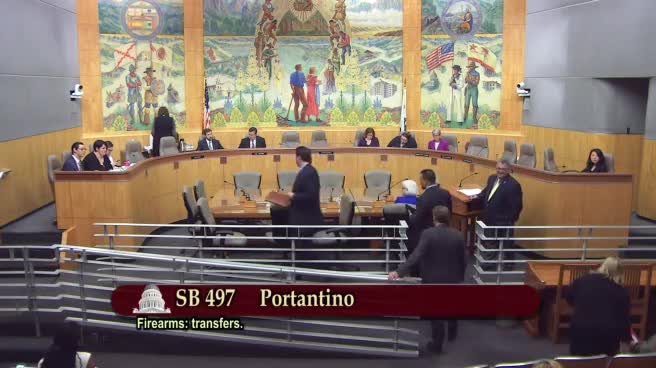 12MIN
Senate Standing Committee on Public Safety
Bill Author

Bill Co-Author(s):