SB 67: Sentencing: driving under the influence.
- Session Year: 2017-2018
- House: Senate
- Latest Version Date: 2017-04-18
Under existing law, if a crime is punishable, in the discretion of the court, either as a misdemeanor or a felony, the crime is a misdemeanor for all purposes under specified circumstances, including, among other circumstances, when the court grants probation to a defendant without imposition of sentence and at the time of granting probation, or on application of the defendant or probation officer thereafter, the court declares the offense to be a misdemeanor.
Existing law makes it a crime to operate a vehicle while under the influence of alcohol or drugs, and sets forth the penalties for a violation of these provisions. Existing law provides that a person who is guilty of driving under the influence, or driving under the influence causing injury, is subject to enhanced penalties if the current offense for driving under the influence, or driving under the influence causing injury, occurred within 10 years of a separate conviction that was punished as a felony for driving under the influence, driving under the influence causing injury, or vehicular manslaughter with gross negligence.
This bill would require the determination of whether an offense constitutes a separate violation or prior conviction under the driving-under-the-influence prohibition described above to be based on the date of the conviction of the separate or prior offense, and would specify that the determination is not affected by the sentence imposed or any subsequent action taken pursuant to the discretionary sentencing provision described above. a felony conviction for driving under the influence or driving under the influence causing injury, to remain a felony for purpose of determining whether the person has been convicted of a separate violation or a prior violation, even if the conviction was subsequently reduced to a misdemeanor pursuant to the discretionary sentencing provision described above. By expanding the group of people eligible for a sentence enhancement, this bill would impose a state-mandated local program.
The California Constitution requires the state to reimburse local agencies and school districts for certain costs mandated by the state. Statutory provisions establish procedures for making that reimbursement.
This bill would provide that no reimbursement is required by this act for a specified reason.
Under existing law, if a crime is punishable, in the discretion of the court, either as a misdemeanor or a felony, the crime is a misdemeanor for all purposes under specified circumstances, including, among other circumstances, when the court grants probation to a defendant without imposition of sentence and at the time of granting probation, or on application of the defendant or probation officer thereafter, the court declares the offense to be a misdemeanor.
Existing law makes it a crime to operate a vehicle while under the influence of alcohol or drugs, and sets forth the penalties for a violation of these provisions. Existing law provides that a person who is guilty of driving under the influence, or driving under the influence causing injury, is subject to enhanced penalties if the current offense for driving under the influence, or driving under the influence causing injury, occurred within 10 years of a separate conviction that was punished as a felony for driving under the influence, driving under the influence causing injury, or vehicular manslaughter with gross negligence.
This bill would require the determination of whether an offense constitutes a separate violation or prior conviction under the driving-under-the-influence prohibition described above to be based on the date of the conviction of the separate or prior offense, and would specify that the determination is not affected by the sentence imposed or any subsequent action taken pursuant to the discretionary sentencing provision described above.
(a)A person is guilty of a public offense, punishable by imprisonment in the state prison or confinement in a county jail for not more than one year and by a fine of not less than three hundred ninety dollars ($390) nor more than one thousand dollars ($1,000) if that person is convicted of a violation of Section 23152 or 23153, and the offense occurred within 10 years of any of the following:
(1)A separate violation of Section 23152 that was punished as a felony under Section 23550 or this section, or both, or under former Section 23175 or former Section 23175.5, or both.
(2)A separate violation of Section 23153 that was punished as a felony.
(3)A separate violation of paragraph (1) of subdivision (c) of Section 192 of the Penal Code that was punished as a felony.
(b)Each person who, having previously been convicted of a violation of subdivision (a) of Section 191.5 of the Penal Code, a felony violation of subdivision (b) of Section 191.5, or a violation of subdivision (a) of Section 192.5 of the Penal Code, is subsequently convicted of a violation of Section 23152 or 23153 is guilty of a public offense punishable by imprisonment in the state prison or confinement in a county jail for not more than one year and by a fine of not less than three hundred ninety dollars ($390) nor more than one thousand dollars ($1,000).
(c)The privilege to operate a motor vehicle of a person convicted of a violation that is punishable under subdivision (a) or (b) shall be revoked by the department pursuant to paragraph (7) of subdivision (a) of Section 13352, unless paragraph (6) of subdivision (a) of Section 13352 is also applicable, in which case the privilege shall be revoked under that provision. The court shall require the person to surrender the drivers license to the court in accordance with Section 13550.
(d)A person convicted of a violation of Section 23152 or 23153 that is punishable under this section shall be designated as a habitual traffic offender for a period of three years, subsequent to the conviction. The person shall be advised of this designation under subdivision (b) of Section 13350.
(e)The determination of whether an offense constitutes a separate violation or prior conviction under this section shall be based on the date of the conviction of the separate or prior offense and is not affected by the sentence imposed or any subsequent action taken pursuant to subdivision (b) of Section 17 of the Penal Code.(e)A conviction for a violation of Section 23152 that was punished as a felony under Section 23550 or this section or both, or a violation of Section 23153 that was punished as a felony, shall remain a felony for purpose of determining whether the person has been convicted of a separate violation or a prior conviction of this section, even if the conviction was subsequently reduced to a misdemeanor pursuant to subdivision (b) of Section 17 of the Penal Code.
SEC. 2.No reimbursement is required by this act pursuant to Section 6 of Article XIIIB of the California Constitution because the only costs that may be incurred by a local agency or school district will be incurred because this act creates a new crime or infraction, eliminates a crime or infraction, or changes the penalty for a crime or infraction, within the meaning of Section 17556 of the Government Code, or changes the definition of a crime within the meaning of Section 6 of Article XIIIB of the California Constitution.
(a)A person is guilty of a public offense, punishable by imprisonment in the state prison or confinement in a county jail for not more than one year and by a fine of not less than three hundred ninety dollars ($390) nor more than one thousand dollars ($1,000) if that person is convicted of a violation of Section 23152 or 23153, and the offense occurred within 10 years of any of the following:
(1)A separate violation of Section 23152 that was punished as a felony under Section 23550 or this section, or both, or under former Section 23175 or former Section 23175.5, or both.
(2)A separate violation of Section 23153 that was punished as a felony.
(3)A separate violation of paragraph (1) of subdivision (c) of Section 192 of the Penal Code that was punished as a felony.
(b)Each person who, having previously been convicted of a violation of subdivision (a) of Section 191.5 of the Penal Code, a felony violation of subdivision (b) of Section 191.5, or a violation of subdivision (a) of Section 192.5 of the Penal Code, is subsequently convicted of a violation of Section 23152 or 23153 is guilty of a public offense punishable by imprisonment in the state prison or confinement in a county jail for not more than one year and by a fine of not less than three hundred ninety dollars ($390) nor more than one thousand dollars ($1,000).
(c)The privilege to operate a motor vehicle of a person convicted of a violation that is punishable under subdivision (a) or (b) shall be revoked by the department pursuant to paragraph (7) of subdivision (a) of Section 13352, unless paragraph (6) of subdivision (a) of Section 13352 is also applicable, in which case the privilege shall be revoked under that provision. The court shall require the person to surrender the drivers license to the court in accordance with Section 13550.
(d)A person convicted of a violation of Section 23152 or 23153 that is punishable under this section shall be designated as a habitual traffic offender for a period of three years, subsequent to the conviction. The person shall be advised of this designation under subdivision (b) of Section 13350.
(e)The determination of whether an offense constitutes a separate violation or prior conviction under this section shall be based on the date of the conviction of the separate or prior offense and is not affected by the sentence imposed or any subsequent action taken pursuant to subdivision (b) of Section 17 of the Penal Code.
|
Date
|
Status
|
|---|---|
| Feb 1, 2018 | Returned to Secretary of Senate pursuant to Joint Rule 56. |
| May 25, 2017 | May 25 hearing: Held in committee and under submission. |
| May 19, 2017 | Set for hearing May 25. |
| May 1, 2017 | May 1 hearing: Placed on APPR. suspense file. |
| Apr 21, 2017 | Set for hearing May 1. |
| Apr 18, 2017 | Read second time and amended. Re-referred to Com. on APPR. |
| Apr 17, 2017 | From committee: Do pass as amended and re-refer to Com. on APPR. (Ayes 5. Noes 0. Page 598.) (April 4). |
| Mar 14, 2017 | Set for hearing April 4. |
| Jan 19, 2017 | Referred to Coms. on PUB. S. and APPR. |
| Jan 6, 2017 | From printer. May be acted upon on or after February 5. |
| Jan 5, 2017 | Introduced. Read first time. To Com. on RLS. for assignment. To print. |
|
Date
|
Description
|
Location
|
Votes
|
|
|---|---|---|---|---|
| May 1, 2017 | Placed on suspense file | Senate Standing Committee on Appropriations |
Passed |
|
| Apr 4, 2017 | Do pass as amended, but first amend, and re-refer to the Committee on [Appropriations] | Senate Standing Committee on Public Safety |
Passed |
This list shows positions taken on this bill by organizations on the date displayed, which is linked to the original source.
Positions by individuals are not included.
|
Organization
|
Position
|
Date
|
|---|---|---|
| California District Attorney Association | * Support | Apr 4, 2017 |
| Orange County District Attorney Office | * Support | Apr 4, 2017 |
| PURPOSE | ** Against | Apr 3, 2017 |
| San Diego County District Attorney | * Support | Apr 4, 2017 |
SENATE COMMITTEE ON APPROPRIATIONS
Senator Ricardo Lara, Chair
2017 - 2018 Regular Session
SB 67 (Bates) - Sentencing: driving under the influence
Version: April 18, 2017 | Policy Vote: PUB. S. 5 - 0 |
Urgency: No | Mandate: Yes |
Hearing Date: May 1, 2017 | Consultant: Shaun Naidu |
This bill meets the criteria for referral to the Suspense File.
Bill Summary:
SB 67 would specify that a felony conviction for driving under the influence (DUI) remains a felony for the purpose of acting as a prior conviction if the court reduces the conviction to a misdemeanor.
Fiscal Impact:
Potential increase in state costs (General Fund) and local costs (local funds) for new commitments to state prison or county jail for defendants who otherwise would not be subject to a new prison-eligible felony conviction, or as lengthy of a jail sentence, if a prior felony DUI conviction was reduced to a misdemeanor for the purpose of acting as a prior conviction.
Background:
Under existing law, if a person is convicted of a felony offense that is punishable either as a misdemeanor or a felony, in certain circumstances, the court may exercise its discretion to reduce the conviction to a misdemeanor for all purposes.
Existing law provides that a person who is guilty of a DUI, or a DUI causing injury, is subject to enhanced penalties if the current offense for driving under the influence, or driving under the influence causing injury, occurred within 10 years of a separate conviction that was punished as a felony DUI, DUI causing injury, or vehicular manslaughter with gross negligence. The enhanced penalties are imprisonment in state prison, imprisonment in county jail for up to one year and a fine of between $390 and $1,000.
Proposed Law:
This bill would require a felony conviction for DUI or DUI causing injury to remain a felony for the purpose of determining if the person has been convicted of a separate violation or a prior violation, even if the conviction was subsequently reduced to a misdemeanor pursuant to the discretionary sentencing provision.
Staff Comments:
If a felony DUI conviction that was reduced to a misdemeanor by a court could not be treated as a misdemeanor for the purpose of determining if the defendant of a current DUI case has any prior felony DUI convictions, the defendant would be subject to the enhanced penalty, which includes imprisonment in state prison. If the prior felony DUI conviction was reduced by a court to a misdemeanor, the enhanced penalties would not apply to a defendant facing a current DUI charge.
By expanding the population of persons subject to the enhanced penalties, the provisions of this bill could result in increased state incarceration costs. The enhanced penalty for this offense is an alternate felony-misdemeanor and ranges from up to one year in county jail to a state prison sentence of 16 months, two years, or three years. The impact to the state prison population cannot be estimated with certainty given the numerous factors involved in charging and sentencing, including, but not limited to judicial and prosecutorial discretion, the prior criminal history of the defendant, and the elements specific to each case. To the extent even one additional defendant is committed to state prison as a result of this bill, state incarceration costs would increase by $75,560 (General Fund) annually based on the cost to detain a person in a state prison facility.
-- END --
SENATE COMMITTEE ON PUBLIC SAFETY
Senator Nancy Skinner, Chair
2017 - 2018 Regular
Bill No: SB 67 Hearing Date: April 4, 2017
Author: | Bates | ||
Version: | January 5, 2017 | ||
Urgency: | No | Fiscal: | No |
Consultant: | MK | ||
Subject: Sentencing: Driving Under the Influence
HISTORY
Source: Orange County District Attorney
Prior Legislation: AB 2690 (Mullin) Chapter 590, Stats. 2014
AB 1601(Hill) Chapter 301, Stats. 2010
AB 1078 (Jackson) Chapter 849, Statutes 2001
AB 130 (Battin) Chapter 901, Stats. 1997
AB 2240 (Battin) 1996, failed Sen. Criminal Procedure
AB 1162 (Leslie) placed on inactive file at the request of the author
Support: Alcohol Justice; Anaheim Police Department; California District Attorneys Association; California Police Chiefs Association; California State University, Fullerton; Cathedral City Police Department; Crime Victims United of California; Garden Grove Police Department; Kern County District Attorney; La Palma Police Department; Long Beach Police Officers Association; Los Alamitos Police Department; MADD, Southern California; Peace Officers Research Association of California; San Bernardino District Attorney; San Diego District Attorney; Westminster Police Department
Opposition: California Attorneys for Criminal Justice; California Public Defenders Association
ANALYSIS REFLECTS AUTHORS AMENDMENTS TO BE OFFERED IN COMMITTEE (see Comment 3)
PURPOSE
The purpose of this bill is to clarify that a felony DUI remains a felony for the purpose of acting as a prior even if the court subsequently reduces the felony to a misdemeanor for other purposes.
Existing law states that it is unlawful for a person who is under the influence of any alcoholic beverage to drive a vehicle. (Vehicle Code § 23152 (a).)
Existing law states that it is unlawful for a person who has 0.08 % or more, by weight, of alcohol in his or her blood to drive a vehicle. (Vehicle Code § 23152 (b).)
Existing law provides that it is unlawful for a person who is under the influence of any drug, or a combined influence of any alcoholic beverage and drug to drive a vehicle. (Vehicle Code § 23152 (e) & (f).)
Existing law prohibits any person, while under the influence of any alcoholic beverage to drive a vehicle and concurrently do any act forbidden by law, or neglect any duty imposed by law in driving the vehicle, and consequently proximately causing bodily injury to any person other than the driver. (Vehicle Code § 23153 (a).)
Existing law prohibits any person, while having 0.08% or more, by weight, of alcohol in his or her blood to drive a vehicle and concurrently do any act forbidden by law, or neglect any duty imposed by law in driving the vehicle, and consequently proximately causing bodily injury to any person other than the driver. (Vehicle Code § 23153 (b).)
Existing law requires a person who is convicted of a DUI and the offense occurred within 10 years of three or more separate violations of specified DUI related offenses, as specified, to be punished as a county jail-eligible felony, or as a misdemeanor in county jail for not less than 180 days nor more than one year, and by a fine of not less than $390 nor more than $1000. The person's driving privilege shall be revoked by the Department of Motor Vehicles (DMV). (Vehicle Code § 23550 (a).)
Existing law provides that gross vehicular manslaughter while intoxicated is punishable by imprisonment in the state prison for 4, 6, or 10 years, except as provided. (Penal Code § 191.5, (c)(1).)
Existing law provides that vehicular manslaughter while intoxicated is punishable as a misdemeanor by imprisonment in the county jail for not more than one year or as a felony by imprisonment in the county jail for 16 months or 2 or 4 years. (Penal Code § 191.5 (c)(2).)
Existing law states the Legislative finding and declaration that the timing of court proceedings should not permit a person to avoid aggravated mandatory minimum penalties for multiple separate offenses occurring within a 10-year period. It is the intent of the Legislature to provide that a person be subject to the enhanced mandatory minimum penalties for multiple offenses within a period of 10 years, regardless of whether the convictions are obtained in the same sequence as the offenses had been committed. (Vehicle Code § 23217.)
Existing law states that a person is guilty of a public offense, punishable by imprisonment in the state prison or confinement in a county jail for not more than one year and by a fine of not less than $390 nor more than $1,000 if that person is convicted of a violation of DUI offenses, and the offense occurred within 10 years of any of the following:
- A prior violation of a DUI offense punished as a felony, as provided;
- A prior violation of a DUI causing injury that was punished as a felony; or,
- A prior violation of vehicular manslaughter with gross negligence that was punished as a felony. (Vehicle Code § 23550.5 (a))
Existing law provides each person who, having previously been convicted of gross vehicular manslaughter while intoxicated, a felony violation vehicular manslaughter while intoxicated, or vehicular manslaughter committed during operation of a vessel, is subsequently convicted of a DUI or DUI causing injury, is guilty of a public offense punishable by imprisonment in the state prison or confinement in a county jail for not more than one year and by a fine of not less than $390 nor more than $1,000. (Vehicle Code § 23550.5 (b).)
Existing law requires the DMV to revoke the driving privilege of a person convicted of one of the offenses described above. (Vehicle Code § 23550.5 (c).)
Existing law designates a person convicted of a DUI or a DUI causing injury that is punishable under the enhanced penalties provided in this section as a habitual traffic offender for a period of three years, subsequent to the conviction, and requires the person to be advised of this designation. (Vehicle Code § 23550.5 (d).)
This bill, as proposed to be amended, provides that a conviction for a violation of 23152 that was punished as a felony under 23550 or this section or both; or, a violation of 2153 that was punished as a felony, shall remain a felony for the determination of a separate violation or prior conviction under this section even if the conviction was subsequently reduced to a misdemeanor under subdivision (b) of Section 17 of the Penal Code.
COMMENTS
1. Need for This Bill
According to the author:
SB 67 clarifies that a felony DUI conviction, regardless of whether the original offense was later reduced to a misdemeanor, can be considered a prior felony offense if a new DUI is committed.
State laws have been established to affirm the seriousness of multiple DUI offenses. Existing law allows some aggravated DUIs to be charged as felonies, including a DUI with a previous felony DUI, a fourth or subsequent DUI offense, a DUI with a serious injury, and a DUI when a person is killed (Vehicle Code § 23550.5). Under the Vehicle Code, a second DUI offense can be considered a felony if the offender has previously been convicted of a felony DUI (Vehicle Code § 23550.5).
Under state law, committing a DUI offense following a prior conviction of a felony DUI is a felony. There is a loophole in existing law in which a prior felony DUI conviction that has been reduced to a misdemeanor at the request of the defendant is prohibited from being used as a prior felony violation necessary to elevate a new DUI to a felony. Without the prior reduction, the offense would qualify as a prior felony offense, allowing a subsequent DUI to be treated as a felony.
The intent of the law to increase the severity of punishment for multiple and serious DUI offenses is not achieved if continued violations following a felony cannot be treated as greater offenses.
There is a large public safety interest in reducing the number of repeat DUI offenders, which currently stands at 26.3% of all offenders according to the DMV. A necessary component of achieving this goal is ensuring courts have the ability to appropriately evaluate and act upon the full extent of an offender’s DUI history.
To ensure that felony DUI convictions are treated with the proper weight during consideration of future DUI violations, SB 67 adds a simple clause to the list of felony DUI qualifications stating that the determination of whether an offense constitutes a prior felony conviction is determined on the date of conviction and is not affected by a later reduction. By allowing original felony convictions to stand as felonies in the light of new DUI violations, SB 67 aims to address only repeat DUI offenders that have already caused serious harm or death to an individual.
2. Prior Felony Remains a Prior Felony
Existing law provides that if a person is found guilty of DUI or a DUI with injury and he or she has had a felony conviction for a DUI, DUI with injury or vehicular manslaughter while DUI then he or she is guilty of a wobbler for the current offense.
The author and sponsor assert there is a loophole in this provision. Penal Code Section 17(b) allows a court to reduce a wobbler that for which a person was originally convicted of a felony to a misdemeanor. In those cases the conviction, even though it was originally a felony, would no longer constitute a felony prior for the purposes of charging a felony for a current violation. This bill would make it clear that a felony that has been reduced to a misdemeanor will still be considered a felony for the purposes of determining a prior conviction.
Keeping a felony conviction a prior for 10 years is consistent with the original intent of the bill that created the 10 year washout. The analysis for AB 130 (Battin) Chapter 901, Stats. 1997 stated in pertinent part:
Under existing law a DUI conviction only acts as a “prior” for sentence purposes for 7 years after the offense was committed. This bill provides that once a person is convicted of a felony DUI, any DUI he/she commits within the next 10 years will also be felony DUI. When a felony DUI is committed the ten year period will begin to run again. If a person has no convictions of the ten year period, then the previous conviction will drop off. (Senate Public Safety Committee Analysis of AB 130 (Battin) as amended March 31, 1997)
3. Author’s Amendment
The author will take an amendment in Committee to amend the bill as follows:
Page 3 delete lines 6-11 and insert:
(e) A conviction for a violation of 23152 that was punished as a felony under 23550 or this section or both; or, a violation of 2153 that was punished as a felony, shall remain a felony for the determination of a separate violation or prior conviction under this section even if the conviction was subsequently reduced to a misdemeanor under subdivision (b) of Section 17 of the Penal Code.
-- END –
Discussed in Hearing
 48MIN
Senate Standing Committee on Appropriations
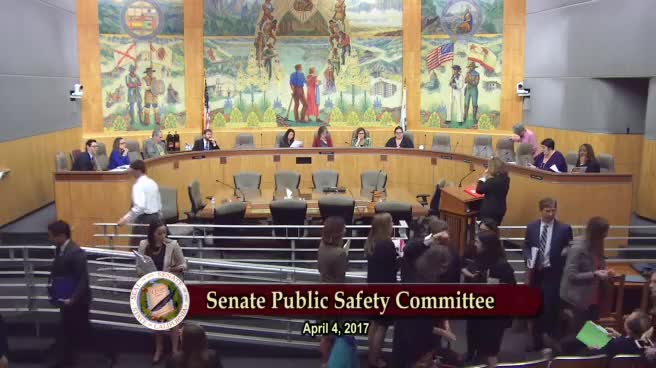 8MIN
Senate Standing Committee on Public Safety
Bill Author

Bill Co-Author(s):
