SB 940: Student financial aid: Cal Grant Program: foster youth.
- Session Year: 2017-2018
- House: Senate
- Latest Version Date: 2018-03-21
Existing law, the Ortiz-Pacheco-Poochigian-Vasconcellos Cal Grant Program, establishes the Cal Grant A and B Entitlement awards, the California Community College Transfer Entitlement awards, the Competitive Cal Grant A and B awards, the Cal Grant C awards, and the Cal Grant T awards under the administration of the Student Aid Commission, and establishes eligibility requirements for awards under these programs for participating students attending qualifying institutions. Existing law provides that any California resident is entitled to a Cal Grant A B Entitlement award, and requires the commission or a qualifying institution, as provided, to allocate that award, if certain criteria are met, including that the student submit a complete financial aid application, submitted or postmarked no later than March 2 of the academic year of high school graduation or its equivalent for the award year immediately following the academic year of high school graduation or its equivalent, or no later than March 2 of the academic year following high school graduation or its equivalent for the 2nd award year following the year of high school graduation or its equivalent. Existing law provides that any California resident is entitled to a Cal Grant B Entitlement award, and requires the commission to allocate that award, if certain criteria are met, including that the student submit a complete financial aid application in accordance with those same deadlines.
This bill would provide alternative deadlines for submitting a complete financial aid application for a student who is a current or former foster youth, who is attending a qualifying institution that offers baccalaureate degrees or is attending a California community college, and has not yet reached 26 years of age as of July 1 of the initial award year.
Existing law authorizes the renewal of Cal Grant A awards and Cal Grant B awards for a total of the equivalent of 4 years of full-time attendance in an undergraduate program, provided that minimum financial need, as defined, continues to exist, subject to certain exceptions.
This bill would authorize the renewal of Cal Grant A awards and Cal Grant B awards, for a current or former foster youth, for a total of the equivalent of 8 years of full-time attendance in an undergraduate program, provided that minimum financial need continues to exist.
Existing law, the Ortiz-Pacheco-Poochigian-Vasconcellos Cal Grant Program, establishes the Cal Grant A and B Entitlement awards, the California Community College Transfer Entitlement awards, the Competitive Cal Grant A and B awards, the Cal Grant C awards, and the Cal Grant T awards under the administration of the Student Aid Commission, and establishes eligibility requirements for awards under these programs for participating students attending qualifying institutions. Existing law provides that any California resident is entitled to a Cal Grant A Entitlement award, and requires the commission or a qualifying institution, as provided, to allocate that award, if certain criteria are met, including that the student submit a complete financial aid application, submitted or postmarked no later than March 2 of the academic year of high school graduation or its equivalent for the award year immediately following the academic year of high school graduation or its equivalent, or no later than March 2 of the academic year following high school graduation or its equivalent for the 2nd award year following the year of high school graduation or its equivalent. Existing law provides that any California resident is entitled to a Cal Grant B Entitlement award, and requires the commission to allocate that award, if certain criteria are met, including that the student submit a complete financial aid application in accordance with those same deadlines.
This bill would provide alternative deadlines for submitting a complete financial aid application for a student who is a current or former foster youth, who is attending a qualifying institution that offers baccalaureate degrees or is attending a California community college, and has not yet reached 26 years of age as of July 1 of the award year.
Existing law authorizes the renewal of Cal Grant A awards and Cal Grant B awards for a total of the equivalent of 4 years of full-time attendance in an undergraduate program, provided that minimum financial need, as defined, continues to exist, subject to certain exceptions.
This bill would authorize the renewal of Cal Grant A awards and Cal Grant B awards, for a current or former foster youth, for a total of the equivalent of 8 years of full-time attendance in an undergraduate program, provided that minimum financial need continues to exist.
(a)Except as otherwise provided in this section, Cal Grant A awards and Cal Grant B awards may be renewed for a total of the equivalent of four years of full-time attendance in an undergraduate program, provided that minimum financial need, as defined in paragraph (3) of subdivision (b) of Section 69432.9, continues to exist. Commencing with the 200102 academic year, the total number of years of eligibility for grants pursuant to this section shall be based on the students educational level in his or her course of study as designated by the institution of attendance when the recipient initially receives payment for a grant.
(b)(1)Commencing with the 201415 academic year, a recipient who was determined to be ineligible for a renewal award in the 201213 or 201314 academic year because he or she exceeded the maximum household income or asset level established by subdivision (k) of Section 69432.7, or failed to meet the minimum need threshold established by paragraph (3) of subdivision (b) of Section 69432.9, shall be eligible to receive a renewal award if the recipient meets all program eligibility requirements for the program from which he or she was previously disqualified and the recipient has remaining renewal award eligibility. For purposes of determining a students remaining renewal award eligibility, an academic year during which a student was ineligible shall reduce his or her renewal award eligibility by one full-time equivalent year.
(2)Commencing with the 201516 academic year, a recipient who is determined to be ineligible for a renewal award because, during the immediately preceding academic year, he or she exceeded the maximum household income or asset level established by subdivision (k) of Section 69432.7, or failed to meet the minimum need threshold established by paragraph (3) of subdivision (b) of Section 69432.9, shall be eligible to receive a renewal award if the recipient meets all program eligibility requirements for the program from which he or she was previously disqualified and the recipient has remaining renewal award eligibility. For purposes of determining a students remaining renewal award eligibility, an academic year during which a student was ineligible shall reduce his or her renewal award eligibility by one full-time equivalent year.
(c)For a student enrolled in an institutionally prescribed five-year undergraduate program, Cal Grant A awards and Cal Grant B awards may be renewed for a total of five years of full-time attendance, provided that minimum financial need, as defined in paragraph (3) of subdivision (b) of Section 69432.9, continues to exist.
(d)(1)A Cal Grant Program award recipient who has completed a baccalaureate degree, and who has been admitted to and is enrolled in a program of professional teacher preparation at an institution approved by the Commission on Teacher Credentialing is eligible for, but not entitled to, renewal of a Cal Grant Program award for an additional year of full-time attendance, if minimum financial need, as defined in paragraph (3) of subdivision (b) of Section 69432.9, continues to exist.
(2)Payment for an additional year is limited to only those courses required for an initial teaching authorization. An award made under this subdivision may not be used for other courses.
(3)A students Cal Grant Program renewal eligibility shall not have lapsed more than 15 months before the payment of an award for purposes of this subdivision.
(e)(1)For a current or former foster youth, Cal Grant A awards and Cal Grant B awards may be renewed for a total of the equivalent of eight years of full-time attendance in an undergraduate program, provided that minimum financial need, as defined in paragraph (3) of subdivision (b) of Section 69432.9, continues to exist.
(2)For purposes of this subdivision, current or former foster youth means a person whose dependency was established or continued by the court on or after the date on which the person reached 13 years of age.
SEC. 2.Section 69434 of the Education Code is amended to read:69434.(a)A Cal Grant A award shall be used only for tuition or student fees, or both, in a for-credit instructional program with a length of not less than two academic years. Each student who meets the Cal Grant A qualifications as set forth in this article shall be guaranteed an award. The amount of any individual award is dependent on the cost of tuition or fees, or both, at the qualifying institution at which the student is enrolled. For each applicant, the award amount shall not exceed the amount of the calculated financial need.(b)Pursuant to Section 66021.2, any California resident is entitled to a Cal Grant A award, and the commission, or a qualifying institution pursuant to Article 8 (commencing with Section 69450), shall allocate that award, if all of the following criteria are met:(1)(A)The student has submitted, pursuant to Section 69432.9, a complete financial aid application, submitted or postmarked no later than March 2 of the academic year of high school graduation or its equivalent for the award year immediately following the academic year of high school graduation or its equivalent, no later than March 2 of the academic year following high school graduation or its equivalent for the second award year following the year of high school graduation or its equivalent, or, if applicable to the student, pursuant to the following dates:(i)No later than March 2 of the academic year immediately prior to the year for which funds would be applied, if the student is a current or former foster youth, is attending a qualifying institution that offers baccalaureate degrees, and has not yet reached 26 years of age as of July 1 of the initial award year.(ii)No later than September 2 of the academic year for which funds would be applied, if the student is a current or former foster youth, is attending a California community college, and has not yet reached 26 years of age as of July 1 of the initial award year.(B)For purposes of this section, current or former foster youth has the same meaning as specified in paragraph (2) of subdivision (e) of Section 69433.6.(2)The student demonstrates financial need pursuant to Section 69433.(3)The student attains a high school grade point average of at least 3.0 on a four-point scale.(4)The students household has an income and asset level that does not exceed the level for Cal Grant A recipients set forth in Section 69432.7.(5)The student is pursuing an undergraduate academic program of not less than two academic years that is offered by a qualifying institution.(6)The student is enrolled at least part time.(7)The student meets the general Cal Grant eligibility requirements set forth in Article 1 (commencing with Section 69430).(8)The student graduated from high school or its equivalent during or after the 200001 academic year.(c)(1)A student who meets the Cal Grant A Entitlement Program criteria specified in this article shall receive a Cal Grant A award for tuition or fees, or both, pursuant to Section 66021.2.(2)A community college student participating in a baccalaureate degree program pursuant to Article 3 (commencing with Section 78040) of Chapter 1 of Part 48 of Division 7 who meets the Cal Grant A Entitlement Program criteria specified in this article shall receive a Cal Grant A award for upper division coursework fees pursuant to Section 66021.2.SEC. 3.SEC. 2.Section 69435.3 of the Education Code is amended to read:69435.3.(a)Any California resident is entitled to receive a Cal Grant B award, and the commission shall allocate that award pursuant to Section 66021.2, if all of the following criteria are met:
(1)(A)The student has submitted, pursuant to Section 69432.9, a complete financial aid application, submitted or postmarked no later than March 2 of the academic year of high school graduation or its equivalent for the award year immediately following the academic year of high school graduation or its equivalent, no later than March 2 of the academic year following high school graduation or its equivalent for the second award year following the year of high school graduation or its equivalent, or, if applicable to the student, pursuant to the following dates:
(i)No later than March 2 of the academic year immediately prior to the year for which funds would be applied, if the student is a current or former foster youth, is attending a qualifying institution that offers baccalaureate degrees, and has not yet reached 26 years of age as of July 1 of the initial award year.
(ii)No later than September 2 of the academic year for which funds would be applied, if the student is a current or former foster youth, is attending a California community college, and has not yet reached 26 years of age as of July 1 of the initial award year.
(B)For purposes of this section, current or former foster youth has the same meaning as specified in paragraph (2) of subdivision (e) of Section 69433.6.
(2)The student demonstrates financial need pursuant to Section 69433.
(3)The student attains a high school grade point average of at least 2.0 on a four-point scale.
(4)The students household has an income and asset level that does not exceed the level for Cal Grant B recipients as set forth in Section 69432.7.
(5)The student is pursuing an undergraduate academic program of not less than one academic year that is offered by a qualifying institution.
(6)The student is enrolled at least part time.
(7)The student meets the general Cal Grant eligibility requirements set forth in Article 1 (commencing with Section 69430).
(8)The student graduated from high school or its equivalent during or after the 200001 academic year.
(b)A student, including a community college student participating in upper division coursework in a baccalaureate degree program pursuant to Article 3 (commencing with Section 78040) of Chapter 1 of Part 48 of Division 7, who meets the Cal Grant B Entitlement Program or Competitive Program criteria specified in this article shall receive a Cal Grant B award for access costs and tuition and fees, as applicable, pursuant to Section 66021.2.
(a)Except as otherwise provided in this section, Cal Grant A awards and Cal Grant B awards may be renewed for a total of the equivalent of four years of full-time attendance in an undergraduate program, provided that minimum financial need, as defined in paragraph (3) of subdivision (b) of Section 69432.9, continues to exist. Commencing with the 200102 academic year, the total number of years of eligibility for grants pursuant to this section shall be based on the students educational level in his or her course of study as designated by the institution of attendance when the recipient initially receives payment for a grant.
(b)(1)Commencing with the 201415 academic year, a recipient who was determined to be ineligible for a renewal award in the 201213 or 201314 academic year because he or she exceeded the maximum household income or asset level established by subdivision (k) of Section 69432.7, or failed to meet the minimum need threshold established by paragraph (3) of subdivision (b) of Section 69432.9, shall be eligible to receive a renewal award if the recipient meets all program eligibility requirements for the program from which he or she was previously disqualified and the recipient has remaining renewal award eligibility. For purposes of determining a students remaining renewal award eligibility, an academic year during which a student was ineligible shall reduce his or her renewal award eligibility by one full-time equivalent year.
(2)Commencing with the 201516 academic year, a recipient who is determined to be ineligible for a renewal award because, during the immediately preceding academic year, he or she exceeded the maximum household income or asset level established by subdivision (k) of Section 69432.7, or failed to meet the minimum need threshold established by paragraph (3) of subdivision (b) of Section 69432.9, shall be eligible to receive a renewal award if the recipient meets all program eligibility requirements for the program from which he or she was previously disqualified and the recipient has remaining renewal award eligibility. For purposes of determining a students remaining renewal award eligibility, an academic year during which a student was ineligible shall reduce his or her renewal award eligibility by one full-time equivalent year.
(c)For a student enrolled in an institutionally prescribed five-year undergraduate program, Cal Grant A awards and Cal Grant B awards may be renewed for a total of five years of full-time attendance, provided that minimum financial need, as defined in paragraph (3) of subdivision (b) of Section 69432.9, continues to exist.
(d)(1)A Cal Grant Program award recipient who has completed a baccalaureate degree, and who has been admitted to and is enrolled in a program of professional teacher preparation at an institution approved by the Commission on Teacher Credentialing is eligible for, but not entitled to, renewal of a Cal Grant Program award for an additional year of full-time attendance, if minimum financial need, as defined in paragraph (3) of subdivision (b) of Section 69432.9, continues to exist.
(2)Payment for an additional year is limited to only those courses required for an initial teaching authorization. An award made under this subdivision may not be used for other courses.
(3)A students Cal Grant Program renewal eligibility shall not have lapsed more than 15 months before the payment of an award for purposes of this subdivision.
(e)(1)For a current or former foster youth, Cal Grant A awards and Cal Grant B awards may be renewed for a total of the equivalent of eight years of full-time attendance in an undergraduate program, provided that minimum financial need, as defined in paragraph (3) of subdivision (b) of Section 69432.9, continues to exist.
(2)For purposes of this subdivision, current or former foster youth means a person whose dependency was established or continued by the court on or after the date on which the person reached 13 years of age.
SEC. 2.Section 69434 of the Education Code is amended to read:69434.(a)A Cal Grant A award shall be used only for tuition or student fees, or both, in a for-credit instructional program with a length of not less than two academic years. Each student who meets the Cal Grant A qualifications as set forth in this article shall be guaranteed an award. The amount of any individual award is dependent on the cost of tuition or fees, or both, at the qualifying institution at which the student is enrolled. For each applicant, the award amount shall not exceed the amount of the calculated financial need.
(b)Pursuant to Section 66021.2, any California resident is entitled to a Cal Grant A award, and the commission, or a qualifying institution pursuant to Article 8 (commencing with Section 69450), shall allocate that award, if all of the following criteria are met:
(1)(A)The student has submitted, pursuant to Section 69432.9, a complete financial aid application, submitted or postmarked no later than March 2 of the academic year of high school graduation or its equivalent for the award year immediately following the academic year of high school graduation or its equivalent, no later than March 2 of the academic year following high school graduation or its equivalent for the second award year following the year of high school graduation or its equivalent, or, if applicable to the student, pursuant to the following dates:
(i)No later than March 2 of the academic year immediately prior to the year for which funds would be applied, if the student is a current or former foster youth, is attending a qualifying institution that offers baccalaureate degrees, and has not yet reached 26 years of age as of July 1 of the initial award year.
(ii)No later than September 2 of the academic year for which funds would be applied, if the student is a current or former foster youth, is attending a California community college, and has not yet reached 26 years of age as of July 1 of the initial award year.
(B)For purposes of this section, current or former foster youth has the same meaning as specified in paragraph (2) of subdivision (e) of Section 69433.6.
(2)The student demonstrates financial need pursuant to Section 69433.
(3)The student attains a high school grade point average of at least 3.0 on a four-point scale.
(4)The students household has an income and asset level that does not exceed the level for Cal Grant A recipients set forth in Section 69432.7.
(5)The student is pursuing an undergraduate academic program of not less than two academic years that is offered by a qualifying institution.
(6)The student is enrolled at least part time.
(7)The student meets the general Cal Grant eligibility requirements set forth in Article 1 (commencing with Section 69430).
(8)The student graduated from high school or its equivalent during or after the 200001 academic year.
(c)(1)A student who meets the Cal Grant A Entitlement Program criteria specified in this article shall receive a Cal Grant A award for tuition or fees, or both, pursuant to Section 66021.2.
(2)A community college student participating in a baccalaureate degree program pursuant to Article 3 (commencing with Section 78040) of Chapter 1 of Part 48 of Division 7 who meets the Cal Grant A Entitlement Program criteria specified in this article shall receive a Cal Grant A award for upper division coursework fees pursuant to Section 66021.2.
SEC. 3.Section 69435.3 of the Education Code is amended to read:69435.3.(a)Any California resident is entitled to receive a Cal Grant B award, and the commission shall allocate that award pursuant to Section 66021.2, if all of the following criteria are met:
(1)(A)The student has submitted, pursuant to Section 69432.9, a complete financial aid application, submitted or postmarked no later than March 2 of the academic year of high school graduation or its equivalent for the award year immediately following the academic year of high school graduation or its equivalent, no later than March 2 of the academic year following high school graduation or its equivalent for the second award year following the year of high school graduation or its equivalent, or, if applicable to the student, pursuant to the following dates:
(i)No later than March 2 of the academic year immediately prior to the year for which funds would be applied, if the student is a current or former foster youth, is attending a qualifying institution that offers baccalaureate degrees, and has not yet reached 26 years of age as of July 1 of the initial award year.
(ii)No later than September 2 of the academic year for which funds would be applied, if the student is a current or former foster youth, is attending a California community college, and has not yet reached 26 years of age as of July 1 of the initial award year.
(B)For purposes of this section, current or former foster youth has the same meaning as specified in paragraph (2) of subdivision (e) of Section 69433.6.
(2)The student demonstrates financial need pursuant to Section 69433.
(3)The student attains a high school grade point average of at least 2.0 on a four-point scale.
(4)The students household has an income and asset level that does not exceed the level for Cal Grant B recipients as set forth in Section 69432.7.
(5)The student is pursuing an undergraduate academic program of not less than one academic year that is offered by a qualifying institution.
(6)The student is enrolled at least part time.
(7)The student meets the general Cal Grant eligibility requirements set forth in Article 1 (commencing with Section 69430).
(8)The student graduated from high school or its equivalent during or after the 200001 academic year.
(b)A student, including a community college student participating in upper division coursework in a baccalaureate degree program pursuant to Article 3 (commencing with Section 78040) of Chapter 1 of Part 48 of Division 7, who meets the Cal Grant B Entitlement Program or Competitive Program criteria specified in this article shall receive a Cal Grant B award for access costs and tuition and fees, as applicable, pursuant to Section 66021.2.
(a)Except as otherwise provided in this section, Cal Grant A awards and Cal Grant B awards may be renewed for a total of the equivalent of four years of full-time attendance in an undergraduate program program, provided that minimum financial need need, as defined in paragraph (3) of subdivision (b) of Section 69432.9 69432.9, continues to exist. Commencing with the 200102 academic year, the total number of years of eligibility for grants pursuant to this section shall be based on the students educational level in his or her course of study as designated by the institution of attendance when the recipient initially receives payment for a grant.
(b)(1)Commencing with the 201415 academic year, a recipient who was determined to be ineligible for a renewal award in the 201213 or 201314 academic year because he or she exceeded the maximum household income or asset level established by subdivision (k) of Section 69432.7, or failed to meet the minimum need threshold established by paragraph (3) of subdivision (b) of Section 69432.9, shall be eligible to receive a renewal award if the recipient meets all program eligibility requirements for the program from which he or she was previously disqualified and the recipient has remaining renewal award eligibility. For purposes of determining a students remaining renewal award eligibility, an academic year during which a student was ineligible shall reduce his or her renewal award eligibility by one full-time equivalent year.
(2)Commencing with the 201516 academic year, a recipient who is determined to be ineligible for a renewal award because, during the immediately preceding academic year, he or she exceeded the maximum household income or asset level established by subdivision (k) of Section 69432.7, or failed to meet the minimum need threshold established by paragraph (3) of subdivision (b) of Section 69432.9, shall be eligible to receive a renewal award if the recipient meets all program eligibility requirements for the program from which he or she was previously disqualified and the recipient has remaining renewal award eligibility. For purposes of determining a students remaining renewal award eligibility, an academic year during which a student was ineligible shall reduce his or her renewal award eligibility by one full-time equivalent year.
(c)For a student enrolled in an institutionally prescribed five-year undergraduate program, Cal Grant A awards and Cal Grant B awards may be renewed for a total of five years of full-time attendance, provided that minimum financial need, as defined in paragraph (3) of subdivision (b) of Section 69432.9, continues to exist.
(d)(1)A Cal Grant Program award recipient who has completed a baccalaureate degree, and who has been admitted to and is enrolled in a program of professional teacher preparation at an institution approved by the California Commission on Teacher Credentialing is eligible for, but not entitled to, renewal of a Cal Grant Program award for an additional year of full-time attendance, if minimum financial need, as defined in paragraph (3) of subdivision (b) of Section 69432.9, continues to exist.
(2)Payment for an additional year is limited to only those courses required for an initial teaching authorization. An award made under this subdivision may not be used for other courses.
(3)A students Cal Grant Program renewal eligibility shall not have lapsed more than 15 months before the payment of an award for purposes of this subdivision.
(e)(1)For a current or former foster youth, Cal Grant A awards and Cal Grant B awards may be renewed for a total of the equivalent of eight years of full-time attendance in an undergraduate program, provided that minimum financial need, as defined in paragraph (3) of subdivision (b) of Section 69432.9, continues to exist.
(2)For purposes of this subdivision, current or former foster youth means a person whose dependency was established or continued by the court on or after the date on which the person reached 13 years of age.
SEC. 2.Section 69434 of the Education Code is amended to read:69434.(a)A Cal Grant A award shall be used only for tuition or student fees, or both, in a for-credit instructional program with a length of not less than two academic years. Each student who meets the Cal Grant A qualifications as set forth in this article shall be guaranteed an award. The amount of any individual award is dependent on the cost of tuition or fees, or both, at the qualifying institution at which the student is enrolled. For each applicant, the award amount shall not exceed the amount of the calculated financial need.
(b)Pursuant to Section 66021.2, any California resident is entitled to a Cal Grant A award, and the commission, or a qualifying institution pursuant to Article 8 (commencing with Section 69450), shall allocate that award, if all of the following criteria are met:
(1)(A)The student has submitted, pursuant to Section 69432.9, a complete financial aid application, submitted or postmarked no later than March 2 of the academic year of high school graduation or its equivalent for the award year immediately following the academic year of high school graduation or its equivalent, or no later than March 2 of the academic year following high school graduation or its equivalent for the second award year following the year of high school graduation or its equivalent. equivalent, or, if applicable to the student, pursuant to the following dates:
(i)No later than March 2 of the academic year immediately prior to the year for which funds would be applied, if the student is a current or former foster youth, is attending a qualifying institution that offers baccalaureate degrees, and has not yet reached 26 years of age as of July 1 of the award year.
(ii)No later than September 2 of the academic year for which funds would be applied, if the student is a current or former foster youth, is attending a California community college, and has not yet reached 26 years of age as of July 1 of the award year.
(B)For purposes of this section, current or former foster youth has the same meaning as specified in paragraph (2) of subdivision (e) of Section 69433.6.
(2)The student demonstrates financial need pursuant to Section 69433.
(3)The student attains a high school grade point average of at least 3.0 on a four-point scale.
(4)The students household has an income and asset level that does not exceed the level for Cal Grant A recipients set forth in Section 69432.7.
(5)The student is pursuing an undergraduate academic program of not less than two academic years that is offered by a qualifying institution.
(6)The student is enrolled at least part time.
(7)The student meets the general Cal Grant eligibility requirements set forth in Article 1 (commencing with Section 69430).
(8)The student graduated from high school or its equivalent during or after the 200001 academic year.
(c)(1)A student who meets the Cal Grant A Entitlement Program criteria specified in this article shall receive a Cal Grant A award for tuition or fees, or both, pursuant to Section 66021.2.
(2)A community college student participating in a baccalaureate degree program pursuant to Article 3 (commencing with Section 78040) of Chapter 1 of Part 48 of Division 7 who meets the Cal Grant A Entitlement Program criteria specified in this article shall receive a Cal Grant A award for upper division coursework fees pursuant to Section 66021.2.
SEC. 3.Section 69435.3 of the Education Code is amended to read:69435.3.(a)Any California resident is entitled to receive a Cal Grant B award, and the commission shall allocate that award pursuant to Section 66021.2, if all of the following criteria are met:
(1)(A)The student has submitted, pursuant to Section 69432.9, a complete financial aid application, submitted or postmarked no later than March 2 of the academic year of high school graduation or its equivalent for the award year immediately following the academic year of high school graduation or its equivalent, or no later than March 2 of the academic year following high school graduation or its equivalent for the second award year following the year of high school graduation or its equivalent. equivalent, or, if applicable to the student, pursuant to the following dates:
(i)No later than March 2 of the academic year immediately prior to the year for which funds would be applied, if the student is a current or former foster youth, is attending a qualifying institution that offers baccalaureate degrees, and has not yet reached 26 years of age as of July 1 of the award year.
(ii)No later than September 2 of the academic year for which funds would be applied, if the student is a current or former foster youth, is attending a California community college, and has not yet reached 26 years of age as of July 1 of the award year.
(B)For purposes of this section, current or former foster youth has the same meaning as specified in paragraph (2) of subdivision (e) of Section 69433.6.
(2)The student demonstrates financial need pursuant to Section 69433.
(3)The student attains a high school grade point average of at least 2.0 on a four-point scale.
(4)The students household has an income and asset level that does not exceed the level for Cal Grant B recipients as set forth in Section 69432.7.
(5)The student is pursuing an undergraduate academic program of not less than one academic year that is offered by a qualifying institution.
(6)The student is enrolled at least part time.
(7)The student meets the general Cal Grant eligibility requirements set forth in Article 1 (commencing with Section 69430).
(8)The student graduated from high school or its equivalent during or after the 200001 academic year.
(b)A student, including a community college student participating in upper division coursework in a baccalaureate degree program pursuant to Article 3 (commencing with Section 78040) of Chapter 1 of Part 48 of Division 7, who meets the Cal Grant B Entitlement Program or Competitive Program criteria specified in this article shall receive a Cal Grant B award for access costs and tuition and fees, as applicable, pursuant to Section 66021.2.
|
Date
|
Status
|
|---|---|
| Jun 26, 2018 | June 26 set for first hearing canceled at the request of author. |
| Jun 4, 2018 | Referred to Com. on HIGHER ED. |
| May 29, 2018 | In Assembly. Read first time. Held at Desk. |
| May 29, 2018 | Read third time. Passed. (Ayes 36. Noes 0.) Ordered to the Assembly. |
| May 25, 2018 | From committee: Do pass. (Ayes 7. Noes 0.) (May 25). |
| May 18, 2018 | Set for hearing May 25. |
| Apr 16, 2018 | April 16 hearing: Placed on APPR. suspense file. |
| Apr 9, 2018 | Set for hearing April 16. |
| Mar 21, 2018 | Read second time and amended. Re-referred to Com. on APPR. |
| Mar 20, 2018 | From committee: Do pass as amended and re-refer to Com. on APPR. (Ayes 6. Noes 0.) (March 14). |
| Mar 5, 2018 | From committee with author's amendments. Read second time and amended. Re-referred to Com. on ED. |
| Feb 27, 2018 | Set for hearing March 14. |
| Feb 8, 2018 | Referred to Com. on ED. |
| Jan 30, 2018 | From printer. May be acted upon on or after March 1. |
| Jan 29, 2018 | Introduced. Read first time. To Com. on RLS. for assignment. To print. |
|
Date
|
Description
|
Location
|
Votes
|
|
|---|---|---|---|---|
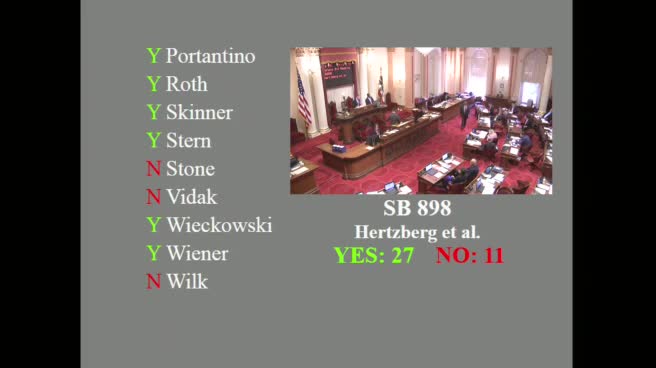
| May 29, 2018 | Senate 3rd Reading SB940 Beall et al. | Senate Floor |
Passed |
|
| May 25, 2018 | Do pass | Senate Standing Committee on Appropriations |
Passed |
|
| Apr 16, 2018 | Placed on suspense file | Senate Standing Committee on Appropriations |
Passed |
|
| Mar 14, 2018 | Do pass as amended, but first amend, and re-refer to the Committee on [Appropriations] | Senate Standing Committee on Education |
Passed |
This list shows positions taken on this bill by organizations on the date displayed, which is linked to the original source.
Positions by individuals are not included.
|
Organization
|
Position
|
Date
|
|---|---|---|
| 2-1-1 san diego | ** Support | May 26, 2018 |
| Ace Scholars Services, California State University, San Marcos | ** Support | May 26, 2018 |
| Alliance for Children's Rights | ** Support | May 26, 2018 |
| American Academy of Pediatrics | ** Support | May 26, 2018 |
| Bakersfield College | ** Support | May 26, 2018 |
| Bill Wilson Center | ** Support | May 26, 2018 |
| Cal State Fullerton, Guardian Scholars Program | ** Support | May 26, 2018 |
| California Alliance Of Child And Family Services | * Support | Mar 14, 2018 |
| California Community College Chancellor's Office | * Indeterminate | Mar 14, 2018 |
| California Community College Student Financial Aid Administrators | ** Support | Mar 13, 2018 |
| California Community College Student Financial Aid Administrators Association | ** Support | Mar 13, 2018 |
| California Community Colleges Extended Opportunity Programs & Services Association | * Support | Mar 14, 2018 |
| California Court Appointed Special Advocates Association | * Support | Mar 14, 2018 |
| California State University, Sacramento, Guardian Scholars Program | * Support | Mar 14, 2018 |
| California Student Aid Commission | * Support | Mar 14, 2018 |
| Casa de Amparo | ** Support | May 26, 2018 |
| Central Valley Higher Education Consortium | ** Support | May 26, 2018 |
| Cerritos College | ** Support | May 26, 2018 |
| Child Advocates Of Silicon Valley | ** Support | May 26, 2018 |
| Children Now Children'S Law Center Of California | ** Support | May 26, 2018 |
| Coalition for Responsible Community Development | ** Support | May 26, 2018 |
| Community College League of California | ** Support | May 26, 2018 |
| County of Santa Cruz Human Services Department | ** Support | May 26, 2018 |
| County Welfare Directors Association Of California (Cwda) | * Support | Mar 14, 2018 |
| Csu Bakersfield Guardian Scholars Program | ** Support | May 26, 2018 |
| David & Margaret Youth and Family Services | ** Support | May 26, 2018 |
| Faculty Association Of California Community Colleges | ** Support | May 26, 2018 |
| Family Care Network | ** Support | May 26, 2018 |
| First Place for Youth | * Support | Mar 14, 2018 |
| First Place Youth | ** Support | May 26, 2018 |
| Foster Care Counts | ** Support | May 26, 2018 |
| Fred Finch Youth Center | ** Support | May 26, 2018 |
| Imperial | ** Support | May 26, 2018 |
| John Burton Advocates for Youth | ** Support | May 26, 2018 |
| Jovenes, Inc. | ** Support | May 26, 2018 |
| Laney College | ** Support | May 26, 2018 |
| Learning Rights Law Center | ** Support | May 26, 2018 |
| Los Angeles Area Chamber Of Commerce | * Support | Mar 14, 2018 |
| National Center for Youth Law | ** Support | May 26, 2018 |
| New Alternatives, Inc. | ** Support | May 26, 2018 |
| Norco College | ** Support | May 26, 2018 |
| North Orange County Community College District | ** Support | Mar 14, 2018 |
| Nossaman LLP | * Support | Mar 14, 2018 |
| Numerous individuals | ** Support | May 26, 2018 |
| Path Scholars Program, Csu Chico | ** Support | May 26, 2018 |
| Peacock Acresis | ** Support | May 26, 2018 |
| Peralta Community College District | ** Support | May 26, 2018 |
| Power To Soar | ** Support | May 26, 2018 |
| Redwood Community Action Agency's Youth Service Bureau | ** Support | May 26, 2018 |
| Reedley College | ** Support | May 26, 2018 |
| Reedley College-Madera Center | ** Support | May 26, 2018 |
| Saints Church Foster Care Project | ** Support | May 26, 2018 |
| self | * Support | Mar 14, 2018 |
| Sierra College | ** Support | May 26, 2018 |
| Silicon Valley Leadership Group | ** Support | May 26, 2018 |
| Starvista | ** Support | May 26, 2018 |
| The Children's Law Center of California | * Support | Mar 14, 2018 |
| The Enriched Scholars Program At Cosumnes River College | ** Support | May 26, 2018 |
| The Institute for College Access and Success | ** Support | May 26, 2018 |
| Ticket To Dream Foundation | ** Support | May 26, 2018 |
| TLC Child and Family Services | ** Support | May 26, 2018 |
| United Friends Of The Children | ** Support | May 26, 2018 |
| Unity Care | ** Support | May 26, 2018 |
| University of California | ** Support | May 26, 2018 |
| University Of California, San Diego Hope Scholars | ** Support | May 26, 2018 |
| University of San Diego | ** Support | May 26, 2018 |
| Unknown affiliation | * Support | Apr 16, 2018 |
| VALLEY INDUSTRY AND COMMERCE ASSOCIATION | ** Support | May 26, 2018 |
| Walden Family Services | ** Support | May 26, 2018 |
Office of Senate Floor Analyses (916) 651-1520 Fax: (916) 327-4478 | SB |
THIRD READING
Bill No: SB 940
:
SENATE EDUCATION COMMITTEE: 6-0, 3/14/18
AYES: Allen, Wilk, Galgiani, Leyva, Pan, Vidak
SENATE APPROPRIATIONS COMMITTEE: 7-0, 5/25/18
AYES: Lara, Bates, Beall, Bradford, Hill, Nielsen, Wiener
DIGEST:
This bill expands eligibility for Cal Grant B Entitlement award for a student who is a current or former foster youth by extending the window of time for submission of an initial financial aid application up to age 26 and by increasing the total award level for this student group from four to eight-years of full-time attendance in an undergraduate program.
Existing law:
- Authorizes the Cal Grant program, administered by the California Student Aid Commission, to provide grants to financially needy students to attend a college or university. The Cal Grant programs include both the entitlement and the competitive Cal Grant awards. The program consists of the Cal Grant A, Cal Grant B, and Cal Grant C programs and eligibility is based upon financial need, GPA, California residency and other criteria. (Education Code § 69430 - 69433)
- Provides that any California resident is entitled to a Cal Grant A and B entitlement award if in addition to meeting the specified criteria, submits a complete financial aid application, submitted and postmarked no later than March 2 of the academic year of high school graduation or its equivalent for the award year immediately following the academic year of high school graduation or its equivalent, or no later than March 2 for the second award year following the year of high school graduation or its equivalent. (EC § 69434 (b)(1) and 69435.3(a)(1))
- Prohibits an applicant from receiving one or a combination of program awards in excess of the amount equivalent to the award level for a total of a four-year period of full-time attendance in an undergraduate program. (EC § 69433.5)
- Authorizes, an additional year of eligibility for students enrolled in an institutionally prescribed five-year undergraduate program or students enrolled in professional teacher preparation program, as specified. (EC § 69432.9)
- Establishes the Cal Grant Competitive Award Program and provides 25,750 Cal Grant A and B awards to applicants who meet financial, academic and general program eligibility requirements. Half of these awards are reserved for students enrolled at a community college and who met September 2 application deadline. ( EC § 69437).
This bill expands eligibility for Cal Grant B Entitlement Program for a student who is a current or former foster youth. Specifically, this bill:
- Provides alternative deadlines for submitting an initial financial aid application that extends beyond the existing window of not more than one year after graduating from high school for a student who:
- Is a current or former foster youth, as defined.
- Applies no later than March 2 of the academic year immediately prior to the year for which funds would be applied and is attending a qualifying institution that offers baccalaureate degrees or no later than September 2 if attending a California community college.
- Is under 26 years of age as of July 1 of the award year.
- Authorizes a student who is a current or former foster youth, as defined, to receive a Cal Grant B award in the amount equivalent to the award level for an eight-year period of full-time attendance in an undergraduate program provided that minimum financial need continues to exist. Current law allows a total award level of four-years of full-time attendance.
Comments
- Need for the bill. According to the author, “by age 26, just 4 percent of former foster youth have achieved a college degree as compared to 36 percent of the same-age population of young adults. Financial aid plays a key role in student success.” The author asserts foster youth face three main barriers to Cal Grant access, “first foster youth receive less assistance preparing for college and do not submit the required financial aid application within one year of completing high school, as required. Second, the average length of time for a foster youth to complete college exceeds the 4-year limit of the Cal Grant. Finally foster youth attending community college often start school without completing a financial aid application, there by missing the March 2nd Cal Grant deadline.” This bill seeks to improve college-going rates and outcomes for foster youth by relaxing certain eligibility requirements for entry into the Cal Grant Entitlement program.
- Entitlement versus competitive program. Current law establishes those awards as an entitlement for students meeting certain eligibility criteria. This means the state automatically funds as many students as qualify. A criterion for qualification is that the initial application be submitted when the student is a high school senior or has graduated from high school within the last year. Eligible applicants who miss the application deadline or enroll well after they have graduated from high school may apply for a Competitive Cal Grant award. However, the competitive program is oversubscribed with applicants that failed to qualify for an Entitlement program, in a given year, approximately 300,000 to 350,000 applicants compete for the 25,750 awards. The provisions in this bill expand the window of time for submission of a Cal Grant application for qualification of an Entitlement award, exclusively for a foster youth.
- Renewal and duration of awards. The Cal Grant program currently offers awards to cover tuition costs for the equivalent of a four-year academic period. The amount and duration of the award are based on the student’s attendance status (full-time/part-time) and term (semester or quarter). This provides some flexibility to take more units within the parameters of their attendance status without losing additional eligibility. By contrast, other programs, such as institutional aid, base eligibility on the number of units and exceeding the allowed number of units would count against a student’s overall eligibility. Under the Cal Grant program, there are two exceptions to the four-year rule. An additional year of eligibility is offered to students enrolled in a mandatory five-year program, and to students who are enrolled in a teacher credential program. This bill extends award eligibility for foster youth to an eight-year academic period (full-time 12 units or more). For a part-time student (six units) this bill extends award eligibility to a 16-year academic period.
- Disincentive for timely completion? In response to concerns that students are taking longer to complete their undergraduate degrees or not at all, public postsecondary institutions and the state have focused on improving and supporting timely degree completion. Recent budget actions have charged each segment with setting goals and implementing strategies for improving transfer, four-year and six-year graduation rates. Some of these strategies include promoting full-time attendance (12 units or more) and infusing additional financial assistance (at California Community Colleges (CCC)) to cover lost wages in exchange for full-time attendance. Expanding Cal Grant award eligibility to eight years, as prescribed in this bill, may serve as a disincentive for timely degree completion.
- Supplanting other forms of aid? Absent the change provided by the provisions in this bill, Cal Grant recipients who exceed the four-year period of eligibility would likely receive financial assistance from federal and/or institutional aid programs to cover the cost of tuition. The federal Pell Grant provides need-based grants to low-income undergraduate students enrolled in participating institutions for up to six-years. Similar to the Pell Grant, most institutional tuition assistance policies offer a six-year period of eligibility. The California State University offers eligible undergraduates the State University Grant, which covers the cost of tuition fees for up to 150 units. According to the University of California (UC), once a student has exhausted their Cal Grant eligibility, the UC subsequently fills the need gap created by the loss of the Grant. At the CCC, the Board of Governors Fee Waiver program (now College promise Grant) fully covers enrollment fees for financially needy students. There is no limit to how long a CCC student can receive a waiver. According to a related report by California College Pathways the majority of foster youth in postsecondary school in California attend community colleges and 80 percent of those students receive a CCC fee waiver. This bill could result in the Cal Grant program paying for costs that might otherwise be covered by institutional and federal financial aid programs.
FISCAL EFFECT: Appropriation: Fiscal Com.: Local:
According to the Senate Appropriations Committee, expansion of Cal Grant B Entitlement awards for foster youth could result in additional General Fund costs of approximately $5 million per year. This amount could be higher if there are additional foster youth enrolled in the segments that meet the program’s requirements and submit an application for a Cal Grant.
2-1-1 San Diego/Imperial
ACE Scholars Services, California State University, San Marcos
Alliance for Children’s Rights
American Academy of Pediatrics
Bakersfield College
Bill Wilson Center
Cal State Fullerton, Guardian Scholars Program
California Community Colleges Association of Student Financial Aid Administrators Association
Casa de Amparo
Central Valley Higher Education Consortium
Cerritos College
Child Advocates of Silicon Valley
Children Now
Children’s Law Center of California
Coalition for Responsible Community Development
Community College League of California
County of Santa Cruz Human Services Department
CSU Bakersfield Guardian Scholars Program
Cuyamaca College
David & Margaret Youth and Family Services
Faculty Association of California Community Colleges
Family Care Network
First Place Youth
Foster Care Counts
Fred Finch Youth Center
John Burton Advocates for Youth
Jovenes, Inc.
Laney College
Learning Rights Law Center
Los Angeles Area Chamber of Commerce
Mount San Antonio College
National Center for Youth Law
New Alternatives, Inc.
Norco College
PATH Scholars Program, CSU Chico
Peacock Acresis
Peralta Community College District
Power to Soar
Redwood Community Action Agency’s Youth Service Bureau
Reedley College
Reedley College-Madera Center
Saints Church Foster Care Project
Sierra College
Silicon Valley Leadership Group
StarVista
The Enriched Scholars Program at Cosumnes River College
The Institute for College Access and Success
Ticket to Dream Foundation
TLC Child and Family Services
Transitional Youth Services of the San Barbara County Education Office
United Friends of the Children
Unity Care
University of California
University of California, San Diego Hope Scholars
University of San Diego
Valley Industry and Commerce Association
Walden Family Services
Numerous individuals
OPPOSITION: (Verified 5/25/18)
5/26/18 15:07:19
**** END ****
SENATE COMMITTEE ON
Senator Ricardo Lara, Chair
2017 - 2018 Regular Session
SB 940 (Beall) - Student financial aid: Cal Grant Program: foster youth
Version: | Policy Vote: |
Urgency: | Mandate: |
Hearing Date: April 16, 2018 | Consultant: |
This bill meets the criteria for referral to the Suspense File.
Bill Summary:
This bill expands eligibility for the Cal Grant B Entitlement award for students who are current or former foster youth by extending the window of time in which they can qualify for an award to up to age 26 and increasing the amount of time that they can receive an award from four years to up to eight years.
Fiscal Impact:
The bill’s expansion of Cal Grant B Entitlement awards for foster youth could result in additional General Fund costs of approximately $5 million per year. This amount could be higher if there are additional foster youth enrolled in the segments that meet the program’s requirements and submit an application for a Cal Grant.
Background:
Existing law authorizes the Cal Grant program, administered by the California Student Aid Commission (CSAC), to provide grants to financially needy students to attend a college or university. The Cal Grant program provides both entitlement and competitive awards through the Cal Grant A, Cal Grant B, and Cal Grant C programs. Eligibility is based on financial need, GPA, California residency and other criteria.
Current law establishes the Cal Grant A and B awards as an entitlement for California students meeting certain eligibility criteria, meaning the state automatically funds those students that qualify. An application must be submitted when the student is a high school senior or has graduated from high school within the last year. Eligible applicants who miss the application deadline or enroll well after they have graduated from high school may apply for a Competitive Cal Grant award.
However, the program prohibits an applicant from receiving one or a combination of program awards in excess of the amount equivalent to the award level for a total of a 4-year period of full-time attendance in an undergraduate program. Existing law authorizes an additional year of eligibility for students enrolled in an institutionally prescribed 5-year undergraduate program or students enrolled in professional teacher preparation program, as specified.
Cal Grant A provides full-tuition coverage for students enrolled at California State University (CSU) and University of California (UC) and partial tuition at private colleges and universities. The Cal Grant B award comes with two payment components—access and tuition fees, in which the access portion covers non-tuition costs in the amount of $1,672. The Cal Grant B program provides full-tuition coverage except not in the first year of college for students enrolled at CSU and UC and partial tuition coverage for students enrolled at private colleges and universities.
California Community College (CCC) students primarily receive Cal Grant B access awards to cover non-tuition costs. These students also receive CCC fee waivers as the Cal Grant program does not cover community college fees. According to a related report by California College Pathways the majority of foster youth in postsecondary school in California attend community colleges and 80 percent of those students receive a California Community College fee waiver.
Existing law also establishes the Cal Grant Competitive Award program which provides 25,750 Cal Grant A and B awards to applicants who meet financial, academic and general program eligibility requirements. Half of these awards are reserved for students enrolled at a community college and who met the September 2 application deadline. Currently, there are only 25,750 Competitive Cal Grant awards that are statutorily authorized each year. According to the CSAC, this program is oversubscribed with applicants that have failed to meet the entitlement programs. In any given year, there may be 300,000 to 350,000 applicants that compete for the 25,750 awards.
Proposed Law:
This bill expands eligibility for the Cal Grant B Entitlement Program for a student who is a current or former foster youth. Specifically, the bill provides alternative deadlines for submitting an initial financial aid application that extends beyond the existing window of not more than one year after graduating from high school for a student who:
- Is a current or former foster youth, as defined.
- Applies no later than March 2 of the academic year immediately prior to the year for which funds would be applied and is attending a qualifying institution that offers baccalaureate degrees or no later than September 2 if attending a California community college.
- Is under 26 years of age as of July 1 of the award year.
This bill also authorizes a student who is a current or former foster youth to receive a Cal Grant B award in the amount equivalent to the award level for up to an eight year period of full-time attendance (current law allows a total of four years) in an undergraduate program provided that minimum financial need continues to exist.
Related Legislation:
SB 1471 (Hernandez) increases the number of Competitive Cal Grant awards from 25,750 to 30,000. This bill is scheduled to be heard by this Committee on April 16, 2018.
Staff Comments:
The Cal Grant Entitlement award is designed to cover tuition for low-income students and currently offers awards to cover tuition costs for the equivalent of a 4-year academic period. The amount and duration of the award are based on the student’s attendance status (full-time/part-time) and term (semester or quarter). This provides some flexibility to take more units within the parameters of their attendance status without losing additional eligibility. By contrast, other programs such as institutional aid, base eligibility on the number of units and exceeding the allowed number of units would count against a student’s overall eligibility. Under the Cal Grant program, there are two exceptions to the 4-year rule. An additional year of eligibility is offered to students enrolled in a mandatory 5-year program and to students who are enrolled in a teacher credential program.
This bill expands eligibility for the Cal Grant B Entitlement award by extending the window of time in which foster youth can qualify to up to age 26 and increasing the amount of time that they can receive an award to up to eight years. The resulting costs will depend on the number of foster youth impacted as well the segment of post-secondary education those students are attending. Depending on the segment, the grant amounts range from about $1,200 at the community colleges to up to $12,630 at the UC. Assuming there are over 2,000 newly eligible foster youth at the various segments and between 160-200 current foster youth that will benefit from the additional time they can receive an award, this bill could result in General Fund costs of approximately $5 million per year. However, this amount could be higher if there are additional foster youth enrolled in the segments that meet the program’s requirements.
-- END --
SENATE COMMITTEE ON EDUCATION
Senator Benjamin Allen, Chair
2017 - 2018 Regular
Bill No: SB 940 Hearing Date: March 14, 2018
Author: | Beall | ||
Version: | March 5, 2018 | ||
Urgency: | No | Fiscal: | Yes |
Consultant: | Olgalilia Ramirez | ||
Subject: Student financial aid: Cal Grant Program: foster youth
SUMMARY
This bill expands eligibility for Cal Grant A and B Entitlement award for a student who is a current or former foster youth by extending the window of time for submission of an initial financial aid application up to age 26 and by increasing the total award level for this student group from 4 to 8-years of full-time attendance in an undergraduate program.
BACKGROUND
Existing law:
Authorizes the Cal Grant program, administered by the California Student Aid Commission, to provide grants to financially needy students to attend a college or university. The Cal Grant programs include both the entitlement and the competitive Cal Grant awards. The program consists of the Cal Grant A, Cal Grant B, and Cal Grant C programs and eligibility is based upon financial need, GPA, California residency and other criteria. (Education Code § 69430 - 69433)
Provides that any California resident is entitled to a Cal Grant A and B entitlement award if in addition to meeting the specified criteria, submits a complete financial aid application, submitted and postmarked no later than March 2 of the academic year of high school graduation or its equivalent for the award year immediately following the academic year of high school graduation or its equivalent, or no later than March 2 for the 2nd award year following the year of high school graduation or its equivalent. (EC § 69434 (b)(1) and 69435.3(a)(1))
Prohibits an applicant from receiving one or a combination of program awards in excess of the amount equivalent to the award level for a total of a 4-year period of full-time attendance in an undergraduate program. (EC § 69433.5)
Authorizes, an additional year of eligibility for students enrolled in an institutionally prescribed 5-year undergraduate program or students enrolled in professional teacher preparation program, as specified. (EC § 69432.9)
Establishes the Cal Grant Competitive Award Program and provides 25,750 Cal Grant A and B awards to applicants who meet financial, academic and general program eligibility requirements. Half of these awards are reserved for students enrolled at a community college and who met September 2 application deadline. ( EC § 69437).
ANALYSIS
- This bill expands eligibility for Cal Grant A and B Entitlement Programs for a student who is a current or former foster youth. Specifically, it:
- Provides alternative deadlines for submitting an initial financial aid
application that extends beyond the existing window of not more than one year after graduating from high school for a student who:
- Is a current or former foster youth, as defined.
- Applies no later than March 2 of the academic year
immediately prior to the year for which funds would be applied and is attending a qualifying institution that offers baccalaureate degrees or no later than September 2 if attending a California community college.
- Is under 26 years of age as of July 1 of the award year.
- Authorizes a student who is a current or former foster youth, as defined, to
receive a Cal Grant A or B award in the amount equivalent to the award level for an 8-year period of full-time attendance in an undergraduate program provided that minimum financial need continues to exist. Current law allows a total award level of 4-years of full-time attendance.
STAFF COMMENTS
- Need for the bill. According to the author, “by age 26, just 4 percent of former foster youth have achieved a college degree as compared to 36 percent of the same-age population of young adults. Financial aid plays a key role in student success.” The author asserts, “foster youth face three main barriers to Cal Grant access, “first foster youth receive less assistance preparing for college and do not submit the required financial aid application within one year of completing high school, as required. Second, the average length of time for a foster youth to complete college exceeds the 4-year limit of the Cal Grant. Finally foster youth attending community college often start school without completing a financial aid application, there by missing the March 2nd Cal Grant deadline.”
This bill seeks to improve college-going rates and outcomes for foster youth by relaxing certain eligibility requirements for entry into the Cal Grant Entitlement program.
- What is covered under Cal Grant A and B? Cal Grant A provides full-tuition coverage for students enrolled at California State University (CSU) and University of California (UC) and partial tuition at private colleges and universities. Cal Grant B award comes with two payment components—access and tuition fees. The access portion covers non-tuition costs in the amount of $1,672. This program provides full-tuition coverage except not in the first year of college for students enrolled at CSU and UC and partial tuition coverage for students enrolled at private colleges and universities.
California Community College (CCC) students primarily receive Cal Grant B access awards to cover non-tuition costs. These students would also receive CCC fee waivers (Cal Grant does not cover CCC fees). According to a related report by California College Pathways the majority of foster youth in postsecondary school in California attend community colleges and 80 percent of those students receive a California Community College fee waiver.
Since Cal Grant A only covers tuition and the majority of foster youth attend CCC where those fees are waived, staff recommends the bill be amended to make it applicable for Cal Grant B Entitlement award only and delete provisions relative to Cal Grant A.
- Entitlement versus competitive program. Current law establishes those awards as an entitlement for students meeting certain eligibility criteria. This means the state automatically funds as many students as qualify. A criterion for qualification is that the initial application be submitted when the student is a high school senior or has graduated from high school within the last year. Eligible applicants who miss the application deadline or enroll well after they have graduated from high school may apply for a Competitive Cal Grant award.
However, as noted in the background of the analysis, only 25,700 Competitive Cal Grants are statutorily authorized annually. According to the California Student Aid Commission, the competitive program is oversubscribed with applicants that failed to meet the Entitlement programs (High School and Transfer), in a given year, approximately 300,000 to 350,000 applicants compete for the 25,750 awards.
The committee may wish to consider the following:
- Cal Grant Entitlement award is designed to cover tuition for low-income students. Should eligibility requirements for Cal Grant awards be modified to consider other social-economic factors such as foster youth status or military veteran status?
- Is the extension of an entitlement a greater policy priority than, for example, increase the access award amount under the Cal Grant B or the number of competitive awards available?
- Renewal and duration of awards. The Cal Grant program currently offers awards to cover tuition costs for the equivalent of a 4-year academic period. The amount and duration of the award are based on the student’s attendance status (full-time/part-time) and term (semester or quarter). This provides some flexibility to take more units within the parameters of their attendance status without losing additional eligibility. By contrast, other programs, such as institutional aid, base eligibility on the number of units and exceeding the allowed number of units would count against a student’s overall eligibility. Under the Cal Grant program, there are two exceptions to the 4-year rule. An additional year of eligibility is offered to students enrolled in a mandatory 5-year program, and to students who are enrolled in a teacher credential program. This bill extends award eligibility for foster youth to an 8-year academic period (full-time 12 units or more). For a part-time student (6 units) this bill would extend award eligibility to a 16-year academic period.
The committee may wish to consider the following:
- How long should a student be granted an opportunity for an entitlement
award to attend college?
- How much greater access is achieved by each additional year?
- Disincentive for timely completion? In response to concerns that students are taking longer to complete their undergraduate degrees or not at all, public postsecondary institutions and the state have focused on improving and supporting timely degree completion. Recent budget actions have charged each segment with setting goals and implementing strategies for improving transfer, 4-year and 6-year graduation rates. Some of these strategies include promoting full-time attendance (12 units or more), creating clear curricular pathways, establishing targeted support services and reducing the number of unnecessary classes that lead students off track. In addition to programmatic changes, an eligible student attending community college may now receive up to $4,270 annually for living expenses in exchange for full-time attendance at a California Community College through the Full-Time Student Success grant which provides an annual supplemental award of $600 to Cal Grant B and C recipients who are enrolled full-time (12 units or more) and Completion Grant, established by SB 85 (Committee on Budget, Chapter 23, and Statutes of 2017) which provides a grant award of $2,000 annually to Full-Time Student Success recipients who complete 15 units within an academic year.
The committee may wish to consider whether expanding the ability to receive a Cal Grant award to 8 years undermine initiatives to improve completion rates.
- Why is timely completion important? Aside from benefitting the state through increased access and more efficient movement of students through college, timely degree completion also reduces the overall cost of higher education for a student. As an example, according to a report by the Campaign for College Opportunity, a student who takes four years to earn an associate degree can spend as much as $15,200 more on fees and other expenses, and will earn $33,500 less than someone who graduated in two years. As a result, of these additional years, this student would incur $48,700 in extra expenses and lost wages.
- Supplanting other forms of aid? Absent the change provided by the provisions in this bill, Cal Grant recipients who exceed the 4-year period of eligibility would likely receive financial assistance from federal and/or institutional aid programs to cover the cost of tuition. The federal Pell Grant provides need-based grants to low-income undergraduate students enrolled in participating institutions for up to 6-years. Similar to the Pell Grant, most institutional assistance policies offer a 6-year period of eligibility. The California State University offers eligible undergraduates the State University Grant, which covers the cost of tuition fees for up to 150 units. According to the University of California, once a student has exhausted their Cal Grant eligibility, the University of California (UC) subsequently fills the need gap created by the loss of the Grant. At the California Community Colleges (CCC), the Board of Governors Fee Waiver program (now CCC Promise Grant) fully covers enrollment fees for financially needy students. There is no limit to how long a CCC student can receive a waiver. The institutional aid programs do not cover non-tuition costs.
This bill could result in the Cal Grant program paying for costs that might otherwise be covered by institutional and federal financial aid programs.
- Related Legislation.
SB 967 (Berryhill, 2018), seeks to prohibit CCC, UC and California State University campuses from charging mandatory systemwide tuition or fees to current or former foster youth, who meet certain requirements, for a total of the equivalent of attendance in a 4-year undergraduate program. SB 967 is pending referral in the Senate Rules Committee.
AB 2306 (Santiago, 2018), among other things, increasing the total award level from 4 to 6-years of full-time attendance in an undergraduate program. AB 2306 is pending in Assembly Higher Education Committee.
SUPPORT
2-1-1 San Diego/Imperial
ACE Scholars Services, California State University, San Marcos
Alliance for Children’s Rights
Alliance for Children’s Rights
American Academy of Pediatrics
Bakersfield College
Bill Wilson Center
Cal State Fullerton, Guardian Scholars Program
California Community College Student Financial Aid Administrators
California Community College Student Financial Aid Administrators Association
Casa de Amparo
Central Valley Higher Education Consortium
Cerritos College
Child Advocates of Silicon Valley
Children Now
Children’s Law Center of California
Coalition for Responsible Community Development
Community College League of California
County of Santa Cruz Human Services Department
County of Santa Cruz Human Services Department
CSU Bakersfield Guardian Scholars Program
Cuyamaca College
David & Margaret Youth and Family Services
Faculty Association of California Community Colleges
Family Care Network
First Place Youth
Foster Care Counts
Fred Finch Youth Center
John Burton Advocates for Youth
Jovenes, Inc.
Laney College
Learning Rights Law Center
Los Angeles Area Chamber of Commerce
Mount San Antonio College
National Center for Youth Law
New Alternatives, Inc.
Norco College
PATH Scholars Program, CSU Chico
Peacock Acresis
Peralta Community College District
Power to Soar
Redwood Community Action Agency’s Youth Service Bureau
Reedley College
Reedley College-Madera Center
Saints Church Foster Care Project
Sierra College
Silicon Valley Leadership Group
StarVista
The Enriched Scholars Program at Cosumnes River College
The Institute for College Access and Success
Ticket to Dream Foundation
TLC Child and Family Services
Transitional Youth Services of the San Barbara County Education Office
United Friends of the Children
Unity Care
University of California
University of California, San Diego Hope Scholars
University of San Diego
Valley Industry and Commerce Association
Walden Family Services
Numerous individuals
OPPOSITION
None received
-- END --
Discussed in Hearing
 5MIN
Senate Floor
 13MIN
Senate Standing Committee on Appropriations
 27MIN













