AB 1590: Major coastal resorts: coastal development permits: audits: waste.
- Session Year: 2023-2024
- House: Assembly
- Latest Version Date: 2023-04-10
Current Status:
Failed
(2024-02-01: From committee: Filed with the Chief Clerk pursuant to Joint Rule 56.)
Introduced
In Committee
First Chamber
In Committee
Second Chamber
Enacted
What does this bill do?
This bill creates the Major Coastal Resorts Environmental Accountability Act and requires large coastal resorts (hotels with 300+ rooms, a golf course, and located near the coast or sensitive areas) to undergo two‑year audits by the Coastal Commission, hire a consultant at the resort’s cost, and publicly report pesticide and fertilizer use. It bans nonorganic pesticides and fertilizers at those resorts, requires permits to include species monitoring, turf/landscape and pest‑management plans, and stormwater monitoring. It also bans many single‑use plastics, requires in‑room recycling and separate collection of recyclables and organic waste, three‑year recordkeeping, and $500 per‑day penalties for violations.
The summary is provided by generative AI which can make mistakes. For original language, please view the details in the table below.
(1)Existing law, the California Coastal Act of 1976, among other things, requires anyone wishing to perform or undertake any development in the coastal zone, except as specified, in addition to obtaining any other permit required by law from any local government or from any state, regional, or local agency, to obtain a coastal development permit from the California Coastal Commission or a local government, as provided.
This bill would establish the Major Coastal Resorts Environmental Accountability Act, and would define major coastal resort for these purposes. The bill would require the commission, with the assistance of a qualified consultant, to every 2 years prepare an audit of a major coastal resorts compliance with specified provisions, including the coastal development permit, as provided. The bill would require the major coastal resort to provide for the qualified consultants compensation for the audit, as provided. The bill would require the commission to document the audits investigation and findings in a public report to be posted on the commissions internet website, as provided. The bill would prohibit the major coastal resort from discriminating or retaliating against any employee or applicant for employment for, among other things, participating in the audit, investigation, or the report.
The bill would require any coastal development permit pertaining to a major coastal resort approved after January 1, 2024, to include, in addition to any other permitting requirements, new requirements, including a turf, landscape, and pest management plan, as provided. The bill would require any major coastal resorts coastal development permit, in existence as of January 1, 2024, to be amended to include these new requirements when the permit is renewed or updated. To the extent the bill would create additional duties for local governments, the bill would impose a state-mandated local program.
The bill would also prohibit the use of any nonorganic pesticide, as defined, or fertilizing material, as defined, at a major coastal resort.
(2)Existing law prohibits lodging establishments from providing a small plastic bottle containing a personal care product to a person staying in a sleeping room accommodation, in any space within the sleeping room accommodation, or within bathrooms shared by the public or guests.
This bill would prohibit a major coastal resort from providing to guests specified materials, including single-use plastic bottled beverages. The bill would require a major coastal resort to, among other things, provide at least one recycling bin or container in each guest room, as provided. The bill would require the major coastal resort to maintain records related to these requirements for 3 years. The bill would subject a major coastal resort that violates these requirements to a civil penalty of $500 per each day the violation continues.
(3)The California Constitution requires the state to reimburse local agencies and school districts for certain costs mandated by the state. Statutory provisions establish procedures for making that reimbursement.
This bill would provide that, if the Commission on State Mandates determines that the bill contains costs mandated by the state, reimbursement for those costs shall be made pursuant to the statutory provisions noted above.
(1)Existing law, the California Coastal Act of 1976, among other things, requires anyone wishing to perform or undertake any development in the coastal zone, except as specified, in addition to obtaining any other permit required by law from any local government or from any state, regional, or local agency, to obtain a coastal development permit from the California Coastal Commission or a local government, as provided.
This bill would establish the Major Coastal Resorts Environmental Accountability Act, and would define major coastal resort for these purposes. The bill would require the commission, with the assistance of a qualified consultant, to every 2 years prepare an audit of a major coastal resorts compliance with specified provisions, including the coastal development permit, as provided. The bill would require the major coastal resort to provide for the qualified consultants compensation for the audit, as provided. The bill would require the commission to document the audits investigation and findings in a public report to be posted on the commissions internet website, as provided. The bill would prohibit the major coastal resort from discriminating or retaliating against any employee or applicant for employment for, among other things, participating in the audit, investigation, or the report.
The bill would require any coastal development permit pertaining to a major coastal resort approved after January 1, 2024, to include, in addition to any other permitting requirements, new requirements, including a turf, landscape, and pest management plan, as provided. The bill would require any major coastal resorts coastal development permit, in existence as of January 1, 2024, to be amended to include these new requirements when the permit is renewed or updated. To the extent the bill would create additional duties for local governments, the bill would impose a state-mandated local program.
The bill would also prohibit the use of any nonorganic pesticide, as defined, at a major coastal resort.
(2)Existing law prohibits lodging establishments from providing a small plastic bottle containing a personal care product to a person staying in a sleeping room accommodation, in any space within the sleeping room accommodation, or within bathrooms shared by the public or guests.
This bill would prohibit a major coastal resort from providing to guests specified materials, including single-use plastic bottled beverages. The bill would require a major coastal resort to, among other things, provide at least one recycling bin or container in each guest room, as provided. The bill would require the major coastal resort to maintain records related to these requirements for 3 years. The bill would subject a major coastal resort that violates these requirements to a civil penalty of $500 per each day the violation continues.
(3)The California Constitution requires the state to reimburse local agencies and school districts for certain costs mandated by the state. Statutory provisions establish procedures for making that reimbursement.
This bill would provide that, if the Commission on State Mandates determines that the bill contains costs mandated by the state, reimbursement for those costs shall be made pursuant to the statutory provisions noted above.
Existing law requires a manufacturer or supplier of plastic products making an environmental marketing claim relating to the recycled content of a plastic food container product to maintain specified information and documentation in written form in its records in support of that claim.This bill would make nonsubstantive changes to that provision.Existing law requires a manufacturer or supplier of plastic products making an environmental marketing claim relating to the recycled content of a plastic food container product to maintain specified information and documentation in written form in its records in support of that claim.
This bill would make nonsubstantive changes to that provision.
This act shall be known, and may be cited, as the Major Coastal Resorts Environmental Accountability Act.
SEC. 2.The Legislature finds and declares all of the following:
(a)The California coastal zone is a valuable natural and scenic resource. Protection of this resource, including its terrestrial and marine wildlife and ecosystems, and the health and welfare of its residents and workers, is a paramount concern to the state.
(b)Major coastal resorts, each of which hosts tens of thousands of guests per year and has a substantial land use footprint, including golf courses and other recreational amenities, can have significant environmental impacts on our sensitive coasts, including potential impacts to wildlife, ecosystems, and water quality.
(c)Some major coastal resorts discharge stormwater to the ocean or beach, yet lack sufficient ongoing monitoring to ensure water quality is not being degraded. Major coastal resorts often employ large volumes of chemical pesticides, herbicides, and fertilizers, but their usage generally is not publicly disclosed, and some resorts lack any requirements to apply up-to-date, nonchemical pest and growth management strategies. Some major coastal resorts also engage in high-volume use of single-use plastics and other unsustainable materials, which are not always properly recycled, and any fugitive release of these plastic materials can impact proximate coastal resources.
(d)Although major coastal resorts are subject to environmental conditions and mitigation measures in their coastal development permits and California Environmental Quality Act documents, there is a need for coordinated and focused oversight to ensure compliance with those requirements. Regulatory agencies and the public often lack information as to whether major coastal resorts are abiding by applicable environmental protections and thus face obstacles in efforts to ensure compliance. In addition, to ensure compliance with applicable environmental protections, it is important for major coastal resorts to have sufficient species monitoring and maintenance plans.
(e)These environmental impacts and regulatory gaps are incompatible with the interests of the state and its residents and with the goal of the California Coastal Act of 1976 to protect, maintain, and, where feasible, enhance and restore the overall quality of the coastal zone environment and its natural and artificial resources.
(f)Legislation establishing a biannual compliance audit that centralizes review and validation of major coastal resorts environmental compliance in an overseeing agency, with some funding provided by the major coastal resorts, and imposing updated species monitoring, stormwater monitoring, pesticide use restrictions, and recycling requirements on major coastal resorts, is necessary and appropriate to ensure the accountability of major coastal resorts for their ecological impacts and compliance with environmental protections and to prevent and mitigate substantial adverse effects on important coastal resources.
(g)Whistleblower protections are necessary and appropriate to ensure major coastal resort employees are protected when disclosing information relevant to major coastal resorts compliance with environmental protections.
SEC. 3.Chapter 8.5 (commencing with Section 30750) is added to Division 20 of the Public Resources Code, to read:8.5.Major Coastal Resorts 30750.For purposes of this chapter, the following terms apply:
(a)Fertilizing material shall have the same meaning as in Section 14533 of the Food and Agricultural Code.
(a)(b)Major coastal resort means a resort or hotel that meets all of the following:
(1)Is composed of more than 250 300 guest rooms or units.
(2)Includes or operates a golf course on the premises.
(3)Is located in whole or in part in the coastal zone.
(4)Is either of the following:
(A)Located, in any part, within 100 meters of the mean high tide line of the sea.
(B)Includes, is adjacent to, or is within 400 meters of, any part of any of the following:
(i)An environmentally sensitive area.
(ii)A sensitive coastal resource area.
(iii)An area otherwise protected or preserved under state, federal, or local law, including, but not limited to, marine managed areas and marine protected areas as defined under Section 36602.
(iv)The habitat of a species protected under state, federal, or local law, including, but not limited to, species that are identified as endangered, threatened, rare, species of concern, or species of special concern by a state or federal agency, and special status species tracked by the Department of Fish and Wildlifes California Natural Diversity Database.
(b)(c)Pesticide means a conventional pesticide with all active ingredients other than biological pesticides and antimicrobial pesticides, with conventional active ingredients generally produced synthetically, including synthetic chemicals that prevent, mitigate, destroy, or repel any pest or that act as a plant growth regulator, desiccant, defoliant, or nitrogen stabilizer, and shall include insecticides, herbicides, rodenticides, fungicides, and growth regulators.
30750.1.(a)Every two years, the commission shall, with the assistance of a qualified consultant identified pursuant to subdivision (b), prepare an audit of each major coastal resorts compliance with all of the following:
(1)The major coastal resorts coastal development permit.
(2)Any applicable local government permit conditions that implement a certified local coastal program.
(3)Any applicable mitigation measures and reporting or monitoring program under the California Environmental Quality Act (Division 13 (commencing with Section 21000)) that pertains to or affects coastal zone resources.
(4)Chapter 6.2 (commencing with Section 42380) of Part 3 of Division 30.
(b)The commission shall compile and keep updated a list of consultants qualified to assist with auditing major coastal resorts compliance. A major coastal resort may select from the list the consultant who will assist in reviewing the resorts compliance and preparing its audit. The consultant shall report to and assist the commission in investigating and preparing the audit. The commission shall have final approval authority over the audit and report described in subdivision (d). The major coastal resort shall provide for the qualified consultants compensation for the audit at the consultants normal rate of pay, which the major coastal resort shall pay directly to the consultant.
(c)At the time the commission commences an audit, the commission shall provide notice to the public and invite public comments on the audit and investigation.
(d)(1)The commission shall document the audits investigation and findings regarding a major coastal resorts compliance in a public report that shall be posted on the commissions internet website.
(2)The report shall include both of the following:
(A)A summary documenting the implementation of the major coastal resorts turf, landscape, and pest management plan, if any, over the preceding two years.
(B)Disclosure of the types, quantity, and frequency of the pesticides and fertilizing material that the major coastal resort has used.
(e)The commission shall decide whether to pursue enforcement under Chapter 9 (commencing with Section 30800) of any violations identified in the audit and shall make that decision available to the public.
30750.2.(a)Any coastal development permit pertaining to a major coastal resort approved after January 1, 2024, shall include, in addition to any other permitting requirements, the following requirements:
(1)(A)A plan for complying with any coastal development permit conditions or mitigation measures regarding biological resources and for continued monitoring of relevant biological resources to ensure that the conditions and mitigation measures are satisfactorily protecting those resources.
(B)The plan shall include, as appropriate, all of the following:
(i)Performance criteria for evaluating the success of conditions or mitigation measures in protecting, restoring, or creating biological resources.
(ii)The maintenance measures necessary to implement the conditions or mitigation measures.
(iii)Qualitative monitoring or surveys of relevant species and habitat.
(iv)Quantitative monitoring or surveys, with randomly selected transects, of relevant species and habitat.
(2)Ongoing monitoring and reporting of the major coastal resorts stormwater discharges in the coastal zone, if any, sufficient to evaluate the contents of the discharges for pollutants or waste and ensure the quality of waters of the state is not being degraded. That monitoring and reporting shall be imposed in coordination with the State Water Resources Control Board or relevant regional water quality control board. For purposes of this paragraph, waste shall have the same meaning as in Section 13050 of the Water Code.
(3)Verification from the major coastal resort that the either of the following applies:
(A)The major coastal resort has been issued, or is in the process of being issued, waste discharge requirements or a waiver under the Porter-Cologne Water Quality Control Act (Division 7 (commencing with Section 13000) of the Water Code) or a national pollutant discharge elimination system permit under the federal Clean Water Act (33 U.S.C. Sec. 1251 et seq.) for the resorts stormwater discharges in the coastal zone, if any.
(B)Waste discharge requirements or a national Pollutant Discharge Elimination System pollutant discharge elimination system permit are not required for the major coastal resorts stormwater discharges in the coastal zone under state or federal law.
(4)A turf, landscape, and pest management plan that follows state-of-the-art environmental methods, such as integrated pest management and nonchemical strategies, to address pests, weeds, and plant growth.
(b)Any coastal development permit for a major coastal resort in existence as of January 1, 2024, shall be amended, when the permit is renewed or updated, to include the requirements in subdivision (a).
(c)The legitimate costs that a local government incurs to implement subdivision (b) shall be eligible for reimbursement pursuant to Section 30353, if such costs have not been provided in an implementation grant issued pursuant to Section 30351.
30750.3.The use of any nonorganic pesticide or fertilizing material at, or on any part of, any major coastal resort is prohibited.
30750.4.(a)A major coastal resort, or person acting on behalf of a major coastal resort, shall not discriminate or retaliate against any employee or applicant for employment for engaging in either of the following:
(1)Participating in an audit, investigation, or report pursuant to Section 30750.1.
(2)Disclosing information, or because the major coastal resort believes the employee or applicant for employment disclosed or may disclose information, to the commission, a consultant acting under Section 30750.1, another government or law enforcement agency, a person with authority over the employee or applicant for employment, or another person who has the authority to investigate, discover, or correct a violation or noncompliance, the media, a nonprofit organization, or a state or local government, if the employee or applicant for employment has reasonable cause to believe that the information discloses a violation of or noncompliance with a coastal development permit, local government permit conditions that implement a certified local coastal program, Section 30750.3, or mitigation measures or a reporting or monitoring program under the California Environmental Quality Act (Division 13 (commencing with Section 21000)) pertaining to or affecting coastal zone resources.
(b)This section may be enforced to the same extent, and pursuant to the same procedures and for the same remedies, as Section 1102.5 of the Labor Code.
(c)In addition to any other remedies, a person discriminated or retaliated against in the terms and conditions of employment or in hiring in violation of subdivision (a) is entitled to recover an additional sum payable as liquidated damages in the amount of five hundred dollars ($500), per employee or applicant for employment, for each day the rights of an employee or applicant for employment under subdivision (a) are violated and continuing until such time as the violation is cured.
SEC. 4.Chapter 6.2 (commencing with Section 42380) is added to Part 3 of Division 30 of the Public Resources Code, to read:6.2.Major Coastal Resorts42380.For purposes of this chapter, the following terms apply:
(a)Major coastal resort shall have the same meaning as in Section 30750.
(b)Organic waste shall have the same meaning as in Section 42649.8.
42380.1.A major coastal resort shall not provide to guests any of the following:
(a)Single-use plastic bottled beverages.
(b)Nonrecyclable single-use coffee pods.
(c)Plastic straws.
(d)Single-use plastic bags as part of a retail sale transaction.
(e)Any expanded polystyrene products.
42380.2.A major coastal resort shall do all of the following:
(a)Provide at least one recycling bin or container in each guest room, and in each individual unit of other guest lodging, such as a cabin or villa. The recycling bin or container shall meet all of the following requirements:
(1)Is in the same area as a bin or container for nonrecyclable trash.
(2)Is visible and easily accessible.
(3)Is clearly marked with educational signage indicating what is appropriate to place in the recycling bin or container in accordance with state law and the local jurisdictions solid waste ordinances and practices.
(b)Source separate recyclable materials, organic waste, and other solid waste.
(c)Subscribe to a recycling service that includes collection and recycling of the recyclable materials, and subscribe to either an organic recycling service that includes collection and recycling of the organic waste or recycle the organic waste on site.
42380.3.A major coastal resort shall maintain records of its operations to comply with the requirements of this chapter. Records of past operations shall be preserved for three years.
42380.4.A major coastal resort in violation of any requirement of this chapter is liable for a civil penalty of five hundred dollars ($500) per each day the violation continues. Any person, including the Attorney General or a district attorney, county counsel, or city attorney, may bring an action for the recovery of civil penalties under this section.
SEC. 5.If the Commission on State Mandates determines that this act contains costs mandated by the state, reimbursement to local agencies and school districts for those costs shall be made pursuant to Part 7 (commencing with Section 17500) of Division 4 of Title 2 of the Government Code.
This act shall be known, and may be cited, as the Major Coastal Resorts Environmental Accountability Act.
SEC. 2.The Legislature finds and declares all of the following:
(a)The California coastal zone is a valuable natural and scenic resource. Protection of this resource, including its terrestrial and marine wildlife and ecosystems, and the health and welfare of its residents and workers, is a paramount concern to the state.
(b)Major coastal resorts, each of which hosts tens of thousands of guests per year and has a substantial land use footprint, including golf courses and other recreational amenities, can have significant environmental impacts on our sensitive coasts, including potential impacts to wildlife, ecosystems, and water quality.
(c)Some major coastal resorts discharge stormwater to the ocean or beach, yet lack sufficient ongoing monitoring to ensure water quality is not being degraded. Major coastal resorts often employ large volumes of chemical pesticides, herbicides, and fertilizers, but their usage generally is not publicly disclosed, and some resorts lack any requirements to apply up-to-date, nonchemical pest and growth management strategies. Some major coastal resorts also engage in high-volume use of single-use plastics and other unsustainable materials, which are not always properly recycled, and any fugitive release of these plastic materials can impact proximate coastal resources.
(d)Although major coastal resorts are subject to environmental conditions and mitigation measures in their coastal development permits and California Environmental Quality Act documents, there is a need for coordinated and focused oversight to ensure compliance with those requirements. Regulatory agencies and the public often lack information as to whether major coastal resorts are abiding by applicable environmental protections and thus face obstacles in efforts to ensure compliance. In addition, to ensure compliance with applicable environmental protections, it is important for major coastal resorts to have sufficient species monitoring and maintenance plans.
(e)These environmental impacts and regulatory gaps are incompatible with the interests of the state and its residents and with the goal of the California Coastal Act of 1976 to protect, maintain, and, where feasible, enhance and restore the overall quality of the coastal zone environment and its natural and artificial resources.
(f)Legislation establishing a biannual compliance audit that centralizes review and validation of major coastal resorts environmental compliance in an overseeing agency, with some funding provided by the major coastal resorts, and imposing updated species monitoring, stormwater monitoring, pesticide use restrictions, and recycling requirements on major coastal resorts, is necessary and appropriate to ensure the accountability of major coastal resorts for their ecological impacts and compliance with environmental protections and to prevent and mitigate substantial adverse effects on important coastal resources.
(g)Whistleblower protections are necessary and appropriate to ensure major coastal resort employees are protected when disclosing information relevant to major coastal resorts compliance with environmental protections.
SEC. 3.Chapter 8.5 (commencing with Section 30750) is added to Division 20 of the Public Resources Code, to read:8.5.Major Coastal Resorts 30750.For purposes of this chapter, the following terms apply:
(a)Major coastal resort means a resort or hotel that meets all of the following:
(1)Is composed of more than 250 guest rooms or units.
(2)Includes or operates a golf course on the premises.
(3)Is located in whole or in part in the coastal zone.
(4)Is either of the following:
(A)Located, in any part, within 100 meters of the mean high tide line of the sea.
(B)Includes, is adjacent to, or is within 400 meters of, any part of any of the following:
(i)An environmentally sensitive area.
(ii)A sensitive coastal resource area.
(iii)An area otherwise protected or preserved under state, federal, or local law, including, but not limited to, marine managed areas and marine protected areas as defined under Section 36602.
(iv)The habitat of a species protected under state, federal, or local law, including, but not limited to, species that are identified as endangered, threatened, rare, species of concern, or species of special concern by a state or federal agency, and special status species tracked by the Department of Fish and Wildlifes California Natural Diversity Database.
(b)Pesticide means a conventional pesticide with all active ingredients other than biological pesticides and antimicrobial pesticides, with conventional active ingredients generally produced synthetically, including synthetic chemicals that prevent, mitigate, destroy, or repel any pest or that act as a plant growth regulator, desiccant, defoliant, or nitrogen stabilizer, and shall include insecticides, herbicides, rodenticides, fungicides, and growth regulators.
30750.1.(a)Every two years, the commission shall, with the assistance of a qualified consultant identified pursuant to subdivision (b), prepare an audit of each major coastal resorts compliance with all of the following:
(1)The major coastal resorts coastal development permit.
(2)Any applicable local government permit conditions that implement a certified local coastal program.
(3)Any applicable mitigation measures and reporting or monitoring program under the California Environmental Quality Act (Division 13 (commencing with Section 21000)) that pertains to or affects coastal zone resources.
(4)Chapter 6.2 (commencing with Section 42380) of Part 3 of Division 30.
(b)The commission shall compile and keep updated a list of consultants qualified to assist with auditing major coastal resorts compliance. A major coastal resort may select from the list the consultant who will assist in reviewing the resorts compliance and preparing its audit. The consultant shall report to and assist the commission in investigating and preparing the audit. The commission shall have final approval authority over the audit and report described in subdivision (d). The major coastal resort shall provide for the qualified consultants compensation for the audit at the consultants normal rate of pay, which the major coastal resort shall pay directly to the consultant.
(c)At the time the commission commences an audit, the commission shall provide notice to the public and invite public comments on the audit and investigation.
(d)(1)The commission shall document the audits investigation and findings regarding a major coastal resorts compliance in a public report that shall be posted on the commissions internet website.
(2)The report shall include both of the following:
(A)A summary documenting the implementation of the major coastal resorts turf, landscape, and pest management plan, if any, over the preceding two years.
(B)Disclosure of the types, quantity, and frequency of the pesticides that the major coastal resort has used.
(e)The commission shall decide whether to pursue enforcement under Chapter 9 (commencing with Section 30800) of any violations identified in the audit and shall make that decision available to the public.
30750.2.(a)Any coastal development permit pertaining to a major coastal resort approved after January 1, 2024, shall include, in addition to any other permitting requirements, the following requirements:
(1)(A)A plan for complying with any coastal development permit conditions or mitigation measures regarding biological resources and for continued monitoring of relevant biological resources to ensure that the conditions and mitigation measures are satisfactorily protecting those resources.
(B)The plan shall include, as appropriate, all of the following:
(i)Performance criteria for evaluating the success of conditions or mitigation measures in protecting, restoring, or creating biological resources.
(ii)The maintenance measures necessary to implement the conditions or mitigation measures.
(iii)Qualitative monitoring or surveys of relevant species and habitat.
(iv)Quantitative monitoring or surveys, with randomly selected transects, of relevant species and habitat.
(2)Ongoing monitoring and reporting of the major coastal resorts stormwater discharges in the coastal zone, if any, sufficient to evaluate the contents of the discharges for pollutants or waste and ensure the quality of waters of the state is not being degraded. That monitoring and reporting shall be imposed in coordination with the State Water Resources Control Board or relevant regional water quality control board. For purposes of this paragraph, waste shall have the same meaning as in Section 13050 of the Water Code.
(3)Verification from the major coastal resort that the either of the following applies:
(A)The major coastal resort has been issued, or is in the process of being issued, waste discharge requirements or a waiver under the Porter-Cologne Water Quality Control Act (Division 7 (commencing with Section 13000) of the Water Code) or a national pollutant discharge elimination system permit under the federal Clean Water Act (33 U.S.C. Sec. 1251 et seq.) for the resorts stormwater discharges in the coastal zone, if any.
(B)Waste discharge requirements or a national Pollutant Discharge Elimination System permit are not required for the major coastal resorts stormwater discharges in the coastal zone under state or federal law.
(4)A turf, landscape, and pest management plan that follows state-of-the-art environmental methods, such as integrated pest management and nonchemical strategies, to address pests, weeds, and plant growth.
(b)Any coastal development permit for a major coastal resort in existence as of January 1, 2024, shall be amended, when the permit is renewed or updated, to include the requirements in subdivision (a).
(c)The legitimate costs that a local government incurs to implement subdivision (b) shall be eligible for reimbursement pursuant to Section 30353, if such costs have not been provided in an implementation grant issued pursuant to Section 30351.
30750.3.The use of any nonorganic pesticide at, or on any part of, any major coastal resort is prohibited.
30750.4.(a)A major coastal resort, or person acting on behalf of a major coastal resort, shall not discriminate or retaliate against any employee or applicant for employment for engaging in either of the following:
(1)Participating in an audit, investigation, or report pursuant to Section 30750.1.
(2)Disclosing information, or because the major coastal resort believes the employee or applicant for employment disclosed or may disclose information, to the commission, a consultant acting under Section 30750.1, another government or law enforcement agency, a person with authority over the employee or applicant for employment, or another person who has the authority to investigate, discover, or correct a violation or noncompliance, the media, a nonprofit organization, or a state or local government, if the employee or applicant for employment has reasonable cause to believe that the information discloses a violation of or noncompliance with a coastal development permit, local government permit conditions that implement a certified local coastal program, Section 30750.3, or mitigation measures or a reporting or monitoring program under the California Environmental Quality Act (Division 13 (commencing with Section 21000)) pertaining to or affecting coastal zone resources.
(b)This section may be enforced to the same extent, and pursuant to the same procedures and for the same remedies, as Section 1102.5 of the Labor Code.
(c)In addition to any other remedies, a person discriminated or retaliated against in the terms and conditions of employment or in hiring in violation of subdivision (a) is entitled to recover an additional sum payable as liquidated damages in the amount of five hundred dollars ($500), per employee or applicant for employment, for each day the rights of an employee or applicant for employment under subdivision (a) are violated and continuing until such time as the violation is cured.
SEC. 4.Chapter 6.2 (commencing with Section 42380) is added to Part 3 of Division 30 of the Public Resources Code, to read:6.2.Major Coastal Resorts42380.For purposes of this chapter, the following terms apply:
(a)Major coastal resort shall have the same meaning as in Section 30750.
(b)Organic waste shall have the same meaning as in Section 42649.8.
42380.1.A major coastal resort shall not provide to guests any of the following:
(a)Single-use plastic bottled beverages.
(b)Nonrecyclable single-use coffee pods.
(c)Plastic straws.
(d)Single-use plastic bags as part of a retail sale transaction.
(e)Any expanded polystyrene products.
42380.2.A major coastal resort shall do all of the following:
(a)Provide at least one recycling bin or container in each guest room, and in each individual unit of other guest lodging, such as a cabin or villa. The recycling bin or container shall meet all of the following requirements:
(1)Is in the same area as a bin or container for nonrecyclable trash.
(2)Is visible and easily accessible.
(3)Is clearly marked with educational signage indicating what is appropriate to place in the recycling bin or container in accordance with state law and the local jurisdictions solid waste ordinances and practices.
(b)Source separate recyclable materials, organic waste, and other solid waste.
(c)Subscribe to a recycling service that includes collection and recycling of the recyclable materials, and subscribe to either an organic recycling service that includes collection and recycling of the organic waste or recycle the organic waste on site.
42380.3.A major coastal resort shall maintain records of its operations to comply with the requirements of this chapter. Records of past operations shall be preserved for three years.
42380.4.A major coastal resort in violation of any requirement of this chapter is liable for a civil penalty of five hundred dollars ($500) per each day the violation continues. Any person, including the Attorney General or a district attorney, county counsel, or city attorney, may bring an action for the recovery of civil penalties under this section.
SEC. 5.If the Commission on State Mandates determines that this act contains costs mandated by the state, reimbursement to local agencies and school districts for those costs shall be made pursuant to Part 7 (commencing with Section 17500) of Division 4 of Title 2 of the Government Code.
SECTION 1.Section 42357.6 of the Public Resources Code is amended to read:42357.6.(a)For purposes of this section, plastic food container product means a product made of plastic that includes a tray, clamshell container, or other receptacle and that is used, or intended to be used, to hold food.(b)A manufacturer or supplier making an environmental marketing claim relating to the recycled content of a plastic food container product shall maintain information and documentation, which shall be in written form in its records, of both of the following in support of that claim:(1)The recycled content for materials has been recovered or otherwise diverted from the solid waste stream either during the manufacturing process (preconsumer) or after consumer use (postconsumer).(2)The recycled content claim conforms to the uniform standards for recycled content contained in the Federal Trade Commission Guides for the Use of Environmental Marketing Claims (16 C.F.R. Part 260).(c)A manufacturer or supplier shall furnish the information and documentation that it is required to maintain pursuant to this section to any member of the public upon request or provide the information and documentation by furnishing a link to a document on its internet website containing the information and documentation.(d)This section does not limit the requirements of this chapter or any other law.(a)For purposes of this section, plastic food container product means a product made of plastic that includes a tray, clamshell container, or other receptacle and that is used, or intended to be used, to hold food.
(b)A manufacturer or supplier making an environmental marketing claim relating to the recycled content of a plastic food container product shall maintain information and documentation, which shall be in written form in its records, of both of the following in support of that claim:
(1)The recycled content for materials has been recovered or otherwise diverted from the solid waste stream either during the manufacturing process (preconsumer) or after consumer use (postconsumer).
(2)The recycled content claim conforms to the uniform standards for recycled content contained in the Federal Trade Commission Guides for the Use of Environmental Marketing Claims (16 C.F.R. Part 260).
(c)A manufacturer or supplier shall furnish the information and documentation that it is required to maintain pursuant to this section to any member of the public upon request or provide the information and documentation by furnishing a link to a document on its Internet Web site internet website containing the information and documentation.
(d)This section does not limit the requirements of this chapter or any other provision of law.
|
Date
|
Status
|
|---|---|
| Feb 1, 2024 | From committee: Filed with the Chief Clerk pursuant to Joint Rule 56. |
| Jan 31, 2024 | Died pursuant to Art. IV, Sec. 10(c) of the Constitution. |
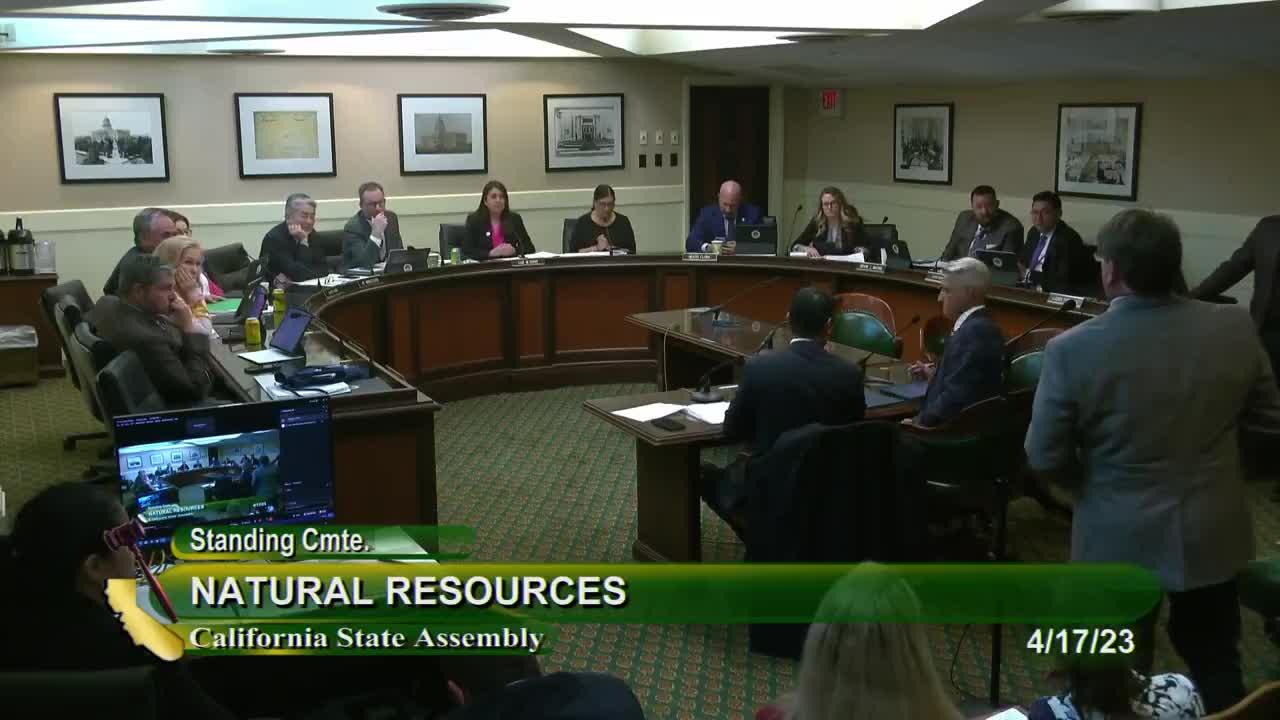
| Apr 17, 2023 | In committee: Set, first hearing. Failed passage. Reconsideration granted. |
| Apr 11, 2023 | Re-referred to Com. on NAT. RES. |
| Apr 10, 2023 | From committee chair, with author's amendments: Amend, and re-refer to Com. on NAT. RES. Read second time and amended. |
| Mar 27, 2023 | Re-referred to Com. on NAT. RES. |
| Mar 23, 2023 | From committee chair, with author's amendments: Amend, and re-refer to Com. on NAT. RES. Read second time and amended. |
| Mar 23, 2023 | Referred to Coms. on NAT. RES. and JUD. |
| Feb 18, 2023 | From printer. May be heard in committee March 20. |
| Feb 17, 2023 | Read first time. To print. |
|
Date
|
Description
|
Location
|
Votes
|
|
|---|---|---|---|---|
| Apr 17, 2023 | Do pass as amended and be re-referred to the Committee on [Judiciary] | Assembly Standing Committee on Natural Resources |
Failed |
This list shows positions taken on this bill by organizations on the date displayed, which is linked to the original source.
Positions by individuals are not included.
|
Organization
|
Position
|
Date
|
|---|---|---|
| American Beverage Association | * Against | Apr 17, 2023 |
| American Chemistry Council | * Against | Apr 17, 2023 |
| California Business Properties Association | * Against | Apr 17, 2023 |
| California Business Roundtable | * Against | Apr 17, 2023 |
| California Chamber Of Commerce | * Against | Apr 17, 2023 |
| California Hotel and Lodging Association | * Against | Apr 17, 2023 |
| California Manufacturers And Technology Association | * Against Unless Amend | Apr 17, 2023 |
| Croplife America | ** Against | |
| Household and Commercial Products Association | ** Against | |
| International Bottled Water Association | * Against | Apr 17, 2023 |
| Plastics Industry Association | ** Against | |
| Responsible Industry for A Sound Environment - Rise | ** Against | |
| Sunrise Movement | * Support | Apr 17, 2023 |
| Terranea Resort | * Support | Apr 17, 2023 |
| Unite Here Local 11 | * Support | Apr 17, 2023 |
| Western Plant Health Association | * Against Unless Amend | Apr 17, 2023 |
Date of Hearing: April 17, 2023
ASSEMBLY COMMITTEE ON NATURAL RESOURCES
Luz Rivas, Chair
ABPCA Bill Id:AB 1590 (
Author:Friedman) – As Amended Ver:April 10, 2023
SUBJECT: Major coastal resorts: coastal development permits: audits: waste
SUMMARY: Establishes environmental standards and auditing for environmental compliance and waste reduction and recycling requirements for major coastal resorts (resorts).
EXISTING LAW:
- Establishes the California Coastal Commission (Commission) to protect regional, state, and national interests in assuring the maintenance of the long-term productivity and economic vitality of coastal resources necessary for the well-being of the people of the state, and to avoid long-term costs to the public and a diminished quality of life resulting from the misuse of coastal resources, to coordinate and integrate the activities of the many agencies whose activities impact the coastal zone, and to supplement their activities in matters not properly within the jurisdiction of any existing agency. (Public Resources Code (PRC) 30004)
- Requires any person wishing to perform or undertake any development in the coastal zone, in addition to obtaining any other permit required by law from any local government or from any state, regional, or local agency, to obtain a coastal development permit. (PRC 30600)
- Pursuant to the California Environmental Quality Act (CEQA), requires lead agencies with the principal responsibility for carrying out or approving a proposed project to prepare a negative declaration, mitigated negative declaration, or environmental impact report for the action, unless the project is exempt from CEQA (CEQA includes various statutory exemptions, as well as categorical exemptions in the CEQA Guidelines). (PRC 21000, et seq.)
- Authorizes the state’s pesticide regulatory program and mandates the Department of Pesticide Regulation (DPR) to, among other things, provide for the proper, safe, and efficient use of pesticides essential for the production of food and fiber, for the protection of public health and safety, for the protection of the environment from environmentally harmful pesticides, and to assure agricultural and pest control workers safe working conditions where pesticides are present by prohibiting, regulating, or otherwise ensuring proper stewardship of those pesticides. (Food and Agriculture Code 11401 et seq.)
- Prohibits lodging establishments with more than 50 rooms from providing small plastic bottles containing personal care products to guests. Expands this prohibition to apply to lodging establishment with 50 or fewer rooms beginning January 1, 2024. (PRC 42372)
- Requires Air Resources Board (ARB) to develop a comprehensive strategy to reduce the emissions of short-lived climate pollutants (SLCP) to achieve a 40% reduction in methane emissions, 40% reduction in hydrofluorocarbon gases, and 50% reduction in anthropogenic black carbon below 2013 levels by 2030. (Health and Safety Code 39730-39730.5)
- Requires the state to reduce the disposal of (i.e., divert) organic waste by 40% from the 2014 level by 2020 and 75% by 2025 to help achieve the state’s methane reduction goal. (HSC 39730.6)
- Requires businesses that generate more than four cubic yards of waste per week (approximately one dumpster) to arrange for recycling services. Requires the business to source separate recyclable materials from solid waste and subscribe to a basic level of recycling service that includes collection, self-hauling, or other arrangements to pick up the materials, or subscribe to a recycling service that may include mixed waste processing that yields diversion results comparable to source separation. (PRC 42649.2)
- Requires businesses that generate more than four cubic yards of waste per week, as specified, to arrange for recycling services for organic waste. Requires the business to take one of the following actions:
- Source separate organic waste from other waste and subscribe to a basic level of organic waste recycling service that includes collection and recycling of organic waste;
- Recycle its organic waste or self-haul its own organic waste for recycling;
- Subscribe to an organic waste recycling service that may include mixed waste processing that specifically recycles organic waste; or
- Make other arrangements that meet specified requirements. (PRC 42649.81)
THIS BILL establishes the Major Coastal Resorts Environmental Accountability Act, which:
- States legislative findings relating to the environmental impacts of resorts and the need for additional state monitoring and oversight.
- Defines terms used in the bill:
- “Major coastal resort” as a resort or hotel that:
- Is composed of more than 250 guest rooms or suites;
- Includes or operates a golf course on the premises;
- Is located in whole or in part in the coastal zone; and,
- Is located within 100 meters of the mean high tide line of the sea or that includes is adjacent to, or is within 400 meters of any part of an environmentally sensitive area, a sensitive coastal resource area, an area otherwise protected or preserved, or the habitat of a protected species.
- “Pesticide” as a conventional pesticide with all active ingredients other than biological pesticides and antimicrobial pesticides, with conventional active ingredients generally produced synthetically, including synthetic chemicals that prevent, mitigate, destroy, or repel any pest or that act as a plant growth regulator, desiccant, defoliant, or nitrogen stabilizer, and includes insecticides, rodenticides, herbicides, fungicides, and growth regulators.
- “Organic waste” as food waste, green waste, landscape and pruning waste, nonhazardous wood waste, and food-soiled paper waste that is mixed with food waste.
- “Major coastal resort” as a resort or hotel that:
- Every two years, requires the Commission, with the assistance of a qualified consultant, as specified, to prepare an audit of each resort’s compliance with the following:
- The resort’s coastal development permit;
- Any applicable local government permit conditions that implement a certified local coastal program;
- Any applicable mitigation measures and reporting or monitoring program under CEQA relating to coastal zone resources; and,
- The recycling requirements established by this bill.
- Requires the Commission to compile and keep updated a list of consultants qualified to assist with auditing major coastal resorts’ compliance, as specified.
- Requires the Commission to provide notice to the public and invite public comment at the time it commences an audit.
- Requires the Commission to document the audit’s investigation and findings regarding a resort’s compliance in a public report posted to the Commission’s website. Requires the report to include a summary of the implementation of the resort’s turf, landscape, and pest management plan, if any, and disclosure of the types, quantity, and frequency of pesticides used.
- Requires the Commission to decide whether to pursue enforcement under the Coastal Act of any violations identified in the audit.
- Amends the Coastal Act to require that any coastal development permit pertaining to a resort approved after January 1, 2024, to include the following:
- A plan for complying with any coastal development permit conditions or mitigation measures regarding biological resources and for continued monitoring of relevant biological resources to ensure that the conditions and mitigation measures are satisfactorily protecting those resources, as specified.
- Ongoing monitoring and reporting of the resort’s stormwater discharges in the coastal zone, if any, sufficient to evaluate the contents of the discharges for pollutants or waste and ensure the quality of waters of the state is not being degraded. Requires this monitoring and reporting be in coordination with the State Water Resources Control Board.
- Verification from the resort that either:
- The resort has been issued, or is in the process of being issued, a waste discharge permit or a waiver under the Porter-Cologne Water Quality Control Act or a national pollutant discharge elimination system permit under the federal Clean Water Act; or,
- Waste discharge requirements or a national pollutant discharge elimination system permit are not required for the resort’s stormwater discharges in the coastal zone under federal or state law.
- A turf, landscape, and pest management plan that follows state-of-the-art environmental methods.
- Requires any coastal development permit for a resort in existence as of January 1, 2024, to be amended when the permit is renewed or updated to include the requirements for coastal development permits established by the bill.
- Specifies that legitimate local government costs associated with the amending or updating a coastal development permit pursuant to the bill are eligible for reimbursement by the Commission, as specified.
- Prohibits the use of any nonorganic pesticide at, or on any part of, any resort.
- Prohibits a resort, or any person acting on a resort’s behalf, from discriminating or retaliating against any employee or applicant for employment for:
- Participating in an audit, investigation, or report pursuant to the bill; or,
- Disclosing information, or because the resort believes an employee disclosed or may disclose information, to the Commission, a consultant, another government or law enforcement agency, a person with authority over the employee, a person with specified authority, the media, a nonprofit organization, or a state or local government, if the employee or applicant for employment has reasonable cause to believe that the information discloses a violation or noncompliance.
- Establishes that violations of the protections against retaliation are punishable pursuant to Labor Code 1102.5 (up to $10,000 for each violation). Additionally, establishes administrative civil penalties for violations of the protections against retaliation up to $500 per day for each violation.
- Prohibits resorts from providing single-use plastic bottled beverages, nonrecyclable single-use coffee pods, plastic straws, single-use plastic retail bags, and expanded polystyrene (EPS) products to guests.
- Requires resorts to:
- Provide at least one recycling bin or container in each guest room, and in each individual unit of other lodging. Requires the bin or container to be in the same area as trash receptacles, be visible and easily accessible, and be clearly marked;
- Source separate recyclable materials, organic waste, and other solid waste;
- Subscribe to a recycling service that includes collection and recycling of the recyclable materials, and subscribe to either an organic recycling service or recycle the organic waste on site; and,
- Maintain records of its operations to comply with the waste handling requirements for three years.
- Establishes penalties for violations of the waste management requirements of civil penalties up to $500 for each day a violation occurs. Authorizes the Attorney General, district attorney, county counsel, or city attorney to bring an action under this provision.
- Specifies that if the bill contains costs mandated by the state, reimbursement shall be made pursuant to Part 7 of Title 2 of the Government Code.
FISCAL EFFECT: Unknown
COMMENTS:
- Author’s statement:
Major coastal resorts—each of which, as defined in AB 1590, hosts tens of thousands of guests a year and has a substantial land use footprint, including a golf course—can have significant environmental impacts on our sensitive coasts, including potential impacts to wildlife, ecosystems, and water quality.
There are concerns that, to the extent major coastal resorts discharge stormwater to the ocean or beach, they lack sufficient ongoing monitoring to ensure nearby water quality is not being degraded. Major coastal resorts are likely to employ large volumes of pesticides and fertilizers, but such usage generally is not publicly disclosed, and there are concerns that some resorts lack requirements to apply up-to-date pest management strategies. There are also concerns that some major coastal resorts engage in high-volume use of single-use plastics and other unsustainable materials, which may not always be properly recycled, and that the fugitive release of these plastic materials can impact proximate coastal resources.
- California Coastal Commission. California Coastal Commission was established in 1972 by Proposition 20 to make land use decisions in the coastal zone, while additional planning occurred. In 1976, the Legislature passed the Coastal Act (Act), which codified the Commission and granted it with broad authority to regulate coastal development. The Act guides how the land along the coast of California is developed, or protected from development. The Act emphasizes the importance public access the coast, and the preservation of sensitive coastal and marine habitat and biodiversity. Development is limited to preserve open space and coastal agricultural lands. The Act calls for orderly, balanced development, consistent with state coastal priorities and taking into account the rights of property owners.
The coastal zone extends three miles seaward, including offshore islands. The inland boundary varies depending on land uses and habitat values, but generally extends inland 1,000 yards from the mean high tide line of the sea, but is wider in areas with significant estuarine, habitat, and recreational values, and narrower in developed urban areas.
The Commission’s enforcement authority was expanded by SB 433 (Allen), Chapter 643, Statutes of 2021, to authorize the Commission to issue administrative civil penalties for all violations of the Act. Penalties for violations range from $500 per day to $15,000 per day, depending on the type and severity of the violation. While the Commission has expanded enforcement authority, it is facing a significant backlog of violations. As of last September, the backlog was around 3,000 cases. The 2022-23 Budget included $5 million to help the Commission address the backlog, and additional enforcement actions are taking place.
- Pesticides. Pesticide use in California is controlled by federal, state, and local governmental entities. The United States Environmental Protection Agency sets minimum pesticide use standards and delegates pesticide enforcement regulatory authority to the states. State law designates DPR as the agency responsible for delivering an effective statewide pesticide regulatory program in California. The Legislature has also delegated local pesticide use enforcement to County Agricultural Commissioners (CACs). DPR works in partnership with the CACs by planning and developing adequate county programs; evaluating the effectiveness of the local programs; and, ensuring that corrective actions are taken in areas needing improvement. CACs enforce state pesticide laws and regulations in agricultural, structural, and nonagricultural use settings in all 58 counties.
- Waste disposal in California. More than 40 million tons of waste are disposed of in California’s landfills annually, of which 28.4% is organic materials, 13% is plastic, and 15.5% is paper. The Department of Resources Recycling and Recovery (CalRecycle) is charged with diverting at least 75% of solid waste from landfills statewide by 2020. Local governments have been required to divert 50% of the waste generated within the jurisdiction from landfill disposal since 2000. AB 341 (Chesbro), Chapter 476, Statutes of 2011, requires commercial waste generators, including multi-family dwellings, to arrange for recycling services for the material they generate and requires local governments to implement commercial solid waste recycling programs designed to divert solid waste generated by businesses out of the landfill. A follow up bill, AB 1826 (Chesbro), Chapter 727, Statutes of 2014, requires generators of organic waste (i.e., food waste and yard waste) to arrange for recycling services for that material to keep it out of the landfill.
SB 1383 (Lara), Chapter 395, Statutes of 2016, requires ARB to approve and implement a comprehensive SLCP strategy to achieve, from 2013 levels, a 40% reduction in methane, a 40% reduction in hydrofluorocarbon gases, and a 50% reduction in anthropogenic black carbon, by 2030. In order to accomplish these goals, the bill specified that the methane emission reduction goals include targets to reduce the landfill disposal of organic waste 50% by 2020 and 75% by 2025 from the 2014 level.
AB 1162 (Kalra), Chapter 687, Statutes of 2019, prohibits lodging establishments from distributing personal care products to guests in small plastic bottles. The bill’s requirements are phasing in, applying to lodging establishments with more than 50 rooms on January 1 of this year, and expanding to include smaller lodging establishments beginning January 1, 2024.
- This bill. This bill establishes a broad range of environmental requirements and review for resorts. The author states that this bill applies to six resorts in California: the Terranea Resort in Rancho Palos Verdes, the Paradise Point Resort and Spa in San Diego, the Park Hyatt Aviara Resort, Golf Club and Spa, the Hyatt Regency Newport Beach, the Ritz Carlton Bacara in Santa Barbara, and the Waldorf Astoria Monarch Beach in Dana Point. According to the sponsor, Unite Here Local 11, there are environmental conditions and mitigation measures for resorts in their coastal development permits and CEQA documents, but there is a need for coordinated and focused oversight to ensure compliance with those requirements.
This bill requires a biannual audit, conducted by a contract auditor selected from a list of approved auditors developed by the Commission, of whether or not the resorts are complying with coastal development permits, certified local coastal program permit conditions, mitigation measures and reporting or monitoring programs required by CEQA, and specified waste reduction and recycling requirements. Additionally, this bill establishes new requirements for new and renewed coastal development permits, including a plan for complying with conditions or mitigation measures regarding biological resources, monitoring of stormwater discharges, permit verifications, and turf, landscape, and pest management plans. This bill also establishes whistleblower protections for resort employees who participate in enforcement actions or disclose information regarding a potential violation or noncompliance by the resort.
Additionally, this bill prohibits resorts from distributing beverages in plastic bottles, coffee pods, plastic straws, plastic bags, and EPS products to guests and requires recycling receptacles to be located in guest rooms. The bill requires resorts to source separate and recycle recyclable materials and organic waste.
The sponsors indicate that this bill is intended to address environmental violations like those described in the report, How Green is Terranea? Examining Terranea Resort’s Record on the Environment. According to the report, Terranea’s operations have resulted in negative impacts to wildlife; significant pesticide use, including those that are toxic to aquatic life; the disposal of recyclable materials with solid waste; and, impacts to water quality, including high fecal coliform levels. This bill is intended to identify issues such as those listed above so enforcement actions can be taken and prevent future violations.
- Suggested amendments. The committee may wish to amend the bill to:
- Clarify that the prohibition on pesticides applies to those defined by the bill and nonorganic fertilizers.
- Allow pesticides, except rodenticides, to be used for incidental and limited use for building maintenance purposes if there are no reasonable alternatives.
- Clarify that the recycling and organic waste service requirements are consistent with the existing requirements established by AB 1826 and AB 341.
- Double referral. Should the committee approve this bill, it will be referred to the Assembly Judiciary Committee.
REGISTERED SUPPORT / OPPOSITION:
Support
Unite Here Local 11
Opposition
American Chemistry Council
California Hotel & Lodging Association
California Manufacturers & Technology Association
CropLife America
Household and Commercial Products Association
Plastics Industry Association
Responsible Industry for A Sound Environment - Rise
Western Plant Health Association
Analysis Prepared by: Elizabeth MacMillan / NAT. RES. /
Discussed in Hearing
 19MIN
Assembly Standing Committee on Natural Resources
Bill Author

Bill Co-Author(s):