AB 2328: Classified employees: school and community college districts: merit system: disciplinary action.
- Session Year: 2023-2024
- House: Assembly
- Latest Version Date: 2024-02-12
Current Status:
Failed
(2024-04-23: In committee: Set, second hearing. Hearing canceled at the request of author.)
Introduced
In Committee
First Chamber
In Committee
Second Chamber
Enacted
Existing law requires the governing board of a school district to employ persons for positions not requiring certification qualifications and the governing board of a community college district to employ persons for positions that are not academic positions. Existing law requires the governing board of a school district or community college district to classify those employees and positions and requires that they be known as the classified service.
Existing law authorizes a school district or a community college district to adopt a merit system that establishes how to employ, pay, and otherwise control the services of classified employees of the school district or community college district. In a school district or community college district that has adopted a merit system, existing law prohibits a person in the permanent classified service from being demoted or removed except for reasonable cause designated by rule of the personnel commission, as provided. Under existing law, any person who willfully or through culpable negligence violates any of the provisions applicable to merit school districts or community college districts is guilty of a misdemeanor.
In a school district or community college district that has not adopted the merit system, existing law prohibits disciplinary action for being taken against a classified employee for any cause that arose before the employee became permanent, or for any cause that arose more than 2 years preceding the date of the filing of the notice of cause, unless the cause was concealed or not disclosed by the employee when it could be reasonably assumed that the employee should have disclosed the facts to the employing district.
In a school district or community college district that has adopted the merit system, this bill would similarly prohibit disciplinary action from being taken against a member of the permanent classified service for any cause that arose before the employee became a member of the permanent classified service, or for any cause that arose more than 2 years preceding the date of the filing of the notice of cause, unless the cause was concealed or not disclosed by the employee when it could be reasonably assumed that the employee should have disclosed the facts to the employing school district. Because a violation of the bill would be a crime, the bill would impose a state-mandated local program.
The California Constitution requires the state to reimburse local agencies and school districts for certain costs mandated by the state. Statutory provisions establish procedures for making that reimbursement.
This bill would provide that no reimbursement is required by this act for a specified reason.
(a)No person in the permanent classified service shall be demoted or removed except for reasonable cause designated by rule of the commission as detrimental to the efficiency of the service. This section shall not be construed to prevent layoffs for lack of work or lack of funds.
(b)Disciplinary action shall not be taken for any cause that arose before the employee became a member of the permanent classified service, nor for any cause that arose more than two years preceding the date of the filing of the notice of cause unless the cause was concealed or not disclosed by the employee when it could be reasonably assumed that the employee should have disclosed the facts to the employing school district.
(c)For purposes of this section, disciplinary action has the same meaning as that term is defined in subdivision (e) of Section 45101.
SEC. 2.Section 88121 of the Education Code is amended to read:88121.(a)No person in the permanent classified service shall be demoted or removed except for reasonable cause designated by rule of the commission as detrimental to the efficiency of the service. This section shall not be construed to prevent layoffs for lack of work or lack of funds.
(b)Disciplinary action shall not be taken for any cause that arose before the employee became a member of the permanent classified service, or for any cause that arose more than two years preceding the date of the filing of the notice of cause, unless the cause was concealed or not disclosed by the employee when it could be reasonably assumed that the employee should have disclosed the facts to the employing district.
(c)For purposes of this section, disciplinary action has the same meaning as that term is defined in subdivision (e) of Section 88001.
SEC. 3.No reimbursement is required by this act pursuant to Section 6 of Article XIIIB of the California Constitution because the only costs that may be incurred by a local agency or school district will be incurred because this act creates a new crime or infraction, eliminates a crime or infraction, or changes the penalty for a crime or infraction, within the meaning of Section 17556 of the Government Code, or changes the definition of a crime within the meaning of Section 6 of Article XIIIB of the California Constitution.
|
Date
|
Status
|
|---|---|
| Apr 23, 2024 | In committee: Set, second hearing. Hearing canceled at the request of author. |
| Apr 16, 2024 | In committee: Set, first hearing. Hearing canceled at the request of author. |
| Apr 3, 2024 | From committee: Do pass and re-refer to Com. on HIGHER ED. (Ayes 5. Noes 0.) (April 3). Re-referred to Com. on HIGHER ED. |
| Mar 4, 2024 | Referred to Coms. on P.E. & R. and HIGHER ED. |
| Feb 13, 2024 | From printer. May be heard in committee March 14. |
| Feb 12, 2024 | Read first time. To print. |
|
Date
|
Description
|
Location
|
Votes
|
|
|---|---|---|---|---|
| Apr 3, 2024 | Do pass and be re-referred to the Committee on [Higher Education] | Assembly Standing Committee on Public Employment and Retirement |
Passed |
This list shows positions taken on this bill by organizations on the date displayed, which is linked to the original source.
Positions by individuals are not included.
|
Organization
|
Position
|
Date
|
|---|---|---|
| California Federation of Teachers, AFL-CIO | ** Support | |
| California Labor Federation, Afl-Cio | ** Support | |
| California School Employees Association | ** Support | |
| California School Employees Association, AFL-CIO | ** Support | |
| California State Council of Service Employees International Union | ** Support |
Date of Hearing: April 23, 2024
ASSEMBLY COMMITTEE ON HIGHER EDUCATION
Mike Fong, Chair
ABPCA Bill Id:AB 2328 (
Author:Mike Fong) – As Introduced Ver:February 12, 2024
SUBJECT: Classified employees: school and community college districts: merit system: disciplinary action
SUMMARY: Prohibits a K-12 and community college district with a merit system from taking disciplinary action against a permanent employee under specified conditions. Specifically, this bill:
- Prohibits a K-12 district with a merit system from taking disciplinary action for any cause if any of the following occurred:
- The cause transpired before the employee became a member of the permanent classified service; or,
- The cause occurred two years before the date of the filing of the notice of cause unless the cause was concealed or not disclosed by the employee when it could be reasonably assumed that the employee should have disclosed the facts to the employing school district.
- Prohibits a community college district with a merit system from taking disciplinary action for any cause if any of the following occurred:
- The cause transpired before the employee became a member of the permanent classified service; or,
- The cause occurred two years before the date of the filing of the notice of cause unless the cause was concealed or not disclosed by the employee when it could be reasonably assumed that the employee should have disclosed the facts to the employing community college district.
- Defines “disciplinary action” to mean any action where an employee is deprived of any classification or any incident of any classification in which the employee has permanence including dismissal, suspension, demotion, or any reassignment without his voluntary consent, except layoff or lack of work or lack of funds.
EXISTING LAW: State law pertaining to community college districts.
- Establishes the California Community Colleges (CCC) under the administration of the Board of Governors of the CCC, as one of the segments of public postsecondary education in this state. The CCC shall be comprised of community college districts (Education Code (EDC) Section 70900).
- Establishes that CCC districts are under the control of a board of trustees, known as the governing board, who has the authority to establish, maintain, operate, and govern one or more community colleges, within its district as specified (EDC Section 70902).
- For non-merit districts: Establishes the procedures and disciplinary proceedings for classified staff in non-merit community college districts. Disciplinary action may not be taken for cause if the cause arose two years prior to the date of the filing notice unless the cause was concealed or not disclosed by the employee when it could be reasonably assumed that the cause should have been disclosed. Specifies, the governing board of a community college district will adopt procedures for disciplinary proceedings that contain a provision for informing the employee by written notice of the specific charges, the employee’s right to a hearing, and the timeframe an employee has to request a hearing (must be at a minimum five days after the notice is received by the employee of the disciplinary action). Permits the governing board of a community college district to delegate authority as to whether there is sufficient cause for disciplinary action to an impartial third-party hearing officer (pursuant to the classified employee’s collective bargaining agreement), but the governing board will retain authority to review the determination under specific circumstances, as defined. Prohibits the suspension, demotion, or dismissal of an employee, who has requested a hearing, unless the governing board of the community college district or the third-party impartial hearing officer have determined the employee engaged in either criminal misconduct, misconduct that presents a risk of harm to pupils, staff, or property, or committed habitual violations of the district’s policies or regulations. Stipulates if a hearing is conducted by a third-party hearing officer the district will stop paying the employee after 30 calendar days from the date the hearing is requested. Clarifies the above appeal procedures only apply to non-merit community college districts (EDC Section 88013).
- For merit-system districts: A permanent classified employee in a merit system CCC district will not be demoted or removed except for reasonable cause as determined by the personnel commission of the CCC district as detrimental to the efficiency of the service. The section will not be construed to prevent layoffs for the lack of work or lack of funds (EDC Section 88121).
State law pertaining to K-12 districts.
- For non-merit districts: Establishes the procedures by which a non-merit K-12 school district may provide a disciplinary action for a classified employee. Disciplinary action may only be taken for any cause that arose after the employee became permanent. Disciplinary action may not be taken for cause if the cause arose two years prior to the date of the filing notice unless the cause was concealed or not disclosed by the employee when it could be reasonably assumed that the cause should have been disclosed. Specifically stipulates, a school district must adopt rules and procedures for disciplinary proceedings that include providing the employee a written notification of the specific charges against the employee, information on the employee’s right to a hearing, and how the employee can request a hearing including a requirement that the district must be notified at least five days after the service of notice to the employee. The burden of proof will remain with the governing board of the school district. Authorizes the governing board of the school district or a third-party impartial hearing officer to determine whether there is sufficient cause for the disciplinary action. If the school district elects to use an impartial hearing officer, the governing board of the school district will retain the ability to review the determination, as defined. Prohibits the suspension, demotion, or dismissal of an employee, who has requested a hearing, unless the governing board of the K-12 district or the third-party impartial hearing officer have determined the employee engaged in either criminal misconduct, misconduct that presents a risk of harm to pupils, staff, or property, or committed habitual violations of the district’s policies or regulations. For specific disciplinary actions involving allegations of egregious misconduct and conduct involving a minor, the governing board of a district will delegate its authority to a judge and the judge’s rule in the disciplinary matter will be binding for all parties. Clarifies the above appeal procedures only apply to non-merit K-12 districts. (EDC Section 45113).
- For merit-system districts: A permanent classified employee in a merit system K-12 district will not be demoted or removed except for reasonable cause as determined by the personnel commission of the K-12 district as detrimental to the efficiency of the service. The section will not be construed to prevent layoffs for the lack of work or lack of funds (EDC Section 45302).
FISCAL EFFECT: Unknown
COMMENTS: Double referred. This measure was heard by the Assembly Pubic Employment and Retirement Committee on April 03, 2024, where it passed with a vote of 5 – 0. A review on the issues germane to the public employment and retirement is addressed in the Committee’s analysis.
What the measure will do. According to the author, “AB 2328 will bring parity to classified employees of merit and non-merit K-12 and community college districts in matters of employee discipline. It gives employees in merit districts the same protections that employees in non-merit districts have: protection from discipline due to conduct prior to permanent employment and in the prior two years. While it brings merit employees greater protection, it allows discipline in cases where a prior offense should have reasonably been disclosed. Classified employees deserve equal protections regardless of whether they work in a merit or non-merit district.”
Currently, permanent classified staff in non-merit districts have protections against disciplinary notifications or actions by the district for causes that either:
- Occurred prior to the classified staffer becoming a permanent employee; or,
- If the cause or reason occurred two years prior to the filing notice for the disciplinary action.
The only exclusion to the above would be incidents or causes that were concealed or not disclosed by the employee when it could be reasonably assumed the employee would have disclosed the information.
Permanent classified staff in merit districts do not have this protection and can be disciplined if the personnel commission determines the cause (for the discipline) was necessary to maintain the efficiency of service to the community college district.
This measure would provide parity for classified staff in merit and non-merit K-12 and community districts as to the circumstances that must be pre-determined before an employee can be disciplined for cause.
Personnel commission and merit system. A personnel commission is an independent board separate from the governing board and the leadership of a college within a district. The purpose of the personnel commission is to maintain a “merit system” for the classified employees of the district and to oversee the work of the executive director and personnel commission staff. The personnel commission’s main directive is to ensure fair and objective treatment of all applicants and employees.
Established in Education Code Section 88060 through 88139, a personnel commission is comprised of three to five citizens who are appointed into staggering terms to oversee the work of the personnel commission staff. In some K-12 and community college districts the personnel commission staff are the human resources staff of either the district or a campus within the district. However, that is not always the case, and for many the personnel commission staff are independent positions separate from the district. If the classified staff elect to have a merit system, the personnel commission is established to oversee and enforce the merit system.
A merit system is a set of rules and procedures to ensure the selection, promotion, and retention of classified staff is conducted in a manner without favoritism or prejudice.
A personnel commission provides oversight to ensure a community college district is hiring, placing, and retaining classified staff in a fair and equitable manner. As part of its role, the personnel commission is tasked with classifying and reclassifying positions and serve as an appeal body for disciplined classified staff.
According to the California School Personnel Commission Association as of 2024, there are only six community college districts with personnel commissions and merit system: Grossmont-Cuyamaca Community College District, Los Angeles Community College District, State Center Community College District, Ventura Community College District, Compton Community College District, and Long Beach Community College District.
Disciplinary process for classified staff. In merit districts, the personnel commission adopt a set of rules regarding the definition of reasonable cause according to Education Code Section 88121 and can provide a notice of disciplinary sanction. A classified employee regardless of whether they are employed by a merit or non-merit district, is still afforded due process rights under Skelly v. State Personnel Board (1975) 15 Cal.3d 194. In Skelly v. State Personnel Board (1975), the Supreme Court ruled public employees are afforded certain procedural safeguards before discipline is imposed against them in order to ensure due process. Specifically, a public employer must provide notice of the disciplinary action proposed to be taken, provide a statement detailing the reason for the disciplinary action, provide a copy of the charges and materials that determined the action, and then provide the employee time to respond to the authority imposing the disciplinary action. This procedure created the function of a “Skelly” officer whose role is to provide an objective review of the proposed discipline and the employee’s response. The officer will then make a judgement or recommendation as to whether the disciplinary action should be sustained, modified, or rejected. AB 2328 (M. Fong) would place a statute of limitations on when a disciplinary action may or may not occur for classified employees in merit districts.
Effectively, AB 2328 (M. Fong) would introduce two separate statute of limitations for permanent employees in merit districts:
- If the reason for the disciplinary action occurred when the employee was a probationary employee (6 months or 130 days of paid service) prior to their permanent status; or
- If the cause occurred two years prior to the disciplinary notification.
The only exceptions are if the “cause” was concealed or if the employee should have disclosed the information to the district. Therefore, the Skelly Officer in presenting the “charges packet” to the classified employee would only be for any incidents occurring in the past two years. Meaning if the employee had past altercations or offenses with the district, they could not be listed as reasons for the disciplinary action if the “altercations or offenses” were older than two years.
Arguments in support. As depicted by Service Employees International Union of California, “Current law already protects classified employees in non-merit school and community college districts from being disciplined for conduct that occurred while the employee was on probation or conduct that occurred more than two years ago. This is an important protection for classified school employees—an employer with a valid cause of action ought to pursue it in a timely manner to ensure a fair discipline process. By the time a disciplinary charge older than two years is issued, an employee may have lost the evidence necessary to disprove the charge. Further, disciplining an employee for conduct that occurred while the employee was on probation is counter to the very purpose of a probationary period—that is, to evaluate employee performance and conduct during a set timeframe and either retain the employee or release them from probation. SEIU represents classified staff at some of the most populous school districts, including the state’s largest merit district. Merit districts comprise a small percentage of all districts, which means that the majority of school districts already operate under the framework that this bill proposes to apply to merit districts. Classified employees in merit districts deserve parity in these basic disciplinary protections.”
Assembly Committee on Education comments. AB 2328 (M. Fong) includes amendments to provisions contained within the jurisdiction of the Assembly Committee on Education. The bill would provide parity in the disciplinary procedures for classified staff who work for non-merit or merit K-12 districts in the same manner it provides parity for classified staff who work for non-merit or merit community colleges. According to the Assembly Education Committee, this bill expands existing law in a way that is inconsistent with similar laws pertaining to certificated employees. Existing law for certificated employees prohibits the expunging of personnel files containing credible complaints of, substantiated investigations into, or discipline for egregious misconduct. Egregious misconduct includes sexual misconduct as well as misconduct involving drugs and violent acts.
This bill would authorize the expunging of all personnel files for classified employees every two years by stating, “disciplinary action shall not be taken for any cause that arose more than two years preceding the date of the filing of the notice of cause.”
Committee comments. In fall 2023, the California Community Colleges employed 29,168 employees who were classified staff (Chancellor’s Office, DataMart, Staff Demographics). Of the various employee classifications, classified staff were the most diverse. Providing additional protections for all classified staff is an equity issue, and AB 2328 (M. Fong) accomplishes this by providing classified staff with equal protections regardless of whether the community college they work for is merit or non-merit.
Technically, this measure provides a statute of limitations that is beyond the current limitations for the filing of sexual harassment complaints. In 2022, the Board of Governors of the CCC adopted regulations that would require all sexual harassment complaints to be filed within one year of the incident, AB 2328 (M. Fong) would extend the statute of limitations for some sexual harassment cases to two years.
REGISTERED SUPPORT / OPPOSITION:
Support
California Federation of Teachers, AFL-CIO
California Labor Federation, AFL-CIO
California School Employees Association
California School Employees Association, AFL-CIO
California State Council of Service Employees International Union
California State Council of Service Employees International Union (SEIU California)
Opposition
None on file.
Analysis Prepared by: Ellen Cesaretti-Monroy / HIGHER ED. / (916) 319-3960
Date of Hearing: April 3, 2024
ASSEMBLY COMMITTEE ON PUBLIC EMPLOYMENT AND RETIREMENT
Tina S. McKinnor, Chair
ABPCA Bill Id:AB 2328 (
Author:Mike Fong) – As Introduced Ver:February 12, 2024
SUBJECT: Classified employees: school and community college districts: merit system: disciplinary action
SUMMARY: Amends existing law relating to discipline of classified employees of school and community college districts that have adopted the merit system. Specifically, this bill:
- Prohibits disciplinary action from being taken for any cause that arose before the employee became permanent in the classified service, nor for any cause that arose more than two years before the date of filing the notice of cause unless the cause was concealed or not disclosed by the employee when it reasonably could be assumed that the employee should have disclosed the facts to the employing school or community college district.
- Incorporates by reference, the definition of “disciplinary action” under existing law.[1]
EXISTING LAW:
- Requires the governing board of school and community college districts to employ individuals not requiring certification qualifications or not in academic positions; to classify all of these employees and positions; and, that such positions be known as the classified service.[2]
- Authorizes school and community college districts to adopt a merit system that establishes the power of the governing board to employ, pay, and control the services of classified employees.[3]
- Prohibits a school or community college district that has adopted the merit system from demoting or removing a permanent classified employee, except for reasonable cause designated by rule of the personnel commission, but does not prevent layoffs for lack of work or funds.[4]
- Provides that any person who willfully or through culpable negligence violates provisions applicable to merit school or community college districts is guilty of a misdemeanor, as prescribed.[5]
- Prohibits a school or community college district that has not adopted the merit system from taking disciplinary action against a permanent classified school employee for cause that arose before the employee’s becoming permanent, nor for cause that arose more than two years before the date of filing of the notice of cause, unless the cause was concealed or not disclosed by the employee when it reasonably could be assumed that the employee should have disclosed the facts to the employing school district.[6]
FISCAL EFFECT: Unknown. This bill is flagged as fiscal by Legislative Counsel.
COMMENTS:
- Dual Referral
The committee is informed that this bill also is referred to the Assembly Committee on Higher Education.
- Brief History of the Establishment of Merit Systems in California Public Schools
“Merit systems,” also commonly referred to as district “civil service systems” relating to public education in California are independent of the school or community college district’s governing board where the Personnel Commission of a “merit system” district is responsible for administering the hiring and retention of classified school employees through a statutory framework pursuant to the Educ. Code. In California, there approximately 100 of these systems that currently exist.
Merit systems derive from the late 19th and early 20th century civil service movement that sought to curtail the “spoils” resulting from political patronage in the system whereby elected political candidates rewarded their supporters with government positions. These systems arose out of a particularly egregious school board decision to discharge over 700 classified employees in the 1930s upon the new board’s election.
This history strongly suggests that the Legislature intended the merit system framework as a means to protect classified employees from local political mistreatment at a time prior to public sector collective bargaining, and in which such systems continue to presently exist.
Generally, in the public education employment arena, districts that have not formally adopted the merit system are referred to as “nonmerit” districts. For such districts, employee disciplinary and termination matters are not addressed by a personnel commission.
- This Bill
This bill proposes to mirror existing law provisions applicable to nonmerit school and community college districts, and similarly make them applicable to merit school and community districts.
- Author Statement
“[This bill] will bring parity to classified employees of merit and non-merit K-12 and community college districts in matters of employee discipline. It gives employees in merit districts the same protections that employees in non-merit districts have: protection from discipline due to conduct prior to permanent employment and in the prior two years. While it brings merit employees greater protection, it allows discipline in cases where a prior offense should have reasonably been disclosed. Classified employees deserve equal protections regardless of whether they work in a merit or non-merit district.”
- Comments by Supporters
Among other things, generally, supporters state that, “[t]he majority of school districts already operate under the framework that this bill proposes to extend to merit districts. Classified employees in merit districts deserve parity in these basic disciplinary protections. [This bill] will ensure that all classified employees operate under the same set of rules when it comes to discipline.”
- Comments by Opponents
None on file.
- Prior or Related Legislation
Chapter 331, Statutes of 2023 (Assembly Bill 472, Wicks) requires nonmerit school and community college districts to pay a classified employee their full compensation upon returning to service for the district from a period of involuntary leave of absence following a finding in favor of the employee for charges of a criminal offense, a criminal investigation or job-related administrative determinations.
Chapter 913, Statutes of 2022 (Assembly Bill 2413, Carrillo) subject to certain specified exceptions, prohibits the suspension, demotion, or dismissal without pay of a permanent classified employee employed by a school district or community college district who timely requests a hearing on charges against the employee and before a decision is rendered on the matter, among other provisions.
Chapter 844, Statutes of 2001 (Assembly Bill 365, Nation) provides, among other provisions, that classified employees in districts that have not adopted the merit system to be able to return to their previous classification if they fail to pass probation in a new position.
Chapter 839, Statutes of 2001 (Assembly Bill 128, Goldberg) authorized districts that have not adopted the merit system to submit employee disciplinary cases to an impartial third party hearing officer.
REGISTERED SUPPORT / OPPOSITION:
Support
California School Employees Association, AFL-CIO (Sponsor)
California Federation of Teachers, AFL-CIO
California Labor Federation, AFL-CIO
California State Council of the Service Employees International Union
Opposition
None on file.
Analysis Prepared by: Michael Bolden / P. E. & R. / (916) 319-3957
Sections 45101 (e) and 88001 (e) of the Educ. Code are incorporated in this bill by reference. These sections expressly provide that “disciplinary action” includes any action where an employee is deprived of any classification or incident of classification in which the employee is permanent, including dismissal, suspension, demotion, or reassignment, without their voluntary consent, except a layoff of lack of work or funds. ↑
Sections 45103 et seq. and 88003 et seq. of the Educ. Code, respectively. ↑
Sections 45241et seq., and 88050 et seq. of the Educ. Code, respectively. ↑
Sections 45302, 45303, 88121, and 88122 of the Educ. Code, respectively. ↑
Sections 45137 and 88136 of the Educ. Code, respectively. ↑
Sections 45113 (d) and 88013 (d) of the Educ. Code, respectively. ↑
Discussed in Hearing
 5MIN
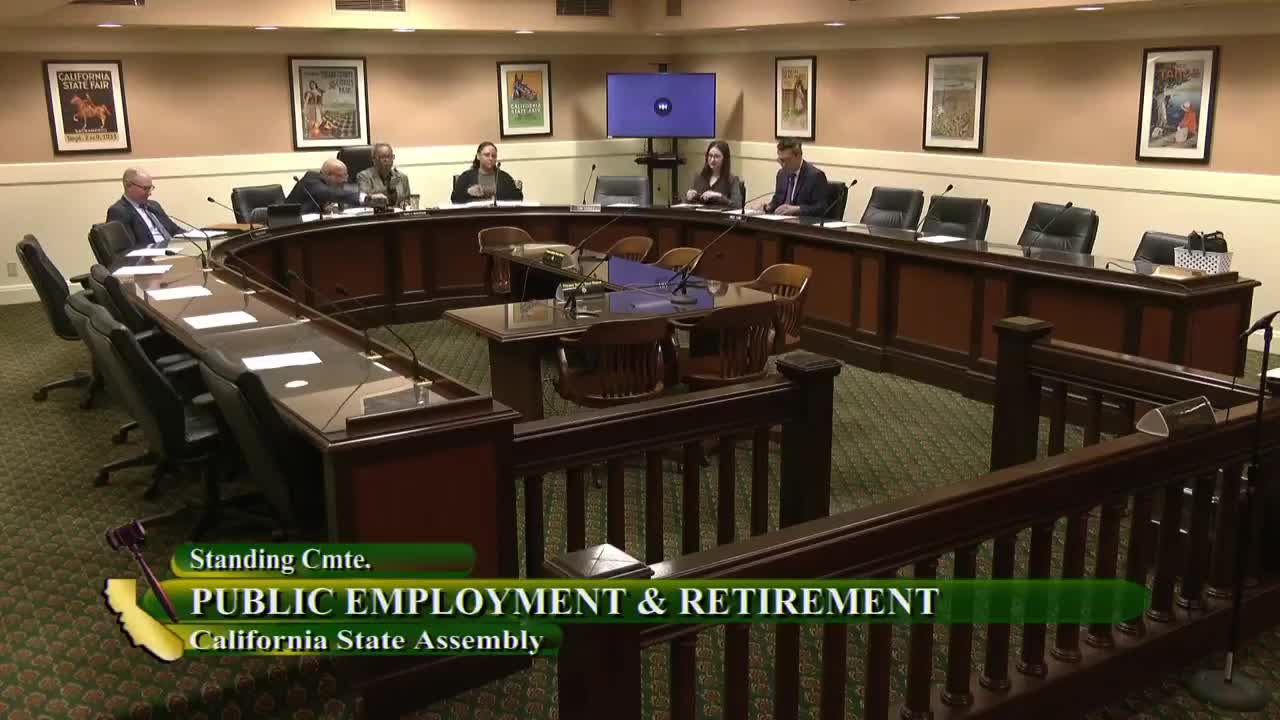
Assembly Standing Committee on Public Employment and Retirement
Bill Author

Bill Co-Author(s):